Get in touch with NEXO Beauty Labs Company

Contact Form 使用中
OPTIONAL DETAILS Company Information

EU Cosmetics Contract Manufacturer for Europe

NEXO Beauty Labs works as an EU cosmetics contract manufacturer from a single production site in China, taking on skincare, hair care and body care for brands selling into the European Union either as OEM cosmetic manufacturing from your own formula or as ODM development from our ready formula library. Your Responsible Person owns the regulatory filing for the EU market, and we supply the manufacturing-side records that filing depends on. Send us a brief and we will tell you whether the formula direction is workable before you pay for a sample.

  • First samples in 3 working days
  • Production in 10–15 working days after approvals
  • 10,000 units standard minimum per SKU
  • Send a brief, a reference product or your own formula
Request a Manufacturing Quote
EU Manufacturing Sample

See Minimums, Lead Times and Terms

Before you share anything, we sign an NDA covering concepts, formulations and confidential business requirements.

Standard minimum order 10,000 units per SKU
First samples 3 working days from confirmed requirements
International sample delivery 5–7 working days by destination
Mass production 10–15 working days after approvals
Quotation response 2 business days
Ready formula library 5,000+ market-ready formula solutions

OEM, ODM and Turnkey Cosmetic Manufacturing

Three contract manufacturing routes cover almost every brief that reaches us, and the route you pick sets how much formulation work sits on your side. All three end in a finished product filled, packed and documented for export, backed by our full service range.

Pick a direction from 5,000+ market-ready formula solutions and we tailor texture, fragrance, active level and claim support to your brand.

OEM ODM and Turnkey Cosmetic Manufacturing

Skincare, hair care and body care all run on in-house lines. Two formats sit outside what a general private label cosmetic manufacturer handles.

Plant-based capsule

Single-dose plant-based capsules for serums and high-active treatments, produced on a dedicated line. Three in-house formulation technologies support this format: Plant-Based Capsule Freshness-Lock, Active Ingredient Sustained-Release and Liposomal Encapsulation.

Sunscreen for the EU market

Sun care runs on its own line with its own regulatory boundary. See sunscreen manufacturing for the format detail.

EU sun care is not a subset of the general process. Under Regulation (EC) No 1223/2009 a UV filter is permitted only if it appears in the Annex VI list, and that list does not match the US or Australian one. Ingredients in nanomaterial form must be marked [nano] in the ingredient list, and certain nanomaterials trigger the separate Article 16 notification route alongside ordinary CPNP notification.

Your target market list decides the filter system, and we select it against that list.

Ingredient and particle-form information for your filing comes with it.

Private Label and OEM Product Categories

Every category below starts either from the ready formula library or from a formula you supply, and all of them are filled on in-house lines rather than brokered out to a third party. Sampling begins once the brief and the sample fee are confirmed.

Private Label and OEM Product Categories
  • Facial cleansers

    What drives the formula Surfactant balance drives both foam and after-feel
    Common formats Gel, cream, foam, cleansing oil, micellar water
    Starting route ODM from library, or OEM from your formula
  • Creams, lotions and masks

    What drives the formula Emulsion stability sets both shelf life and sensory result
    Common formats Cream, lotion, gel-cream, sheet mask, wash-off mask
    Starting route ODM is fastest, since the library covers most texture targets
  • Serums and ampoules

    What drives the formula Active level and carrier system decide claim support
    Common formats Dropper serum, ampoule, single-dose plant-based capsule
    Starting route ODM for capsule formats, with the active concentration confirmed in writing before sampling
  • Sunscreen

    What drives the formula The filter system must come from the Annex VI permitted list
    Common formats Lotion, fluid, stick, spray, tinted base
    Starting route ODM, so the filter system starts from a compliant base and your target markets are confirmed first
  • Body care

    What drives the formula Large fill volumes make packaging cost a real design input
    Common formats Body lotion, body wash, scrub, butter, hand cream
    Starting route ODM from library, or OEM from your formula
  • Shampoo and hair care

    What drives the formula Rinse-off performance is judged on wet and dry feel together
    Common formats Shampoo, conditioner, mask, leave-in, scalp treatment
    Starting route ODM from library, or OEM from your formula
  • Something not listed

    What drives the formula A high-quality brief beats a category label
    Common formats Tell us the reference product and the price position
    Starting route Feasibility answered before you commit to sampling

Packaging, Filling and Labelling

Packaging decisions move faster when both sides know who owns which task. The split below is how we run it as standard.

  • Filling, capping and sealing of bulk into your chosen primary pack
  • Assembly, cartoning and shipper packing
  • Label application and finished-pack inspection
  • Batch coding on pack
  • Packaging component selection against your brand and budget
  • Custom packaging development where a stock component does not fit
  • Packaging procurement and supplier coordination
  • Third-party testing coordination

Decoration options include silk-screen printing, hot stamping, labels, sleeves and secondary cartons, quoted with the component itself rather than as a separate line.

Packaging, Filling and Labelling facility

What Your Label Must Carry for the EU

An EU label is a regulatory output, not only a print job. Article 19 of Regulation (EC) No 1223/2009 requires the container and outer packaging to carry:

  • The name and address of the Responsible Person
  • The country of origin, for imported products
  • The nominal content at the time of packaging
  • The date of minimum durability, or the period-after-opening symbol
  • Particular precautions for use
  • The batch number or production reference
  • The function of the product, where it is not clear from presentation
  • The ingredient list, in INCI nomenclature

Several of those items must appear in the language set by the member state where the product is placed on the market. Plate-making and printing run to the artwork your Responsible Person signs off: the wording is decided by the Responsible Person, the printing is done by us.

Commercial and Production Specifications

These are the numbers a buyer needs before an internal approval meeting. Commercial terms sit in the first group and plant capacity in the second.

Commercial and Production Specifications plant floor
Standard minimum order quantity 10,000 units per SKU
First samples 3 working days from confirmed requirements
International sample delivery 5–7 working days by destination
Mass production 10–15 working days after formula approval, packaging confirmation and production preparation
Quotation response 2 business days
Payment terms 50% on order confirmation, balance after pre-shipment inspection
Default Incoterms FOB China; DDP and others quoted on request
Serum-capsule line capacity Our serum-capsule line runs up to 6,000,000 capsules per day
Sunscreen line capacity Our sunscreen line runs up to 200,000 units per day
Ready formula library 5,000+ market-ready formula solutions
Manufacturing floor 36,000 m² (about 387,500 sq ft) across 56 production lines at one site

Capacity figures describe specific lines at a single manufacturing site, not a group total. You are welcome to see those lines before you place an order, and the section below sets out how.

Not ready to request a quotation? Post us a market reference product instead and we will tell you whether the formula direction is reproducible — start a formula-match assessment →

Quotation, Payment and Lead Times

Price follows formula complexity, packaging specification, order quantity, testing scope and Incoterms. None of them move independently, which is why a firm number needs a brief rather than a category name.

Sample fees are quoted with the brief and are charged before sample development begins. Payment terms are 50% on order confirmation with the balance after pre-shipment inspection, and our default trade term is FOB China with DDP and other terms quoted on request.

Process
  1. You send a brief, a reference product or your existing formula.
  2. We answer feasibility and formula direction, including anything the EU market rules out.
  3. You receive a written quotation within 2 business days.
  4. Sample fee and brief are confirmed, and sample development starts.

The EU Launch Runway

Work backwards from the date you want stock on a European shelf. We commit to the segments we run; the segments you and your Responsible Person run are listed without invented durations, because their length is set by your filing and your reviewers.

Stage Who runs it Window
Brief, feasibility and quotation NEXO 2 business days for the written quote
First sample production NEXO 3 working days from confirmed requirements
International sample delivery NEXO 5–7 working days by destination
Brand evaluation and sample revision You Set by your review cycle
Formula and packaging sign-off You and NEXO Set by your sign-off process
Mass production NEXO 10–15 working days after approvals
Ocean or air freight and customs clearance Freight and customs Quoted per destination against your Incoterms
Safety assessment, PIF and CPNP notification Your Responsible Person Set by your Responsible Person

Two things shift a delivered date without changing any production window: goods entering the EU clear customs before free circulation, and the Chinese holiday calendar includes a nine-day Spring Festival shutdown whose dates the State Council sets each year. Both are priced into the date quoted when you order.

About the 10,000-unit minimum

Setup work on a production run — line changeover, cleaning, first-article checks — is charged once and spreads across the batch, so a larger run buys you a lower setup cost per unit. Inventory you hold costs you on your own side, and that cost rises with the quantity you order.

We publish the mechanism rather than a payback figure, because the second direction is priced entirely on your side and we have no visibility of it. A first run below our minimum is better placed elsewhere.

Dynamics
  • Direction one: unit cost falls as the run grows, because fixed setup is divided across more units.
  • Direction two: carrying cost rises as the run grows, because unsold stock sits on your balance sheet.
  • What settles it: your sell-through rate, not our line alone.

Quality Control and Manufacturing Documentation

The gap that delays most EU launches is not the formula but a missing manufacturing record at the moment the Product Information File is assembled, and that gap is structural, because those records have to be created while the batch runs and cannot be reconstructed afterwards. Quality control at NEXO Beauty Labs therefore means recorded checks at fixed points, and the records are what your filing draws on later. Our manufacturing foundation dates to 1999 and we have run a dedicated international business team since 2020, described further on our company background page.

Six inspection stages process

Six inspection stages

  1. Incoming raw material inspection against specification
  2. In-process control during compounding
  3. Bulk inspection before filling
  4. Filling and packaging inspection
  5. Finished-product inspection
  6. Batch review and release
Our release rule: the batch review record is signed before the pallet is built, never after. A record written after the fact is not a record.
Batch traceability documentation

Batch traceability

  • Batch identification carried through compounding, filling and packing
  • Production records for each batch
  • Quality inspection records at each of the six stages
  • Retained production samples held from the batch that shipped
  • Finished-product release records
Documents supplied with each order

Documents supplied with each order

  • Export documentation for the shipment
  • Product technical files
  • Ingredient information, including particle form where relevant
  • Quality documentation covering the batch

Why the manufacturing records matter to your filing. Article 11(2)(c) of Regulation (EC) No 1223/2009 sets out what a Product Information File must contain, and two of those mandatory items land squarely on the manufacturing side: a description of the method of manufacturing, and a statement on compliance with good manufacturing practice. Those are named requirements of the cosmetic regulations, not optional extras.

We supply the manufacturing-side records that support both items.

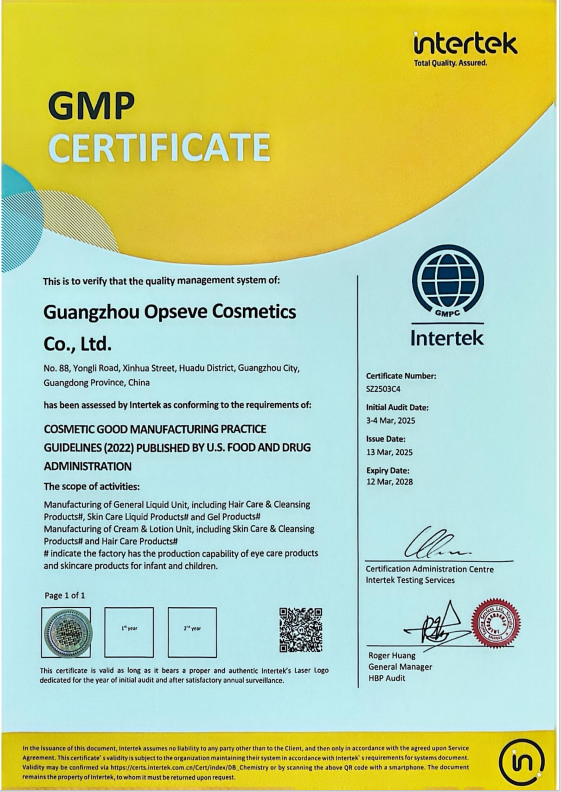
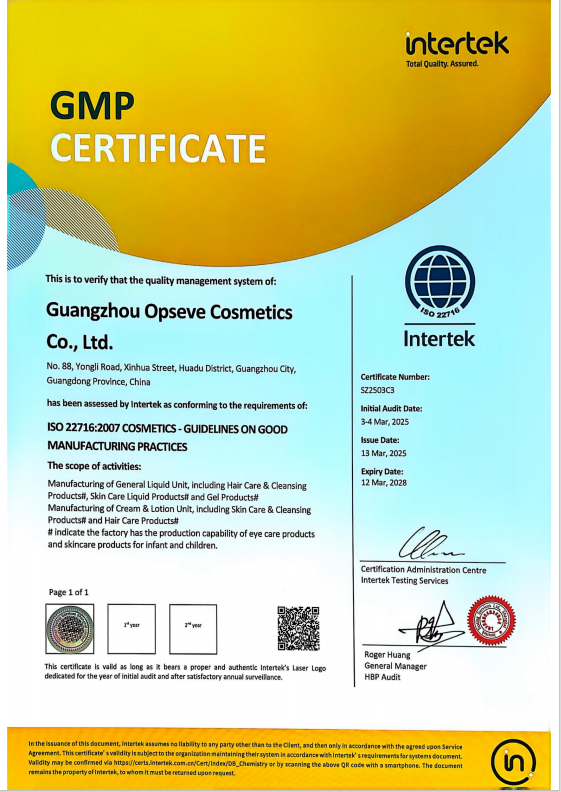
EN ISO 22716 is the harmonised standard referenced for good manufacturing practice in the EU framework. Its scope covers production, control, storage and shipment of cosmetic products, and expressly excludes research and development and the distribution of finished products.

Looking beats taking our word for it. Three routes are open to any qualified project:

  • On-site factory visits for qualified projects
  • Remote video factory tours, arranged on the lines your product would run on
  • Support for a customer-appointed third-party audit, on a scope you set

How a Project Runs

Brief received, NDA signed, feasibility answered.

Formula direction agreed and the sample fee confirmed.

First samples produced and shipped for your evaluation.

Revisions run until you sign off formula, fragrance and packaging.

Production preparation: raw material and component procurement, line scheduling.

Mass production, six-stage inspection, batch release and export documentation.

One project contact owns your file from brief to shipment, so questions about a batch go to someone who was there when it ran. Release depends on evidence that the finished product meets the approved reference sample on every agreed parameter, and where it does not, we hold the batch and tell you before it ships.

Where a Small-Batch Private Label Supplier Fits Better

Four situations make NEXO Beauty Labs the wrong choice. Unlike a supplier who lets you discover that after the sample fee is spent, we would rather say it now.

SCENARIO 01

A first run under 10,000 units

Minimums exist across the cosmetic industry because plate-making and line changeover are charged per run, not per unit. The trade-off below our minimum is between unit cost and the inventory you carry, and it usually points away from us. A European small-batch filler is where to look instead: prove the SKU, then move production once the volume supports it.

SCENARIO 02

A "Made in EU" origin claim

Article 19 requires the country of origin on the label of an imported product, and that origin is set by the EU non-preferential rules of origin rather than by the address on your invoice. Where the bulk is compounded, filled and packed at our site, that is the origin your label declares; simple repackaging of bulk made somewhere else does not move origin, so tell us where the bulk comes from when it is not made here. If a Made in EU claim is central to your positioning, NEXO Beauty Labs is not a substitute for production inside the EU.

SCENARIO 03

Someone to act as your Responsible Person

Under Article 4(5) of Regulation (EC) No 1223/2009, the importer placing a cosmetic product on the EU market is the Responsible Person by default. Shifting that role to another entity inside the EU requires a written mandate that the other party accepts in writing, and a manufacturing contract is not interchangeable with that appointment. We do not take the role; we supply the manufacturing-side documents it needs.

For the wider service scope, explore Global Cosmetic Manufacturing Support.

SCENARIO 04

Someone to sign the safety assessment

This is a third regulated role, separate from the Responsible Person. Article 10 requires the cosmetic product safety report to be carried out by a safety assessor holding the qualifications the regulation specifies. We provide formulation and production inputs; the assessment itself is done by you or by the assessor you appoint.

Frequently Asked Questions

Are products EU compliant and produced under GMP?

NEXO Beauty Labs manufactures to the EN ISO 22716 good manufacturing practice model, the harmonised standard the EU framework references for cosmetic products, and supplies the records your Product Information File draws on. Compliance of the finished product on the EU market is established by your Responsible Person, through the safety report, the file and CPNP notification.

Who is the responsible person for a cosmetic imported into the EU?

Article 4(5) of Regulation (EC) No 1223/2009 makes the importer placing the product on the EU market the Responsible Person by default. The role passes to another entity established in the EU only through a written mandate that the entity accepts in writing.

Who carries out the cosmetic product safety assessment?

A safety assessor holding the qualifications set out in Article 10, working independently of both the Responsible Person role and the manufacturer. Formulation, raw material and production information go to the assessor on request; the assessment itself stays with you.

What documentation do you supply for the Product Information File?

Article 11(2)(c) names a description of the method of manufacturing and a statement on compliance with good manufacturing practice among the mandatory contents. We supply records supporting both, plus ingredient information, batch quality documentation and product technical files.

How does EU sunscreen manufacturing differ from other markets?

UV filters are permitted in the EU only from the Annex VI list, which differs from the US and Australian lists, so a formula that ships in one market does not automatically ship in another. Nanomaterial forms carry a [nano] marker in the ingredient list, and some trigger a separate Article 16 notification.

What is the difference between private label and white label skincare?

White label means a finished stock product rebranded as it stands. Private label cosmetic manufacturing starts from a formula adjusted for your brand, and OEM production starts from a formula you already own. The second and third are where we work.

Can we provide our own formula, or match an existing reference product?

Both. Send the formula and we produce to it, or send a reference product and we develop toward it from our library. A written brief covering target user, claim direction and price position makes the first sample land closer either way.

Which packaging do you supply, and which do we source ourselves?

Filling, assembly, label application and batch coding are done in house. Component selection, custom packaging development, procurement and third-party testing are coordinated by us with outside suppliers. You are free to nominate your own component supplier instead.

What must our EU label carry, and who decides the wording?

Article 19 requires the Responsible Person's name and address, country of origin for imported products, nominal content, durability date or period-after-opening, precautions, batch number, product function and the INCI ingredient list, several of them in the language of the member state where the product is sold. Your Responsible Person signs off the wording; we print to that artwork.

What is your minimum order quantity, and is it per SKU or per order?

10,000 units per SKU, not per order, so a three-SKU launch is three separate minimums. It is a high minimum in this market and we state it plainly rather than negotiate it after sampling. Below that volume, a European small-batch filler is the better route.

What are typical lead times from brief to delivered stock?

Our side is 2 business days to a written quote, 3 working days to first samples, 5–7 working days for international sample delivery and 10–15 working days for mass production after approvals. Freight is the variable brands underestimate: the European Maritime Safety Agency reports cargo vessel voyages between China and Europe averaging 30 to 33 days, depending on route, ship type and speed. Customs clearance and your review cycles sit on top.

How do you handle formula confidentiality?

Before you send anything, we sign an NDA covering concepts, formulations and confidential business requirements. Formulas you supply stay yours, and formulas developed for you are not offered to another brand.

Can we visit the factory or send our own auditor?

Yes to both. On-site factory visits run for qualified projects, remote video tours run on the lines your product would use, and we support a customer-appointed third-party audit on a scope you define. Contact us to arrange any of the three.