Get in touch with NEXO Beauty Labs Company

Updated August 2026 · Written by XCX · Ordinary cosmetics scope
How do white label cosmetics work is a process question about controlled handoffs. A supplier starts with a defined formula, the brand chooses an eligible product and package, both sides approve the sample and artwork, then the manufacturer produces a controlled batch for release. The shortcut is development time, not evidence, label review, market duties, or batch acceptance.
Jurisdiction boundary
This guide uses United States federal cosmetics rules as its primary regulatory example and adds a short European Union contrast where roles differ. It is a purchasing and evidence framework, not a multi-market compliance manual or legal advice; confirm the rules for each market.
| Step | Control type | Evidence handoff |
|---|---|---|
| 1 | Scope | Product and market |
| 2 | Identity | Sample, formula and rights |
| 3 | Configuration | Package and label |
| 4 | Evidence | Safety, claims and entry |
| 5 | Contract | Approved order state |
| 6 | Production | Lot and release |
| 7 | Post-market | Launch records |
| 8 | Change | Repeat-order baseline |
What Is Already Decided in a White Label Model?
White label cosmetic products are typically ready-made cosmetics produced by one company and branded and sold under another brand’s name. A third-party white label supplier may offer the same base to multiple brands, but “the product is identical” is a claim records must prove because the package, formula version, specifications, and quality control can differ.
Private label products may offer more customization, yet the phrases “white label and private label” or “white label or private label” do not prove exclusivity, ownership, portability, or market readiness. Products under your own brand still require written permission; a blank label is not authorization.
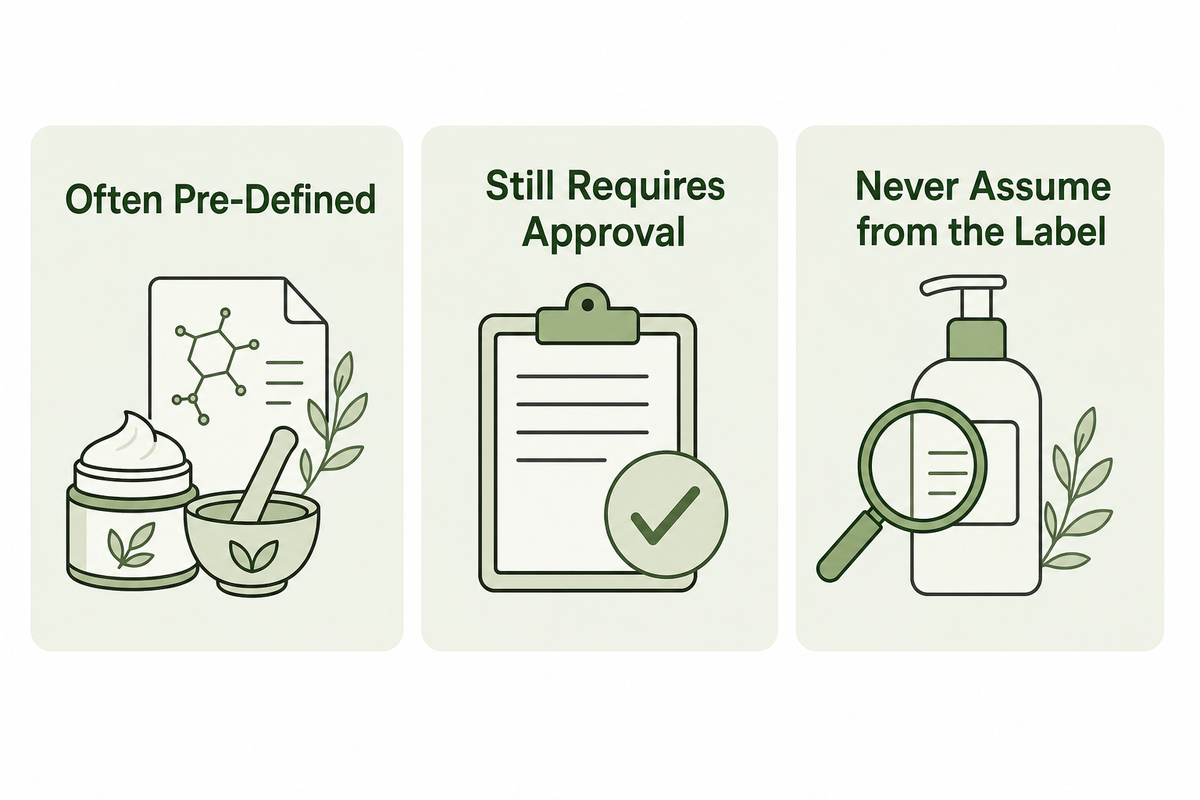
| Often pre-defined | Still requires approval | Never assume from the label |
|---|---|---|
| Base formula and version | Actual sample and specification | Formula ownership |
| Eligible container menu | Final component combination | Universal compatibility |
| Standard production path | Claims, label, lot and release terms | Supplier assumes every legal duty |
Step 1: Choose the Product and Define Where It Will Be Sold
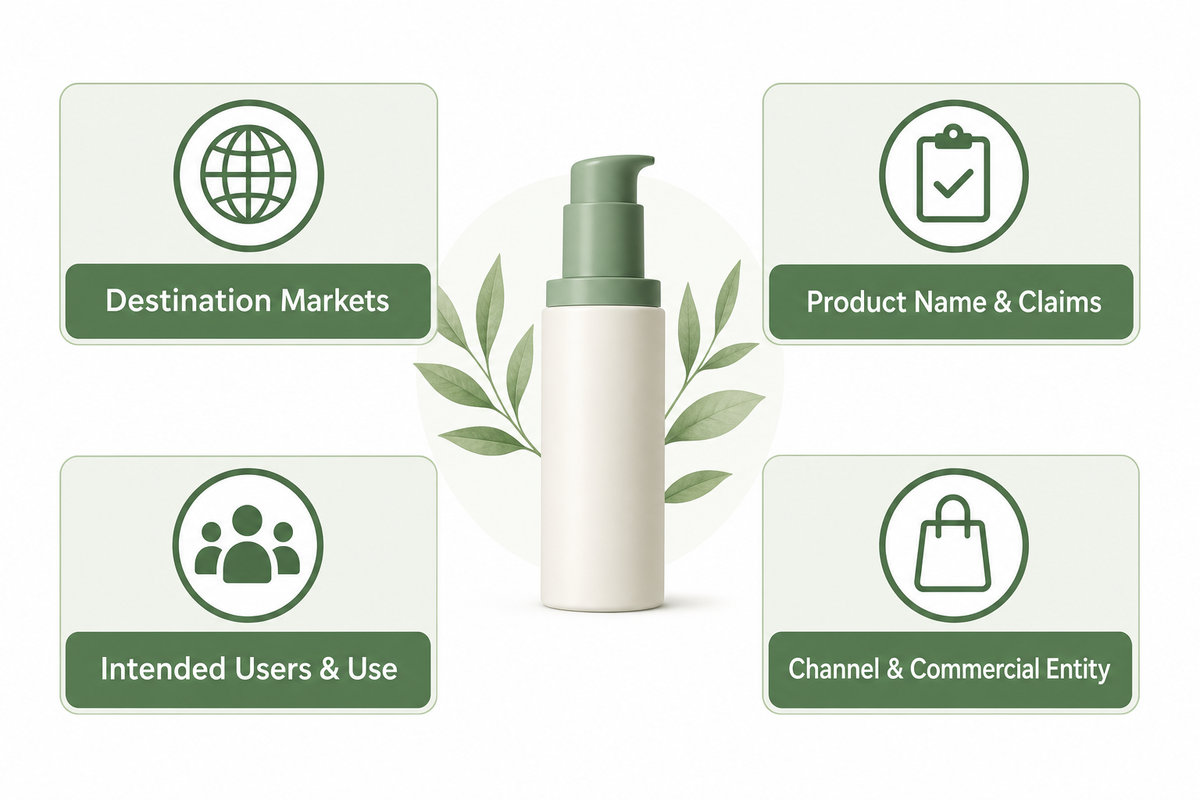
Start with the intended use and selling market, not the bottle design. A cleanser, scalp serum, body lotion, or color product can raise different ingredient, claims, warning, evidence, and label questions, while a formula accepted in one market is not automatically ready for another.
First briefing line“We plan to sell [product format] to [intended users] through [channel] in [market], using [claims] and [final package].”
In the United States, intended use helps determine whether a product is a cosmetic, a drug, both, or soap under a separate definition. The FDA’s product-category guidance shows why changing a claim can change the regulatory question even when the formula stays the same.
- List each destination market.
- Freeze the proposed product name and claims for review.
- Identify intended users and reasonably foreseeable use.
- Record the sales channel and responsible commercial entity.
Search-intent boundary“White label cosmetics Europe,” “white label cosmetics dropshipping,” “white label makeup brands,” and “white label services” signal different needs. This guide covers manufacturing, not legal advice, dropshipping operations, online-store or Shopify setup, lists of cosmetics brands, or rankings.
Step 2: Verify the Formula, Sample, and Rights Boundary
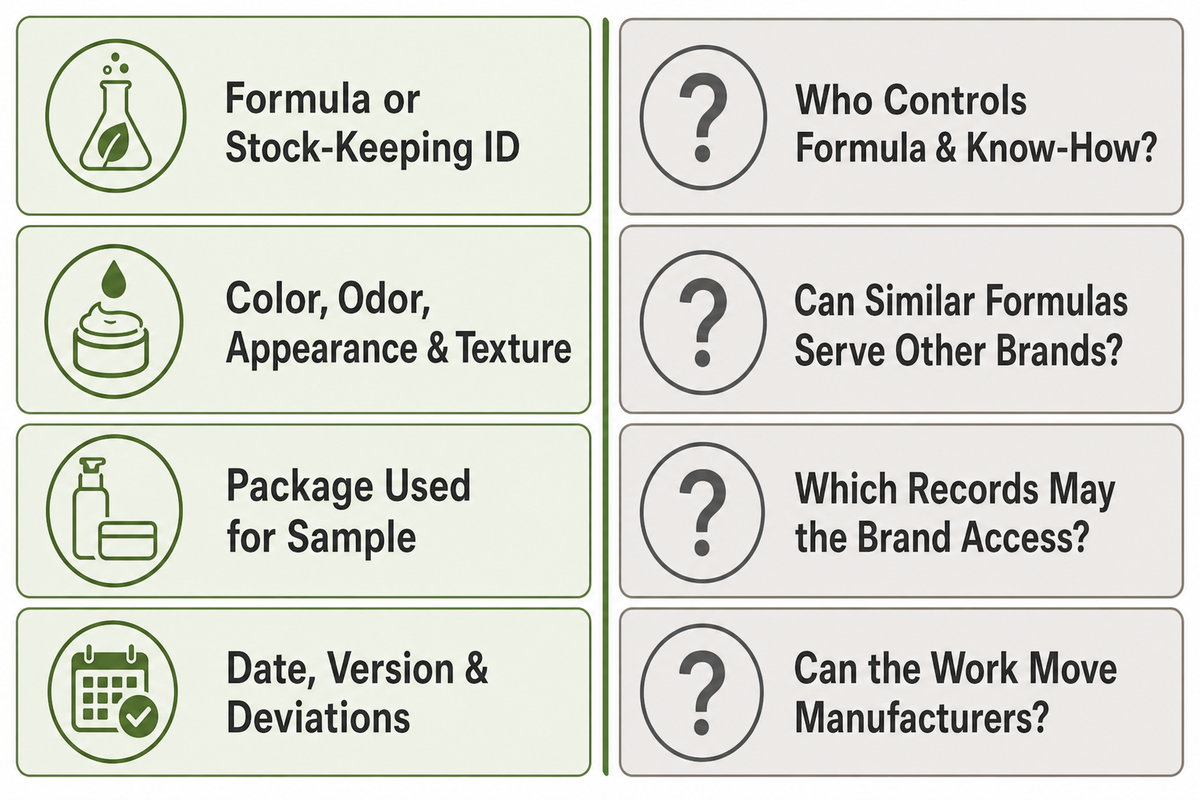
Use a sample-to-production acceptance checklist to bind the sample to a formula or specification version. Approve sensory attributes and measurable acceptance points separately, because “this feels right” is useful feedback but not a complete production specification.
Sample approval record
- Formula or stock-keeping identifier
- Color, odor, appearance and texture
- Package used for the sample
- Date, version and approved deviations
Separate rights questions
- Who controls the formula and know-how?
- Can similar formulas serve other brands?
- What records may the brand access?
- Can the work move to another manufacturer?
Payment for product or development does not, by itself, answer every ownership, licence, confidentiality, know-how, or transfer question. WIPO’s overview of technology-transfer agreements illustrates why different rights and obligations belong in the agreement rather than in assumptions about a commercial label.
Decision gate: do not call the formula “owned,” “exclusive,” or “portable” unless the signed scope identifies what that term covers, where, for how long, with which exceptions, records, disclosures, and exit assistance.
Step 3: Match Packaging, Artwork, and the Label Roles
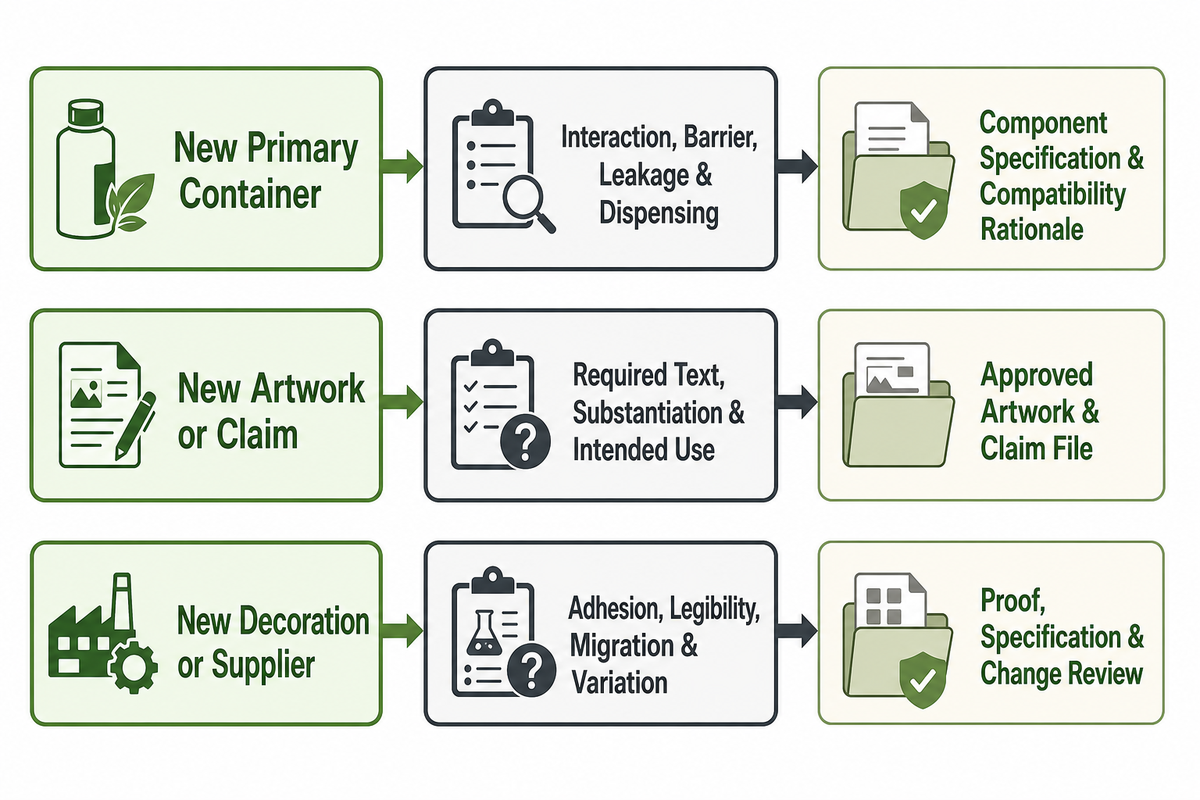
The final product combines formula, container, closure, and artwork. Do not assume bulk-formula history covers a new pump, liner, decoration, or transport condition; ask how the evidence applies to the proposed pack.
The Cosmetics Europe stability guideline describes stability work as a way to support product quality in its intended container and under reasonably foreseeable storage conditions. Its method is guidance rather than a universal fixed protocol, so the supplier should explain why the available stability and package-compatibility evidence fits the actual product.
| Change | Question reopened | Acceptance record |
|---|---|---|
| New primary container | Interaction, barrier, leakage, dispensing | Component specification and compatibility rationale |
| New artwork or claim | Required text, substantiation, intended use | Approved artwork and claim file |
| New decoration or supplier | Adhesion, legibility, migration, process variation | Proof, specification and change review |
For United States sales, use the current FDA Cosmetics Labeling Guide to review identity, net contents, ingredient declaration, business information, warnings, and other applicable details. The brand should know who drafts, checks, approves, prints, and rechecks the final label; a printer-ready file is not proof of regulatory review.
Step 4: Scope Safety, Claims, and Market-Entry Evidence
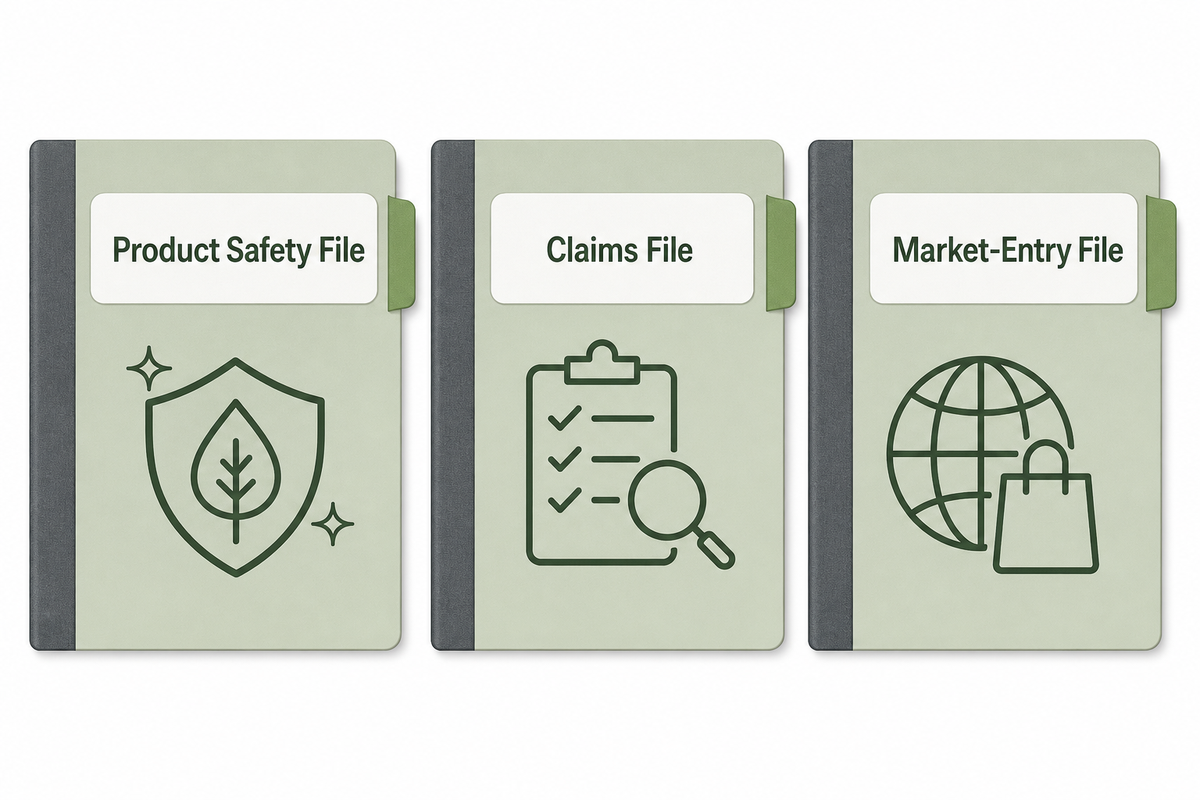
Build an evidence index for the specific formula version, intended use, final package, claims, users, and market. The index should show each record’s owner, date, scope, version, conclusion, limitation, and change trigger instead of presenting a folder of unrelated certificates as a complete answer.
United States role boundaryMoCRA’s “responsible person” is the manufacturer, packer, or distributor whose name appears on the label. That term does not mean every other participant disappears from potential responsibility: FDA’s current key-terms page says manufacturers, packers, distributors, and retailers may each have responsibility when cosmetics are adulterated or misbranded.
Use the FDA key-terms explanation to avoid turning “we handle compliance” into a complete exposure map. Contracts can allocate tasks, records, indemnities, and approvals, but they do not rewrite statutory responsibilities.
Product safety file
Formula/version, intended use, safety substantiation basis, warnings, package scope and reviewer.
Formula/version, intended use, safety substantiation basis, warnings, package scope and reviewer.
Claims file
Exact wording, evidence link, intended-use review, approved channels and change owner.
Exact wording, evidence link, intended-use review, approved channels and change owner.
Market-entry file
Required registrations or listings, responsible entities, label version, dates and renewal owner.
Required registrations or listings, responsible entities, label version, dates and renewal owner.
FDA does not generally pre-approve cosmetic products or ingredients before market, except for color additives where applicable. That makes “FDA approved” an unsafe shortcut for ordinary cosmetics; verify the current boundary on the FDA cosmetics approval page and review claims separately.
European Union contrastRegulation (EC) No 1223/2009 uses a European Union “responsible person” structure and can assign that role to an importer or to a distributor that places a product under its own name or trademark, subject to the regulation’s conditions. Don’t copy the United States responsibility matrix into the European Union; review the current consolidated regulation and obtain market-specific advice.
Step 5: Convert the Approved Sample into a Purchase Order
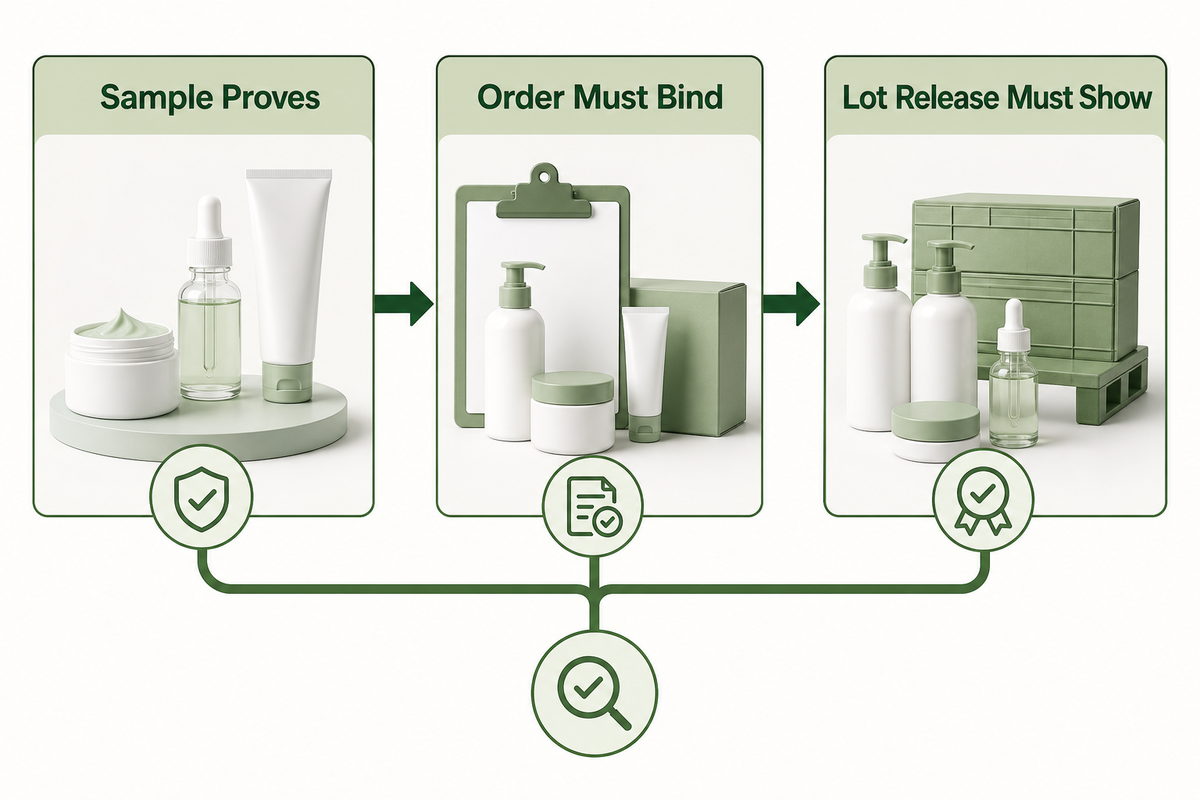
A purchase order should convert the approved concept into controlled production inputs. It needs more than a product name and quantity: bind the formula, package, artwork, specification, price layers, delivery terms, release evidence, permitted substitutions, and change-approval path.
| Sample proves | Order must bind | Lot release must show |
|---|---|---|
| A reviewed example was acceptable | Versioned formula and finished-product specification | The produced lot met agreed release criteria |
| Selected pack and artwork looked right | Component codes, suppliers, decoration and files | Correct components and coding were used |
| Sensory target was understood | Acceptance limits and approved deviations | Inspection result and disposition |
Treat sample approval as a reviewed example, not proof every batch will conform. Define the production specification, deviation authority, nonconforming-goods treatment, shipment records, and release point.
Commercial check: MOQ is more than one headline number. Separate minimum order quantities for the formula batch, primary components, packaging design, decoration, cartons, testing, freight, storage, and setup. One quoted minimum may hide the item that determines cash exposure.
Step 6: Manufacture, Fill, Inspect, and Release
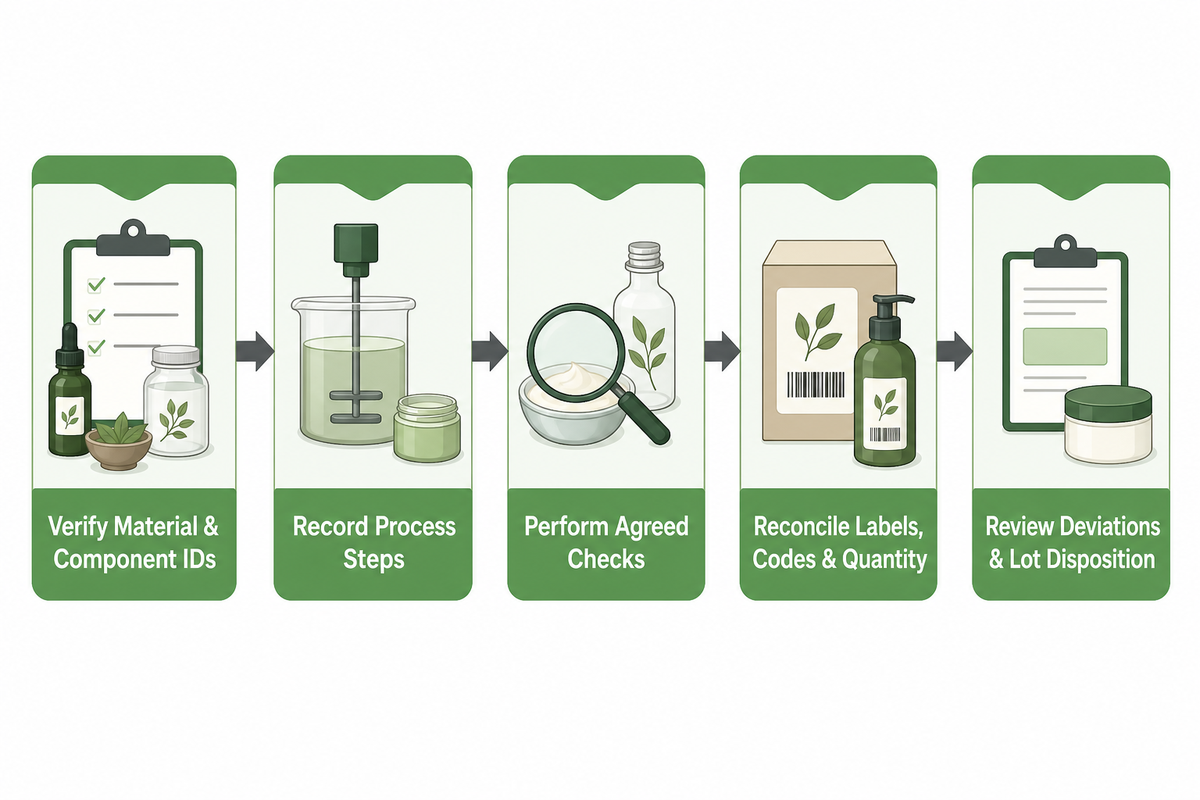
Production should follow approved instructions and create traceable records from incoming materials through compounding, filling, packing, inspection, and lot disposition. The exact controls depend on the product and operation, so ask for the record set that demonstrates the agreed process rather than accepting a generic quality statement.
The FDA cosmetic good manufacturing practice checklist covers areas such as facilities, equipment, personnel, raw materials, production, laboratory controls, records, labels, complaints, and audits. It is useful as a question map, while the FDA checklist itself says it is guidance and does not create binding requirements.
- Verify received material and component identities.
- Record weighing, compounding and critical process steps.
- Perform agreed in-process and finished-product checks.
- Reconcile labels, coding and packaged quantity.
- Review deviations and authorize the lot disposition.
Agree on the release-packet contents before ordering so “documents available on request” does not become a post-shipment negotiation.
Step 7: Ship, Launch, and Keep the Records the Brand Still Needs
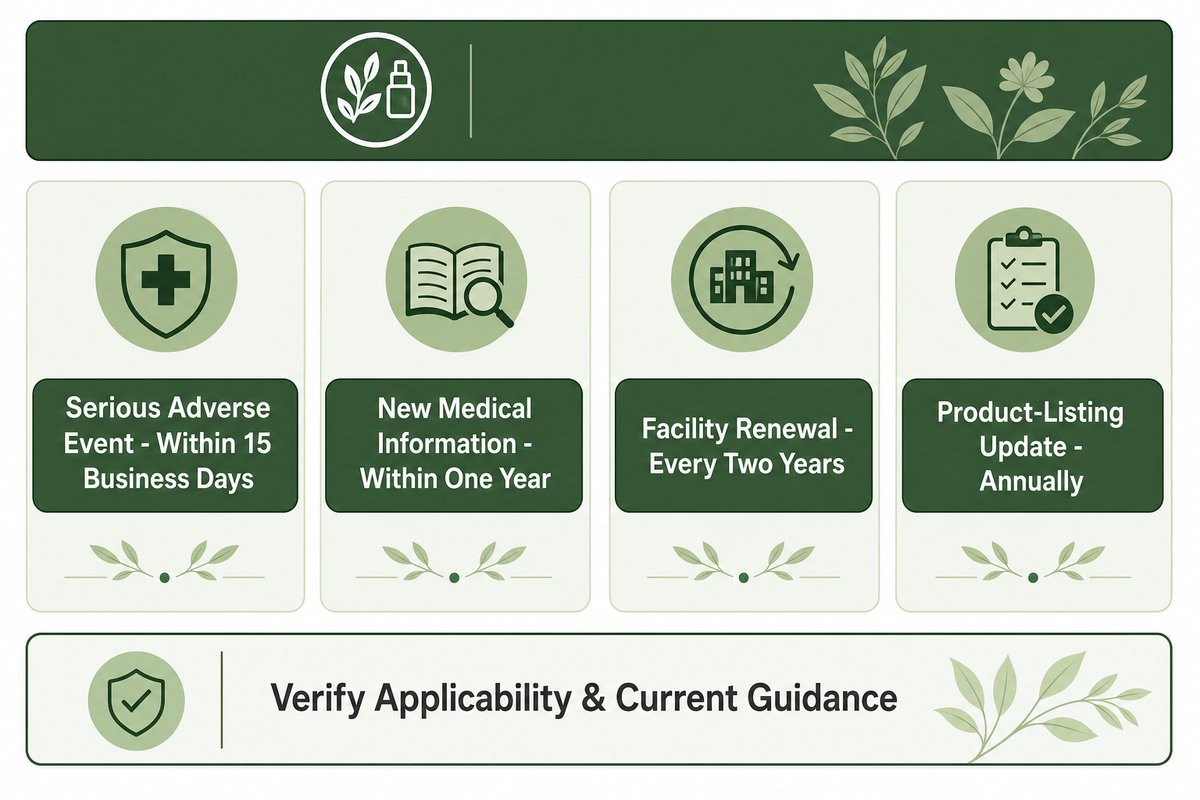
Release is the start of post-market control, not the end of the evidence chain. Keep the current formula and label versions, lot links, distribution records, complaints, adverse-event information, claims support, market filings, and change correspondence in a retrievable system.
| Checkpoint | Timing | Control question |
|---|---|---|
| Serious adverse event report | Within 15 business days | Who receives, assesses and submits it? |
| New material medical information | Information received within one year follows the reporting rule | Who maintains the follow-up file? |
| Facility registration renewal | Every two years | Which facility and owner are in scope? |
| Product-listing update | Annually | Who tracks formula and label changes? |
These points come from the current FDA MoCRA overview, but exemptions and detailed applicability require review. Build an escalation map that connects customer service, the brand, manufacturer, safety reviewer, insurer, logistics partners, and counsel instead of leaving reports in separate inboxes.
Record retrieval test: choose one shipped lot and confirm that the team can retrieve its approved label, release record, distribution path, complaints, changes, and market filing references without reconstructing them from memory.
Step 8: Control Repeat Orders and Product Changes
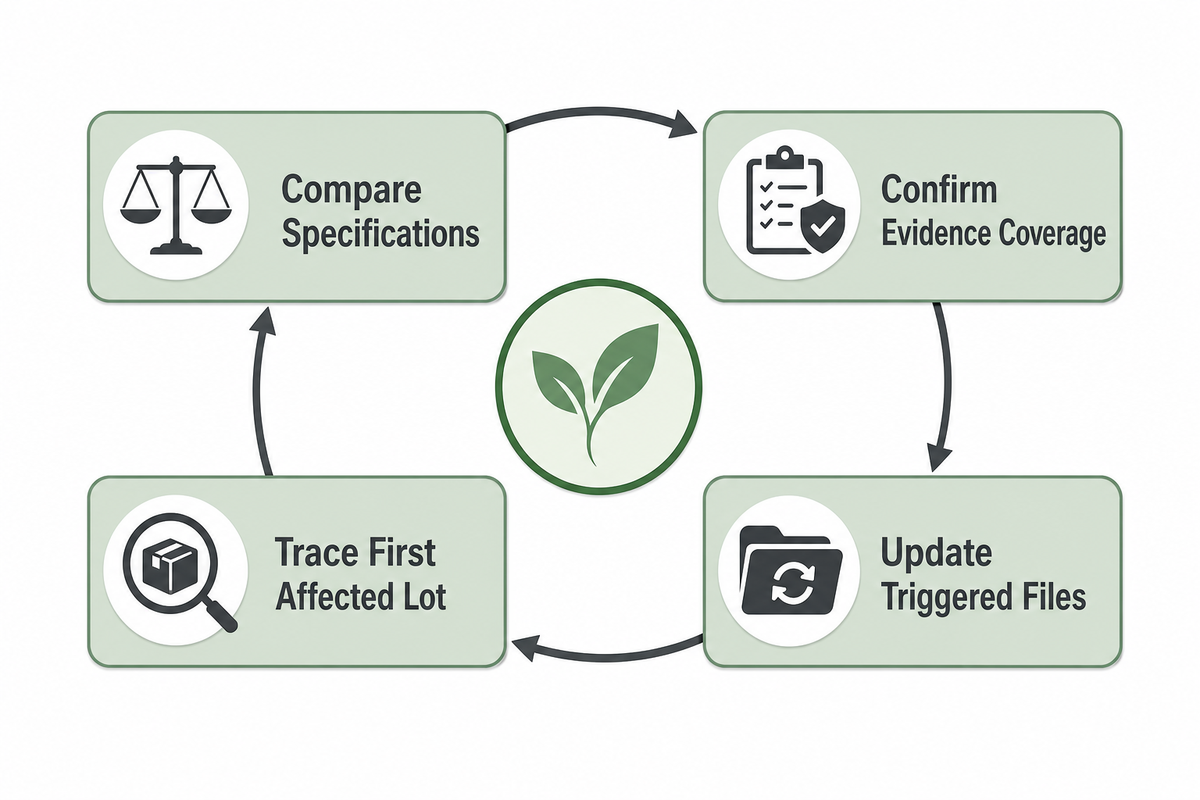
A repeat order should reference the last approved state and identify every proposed change before production. Formula ingredients, raw-material suppliers, processing, component suppliers, decoration, artwork, claims, destination markets, and test methods can all reopen earlier decisions.
No declared change
Confirm current version identifiers, available materials, open complaints, filing status, and release requirements before issuing the repeat order.
Proposed change
Record the reason, affected versions, evidence impact, responsible reviewer, approval, implementation lot, inventory disposition, and customer communication.
A shared-formula supplier may need to change one input across several customers. Define notice, emergency substitutions, approval rights, re-review triggers, remaining-stock treatment, and the path when a change is rejected.
- Compare current and previous specifications.
- Confirm whether evidence still covers the new state.
- Update labels, listings and claims files when triggered.
- Keep the first affected lot and approval date traceable.
Use the 6-Stage White Label Evidence Relay Before You Approve the Order
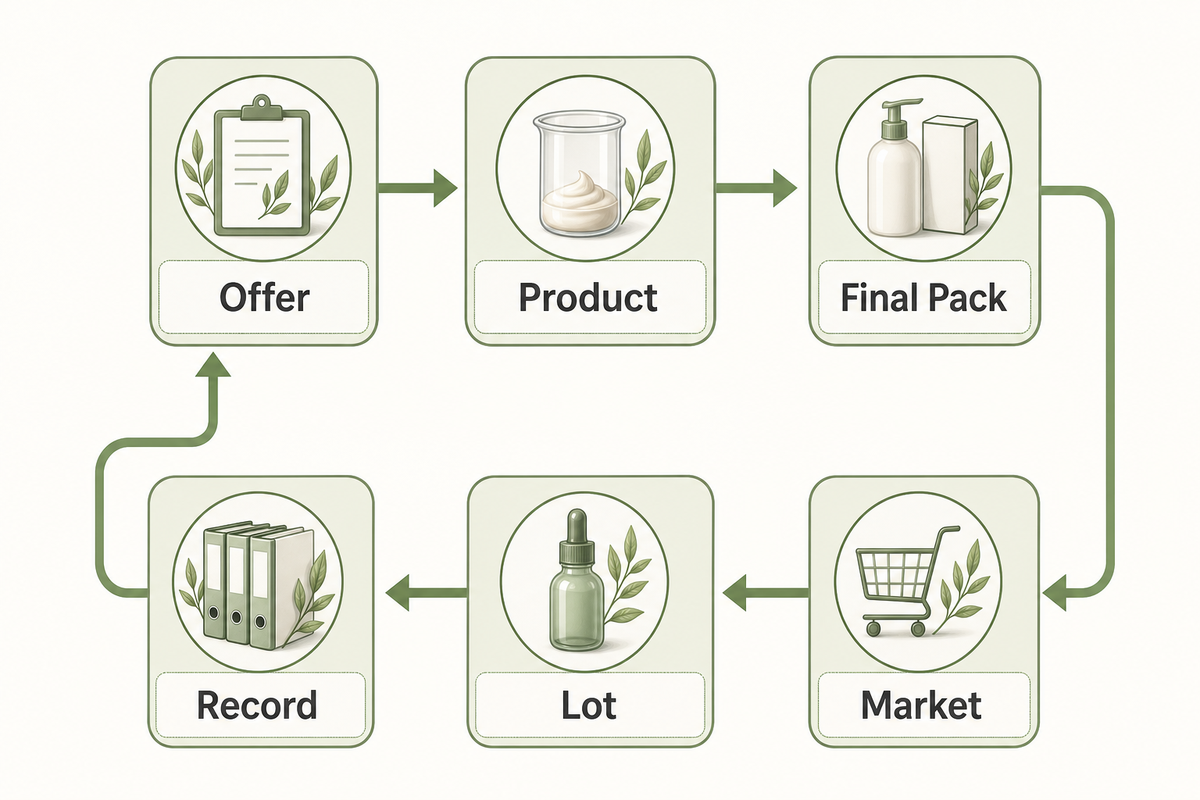
The White Label Evidence Relay is an original NEXO buyer-review framework for checking whether decisions survive the handoff from supplier offer to product, package, claim, market, production lot, and post-market record. A handoff fails when evidence from one stage is presented as proof for a different stage without showing the connection.
Offer
What is actually included?
What is actually included?
Product
Which formula and use?
Which formula and use?
Final pack
Which component state?
Which component state?
Market
Which role and evidence?
Which role and evidence?
Lot
What was made and released?
What was made and released?
Record
Can the history be retrieved?
Can the history be retrieved?
Run the relay by taking every major claim in the quotation—ready formula, tested package, market-ready label, controlled production, compliant launch—and asking which exact record supports it at the next stage. Record a gap when the evidence has a different formula, package, market, claim, date, owner, or production state.
| Supplier statement | Relay question | Acceptable next evidence |
|---|---|---|
| “Formula is ready” | Ready for which use, claim, package and market? | Versioned evidence index and limitations |
| “Sample is approved” | How does it bind production? | Specification, component codes and release criteria |
| “We handle compliance” | Which operational tasks and which statutory roles? | Market-specific responsibility matrix |
The relay cannot guarantee success or eliminate compliance risk. It exposes assumptions before inventory is committed.
When Should You Ask About a More Customized Route?
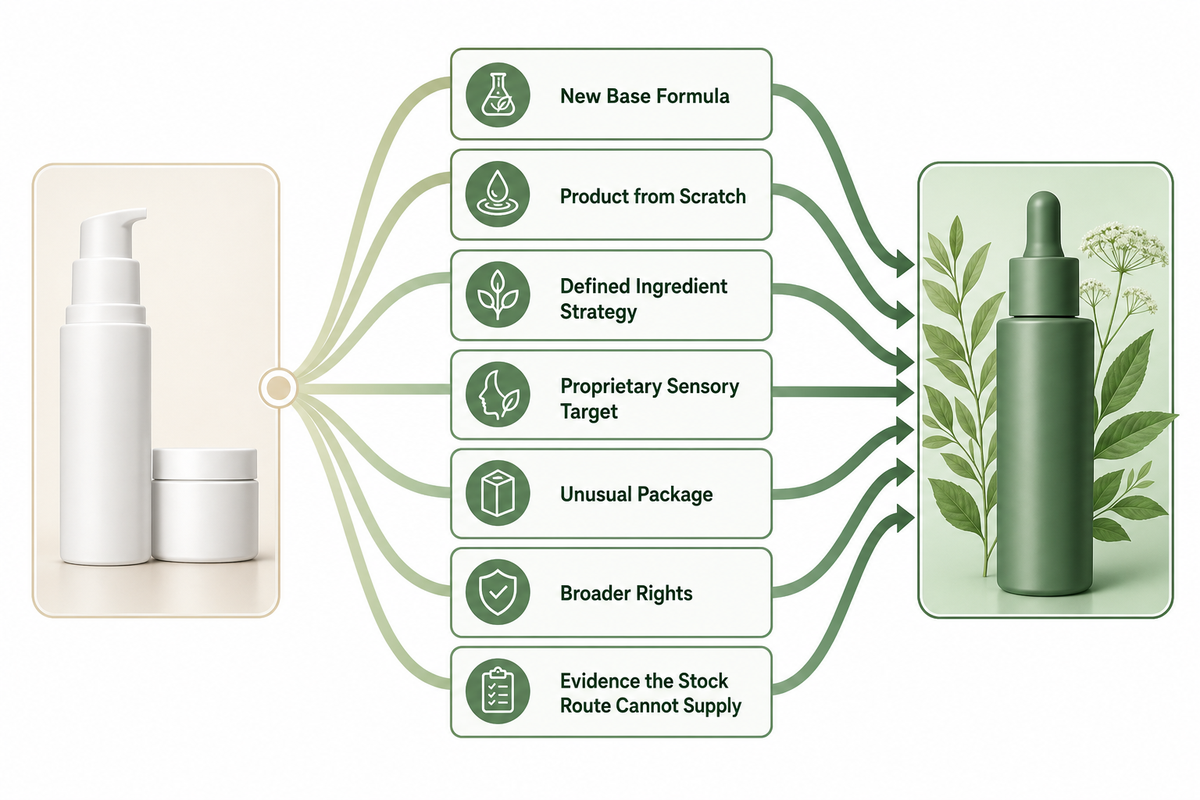
Ask when the required difference extends beyond the ready offer: a new base formula, product from scratch, defined ingredient strategy, proprietary sensory target, unusual package, tightly bounded exclusivity, broader rights, or evidence the stock route cannot supply. Customization adds decisions, time, evidence work, and commercial commitments, so connect it to a real requirement.
Stay white label whenAsk what usually cannot change, what packaging can be changed, and what is unique to your brand. The formula, claims, package options, rights, evidence, market path, and economics must meet the goal without presenting standard products as exclusive products.
NEXO Beauty Labs publicly presents itself as an OEM and ODM cosmetics partner for skincare and skin care, hair care products, body care, product development and formulation development, and manufacturing. Brand founders comparing white label services, private label services, or a private label cosmetic manufacturer can review NEXO’s private label cosmetics manufacturing path and use its development route comparison before discussing personal care products.
Route-change brief: state the product difference, why customers should care, markets and claims, rights needed, unacceptable shared-formula exposure, final package, target evidence, and change-control expectations. Structure those inputs with the private label cosmetics RFQ brief builder.
Frequently Asked Questions
“What are white label cosmetics?” and “how to tell if a product is white labeled” are answered by product records and the written supply scope.
What are the disadvantages of white labeling?
Ready-made offers lower barriers to entry but can limit label design, rights, exclusivity, change control, and transfer. Different brands may use white label formulas or branded products, so a beauty brand cannot infer high-quality products or product quality from the name. White label branding, branding and marketing, brand identity, and focus on branding remain seller work.
Is white labeling illegal?
No. Cosmetics manufactured by a third party and sold under another brand’s name are not inherently illegal when the agreement permits branding. The agreement should identify goods, permitted branding, rights, and records for the product actually sold. The product must still meet applicable safety, labeling, claims, filing, records, intellectual-property, and market-role requirements. Products under your own brand need a defined agreement and records; a brand name on the label is not a universal shield. United States participants may share responsibility for adulterated or misbranded cosmetics, while European Union roles differ. Confirm current classification, label, safety, filing, and reporting duties for each market.
How can you tell if a cosmetic product is white labeled?
Packaging similarities, identical ingredient lists, or a product sold by multiple brands can be clues, but not proof the product is identical. Reliable evidence comes from agreements, formula identifiers, records, disclosures, or authorized manufacturing information. The label of the packaging alone cannot prove the commercial route or final formula version.
Can I buy a cosmetic product and sell it under my own brand?
Only with an arrangement that permits branding and defines product, rights, records, and applicable sales scope. Brand founders planning to sell white label or selling white label products through an online store, Shopify, marketplaces, or dropshipping still need safety substantiation, package review, claims support, market roles, lot release, traceability, complaints, and change control. A retail purchase grants none of those rights or records.
Can you give an example of a white label cosmetic?
A private label cosmetic or white label cosmetic can be a moisturizer. Cosmetics produced by one company but sold under another brand’s name may serve multiple brands, which put their brand on approved artwork. This makes no NEXO-specific claim.
How much profit can a white label cosmetic make?
There is no universal margin. A faster route to enter the market or launch products does not guarantee demand. Model actual costs and inventory. Distributional economies of scale apply only when real orders and sales support them, even for established brands.
References & Sources
Primary sources support this article’s regulatory, rights, and stability boundaries. No cited source establishes NEXO-specific minimum orders, prices, lead times, certifications, production capacity, testing outcomes, customers, or commercial results.
- U.S. Food and Drug Administration — Key Terms in Cosmetics Regulation
- U.S. Food and Drug Administration — Modernization of Cosmetics Regulation Act
- U.S. Food and Drug Administration — Cosmetics Labeling Guide
- U.S. Food and Drug Administration — Does FDA Approve Cosmetics?
- EUR-Lex — Regulation (EC) No 1223/2009 on Cosmetic Products
- World Intellectual Property Organization — Technology Transfer Agreements
- Cosmetics Europe — Guidelines on Stability Testing of Cosmetic Products
Turn a ready formula into a reviewable launch brief
Bring your product, destination market, package, claims, evidence questions, rights boundary, and reorder plan.