Get in touch with NEXO Beauty Labs Company

Updated September 2026
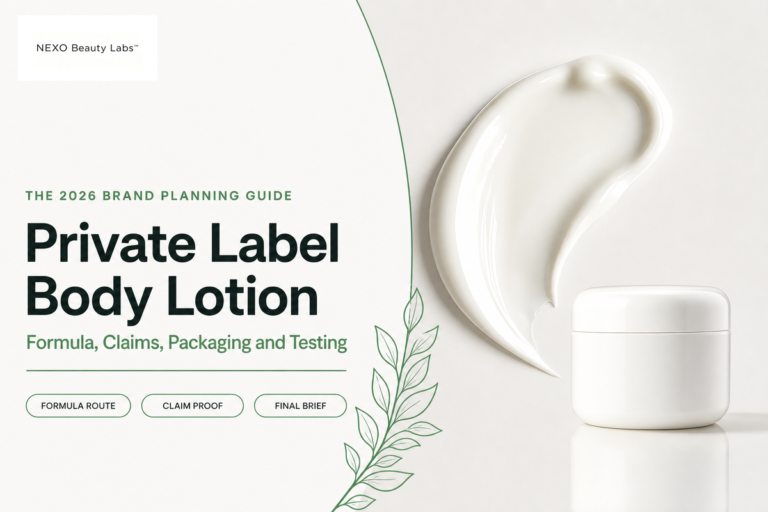
Private label body care products are lotion, wash, scrub, oil, and hand or foot care items that a manufacturer formulates and produces, then sells to a brand to market under its own label. The brand owns the product’s positioning, pricing, packaging and label, while a contract manufacturer handles the formulation and batch production.
This guide is for brand founders, product developers, and sourcing teams deciding whether and how to start a body care line through a private label partner. It’s a primer on the sourcing model itself: how minimum order quantities really add up, what to compare between manufacturers, the US regulatory basics a buyer should understand, and the quality standards worth asking about. It won’t walk you through our own project timelines, pricing, or minimum order figures — once you’re ready to discuss your body care project, formats and formulation routes directly, visit our private label body care manufacturing page for next steps. This article is the groundwork that comes before that conversation.
The short version
- Private label body care means a manufacturer develops and produces the product; the brand owns everything about how it’s sold.
- Minimum order quantities are layered — the packaging component, not the formula batch, is usually what actually sets your floor.
- Under US law (MoCRA), the responsible person named on the label carries facility, listing and safety-substantiation duties — confirm who that is in writing.
- A supplier’s homepage tone tells you how they want to be seen, not what they can actually deliver — compare concrete specifics instead.
- “Natural,” “vegan” and “cruelty-free” are three separate claims with three separate evidence requirements.
Note on scope: before writing this piece we checked how Google currently treats this search phrase. Of roughly 33 ranking and related pages we reviewed, about 21.2% were pure informational guides rather than product or solution pages — the rest were exactly the kind of specifics-first page our own private label body care manufacturing page already covers. That split is why this article stays in buyer-education territory (how the model works, what to check, what regulations apply) rather than repeating our own program details.
What Are Private Label Body Care Products?
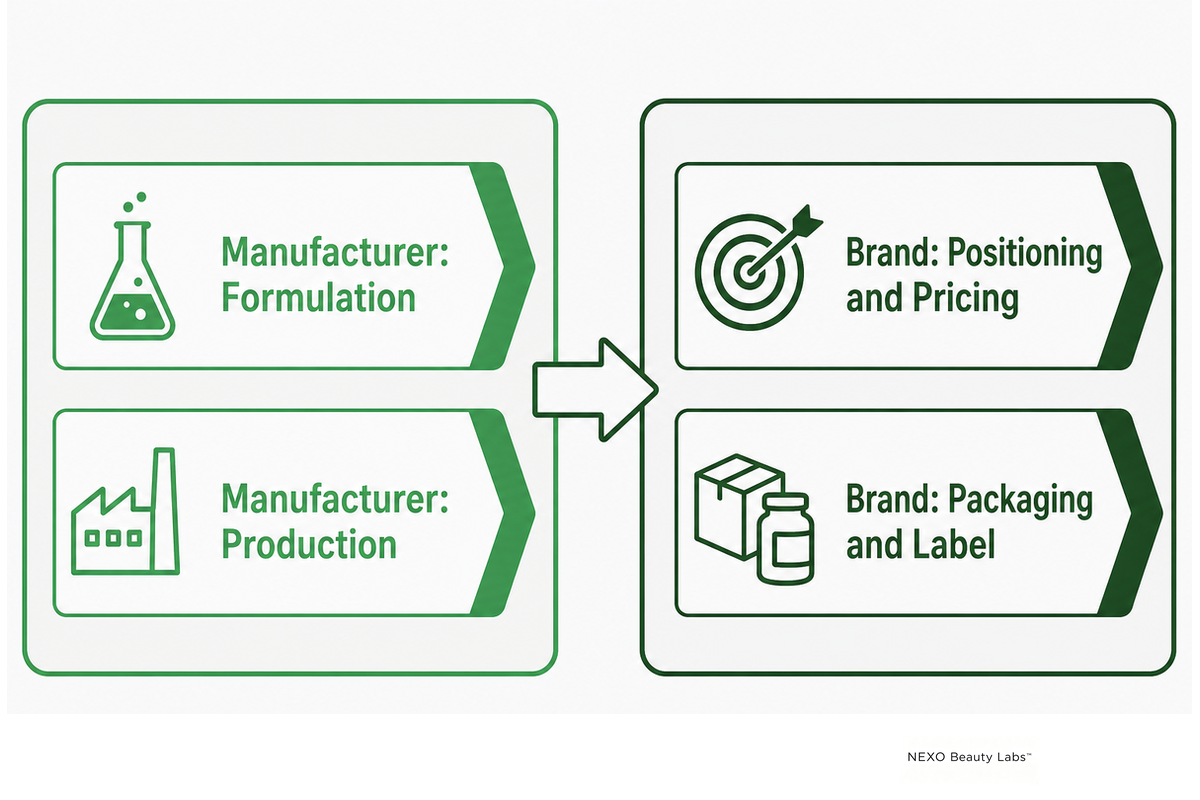
Private label body care spans several formats: body lotion and cream, body wash and shower gel, body scrub and polish, body oil, and hand and foot care items. What connects them is the business relationship behind them — a manufacturer builds the formula, and the brand controls everything the customer sees. Each format falls under the FDA’s cosmetic classification, covered below.
That’s structurally different from reselling standard retail merchandise. When a brand resells an existing item under its own name, it has little to no input into fragrance, feel, or packaging. With private label body care, by contrast, the formula direction is genuinely controllable by the brand, even when it starts from an existing formula base rather than a completely clean-slate creation.
The private label cosmetics market — of which body care is a solid and growing share — has been estimated at roughly $10.6 billion in 2024, projected to reach $14.4 billion by 2030 (secondary-source market-research estimate, not primary government data).
Private label body care serves different buyer types in different ways. Brand founders launching a first product line are often deciding where to start and how much creative input to take on. Product development teams weigh formulation routes and technical risk. Sourcing and procurement leads compare minimum order quantities, lead times and responsibility boundaries across suppliers. An e-commerce brand or distributor usually wants a coherent multi-SKU range rather than a single product. This guide is written for all four, with sections organized so each can find the part most relevant to their decision.
Body care sits within the wider private label skincare and personal care industry, so a buyer researching one category will often run into the other. A private label skincare manufacturer that formulates a high-quality moisturizer or facial serum will frequently offer body lotion, body wash, or hand cream from the same production lines, since the underlying emulsion and formulation know-how overlaps. Search for a private label skin care manufacturer or a private label skincare partner, and body care usually shows up as one category inside a much wider skincare product catalog — the same private label skin care sourcing logic covered here applies equally to a body lotion or a moisturizer.
Private Label vs. White Label vs. Custom Formulation
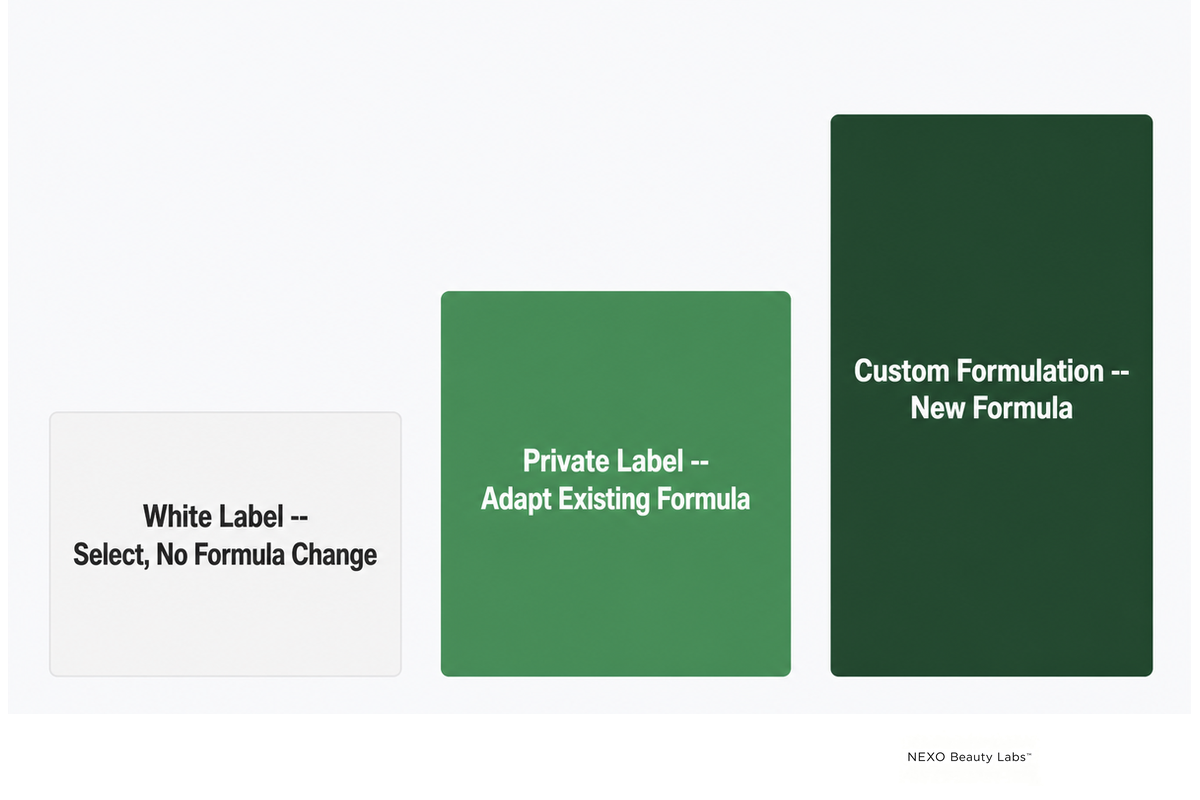
These three terms get used somewhat interchangeably, and suppliers apply them inconsistently, so it helps to understand the underlying model rather than rely on the label alone — this buyer community discussion is a good illustration of how often the terms get mixed up in practice.
- White label typically means selecting a product from a manufacturer’s existing catalog and putting your label on it, with little or no formula change. It’s the fastest and cheapest entry point, but the least differentiated — other brands may be selling the identical product.
- In the stricter sense, private label describes a manufacturer adapting an existing formula direction — adjusting texture, fragrance, or active-ingredient level — to fit a specific brand’s brief.
- Custom formulation, sometimes called full-service or turnkey private label, begins with a new formula built specifically for the brand’s brief: target texture, sensory profile, fragrance direction, and claims.
Because these terms aren’t legally standardized, the practical difference is whatever a specific supplier means by them. When talking to a private label manufacturer, clarify directly whether the term means selecting from an existing formula library, adapting one, or building a new formula — the three routes carry very different timelines and levels of creative control.
Body Care Product Categories You Can Private Label
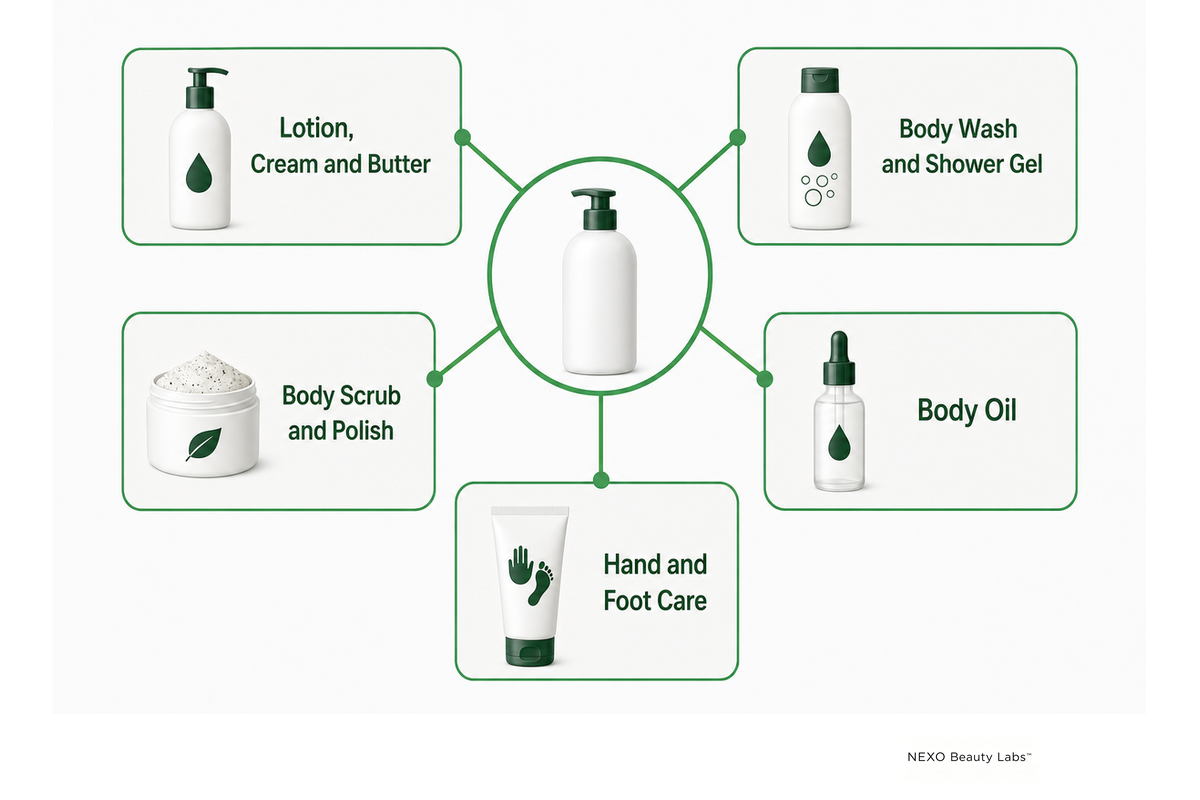
Most private label body care work falls into one of five categories, and it helps to know the landscape before narrowing to one product — all of them fall under the FDA’s cosmetic classification as long as the claims stay cosmetic rather than drug-like.
- Body lotion, cream and butter spans lightweight lotion through rich, heavy butter, differentiated mainly by water/oil ratio and after-feel.
- Rinse-off cleansing formats make up body wash and shower gel, where foam behavior, fragrance carry-through, and after-wash skin feel are the main formulation levers.
- Body scrub and polish are exfoliating formats built around a particulate (sugar, salt, or synthetic bead) suspended in a rinse-off or leave-on base.
- Body oil covers lightweight or dry-touch oil formats, typically differentiated by dispensing format (dropper, pump, spray) and absorption speed.
- Hand and foot care groups creams, masks, and repair sticks addressing more targeted or intensive skin needs than a general body lotion.
Assuming every body-care format runs on the same production line is a common mistake, and it’s a mismatch that usually surfaces only after a batch is already filled: a scrub’s particulate size can create packaging problems a lotion never would, and treating the two as interchangeable at the brief stage is a structural risk, not a minor detail. Brands don’t need to pick one category permanently — many private label projects start with a single lead product and expand into an adjacent category once the first launch validates demand. It’s also common for the same manufacturer producing your body care to offer adjacent personal care products, such as a toner, a cleanser, or even hair care — so a brand building a wider personal care range can often consolidate more of its catalog with one partner instead of managing separate suppliers per category.
| Format | Category | Typical Texture Profile | Common Packaging |
|---|---|---|---|
| Body lotion | Leave-on | Lightweight, fast-absorbing | Bottle, pump |
| Body cream | Leave-on | Richer, slower-absorbing | Jar, tube |
| Body butter | Leave-on | Thick, occlusive, whipped or solid | Jar, tub |
| Body wash / shower gel | Rinse-off | Foaming or low-foam gel | Bottle, pump |
| Body scrub / polish | Exfoliating | Particulate suspended in base | Jar, tub |
| Body oil | Leave-on | Lightweight to dry-touch oil | Dropper, pump bottle |
| Hand cream | Leave-on, targeted | Fast-absorbing, non-greasy | Tube |
| Foot care (cream/stick) | Leave-on, targeted | Dense, occlusive | Tube, stick, jar |
Understanding Minimum Order Quantities
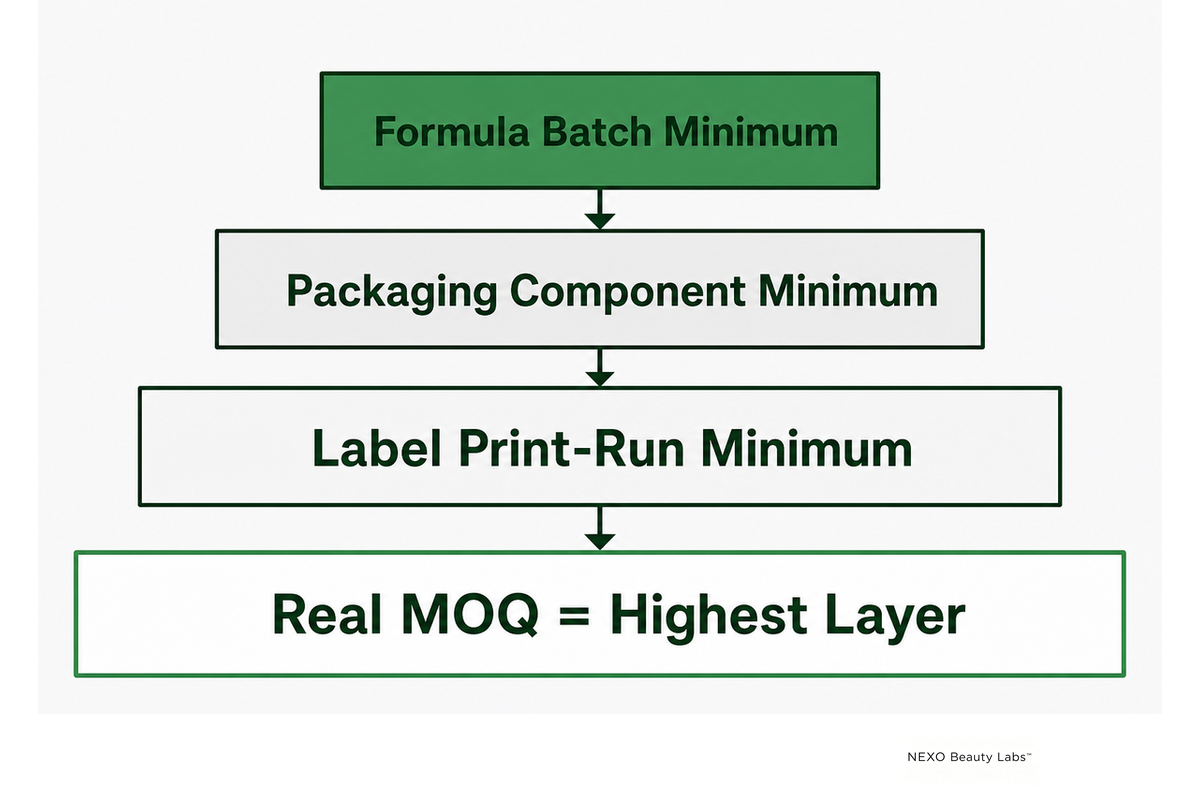
Minimum order quantity is the single most common source of buyer surprise in private label sourcing, and the reason is structural: an MOQ isn’t one number, it’s a stack of separate minimums that don’t move together — a formula batch minimum, a packaging component minimum, and a label print-run minimum, each set independently.
The MOQ Layer Test. Before assuming your MOQ is whatever number a supplier first quotes, check each layer separately: the formula batch minimum, the packaging component minimum (bottle, jar, tube, or pump tooling), and the label print-run minimum. Worked example: a formula batch minimum of 500 units sounds achievable, but if the custom-tooled bottle you want carries a 2,000-unit minimum and the label print run needs 5,000 to hit a reasonable per-unit cost, your real MOQ isn’t 500 — it’s 5,000, set by the label layer, not the formula.
In practice, packaging is usually the binding constraint, not the formula. Manufacturers may happily run a small formula batch, but a custom bottle mold or a short label print run can carry a much higher minimum than the formula itself. One workaround for early-stage brands: digital inkjet or direct-to-object printing lets you buy the minimum quantity of a single stock bottle shape and vary only the printed decoration per SKU, avoiding the higher tooling minimum that comes with a fully custom bottle.
Before committing to any quote, ask for the MOQ broken down by layer — formula, packaging component, and label or decoration — rather than accepting a single headline number. That breakdown tells you which layer to negotiate first, and whether a small first order is realistic at all.
Building a bulk or wholesale order into your plan? The category-level demand for wholesale bath and body sourcing (search interest running in the hundreds per month) suggests this is a common enough path that most manufacturers have a standard bulk-order process — ask about it directly rather than assuming your first order has to be small.
Suppliers advertising “low MOQs” aren’t necessarily being misleading, but the claim usually applies to one layer only — often the formula batch — while packaging and label print runs get quoted separately once you’re further into the conversation. Ask which layer a “low MOQ” claim actually refers to before treating it as your real starting cost. If you already have a format in mind, you can discuss your body care manufacturing project directly and get a layer-by-layer MOQ breakdown for your specific brief.
How to Evaluate a Private Label Body Care Manufacturer
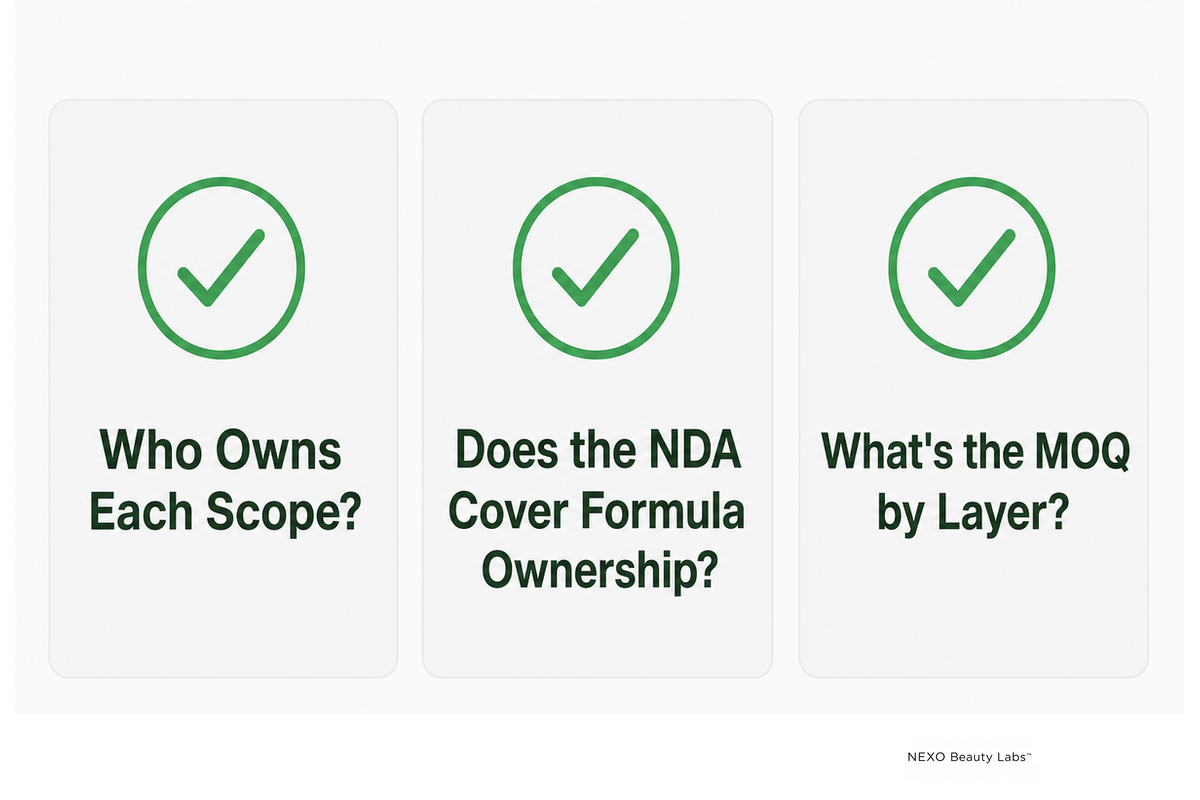
Manufacturer homepages tend to sound similar — clean ingredients, fast turnaround, dedicated support — and that similarity is exactly why comparing marketing language gets buyers nowhere. A more useful approach: read a supplier’s public positioning first, then check whether it’s backed by concrete, checkable specifics.
Positioning vs. Specifics Checklist. As one illustration of the pattern (not a criticism — this is common industry practice): Pravada Private Label’s public collections pages lead with launch-speed and trust-building language rather than a layer-by-layer MOQ breakdown or a named responsible-person policy. That’s not unusual, but it means a buyer has to ask for the specifics directly rather than assume the marketing copy already answers the sourcing questions.
Researching this space, you’ll come across dozens of private label manufacturers and private label products — names like Rainshadow Labs, Malibu Labs, Libby Labs, and GAR Labs show up regularly alongside Pravada in supplier directories and comparison lists of the best private label skincare manufacturer options. None of these names are endorsements or warnings; the point is that the private label skincare manufacturer landscape is large, and most of what differentiates one from another comes down to specifics behind the marketing, not which name sounds most established. The same applies to claims about being “the best private label skincare manufacturer” or a top-ranked skincare company — treat superlative language as a prompt to ask for specifics, not as the specifics themselves.
Location is worth asking about too. Manufacturing in the USA typically means faster domestic shipping and more straightforward MoCRA compliance conversations, while an overseas manufacturer may offer lower unit costs at higher minimums. Neither is automatically better — confirm which tradeoff matters more for your launch timeline and budget. NEXO Beauty Labs’ private label body care manufacturing services page lists the specific formats and development routes available if you want to compare a named domestic option against your other candidates.
A short set of questions separates suppliers that can back up their positioning from those that can’t:
| Question to ask | Why it matters | What a vague answer signals |
|---|---|---|
| Who owns formulation R&D, manufacturing QC, independent testing, and market/responsible-person duties? | These are often four separate scopes, not one bundled service — a project brief should assign each explicitly rather than assume one supplier covers all four. | A single vague “we handle everything” answer often means one or more of these scopes isn’t actually covered in writing. |
| Does an NDA also cover formula ownership and modification rights? | An NDA protects confidential information, but it does not by itself settle who owns the resulting formula, or whether the brand can take it to another manufacturer later. | If ownership terms aren’t in a separate written agreement, assume the manufacturer retains more rights than the brand expects. |
| What’s the MOQ broken down by formula, packaging, and label layer? | See the MOQ Layer Test above — the highest layer sets the real minimum. | A single headline MOQ number without a breakdown usually means the packaging or label constraint hasn’t been disclosed yet. |
US Regulatory Basics Every Buyer Should Know
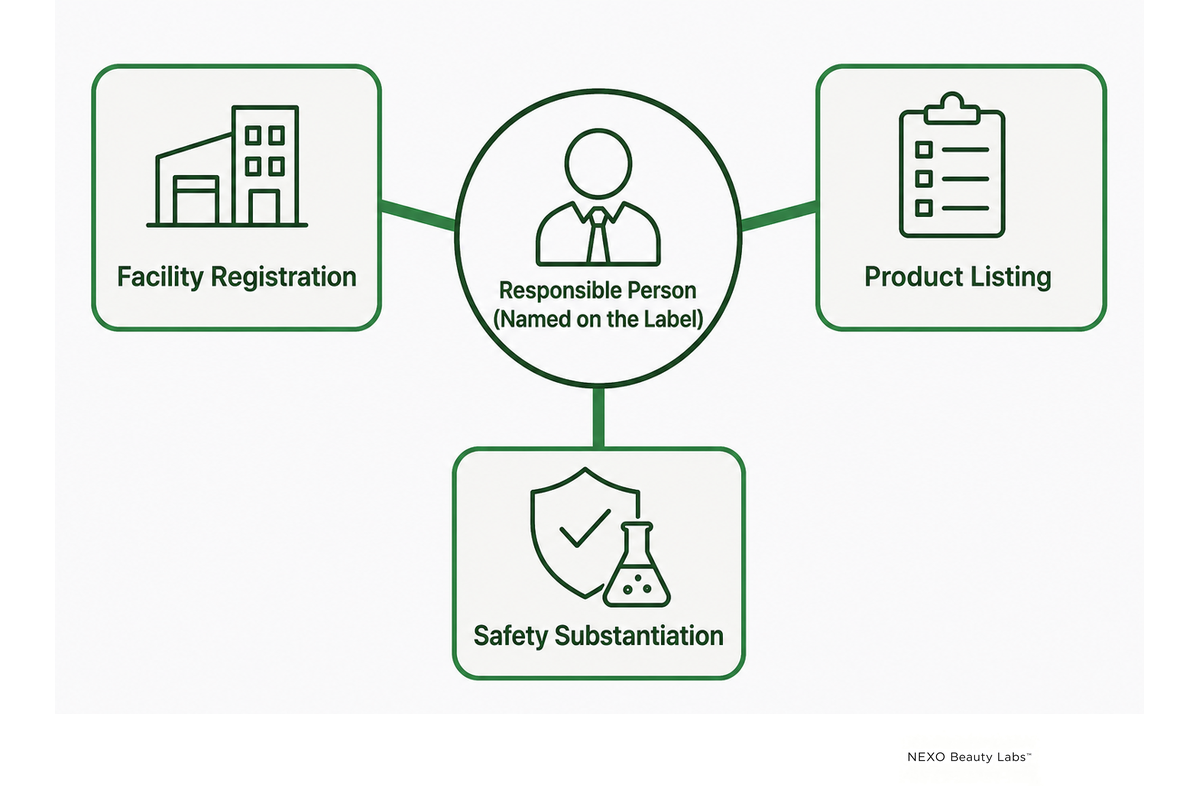
This section explains the regulatory framework a buyer should understand — it’s general education, not legal advice. Confirm your specific obligations, and who holds them, in a written project scope.
Assuming your manufacturer automatically owns every regulatory obligation is a common and costly mistake: facilities already operating when MoCRA took effect were given exactly one year — until December 2023 — to register, and that registration duty falls on whoever the written scope names, not on whoever happens to run the production line.
Under US law, a cosmetic is an article intended to be applied to the human body for cleansing, beautifying, or altering appearance. By contrast, a drug is an article intended to diagnose, cure, mitigate, treat, or prevent disease, or to affect the body’s structure or function — and drugs are regulated far more strictly than cosmetics. This distinction matters directly for body care claims: a lotion marketed as moisturizing stays a cosmetic, but the same lotion marketed to “treat eczema” or “cure dry skin” crosses into drug territory, with an entirely different regulatory burden. The FDA generally does not pre-approve cosmetic products before they reach the market, apart from specific color-additive requirements — the absence of pre-approval is not evidence that a product has been reviewed or is market-ready. The Modernization of Cosmetics Regulation Act of 2022 is the current framework governing these duties.
The Modernization of Cosmetics Regulation Act of 2022 (MoCRA) assigns specific duties to a named responsible person — the manufacturer, packer, or distributor whose name appears on the product label. That responsible person, not automatically the contract manufacturer, carries facility registration, product listing, and safety-substantiation duties. If your brand’s name goes on the label, confirm explicitly whether your brand or your manufacturing partner is taking on the responsible-person role — it should never be assumed by default. It’s also worth knowing that the FDA’s own registration and listing page states plainly that it does not issue “certificates” that would mean a facility or product is approved in the way that phrase implies; a facility registration confirms a manufacturer has registered, and an export certificate confirms specific statements for a foreign buyer — neither is a stamp of product approval.
Quality and Testing Standards to Look For
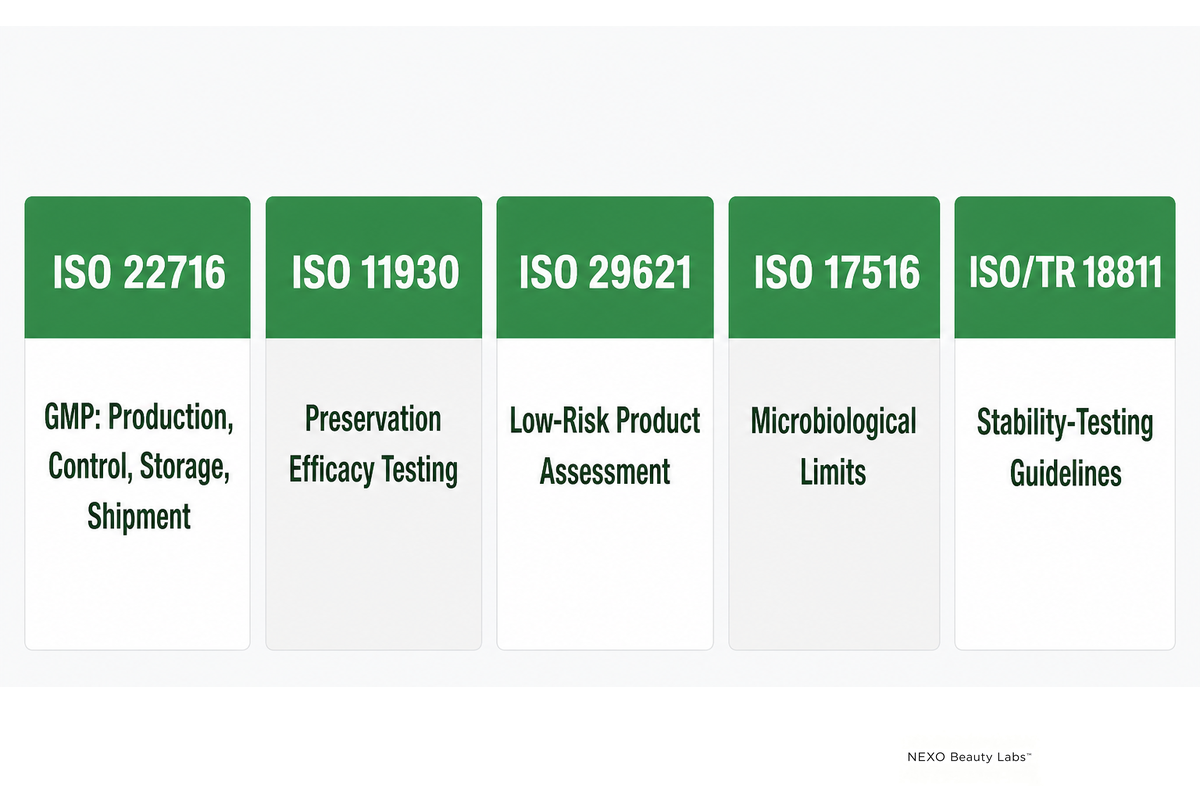
Several ISO standards govern different, non-overlapping slices of cosmetic quality, and it’s worth knowing what each one actually covers rather than treating “ISO certified” as one undifferentiated stamp of approval.
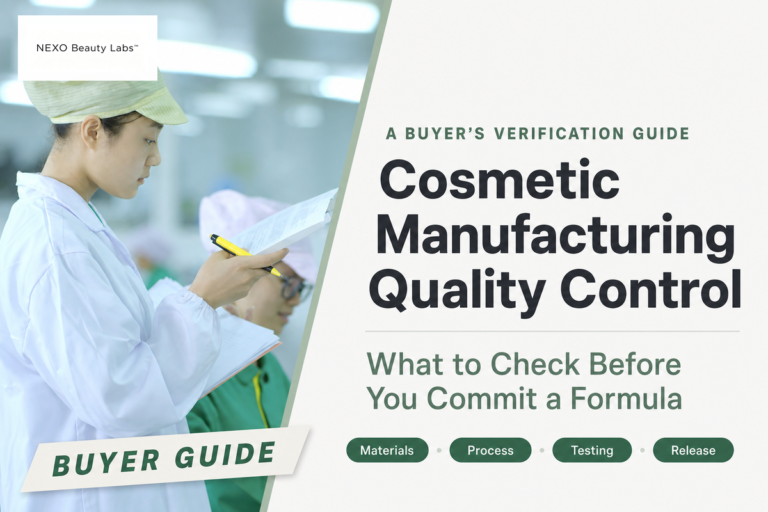
- ISO 22716 covers cosmetic good manufacturing practice — production, control, storage, and shipment. Its published scope explicitly does not extend to research and development, so formulation development and manufacturing quality control are properly evaluated as separate workstreams, not one bundled certification.
- Preservation-efficacy (challenge) testing, evaluating how well a formula resists microbial contamination over time, is governed by ISO 11930 — most relevant to water-based products like lotions and creams.
- Guidelines for identifying microbiologically low-risk cosmetic products come from ISO 29621, which can justify a lighter microbiological testing burden when the risk assessment supports it.
- Microbiological limits for cosmetic products are set by ISO 17516, used together with a documented risk assessment to confirm a product meets acceptable microbial levels.
- ISO/TR 18811 provides stability-testing guidelines, but it does not prescribe one universal set of conditions or pass criteria — a manufacturer is expected to specify and justify its own protocol for the specific formula and package.
Asking a manufacturer which of these standards its testing process actually follows — and for which product types — is a more useful question than asking whether they are “ISO certified” in general.
| Standard / Source | Scope | Applies To |
|---|---|---|
| ISO 22716 | Cosmetic GMP: production, control, storage, shipment | All formats |
| ISO 11930 | Preservation-efficacy (challenge) testing | Water-based formats (lotion, cream) |
| ISO 29621 | Low-microbiological-risk product assessment | Low-water-activity formats |
| ISO 17516 | Microbiological limits | All formats |
| ISO/TR 18811 | Stability-testing guidelines (no fixed protocol) | All formats |
| ISO 16128-1 | Natural/organic ingredient definitions (not claims/safety) | Formats with natural/organic claims |
| MoCRA (21 U.S.C. 364) | Responsible-person, facility registration, listing | All US-market formats |
| FDA cosmetic/drug definition (21 U.S.C. 321) | Cosmetic vs. drug classification boundary | All formats with therapeutic-adjacent claims |
| FDA export/facility certificates | Confirms registration/export statements only, not product approval | All formats sold internationally |
Formulation Development Routes: Stock, Adapted or Fully Custom
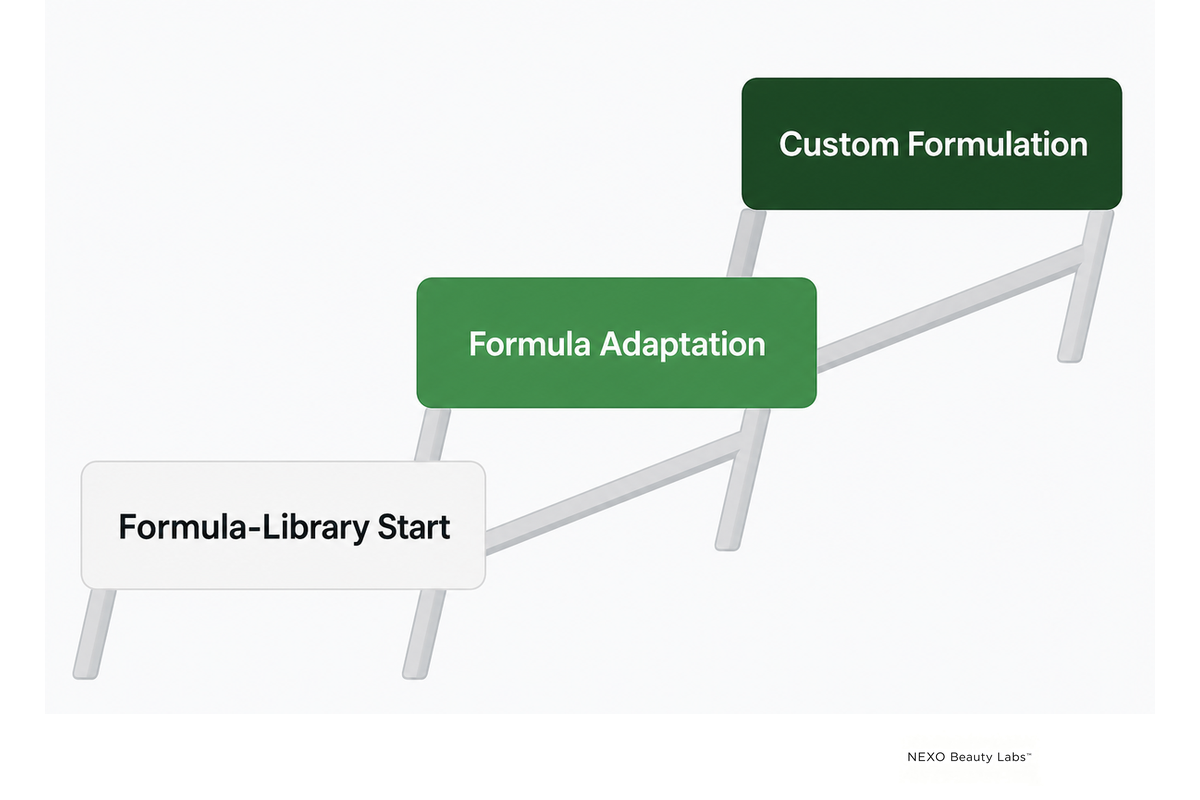
Most private label body care projects start from one of three development routes, and choosing the right one is largely a tradeoff between speed, cost, and creative control:
- Called a formula-library starting point, this route means the manufacturer offers an existing formula as-is or as a near-identical starting point. It’s the fastest and lowest-cost option, but limits differentiation — other brands may have access to the same or a very similar base.
- With formula adaptation, an existing formula is adjusted for texture, fragrance, skin feel, or format — a middle path that keeps development time reasonable while giving the brand meaningful input.
- Custom formulation starts from the brand’s concept, market, and sensory target rather than an existing base — products from scratch, in the fullest sense. It carries the longest timeline and typically the highest minimum commitment, but delivers the most differentiated result.
None of these routes is inherently better — a brand testing initial demand may reasonably start with a formula-library product, then move to adaptation or custom formulation once the category is validated. Whichever route you choose, ask directly whether the manufacturer’s custom formulation services include sensory-target adjustment (see the next section) or only concentration and fragrance-level changes — “custom” means different things to different suppliers. NEXO Beauty Labs describes its own formula-to-pack development routes for body care on its solution page.
How Professional Formulators Judge Texture and Feel
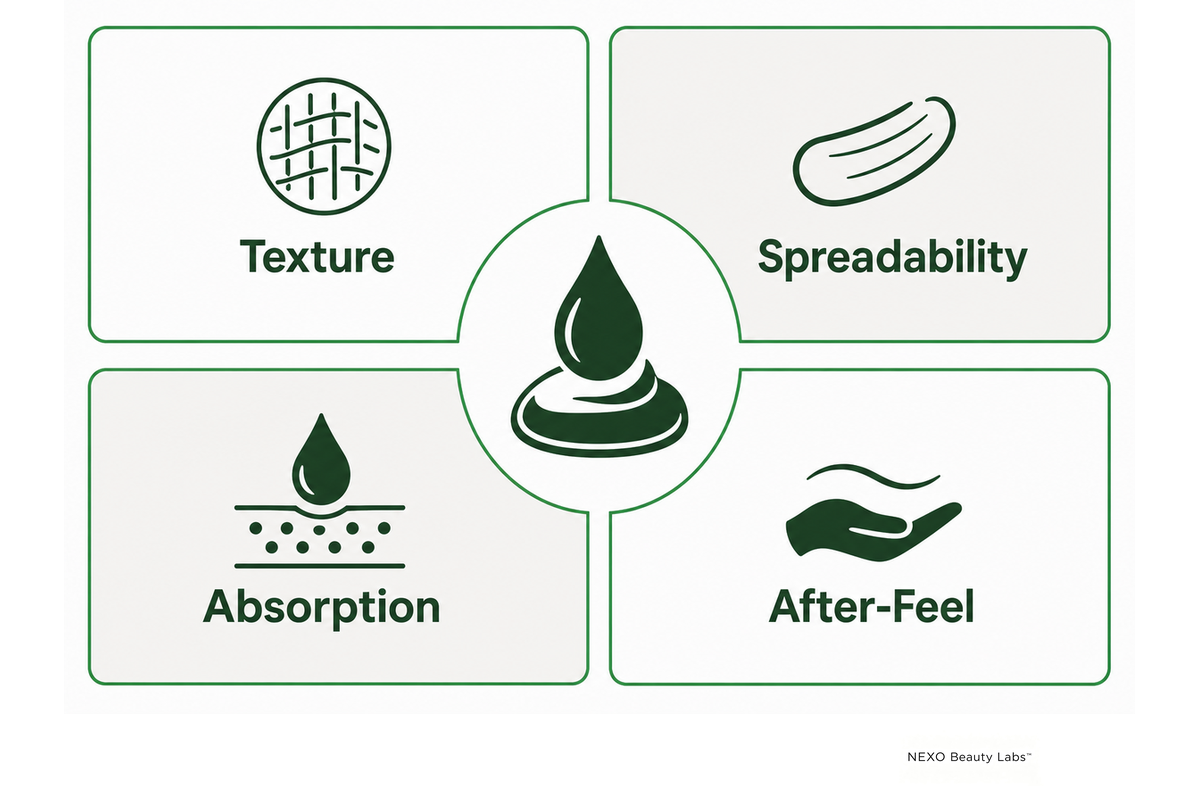
“I want it to feel nice” isn’t a formulation brief a manufacturer can act on. A brief that only says “lightweight” leaves the formulator guessing whether the real goal is fast absorption or a dry after-feel — an ambiguity that can cost weeks of resubmission. Professional formulators instead evaluate texture across four distinct sensory dimensions, as part of the same quality-control discipline ISO 22716 governs at the manufacturing stage:
- Texture — how the product looks and behaves at rest and during application: thick or thin, gel-like or creamy, whipped or dense.
- Spreadability — how easily the product moves across skin during application, and how much force that takes.
- Absorption — how quickly the product is taken up by the skin, versus sitting on the surface.
- After-feel — what the skin feels like once the product has finished absorbing: matte, dewy, tacky, or silky.
Describing your desired product using these four dimensions — rather than a single adjective like “lightweight” — gives a formulator a much clearer target, and makes it easier to evaluate whether a sample actually matches your brief.
2026 Market Trends Shaping Private Label Body Care
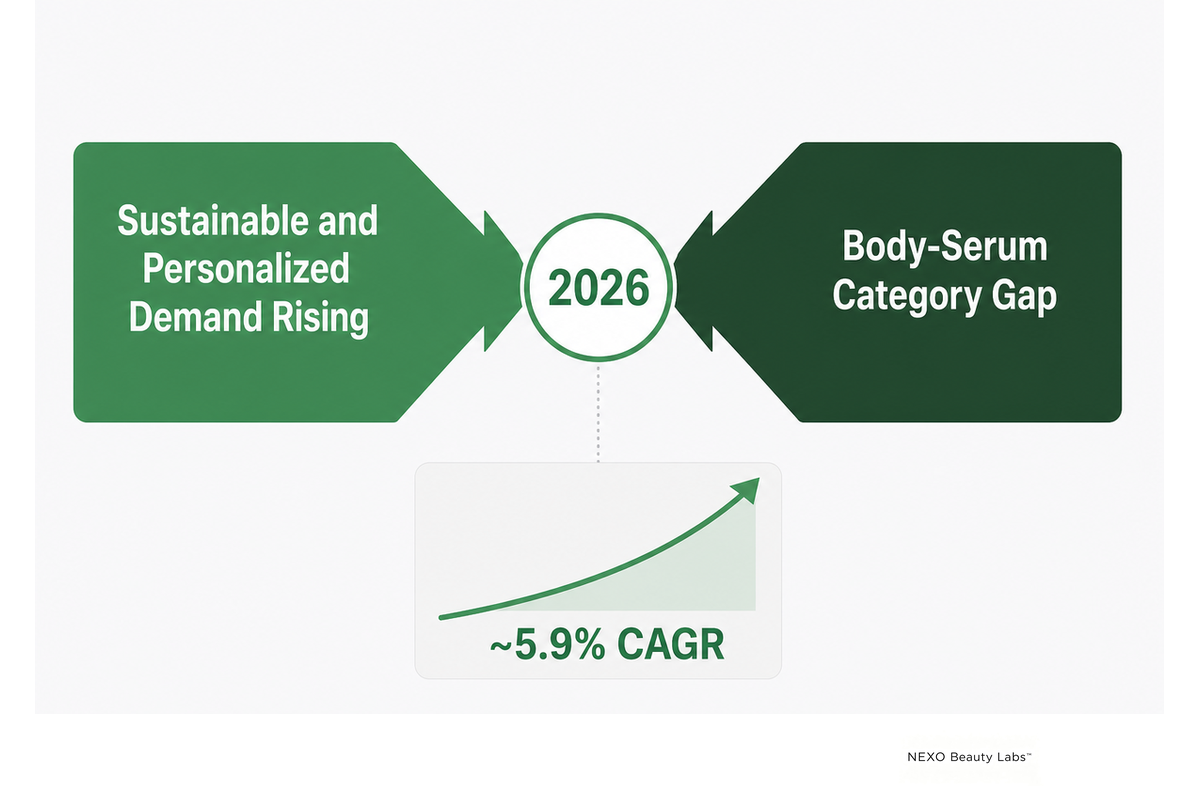
Two forces are converging on private label body care in 2026 that matter more to a buyer’s timing decision than any single market-size figure: rising demand for sustainable and personalized formats, and a body-serum category gap that most private label catalogs still haven’t filled. Body serums are trending in broader skincare, yet relatively few private label suppliers have built serum-specific body-care offerings compared to the well-covered lotion and scrub categories — which means a brand willing to move into that gap now has a real timing advantage over brands entering an already-crowded lotion category, independent of overall market growth (see this 2026 trend roundup for the broader category picture).
The broader numbers back up the direction, even if they shouldn’t be the whole basis for a launch decision. Industry estimates put the global body care market at a compound annual growth rate of roughly 5.9%, heading toward an estimated $27.77 billion by 2034 (secondary-source estimate). Reported buyer priorities lean toward sustainable, minimal-packaging formulations, natural ingredients, and biotech-derived actives — broadly the same clean beauty direction shaping the wider skincare industry — alongside growing interest in personalized or tailored formulation options. This doesn’t mean every private label body care product needs to be built from scratch with a fully custom formula; a formula-library or adaptation route can still incorporate natural ingredients or a cleaner claims profile if that direction is stated in the brief. On the packaging side, mono-material and refillable systems — PCR plastic and glass jars with bamboo lids among the more visible choices — are gaining traction as brands respond to the same sustainability pressure. None of these figures should be treated as precise forecasts; they’re directional industry estimates, useful for gauging where demand is heading, not a substitute for validating demand in your own specific category and price point.
Claims and Labeling: What “Natural,” “Vegan” and “Cruelty-Free” Actually Mean
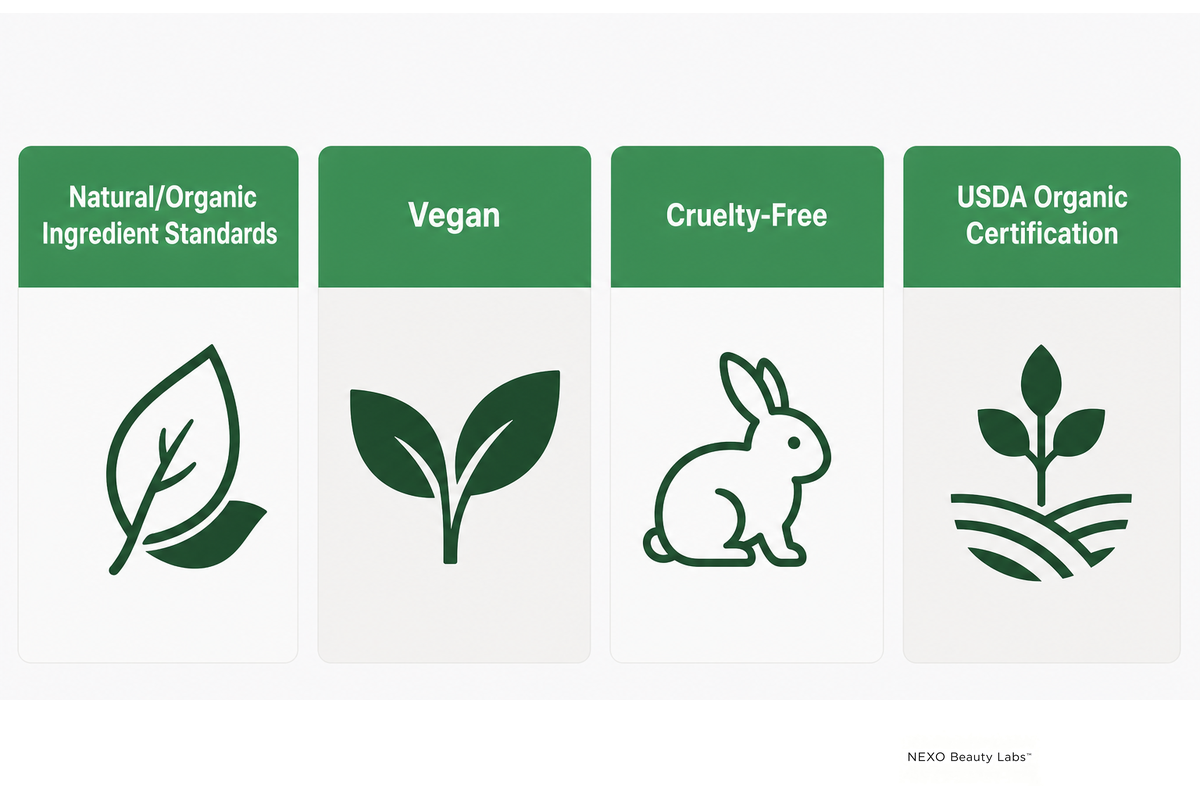
These three claims get bundled together in marketing copy, but they answer three separate questions, and a product can honestly qualify for one without qualifying for the others — ISO 16128-1 is a useful starting point for the first one.
- Ingredient standards for natural / organic claims, such as ISO 16128-1, provide definitions for what counts as a natural or organic ingredient — but that standard’s scope explicitly does not extend to claims, human safety, packaging, or broader regulatory requirements. Meeting an ingredient-sourcing definition is not the same as substantiating a marketing claim.
- Vegan means no animal-derived ingredients. It doesn’t, by itself, establish cruelty-free status.
- A separate claim about testing practices, cruelty-free requires raw-material suppliers, contract laboratories, historical testing records, and current company policy to all be reviewed independently. A peer-reviewed study of products marketed as “clean” found that a large majority still contained at least one potential allergen, a reminder that a marketing label and an ingredient-safety profile aren’t automatically the same thing.
- USDA Organic is a distinct, formally regulated certification with its own qualifying-ingredient percentage thresholds — it isn’t interchangeable with a generic “organic skincare” or “natural products” marketing claim, and a manufacturer can’t apply the USDA Organic seal to a formula that hasn’t gone through that certification process.
If your brand plans to make any of these claims — whether for a general skin care product or a line of natural skincare positioned around specific skin concerns — confirm with your manufacturer in writing exactly which claim they can substantiate and how, rather than assuming one clean-sounding label covers all four. Ask specifically how the products are made and tested, not just how they’re marketed, before committing to a “natural” or “private label natural” position across multiple SKUs.
From Brief to Production: What the Process Looks Like
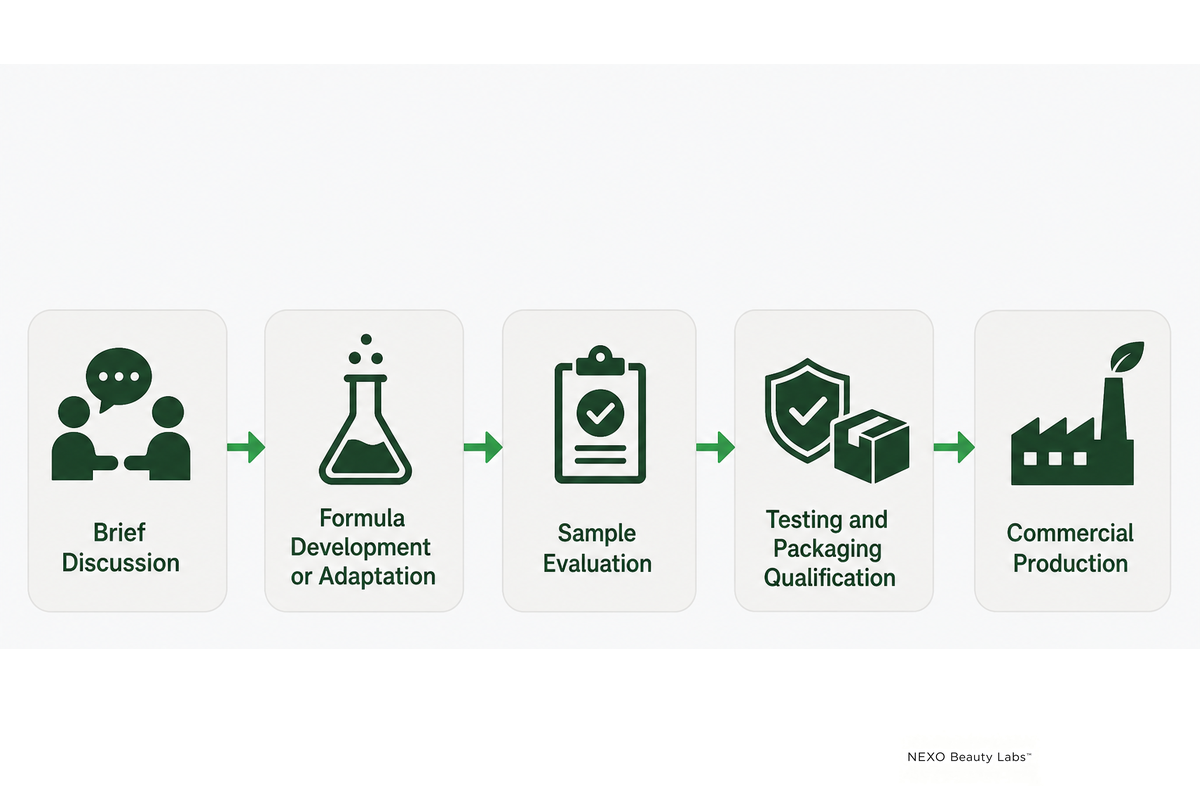
While every manufacturer structures its process a little differently, most private label body care projects move through a similar sequence: an initial product-brief discussion to align on format, texture, fragrance and target market; formula development or adaptation against that brief; sample evaluation, where the brand assesses texture, fragrance and skin feel against the four sensory dimensions above; testing and packaging qualification, confirming stability and packaging compatibility together rather than sequentially; and finally commercial production and delivery once the formula and packaging are both approved.
One practical note: packaging decisions made too late in this sequence are a common source of rework. If packaging compatibility testing happens after the formula is already finalized, a mismatch can force a return to the formulation stage. Defining your packaging direction as part of the initial brief — not as an afterthought once the formula is locked — avoids the most common cause of project delay.
Whether a brand is building a new beauty brand from a ready-made private label starting point or developing custom skincare formulations from scratch, the beauty industry rewards brands that treat this process as a sequence of confirmed decisions rather than a single handoff. Skincare companies and body care manufacturers in the USA alike expect a brief that states clear skincare needs up front; skincare manufacturers in the USA and overseas both work faster against a specific brief than a general request to “launch your skincare brand.” A private label body care line built this way — high-quality products backed by a clear brief — gives a new skincare brand or skincare line the best odds of a smooth first production run.
Ready to start your private label body care project?
NEXO Beauty Labs works across lotion, cream, wash, scrub, oil, and hand and foot care formats, with formula-to-pack development support.
Discuss Your Body Care Project
Frequently Asked Questions
What are private label body care products?
Private label body care products are lotions, washes, scrubs, oils, and hand or foot care items that a manufacturer develops and produces, then sells to a brand to market under its own name and packaging. The brand controls positioning, pricing, and label design, while the manufacturer handles formulation, sourcing, and batch production. It differs from reselling finished retail goods, because the brand owns the product identity even though another company makes it.
Is private label body care profitable?
Profitability depends less on the private label model itself and more on how a brand manages three variables: minimum order quantity against realistic sell-through, the margin gap between manufacturing cost and retail price, and how differentiated the product feels next to competitors. Private label lowers the barrier to launching a line by removing in-house production costs, but it doesn’t remove the need for real demand validation and a pricing strategy that survives shipping and marketing costs.
How do I find a private label body care manufacturer?
Start by narrowing manufacturers to those with direct experience in the specific format you want, since a supplier strong in body wash formulation isn’t automatically strong in body butter or oil-based products. Compare minimum order quantities at the packaging level, ask how formulation and safety-substantiation responsibilities are divided, and request a written project scope before assuming any capability. Treat marketing language as a starting point for questions, not a substitute for confirmed specifics.
What’s the difference between private label and white label body care?
Private label usually implies formula adaptation toward your brief; white label usually means selecting from a fixed, ready-made catalog with little formula change. Neither term is standardized, so confirm what a given supplier actually means by it before you assume.
Does a manufacturer’s certificate mean my product is FDA-approved?
No. The FDA does not pre-approve cosmetic products, and it does not issue a “certificate” that means a product or facility is approved in the way that term implies. A facility registration confirms a manufacturer registered with the FDA, and an export certificate confirms specific statements for a foreign buyer — neither is evidence a finished product has been reviewed and approved. Responsibility for safety substantiation sits with the responsible person named on the label.
What information should I prepare before contacting a manufacturer?
Come with a clear product format, a rough texture and fragrance direction, your target market, desired claims, and an honest first-order quantity range. Suppliers move faster with a specific brief than a vague one — NEXO’s manufacturing experience works fastest that way too.
References & Sources
- FDA — Modernization of Cosmetics Regulation Act of 2022 (MoCRA)
- FDA — Is It a Cosmetic, a Drug, or Both? (Or Is It Soap?)
- FDA — Registration & Listing of Cosmetic Product Facilities and Products
- ISO 22716 — Cosmetics Good Manufacturing Practices
- ISO 11930 — Cosmetics Microbiology, Preservation Efficacy Testing
- ISO 16128-1 — Natural and Organic Cosmetic Ingredients and Products, Definitions