Get in touch with NEXO Beauty Labs Company


Updated September 2026
Cosmetic manufacturing quality control is the documented quality control system used to check materials, production conditions, finished products, packaging, and release evidence against written acceptance criteria. For a beauty brand, the practical test is not whether a factory says “GMP” or sends a certificate. The test is whether the manufacturer can show what was checked, by which method, against which limit, by whom, and what happened when a result failed.
That evidence matters before a formula is committed because the same certificate can sit above very different product scopes, sampling plans, laboratory methods, and investigation practices. This buyer-side guide explains where to look, which records to request, and which responsibilities still remain with the brand or market-side responsible person. Across the cosmetics industry, credible cosmetic quality control procedures link quality and safety claims to the records behind each decision.
Fast answer: Verify five linked control points: incoming materials, in-process checks, finished-product testing, stability and pack compatibility, and documented batch release. One gap can weaken the evidence for the whole batch.
1. What Cosmetic Manufacturing Quality Control Actually Covers
Quality control for cosmetics covers the measurements, samples, tests, records, and release decisions attached to a defined product and batch. Quality assurance designs and reviews the system; the quality control process generates and evaluates the product quality evidence used inside it. A factory tour or wall certificate cannot replace either function.
The control boundary starts before production and extends beyond filling. FDA inspection guidance identifies contamination routes that include raw materials, water, poor manufacturing conditions, ineffective preservation, packaging, storage, and shipping; it doesn’t rank one route as the cause of most failures. Documented quality monitoring can reveal batch-to-batch drift and potential quality issues before they become recurring failures.
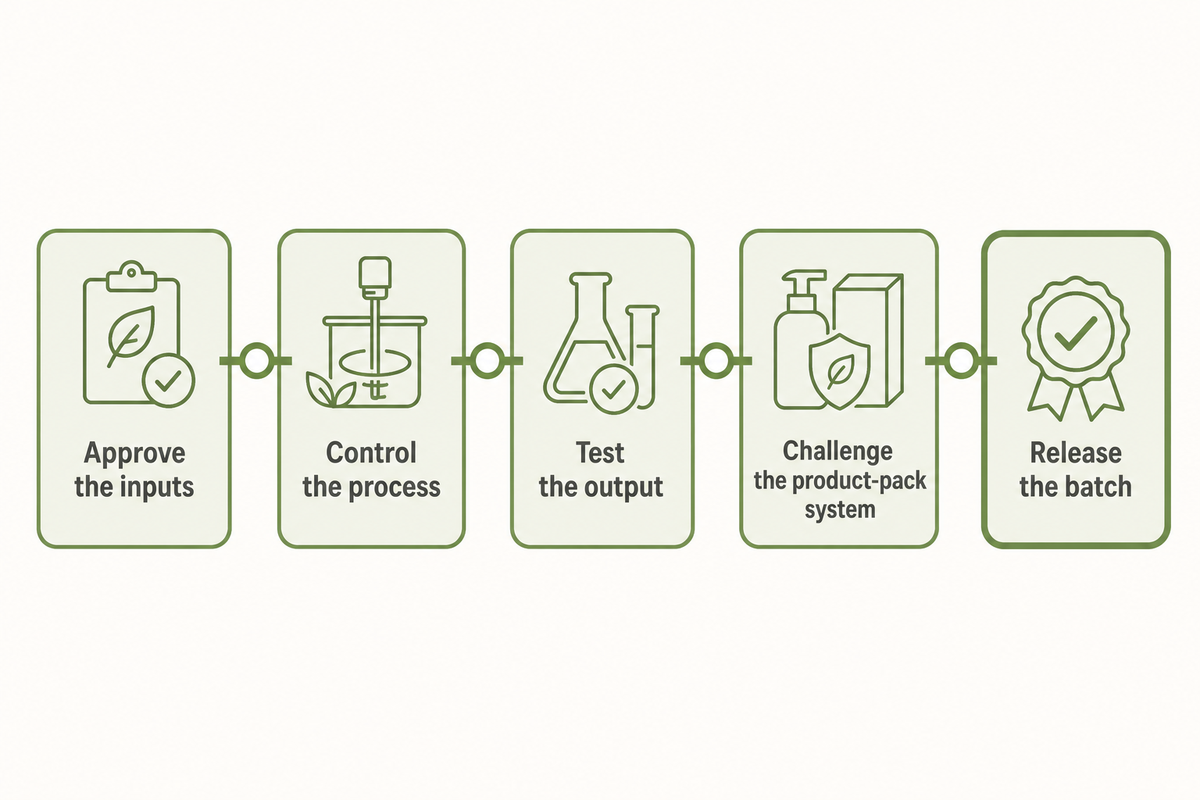
- Approve the inputs — match the purchase order, delivery record, supplier reference, internal receipt code, and acceptance evidence.
- Control the process — follow standard operating procedures and record additions, times, temperatures, speeds, sampling points, and cleaning against the batch instruction.
- Test the output — use defined physical, chemical, and microbiological methods that are suitable for the product matrix.
- Challenge the product-pack system — examine stability, package interaction, transport, storage, and foreseeable use conditions.
- Release the batch — reconcile the records, deviations, test results, label status, and authorized decision before shipment.
Buyers can use those five control points to compare cosmetic factory capabilities without reducing the decision to equipment photos. Each point should lead to a named record, not a verbal assurance. This is how cosmetic manufacturers implement quality control practices across a batch rather than describing an ideal system.
Evidence capsule: FDA’s inspection page names seven broad contamination routes across inputs, manufacturing, preservation, packaging, storage, and shipping. The useful buyer question is therefore “show me the connected controls,” not “which single test proves quality?”
2. The Standards Behind It: ISO 22716, Good Manufacturing Practices, and What the FDA Actually Says
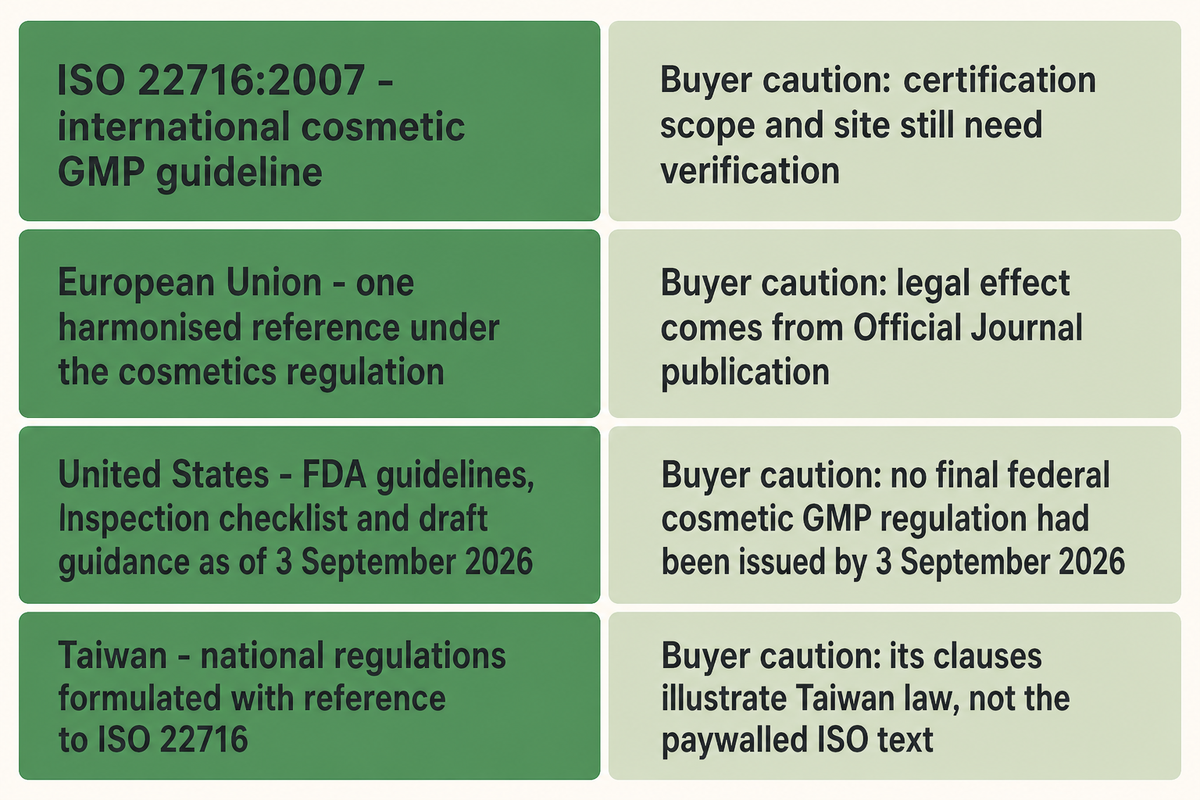
ISO 22716:2007 is a current international guideline for cosmetic good manufacturing practices, last reviewed and confirmed in 2022. It addresses production, control, storage, and shipment, but it isn’t a worldwide statute and doesn’t replace the market-specific legal duties of the brand, importer, or responsible person. It is one source of best practices for cosmetic manufacturing, not a substitute for applicable regulatory requirements, industry regulations, or safety standards.
The European Commission’s harmonised-standards page for Regulation (EC) No 1223/2009 lists one entry: EN ISO 22716:2007, first published in the Official Journal on 21 April 2011, with no superseded reference or cessation date shown. The Commission also warns that its web list may be incomplete and has no legal effect by itself; the Official Journal publication controls.
Health Canada says the United States, European Union, Japan, and Canada endorse ISO 22716 through the International Cooperation on Cosmetic Regulation. Its guidance also makes an important boundary clear: good manufacturing practice describes expected outcomes rather than one required recipe for how every manufacturer must produce a cosmetic. Guidance from regulators and industry associations, quality standards, and industry best practices must all be translated into site-specific controls.
“incorporate, modify or exclude specific aspects”
That short phrase explains why an ISO certificate and FDA status are not interchangeable. FDA’s current inspection page says there are no federal cosmetic GMP regulations; the agency has guidelines and an inspection checklist, while its draft guidance is nonbinding. Taiwan’s Cosmetics Good Manufacturing Practice Regulations, by contrast, are binding national rules formulated with reference to ISO 22716 and provide a free clause-by-clause example of GMP-level controls.
| Framework | What it establishes | Buyer caution |
|---|---|---|
| ISO 22716:2007 | International cosmetic GMP guideline; current edition confirmed in 2022 | Certification scope and site still need verification |
| European Union | One harmonised reference, EN ISO 22716:2007, under the cosmetics regulation | Legal effect comes from Official Journal publication |
| United States | FDA guidelines, inspection checklist, and a draft guidance as of 3 September 2026 | No final federal cosmetic GMP regulation had been issued by that date |
| Taiwan | National regulations formulated with reference to ISO 22716 | Its clauses illustrate Taiwan law, not the paywalled ISO text |
3. Raw Material Control: Qualify the Supplier Before You Trust the Certificate
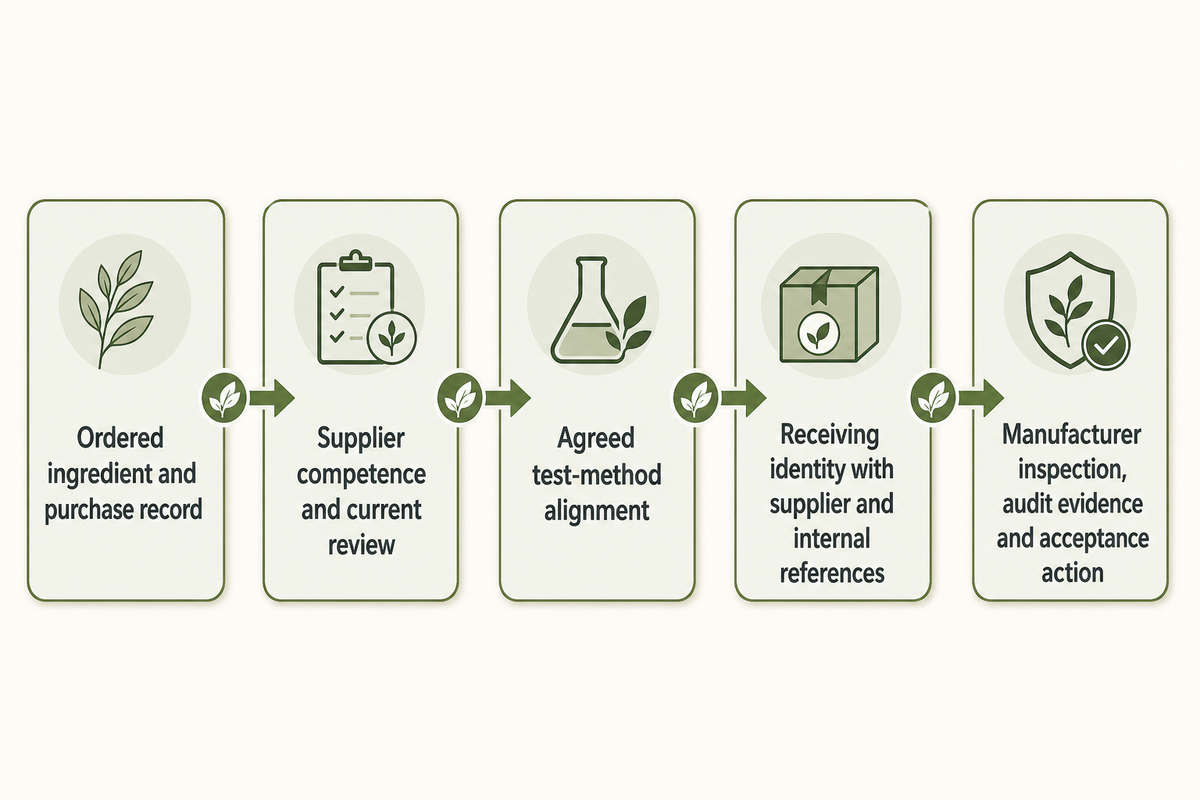
Raw material control is the chain that connects an ordered ingredient to the material weighed into a batch. Supplier certificates of analysis can form part of acceptance, but each document becomes meaningful only when supplier competence, method alignment, receiving identity, and audit evidence are connected. Traceability therefore starts with the sourcing of raw materials, not at the mixing vessel.
Taiwan’s regulation provides a precise test. Taiwan Article 36.3 permits reliance on a supplier analysis certificate only when the supplier has sufficient competence and knowledge, agrees with the company’s test methods, and is subject to suitable inspection and audit by the manufacturer. The certificate is conditional evidence, not an automatic substitute for control.
Articles 34 and 35 add two record checks a buyer can request: the purchase order, delivery note, and receiving record should match, while the received material should carry both the supplier’s batch reference and the internal reference assigned at receipt. FDA’s checklist calls for extra attention to animal- or vegetable-origin materials and materials used in cold-processed cosmetics.
The sharper supplier question
Do not stop at “Do you collect certificates of analysis?” Ask: Which ingredient suppliers have you audited, what did you find, and how did those findings change incoming acceptance?
Credible answers identify the supplier, material, approved specification, agreed method, most recent review, deviations found, and resulting action. A generic supplier score or an unsigned certificate does not show that the ingredient in your formula passed the manufacturer’s own acceptance path.
4. In-Process Quality Control: The Checks That Happen While the Batch Is Moving
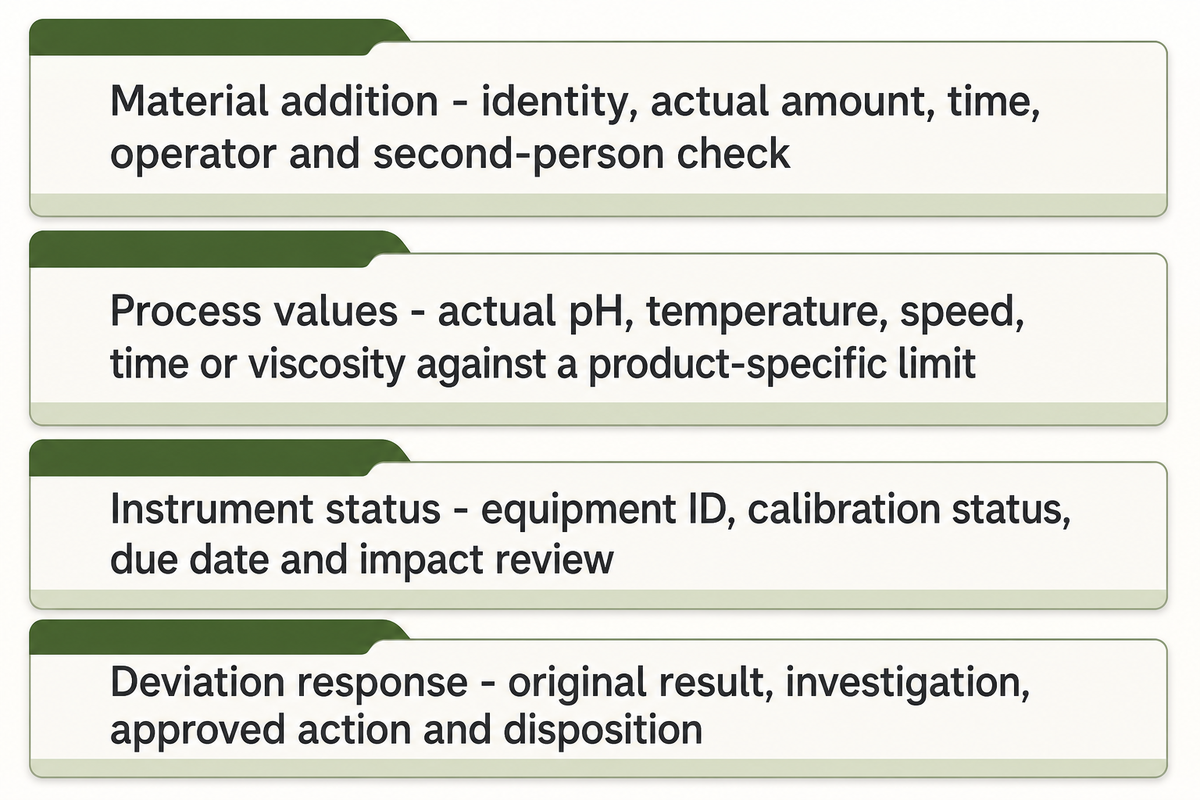
In-process quality control confirms that the batch follows its approved manufacturing process while corrections are still possible. The useful evidence is a time-linked record of actual values and operator checks, not a polished flowchart created for a sales presentation. A defined production process supports consistent quality by making variation visible before release.
No regulator in the reviewed evidence prescribes one pH range, viscosity band, mixing speed, temperature, or calibration interval for all cosmetics. Health Canada explicitly leaves the means of achieving GMP outcomes to each manufacturer, and Taiwan requires regular calibration of equipment plus checks at an established period. Each quality control test for cosmetics becomes meaningful only after its method and limit are named.
Product and equipment differences make the factory’s written plan decisive. Taiwan Article 41 shows what a manufacturing document may need to carry: material additions, temperature, speeds, mixing time, sampling, equipment cleaning, control stages, and acceptance criteria. To reduce human error, FDA’s checklist says raw-material weighing and measuring should be checked by a second person, with containers properly identified.
| Record field | What the record should connect | Warning sign |
|---|---|---|
| Material addition | Identity, actual amount, time, operator, second-person check | Pre-filled values with no time trail |
| Process values | Actual pH, temperature, speed, time, or viscosity against a product-specific limit | A universal range reused across unrelated formulas |
| Instrument status | Equipment ID, calibration status, due date, and out-of-tolerance impact review | “Calibrated” with no device or date |
| Deviation response | Original result, investigation, approved action, and disposition | A replacement result with no reason for retesting |
Taiwan Article 53 permits retesting only for a sufficient and legitimate reason. Ask for the last three out-of-specification investigations, including one that led to rejection or rework if available; the request tests whether limits govern decisions or merely decorate the record.
5. Finished-Product Testing: Physical, Chemical, and Microbiological Release Criteria
Quality control of cosmetic products at release compares a representative sample with approved specifications using named methods. Passing results support a release decision only within the sample, method, detection conditions, and acceptance limits used; they don’t prove every unit is defect-free. That quality testing may combine physical tests, chemical measurements, checks for microbial contamination, and product performance evidence where the pack or claim requires it.
What Are the Four Types of Quality Control?
For buyer review, four useful groupings are identity and appearance, physical or chemical measurements, microbiological evaluation, and packaging or functional checks. The groupings are a purchasing framework, not a universal legal taxonomy, and the exact test menu changes with formula, pack, claims, market, and user group. The menu should reflect cosmetic science, foreseeable contact with the skin, and the safety and quality risks that affect the quality of cosmetics in actual use.
Public regulator guidance applying ISO 17516:2014 criteria reports nominal limits of 1 × 10² CFU/g or ml for Category 1 products used around the eyes, on mucous membranes, or by children under three, and 1 × 10³ CFU/g or ml for Category 2 products. Because plate counts vary, results above 200 CFU/g or ml and 2,000 CFU/g or ml respectively are interpreted as exceeding those limits; the same criteria require Escherichia coli, Pseudomonas aeruginosa, Staphylococcus aureus, and Candida albicans to be absent in 1 g or 1 ml.
Evidence capsule: Bolzon and colleagues selected six cosmetic matrices and spiked samples with 3–5 CFU/g of four common cosmetic pathogens. For C. albicans, plate count verified the inoculum at 3.9 CFU/g; after 36 hours of enrichment, real-time PCR returned at least 4 of 7 positive replicates across all formulations, while reference plate methods missed the organism in the tested cream and gel matrices. This is a single, industry-authored study: two authors disclosed employment by a cosmetic contract manufacturer and another by a pharmaceutical company; the paper reports no external funding.
The single 2025 peer-reviewed study doesn’t make real-time PCR a routine release requirement. The authors call for standardized protocols aligned with ISO guidance, and the result shouldn’t be generalized beyond the six matrices studied. Its buyer lesson is narrower: culture-based testing at low cell counts can depend on matrix and method suitability, so sampling and method validation deserve separate questions.
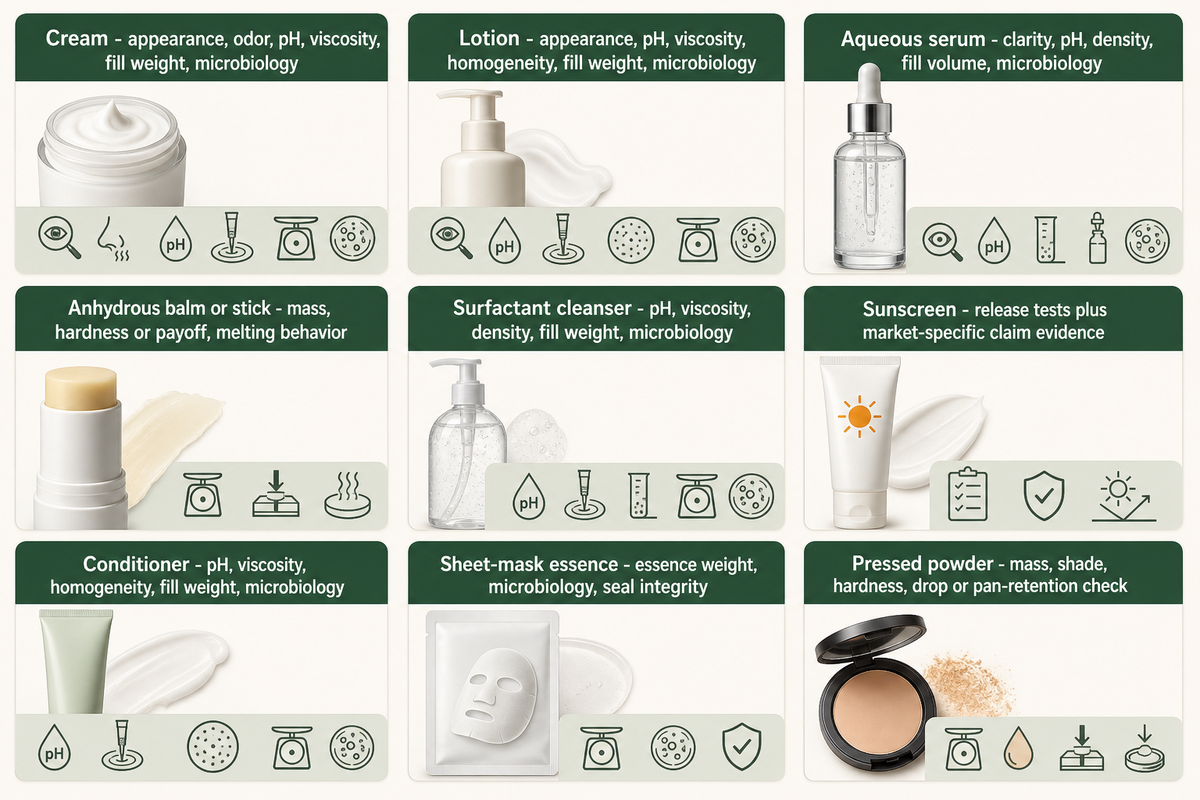
The Product-Type QC Test Menu below is a brief-building tool, not a fixed standard. Copy only the relevant row into your request, then ask the manufacturer to name the test method and acceptance criterion it proposes.
| Product type | Release evidence to discuss | Extra method question |
|---|---|---|
| Cream | Appearance, odor, pH, viscosity, fill weight, microbiology | How was the microbial method shown suitable for an emulsion? |
| Lotion | Appearance, pH, viscosity, homogeneity, fill weight, microbiology | At which temperature and spindle conditions is viscosity read? |
| Aqueous serum | Clarity or appearance, pH, density, fill volume, microbiology | Does sampling cover the start, middle, and end of filling? |
| Anhydrous balm or stick | Appearance, odor, mass, hardness or payoff, melting behavior | Which water-activity or microbial rationale supports the plan? |
| Surfactant cleanser | Appearance, pH, viscosity, density, fill weight, microbiology | How are foam and air entrainment controlled during sampling? |
| Sunscreen | Physical and microbial release tests plus market-specific claim evidence | Which independent protocol supports the labeled protection claim? |
| Conditioner | Appearance, pH, viscosity, homogeneity, fill weight, microbiology | How is method interference from conditioning agents checked? |
| Sheet-mask essence | Appearance, pH, viscosity, essence weight, microbiology, seal integrity | Is the finished pouch sampled, not only the bulk essence? |
| Pressed powder | Appearance, mass, shade, hardness, drop or pan-retention check | How is shade assessed against an approved physical standard? |
Use a manufacturer’s laboratory-services arrangement as a prompt to verify which tests are performed at the proposed site and which are outsourced. An on-site instrument, a qualified method, an authorized analyst, and an independent claim test are four different things. The aim is not a generic promise of high-quality cosmetics but product performance and release evidence suited to the formula.
6. Stability and Shelf Life: The Test That Runs Longer Than Your Launch Window
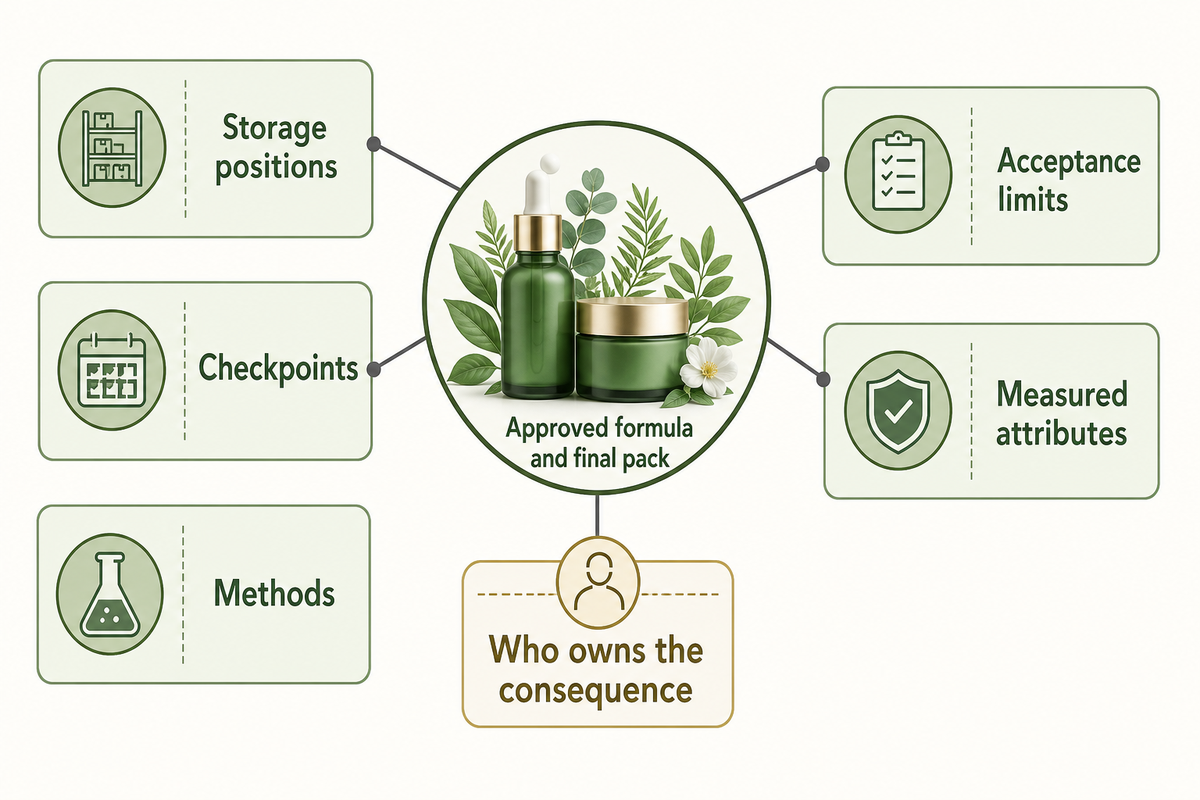
Stability work examines how a formula and its package change over defined time and conditions. ISO/TR 18811 offers guidance for cosmetic stability testing but does not prescribe one universal temperature, humidity, duration, or sampling calendar for every product. The stability of products must therefore be judged against named attributes and an approved protocol.
“40°C for three months” appears often in published cosmetic practice, yet it should be treated as a study design choice rather than a law. A useful protocol states why each condition was selected, which attributes are measured, what counts as failure, how the intended shelf life is inferred, and which market storage or transport exposures remain outside the study.
The package belongs inside that protocol because formula contact can change color, odor, viscosity, evaporation, leakage, dosing, seal performance, and component integrity. Read the detailed guides to cosmetic stability testing and packaging compatibility testing before freezing a launch date.
Evidence capsule: A three-month accelerated study covers about 90 days under its stated conditions, not every transport route or consumer bathroom. The protocol should link the formula, final pack, storage positions, checkpoints, methods, and acceptance limits to one approved version.
Place the study beside the skincare product development process, not after commercial production has already begun. An early result can support a risk decision, but only the agreed contract should say whether that evidence is enough to proceed and who owns the consequence.
7. Documentation and Release: Batch Records, Certificates of Analysis, and What They Prove
Batch release is an authorized decision built from reconciled manufacturing records, deviations, test results, and labeling or packaging status. A certificate of analysis summarizes selected results; it isn’t the complete batch history and can’t show every correction, hold, investigation, or line-clearance event. Together, the underlying records protect the integrity of cosmetic products by preserving what actually happened.
Taiwan Articles 81 and 82 require records to be written in permanent ink, signed, and dated, with corrections leaving the original entry readable. Revised documents carry a revision number and the reason for revision is retained. Those features make a record traceable rather than merely tidy.
Release Document Decoder
| Document | Useful evidence | Still ask for |
|---|---|---|
| Certificate of analysis | Batch identity, selected specifications, results, status, and approval | Methods, sampling plan, raw data access, and investigation links |
| Batch manufacturing record | Actual additions, equipment, process values, times, operators, and yields | Approved master version and unexplained edits or blanks |
| Deviation or out-of-specification report | Original event, investigation, root cause, action, and disposition | Impact on related batches and proof the action was effective |
| Retention-sample log | Batch, quantity, location, package form, retention period, access | Enough material for analysis and the complete market pack |
| Artwork approval | Approved version, market, language, code, and sign-off | Who owns legal review and line-side version control |
Taiwan Article 57 specifies that retention samples should be sufficient for analysis and kept with complete packaging. Artwork approval deserves the same attention because release evidence can be technically sound while the wrong label version reaches the line; the cosmetic labeling requirements guide covers that separate market-facing review.
8. What an ISO 22716 Certificate Does and Does Not Tell You
An ISO 22716 certificate indicates that a certification body assessed a named organization, site, activity scope, and period against stated criteria. The certificate doesn’t, by itself, prove that your product category, outsourced laboratory, warehouse, batch, market claim, or current corrective action sits inside that assessed scope. Phrases such as commitment to quality, stringent quality, culture of excellence, and quality products remain marketing language until matched to that scope and evidence.
The Scope-Before-Certificate Rule
Read the scope line before reading the logo. Match the legal entity, manufacturing address, covered activities, standard edition, issue and expiry dates, certificate number, and certification body to the proposed supply chain. Then verify the record through the issuing body or a public registry rather than relying only on the PDF supplied by sales.
NSF/ANSI 455-3 listings offer one free verification route for facilities certified under that program. Its scope can cover manufacturing, packaging, warehouse, or distribution activities and related best practices, so a public match still needs to be read for what is and isn’t included. Different revision cadences don’t make ISO 22716 obsolete; they mean the buyer must identify the exact scheme and edition behind a claim.
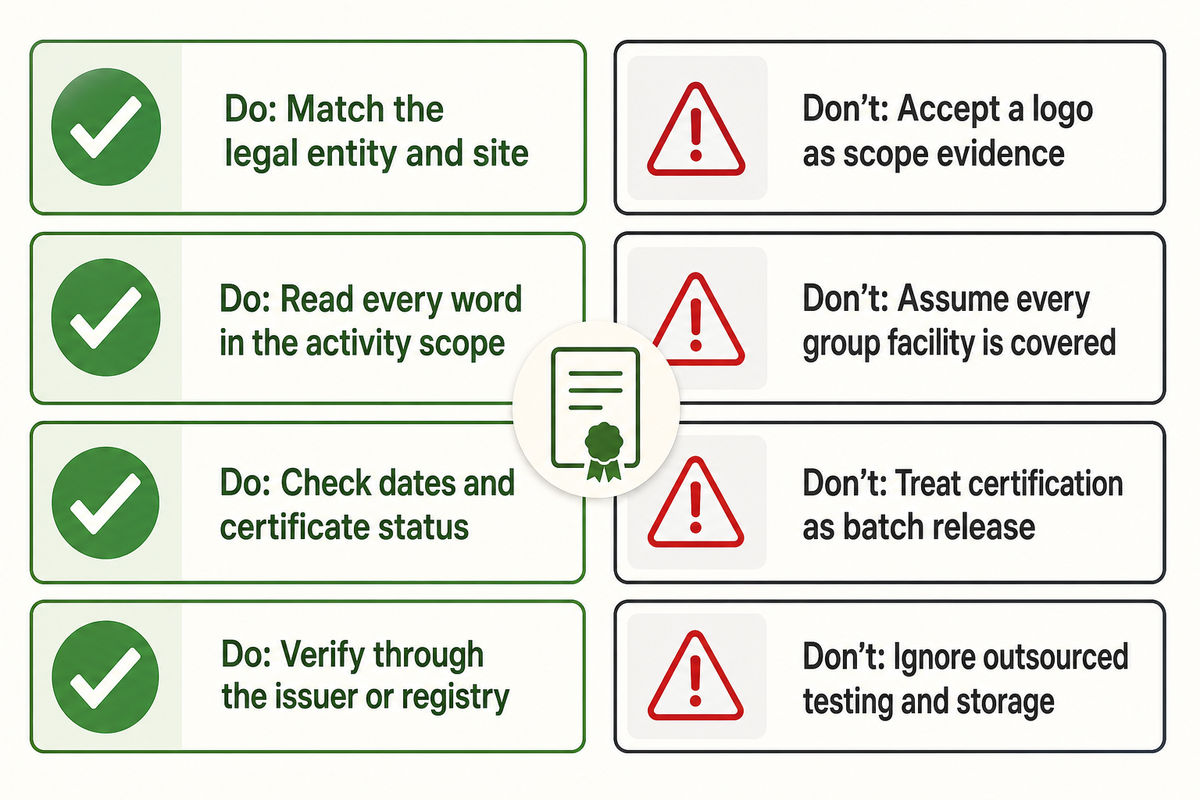
Do
- Match the legal entity and site.
- Read every word in the activity scope.
- Check dates and certificate status.
- Verify through the issuer or registry.
Don’t
- Accept a logo as scope evidence.
- Assume every group facility is covered.
- Treat certification as batch release.
- Ignore outsourced testing and storage.
A certificate therefore answers “was a defined system assessed?” It doesn’t answer “did this batch meet our approved specification?” The second question requires the records in the Release Document Decoder and the manufacturer’s current cosmetic quality management evidence.
9. How to Verify a Manufacturer’s Quality Control Before You Commit
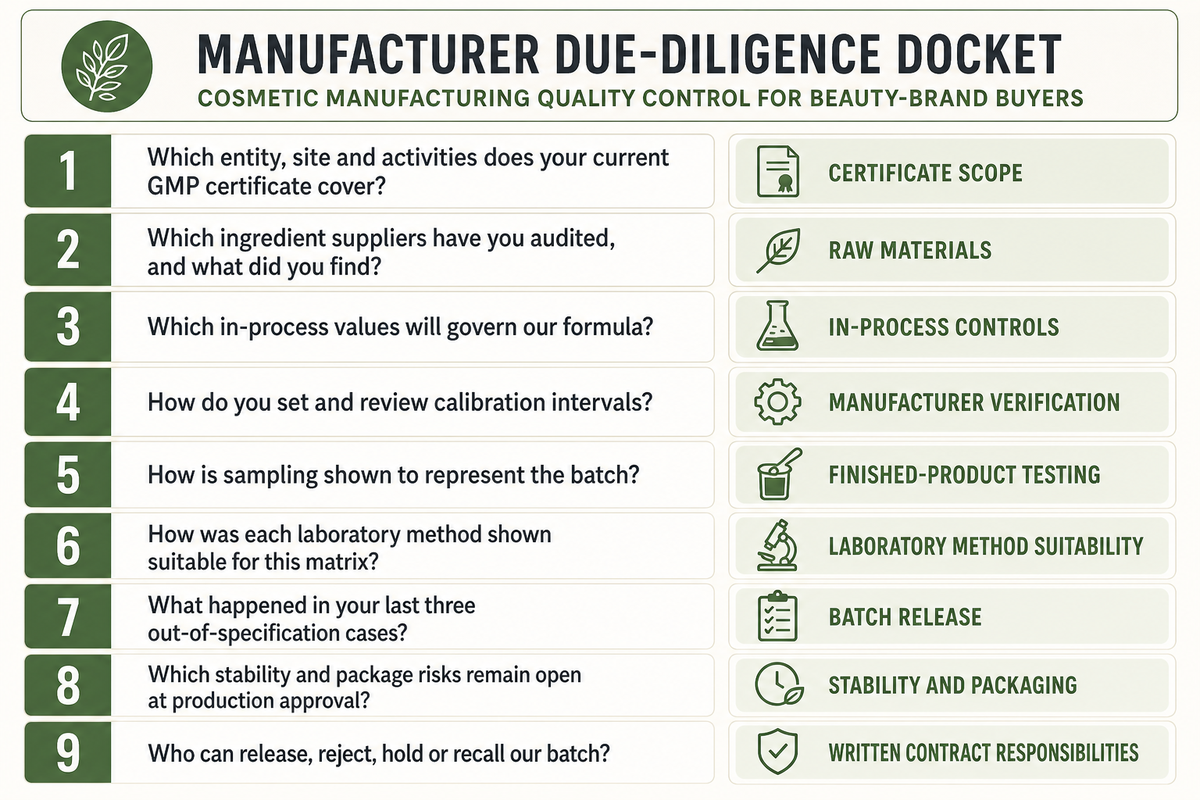
Manufacturer verification should convert sales claims into a short, comparable evidence request before price or formula ownership makes switching difficult. The goal isn’t to collect the largest file bundle; it’s to test whether the proposed site can trace a real decision from specification to result to release. For a new cosmetic project, this protects brand reputation before the product enters the cosmetics market.
The 9-Question Manufacturer QC Verification Docket
| Question | Evidence to request | What the answer tests |
|---|---|---|
| 1. Which entity, site, and activities does your current GMP certificate cover? | Certificate plus issuer or registry record | Scope and status |
| 2. Which ingredient suppliers have you audited, and what did you find? | Redacted qualification and follow-up example | Conditional certificate reliance |
| 3. Which in-process values will govern our formula? | Draft control plan with methods and limits | Product-specific controls |
| 4. How do you set and review calibration intervals? | Current equipment register and one impact review | Defined frequency and failure response |
| 5. How is sampling shown to represent the batch? | Sampling plan tied to batch size and fill stages | Representativeness |
| 6. How was each laboratory method shown suitable for this matrix? | Suitability summary and external-lab scope | Method limitations |
| 7. What happened in your last three out-of-specification cases? | Redacted investigations, dispositions, and actions | Whether failures drive decisions |
| 8. Which stability and package risks remain open at production approval? | Protocol, current results, open-risk register, contract decision | Launch-risk ownership |
| 9. Who can release, reject, hold, or recall our batch? | Responsibility matrix and sample release authorization | Decision authority |
Manufacturers may redact unrelated formulas, names, and commercially sensitive values while preserving the structure needed for review. Repeated inability to show dates, roles, original results, approvals, or a failed case is more informative than a long deck of successful test summaries.
For an ODM project, bind the approved formula version, testing plan, packaging, markets, release roles, and open stability decisions in the commercial scope. NEXO Beauty Labs describes its cosmetic ODM manufacturing route as spanning product concept, formulation, and commercial production; the contract should still name the actual provider, manufacturing site, and scope. Brands comparing other structures can begin with the broader cosmetic contract manufacturing overview.
The contract manufacturer performs the agreed work, but a brand-side responsible person, importer, or label entity may retain legal duties in the destination market. Assign specification approval, safety assessment, claims support, notifications, artwork, adverse-event handling, change control, release, and recall before purchase-order acceptance.
Key takeaway
A credible quality claim connects one current site scope, one approved product specification, one representative sample, one suitable method, and one authorized batch decision.
10. What Is Changing in 2026, and What It Means for Your Contract
The United States regulatory timetable remains unresolved. That site-and-decision trail becomes more valuable while the regulatory baseline is still moving. MoCRA directed FDA to establish cosmetic good manufacturing practice regulations, but the FDA pages checked on 3 September 2026 showed neither a proposed nor a final rule after the 29 December 2025 statutory deadline.
FDA also states that it intends to withdraw or revise its existing guidance when rulemaking is completed. A 2024 industry forecast expected GMP requirements by December 2025, showing why a predicted date is not the same as an issued rule. As of the date above, the current United States position still rests on inspection guidance, a checklist, and nonbinding draft guidance.
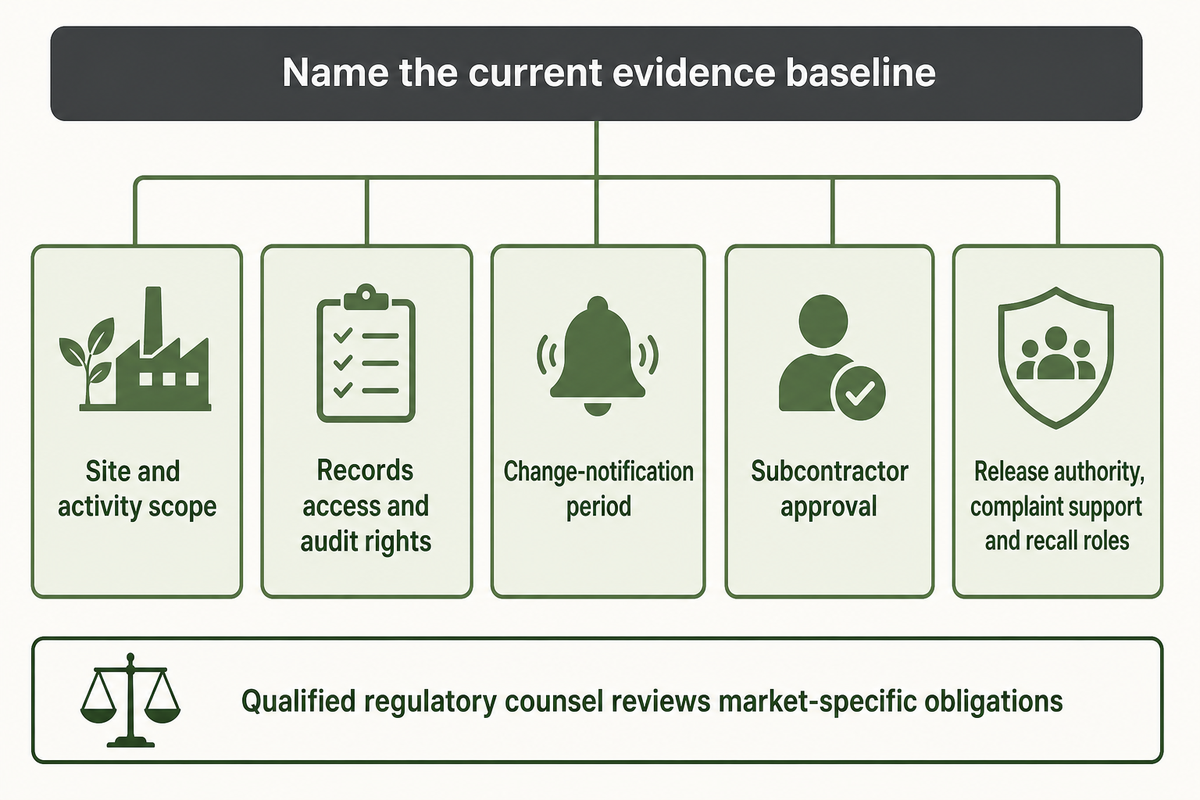
The contract consequence is immediate even while the rule isn’t. Define the standard edition, site and activity scope, product specifications, change-notification period, records access, audit rights, subcontractor approval, sample retention, deviation notice, release authority, complaint support, and recall roles in writing.
Evidence capsule: ISO 22716 remains the 2007 edition, confirmed current in 2022, while the United States final GMP rule remained unissued on 3 September 2026. A contract should therefore name the current evidence baseline and include a change clause for later regulatory updates.
Future rules may change regulatory compliance duties, a required record, or a responsibility. They can’t repair an ambiguous supply agreement retroactively. Build a change pathway now and have qualified regulatory counsel review market-specific obligations before launch.
Frequently Asked Questions
What is the role of quality control in cosmetics?
Quality control generates and evaluates evidence against approved specifications so authorized staff can accept, hold, investigate, rework, or reject materials and batches. The work includes controlled sampling, method-based testing, review of original results, instrument-status checks, and documented handling of deviations. It supports release but doesn’t replace quality assurance, product safety assessment, market registration, brand-side legal duties, or other functions needing assigned owners and records.
For a buyer, the importance of quality control appears in the decision trail: every accepted batch should connect its identity and approved specification to representative samples, suitable methods, reviewed results, and a named release authority.
What are five responsibilities of cosmetic quality control?
Five practical responsibilities are sampling, testing, instrument-status control, review of results and deviations, and approval or rejection support. The exact organizational authority should be written in the contract, because a laboratory result and a final release decision may belong to different roles.
Does an ISO 22716 certificate mean a manufacturer meets FDA requirements?
No. ISO 22716 certification addresses the scope assessed by its certification body, while FDA obligations arise under United States law and agency action. FDA hadn’t issued final federal cosmetic GMP regulations as of 3 September 2026, so certificate, legal status, and batch evidence must be checked separately.
How often should cosmetic manufacturing equipment be calibrated?
No reviewed standard sets one interval for all equipment or every use case. Taiwan’s regulation requires regular calibration, with out-of-tolerance instruments removed from service and potential impact on released product investigated; for other markets, confirm the applicable requirements and the equipment’s documented, risk-based schedule.
What is the difference between cosmetic quality control and quality assurance?
Quality assurance establishes and reviews the system that prevents and manages quality problems. Quality control handles sampling, measurements, tests, results, and related acceptance evidence within that system. Strong cosmetic production needs both, with defined authority, controlled records, and independent review.
Which documents should a brand review before approving a batch?
Review the authorized certificate of analysis, completed batch record, sampling and test records, deviations or out-of-specification investigations, packaging and artwork status, yield reconciliation, and release authorization. Before release, the required set should match the product, market, contract, and open stability risks.
Turn Quality Claims Into a Verifiable Manufacturing Brief
Bring NEXO Beauty Labs your formula route, target markets, product format, package, claims, and evidence expectations. Use these inputs to build a testable development and manufacturing brief that names the provider, site, scope, records, and approval responsibilities before commercial production begins.
Scope note: This article provides manufacturing due-diligence information and doesn’t replace legal, regulatory, toxicological, or laboratory advice for a specific product or market.
References & Sources
- U.S. FDA — Draft Guidance for Industry: Cosmetic Good Manufacturing Practices
- U.S. FDA — Inspection of Cosmetics
- U.S. FDA — Modernization of Cosmetics Regulation Act of 2022
- Taiwan Food and Drug Administration — Cosmetics Good Manufacturing Practice Regulations
- Health Canada — Good Manufacturing Practices for Cosmetic Products
- European Commission — Harmonised Standards for Cosmetic Products
- UK Government — Making Cosmetic Products Available to Consumers in Great Britain
- ISO — ISO 22716:2007 Cosmetics, Good Manufacturing Practices
- ISO — ISO/TR 18811:2018 Guidelines on the Stability Testing of Cosmetic Products
- Bolzon V, Bulfoni M, Nencioni A, Nencioni E. Frontiers in Public Health. 2025;13:1572201. DOI:10.3389/fpubh.2025.1572201
- BAV Institute — Microbiological Criteria According to ISO 17516
- NSF — Public NSF/ANSI 455 GMP Listings