Get in touch with NEXO Beauty Labs Company


Cosmetic Packaging Compatibility Testing: A Formula-to-Pack Review Guide


Cosmetic packaging compatibility testing is a product-specific evaluation of a represented formula in its intended commercial pack. It asks whether contact surfaces, barrier performance, closures, dispensing parts, decoration, storage, and use conditions remain acceptable for a stated decision. Supplier material statements or formula-only stability results do not automatically prove that the final combination is suitable.
The buyer’s short answer
Freeze the formula and package configuration, define the risks and observations, compare test samples with an appropriate baseline or control, and assign decision owners before testing begins. Keep every conclusion limited to the formula-pack system, conditions, methods, time points, and criteria actually represented.
Ordering production packaging before those inputs are controlled can leave a brand with evidence for a configuration it will not sell. There is also no responsible universal promise that one temperature, duration, or checklist proves every cosmetic package.
Cosmetic Packaging Compatibility Testing in One Decision
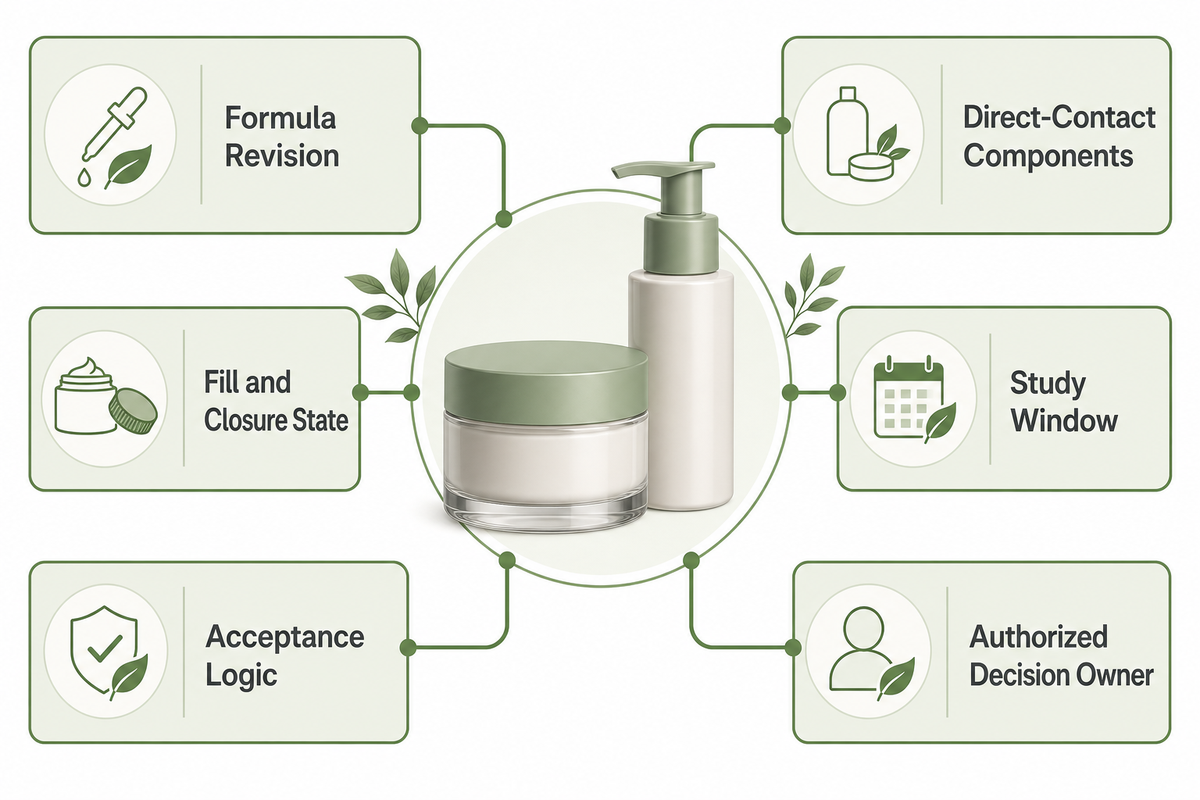
That is why a useful compatibility conclusion is about a named product system, not a resin trade name. It identifies the formula revision and batch, every direct-contact component, fill and closure state, intended storage and use, study window, methods, acceptance logic, limitations, and the person authorized to decide what happens next.
Write the decision before writing the protocol
“Determine whether formula [revision] in package [component and supplier revisions], filled and closed under [conditions], remains within [defined formula, package, and functional criteria] during [named exposures and time points], subject to [listed limitations].”
“Determine whether formula [revision] in package [component and supplier revisions], filled and closed under [conditions], remains within [defined formula, package, and functional criteria] during [named exposures and time points], subject to [listed limitations].”
“Cosmetic grade” can be a useful supplier description, but it is not proof that a specific formula will not permeate, sorb, migrate, discolor, soften, corrode, leak, clog, or change dose delivery in a specific pack. ISO/TR 18811 states that stability planning is product-specific rather than governed by one universal set of conditions, parameters, or criteria.
The name of a packaging material cannot establish whether something may leach into the formula or whether repeated contact may degrade a component. Those are questions to evaluate, not foregone outcomes. Document each relevant formula package interaction in the study brief.
Later changes to a liner, gasket, spring, colorant, coating, adhesive, decoration, component supplier, formula, fill temperature, headspace, or assembly setting may therefore reopen the decision. That does not make the earlier evidence wrong; the new commercial configuration needs a documented representation review.
Cosmetic Stability and Compatibility, Migration, and Microbiology Are Different Evidence Tracks
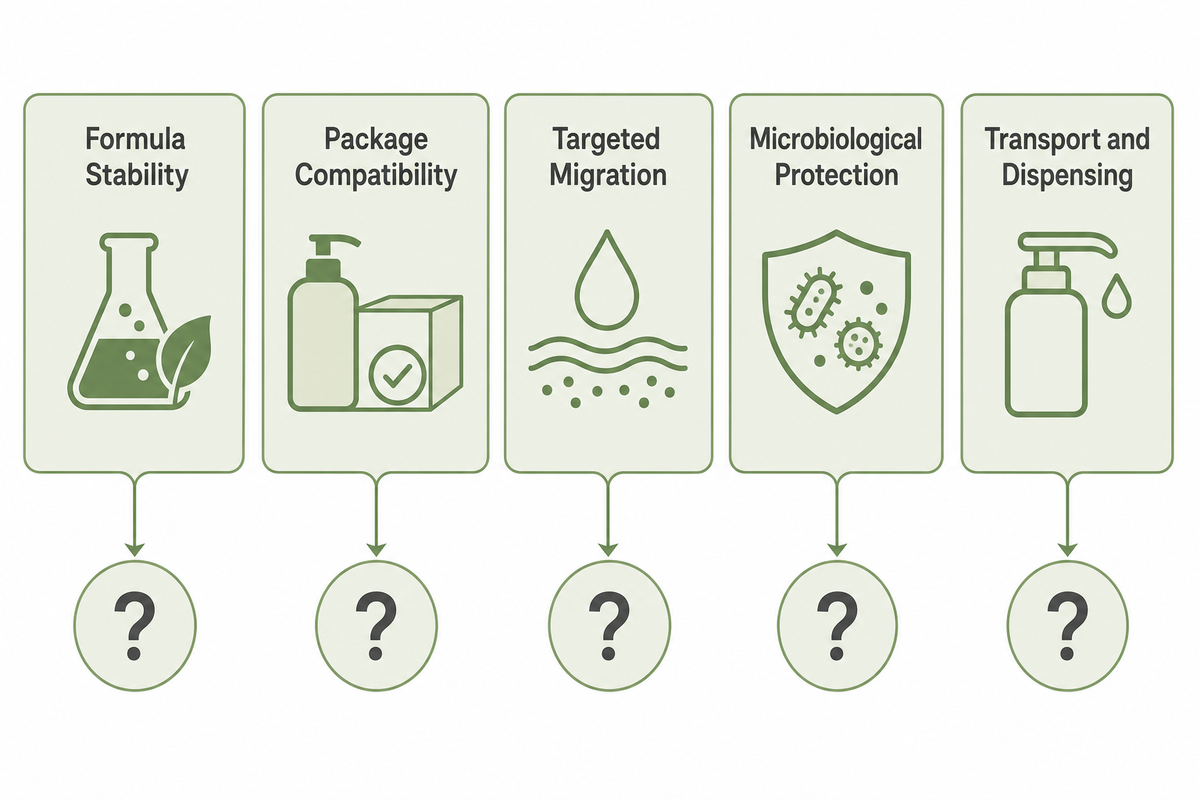
A stability and compatibility test may share samples and observations, but it does not turn formula stability, package function, migration, and microbiological protection into one conclusion. Assign each risk to the appropriate evidence track, method, acceptance logic, and decision owner so that product stability and product compatibility remain distinguishable.
| Evidence track | Question answered | Typical observations | Decision owner | Does not prove alone |
|---|---|---|---|---|
| Formula stability | Do defined product attributes remain acceptable? | Appearance, odor, pH, viscosity, separation, assay where relevant | Formulation / quality | Final-pack integrity or dispensing function |
| Package compatibility | Does formula-pack contact change either side? | Leakage, mass change, deformation, seal or decoration change | Packaging / quality | Every chemical-transfer or safety question |
| Targeted migration or extractables work | Can specified substances transfer under defined conditions? | Method-specific chemical results and controls | Qualified analytical / safety reviewer | Routine package function or complete safety |
| Microbiological quality and protection | Is contamination controlled for the represented product and use? | Microbial limits, challenge-test response, in-use protection | Microbiology / safety | Chemical or mechanical compatibility |
| Transport and dispensing | Does the filled pack survive handling and deliver as intended? | Seal, torque, priming, dose, clogging, drop or vibration response | Packaging / operations | Long-term formula stability |
Translate common labels into decision-ready protocol language
| Label a buyer may encounter | Clarification to request |
|---|---|
| Stability studies, accelerated stability test, or real-time stability tests | Ask which physical and chemical properties, microbiological stability questions, shelf-life claim, and period after opening (PAO) decision are represented. “Stability of the product” needs named attributes, not a broad promise that the product remains unchanged. |
| Chemical compatibility, physical compatibility, or final packaging compatibility | Name the cosmetic formulation, cosmetic ingredients, cosmetic packaging materials, type of packaging, and direct-contact interfaces. State whether the question concerns changes in the product, changes in product packaging, movement from packaging into the product, or package function. |
| Challenge testing, product safety report, or “EU compliant” | Do not merge preservative efficacy, consumer safety, and package compatibility. Ask how the work supports the cosmetic product safety report, product information file, product registration, and market-specific compliance with EU requirements without claiming that one compatibility result ensures product quality and safety. |
| Testing lab condition or generic protocol claim | Ask why the selected foreseeable conditions represent the conditions of storage and use, storage and transport conditions, light exposure, and consumer handling. A statement that compatibility tests must use “40 or 45 degrees” is not a universal protocol; the testing lab should justify each condition and the limits of extrapolation. |
The United States Food and Drug Administration does not prescribe one fixed test list for every cosmetic, while manufacturers and distributors remain responsible for product safety. In the European Union, stability under reasonably foreseeable storage conditions and microbiological quality are explicit parts of the cosmetic product safety report; the qualified safety assessment and responsible-person duties remain separate from a supplier’s package statement.
Packaging may also affect exposure after purchase. Separate peer-reviewed studies have found package-dependent differences in product use, but their products, populations, formats, and even direction of effect differ; they do not support a universal pump-versus-tube ranking.
Build the Formula-to-Pack Evidence Brief
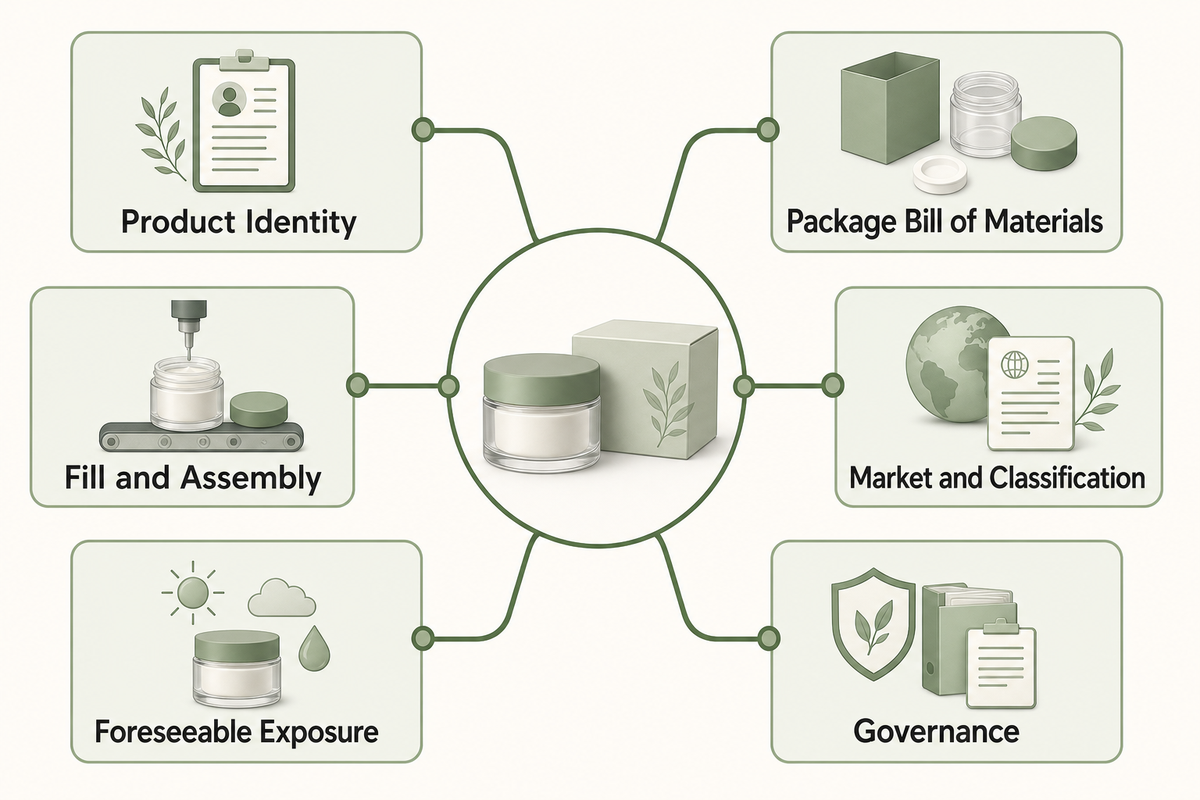
Product name, jar type, and desired shelf life are not enough to commission comparable work. A structured compatibility brief identifies the product composition, packaging used, packaging types under comparison, commercial configuration, decision scope, and unknowns before samples enter testing. This prevents hidden assumptions from becoming protocol inputs.
| Formula-to-Pack Evidence Brief | What to freeze or describe | State | Owner | Evidence path |
|---|---|---|---|---|
| 1. Product identity | Formula revision, product form, batch and manufacturing representation | Known / unknown | Formulation | Formula and batch records |
| 2. Package bill of materials | Container, closure, liner, gasket, spring, dip tube and applicator revisions | Known / unknown | Packaging | Drawings and supplier specifications |
| 3. Contact and decoration | Direct-contact surfaces, coatings, inks, adhesives and labels | Known / unknown | Packaging / brand | Declarations and component samples |
| 4. Fill and assembly | Fill mass, temperature, headspace, torque, priming and sealing settings | Known / unknown | Manufacturing | Work instruction and production record |
| 5. Market and classification | Target markets, product classification and responsible roles | Known / unknown | Regulatory | Market assessment |
| 6. Foreseeable exposure | Use, storage, transport, light, temperature, orientation and opening pattern | Known / unknown | Quality / supply chain | Distribution and use brief |
| 7. Decision goal | Shelf-life goal, development milestone and release question | Known / unknown | Brand / quality | Approved development brief |
| 8. Sample plan | Final packs, controls, replicates, orientation, retains and quantities | Known / unknown | Study owner | Protocol and sample log |
| 9. Observation plan | Conditions, time points, methods, baselines and acceptance logic | Known / unknown | Study / quality | Approved protocol |
| 10. Governance | Deviation route, report owner, retention, change notice and disposition authority | Known / unknown | Quality / brand | Report and change ledger |
This brief is an editorial buyer tool synthesized from product-specific, risk-based guidance. It is not a NEXO standard operating procedure, a testing laboratory protocol, or a substitute for qualified scientific and market-specific review.
Turn Formula and Package Properties into Risk Questions
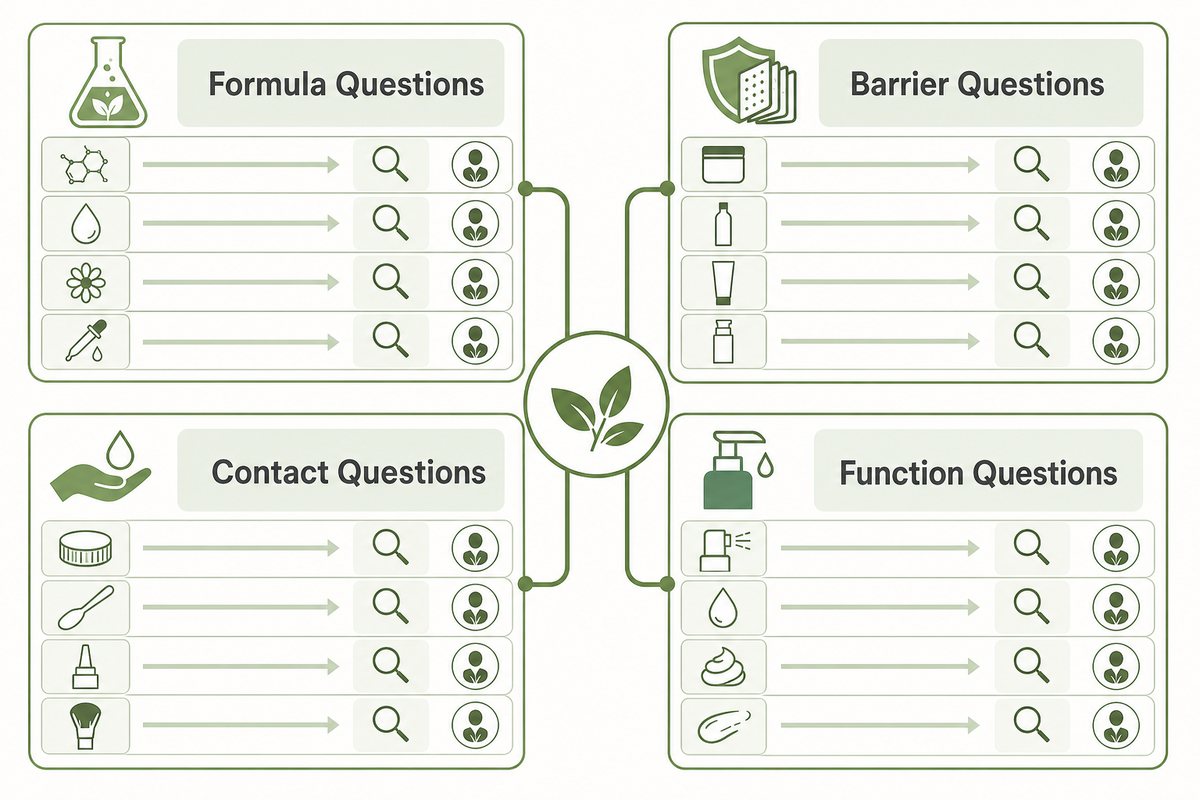
Material names, formula categories, and trade names are screening data, not definitive pass-or-fail answers or predictions.
Convert every attribute that a reviewer believes could be affected by an interaction or change into a mechanism question, an observable signal, and an identified decision owner.
Formula questions
Could volatile or aromatic components be lost? Could oils, solvents, pH, oxidation sensitivity, colorants, high viscosity, particles, or an anhydrous format affect contact materials or dispensing?
Could volatile or aromatic components be lost? Could oils, solvents, pH, oxidation sensitivity, colorants, high viscosity, particles, or an anhydrous format affect contact materials or dispensing?
Barrier questions
Could the package admit or lose moisture, oxygen, light, odor, or volatile matter? Is headspace, orientation, or opening frequency relevant to the intended use?
Could the package admit or lose moisture, oxygen, light, odor, or volatile matter? Is headspace, orientation, or opening frequency relevant to the intended use?
Contact questions
Which resin, liner, gasket, spring, coating, adhesive, ink, or decoration directly or indirectly contacts the formula, and which chemical or physical change is plausible?
Which resin, liner, gasket, spring, coating, adhesive, ink, or decoration directly or indirectly contacts the formula, and which chemical or physical change is plausible?
Function questions
Can a pump, dropper, tube, jar, or closure prime, dose, reseal, recover, and remain legible after the represented storage and use pattern?
Can a pump, dropper, tube, jar, or closure prime, dose, reseal, recover, and remain legible after the represented storage and use pattern?
One peer-reviewed migration study illustrates why this translation matters: its findings depended on packaging source, polymer construction, contacting medium, controls, analytical method, and disclosed exposure. Its 11 packages, five polymer types, six simulants, and one-month exposure at 50 °C are study facts, not universal cosmetic acceptance criteria.
China’s 2024 compatibility guidance describes multiple evidence routes, including migration or extractables work, historical safety data, supplier information, quality-control reports, prior compatibility work, and stability results. The point is not to order every possible test; it is to explain why the selected evidence resolves the represented risk.
Choose Conditions, Time Points, and Acceptance Logic
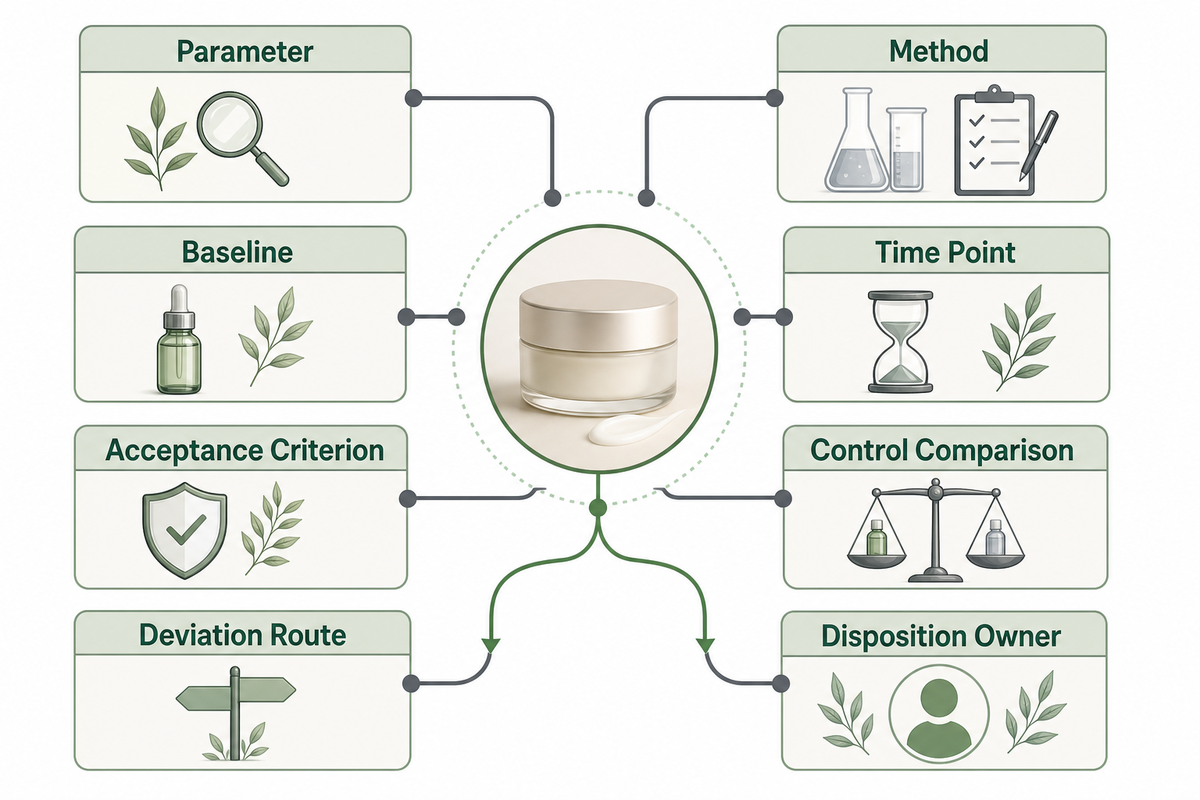
Accelerated stability, real-time or ongoing work, cycling or stress, UV light, transport, and in-use work serve different questions. Stability tests are conducted against defined samples, exposures, methods, baselines, criteria, and decision rules; they do not automatically show how every product behaves or establish quality and safety over time.
Acceptance record for every material observation
Record the parameter, method, baseline, scheduled time point, numerical limit or qualified review rule, control comparison, deviation route, and disposition owner. If a criterion is still being developed, say so before testing instead of converting an unexpected result into a convenient pass afterward.
Record the parameter, method, baseline, scheduled time point, numerical limit or qualified review rule, control comparison, deviation route, and disposition owner. If a criterion is still being developed, say so before testing instead of converting an unexpected result into a convenient pass afterward.
The fixed claim “three months at 40 °C proves two years” is not a universal rule for cosmetic products. Conditions should be justified against the product formulation, packaging barrier properties, market, transport and storage route, consumer use, claimed shelf life, and the limits of any extrapolation.
Map Final-Pack Signals to a Decision
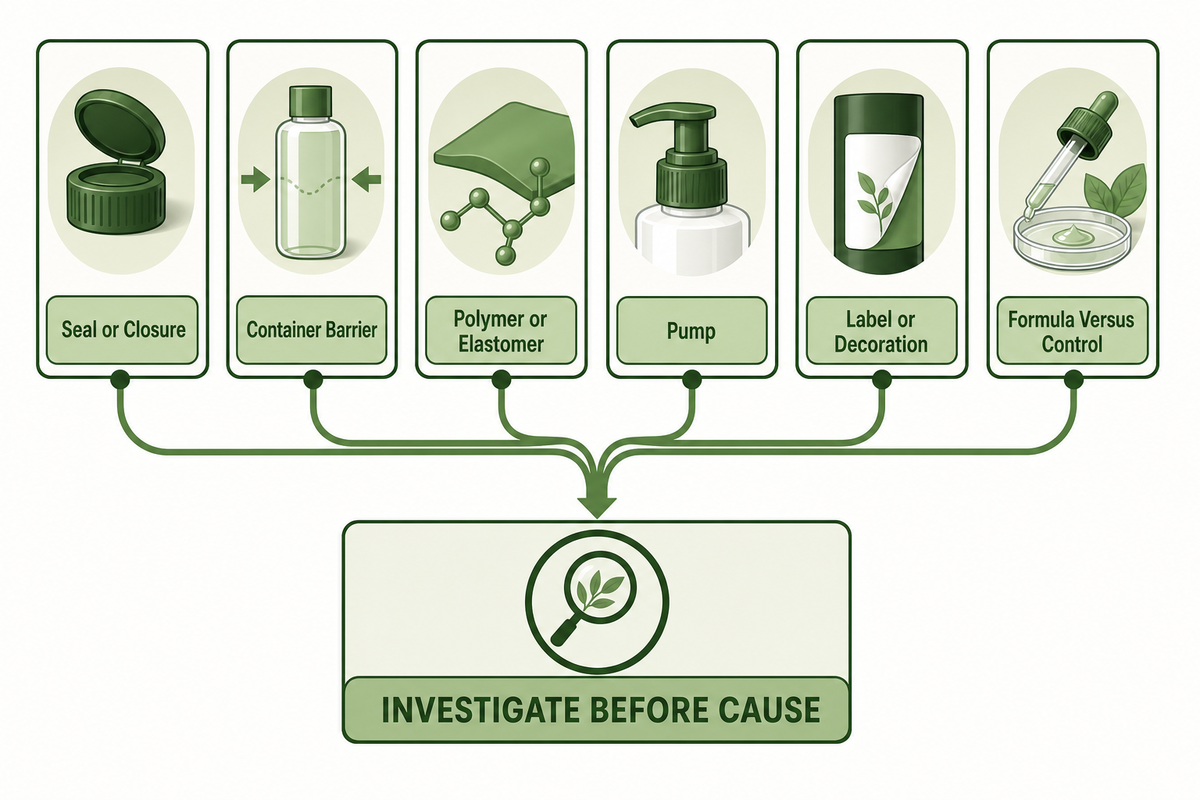
“It looks fine” and “it did not leak” are too narrow for most final-pack reviews. Use this matrix to connect compatibility test results, including formula observations and product packaging function, with a controlled next decision. Compatibility issues and compatibility failures are dispositions to investigate, not causes that can be inferred from appearance alone.
| Signal type, Compatibility Signal-to-Decision Matrix | Baseline / signal | Measurement | Possible cause | Owner | Next decision |
|---|---|---|---|---|---|
| Seal or closure | Leakage or loss of seal | Orientation, seal and closure inspection | Torque, liner, geometry, formula contact | Packaging | Investigate assembly and interface |
| Container barrier | Mass gain or loss | Controlled weighing and control comparison | Permeation, evaporation, seal | Packaging / quality | Confirm source and product effect |
| Volatile profile | Odor or aromatic change | Qualified sensory or analytical method | Loss, sorption, oxidation | Formulation / analytical | Compare control and pack barrier |
| Container wall | Paneling or deformation | Visual and dimensional check | Pressure, barrier, geometry | Packaging | Review component and headspace |
| Polymer or elastomer | Swelling, softening, brittleness, cracking | Visual, dimensional or mechanical check | Sorption or chemical interaction | Packaging / materials | Isolate the contact component |
| Metal or coated part | Corrosion or discoloration | Inspection and targeted analysis | Coating defect, pH, contact path | Packaging / analytical | Assess safety and function |
| Liner or gasket | Shape, adhesion or compression change | Dimensional and seal review | Contact, torque, compression set | Packaging | Review material and closure setting |
| Closure retention | Torque or retention drift | Defined torque or retention method | Creep, thread, application setting | Packaging / filling | Check equipment and component |
| Pump | Priming or dose inconsistency | Cycle and dose-mass check | Viscosity, spring, valve, fill | Packaging / formulation | Investigate function and use impact |
| Dropper or tube | Poor pickup, recovery or extrusion | Functional cycle and dose check | Viscosity, geometry, air ingress | Packaging / formulation | Review package-formula match |
| Orifice or actuator | Clogging or residue buildup | Repeated use and cleaning simulation | Drying, particles, geometry | Packaging / formulation | Change design, formula or directions |
| Label or decoration | Lifting, bleeding, abrasion, illegibility | Adhesion, rub and visual check | Formula contact, humidity, ink, adhesive | Packaging / brand | Revise decoration system |
| Formula versus control | Color, odor, pH, viscosity, separation or particles | Specified formula method plus control comparison | Formula instability, package interaction, handling | Formulation / quality | Triage before assigning cause |
Each signal starts an evaluation; it does not prove causation by itself. One prototype study observed swelling, leakage, opening, mass loss, and appearance changes under disclosed conditions, but its materials, timing, and results are not market-wide limits.
Use the 4-Cause Compatibility Triage Before a Pass Label
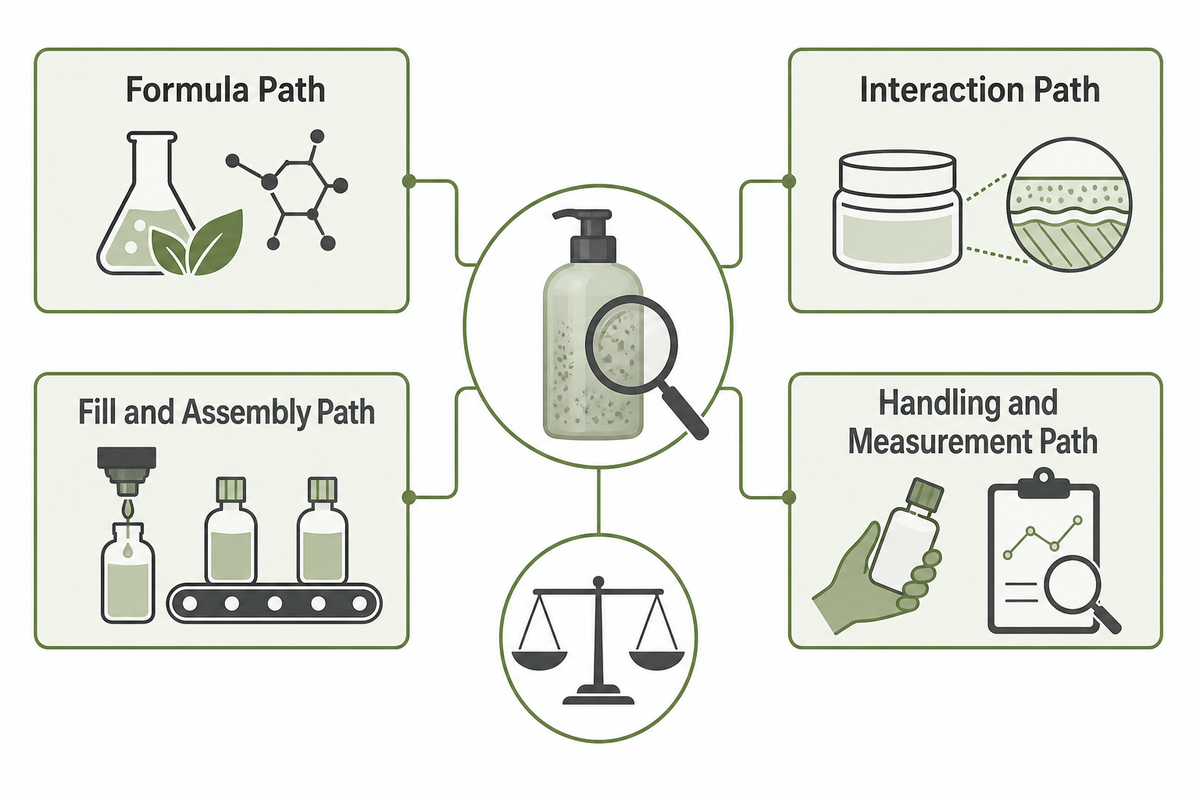
An unexpected observation should trigger a controlled comparison before anyone calls the package incompatible. Record the sample identity, baseline, method, control result, deviation, hypothesis, follow-up, owner, and authorized disposition so potential chemical reactions, fill or assembly effects, and measurement error are not confused. This protects product integrity without overstating causation.
Four-Cause Compatibility Triage: check the formula, formula-pack interaction, fill or assembly, and handling or measurement paths before disposition.
1. Formula path
Is the same change present in an inert or suitable control container? Review batch, baseline, method, and formula stability before assigning package cause.
Is the same change present in an inert or suitable control container? Review batch, baseline, method, and formula stability before assigning package cause.
2. Interaction path
Is the signal isolated to one contact component, surface, orientation, or package revision? Compare components and define targeted confirmation.
Is the signal isolated to one contact component, surface, orientation, or package revision? Compare components and define targeted confirmation.
3. Fill and assembly path
Did fill mass, temperature, headspace, torque, sealing, priming, or sample preparation differ? Verify production and sample records.
Did fill mass, temperature, headspace, torque, sealing, priming, or sample preparation differ? Verify production and sample records.
4. Handling and measurement path
Was there a storage excursion, transport event, labeling error, mixed sample, or method issue? Protect the original observation and investigate traceability.
Was there a storage excursion, transport event, labeling error, mixed sample, or method issue? Protect the original observation and investigate traceability.
The final evidence state can be supported, qualified, unresolved, or retest required. Reporting only “pass” is inadequate when the record cannot show which formula-pack system passed, what was measured, which deviation was assessed, and how limitations affect the commercial decision.
Pack or Formula Changes That Trigger Evidence Review
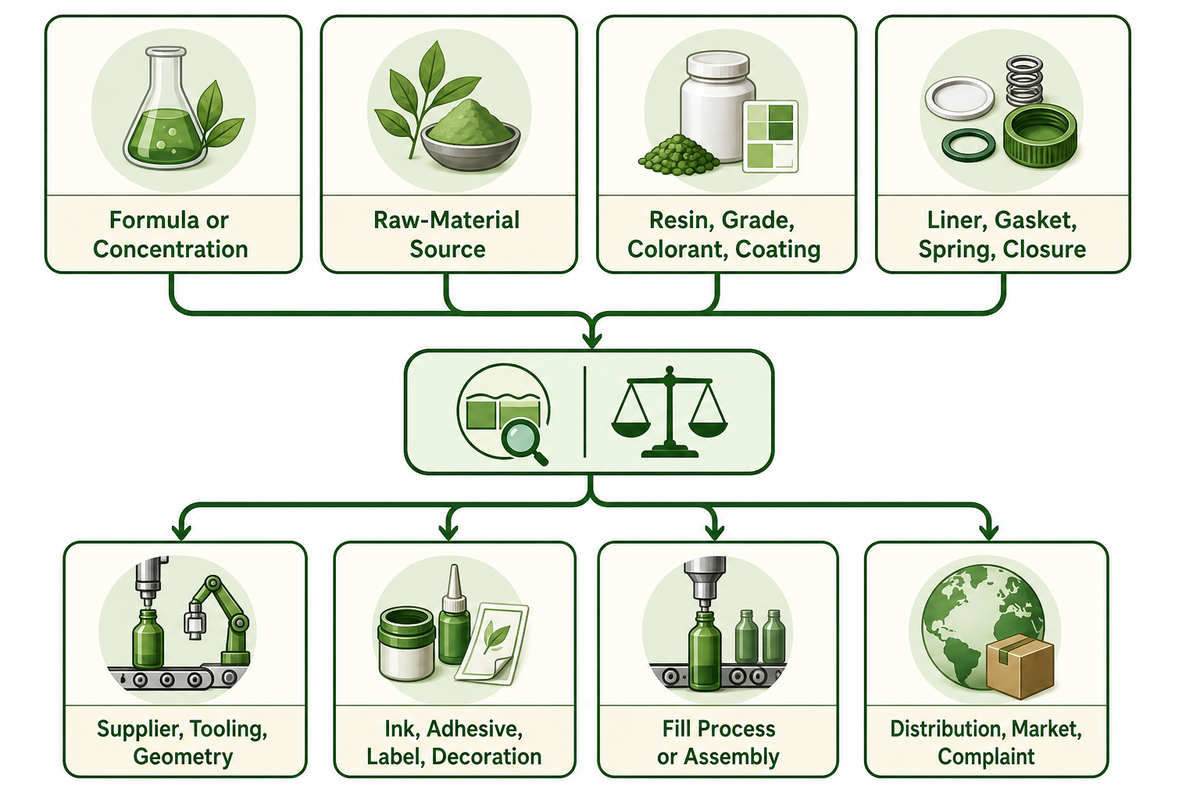
Stock formulas and easily recognized families of resins help reduce uncertainty, but they don’t eliminate the need to compare tested systems to commercial systems. Existing evidence may be retained unchanged, may need targeted validation, or may need replacement depending on the changed interface and the documented rationale.
| Pack Change Evidence Ledger | Affected interface | Prior evidence to compare | Equivalence question | Possible decision | Owner |
|---|---|---|---|---|---|
| Formula, concentration, fragrance or color | All contact and formula attributes | Formula and package studies | Which mechanisms changed? | Reuse, target or repeat | Formulation / quality |
| Raw-material source | Composition and interaction risk | Specifications and performance history | Are relevant properties equivalent? | Document or confirm | Procurement / formulation |
| Resin, grade, colorant or coating | Barrier and contact material | Supplier data and prior final-pack results | Is source and direct-contact construction aligned? | Target or repeat | Packaging / safety |
| Liner, gasket, spring or closure | Seal, contact and function | Component and functional results | Does contact or load change? | Targeted confirmation | Packaging |
| Supplier, tooling or geometry | Fit, dose, seal and barrier | Drawings, tolerances and study record | Does commercial performance remain represented? | Confirm affected functions | Packaging / quality |
| Ink, adhesive, label or decoration | Indirect contact and legibility | Adhesion, rub and exposure results | Did substrate or exposure change? | Target decoration review | Packaging / brand |
| Fill process, temperature, scale or assembly | Headspace, seal, dose and sample representation | Process and package records | Was the tested pack made the same way? | Process or pack confirmation | Manufacturing / quality |
| Distribution, market, complaint or trend | Exposure and risk assumptions | Protocol, market record and post-market data | Is a new exposure or failure mode present? | Investigate and update | Quality / regulatory |
The 2024 NIFDC package-specific question-and-answer document described reasoned use of similar-formula evidence under stated alignment conditions, including the direct-contact material and its source. European guidance also permits reliable analogous data when relevance and any missing-data rationale are explained; neither source supports silent equivalence.
A July 2026 NIFDC question-and-answer document confirms that registrants and filing parties may apply similar-product assessment principles to stability, preservative efficacy, and package compatibility. This article uses the older package-specific details as a conservative evidence-review boundary, not as a claim that those details are a current universal legal requirement.
Evidence Ownership from Supplier Data to Brand Release
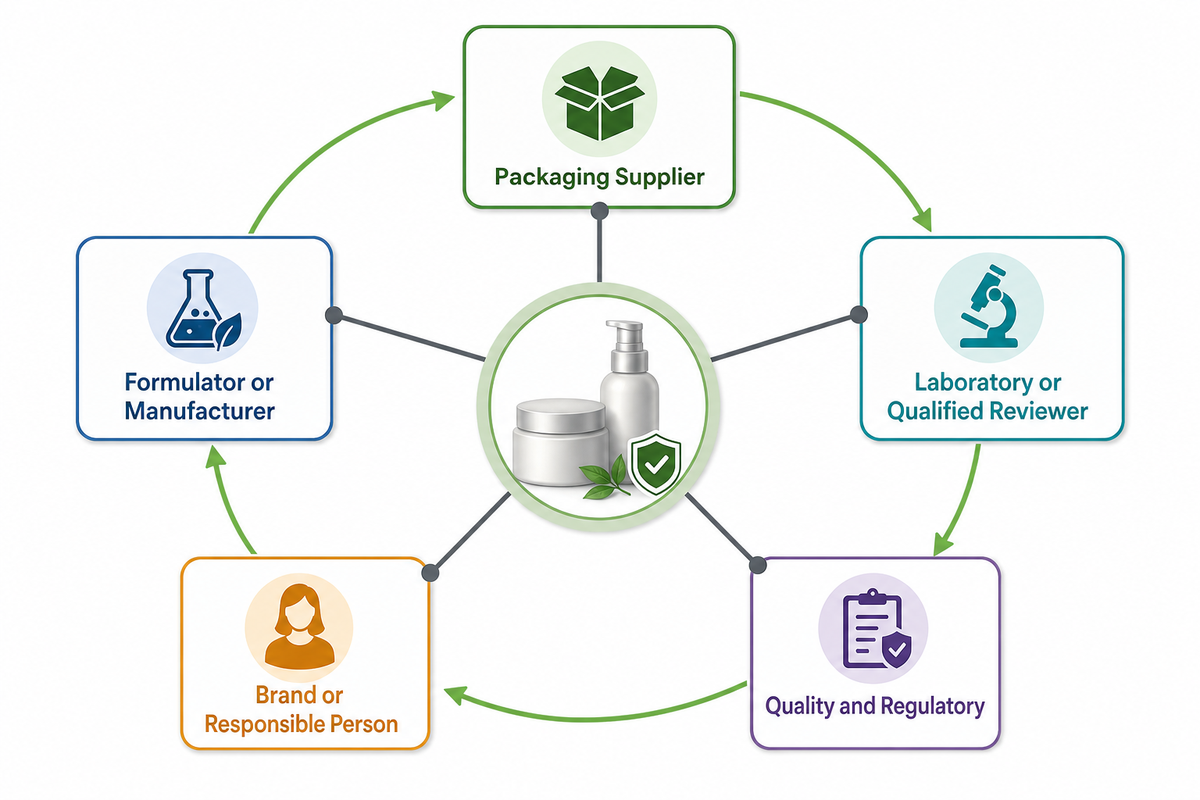
The packaging supplier can provide valuable composition, specification, declaration, drawing, and change-notice records, but cannot unilaterally release every finished formula-pack combination. Compatibility studies and testing services still need a visible responsibility split before work begins, including who decides whether a test is required and who may authorize a conclusion.
| Stakeholder | Supplies | Evaluates | Must not be assumed |
|---|---|---|---|
| Packaging supplier | Component identity, drawings, material and change data | Component conformance within its scope | Finished-product release authority |
| Formulator / manufacturer | Formula, batch, process, fill and sample representation | Product and process effects | Automatic legal sign-off in every market |
| Testing laboratory / qualified reviewer | Methods, observations, results, deviations and limitations | Questions within the commissioned scope | Evidence outside the protocol |
| Quality and regulatory | Specifications, market requirements and record controls | Deviations, applicability and release evidence | A supplier statement as a complete dossier |
| Brand / responsible person | Intended product, market, claims, use and commercial decision | Whether the evidence supports release and continued sale | Transfer of statutory responsibility by purchase order |
Traceable primary packaging records, finished-product controls, retained samples, methods, results, deviations, and dispositions help keep the evidence attached to the product sold. Post-market complaints or unexpected trends should feed back into the ledger rather than disappear after launch.
Brief a White-Label Skincare Manufacturing Partner Without Evidence Gaps
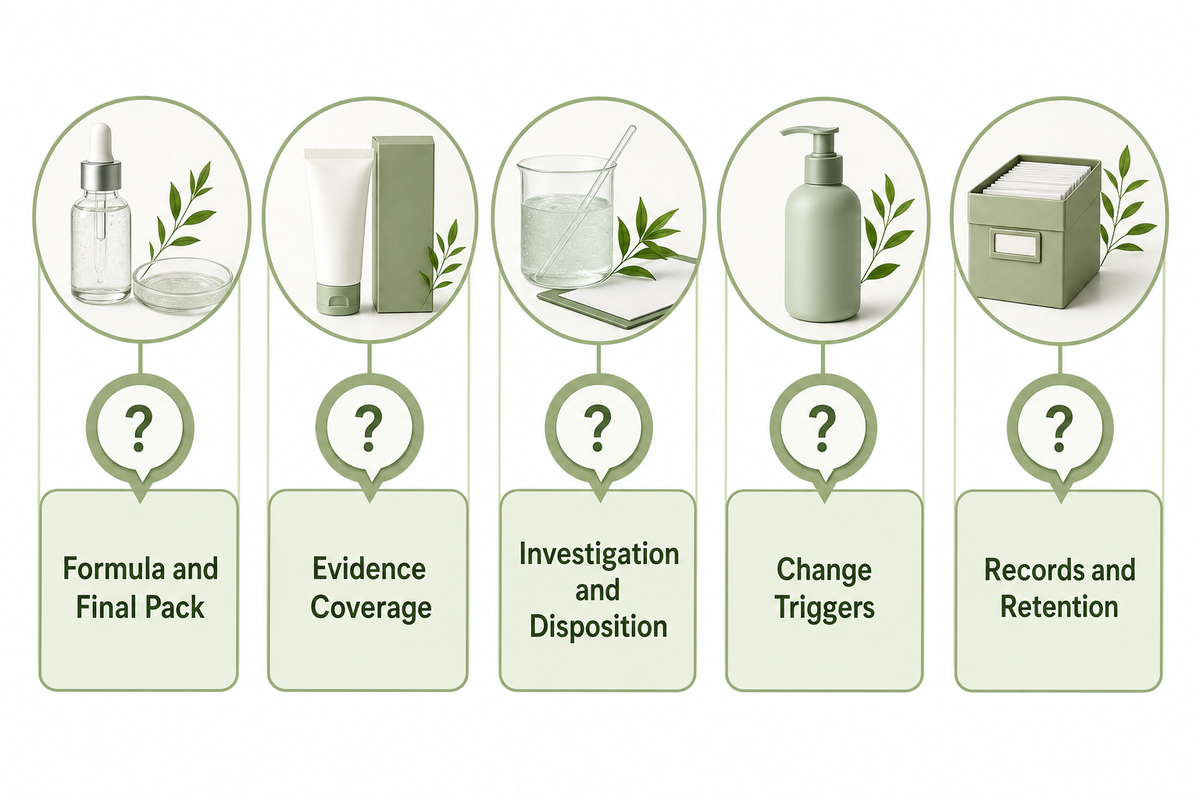
Compare proposals against the same Formula-to-Pack Evidence Brief, not package appearance or price alone. Ask each party to state the exact formula revision, component list, sample and control matrix, conditions, time points, methods, acceptance logic, reviewer scope, raw-data access, deviation route, change-notice process, sample retention, responsibility split, and retest triggers.
Questions to resolve before package approval
- Does the quoted work represent the formula and full commercial package you intend to sell?
- Which risks are covered by supplier documentation, compatibility observations, analytical work, microbiology, or functional checks?
- Who investigates a failed or missed time point, and who can authorize disposition?
- Which formula, component, supplier, process, market, or distribution changes reopen the evidence?
- Which party retains the protocol, raw observations, report, samples, and change history?
NEXO Beauty Labs is described by the company as a global cosmetic original equipment and original design manufacturing partner for skincare, hair care, and body care. Its manufacturing foundation dates to 1999, it reports more than 25 years of cosmetic manufacturing experience, and its international team has supported global business since 2020; those company-history facts do not prove a specific compatibility-testing capability, accreditation, protocol, result, capacity, lead time, minimum order, or customer outcome.
Buyers assembling a formula, package, and evidence brief can review NEXO’s white label skincare manufacturing route. Use the brief to separate what is already documented, what needs a qualified external testing laboratory or reviewer, and what must remain a brand or responsible-person decision.
When comparing a stock formula with a custom option, use the same white label skincare development route to ask which formula and final-pack records already exist and which interfaces remain unrepresented. Without proper testing and review, similarity in appearance or resin name cannot ensure the product maintains its intended quality in the configuration that will be sold.
For the manufacturing handoff, review our cosmetic filling and packaging services.
Bring the evidence questions into one development brief
Prepare your formula, package specification, target market, and open evidence questions, then open a project discussion with NEXO Beauty Labs.
Prepare your formula, package specification, target market, and open evidence questions, then open a project discussion with NEXO Beauty Labs.
Frequently Asked Questions
What tests are used in compatibility testing?
Cosmetic packaging compatibility testing can combine formula measurements, package inspections, and functional checks selected for the represented risk. Teams may monitor appearance, odor, color, pH, viscosity, mass change, leakage, deformation, seal behavior, closure or pump function, and differences between a control and the final pack. Targeted analytical work may be added when a defined migration or chemical-transfer question exists. The protocol should explain why each method, condition, time point, and criterion supports the intended decision.
What are the different types of packaging tests?
Formula-contact compatibility checks look for interaction between the product and direct-contact components. Barrier and mass-change work examines loss or gain across the pack, while seal, torque, leakage, pump, dropper, tube, and dose-delivery checks address function. Transport or handling work addresses mechanical exposure, and targeted extractables, leachables, or migration studies address defined chemical-transfer questions. The useful combination depends on the formula, commercial pack, market, distribution route, and decision scope.
What is the difference between stability testing and compatibility testing?
Stability testing asks whether the cosmetic formula maintains defined physical, chemical, and microbiological attributes under represented conditions. Compatibility testing asks whether contact with the intended package changes the formula or the package’s integrity and function. The work can share samples, storage conditions, and time points, but the conclusions are not interchangeable. Formula-only evidence cannot automatically prove the final package, and a functional package check cannot prove formula stability.
Is cosmetic packaging compatibility testing mandatory?
Requirements vary by product and market. United States guidance does not mandate one fixed cosmetic test list, but businesses remain responsible for safety substantiation. European Union and China frameworks use product-specific evidence and qualified assessment routes. Qualified regulatory and safety reviewers should determine the exact obligation for the formula, package, classification, claims, and target market rather than treating this article as legal advice.
When should compatibility evidence be reviewed or repeated?
Review the evidence when the represented formula-pack system changes or a result creates doubt. Triggers include a formula or ingredient change; a new component, supplier, liner, gasket, pump, closure, coating, ink, adhesive, decoration, fill condition, process, distribution route, or market; and a complaint or unexpected trend. Compare the tested and new configurations, identify the affected interface, and decide whether prior evidence remains applicable, targeted confirmation is enough, or a new study is needed.
Record the formula and package revisions, prior report, affected risk, rationale, reviewer, approval date, and open follow-up in the Pack Change Evidence Ledger. Keep that decision with the released product record so a later complaint, supplier notice, or process change can be traced to the evidence it may affect. Full repeat is not automatic for every change, but silent reuse is not defensible.
Keep the conclusion no broader than the evidence
Use the Formula-to-Pack Evidence Brief, signal matrix, triage route, and change ledger to align brand, formulation, packaging, quality, regulatory, procurement, and laboratory roles. When your inputs are ready, contact NEXO Beauty Labs.
Use the Formula-to-Pack Evidence Brief, signal matrix, triage route, and change ledger to align brand, formulation, packaging, quality, regulatory, procurement, and laboratory roles. When your inputs are ready, contact NEXO Beauty Labs.
References and Sources
- International Organization for Standardization, ISO/TR 18811:2018
- United States Food and Drug Administration, Product Testing of Cosmetics
- United States Food and Drug Administration, Shelf Life and Expiration Dating of Cosmetics
- United States Food and Drug Administration, Microbiological Safety and Cosmetics
- United States Food and Drug Administration, Cosmetics Good Manufacturing Practice Guidelines and Inspection Checklist
- United States Food and Drug Administration, Modernization of Cosmetics Regulation Act of 2022
- China National Institutes for Food and Drug Control, 2024 Compatibility Guidance Questions and Answers
- China National Institutes for Food and Drug Control, 2026 Cosmetic Registration and Filing Questions and Answers
- Regulation (EC) No 1223/2009 on Cosmetic Products
- Commission Implementing Decision 2013/674/EU
- Migration Studies and Endocrine Disrupting Activities: Chemical Safety of Cosmetic Plastic Packaging
- 3D-Printed Polyester-Based Prototypes for Cosmetic Applications
- Influence of the Container on the Consumption of Cosmetic Products
- The Role of Dispensing Device and Label Warnings on Dosing for Sunscreen Application: A Randomized Trial
- Development of a Standardized Method to Evaluate the Protective Efficiency of Cosmetic Packaging Against Microbial Contamination
Why beauty brands work with NEXO
About NEXO Beauty Labs Manufacturing Support
NEXO Beauty Labs supports skincare, body care, sun care, hair care, and private label brands with formulation, sampling, filling, quality control, and export-ready launch support.
Project Review Before RFQ
Before quotation, we help clarify product category, active direction, formula stage, package choice, compliance market, MOQ, sampling schedule, and required documents.
Request a Cosmetic QuoteCompany Profile // Data Sheet
CompanyNEXO Beauty Labs
Business TypeCosmetic OEM / ODM manufacturing partner
Main ProductsPrivate label skincare, facial serums, moisturizers, cleansers, sunscreen, body care, and hair care products
Manufacturing CapabilityFormula development, sample adjustment, package sourcing, filling, QA/QC, documentation, and export support
RFQ Data NeededProduct type, formula goal, package format, target market, MOQ, claims, timeline, and benchmark samples
Websitenexobeautylabs.com