Get in touch with NEXO Beauty Labs Company


Updated August 2026
Barrier repair cream manufacturing is the work of turning a product concept into a reproducible cosmetic system: a formula with a defined structure, a process that survives scale-up, packaging that remains compatible, and an evidence file that supports the intended claims. In a skin barrier repair cream, a list of ceramides and soothing ingredients is only the beginning. Commercial readiness depends on what those materials do together, how they are processed, how the finished cream changes over time, and what the brand can substantiate.
This guide is for brand, product, sourcing, quality, packaging and regulatory teams that need to understand those connections before approving a project. It is not a copyable formula or medical advice. NEXO’s existing private label barrier repair cream development page remains the place for formula routes, samples, manufacturing scope and commercial enquiries. Here, the focus is the decision logic a team should settle before selecting a cream manufacturer.
In brief
- Design a barrier system, not an ingredient shopping list.
- Lock the formula, process, package and proof plan as one connected chain.
- Use the pilot batch to discover scale-dependent risks before filling a commercial order.
- Match every claim to finished-product evidence and the rules of the destination market.
What Barrier Repair Cream Manufacturing Actually Controls
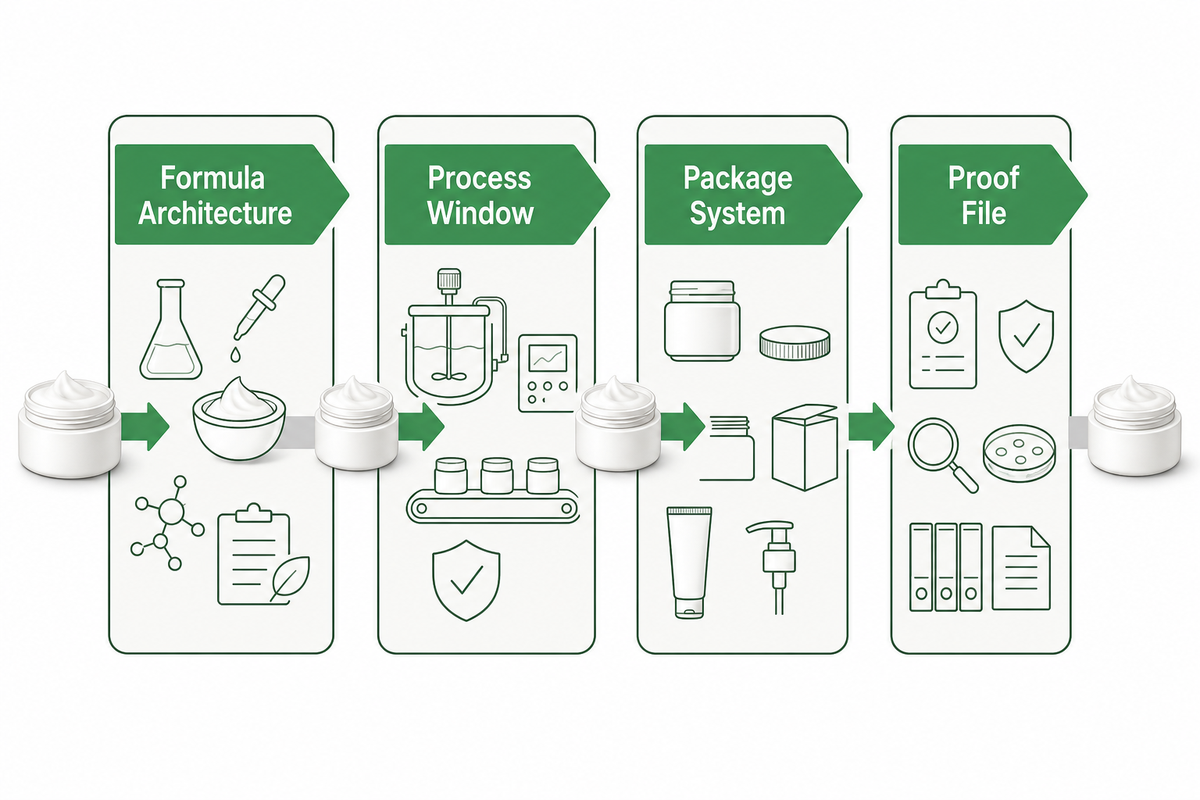
A barrier repair cream may look simple in a jar or tube, but four outputs have to agree before the product is ready to scale:
- Formula architecture: the water-binding, emollient, occlusive, lipid, emulsifying, rheology and preservation systems have to work as a whole.
- Process window: material form, phase preparation, addition order, temperature history, shear and cool-down conditions must produce the intended structure repeatedly.
- Package system: the bulk and its contact materials, dispenser, closure and decoration have to remain compatible through storage, transport and use.
- Proof file: stability, microbiology, compatibility and performance evidence must answer the questions raised by the product specification and proposed claims.
Think of these outputs as a Formula–Process–Pack–Proof chain. Changes at one link rarely stay local. Increasing an occlusive or butter may alter skin feel, viscosity, cooling behavior and pumpability. Changing a ceramide raw material may affect dispersion, crystallization risk and the analytical method used to confirm identity. Changing to a different airless pump may improve dispensing hygiene but create new dose, priming or compatibility questions.
This is why an attractive laboratory prototype is not the same as a manufacturing-ready formula. One lab sample demonstrates a direction under one set of conditions. Scale-up asks whether the same product attributes can be reproduced with different vessel geometry, heat-transfer rate, mixing energy, batch mass, transfer route and filling equipment.
ISO 22716 describes cosmetic good manufacturing practice across production, control, storage and shipment. Its public scope is a useful reminder that quality does not begin at final inspection. It is built into controlled materials, instructions, records, handling and release decisions. Exact controls for one cream still need to be defined by the manufacturer and brand; the standard’s scope is not a universal batch sheet.
Decision rule: if the team cannot state what a change could affect in the formula, process, package and evidence file, the change is not yet ready for approval.
Build a Barrier System, Not an Ingredient Shopping List
The outermost layer of the epidermis, the stratum corneum, is made of corneocytes surrounded by highly organized extracellular lipid regions. Major lipid classes include ceramides, cholesterol and free fatty acids. Published peer-reviewed research on stratum-corneum lipid models describes both the importance of that organization and the substantial biological variability in composition. That science supports a biomimetic design direction; it does not hand the formulator one universal cosmetic recipe.
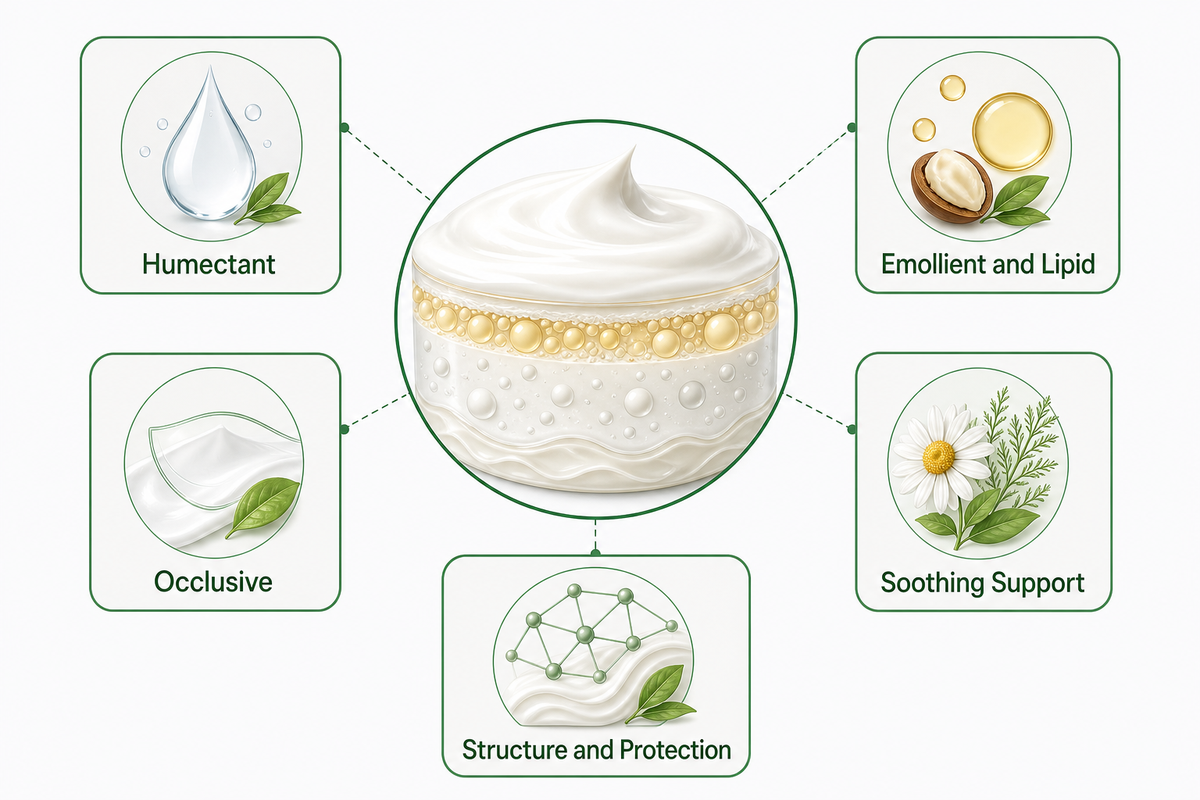
Barrier-oriented moisturizing creams, including concepts positioned for sensitive skin, usually coordinate several functional roles. Barrier lipids, humectants, emollients and occlusives must be assessed as a system rather than as isolated hero ingredients:
| Role | Development question | Possible ingredient families | What the ingredient list cannot prove |
|---|---|---|---|
| Humectant | How will the formula bind and manage water? | Glycerin, panthenol, hyaluronic acid | A specific hydration result in the finished product |
| Emollient and lipid | How will the cream spread, soften and support the lipid phase? | Ceramide materials, cholesterol, fatty acids, squalane, esters and oils | That the lipid reaches or reorganizes human stratum corneum in use |
| Occlusive | How much surface film and water-loss control fits the target skin feel? | Petrolatum, selected waxes, dimethicone and richer emollients | A universal reduction in transepidermal water loss |
| Soothing support | Which sensory or cosmetic positioning needs support? | Allantoin, madecassoside, colloidal oatmeal, niacinamide | Treatment of inflammation, dermatitis or another condition |
| Structure and protection | How will the formula remain emulsified, pourable or pumpable, and microbially protected? | Emulsifiers, fatty alcohols, polymers such as xanthan gum, chelators and a suitable preservation system | Stability, compatibility or challenge-test success |
The categories overlap. Panthenol and glycerin can contribute to humectancy and moisture retention, but the finished formula still determines the measurable result. An oil can change slip and occlusion. Fatty alcohols can support texture as well as the emulsion structure. An electrolyte-rich active can change polymer behavior. Ceramide concentrates may arrive in carrier systems that affect the oil phase, sensory profile and processing method. Supplier trade names are therefore less informative than complete raw-material specifications, composition, physical form and use instructions; the list alone cannot demonstrate finished-product barrier function.
Even within “ceramide,” structure matters. In a 2018 ex vivo human-skin model, researchers tested selected ceramide-containing formulations on regenerating, barrier-compromised stratum corneum. Both tested single-ceramide and two-ceramide-plus-fatty-acid systems produced denser lateral lipid packing, with the strongest effect in that model observed for a single-ceramide formulation. That study did not establish a universal retail formula or a consumer outcome. Its practical lesson is narrower and more useful: more ceramide names do not automatically make a better system, and lipid identity and organization deserve formulation attention.
Similar caution applies to the often-repeated idea of a single “skin-identical” ratio. Biological composition data describe living tissue, not the complete requirements of an emulsion that must be processed, preserved, filled, shipped and used. Ratios may serve as research hypotheses. They become product decisions only after the team checks raw-material form, solubility or dispersion, crystal behavior, sensory target, process compatibility and finished-product evidence.
Barrier Formula Control Map
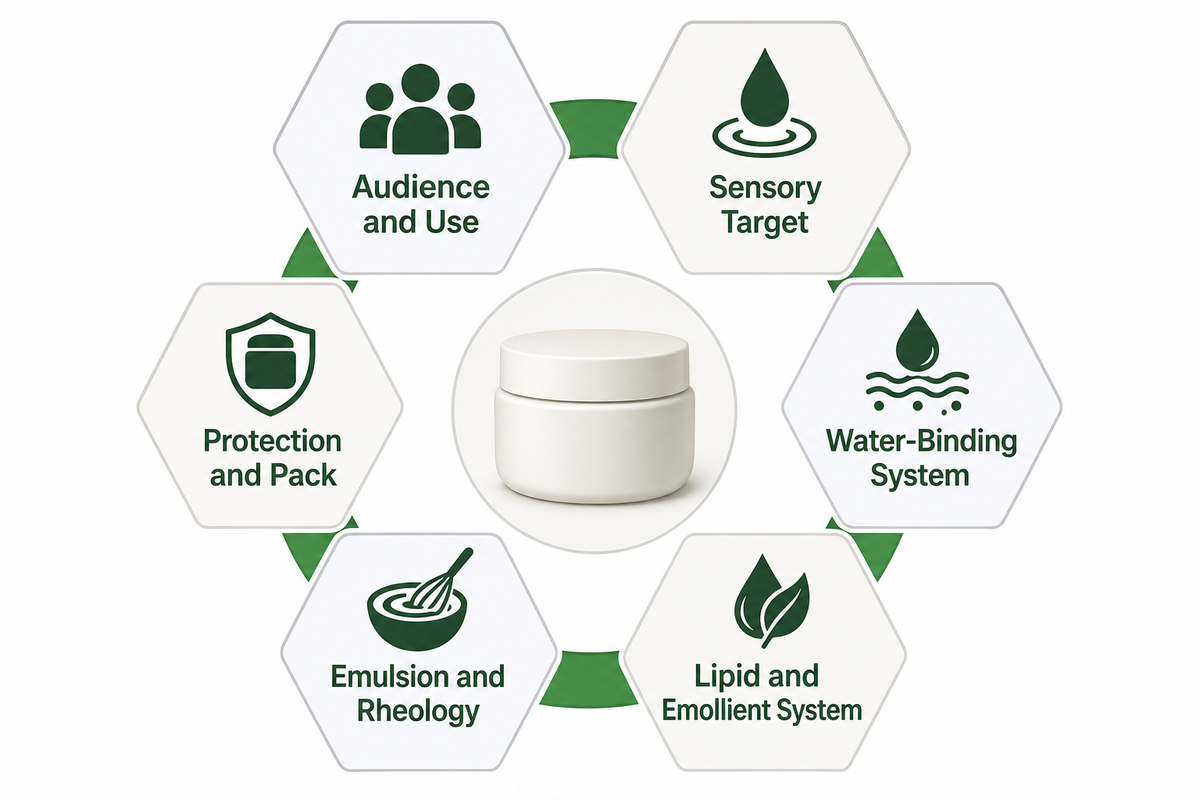
Collecting ingredient requests before defining the product is the fastest way to lose control of a custom barrier repair project. Better briefs use six linked blocks. Each block ends with a measurable output or a recorded decision.
1. Audience and use
Define the intended user, skin type language, climate, routine position, frequency, application area and claim boundary. Output: a signed product-purpose statement.
2. Sensory target
Describe pick-up, spread, cushion, absorption, film, after-feel and acceptable tack. Output: benchmark attributes with agreed evaluation conditions.
3. Water-binding system
Set the humectant direction and decide how tack, water activity, polymer compatibility and climate affect the choice. Output: a role-based rationale.
4. Lipid and emollient system
Balance ceramide direction, cholesterol or fatty-acid context, oils, esters, squalane and occlusives against texture and process risk. Output: phase and material-form plan.
5. Emulsion and rheology
Choose the structural system and define target appearance, viscosity method, flow, recovery and temperature sensitivity. Output: measurable bulk attributes.
6. Protection and pack
Connect preservation, chelation, pH, contact materials, dispenser, dose, filling and consumer use. Output: microbiology and compatibility risk plan.
Dependencies are the point of the map. Suppose a brand changes its sensory target from a rich balm-like cream to a faster-breaking moisturizer. That may alter the oil-phase load, emulsifier system, rheology profile, required shear, air sensitivity, fill temperature, dispenser choice and the relevance of the original stability protocol. Treating “texture” as a standalone marketing note would hide all of those consequences.
This map also turns subjective feedback into usable development input. “Make it more premium” is not an acceptance criterion. “Reduce the waxy drag during the first ten seconds of rub-out while retaining a light protective film after two minutes under the agreed application amount” gives the formulator and sensory panel a direction they can compare. Before approving a prototype, brand teams should define the evaluation method—sample conditioning, dose, application area and time point—used for sensory comments.
Briefing test: every must-have ingredient should have a stated role, every prohibited material should have a market or positioning reason, and every target claim should have an evidence owner.
From Lab Batch to Commercial Batch
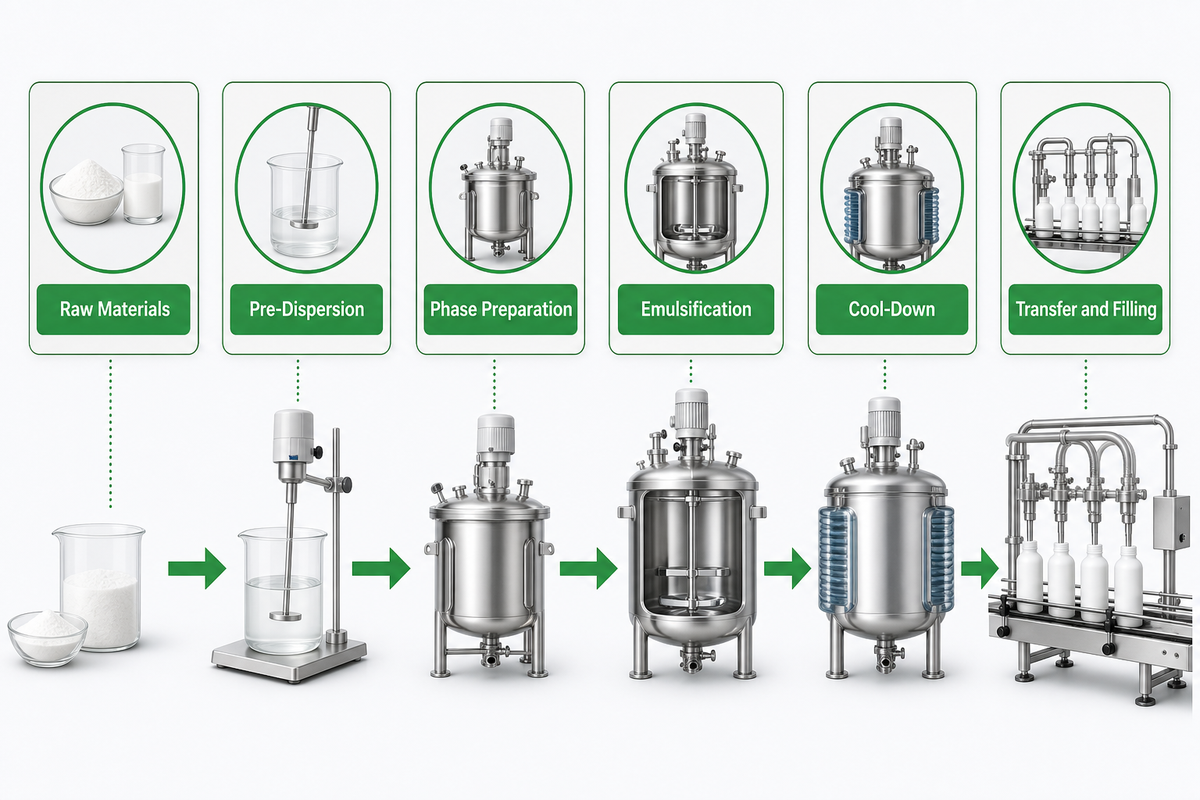
Scale-up is a transfer of controlled outcomes, not a multiplication exercise. Bench mixers and production vessels can run at identical shaft speeds while generating very different flow and shear. A five-kilogram batch and a multi-hundred-kilogram batch also heat and cool at different rates. Holding time, transfer distance, dead zones and filling temperature can change the product after the emulsification step appears complete.
Useful transfer records capture what matters at each stage:
- Raw materials: verify identity, lot, specification, physical form and any required preconditioning. Powdered actives, liquid dispersions and carrier-based blends with similar marketing names may require different handling.
- Pre-dispersion: document the vehicle, order and endpoint used to wet polymers, pigments, powders or lipid concentrates. Incomplete wetting can appear later as lumps, grit or viscosity drift.
- Phase preparation: record component sequence, temperature range, clarity or melting endpoint, hold time and protection from excessive heat where relevant.
- Emulsification: define the addition direction, flow conditions, shear regime and observable endpoint. Transfer should be based on product response and equipment capability, not a copied rpm number.
- Cool-down: track the curve, agitation and addition window for heat-sensitive or volatile materials. Long exposure through a critical temperature range can change crystallization or structure.
- Adjustment and bulk checks: standardize how pH, appearance, odor and viscosity are measured. Temperature, spindle, speed, rest time and sample history can change the reading.
- Deaeration and hold: decide how entrained air is removed, how long bulk may wait, which vessel conditions apply and what recheck is needed before filling.
- Transfer and filling: confirm hose, pump and contact-material compatibility; define fill temperature, dose or weight checks, closure controls and in-process sampling.
Pilot batches make these assumptions visible. Their purpose is not to create a large sample for photographs. They should demonstrate whether the proposed process can reach the target attributes, identify scale-dependent variation, and produce samples for the agreed stability, microbiology, compatibility and performance program.
Sampling matters. One top-of-vessel sample cannot show whether the bulk is uniform after mixing, transfer and filling. Sampling plans should reflect the question: uniformity across locations, change during bulk hold, early-versus-late fill behavior, or dispenser dose consistency. Project records should define the protocol and acceptance criteria before results are interpreted.
Scale-Up Failure Mode Matrix
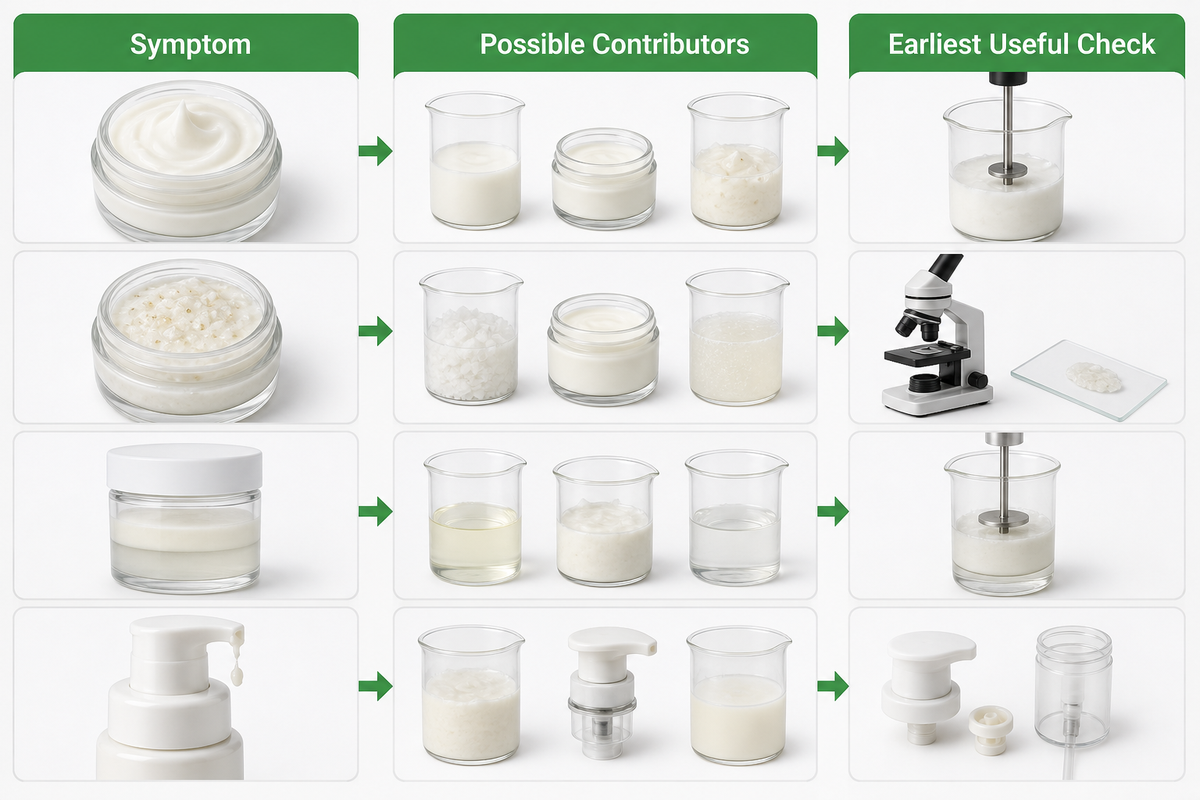
A failure symptom rarely proves one cause. “Grainy” could involve a lipid crystal, an incompletely dispersed powder, a polymer agglomerate or a package-generated particle. This investigation map points to plausible contributors and the earliest useful check without pretending to diagnose a batch from appearance alone.
| Symptom | Possible contributors | Earliest useful check | Decision owner |
|---|---|---|---|
| Grit or crystals | Incomplete melting or dispersion, solubility limit, cooling history, lipid polymorphism | Raw-material form, hot-phase endpoint, cool-down samples and microscopy where appropriate | Formulation and process development |
| Separation | Phase ratio, emulsifier mismatch, addition order, insufficient or excessive shear, thermal stress | Pilot-process record, initial bulk structure and accelerated observations | Formulator with manufacturing lead |
| Viscosity drift | Polymer hydration, electrolyte interaction, pH, cooling rate, measurement conditions | Standardized time-and-temperature measurement series | Quality and formulation |
| Excess air | Vortexing, high-shear exposure, poor vessel fill level, transfer pump or inadequate deaeration | In-process bulk density, visual cross-section and fill-weight behavior | Manufacturing and filling |
| Color or odor change | Oxidation, heat exposure, light, raw-material variation or package interaction | Controlled reference, raw-material review and stability pull | Quality with formulation and packaging |
| Microbiology concern | Preservation-system mismatch, pH drift, raw-material bioburden, water exposure or consumer-use pattern | Risk assessment, manufacturing hygiene evidence and applicable preservation testing | Microbiology/quality owner |
| Pack malfunction | Viscosity mismatch, air pocket, valve orifice, seal swelling, liner interaction or fill condition | Filled-component compatibility and dose/priming checks | Packaging with formulation and filling |
| Dose or fill inconsistency | Bulk aeration, temperature-dependent flow, line setting, pump variability or settling | Early/middle/late run in-process checks under defined bulk conditions | Filling and quality |
One hidden variable appears across nearly every row: measurement conditions. If one viscosity result comes from a freshly filled warm sample and another from a conditioned sample after 24 hours, the difference may reflect the method rather than the batch. Specifications should state enough about sampling, conditioning and measurement to support a consistent release decision.
When a result misses the agreed range, the team should resist adjusting the next batch before it knows what changed. Review the raw material lots, process record, sample history, equipment conditions and package components. Correcting the next batch for the wrong cause can make the following failure harder to interpret.
Evidence Stack: Stability, Microbiology, Packaging and Performance
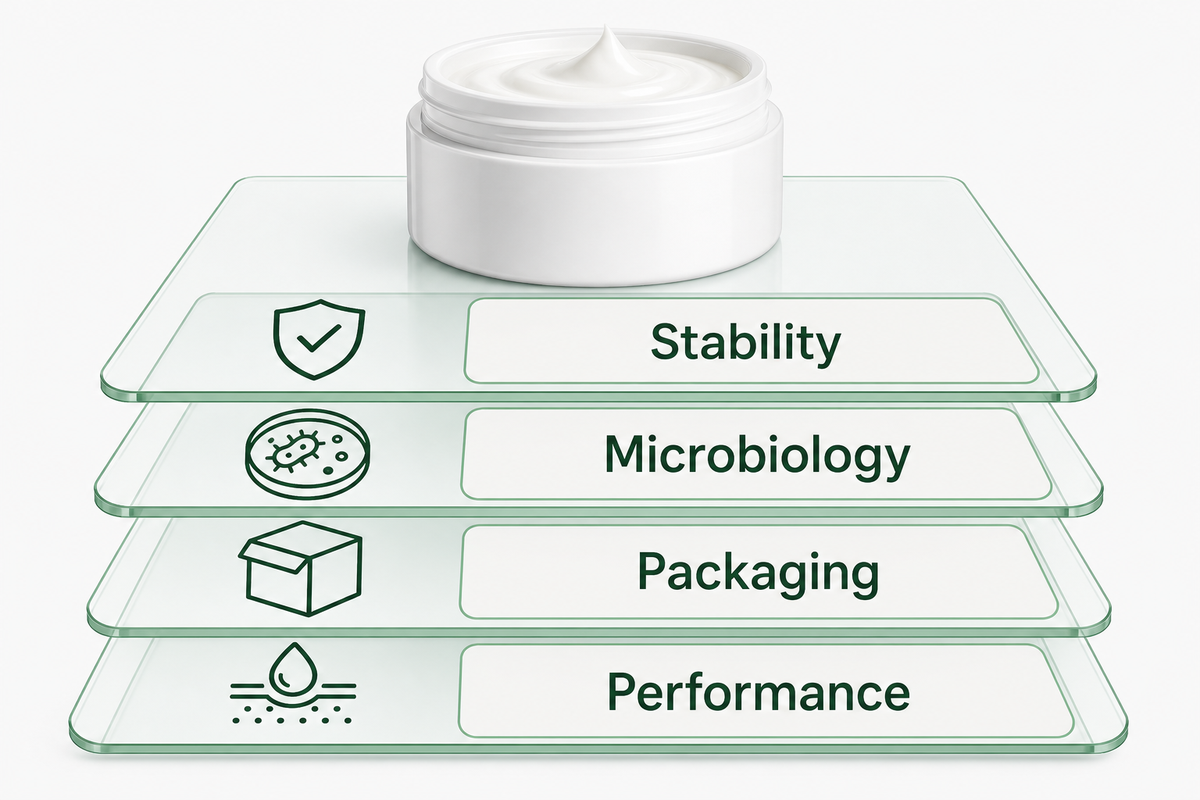
Evidence should be designed around decisions. “Run stability” is not a complete instruction. Teams need to know which product-package combinations are in scope, which conditions and time points answer the project’s risk questions, which attributes will be checked, what constitutes an alert or failure, and who approves a deviation or change.
ISO/TR 18811:2018 gives guidelines for cosmetic stability testing, while its public abstract explicitly states that it does not prescribe universal conditions, parameters or criteria. That limitation is useful. A low-viscosity airless gel-cream and a rich jar cream may face different physical, dispensing and consumer-use risks even when both use “barrier repair” positioning.
Microbiological protection is also more than adding a preservative. ISO 11930:2019 covers interpretation of preservation-efficacy and microbiological-risk information for overall antimicrobial protection, including a distinction for products assessed as low risk. Planning should consider the formula, pH, water availability, raw materials, manufacturing environment, packaging and expected use. This article does not prescribe a preservation system or pass limit.
Package compatibility belongs beside stability, not after it. Contact materials may interact with the formula; seals or liners may swell; a pump may lose prime; a tube may panel or leak; decoration may change; a jar may introduce a different consumer-use exposure. Test units should represent the intended component materials and filling conditions closely enough to answer the real question.
| Question | Evidence family | Can support | Cannot prove by itself |
|---|---|---|---|
| Does the bulk retain target attributes? | Defined physical/chemical stability program | Observed change under the tested conditions | Every possible storage or use condition |
| Is antimicrobial protection suitable? | Risk assessment and applicable preservation efficacy testing | Protection under the defined method and product scope | Future GMP compliance or careless use |
| Does the chosen pack function with the formula? | Filled-pack compatibility and functional checks | Performance of the tested component/formula combination | An untested material, supplier or decoration |
| Can the brand make a performance claim? | Claim-specific finished-product study or suitable evidence package | The defined endpoint in the tested population and conditions | Broader therapeutic or universal outcomes |
A 2025 peer-reviewed review of barrier products surveys in vivo, in vitro, biomimetic and other efficacy approaches. That breadth is the lesson: the study design must match the question. Instrumental hydration, transepidermal water loss, expert grading, consumer perception and model-based lipid measurements answer different questions. One result should not be stretched across claims it was not designed to substantiate.
Claims and Market Responsibility Need an Evidence Ladder
“Barrier repair” sits close to a regulatory boundary because ordinary consumers may read it as cosmetic care, while stronger wording can imply treatment or a change to body structure or function. In the United States, the FDA states that cosmetic labeling claims must be truthful and not misleading. Claims to treat or prevent disease, or to affect body structure or function, can cause a product to be regulated as a drug based on intended use.
That does not mean a team can solve the boundary by avoiding one forbidden phrase. Intended use can be communicated through the complete label, website, advertising, images and context. Brand teams should review the full claim set for its destination market with qualified regulatory support. Manufacturers can supply technical information and development evidence, but the business roles and final approvals should be explicit.
Under MoCRA, the FDA describes facility-registration and cosmetic-product-listing duties, a responsible-person role, renewal or update requirements and exemptions. FDA also states that registration and listing are not cosmetic approval programs. Project plans should therefore identify who owns facility and product duties without turning a filing into a marketing claim.
For the European Union, Commission Regulation (EU) No 655/2013 sets common criteria for cosmetic claims, including truthfulness and evidential support. It specifically warns against implying that an ingredient’s properties are the finished product’s properties when the evidence does not support that conclusion.
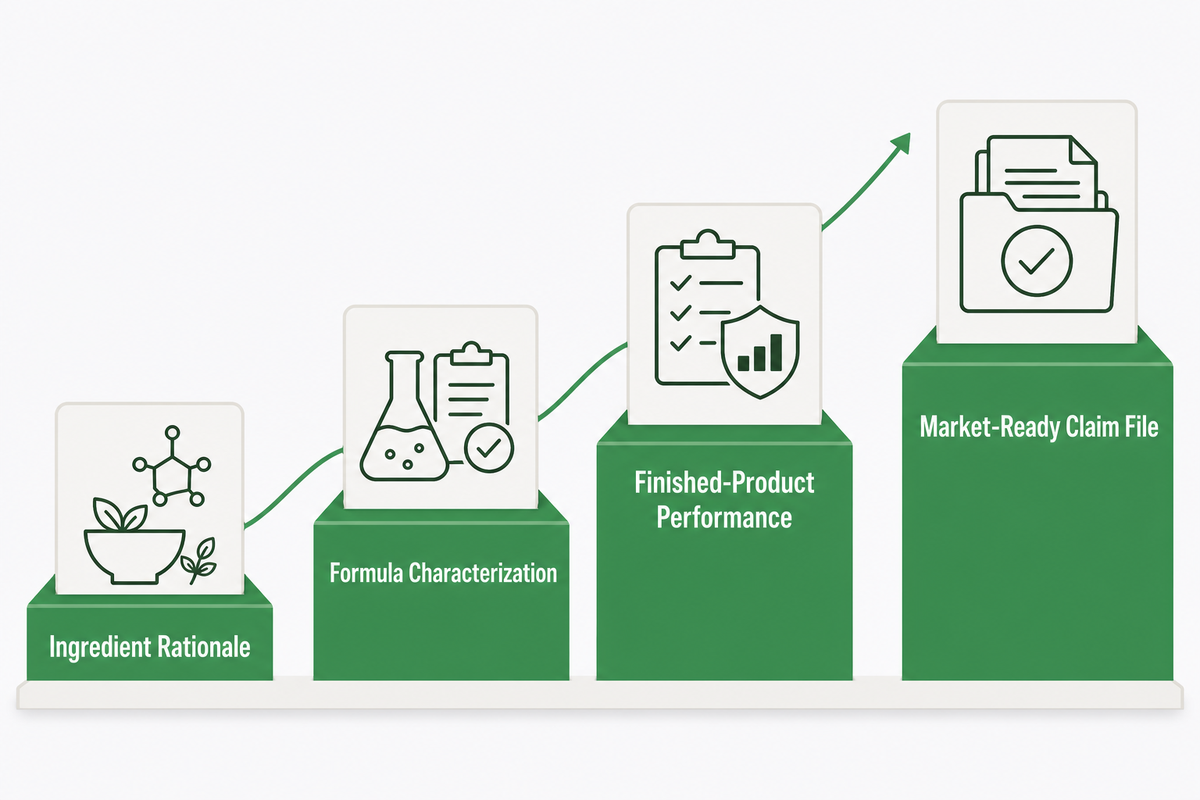
A four-level evidence ladder helps teams keep the difference visible:
- Ingredient rationale: explains why a material was considered. Supplier data or published literature may support the mechanism, but not the result of the final cream.
- Formula characterization: records what the developed product is—composition controls, pH, viscosity, appearance, structure or other relevant attributes.
- Finished-product performance: measures a defined endpoint using the intended formula, protocol, population or model and conditions.
- Market-ready claim file: connects the exact wording, audience and media to suitable evidence, safety information and the responsible market review.
Safer scope: “Formulated with ceramides, cholesterol and fatty-acid components as part of a barrier-oriented moisturizing system” describes composition and design intent. “Rebuilds damaged skin in seven days” is a defined outcome claim that needs suitable finished-product evidence and market review; it should not be inferred from the ingredient list.
This is educational planning, not legal clearance. Product category, intended use, label, advertising, market and business roles can change the answer for a real SKU.
Manufacturer Briefing Checklist and NEXO Next Step
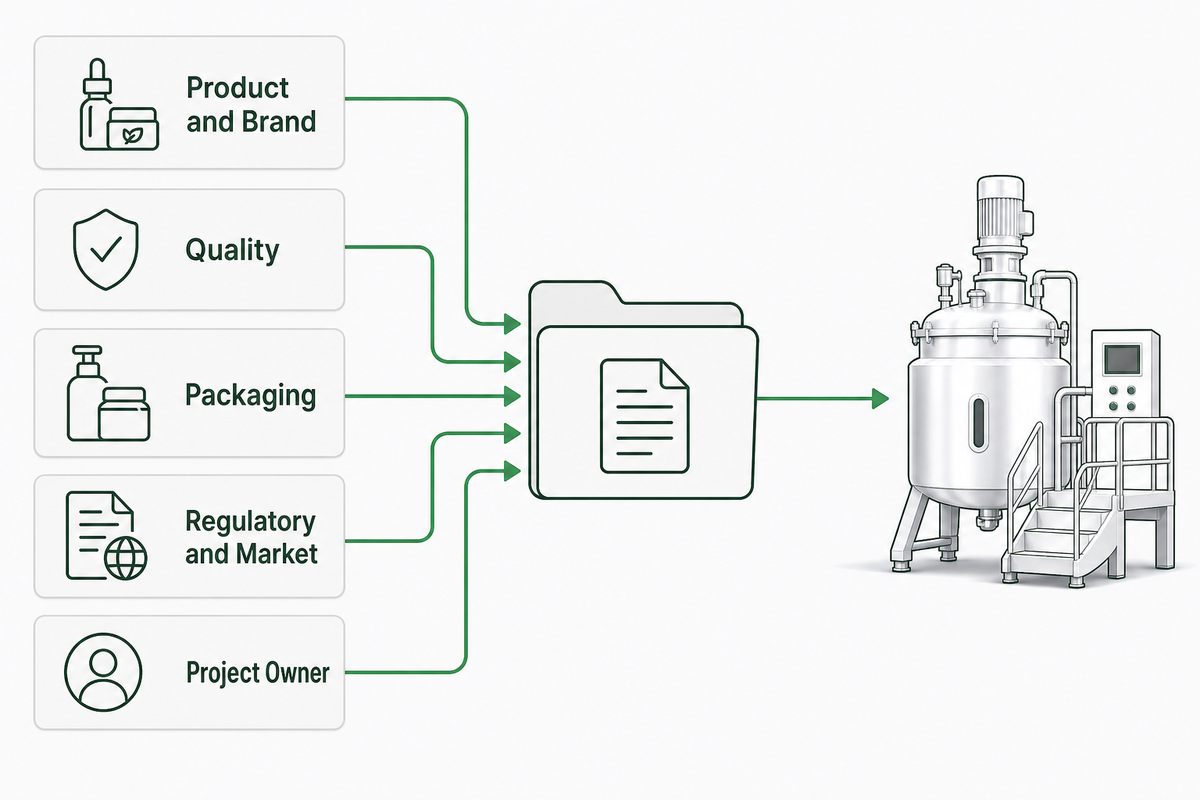
A useful manufacturer brief is a decision package, not a mood board. It shows what is fixed, what can move, how results will be judged, who owns each approval and which assumptions still need testing.
| Owner | Send before development | Approve before scale-up |
|---|---|---|
| Product/brand | Audience, use occasion, sensory target, benchmark, must-have and must-avoid requirements, claim hypothesis | Prototype direction, sensory method and final product-positioning boundary |
| Quality | Target attributes, sample conditioning, measurement methods, change-control expectations and document needs | Pilot evidence, specifications, release inputs and deviation path |
| Packaging | Format, dose, component materials, supplier, decoration, closure and user interaction | Filled-pack compatibility, dispensing performance and line readiness |
| Regulatory/market | Destination markets, product category, responsible roles, ingredient restrictions and proposed claim wording | Label/claim review and the evidence package for the actual market |
| Project owner | Decision rights, target launch sequence, approved dependencies and unresolved assumptions | Go/no-go criteria and ownership of remaining risks |
According to the company background provided for this article, NEXO Beauty Labs is a cosmetic OEM and ODM partner across skincare, hair care and body care. NEXO describes a manufacturing foundation dating to 1999 and an international business team supporting global brand, e-commerce, distributor and private-label projects since 2020. Those details explain the perspective behind the checklist; they do not replace project-specific evidence or market responsibilities.
If your team has defined the intended user, texture, ingredient constraints, package direction, market and claim hypothesis, the next step is to turn that information into a scoped project conversation. Review NEXO’s barrier repair cream manufacturing options and project inputs. Commercial route selection stays on the solution Page; this guide remains the technical preparation layer.
Bring NEXO a clearer barrier cream brief
Align the formula, process, package and evidence questions before the first commercial decision.
Discuss Your Project
Align the formula, process, package and evidence questions before the first commercial decision.
Discuss Your Project
Frequently Asked Questions
Is there one ideal ceramide-to-cholesterol-to-fatty-acid ratio?
No universal finished-product ratio can be taken directly from skin biology. Biological ratios and published models can inform a hypothesis, but a commercial cream also needs compatible raw-material forms, an emulsion structure, acceptable sensory properties, a manufacturing process, preservation, packaging and finished-product evidence. Even a promising ratio remains provisional until the actual raw-material carriers, dispersion behavior, process window and finished formula have been evaluated together.
Does adding more ceramide automatically improve a finished cream?
No. Ceramide class, chain structure, carrier, solubility or dispersion, lipid context, process and final organization can all matter. An ex vivo study cited above is a useful warning against counting ingredient names as a performance measure. Each intended formula still requires its own evaluation.
How is a barrier repair cream different from a standard moisturizer?
Meaningful differentiation should come from a defined product architecture and claim position, not from the words on the front label alone. A barrier-oriented cream may give more deliberate attention to lipid systems, occlusion, sensitive-skin sensory choices and claim evidence. Both products still need suitable stability, microbiology, packaging and safety work.
Which package—jar, tube or airless pump—is best?
There is no automatic winner. Package choice depends on viscosity, dose, user behavior, preservation strategy, oxygen or light sensitivity, component materials, decoration, filling capability and cost position. Representative final components should be used to test the intended formula.
What should be fixed before the pilot batch?
Before the pilot batch, teams should have an approved prototype direction, defined raw materials, a proposed process, target bulk attributes and measurement methods, representative packaging, a sampling plan, acceptance criteria and an agreed stability/microbiology/compatibility program. Open assumptions should be recorded as questions the pilot must answer.
Which tests are required before a barrier claim is approved?
Required evidence depends on the exact wording, market, product and risk. Ingredient literature may support rationale, while a quantified finished-product claim generally needs suitable finished-product evidence. Regulatory and claim reviewers should match the protocol and evidence threshold to the proposed communication.
Can a cosmetic claim to treat damaged or diseased skin?
In the United States, treatment, disease-prevention and structure/function claims can make a product a drug based on intended use. Other markets have their own rules. Do not rely on a generic phrase list; review the full labeling and promotion for the actual market with qualified support.
When should the manufacturer join product development?
Before claims, sensory targets, packaging and launch assumptions are locked. Early manufacturing input reveals conflicts while changes remain practical.
References & Sources
- U.S. FDA — Cosmetics Labeling Claims
- U.S. FDA — Registration & Listing of Cosmetic Product Facilities and Products
- ISO 22716:2007 — Cosmetics GMP
- ISO 11930:2019 — Antimicrobial Protection of a Cosmetic Product
- ISO/TR 18811:2018 — Cosmetic Stability Testing Guidelines
- Commission Regulation (EU) No 655/2013 — Common Criteria for Cosmetic Claims
- Berkers et al. — Topically Applied Ceramides in Compromised Ex Vivo Skin
- The Skin Barrier and Moisturization: Function, Disruption, and Mechanisms of Repair
- Using Molecular Simulation to Understand the Skin Barrier
- Barrier Products for Topical Delivery — Efficacy Testing and Compounds