Get in touch with NEXO Beauty Labs Company

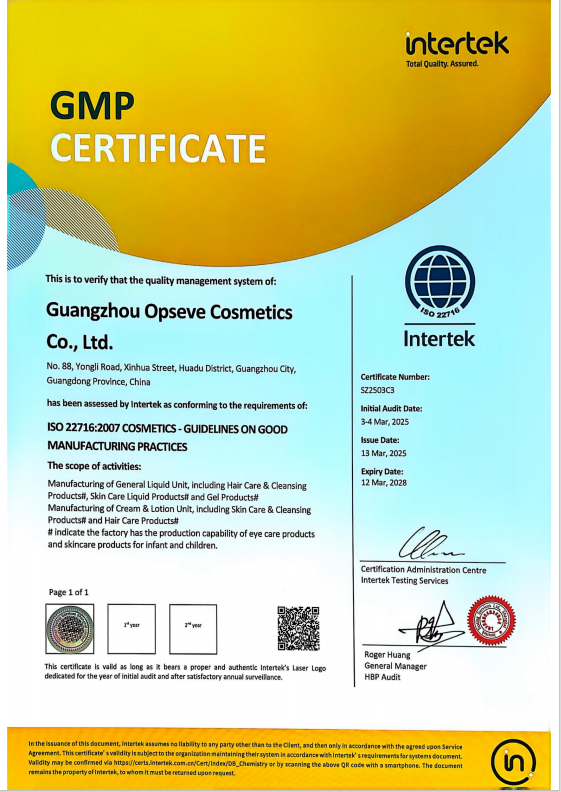
ISO Certified | Intertek SZ2503C3
Request a hair care quotation
Hair Care Product Manufacturing
Hair Care Product Manufacturing Across Five Formats
Hair care product manufacturing at NEXO Beauty Labs covers five formats under one brief: shampoo, conditioner and hair mask, scalp serum, hair oil and leave-in serum, and single-dose serum capsules. You can build one product or an entire hair care line from the same development team, the same production units and the same release-testing routine.
We’re a private label hair care manufacturer and ODM partner, not a stock catalogue. Every programme starts from your positioning, your target market and your packaging, and ends with a batch that carries its own certificate of analysis. Brands come to a hair care products manufacturer at two different moments: launching a first hair care brand, or extending an existing product line into private label hair care products that need to sit beside what they already sell. This page is written for both.
Hair care product manufacturing companies aren’t interchangeable, and the differences that matter are rarely the ones on the front page. Order floor, audited scope, lead-time trigger points and what happens to your formula if you leave decide more than any capability list does.
Your concept and formula are covered by a non-disclosure agreement signed on request before the brief is shared.
Order floor
10,000 units per SKU
Formats
Shampoo, conditioner and mask, scalp serum, hair oil and leave-in, single-dose capsule
Sample lead time
3-7 working days from a confirmed brief
Production lead time
10-15 days after sample and artwork approval
Audited scope
Hair care named in both production units, Intertek SZ2503C3, valid to 12 March 2028
Commercial terms
30-50% deposit starts production, balance settled before shipment
3-7 Days
Samples delivered in working days from a confirmed brief.
10-15 Days
Production time after sample and artwork approval.
10,000 Units
Minimum order floor capacity required per SKU.
100% NDA
Signed and secured before your brief is shared.
Hair Care Manufacturing Capabilities and Development Routes
Four development routes cover the range from a fast launch on an adapted formula to a fully bespoke system built around your brief. The route you choose determines how much of the product development work sits with our laboratory and how much arrives with you.
The same four routes serve white label programmes, private label cosmetics ranges and full custom formulation projects. What changes between them is the starting point, not the manufacturing process that follows.
Private label from the formula library
We start from a proven formula in our own library and adapt it to your positioning. Ingredient substitutions, texture and sensory adjustment, fragrance and packaging are all in scope.
This is the shortest route from brief to shelf, and it’s the one most brands use for a first hair care SKU.
Custom ODM development
You bring a concept, an ingredient direction or a market requirement, and our formulation team builds a custom formulation from there. Sensory work and stability evaluation run alongside the development.
Use this route when the point of the product is that nobody else has it.
Reference sample development
You supply a market product or an existing formula as a reference. We evaluate it, then develop a formulation that meets your texture, sensory and performance targets.
This route suits brands extending a range while keeping a house feel across products.
Contract manufacturing of your formula
You already own a formula and the specifications behind it. We provide bulk manufacture, filling, packaging and release inspection against those specifications.
Here the formula stays yours from the first day to the last, because it arrived that way.
FORMULATION
Five Hair Care Formats and Their Formulation Platforms
Three of the five formats have their own programme page with full platform detail. The two that don’t are described here, because a hub page should tell you what exists rather than send you looking for it.
Across all five, the formulation platforms cover the claim directions a hair care brand normally needs: repair, hydration, frizz control, heat protection, gloss, volumizing, colour-treated and color-safe systems, and scalp comfort. Salon-grade positioning and retail positioning are both supported, and which one you’re building for belongs in the brief.
Styling products such as gels, pomades, mousses and hairsprays aren’t part of this range. They use different equipment and a different regulatory profile, and we would rather say so on this page than after a specification has been written.
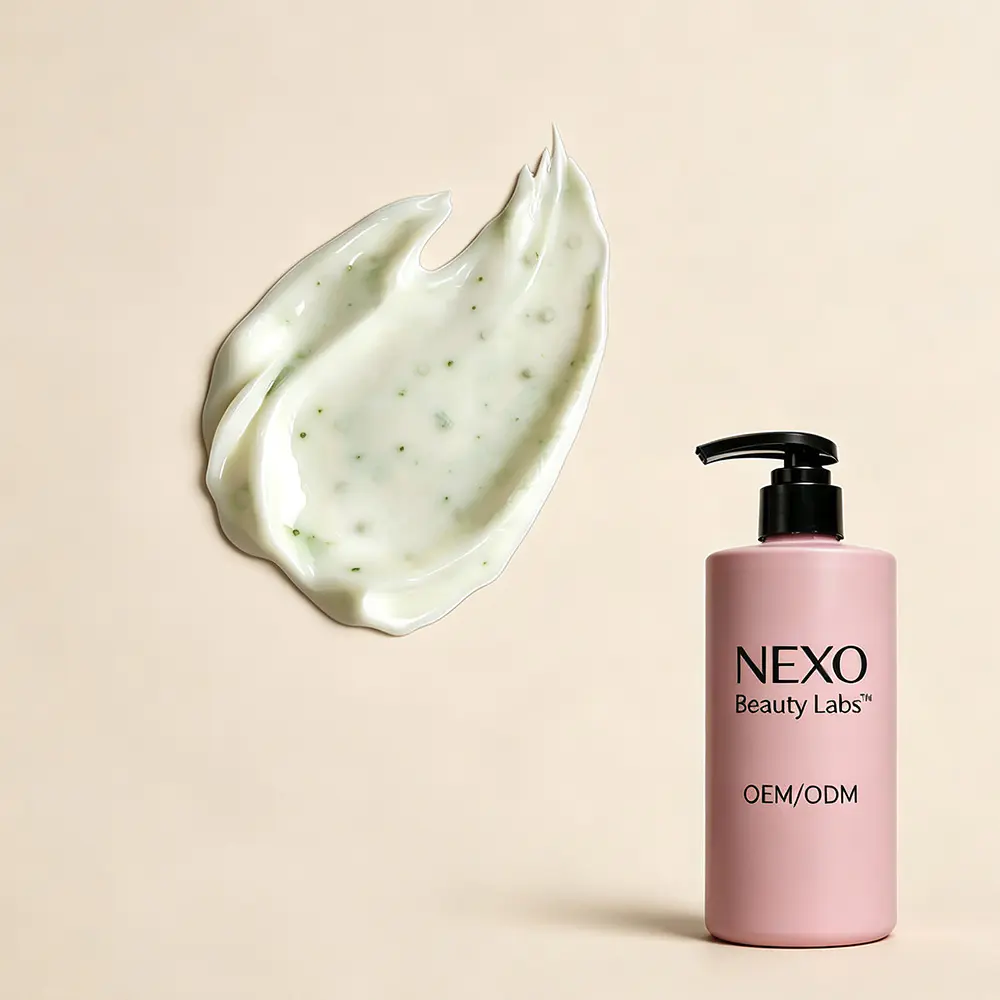
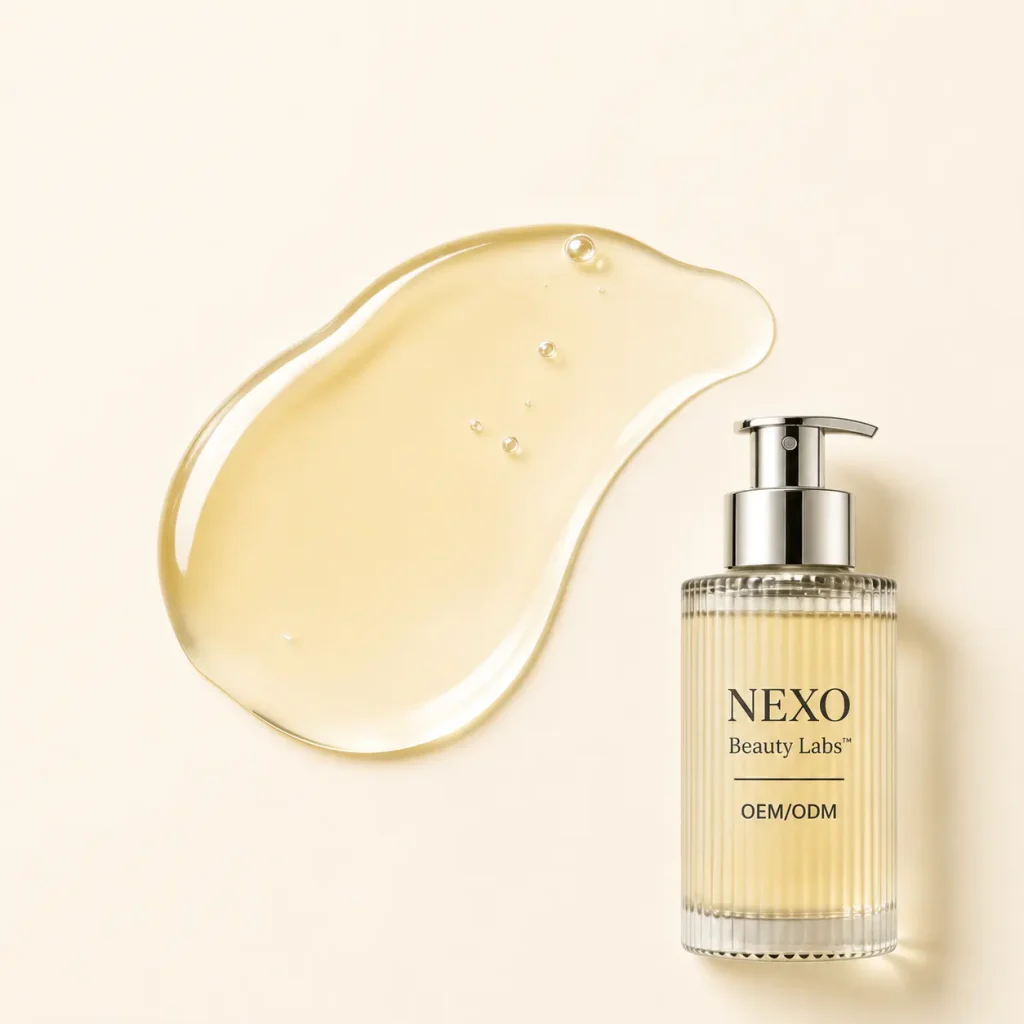
Hair oil and leave-in serum
Leave-on oils and serums are formulated as low-water or anhydrous systems, which changes both the sensory target and the testing route. Three platforms cover most briefs in this format.
- Botanical repair oil: argan, jojoba, camellia and squalane, aimed at dry, damaged and frizz-prone hair
- Advanced repair serum: plant lipids, peptides and ceramides in a leave-in system for chemically treated and heat-stressed hair
- Lightweight glow oil: meadowfoam seed oil, grapeseed oil, jojoba and antioxidants, built for gloss without weight
Oil chemistry isn’t interchangeable, and the published research is blunt about it. Work published in 2024 on coconut, avocado and argan oil in Caucasian hair found coconut oil penetrating to around 50 micrometres and raising both stiffness and break stress in virgin hair, while argan oil increased water absorption and lowered both. Bleached hair came off worst, because a bleached fibre is more hydrophilic, takes up more of the oil and more water with it, and is left more fragile under mechanical stress. A brief that says “add argan oil for repair” needs to survive that finding before it becomes a claim.
This is where a high-quality hair product separates from a well-marketed one. Choosing an oil because it tests well on the hair state your buyer actually has is a development decision, and it happens before the label is designed rather than after.
Single-dose serum capsules
A single-dose capsule holds one application of a concentrated leave-in system in a plant-based shell. The format removes the preservative question almost entirely, because the concentrate is anhydrous and the dose is sealed until use.
- Plant-based capsule shell with customisable size, shape, colour and fill weight
- Anhydrous concentrated systems built for repair, heat protection or gloss positioning
- Packaging designed around the capsule rather than adapted to it
This is the format that most often decides which manufacturer a brand ends up with, because comparatively few hair care facilities run a capsule line at all. Innovation in hair care tends to arrive as a delivery format before it arrives as a molecule, and the capsule is the current example.
Claim Routes, Sensory Profiles and Packaging Options
A hair care brief has two halves. One half is what the product does to hair, and the other half is what you’re allowed to say about it in the market you’re shipping to.
Positioning attributes that carry no performance claim (cruelty-free, vegan, sulphate-free, silicone-free) are set at brief stage, because each one constrains the raw material list before formulation starts rather than after. Positioning that depends on organic certification needs the certificate scheme named in the brief too, since the raw material list has to be built against it from the first trial.
What buyers of your product actually look for
A 2025 survey of more than 200 regular conditioner, mask and treatment users in the United States and United Kingdom put shine first at 50%, frizz control at 49%, smoothness at 47%, moisture at 41% and strength at 40%. Strength ranks fifth, behind four attributes that are visible or tactile on first use.
The same survey found that only around 10% of those users were very confident that conditioning and repair products deliver on their claims, with about 55% only somewhat confident. That gap is where a claim route earns its keep, and it’s the single most useful thing to know about the hair care industry before writing a label.
Sensory and texture targets
- Lightweight cream, rich cream and butter-style mask textures
- Easy rinse, soft hair feel and manageability across everyday hairstyles, set as measurable formulation targets
- Weightless finish for leave-on oils, gloss without a greasy hand
- Fragrance direction developed with the formula, not added at the end
Packaging formats
- Bottles, tubes, jars and pump systems for rinse-off and leave-on formats
- Dropper and applicator systems for scalp serums
- Single-dose capsules with custom size, shape, colour and fill weight
- Artwork and labelling prepared for the destination market you name in the brief
The Dual-Status Threshold
Hair claims sit on a ladder, and there’s a point on that ladder where a product stops being only a cosmetic. Crossing it doesn’t remove cosmetic status. It adds drug obligations on top of the cosmetic ones, and both sets then apply to the same bottle.
| Tier | What the claim says | Status in the United States |
|---|---|---|
| 1 | Cleansing, conditioning, appearance and sensory: shine, smoothness, softness, manageability, frizz control | Cosmetic |
| 2 | Scalp comfort and scalp condition described in appearance terms rather than treatment terms | Cosmetic, with wording that stays on the appearance side |
| 3 | Fuller-looking hair described as an appearance outcome | Cosmetic, and the wording carries the whole risk |
| — | The threshold | |
| 4 | Treating dandruff, seborrhoeic dermatitis or psoriasis | Cosmetic and drug. FDA uses an antidandruff shampoo as its own example of a product that is both, and OTC monographs exist for these categories |
| 5 | Restoring hair growth or preventing hair loss | Drug claim. FDA lists restoring hair growth among the claims that establish a product as a drug |
Three things decide where you sit on the Dual-Status Threshold, and only the first is under your direct control. Claims made on the label, in advertising and on your website come first. Consumer perception of what the product is for comes second. Ingredients with a well-known therapeutic use come third, and they can move a product across the threshold even when the label says nothing.
Products above the Dual-Status Threshold must carry combination labelling, with drug ingredients listed alphabetically as active ingredients and cosmetic ingredients listed in descending order of predominance as inactive ingredients. There’s no middle category to fall back on: the FD&C Act doesn’t recognise “cosmeceuticals” at all.
Format matters here too. Which actives are permitted, and at what level, changes between rinse-off and leave-on products and changes again between destination markets. A scalp active that’s straightforward in a shampoo can be restricted in a leave-on serum, which is why the format and the market belong in the brief rather than in a later revision.
Bond repair deserves its own note. The chemistry behind several well-known bond-building systems is covered by third-party patents, so a brief asking for “the same effect as” a named product is a commercial question before it’s a formulation one.
Hair Care Programme Specifications
Hair care formats don’t share one testing routine, and treating them as if they did is how a launch slips. The axis that separates them is water activity, not simply whether a formula contains water.
Low water activity is one of several conditions that can put a product in the low-microbiological-risk group, alongside hydro-alcoholic composition and extreme pH. The classification itself comes from a written microbiological risk assessment rather than from reading the ingredient list, and that assessment is part of the development work rather than an afterthought.
The Water-Activity Split
The five commercial formats resolve into six positions on the Water-Activity Split, because a daily rinse-off conditioner and an intensive mask don’t sit in the same place. The mask carries a richer phase and a longer contact time, and both change the stability question.
| Format | Water-activity band | Preservation assessment | Microbiological quality | Stability protocol | Order floor and timing |
|---|---|---|---|---|---|
| Shampoo | Water-rich, water-miscible | ISO 11930 preservation efficacy test applies directly | Full microbiological quality assessment under ISO 17516, organisms detected per ISO 18415 | Protocol specified and justified per ISO/TR 18811 | 10,000 units per SKU · samples 3-7 working days · production 10-15 days |
| Conditioner, daily rinse-off | Emulsified, water continuous | ISO 11930 preservation efficacy test applies directly | Full assessment under ISO 17516, with emulsion sampling | Protocol specified and justified per ISO/TR 18811 | 10,000 units per SKU · samples 3-7 working days · production 10-15 days |
| Hair mask and intensive treatment | Emulsified, richer phase, water continuous or water internal | ISO 11930 applies, with modification where water is the internal phase | Full assessment under ISO 17516, with emulsion stability sampling | Protocol specified and justified per ISO/TR 18811, with longer contact time in scope | 10,000 units per SKU · samples 3-7 working days · production 10-15 days |
| Format | Water-activity band | Preservation assessment | Microbiological quality | Stability protocol | Order floor and timing |
|---|---|---|---|---|---|
| Scalp serum | Low-water leave-on, sometimes hydro-alcoholic | Risk assessment first under ISO 29621, then ISO 11930 where the product is not low risk | Scope set by the risk assessment rather than a standard checklist | Protocol specified and justified per ISO/TR 18811, with applicator compatibility | 10,000 units per SKU · samples 3-7 working days · production 10-15 days |
| Hair oil and leave-in serum | Anhydrous or very low water activity | Identified as low risk under ISO 29621 in most briefs, in which case ISO 11930 does not apply | Reduced scope, justified in writing rather than assumed | Protocol specified and justified per ISO/TR 18811, with oxidation and packaging compatibility | 10,000 units per SKU · samples 3-7 working days · production 10-15 days |
| Single-dose serum capsule | Anhydrous concentrate, sealed dose | Low risk under ISO 29621 in most briefs, confirmed by assessment | Reduced scope, plus shell and fill compatibility | Protocol specified and justified per ISO/TR 18811, with fill-weight and shell integrity | 10,000 units per SKU · samples 3-7 working days · production 10-15 days |
Read the Water-Activity Split left to right and the pattern is the point. Moving from shampoo to capsule doesnt simplify the work, it relocates it. The trade-off is that preservation effort falls away while packaging compatibility, oxidation and fill accuracy take its place.
This is also why a shampoo and its matching treatment cant share one test plan. A brief for private label shampoo and conditioner sold as a pair still needs two testing routes, because the two products sit at different points on the Water-Activity Split.
The question we ask first is never which preservative to use. It is what the water activity will be once the formula is finished, because that single answer decides the preservation route, the microbiological scope, the stability protocol and half the packaging brief at the same time.
Audited Scope, Quality Control and Release Testing
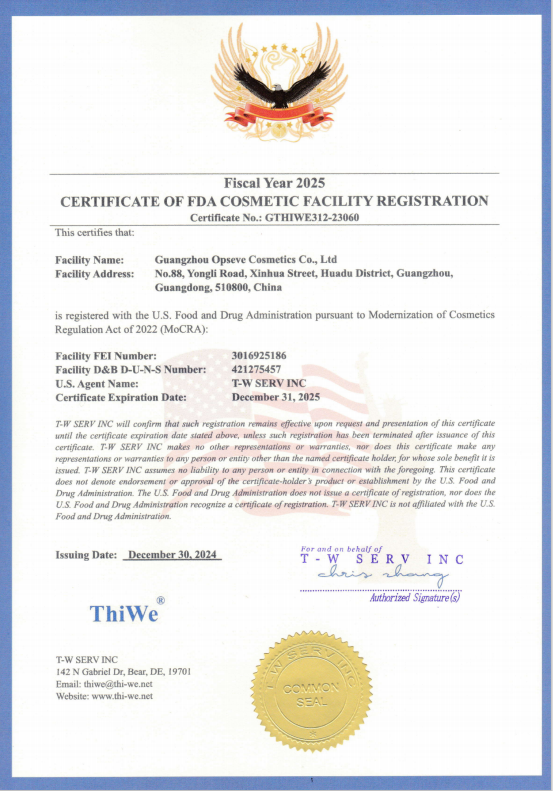
The certificate, and exactly what it covers
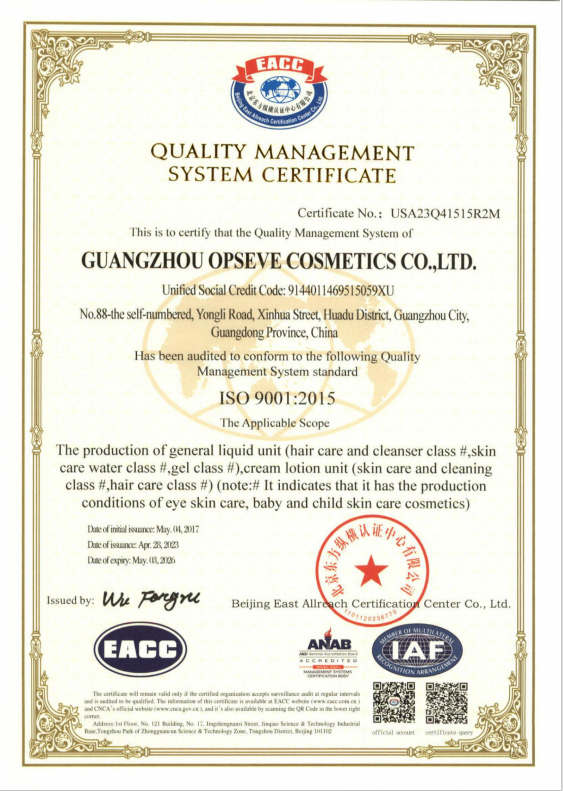
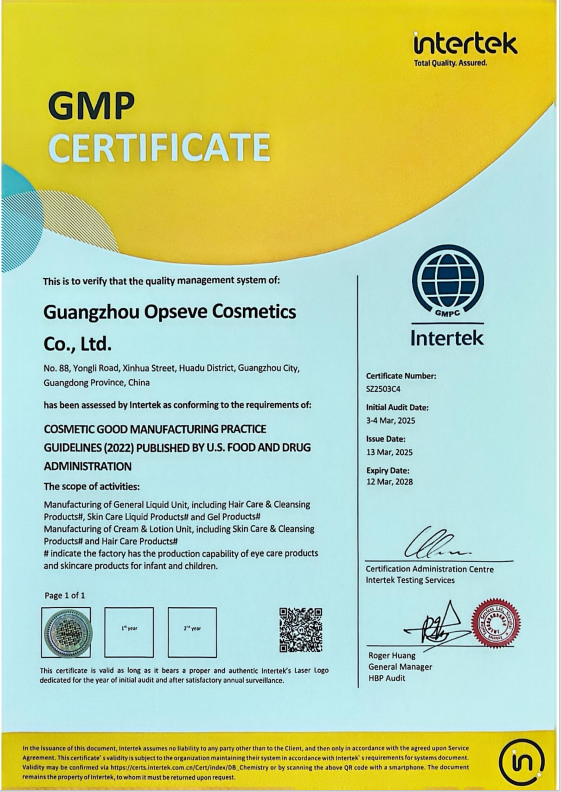
Manufacturing takes place at Guangzhou Opseve Cosmetics Co., Ltd., No. 88 Yongli Road, Xinhua Street, Huadu District, Guangzhou. That site holds Intertek certificate SZ2503C3 against ISO 22716:2007, the international cosmetic good manufacturing practice standard, valid to 12 March 2028. The registered audited scope names hair care in both production units:
General Liquid Unit: hair care and cleansing products, skin care liquid products and gel products
Cream & Lotion Unit: skin care and cleansing products and hair care products
Both entries carry a marker indicating the factory also has production capability for eye-area products and for skincare intended for infants and children. The certificate is published in Intertek's own certificate database, searchable by number, and the scope text there is the same text printed on the certificate.
NEXO Beauty Labs sources every hair care batch from that site. Quoting the certificate by number, holder and audited scope rather than by standard name alone is how you can confirm that for yourself in about ten seconds, without asking us for anything.
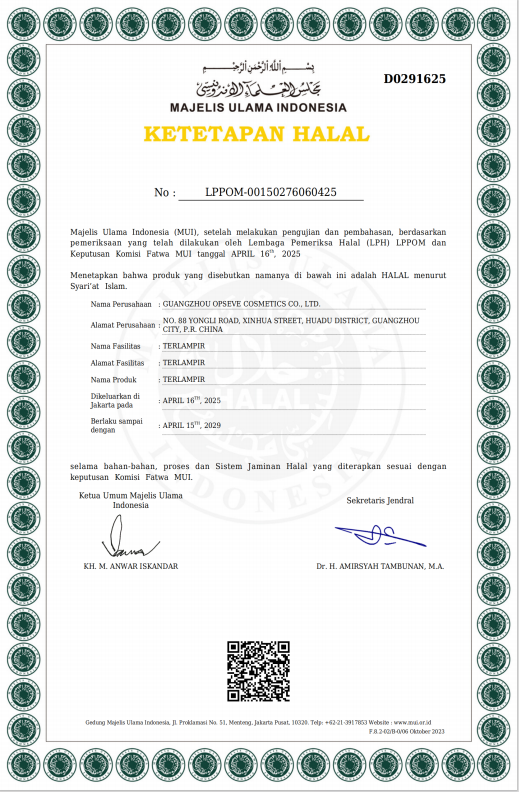
The site also holds a Ketetapan Halal from Majelis Ulama Indonesia, certificate LPPOM-00150276060425, valid to 15 April 2029. Its covered facilities and products are listed in an annex to the certificate, so the specific products it reaches are confirmed against that annex at quotation stage.
Six quality-control stages
1. Incoming material inspectionwhere raw materials and packaging components are checked and approved before they enter production.
2. In-process controlmonitoring key product and process parameters while the batch is being made.
3. Bulk inspectionwhich evaluates bulk product before it goes anywhere near a filling line.
4. Filling and packaging inspectioncovering fill accuracy, sealing and packaging condition during the run.
5. Finished product inspectionagainst the specification agreed for your product.
6. Batch review and releasewhere production and quality records are reviewed and retained before the batch ships.
What a cosmetic GMP certificate does and does not reach
ISO 22716 covers production, control, storage and shipment. ISO's own scope statement puts research and development outside it, along with distribution at the point of sale. A certificate against it is evidence about a site and its process control, never evidence about how a finished product performs.
A product that a national regulator classifies as a drug is governed by drug manufacturing rules rather than by this standard, which is the reason the last section on this page routes those projects elsewhere.
Certificates under this standard run on a three-year cycle with annual surveillance audits. The dates on ours reflect that cycle rather than a one-off assessment.
What is measured before release
Finished product is evaluated for appearance and odour, pH, viscosity, microbiological quality, filling weight and packaging condition, with batch consistency assessed before release. Retained samples are held from each production batch.
Those checks exist to confirm one thing: that the product meets the specification agreed for your SKU, batch after batch. A hair care solutions partner that can't show you that record is asking you to take consistency on trust.
Each batch ships with a certificate of analysis and the technical file agreed in your quotation. Those two documents are what make a batch auditable after it leaves the building, which matters more than any badge on a web page.
×
![Enlarged Manufacturing View]()
How We Work: From Product Brief to Commercial Batch
Six stages run between a confirmed brief and a released batch, and two of them are yours rather than ours: approving the sample and approving the artwork. Those two approvals are what start the production clock, which is why the lead times on this page are quoted from a decision rather than from an enquiry.
Brief and route selection.
You give us the format, positioning, target market, packaging direction and volume. We confirm which of the four development routes fits and sign the non-disclosure agreement before formula detail changes hands.Formula and sample development.
Samples reach you in 3-7 working days from a confirmed brief, and revisions run against your written feedback rather than a general impression.Sample approval and artwork.
You approve the sample and the packaging artwork for your destination market. Both approvals are needed before the production clock starts.Deposit and scheduling.
A 30-50% deposit starts production and the batch enters the schedule.Manufacture and in-process control.
Production runs 10-15 days from approval, under the six-stage quality routine described above.Release, documentation and shipment.
The batch is reviewed and released, the certificate of analysis and technical file are issued, and the balance is settled before shipment.Formula Ownership, Change Control and Documentation Handover
Sourcing managers ask about this earlier than most manufacturer pages assume, and the reason is practical. Brands that leave a manufacturer sometimes discover they can't take the formula with them.
The development route you choose already answers most of the ownership question, before any contract is drafted:
| Route | Where the formula starts | What that means at handover |
|---|---|---|
| Private label | Our formula library, adapted to your brief | The base is ours and your adaptations are documented against it |
| Custom ODM | Developed from your brief by our laboratory | Ownership and licensing are set in the manufacturing agreement, and it is worth setting them before development starts rather than after |
| Reference sample | Developed from a reference you supply | Same as custom development, with the reference recorded in the project file |
| Contract manufacturing | Your formula, supplied by you | It stays yours throughout, because it never stopped being yours |
Three things travel with every batch regardless of route: the certificate of analysis for that batch, the technical file agreed in your quotation, and the retained sample held on our side. Exclusivity, change-control procedure and ownership of testing reports are settled in the manufacturing agreement, which is the right place for them and the only place they're enforceable.
Which market obligations stay with you
Manufacturing documentation doesn't transfer regulatory roles, and any supplier who implies otherwise is describing something they can't deliver.
Under the Modernization of Cosmetics Regulation Act of 2022, facility registration with FDA and its biennial renewal sit with the facility that manufactures or processes the product. Product listing sits elsewhere: it belongs to the responsible person, and FDA defines the responsible person as the manufacturer, packer or distributor whose name appears on the product label. On a private label programme, that name is usually yours.
Two consequences follow. Product listing and its annual updates are a brand-side obligation on almost every private label launch, and no certificate substitutes for them. FDA also states plainly that registration and listing are neither an approval programme nor a promotional tool, and that it issues no certificates for either.
Professional Hair Care Manufacturing Tools
Claim tier checker
Paste the wording you intend to put on the label or the product page. This places it on the five-tier ladder described above and tells you whether it keeps the product a cosmetic, puts it in both categories, or moves it to the drug side. Written for the United States position; other markets draw the line in different places.
Access Tool →
Testing route selector
The axis that decides a hair care testing plan is water activity, not whether the formula contains water. Pick the format and, if you know it, the water activity you are formulating to. This returns the route that applies and the standards that carry it, so a shampoo and its matching treatment are not accidentally put on one test plan.
Access Tool →
Programme scope and lead-time planner
Both lead times here are measured from a decision rather than from an enquiry, so this planner asks for the shape of the programme and returns the trigger points along with it. It also tells you plainly when a programme sits below the order floor, because that is a better answer than a quotation nobody can honour.
Access Tool →
Hair Care Manufacturing FAQ
Four things a sourcing team can check without a call: whether the order floor is published, whether the certificate is given by number rather than by standard name, whether lead times carry their trigger points, and whether the page says what the supplier won't take on.
If you're working from a list of hair care contract manufacturers, those four filters will shorten it faster than any capability comparison.
If you're working from a list of hair care contract manufacturers, those four filters will shorten it faster than any capability comparison.
Private label means the formula starts on our side and is adapted to your brand. Contract manufacturing means the formula starts on your side and we manufacture it to your specification.
The practical difference shows up in two places: how much development work sits with our laboratory, and where the formula lives when the relationship ends.
The practical difference shows up in two places: how much development work sits with our laboratory, and where the formula lives when the relationship ends.
Haircare products across five formats: shampoo; conditioner and hair mask; scalp serum; hair oil and leave-in serum; and single-dose serum capsules.
Those formats sit inside the two production units named on the site's cosmetic GMP certificate, which is why the list stops where it does rather than covering every category in hair care.
Those formats sit inside the two production units named on the site's cosmetic GMP certificate, which is why the list stops where it does rather than covering every category in hair care.
A cosmetic product carries its ingredients in descending order of predominance under cosmetic labelling rules.
A product that also meets the definition of a drug carries combination labelling instead, with drug ingredients listed alphabetically as active ingredients followed by cosmetic ingredients in descending order as inactive ingredients.
A product that also meets the definition of a drug carries combination labelling instead, with drug ingredients listed alphabetically as active ingredients followed by cosmetic ingredients in descending order as inactive ingredients.
Sulphate-free surfactant systems are a common brief and we formulate them routinely. They change foam profile, viscosity build and rinse feel, so the sensory targets have to be set with that in mind rather than copied from a sulphate system.
Whether it's right for your range is a positioning question for your target market, and we would rather discuss it at brief stage than reformulate later.
Whether it's right for your range is a positioning question for your target market, and we would rather discuss it at brief stage than reformulate later.
Both. Custom ODM development builds the formula from your brief, and reference sample development builds it from a product or formula you supply.
Adaptation from our formula library is the fastest route, and it's the one most first SKUs use.
Adaptation from our formula library is the fastest route, and it's the one most first SKUs use.
Yes. Repair, bond and protein care, lipid nourishment, hydration, frizz control, heat protection, gloss, scalp balance and scalp comfort are all supported formulation directions.
The platform detail for shampoo, conditioner and scalp serum lives on each format's own programme page.
The platform detail for shampoo, conditioner and scalp serum lives on each format's own programme page.
Yes, and it's the most common way a hair care line starts here. One brief, one development team, one sensory direction across the range.
Each product is still its own SKU for the purposes of the order floor, so a three-product range means three separate 10,000-unit floors.
Each product is still its own SKU for the purposes of the order floor, so a three-product range means three separate 10,000-unit floors.
Because water activity decides which testing route applies. A preservation efficacy test is designed for water-soluble and water-miscible products and can be used with modification where water is the internal phase, but it doesn't apply at all to products a written risk assessment identifies as low microbiological risk.
Low water activity is one of the conditions that puts a product in that group, along with hydro-alcoholic composition and extreme pH. The Water-Activity Split is why an anhydrous hair oil and a shampoo end up on entirely different testing paths.
Low water activity is one of the conditions that puts a product in that group, along with hydro-alcoholic composition and extreme pH. The Water-Activity Split is why an anhydrous hair oil and a shampoo end up on entirely different testing paths.
10,000 units per SKU, and it's a floor rather than an opening position.
If your volume is below that, our low minimum order programme covers hair care and confirms a workable starting quantity in writing for each project. Where neither route fits, suppliers configured for low minimums are the better answer, and we would rather say so than take a project the economics don't support.
If your volume is below that, our low minimum order programme covers hair care and confirms a workable starting quantity in writing for each project. Where neither route fits, suppliers configured for low minimums are the better answer, and we would rather say so than take a project the economics don't support.
Formula and texture samples reach you in 3-7 working days from a confirmed brief. Commercial production runs 10-15 days after sample and artwork approval.
Both clocks start at a decision point rather than at first contact, which is the only way the numbers stay meaningful.
Both clocks start at a decision point rather than at first contact, which is the only way the numbers stay meaningful.
A 30-50% deposit starts production and the balance is settled before shipment, by wire transfer.
Exact terms for your programme are confirmed in the quotation alongside volumes and timing.
Exact terms for your programme are confirmed in the quotation alongside volumes and timing.
The manufacturing site holds Intertek certificate SZ2503C3 against ISO 22716:2007, valid to 12 March 2028, with hair care named in both audited production units. It also holds MUI halal certificate LPPOM-00150276060425, valid to 15 April 2029.
You can verify the Intertek certificate yourself by number in Intertek's own certificate database. We would encourage it, and the link is in the quality section above.
You can verify the Intertek certificate yourself by number in Intertek's own certificate database. We would encourage it, and the link is in the quality section above.
US products positioned as dandruff, seborrhoeic dermatitis or psoriasis treatments, formulas requiring pharmaceutical actives, projects needing a domestic country-of-origin mark, and single SKUs below 10,000 units.
The reasoning and the alternatives for each are set out in the section above this one.
The reasoning and the alternatives for each are set out in the section above this one.