Get in touch with NEXO Beauty Labs Company

Updated September 2026
Cosmetic contract manufacturing is the practice of hiring a factory to formulate, produce, and package skincare, hair care, or body care products that a brand then sells under its own name. For a first-time buyer, the hardest part is not finding a factory — a search returns dozens of cosmetic contract manufacturing companies and cosmetic formulation companies — it is knowing which certifications actually matter, who legally owns the formula once it’s developed, and what still stays on the brand’s own shoulders after production is contracted out. This guide walks through the mechanics, the regulatory landscape across the US, EU, and UK, and a verification framework for evaluating a specific manufacturer.
Quick Specs
| OEM (cosmetics-industry usage) | Manufacturer produces to the brand’s own formula/specification |
| ODM | Manufacturer develops and licenses its own formula to the brand |
| Typical certification to check | ISO 22716 (cosmetic GMP), site-specific audit scope |
| Who is liable if something goes wrong | Brand/label owner, not automatically the factory |
| Typical MOQ range (2026) | Roughly 1,000-5,000 units/SKU standard; some manufacturers now offer 50-500 unit entry points |
What Is Cosmetic Contract Manufacturing? OEM vs ODM Explained
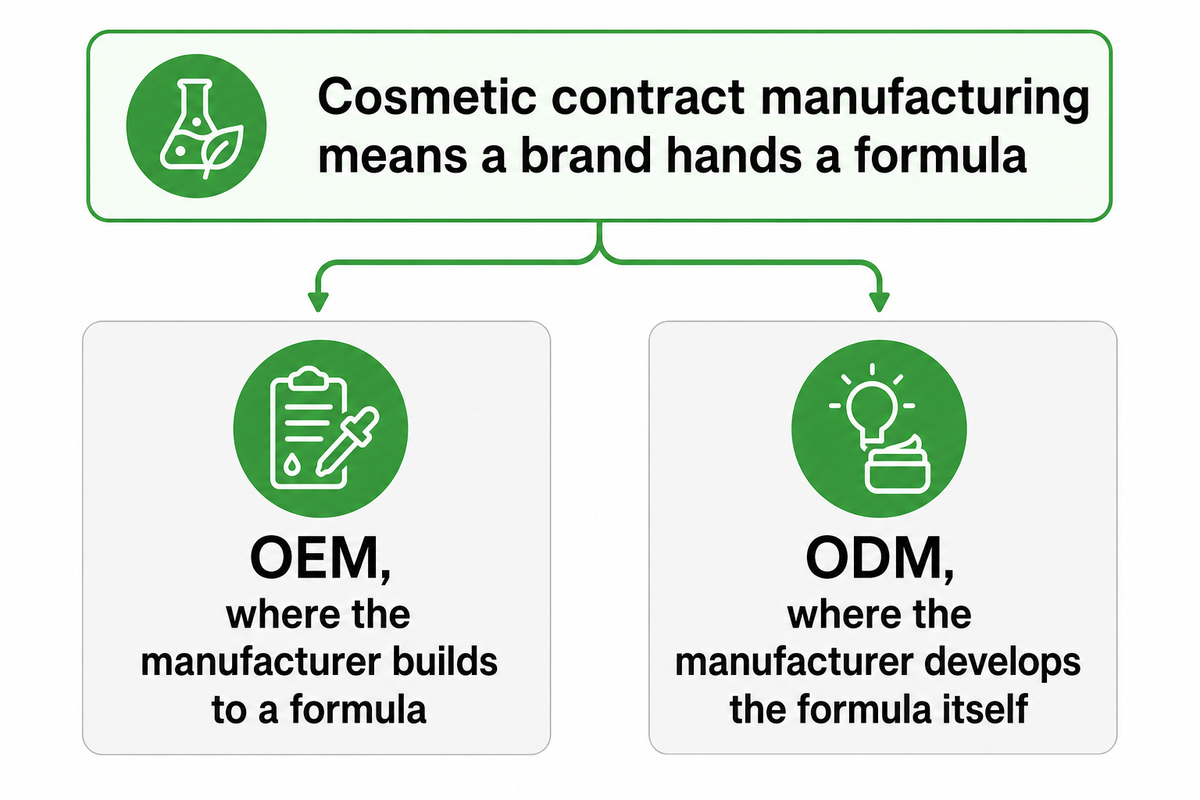
Cosmetic contract manufacturing means a brand hands a formula, or a formula concept, to a third-party factory that handles production, filling, and packaging under the brand’s own label. Two routes sit inside that arrangement: OEM, where the manufacturer builds to a formula the brand already owns or specifies, and ODM, where the manufacturer develops the formula itself and licenses it to the brand.
NEXO’s own OEM and ODM manufacturing route page frames the same split around who takes responsibility for formula development first, which is the practical question that matters more than the acronym.
A word of caution on the term “OEM” itself: it does not carry one fixed meaning across every industry. In electronics and hardware, OEM commonly refers to the company that designs a product and sells it under its own brand — closer to what cosmetics calls the brand owner, not the factory. This guide uses OEM the way cosmetics contract manufacturing conventionally does — manufacturer-builds-to-buyer-specification — but a buyer coming from a different industry background should confirm which meaning a given supplier intends before comparing quotes.
The same OEM/ODM logic applies beyond skincare: color cosmetics, hair care, and other personal care product categories all run through the same basic manufacturing-partner relationship, though formulation development expertise and ingredient sourcing requirements shift by category.
OEM
Brand supplies the formula or detailed specification; manufacturer executes production. Faster to start if the brand already has a working formula. Formula IP typically stays with whoever developed it, which is usually the brand in a pure OEM arrangement — confirm this in writing.
ODM
Manufacturer develops the formula from its own library or from scratch and licenses it to the brand. Faster to launch since formulation work is largely done, but the manufacturer usually retains formula ownership by default unless the contract states otherwise.
The Contract Manufacturing Process, From Formulation to Finished Product
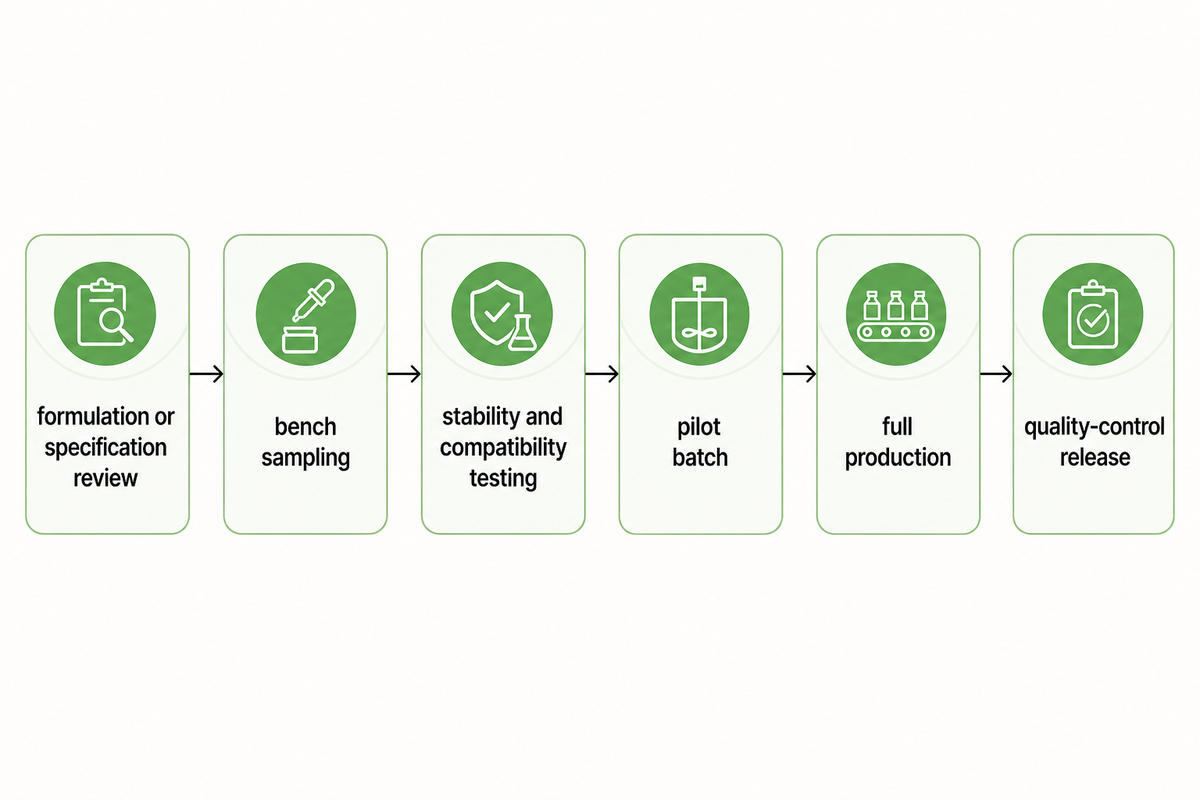
A typical engagement runs through six stages: formulation or specification review, bench sampling, stability and compatibility testing, pilot batch, full production, and quality-control release. On a real NEXO programme, for example, prototype development commonly follows brief agreement within about 3 business days, international sample delivery follows roughly 5-7 days after dispatch, and commercial production runs about 15 days after both formula approval and packaging qualification are confirmed, both prerequisites, not a standalone launch clock.
Timelines like these vary by manufacturer and formula complexity, but they illustrate that “sampling” and “production” are genuinely separate gates, not one continuous process.
One greenhouse-style mistake in this stage is treating a good sample as proof that scaling to full production will behave identically. A formulation that mixes cleanly in a 5-liter bench batch can separate, thicken unpredictably, or shift preservative efficacy in a 500-kilogram production tank because heat transfer, shear, and hold times all change with scale. That is exactly why pilot batches exist between sampling and full production — skipping one to save a week is a common way brands discover a stability problem after committing to a full production run rather than before.
Real production capabilities and manufacturing expertise mean treating filling and packaging as part of the same quality system as formulation, not a separate vendor problem handled after the fact. Large batches strain manufacturing capabilities differently than small ones: a manufacturing company running large batches for an established brand needs different scalable production planning than one filling a small pilot run of a new serum or skincare line.
Packaging & Component Lead Times
Packaging is frequently the actual bottleneck, not the formula. Custom-colored pumps, caps, or dispensers can carry component minimums and lead times that run longer than the formulation timeline itself, and a manufacturer that quotes a fast formula turnaround while packaging is still on order is quoting half the real schedule. Buyers should request packaging lead time as a separate line item from formulation lead time before setting a launch date.
Private Label vs Custom Formulation — and Why MOQ Isn’t One Number
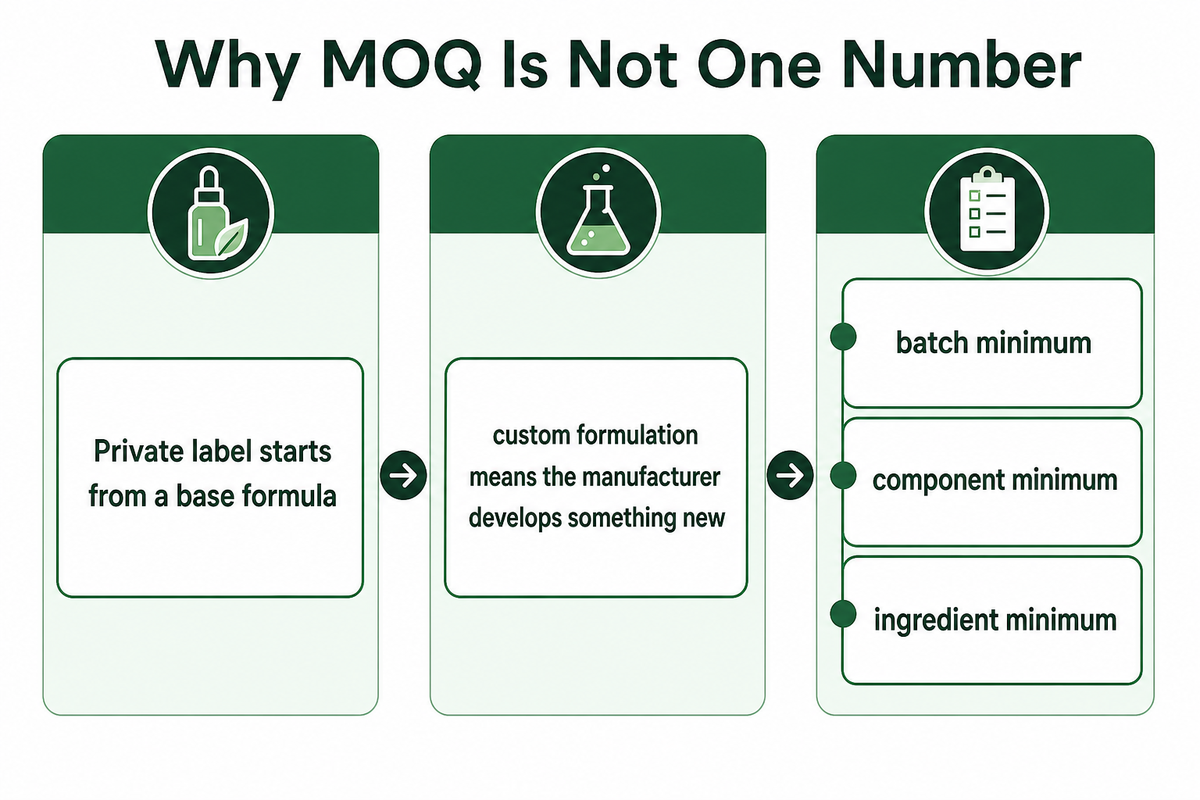
Private label starts from a base formula the manufacturer already owns and is modified lightly through a fragrance swap or color change, while custom formulation means the manufacturer develops something new around the brand’s brief. The practical difference is speed versus differentiation: private label launches faster and costs less to enter, custom formulation takes longer but produces something competitors can’t simply reorder from the same factory.
NEXO’s private label cosmetics and white label skincare programmes sit on this end of the spectrum; for a full breakdown of MOQ mechanics and formula-ownership contract language, see NEXO’s dedicated low-MOQ skincare manufacturing resource.
Minimum order quantities aren’t one number, each is set by whichever is highest of three separate minimums: the batch minimum the mixing equipment justifies running, the component minimum for packaging parts like bottles and pumps, and the ingredient minimum a supplier requires per purchase. Any minimum quoted in the low hundreds is almost always a stock-formula relabel rather than a newly developed formula, because packaging components, not the mixing vessel, usually set the real floor once a brand wants something custom. Standard private-label MOQs commonly run 1,000-5,000 units per SKU as of 2026, though some manufacturers now offer entry points as low as 50-500 units for brands testing a category before committing to volume.
Customized formulations and pre-existing formulations sit at opposite ends of the private label manufacturer spectrum: a private label manufacturer offering only pre-existing formulations moves fastest, while custom development produces genuine product formulations a brand can call its own signature product.
Unless otherwise specified in a written agreement, the contract manufacturer who formulates a cosmetic can legally retain ownership of the formula, even if the brand funded development – the contract-law default in such places as the United States, according to IP attorneys specializing in contract-manufacturing agreements, not a hard-and-fast international rule but a common default never to be assumed away. Address formula ownership, or at least exclusivity, in the development agreement before formulation starts, never after a formula you love is attached to one supplier.
Certifications & Regulatory Compliance — What ISO 22716, GMP, and MoCRA Actually Mean
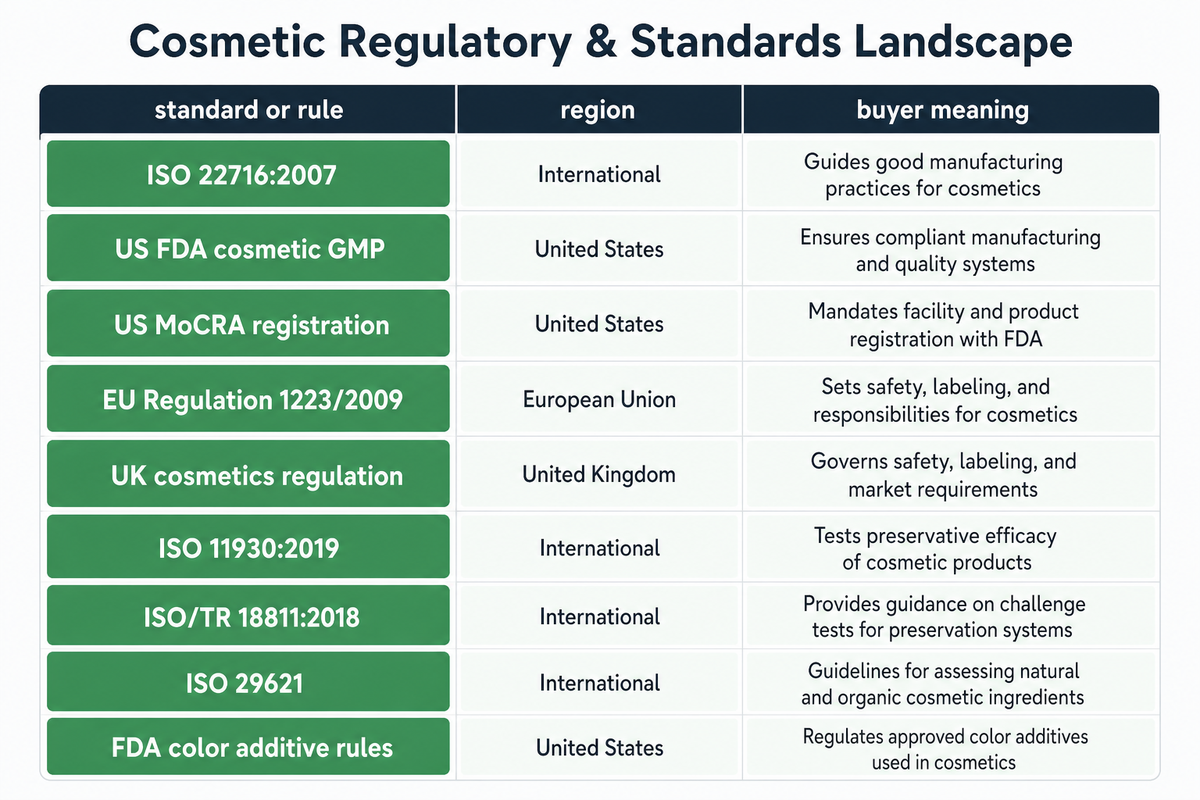
A manufacturer’s certifications describe what its facility does, not what the finished product is legally allowed to claim, and the two get conflated more often than buyers expect. ISO 22716 covers production, quality control, storage, and shipment, a real, meaningful scope.
Its own text explicitly excludes research and development and distribution beyond the manufacturing site. A site certificate proves the factory runs a controlled process; it cannot by itself prove a formula was properly developed or that a finished product performs as claimed.
| Standard / Regulation | Region | What It Covers | Status (Sept 2026) |
|---|---|---|---|
| ISO 22716:2007 | International | Production, QC, storage, shipment (GMP) | Current; excludes R&D and distribution |
| US FDA cosmetic GMP | United States | Federal cosmetic manufacturing practice | No binding final rule; 2013 draft only (docket FDA-2013-S-0610); facility-GMP rulemaking (RIN 0910-AJ00) now delayed to a November 2027 proposal date |
| US MoCRA registration | United States | Facility registration + product listing | Mandatory, biennial renewal; FDA issues no “certificate” for either step |
| EU Regulation 1223/2009 | European Union | Responsible Person + Product Information File | Non-EU manufacturer cannot itself be the Responsible Person; the importer, a designated EU distributor, or another EU-established party appointed by written mandate must hold that role |
| UK cosmetics regulation | Great Britain | Responsible Person + Product Information File | Separate regime from the EU post-Brexit; the same Responsible Person logic applies |
| ISO 11930:2019 | International | Antimicrobial/preservative-efficacy evaluation | Current |
| ISO/TR 18811:2018 | International | Stability-testing guidelines | Current; deliberately does not specify universal test conditions or pass criteria |
| ISO 29621 | International | Low-microbiological-risk product assessment | Current; can reduce testing burden for products that qualify |
| FDA color additive rules | United States | Premarket approval for color additives | The one real exception to “no premarket approval” — some color additives require FDA batch certification |
⚠️ Certification Does Not Transfer Your Compliance Liability
Choosing a certified factory does not hand your regulatory responsibility to that factory. Under US law, nearly everyone handling cosmetics in interstate commerce, the brand owner, the distributor, the packer, can remain responsible for adulteration or misbranding even when the contract manufacturer caused the underlying problem. The same separation runs through MoCRA’s Responsible Person structure and the EU/UK Responsible Person requirement: the manufacturer runs a compliant process, but a named party on the brand side still carries the legal duty to substantiate safety and respond if something goes wrong. Product claims raise the stakes further: positioning a formula for sunscreen, antiperspirant, acne treatment, dandruff treatment, or hair restoration can move it out of ordinary cosmetic status and into FDA drug regulation regardless of how the factory is certified, so the claims a brand plans to make need the same scrutiny as the factory’s paperwork.
Meeting quality standards on the factory floor is not the same as safety substantiation in the eyes of a regulator: FDA regulations require the brand, not the factory, to hold the safety file, and a formula that crosses into drug products territory faces a stricter regulatory path than an ordinary cosmetic regardless of how strict quality control on the factory floor already is.
MoCRA’s small-business registration exemption is also narrower than the “small company” framing suggests: it doesn’t cover products that contact the eye mucous membrane, are injected, are used internally, or are intended to alter appearance for more than 24 hours; the boundary depends on the product type, not just company size. And when a client’s own certificate names the manufacturing site, that name matters: a certificate belongs to a specific legal entity, and buyer-facing material should say so rather than write “our certificate,” since certification and brand ownership are frequently two different legal parties in this industry.
How to Vet a Cosmetic Contract Manufacturer — The 4-Layer Verification Framework
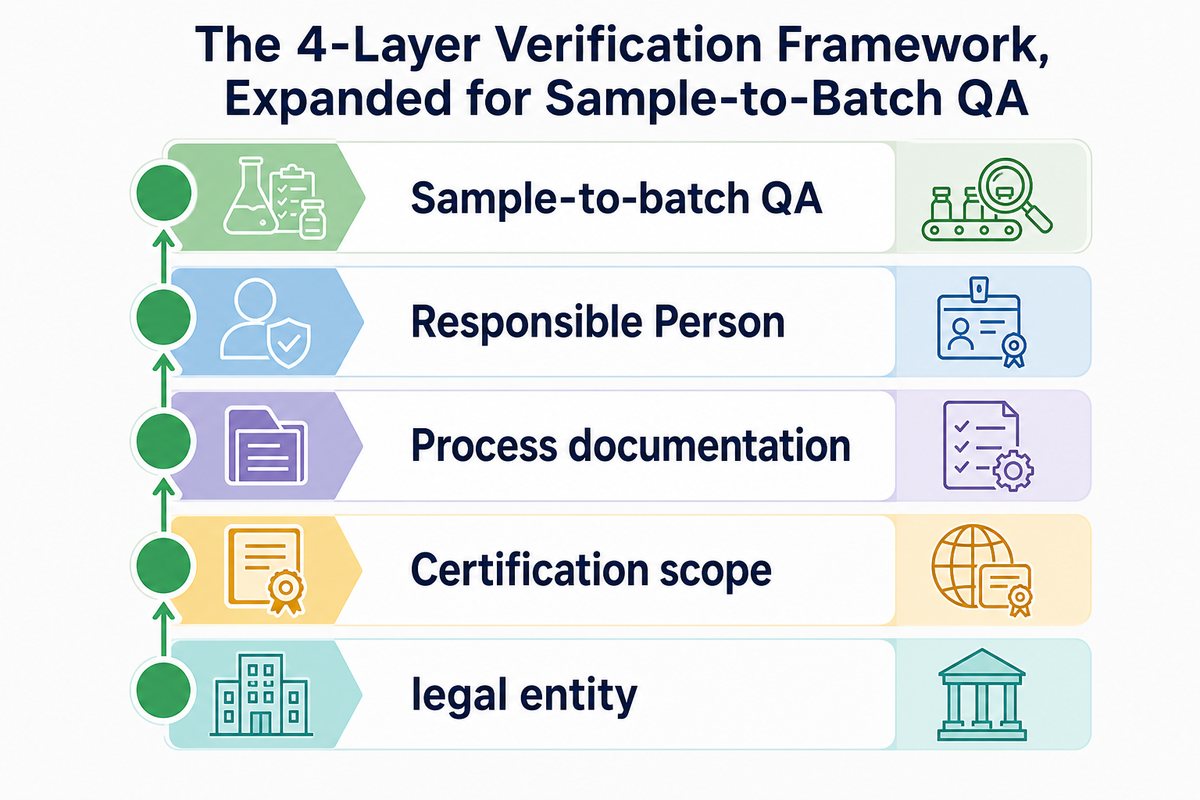
Looking only for certifications leaves three of the four qualities that predict a manufacturing relationship unseen. The 4-Layer Verification Framework checks the legal entity, the certificate’s actual scope, process documentation, and the named Responsible Person before a buyer treats supplier paperwork as evidence.
The 4-Layer Verification Framework — copy these into your supplier evaluation:
| Layer | What to check | Why it matters | How to verify |
|---|---|---|---|
| 1. Legal entity | Which company legally holds any certification named in their marketing | A certificate is issued to a specific legal entity, not to a brand name | Ask for the certificate number and cross-check the registered holder against the manufacturer’s business registration |
| 2. Certification scope | What the certificate’s audited scope actually covers | ISO 22716 covers production/QC/storage/shipment, not R&D or distribution | Request the certificate’s scope statement, not just the certificate number |
| 3. Process documentation | Whether sample approval is documented separately from batch-release sign-off | Sample approval is not proof of batch consistency or shelf life | Ask which specific tests — preservative efficacy, stability — gate the batch-release decision |
| 4. Responsible Person | Who is named as the legal Responsible Person in each target market | Compliance liability does not transfer to the factory by default | Confirm in writing whether the brand, an importer, or a distributor holds this role per market |
| 5. Sample-to-batch QA | Whether stability data is product-specific or reused from another format | Formats behave differently under similar shelf conditions | Request the stability data set for the specific product, not a generic company-wide claim |
A high-quality process leaves a paper trail at every one of these five layers, not just a certificate at the end. Layer 3 deserves its own explanation because it is the one buyers skip most often. Consider a conditioner sample-to-batch handoff: it has to separate facility GMP, preservative-efficacy evidence, and the product-specific stability protocol instead of treating a sensory sample approval as proof of batch release or shelf life; the three evidence layers answer different questions and none substitutes for the others. ISO 11930 governs the preservative-efficacy layer specifically; ISO/TR 18811 governs the stability-testing layer and deliberately does not hand every product the same test conditions or pass criteria, which is why the layer has to be verified per product, not assumed from a supplier’s general reputation.
“A contract manufacturer substituted our working preservative system with a ‘natural’ one without telling us — and the stability tests failed.”
A cosmetic formulator, Chemists Corner (cosmeticsciencetalk) professional community
That failure traces to a Layer 3 gap: preservative-system changes were made without the documentation and disclosure step that would have flagged the switch before it reached a stability test. Asking a manufacturer, in writing, whether formula-affecting substitutions require sign-off before they happen is a direct way to test whether Layer 3 is a real process or a marketing claim.
What Drives Cosmetic Contract Manufacturing Cost
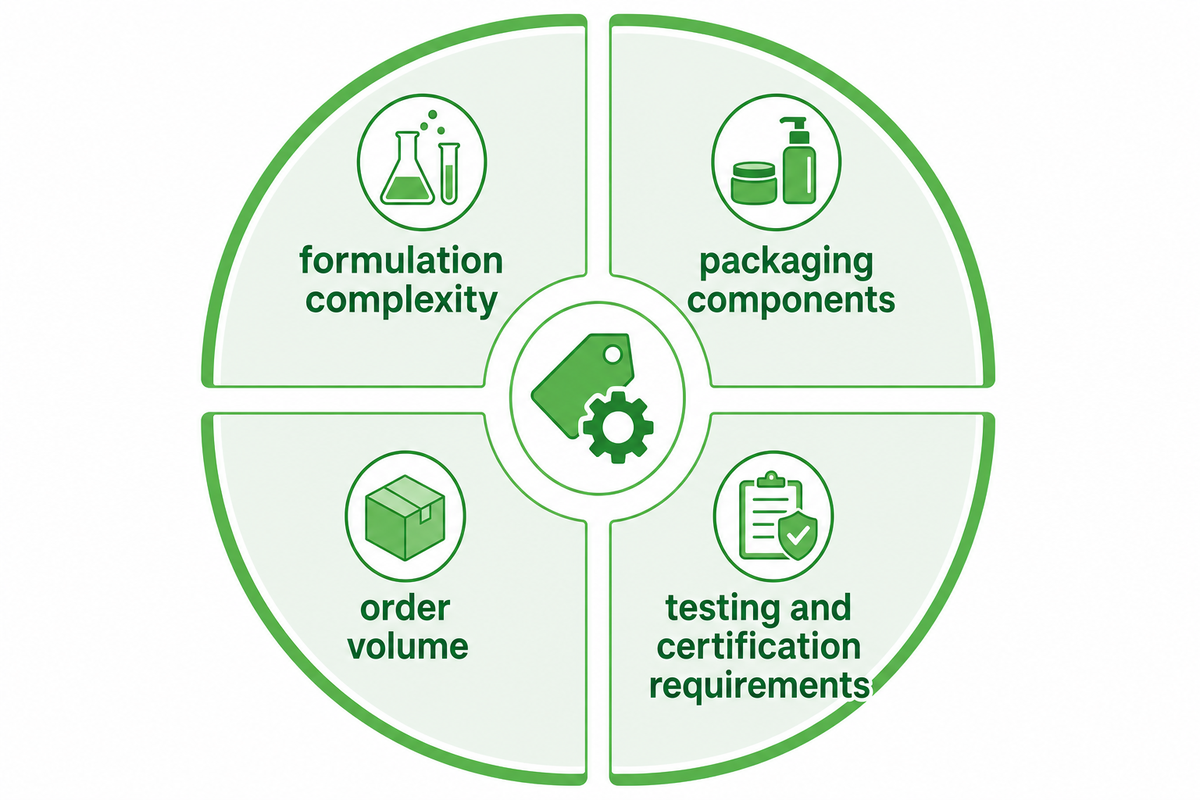
Cost is driven by three variables that move independently: formulation complexity, packaging components, and order volume, plus whatever testing and certification requirements a target market adds on top. Formulation and development fees for custom work commonly run in the low thousands of dollars, with packaging often priced per unit rather than per batch — figures that vary enough by supplier and product category that a single published number is close to meaningless without knowing what it includes.
The reason a small run costs more per unit is structural, not a markup: setup costs at the factory are largely fixed whether the run is 500 units or 50,000, so a small batch spreads that fixed cost across fewer units. Buyers comparing quotes across manufacturers should confirm each quote covers the same scope, formulation fee, MOQ commitment, per-unit cost, and separately, packaging, tooling, and testing, before treating a lower headline number as the cheaper option.
A full-service manufacturer that bundles formulation, packaging, and testing under one quote is often more practical guidance than chasing the lowest per-unit number in isolation, since product quality and future growth both depend on a manufacturing relationship that scales smoothly rather than a cheap first order that becomes expensive to fix later.
Industry Trends Shaping Cosmetic Contract Manufacturing in 2026
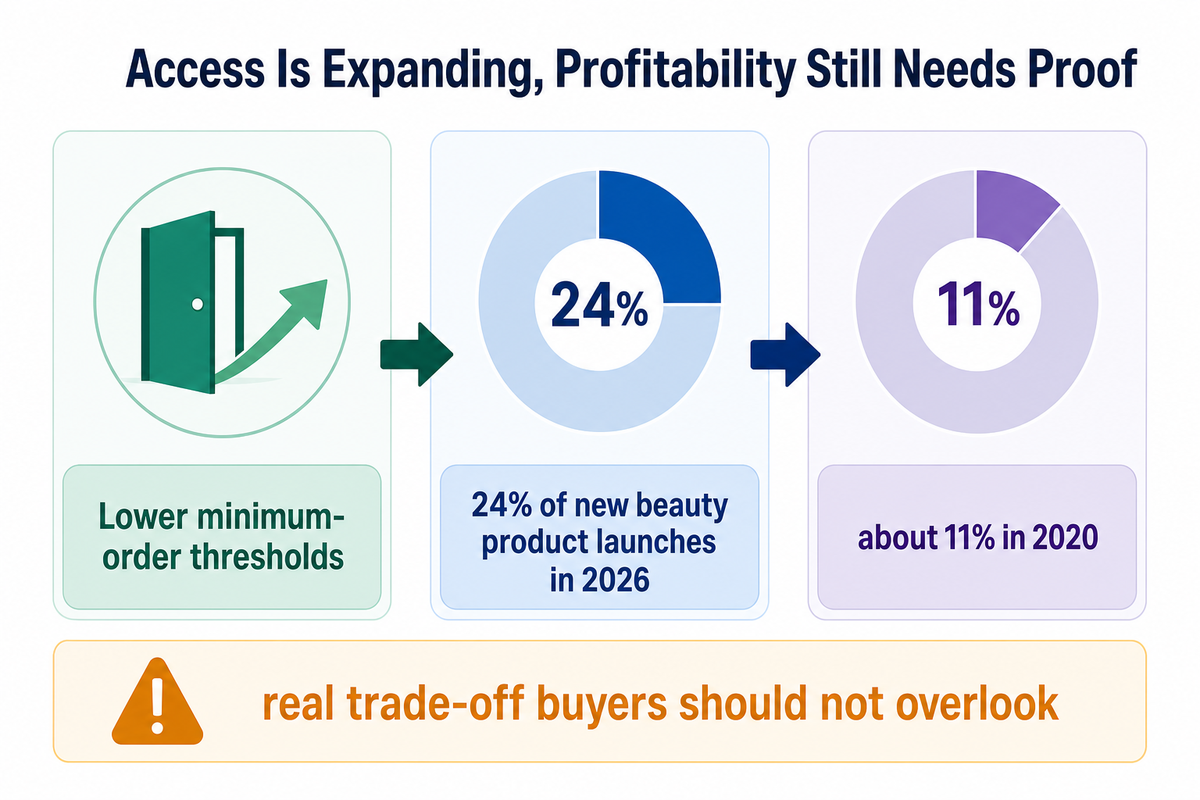
Lower minimum-order thresholds and direct-to-consumer brand growth mean smaller, newer brands now have realistic access to contract manufacturing that used to be gated by six-figure minimum commitments — in practice, “too small to work with a real manufacturer” is less true in 2026 than it was five years ago.
Minimums that used to sit in the thousands of units now commonly start in the low hundreds at manufacturers targeting new-brand customers, and direct-to-consumer brands accounted for roughly 24% of new beauty product launches in 2026, up from about 11% in 2020 — both figures come from industry reporting rather than a single named research firm, so they should be read as directional rather than precise.
That access comes with a real trade-off buyers should not overlook: DTC growth in launch volume has not translated evenly into profitability. One documented case shows a direct-to-consumer beauty brand’s advertising and promotion spending rising from about 20% of revenue in FY2020 to about 52% of revenue in FY2023 — customer-acquisition cost is climbing fast enough that “launch is easier now” does not automatically mean “the business model is easier now.” A brand entering contract manufacturing on the strength of a lower MOQ should budget for that acquisition-cost trend as carefully as for the factory relationship itself.
Consumer demand for organic formulations and clean-label claims is reshaping the beauty industry alongside the MOQ and DTC shifts already covered here, and global brands with a genuine focus on innovation — the kind of cosmetic innovations that show up in real formulation work — are increasingly judged on product performance data, not launch volume alone. The most future-ready contract manufacturing relationships account for all of this from the start, not just today’s minimum order — including the slower-moving regulatory side of that landscape, where the long-pending federal cosmetic GMP facility rule (RIN 0910-AJ00) has been pushed to a November 2027 proposal date.
Common Mistakes and Red Flags When Choosing a Manufacturer
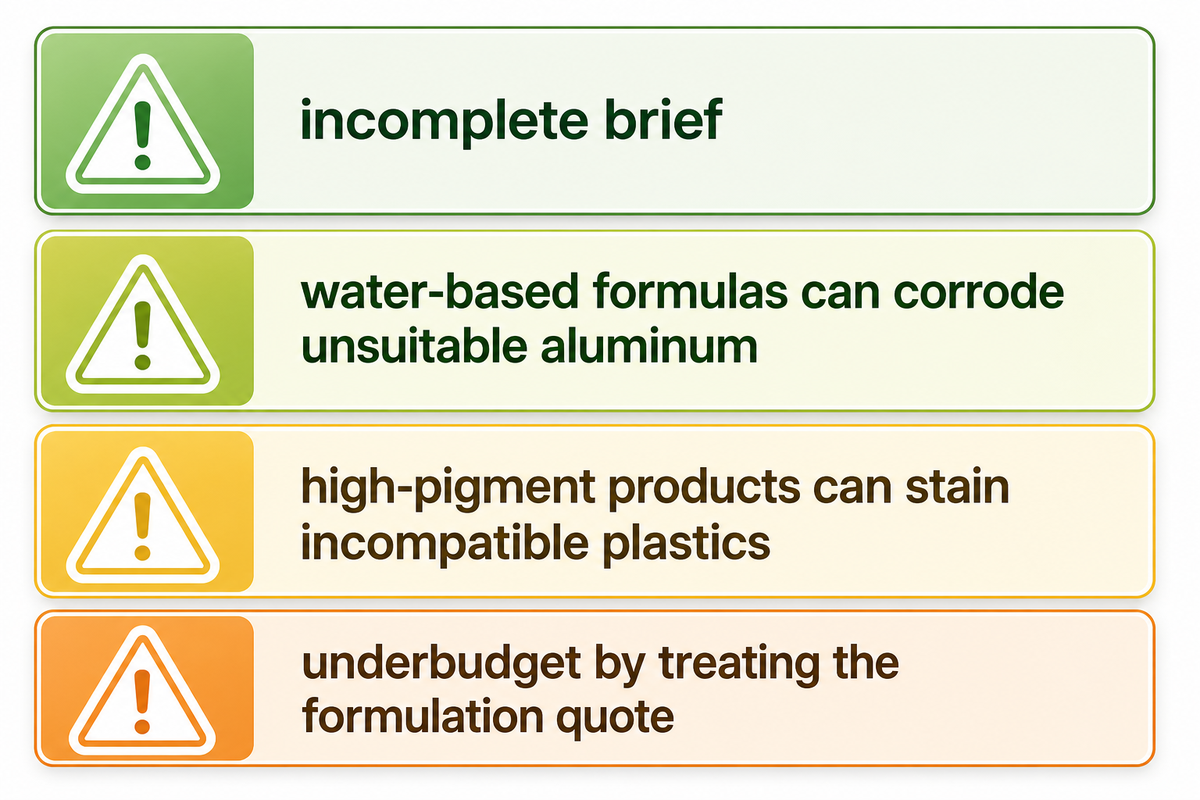
The recurring mistakes in cosmetic contract manufacturing usually begin with an incomplete brief, not a bad-faith supplier. Vague formulation, packaging, and quality requirements leave the factory guessing; water-based formulas can corrode unsuitable aluminum, and high-pigment products can stain incompatible plastics.
Buyers also routinely underbudget by treating the formulation quote as the whole cost, then get surprised by certification fees, dermatological testing, or logistics that were never in the original number.
✔ Signs a Manufacturer Is Ready
- Names the certificate-holding legal entity by name, unprompted
- Separates sample approval from batch-release documentation
- Quotes formulation, packaging, and testing as distinct line items
- Discusses Responsible Person duties without being asked first
⚠ Red Flags
- Lists certifications with zero explanation of scope
- Slow or vague responses to pre-sales technical questions
- No written IP/NDA protection offered before formula details are shared
- Treats compliance as “the brand’s problem, not ours”
The single costliest mistake is sharing formulation details before an NDA or IP-protection agreement is in place. Once a manufacturer has seen a full formula, there is little practical recourse if it gets replicated or shared, which is why the IP conversation belongs at the very start of supplier discussions, not after a favorite factory has already been chosen.
When NOT to Use Contract Manufacturing / Common Failure Modes
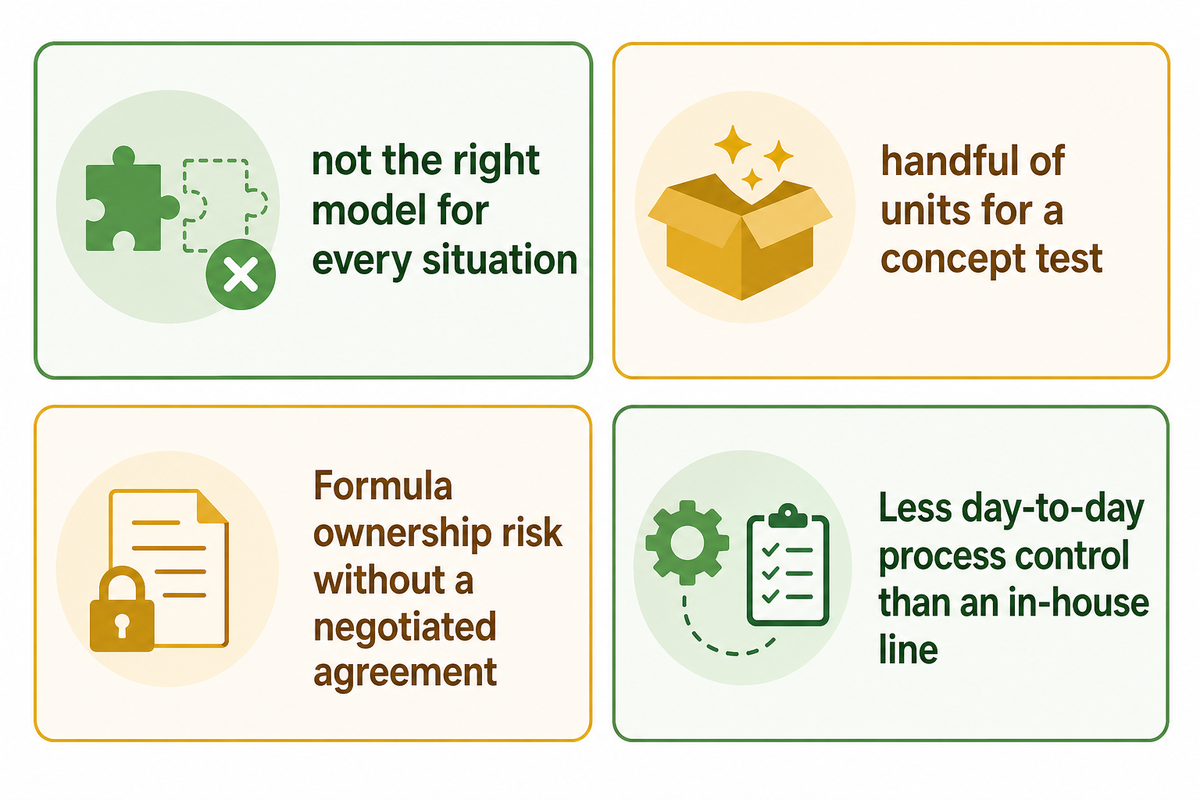
Contract manufacturing is not the right model for every situation. It is a poor fit when a brand needs only a handful of units for a concept test, cannot share a proprietary process, or needs day-to-day control that a third-party production schedule cannot provide.
✔ Advantages
- No capital outlay for mixing/filling equipment
- Access to formulation expertise the brand doesn’t have in-house
- Faster path to market than building production capability
⚠ Limitations
- MOQ commitments below very-low-volume test runs
- Formula ownership risk without a negotiated agreement
- Less day-to-day process control than an in-house line
A volume-sensitive case: a brand testing a genuinely experimental product with an unknown market — a handful of units for a trade-show reaction test, not a launch — will usually find every contract manufacturer’s MOQ too high for that purpose, since even a 50-500 unit “low MOQ” tier assumes an intent to sell, not to sample-test a concept. Another formula-sensitivity case: a brand whose entire competitive position rests on a single proprietary process (not just a formula, but a manufacturing method) may find that no NDA fully removes the exposure of teaching that process to a factory that also serves other clients in the same category — an in-house pilot line, even a small one, can be the more defensible choice there despite the higher upfront cost.
Working With an Overseas vs Domestic Cosmetic Manufacturer
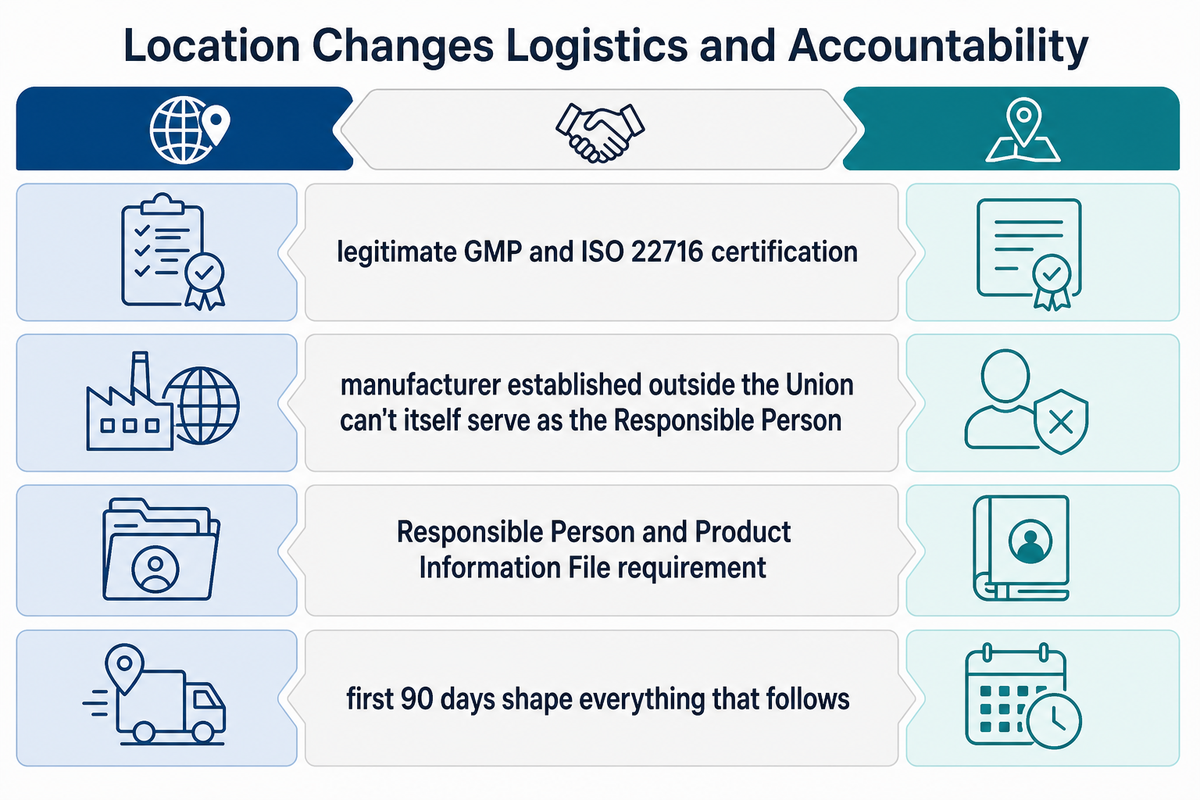
Domestic and overseas manufacturers can both hold legitimate GMP and ISO 22716 certification; the real differences are logistics, lead time, and who carries specific regulatory duties once the product crosses a border. NEXO’s EU cosmetics contract manufacturing page is a useful reference point for exactly this question, since selling into the EU or UK from a non-EU factory changes who is legally accountable, not just where the product is made.
In the EU specifically, a manufacturer established outside the Union can’t itself serve as the Responsible Person under Regulation 1223/2009; that role passes to the importer, a distributor the brand designates, or another EU-established party the brand appoints by written mandate; someone has to hold it before the product can legally reach the EU market. The UK runs a comparable, separate regime post-Brexit with its own Responsible Person and Product Information File requirement. For a brand sourcing from an overseas factory, this means the compliance conversation isn’t “does the factory have certifications” but “who on our side, or on our importer’s side, is prepared to be legally named as accountable in each market we sell into” — a question worth settling before signing, not after the first shipment is held at customs.
Getting products to market on schedule depends on matching batch sizes to real demand from the start — a mismatch between development and manufacturing timelines is one of the most common ways a launch date slips. Whether a brand needs full development and manufacturing for a new hair-care product line, straightforward manufacturing for cosmetics already formulated, or bundled manufacturing and filling plus packaging services for an existing product, the right manufacturer treats formulation and manufacturing as one continuous system rather than handoffs between departments. Scalability and long-term success come from that continuity, not from chasing the single cheapest quote — a lesson that shows up repeatedly in expert insights from formulators who have tried both approaches. For a brand building a high-quality cosmetic line, or more broadly high-quality personal care products, production and quality decisions made in the first 90 days shape everything that follows.
Key takeaway
A certified, well-run factory is necessary but not sufficient — the paperwork that actually protects a brand is the formula-ownership clause, the Responsible Person designation, and the sample-to-batch documentation trail, none of which a certificate covers by itself.
Contract Manufacturing vs Private Label vs White Label vs In-House
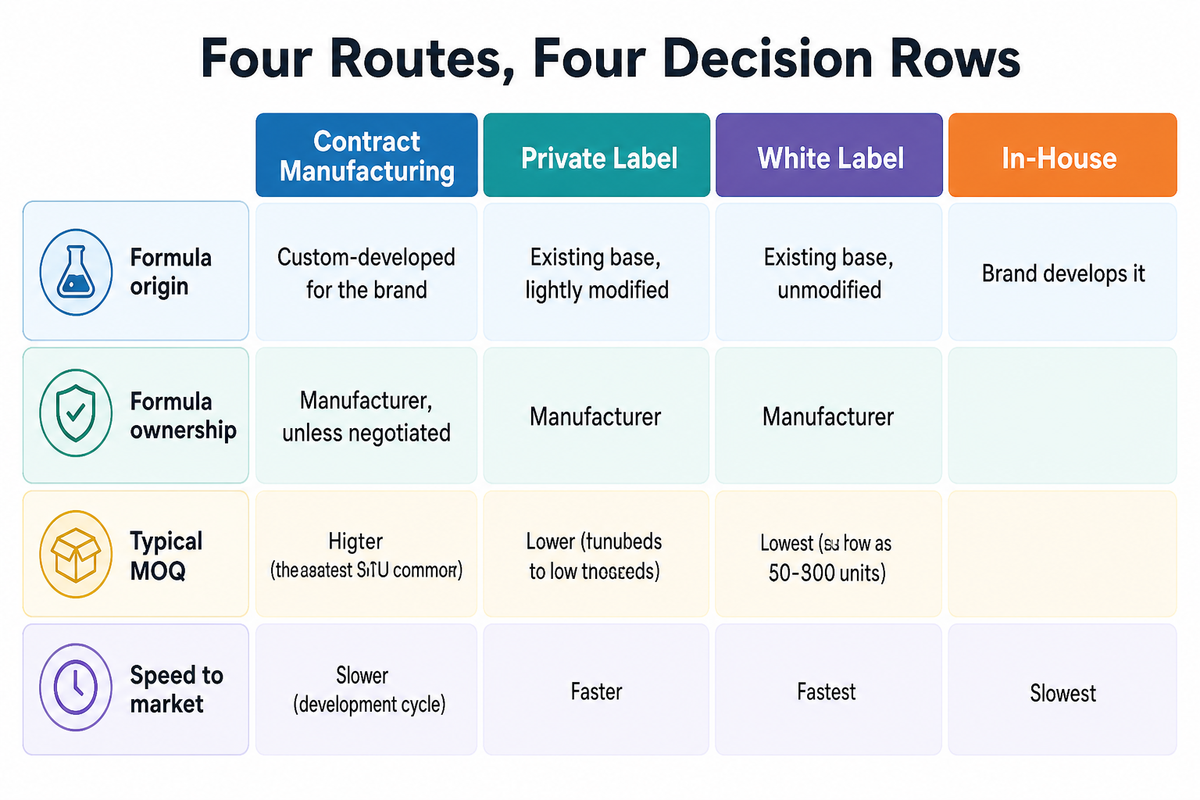
All four models can run on the same underlying ISO 22716 production and quality-control baseline; what changes across them is who owns the formula, who carries FDA/MoCRA registration duties, and how much control a brand keeps day to day in a buyer’s launch plan.
| Model Type / Dimension | Contract Manufacturing | Private Label | White Label | In-House |
|---|---|---|---|---|
| Formula origin | Custom-developed for the brand | Existing base, lightly modified | Existing base, unmodified | Brand develops it |
| Formula ownership (default) | Manufacturer, unless negotiated | Manufacturer | Manufacturer | Brand |
| Typical MOQ | Higher (thousands/SKU common) | Lower (hundreds to low thousands) | Lowest (as low as 50-500 units) | N/A — own capacity |
| Speed to market | Slower (development cycle) | Faster | Fastest | Slowest |
| Formulation control | High | Low-medium | None | Complete |
| IP/differentiation risk | Low if formula secured | Medium (base is shared) | High (identical to other buyers) | None |
| Certification burden | Mainly on manufacturer’s facility | Mainly on manufacturer’s facility | Mainly on manufacturer’s facility | Falls on the brand |
| Primary cost driver | Formulation R&D + MOQ | Packaging/branding | Branding only | Capital equipment + staff |
| Best for — Limitations / Not suitable for | Differentiated formula concepts; not for sub-MOQ test runs | Speed with light customization; not for true differentiation | Fast category testing; not for brand defensibility | Long-term volume with capital; not for fast, low-risk entry |
Frequently Asked Questions
Q: Who owns the formula in contract manufacturing?
Without a written agreement stating otherwise, the manufacturer that develops the formula may legally own it, even if the brand paid for development, unless the contract assigns ownership to the brand.
Intellectual-property counsel who cover contract-manufacturing agreements confirm this as the common default position, not an edge case. Brands should negotiate explicit IP-assignment language into the development agreement before formulation work begins, not after a formula they like is already locked to one supplier. The agreement should identify formula files, improvements, test data, and the right to transfer the formula to a second factory; retain a signed copy before any pilot batch starts.
Q: What is a typical MOQ for cosmetic contract manufacturing?
MOQ is set by whichever is highest of three minimums — batch, component, and ingredient — not by a single published number for every approved product and package.
On NEXO’s ceramide-cream programme, for example, manufacturing MOQ starts from 10,000 units per approved SKU configuration once formula and packaging are both qualified — packaging components, not the mixing vessel, are usually what sets the real floor. Ask the quote to separate batch, component, and ingredient minimums, and confirm whether the 10,000-unit example applies only after both formula and packaging qualification.
Q: What is the difference between contract manufacturing, private labeling, and white labeling?
Contract manufacturing builds a custom or co-developed formula; private and white labeling both start from an existing base the manufacturer already owns, with different ownership and control consequences.
The difference between private and white labeling is mainly branding exclusivity, not the formulation process itself. Buyers who need a genuinely differentiated formula should confirm which model a quoted price actually reflects before comparing offers. Private label is faster because the base already exists, while white label usually changes branding only; custom formulation adds development work and a different ownership conversation.
Q: How much does it cost to manufacture cosmetics with a contract manufacturer?
Cost depends on formulation complexity, packaging, volume, and testing requirements — there is no reliable single per-unit figure across suppliers because setup and testing charges vary.
NEXO does not publish blanket per-unit pricing for exactly this reason. Buyers should treat any quoted price as programme-specific and request a formal quote scoped to their exact formula, packaging, and volume rather than comparing a headline number across suppliers.
Q: Does the FDA certify cosmetic manufacturers?
No — FDA records facility registration and product listing, but it does not certify a cosmetic facility or approve each cosmetic product before sale in the United States.
As of mid-2026 there were over 16,000 active facility registrations and nearly 1.3 million active product listings, all self-registered, not FDA-approved. A supplier describing an “FDA certificate” is describing something FDA does not issue for either process; ask what document they actually mean.
Q: Are U.S.-based contract manufacturers better than overseas options?
Not automatically — both can hold legitimate GMP and ISO 22716 certification; the real difference is logistics and regulatory-responsibility structure after the market and product scope are checked.
In the EU and UK, an overseas manufacturer cannot itself be the Responsible Person — that duty passes to your importer or distributor.
Q: What questions should you ask before signing with a manufacturer?
Ask four things before signing: which legal entity holds each certification named in their marketing, exactly what scope that certification audits (production only, or also R&D and distribution), how sample approval is documented separately from the batch-release decision, and what specific stability and preservative-efficacy evidence backs any shelf-life claim they make for your formula.
Any manufacturer that answers all four concretely, with named documents rather than reassurance, has a real quality system behind it, not just a certificate on a wall. See the 4-Layer Verification Framework above for the full checklist, including how to verify each layer rather than just ask about it. It also helps to ask the question in reverse: request one example of a formula-affecting change — a preservative substitution, a supplier swap, a packaging material change — that the manufacturer made on a prior client’s project, and how that client was notified before it happened, not after. A manufacturer with a real documentation trail can produce a specific example; one that cannot is telling you something about how Layer 3 actually works there, regardless of what their sales material claims about quality control.
Related Reading on NEXO Beauty Labs
- NEXO’s cosmetic contract manufacturing services — programme details, capabilities, and how to start a project
- Custom cosmetic formulation for skincare — for brands developing a formula from scratch
- Private label skincare manufacturing — the full private-label product range
Why We Write This
The cosmetic contract manufacturing guide draws on NEXO Beauty Labs’ own manufacturing programme data (prototype and sample-delivery timelines, MOQ structures) alongside independently verified regulatory sources across the US, EU, and UK. Where a data point could not be independently cross-verified — MOQ ranges, DTC growth figures — we say so directly rather than presenting industry estimates as precise numbers. Reviewed by the NEXO Beauty Labs technical team.
References & Sources
- Registration & Listing of Cosmetic Product Facilities and Products — U.S. Food and Drug Administration
- Product Testing of Cosmetics — U.S. Food and Drug Administration
- Draft Guidance for Industry: Cosmetic Good Manufacturing Practices — U.S. Food and Drug Administration
- RIN 0910-AJ00: Good Manufacturing Practice for Cosmetic Product Facilities — Office of Information and Regulatory Affairs
- ISO 22716:2007 — Cosmetics: Good Manufacturing Practices — International Organization for Standardization
- ISO 11930:2019 — Evaluation of the Antimicrobial Protection of a Cosmetic Product — International Organization for Standardization
- ISO/TR 18811:2018 — Guidelines on Stability Testing of Cosmetic Products — International Organization for Standardization
- ISO 29621 — Guidelines for the Risk Assessment of Microbiologically Low-Risk Cosmetic Products — International Organization for Standardization
- Regulation (EC) No 1223/2009 on Cosmetic Products — EUR-Lex, European Union
- Making Cosmetic Products Available to Consumers in Great Britain — UK Government
- Certificate Registry Entry SZ2503C3 — Intertek
- The Correct Duration for Stability Tests — Happi