Get in touch with NEXO Beauty Labs Company
Skincare Packaging Guide: Match Formula, Format, Channel, and Artwork


A skincare packaging guide is a decision framework for package selection. A useful skincare packaging guide should do more than compare attractive jars and bottles. The right commercial pack has to protect the represented cosmetic formula, dispense an intended amount, survive its channel, carry market information, and remain controllable through production.
The short answer
Choose packaging by connecting seven inputs: formula, dose, user contact, channel, target market, artwork, and manufacturing. Compare the complete component system, identify the evidence still missing, and freeze neither artwork nor commercial terms while a controlling unknown remains open.
This guide covers cosmetic skincare, including formats used for a moisturizer or liquid serum. If intended use or claims make a product a drug, or both a drug and a cosmetic, classify it first and run the applicable regulatory and label review before approving package space or artwork.
Design follows the controlled brief
For cosmetic brands, the cosmetic packaging design process starts by defining how the pack will protect the product and express brand identity, not by copying packaging trends. The right packaging for beauty products may be a minimalist stock system or custom cosmetic packaging, but appearance does not resolve formula or channel risk.
For cosmetic brands, the cosmetic packaging design process starts by defining how the pack will protect the product and express brand identity, not by copying packaging trends. The right packaging for beauty products may be a minimalist stock system or custom cosmetic packaging, but appearance does not resolve formula or channel risk.
| Search wording | Decision route in this guide |
|---|---|
| Skincare packaging types | Format comparison and evidence tracks |
| Cosmetic container selection | Seven-factor fit map |
| Primary and secondary cosmetic packaging | Complete pack stack |
| Skincare bottles | Bottle, pump, and user-contact questions |
| Custom skincare packaging | Controlled brief and quotation normalizer |
| Sustainable skincare packaging | Whole-pack environmental-claim screen |
1. Use the 7-Factor Formula-Pack-Channel Fit Map
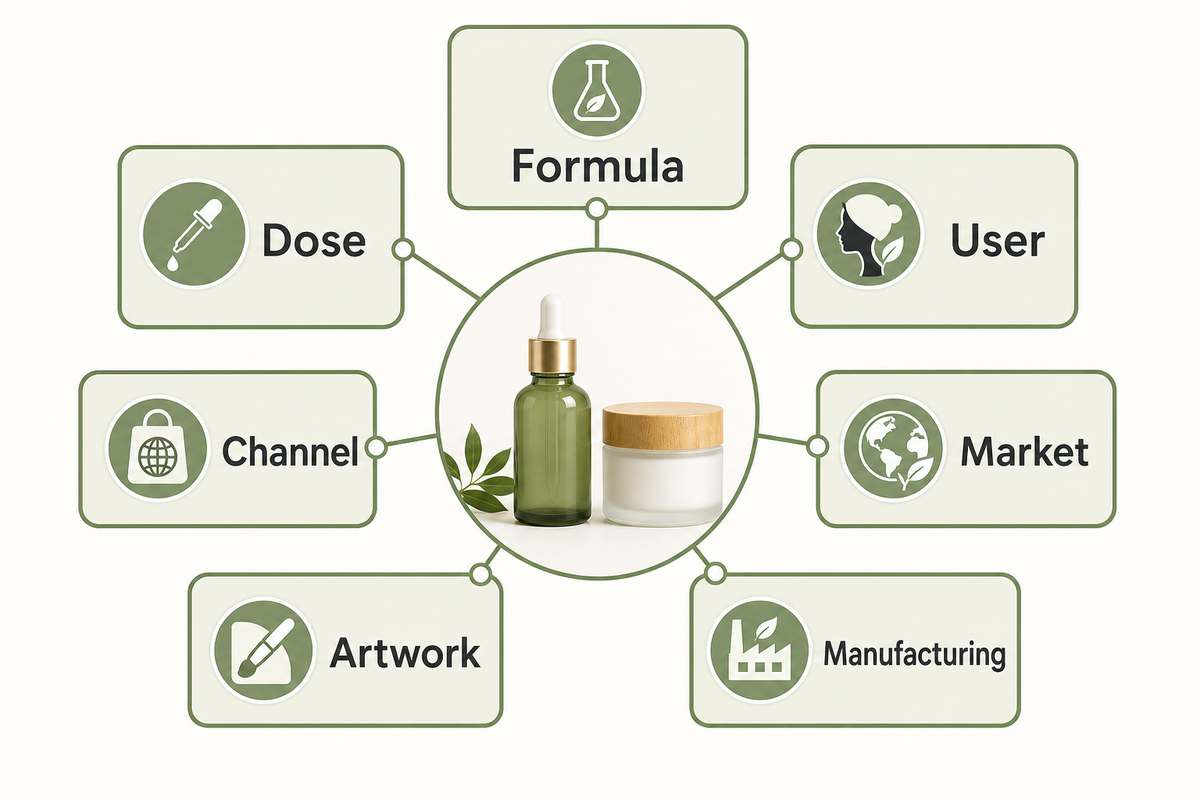
“It is a serum” or “we want a premium jar” is not a packaging brief. A decision becomes comparable only when the team records what the package must do, who owns each input, and which facts are still commercially unknown.
| Fit factor | Minimum input | What it can change | Typical owner | Evidence or open question |
|---|---|---|---|---|
| 1. Formula | Revision, form, viscosity, sensitivities | Contact, barrier, filling, dispensing | Formulation | Represented formula record |
| 2. Dose | Intended amount and frequency | Pump output, orifice, applicator | Product / packaging | Defined delivery question |
| 3. User | Finger contact, opening, grip, repeat use | In-use exposure and accessibility | Brand / quality | Use scenario |
| 4. Channel | Retail, salon, parcel, distributor | Leak, scuff, breakage, tamper needs | Supply chain | Distribution brief |
| 5. Market | Countries, classification, languages | Panel content and claim review | Regulatory | Market-specific source |
| 6. Artwork | Copy, decoration, readable area | Tooling, label, print and finish | Brand / regulatory | Content-to-panel map |
| 7. Manufacturing | Fill, closure, assembly and controls | Line fit and commercial repeatability | Manufacturer / quality | Controlled process assumptions |
The 7-Factor Formula-Pack-Channel Fit Map is an editorial tool proposed in this guide. It is not a NEXO-validated standard, and completing it does not prove that a shortlisted package will work. If the formula remains open, use custom cosmetic formulation as the upstream development route rather than treating a packaging decision as formulation evidence.
2. Compare Bottles, Jars, Tubes, Pumps, Droppers, and Sachets
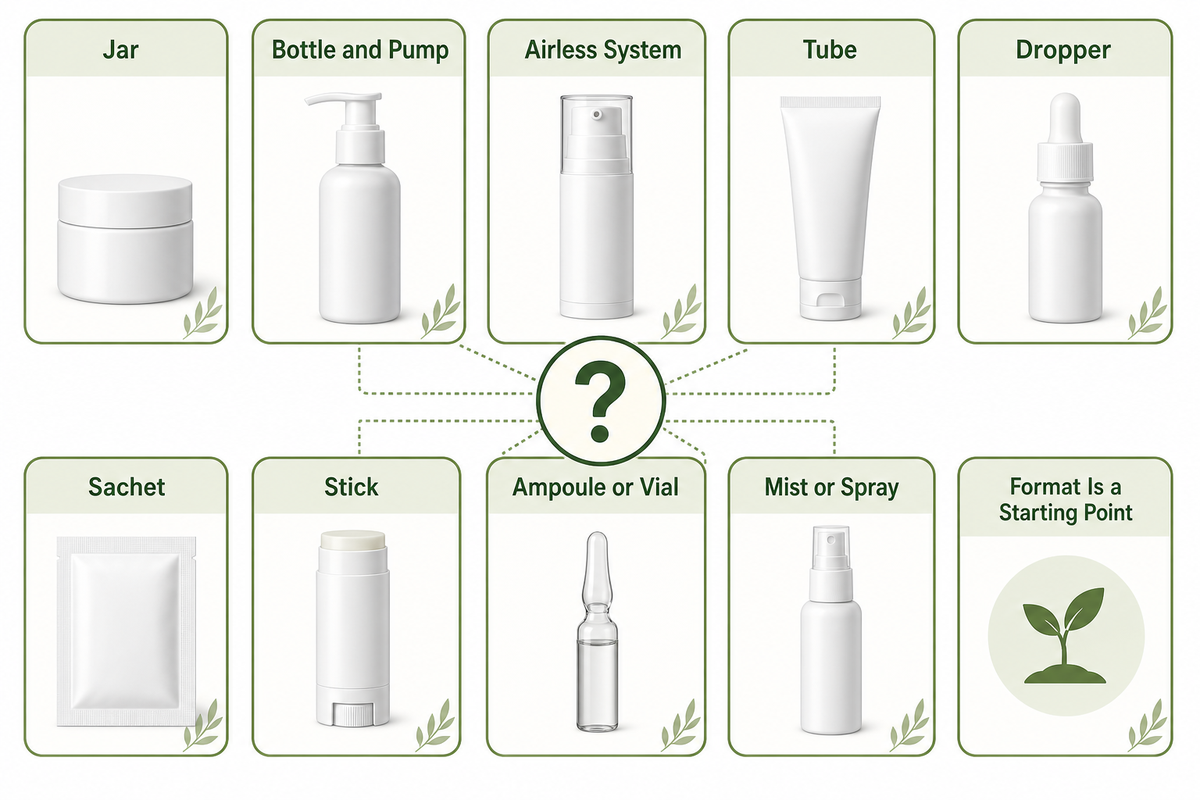
Format names describe a starting architecture, not a performance result. That seven-factor map turns each shortlisted package into a defined set of format questions. Compare how each candidate manages user contact, dose, priming, residue, sealing, filling, and foreseeable channel exposure for the represented formula.
These packaging types also behave differently with a cream, lotion, gel, oil, or other product form. Use the table to compare packaging formats as questions rather than fixed recommendations.
| Format | Useful fit question | In-use question | Evidence to request | What the name does not prove |
|---|---|---|---|---|
| Jar | Can the user access the product at its viscosity? | How is repeated contact managed? | Closure, liner, use and microbiological review | Preservation or contamination control |
| Bottle + pump | Can it prime and deliver the intended amount? | Does dose remain useful over pack life? | Dose, priming, clogging and residue checks | Air exclusion or shelf-life extension |
| Airless system | Does the mechanism suit fill and formula behavior? | What happens after storage, cycling and use? | Component, fill, evacuation and functional evidence | Compatibility, recyclability or zero residue |
| Tube | Do wall, shoulder and closure suit the product? | Can users control delivery and empty it acceptably? | Seal, panel, cap, decoration and use checks | Barrier or complete evacuation |
| Dropper | Is pickup and delivery suitable for the product? | Can the applicator contact skin or return product? | Bulb, pipette, wiper, closure and dose review | A fixed or hygienic dose |
| Sachet | Is the intended unit dose fillable and openable? | Can the user access the contents without excess loss? | Film, seal, notch, print and distribution evidence | Suitability for every formula or channel |
| Stick | Can the product form advance and retract consistently? | How are direct application and surface exposure managed? | Mechanism, cup, cap, fill and use checks | Suitability for the represented formula |
| Ampoule or vial | Does the opening system suit the intended use? | How are opening, access and remaining product handled? | Container, closure, opening and use evidence | A single-use or protected-use result |
| Mist or spray | Can the system deliver the intended spray pattern? | Do orientation, clogging and user handling change delivery? | Actuator, dip tube, closure, dose and use checks | Uniform coverage or formula compatibility |
Are airless pumps always better for skincare?
No—airless systems can change exposure and dispensing, but mechanism design, priming, compatibility, intended dose, fill process, evacuation, component sourcing, and end-of-life conditions still need evidence. Before approving the format, confirm the formula and component revisions, define the filling and priming assumptions, record what must be measured throughout pack life, and keep recyclability or environmental claims separate from functional approval.
Why format evidence stays product-specific
One independent study of 221 French adults reported 5%–23% higher mean consumption from flip-top tubes than pump bottles for each of three tested cosmetics. That finding shows format can matter; it does not create a universal pump-versus-tube ranking, because products, users, package designs, and methods define the result.
One independent study of 221 French adults reported 5%–23% higher mean consumption from flip-top tubes than pump bottles for each of three tested cosmetics. That finding shows format can matter; it does not create a universal pump-versus-tube ranking, because products, users, package designs, and methods define the result.
In-use microbiological protection, delivered dose, package compatibility, closure function, and product evacuation are separate evidence tracks. A package can perform well on one track and still need work on another.
3. Evaluate the Whole Material System, Not One Material Name
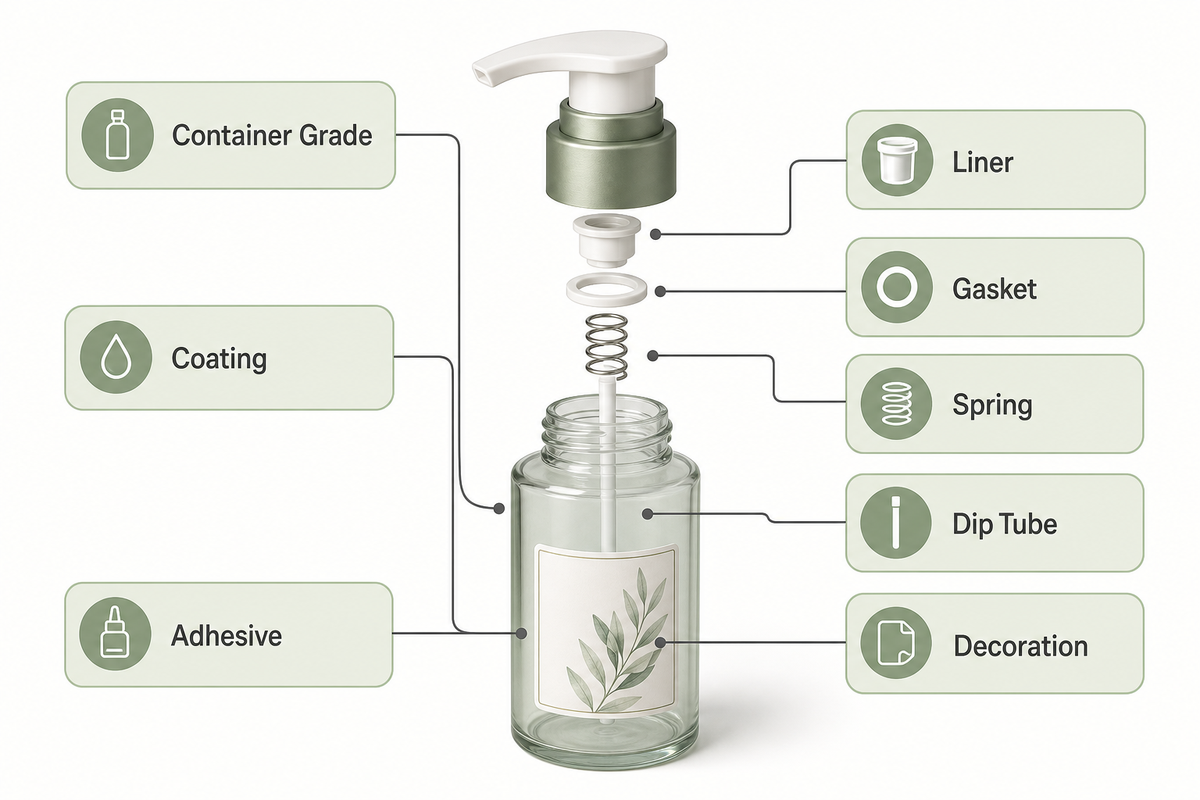
“Glass,” “plastic,” or “aluminum” (aluminium) is not a complete specification. Those separate evidence tracks only become testable when the complete component system is named. List the container grade, coating, liner, gasket, spring, dip tube, adhesive, ink, decoration, label, and other functional parts that can control contact, barrier, sealing, use, transport, or recovery.
A packaging material name can group unlike constructions. Record the cosmetic packaging materials and revisions behind every shortlisted cosmetic container before comparing risk or end-of-life claims.
Direct contact
Which resin, glass surface, coating, liner, gasket, dip tube, or applicator touches the formula?
Which resin, glass surface, coating, liner, gasket, dip tube, or applicator touches the formula?
Barrier and function
Which parts control moisture, oxygen, light, odor, seal, torque, priming, dose, or reopening?
Which parts control moisture, oxygen, light, odor, seal, torque, priming, dose, or reopening?
Decoration and handling
Can inks, labels, coatings, scuffing, breakage, weight, or grip alter the channel decision?
Can inks, labels, coatings, scuffing, breakage, weight, or grip alter the channel decision?
End-of-life boundary
What can actually be separated, collected, refilled, sorted, or processed in the target geography?
What can actually be separated, collected, refilled, sorted, or processed in the target geography?
Is glass packaging better than plastic for skincare?
Not in every system. Glass can offer useful barrier properties and premium cues in practice, while weight and breakage can matter; plastics can reduce weight and enable dispensing designs, while grade, barrier, component mix, and local recovery conditions still matter.
A 2025 peer-reviewed emptiability study reported less than 1% residue for the tested hand-cream jars and airless pump dispensers, while some tested pump-dispenser results reached up to 26%. The authors also said an established standardized method and clear thresholds were absent, so treat those observations as specific to the tested products, packages, procedures, and assumptions—not as a material scorecard or NEXO result.
4. Specify Primary, Secondary, and E-commerce Packaging as One Stack
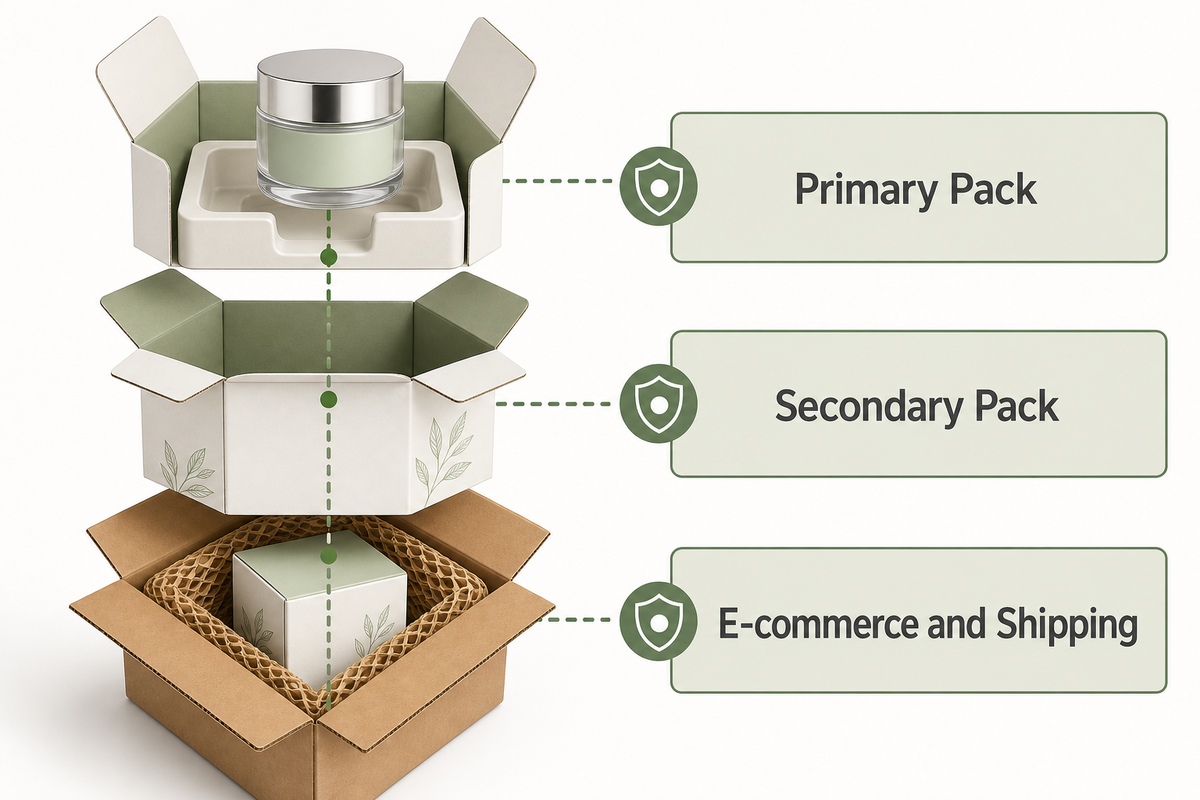
The commercial pack is a chain, not an isolated bottle. That package-specific evidence still has to cover the secondary and distribution layers around the tested primary pack. A closure that works on the filling line may still need protection in a carton or parcel, while a carton may fail if the primary pack leaks or the shipping stack permits movement.
1. Primary pack
Formula-contact container, closure, dispenser, label, decoration
Formula-contact container, closure, dispenser, label, decoration
2. Secondary pack
Carton, insert, tamper feature, product and market information
Carton, insert, tamper feature, product and market information
3. Distribution pack
Parcel shipper, divider, cushioning, case, pallet assumptions
Parcel shipper, divider, cushioning, case, pallet assumptions
Create one Pack Stack Specification Sheet with component revisions, dimensions, weights, artwork state, closure protection, stacking, orientation, and channel risks. Record whether each layer is fixed, provisional, supplier-selected, or still unknown.
This turns product packaging into one controlled stack instead of three disconnected purchase decisions, and it keeps the customer experience connected to actual channel risks.
5. Reserve Label and Artwork Space Before Tooling
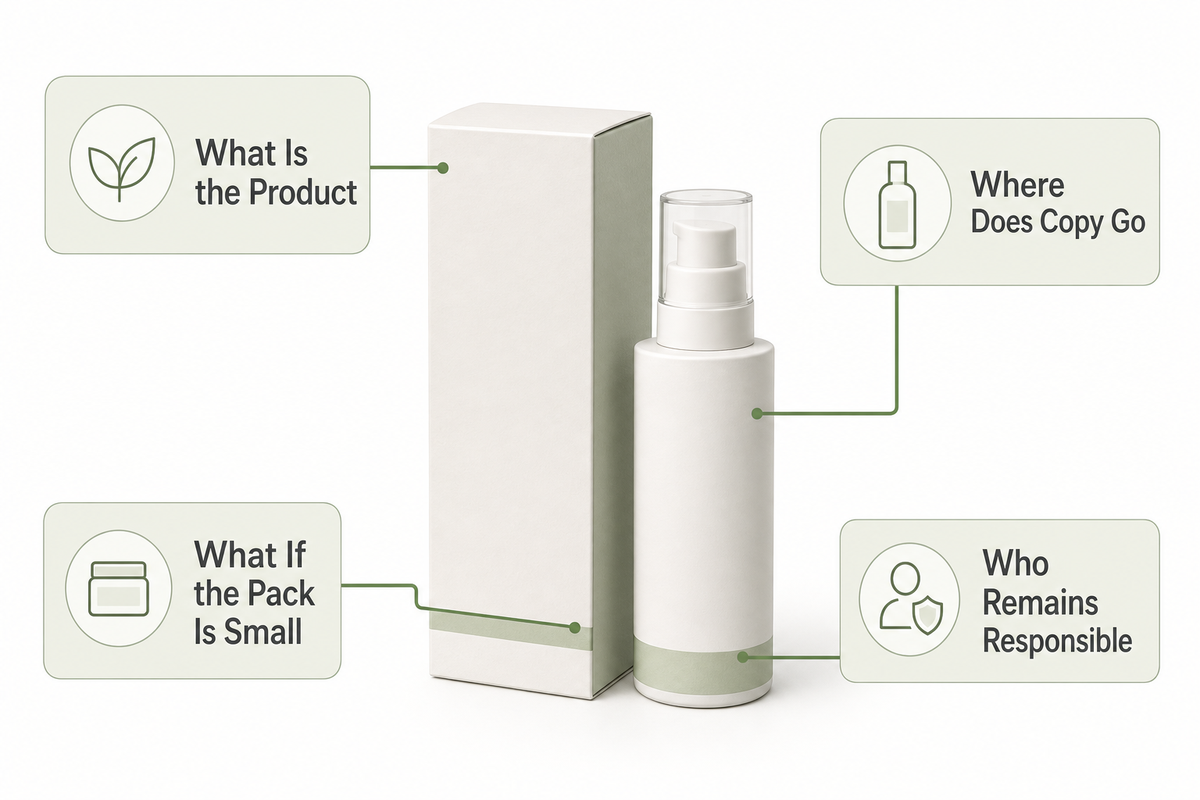
Regulatory copy cannot always be shrunk or moved after decoration is frozen. Once that controlled stack is defined, panel space becomes a cross-layer constraint rather than a late artwork adjustment. Build a content-to-panel map early, with the target market, classification, language set, required particulars, responsible roles, warnings or instructions where applicable, readable area, and unresolved exceptions.
| Artwork question | United States orientation | European Union orientation | Freeze owner |
|---|---|---|---|
| What is the product? | Identity and intended use affect classification and panel review | Product function may be required unless clear from presentation | Regulatory / brand |
| Where does copy go? | Principal display and information-panel rules matter | Container and packaging particulars require Article 19 review | Regulatory / artwork |
| What if the pack is small? | Specific type-size and limited off-package provisions may apply | Exceptions and practical measures require direct text review | Market reviewer |
| Who remains responsible? | Named manufacturer, packer, distributor, or responsible role must be confirmed | Responsible-person and market duties remain legally defined | Brand / legal / regulatory |
The FDA cosmetics labeling page is an overview, and Regulation (EC) No 1223/2009 Article 19 is the direct source for European Union cosmetic particulars. Neither source replaces market-specific review, and the packaging-waste regulation is not a substitute source for cosmetic label particulars.
FDA’s overview states that ingredient lettering is generally at least 1/16 inch (about 1.6 mm) high, with 1/32 inch (about 0.8 mm) permitted when total package surface available for labeling is below 12 square inches (about 77.4 cm²); limited off-package treatment also has conditions. Verify the current rule and actual available surface instead of treating those dimensions as an automatic small-pack exemption.
Classification before artwork
Acne treatments, skin protectants, and other products can be drugs, or both drugs and cosmetics, depending on intended use and claims. Do not treat a cosmetics-only panel map as sufficient for every item called “skincare.”
Acne treatments, skin protectants, and other products can be drugs, or both drugs and cosmetics, depending on intended use and claims. Do not treat a cosmetics-only panel map as sufficient for every item called “skincare.”
6. Move Through the 5-Rung Pack Evidence Ladder
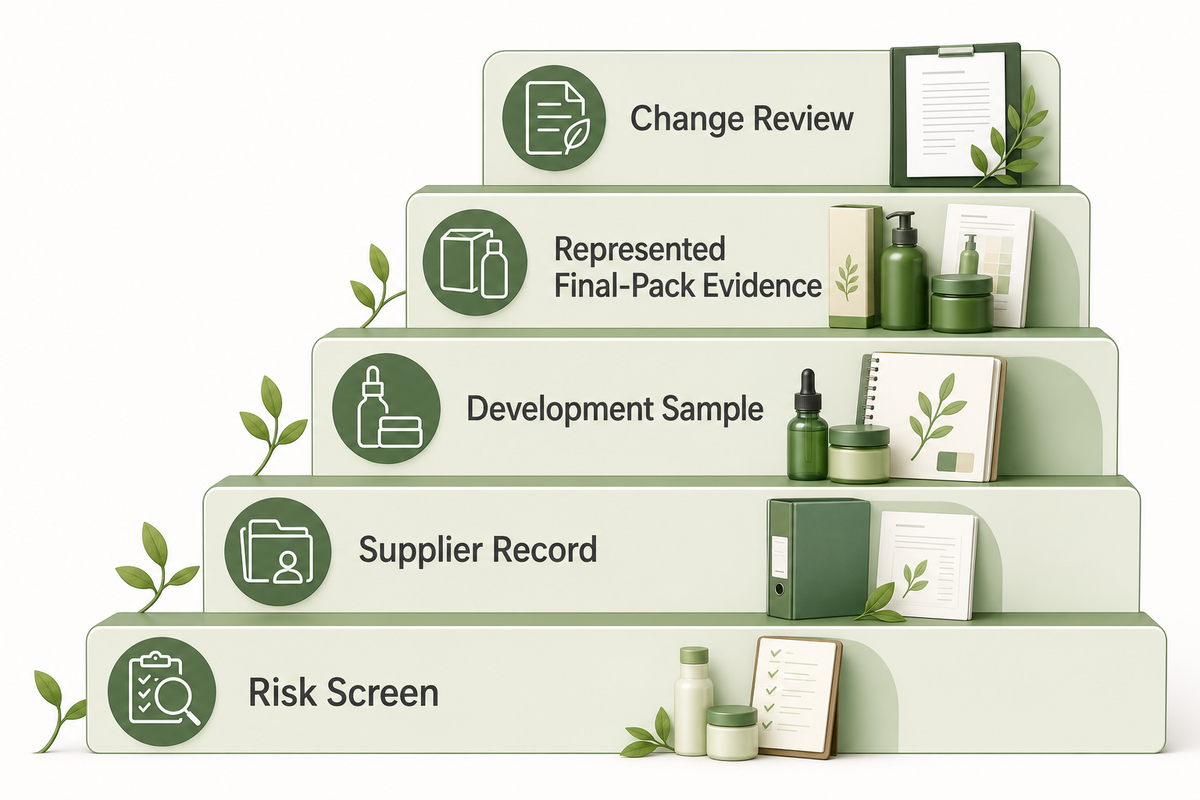
A supplier declaration, a development sample, and represented final-pack evidence answer different questions. Classify what you have before anyone labels the package “approved.” Each rung answers a different approval question, so one record should not be treated as evidence for the next.
- Risk screen: convert formula, component, channel, market, and use properties into questions.
- Supplier record: collect drawings, material and component identities, declarations, and revision status.
- Development sample: check fit, filling, closure, decoration, priming, dose, handling, and obvious interactions.
- Represented final-pack evidence: evaluate the controlled formula and component system under defined conditions and acceptance logic.
- Change review: decide whether a formula, component, supplier, decoration, process, or channel change reopens prior conclusions.
The 5-Rung Pack Evidence Ladder is an editorial routing framework, not a laboratory protocol or NEXO certification. Detailed compatibility planning belongs in the existing cosmetic packaging compatibility testing resource, and formula-package stability planning belongs in the cosmetic stability testing resource, while this guide keeps the buyer’s decision boundary visible.
A useful approval sentence
“Approved for [formula revision] with [component revisions], filled and closed under [defined assumptions], for [named market and channel], based on [listed evidence], subject to [limitations and change triggers].”
“Approved for [formula revision] with [component revisions], filled and closed under [defined assumptions], for [named market and channel], based on [listed evidence], subject to [limitations and change triggers].”
7. Screen Sustainable Packaging as a Whole-Pack Claim
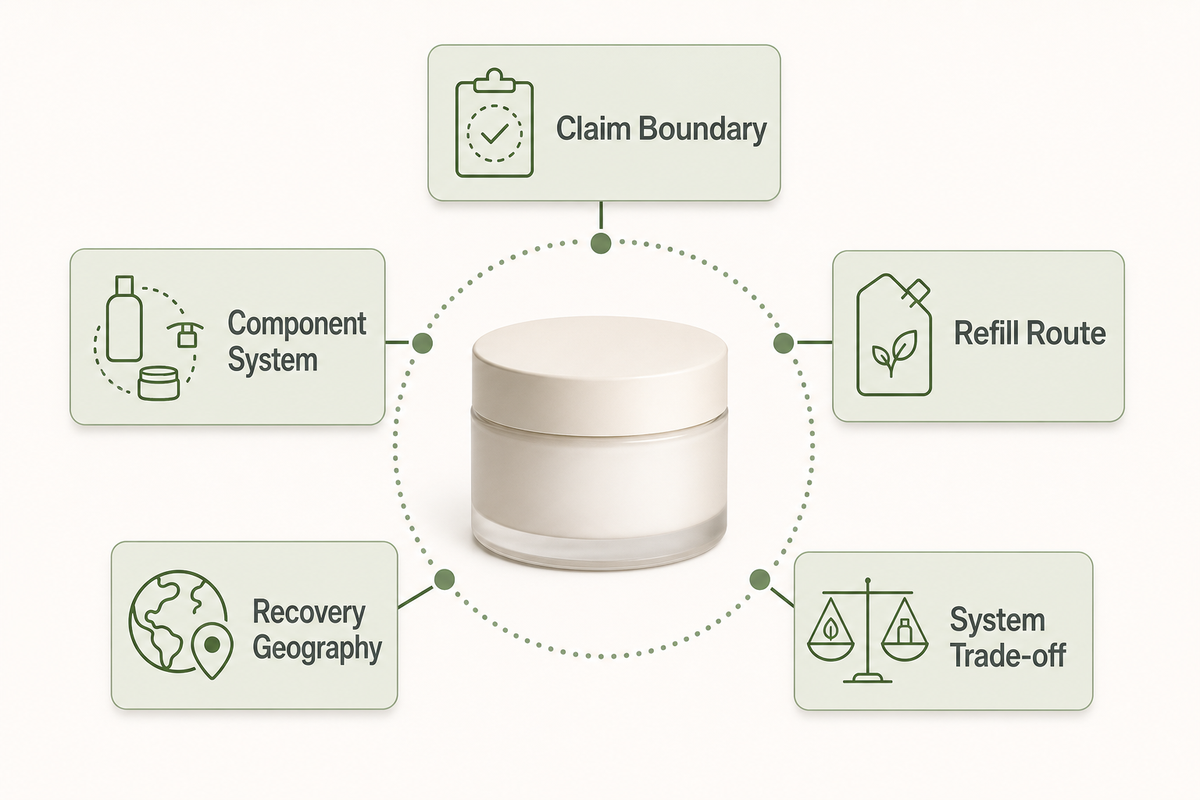
Review the whole commercial pack even when the final claim concerns only one component. The same evidence-ladder discipline should separate a supported component claim from a whole-pack conclusion. State whether “recycled,” “recyclable,” “refillable,” or another environmental benefit applies to the product, package, named component, or material fraction, and specify the geography, recycling route, and conditions.
Do not let trend language replace claim evidence
Eco-conscious buyers may ask for eco-friendly packaging or refillable packaging, but those labels still need a defined claim boundary and current market conditions. An eco-friendly statement is not self-proving, and packaging requirements can differ by launch geography and date.
Eco-conscious buyers may ask for eco-friendly packaging or refillable packaging, but those labels still need a defined claim boundary and current market conditions. An eco-friendly statement is not self-proving, and packaging requirements can differ by launch geography and date.
| Whole-Pack Sustainability Screen | Question | Evidence | Trade-off or condition | Owner |
|---|---|---|---|---|
| Claim boundary | Which item or fraction does the wording describe? | Substantiation tied to exact wording | Avoid broad benefit spillover | Legal / regulatory |
| Component system | Which parts, weights, materials and separations matter? | Bill of materials and supplier records | Pump, spring, label, ink and adhesive | Packaging |
| Refill route | Is a real collection/refill system or refill product available? | Market route and consumer instructions | Use, cleaning, loss and disposal | Brand / operations |
| Recovery geography | Can the target market collect, sort and process it? | Current local criteria | Rules and infrastructure can change | Market reviewer |
| System trade-off | What changes in weight, breakage, product loss, transport or function? | Defined comparison scope | No single material winner | Cross-functional team |
The United States Federal Trade Commission Guides caution against broad, unqualified environmental-benefit claims and require a reasonable basis for claims. Section 260.14 says an unqualified refillable claim should not be made unless the marketer provides a means for refilling, either through a collection/refill system or a refill product for sale.
The Guides also illustrate how a qualified statement can identify a 30% recycled-material fraction instead of implying that the entire product or package carries the same benefit. Use the exact supported boundary rather than borrowing the example as a performance target.
Regulation (EU) 2025/40 generally applies from 12 August 2026, but particular provisions can have different dates or exceptions. Check the rules that apply to the actual package and launch date instead of copying a supplier’s broad compliance statement.
8. Normalize Quotes with the 12-Field Pack RFQ Normalizer
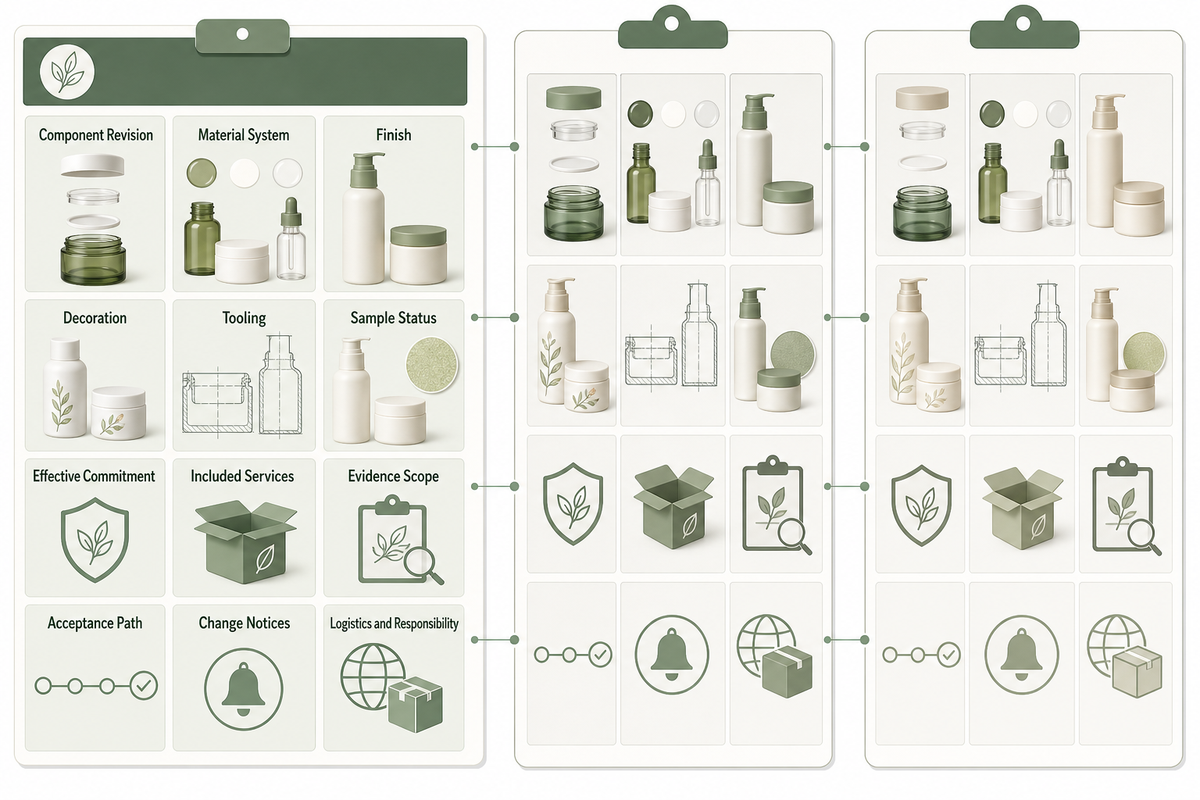
The cheapest quote is not always the best commercial fit. Market-specific compliance conditions also belong in a comparable quote. Two unit prices are not comparable when one includes decoration, tooling, samples, assembly, testing support, freight, or change control and the other does not. Transfer each proposal into the same twelve fields, preserving blanks and supplier qualifications.
| Field type | Record for every proposal | Do not infer |
|---|---|---|
| 1. Component revision | Drawing, size, closure and supplier revision | Equivalent construction |
| 2. Material system | Grades, contact parts, liners, gaskets and springs | Compatibility |
| 3. Finish | Color, coating, texture and acceptance reference | Visual match from a rendering |
| 4. Decoration | Method, colors, area, artwork and tolerances | All copy will fit |
| 5. Tooling | Included work, ownership, life, storage and changes | Ownership or exclusivity |
| 6. Sample status | Stock, decorated, pilot or represented production sample | Commercial equivalence |
| 7. Effective commitment | Pack quantity, surplus, scrap, spares and rounding | A public minimum |
| 8. Included services | Sourcing, artwork, assembly, filling or coordination | Unlimited revisions |
| 9. Evidence scope | Documents, samples, checks and exclusions | Certification or guaranteed outcome |
| 10. Acceptance path | Who approves what, against which reference | Silence equals approval |
| 11. Change notices | Supplier, component, material and process-change route | Permanent configuration |
| 12. Logistics and responsibility | Delivery terms, packaging, timing basis, risk and owner split | Total landed cost or binding timing |
The 12-Field Pack RFQ Normalizer is an editorial comparison aid informed by public supplier-scouting and procurement structures. It is not a mandatory form, an offer, a contract, or a replacement for supplier drawings, tolerances, testing scope, commercial review, and written terms.
9. Hand the Approved Pack into White-Label Production
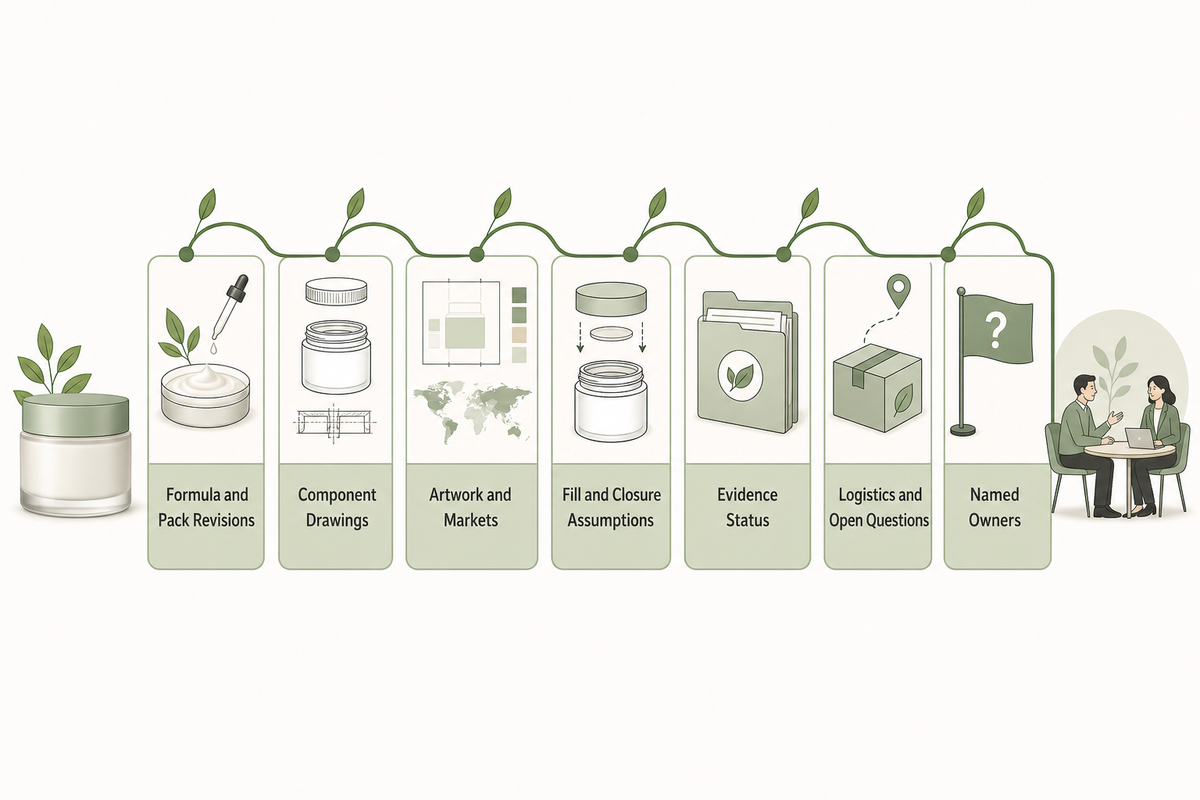
Bring one controlled package record into the manufacturing discussion: formula and pack revisions, component drawings, artwork, fill and closure assumptions, markets, quotation quantity, evidence status, logistics, unresolved questions, and owners. A mood board or supplier link cannot carry that responsibility.
Commercial handoff boundary
Physical manufacturing responsibility and regulatory responsibility are not automatically the same. Confirm the duties of the manufacturer, packer, distributor, label owner, or other legally defined responsible person for each target market in written project terms.
Physical manufacturing responsibility and regulatory responsibility are not automatically the same. Confirm the duties of the manufacturer, packer, distributor, label owner, or other legally defined responsible person for each target market in written project terms.
NEXO Beauty Labs is a global cosmetic original-equipment and original-design manufacturing partner for skincare, hair care, and body care development. Its manufacturing foundation dates to 1999, and its international business team has supported global beauty brands and private-label partners since 2020.
The broader skincare product development process shows where a controlled packaging record sits before commercial production.
Teams ready to connect a controlled packaging brief with an established-formula or custom-development route can review NEXO’s white label skincare manufacturing pathway. That first-party page is a commercial handoff, not proof of package performance, testing outcomes, public minimum orders, price, timing, capacity, certification, ownership, or exclusivity.
Bring the package decision into one development brief
Prepare your formula revision, target markets, pack stack, artwork state, evidence gaps, quotation fields, and open owners.
Discuss Your Skincare Project
Prepare your formula revision, target markets, pack stack, artwork state, evidence gaps, quotation fields, and open owners.
Discuss Your Skincare Project
Frequently Asked Questions
Which packaging is best for skincare products?
There is no single best package for every cosmetic skincare formula. Start with formula revision, viscosity, sensitivities, dose, user contact, channel, target markets, and artwork needs, then compare the container and closure system against those inputs. A jar, tube, bottle, pump, dropper, or sachet becomes viable only after the team records what it must protect and which evidence remains open. Approve the component system, not the format name, and reopen the decision when a formula, supplier, or channel assumption changes.
Are airless pumps always better for skincare?
No. An airless mechanism can change dispensing and exposure, but the format name does not prove formula compatibility, dose consistency, filling suitability, package evacuation, recyclability, shelf life, or consumer preference. Review the actual component system and represented formula under defined conditions.
Is glass packaging better than plastic for skincare?
Neither material is universally better. Glass can offer useful barrier and presentation properties while adding weight and breakage considerations; plastics can reduce weight and enable dispensing architectures while raising grade, barrier, component-mix, and recovery questions. Compare the complete commercial system in its actual channel and geography.
What information should a skincare packaging brief include?
Include formula and package revisions, every direct-contact and functional component, intended dose and use, fill and closure assumptions, target markets, artwork status, channel stack, evidence state, quotation quantity, logistics, open questions, and owners. Preserve unknowns instead of letting them become supplier assumptions.
When should packaging compatibility evidence be reviewed?
Review evidence before commercial package approval and again when a formula, direct-contact component, supplier, closure, decoration, fill process, channel, or relevant market assumption changes. The review should decide whether existing evidence still represents the commercial system rather than imposing an automatic retest rule.
Turn unknowns into a controlled packaging brief
Align brand, formulation, packaging, quality, regulatory, procurement, and manufacturing roles before the pack is frozen.
Contact NEXO Beauty Labs
Align brand, formulation, packaging, quality, regulatory, procurement, and manufacturing roles before the pack is frozen.
Contact NEXO Beauty Labs
References and Sources
- United States Food and Drug Administration: Summary of Cosmetics Labeling Requirements
- United States Food and Drug Administration: Microbiological Safety and Cosmetics
- EUR-Lex: Consolidated Regulation (EC) No 1223/2009, including Article 19
- EUR-Lex: Regulation (EU) 2025/40 on Packaging and Packaging Waste
- Electronic Code of Federal Regulations: 16 CFR Part 260, FTC Guides for Environmental Marketing Claims
- Klein et al.: Standardization Approaches for the Emptiability of Cosmetic Packaging
- Peer-reviewed study: Influence of Packaging on the Quantity of Cosmetic Product Used
- Peer-reviewed study: Classification of Packaging Systems According to Microbial Protection
- NIST Manufacturing Extension Partnership: Supplier Scouting Opportunity Synopsis fields
- Acquisition.gov: Federal Acquisition Regulation 15.204-2
This guide is educational and does not replace formula-specific packaging work, qualified safety or regulatory review, market-specific legal advice, supplier documentation, or written commercial terms. The four named buyer tools are editorial frameworks proposed in this article, not NEXO certifications or validated test methods.
Why beauty brands work with NEXO
About NEXO Beauty Labs Manufacturing Support
NEXO Beauty Labs supports skincare, body care, sun care, hair care, and private label brands with formulation, sampling, filling, quality control, and export-ready launch support.
Project Review Before RFQ
Before quotation, we help clarify product category, active direction, formula stage, package choice, compliance market, MOQ, sampling schedule, and required documents.
Request a Cosmetic QuoteCompany Profile // Data Sheet
CompanyNEXO Beauty Labs
Business TypeCosmetic OEM / ODM manufacturing partner
Main ProductsPrivate label skincare, facial serums, moisturizers, cleansers, sunscreen, body care, and hair care products
Manufacturing CapabilityFormula development, sample adjustment, package sourcing, filling, QA/QC, documentation, and export support
RFQ Data NeededProduct type, formula goal, package format, target market, MOQ, claims, timeline, and benchmark samples
Websitenexobeautylabs.com