Get in touch with NEXO Beauty Labs Company
How to Plan a Private Label Body Lotion Line

Updated September 2026
Building a private label body lotion isn’t the same as selecting a neutral base and a logo; it requires a cohesive strategy. Private label body lotion refers to lotion made by one company for sale under another company’s brand, while the product line remains governed by the agreed formula, package, evidence, and ownership scope. Each of the elements, including commercial idea, route to claim, packaging, test plan, label, and production file, is interrelated. A decision made late in the process can undermine work that appeared to be completed earlier.
This guide is designed specifically for brand founders, product developers, quality teams, and buyers when preparing a defensible brief prior to approving production. In addition, it explains the decision order. The body lotion manufacturing page is the proper place for discussions about supplier capabilities, minimum order quantities, quotes, and project timelines.
Key takeaway
A useful lotion brief connects seven items: buyer, sensory target, formula route, claims, package, validation plan, and release file. If one stays vague, the next decision inherits the uncertainty.
What Does Private Label Body Lotion Actually Mean?
Private label body lotion is manufactured by one company and sold by a different company under their brand. The phrase doesn’t address how much of the formula, scent, package, testing, and documentation can change. Those variables are dependent upon the supplier’s allocated project and the agreed upon program.
For a US launch, the brand should also check how FDA determines intended use, because the name “body lotion” alone does not settle whether every proposed claim stays within cosmetic scope.
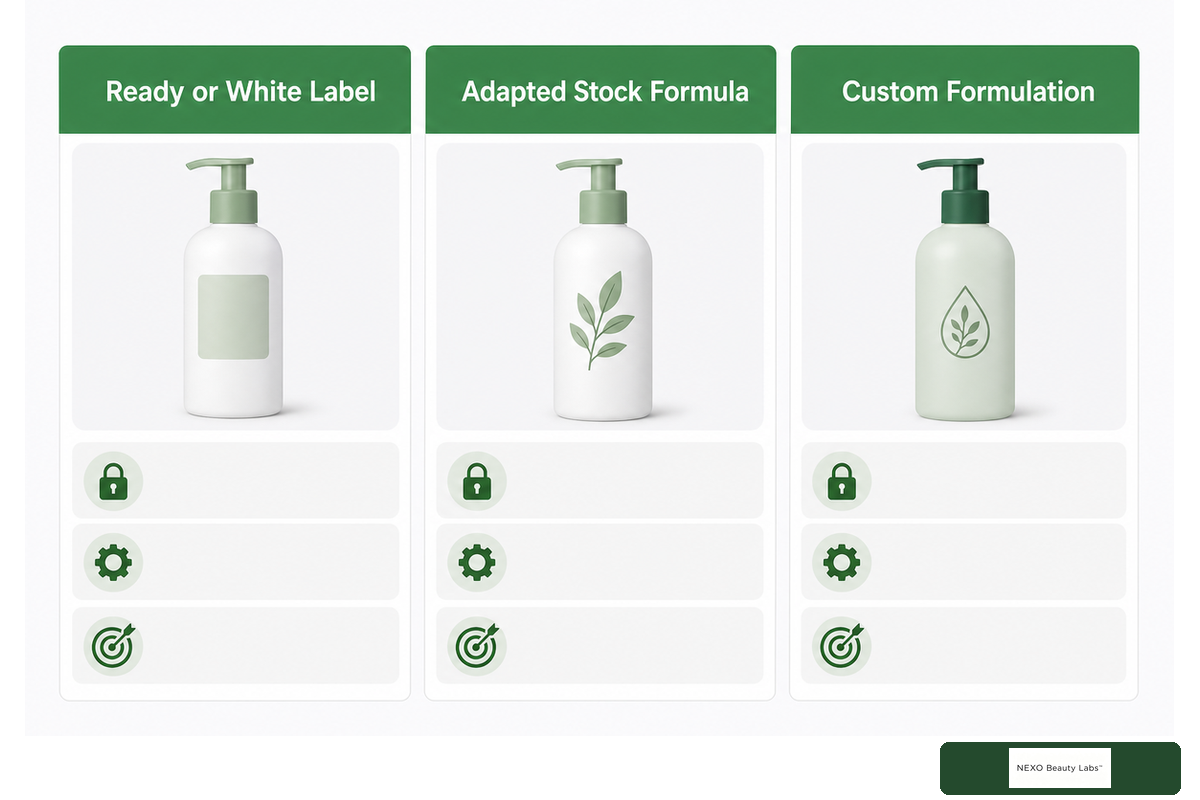
Buyers tend to encounter three broad types of routes. Names aren’t a definitive categorization, and suppliers may assign different meanings to the names. It makes more sense to analyze the decisions and logic underlying the labels, rather than the labels themselves.
Listings for private label lotions may group ready-to-fill products, lotion manufacturer services, and complete contract manufacturing under the same language. This is why a shortlist of body lotion manufacturers should be assessed on the basis of the overall scope rather than the category label. Search language can blur the boundary. A query for “private label lotions” or “body lotion private label” can surface stock, adapted, and custom offers, while “private label body lotion manufacturers” can describe either a service provider or the factory behind it. That mismatch is risky because a buyer can shortlist a supplier under the wrong route; treat the wording as discovery shorthand, then verify scope.
| Route | What is usually fixed | What may change | Best fit |
|---|---|---|---|
| Ready or white label | Core formula and much of the validation history | Brand, label, pack selection, and sometimes scent | A focused launch that does not need formula exclusivity |
| Adapted stock formula | Existing platform and manufacturing route | Selected ingredients, fragrance, texture direction, or claims | A brand that needs moderate differentiation with controlled development |
| Custom formulation | Only the agreed project constraints | Formula architecture, sensory profile, claims plan, and pack system | A validated concept that can support a larger evidence and development burden |
Don’t think “custom” translates to “better.” That logic creates more control, but also more validations. Think about what can change, who owns the resulting formula, what evidence transfers, and what triggers retesting.
Which Commercial Decisions Should Come Before Ingredients?
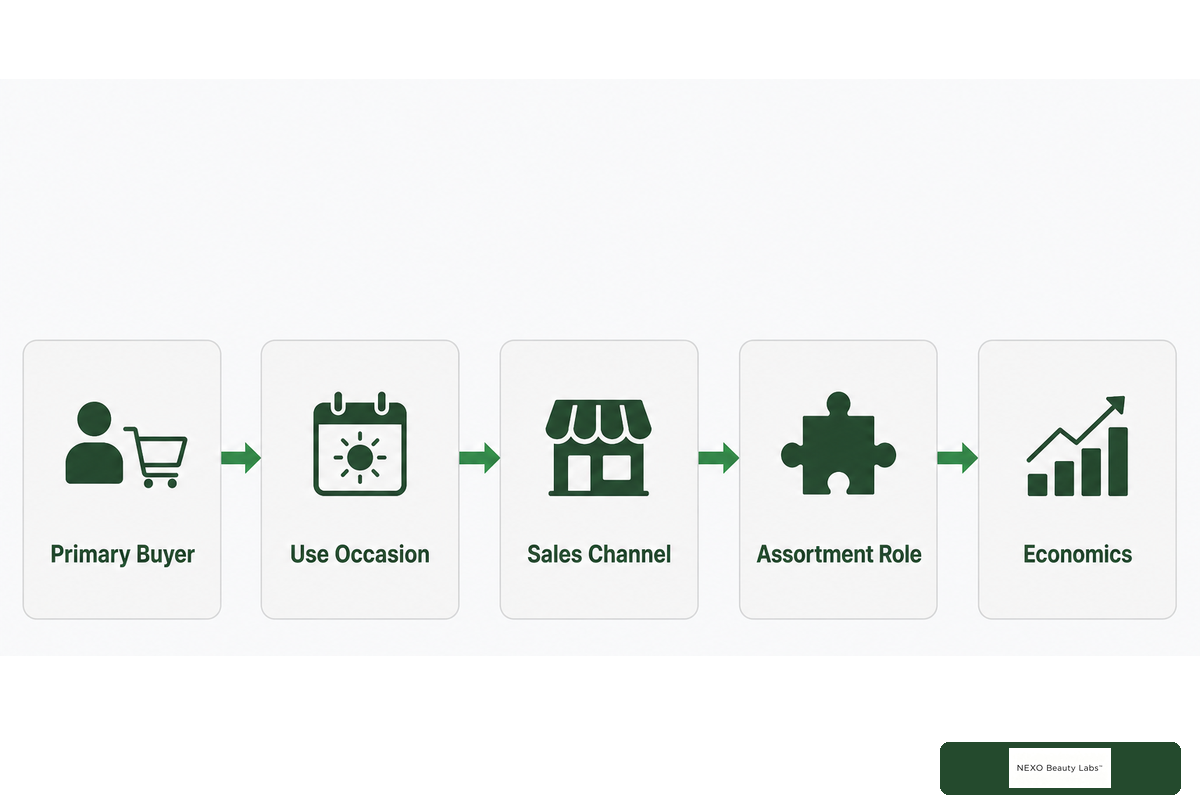
Think about who will use the lotion, when they’ll use it, where it will be sold, what role it will play in the assortment, and what price structure the channel can sustain before thinking about the hero ingredients. These factors define the need the formula must fulfill.
If those choices stay open, the factory brief becomes unstable: the brand may approve ingredients before it has defined the buyer, channel, cost ceiling, and evidence needs. That sequence raises rework risk because each later constraint can force the supplier to revisit an earlier decision.
| Decision | Question to answer | What goes wrong when it stays open |
|---|---|---|
| Primary buyer | Whose problem and routine are you designing for? | The sample becomes a compromise for several unrelated audiences. |
| Use occasion | Daily all-over use, spa service, travel, hospitality, or a targeted routine? | Texture and pack size are chosen without a real use condition. |
| Sales channel | Direct-to-consumer, marketplace, retail, professional, or hotel supply? | Margins, label space, ship testing, and merchandising needs conflict later. |
| Assortment role | Hero SKU, entry product, bundle companion, refill, or seasonal item? | The team overinvests in a secondary SKU or underbriefs the hero. |
| Economics | What landed-cost ceiling and retail margin must the project preserve? | An attractive sample reaches costing with no commercially viable path. |
Create these as constraints instead of aspirations. “Premium” is an aspiration. “A fragrance-light daily lotion rather than a heavier body cream, for sensitive-skin-positioned direct-to-consumer buyers, in a bathroom-safe pump, within an approved landed-cost ceiling” is a usable starting brief. The final sensitive-skin wording still needs a separate claim review.
The external checkpoint is the FTC’s advertising guidance: the intended express and implied claims should be reviewed against the evidence available for the finished product.
Stock, Adapted, or Custom: Which Formula Route Fits?
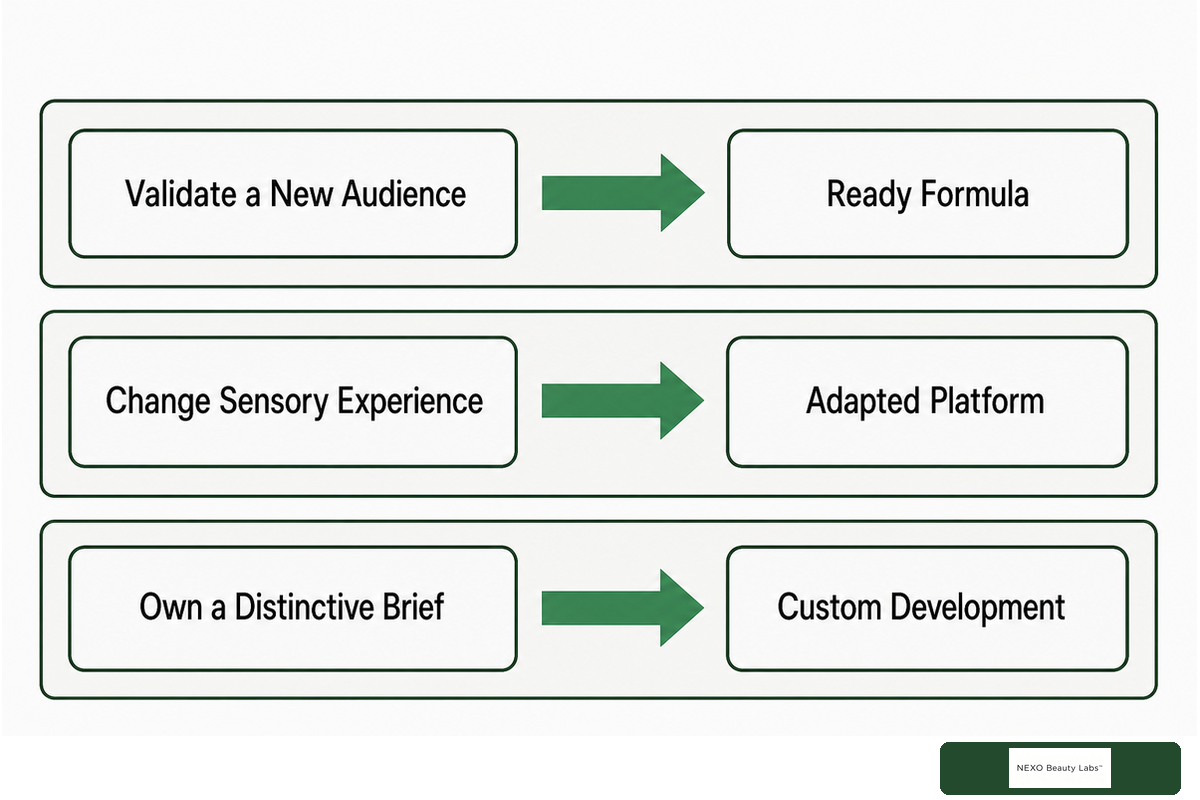
Choose the route that provides the most differentiation with the least amount of complexity. Custom routes are justified when the product promise can’t be fulfilled with an existing option. The commercial brief should define what a custom body lotion must achieve before added product development starts.
With the commercial constraints fixed, NEXO presents stock, semi-custom, and custom paths on its body lotion manufacturing options page, although the available changes can overlap across these routes.
A differentiated sensory or performance brief warrants additional development of the body lotion. A custom route shouldn’t be used to create the illusion of exclusivity. The route decision creates a real tradeoff: choosing custom can add cost and delay, while choosing stock can narrow differentiation. For a buyer, the risk appears when a supplier recommends a route before factory feasibility, claim, package, volume, and evidence needs are fixed, because the project may pay for complexity it doesn’t use.
| If your priority is… | Start by testing… | Confirm before choosing |
|---|---|---|
| Validate a new audience with limited complexity | A ready formula in an available pack family | Transferable evidence, permitted claims, and realistic differentiation |
| Change the sensory experience or selected ingredients | An adapted platform | Which changes alter stability, preservation, compatibility, or claim support |
| Own a distinctive performance and sensory brief | A custom development scope | Formula ownership, development stages, test responsibility, and change control |
A successful route choice ends with a firm line. This demarcates what’s fixed, what can change, current evidence, required evidence, and what each of the parties has responsibility for. Without this boundary, two suppliers may quote projects that appear identical but differ in scope.
What Must the 7-Lock Body Lotion Constraint Cascade Set Before Sampling?
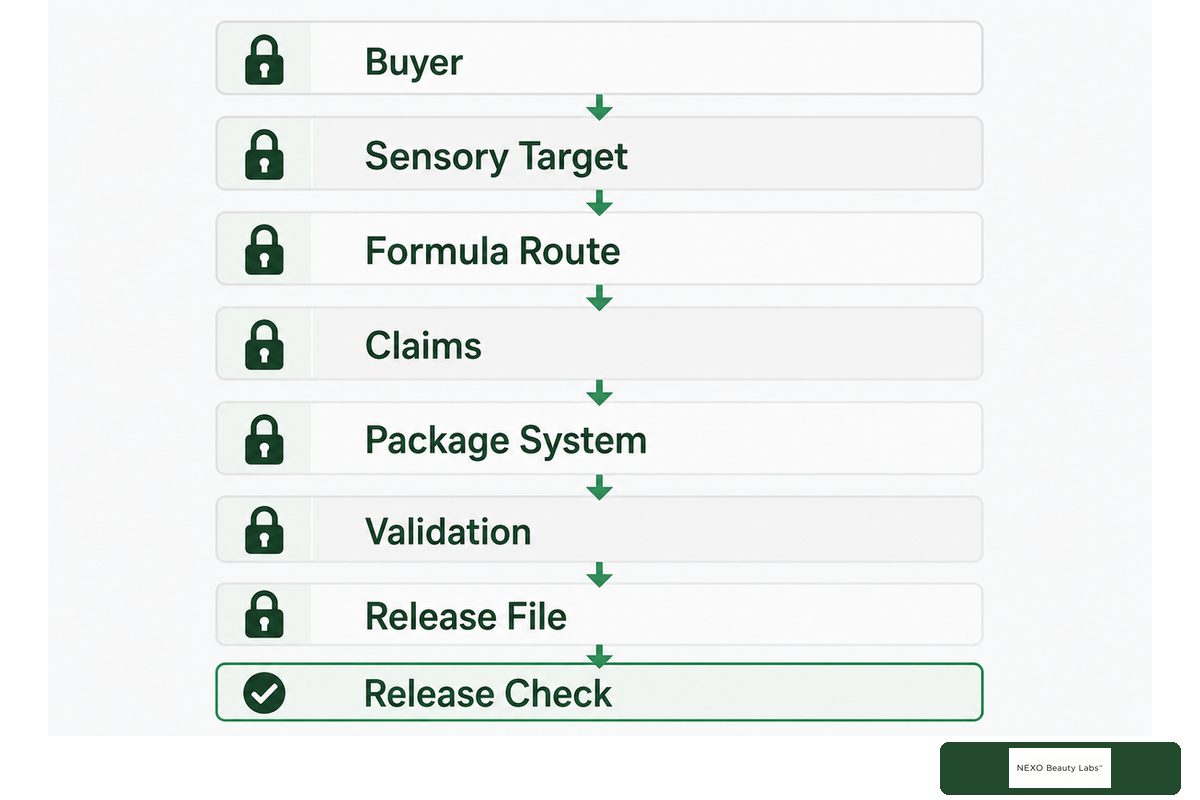
The 7-Lock body lotion Constraint Cascade is an editorial planning tool to sequence decisions in order. It is not an ISO standard, a certificate, a legal checklist, or a passed test. Its aim is to identify an open constraint before that uncertainty moves to sampling, artwork, packaging, procurement of materials, and production.
For contrast, ISO 11930:2019 has a defined public scope for evaluating antimicrobial protection; the 7-Lock sequence has no such standards status.
| Lock | Decision to set | Working owner | Evidence or output | If left open |
|---|---|---|---|---|
| 1. Buyer | Audience, routine, channel, price structure | Brand lead | Approved commercial brief | The formula solves no single buyer problem. |
| 2. Sensory target | Spread, play time, absorption, residue, finish, scent | Product lead | Sample scorecard and reference conditions | Subjective feedback creates endless revisions. |
| 3. Formula route | Ready, adapted, or custom boundary | Brand and formulator | Written development scope | Cost, ownership, and evidence expectations drift. |
| 4. Claims | Exact product, label, and campaign representations | Marketing and regulatory | Claim inventory with evidence owner | Artwork promises more than the file supports. |
| 5. Package system | Container, closure, pump, seal, decoration, ship case | Packaging and operations | Controlled bill of materials and compatibility plan | A stable bulk formula fails in the final pack. |
| 6. Validation | Test purpose, method, samples, limits, and decision rule | Quality lead | Project-specific protocol | A pleasing sample is mistaken for shelf-life evidence. |
| 7. Release file | Approved versions, responsibilities, exceptions, and changes | Quality and operations | Production-request and release records | The manufactured version cannot be traced to the approved version. |
| Release check | Confirm every open item, owner, decision date, and release criterion | Brand and operations | Signed 7-Lock decision record | An unresolved item is mistaken for a completed release. |
A cascade isn’t seven transactions conducted in parallel. A new statement may require a new test. A new pump may modify the compatibility plan. A new ship mode may require a new label review. When an upstream lock is modified, record what downstream locks must be modified.
How Should You Describe Texture Without Vague Words?
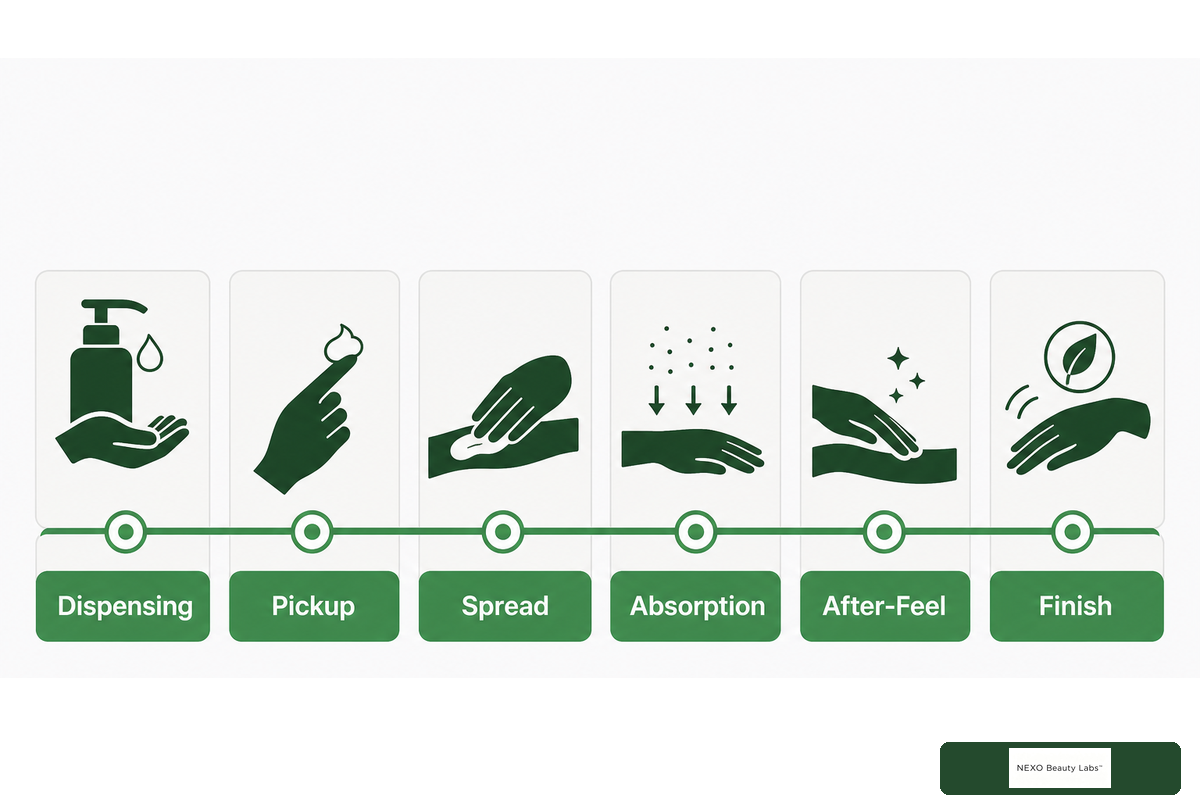
Texture can be described as a series of observable states that occur during performance: dispensing, picking up, spreading, working time, absorption, leaving a residue, finish, and the state after a period of time. “Rich but not greasy” is too vague until the reviewers agree on what’s meant by “rich” and “greasy” in the given context.
For a buyer comparing samples, ambiguous texture words fail because each reviewer imagines a different finish. The factory sample team needs a repeatable application amount, timing, observation points, and acceptance language before the supplier changes the formula.
| Moment | What to describe | Useful comparison question |
|---|---|---|
| Dispensing | Flow from the selected pump or tube | Does one normal actuation deliver a usable amount without stringing or sputtering? |
| Pickup | Body, shape retention, and initial cushion | Does the lotion hold briefly or run immediately? |
| Spread | Glide, drag, whitening, and coverage | How much effort is needed across the intended body area? |
| Absorption | Perceived play time and change during rub-in | When does the surface stop feeling mobile? |
| After-feel | Tack, slip, waxiness, powder, or coating | What remains after the agreed evaluation interval? |
| Finish | Matte, natural, luminous, or glossy appearance | Does the visible finish suit the positioning and skin range? |
While keeping review conditions consistent enough to compare samples, don’t create universal thresholds. Capture sample code, package, dose approach, body area, evaluator, environment, and observation time. This is still a product-development scorecard, not a clinical efficacy study.
The FTC’s cosmetics enforcement example is a useful boundary: scientific or clinically framed claims need substantiation that matches the representation, not just a sensory scorecard.
Which Ingredient and Performance Claims Need Proof?
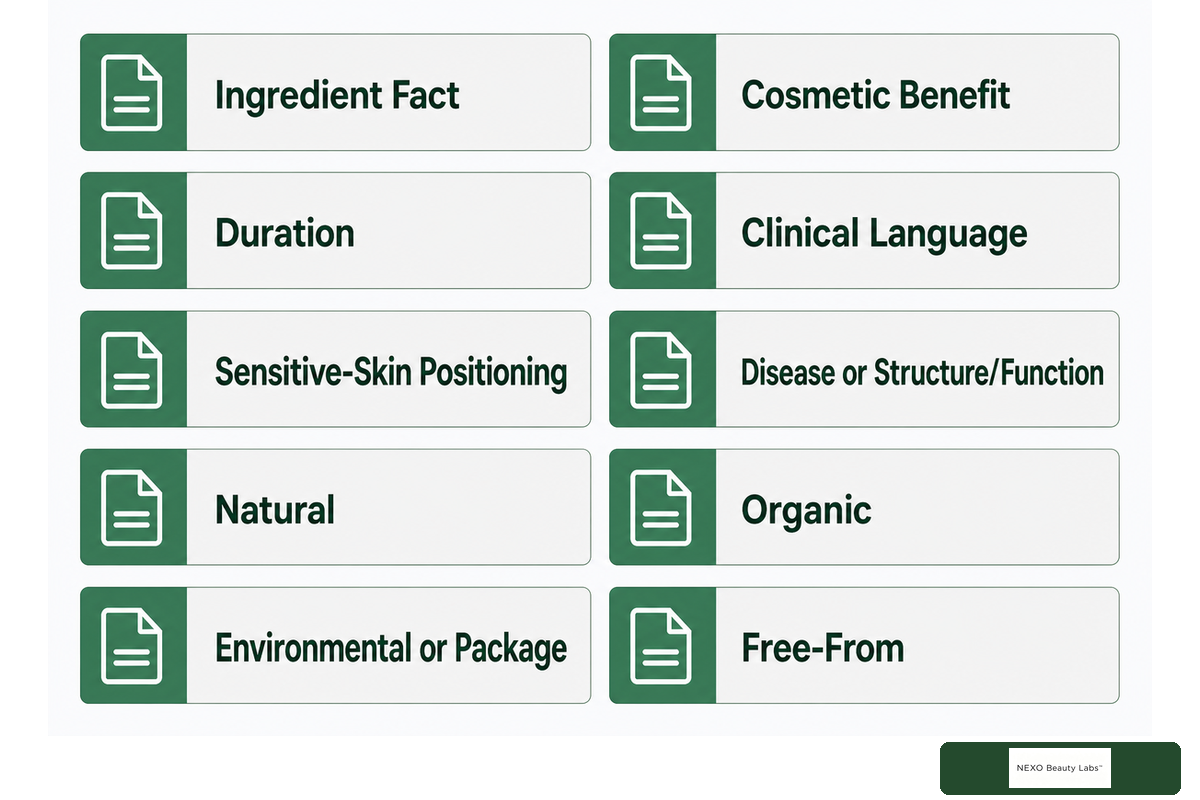
Describe what the buyer will see first, then describe how this information can be substantiated. An ingredient list confirms presence. It doesn’t prove duration, clinical result, disease benefit, environmental outcome, or usability by every sensitive user. Match the evidence to the exact claim wording and sales market.
Under FDA’s intended-use framework, claims can affect whether a product is classified as a cosmetic, a drug, or both. The FTC’s cosmetics enforcement example also shows why unsupported objective or “clinically proven” claims are problematic.
Aloe vera, Vitamin E, jojoba oil, hyaluronic acid, and essential oils are commonplace examples used in skin care products. Yet, their presence doesn’t confirm a product can nourish, soothe, and suit all types of skin.
| Claim family | Example direction | Minimum planning question | Evidence owner | Important limitation |
|---|---|---|---|---|
| Ingredient fact | “Made with shea butter” | Is the named material present in the final approved formula and label declaration? | Formula and regulatory | Presence alone does not prove a performance result. |
| Cosmetic benefit | “Helps skin feel softer” | What consumer or instrumental support fits the precise wording? | Brand and regulatory | Do not expand a modest finding into a stronger implied claim. |
| Duration | “24-hour hydration” | Was the final product tested for the stated endpoint, duration, and population? | Brand and test sponsor | A supplier ingredient dossier may not prove the finished-product claim. |
| Clinical language | “Clinically proven” | What study design, comparator, endpoint, sample, and statistics support the statement? | Brand and regulatory | The wording must not exceed the study. |
| Sensitive-skin positioning | “For sensitive skin” | What definition, screening, use test, and complaint plan support the intended audience? | Product safety and regulatory | No single ingredient creates universal suitability. |
| Disease or structure/function | “Treats eczema” | Would the intended use move the product into drug regulation? | Qualified regulatory counsel | Do not use cosmetic evidence to support a drug claim. |
| Natural | “Natural body lotion” | What internal definition, ingredient basis, and market-specific rule support the term? | Brand and regulatory | “Natural” is not a universal shortcut to safety or efficacy. |
| Organic | “Organic” or an organic seal | Which USDA or other applicable certification and composition rules apply? | Certification and regulatory | Cosmetic labeling and organic certification are separate questions. |
| Environmental or package | “Recyclable,” “refillable,” or “green” | Does the package, collection reality, qualification, and consumer takeaway support the claim? | Packaging, legal, and marketing | Broad environmental benefits can imply more than the evidence shows. |
| Free-from | “Free from X” | Is the statement truthful, meaningful, and supported across formula and supply controls? | Formula, quality, and regulatory | A truthful absence can still create a misleading safety implication. |
Compile a claims inventory prior to final art. For more in-depth methods, direct the team to the existing document on skincare claims substantiation. This avoids repetition in this document.
How Do Formula and Packaging Need to Work Together?
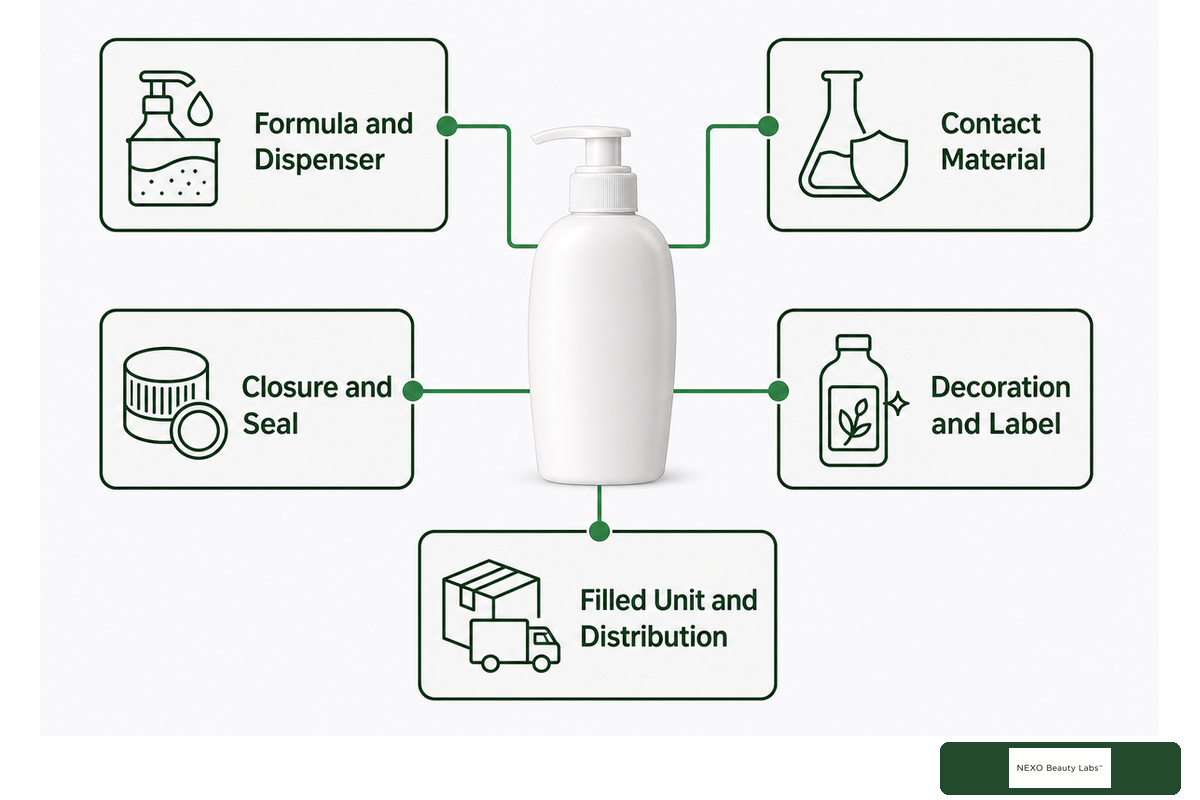
The product formulation is part of the lotion system. The appearance of the packaging, on its own, can’t verify whether the filled product will prime, dose, seal, survive distribution, maintain contact material compatibility, preserve the sensory experience, or retain its desired state in the final bottle, tube, or pump.
Intertek’s public testing overview outlines physical, microbiological, packaging, pump, dose delivery, leakage, and locking tests. It’s a valuable map of test categories, not a full test procedure. The actual method, sample size, test conditions, durations, and acceptance criteria must be determined for the product and for the market. A factory filling trial is the practical handoff between the package drawing and the finished unit. Without it, a supplier may pass a component on paper but still face leakage, dose inconsistency, or locking problems because the assembled system behaves differently.
| Interface | What to observe | Decision record |
|---|---|---|
| Formula and dispenser | Priming, output consistency, clogging, stringing, sputtering | Approved component and formula version |
| Formula and contact material | Color, odor, swelling, stress, corrosion, or migration concern | Material disclosure and compatibility conclusion |
| Closure and seal | Leakage, torque, lock function, liner behavior | Pack specification and test condition |
| Decoration and label | Adhesion, rub resistance, staining, scuffing, legibility | Approved artwork and decorated samples |
| Filled unit and distribution | Orientation, vibration, pressure, temperature exposure, ship case | Distribution plan tied to the intended channel |
Use the cosmetic packaging compatibility testing article as the primary reference. In this article, a simpler control applies: the lotion formula and package should be released for sale as one tested system, not as separate assumptions.
What Testing Plan Should Precede Sample Approval?
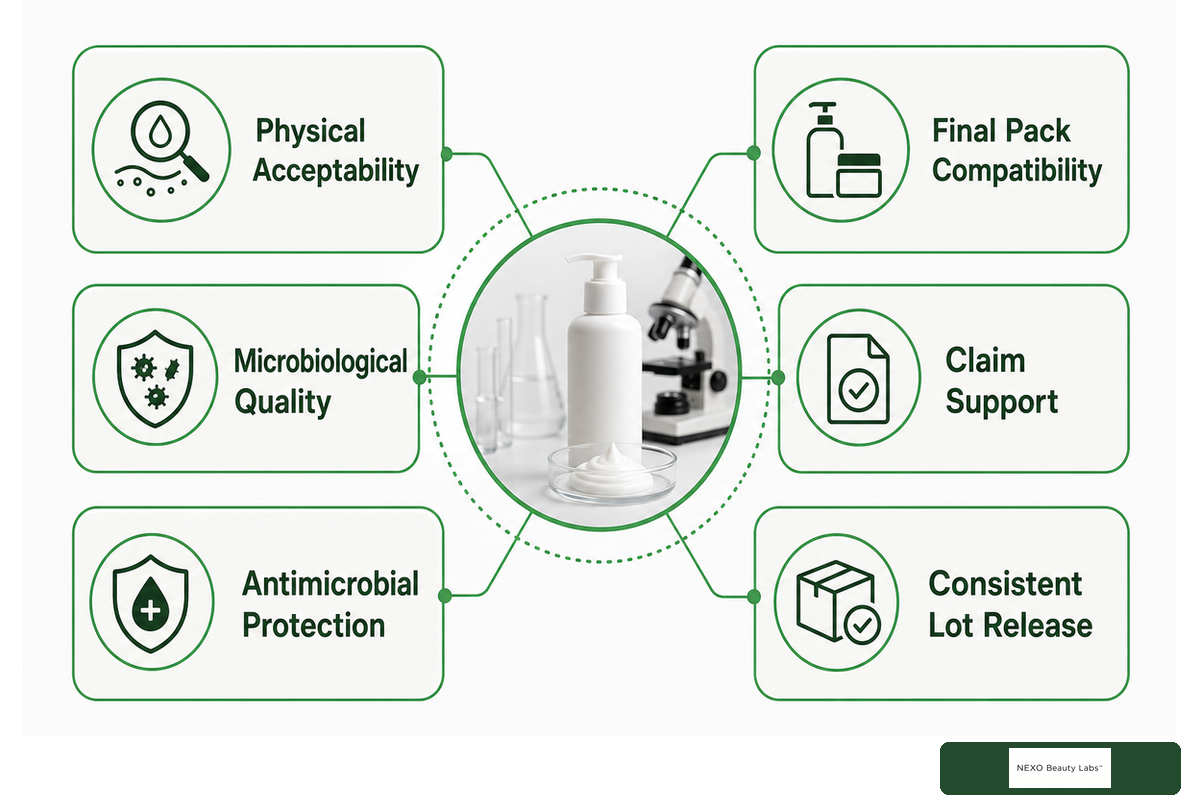
Prior to commencing any testing, determine the scope of each required test. The plan should include physical stability, microbiological preservation, safety, and release. The exact methods and limits should match the formula, the package, the claims, risk, and the market.
The public scope for ISO 11930:2019 describes a reference method for evaluating antimicrobial protection and a risk-based path for products considered low risk. It does not mean every lotion follows an identical schedule, and referencing the standard is not the same as showing a passing product result. Use the factory’s in-house screen as a development signal, not as a substitute for a qualified or accredited lab report when the agreed risk and release plan calls for one. The evidence matters because a supplier’s internal check and a product-specific test result answer different questions.
| Question | Evidence to plan | What the evidence does not prove alone |
|---|---|---|
| Does the formula remain physically acceptable? | Protocol-defined observations such as appearance, odor, pH, viscosity, or separation | Microbiological quality or package performance |
| Is microbiological quality controlled? | Applicable limits, methods, sampling, and manufacturing controls | Preservation through every foreseeable use condition |
| Is antimicrobial protection adequate? | Risk assessment and preservation-efficacy approach where applicable | Every shelf-life, claim, or market requirement |
| Does the final pack work with the formula? | Filled-pack compatibility and functional checks | Bulk stability in a different container |
| Can the proposed claim be supported? | Finished-product or otherwise appropriate substantiation matched to the claim | A broader or stronger advertising statement |
| Can production lots be released consistently? | Approved specifications, methods, deviations, and release authority | Long-term performance outside the stated scope |
An attractive bench sample can be a useful milestone in the development process. An attractive bench sample doesn’t provide proof of shelf life, preservation, compatibility, or the fulfillment of a claim. The more complete stability guide in the cosmetic stability testing section covers this topic.
Who Owns the Label and US Market Responsibilities?
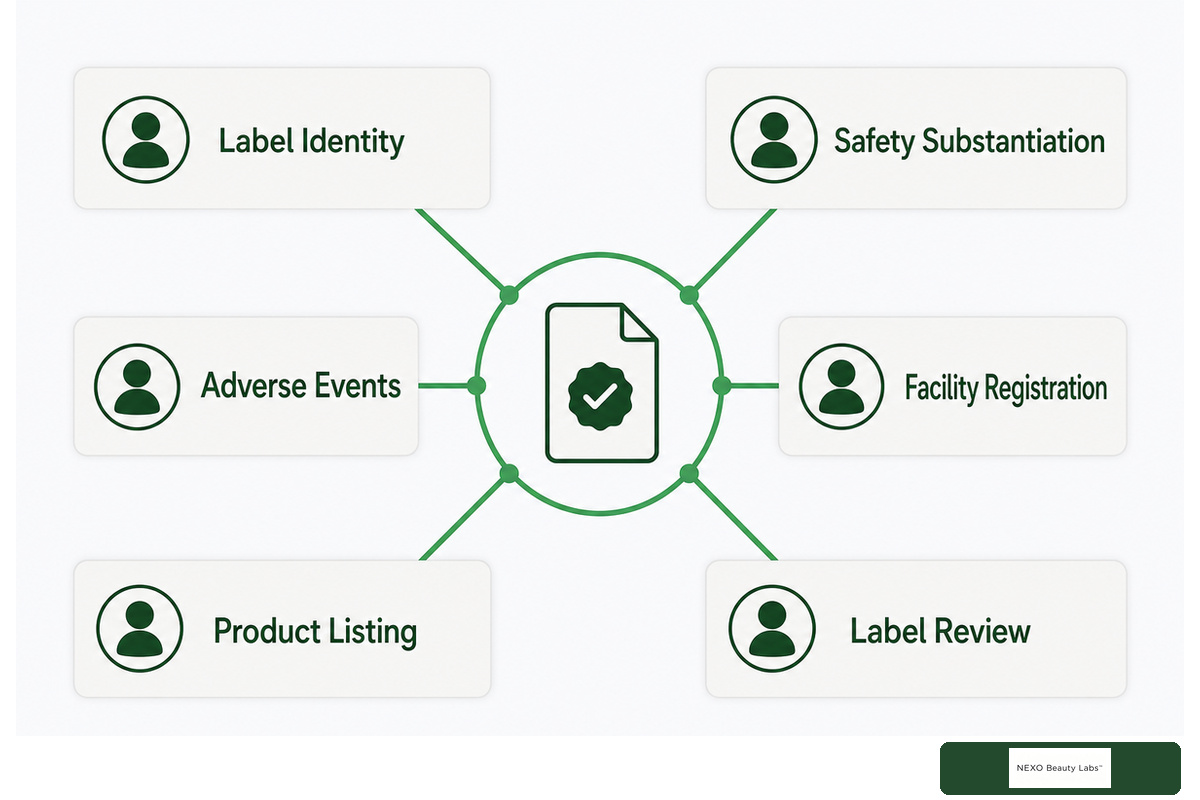
Starting with a federal responsibility map for the US is a good first step. Once this is done, research each channel and each state for which the product will be offered. Don’t think that the contract manufacturer covers everything. The name on the label, facility function, product, records, exemptions, agreements, and assigned roles can point to different owners.
Under the current definition of the MoCRA overview by the FDA, the responsible person is the manufacturer, packer, or distributor whose name appears on the label. The FDA overview also describes serious-adverse-event reporting, safety substantiation records, facility registration, and product listing. There are exemptions; therefore, responsibility is not identical in every case. The handoff can fail when the brand assumes a manufacturer, packer, distributor, or factory owns every task. That risk exists because FDA definitions identify roles, but the actual supplier agreement must still assign records, reporting, review, and escalation.
| Workstream | Question to resolve | Evidence to retain |
|---|---|---|
| Label identity | Whose name appears, and who is the responsible person for this product? | Approved label and role memo |
| Safety substantiation | Who holds the records supporting adequate safety? | Controlled safety file and access terms |
| Adverse events | Who receives, evaluates, reports, and follows up complaints? | Contact route, procedure, and escalation record |
| Facility registration | Which covered facilities must register or renew, and does an exemption apply? | Current filing evidence and scope check |
| Product listing | Who submits and maintains the listing for the marketed product? | Listing record, updates, and responsible-person owner |
| Label review | Who verifies identity, net contents, business information, ingredients, and warnings? | Signed artwork review |
Registration and listing are not FDA product approval and should not be marketed as an FDA promotional certificate. The FDA’s registration and listing page also documents exemptions and role-specific operations.
Scope limit: this is only a federal baseline. State regimes can add ingredient restrictions, reporting, and party-specific duties. Washington’s official cosmetics compliance page is one current example. Please note that this isn’t a complete legal map of the US and shouldn’t be treated as such. Please consult regulatory counsel for the actual market list.
What Manufacturer Evidence Matters More Than Sales Copy?
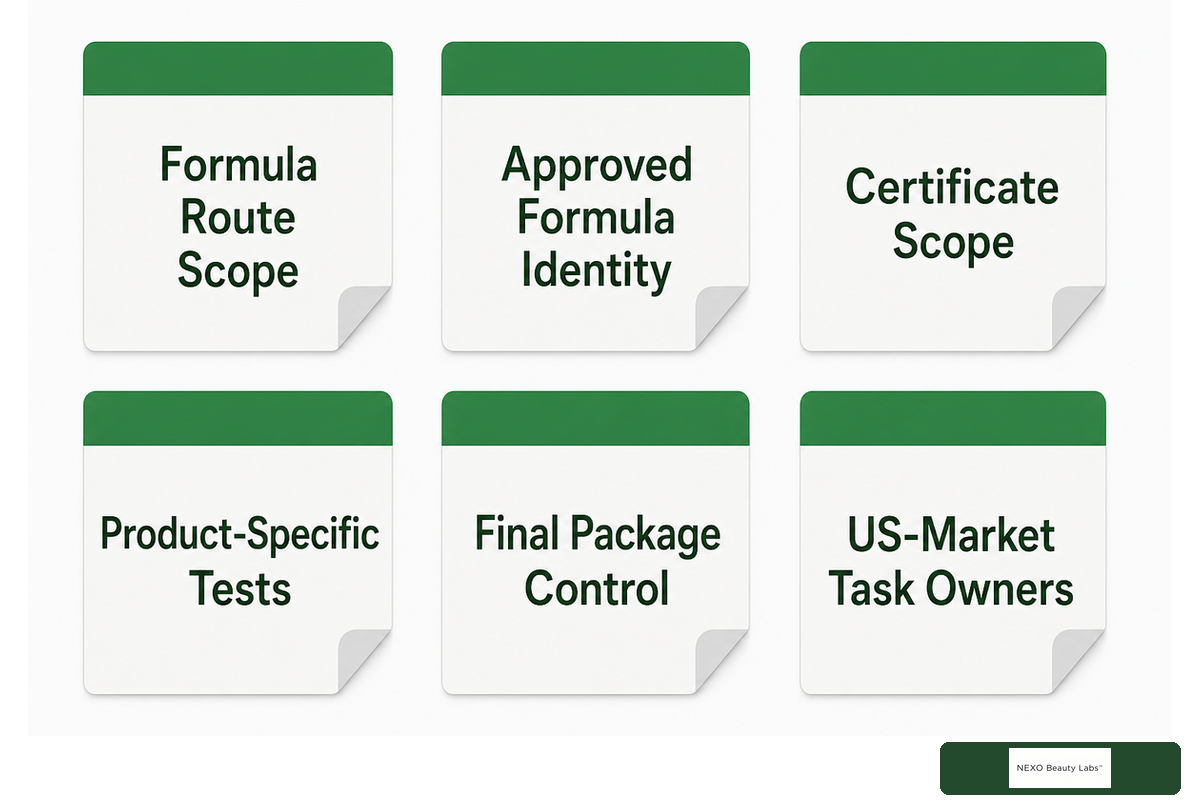
Ask for records that show scope, ownership, version control, test status, and change handling. General statements such as “high quality,” “FDA registered,” or “ISO compliant” are not interchangeable with product approval, a passed test report, a certificate in scope, or evidence for your finished product.
In sales copy, “high quality” isn’t sufficient because it doesn’t explain how the approved sample relates to the production formula and package or how the release specification relates to that sample. Commercial search labels need the same scope test. “Best private label body lotion” isn’t a test standard, “private label body lotion wholesale” doesn’t prove stock is ready for a buyer’s channel, and “private label lotion manufacturers USA” doesn’t prove which factory operations occur in the United States. During procurement, ask whether each certification, in-house check, accredited-lab report, and supplier record covers the current formula and package; otherwise, scope mismatch becomes a risk because the evidence may belong to a different product.
| Ask | Useful evidence | Warning sign |
|---|---|---|
| What exactly is included in this formula route? | Scope showing fixed and changeable items, ownership, and retest triggers | Every option is called custom without a written boundary. |
| How is the approved formula identified? | Formula code, version, master record, and authorized change path | Sample names are used with no controlled production identity. |
| What does each certificate cover? | Issuer, legal entity, site, activity, standard, status, and validity | A logo or registration number is treated as finished-product approval. |
| Which tests apply to this product? | Protocol, sample identity, method, conditions, limits, result, and reviewer | A generic test list is offered without product or package linkage. |
| How is the final package controlled? | Component specifications, approved supplier, samples, and substitution rules | “Equivalent package” substitutions can occur without review. |
| Who owns US-market tasks? | Responsibility matrix tied to label identity and actual facilities | The manufacturer says “we handle compliance” without naming deliverables. |
NEXO Beauty Labs describes its manufacturing and export history and quality system in the public domain. These are company statements. For this project, request the current certificate, entity, site, scope, validity, and product records that support your proposed lotion.
What Is Changing in Body Care in 2026, and What Should Brands Test First?
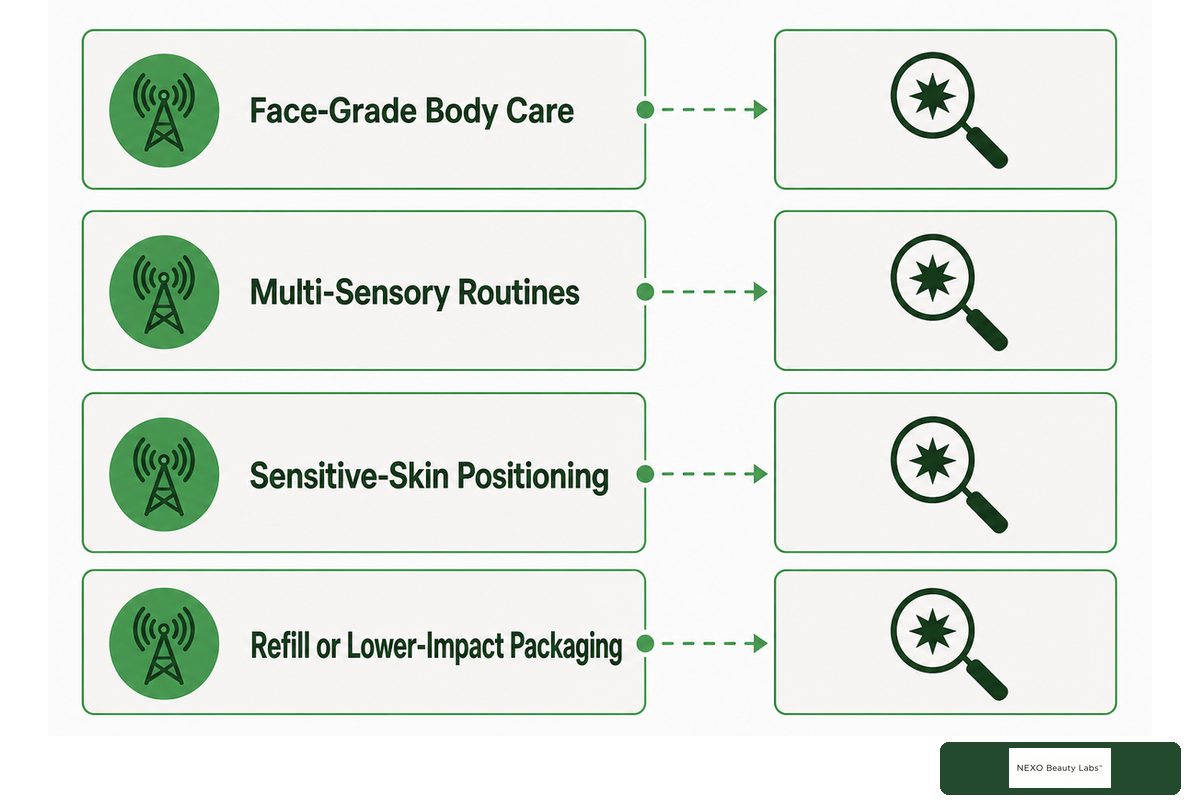
Current body care trends indicate interest in face-grade performance, more elaborate sensory rituals, and targeted skin-concern positioning that brand teams should first test against their buyer, price point, and use occasion. Treat them as working hypotheses, not reasons to omit the formula, claims, packaging, and supporting evidence.
Even though vegan, natural private label, or organic claims may influence how consumers perceive body care products, ambiguous terms should be substantiated to avoid unrealistic expectations. Don’t add a claim merely because competing skincare products use it.
A March 2026 Croda Beauty trend article mentions multi-sensory body care and the level of detail expected in face care. Because this is a commercial trend source, its survey figures are directional context only. They don’t establish demand for your channel or a performance claim for your lotion. Before a brand scales a trend, a buyer should ask the factory and supplier to define a small pilot, the observation method, and the stop condition. This avoids mismatch risk because a compelling trend signal isn’t the same as evidence that the formula, package, claim, and channel will work together.
| Signal | Product implication | What to test before committing |
|---|---|---|
| Face-grade body care | More specific ingredient and benefit language | Does the target buyer value the benefit enough to support the evidence and cost? |
| Multi-sensory routines | Texture, fragrance, finish, and ritual become more important | Which sensory profile drives preference and repeat use in the intended occasion? |
| Sensitive-skin positioning | Fragrance, ingredient, testing, and complaint expectations may change | What exact claim, audience definition, and proof plan can the project support? |
| Refill or lower-impact packaging | Package architecture and environmental claims become connected | Can the system work technically, operationally, and truthfully in the sales market? |
The broader body care product manufacturing guide provides information about manufacturing decisions for the body care category as a whole. Keep the lotion guide limited to the buyer’s constraint sequence.
What Must Be Locked Before You Request Production?
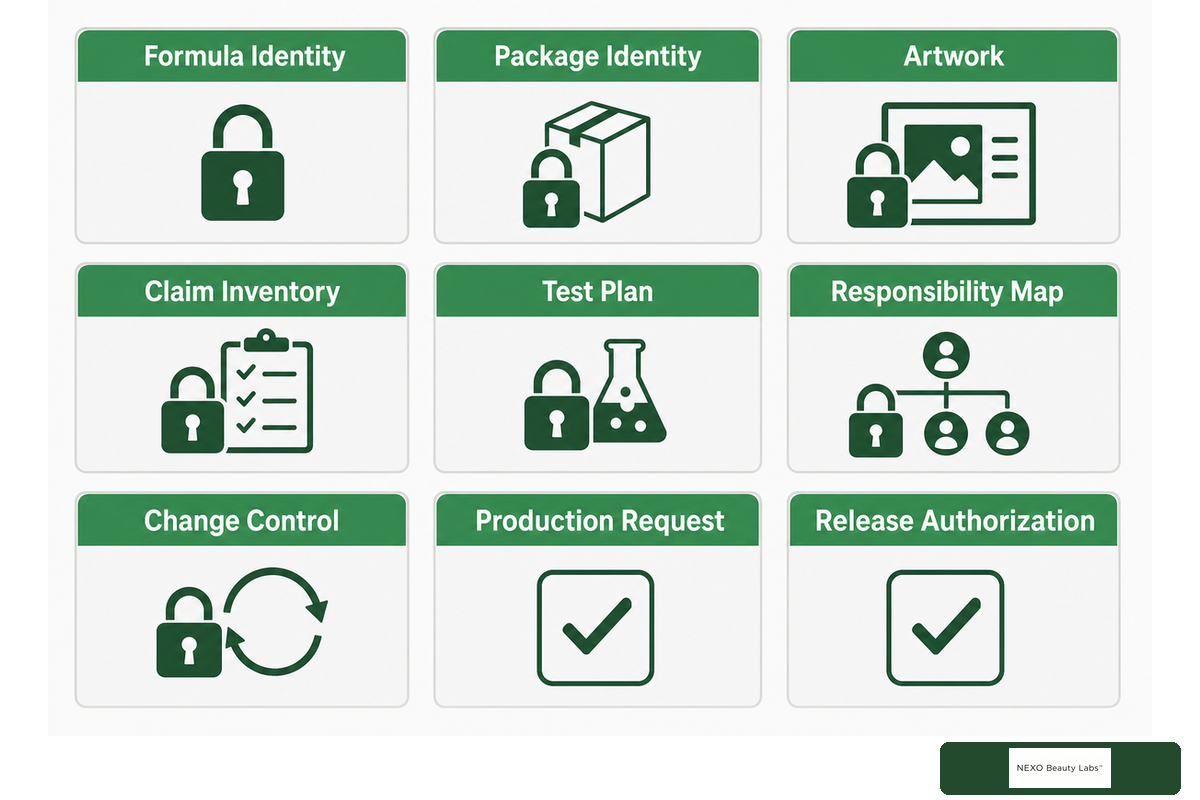
Segregate a commercial production request from final release approval. A project can place an order even though some controlled work is still planned. However, items, owners, decision dates, and release criteria must be specified before the brand approves funding that can’t be rescinded.
FDA states that facility registration and product listing do not mean product approval. Keep that regulatory distinction separate from the brand’s own production-request and release-authorization records.
Decision boundary: A sample can be approved for development while the release file remains incomplete. Treat those as two different decisions.
The following table can be placed in the project request. Numbers in the table are based on the editorial control and aren’t representative of legal minimums or universal industry standards.
Production file checklist: copy these into your request:
| Parameter | Recommended range | Why it matters | How to verify |
|---|---|---|---|
| Formula identity | 1 approved formula version | Connects the sample to the production master | Match formula code and signed approval |
| Package identity | 1 final package BOM | Controls bottle, closure, pump, seal, decoration, and ship case | Match component codes and approved filled samples |
| Artwork | 1 signed artwork file set | Prevents label copy or ingredient-list drift | Compare proof, version, approver, and printer file |
| Claim inventory | 1 claim ledger per SKU | Ties every material representation to an owner and evidence | Review label, product page, and campaign copy together |
| Test plan | 1 approved protocol per test family | Defines purpose, samples, method, limits, and decision rule | Check signed protocol and final product identifiers |
| Responsibility map | 1 named owner per duty | Separates manufacturing, label, records, filings, and complaints | Review the signed role matrix against the label name |
| Change control | 1 active change log per SKU | Shows what must be reassessed after a change | Confirm notification, approval, and retest triggers |
Production-Request vs Release Evidence Handoff
| Decision | What it authorizes | What must be visible |
|---|---|---|
| Production request | Commercial commitment and scheduled manufacturing work | Approved identities, open items, named owners, dates, cost exposure, and stop conditions |
| Release authorization | Permission to distribute the finished product | Completed release evidence, accepted deviations, label status, and accountable approver |
The control here is transparency: the team should know what’s done, what isn’t, what determines it, and what’s needed to be presented prior to release.
Frequently Asked Questions
Is it legal to private label products?
Yes, private labeling is lawful, but the finished product and the brand’s assigned responsibilities must meet the rules in every market where the lotion is sold.
Yes, private labeling is a lawful business model, but the finished product still has to meet the rules in each market where it is sold. In the United States, cosmetics are generally not pre-approved by FDA, yet the company named on the label may carry important responsibilities under federal cosmetic law. Claims can also change how a product is regulated. A brand should confirm label, safety, listing, adverse-event, and responsibility assignments with qualified regulatory counsel before launch.
Do I need a license to sell skincare?
No single skincare license covers every product, business role, location, and sales market. Check the product, business role, manufacturing location, and every sales market before launch.
There is no single universal “skincare license” that covers every product and jurisdiction. Requirements can depend on where the business operates, where the product is manufactured, what the label claims, and which sales channels or local authorities are involved. In the US, federal cosmetic obligations may apply alongside state, local, tax, and business-registration rules. Treat the manufacturer’s support as one input and verify your own market-role obligations before selling.
Is private label skin care profitable?
A private label skin care line can be profitable when validated demand, channel economics, complete landed cost, and a realistic sell-through plan support a defensible margin.
It can be, but the manufacturing model alone does not create profit. A brand still has to validate demand, control landed cost, choose an order size it can sell through, and leave room for testing, packaging, fulfillment, marketing, returns, and retailer margin. The safer question is whether one defined audience will pay enough for a clearly differentiated lotion at the planned channel economics. Model those assumptions before approving a large order.
What is the difference between private label and white label body lotion?
White label body lotion usually offers a more fixed formula and package, while private label programs may allow additional brand-specific choices within a supplier’s defined scope.
Supplier usage varies. Ask what can change, who owns the formula, which evidence transfers, what is exclusive, and what triggers new testing instead of relying on the program name. Compare the written scope, not the label used for the service.
How long does a private label body lotion project take?
A private label body lotion project has no universal timeline because formula, package, testing, evidence, approval, production, shipping, and market paths vary by scope. The sales channel can change the sequence.
The route, revision count, ingredient availability, packaging availability, compatibility work, preservation approach, stability plan, claim evidence, safety review, artwork, market review, order size, factory schedule, and shipping method can all change the calendar. Request a milestone table tied to the actual scope. Label each date as an estimate, dependency, approval window, test completion, committed production event, or logistics event. When a dependency changes, update the affected milestone instead of preserving a date that no longer has a factual basis.
What should I send a manufacturer before asking for samples?
Before requesting samples, send the manufacturer a constrained product brief covering the target user, formula route, package, claims, market, cost boundary, and every open question.
Include the target user, use occasion, sensory direction, formula route, claim ideas, package, market list, cost boundary, and approval process. Mark unknowns clearly, assign decision owners, and state how competing samples will be compared before the supplier prepares a sample.
Key takeaway
A strong lotion project does not eliminate uncertainty at the start. It makes uncertainty visible, assigns an owner, and prevents a sample, certificate, filing, or trend from being asked to prove more than it can.
If your buyer, sensory target, claims, package, test plan, and launch file are completed and ready for a supplier discussion, click the button below to send NEXO Beauty Labs your approved brief. The team can evaluate the real project and its specific manufacturing requirements rather than a generic inquiry.
Discuss Your Body Lotion Brief
How This Lotion Guide Was Built
The private label body lotion guide combines current public regulatory sources, standards-scope material, technical testing context, and NEXO’s public manufacturing information. Company facts remain identified as first-party statements, while formulas, protocols, claims, filings, and sales-market obligations are treated as project-specific. The 7-Lock framework organizes buyer decisions; it doesn’t replace product evidence or legal review.
References & Sources
- Modernization of Cosmetics Regulation Act of 2022 U.S. Food and Drug Administration
- Registration and Listing of Cosmetic Product Facilities and Products U.S. Food and Drug Administration
- Is It a Cosmetic, a Drug, or Both? U.S. Food and Drug Administration
- Cosmetics Labeling Guide U.S. Food and Drug Administration
- Scientific Claims Need Proof U.S. Federal Trade Commission
- ISO 11930:2019 public scope International Organization for Standardization
- Cosmetic Stability Testing Intertek
- Toxic-Free Cosmetics Act compliance Washington State Department of Ecology
- 2026 Body Care Trends Croda Beauty (directional commercial trend context)
Why beauty brands work with NEXO
About NEXO Beauty Labs Manufacturing Support
NEXO Beauty Labs supports skincare, body care, sun care, hair care, and private label brands with formulation, sampling, filling, quality control, and export-ready launch support.
Project Review Before RFQ
Before quotation, we help clarify product category, active direction, formula stage, package choice, compliance market, MOQ, sampling schedule, and required documents.
Request a Cosmetic QuoteCompany Profile // Data Sheet
CompanyNEXO Beauty Labs
Business TypeCosmetic OEM / ODM manufacturing partner
Main ProductsPrivate label skincare, facial serums, moisturizers, cleansers, sunscreen, body care, and hair care products
Manufacturing CapabilityFormula development, sample adjustment, package sourcing, filling, QA/QC, documentation, and export support
RFQ Data NeededProduct type, formula goal, package format, target market, MOQ, claims, timeline, and benchmark samples
Websitenexobeautylabs.com