Get in touch with NEXO Beauty Labs Company

Updated August 2026
Body care product manufacturing is the controlled process that turns an approved product definition into repeatable, traceable and releasable batches. The work is broader than increasing ingredient weights. The process connects the formula version, raw materials, production equipment, process conditions, package, test methods, deviations and release decision.
This guide is for product, sourcing, quality, packaging and regulatory teams preparing a lotion, cream, wash, scrub, oil or related body care format for commercial production. The guide explains the control questions behind manufacturing; it doesn’t provide a copyable formula, universal operating settings or legal advice. If you’re comparing formulation routes, project scope or production support, use NEXO’s body care product manufacturing solution page. That commercial page remains the destination for a project discussion. This article owns the educational process from formula freeze to evidence-based release.
The short version
- Classify the product and claim direction before choosing a cosmetic manufacturing framework.
- Branch controls by physical system; a cream, wash, oil and scrub don’t share one process window.
- Translate the lab method into production questions instead of copying rpm, time or temperature.
- Keep test results with their methods, conditions, sample history and decision owner.
- Release only when the evidence stack answers the risks defined for the formula-package-market combination.
What Body Care Product Manufacturing Must Control
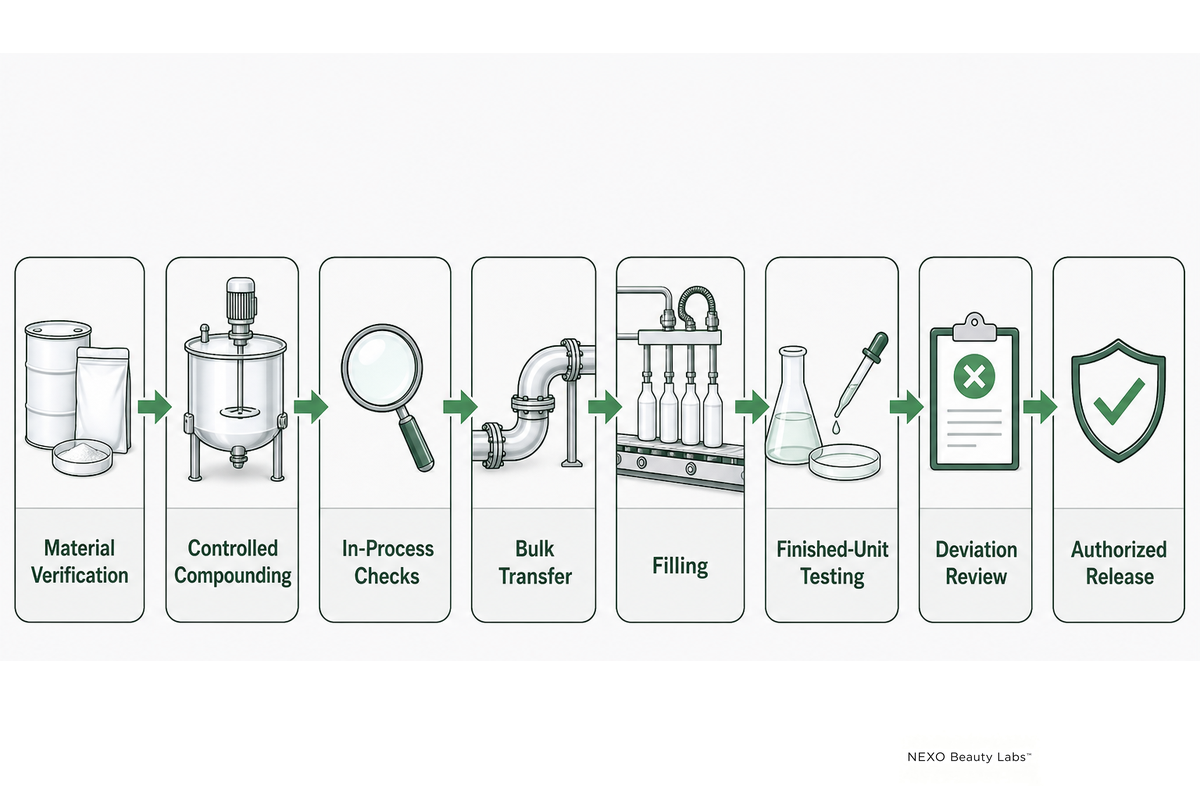
Body care product manufacturing must control the product definition, qualified materials, equipment-relevant process, in-process checks, filling conditions, test methods, deviations and release decision. A bench sample only shows that one formula direction worked under recorded laboratory conditions; manufacturing must reproduce the intended result in the selected production system.
Five states shouldn’t be treated as interchangeable:
- Product concept: the user, format, sensory target, market and claim direction.
- Laboratory formula: percentages and a bench method associated with a specific version.
- Production definition: qualified materials, equipment-relevant process instructions, in-process checks and package assumptions.
- Manufactured batch: the actual materials, conditions, observations and deviations recorded during execution.
- Released lot: finished units for which an authorized decision owner has reviewed the required evidence and approved disposition.
This distinction prevents a common handoff error: “the sample looks right, so the factory can make more.” Visual acceptance does not resolve an ambiguous formula identity, a missing viscosity method, an unqualified raw material, an untested package or a proposed claim that changes the regulatory route.
The public scope of ISO 22716 covers production, control, storage and shipment of cosmetic products. That scope is useful because it locates quality throughout the operating system, not only in a final inspection. The standard does not give one universal batch record for every product, and its public abstract specifically excludes research and development activities and finished-product distribution.
Control boundary: manufacturing begins with an identified formula and package assumption; release ends with an authorized disposition. Everything between them needs an owner, a method or a record.
Match the Product System to the Production Path
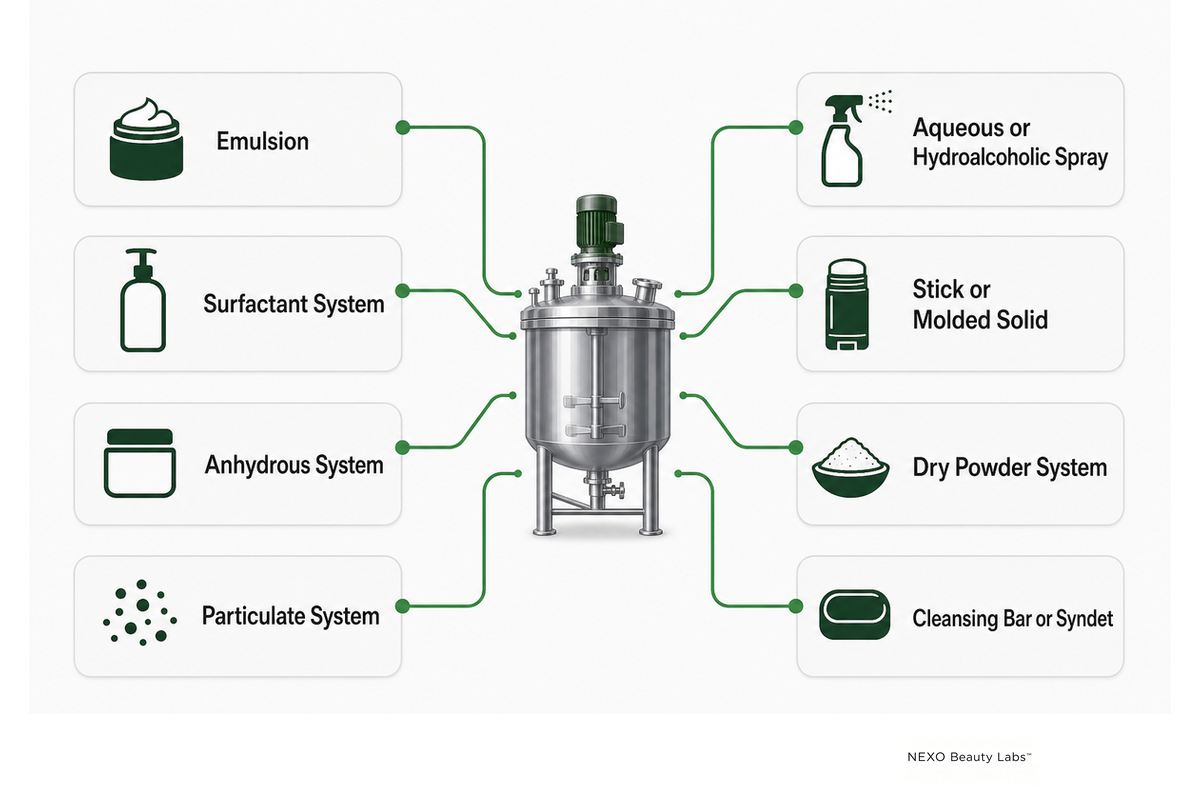
Before selecting process controls, confirm the legal and physical system. In the United States, intended use helps determine whether a product is a cosmetic, a drug, both, or, in a narrow set of cases, soap. FDA explains that claims to treat or prevent disease, or affect body structure or function, can make a body care product a drug. Sunscreen lotion, antiperspirant or acne treatment therefore cannot be routed through a cosmetic-only checklist simply because it is applied to skin.
After classification, branch the production questions by the formula’s physical behavior. The matrix below isn’t a recipe. It’s a way to expose which assumptions require evidence.
| System category | Process-sensitive question | Filling implication | Release question |
|---|---|---|---|
| Emulsion lotions, creams, butters |
How do phase preparation, addition, shear, cooling and hold history create the target structure? | At what bulk condition does the product fill consistently without damaging the structure or trapping air? | Do physical, microbiological and package results support the defined formula-pack combination? |
| Surfactant system body washes, shower gels |
How do order of addition, electrolyte exposure, aeration and temperature affect clarity, viscosity and foam? | Can the bulk transfer and fill without excessive foam, settling or dose variation? | Are pH, viscosity, appearance, microbiology and package function within the approved methods and ranges? |
| Anhydrous system oils, balms, some butters |
Which materials require melting, dispersion or controlled cooling, and what oxidation or crystallization risks apply? | Does temperature-dependent flow match the pump, jar or tube and the selected filling process? | Does the risk assessment justify the chosen chemistry, microbiology, stability and package checks? |
| Particulate system scrubs, suspended beads or powders |
What keeps particles wet, uniform and intact without settling, floating, agglomerating or abrading equipment? | Can the filler handle the particle size and maintain distribution from early to late units? | Do homogeneity, dose, package passage and consumer-use checks support release? |
| Aqueous or hydroalcoholic spray body mists and sprays |
How will solubility, volatility, filtration and bulk uniformity be maintained during compounding and hold? | Can the selected valve, pump and line deliver a consistent spray without leakage, blockage or unacceptable evaporation? | Do composition, package function, compatibility, microbiology and use-direction checks support release? |
| Stick or molded solid deodorant and treatment sticks |
Which melt, dispersion, cooling and crystallization conditions produce the intended structure and payoff? | Does the fill-and-cool sequence avoid voids, cracking, shrinkage or package interference? | Do structure, dose, package travel, stability and consumer-use checks support release? |
| Dry powder system body powders and dry blends |
How do particle properties, humidity exposure, blending sequence and segregation risk affect uniformity? | Can the filler control flow, dust and dose while maintaining blend distribution? | Do identity, homogeneity, dose, package containment and microbiological-risk decisions support release? |
| Cleansing bar or syndet solid body cleansers |
How do mixing, refining, forming, moisture and conditioning history affect bar integrity and use performance? | Can forming, cutting, stamping and wrapping preserve dimensions and surface quality? | Do composition, physical integrity, use, stability, packaging and classification checks support release? |
Even products in the same row can respond differently. One peer-reviewed 2023 study of a topical ointment system found that homogenization speed during cooling and addition temperature affected stability, rheology and sensory properties. In a separate 2024 study of an emulsion cream, several homogenization and cooling variables had minimal influence, while a holding step and its conditions mattered. Neither result is a universal body-lotion setting. Together, they support the more useful rule: identify candidate variables for the exact system, then verify which ones are critical.
Freeze a Production-Ready Formula Definition
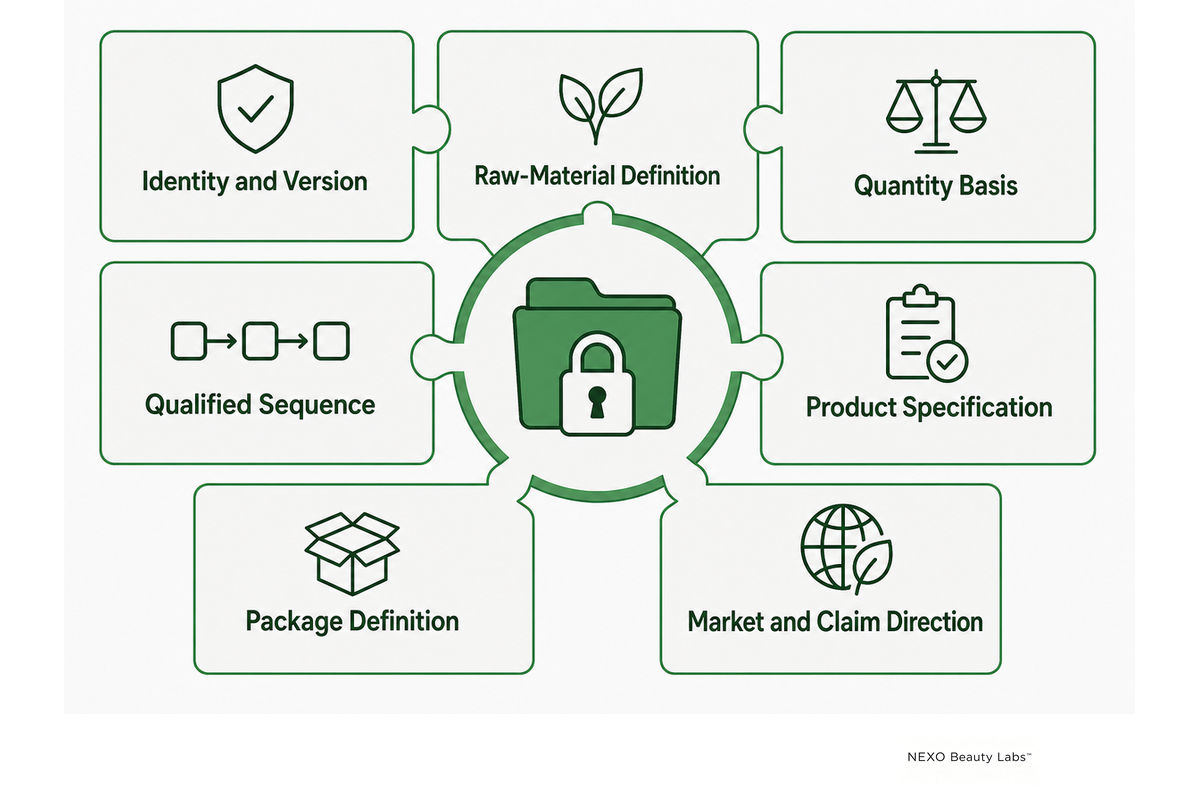
An ingredient list isn’t a controlled formula transfer. A production-ready definition must tell the receiving team exactly which version is authorized, which materials it means and which product attributes must be reproduced.
At minimum, freeze these connected fields before a commercial authorization:
- Identity and version: formula ID, revision, effective date and approvers.
- Raw-material definition: INCI or technical identity, supplier/grade where material equivalence matters, specification, storage and any preconditioning.
- Quantity basis: calculation basis, theoretical yield and how processing aids, losses or adjustments are handled.
- Qualified sequence: phase preparation, order of addition, material form, endpoint and the conditions under which the next step may start.
- Product specification: appearance, odor and relevant physical, chemical and microbiological attributes with the test method and sample condition.
- Package definition: primary contact materials, closure or dispenser, decoration where relevant, intended fill and confirmed alternatives.
- Market and claim direction: destination market, label owner, intended use and claim boundaries that may change testing or classification.
Method detail is part of the result. “Viscosity: 18,000” is incomplete without the unit, instrument or method, geometry or spindle, speed or shear condition, sample temperature, conditioning/rest time and any relevant preparation. pH can also depend on sample preparation, temperature and instrument procedure. If the pilot and release laboratory don’t use comparable methods, the project may manufacture an argument instead of a trend.
Supplier files and finished-product evidence play different roles. For incoming materials, a certificate of analysis helps establish that a received material was tested against an agreed supplier specification. The certificate doesn’t prove that the final lotion is stable, that the preservative system suits the package and use pattern, or that a performance claim is substantiated. Keep each document tied to the decision it can actually support.
For protocol-level detail, NEXO’s guide to the skincare product development process explains the wider development sequence. This section stays narrower: the exit condition is one approved production definition with no silent version conflict.
Run a Change-Impact Screen Before Reusing Evidence
Controlled formulas don’t stay frozen forever. Materials become unavailable, a brand changes fragrance, the filling site introduces another pump, or a new market requires different artwork. The practical question isn’t whether change is allowed. It’s whether the existing evidence still answers the same risk questions after the change.
| Proposed change | First affected questions | Evidence to reconsider |
|---|---|---|
| Raw-material supplier or grade | Is composition, carrier, particle form, impurity profile or use instruction equivalent? | Incoming specification, process behavior, finished specification, safety and stability rationale. |
| Formula percentage or fragrance | Could pH, solubility, preservation, oxidation, sensory profile or package contact change? | Pilot checks, stability, microbiology, compatibility, safety and claim file. |
| Batch scale or equipment | Does flow, heating/cooling, shear, hold, transfer or filling remain equivalent? | Control map, process qualification, sampling plan and drift history. |
| Primary package | Are contact materials, headspace, dose, light exposure and consumer contamination pattern different? | Compatibility, dispensing, transport, microbiological risk and label instructions. |
| Claim or market | Does intended use, product classification, target population or evidence standard change? | Regulatory review, safety substantiation, performance study, artwork and listing data. |
Don’t use “same INCI” as the only equivalence test. Two materials can share an ingredient name while differing in concentration, carrier, molecular distribution, preservative, water content, particle form or processing behavior. Likewise, a package with a similar shape can use different resin, liner, valve or decoration. The change owner should document what remains comparable, what new uncertainty appears and which previous evidence is retained, supplemented or repeated.
Use this simple decision sequence: describe the change → identify the affected risk → locate the controlling evidence → decide the extent of revalidation → obtain approval before use. If the team can’t trace the change to an authorized decision, the production definition is no longer controlled.
Build a System-Specific Formula-to-Fill Control Map
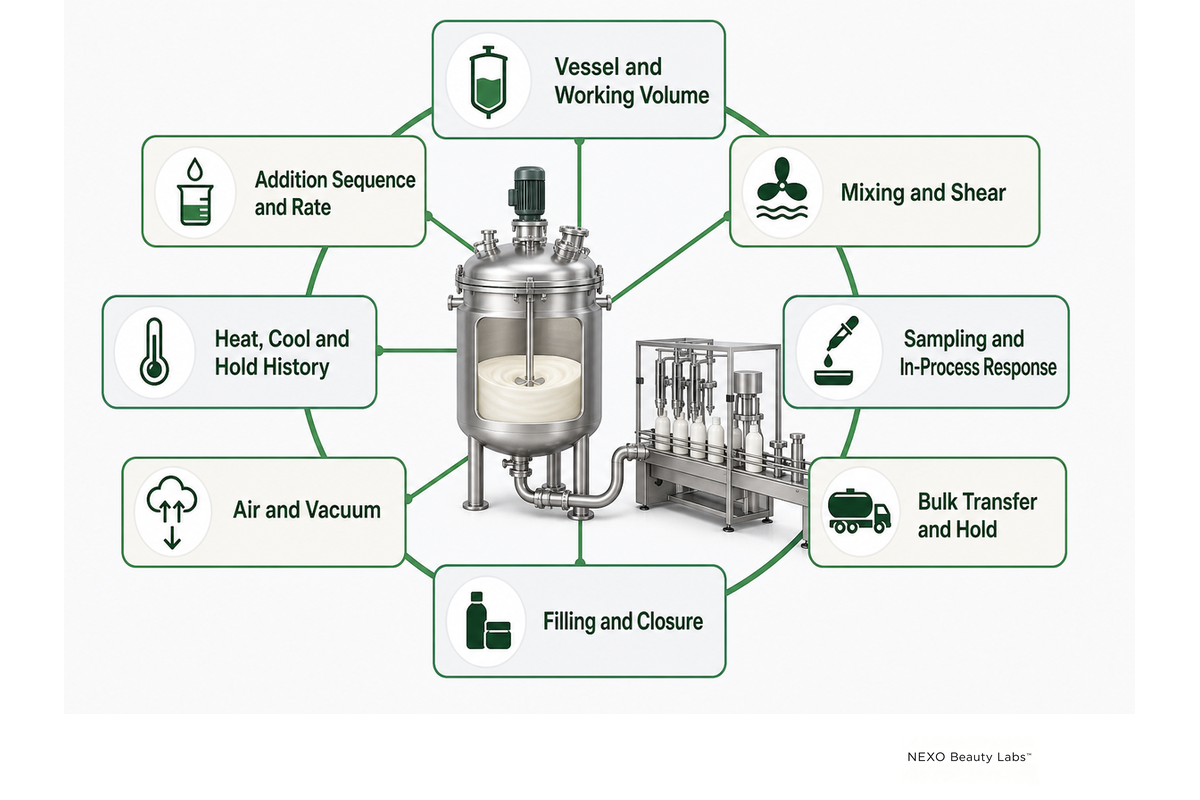
The Formula-to-Fill Control Map is a pre-production question set. The map doesn’t replace an SOP, master manufacturing instruction or batch record. Its job is to connect a lab step to the production condition that may change its outcome, then identify what evidence and owner are needed before transfer.
| Transfer field | Why scale can change it | Evidence to retain | Owner |
|---|---|---|---|
| Vessel and working volume | Geometry, fill level, baffles and impeller position change flow and turnover. | Equipment ID, configuration, working volume and transfer rationale. | Process development / manufacturing |
| Addition sequence and rate | A charge that is instant at bench scale may take minutes in production and meet a different local concentration. | Sequence, addition window, visible endpoint and hold before the next step. | Formulation / operator |
| Mixing and shear | The same rpm does not preserve tip speed, power per volume or flow pattern; more shear may also damage a developed structure. | Equipment, operating range, duration, product endpoint and stop rule. | Process development |
| Heat, cool and hold history | Larger batches exchange heat differently; crystallization, hydration, volatility and addition timing can shift. | Product-temperature trace, critical windows, holds and intervention notes. | Operator / quality review |
| Sampling and in-process response | A larger vessel and longer run can hide location or time-based variation that one convenience sample misses. | Sample location and timing, preparation method, result, action limit and authorized response. | Quality / process development |
| Air and vacuum | Vortexing, powders, pumps and high shear can change entrained air, bulk density and filling behavior. | Deaeration step, vacuum condition where used, bulk observation and density method. | Manufacturing / filling |
| Bulk transfer and hold | Hoses, pumps, screens, line hold-up, time and temperature can alter structure or apparent yield. | Transfer route, allowable hold, recheck, line clearance and reconciliation. | Manufacturing / quality |
| Filling and closure | Product flow changes with temperature and air; the package can introduce dose, priming, seal or compatibility constraints. | Fill condition, in-process frequency, closure setting, functional checks and rejects. | Filling / packaging / quality |
The map forces a useful distinction between a candidate variable and a critical variable. Mixing speed may be important in one formula and comparatively insensitive within the studied window of another. The team shouldn’t maximize every parameter. Instead, the team should define a reasonable window, observe the product response and retain the basis for the final operating range.
Pilot batches succeed when they reduce uncertainty, not merely when they produce sellable-looking bulk. A useful pilot should reveal whether the selected equipment and sequence reproduce the target attributes, whether the sampling plan can detect variation, and whether filled units are appropriate for the agreed stability, microbiology, compatibility and performance work.
Record Drift During Compounding and Filling
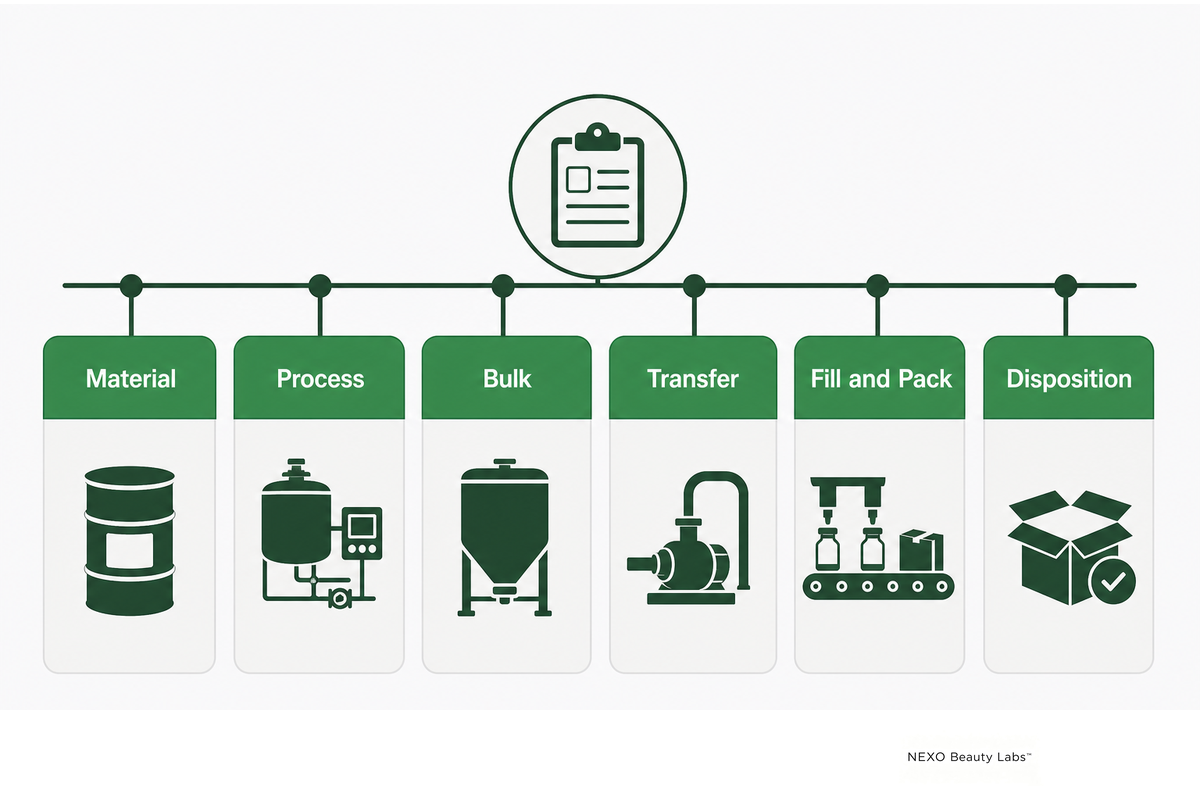
The Batch Drift Register is an execution view. While the control map plans the transfer questions, this register records where the actual batch departed from the authorized condition and how the deviation was assessed. It supplements, not replaces, the production and control records governed under the cosmetic GMP system.
Useful drift fields include:
Material
Lot, supplier/grade, condition, substitution status and reconciliation.
Process
Sequence, addition time, temperature, mixing, hold, vacuum and observable endpoint.
Bulk
Appearance, odor, pH, viscosity, density, homogeneity, sample location and conditioning.
Transfer
Route, screen or pump, hold-up, rework, time to fill and yield reconciliation.
Fill and pack
Early/middle/late checks, fill weight or delivered dose, closure and functional observations.
Disposition
Impact assessment, additional evidence, decision owner, approval and recurrence action.
Sampling should follow the question. If the concern is vessel homogeneity, one convenient sample is weak evidence. If the concern is fill drift, compare defined points across the run. If the bulk rests before filling, specify when it’s rechecked and whether re-mixing is allowed. Sampling more units isn’t automatically better; sampling from the wrong locations can give more precise evidence about the wrong thing.
Keep observations neutral until the investigation supports a cause. A low-viscosity result could reflect real structure loss, incomplete polymer hydration, a raw-material change or a different sample temperature. “Correcting” the batch before confirming the measurement method can erase evidence and introduce a second variable.
Three fields make the register actionable: expected condition, actual observation and decision consequence. Without the consequence, it becomes a diary. Without the expected condition, it becomes a list of numbers. Without the actual observation, the team can’t learn from the transfer.
Build the Release Evidence Stack
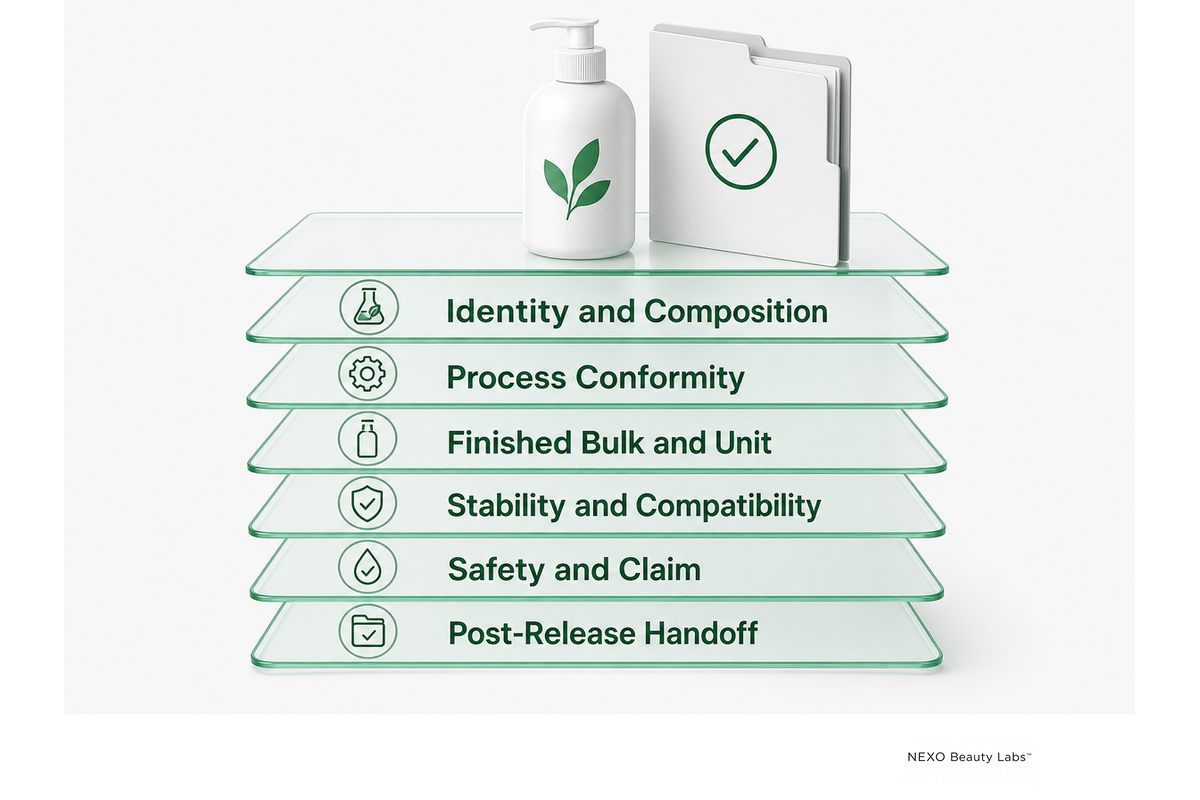
The Release Evidence Stack is a decision index. It points the authorized reviewer to the specifications, batch records, deviations, certificates, laboratory reports and approvals required for disposition. It doesn’t replace those controlled records.
Build the stack from the risk questions backward:
- Identity and composition layer: does the released formula version match the authorized raw materials, quantities and approved changes?
- Process-conformity layer: were required steps and in-process controls completed, and were deviations assessed by the correct owner?
- Finished-bulk and unit layer: do method-bound physical, chemical, microbiological and packaging results meet the approved specification and sampling plan?
- Stability and compatibility layer: does the current evidence support the proposed formula-package combination, shelf-life decision and storage statement?
- Safety and claim layer: is the safety substantiation record maintained, and do claims stay within the evidence and legal classification?
- Post-release handoff: are distribution traceability, complaint intake, serious-adverse-event escalation and recall decision ownership active?
Microbiology begins with risk classification, not a copied test name. The public abstract of ISO 11930:2019 describes preservation-efficacy testing and microbiological-risk assessment for overall antimicrobial protection. It states that the reference test does not apply to products determined to be microbiologically low risk under its cited framework and is primarily designed for water-soluble or water-miscible cosmetics, with modification possible for some other systems. ISO 17516:2014 addresses microbiological quality and also recognizes low-risk products. These standards answer different questions; neither is permission to skip a documented product-specific risk decision.
FDA’s cosmetic product testing page says it does not provide one required list of tests for every cosmetic. The manufacturer or distributor remains responsible for ensuring safety under labeled or customary use. That is why a risk-based stack is stronger than a ceremonial list of “standard tests.”
Stability, preservation and packaging compatibility should remain separate decisions. Stable appearance doesn’t establish microbiological protection. Challenge-test results don’t prove dispenser function. Pump compatibility doesn’t substantiate a skin-performance claim. NEXO’s dedicated guides to cosmetic stability testing and cosmetic packaging compatibility testing cover those specialist protocols without duplicating them here.
Release test: for every document in the stack, write the decision it supports. If the answer is “quality” or “compliance” without a specific question, the record is probably being used too broadly.
Make Partial Evidence Visible
Commercial schedules often move while long-term evidence is still developing. The answer isn’t to label every open item a failure or to pretend that an early observation proves the final shelf life. Use an evidence-status table that separates what’s complete, what’s interim, what’s pending and what has produced an adverse signal.
For each open item, record the tested formula and package version, completed time points or runs, current observations, pre-agreed alert criteria, next pull or action date, decision owner and the commercial decision currently permitted. That last field matters. An interim result may support continuing a study, ordering components at risk or preparing artwork; it may not support releasing a finished lot or making the final shelf-life statement.
Also separate absence of evidence from evidence of absence. If a test hasn’t been run, the file is incomplete. If a relevant, well-designed test has been completed without the effect or failure, the team has evidence within that protocol’s scope. Those are different states and should lead to different decisions.
When a result is out of expectation, preserve the original record and open the appropriate investigation. Document sample identity and history, method suitability, equipment status, calculation, raw data, retest rationale and potential impact on other batches or claims. Repeating a test until a convenient result appears weakens the stack; a governed investigation explains why any repeat is scientifically and procedurally justified.
Put MoCRA and Claims Duties With the Right Party
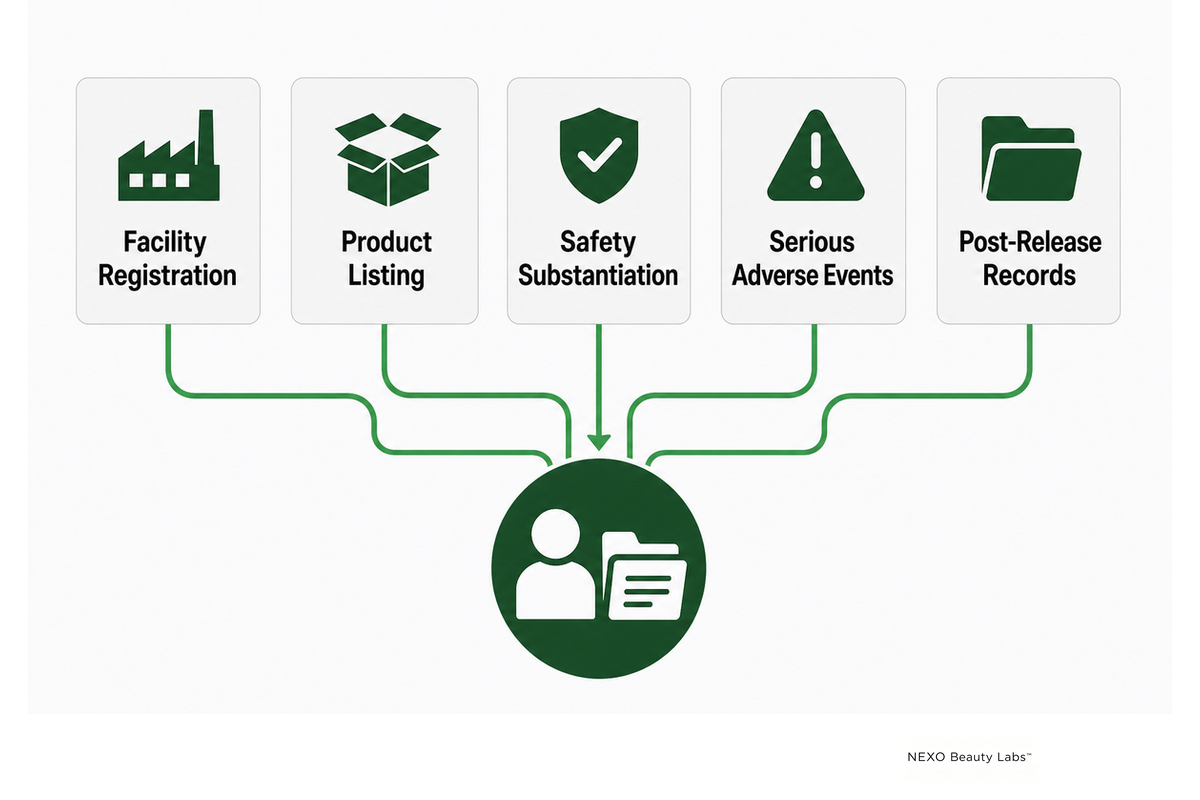
Regulatory ownership should be agreed before artwork and launch. It cannot be inferred from the phrase “contract manufacturer.” Under MoCRA, FDA defines a facility as an establishment that manufactures or processes cosmetic products distributed in the United States. It defines the responsible person as the manufacturer, packer or distributor whose name appears on the label under the relevant law.
For entities within scope and subject to any applicable exemptions:
- manufacturers and processors register facilities and renew those registrations every two years;
- the responsible person lists each marketed cosmetic product, including ingredients, and provides updates annually;
- the responsible person maintains records supporting adequate safety substantiation;
- the responsible person reports serious adverse events to FDA within the statutory timeframe and submits certain new information received later; and
- records, complaints, distribution information and recall coordination need operational owners after the lot is released.
FDA’s current registration and listing page states plainly that facility registration and product listing are neither cosmetic approval programs nor promotional tools, and FDA does not issue certificates for them. “FDA registered” must not be used to imply that FDA approved a cosmetic or endorsed its performance.
Classification comes first. FDA’s cosmetic-versus-drug guidance explains that intended use can be established through labeling, advertising, internet promotion, consumer perception or ingredient context. A body lotion promoted only to moisturize and beautify may be a cosmetic. Claims to treat disease or affect body structure or function can change the legal route. Products that are both cosmetics and drugs must meet both sets of applicable requirements.
Use a responsibility matrix with at least four columns: duty, legal or contract owner, supporting records and escalation path. The manufacturer may generate batch and laboratory evidence; the label owner may be the responsible person; an external laboratory may execute a method; the brand may approve claims and artwork. The matrix should show these relationships without pretending that technical assistance transfers legal responsibility.
NEXO’s cosmetic labeling requirements guide provides more label-specific context. This article’s rule is simpler: freeze classification and ownership before the final label turns a manufacturing assumption into a market claim.
Prepare the Transfer Dossier Before Commercial Production
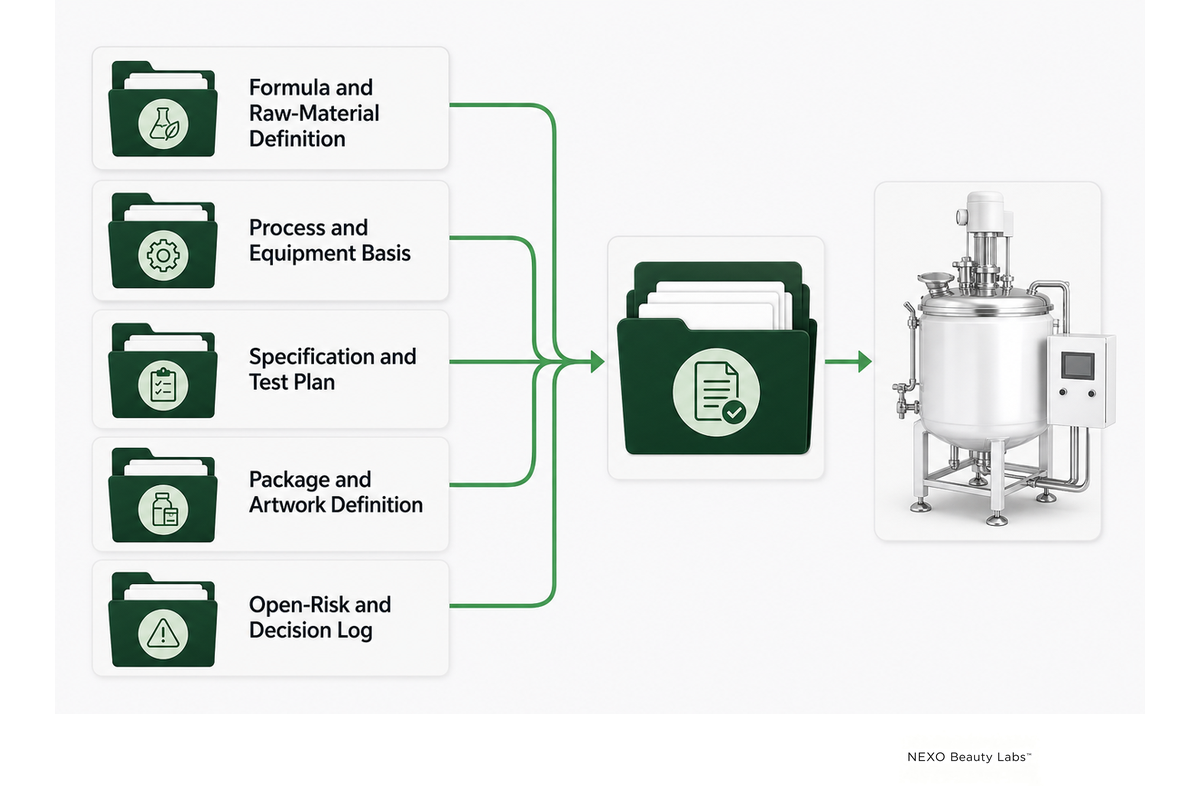
A transfer dossier is the receiving team’s decision package. A qualified reviewer should be able to identify the approved product, reproduce the intended process, see unresolved risks and know who can authorize each next step. A verbal sample approval isn’t a transfer dossier.
| Record | Receiving decision | Revalidation trigger |
|---|---|---|
| Formula and raw-material definition | Which exact composition and qualified inputs are authorized? | Formula, grade, supplier, specification or market change. |
| Process and equipment basis | Can the selected equipment reproduce the defined stages and checks? | Vessel, batch scale, mixing, transfer or filling change. |
| Specification and test plan | Which evidence is required for batch, stability and market decisions? | Method, limit, package, claim, shelf-life or use change. |
| Package and artwork definition | Which contact system, fill, label and intended use are approved? | Component material, supplier, decoration, dose or claim change. |
| Open-risk and decision log | What remains unresolved, who owns it and what blocks authorization? | New evidence, deviation, complaint, adverse event or investigation. |
The three tools in this guide occupy different moments. The Formula-to-Fill Control Map prepares transfer questions. The Batch Drift Register captures what actually differed during execution. The Release Evidence Stack indexes the records reviewed for disposition. Their value is the handoff between functions; the authoritative GMP records remain the approved specifications, instructions, batch records, deviations, changes, reports and release authorizations.
Set explicit stop conditions before the first commercial batch. Examples include an unresolved formula version, an unapproved material substitution, a package without the required compatibility status, a missing method for a release attribute, a claim that changes classification, or a pilot deviation whose product impact hasn’t been assessed. A stop condition isn’t a prediction that the product will fail. It’s a governance rule that prevents schedule pressure from silently converting an open question into an approved assumption. Record who can clear each condition and which evidence is required to do so.
If you’re ready to convert a body care brief into a defined manufacturing project, review NEXO’s body care manufacturing capabilities and the company’s About NEXO Beauty Labs page. Bring the intended format, market, claim direction, benchmark or sensory target, pack assumptions and unresolved evidence questions, not only an ingredient wish list.
Turn Your Body Care Brief Into a Controlled Transfer
Share the product system, target market, package direction and current formula status. NEXO can discuss the appropriate development and manufacturing route without treating this guide as a universal specification.
Frequently Asked Questions
What does body care product manufacturing include?
Body care product manufacturing includes the controlled transfer of an identified formula and package into production: material verification, compounding, in-process checks, bulk transfer, filling, finished-unit testing, deviation review and authorized release. The exact controls depend on the product system and legal classification.
How is a lab formula scaled for production?
A team first identifies which lab outcomes must be preserved, then maps each step to the production equipment, sequence, addition rate, thermal history, mixing or shear regime, hold, transfer and filling conditions. It defines candidate variables and verifies them in the relevant system rather than multiplying weights or copying rpm. Pilot observations, method-bound measurements and filled-package evidence are then used to set or refine the process window.
Do skincare products need FDA approval before sale?
Most cosmetics do not require FDA premarket approval, apart from applicable color-additive requirements, but they remain regulated and must be safe and properly labeled. Claims or intended use can make a product a drug or both a cosmetic and a drug, which changes the applicable requirements. Cosmetic facility registration and product listing under MoCRA are not product approval and must not be promoted as an FDA certificate or endorsement. Confirm current rules for the exact product, claims and destination market.
For a launch, separate four questions: product classification, safety substantiation, compliant labeling, and the MoCRA duties that apply to the facility and responsible person. Then confirm the current requirements for the destination market and the exact claim set.
What quality checks are used during cosmetic manufacturing?
Checks can include material identity and status, sequence and process observations, temperature, pH, viscosity or rheology, appearance, odor, density, homogeneity, fill weight or delivered dose, closure and dispenser function, microbiological attributes and reconciliation. The relevant tests, limits, methods, sample locations and frequency are product-specific. A number without the method and sample condition is weak release evidence.
Are stability testing and preservative testing the same thing?
No. Stability work tracks defined product attributes under selected storage conditions and time points. Preservation-efficacy testing evaluates antimicrobial protection under a defined method, while microbiological-quality testing answers another question. Packaging compatibility covers contact materials and function. Assign each evidence family to a specific decision.
What should a brand approve before commercial production?
Before commercial production, approve the formula version, qualified materials, process and equipment basis, test methods, package, sampling plan, market and claims, artwork inputs, unresolved-risk owners and stop conditions. Commercial terms belong in the manufacturing agreement; they don’t replace the technical transfer dossier.
References & Sources
- FDA, Modernization of Cosmetics Regulation Act of 2022 (MoCRA)
- FDA, Registration & Listing of Cosmetic Product Facilities and Products
- FDA, Is It a Cosmetic, a Drug, or Both? (Or Is It Soap?)
- FDA, Product Testing of Cosmetics
- ISO 22716:2007, Cosmetics GMP
- ISO 11930:2019, Evaluation of Antimicrobial Protection
- ISO 17516:2014, Microbiological Limits
- Chow et al. (2023) — Influence of Manufacturing Process on a Topical Ointment
- Chow et al. (2024) — Process Parameters in an Emulsion Cream
Scope note: Standards and regulations can change, exemptions are fact-specific, and product classification depends on intended use. Confirm the current requirements, editions and qualified professional advice for the exact formula, claims and destination market.