Get in touch with NEXO Beauty Labs Company
Cosmetic Labeling Requirements: A U.S. and EU Buyer Guide

Cosmetic labeling requirements are not one global checklist. The fields, wording, placement, language, responsible party, warnings, and claims controls depend on the destination market, product category, intended use, formula, and package. Classification and market routing should therefore happen before graphic design.
The buyer’s short answer
Freeze the product, formula revision, claims, target markets, pack dimensions, business roles, contact channel, and evidence owners. Then map each required element to the right market, panel, container layer, language, source, reviewer, and proof revision.
Freeze the product, formula revision, claims, target markets, pack dimensions, business roles, contact channel, and evidence owners. Then map each required element to the right market, panel, container layer, language, source, reviewer, and proof revision.
Attractive artwork can still fail when the ingredient declaration, net quantity, responsible-business details, claims, and target market were never controlled together. This guide is general information current to August 28, 2026; it is not legal advice, an artwork approval, or a substitute for product-specific regulatory review.
Freeze the regulatory route before the proof: one unresolved market, claim, formula revision, legal role, or panel dimension can invalidate otherwise polished artwork.
Searchers often begin with cosmetic label examples, MoCRA labeling requirements, or FDA labeling requirements for skin care products. Each is a useful starting phrase, but none supplies the product-specific classification, formula, role, package, and market facts required for a release decision.
Start with a Market and Product Classification Gate
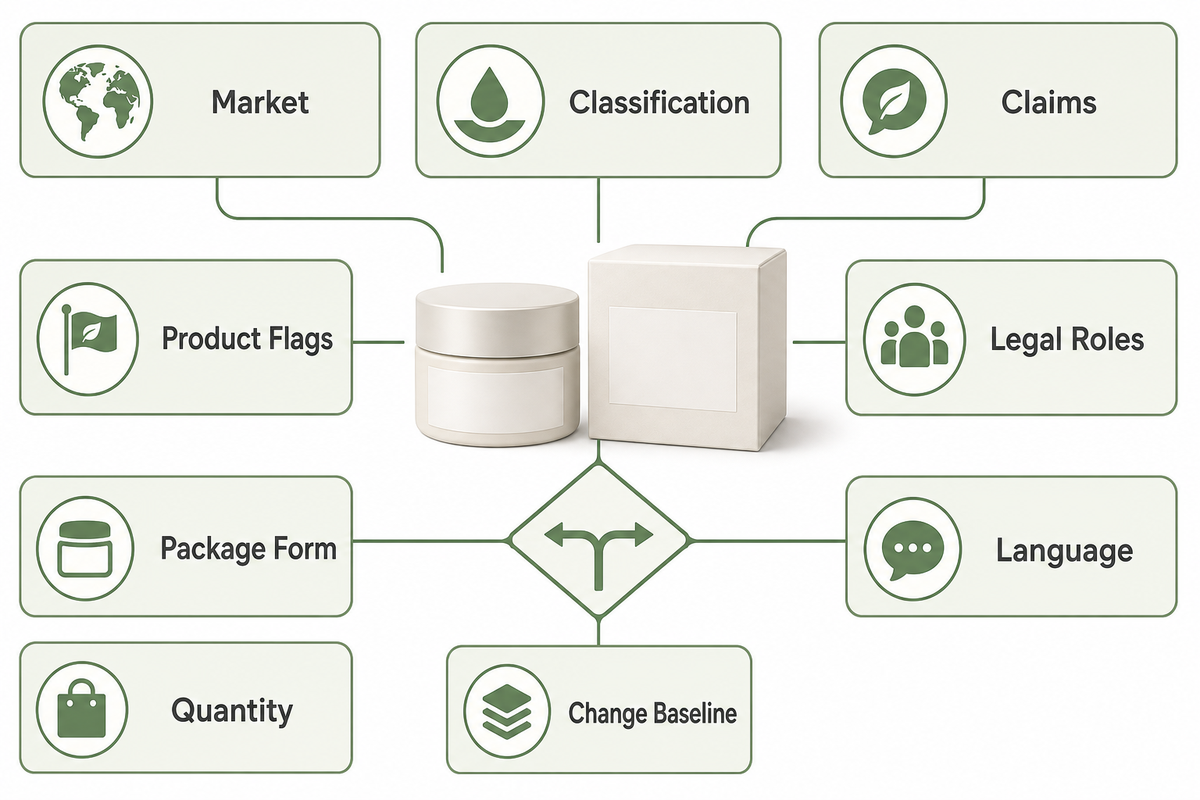
The controlling rules follow the destination market, product definition, intended use, dosage form, claims, and any product-specific overlay. In the United States, a skincare formula may be a cosmetic, a drug, or both depending on intended use—even when the package looks like an ordinary beauty product.
The practical risk is starting design while the product category or market owner is unresolved. That failure pushes a classification decision into prepress, where a name, claim, warning, or legal role may force expensive artwork changes.
| Label Jurisdiction Freeze Sheet | Question to freeze | Evidence owner | Stop condition |
|---|---|---|---|
| Market | Where will the finished product be offered? | Brand / regulatory | Country or state route is unresolved |
| Classification | What is the intended cosmetic function and dosage form? | Product / regulatory | Drug, sunscreen, soap, or other boundary is open |
| Claims | What will text, imagery, product name, and advertising imply? | Brand / evidence owner | Evidence or permitted category is unclear |
| Product flags | Which ingredients, warnings, application sites, users, or formats alter the route? | Formula / safety | A trigger has not been evaluated |
| Legal roles | Who is the named business or responsible person in each market? | Brand / market owner | Role and contact ownership conflict |
| Package form | Which container layers, panels, and dimensions will carry the label? | Packaging / artwork | The represented commercial pack is not frozen |
| Quantity | What verified fill and units will the marketed package declare? | Quality / market owner | Fill basis or unit treatment is unresolved |
| Language | Which market language rules apply to each required field? | Market owner / translator | Mandatory wording lacks a controlled language version |
| Change baseline | Which formula, pack, claim, and artwork revisions does this proof represent? | Quality / document owner | A source revision does not match the proof |
FDA’s current Cosmetics & U.S. Law overview states that the agency does not preapprove cosmetic products or ingredients, apart from some color additives. “Not preapproved” does not mean unregulated, and “FDA approved” should not appear on a cosmetic merely because the business believes its label follows the rules.
A federal checklist also may not exhaust customs marking or state obligations. California, for example, maintains a separate ingredient-reporting program for products containing listed ingredients; that is a scoped state reporting overlay, not a universal federal on-pack field.
United States Cosmetic Label Requirements by Panel
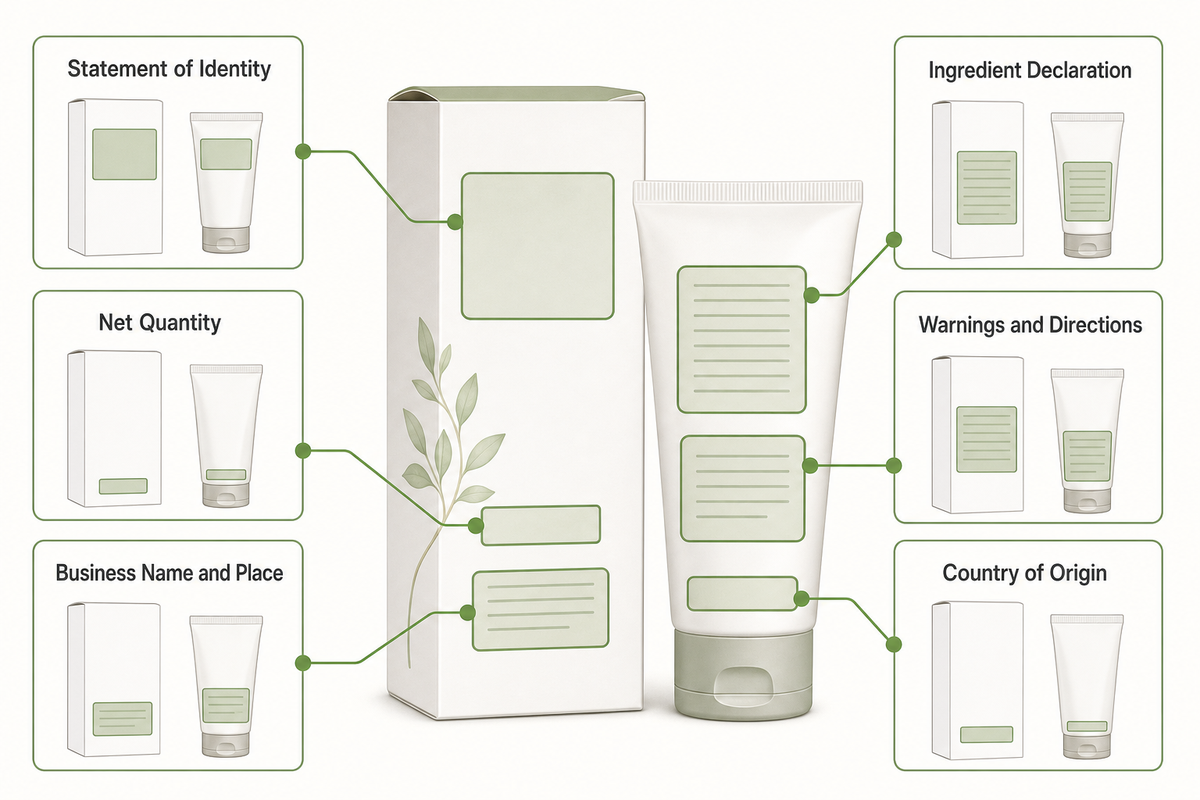
The FDA Cosmetics Labeling Guide distinguishes the principal display panel from the information panel, and some statements differ between the outer and immediate containers. A phrase does not become compliant simply because it appears somewhere; its location, prominence, wording, and package context matter.
| Label Element Placement Matrix | Typical location | Layer check | Source input | Approval question |
|---|---|---|---|---|
| Statement of identity | Principal display panel | Outer and sale presentation | Product classification | Does the name accurately identify the cosmetic? |
| Net quantity | Principal display panel | Sale package | Verified fill and units | Do units, location, and type size fit the actual panel? |
| Business name and place | Information panel | Outer / immediate rules | Legal business role | Is qualifying wording required? |
| Ingredient declaration | Information panel | Package-specific | Released formula reconciliation | Are name, order, and presentation verified? |
| Warnings / directions | Required conspicuous space | Trigger-specific | Product risk and rule | Is the exact warning triggered and readable? |
| Country of origin | Customs-marking route | Imported product | Origin determination | Has the import-marking owner confirmed treatment? |
The FDA guide states that ingredient lettering is generally at least 1/16 inch high (about 1.6 mm) and may be at least 1/32 inch (about 0.8 mm) when the available labeling surface is less than 12 square inches. Net-quantity minimums vary with principal-display-panel area, so a single type-size value should not be copied across every pack.
English is the default language route, but an additional language can bring a requirement to repeat mandatory information in that language. Small packages, decorative containers, aerosols, and other product-specific situations need review against the actual pack rather than a generic mockup.
11-Point Rule-Language Decoder for a Label Brief
Regulatory search results often use overlapping phrases. This decoder turns that vocabulary into controlled buyer questions instead of treating repeated wording as separate requirements.
| Category | Phrases encountered | Buyer interpretation |
|---|---|---|
| 1. Required content | label information; required label information; part of the label; label statements | Name the exact statement, trigger, source, and placement. |
| 2. Governing law | labeling regulation; cosmetic labeling regulations; Fair Packaging and Labeling Act; Federal Food, Drug, and Cosmetic Act | Cite the current provision, not the broad act name alone. |
| 3. Industry terms | personal care; personal care product; Personal Care Products Council; cosmetics and personal care products | Industry terminology can support context but does not replace law. |
| 4. FDA route | FDA cosmetic labeling requirements; FDA labeling; FDA regulations; FDA requirements; FDA labeling rules; FDA authority over cosmetics | Resolve the product category and exact federal provision. |
| 5. Ingredients | ingredient labeling; cosmetic ingredient labeling; purpose of cosmetic ingredient labeling; ingredients must be listed; must be listed in descending order | Reconcile names and order to the released formula and the 1% rule. |
| 6. Alternative delivery | off-package ingredient labeling; off-package cosmetic ingredient labeling; direct mail cosmetics; available for labeling; labeling accompanying the product | Confirm whether a specific exception permits another medium. |
| 7. Scope | label or labeling; labeling compliance; labeling of cosmetics; labeling purposes | Separate the physical label from broader accompanying material. |
| 8. Available surface | available to bear labeling; area available to bear labeling; panel of the label; panel of a cosmetic | Use the actual dieline and exclude surfaces the cited rule excludes. |
| 9. Status and safety | cosmetic label must; label of a cosmetic; cosmetic misbranded; considered cosmetics; safety of a cosmetic; must bear appropriate label warnings | Test each statement against the actual product and trigger. |
| 10. Category and nomenclature | nature of the cosmetic; cosmetic is also a drug; guide to cosmetic labeling; cosmetic ingredient dictionary | Classification precedes naming resources and layout. |
| 11. Container and quantity | container holding the cosmetic product; immediate container holding the cosmetic; cosmetic in the container; cosmetic in the package; reveal the quantity of cosmetic; fluid measure if the cosmetic is liquid; viscous cosmetic; including decorative cosmetic containers; cosmetic manufacturers; ingredients of all products sold | Map the exact container layer, product consistency, units, and any exception. |
Build an Ingredient Declaration That Matches the Formula
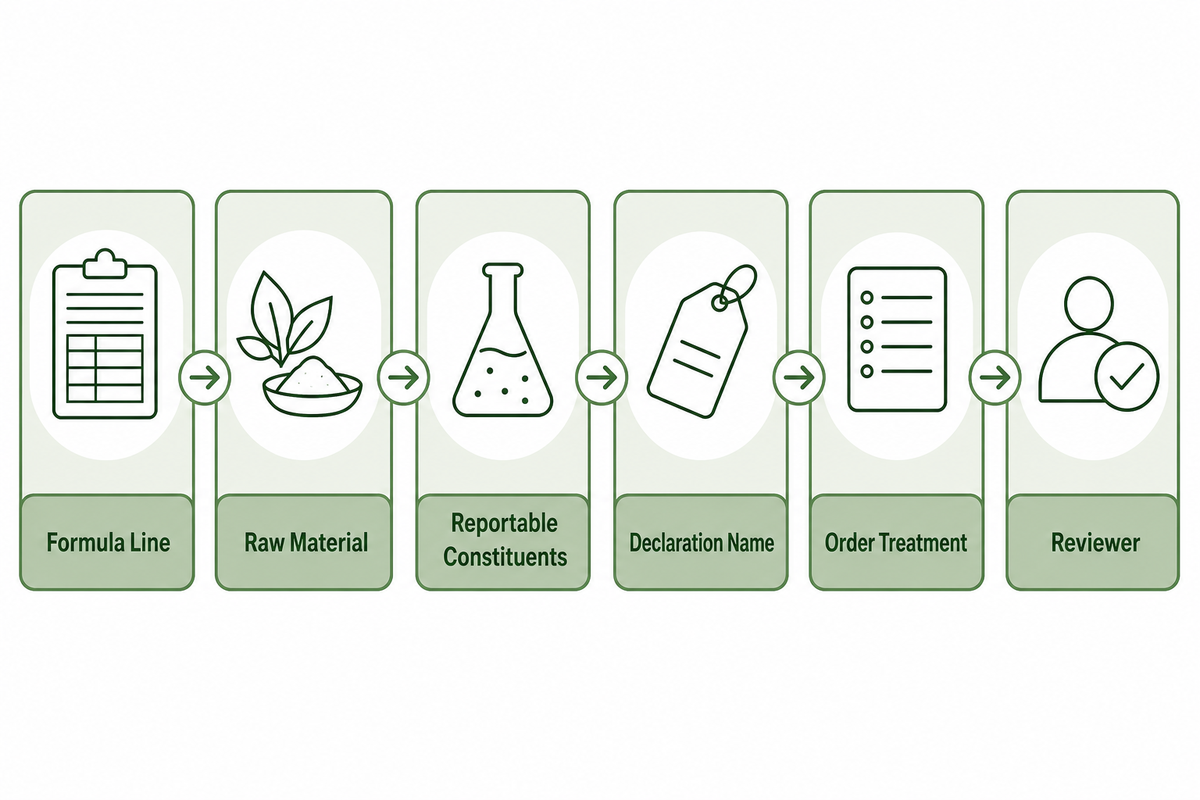
A defensible ingredient declaration starts with the released formula, not with a competitor label or supplier marketing sheet. Reconcile every raw material and constituent to the permitted declaration name, concentration band, order rule, color or fragrance treatment, source, and reviewer.
The root cause of many ingredient declaration failures is an unreviewed gap between a supplier composition and the commercial formula. Evidence under 21 CFR 701.3 belongs beside the reconciliation record so a reviewer can confirm why each name and order was used.
Formula-to-label reconciliation
Track formula line → raw material → reportable constituents → declaration name → concentration band → order treatment → color, fragrance, or flavor treatment → source → reviewer → variance. Hold artwork when the formula revision or a supplier composition is unresolved.
Track formula line → raw material → reportable constituents → declaration name → concentration band → order treatment → color, fragrance, or flavor treatment → source → reviewer → variance. Hold artwork when the formula revision or a supplier composition is unresolved.
Under 21 CFR 701.3, ingredients are generally declared in descending order of predominance. Ingredients present at no more than one percent may be listed in any order after those above one percent, and color additives may follow the non-color ingredients under the rule.
International Nomenclature of Cosmetic Ingredients terminology is useful, but an ingredient list prepared for another market is not automatic proof of a correct United States declaration. Trade names can conceal multiple constituents, while supplier or formula changes can invalidate an earlier label even when the product name stays the same.
Separate Business Identity from the MoCRA Adverse-Event Contact
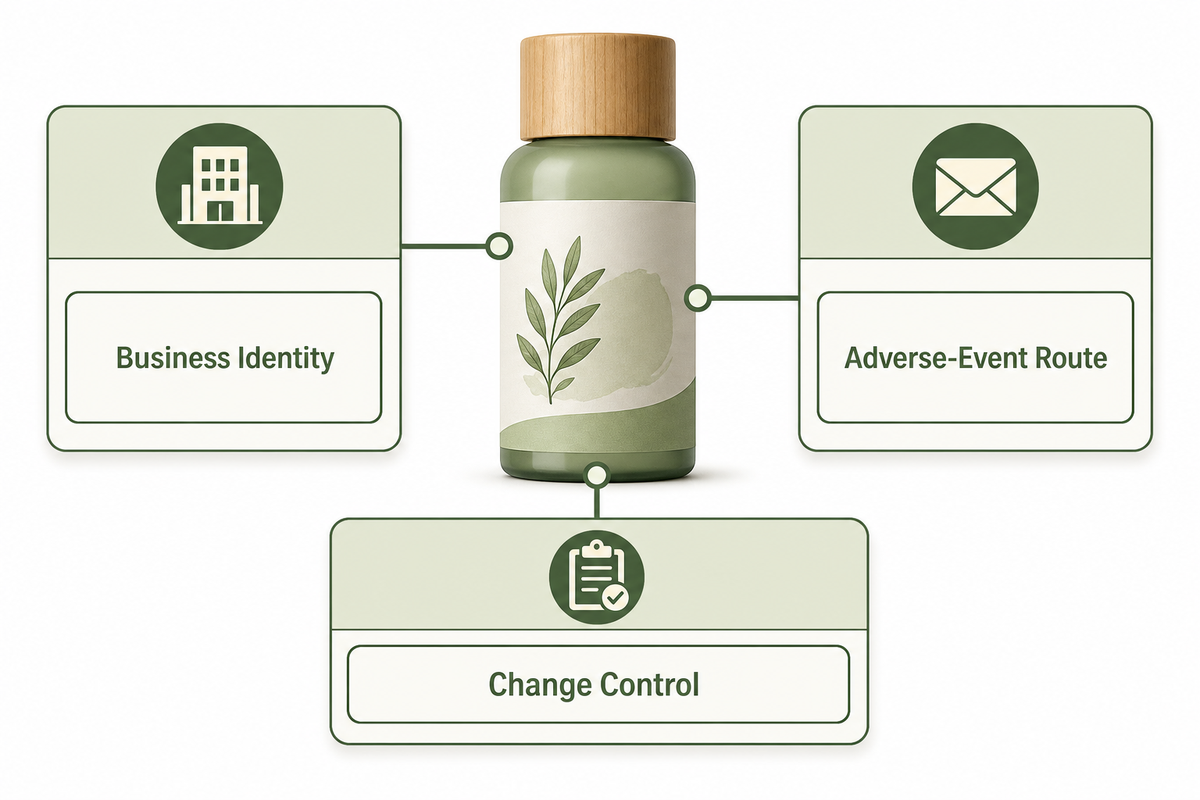
The business identity statement and the MoCRA adverse-event contact are related but separate data fields. 21 U.S.C. § 364e establishes the label contact requirement: a domestic address, domestic phone number, or electronic contact through which the responsible person can receive cosmetic adverse-event reports.
Business identity
Confirm the named firm, its actual role, the address basis, and whether “Manufactured for” or “Distributed by” treatment is required.
Confirm the named firm, its actual role, the address basis, and whether “Manufactured for” or “Distributed by” treatment is required.
Adverse-event route
Freeze the domestic address, domestic phone, or electronic contact and the person who monitors and escalates incoming reports.
Freeze the domestic address, domestic phone, or electronic contact and the person who monitors and escalates incoming reports.
Change control
Set a notification trigger for address, role, domain, phone, inbox, vendor, or monitoring-owner changes.
Set a notification trigger for address, role, domain, phone, inbox, vendor, or monitoring-owner changes.
FDA describes the United States responsible person as the manufacturer, packer, or distributor whose name appears on the label. The domestic contact requirement should not be confused with facility registration, product listing, safety substantiation, or the separate 15-business-day serious-adverse-event reporting clock.
Screen Warnings and Claims Before They Reach Artwork
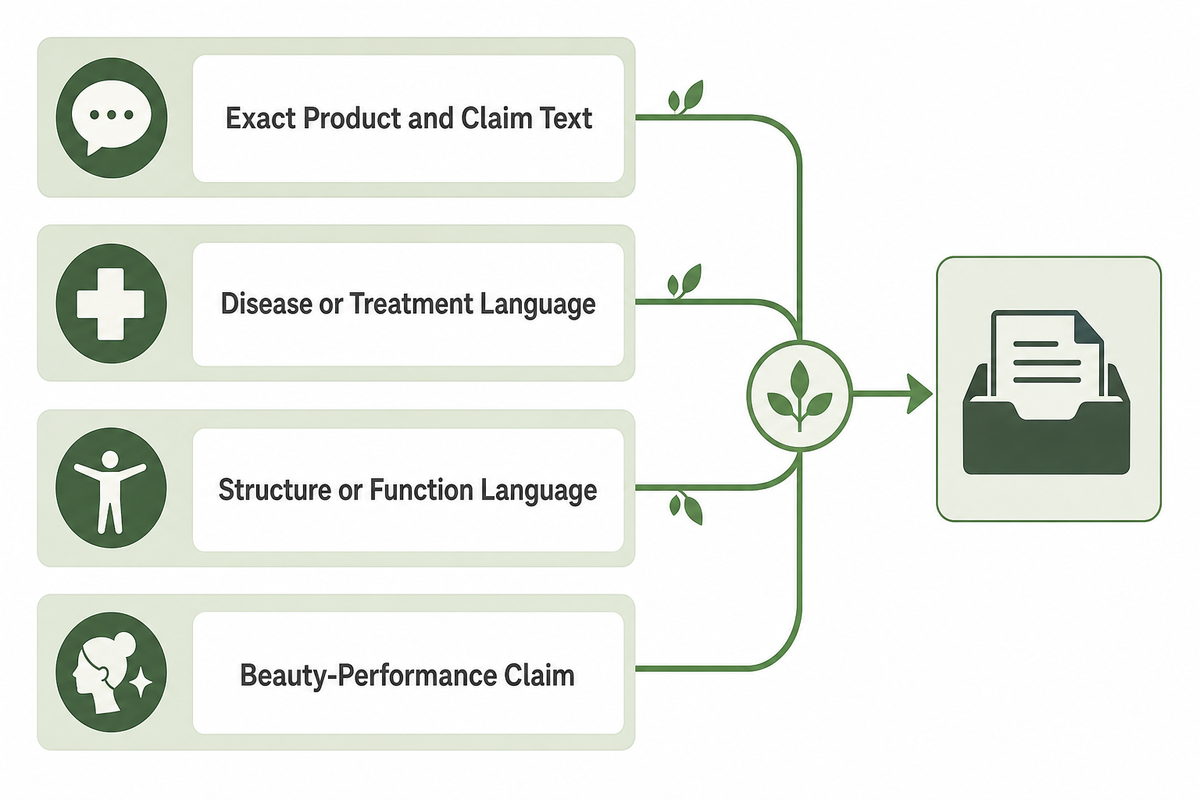
Claims can change the regulatory route before they become polished copy. In the United States, disease prevention or treatment and structure-or-function claims may establish drug intended use; the FDA cosmetics claims guidance explains that, under the law, cosmetic claims must be truthful and not misleading.
| Claim Wording Escalation Queue | Implied takeaway | Category signal | Evidence held | Decision |
|---|---|---|---|---|
| Exact product and claim text | What would a reasonable consumer understand? | Cosmetic, drug, or unresolved | Product-matched support | Allow / revise / remove / escalate |
| Disease or treatment language | Prevents, treats, heals, or mitigates disease | Drug signal | Regulatory pathway evidence | Escalate before use |
| Structure or function language | Changes how the body works | Drug signal | Category and substantiation review | Escalate or rewrite |
| Beauty-performance claim | Cleanses, beautifies, or alters appearance | Cosmetic may fit | Claim-specific evidence | Review truthfulness and scope |
Trace the language across your packaging, product names, web sites, advertising, images, trademarks, distributor information, and anywhere it appears (implicitly or explicitly). A disclaimer cannot rescue an otherwise drug-defining intended use, and there is no invented universal safe harbor for “dermatologist tested,” “hypoallergenic,” “clean,” or “non-toxic.”
Warnings need their own route: universal provision, product-type warning, ingredient-triggered wording, safe-use directions, or another market-specific requirement. The correct answer comes from the exact product and rule, not from accumulating generic caution language.
European Union Article 19 Requires a Different Field Set
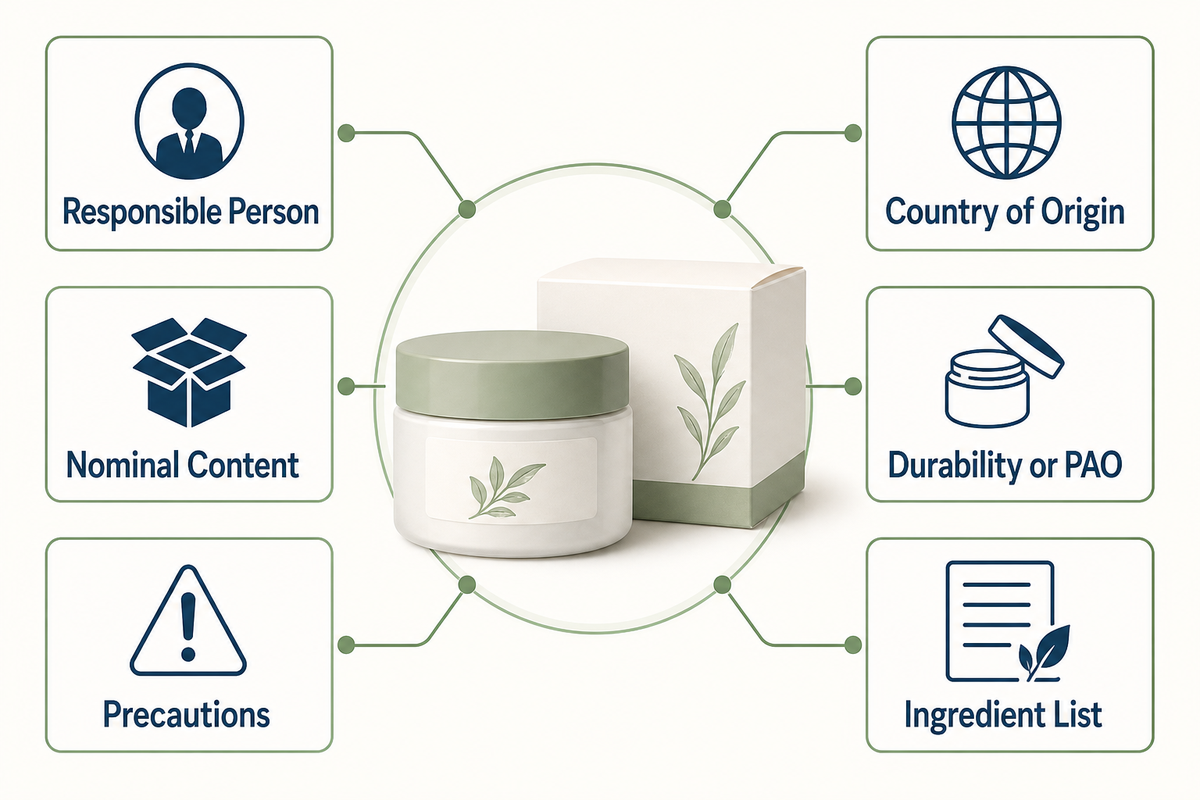
A United States label does not become a European Union label through translation alone. Article 19 has its own particulars, role definitions, placement routes, language allocation, durability treatment, and exceptions, all of which must be planned for the actual product and member-state market.
The compliance risk is assuming overlap means equivalence. The current consolidated Regulation (EC) No 1223/2009 provides the evidence path, because the container, packaging, language, and practical-impossibility rules belong to the exact European Union route.
Article 19 particulars checklist
Responsible-person name and address; country of origin for imported cosmetics; nominal content; minimum durability or period after opening; precautions; batch reference; product function unless clear; ingredient list; member-state language; and the permitted placement or practical-impossibility route.
Responsible-person name and address; country of origin for imported cosmetics; nominal content; minimum durability or period after opening; precautions; batch reference; product function unless clear; ingredient list; member-state language; and the permitted placement or practical-impossibility route.
The consolidated regulation requires container and packaging particulars to be indelible, easily legible, and visible. It also includes detailed alternatives for practical impossibility and small products; it does not simply erase information because the primary pack is small.
For each fragrance allergen covered by an applicable Annex III entry, Regulation (EU) 2023/1545 requires individual disclosure in the ingredient list when its concentration exceeds 0.001 percent in a leave-on product or 0.01 percent in a rinse-off product. Its placement transition ended July 31, 2026, while qualifying legacy stock may remain available until July 31, 2028; the exact substance, product, and current restriction—including later amendments reflected in the May 18, 2026 consolidated text—determine whether that transition applies.
Claims require a separate evidence review. Regulation (EU) No 655/2013 applies to explicit and implicit claims across media and organizes the review around legal compliance, truthfulness, evidential support, honesty, fairness, and informed decision-making.
Use a United States–European Union Gap Matrix
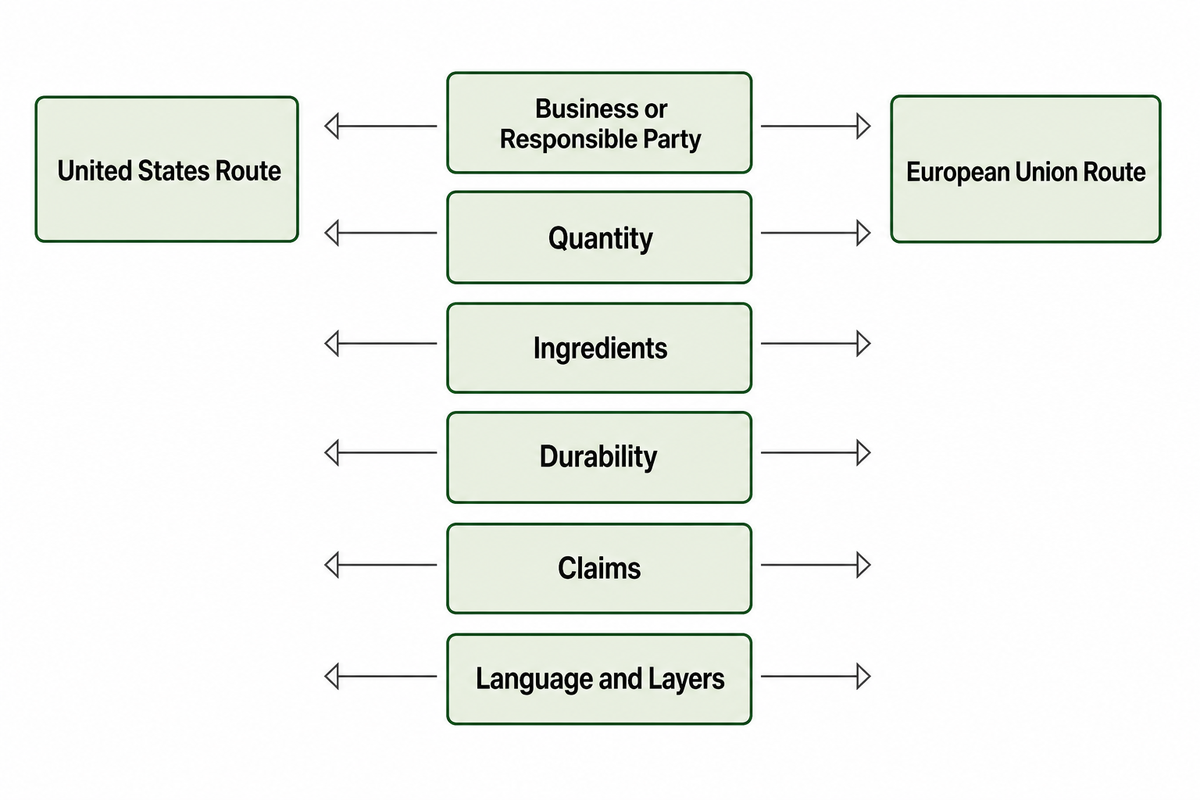
One master data set can reduce transcription errors, but shared data does not make the final artwork interchangeable. Compare the legal role, wording, symbol, language, placement, and evidence for every field before deciding whether any artwork element can be reused.
The risk appears when a shared ingredient or quantity field is copied because it looks familiar. United States Part 701 rules and European Union requirements use different role, placement, and language logic, so the gap matrix records both the common source and the market-specific expression.
| Field | United States route | European Union route | Shared data? | Open check |
|---|---|---|---|---|
| Business / responsible party | Manufacturer, packer, distributor; MoCRA responsible person | European Union responsible person | Sometimes | Role, address, qualifying wording |
| Quantity | Net quantity and presentation rules | Nominal content with exceptions | Source fill may be shared | Units, symbols, placement |
| Ingredients | 21 CFR 701.3 declaration | Article 19 ingredient list | Formula source may be shared | Names, order, allergens, exceptions |
| Durability | No universal cosmetic expiration field | Minimum durability or period after opening route | Study data may inform both | Market expression and symbol |
| Claims | Truthful, not misleading, category-safe | Article 20 plus six common criteria | Underlying evidence may overlap | Exact market claim and context |
| Language and layers | English default; outer/immediate mapping | Member-state language; container/packaging routes | No automatic reuse | Each panel, leaflet, tag, or card |
Assign Artwork Inputs, Checks, Approval, and Retention
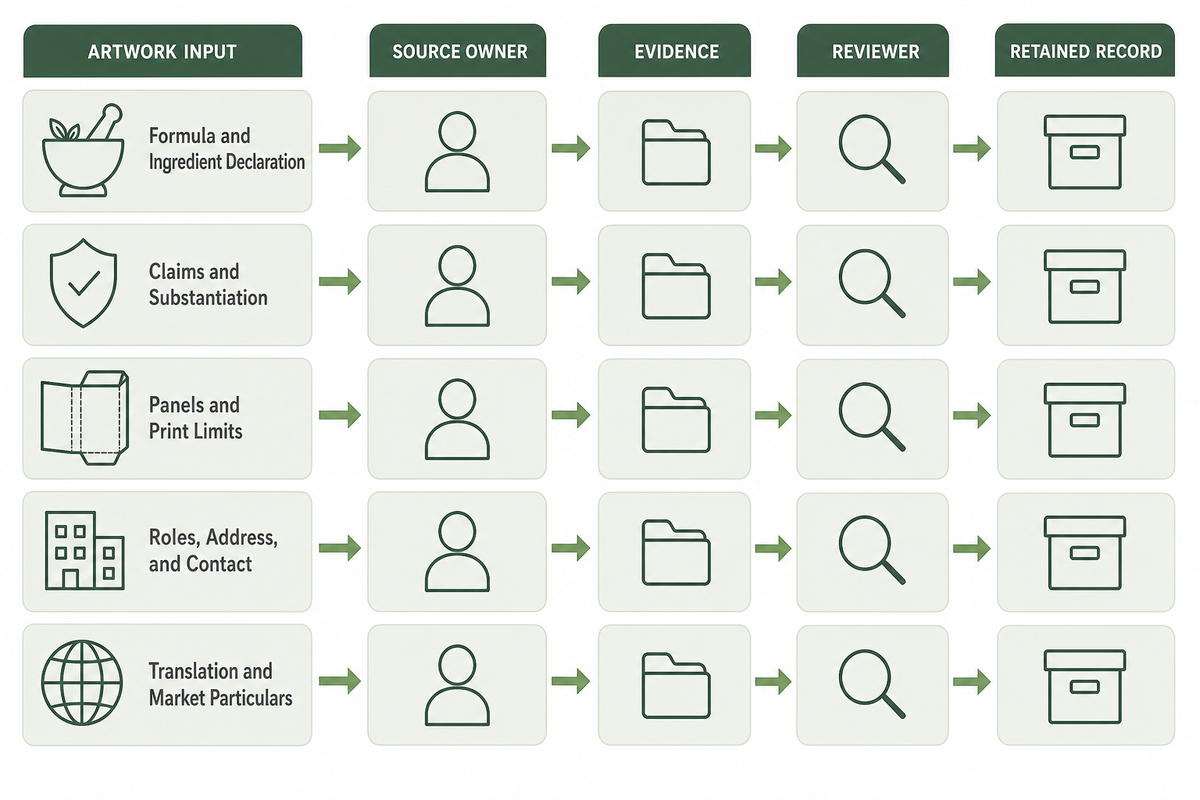
Printing or filling a package does not automatically make that party the final legal approver. The brand, responsible person, formulator, manufacturer, packaging supplier, designer, translator, regulatory reviewer, quality approver, and printer need an explicit handoff for each controlled input.
| Artwork Source-and-Signoff Register | Source owner | Verification evidence | Reviewer / approver | Retained record |
|---|---|---|---|---|
| Formula revision and ingredient declaration | Formulator / manufacturer | Released reconciliation | Quality / regulatory | Formula and label revision |
| Claims and substantiation | Brand / evidence owner | Claim file matched to wording | Regulatory / legal as applicable | Approved claim and source |
| Panels, dimensions, and print limits | Packaging supplier / printer | Current dieline and specification | Packaging / prepress | Dieline and proof revision |
| Roles, address, and contact | Brand / responsible entity | Entity and monitoring confirmation | Market owner | Approved role record |
| Translation and market particulars | Qualified translator / regulatory | Source-to-target review | Member-state / market reviewer | Language approval and final proof |
Required inputs include the formula revision, exact claims, pack dimensions, net or nominal quantity, market, legal identities, contact route, warnings, directions, languages, symbols, and proof revision. A manufacturing partner may supply or check data within an agreed scope, but a web page or service contract cannot be used to infer every legal role or final approval.
Reopen Review When a Label-Bearing Fact Changes
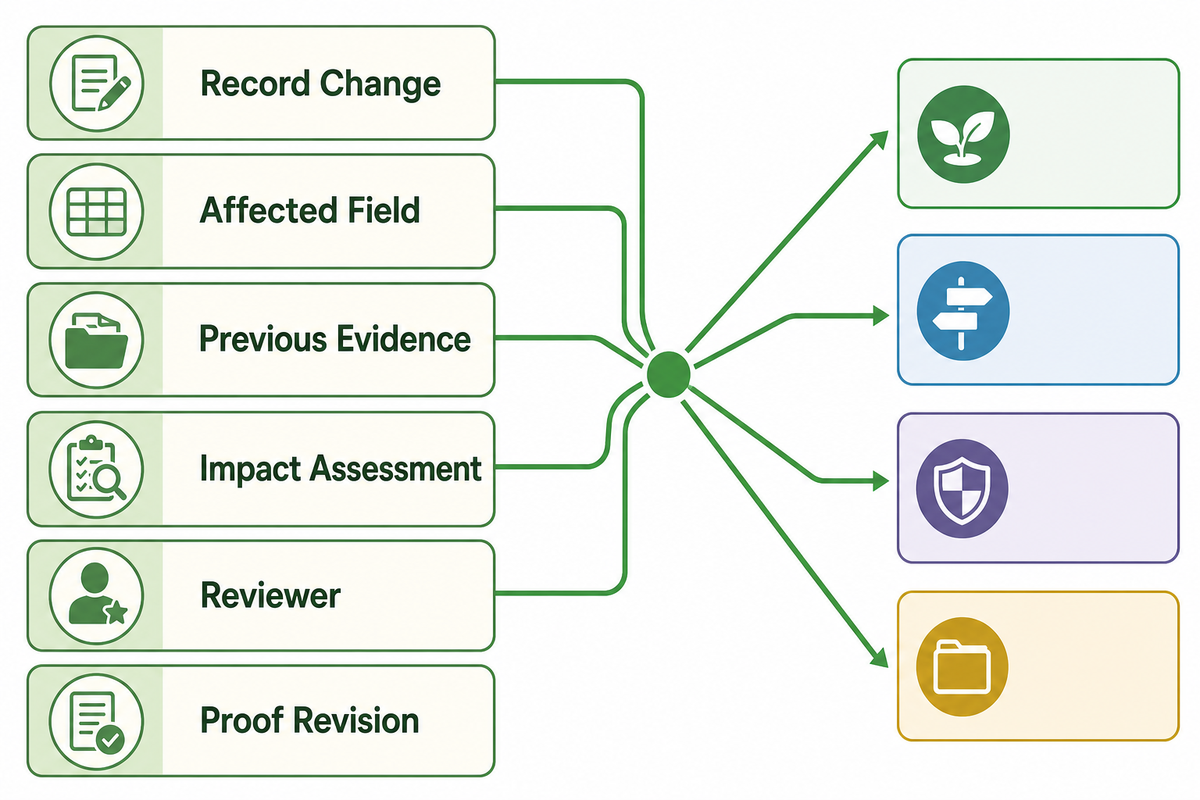
An earlier approval represents the facts recorded at that time. Reopen impact assessment when a formula, claim, supplier composition, package surface, quantity, business role, contact, language, market, warning, regulation, or artwork fact changes—even when the edit looks minor.
The recurring risk is silent reuse: because a prior proof still looks familiar, a team can miss a failure in the formula-to-label link. Recheck the official FDA labeling source or current European Union regulation whenever the trigger ledger shows a market-bearing change.
Artwork Revision Impact Record
Record change → affected field → previous evidence → impact assessment → market → reviewer → action → proof revision → approval date. Use four decision states: no label impact with rationale; controlled data update; market-specific review; or new substantiation / reclassification escalation.
Record change → affected field → previous evidence → impact assessment → market → reviewer → action → proof revision → approval date. Use four decision states: no label impact with rationale; controlled data update; market-specific review; or new substantiation / reclassification escalation.
A raw-material substitution can change constituent naming; a new claim can change classification; a smaller panel can change presentation; a new country can change language and role details; and a contact-domain change can break the adverse-event route. “Text-only” and “same formula name” are not impact assessments.
Brief a White-Label Skincare Manufacturing Partner
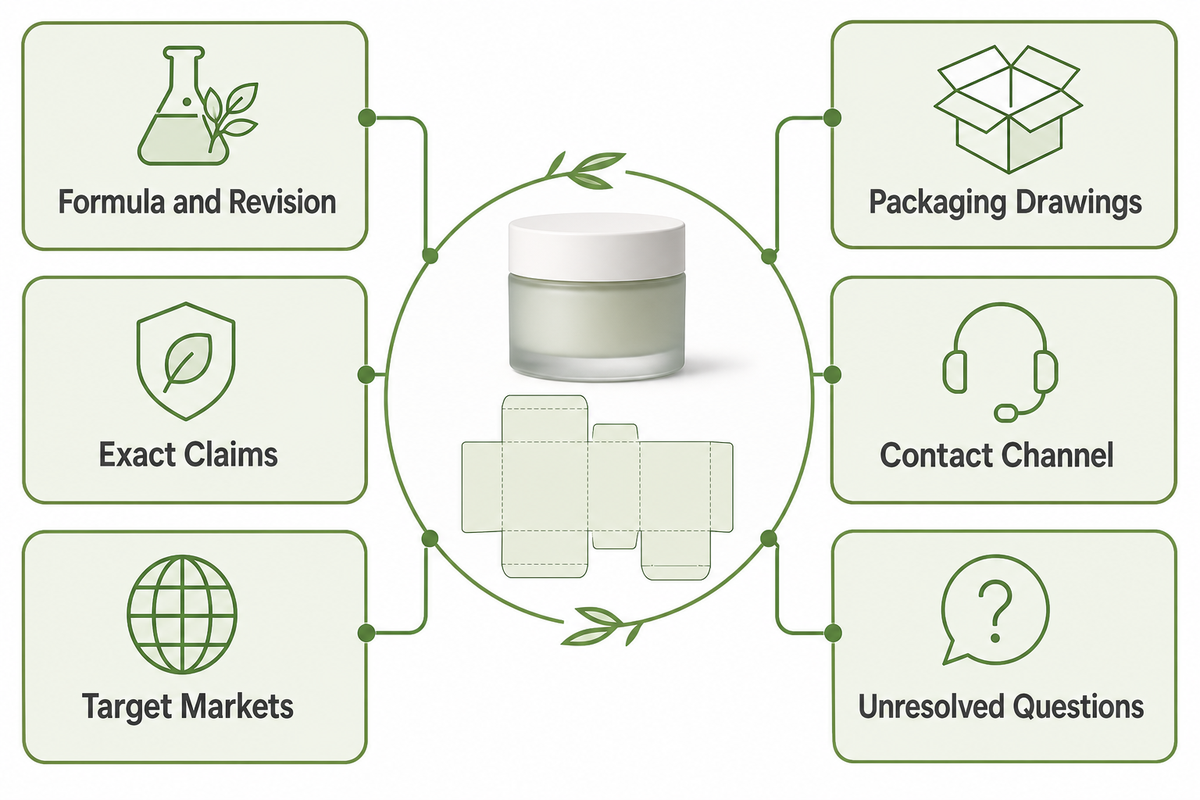
A stock skincare formula does not make the label automatically ready. Before requesting artwork, prepare one controlled brief containing the formula and revision, product identity, exact claims, target markets, responsible entities, quantity, packaging drawings, ingredient-declaration source, warnings, directions, contact channel, languages, evidence, owners, and unresolved questions, with the applicable regulator source beside each controlled field.
NEXO Beauty Labs is a global cosmetic original-equipment and original-design manufacturing partner specializing in skincare, hair care, and body care development, formulation, and scalable manufacturing. Its manufacturing foundation dates to 1999, and its international team has supported global partners since 2020; these company facts do not by themselves establish a legal-review service, certification, guarantee, capacity, minimum order, lead time, or client result.
Brands preparing a formula, claims, pack, and market brief can review NEXO skincare development support before starting an artwork handoff.
Bring the unresolved facts into one brief
Prepare your formula, target market, packaging drawing, exact claims, and open label questions, then open a development discussion with NEXO Beauty Labs.
Prepare your formula, target market, packaging drawing, exact claims, and open label questions, then open a development discussion with NEXO Beauty Labs.
Frequently Asked Questions
What are the requirements for cosmetic labeling?
Cosmetic labeling requirements depend on the destination market, product classification, claims, formula, and package. In the United States, a typical review covers the statement of identity, net quantity, business name and place, ingredient declaration, required warnings, and conspicuous placement on the appropriate panel. MoCRA also added adverse-event contact information. Product-specific exceptions and drug-type claims can change the route, so use the current regulation and regulator guidance for the actual product rather than a generic template.
Do I need FDA approval to sell cosmetics?
The United States Food and Drug Administration generally does not preapprove cosmetic products or cosmetic labels before sale, except that color additives require approval for their intended use. That does not remove the company’s responsibility: the product must be safe for consumers under labeled or customary conditions, and the label must not be false or misleading. Claims can also make a product a drug, which introduces a different regulatory pathway. Confirm the category and every claim before treating “no preapproval” as permission to launch.
Can the same cosmetic label be used in the United States and European Union?
Sometimes a shared data set can support both labels, but the final artwork should not be assumed interchangeable. The two markets differ in legal roles, required particulars, language, durability or period-after-opening treatment, adverse-event contact, claims framework, country-of-origin treatment, and presentation details. Build a field-by-field gap matrix for the actual formula and pack. Reuse only the information that truly matches, then obtain market-specific review for wording, symbols, placement, and responsible entities.
Is INCI naming mandatory on United States cosmetic labels?
International cosmetic ingredient nomenclature is widely used, but the legally required United States declaration must follow 21 CFR 701.3 and the names permitted or required there. Reconcile the exact formula and constituents against the applicable United States naming and order rules.
Who is responsible for private-label cosmetic compliance?
Responsibility depends on the destination market and the roles actually held by the brand, United States responsible person, European Union responsible person, manufacturer, packer, or distributor. A contract manufacturer may provide formula, production, packaging, and change-notice inputs within its agreed scope, but that participation does not automatically transfer every statutory duty or final-artwork decision. The named business may need qualifying wording; the responsible person may need a monitored adverse-event contact; and the market owner may need to retain claim support, safety information, translations, approval records, and current proofs. Contracts should assign who supplies each data field, who checks it against source evidence, who approves the market version, who receives regulatory or supplier changes, who handles adverse events, and who retains the final record. If two parties believe the other owns a task, mark it unresolved and stop the proof rather than printing on assumption.
One practical next step
Run the routing gate, placement matrix, claim screen, responsibility handoff, and change ledger before releasing a proof. When the inputs are controlled, contact NEXO Beauty Labs to discuss the manufacturing brief.
Run the routing gate, placement matrix, claim screen, responsibility handoff, and change ledger before releasing a proof. When the inputs are controlled, contact NEXO Beauty Labs to discuss the manufacturing brief.
Primary References
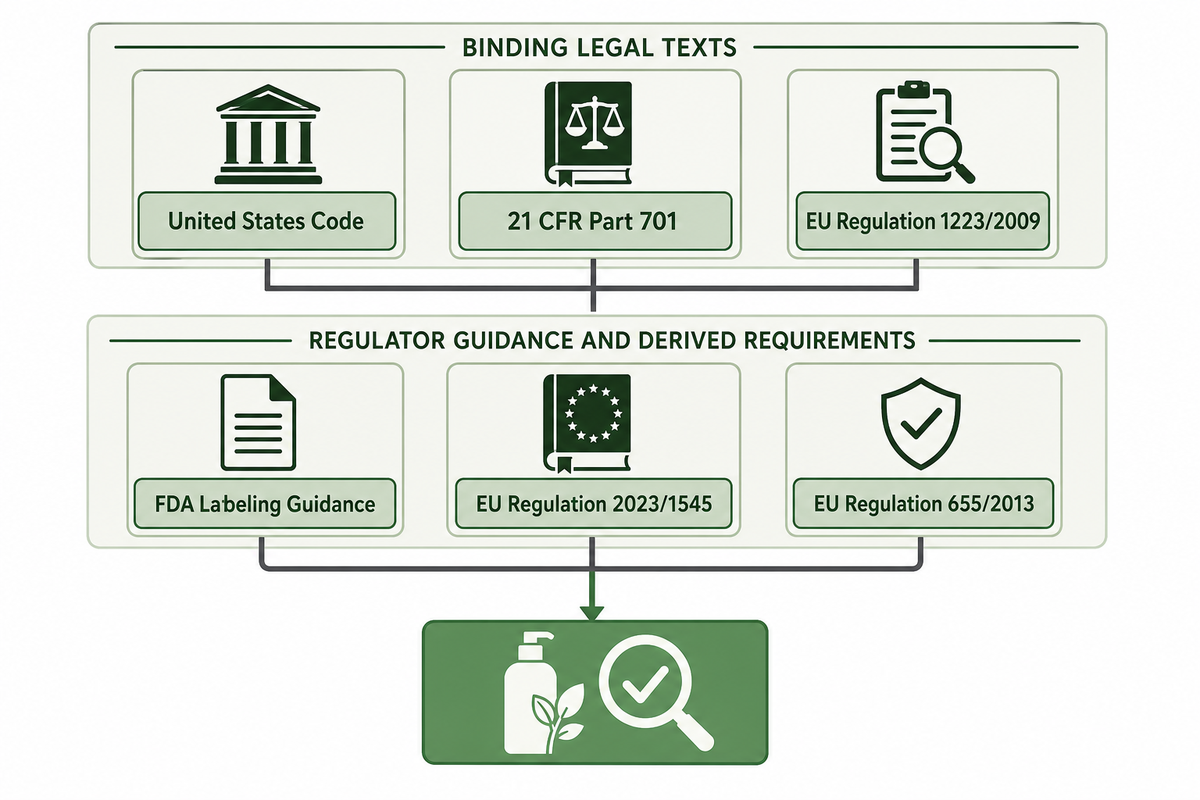
The References & Sources below support the regulatory distinctions and buyer checks used throughout this guide.
- FDA Cosmetics Labeling Guide
- FDA Cosmetics & U.S. Law
- Electronic Code of Federal Regulations, 21 CFR Part 701
- United States Code, 21 U.S.C. § 364e (Cosmetic Labeling)
- FDA MoCRA Implementation Overview
- FDA Cosmetics Labeling Claims
- FDA: Is It a Cosmetic, a Drug, or Both?
- Consolidated Regulation (EC) No 1223/2009, May 18, 2026 version
- Commission Regulation (EU) No 655/2013
- Commission Regulation (EU) 2023/1545
- California Safe Cosmetics Program
The five named decision tools in this article are editorial syntheses of public sources. They are not NEXO standard operating procedures, legal opinions, regulatory approvals, or proof of a NEXO compliance service.
Why beauty brands work with NEXO
About NEXO Beauty Labs Manufacturing Support
NEXO Beauty Labs supports skincare, body care, sun care, hair care, and private label brands with formulation, sampling, filling, quality control, and export-ready launch support.
Project Review Before RFQ
Before quotation, we help clarify product category, active direction, formula stage, package choice, compliance market, MOQ, sampling schedule, and required documents.
Request a Cosmetic QuoteCompany Profile // Data Sheet
CompanyNEXO Beauty Labs
Business TypeCosmetic OEM / ODM manufacturing partner
Main ProductsPrivate label skincare, facial serums, moisturizers, cleansers, sunscreen, body care, and hair care products
Manufacturing CapabilityFormula development, sample adjustment, package sourcing, filling, QA/QC, documentation, and export support
RFQ Data NeededProduct type, formula goal, package format, target market, MOQ, claims, timeline, and benchmark samples
Websitenexobeautylabs.com