Get in touch with NEXO Beauty Labs Company


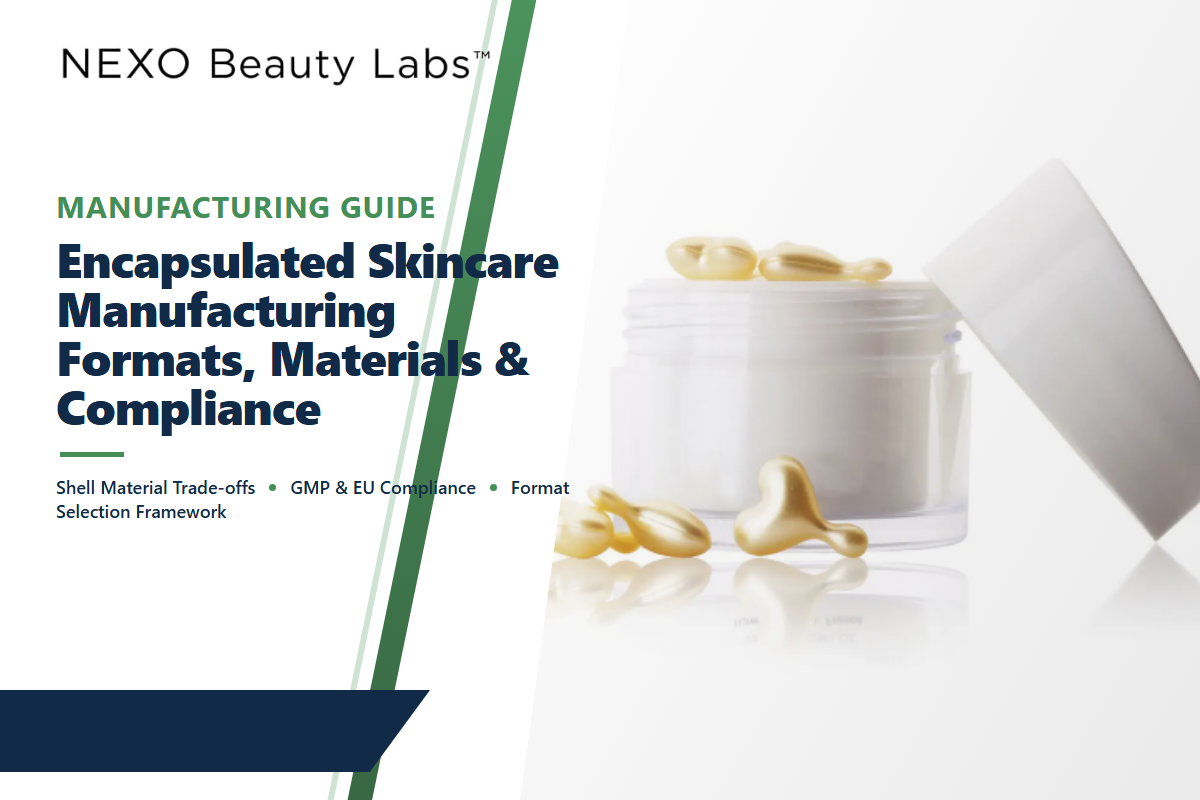
Encapsulated skincare manufacturing is the process of coating an active ingredient in a shell designed to release on a specific trigger, instead of leaving that active exposed to air, light, and the rest of the formula from the moment the product is filled. For brand teams briefing a contract manufacturer, one decision cascades into the next — shell material selection, packaging format, and how to make a compliant claim without stretching the truth — so this guide goes through each, step by step, using NEXO Beauty Labs’ own capsule serum line as one example of a range of formats available.
The reason encapsulation shows up so often in modern skincare formulas comes down to a manufacturing fact, not a marketing trend: several of the actives brands most want in a skincare product — retinol, vitamin C, certain peptides — are also the ones most vulnerable to environmental factors like oxygen, light, and moisture once a formula leaves the lab. Encapsulated active ingredients stay isolated from those environmental factors until the protective layer breaks open on skin, which is the core benefit of encapsulation for any brand building a skincare routine around actives that would otherwise degrade in the bottle. This guide treats encapsulation in skincare and single-dose packaging as two related but separate manufacturing decisions, and works through the shell materials, formats, and compliance notes a brand needs before briefing a manufacturer on either one.
Quick Specs
| Core searched term | encapsulated skincare (30/mo, steady) |
| Most common carriers | microcapsules, liposomes, polymer particles |
| Most common packaging formats | single-dose capsule, airless pump, sachet, jar |
| Governing preservation standards | ISO 11930 (challenge test), ISO 29621 (low-risk criteria) |
| GMP standard | ISO 22716 (de facto — see Compliance Notes below) |
What Encapsulated Skincare Actually Means
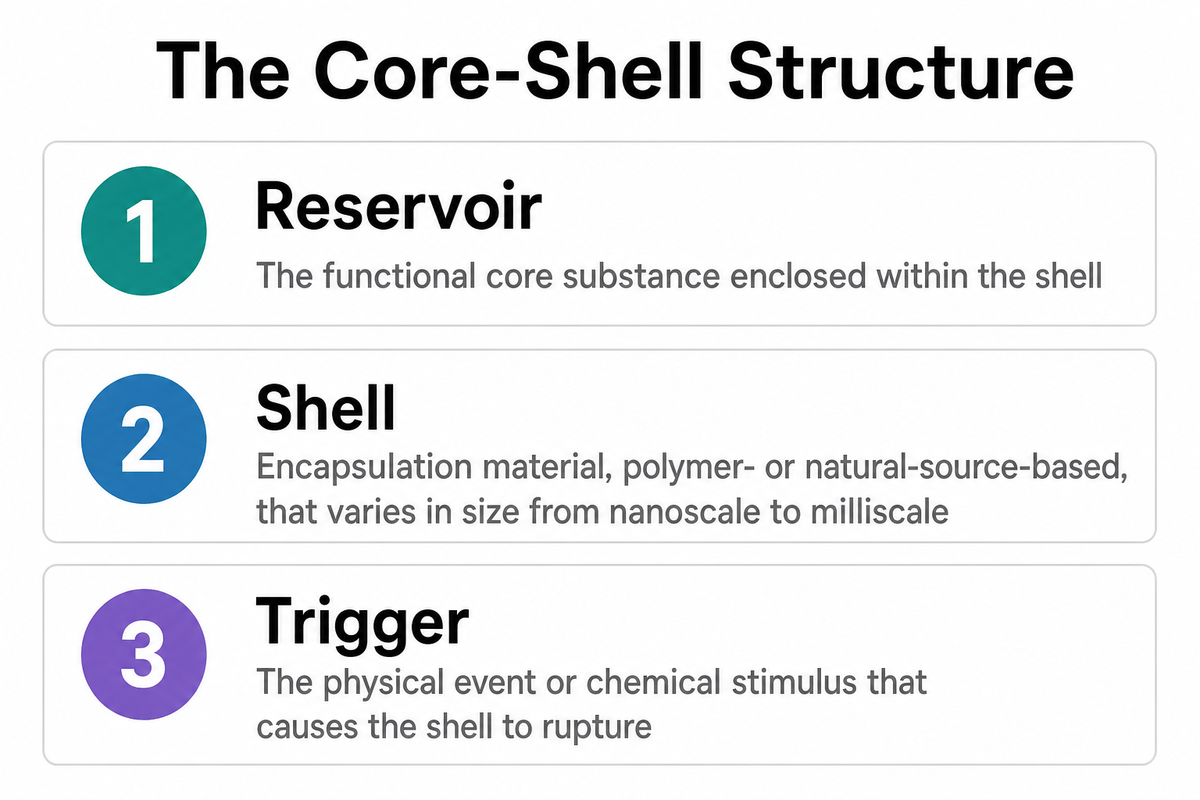
Encapsulated skincare is a core-shell delivery structure: a functional active ingredient sits as a protected core inside a shell of organic, inorganic, or hybrid material, and that shell — not the active itself — is what stays exposed to air, light, and the rest of the formula until it breaks open on a specific trigger.
By design the shell breaks to allow for the delivery of an active on the skin either at a specific timing through a number of physical delivery methods or using chemical triggers (diffusion within the shell, osmosis, hydration, mechanical release by rubbing, enzymatic and pH-based hydrolysis for instance), and which specific trigger is chosen dictates the timing of product delivery and the site on skin where that delivery occurs. The three parts of that structure work together, and it helps to name them separately before going further:
- Reservoir: the functional core substance enclosed within the shell as an enclosed entity.
- Shell: an encapsulation material (polymer- or natural-source-based, such as a lipid or protein) that varies in size from nanoscale to milliscale, depending on the carrier system.
- Trigger: the specific physical event or chemical stimulus that causes the rupture of the shell.
Immobilizing such ingredients into these encapsulation platforms isn’t simply an aesthetic application, but a functional one: it significantly stabilizes delicate or poorly-behaved actives and requires less in process rework by virtue of less degeneration. This stability benefit is precisely what drives the increased manufacturing cost, so which actives really do require it? NEXO’s private-label skincare category range spans serums, moisturizers, cleansers, sheet masks, and ceramide-based repair lines — not just capsule serums.
Which Active Ingredients Get Encapsulated, and Why
Not every active needs a shell: encapsulation only earns its added manufacturing cost for actives that genuinely oxidize, degrade, or irritate skin when applied unprotected, and retinol and vitamin C remain the two clearest, best-documented cases among all common encapsulated ingredients on the market today.
Retinol in particular is worth this manufacturing step because it is the active most brands reach for when a formula’s core claim is reducing fine lines and wrinkles or supporting collagen production — a claim that depends on the active actually surviving in the formula long enough to work. The reasons the remaining actives below need protection differ by ingredient type, which is why the table separates the mechanism from the benefit for each one.
| Active | Why it degrades/irritates unprotected | Encapsulation benefit | Limitations / not suitable for |
|---|---|---|---|
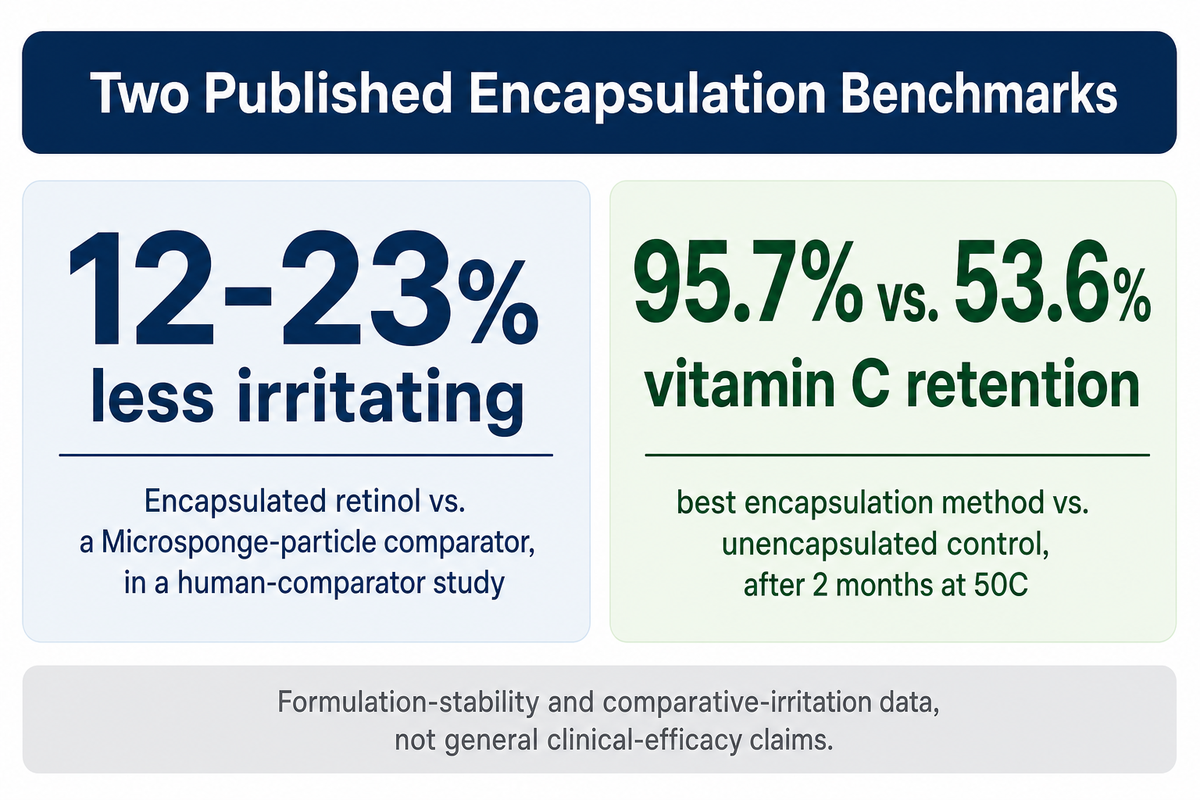
| Retinol | Oxidizes on contact with air/light; unencapsulated forms deliver the full dose at once, which is what drives redness and flaking | One published silicone-particle comparison found a substantially longer stability half-life than unencapsulated retinol, and a human-comparator study found the encapsulated formulation 12-23% less irritating than a Microsponge-particle comparator — read as formulation-stability and comparative-irritation data, not a general clinical-efficacy claim | Not a substitute for prescription tretinoin; still an OTC-strength active regardless of shell |
| Vitamin C (ascorbic acid) | Highly oxygen- and light-sensitive; degrades to inactive compounds, catalyzed by trace metal ions in the formula | One published cosmetic-formulation study tested three microencapsulation methods in a foundation product and measured vitamin C retention after two months at 50C: the best-performing method retained 95.7% of the vitamin C, versus 53.6% for the unencapsulated control | Single-study figures — treat as directional, not a guaranteed shelf-life spec, until validated on the specific formula |
| Peptides | Susceptible to enzymatic breakdown and pH shifts in a mixed formula | Shell isolation from the aqueous phase reduces premature hydrolysis | Benefit is formula-dependent; not every peptide needs isolation |
| Niacinamide | Generally stable, but can react with vitamin C at certain pH combinations in the same formula | Encapsulation is a formula-compatibility tool here more than a stability necessity — keeps it from reacting with co-actives, supports brightening claims that depend on delivering the full dose | Often not worth the added cost if niacinamide is the only active in the formula |
| Ceramide | Lipid-based, can separate or lose barrier-repair performance in water-heavy formulas | Lipid-shell encapsulation keeps the ceramide phase stable through the shelf life | Less critical in fully anhydrous barrier-repair formats |
| Hyaluronic acid | Not oxidation-prone, but molecular-weight fragments can lose hydration performance if exposed to the wrong pH for extended periods | Encapsulation supports a targeted-hydration claim by controlling exactly when the HA reaches the skin surface | Lower-value use of encapsulation vs. retinol/vitamin C — HA is comparatively stable on its own |
“Remaining percent of VC in the foundations containing VC, (A), (B), and (C) were, respectively, 53.6, 84.5, 91.5, and 95.7%.”
— Chemical and Pharmaceutical Bulletin, cosmetic-formulation microencapsulation study (via J-Stage)
A note on consumer preference: “encapsulated” generally provides a smoother, gentler consumer experience for sensitive skin because a triggered-release mitigates “all-at-once” exposure which is what formulators mean by irritation. That is a real tolerability benefit rather than a marketing line — but “encapsulated” does not automatically mean safe for every skin type, and tolerance still varies across different skin types: concentration and the specific active — whether the target is an uneven skin tone or fine lines — set the sensitivity ceiling on a product-by-product basis, and gains in efficacy and stability only follow if that ceiling is respected. The release trigger also determines how deep the active gets: some carrier systems are built to reach deeper layers of the skin rather than sitting on the surface, which matters for actives whose target site is below the outermost layers of the skin. Retinol is the clearest test case for how much that combination of protection and depth actually matters in practice.
Does Encapsulated Retinol Actually Work?
Encapsulated retinol works as a stability and tolerability improvement over unencapsulated retinol — it is not a documented clinical-efficacy upgrade, and the two claims should not be confused when evaluating a supplier’s marketing copy.
The published evidence for encapsulated retinol clusters around two endpoints – formulation stability (encapsulated retinol is generally more stable against oxidation than un-encapsulated retinol, in the data available) and comparative irritation (encapsulated formulation has produced less irritation in controlled comparisons than certain un-encapsulated comparators, in available tests). Neither of these is equivalent to a finished product efficacy trial, and a clinical review of cosmetic retinoids has found very few high-quality trials substantiating general efficacy claims within the category. An honest statement from a manufacturer about encapsulation to a brand would be: encapsulation is a real formulation-stability and tolerability tool for retinol, not a documented means to clinical efficacy multiplication.
Encapsulation Technology vs. Packaging Format: Two Different Decisions
These two issues are almost always confused, and shouldn’t be lumped together. Formulation-level microencapsulation is the delivery mechanism of the active at the microscopic level — a liposome, a polymer microcapsule, a nanoparticle. Packaging format is the consumer-facing package — e.g., individual capsule dose, airless pump dispenser, small jar, packet. A given form can use microencapsulation and ship in a pump, or be packaged in an individual capsule dose form without any microencapsulation at all. Confusing formulation with packaging creates common brief errors: a brand wants “encapsulated technology,” but requests the packaging format of the capsules in its place, or vice versa. Once that distinction is clear, the next question is purely about the packaging side.
With the microencapsulation decision settled (or ruled out entirely), the next task is identifying the ideal packaging choice given the need for precise dosing, protection, and shipping volume.
| Format | Barrier performance | Dosing precision | Unit-cost direction | Limitations / not suitable for |
|---|---|---|---|---|
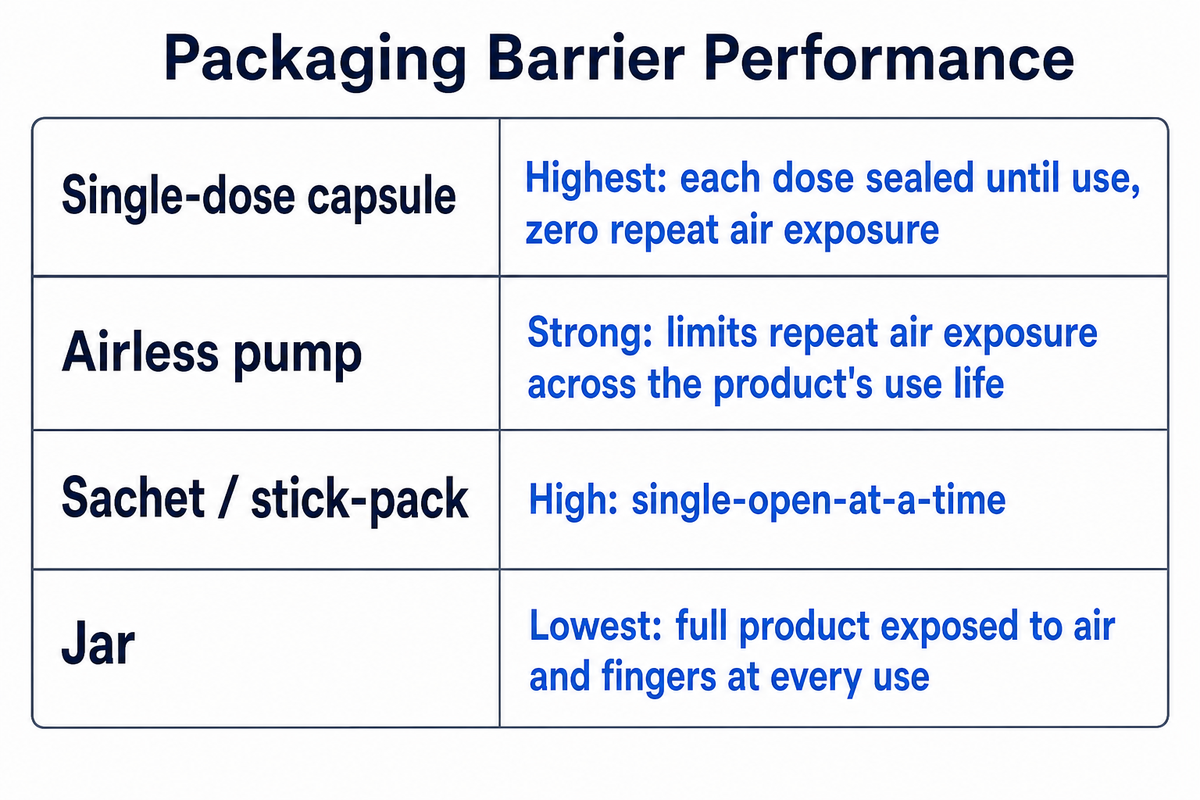
| Single-dose capsule | Highest — each dose sealed until use, zero repeat air exposure | Highest — fixed fill volume per capsule, run as discrete sizes rather than a continuous pourable range | Higher per-dose cost than multi-use formats; exact fill volumes and order thresholds vary by program — see NEXO’s capsule serum line for the specific tiers | Not cost-efficient for daily-use, high-volume products where a reusable format amortizes better |
| Airless pump | Strong post-opening barrier — limits repeat air exposure across the product’s use life | Moderate — consistent per-pump dose, but not sealed like single-dose | Roughly $1.50-4.00 per unit vs. roughly $0.40-1.50 for a standard tube (packaging-only cost, industry-aggregated figures, exact quotes vary by supplier and volume) | Overkill for stable, non-oxidation-sensitive formulas |
| Sachet / stick-pack | High per-dose barrier, single-open-at-a-time | High — pre-measured, similar precision logic to capsules | Generally the lowest unit cost of the single-dose formats | Weaker dosing precision than a capsule for viscous or oil-based fills; best suited to trial/subscription/sample programs rather than a brand’s core SKU |
| Jar | Lowest — full product exposed to air and, often, fingers at every use | Lowest — no metered dose | Generally the cheapest packaging format per unit volume | Not suitable for oxidation-sensitive encapsulated actives unless the shell itself is doing all the protective work |
💡 Pro Tip
If the brief is for an oxidation-sensitive active in a precise, trial-friendly dose, NEXO’s capsule serum fill programme is the format built specifically for that combination — worth a direct look before defaulting to pump or jar.
Shell Material Choices and Trade-offs
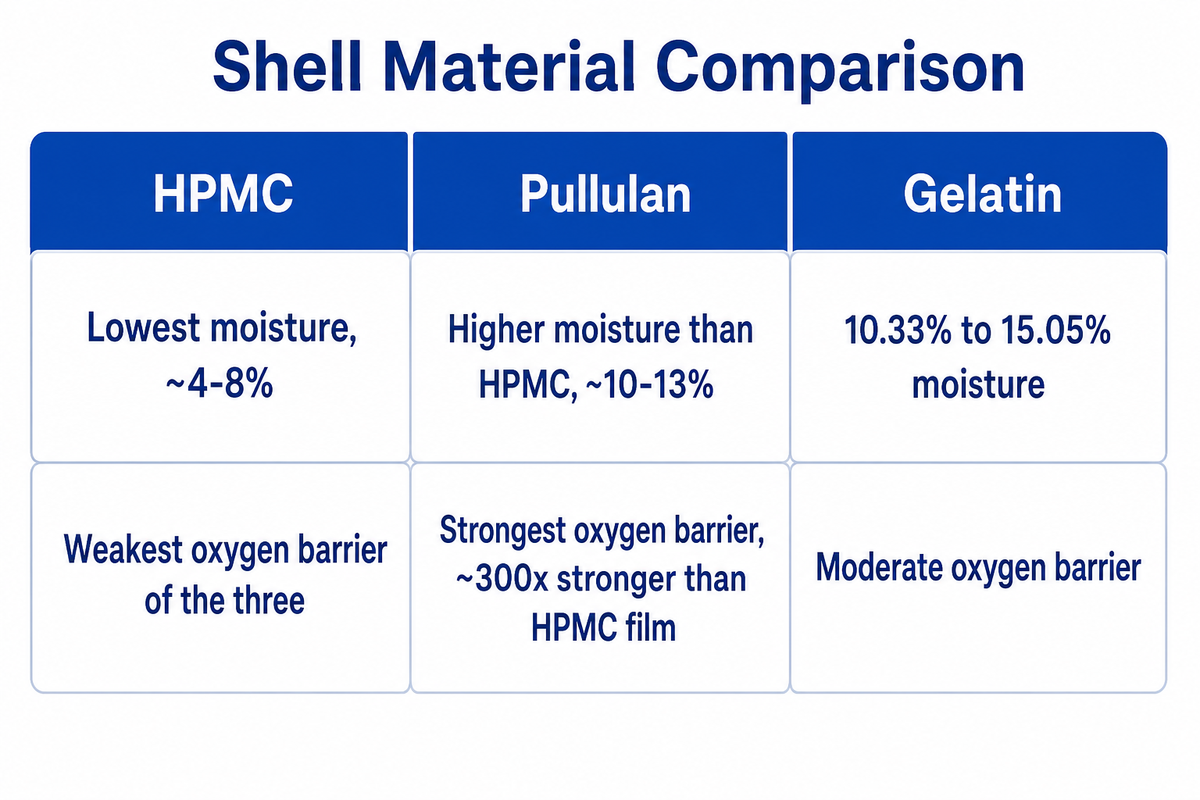
For individual-capsule shell construction alone, a product needs at least three aspects balanced: moisture-barrier properties, oxidation resistance, and cost. The strongest scientific evidence on HPMC’s moisture-barrier characteristics comes not from the skincare category, but from a peer-reviewed study devoted to inhalation capsules. Because of that, no single combined metric has been constructed here — the two data sets are kept distinct in the table below, and each row notes which one it draws on:
| Shell material | Moisture content | Oxygen barrier | Cost direction | Sourcing |
|---|---|---|---|---|
| HPMC (hydroxypropyl methylcellulose) | Lowest of the three — industry figures put it around 4-8%; a separate peer-reviewed pharmaceutical-capsule study (inhalation dosage forms, not topical) measured a comparable low-moisture profile against gelatin under humidity testing | Weakest of the three plant-based/animal options | Cheaper than pullulan, pricier than gelatin | 100% plant-derived (wood-pulp cellulose) |
| Pullulan | Higher than HPMC — industry figures put it around 10-13% | Strongest — reported roughly 300x stronger than an equally thick HPMC film, useful specifically for oxygen-sensitive actives like vitamin C | Highest of the three | 100% plant-derived (fermented tapioca starch) |
| Gelatin | Higher than HPMC under the same humidity testing (10.33% rising to 15.05%); not directly compared against pullulan in the sources cited here | Moderate | Lowest cost of the three | Animal-derived (bovine or porcine) — not vegan/halal-compatible without a certified alternative source |
📐 Engineering Note
For a product that heavily emphasizes vitamin C (or other oxygen-sensitive antioxidants), pullulan is the better choice over HPMC — the added cost buys superior oxidation resistance, which matters specifically for oxygen-sensitive actives, not general damage protection. For an HPMC-based formula where moisture ingress is the bigger concern rather than oxidation, the cheaper, lower-moisture-content option remains the default.
The Preservation Science Behind Single-Dose Formats
Use of an anhydrous formula or a single-dose approach can help reduce levels of preserved material; however, the intended reason of this approach is often not as direct as a company’s branding copy might suggest, nor does the form itself necessarily exclude the requirement for a preservative. Encapsulation and preservative-free status are, by any measure, two separate issues that can’t simply be equated — conflating them is one of the most common inaccuracies in this category.
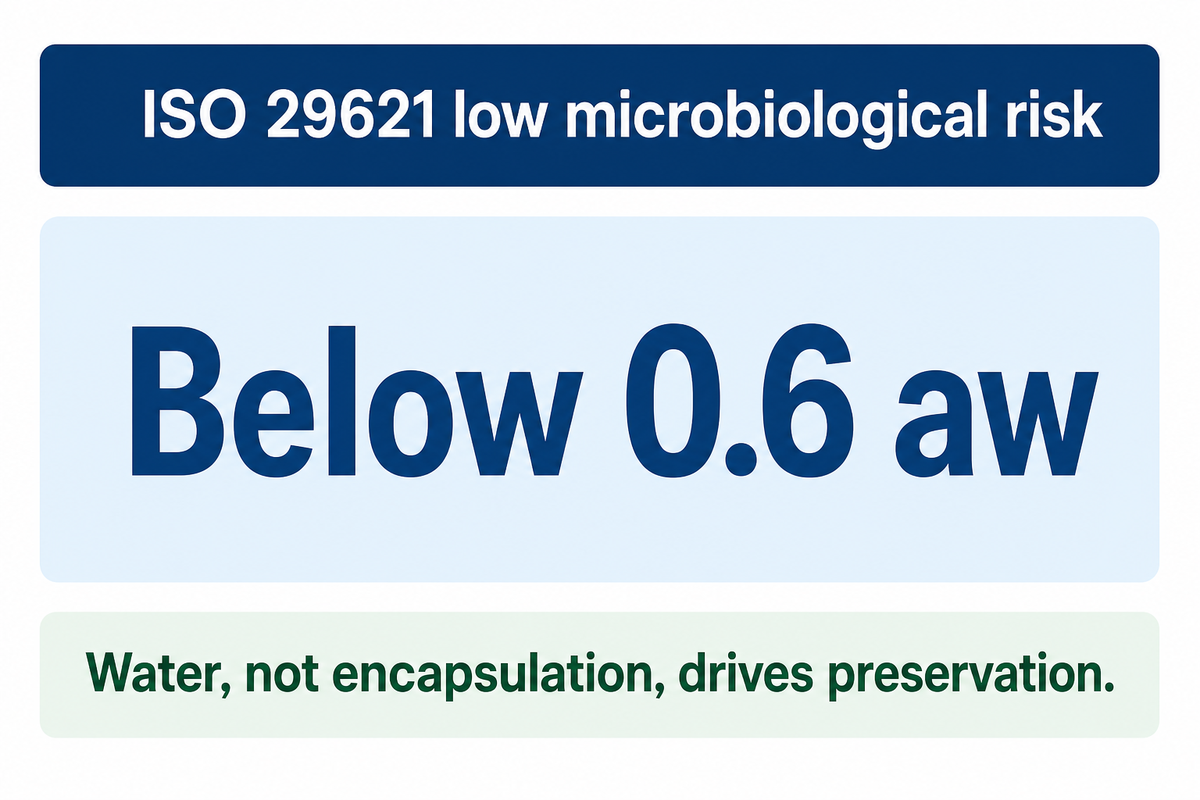
The real standard here is risk-based: ISO 29621:2017 spells out which finished cosmetic products carry low microbiological risk, and anhydrous products with a water activity below 0.6 aw hit that low-risk threshold — meaning truly anhydrous single-dose oils and balms may occasionally skate through the full-scope preservation efficacy test ISO 11930 specifies for water-bearing formulas. That’s to say, water, or the absence of water (not encapsulation itself), rather than any other component is the driver for preservation. A capsule serum with an aqueous core still needs a working preservation strategy behind that shell; an anhydrous oil serum in the same capsule format may not.
The regulations for safe, shelf-stable cosmetics are simpler than this “just throw a preservative in” myth; regulators require the finished cosmetic product be safe per labeled use and under conditions of intended or reasonable customary use – not the presence of specific, approved-for-preservation ingredients. A work-horse preservation strategy is simply how it’s usually done within the industry to assure such safety over a product’s shelf life in water-containing products.
Sustainability Trade-offs of Single-Dose Packaging
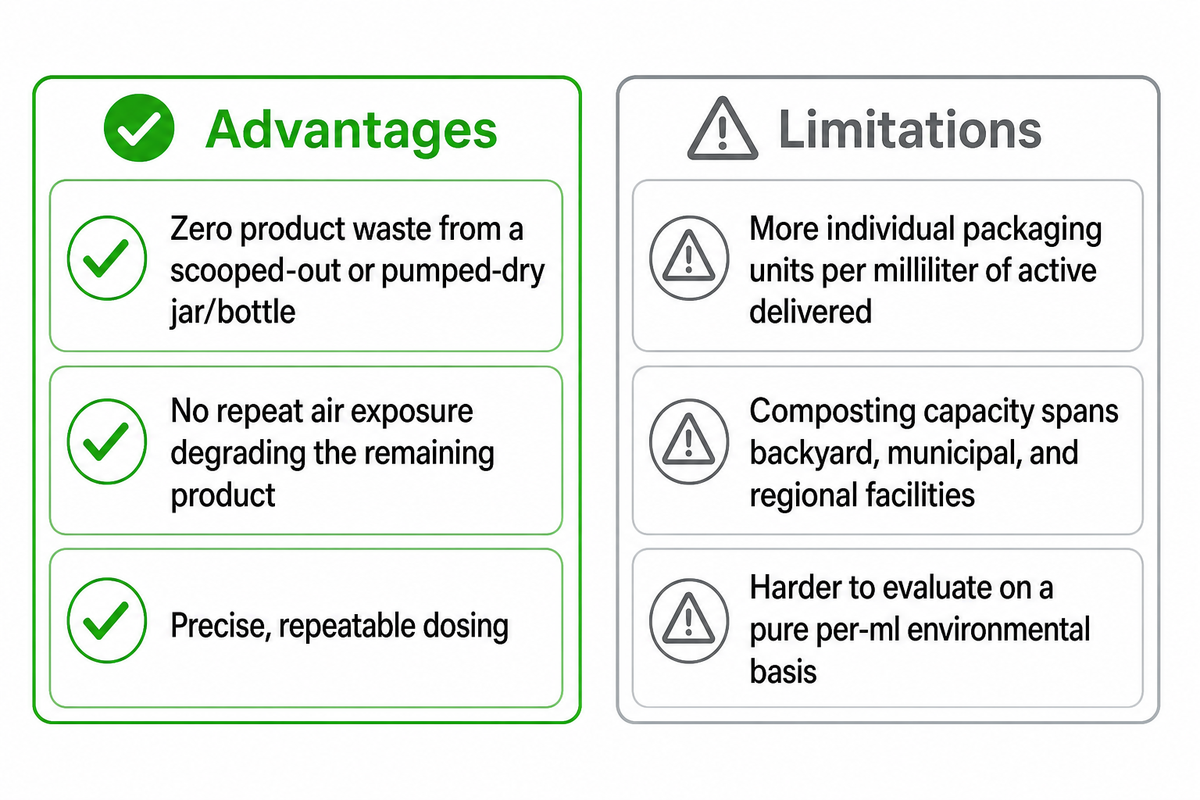
Of course, Precise dosing and lowered preservative needs do require trading up for packaging volume, which is worth speaking to honestly, rather than glossing over.
✔ Advantages
- Zero product waste from a scooped-out or pumped-dry jar/bottle
- No repeat air exposure degrading the remaining product over the use period
- Precise, repeatable dosing supports both formulation stability and consistent user experience
⚠ Limitations
- More individual shell/packaging units per milliliter of active delivered than a bulk format
- Shell-material footprint (plant-derived shells are compostable in principle, but composting capacity itself spans backyard, municipal, and regional facilities rather than one uniform system, so real-world access still depends on what exists locally)
- Single-dose formats are genuinely harder to evaluate on a pure per-ml environmental basis than they first appear — shifting the burden rather than simply reducing it is a fair description in some cases
Compliance Notes: GMP Status and Market Responsibility
Two compliance questions come up in nearly every manufacturer conversation for this category: what GMP is really governing, and when your manufacturer is working outside your brand’s home market, who bears that ultimate responsibility?
On GMP: there is still no finalized FDA cosmetic GMP regulation. FDA’s own guidance remains a 2013 draft that FDA itself says is not for implementation and not binding, pending the GMP rulemaking that MoCRA requires. In that gap, ISO 22716 functions as the de facto manufacturing standard the industry actually certifies against. For EU-facing distribution specifically, French authorities (DGCCRF) have stated that ISO 22716 GMP compliance was already required as of December 2025 — not a future mandate, a requirement already in effect — with a separate certification track that started in March 2025 applying specifically to cosmetics exported outside the EU/EEA.
⚠️ Important
ISO 22716 GMP addresses all forms of production, control, storing and shipping practices, but — and this is the critical point — it explicitly excludes research and development activities and distribution of finished products: the certificate indicates management of your manufacturing process, but it won’t prove capability of new product development.
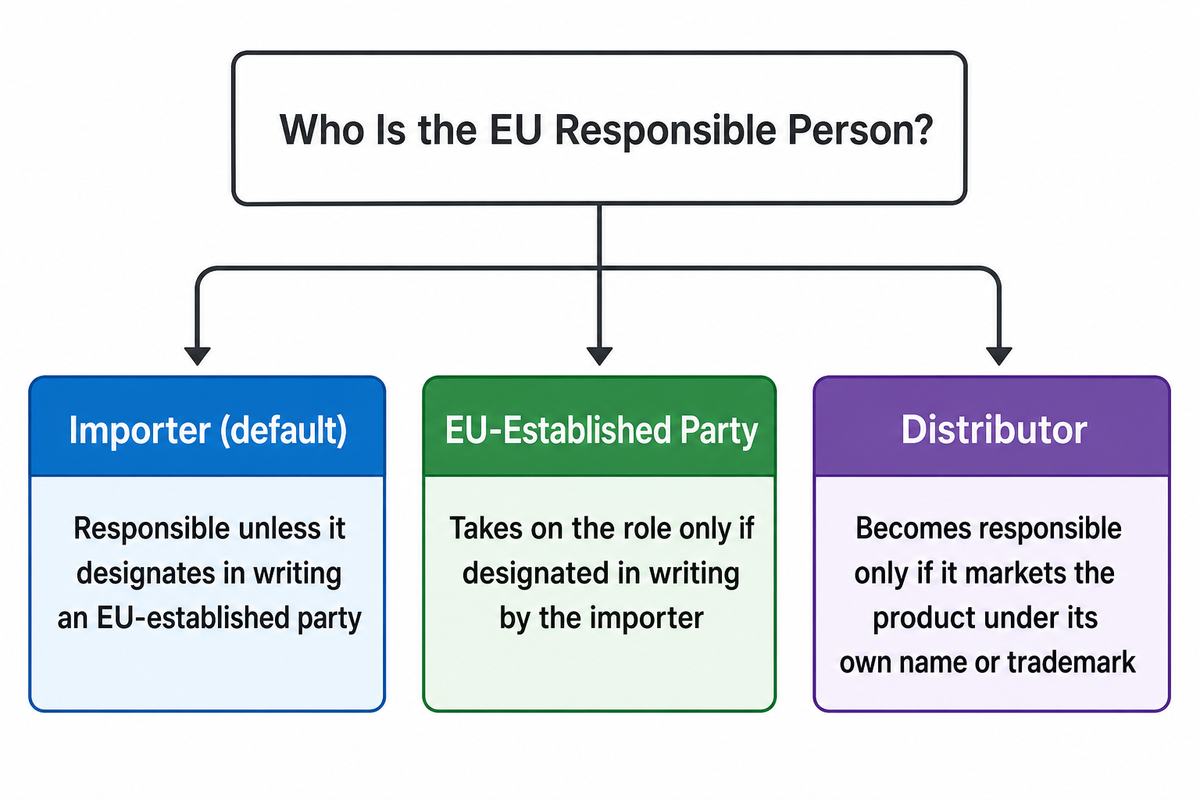
Concerning the ‘responsible party’: Under EU law (EU Regulation (EC) No 1223/2009, article 4) any non-EU manufacturer of the product may not be the one designated as the ‘responsible person for the cosmetic product in the Union.’ The importer is the default responsible person for the specific products it places on the market, unless it designates in writing an EU-established party to take on that role. A distributor becomes the responsible person when it places the product on the market under its own name or trademark. For a brand sourcing from a non-EU manufacturer and selling into the EU, this is not a formality to skip — it determines who is legally on the hook if a product safety issue surfaces after launch.
Who Is Responsible If My Manufacturer Is Overseas?
For EU market entry, the importer is the default responsible person unless it designates an EU-established party in writing, or a distributor takes on that role by branding the product under its own name.
Regulation (EC) No 1223/2009 Article 4 sets out four specific cases determining who holds responsible-person status for a product manufactured outside the EU. Brands sourcing from an overseas manufacturer should confirm in writing, before production, which party (importer, a designated EU-based representative, or the distributor) is formally taking on that role — this is a legal determination, not something the manufacturing contract alone settles by default.
Choosing a Manufacturing Partner for Encapsulated Skincare
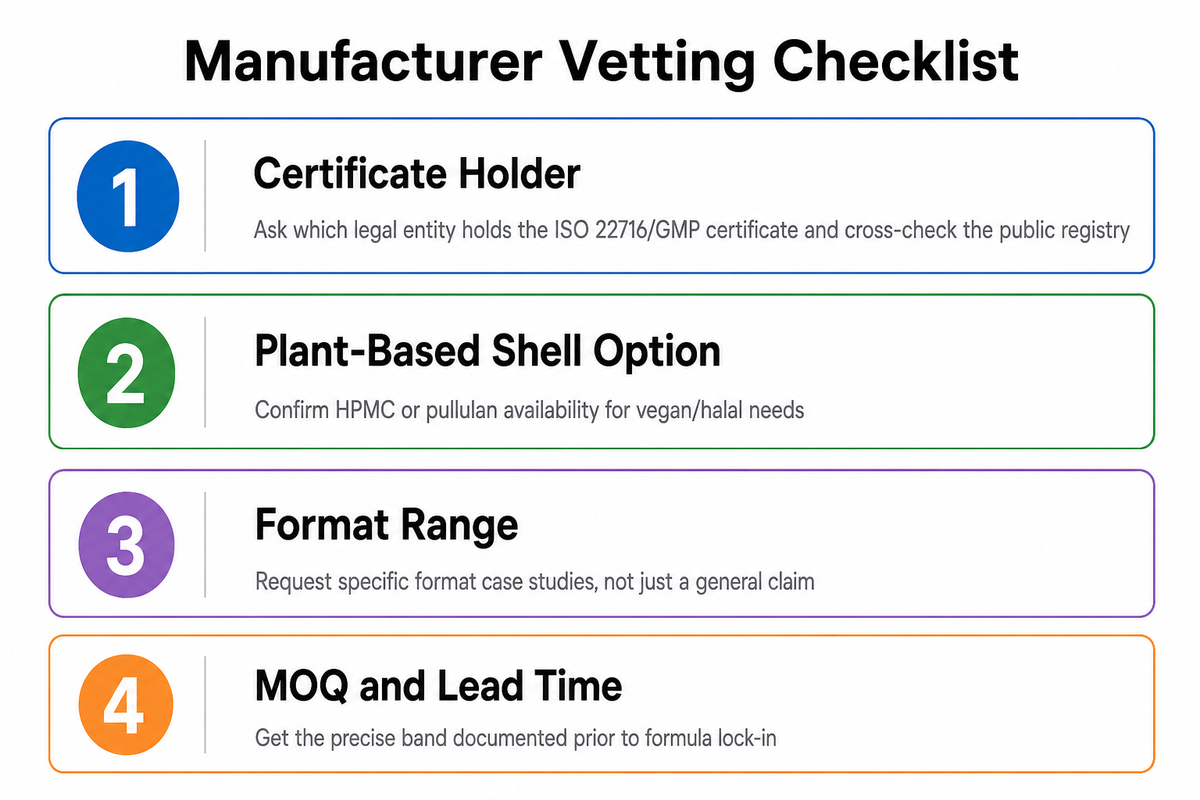
Before committing to a manufacturer for this format, a short vetting pass on four points avoids the most common mismatches — and for brands still finalizing the active itself, that vetting should extend to whatever formulation and lab support the manufacturer offers before the shell-and-format decision is even made:
- Explicit certificate holder indicated. Ask which legal entity holds any ISO 22716 or GMP certificate cited, and cross-check it directly against the certifying authority’s public registry (not all “our certificated facility” claims mention the actual cert holder — for example, the Intertek ISO 22716 and GMPC certificates referenced on NEXO Beauty Labs’ pages are issued to Guangzhou Opseve Cosmetics Co., Ltd., the production site, with an audited scope covering hair care and cleansing products in the general liquid and cream & lotion units, verifiable on Intertek’s public registry; the same verification method applies for any manufacturer considered).
- Plant-based shell option available. Confirm if HPMC or pullulan shells are available for the format, if vegan or halal compatibility is required.
- Format range aligns with the specifications brief. Choosing a capsule-equipped serums manufacturer doesn’t guarantee expertise across all airless-pump or sachet formats–request specific format case studies.
- MOQ and lead time norms are documented prior to formula lock-in. Single-dose capsule programs consume a different MOQ, tooling, and lead time timeline than bottled formats–obtain the precise band information up-front, rather than rely on a blanket low-MOQ claim.
The MOQ/IP-ownership mechanics that generally apply to private-label skincare manufacturing — deposit structure, formula ownership defaults, tooling-cost triggers — are a separate topic from the format decision covered here; the specific capsule-serum fill sizes and order thresholds live on the capsule serum specifications and MOQ page. With those vetting points and cross-links in hand, the last step is turning everything above into a shortlist a brand can actually bring to a quote request.
The Trigger-to-Format Decision Path: Which Encapsulation Route Fits Your Brand
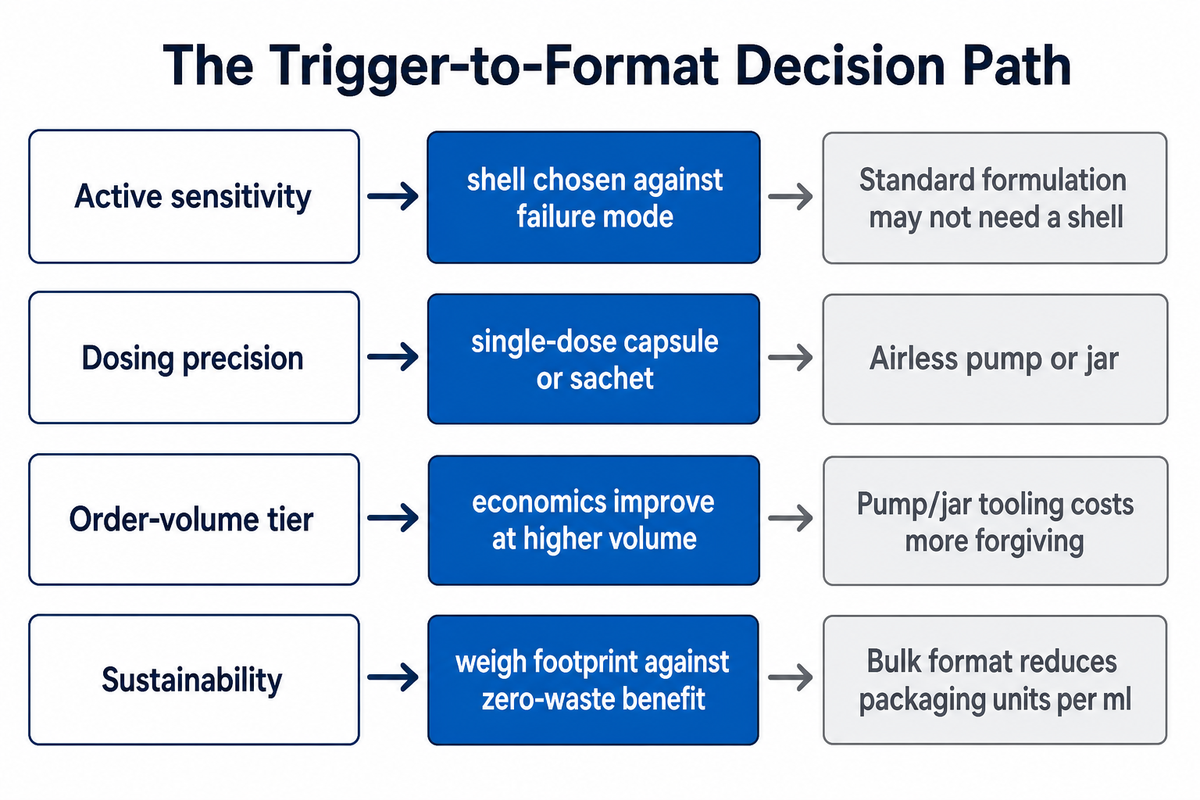
Four signals, run through this Trigger-to-Format Decision Path, point toward a specific format family faster than starting from a blank brief:
| Signal | If high | If low |
|---|---|---|
| Active sensitivity (oxidation/degradation risk) | Encapsulation technology — shell material chosen against the specific failure mode (oxygen for vitamin C, moisture for others) | Standard formulation may not need a protective shell at all |
| Dosing precision need | Single-dose capsule or sachet | Airless pump or jar |
| Order-volume tier | Capsule/sachet economics improve meaningfully at higher volume tiers | Lower-volume launches may find pump/jar tooling costs more forgiving |
| Sustainability priority | Weigh shell-material footprint explicitly against zero-waste-per-dose benefit — there is no single right answer here, only an honest trade-off | Bulk format reduces packaging units per ml, at the cost of precise dosing and post-opening barrier |
Key takeaway
Encapsulation is a delivery system, not a quality assurance — it protects an active in transit, it doesn’t correct a fill that was unstable to start with. Running the brief through the Trigger-to-Format Decision Path, then correctly sourcing the right shell material, packaging format and preservation strategy in that order, is what really ensures a format can deliver. The same logic holds across skin care, hair care, or body care lines: brands that treat encapsulation and packaging as one combined decision end up with skincare solutions that hold up past the lab bench, not just on paper. Whether the ingredients in skincare formulas are a barrier-repair ceramide or an active meant to exfoliate, the real measure of stability and efficacy in any encapsulated skincare formulation is whether the active still works on the shelf date printed on the box, not just on day one.
Frequently Asked Questions
Q: What does “encapsulated” mean on a skincare label?
“Encapsulated” means an active ingredient is sealed inside a protective shell that releases the active on a specific physical or chemical trigger, instead of exposing the active to air and the rest of the formula from the moment the product is filled.
The shell material choice and release mechanism depend on the product — liposomes, polymer microcapsules, and other delivery systems are common options, each appropriate for different actives and formats. Shell material selection is not cosmetic: HPMC, pullulan, and lipid-based shells each trade off moisture resistance, oxygen barrier strength, and cost differently, and the release trigger (rubbing, moisture, pH, or enzymatic breakdown) determines whether the active reaches the skin on contact or over an extended period. Refer to “What Encapsulated Skincare Actually Means” above for the full mechanism breakdown.
Q: Does encapsulated retinol actually work?
Encapsulated retinol works as a stability and tolerability improvement over unencapsulated retinol — published formulation-science data supports that specific claim, not a general clinical-efficacy claim.
See the “Does Encapsulated Retinol Actually Work?” answer under “Which Active Ingredients Get Encapsulated, and Why” above for the specific studies and how to frame the claim accurately.
Q: Is encapsulated retinol the same as tretinoin?
No, encapsulated retinol and tretinoin are not the same: encapsulated retinol is still an over-the-counter cosmetic ingredient, while tretinoin is a prescription-only active retinoic acid dispensed under a physician’s direction.
Encapsulation alters how the retinol is delivered and tolerated, not its regulatory classification or its relative strength compared to tretinoin. Retinol, encapsulated or not, stays an over-the-counter cosmetic ingredient sold at consumer-safe concentrations; tretinoin is a prescription drug dispensed at pharmacologically active doses under a physician’s direction. A brand may not market an encapsulated-retinol product with tretinoin-equivalent claims regardless of the delivery system, and marketing copy that blurs this distinction risks a false-advertising or unapproved-drug-claim problem, not just an inaccurate one.
Q: What should a brand ask a manufacturer about encapsulated retinol’s irritation profile before finalizing a formula?
Ask what concentration and tolerability data the manufacturer has on file — encapsulation generally reduces irritation versus unencapsulated retinol, but it doesn’t eliminate the concentration-dependent risk of redness, stinging, or flaking.
The controlled release is what softens the irritation profile, not a change to the active itself, so the practical tolerance threshold still comes down to concentration and the target skin type — a brand should ask the manufacturer to document both before a claim is finalized, not rely on “encapsulated” alone as a tolerability guarantee.
Q: Are encapsulated/single-dose formats always preservative-free?
No, they are not always preservative-free — only genuinely anhydrous (100% oil-based) formats can make that claim; encapsulation and preservative-free status are two separate formulation decisions.
See ISO 11930/29621 in the section on “The Preservation Science Behind Single-Dose Formats” above: the required preservation level comes down to water content, not encapsulation or single-dose format.
Q: Who is legally responsible for compliance if my manufacturer is outside my market?
For the EU specifically, the importer is the default responsible person unless it designates an EU-established party in writing, or a distributor takes on that role.
See “Who Is Responsible If My Manufacturer Is Overseas” under Compliance Notes above for the full Article 4 breakdown: always agree on and document this in writing before manufacturing begins.
References & Sources
- Microscale Delivery Systems for Hydrophilic Active Ingredients in Functional Consumer Goods PMC/NIH, peer-reviewed
- Comparative Evaluation of Gelatin and HPMC Inhalation Capsule Shells Exposed to Simulated Humidity Conditions Pharmaceutics, 2025, peer-reviewed
- ISO 11930:2019 International Organization for Standardization
- Draft Guidance for Industry: Cosmetic Good Manufacturing Practices U.S. Food and Drug Administration
- Regulation (EC) No 1223/2009, Article 4 EUR-Lex, consolidated text in force 2026-05-01
- Les produits cosmétiques DGCCRF (French Directorate General for Competition, Consumer Affairs and Fraud Control)
Why We Write This
We separate encapsulation technology from packaging format in this guide because most manufacturer briefs we receive conflate the two. On compliance, we apply the same certificate-holder check recommended above: the ISO 22716 and GMPC certificates covering our production site are held by Guangzhou Opseve Cosmetics Co., Ltd. and are verifiable on Intertek’s public registry.