Get in touch with NEXO Beauty Labs Company

Facial cleanser manufacturing is the controlled work that turns a market and formula brief into a documented batch and filled product. It doesn’t, by itself, complete safety substantiation, stability work, market files, batch release, delivery, or market authorization. A useful buyer plan keeps those outputs separate and assigns each one to an owner.
The buyer’s decision in one sentence
Don’t approve “the cleanser” as one item. Approve a linked formula, process, package, evidence plan, market role, and release route, and record what would force any of them back into review.
What Facial Cleanser Manufacturing Includes, and What It Does Not
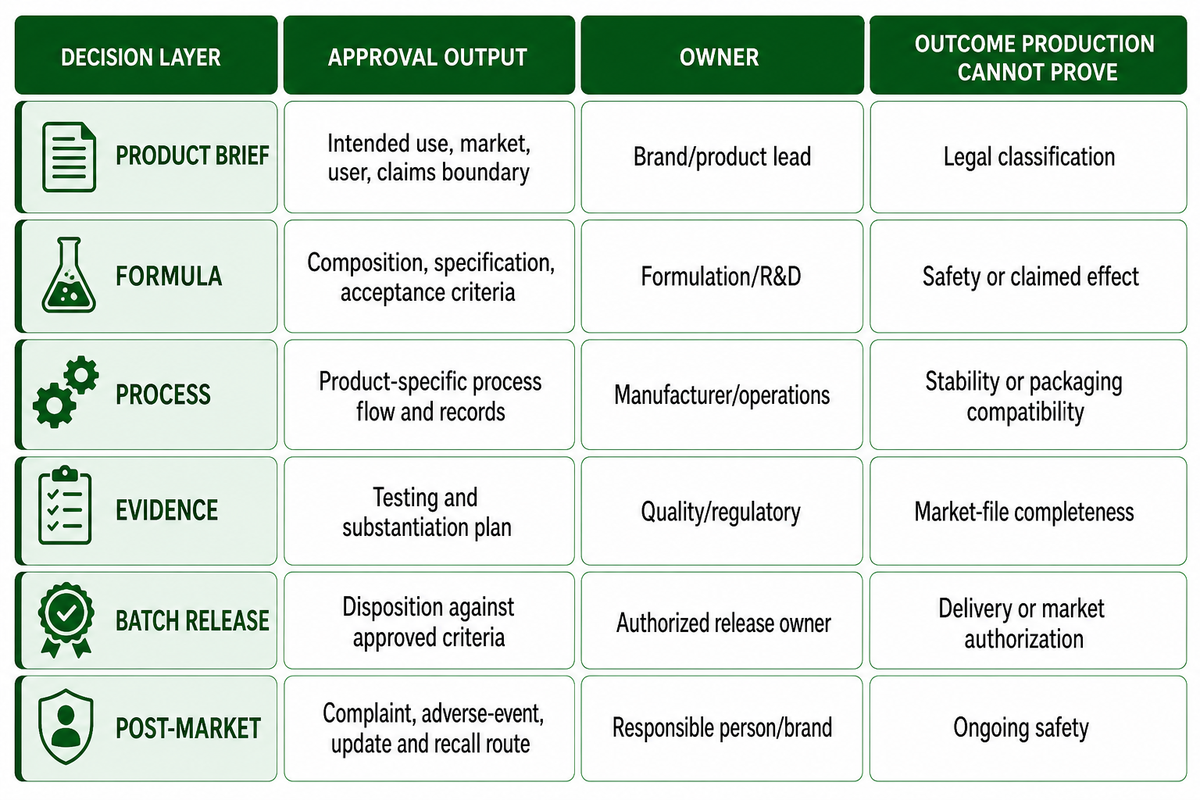
Manufacturing covers the controlled activities used to receive materials, prepare and combine the formula, hold and sample the bulk, fill the chosen package, and create batch records. Product classification, safety evidence, claims, regulatory files, release, and market entry remain linked decisions with their own owners and proof.
Classification comes first. An ordinary rinse-off cosmetic and a cleanser promoted to treat acne or another condition may not follow the same United States route. According to the FDA’s cosmetics and U.S. law overview, intended use can make a product a cosmetic, a drug, or both. Commercial labels such as OEM or ODM do not override that classification.
| Decision layer | Output to approve | Owner to name | What production cannot prove |
|---|---|---|---|
| Product brief | Intended use, market, user, claims boundary | Brand/product lead | Legal classification |
| Formula | Composition, specification, acceptance criteria | Formulation/R&D | Safety or claimed effect |
| Process | Product-specific process flow and records | Manufacturer/operations | Stability or packaging compatibility |
| Evidence | Testing and substantiation plan | Quality/regulatory | Market-file completeness |
| Batch release | Disposition against approved criteria | Authorized release owner | Delivery or market authorization |
| Post-market | Complaint, adverse-event, update and recall route | Responsible person/brand | Ongoing safety |
This scope boundary also keeps the guide from duplicating NEXO’s commercial cleanser page. Product formats, project terms, samples, and production discussions belong on the solution page; this article helps a buyer decide what to specify and verify before using it.
Build a Formula, Process–Pack Brief Before You Discuss a Batch
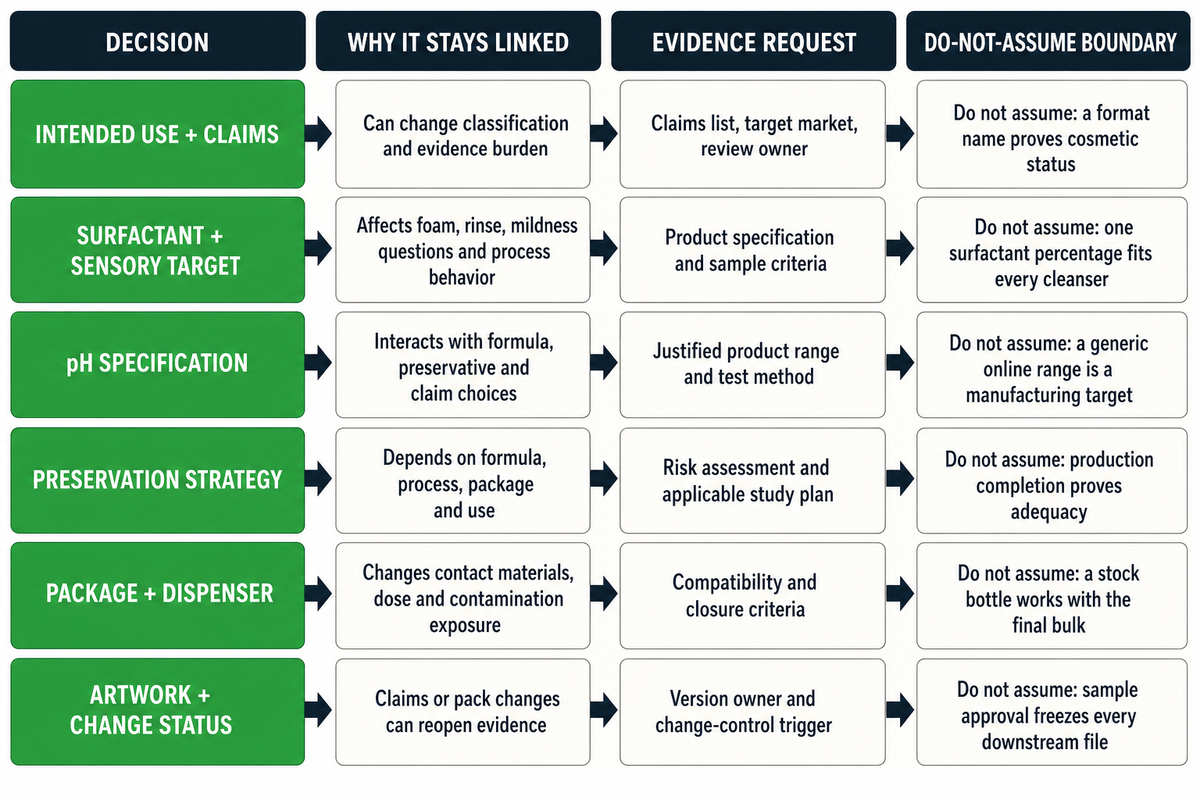
Turn each formula reference into decisions. State what the cleanser is intended to do, which claims are proposed, where it will be sold, what texture and rinse feel are expected, which pack is being considered, and which assumptions are still open.
Portfolio language can hide scope. A skincare line may include a face wash, foaming cleanser, cream cleanser, cleansing oil, toner, serum, sunscreen, hair care, body care, and other care products, but those aren’t one manufacturing route. When a brand want to customize a cleanser for a particular skin type, customization must connect the intended use to the actual formula and package.
Skincare formulation teams should write those boundaries into the brief. Each skincare brief should avoid borrowing evidence from an adjacent category, and private label skincare planning should keep every skin care product’s claims, formula, package, and market file distinct.
Claim-language screen
A private label face cleanser brief can inherit search and sales phrases such as facial cleansing, gel cleanser, cleansing mousse, skincare products, facial products, facial skin, facial care, hydrating ingredients, brightening skincare, oily or acne-prone skin, suitable for all skin types, remove dirt and oil, impurities from the skin, gently exfoliate the skin, and removing dead skin cells. Treat each phrase as a proposed claim, use description, or format clue until its scope and evidence are confirmed.
Terms such as best facial cleanser manufacturers, Korean skincare, private label skin, facial skin care, successful skincare, private label solutions, care solutions, beauty solutions, and face and body don’t define a manufacturing process or quality control plan. Ask the R&D team to connect the cleanser formulation, cosmetic formulations, packaging design, manufacturing services, and global market responsibilities before using them in customized skincare copy.
Claims need the same discipline. Words such as exfoliate, nourish, sensitive skin, skin barrier, acne-prone, acne-prone skin, excess oil, salicylic acid, hyaluronic acid, plant extracts, and active ingredients can change the evidence or classification questions. State whether the product is intended to cleanse everyday soil, cleanse makeup, cleanse excess oil, or cleanse after sunscreen use. A proposal to cleanse acne-prone skin needs specific treatment-claim screening.
Why link these inputs? The FDA’s microbiological-safety guidance identifies raw materials, water, manufacturing conditions, preservation, packaging, storage, and consumer use as possible contamination paths. A decision in one column can therefore change the evidence needed in another.
| Formula, Process–Pack decision | Why it stays linked | Evidence or confirmation to request | Do not assume |
|---|---|---|---|
| Intended use and claims | Can change classification and evidence burden | Claims list, target market, review owner | A format name proves cosmetic status |
| Surfactant system and sensory target | Affects foam, rinse, mildness questions and process behavior | Product specification and sample criteria | One surfactant percentage fits every cleanser |
| pH specification | Interacts with formula, preservative and claim choices | Justified product range and test method | A generic online range is a manufacturing target |
| Preservation strategy | Depends on formula, process, package and use | Risk assessment and applicable study plan | Production completion proves adequacy |
| Package and dispenser | Changes contact materials, dose and contamination exposure | Compatibility and closure criteria | A stock bottle works with the final bulk |
| Artwork and change status | Claims or pack changes can reopen evidence | Version owner and change-control trigger | Sample approval freezes every downstream file |
Why does pH and surfactant choice matter so much in a face cleanser?
pH and surfactant choice influence cleansing behavior, sensory feel, formula compatibility, preservation questions, and how the product interacts with skin. They don’t work as isolated scores. A low pH doesn’t automatically make a cleanser mild, and a familiar surfactant name doesn’t establish the finished formula’s performance. The buyer should ask for a justified product specification and evidence from the actual formula and package, not import a universal value from a search result.
Need help translating the use occasion and texture into a first brief? NEXO’s cleanser format selector can organize the discussion. It’s a briefing aid, not proof that a particular formula or package has passed project-specific checks.
Choose OEM, ODM, or Custom Development by Responsibility
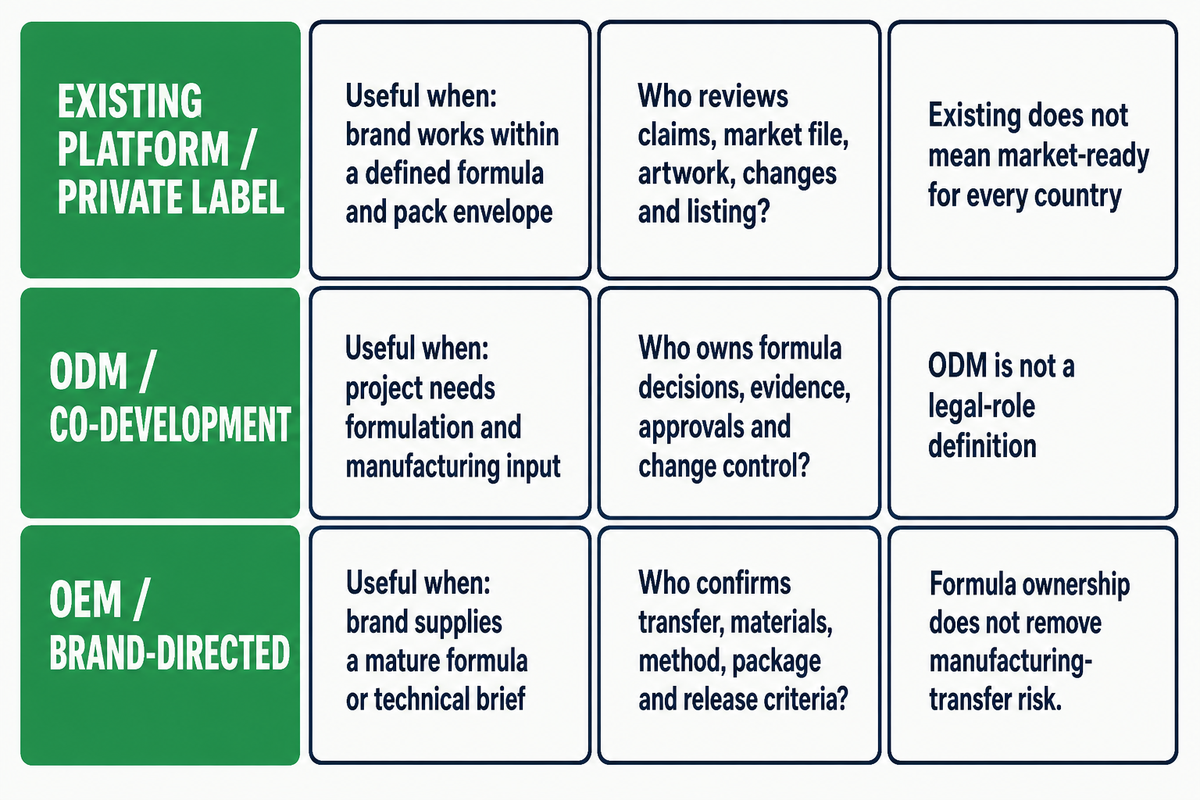
OEM, ODM, private-label, and custom-development labels describe commercial ways of organizing work. They don’t decide who’s the statutory responsible person, who owns a safety file, or whose name appears on the label. Map the project route and the legal market role on separate lines.
| Development route | Useful when | Responsibility questions | Limitation |
|---|---|---|---|
| Existing platform/private label | The brand can work within a defined formula and pack envelope | Who reviews claims, market file, artwork, changes and listing? | “Existing” does not mean market-ready for every country |
| ODM/co-development | The project needs formulation and manufacturing input | Who owns formula decisions, evidence, approvals and change control? | ODM is not a legal-role definition |
| OEM/brand-directed | The brand supplies a mature formula or technical brief | Who confirms transfer, materials, method, package and release criteria? | Formula ownership does not remove manufacturing-transfer risk |
In the United States, the definition is role-based: the responsible person is the manufacturer, packer, or distributor whose name appears on the label. European Union rules use their own responsible-person structure. Write those statutory roles into the project responsibility map after choosing a commercial route. NEXO’s facial cleanser development route comparison can help frame the operating model.
Follow the Process Sequence Through Its Control Points
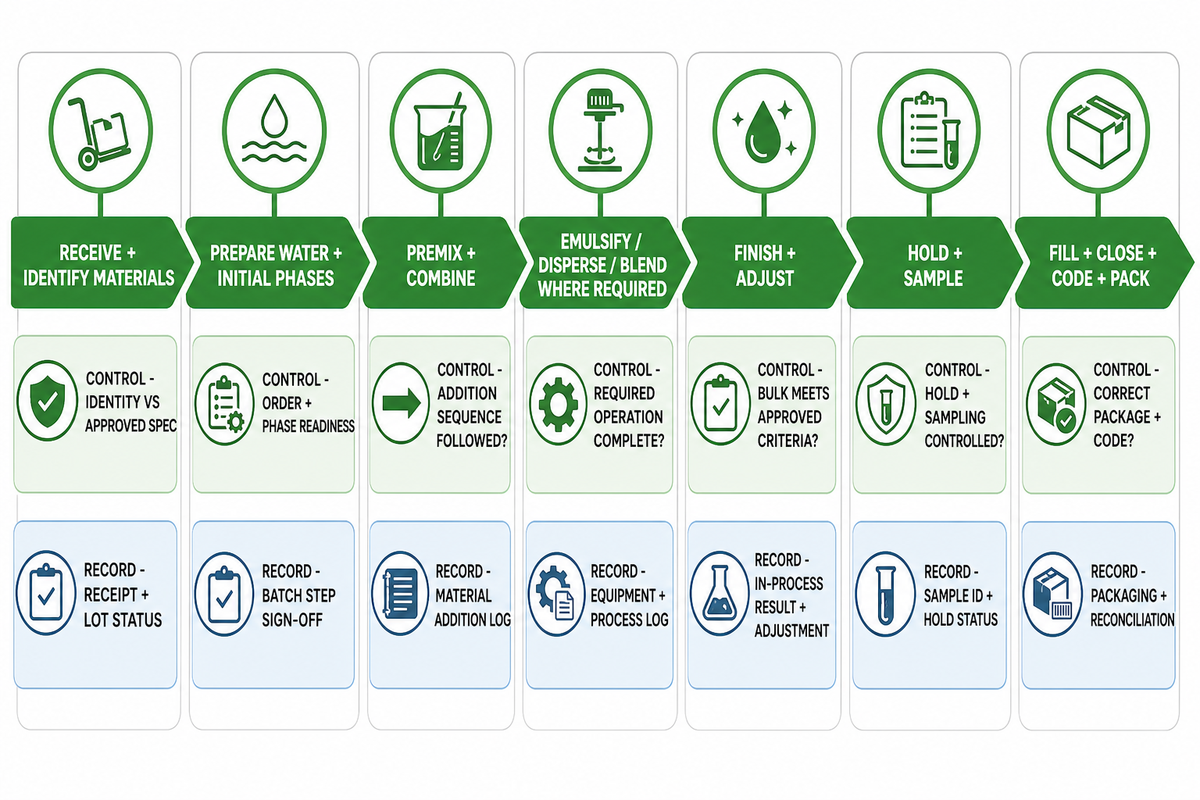
Each credible manufacturing flow is product-specific. It identifies what’s added, where and in what order; which equipment and process window apply; where the bulk may be held; how samples are taken; what happens after a deviation; and what must be true before the product enters the filling line.
FDA’s cosmetics GMP inspection checklist covers facilities, equipment, raw materials, water, production, laboratory controls, records, retained samples, complaints, and labeling. Use it as a question source, not proof that one generic flow fits every cleanser.
- Receive and identify materials. Confirm supplier, lot, status, storage, and sampling route.
- Prepare water and initial phases. Use the approved method and product-specific controls.
- Premix and combine. Record order, equipment, and the applicable process window.
- Emulsify, disperse, or blend where required. Don’t assume every gel, oil, cream, or mousse uses the same operation.
- Finish and adjust. Work only within the approved formula and specification.
- Hold and sample. Define bulk status, time limits, sampling method, and disposition authority.
- Fill, close, code, and pack. Confirm pack interaction, in-process checks, traceability, and line clearance.
How is an oil cleanser or balm different to manufacture than a gel?
Oil, balm, and gel routes differ by more than one “oil versus water” instruction. They can use different material handling, heating or cooling questions, mixing equipment, order of addition, bulk-hold behavior, and filling conditions. Gel can raise viscosity, aeration, dispersion, and pumpability questions; balm can raise melt, cooling, crystallization, and warm-fill questions; oil can raise oxidation and package-interaction questions. The approved product determines the process.
Use the 6-Link Cleanser Scale-Up Transfer Chain
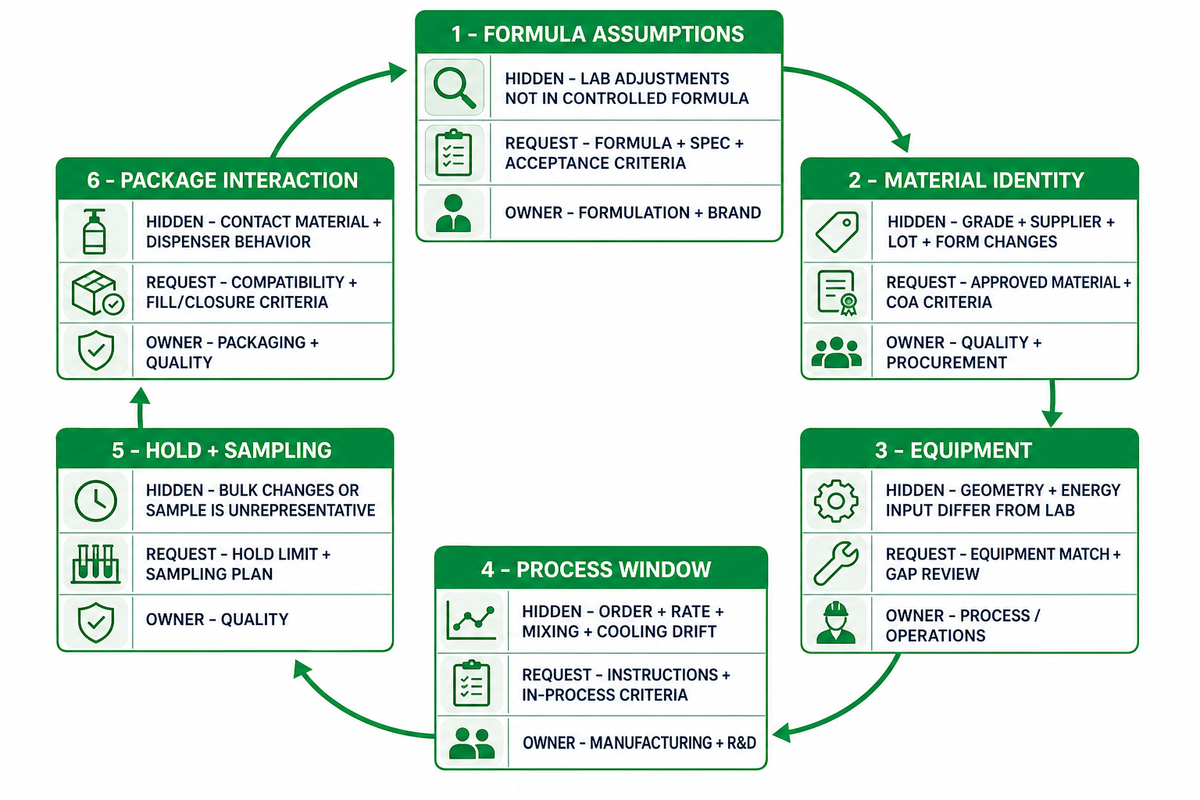
Scale-up is not recipe multiplication. It is a transfer across six connected links: formula assumptions, material identity, equipment, process window, bulk hold and sampling, and package interaction. A change at any link creates a comparability question that should be answered before the first commercial batch is treated as equivalent.
The FDA cosmetics GMP inspection checklist treats materials, equipment, production controls, laboratory controls, and records as separate review areas. That separation supports the chain’s central rule: evidence from one transfer link cannot silently clear the other five.
| Transfer link | Hidden bottleneck | Evidence request | Stop/go owner |
|---|---|---|---|
| 1. Formula assumptions | Lab adjustments are not in the controlled formula | Approved master formula and specifications | R&D |
| 2. Material identity | Grade, supplier, lot, or physical form changes | Approved source and incoming criteria | Quality/procurement |
| 3. Equipment | Geometry and energy input differ from the lab | Equipment and batch-scale rationale | Process/operations |
| 4. Process window | Order, rate, mixing, temperature, or cooling drift | Approved ranges and monitoring plan | Process/R&D |
| 5. Hold and sampling | Bulk changes before filling or sample is unrepresentative | Hold limit, sample plan, bulk disposition | Quality |
| 6. Package interaction | Fill route, contact material, closure, or dispenser changes | Compatibility and line-trial criteria | Quality/packaging |
Worked transfer example: suppose the lab sample was mixed in a small vessel and poured directly into a test bottle. The commercial route uses different geometry, a bulk hold, a pump, and a foaming dispenser. Even if the ingredient list is unchanged, the buyer should ask whether the observed viscosity, aeration, hold behavior, dose, closure, and sample plan remain comparable. The example identifies questions; it doesn’t prescribe a process.
Build a 5-Layer Cleanser Release Evidence Ladder
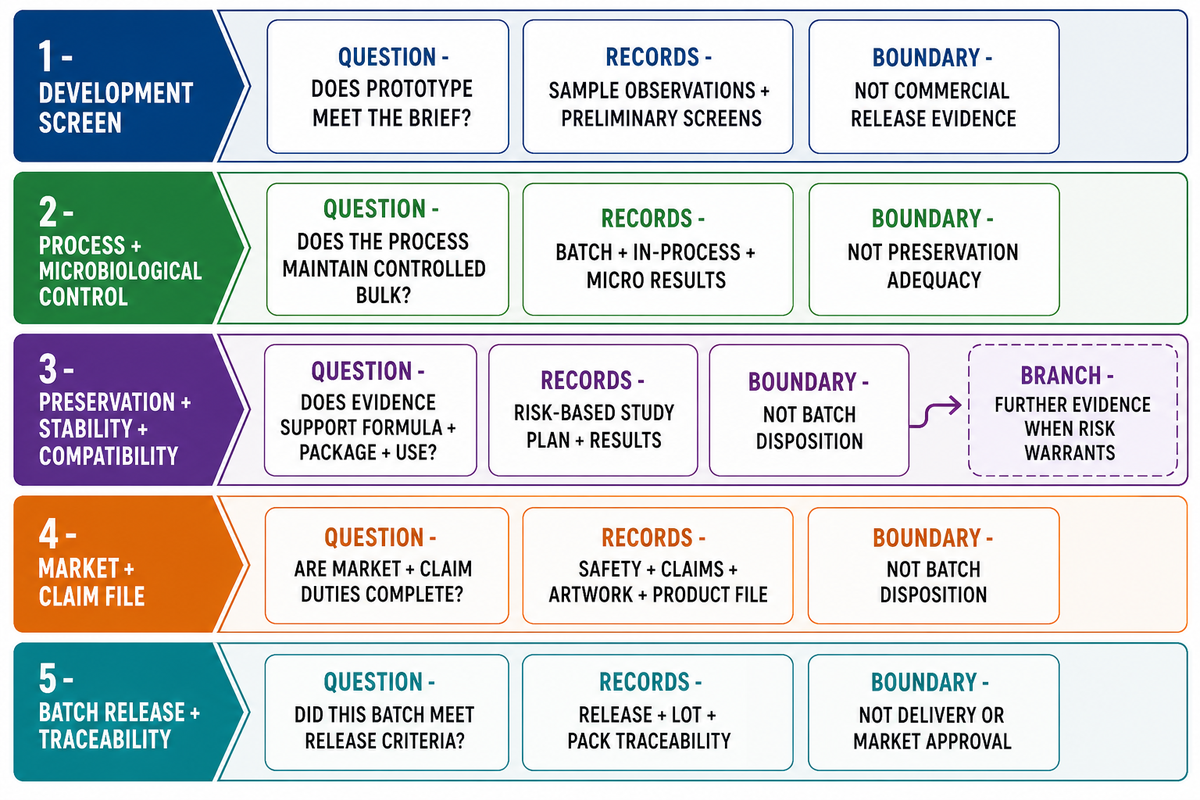
Production date isn’t a release verdict. This evidence ladder separates development screens, process and microbiological controls, preservation/stability/compatibility, market files, and batch disposition. It also branches by product risk and intended use: one preservation-efficacy route isn’t automatically applicable to every formula, package, or microbiological-risk profile.
| Evidence layer | Question answered | Example records | Boundary |
|---|---|---|---|
| 1. Development screen | Is this direction worth advancing? | Sample observations and preliminary screens | Not commercial release evidence |
| 2. Process and microbiological control | Was the controlled process followed? | Materials, water, environment, batch and in-process records | Does not replace product risk assessment |
| 3. Preservation, stability and compatibility | Can the product and pack support the proposed life and use? | Risk-based study plan and results | Method and need are product-specific |
| 4. Market and claim file | Are safety, claims and market documents ready? | Substantiation, safety report/file, notification/listing, artwork evidence | Jurisdiction and claims change the file |
| 5. Batch release and traceability | Can this batch be dispositioned? | Specifications, results, deviations, approval and distribution trace | Release is not delivery or market approval |
ISO’s 11930:2019 catalogue and Amendment 1:2022 status describe evaluation of a cosmetic product’s antimicrobial protection and the microbiological-risk route. Products determined to be low risk under the applicable assessment should not be forced through a generic checklist merely because another cleanser used it. Record the decision and its evidence.
How do you judge the quality of a facial cleanser?
Judge quality against an approved, product-specific evidence stack: formula and package specifications, controlled materials and manufacture, applicable microbiological and preservation evidence, stability and compatibility, claims and market files, batch results, deviations, and traceable release. Appearance, odor, foam, rinse feel, and viscosity can be useful acceptance attributes, but they don’t independently prove microbial safety, claim support, or market compliance.
Assign United States and European Union Responsibilities Separately
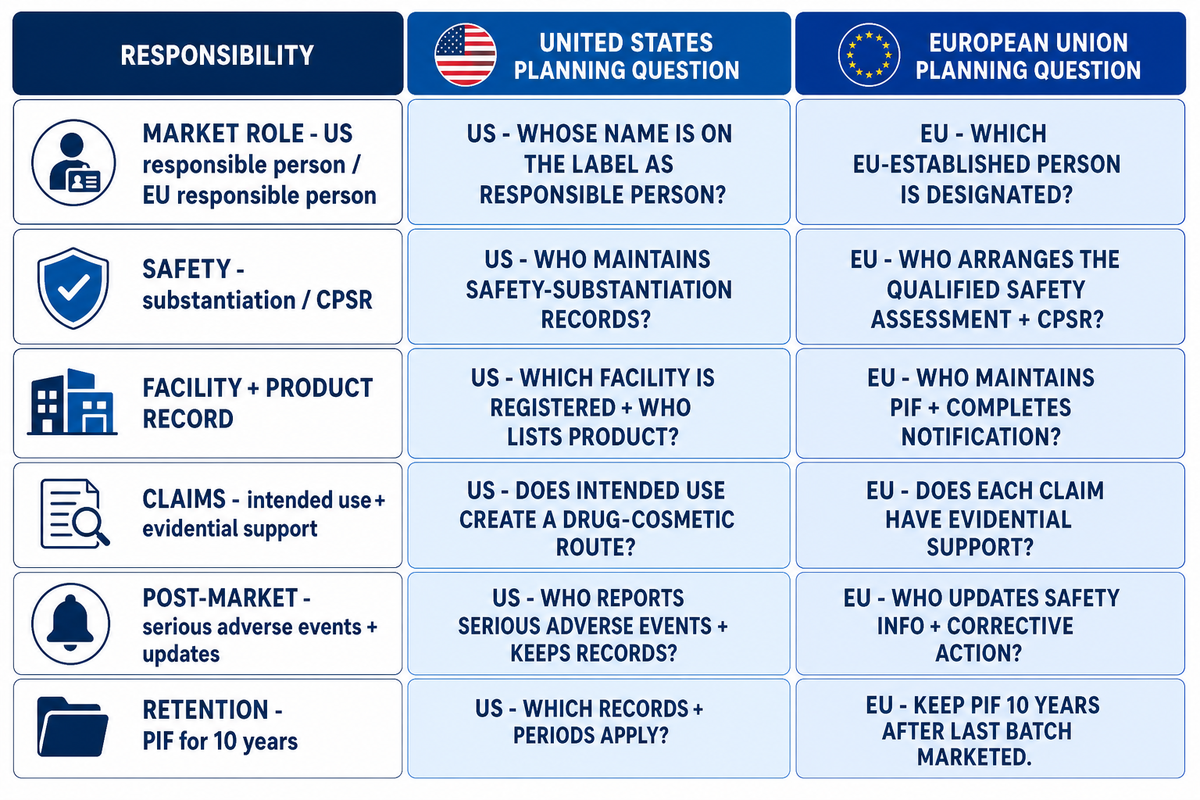
United States and European Union cosmetics rules don’t use one interchangeable file. Map the proposed label name, responsible person, facility, product listing or notification, safety evidence, claims evidence, records, adverse-event route, and post-market updates for each target market before artwork approval.
“Manufacturers and processors must register their facilities with FDA and renew their registration every two years.”
U.S. Food and Drug Administration, MoCRA overview
| Responsibility | United States planning question | European Union planning question |
|---|---|---|
| Market role | Whose name appears on the label as responsible person? | Which EU-established legal or natural person is designated? |
| Safety | Who maintains adequate safety-substantiation records? | Who arranges the qualified safety assessment and CPSR? |
| Facility/product record | Which required facility is registered and who lists the marketed product? | Who maintains the PIF and completes notification? |
| Claims | Does intended use create a drug-cosmetic route? | Does each explicit or implied claim meet common criteria and evidential support? |
| Post-market | Who receives and reports serious adverse events and maintains records? | Who updates safety information and coordinates corrective action? |
| Retention | Which records and periods apply to the role and event? | Who keeps the PIF for 10 years after the last batch is placed on the market? |
Under the FDA’s MoCRA summary, covered manufacturers and processors have registration duties, and the responsible person has product-listing, safety-substantiation, and serious-adverse-event responsibilities. Exemptions can apply, so the buyer should verify scope rather than write “all facilities” into a contract.
Current EU cosmetics rules consolidated to 1 May 2026 contain the responsible-person, safety-report, product-information-file, notification, GMP, and labeling framework. Separate EU common criteria for cosmetic claims make claim evidence its own workstream; general safety evidence can’t stand in for proof of a claimed effect.
Audit the Manufacturer with a Scope-to-Release Proof Stack
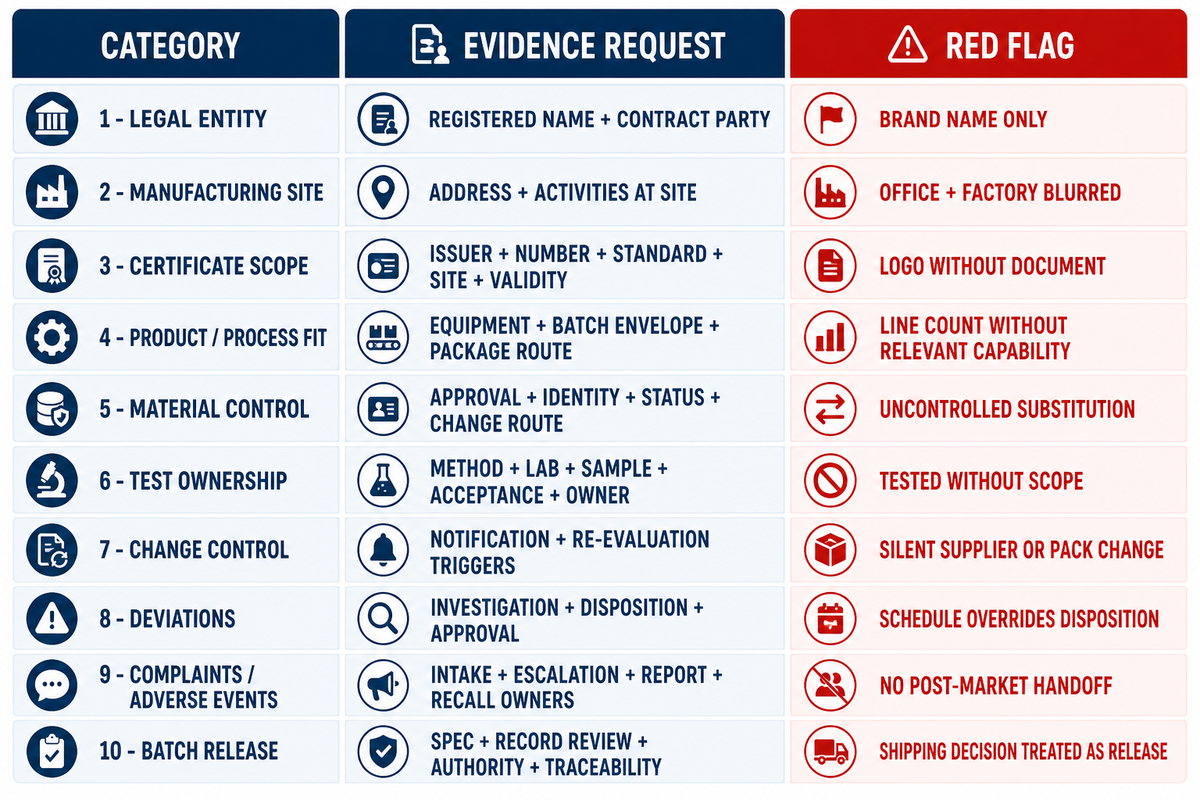
Treat a certificate image as a lead, not a conclusion. Supplier qualification should bind each document to the legal entity, physical site, product category, process, issuing body, validity period, and proposed responsibility. Useful scorecards also ask how changes, deviations, complaints, tests, and release decisions move through the project.
Buyers comparing facial cleanser manufacturing companies may search for the “best facial cleanser manufacturing” option, but a supplier list can’t answer the scope questions below. Evaluate each facial cleanser manufacturer against the proposed site, process, evidence, market role, and release responsibility.
Scope-to-Release Manufacturer Proof Stack
ISO’s official 22716:2007 page describes guidelines for cosmetic production, control, storage, and shipment. It does not certify NEXO, or any other supplier. Ask for the actual certificate, issuer, number, scope, site, and validity, then verify them with the issuing body where appropriate.
| Proof category | What to request | Red flag |
|---|---|---|
| 1. Legal entity | Registered name and contract party | Brand name only |
| 2. Manufacturing site | Address and activities performed there | Office and factory blurred together |
| 3. Certificate scope | Issuer, number, standard, site, category, validity | Logo without document |
| 4. Product/process fit | Relevant equipment, batch envelope and package route | Total line count without relevant capability |
| 5. Material control | Approval, identity, status and change route | Uncontrolled substitution |
| 6. Test ownership | Method, lab, sample, timing, acceptance, report owner | “Tested” without scope |
| 7. Change control | Notification and re-evaluation triggers | Silent supplier or pack change |
| 8. Deviations | Investigation, disposition and approval route | Schedule overrides disposition |
| 9. Complaints/adverse events | Intake, escalation, records, report and recall owners | No post-market handoff |
| 10. Batch release | Specification, record review, authority and traceability | Shipping decision treated as release |
Buyer priorities determine the weights in a supplier scorecard. A start-up may weight change control and launch support differently from a regulated retailer, but neither should convert a marketing badge into verified scope. Use NEXO’s facial cleanser RFQ readiness score to identify missing brief inputs before the evidence review begins.
Compare Cost per Accepted Unit, Not a Headline MOQ
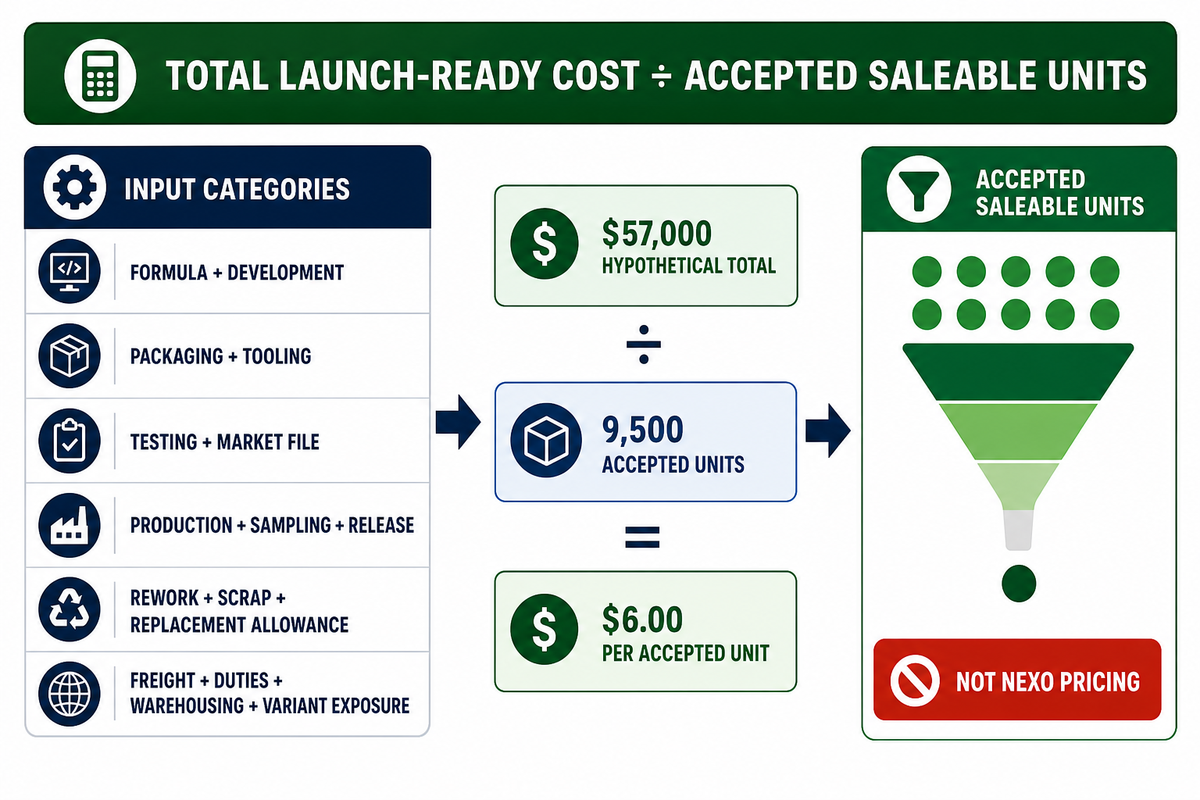
Minimum order quantity still matters: it affects setup, purchasing, packaging, freight, inventory, and cash exposure. The mistake is treating the headline quantity as the complete economic decision. Compare projects using the cost of accepted, saleable units after the relevant development, evidence, pack, production, and nonconformity assumptions are visible.
Yielded cost divides accumulated manufacturing cost by good output. A University of Maryland manufacturing-cost paper describes cost per good assembly as a process-level measure. Applying the idea to cosmetics is an editorial worksheet, not a cosmetic-industry benchmark.
Cost per accepted unit
Total launch-ready cost ÷ accepted saleable units
Illustrative calculation only: if a hypothetical project totals $57,000 and produces 9,500 accepted saleable units, the modeled cost is $6.00 per accepted unit. Replace every input with the actual quotation, test scope, packaging, freight, rework, scrap, acceptance, and inventory assumptions. This is not NEXO pricing.
- Formula or development work
- Packaging, decoration, tooling and minimums
- Testing, safety, claims and market-file work
- Production, sampling and release
- Nonconformity, rework, scrap and replacement allowance
- Freight, duties, warehousing and variant exposure
Order quantity can still be the economic bottleneck. The worksheet prevent a low unit quote from hiding a low acceptance yield or high inventory exposure; it doesn’t argue that larger or smaller orders are automatically better. For the broader sequence of brand, product and launch decisions, see how to start a cosmetic line.
Convert the Guide into an RFQ and Release Plan
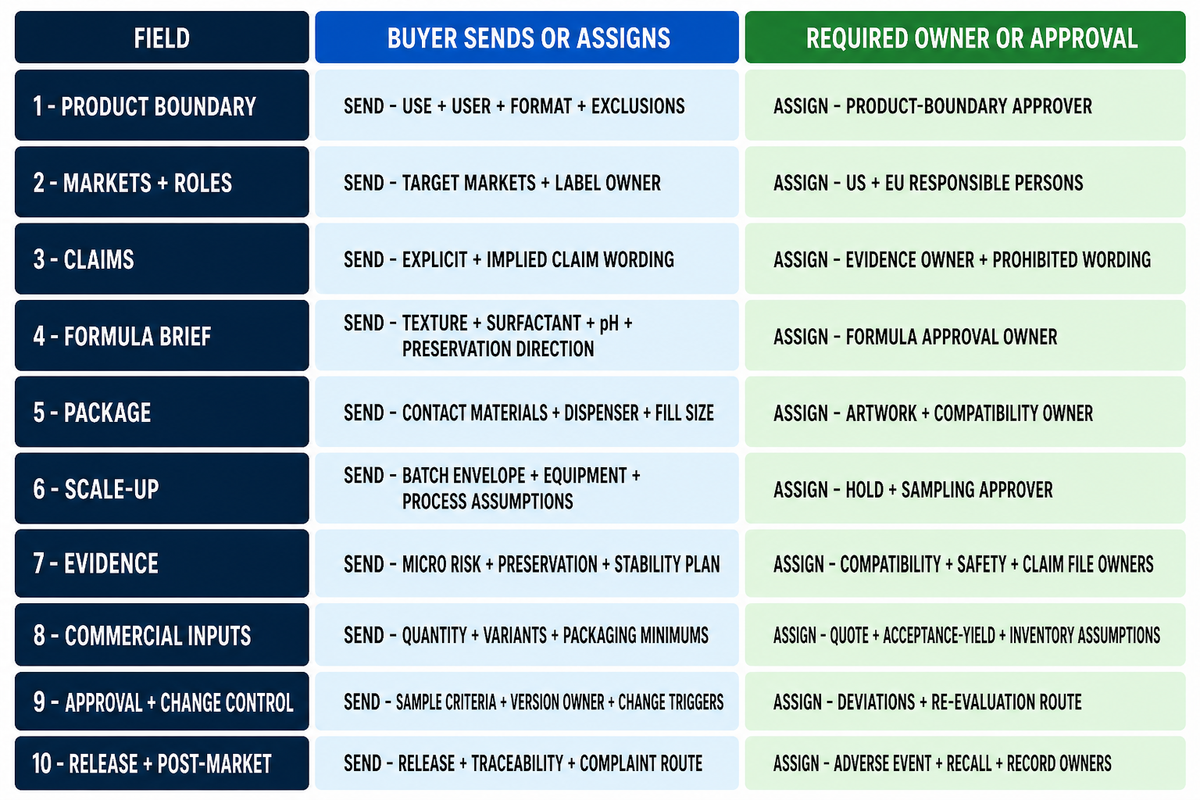
Treat the request for quotation as a responsibility map. It tells the manufacturer what the brand is trying to create, identifies the target market and intended claims, exposes open decisions, and states which evidence and approvals must exist before the project can move from sample to commercial batch and post-market support.
- Product boundary, intended use, user, rinse-off format, exclusions, and drug-like claim screen.
- Markets and roles, label owner, United States responsible person, EU responsible person, importer or distributor.
- Claims, proposed explicit and implied wording, evidence owner, and prohibited wording.
- Formula brief, texture, sensory reference, surfactant direction, pH specification approach, preservation strategy, and allergens or exclusions.
- Package, contact materials, closure/dispenser, fill sizes, artwork status, and compatibility plan.
- Scale-up, batch envelope, equipment route, process-window assumptions, hold and sampling plan.
- Evidence, microbiological-risk assessment, applicable preservation work, stability, compatibility, safety and claim files.
- Commercial inputs, quantity, variants, packaging minimums, quotation scope, acceptance-yield and inventory assumptions.
- Approval and change control, sample criteria, version owner, change triggers, deviations and re-evaluation.
- Release and post-market, batch disposition, traceability, complaints, serious adverse events, updates, recall support and retained records.
Under MoCRA, serious adverse events must be reported by the responsible person within 15 business days, while EU safety information must remain current when relevant information changes. Those duties are why the plan shouldn’t end at shipment.
NEXO Beauty Labs states that its cosmetic manufacturing foundation dates to 1999 and that it has more than 25 years of manufacturing experience. That history is context for a project conversation, not a substitute for the product-, site-, certificate-, test-, and market-specific evidence described in this guide.
Ready for the commercial discussion?
Review NEXO’s private label facial cleanser manufacturing options after the formula, market, packaging, evidence, and responsibility fields are clear.
Frequently Asked Questions About Facial Cleanser Manufacturing
What does a facial cleanser manufacturer do?
A facial cleanser manufacturer converts an approved project brief into controlled formula transfer or development, production, filling, records, and batch-disposition support within the assigned contract.
Depending on the contract, the work can include formula development or transfer, material sourcing, batch processing, filling, packaging coordination, in-process checks, documentation, and batch disposition support. The manufacturer does not automatically become the statutory responsible person, own every market file, or prove product claims merely by producing the batch. Those roles must be assigned.
What are the basic components of a facial cleanser formula?
A facial cleanser formula combines a product-specific cleansing system with texture, support, adjustment, and protection ingredients selected for its intended use and package before approval begins.
The exact structure can include water or oils, surfactants, rheology or texture modifiers, humectants, chelating or supporting ingredients, fragrance or color where used, pH adjustment, and a justified preservation approach. Oil, balm, gel, cream, micellar, mousse, and powder routes differ. No universal ingredient list or percentage should be copied into a manufacturing brief.
What testing is needed before a facial cleanser is launched?
A facial cleanser test plan is selected from the finished formula, package, intended claims, target market, microbiological risk, and the decisions each result must support.
A project may need formula and package specifications, microbiological controls, risk-based preservation evidence, stability and compatibility work, safety substantiation, claim support, and batch-release testing. United States and European Union files differ. Qualified reviewers should justify the methods, samples, conditions, acceptance criteria, timing, and owner for the actual product rather than apply one internet checklist. Low-microbiological-risk products may follow a different preservation-evidence route from water-rich products, and a claim such as acne treatment can change the product category before the test plan is even selected.
How long does facial cleanser development take?
Facial cleanser development time is a chain of separate clocks for sampling, feedback, packaging, evidence, artwork, production, release, freight, and market entry for each market.
Sampling, testing, artwork, production, release, freight, and market entry can run on different schedules. Ask what the quoted time includes and excludes.
What MOQ should a brand expect?
Facial cleanser MOQ varies with formula route, bulk batch, package, decoration, variants, component supplier minimums, filling setup, and the manufacturer’s operating envelope for the project.
Separate bulk, component, decoration, and per-SKU minimums, then compare accepted-unit cost and inventory exposure.
How This Guide Was Built
Source selection for this guide separates NEXO’s commercial cleanser page from the buyer’s manufacturing and evidence decisions. Company history is attributed to NEXO’s supplied description; regulatory and safety statements are tied to current authority sources. Unverified capacity, certification, formula-performance, and test-result claims were excluded.
References & Sources
- Modernization of Cosmetics Regulation Act of 2022 (MoCRA) U.S. Food and Drug Administration
- Registration & Listing of Cosmetic Product Facilities and Products U.S. Food and Drug Administration
- Microbiological Safety and Cosmetics U.S. Food and Drug Administration
- Cosmetics GMP Guidelines / Inspection Checklist U.S. Food and Drug Administration
- Consolidated Regulation (EC) No 1223/2009 on Cosmetic Products (1 May 2026) EUR-Lex
- Guidelines on the Cosmetic Product Safety Report European Commission Decision 2013/674/EU
- Common Criteria for the Justification of Claims Used in Relation to Cosmetic Products Commission Regulation (EU) No 655/2013
- ISO 22716:2007, Cosmetics Good Manufacturing Practices International Organization for Standardization
- ISO 11930:2019 and Amendment 1:2022, Evaluation of Antimicrobial Protection International Organization for Standardization
- A Yielded-Cost Method for Manufacturing Decisions University of Maryland CALCE