Get in touch with NEXO Beauty Labs Company


Updated August 2026 · A decision guide for skincare founders, product managers, and sourcing teams
Private Label Facial Serum Formulation Guide means more than choosing a fashionable active. Launch-ready serums connect five decisions: positioning, formula architecture, manufacturing controls, packaging, and proof. Treating those decisions as one system helps a beauty brand find conflicts while they are still inexpensive to correct.
Direct answer: Start with the product role and target experience, select the formula architecture, map ingredient and package risks, define evidence requirements, and approve samples against written criteria. Ingredient popularity alone cannot establish finished-product stability, safety, compatibility, or claim support.
Quick decision summary
- Decide the consumer job first. A clear routine role is more useful than a long active-ingredient wish list.
- Treat formula and package as one product. The same bulk serum may behave differently after repeated exposure, pumping, transport, or contact with another material.
- Separate ingredient rationale from finished-product proof. A supplier dossier does not automatically substantiate the marketed serum.
- Approve with records. A pleasant sample is a milestone, not permission to skip stability, microbiology, compatibility, safety, or claims work.
What This Guide Controls—and What the Solution Page Owns
Formulation guides should control the decisions that turn a concept into an approvable development brief. Commercial solution pages should help a buyer compare manufacturing options and start a project. Keeping those jobs separate gives searchers a clearer answer and prevents an informational article from duplicating the conversion intent of a product or service page.
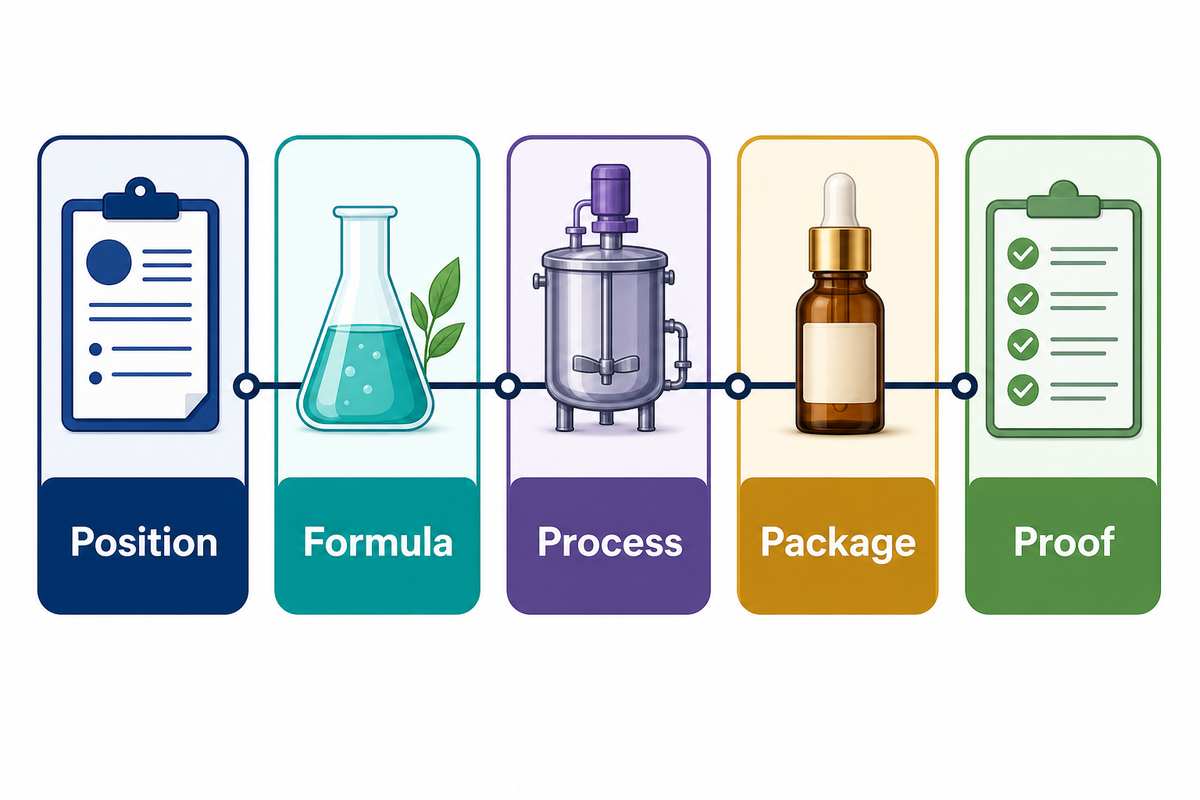
Serum Decision Chain
Serum Decision Chain is a five-link planning framework: position → formula → process → package → proof. Each link constrains the next. For example, a low-viscosity, oxidation-sensitive concept creates different filling, closure, consumer-use, and evidence questions from a cushiony emulsion-serum sold for daily hydration.
| Reader need | Use this guide | Use the commercial page |
|---|---|---|
| Build a product brief | Yes—define roles, risks, tests, and acceptance criteria | Only after the concept is clear |
| Compare formula architectures | Yes—compare development consequences | Compare available development options |
| Ask about MOQ, timing, or a quote | No | Yes |
If your team is already comparing manufacturing support rather than learning the decision process, explore NEXO’s private label facial serum development options. This article stays focused on the informational job.
Start With a Four-Lock Serum Brief
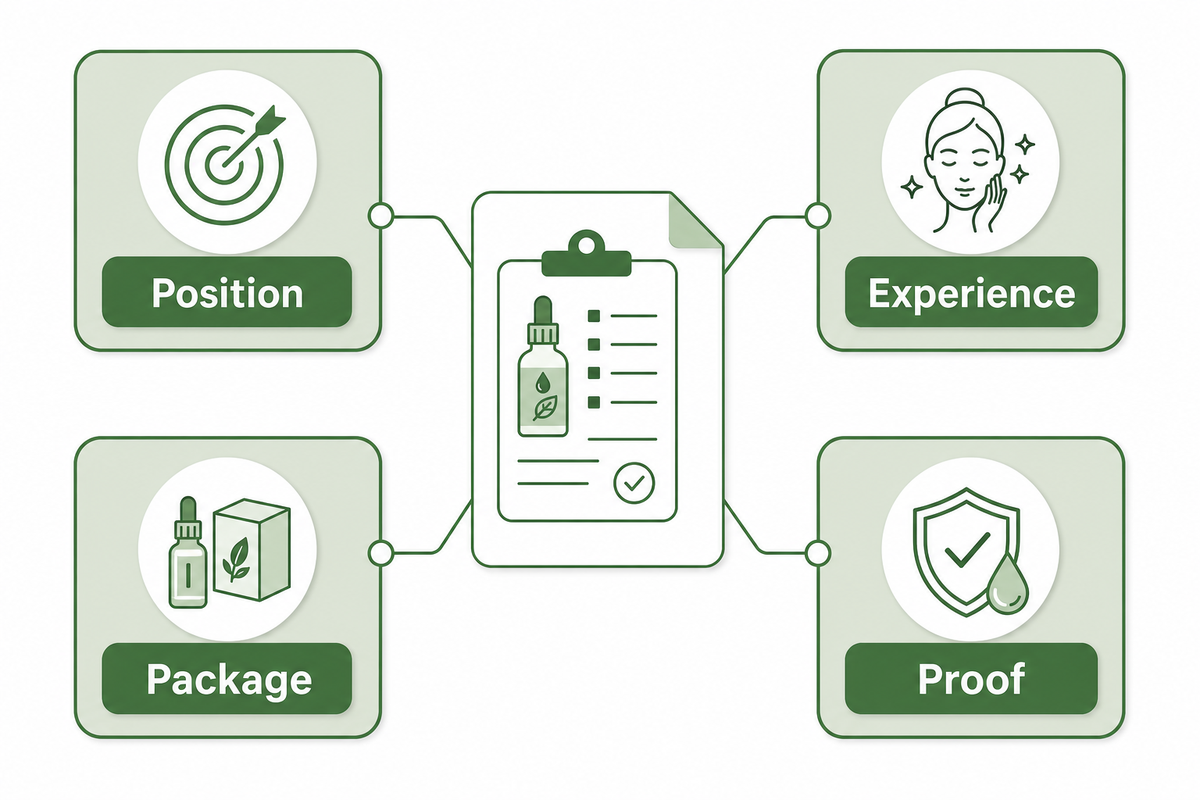
Useful serum briefs lock four connected areas before prototype work expands: position, experience, package, and proof. “Lock” does not mean every detail is permanent. It means every assumption is visible, has an owner, and includes a measurable condition for approval or a named reason to revisit it.
Four-Lock Brief
The Four-Lock Brief is a development worksheet that assigns an owner, acceptance condition, and unresolved assumption to each critical decision. It prevents a change in one department from silently invalidating another department’s work.
| Lock | Questions to settle | Example acceptance condition | Typical owner |
|---|---|---|---|
| 1. Position | Target user, routine slot, cosmetic benefit direction, use occasion, price tier | The concept can be explained in one appearance-focused sentence | Brand/product lead |
| 2. Experience | Appearance, slip, spread, tack, absorption, after-feel, finish, fragrance, pilling tolerance | Panel records an agreed rating on defined comparison samples | Product development |
| 3. Package | Format, dose, contact materials, light/oxygen exposure, application hygiene | Intended component set delivers the agreed dose without leakage or clogging in the protocol | Packaging/operations |
| 4. Proof | Target markets, claim wording, safety, stability, microbiology, compatibility, decision owners | Every proposed claim maps to an evidence owner and approval step | Regulatory/brand |
One common failure starts when marketing approves “fast-absorbing and dewy,” procurement selects a package before viscosity is defined, and the evaluator later rejects the prototype for tack. Nothing is technically wrong in isolation; the acceptance language was incomplete. Record the sensory target using spread, absorption, after-feel, and finish as four separate dimensions. NEXO uses those dimensions as a first-party briefing method, not as an industry standard.
Common mistake: “Suitable for sensitive skin” is not a complete brief. Identify the intended user, ingredients or sensations to avoid, claim wording, evaluation method, and who is qualified to approve the conclusion.
Choose the Serum Architecture Before the Hero Active
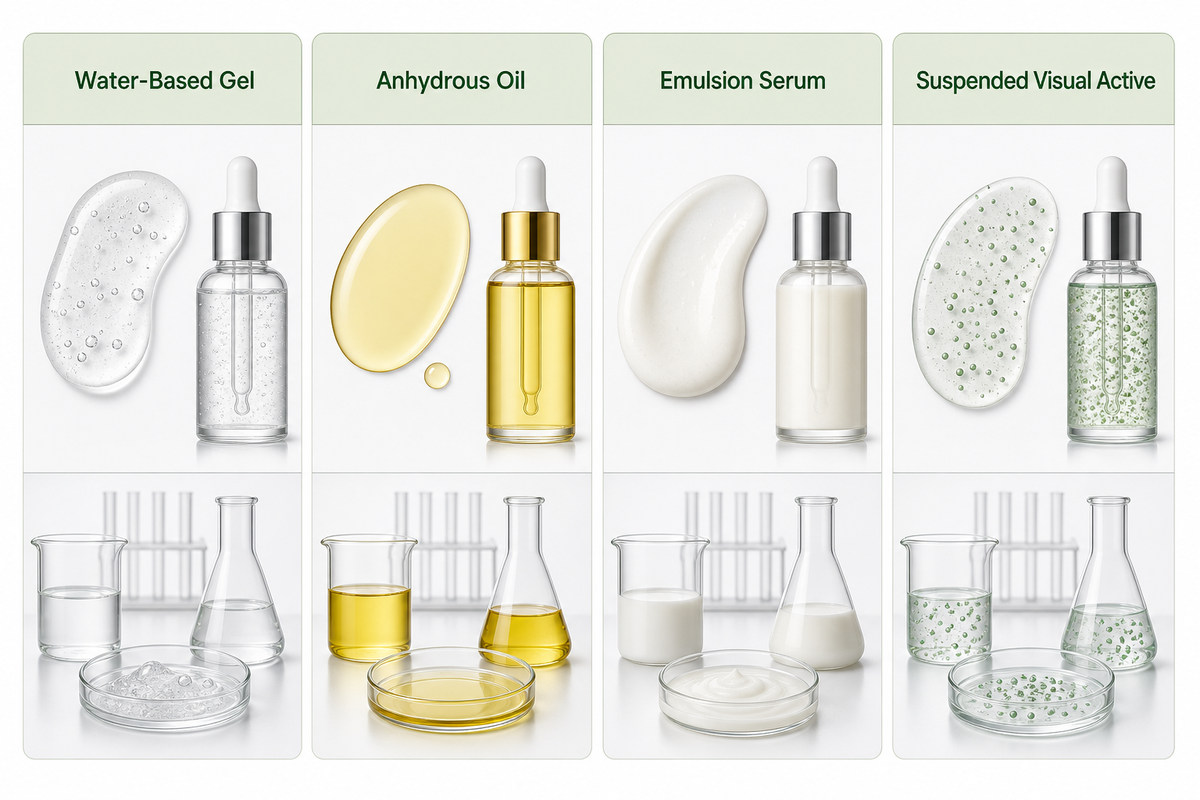
Serum architecture determines the development questions that a hero ingredient must survive. “Serum” is a market format, not one chemistry: a clear water gel, an anhydrous oil, a light emulsion, and a suspended visual-active product can all be sold as face serum products while requiring different process, preservation, sensory, and packaging controls.
| Architecture | Consumer experience | Formulation challenge | Preservation question | Package implication | Limitations / not suitable for |
|---|---|---|---|---|---|
| Water-based gel | Fresh, light, quick spread | Viscosity, electrolyte load, pH, pilling | Water activity and preservation-system adequacy need explicit review | Pump or dropper must match rheology and dose | Poor choice when the brief requires only oil-soluble materials without a delivery strategy |
| Anhydrous oil | Rich slip, emollient finish | Oxidative stability, odor, color, greasy after-feel | Water absence changes, but does not eliminate, contamination and use-risk review | Seal/material compatibility and controlled drop size matter | May conflict with an oil-free positioning or very dry-touch target |
| Light emulsion-serum | Cushioned, layered hydration | Phase stability, droplet system, viscosity drift | Aqueous phase and manufacturing hygiene affect the plan | Pump path, shear, and evacuation require testing | Not ideal when crystal clarity or a true oil-only claim is mandatory |
| Suspended or microbead direction | Visible differentiation and texture cues | Uniform suspension, breakage, settling, dose consistency | System-specific, including particles and consumer use | Orifice size and pump/dropper geometry become critical | Avoid when visual uniformity or a narrow delivery path cannot be controlled |
Architecture also affects routine compatibility. Humectant-rich hyaluronic acid serum may feel elegant alone but pill beneath sunscreen if polymer load, rubbing, dose, and application sequence interact poorly. Oil serum formats may support a nourishing position yet feel out of place beneath a lightweight daytime makeup routine. Prototype evaluation should therefore include the intended skincare routine, not only a forearm rub-in. This skincare formulation check should cover the relevant skin types and the dose consumers are expected to apply.
Turn Hero Ingredients Into a Risk Register
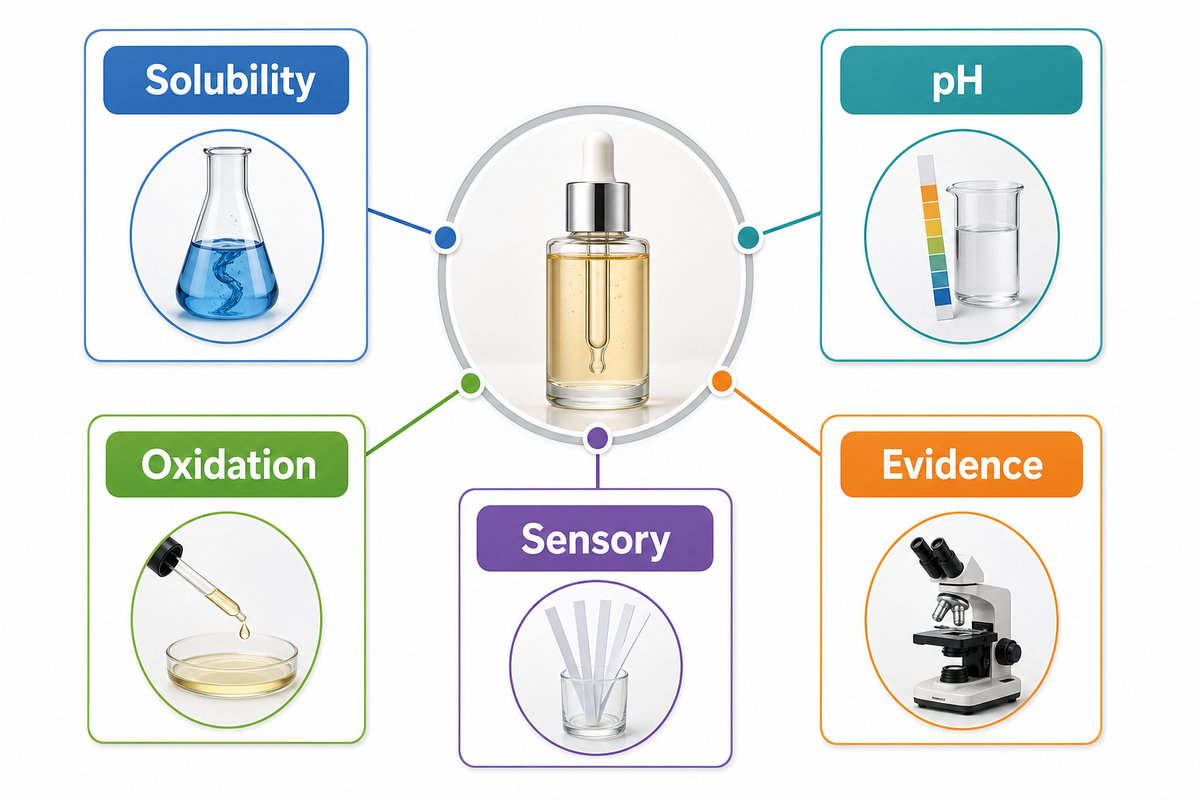
Hero actives should be translated into formulation, package, sensory, and claim questions before they become front-label promises. Hyaluronic acid, niacinamide, vitamin C, peptides, and retinol are not interchangeable marketing decorations; each may introduce different solubility, pH, oxidation, color, odor, tolerance, viscosity, and evidence considerations.
Use one primary “job” for the serum and let supporting ingredients help that job. A hydration concept might use hyaluronic acid as part of a broader humectant and sensory system. An antioxidant or anti-aging serum direction using vitamin C must define the selected material, claim boundary, discoloration tolerance, exposure risk, and package strategy. “Vitamin C” alone is not a complete technical instruction, and skin concerns do not justify therapeutic wording.
| Risk question | Hyaluronic acid | Niacinamide | Vitamin C direction | Peptide direction | Retinol direction |
|---|---|---|---|---|---|
| 1. Solubility/dispersibility | Grade and hydration method affect handling | Confirm complete incorporation in the chosen base | Depends on selected form and vehicle | Follow supplier handling and compatibility data | Vehicle and delivery approach are central |
| 2. pH window | Check polymer behavior in the complete system | Define with the full formula and claim plan | Selected derivative/form drives the question | Use material-specific documentation | Assess stability and tolerance in the full system |
| 3. Light/oxygen sensitivity | Usually not the only package driver | Assess complete-formula drift | Often a major development variable | Material-specific | Often a major development variable |
| 4. Viscosity interaction | Can change stringiness, slip, and pilling | Check electrolyte/polymer interaction | Check system-specific change over time | Check with rheology system | Check vehicle and package delivery |
| 5. Color/odor drift | Set finished-product criteria | Monitor full formula | Define acceptable change before testing | Monitor with selected raw material | Define acceptance tightly |
| 6. Tolerance/use | Evaluate tack and routine fit | Align concentration and communication with product assessment | Usage and claim language need care | Avoid assuming all peptides share one profile | Usage directions and market rules matter |
| 7. Claim boundary | Hydration/appearance wording needs evidence | Brightening or appearance claims need support | Avoid disease or structure/function promises | Do not borrow supplier claims blindly | Therapeutic language creates regulatory risk |
| 8. Package dependency | Viscosity/dose delivery | Material and formula compatibility | Exposure and headspace strategy | Material-specific protection | Light/oxygen and dosing control |
| 9. Evidence owner | Brand + formulator + lab | Brand + formulator + lab | Brand + formulator + package/lab | Brand + supplier + formulator/lab | Brand + regulatory + formulator/lab |
Ingredient supplier dossiers can support identity, handling, and scientific rationale for a raw material. They cannot, by themselves, prove that the finished skincare product delivers a marketed outcome after processing, packaging, storage, transport, and consumer use. Finished-product efficacy testing should follow the exact claim rather than the most impressive test available. Brands may customize a private label serum, but every permitted customization must be checked for its effect on the formula, package, evidence, and change record.
Design Stability, Microbiology, and Package Tests as One Program
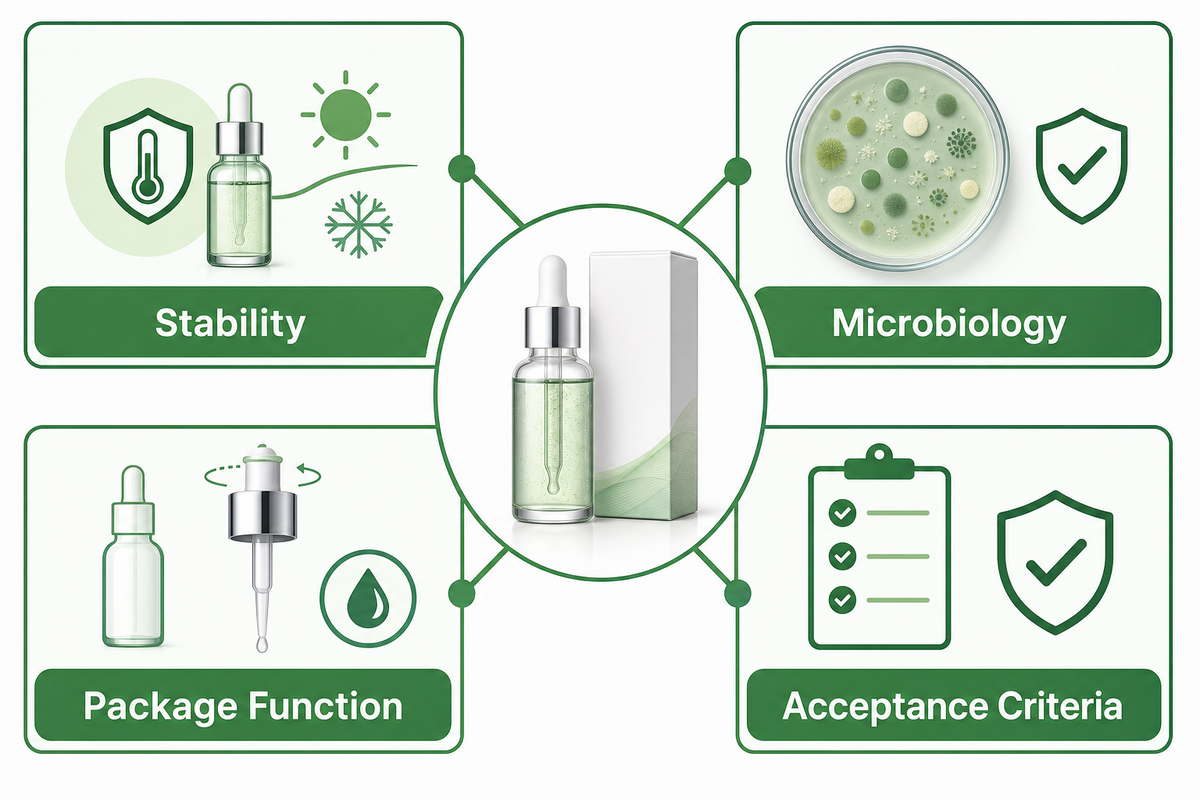
Defensible testing programs bind the intended formula to the intended market package, foreseeable storage and use conditions, defined time points, and pre-agreed acceptance criteria. Stability, microbiological quality, preservation-system adequacy, and package function answer different questions, but their results must be interpreted together rather than as unrelated certificates.
“Manufacturers can use relevant safety data that is already available.”
FDA’s cosmetic product-testing guidance does not prescribe one universal checklist for every cosmetic. Marketers remain responsible for safety, so the protocol should follow the actual risk profile. For EU planning, the cosmetic product safety report addresses stability under reasonably foreseeable storage conditions and microbiological quality.
Failure Budget Matrix
Failure Budget Matrix is a pre-test register that gives every foreseeable failure an early signal, confirmation check, and decision owner. It does not predict that a failure will occur; it prevents a vague observation from drifting without a resolution path.
| Failure mode | Early signal | Possible contributors | Confirmation question | Decision owner |
|---|---|---|---|---|
| Oxidation | Color/odor change | Formula, headspace, light, closure, process | Does change exceed the predefined criterion? | Formulator + package lead |
| Viscosity drift | Dose or spread changes | Polymer, electrolyte, temperature, shear | Was rheology measured under the same conditions? | Formulator |
| Precipitation | Particles or sediment | Solubility, pH, temperature, interaction | Is the change reversible and acceptable? | Formulator |
| Phase change | Separation or creaming | Emulsion system, process, temperature | Which condition reproduces the change? | R&D/process |
| Microbial protection concern | Test result or contamination signal | Water, raw materials, process, preservation, use | Does the intended system control foreseeable contamination? | Microbiology/quality |
| Delivery failure | Leak, clog, variable dose, poor evacuation | Viscosity, particle size, component tolerance, transport | Does the intended retail set perform throughout use? | Packaging/operations |
Contamination can enter through raw materials, water, manufacturing, ineffective preservation, packaging, storage, or use, as summarized by the FDA microbiological safety guidance. Water-containing serums therefore deserve an explicit risk review. “Preservative included” is not a result, and a clean initial sample does not establish protection across its intended life.
Match the Package to the Formula and Use Pattern
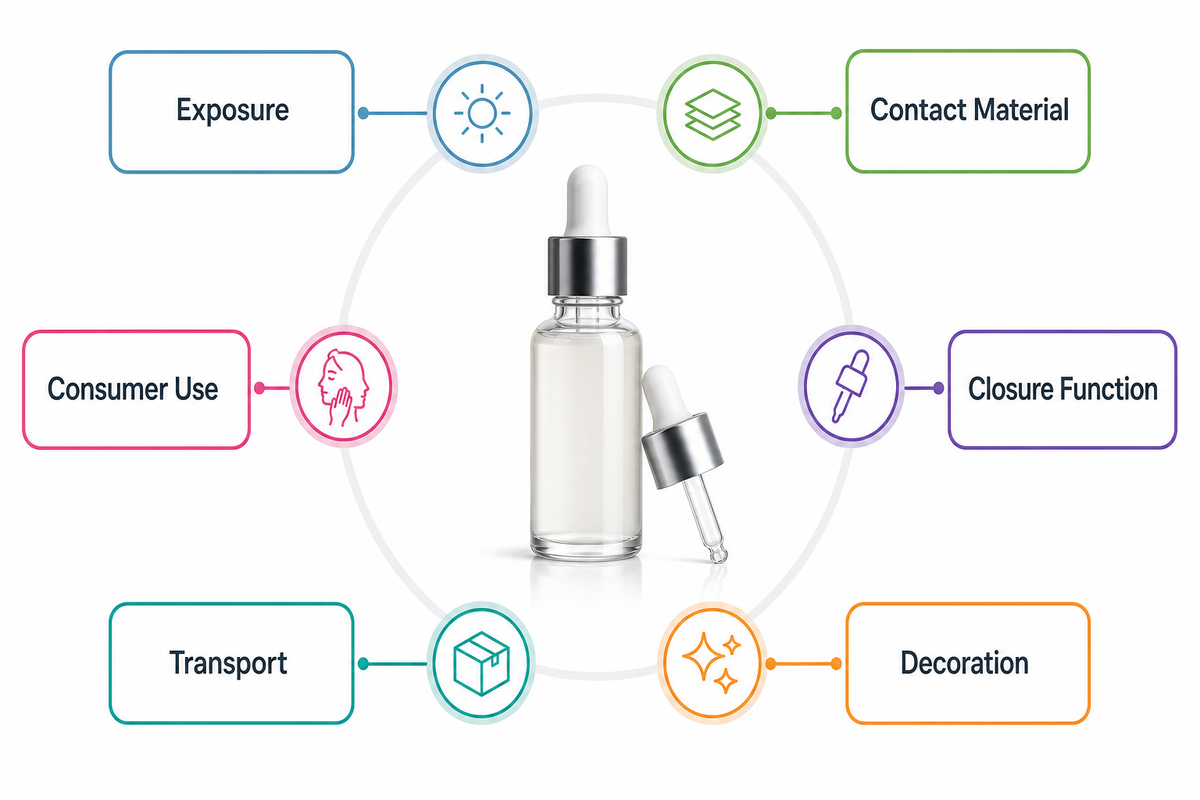
Serum packaging should be selected against formula rheology, sensitivity, dose, contact materials, transport, and consumer behavior. Droppers, pumps, and airless systems create different exposure and delivery conditions; none is automatically superior. The relevant question is whether the complete retail set works consistently with the approved bulk formula.
Package Stress Map
Package Stress Map is a six-zone compatibility review: exposure, contact material, closure function, decoration, transport, and consumer use. Every zone needs a responsible owner and an observable pass/fail condition.
| System | Potential advantage | Questions to verify | When not to assume it fits |
|---|---|---|---|
| Dropper | Familiar premium ritual; suitable for some low-viscosity systems | Drop consistency, closure seal, user contact, exposure, glass/elastomer compatibility | Do not assume suitability for thick, suspended, or exposure-sensitive formulas |
| Pump | Controlled delivery and reduced direct contact | Priming, dose variance, clogging, spring/path compatibility, leakage | Do not assume one pump handles every viscosity or particle system |
| Airless system | May reduce some exposure and improve evacuation | Bag/piston behavior, paneling, priming, dose, residual product, material contact | “Airless” is not proof of compatibility or complete oxygen protection |
Consider a light emulsion-serum that passes bulk observations in a jar but intermittently loses prime in the selected airless pack after transport conditioning. Reworking the formula to suit the pump can change sensory acceptance; changing the pump can change cost, decoration, and dose. Neither component should be declared defective without investigation. Reopen the formula–package interface, reproduce the failure, and document the approved revision.
When not to buy packaging on appearance alone
Visual appeal does not make a component production-ready. Delay a volume commitment when the final formula version, contact materials, closure path, dose target, decoration, and transport conditions are still changing. Compatibility review may include leakage, clogging, paneling, discoloration, odor transfer, evacuation, decoration adhesion, and delivery consistency where relevant. Your final protocol must fit the product; this list is not universal.
Build Claims and Market Responsibility Into Development
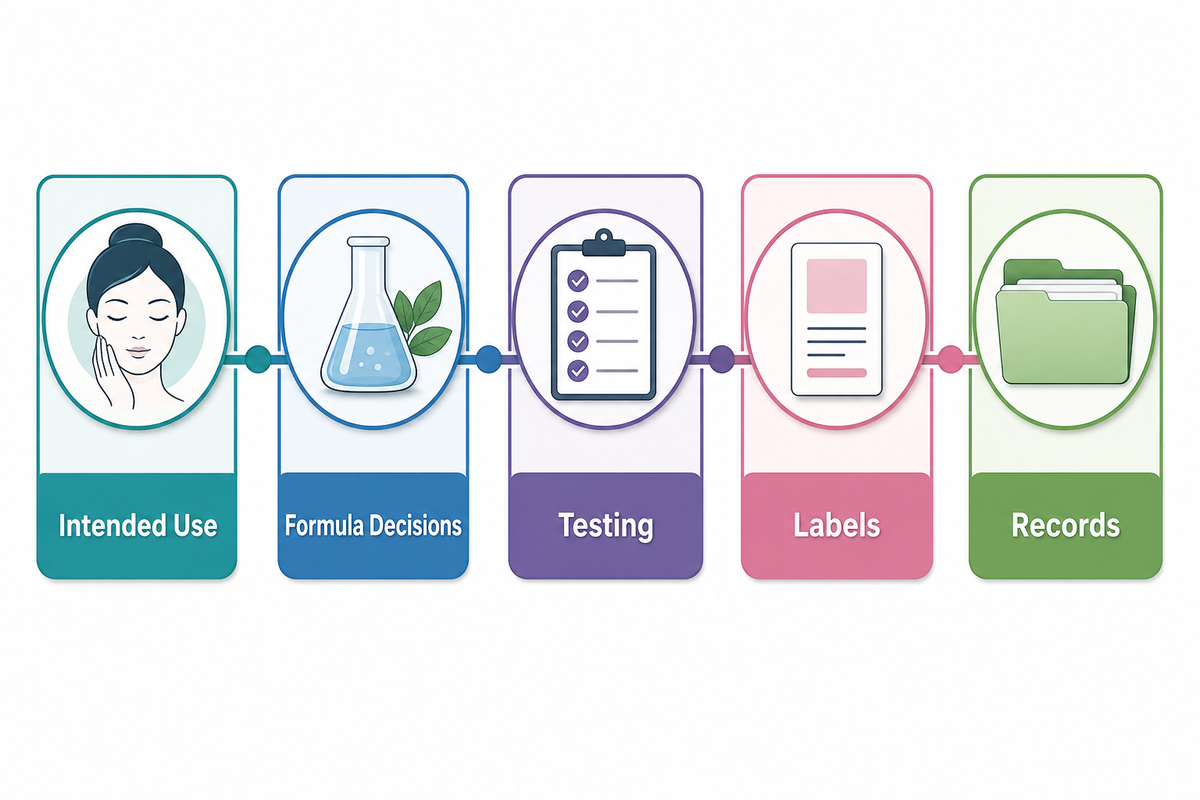
Claims and market responsibilities belong in the development brief because they influence formula decisions, testing, labels, and records. In the United States, intended use can determine whether a product is regulated only as a cosmetic or also as a drug. In the EU and Great Britain, responsible-person and safety-file duties must be planned before market placement.
FDA’s cosmetics claims guidance explains that disease-treatment and structure/function claims can establish drug intended use. Appearance-focused language such as “helps skin look smoother” still needs truthful, non-misleading support; it is not automatically acceptable simply because it avoids a disease word.
Under MoCRA, FDA describes the responsible person as the manufacturer, packer, or distributor whose name appears on the label under the relevant law. Product-listing duties and annual updates are subject to the actual facts and applicable exemptions. Confirm the label arrangement rather than assuming the factory always owns the role. For a deeper launch-level overview, see how to start a skincare line with manufacturing and compliance decisions aligned.
| Party | Typical development input | What must not be assumed |
|---|---|---|
| Brand/label owner | Market, audience, claims, label and commercialization decisions | A manufacturer automatically owns every market obligation |
| Formulator/manufacturer | Feasibility, formula/process controls, specifications, change records | GMP alone proves performance claims |
| Test laboratory | Defined methods, results, deviations, reports | One test report answers every safety or efficacy question |
| Packaging supplier | Component specifications, material information, samples | A catalogue label proves compatibility with the formula |
| Market responsible person | Market-access review and required records/submissions | The role is identical across jurisdictions |
EU cosmetics rules require a responsible person, cosmetic product safety report, and product information file for products placed on the market. Regulation (EC) No 1223/2009 is the primary legal text. ISO 22716 supports good manufacturing practice for production, control, storage, and shipment; its stated scope excludes research and development, so it does not prove formula efficacy or replace product-specific testing.
This section is development guidance, not legal advice or market clearance. Obtain qualified regulatory review for the actual formula, claims, label, parties, and destination markets.
Score Samples Before You Approve Them
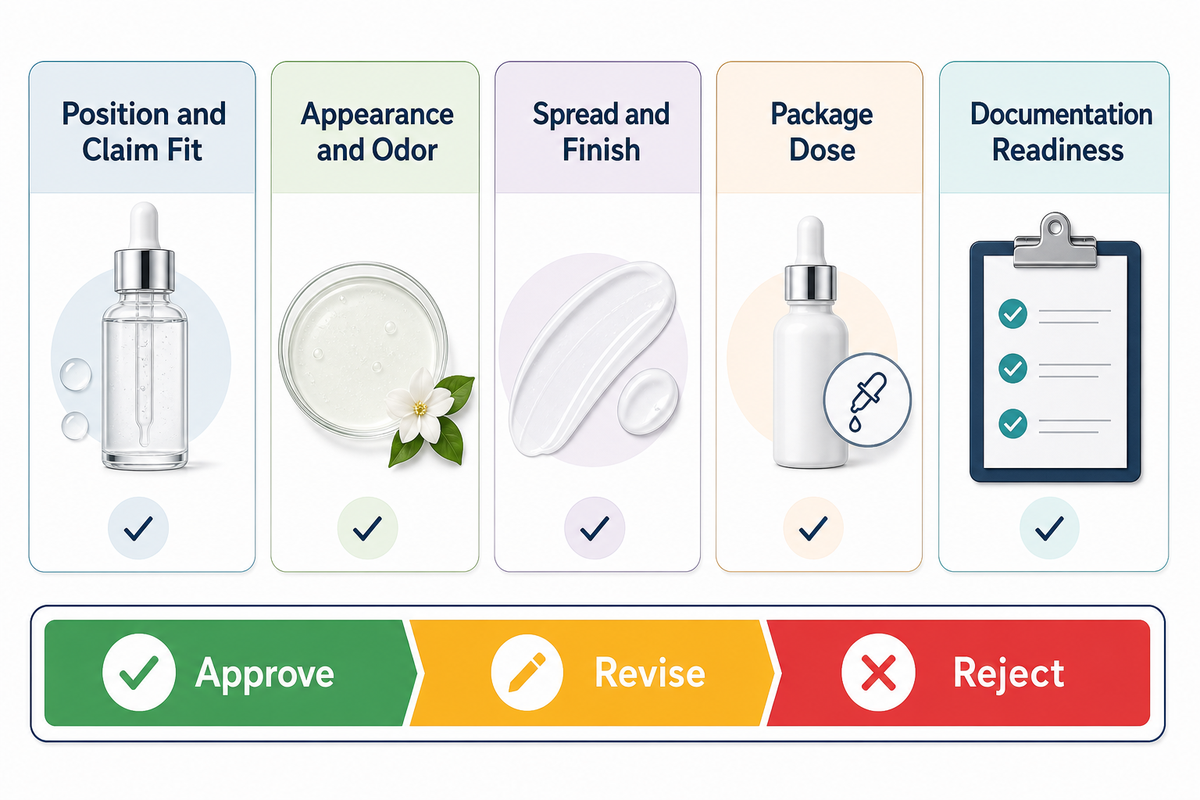
After regulatory and evidence responsibilities are assigned, sample approval should compare an identified prototype against written position, sensory, package, and documentation criteria. Written scoring makes trade-offs visible and keeps “I like it” from becoming the only record. Our suggested 100-point model below is an editorial framework, not a safety standard or evidence of product performance.
100-Point Sample Scorecard
100-Point Sample Scorecard weights seven approval areas and always records an approve, revise, or reject decision with reasons. Teams may change the weights before evaluation, but should not change them after seeing the preferred sample.
| Evaluation area | Suggested points | Record |
|---|---|---|
| Position and claim fit | 15 | Does the sample deliver the intended cosmetic role? |
| Appearance and odor | 10 | Observe under defined lighting and conditioning |
| Spread, absorption, after-feel, finish | 25 | Rate dimensions separately |
| Pilling and routine compatibility | 10 | Use agreed companion products and dose |
| Package dose and usability | 15 | Record priming, delivery, leakage, and handling |
| Early observations/documentation readiness | 15 | Do not confuse early observations with completed studies |
| Decision-record completeness | 10 | Sample code, evaluator, benchmark, deviations, decision |
| Total | 100 | Approve / revise / reject, with owner and next action |
Suppose a launch team scores two prototypes 82 and 79. One version wins on immediate sensory appeal but loses package-dose points because it strings at the dropper tip; the other pumps consistently and fits the routine better. Totals alone cannot decide. Review the failed criteria, their severity, and whether revision would affect testing already performed.
Safety boundary: A 95-point sensory score cannot replace formal safety assessment, stability work, microbiology, package compatibility, or finished-product claim evidence.
Prepare the Manufacturer Handoff
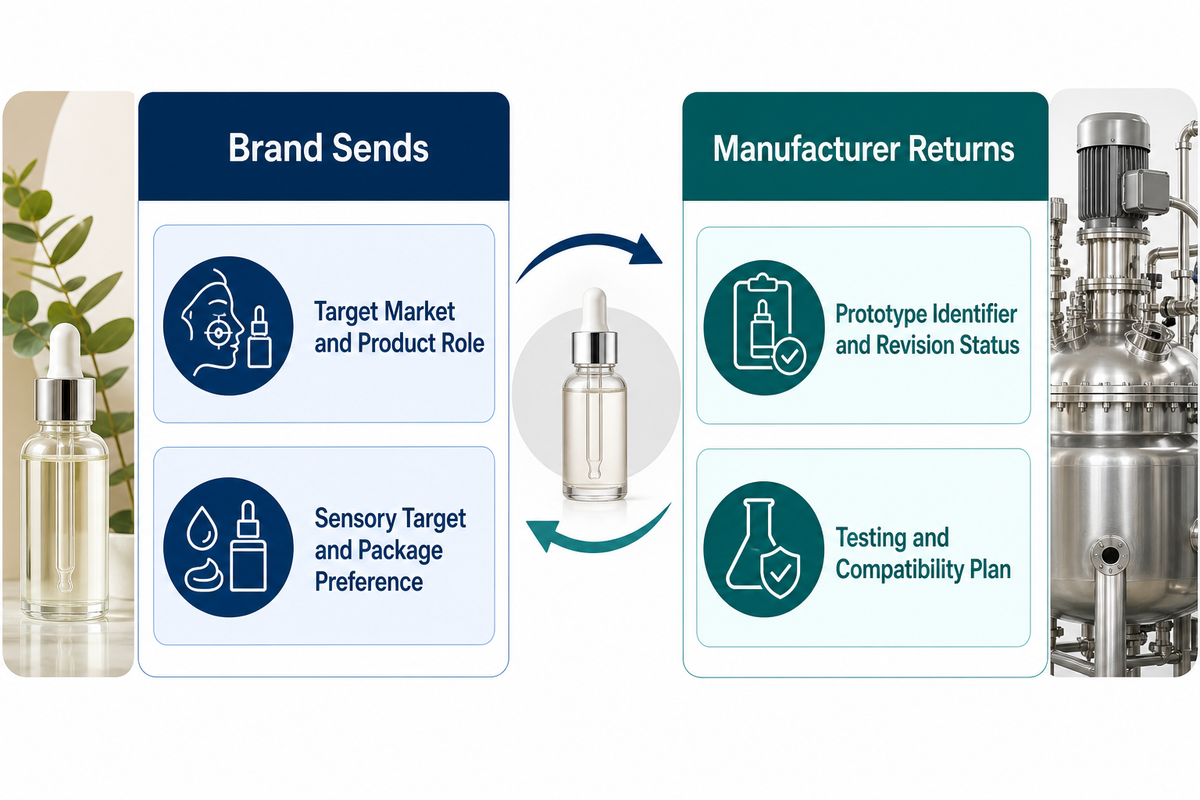
Manufacturer handoffs should exchange two controlled packages: the brand sends the commercial and experiential intent, while the serum manufacturer returns feasibility, prototype, process, testing, and change-control information. Completion requires open assumptions and decision owners to be visible on both sides, whether the project uses private label manufacturing, contract manufacturing, or custom serum formulation.
Brand sends
- Target market and product role
- Consumer benchmark and skincare concerns
- Must-have and must-avoid constraints
- Sensory target and package preference
- Claim hypothesis and evidence threshold
- Decision owners and change authority
Manufacturer returns
- Feasibility notes and architecture
- Prototype identifier and revision status
- Process-sensitive controls
- Testing and compatibility plan
- Change log and specification inputs
- Unresolved assumptions and next decision
Before pilot or commercial production, approve the identified formula version, raw-material requirements, target sensory profile, relevant process controls, intended packaging components, evidence plan, claims direction, and artwork inputs. If the project changes the formula, supplier, package, process, or claim, record which earlier conclusions require review. For a more detailed testing discussion, use NEXO’s cosmetic stability testing guide.
NEXO Beauty Labs is a global cosmetic OEM and ODM partner supporting skin care, hair care, and body care development, formulation innovation, and scalable serum manufacturing. Its manufacturing foundation dates to 1999, and its international business team has supported global beauty brands, e-commerce companies, distributors, and private-label partners since 2020. For a skincare brand building a new product line, these are company-profile facts—not claims that every formula, market, certification, or formulation service is included in one project.
Frequently Asked Questions
What is the difference between private label and custom facial serum formulation?
Answer
Private label usually starts from an established formula platform that a brand selects and adapts within permitted options. Custom formulation begins with a new or materially different brief. The practical distinction is which formula, package, and evidence variables can change, who owns each decision, and what must be revalidated after a change.
Which facial serum should a new skincare brand launch first?
Answer
Choose the concept with the clearest audience, routine role, cosmetic benefit direction, sensory target, and evidence path—not simply the most discussed ingredient. Compare ideas through the Four-Lock Brief before committing to a hero active or package.
How do I test serum stability and efficacy?
Answer
Separate the questions. Stability asks whether the finished formula and intended package remain within defined criteria under the chosen protocol. Efficacy testing asks whether evidence supports a specific cosmetic claim. Methods, sample sizes, conditions, and acceptance criteria should follow the product, package, market, and exact wording.
Is an airless pump always better than a dropper?
Answer
No. Airless systems may reduce some exposure and support controlled dispensing, but they introduce their own compatibility, priming, evacuation, and dose-consistency questions. Droppers change exposure and user-contact conditions. Verify the intended components with the actual formula.
Can a cosmetic serum claim to treat acne or repair tissue?
Answer
In the United States, claims about treating or preventing disease or affecting body structure or function can establish drug intended use. Keep cosmetic development language appearance-focused and obtain market-appropriate review before packaging and promotion are finalized.
Who is the MoCRA responsible person for a private label cosmetic?
Answer
FDA defines the responsible person by the manufacturer, packer, or distributor whose name appears on the cosmetic label under the relevant law. That role follows the actual label arrangement, not a blanket assumption about the factory. Confirm exemptions and responsibilities for the specific product.
Does ISO 22716 prove a serum formula is effective?
Answer
No. ISO 22716 provides GMP guidance for production, control, storage, and shipment, while its stated scope excludes research and development. A controlled manufacturing system matters, but it does not prove stability, package compatibility, or a finished-product performance claim.
What should be approved before pilot or commercial production?
Answer
Approve the identified formula, raw-material requirements, sensory target, process-sensitive controls, package components, testing plan, claims direction, artwork inputs, and decision owners. Also record unresolved risks and the result that would trigger revision.
Turn the Guide Into a Controlled Serum Brief
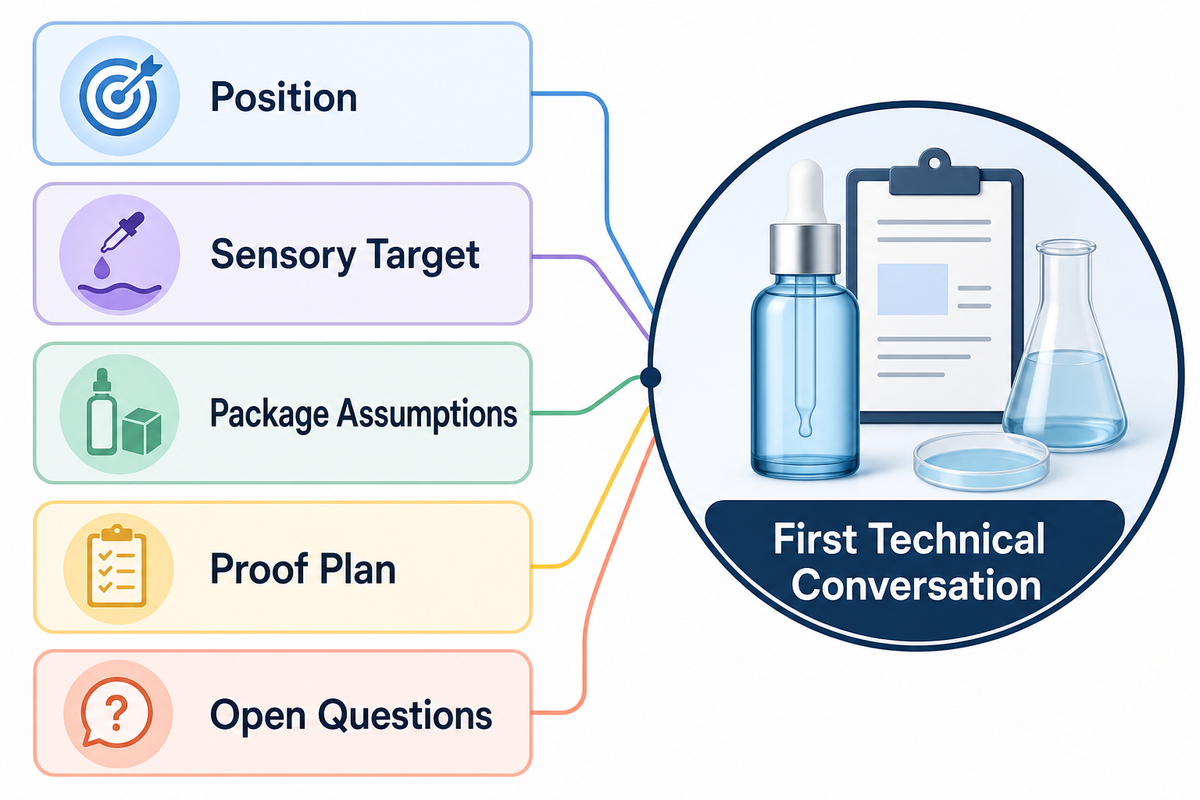
Controlled serum briefs give private label skincare projects a shared decision record before sampling expands. If your position, sensory target, package assumptions, and proof plan are taking shape, scope the project with NEXO Beauty Labs. Bring the open questions as well as the decisions—both belong in the first technical conversation.
Transparency note: The Serum Decision Chain, Four-Lock Brief, Failure Budget Matrix, Package Stress Map, and 100-Point Sample Scorecard are editorial planning tools created for this guide. They are not standards, laboratory protocols, legal advice, or NEXO performance data. Product-specific decisions require qualified formulation, safety, regulatory, packaging, and testing input.
Related Articles
References & Sources
- Product Testing of Cosmetics — U.S. Food and Drug Administration
- Microbiological Safety and Cosmetics — U.S. Food and Drug Administration
- Cosmetics Labeling Claims — U.S. Food and Drug Administration
- Registration & Listing of Cosmetic Product Facilities and Products — U.S. Food and Drug Administration
- Regulation (EC) No 1223/2009 on Cosmetic Products — EUR-Lex
- ISO 22716: Cosmetics—Good Manufacturing Practices — International Organization for Standardization
- Making Cosmetic Products Available to Consumers in Great Britain — GOV.UK