Get in touch with NEXO Beauty Labs Company

Private label moisturizers are creams, lotions, or gel-creams sold under a brand’s own label but formulated and produced by a contract manufacturer, typically starting from an existing “mature” formula base rather than a from-scratch custom formulation. The practical differences that matter to a first-time buyer are not cosmetic, they are minimum order quantity, formulation route, development timeline, and who carries regulatory responsibility for the finished product. This guide walks through all four, using client-confirmed program data, publicly verifiable FDA and ISO standards, and cross-industry benchmarks. It’s written for brand owners launching a skincare line, estheticians sourcing white-label skincare products for a retail program, and anyone comparing private label skin care solutions before requesting a quote.
What Is a Private Label Moisturizer? (And How It Differs From Custom Formulation)
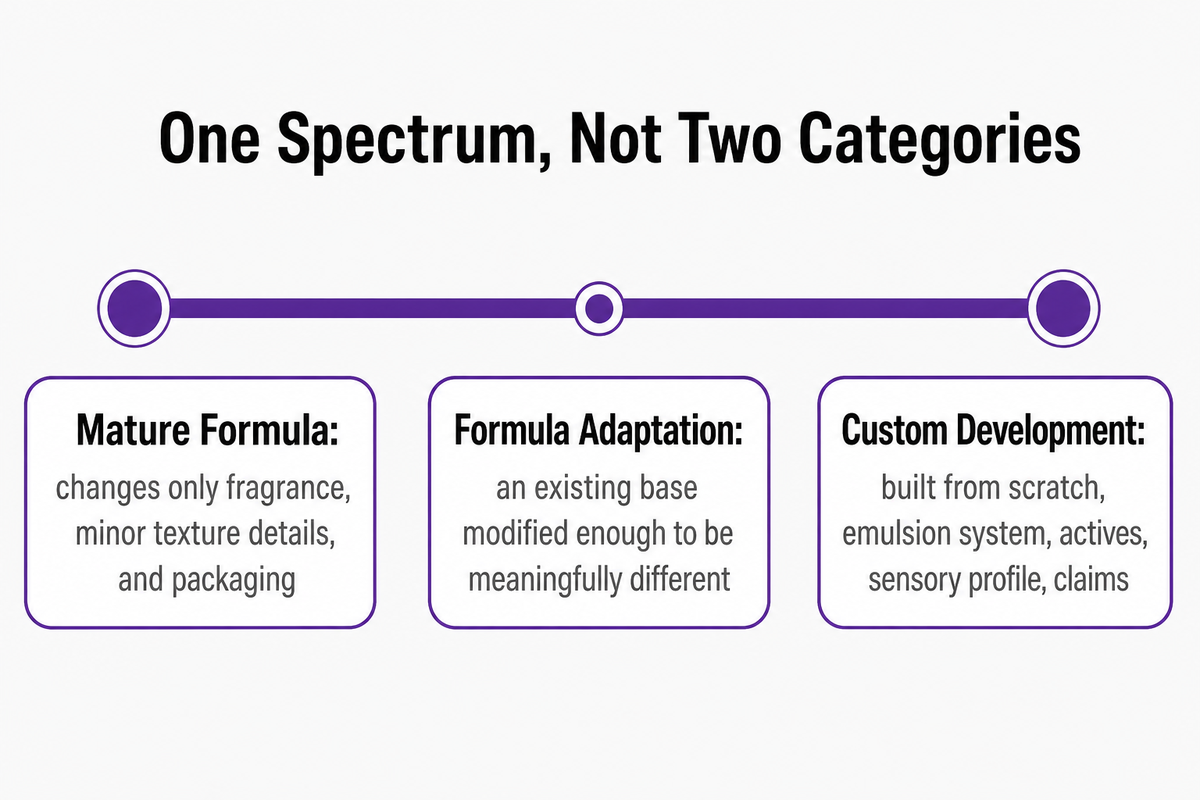
Private label and custom formulation sit on a spectrum rather than being two separate categories. At one end, a brand selects an existing, already-qualified moisturizer formula and changes only the fragrance, minor texture details, and packaging, this is the fastest and lowest-risk route to market.
At the other end, a brand specifies its own formula from scratch: choice of emulsion system, active ingredient concentrations, sensory profile, and claims, developed and stability-tested specifically for that brand. Most private label skincare programs, moisturizers included, actually offer a middle path: a “formula adaptation” route where an existing base is modified enough to be meaningfully different without the full cost and timeline of custom development.
None of this is unique to moisturizers, but moisturizers are where the choice matters most in practice: a facial moisturizer sits in nearly every skincare routine, which means it also sits in the SERP alongside dozens of near-identical commercial catalog pages, a landscape we cover in a later section on choosing between formulation routes.
The umbrella term “private label skin care” covers a range of arrangements, from fully turnkey private label services (formula, packaging, and fulfillment bundled together) to more à la carte private label solutions where a brand sources formulation and packaging separately. Whichever arrangement a program uses, the underlying formulation-route decision below is the same.
None of this distinction carries regulatory weight, either: MoCRA and the FD&C Act apply the same responsible-person, facility-registration, and safety-substantiation obligations to a finished moisturizer regardless of whether its formula started as a mature base, a formula adaptation, or a ground-up custom development. FDA’s registration and listing framework tracks the product named on the label, not how the formula behind it was developed.
The Three Formulation Routes and Four Core Texture Directions in Most Private Label Moisturizer Programs
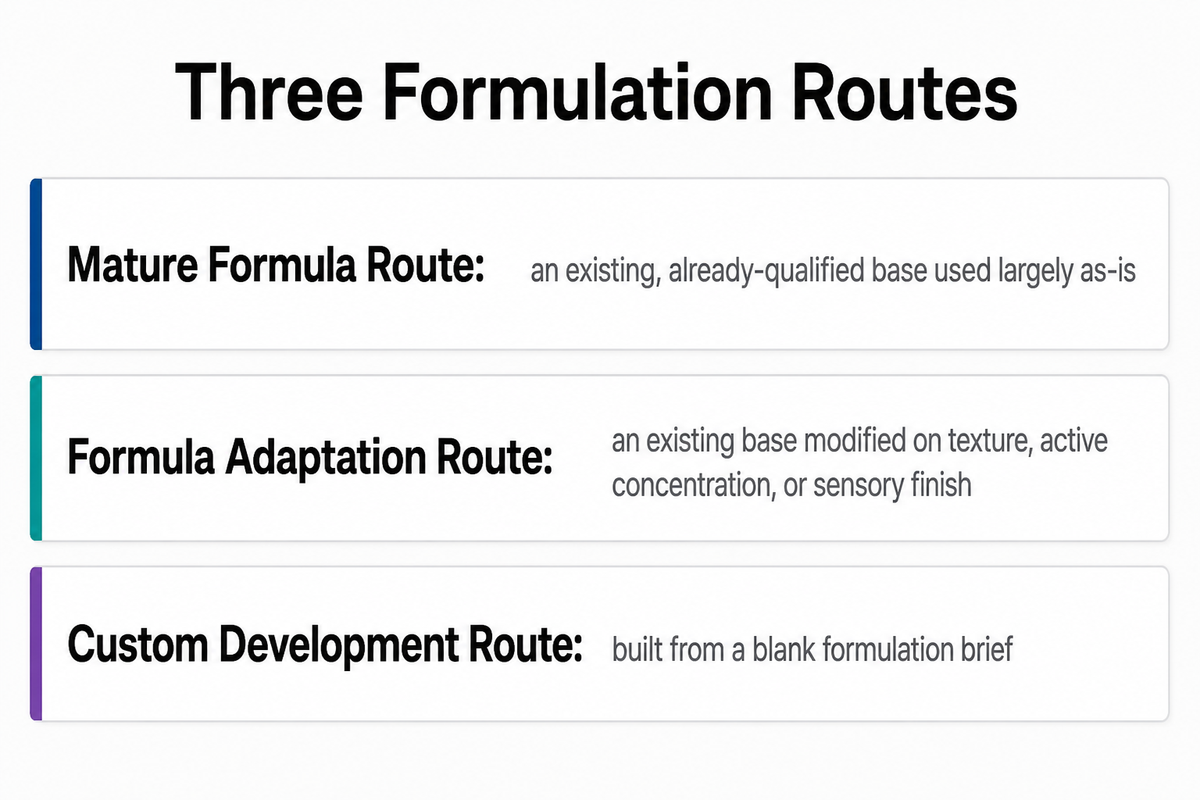
Manufacturers that run structured private label skincare programs typically formalize the mature-vs-custom spectrum above into three explicit development routes: a mature formula route (an existing, already-qualified base used largely as-is), a formula adaptation route (an existing base modified on texture, active concentration, or sensory finish), and a custom development route (built from a blank formulation brief). For moisturizers specifically, texture is the variable buyers care about most, and it typically breaks into four core directions: gel-cream, lightweight lotion, rich cream, and balm, each suited to a different skin type and marketing position (oil-control vs. deep hydration vs. barrier repair) — the Texture-to-Claim Compatibility Matrix below expands these into the fuller set of positioning variants a 2026 brief is likely to specify.
The route a brand should pick is mostly a timeline-and-budget decision, which we quantify in the timeline section below, but as a rule of thumb, a first SKU aimed at market validation is usually better served by mature formula or formula adaptation, with custom development reserved for a brand’s signature hero product once the category is proven. Moisturizer development rarely stops at one SKU: most brands plan a small moisturizer line (a day cream, a night cream, maybe a targeted variant) rather than a single standalone product, and it’s worth choosing a route that scales to that plan rather than optimizing only for SKU one. Before committing to a route, check it against the Texture-to-Claim Compatibility Matrix below and the Decision Framework at the end of this guide.
Whichever route a brand picks, the same third-party test standards apply regardless: preservation-efficacy challenge testing under ISO 11930 and stability testing under ISO/TR 18811 govern a mature-base cream exactly the same way they govern a custom-built one, the route changes the timeline and cost, not the testing obligation.
The Texture-to-Claim Compatibility Matrix, Matching Skincare Formulation to Skin Type and Claims
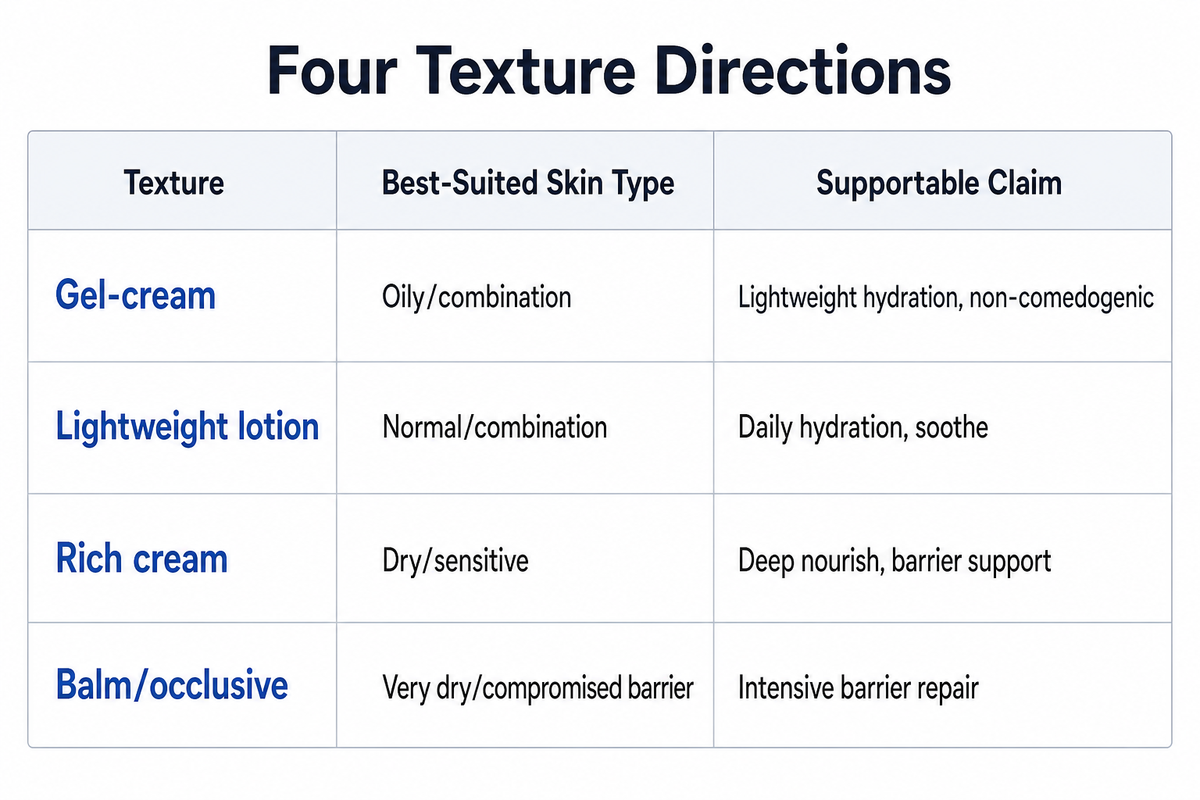
Those same third-party test standards interact directly with texture choice: different active ingredients and texture directions support different marketing claims and suit different skin types. The table below maps the most common combinations a private label skincare buyer will evaluate.
| Texture Direction | Best-Suited Skin Type | Typical Active Ingredients | Supportable Claim | Relevant Test |
|---|---|---|---|---|
| Gel-cream | Oily / combination | Hyaluronic acid, niacinamide | Lightweight hydration, non-comedogenic | Preservation efficacy (ISO 11930) |
| Lightweight lotion | Normal / combination | Squalane, botanical extracts | Daily hydration, soothe | Preservation efficacy (ISO 11930) |
| Rich cream | Dry / sensitive | Ceramide, shea butter, fatty acids | Deep nourish, barrier support | Stability (ISO/TR 18811) |
| Balm / occlusive | Very dry / compromised barrier | Ceramide complex, occlusive lipids | Intensive barrier repair | Stability + preservation (both) |
| Any texture + retinol | Anti-aging focused (patch-test advised) | Retinol, peptides | Anti-aging, skin renewal | Stability (retinol is oxidation-sensitive) |
| Any texture, clean-formulated | Sensitive / clean-beauty focused | Naturally derived actives | Clean beauty, cruelty-free | Microbiological risk assessment (ISO 17516 / ISO 29621) |
| Whipped / aerated cream | Normal / dry, texture-led positioning | Air-whipped emulsion, light occlusives | Sensorial “clean feel”, daily hydration | Stability (ISO/TR 18811, aeration-sensitive) |
| Overnight mask-cream | Dry / dull, PM routine | Peptides, niacinamide, higher occlusive load | Overnight repair, radiant morning finish | Preservation efficacy (ISO 11930) |
| Tinted moisturizer | Normal / combination, makeup-adjacent | Iron oxides, light SPF boosters, hyaluronic acid | Brightening moisturizer, evens tone | Stability + preservation (both; pigment load affects both) |
| Vitamin C-forward serum-cream hybrid | Normal / combination, brightening focus | Vitamin C derivatives, ferulic acid, hyaluronic acid | Vitamin C moisturizer, brightening, antioxidant | Stability (vitamin C is oxidation-sensitive, like retinol) |
A working rule for first-time skincare brands: pick the texture direction first (based on target skin type and price tier), then let that choice narrow the active-ingredient shortlist, going the other direction, starting from a trendy active ingredient and forcing it into an unsuited texture, is a common source of stability failures later in development. “Deep nourishment” as a marketing claim, for instance, is easy to promise but only holds up if the texture and occlusive-lipid content actually back it.
Some of the most requested facial moisturizers in 2026 briefs fall into a handful of recognizable positioning categories: a vitamin C moisturizer or brightening moisturizer aimed at uneven tone and a radiant finish, a barrier-repair cream for compromised skin, and a gentler formula built around sensitive skin and skin barrier support. Positioning around “improve skin health” or “improve skin texture” is common, but it works best when tied to a named active and a texture that can plausibly deliver it, rather than left as a generic skin concerns claim. One boundary worth flagging early: this guide covers moisturizers regulated as cosmetics under MoCRA. Any moisturizer carrying a sun-protection claim (an SPF number, not just light SPF-boosting actives) or a disease/structure-function claim crosses into OTC drug-cosmetic territory, which layers on FDA drug-monograph requirements on top of everything covered here, that’s a separate regulatory conversation, not a variation on this one.
The Quality Standards That Actually Govern Moisturizer Manufacturing
Whichever texture-and-claim combination a brand lands on from the matrix above, the manufacturer producing the finished product needs credible standards behind the label claim, not just a texture match. A solution page will tell you a manufacturer “is GMP certified.” A useful due-diligence question goes one level deeper: certified to what scope, tested against which standard, and what does that standard actually require? Contract manufacturing services vary widely in how much of the formulation and production chain they actually control in-house versus subcontract, and that distinction shows up first in which standards their own certificates actually cover.
- ISO 22716 is the core cosmetic Good Manufacturing Practice standard. It covers production, quality control, storage, and shipment, but its guidelines explicitly do not extend to research & development or to distribution beyond the manufacturing site, so a certificate scoped to ISO 22716 tells you about the factory floor, not about formulation R&D.
- Microbiological testing requirements for cosmetics generally fall under ISO 17516, which sets the limits and test methods a finished product must meet.
- Under ISO 29621, a documented risk assessment identifies products that qualify as microbiologically low-risk, and that classification is what can waive some of ISO 17516’s stricter testing requirements — relevant if a manufacturer is quoting a faster or cheaper QC path for an anhydrous or high-alcohol formula.
- Preservation-efficacy (challenge) testing, the test proving a moisturizer’s preservative system actually stops microbial growth over its shelf life, is governed by ISO 11930, and matters more for water-based emulsions (most moisturizers) than for anhydrous balms.
- Stability testing falls under ISO/TR 18811, whose key feature for buyers is what the standard does not do: it never prescribes one universal set of conditions, parameters, or pass criteria. The manufacturer is responsible for specifying and justifying its own protocol — “we do stability testing” is not, by itself, a complete answer; “we test under these specific conditions, for these reasons” is.
All five of those are voluntary standards, which surprises some first-time buyers once they check the regulatory record directly: FDA began enforcing MoCRA’s facility-registration and product-listing requirements on schedule (July 1, 2024, after a six-month enforcement-discretion window, with FDA updating its industry guidance again in December 2024), but the mandatory federal cosmetic-GMP rule MoCRA itself required FDA to propose has not been published, the statutory deadline for it passed, and, as of the Spring 2025 regulatory agenda (the most recent available at the time of writing), FDA moved it into “Long-Term Actions” with the proposed-rule date listed as “to be determined.” A manufacturer claiming ISO 22716 certification is following the closest thing the industry has to a GMP baseline, not complying with a federal mandate that does not exist yet, and a buyer should treat “ISO 22716 certified” as evidence of process discipline, not as a legal requirement being satisfied.
The 4-Layer Moisturizer Order-Floor Grid, Understanding MOQ Before You Quote
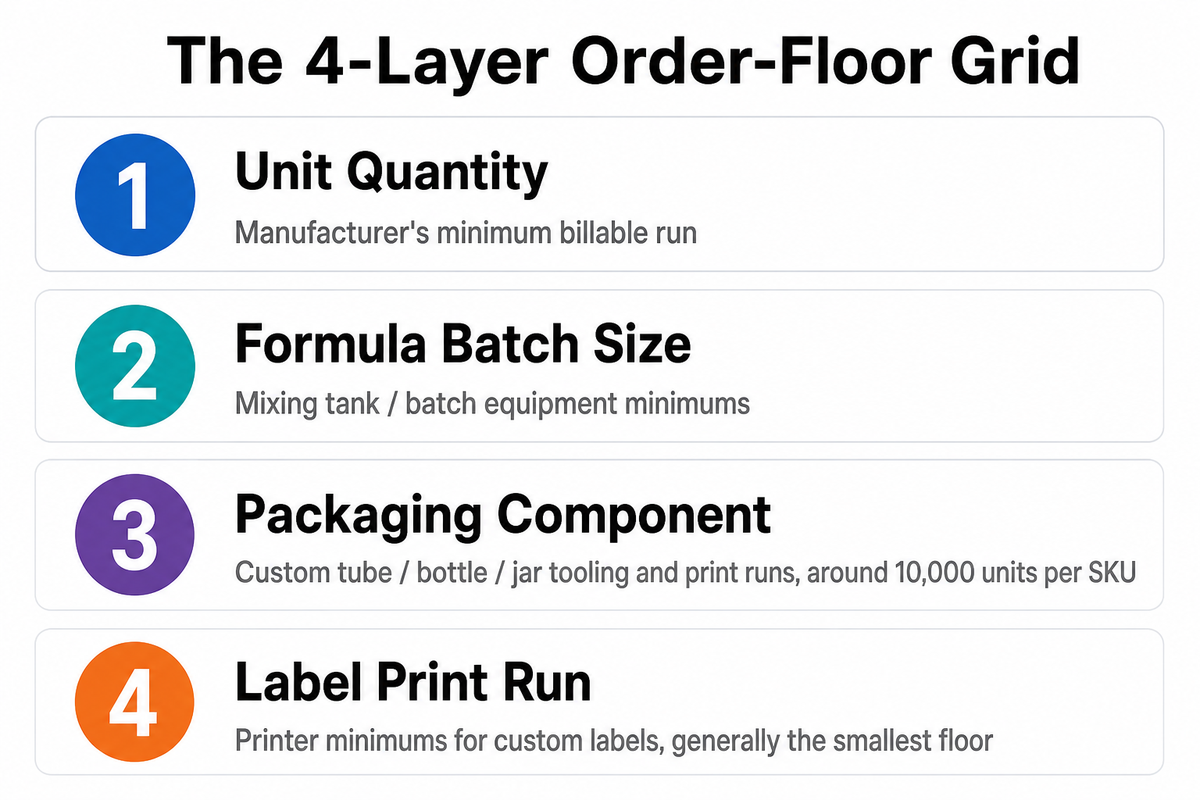
Private label minimums are layered, not singular — set by whichever of four independent floors (unit quantity, formula-batch size, packaging component, label print run) binds highest for a given spec; brands that need a lower-entry route can compare those layers against NEXO’s low-MOQ skincare manufacturing program. For a moisturizer specifically, the layer most likely to bind — and the one buyers underestimate most — is the packaging component, and which component floor applies depends on the texture direction chosen from the matrix above.
| # | Layer / Texture Factor | What Sets It | Typical Range | How Brands Work Around It |
|---|---|---|---|---|
| 1 | Unit quantity | Manufacturer’s minimum billable run | Varies widely by factory | Consolidate SKUs into one larger first order |
| 2 | Formula batch size | Mixing tank / batch equipment minimums | Often lower than the component floor | Rarely the binding constraint on its own |
| 3 | Packaging component | Custom tube / bottle / jar tooling and print runs | ~10,000 units per SKU (custom-decorated) | Buy the minimum quantity of one stock bottle shape, vary only per-SKU decoration |
| 4 | Label print run | Printer minimums for custom labels | Generally the smallest floor | Digital/on-demand label printing where available |
| 5 | Emulsion viscosity class | Determines which fill line and closure a manufacturer can actually run the product through | Thin lotion / rich cream / balm behave differently on the same filler | Confirm the manufacturer’s fill equipment handles your target viscosity before locking in packaging |
| 6 | Pump-dispenser closure | Calibrated pump-head sourcing, usually the most expensive component to customize | Sits at the higher end of the ~10,000-unit component floor | Use a stock pump body, customize only the bottle print |
| 7 | Jar closure | Wide-mouth fill tolerates viscosity variation better than pump dispensing | Comparable component floor to bottles | Stock jar body, custom label or outer box only |
| 8 | Tube closure | Needs viscosity within the tube-filling machine’s tolerance band; thin lotions risk underfilling | Comparable component floor to bottle/jar | Confirm viscosity spec against the filler’s tolerance before committing to tube packaging |
| 9 | Multi-texture line (e.g., day cream + night cream + a serum-cream hybrid) | Each texture can need a different closure, multiplying component-MOQ exposure across the line | Compounds rows 6–8 per additional SKU | Standardize on one closure type across the line where the positioning allows it |
In practice, packaging is the layer most first-time buyers underestimate: a formula that “could” run at 500 units is frequently gated by a 2,000-piece (or higher) bottle-tooling minimum for that specific closure and viscosity combination, so the honest answer to “what’s your MOQ?” is almost always “it depends which layer, and which texture-driven packaging choice, binds for your spec.” For moisturizers and creams specifically, industry benchmarks put the low-MOQ tier around 250 to 500 units, standard private-label programs around 1,000 to 3,000 units, and full custom development at 5,000 units or more, so a headline “our MOQ is 500” answer is worth checking against which of those tiers — and which closure — it actually describes. The packaging floor also has a timeline dimension buyers underestimate as often as the unit count: a packaging-industry professional’s public account puts standard stock bottle lead time at 3 to 4 months from order to delivery, and custom color or shape tooling at 4 to 6 months; brands that only discover this once they are ready to launch are the ones who end up quoting a manufacturer’s fast formula timeline while packaging is still the real constraint.
The 2-Speed Development Runway, From Brief to Moisturizer Manufacturing Shipment
Development timelines split cleanly around the mature-vs-custom decision from earlier in this guide; buyers comparing the custom path can review NEXO’s custom skincare formulation program. For a moisturizer specifically, the active-ingredient sensitivity class chosen from the Texture-to-Claim Matrix above adds its own timeline variable on top of the base split:
| Stage | Mature-Base / Private Label Route | Custom / OEM New-Formula Route |
|---|---|---|
| First order, brief to shipping | ~4–6 weeks | ~12–16 weeks |
| Why the gap | Formula already qualified; skips stability testing and pilot run | Includes stability testing and a pilot production run before commercial scale-up |
| Reorder | ~3–4 weeks | ~8–10 weeks |
| Stability-testing duration, by active class | Standard hydrating/occlusive base: fits within the window above | Oxidation-sensitive actives (retinol, vitamin C): can extend the custom window further, sometimes requiring accelerated and real-time stability data to be run in parallel rather than sequentially |
Within the mature-base route, a formula and texture sample stage is commonly quoted in the range of a few days to just over a week (business days, not calendar days) once a brief is accepted; for reference, NEXO Beauty Labs’ own private-label skincare program states formula and texture sample development in 3 to 7 business days after the brief is accepted, international sample delivery a further 5 to 7 business days after dispatch, and commercial production completed within 15 days after formula approval and packaging confirmation — that approval-and-confirmation condition is doing real work in that number, since a pending packaging decision or an unresolved formula tweak is a common reason a 15-day quote stretches longer in practice.
Who Is the “Responsible Person” on Your Moisturizer Label? A Plain-English MoCRA Primer
Under the Modernization of Cosmetics Regulation Act (MoCRA), the responsible person is defined as the manufacturer, packer, or distributor of a cosmetic product whose name appears on the product’s label, per section 609(a) of the FD&C Act. For the overwhelming majority of private label moisturizer programs, that is the brand, not the contract manufacturer, because it is the brand’s name on the retail packaging.
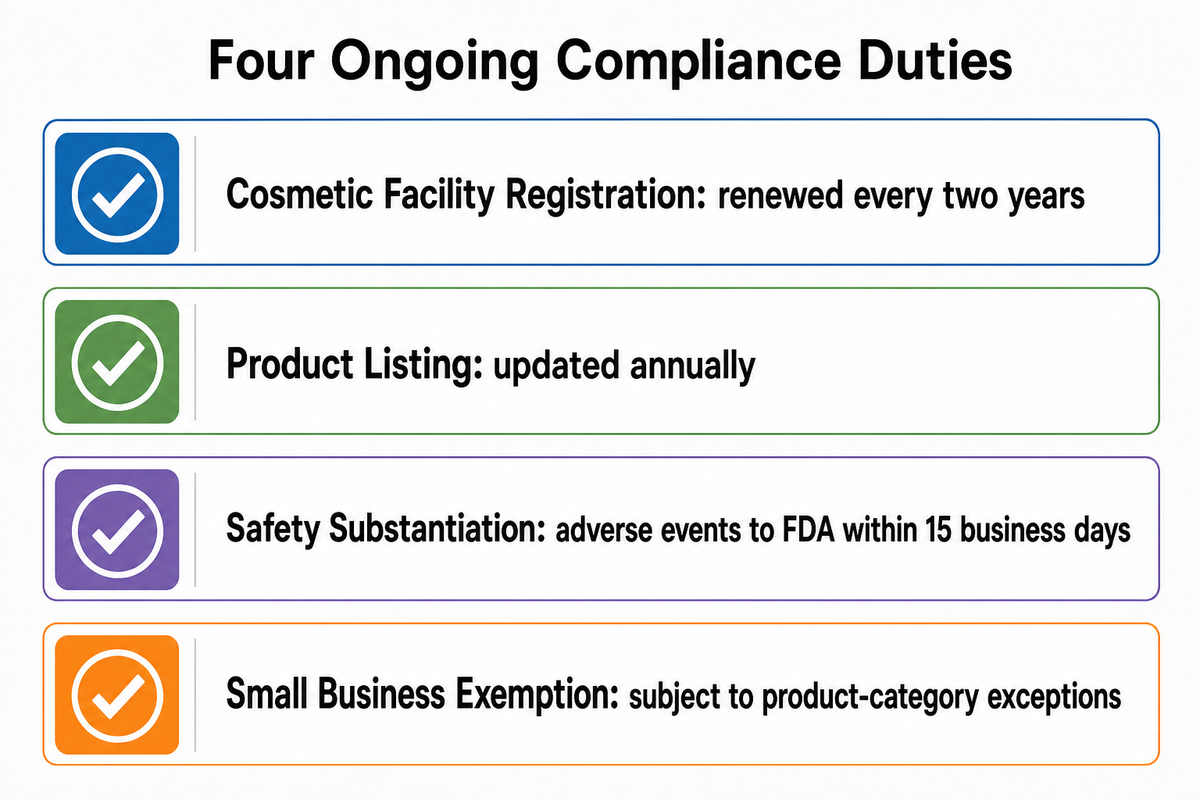
Registration and listing are not the whole job, either, the responsible person role is an ongoing compliance duty, not a one-time filing:
- Cosmetic facility registration must be renewed every two years, and any change to that registration must be updated within 60 days.
- Product listing (each marketed product, including its ingredients) must be updated annually, within 12 months of the prior listing.
- Safety substantiation records supporting the product’s safety must be maintained on an ongoing basis, and serious adverse events reported to the brand must be forwarded to FDA within 15 business days, this is a live monitoring obligation, not a launch-day checkbox.
- MoCRA does carve out an exemption from the GMP, facility-registration, and product-listing requirements for qualifying small businesses, subject to product-category exceptions, so a first-time brand’s exact obligations depend on where it falls on that threshold, not just on the general rules above.
A related point worth stating plainly, because it comes up in supplier conversations: the FDA does not issue certificates for cosmetic facility registration or product listing.
“Cosmetic product facility registration and product listing is neither a cosmetic approval program nor a promotional tool. FDA does not issue ‘certificates’ for cosmetic product facility registrations or product listings.” — FDA, Registration & Listing of Cosmetic Product Facilities and Products, Important Notes
If a supplier presents something described as an “FDA cosmetic certificate,” that document did not come from the FDA — it came from a private registration agent, and it is worth a direct follow-up question rather than a green light. For an overview of regional manufacturing and compliance handoffs, see NEXO’s global cosmetic manufacturing program.
For moisturizers headed to the European Union, a separate but analogous rule applies under Regulation (EC) No 1223/2009: the “responsible person” role defaults to a manufacturer established within the Union, meaning a non-EU manufacturer cannot automatically serve as the EU responsible person for a product it exports, a distinct entity, whether an EU-based distributor or an appointed responsible person service, needs to hold that role.
What First-Time Skincare Brands Get Wrong About Formula Ownership
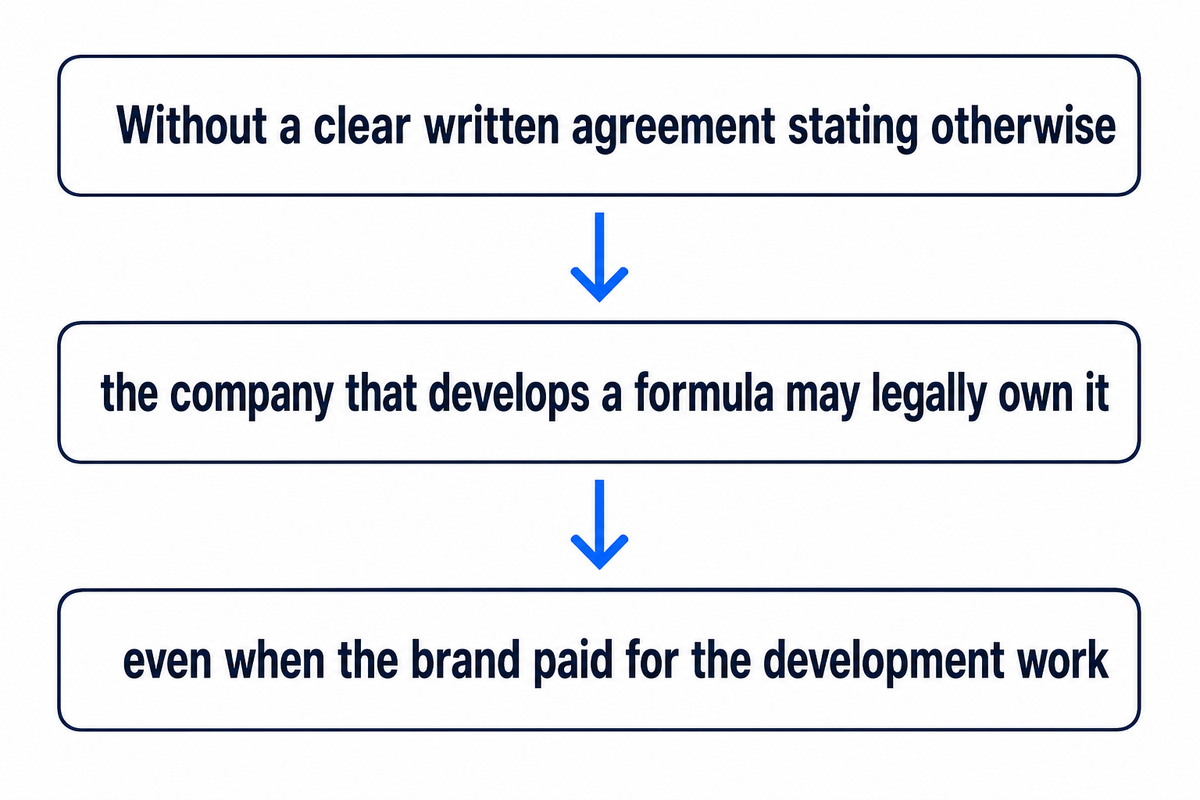
Buyer-side discussion in private label and contract manufacturing communities points to a recurring pattern, and a US business-law firm’s public guidance on contract-manufacturing agreements makes the same point: without a clear written agreement stating otherwise, the company that develops a formula may legally own it, even when the brand paid for the development work. This is a real financial risk, not just a formality: if the relationship ends or the brand wants to switch partners, it can find itself without even the right to use the formula it paid to develop. Hesitation from a manufacturer to sign an NDA, or vague contract language around intellectual property in a quote, is commonly cited as an early warning sign worth taking seriously. The scenario that surfaces this most often: a brand outgrows its first manufacturer after two or three reorders, tries to move production for better pricing or capacity, and only then finds the formula itself doesn’t travel with it, an expensive, hidden switching-cost trap that forces a full reformulation instead of a simple manufacturer switch, effectively restarting the 84 to 112 days (12 to 16 weeks) of custom-development work from zero.
The practical takeaway isn’t that formula ownership is always negotiable, many manufacturers legitimately retain ownership of formulas built from their own proprietary base, but that it’s worth confirming explicitly, in writing, before signing, rather than assuming a default that may not match expectations. Buyers who have already been through it describe the same pattern in their own words: “You don’t own your formula. Your CM does. Because you never signed a development agreement,” as Loren Scott put it in a public LinkedIn post on the exact scenario. Before a custom program begins, pair that written ownership clause with the technical scope in NEXO’s custom cosmetic formulation program.
How to Vet a Private Label Moisturizer Manufacturer, A Cleanser-to-Serum Line Checklist
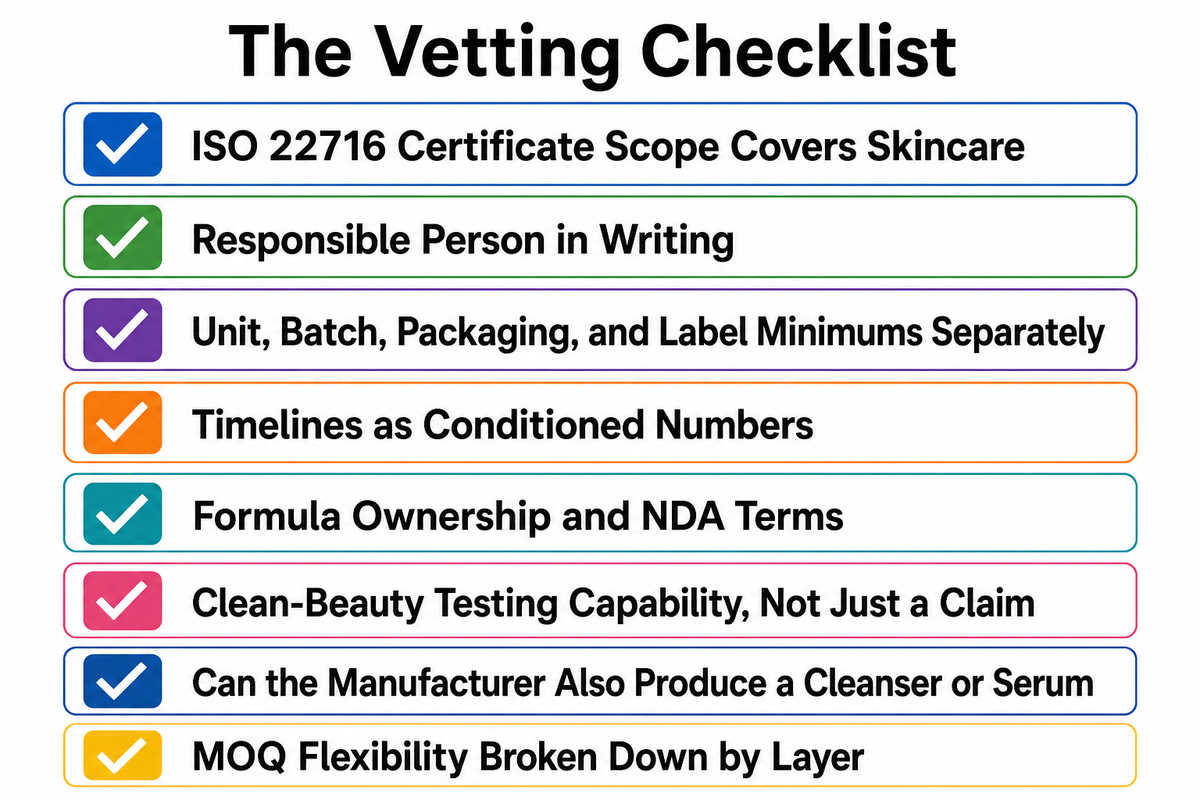
Most brands do not launch a single moisturizer SKU in isolation, a moisturizer is usually the anchor product in a small line that also includes a cleanser and, later, a serum. Vetting a manufacturer with that fuller line in mind surfaces gaps that a moisturizer-only conversation can miss; compare the checklist below against NEXO’s private-label cosmetics manufacturing capabilities:
- Confirm the ISO 22716 (or equivalent) certificate scope explicitly covers skincare / cream and lotion products — GMP scope matters more than the certificate’s mere existence, since it can just as easily be limited to an adjacent category like hair care.
- Get in writing who is registered as the responsible person for facility registration and product listing.
- Ask for the unit, formula-batch, packaging-component, and label-print minimums separately — a single headline number hides which layer will actually bind (packaging-industry reporting puts custom-decorated component minimums around 10,000 units/SKU, consistent with the Order-Floor Grid above). NEXO’s own low-MOQ program is one example of a layer-by-layer breakdown worth requesting in writing.
- Timelines belong in writing, as explicit, conditioned numbers (e.g., “15 days after formula approval and packaging confirmation”) rather than as an unconditional promise.
- Formula ownership, NDA willingness, and any restrictions on moving production elsewhere later are worth confirming before signing, not after.
- If clean, organic, or cruelty-free positioning matters to the brand, confirm it as a formulation and testing capability against documented clean beauty standards, not just a marketing claim the manufacturer is willing to print, and ask specifically whether “natural and organic” or “responsibly sourced ingredients” claims are backed by a named certification or a supplier’s own definition.
- Ask whether the same manufacturer can also produce a matching cleanser or serum later, and whether the line can extend into adjacent categories such as sun care; qualifying a second manufacturer from scratch has its own timeline and MOQ cost. Gogi Sangha, CEO of contract manufacturer G.S. Cosmeceuticals, framed the underlying test the same way in a 2017 industry-media interview: a manufacturer worth signing has “historical knowledge and experience with the type of products that the client is looking to manufacture,” a real quality department with teeth, and “sizeable R&D support, and technical transfer capabilities,” not just an attractive first quote.
- Estheticians and other professional-channel buyers should also confirm minimum order flexibility; a “low MOQ” claim is only useful once it is broken down by the layers covered in the Order-Floor Grid above. It is also worth resisting the instinct to treat the lowest available MOQ as automatically the best deal, a lower MOQ commonly trades off against a higher unit price, less customization, and a real risk of landing on a dated or generic stock formula rather than a true differentiator.
How Manufacturers Position Themselves, and Why the Positioning Rarely Answers Your Real Questions
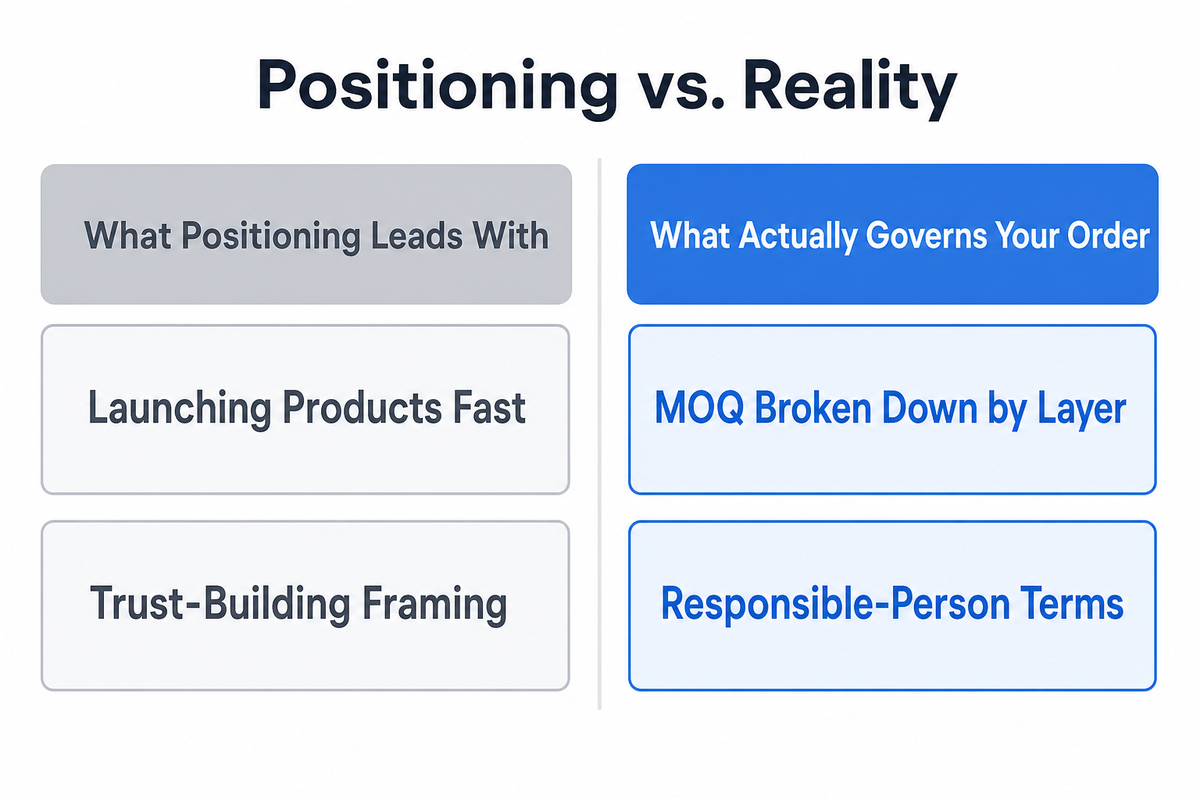
Search for “private label skin care products” or “top private label moisturizer” and most results lead with brand positioning rather than specifics: catalogs promising a “trusted private label cosmetics program” for beauty brands, or a premium private label tier aimed at estheticians and boutique retailers.
A typical manufacturer catalog page, for instance, leads with launching products fast rather than with responsible-person terms, and even where MOQ tiers are disclosed, they usually sit several clicks below the headline pitch rather than in it. None of that framing is dishonest, but it answers a different question than the one this guide is built around: not “who sounds trustworthy,” but “what will actually govern my first order.” Positioning is a reasonable filter for narrowing a shortlist; it is not a substitute for the MOQ, timeline, and responsible-person answers covered above.
The gap matters in practice, not just in principle. Picture a procurement lead who shortlists five manufacturers on trustworthy-sounding positioning copy alone, then sends each the same two questions: break the MOQ down by layer, and confirm who is registered as the responsible person. Manufacturers whose positioning copy is written to close the initial inquiry rather than survive a spec conversation often deflect both questions back to a sales call instead of answering them in writing. Manufacturers with nothing to hide about their packaging-component minimums, their responsible-person paperwork, or whether their ISO 22716 certification scope actually covers cream and lotion products rather than an adjacent category generally answer directly rather than pivoting back to the trust-building framing on their collections page. That pivot back to trust-building copy is worth treating as a prompt for a direct follow-up question, not an automatic disqualifier: a useful test is whether a manufacturer’s own site can answer the MOQ-by-layer question from the Order-Floor Grid above without a sales call at all. If it can’t, treat the positioning copy as marketing, not as due diligence, and run the vetting checklist above before signing anything, it filters out the pages that look trustworthy but don’t hold up to a direct question.
What’s Actually Changing in Moisturizer Formulation for 2026
Skincare trends move faster than formulation-route decisions should. The headline market-size numbers around private label cosmetics look impressive but aren’t the useful signal for a formulation decision, the more decision-relevant shift is what buyers are actually asking manufacturers to combine into a single product.
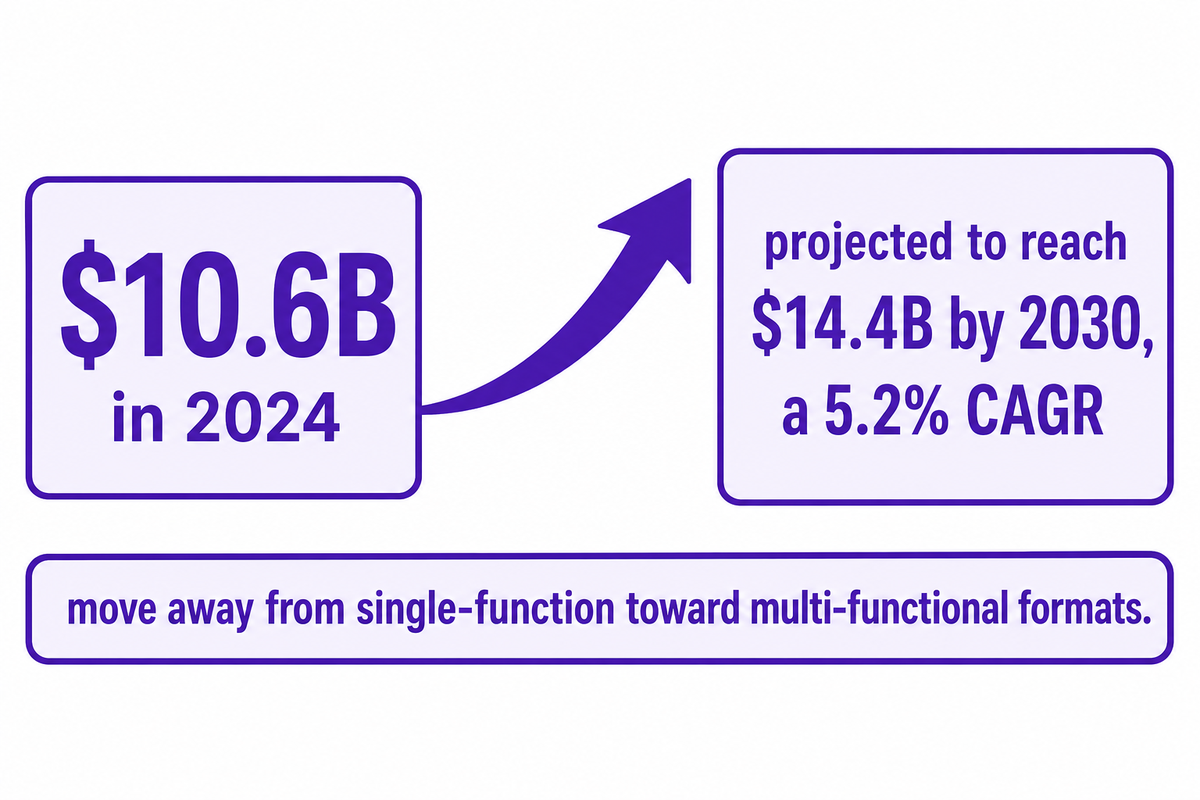
Through 2025 into 2026, the clearest formulation trend is a move away from single-function “just hydrating” moisturizers toward multi-functional formats that combine hydration, barrier repair, and environmental protection in one product. That shift matters directly for the formulation-route decision earlier in this guide: a single-claim mature-base formula is a poor fit for a brand trying to market a multi-benefit product, a mismatch risk that tips the calculus toward formula adaptation or custom development even for a first SKU, because a manufacturer whose ISO 22716-certified process wasn’t built around multi-active stability testing cannot credibly retrofit a hydration-plus-repair claim onto an existing single-function base.
For context (reported with appropriate caution, since these are secondary-source estimates rather than primary government data): the global private label cosmetics market is estimated around $10.6B in 2024, projected to reach $14.4B by 2030 (a 5.2% CAGR), with growth concentrated in clean and plant-based formulation demand. The US personal-care contract manufacturing market, separately, is estimated at roughly $3.33B (2024) with 7.9% projected CAGR through 2030, per a private-label manufacturer directory’s own market summary — a lower-authority source than the Grand View Research figure above, included here only as directional context. Treat both as directional market-sizing context, not a substitute for a manufacturer’s own capacity and formulation-route conversation. A brand selling to a US buyer and an EU buyer from the same production run inherits both compliance regimes at once (MoCRA and Regulation (EC) No 1223/2009, covered above), a separate cost from the formulation-trend shift itself and one that an 84-to-112-day custom-development timeline needs to absorb if the multi-functional claim requires new stability data in both markets.
The year-over-year picture is a useful check against the headline market-size figures above: global private label sales across categories grew 4.3% year-on-year according to a 2025 NielsenIQ global outlook, slightly behind the 4.8% growth of the top-10 global branded players, and private label’s European growth rate specifically decelerated from near 12% in 2023 to under 4% in 2024. A market that is still growing but decelerating changes the calculus for a first SKU: it argues against treating any single year’s headline projection as a guarantee and in favor of the same conditioned, layer-by-layer MOQ and timeline confirmations covered throughout this guide, rather than a launch plan built on a static market-size number alone.
Two other skincare trends worth tracking for a private label skincare line: moisturizer production is increasingly expected to slot into a global skincare supply chain (brands sourcing from one manufacturer but selling across multiple regions with different labeling regimes), and successful skincare launches in 2026 lean more on the formulation and compliance specifics covered in this guide than on generic skincare products marketing copy.
Private Label vs. Custom Formulation: A Decision Framework
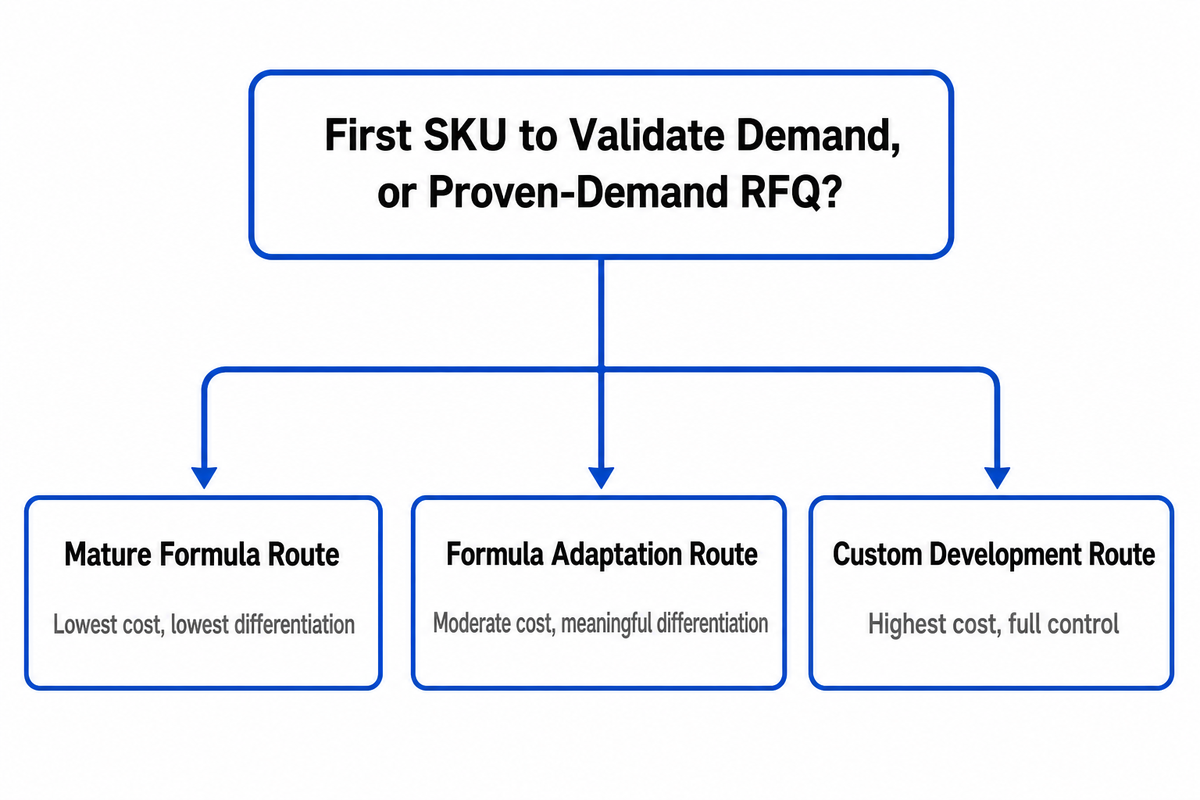
A common failure pattern: a brand picks custom development for its first moisturizer SKU because it sounds more “premium,” commits 84 to 112 days (12 to 16 weeks) and the higher cost that comes with it, a real financial risk when the category itself is unproven, then discovers post-launch that the category wasn’t validated and the product doesn’t sell, having spent the budget a mature-formula route would have preserved for a second attempt. The framework below exists to catch that mistake before the quote is signed, not after.
Start here: Is this your brand’s first moisturizer SKU, launched primarily to validate market demand, or is a procurement lead already building an RFQ around a category with proven demand?
- → Yes, and budget/timeline are tight: Mature formula route. Lowest cost, ~4–6 weeks (28–42 days), lowest differentiation.
- → Yes, but you need a specific claim (e.g., clean/organic, multi-functional): Formula adaptation route. Moderate cost and timeline, meaningful differentiation on the claims that matter most to your positioning.
- → No, this is a proven category and you’re building a signature hero product: Custom development route. Highest cost and ~12–16 weeks (84–112 days), but full control over formula, texture, and claims.
Whichever route you choose, resolve the MOQ layering (packaging is usually the real constraint), confirm responsible-person and formula-ownership terms in writing, and get timeline commitments as conditioned numbers rather than round figures.
If you’ve worked through this framework and are ready to move from research to a formal quote, NEXO Beauty Labs’ private label moisturizer manufacturing program covers all three formulation routes and quotes by layer rather than a single flat number; its packaging-component floor for most skincare SKUs runs around 10,000 units, consistent with the custom-decorated component range covered above, with a separate low-MOQ program available for brands that need a lower entry point.
Frequently Asked Questions
What is the typical MOQ for a private label moisturizer?
There’s no single MOQ for a private label moisturizer because the real floor is set by whichever layer is strictest: the unit quantity per SKU, the formula batch size, the packaging component, or the label print run. In practice, the packaging component is the layer that most often binds first, custom-decorated tubes, bottles, and jars commonly carry a minimum around 10,000 units per SKU, even when the formula batch itself could technically run smaller. Brands that need a lower entry point typically buy the minimum quantity of one stock bottle shape and vary only the printed decoration per SKU, which sidesteps the custom-component minimum without touching the formula.
How long does it take to launch a private label moisturizer?
Timelines split into two speeds depending on the formulation route. Peer benchmarks across the industry put a mature-base program (an existing formula with light customization) at roughly 4 to 6 weeks from brief to shipping for a first order, and 3 to 4 weeks for reorders. A custom or OEM program built on a new formula runs closer to 12 to 16 weeks, since it has to absorb stability testing and a pilot run before commercial production, with reorders around 8 to 10 weeks. Individual manufacturer timelines vary, for example, a formula and texture sample stage alone is commonly quoted at a few days (business days) once a brief is confirmed, but the mature-versus-custom split is the single biggest driver of how long the whole process takes.
Who is the “responsible person” required on a US moisturizer label?
Under the Modernization of Cosmetics Regulation Act (MoCRA), the “responsible person” is defined as the manufacturer, packer, or distributor of a cosmetic product whose name appears on the product’s label, per section 609(a) of the FD&C Act. This isn’t automatically the contract manufacturer, it’s whichever entity’s name is on the retail packaging, which for most private label moisturizers is the brand itself. That responsible person is the one obligated to keep the cosmetic product facility registration current (renewed every two years) and to submit the product listing (updated annually), and to maintain adequate safety substantiation records for the finished product.
Can moisturizers be formulated with clean, organic, or cruelty-free positioning?
Yes, texture, active ingredient selection, and testing protocol can all be built around clean-beauty or cruelty-free positioning, though “organic” carries additional certification requirements (e.g., USDA/COSMOS) that go beyond formulation choices alone.
What’s the difference between a mature formula and a custom formulation?
A mature formula starts from an existing, already-qualified base with limited customization (fragrance, minor texture tweaks); a custom formulation is built from scratch to a brand’s own specification, which costs more time and money but yields a differentiated product rather than a re-labeled base.
References & Sources
- U.S. FDA, “Cosmetics & U.S. Law” fda.gov/cosmetics/cosmetics-laws-regulations/cosmetics-us-law (responsible person definition, MoCRA facility registration and product listing cycles; verified 2026-08-20)
- U.S. FDA, “Modernization of Cosmetics Regulation Act of 2022 (MoCRA)” fda.gov/cosmetics/cosmetics-laws-regulations/modernization-cosmetics-regulation-act-2022-mocra (Facility vs. Responsible Person definitions; verified 2026-08-21)
- U.S. FDA, “Guidance for Industry: Registration and Listing of Cosmetic Product Facilities and Products” fda.gov/regulatory-information/…/guidance-industry-registration-and-listing-cosmetic-product-facilities-and-products (December 2024 update; source for the mandatory cosmetic-GMP rule status; verified 2026-08-21)
- U.S. FDA, “Registration & Listing of Cosmetic Product Facilities and Products” fda.gov/cosmetics/registration-listing-cosmetic-product-facilities-and-products (source of the direct quote above; 60-day update requirement, biennial renewal cycle; verified 2026-08-20)
- U.S. FDA, “Cosmetics Export Certificate FAQs” fda.gov/cosmetics/cosmetics-exporters/cosmetics-export-certificate-faqs (export certificate types and process; verified 2026-08-20)
- ISO, cosmetic manufacturing and testing standards: ISO 22716 (GMP), ISO 17516 (microbiological quality), ISO 29621 (low-risk waiver), ISO 11930 (preservation efficacy), ISO/TR 18811 (stability testing)
- Regulation (EC) No 1223/2009, EU cosmetics responsible person requirement (verified 2026-08-21)
- Grand View Research, “Private Label Cosmetics Market Size Report, 2025–2030” (secondary-source estimate; verified 2026-08-21)
- Medpak Solutions, “Trends in Cosmetic Manufacturing for 2026” (secondary-source estimate; verified 2026-08-21)
- distil.market, “Top Private-Label Cosmetics Manufacturers in USA (2026)” — US personal care contract manufacturing market sizing (secondary-source estimate, manufacturer-directory site; verified 2026-08-21)
- Beauty Packaging, “Low MOQs? No Problem” — custom-decorated packaging-component MOQ reporting (verified 2026-08-21)
- EPGD Business Law, “Your Product Formula: Who Really Owns It?” — contract-manufacturing IP-ownership default (verified 2026-08-21)
- Covington & Burling, “MoCRA Implementation: FDA Spring 2025 Unified Agenda Update” — law-firm analysis of the delayed cosmetic-GMP rulemaking timeline (secondary source; verified 2026-08-21)
- NielsenIQ, “Finding Harmony on the Shelf: 2025 Global Outlook on Private Label & Branded Products” — year-over-year private label growth data (verified 2026-08-21)
- Global Cosmetic Industry, “Choosing the Right Beauty Care Manufacturer” — Gogi Sangha (CEO, G.S. Cosmeceuticals) on manufacturer vetting criteria (verified 2026-08-21)
- Sheleys, “Private Label Skincare MOQ Explained” — MOQ cost/customization trade-off data (verified 2026-08-21)
- Guangdong Cosmetics, “What Is the Average MOQ for Private Label Cosmetics?” — category-specific MOQ tier benchmarks (verified 2026-08-21)
- Loren Scott, LinkedIn post on formula-IP-ownership disputes (public post; verified 2026-08-21)
- Rowland King, LinkedIn post on packaging lead times (public post; verified 2026-08-21)