Get in touch with NEXO Beauty Labs Company

Updated September 2026 · Written by XCX
Body wash manufacturers are production partners that turn a brand’s formula route, evidence scope, package system, and market brief into a manufactured body wash; they should be compared against one controlled brief, not a universal “best” list. The ideal manufacturing partner depends on several factors, including the formula route, evidence scope, package system, destination market, quote boundaries, and change owners. The best place to shortlist competitors is after each product or service is evaluated against the same technical and commercial questions, before final negotiation.
One document trap to remove immediately“Cosmetic product facility registration and cosmetic product listing is neither a cosmetic approval program nor a promotional tool.” U.S. FDA
This guide organizes the process to evaluate competitors. Information on minimum orders, pricing, lead times, accredited tests, and production capacity must be provided by each interested supplier and verified case by case for the exact entity, facility, formula, package, market, and order.
| Control category | Buyer output | Decision protected |
|---|---|---|
| 1. Route | Program and route brief | Comparable starting scope |
| 2. Entity | Legal entity and facility map | Who performs the contracted work |
| 3. Evidence | Evidence Request Pack | Proof tied to the actual program |
| 4. System fit | Formula-Package Risk Map | A product that can be made and dispensed as intended |
| 5. Commercial | Quote Normalization Grid | Like-for-like evaluated cost |
| 6. Handoff | Sample-to-batch record | Controlled scale-up and release |
| 7. Market role | Destination-duty map | Named regulatory and post-market owners |
| 8. Service and change | Escalation and change path | Continuity and record access |
| 9. Selection | Shortlist Decision Ledger | Knockouts kept separate from preferences |
Start With the Program and Manufacturing Route
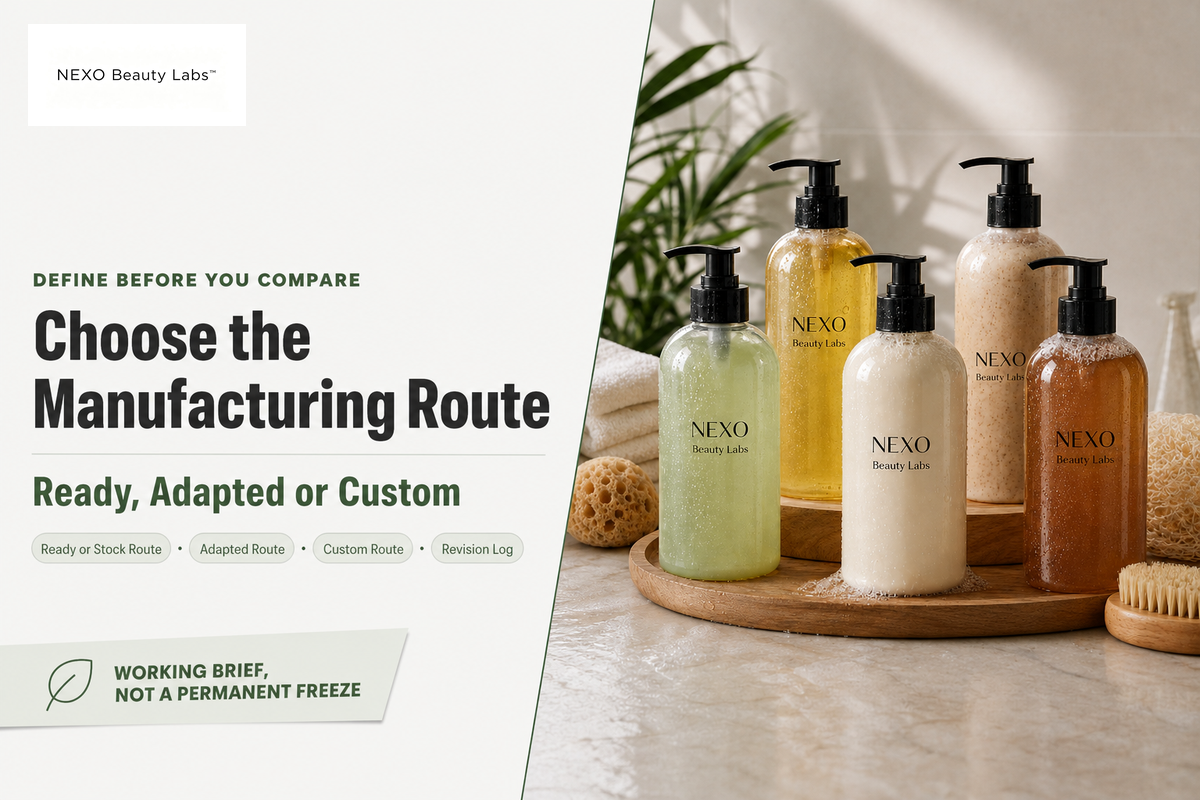
Define your desired end product and the routes to get there and then gather evidence through route conversations with suppliers. Each route defines a product and evidence scope and identifies an owner for brief changes and approval decisions.
Working brief, not a permanent freezeDefine enough to search and compare suppliers, but keep a revision log. Learning may change a fragrance, package, route, claim, or market; the control is to record the change and reopen the affected evidence, not to pretend the first brief can never move.
Given the right fit, a supplier can offer a private label body wash from a stock base, while a contract manufacturer can include custom formulation in a broader contract manufacturing product line. The same reasoning applies to other care products and product lines, including skin care, personal care products, and body care products. There are many marketing-positioning choices, such as high-quality, sulfate, botanical, aloe, or scrub claims, but none is verified manufacturing evidence on its own.
Product naming is not a reliable route decision. The FDA classification guide explains that composition, intended use, and claims can place a cleanser under soap, cosmetic, drug, or combined rules in the United States.
Private Label Body Wash Manufacturer Route Options
Ready or stock routeConfirm the exact base, permitted package menu, evidence that may be reused, formula rights, available changes, and what triggers new review.
Adapted routeName each allowed change and the evidence it reopens. “Minor customization” is not a technical scope until fragrance, color, viscosity, claims, and pack are identified.
Custom routeDefine development inputs, iteration control, ownership and use rights, evidence responsibilities, scale-up handoff, and the records available if the relationship ends.
The NIST MEP supplier-scouting intake asks for manufacturing process, specifications, materials, certifications, regulations, business volume, target price, delivery, and packaging requirements before its network searches for capable suppliers. That’s a useful discipline: supplier discovery improves when the need is explicit.
- State intended users, ordinary cosmetic use, rinse feel, appearance, fragrance direction, and dispensing intent.
- List target markets and intended claims, including claims that are explicitly out of scope.
- Identify the planned formula route and which decisions can still change.
- Provide volume scenarios only as quote assumptions, never as a claimed market-wide minimum.
- Name buyer-supplied components, approval owners, and launch dependencies.
Request Evidence Tied to the Exact Formula, Package, and Facility
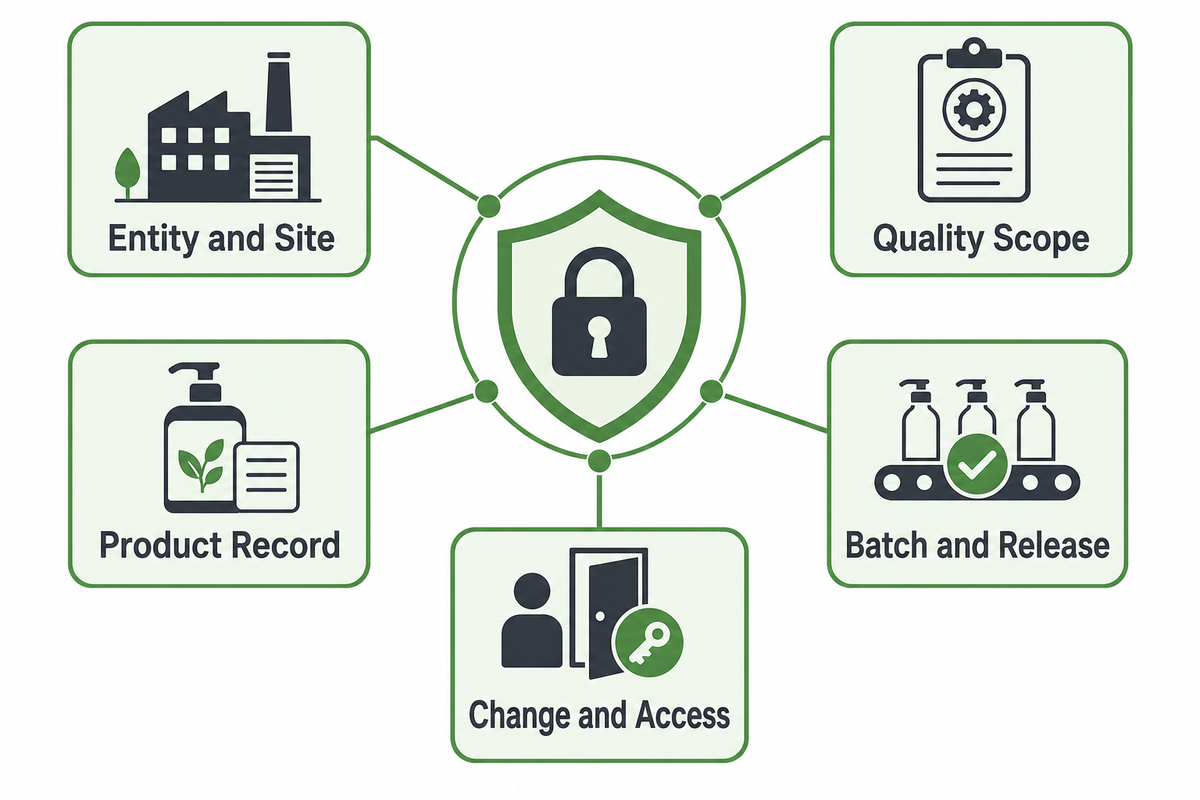
If a supplier is requested to provide evidence regarding a program or service, the request should identify the legal entity, location, revised specification, package, test, control, market, date, and the name of the issuing authority. Evidence pertaining to a generic capability or test may support discovery, but it doesn’t prove that the exact program is covered. However, such evidence isn’t prima facie proof that the supplier follows the listed program practices.
| Evidence group | Scope fields to capture | Gap that stays open |
|---|---|---|
| Entity and site | Legal name, address, activity, subcontractor, market role | Who actually makes, fills, stores, or releases? |
| Quality scope | Issuer, standard, covered site, activity, issue and expiry | Does the document cover this facility and work? |
| Product record | Formula, specification, package, revision, test method | Is this evidence transferable to the proposed state? |
| Batch and release | Lot, process status, results, deviations, disposition, approver | What will the brand receive for each order? |
| Change and access | Notice trigger, evidence review, approval, retention, file access | What happens when formula, supplier, site, or pack changes? |
The current FDA cosmetic GMP checklist asks whether firms maintain written formulations, processing, transfer, filling, in-process controls, equipment and batch status, laboratory checks, and manufacturing records. It is guidance, not proof that a particular supplier follows every listed practice.
Shower Gel Manufacturer and Body Wash Evidence Scope
The scope testFor every document, ask: who issued it, which legal entity and facility it covers, which activity and product state it addresses, when it was valid, and what it does not prove. If those answers are missing, retain the document as a lead—not as a closed requirement.
An “FDA registration certificate” should be treated as a knockout issue until its provenance is resolved.
Treat Formula, Fragrance, Filling, and Packaging as One System
Samples of a final product depend upon numerous interrelated factors, including raw materials, design, formulation, choice of ingredients, the methods and conditions used during manufacture and processing, transportation, storage, preservation, use and exposure to the consumer, and various other factors, both of a chemical and physical nature. The supplier is expected to explain how the evidence presented covers the entire combination product.
| System input | Possible interaction | Evidence question | Change trigger |
|---|---|---|---|
| Rheology and temperature | Mixing, transfer, filling, pump priming, dose | Which limits and observations apply to this formula and line? | Process, equipment, climate, or dispenser change |
| Fragrance, color, surfactant system | Appearance, odor, viscosity, material interaction | What was assessed, in which version and package? | Supplier, level, or formula revision |
| Preservation and package protection | Microbial exposure during making, storage, and use | Why is the protection plan suitable for intended use? | Water, raw material, package, or use-pattern change |
| Transport and storage | Leakage, deformation, separation, label damage | Which assumed route and conditions were reviewed? | Route, carton, pallet, climate, or storage change |
FDA lists contaminated water or raw materials, poor manufacturing conditions, ineffective preservation, inadequate package protection, shipping or storage, and consumer use among the ways cosmetics may become contaminated. Its microbiological safety overview is a strong reason to include preservation and package protection in the same risk conversation.
A technical scale-up review in Cosmetics & Toiletries frames scale-up as a process-engineering problem rather than simple percentage multiplication. Use that principle to ask for a program-specific rationale, not to invent one universal viscosity, temperature, compatibility period, or fill window.
Body Wash Formula and Packaging Options Compatibility
Package commitment gateBefore committing components, record the exact formula revision, intended use, package parts, dispensing target, filling assumptions, microbial-protection rationale, transport case, acceptance points, and the person who can approve a deviation.
Normalize Quote Scope Before Comparing Price
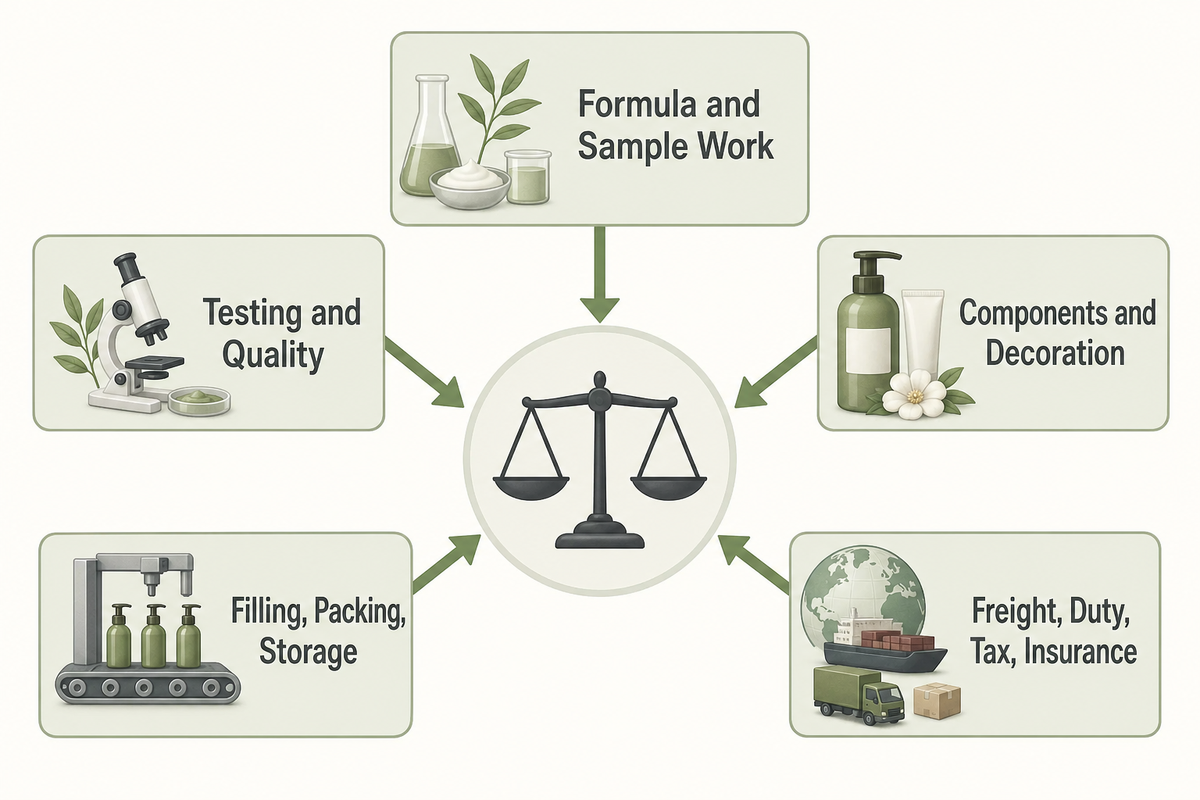
A low unit price doesn’t always result in a low total evaluation, and vice versa. It shouldn’t be assumed that qualified offers and prices are equivalent until their scope and terms match. Before arriving at a conclusion based upon price, other requirements and the evaluation scope should be aligned, and unresolved risks should be addressed.
| Cost or deliverable | Included | Excluded / optional | Quantity or timing basis | Evidence delivered |
|---|---|---|---|---|
| Formula and sample work | Scope and rounds | Extra changes | Trigger and expiry | Version and approval record |
| Testing and quality | Named plan | Retest or external work | Product/package assumptions | Method, result, reviewer, release file |
| Components and decoration | Part and finish | Tooling, plates, rejects | Component and production basis | Specification and approval proof |
| Filling, packing, storage | Operations and period | Over-run, disposal, long storage | Lot and inventory assumptions | Batch, packing, disposition records |
| Freight, duty, tax, insurance | Named responsibility | Buyer-paid items | Incoterm, route, estimate date | Commercial documents |
In procurement, FAR 15.404-1 states that prices are not comparable when terms and conditions differ significantly, and material differences can influence or require adjustment to the price. A cosmetic RFQ isn’t a federal invitation for bids; however, the comparison principle remains relevant: don’t treat materially different offers as equivalent.
According to the U.S. International Trade Administration, landed cost is the cost of the goods, plus shipping and handling, insurance, and customs duties. When the terms of a sale are outlined by an Incoterm, responsibility for duties and taxes may remain with the seller or pass to the buyer, depending on that term. Therefore, to compare costs of a sale, it’s essential to analyze the route and responsibility of the goods, as opposed to analyzing unit costs.
Body Wash Contract Manufacturing Quote Decisions
Why assumptions matterThe government page’s worked example combines a $10,000 invoice, $1,000 insurance, and $2,500 freight into a $13,500 CIF value, then compares a 5% tariff with a 0% trade-agreement rate and applies 19% VAT; the resulting examples are $16,065 and $16,868.25. Those figures are an illustration, not a body-wash forecast; they show why the date, market, classification, and cost owner must be recorded.
Decision rule: reject a quote that cannot be reconciled to the brief. For the remaining offers, price is meaningful only beside its quantity basis, exclusions, uncertainty, evidence handoff, payment trigger, change work, and termination obligations.
Audit the Path From Approved Sample to Commercial Batch
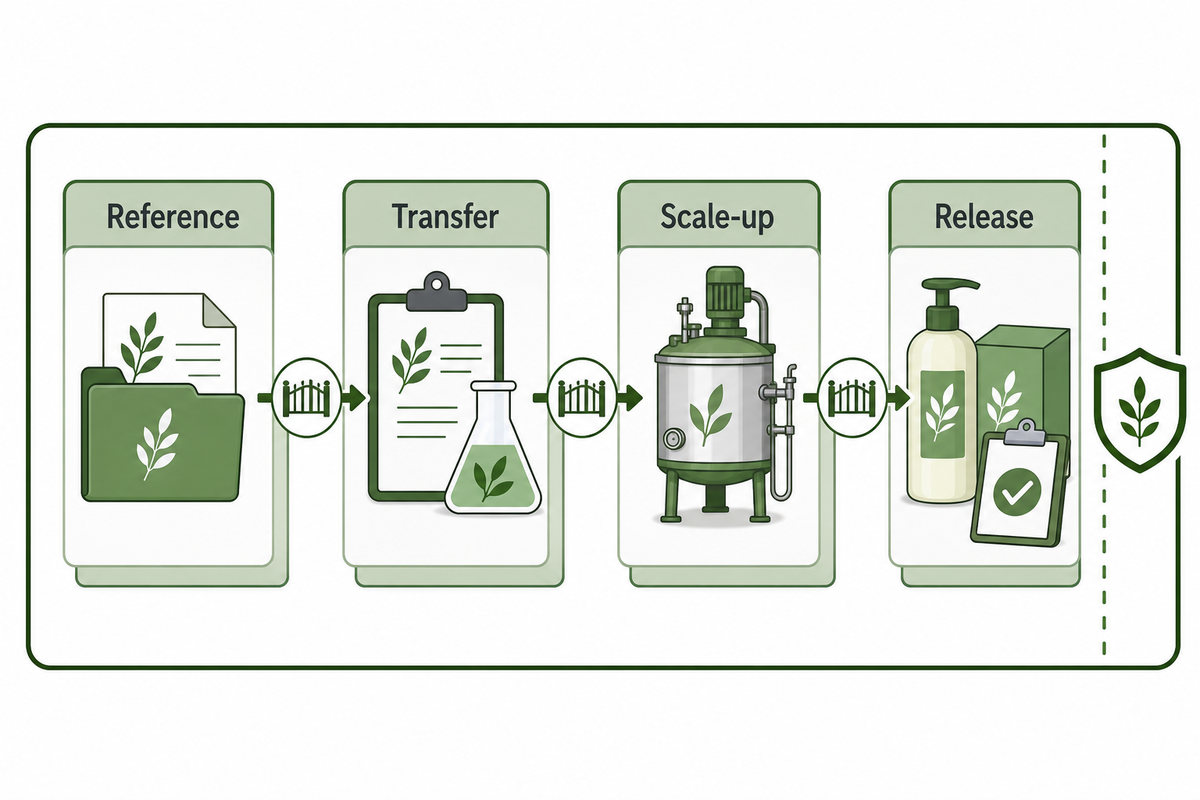
Sample approval confirms that one reviewed sample met the agreed decision at that time; it doesn’t release every later production lot. Before ordering, define the formula and package state, process transfer, scale-up learning, in-process checks, finished specification, deviation route, release owner, retained records, and the changes that reopen approval.
Body Wash Manufacturing Sample-to-Batch Controls
The FDA checklist separates written production instructions, in-process and finished-product checks, batch records, laboratory controls, and control status. Knowledge of these controls supports understanding of the FDA’s expectations with respect to a product and allows a company to plan for the collection of product release information.
Body Care Products Change Triggers and Control Responses
Change triggers to name
- Ingredient or raw-material supplier
- Fragrance, color, or process
- Equipment, facility, or subcontractor
- Package, decoration, or artwork
- Claim, market, test method, or limit
Control response to assign
- Notice owner and timing
- Risk and evidence review
- Required re-sampling or reassessment
- Approval or rejection authority
- First affected lot and inventory treatment
Not all process development and scale-up work results in the desired outcome. However, all results should be documented and actively assessed. Assumptions shouldn’t be made that process and product development work carried out as part of process and product validation studies will result in an acceptable outcome during commercial manufacturing.
Map Destination-Market Duties and Service Fit Separately From Quality
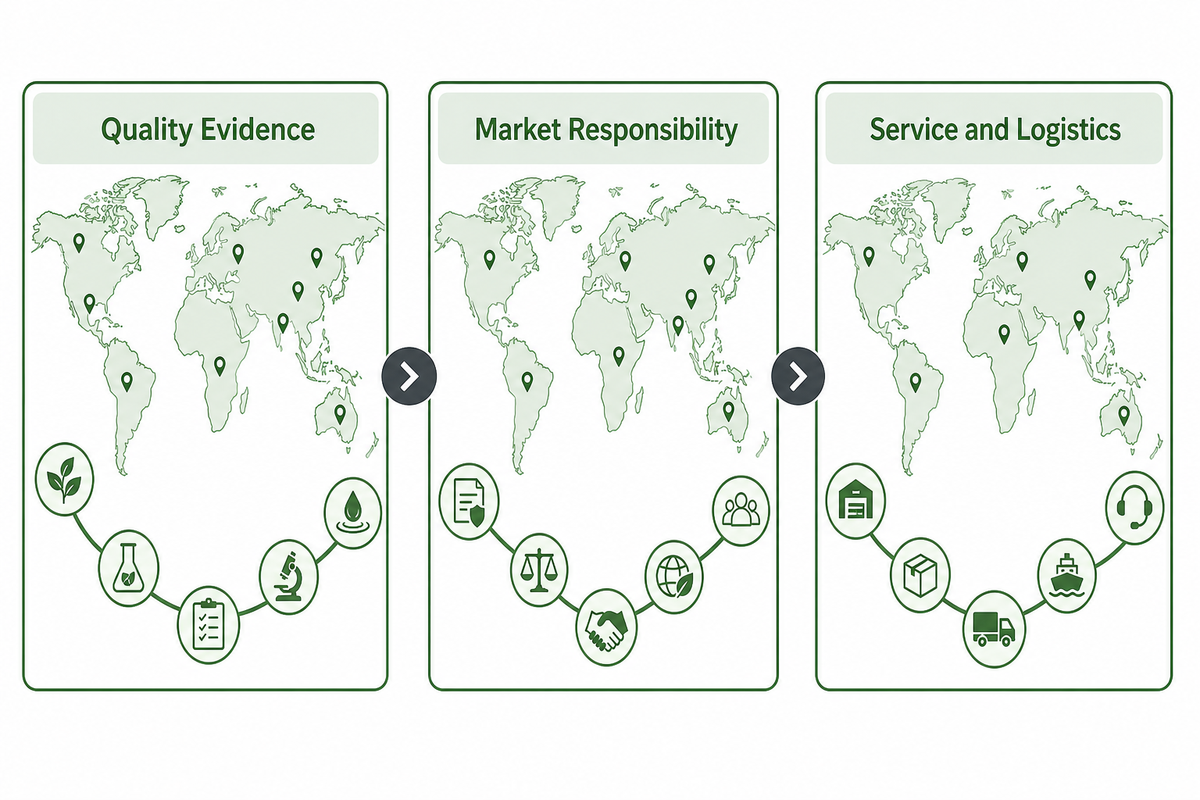
Where a product is sourced doesn’t remove the need to document the outcome of a quality audit or map destination-market responsibilities. Location affects time zones, freight, language, access, and options for the visit, and legal matters, but evidence must name the product to be assessed and the market where it’s to be sold.
| Map | Questions | Do not infer |
|---|---|---|
| Quality evidence | Which site, system, formula, package, record, result, and approver? | Country equals good or bad quality |
| Market responsibility | Who is manufacturer, importer, label-named party, responsible person, safety-file or notification owner, and incident contact? | The factory automatically owns every duty |
| Service and logistics | Who responds, escalates, controls files, coordinates samples, gives change notice, manages freight, and supports continuity? | Fast sales response equals strong change control |
The EU legislation on cosmetics identifies the responsibilities of an EU responsible person, including a product safety report before market placement, central notification procedures, and serious-undesirable-effect reporting requirements. The information provided illustrates the importance of having a market-role map, in addition to an operations supplier scorecard.
Health Canada’s notification policy requires manufacturers and importers to notify the agency within 10 days of the first sale of the product in Canada. The notification should be amended to reflect any changes in the information communicated. The policy provides market information requirements that show why the accountable party and update workflow must be named for each market.
Cosmetic Manufacturer Service-Fit Evidence
Service-fit evidenceAsk for a named owner, escalation path, sample-feedback loop, decision log, file-access rule, subcontractor disclosure, change-notice route, incident coverage, continuity plan, and exit handoff. Score what’s demonstrated for the proposed program, not what appears in a generic capability list.
Use Red Flags as Knockout Tests, Not a Vague Score
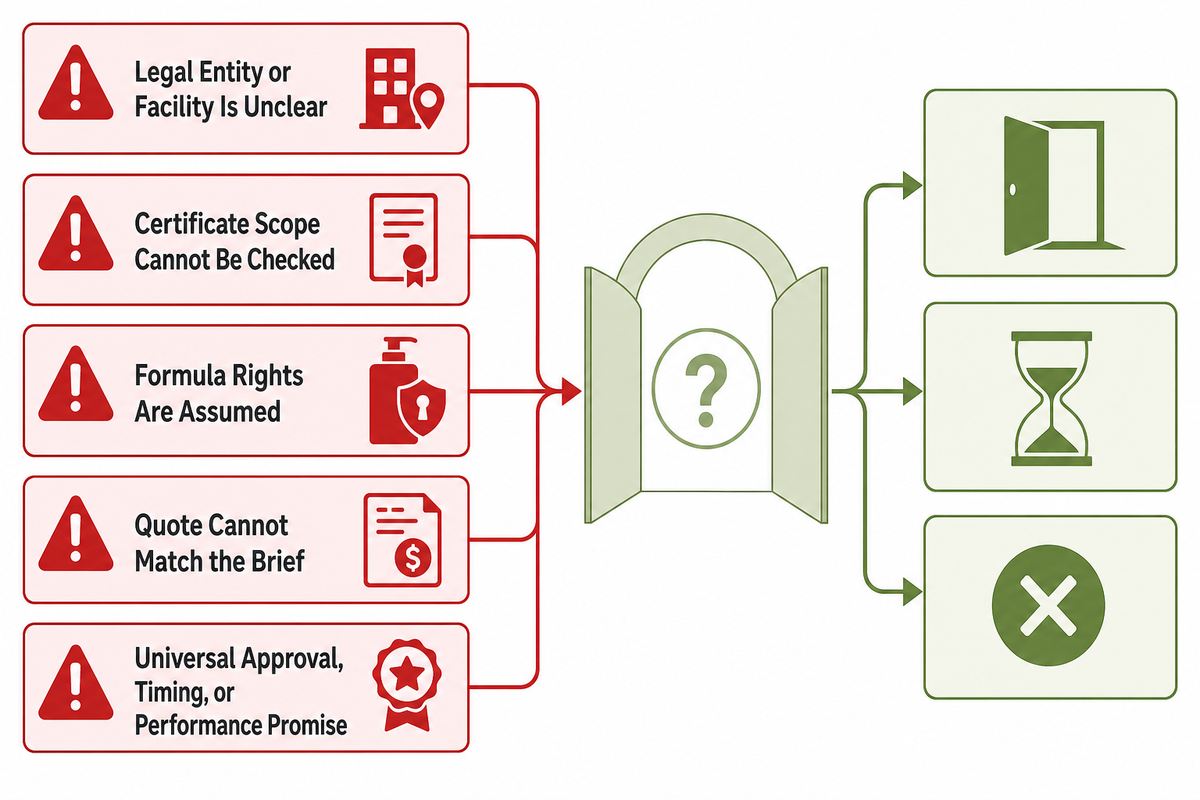
Expected weights should never take the place of missing absolutes. Evaluate absolutes first, including legal identity and facility scope, evidence availability, formula and package rights, quote reconciliation, subcontracting, change control, record transfer, and support for every approval or performance promise. Only then, evaluate weights for your preferences.
| Signal | Knockout question | Evidence needed to reopen |
|---|---|---|
| Legal entity or facility is unclear | Who performs the contracted work? | Identified entity, site, activity, and subcontractor map |
| Certificate scope cannot be checked | Does it cover this site and activity? | Issuer record and full scope |
| Formula rights are assumed | Who can use, modify, transfer, or disclose what? | Written rights and exit terms |
| Quote cannot match the brief | What is actually included and on which basis? | Reconciled quote and assumption log |
| Universal approval, timing, or performance promise | Which market, product state, method, condition, and owner support it? | Scope-specific primary evidence and qualified wording |
Preference scores are warranted for other fit factors including the supplier’s portfolio, optional services, location, and website. Preference scores are acceptable, but a missing absolute should never be given a neutral score.
Private Label Manufacturer Red-Flag Resolution
A useful “not yet”: a candidate does not need to be permanently rejected when a document is missing. Mark the gate open, name the exact evidence required, set an owner and deadline, and prevent the candidate from advancing until the issue is resolved.
Build the 9-Factor Manufacturer Qualification Matrix and Decision Ledger
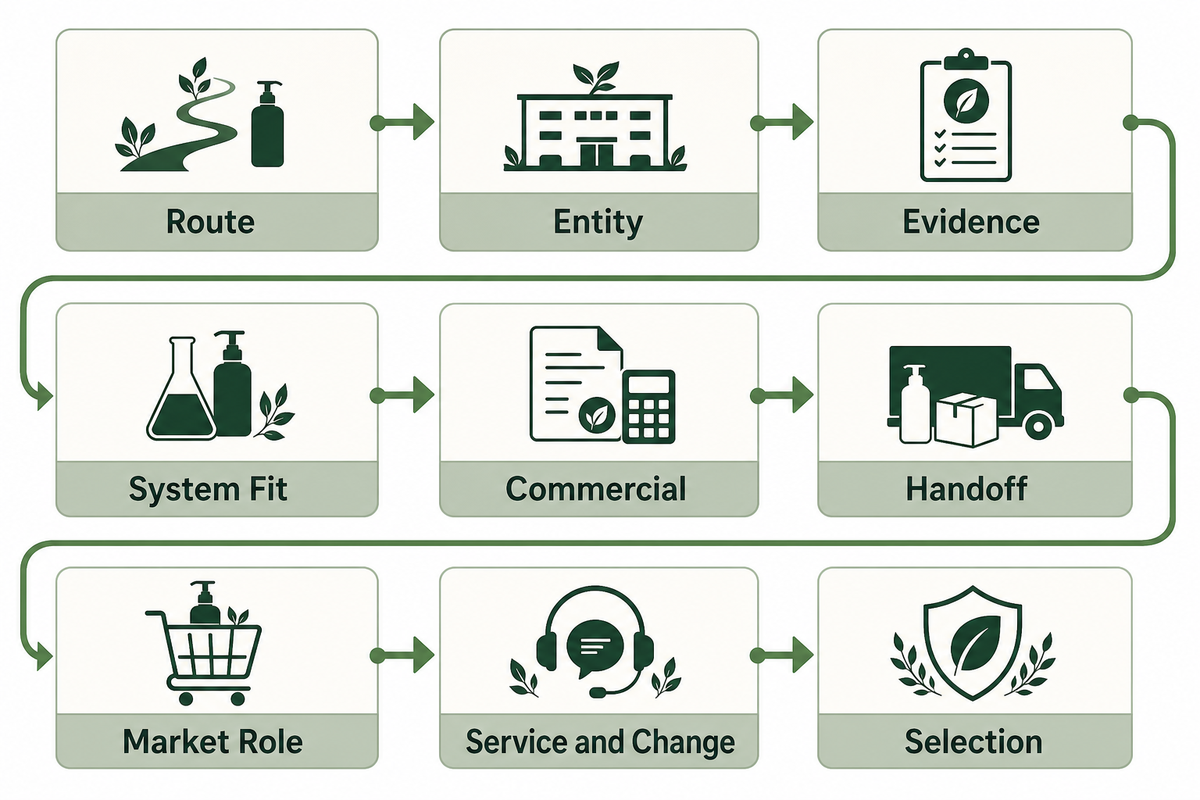
The final decision record must preserve required and verified evidence, remaining uncertainty, decision owners, and the preference scores applied. The record of required and verified evidence isn’t a universal ranking formula. Decisions will record a fallback if the preferred supplier isn’t used.
- Apply knockout rules before assigning any weighted score.
- Score only evidence that’s current, retrievable, and in scope for the proposed program.
- Record uncertainty and missing items instead of converting them to average points.
- Run the preferred candidate through the same brief, evidence pack, package map, quote grid, and change workflow.
- Document the approval owner, reasons, conditions, first-order checkpoints, and fallback candidate.
| Category | Verified evidence | Uncertainty | Decision | Owner / date |
|---|---|---|---|---|
| Route fit | Exact offered route and change boundary | Open development choices | Accept / condition / reject | Named approver |
| Evidence | Entity, site, product, package, method, record | Missing or non-transferable proof | Gate result | Technical reviewer |
| Commercial scope | Normalized inclusions and evaluated cost | Optional or variable items | Comparison result | Commercial owner |
| Service and change | Named contacts, workflow, notice, file access | Response or continuity risk | Conditions and fallback | Program owner |
NEXO Beauty Labs is a global cosmetic OEM/ODM partner for skincare, hair care, and body care development, formulation innovation, and scalable manufacturing. Its manufacturing foundation dates to 1999, and its international business team has supported global beauty brands, e-commerce companies, distributors, and private-label partners since 2020; these supplied facts don’t prove a project-specific minimum, price, timing, capacity, certification, test result, or outcome.
Private Label Cosmetics Supplier Conversation
Put the framework into a real supplier conversationOnce the route, evidence pack, package map, and quote grid are ready, use them to discuss a body wash manufacturing programme with NEXO Beauty Labs.
Frequently Asked Questions
How do I find a body wash manufacturer?
Start with a controlled program brief, then search for manufacturers whose route, market coverage, packaging capability, quality evidence, and commercial model match it. Build a longlist from directories, search results, referrals, and trade sources, but don’t rank companies by marketing claims alone. Ask every candidate the same questions and remove any supplier that can’t satisfy a non-negotiable requirement. Keep the rejected candidates and reasons in the ledger, because a later package, market, or volume change may alter fit without changing the evidence standard. Before contacting the longlist, prepare one evidence request and one quote grid so that early sales conversations don’t create a different definition of the product for each supplier.
What should I ask before requesting samples?
Ask which formula route the sample represents, which claims and ingredients are in scope, who controls the formula and packaging files, what changes are permitted, which evidence is planned, and how scale-up will be governed. Also request exact quote inclusions and exclusions, approval points, document deliverables, change-notice rules, and the identity and scope of any certificate being relied on.
Is body wash the same as shower gel for manufacturing purposes?
The terms often overlap in the market, but the label name doesn’t define one technical specification. Cleansing system, viscosity, fragrance, visual format, rinse feel, intended use, claims, package, and dispensing method can make similarly named products behave differently. Validate the actual formula, package, process, acceptance criteria, and claims rather than assuming the names make two programs equivalent.
Should I choose a US or overseas manufacturer?
Choose by program fit, not geography alone. Location can affect communication hours, freight, import work, component sourcing, regulatory coordination, visit access, and contingency options, but it doesn’t prove quality. Compare the legal entity, facility scope, evidence access, package supply, landed-cost assumptions, accountable market roles, and change-control response under the same framework.
Who owns a custom body wash formula?
Ownership depends on the agreement, development inputs, background intellectual property, paid work, confidentiality terms, and transfer rights. Don’t assume that paying for samples transfers a formula or that a private-label formula becomes exclusive. Ask for written definitions of ownership, permitted use, modification, documentation access, disclosure, exit assistance, and treatment of supplier-owned bases before development begins.
Bring a reviewable brief, not a vague supplier request
Combine your route choice, package concept, target market, evidence gaps, quote assumptions, and approval owners. NEXO Beauty Labs can then review the program against a defined starting point.
References & Sources
- U.S. FDA, Is It a Cosmetic, a Drug, or Both? (Or Is It Soap?)
- U.S. FDA, GMP Guidelines / Inspection Checklist for Cosmetics
- U.S. FDA, Registration & Listing of Cosmetic Product Facilities and Products
- U.S. FDA, Cosmetics Labeling Claims
- U.S. FDA, Microbiological Safety and Cosmetics
- European Commission, Cosmetics Legislation
- Health Canada, Notification of Cosmetics
- NIST MEP, Supplier Scouting Opportunity Synopsis
- Federal Acquisition Regulation, Subpart 15.4 Contract Pricing
- International Trade Administration, Determine Total Export Price
- Cosmetics & Toiletries, Scale-up Considerations for Cosmetics
Sources reviewed September 28, 2026. Regulatory and guidance pages can change; verify the current text and obtain market-specific advice before making compliance decisions.