Get in touch with NEXO Beauty Labs Company

Updated September 2026
Quick answer
- White label usually starts with a supplier-controlled, ready formula; private label may include more adaptation or development, but the terms aren’t legal categories.
- Formula access, exclusivity, change control, records and transfer rights come from the contract and specification.
- Compare quotes against one frozen product, package and market brief. Low unit prices can hide testing, artwork, compliance and switching costs.
- Use the Three-Brief Skincare Supplier Route Record, Contract-Control Matrix and Ready-Formula Validation Ladder below before approving a purchase order.
Private label vs White Label skincare is a commercial comparison, not a regulated naming system. In common supplier language, white label refers to an existing formula that several brands can purchase, whereas private label refers to a brand-specific brief or adaptation. The same supplier can use the labels differently. The signed specification, quality agreement, and destination market plan will determine what you’ll actually receive.
Private label gives a buyer more possible control over formulation and differentiation; white label gives a buyer a more bounded route to market. Neither label proves ownership, exclusivity, package compatibility or regulatory responsibility. Those points must be written and evidenced before a launch commitment.
Reader map: Start with the model comparison and check the rights, packaging evidence, regulatory roles and quote economics. Procurement can use the Three-Brief Skincare Supplier Route Record, Contract-Control Matrix and quote checklist; quality assurance can use the validation ladder; finance and brand teams can use the same brief to compare landed cost and differentiation.
Private Label vs White Label Skincare at a Glance
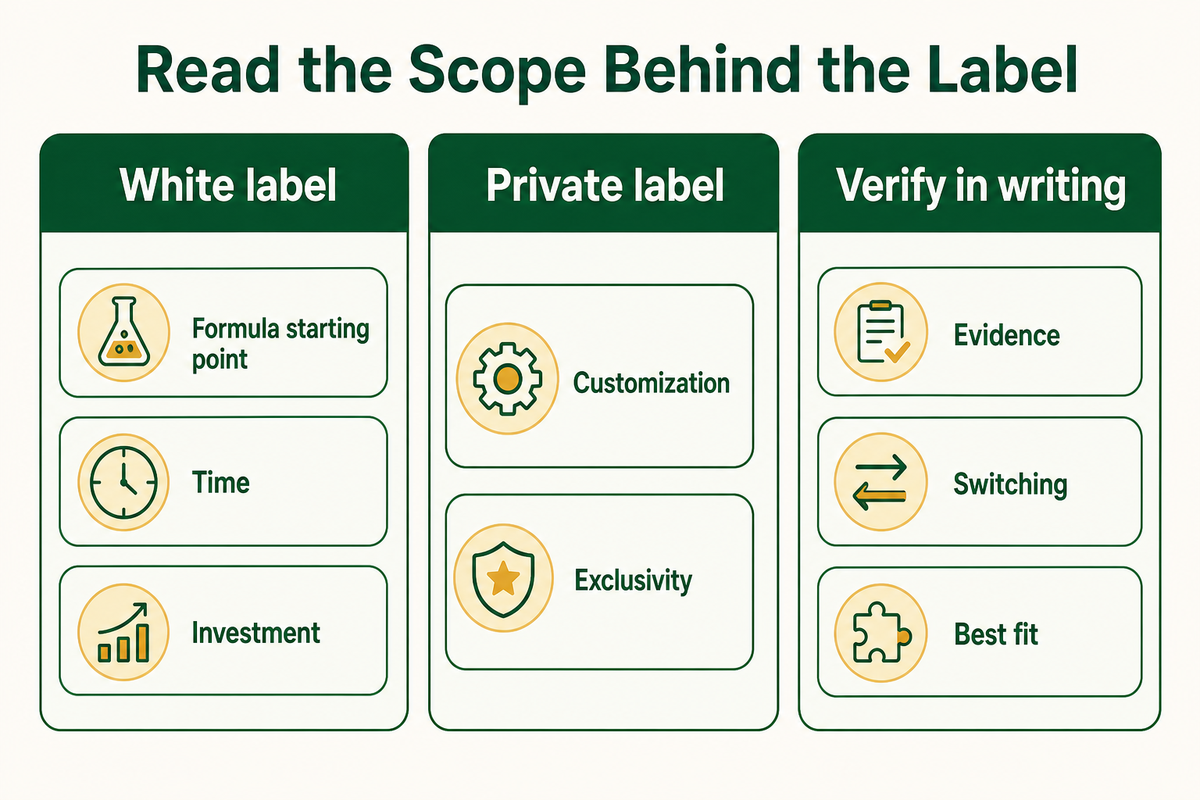
White label is usually the faster route when the supplier has already formed a base formula and manufacturing process. Private label can support a more precise product brief, but the buyer may have to oversee trials, revisions, validation and documentation. Neither of these outcomes is guaranteed by the sales label alone.
For white label and private label skincare, the key difference is the documented control path. White label products may place one generic product with multiple retailers, while a private label product may carry the buyer’s brand name and a more specific brief. Across white labeling and private label programs, a third-party manufacturer can help a brand market faster, but the upfront decision still depends on evidence, rights, and destination-market responsibilities.
White label route
- Ready or supplier-controlled formula
- Bounded customization
- Faster brief-to-sample path
- Differentiation through package, claims and channel
- Rights depend on the written program
Private label route
- Brand-specific brief or adaptation
- More development decisions to govern
- Potentially stronger differentiation
- More evidence and revision work
- Ownership still depends on contract language
| Dimension | What the label may suggest | What to verify | Limitations / not suitable for |
|---|---|---|---|
| Formula starting point | Ready base vs brand brief | Formula version and change log | Prior batches do not prove suitability for a new package |
| Customization | Limited vs broader adaptation | Allowed edits and revision ownership | Do not alter preservative system without review |
| Exclusivity | Sometimes implied | Territory, channel, term and remedy | No clause means no reliable exclusivity |
| Evidence | Pre-tested or developed | Dossier, batch and package records | Supplier marketing is not a release record |
| Time | White label may be quicker | Milestones for samples and approvals | No universal lead time without a frozen brief |
| Investment | Private label may carry more development | Testing, tooling, artwork and setup fees | Unit price alone misstates landed cost |
| Switching | Private work may feel stickier | Transfer documents and exit rights | No file access can lock a brand in |
| Best fit | Speed vs differentiation | Buyer capability and launch risk | Neither model guarantees profit |
Use the more extensive cosmetics comparison for context at the category level and then keep the focus of this page on procurement of skincare.
What Each Manufacturing Model Usually Includes
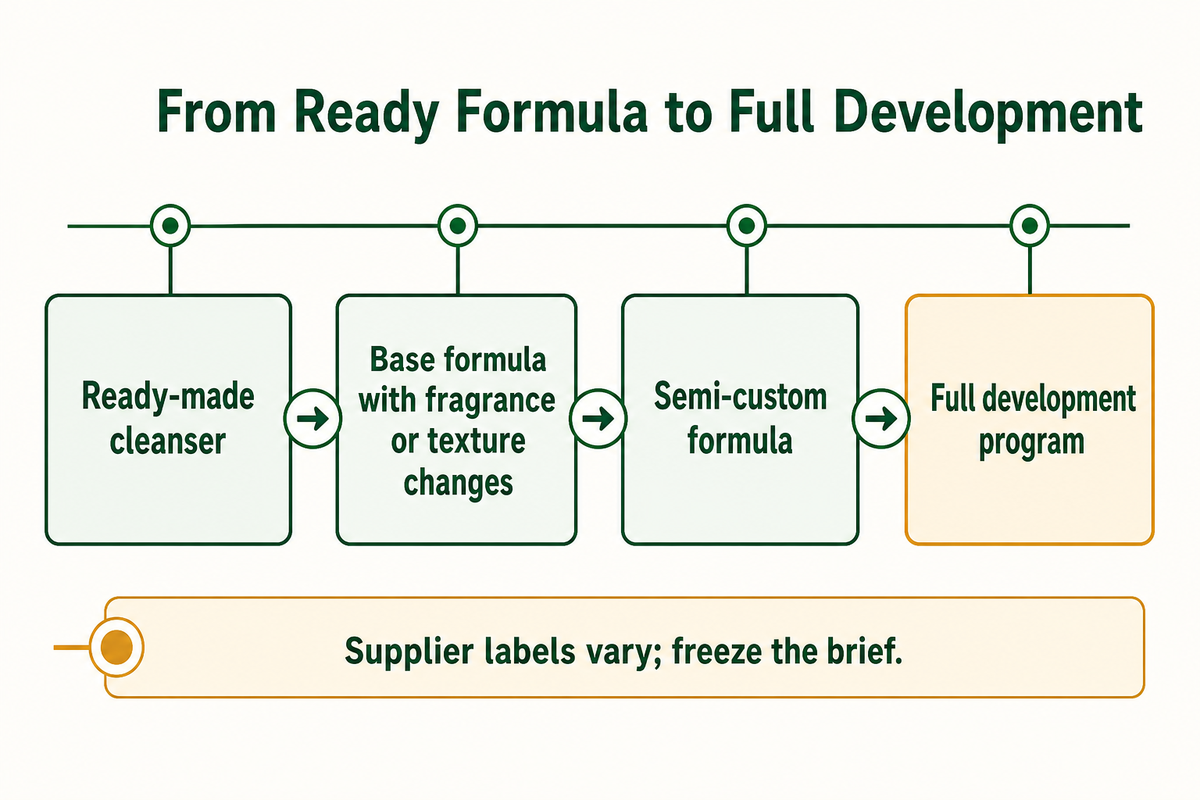
Skincare manufacturing is better understood as a continuum rather than a set of boxes. Suppliers may offer a ready-made cleanser, a base formula with fragrance or texture changes, a semi-custom formula, or a full development program. Beauty Independent describes stock or private-label products as pre-developed and pre-tested formulations, and also warns that minor changes can affect stability and preservation systems.
The practical question is where the control point sits. Brand teams seeking a specific sensory profile, ingredient restriction or claim should request a development brief and revision record. Retail teams testing a channel may prefer a stable ready formula and focus their effort on package design, merchandising and demand validation. In both cases, the supplier should identify the formula version, manufacturing facility and authorized modifications.
Apply the Labels to a Skincare Brief
Private label vs white label skincare is a comparison of business strategy labels, not a fixed manufacturing model. Supplier language may use private label and white label. It may also say white label vs private label or white label vs OEM. Some briefs use private label or white label without defining control. People confuse private and white labeling because business models vary. The real difference between white label routes is documented control. Differences between private label models also depend on that control. Ask what’s the difference in the actual skincare brief. Ask what’s the difference in rights, records, and approvals. Similarities and differences in labels do not prove control. Claims that “private labeling offers total control” need evidence. “Private labeling is the way” is sales language. So is advice to choose private without a brief. White label products offer a pre-made, pre-formulated skincare starting point. White-label products may serve more than one product line. White label companies may say white label products are manufactured for resale. Claims about similar products do not prove that selling similar formulas fits the brief.
To align with your brand’s specific needs, define what is unique to your brand. Use a cleanser, moisturizer, or other personal care product or service as the brief. Freeze the formula version, permitted changes, branding and packaging, claims, and target audience. Name the destination market, record owner, and exit file. State whether the supplier or manufacturing company controls each item. Record any third-party provider and its responsibilities. Decide whether it must create a product, create a unique formula, or develop a product from scratch. A business owner and brands looking to launch should choose the right option. When teams expand your product range or expand their product portfolio, decide what is right for your business. Compare speed and cost, price points, profit margins, product to market timing, and whether one route is more expensive than white label. Brand loyalty and competitive edge are goals, while “enter the market faster” and “market faster” are timing objectives. Use the Three-Brief Skincare Supplier Route Record for each skincare brief. Record the starting route, reassessment trigger, and next evidence item.
Common mistake: treating a minor ingredient request as artwork. Changes to viscosity, fragrance, pH or preservation may affect filling behavior, safety evidence or package interaction. Have the quality team classify the change before finance compares the revised quote.
For custom formulations, review custom cosmetic formulation requirements alongside your internal brief. This page shouldn’t be interpreted as a promise that any private label program includes full formula ownership.
Formula Ownership, Exclusivity and Change Control
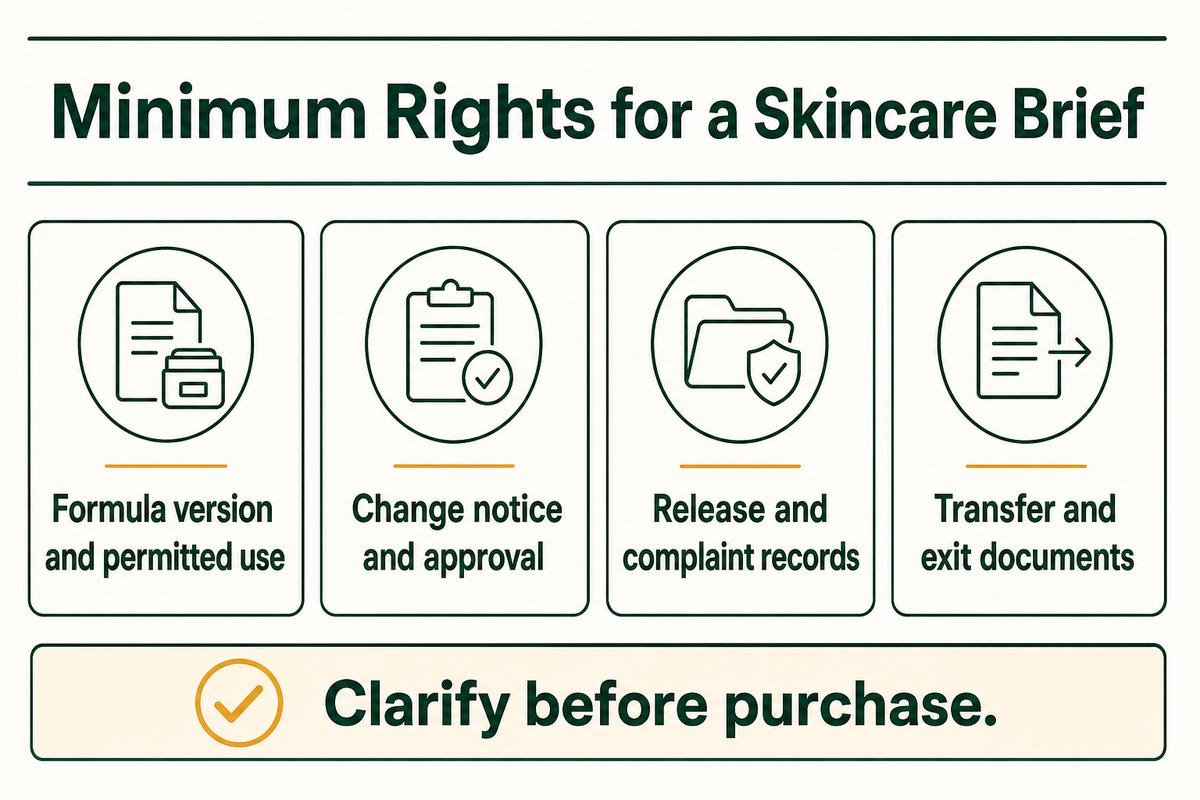
Private label proposals may still provide no usable formula rights; this Contract-Control Matrix is an editorial skincare framework, not a regulatory standard. Ownership is one control element among access, confidentiality, permitted use, independent development, manufacturing continuity and transfer documents. Have the supplier name the formula version, permitted adaptations, package-validation owner, claim-evidence owner and records supplied with each batch before issuing a purchase order.
Contract-Control Matrix, editorial skincare framework, not a regulatory standard.
| Field | Pass evidence | If missing |
|---|---|---|
| Formula access | Current skincare formula, specification and INCI supplied | Clarify before approval |
| Modification rights | Allowed formula, fragrance and texture edits with approval path | No change request should proceed |
| Ownership | Contract names owner and background IP | Do not infer ownership from “private” |
| Confidentiality | Scope, term and permitted disclosures | Protect buyer and supplier information |
| Exclusivity | Territory, channel, term and remedy | Assume the formula may be shared |
| Change notice | Formula, ingredient, package or manufacturing-site trigger and notice period | Quality assurance cannot assess impact in time |
| Records | Batch, test, complaint and retained-sample records defined | Evidence trail is incomplete |
| Supply continuity | Manufacturing site, ingredient and package-substitute controls | Continuity risk remains open |
| Transfer rights | Dossier, test records and technical-transfer terms | Switching may require redevelopment |
| Exit and remedy | Termination, sell-off and dispute path | Finance cannot price the downside |
Run the matrix with procurement, quality assurance and brand counsel together. While a supplier sales deck may state a formula is exclusive, the buyer should mark every field Pass, Clarify or Reject; “Clarify” blocks the purchase until each missing right, record or approval path is resolved. The broader cosmetics comparison covers category-level proposal evidence, while this matrix keeps each field tied to the skincare brief.
Why a Ready Formula Is Not Automatically Package-Ready
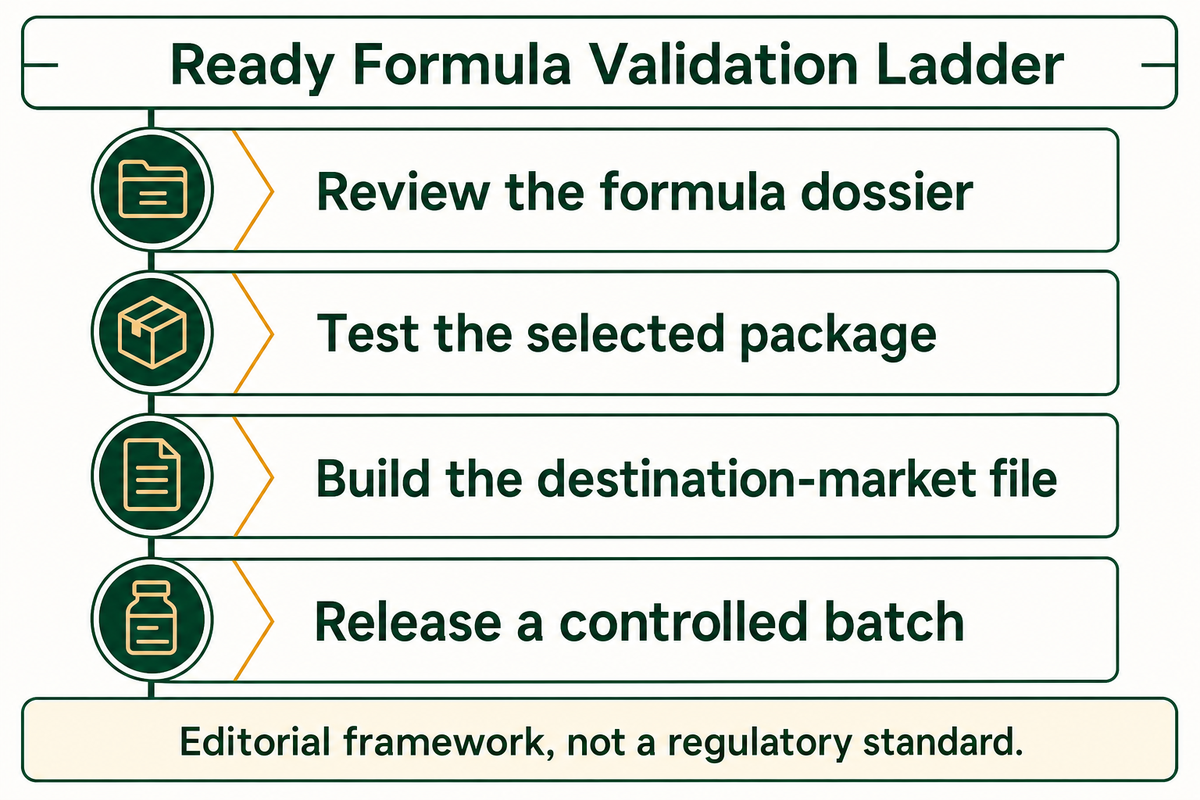
A ready formula can come with prior development or test records, but it does not by itself prove the supplier’s manufacturing history or compatibility with your selected pump, jar, liner, decoration and shipping configuration. Intertek separates testing for the stability of cosmetics from the performance and compatibility of the packaging.
Ready-Formula Validation Ladder, editorial framework, not a regulatory standard.
- Review the formula dossier: confirm version, ingredients, specifications, known sensitivities and prior stability scope.
- Test the selected package: evaluate contact materials, closure function, fill weight, decoration and shipping stresses.
- Build the destination-market file: align safety, claims, label, responsible-person and notification evidence for the market.
- Release a controlled batch: approve sampling, finished-product tests, retained samples, deviations and release authority.
Blocking Objection: “The formula has sold before, so package validation is unnecessary.” This isn’t the case when the system of container closures, the fill process, the transport conditions or the label claims have changed. QA should require package-specific evidence or document a justified risk decision. For complete technical answers, refer to the site’s guides on cosmetic stability testing, skincare packaging selection, and how far a ready skincare formula can be adapted.
The responsible person lists each marketed cosmetic product with FDA where the requirement applies; facility registration belongs to manufacturers and processors, subject to applicable exemptions.
Who Handles Safety, Listing and Market Compliance?
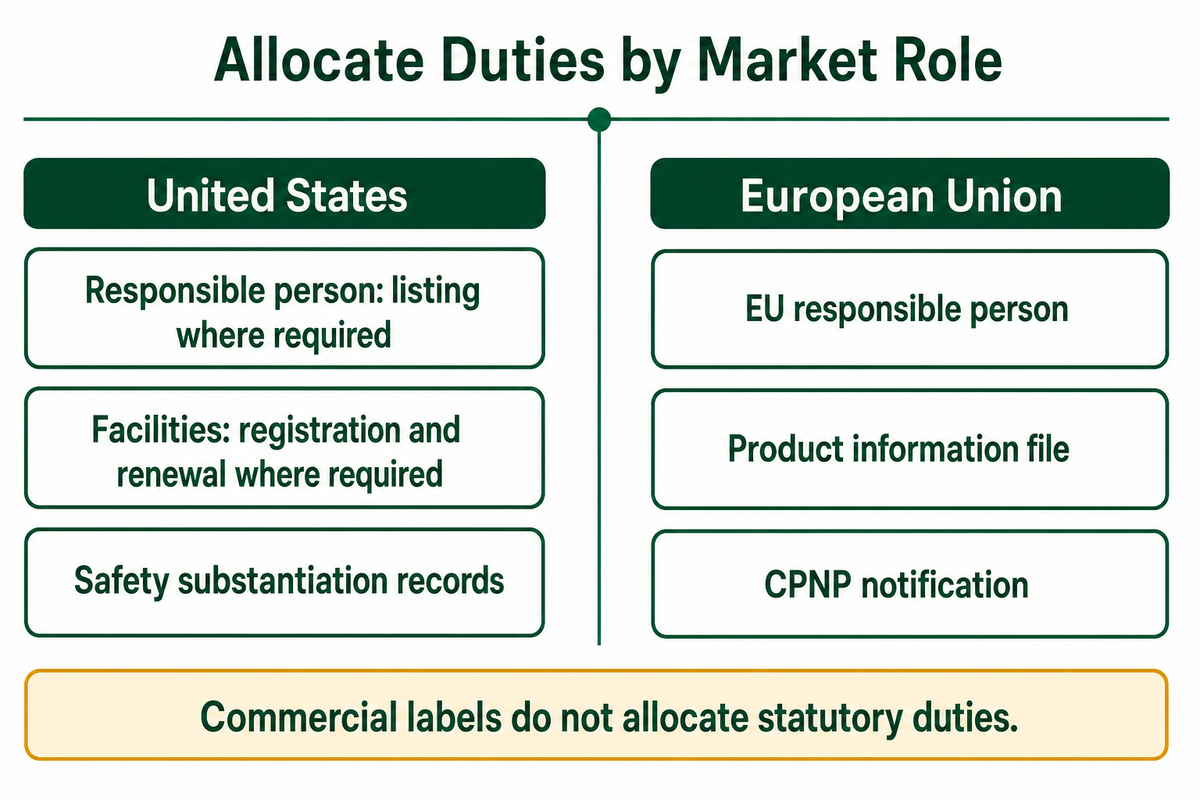
The starting point of compliance is to classify the product and to determine the intended use. A skincare product with drug-like claims may fall under a different regulatory regime for the US compared to a cosmetic. Therefore, don’t allocate duties from the program label. The contract should identify the responsible personnel, records, submissions and approval gates for each target market.
In the United States, the label-defined responsible person is the manufacturer, packer or distributor whose name appears on the cosmetic label. Where these requirements apply, the responsible person lists marketed cosmetic products and provides annual updates, while facilities have separate registration and renewal duties. MoCRA exempts certain small businesses from facility registration and product listing requirements. The responsible person must also ensure and keep records to support the adequate safety substantiation requirements of the Modernization of Cosmetics Regulation Act. A registration or listing number is not FDA approval.
The manufacturer may prepare the dossier, batch records and test reports, but the brand can’t assume that preparation equals statutory responsibility. Put submission access, safety evidence, adverse-event routing and change notification into the quality agreement. Keep advertising and skincare claims substantiation as a separate evidence field.
In the European Union, a cosmetic product needs an EU-designated responsible person before it’s placed on the market. The responsible-person relationship depends on manufacturing, importing and distribution facts, not on whether the supplier calls the program white label. A distributor can become responsible when it markets a product under its own name or trademark, or makes a compliance-relevant modification.
Products placed on the EU market are notified through the Cosmetic Products Notification Portal. Agree who owns the product information file, who controls the label version, who submits the notification and who updates it after a change in formula or responsible person. An EU notification does not substitute for US compliance, and a US listing does not substitute for an EU notification.
Each field requires an owner and due date. For the launch meeting, procurement has taken ownership of the commercial scope and of commitments made by supplier. QA has taken ownership of formula, packaging, batches, and complaint evidence. Regulatory counsel retains ownership of classification and market submissions. Finance owns pricing for testing, artwork, inventory, and exposure upon exit; brand retains ownership of claims, consumer promise, and label approval.
How to Compare MOQ, Price and Lead Time Without False Benchmarks
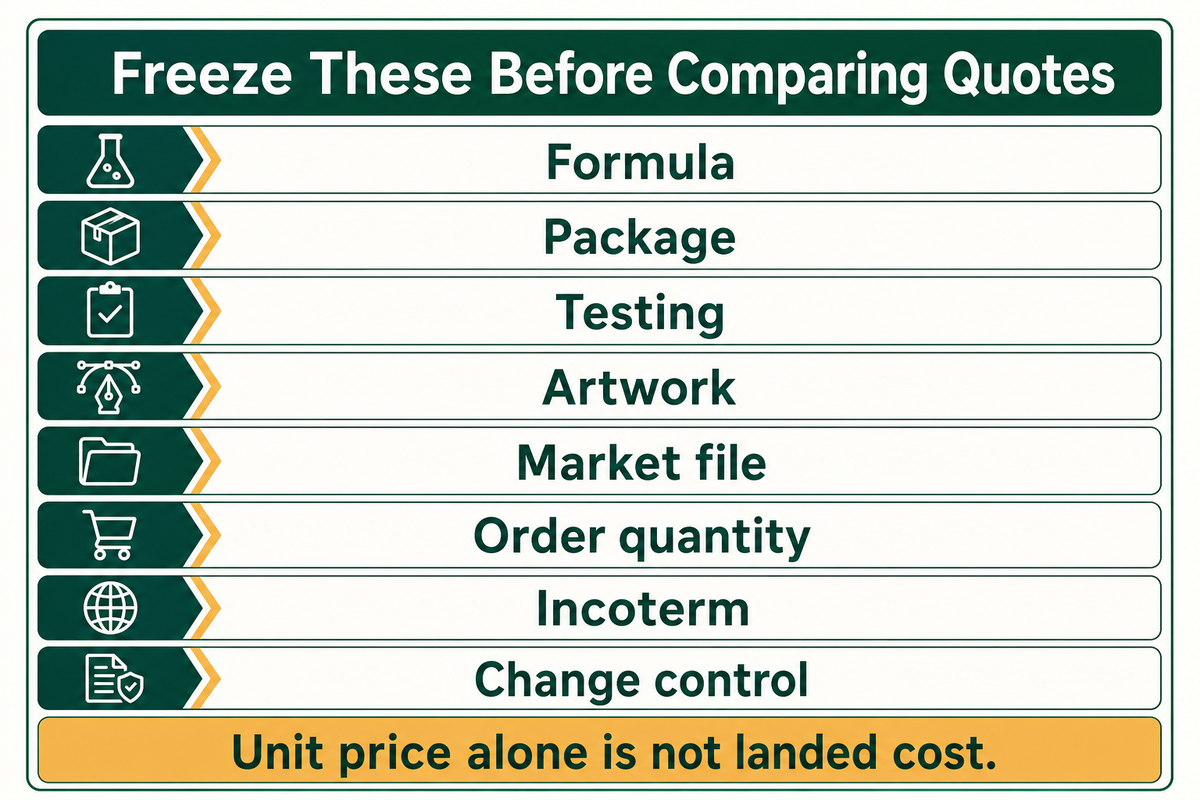
There is no skincare minimum order quantity, price or lead time that stays constant across formulas, packaging, decoration, testing and delivery markets. Supplier quotes cannot be compared until the brief is fixed. If one quote includes a stock bottle and another includes an airless pump, their unit prices are not directly comparable.
RFQ checklist: copy these fields into every quote request:
| Parameter | Frozen brief | Why it matters | How to verify |
|---|---|---|---|
| Formula | Version and adaptation scope | Prevents like-for-unlike pricing | Signed specification and revision log |
| Package | Material, size, closure and decoration | Drives compatibility and setup | Component quote and sample |
| Testing | Stability, micro and package scope | Makes evidence costs visible | Protocol, report and owner |
| Artwork | Label files, language and claims | Avoids late regulatory rework | Approved artwork revision |
| Market file | US or EU role and submission scope | Separates duties from sales language | Named responsible person and file index |
| Order quantity | Units, runs and forecast | Shows inventory exposure | MOQ, price breaks and sell-off terms |
| Incoterm | Named place and freight responsibility | Converts quote to landed cost | Commercial invoice assumptions |
| Change control | Notice, approval and remedy | Prices future risk | Quality agreement clause |
Finance should normalize one-time development fees, recurring testing, packaging setup, freight, duties, storage, write-offs and returns. The brand should also define the difference it intends to purchase: a private-label adaptation has value only when the brief, rights and claims support it. Treat supplier-specific lead-time statements as planning inputs, not industry benchmarks.
Three-Brief Skincare Supplier Route Record
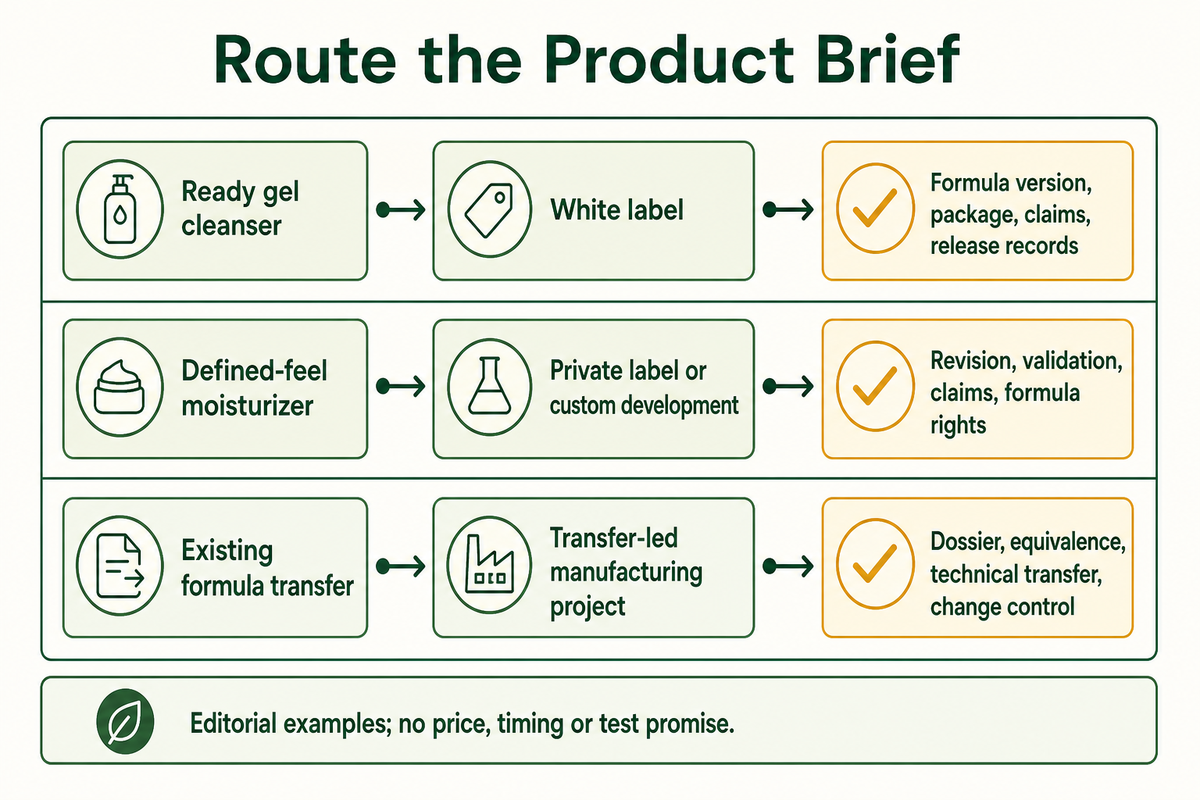
Use these three product briefs in a cross-functional review. When a record is “Clarify”, do not approve the route even if the sample looks good.
- Ready gel cleanser for a limited channel test. Start with white label; reassess after a preservative, fragrance, viscosity or container change; request the current formula specification and package-compatibility scope.
- Moisturizer with a defined skin feel and ingredient exclusions. Start with a private-label adaptation; reassess when the approved base cannot meet the brief; request the revision log, stability plan and selected-package test plan.
- Existing brand formula moving to a new supplier. Use a transfer route only when rights and records support it; stop when the dossier or transfer rights are incomplete; request the rights record, technical-transfer file and manufacturing capability review.
A listing or registration number does not automatically complete a route or earn a Pass. Request the underlying document, its scope, the product or facility the scope applies to, and the current version. Procurement should save the selected brief with a Pass, Clarify or Reject result and add the next evidence link to the sourcing file.
When White Label Wins: When Private Label Wins
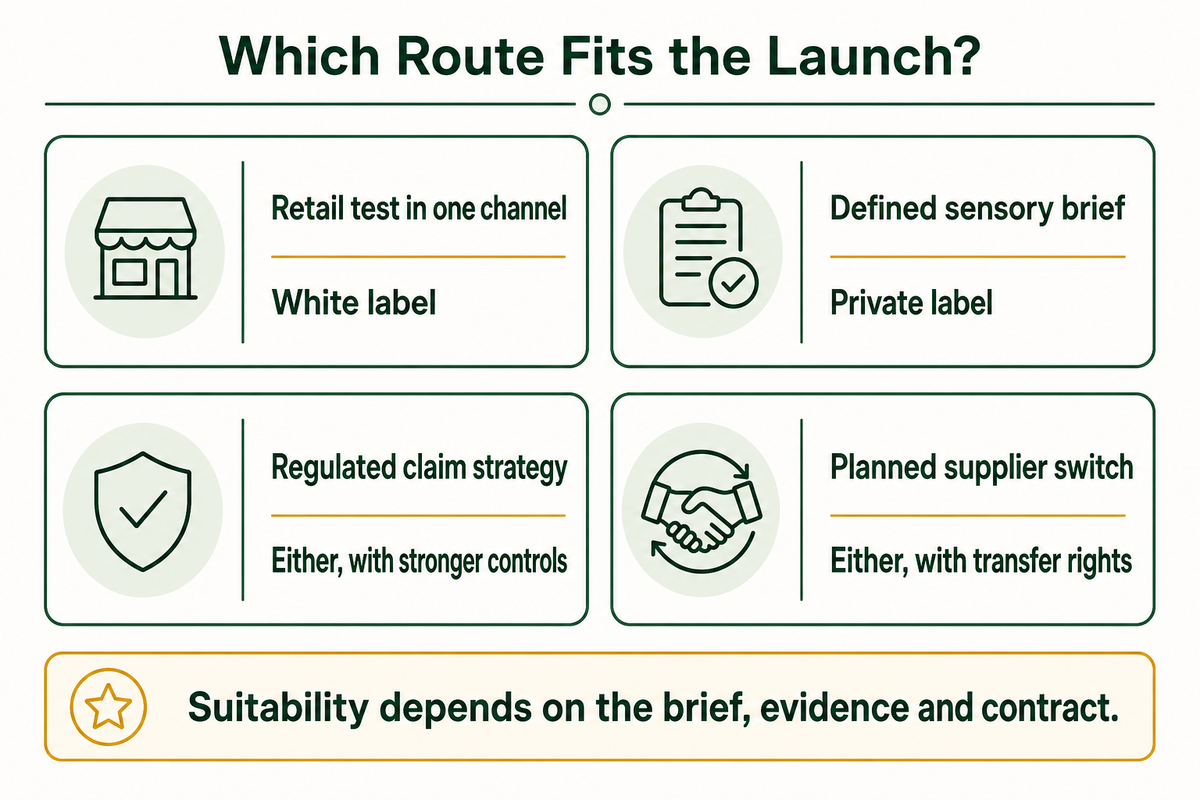
White label can win when the buyer needs a controlled, testable launch and can differentiate through packaging, channel, claims and customer experience. Private label can win when the brand has a clear product brief, can fund development and needs documented control over formulation decisions. The right answer depends on the capacity to produce and manage evidence and on exit requirements.
| Scenario | Likely fit | Reason | Limitations / not suitable for |
|---|---|---|---|
| Retail test in one channel | White label | Lower development burden | Weak fit if formula uniqueness is the core promise |
| Founder with a defined sensory brief | Private label | More room to govern the brief | Weak fit without QA and regulatory capacity |
| Regulated claim strategy | Either, with stronger controls | Claims evidence matters more than label | Weak fit when evidence ownership is unclear |
| Planned supplier switch | Either, with transfer rights | Exit documents decide resilience | Weak fit when formula files cannot move |
Key takeaway
Choose the model that gives your team enough control over formula evidence, package validation, market duties and exit documents for the risk you are willing to carry.
Frequently Asked Questions
Is private label the same as white label skincare?
Answer
They overlap in market usage. White label often means a ready formula and private label often means a brand-specific adaptation, but suppliers use the terms inconsistently. Formula rights, customization, exclusivity and compliance duties come from the contract and destination-market rules. Compare the actual formula record, change process, validation scope and transfer documents before treating either label as a sourcing commitment.
Which is better, white label or private label skincare?
Answer
Choose by launch speed, required differentiation, evidence burden, internal governance and exit needs. White label can suit a controlled channel test. Private label can suit a defined product brief when the buyer can govern development and validation. Neither model guarantees a profitable launch. The better route is the one your team can document, fund and manage through packaging checks, market compliance, replenishment and an eventual supplier change.
Is private label skincare profitable?
Answer
Profit depends on landed cost, sell-through, channel margin, returns, inventory exposure, testing and compliance work. A private-label formula may support differentiation, but it can also carry development and switching costs. Build a conservative unit economics model from the frozen quote brief. Test the model against slower sales, higher freight, rejected packaging, extra validation, reformulation and unsold inventory. Profitability should still hold when a realistic downside case replaces the supplier’s most optimistic volume assumptions.
Does private label mean I own the formula?
Answer
No. Ownership, permitted use, confidentiality, exclusivity and transfer rights must appear in the contract. The word “private” on a proposal isn’t proof of ownership.
What are the downsides of private label skincare?
Answer
Development can require more samples, revision cycles, testing and working capital. A buyer may also carry order exposure and change-governance work. If the supplier doesn’t provide usable records or transfer rights, a supposedly differentiated product can be hard to switch or defend.
Prepare a defensible skincare sourcing brief
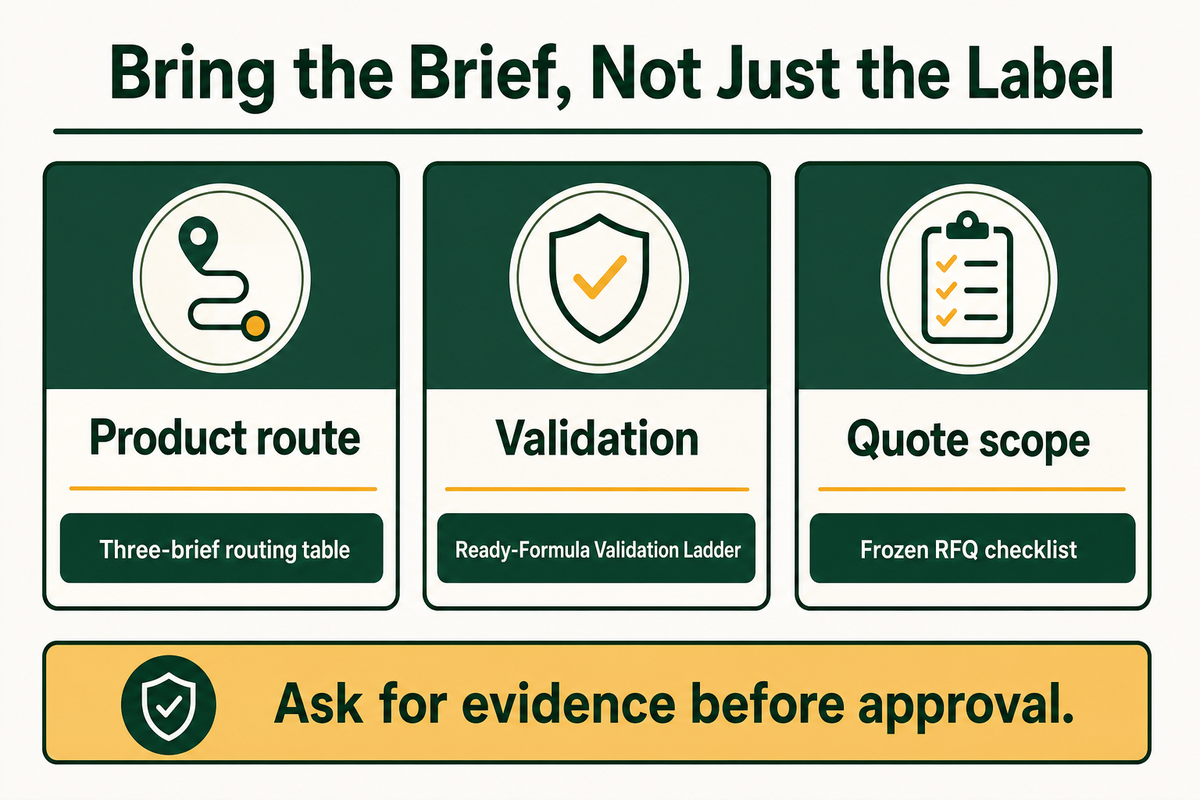
Bring the Three-Brief Skincare Supplier Route Record, Contract-Control Matrix, Ready-Formula Validation Ladder and frozen RFQ checklist into your next supplier call. Ask for evidence before you approve a model.
Transparency: This article is a procurement framework, not legal advice or a regulatory determination. It isn’t a supplier Quote that’s Universal. Check classification, responsible-person duties and product claims. Verify with licensed lawyers qualified in that market.
References & Sources
- Registration and Listing of Cosmetic Product Facilities and Products: U.S. Food and Drug Administration
- Cosmetics and U.S. Law: U.S. Food and Drug Administration
- Modernization of Cosmetics Regulation Act of 2022: U.S. Food and Drug Administration
- Cosmetics legislation: European Commission
- Cosmetic Product Notification Portal: European Commission
- Cosmetic Stability Testing: Intertek
- The Case For And Against Stock Beauty Formulas: Beauty Independent
Related articles
- Cosmetic stability testing
- Skincare packaging selection
- Skincare claims substantiation
- Custom cosmetic formulation
- Broader cosmetics comparison