Get in touch with NEXO Beauty Labs Company
OEM / ODM
Private Label Conditioner
Private Label Conditioner and Hair Mask Manufacturing
Quotation within two working days
Formula and texture samples in 3–7 business days
Production in 10–15 working days
Minimum 10,000 units per SKU
This private label manufacturing program is built for beauty brands, distributors and e-commerce companies ordering a private label conditioner, a hair mask, or a full range of private label hair care products at scale. NEXO Beauty Labs handles private label hair care manufacturing as a hair care product manufacturer: we develop and manufacture rinse-off conditioner, deep conditioner, hair mask and leave-in conditioner treatment under your own brand, from a written brief, a reference product, an existing formula or a finished artwork file.
Request a Quote
Not sure whether your launch reaches the minimum? Check your volume against the program minimum — no contact details needed.
Request a conditioner or hair mask quote
Your brief is handled as confidential and a Non-Disclosure Agreement can be signed before formula or concept details are exchanged.
Minimum order
10,000 units per SKU
Quotation turnaround
Within two working days
Formula & Texture Samples
3–7 business days after the brief is accepted
International sample delivery
A further 5–7 business days after dispatch
Commercial production
10–15 working days after formula approval and packaging confirmation
Certified manufacturing scope
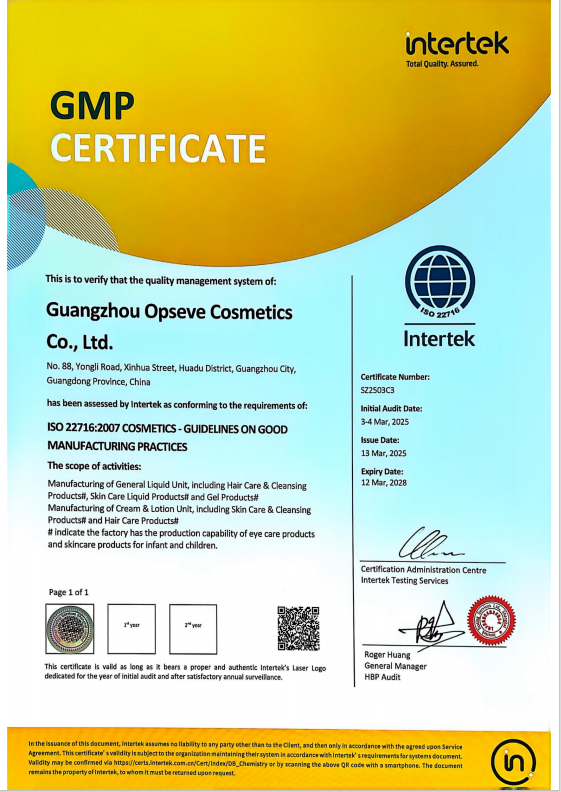
Intertek SZ2503C3, ISO 22716:2007, valid to 12 March 2028
Conditioner and Hair Mask Manufacturing Capabilities
A rinse-off conditioner and a hair mask are cationic emulsions, and they are made on the same process line as a face cream rather than on a shampoo line. In hair care product manufacturing, that distinction decides which manufacturing unit a hair care product belongs to, and it is written into the audited scope our facility holds.
Certified scope covers hair care in both manufacturing units
The certificate is issued against ISO 22716:2007, the cosmetics good manufacturing practice standard. The audited scope on Intertek certificate SZ2503C3 reads, in full: manufacturing of General Liquid Unit, including Hair Care & Cleansing Products, Skin Care Liquid Products and Gel Products; manufacturing of Cream & Lotion Unit, including Skin Care & Cleansing Products and Hair Care Products.
Cream & Lotion Unit
— rinse-off conditioner, deep conditioner, hair mask, intensive treatment
General Liquid Unit
— the matching shampoo and cleansing side of the same hair care line
Both units are named on the same certificate, so a shampoo and conditioner pair does not need two suppliers
Product formats we manufacture
Rinse-off conditioner
Daily and repair positioning, lightweight through to rich cream. The cationic system and fatty alcohol ratio set slip, rinse feel and how much weight the formula leaves behind.
Hair mask and intensive treatment
Higher active load and longer dwell time than a daily conditioner. Butter-like textures are built for weekly use on dry, rough and frizz-prone hair.
Leave-in treatment
Lower deposition, no rinse step, formulated so repeated daily use does not build up. Sits alongside the rinse-off range in a complete hair care line.
Hair oil and scalp care
Manufactured on the same site as part of the wider hair and scalp care category, so a conditioner program can extend into a full collection without changing supplier.
Production equipment behind a conditioner batch
An emulsion is only as reproducible as the vessel it is made in. Our manufacturing facility runs vacuum emulsifying vessels, automatic liquid filling lines, a class-100,000 filling workshop, two-stage reverse-osmosis water treatment, a retained-sample room, high-precision explosion-proof weighing equipment, and quality-control instrumentation including heavy-metal testing.
Corporate Manufacturing Scale
01
Cosmetic manufacturing since 1999, on a 36,000 square meter site with 56 production lines
02
More than 5,000 formulations across skincare, hair care and body care
03
Formulation development and technical support from Winskin Life Science Research Institute
04
An international business team dedicated to overseas brand projects since 2020
Technical Specifications
Formula Platforms and Key Ingredient Systems
Surface Charge & Base Formulations
Hair carries a net negative surface charge across the pH band a rinse-off conditioner sits in, which is why positively charged conditioning agents deposit on it at all. Electrokinetic measurement puts the isoelectric point of healthy hair at pH 3.31 and conditioner formulations at pH 3.5 to 5.5.
Damaged hair does not simply attract more. Its intrinsic surface charge is more negative than healthy hair, but that charge is screened, and measured zeta potential falls from −29.2 mV to −0.9 mV on damaged hair. Repair platforms are built around what survives the rinse rather than around loading more cationic in, which is why three of our four platforms are designed specifically for damaged hair.
| Formula platform | Positioning | Key ingredient system |
|---|---|---|
| Bond Repair | Strength & damage | Keratin, amino acids, ceramides |
| Protein Repair | Conditioning support | Protein complex, peptides, panthenol |
| Lipid Nourishment | Softness & smooth | Ceramides, squalane, plant oils |
| Hydrating | Daily manageability | Hyaluronic acid, amino acids |
The Four Formulation Levers
A rinse-off conditioner works by charge. Four things decide the result, and a brief has to settle all four: the water phase, the fatty alcohols, the cationic conditioning agent, and the actives that carry your claim.
Why the levers interact
Low-HLB fatty alcohols such as cetyl, stearyl and behenyl co-crystallize with the cationic into a lamellar gel network, and that network — not a thickener — is what gives a cream conditioner its body.
Viscosity as an indicator
Patent art on low-viscosity conditioners identifies the molar ratio of cationic surfactant to total fatty alcohol as a direct viscosity driver, settling the network at sample approval.
| Lever | What it buys you | What it costs you |
|---|---|---|
| More cationic | Slip, detangling on damaged hair | Build-up risk, heavier feel |
| Longer alkyl chain | Stronger van der Waals deposition | Rinse-off clarity issues |
| More fatty alcohol | Viscosity and a richer cushion | Sacrifices formulation lightness |
| More active | Stronger marketing claim strength | Less room in the gel network |
Briefs by Market Position
Positioning moves the formula more than the marketing copy does. Platforms built to moisturize and nourish carry a higher lipid and humectant load; a volumizing claim runs the other way.
Claim language belongs in the brief: Claim language is a separate question from formulation. Positioning such as color-safe or cruelty-free has to be carried by substantiation and by the rules of your destination market, not by an ingredient list. Private label hair conditioner brands are built here one SKU at a time.
| Brief that arrives | What it moves inside the system | Platform it lands in |
|---|---|---|
| Curly and coily | Heavier lipid and cationic load | Lipid Nourishment |
| Fine / Weighed down | Holds cationic in the lower half | Hydrating Conditioner |
| Oil-led naturals | Oil phase carries the core claim | Lipid Nourishment |
| Salon back-bar | Scaled back-bar fill size formulations | Any platform |
Advanced Formulation Tech
Market-Ready Formula Concepts
Three concepts are already worked up and can be adapted rather than developed from zero.
Keratin Bond Repair Hair Mask™
hydrolyzed keratin, amino acids, peptides, ceramides, panthenol
Caviar Repair Hair Mask™
caviar extract, hydrolyzed keratin, peptides, plant oils, panthenol
Supply Chain Control
Incoming materials and packaging components are inspected and approved before production under the site’s ISO 22716:2007 scope, not accepted on a supplier certificate alone.
Custom Formulation Route
A custom formulation for hair care starts from a written brief. The in-house R&D team at NEXO Beauty Labs builds a new custom formula around your target market, ingredient direction, and claim strategy.
Texture, Fragrance and Pack Format Options
Texture is the part of a conditioner a brand approves by hand and a factory reproduces by measurement. Getting the target agreed in words before sampling starts removes most of the back-and-forth later.
Packaging and labeling
One common assumption is that the pack can be swapped after the formula is signed off. Compatibility is only valid for the pack it was run on, so a late change re-opens that test rather than inheriting the earlier result.
Who buys the pack
Packaging components are one part of your order that is bought in rather than molded here. We select, source and coordinate stock or custom packaging, which means the bottle, jar, tube, pump, cap and carton arrive qualified against the formula rather than arriving as your problem.
Formats
jar, tube, pump bottle, or a custom pack developed for the brand
Labeling
custom package design, brand identity artwork, ingredient declaration layout, market-specific label content
Qualification
packaging compatibility testing is run on the pack intended for market
Component control
incoming packaging components are inspected and approved before production under the site’s ISO 22716:2007 scope
Where a pack change is close enough to a formula and packaging combination already assessed, that existing experience can carry it. Where it is not, the combination is reassessed before the order is released. ISO/TR 18811:2018 takes the same position on stability testing: there is no single method that covers every cosmetic, so the protocol is specified and justified for your product rather than taken off a shelf.
Want the specification sheet before you talk to anyone?
Build your sample-approval specification — it is supplier-neutral and yours to take anywhere.Cost Drivers, Minimum Order and Lead Time
Price follows formula route, ingredient system, texture, fill size, packaging specification and order quantity rather than a fixed price list. We quote against your brief instead of publishing a unit price that would be wrong for most projects.
Two separate minimums sit under every private label order. One is the formula batch our vessels run; the other is the minimum production run your chosen bottle, cap, pump and carton suppliers require. Whichever of the two is higher sets the real order size, and on a custom pack it is almost always the components.
Brands ask us to lower the minimum. What actually lowers it is choosing a stock pack, because then the component run stops being the constraint and the formula batch becomes the floor.
— NEXO Beauty Labs production team
- Payment a deposit on the signed proforma invoice, with the balance before shipment once the batch Certificate of Analysis is issued
- Incoterms EXW and FOB as standard, with CIF and DDP available on request
- Samples produced against an accepted brief, with their cost confirmed in your project quotation
- Working backwards from a launch date? Plan your launch timeline — it returns the latest start point for each of the four clocks.

The four clocks, and where each one starts
| Stage | Duration | Clock starts when |
|---|---|---|
| Quotation | Within two working days | Your brief reaches the international business team |
| Formula and texture samples | 3–7 business days | The brief is accepted and the formula direction is agreed |
| International sample delivery | A further 5–7 business days | Samples are dispatched, subject to destination |
| Commercial production | 10–15 working days | Formula approval and packaging confirmation are both complete |
×
![Zoomed Facility Image]()
Certified Manufacturing Scope and Batch Traceability
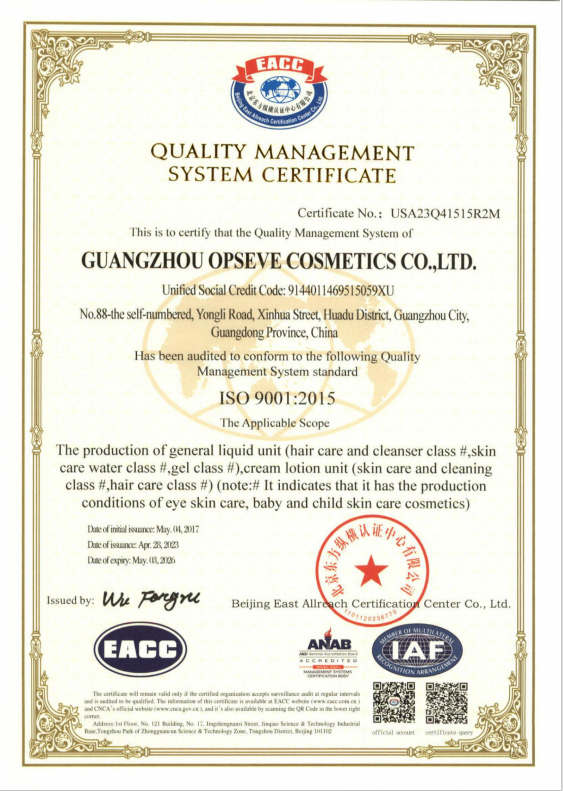
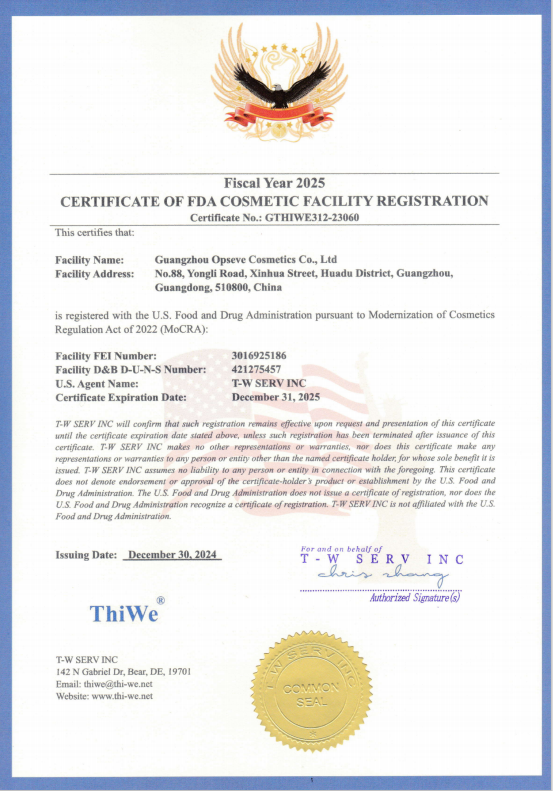
Here are the certificate numbers, the issuing body, the audited scope and the expiry date, published so you can check every one of them yourself before you send a brief.
Both Intertek records are searchable by certificate number in the Intertek certificate registry, which gives you third-party verification rather than our word for it. The certificates are held by our manufacturing facility, Guangzhou Opseve Cosmetics Co., Ltd.
Intertek SZ2503C3
Standard: ISO22716 — ISO 22716:2007 Cosmetics, GMP
Valid to: 12 March 2028
Intertek SZ2503C4
Standard: GMPC — Cosmetic GMP Guidelines (2022) FDA
Valid to: 12 March 2028
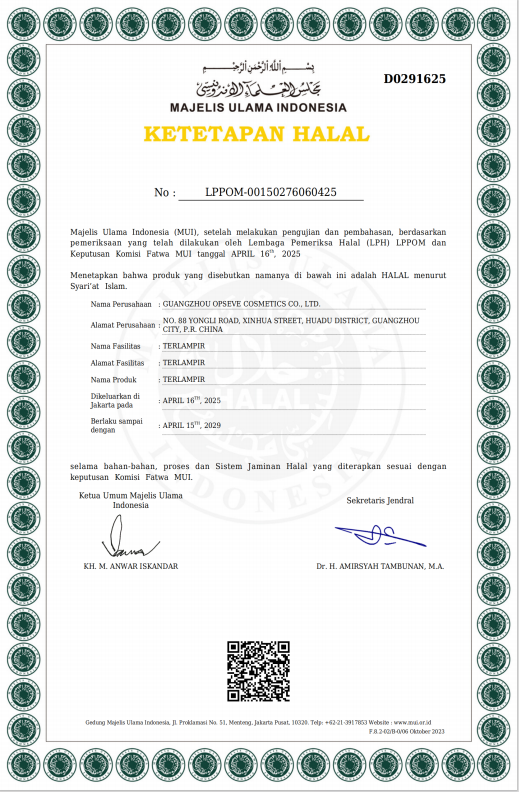
MUI LPPOM
Standard: Halal determination, company level
Valid to: 15 April 2029
Quality Control (6 Stages)
01. Material Inspection
PROCESS POINT
Raw materials and packaging components checked before approval.
Incoming Stage
02. Process Control
PROCESS POINT
Key product and process parameters monitored dynamically.
In-Process
03. Bulk Inspection
PROCESS POINT
Bulk evaluated before filling; ensuring base stability.
Pre-Fill
04. Filling & Packaging
PROCESS POINT
Filling accuracy, sealing and packaging condition checked in line.
Line Check
05. Finished Product
PROCESS POINT
Evaluated against the approved specification before release.
Final Check
06. Batch Review
PROCESS POINT
Production and quality records reviewed and retained securely.
Release
What product-level compliance actually means
Product-level compliance in your destination market rides on your approved specification and its supporting testing, not on our facility certificate.
That is a division of labor, and the points below set out which side of it each obligation falls on.
- Batch Traceability: Each batch carries identification, inspection records, and retained samples. Retained samples matter more than paperwork when questions arise months later.
- Microbiological (ISO 17516): Limits apply to every batch we release for standard rinse-off products.
- Stability Testing: Accelerated conditions follow the widely used 40°C and 75% relative humidity protocol.
- Packaging Compatibility: Run strictly on the pack intended for market release.
Facility & Documentation
Click on an active image to zoom in and enlarge details.
❮
❯
Business Solutions
From Brief to Batch:
Four Routes
Four routes cover almost every conditioner and hair mask project. They differ in what you bring, what we build, and the point at which the formula stops changing.

01
Private Label
Select from the existing formulation library, adjust fragrance and texture at a minimal library.
02
Custom ODM
Premium private label custom tailored. New formula development, sensory optimization, and stability.
03
Reference Sample
Aimed to match a market reference through rigorous formula analysis and exact texture matching.
04
Contract Mfg.
Built around a brand's own formula. We execute bulk production, packaging, and quality inspection.
Quality Assurance
The Sample-to-Batch Contract
Brands approve a conditioner by feel. Factories reproduce it by measurement. The Sample-to-Batch Contract is the mapping between those two.
| What you approve | Check at batch scale | If it drifts |
|---|---|---|
| Texture and slip | Viscosity testing | Feels thinner or heavier |
| Hair feel and conditioning | pH testing | Cationic deposition shifts |
| Appearance and color | Appearance evaluation | Visible difference on shelf |
| Fragrance strength | Odor evaluation | Scent stronger or fades faster |
| What you approve | Check at batch scale | Where it appears |
|---|---|---|
| Preservation performance | Preservative assessment | Test report (ISO 11930) |
| Microbiological cleanliness | Microbiological testing | CoA (ISO 17516) |
| What you approve | Check at batch scale | If it drifts |
|---|---|---|
| Pack and formula interaction | Compatibility testing | Interaction over shelf life |
| Transport and storage | Stability testing | Separation in transit |
| Fill consistency | Filling weight control | Under-fill complaints |
What we hold and what stays with you
Sits with our facility
- Manufacturing under the audited GMP scope
- Batch records, retained samples and release
- Certificate of Analysis, technical file, export docs
- Facility-level obligations attaching to the site
Stays with the brand
- Product listing in the destination market
- Safety substantiation records for the marketed product
- Adverse event receipt and reporting
- Label content, including the contact named on pack
Getting Started
The Ordering Process
1
Brief & NDA
Send the brief, reference product, or formula. NDA can be signed first.
2
Quotation
Receive a quotation within two days covering route, pack, and timeline.
3
Samples
Formula samples in 3–7 days, plus 5–7 days for delivery.
4
Contract Fixed
Approve sample and specification. The Sample-to-Batch Contract is fixed.
5
Packaging
Confirm packaging. Production is scheduled from this point.
6
Production
Commercial production in 10–15 days, released against batch CoA.
Under US law the responsible person is the manufacturer, packer or distributor whose name appears on the label. In the EU the origin must be specified.
Start Project
Manufacturing Toolkit
Private Label Conditioner Planning & Launch Tools
01
Volume threshold check
Quantity Calculator
Enter your launch quantity and it returns whether the order clears a 10,000-unit per SKU minimum, by how much it misses, and how long the stock lasts at your expected sell-through. Nothing is sent anywhere and no contact details are needed.
02
Sample-to-batch specification builder
Attribute Sync
Tick the attributes you want carried from the approved sample to the production batch. The sheet it prints is supplier-neutral: take it to any manufacturer and ask them to sign against the same rows.
03
Launch timeline planner
Schedule Manager
Work backwards from the date stock has to be in your warehouse. The planner returns the latest day each of the four clocks can start and tells you whether the plan still has slack. Working days only, and it deliberately uses the slow end of each published window.
Conditioner and Hair Mask Manufacturing FAQ
What is the minimum order quantity for a private label conditioner?
Our standard minimum is 10,000 units per SKU. For new product launches, market testing projects or special development requirements, flexible minimum order quantities may be evaluated based on product category and project needs.
Can you develop a conditioner from a reference product I send?
Yes. The Reference Sample route starts from a market product you supply. Our technical team evaluates it, analyzes the formula direction and works to a texture match, and the formula locks once you confirm that match.
How long does it take to get an approved sample?
Formula and texture samples take 3–7 business days after the brief is accepted. International sample delivery adds a further 5–7 business days after dispatch, depending on destination.
How long does production take after I approve the formula?
Commercial production runs 10–15 working days after formula approval and packaging confirmation are both complete. Both gates matter: production is scheduled from the later of the two, not from the enquiry date.
Can you make a matching private label shampoo and conditioner pair?
Yes. Shampoo sits in the General Liquid Unit and conditioner in the Cream & Lotion Unit, and both units are named on the same audited certificate scope. A shampoo and conditioner pair, a hair mask and a leave-in treatment can all be produced as one hair care line.
What is the difference between private label and contract manufacturing here?
Private label starts from our existing formulation library and customizes it for your brand. Contract manufacturing starts from a formula and specification you already own, and we produce, fill, pack and release it. Custom ODM and Reference Sample sit between the two, and white label in the strict sense — a finished stock product relabeled with no formulation work — is not one of the four routes here.
Which certificate covers hair care, and how do I verify it?
Intertek certificate SZ2503C3 certifies our manufacturing facility to ISO 22716:2007, and its audited scope names Hair Care Products in the Cream & Lotion Unit and Hair Care & Cleansing Products in the General Liquid Unit. Enter the certificate number in the Intertek certificate registry to confirm the holder, the scope and the expiry date of 12 March 2028.
What documentation ships with the order?
A batch Certificate of Analysis, the product technical file, ingredient information and export documentation ship with your order. Additional market documentation can be prepared according to project requirements.
Who sources the packaging?
We do. Packaging selection, sourcing and supplier coordination are part of the program, and packaging compatibility testing is run on the pack intended for market rather than on a laboratory container alone.
Will you sign an NDA before I share my formula or concept?
Yes. A Non-Disclosure Agreement can be signed before formula or concept details are exchanged, and exclusive formula development is supported for brands that need a formula developed for them alone.
Does accelerated stability testing tell me the real shelf life?
It gives an early signal rather than a final answer. Accelerated protocols are not necessarily predictive of real-world shelf life, and published reviews of the technique caution that estimating long-term shelf life from accelerated data alone is unreliable. Real-time data is what confirms it.
Can one supplier cover a full haircare line?
Yes, inside the named categories. As a hair care manufacturer holding both a General Liquid Unit and a Cream & Lotion Unit on the same certificate, the site runs shampoo, conditioner, hair masks, hair oils, leave-in treatments and scalp care. Cosmetic product manufacturing for a matching skincare or body care item sits in the same facility, so private label hair products and adjacent hair care solutions can be quoted on one project.
What should I look for when hiring a cosmetic manufacturer?
Ask for the certificate number and the audited scope rather than a badge, then check that number in the issuing body registry yourself. Settle four things in writing before sampling: who owns the formula, who sources the packaging, which measured attributes carry from the approved sample to the batch, and what the minimum and lead time actually are.
Can you support Halal market requirements?
A company-level Halal determination is held by our manufacturing facility under MUI reference LPPOM-00150276060425, valid to 15 April 2029. Product-level coverage for a specific formula is confirmed per project rather than assumed from the company-level determination.