Get in touch with NEXO Beauty Labs Company
How to Start a Cosmetic Line: From Brand Idea to Production Release

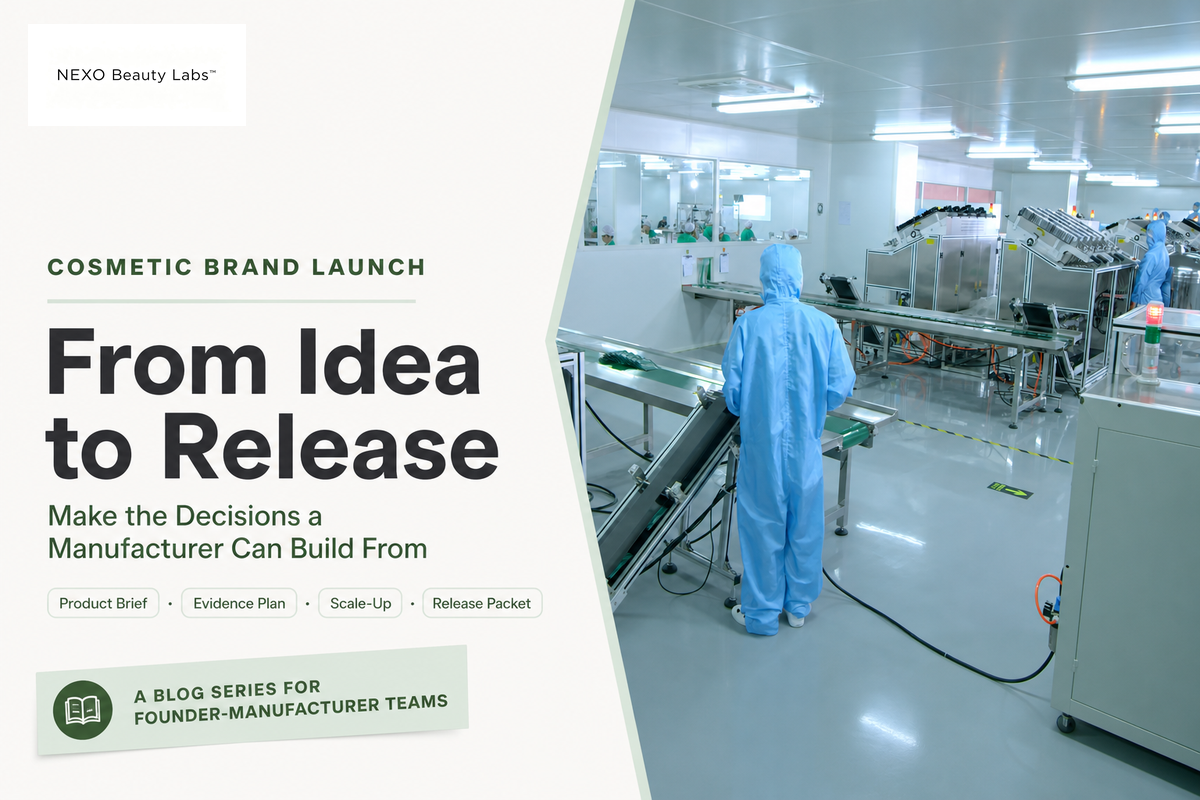
How to start a cosmetic line is best understood as a sequence of eight connected decisions, not a hunt for a formula and a logo. Define one customer and product job, choose a development route, write a usable brief, map the first-order constraints, assign market roles, approve evidence, confirm production and packaging fit, then freeze a release packet.
The short answer
Don’t begin with a large product line. Begin with one traceable first SKU whose customer, claim boundary, route, pack, evidence, market owner, and release conditions are clear enough for every party to make the same product.
The Idea-to-Release Decision Ladder: An 8-Gate Decision Map Before Production
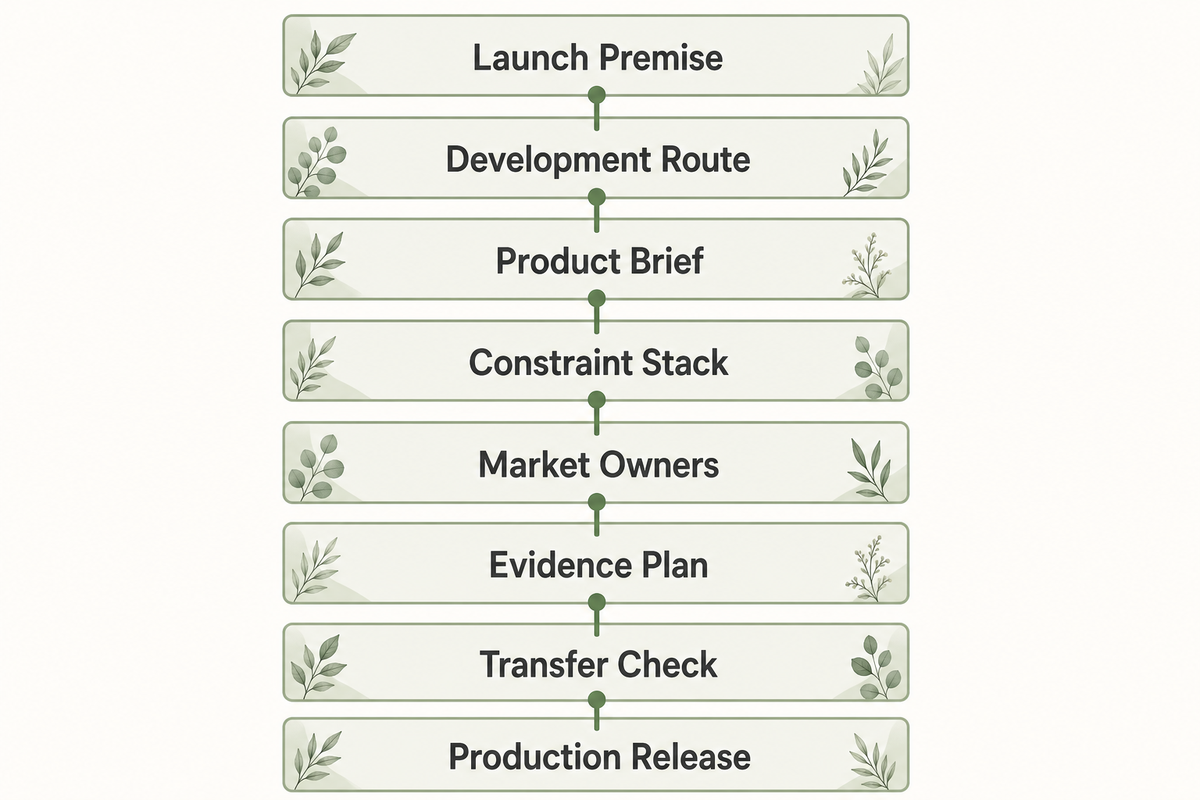
The product idea is only the first gate. Requesting a sample before the other decisions are stable often pushes unresolved choices into laboratory revisions, packaging changes, claim edits, or production holds.
- 1. Launch premise
One customer, one product job, one market. - 2. Development route
Private label, adaptation, custom work, or extension. - 3. Product brief
Inputs a cosmetic lab can act on. - 4. Constraint stack
The layer that sets the feasible first order. - 5. Market owners
Named people for safety, labels, claims, and filings. - 6. Evidence plan
Acceptance criteria beyond look and feel. - 7. Transfer check
Formula, process, component, fill, and final container. - 8. Production release
One approved packet controls the first run.
Define One Customer, One Product Job, and One Launch Market
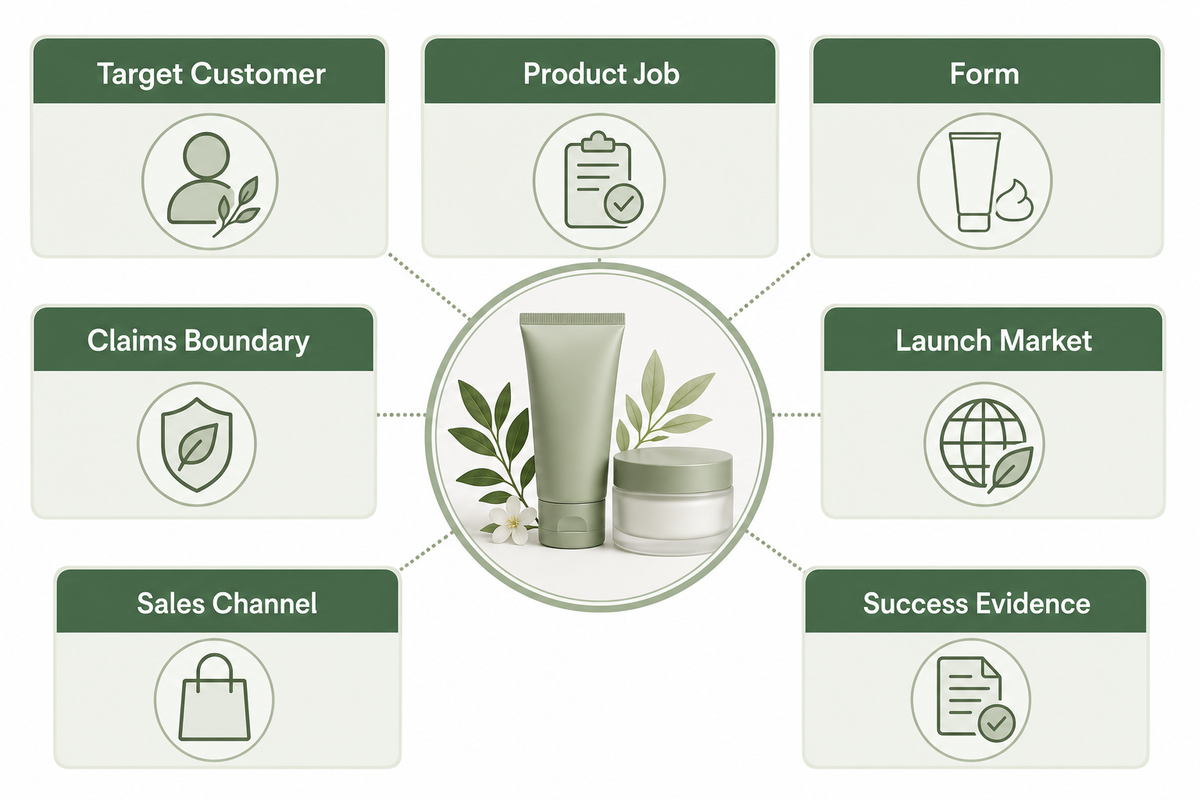
Broad ambition sounds creative but gives a cosmetic chemist too many variables. “A clean, premium skincare line for everyone” does not say what the first cosmetic product must do, who will use it, which claims matter, or which rules apply.
Write a seven-field launch premise
- Target customer: a specific user and buying context.
- Product job: the cosmetic benefit and use occasion.
- Form: cream, serum, cleanser, shampoo, balm, or another defined format.
- Claims boundary: what you intend to say—and will not say.
- Launch market: the first country or regulatory region.
- Sales channel: online store, retail, professional, distributor, or a bounded mix.
- Success evidence: the behavior that justifies a repeat order or second SKU.
For example: “A fragrance-free facial cleanser for adults who dislike tight after-feel, sold first through a United States direct-to-consumer channel, with claims limited to cleansing and cosmetic feel.” That premise is not a finished business plan. It is a fixed starting point for formula decisions, packaging design, product testing, brand identity, and market research.
Translate founder search language into one brief
- If you are looking to start a beauty brand, start a makeup line, start a cosmetic business, or “start my own line,” define one beauty product and target market first—whether the idea is makeup and beauty, makeup and skincare, a skincare business, or other beauty care items.
- To set your business up properly, separate the core of your business from marketing and sales. A well-defined brand identity says whom the beauty brand needs to serve and why the offer can create an emotional response.
- Create your retail strategy before you start selling: online, high-end retail, or sell face to face. If you want to sell through several channels, remember that marketing and selling your beauty products cannot rescue a weak brief, and selling your beauty products in more places does not prove demand.
- Ask each supplier to define its project scope in writing, including whether it supplies label components, formulation work, a finished-product route, or a bounded combination. Ask a cosmetic lab or contract partner how it will create your products and protect the safety of your products. This scope check helps a skincare brand or cosmetics company choose what is best for the project.
- If “starting your own makeup line” describes your goal, you may want a step-by-step guide to learn how to start, grow your business, and build a successful beauty offer. In the U.S. beauty industry and wider cosmetic industry, the first gate is still a bounded product, not a promise to launch an entire line.
Add a classification checkpoint before the brief is approved. In the United States, intended use can change whether a product is treated as a cosmetic, a drug, or both; FDA says intended use can be established through claims, promotion, consumer perception, and ingredients. Acne treatment, antidandruff, antiperspirant, and sunscreen concepts therefore need a different path from an ordinary cosmetic-only premise.
Choose a Development Route: Private Label, Adaptation, Custom Formulation, or Line Extension
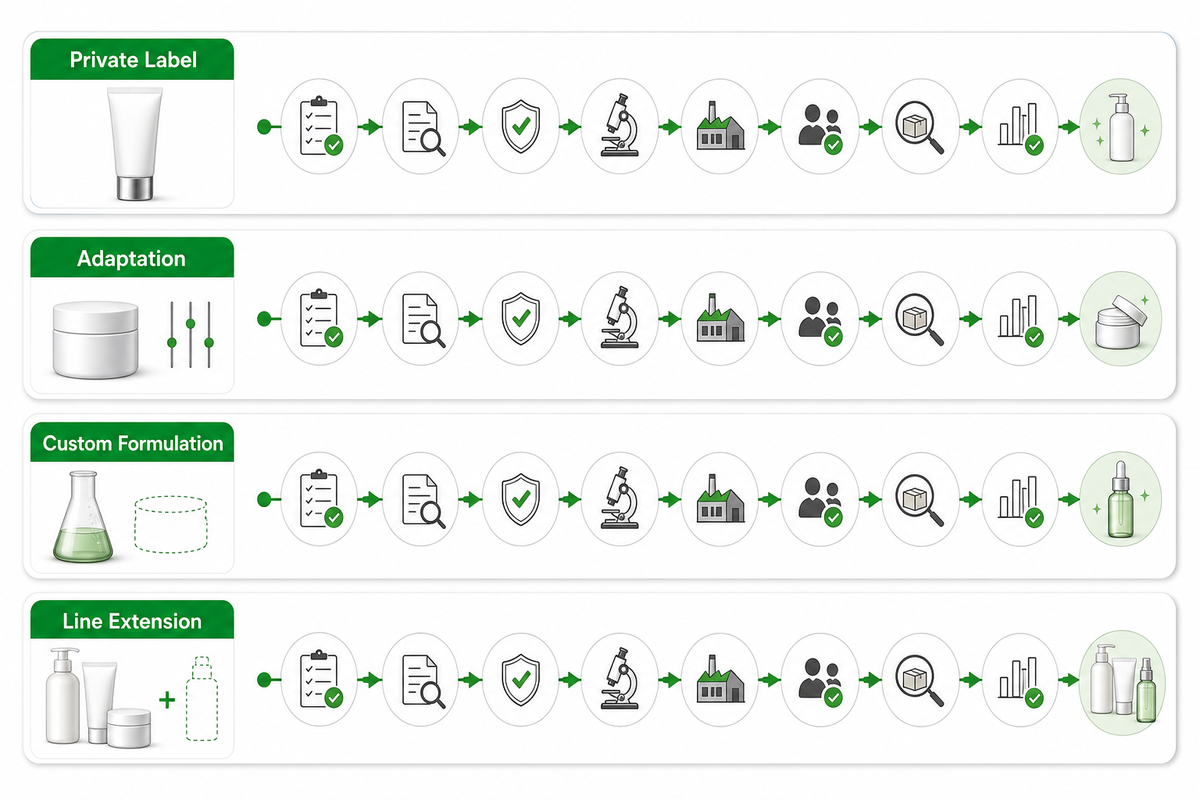
The best manufacturing strategy is the route that preserves the decisions your beauty business must control. NEXO describes four practical starting points in its public process: an existing formula, adaptation of a base, a new custom formulation, or an extension from an existing product concept.
| Route | Starting input | Brand decisions | Questions to put in writing |
|---|---|---|---|
| Private label | Existing formula option | Selection, pack, artwork, claims, market | Access, permitted changes, evidence, exclusivity, order terms |
| Adaptation | Existing base plus defined changes | Change priorities and acceptance criteria | What triggers new testing, evidence, or component review |
| Custom formulation | New product brief | Formula intent, sensory target, pack, evidence | Ownership, licensing, transfer, confidentiality, change authority |
| Line extension | Approved product or platform | New shade, format, scent, size, or use case | What remains valid and what must be reassessed |
Route names do not settle formula ownership. WIPO’s trade-secret guidance treats manufacturing processes and chemical know-how as assets whose access, disclosure, licensing, and assignment need active management. Confirm those rights, plus exclusivity and transfer conditions, in the agreement.
Explore NEXO’s private label cosmetics manufacturing path to see how a manufacturing discussion can begin from different levels of product readiness.
Bring a route, not just an idea
Choose your likely starting route and prepare the first-product brief below, then open a project discussion with NEXO Beauty Labs.
Choose your likely starting route and prepare the first-product brief below, then open a project discussion with NEXO Beauty Labs.
Build a Manufacturer-Ready Cosmetic Product Brief
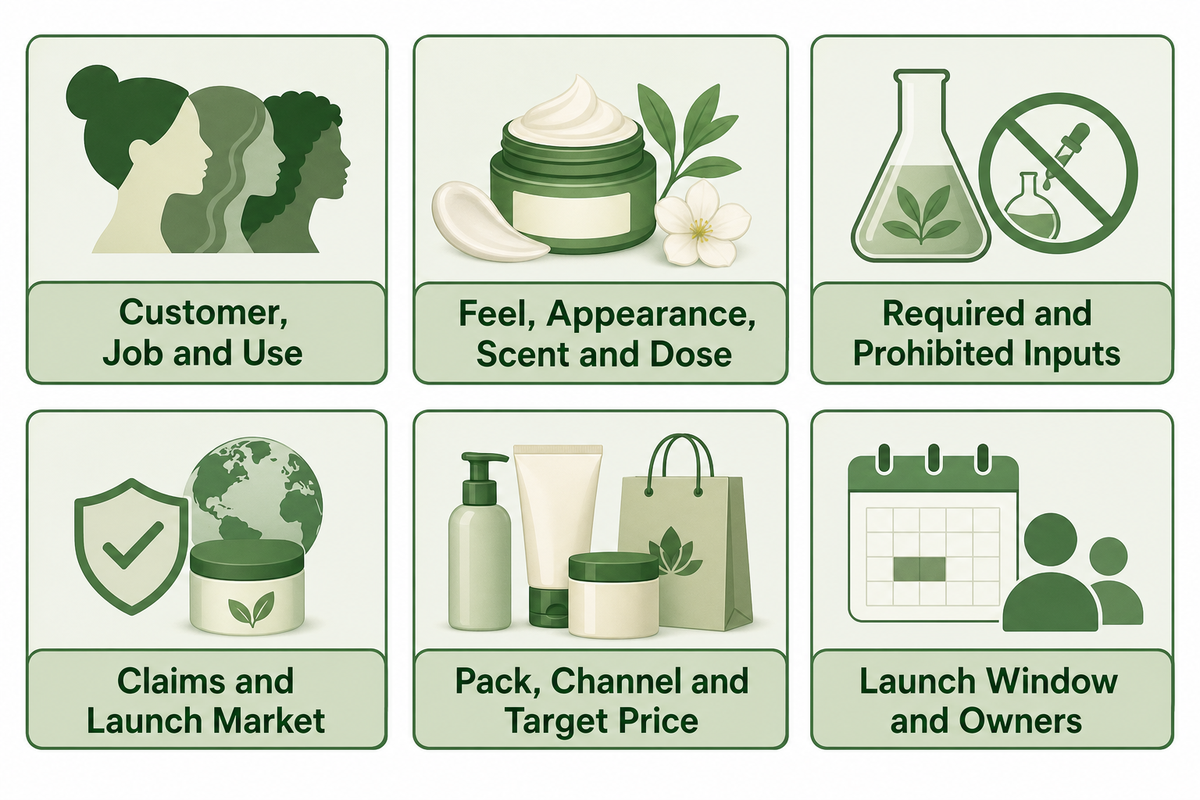
Reference samples and mood boards can explain taste, but they do not define feasibility. The manufacturer-ready brief turns preference into choices that research and development, packaging, quality, procurement, and marketing can evaluate against the same target. If your route requires custom work, review NEXO’s cosmetic laboratory services before formulation begins.
| Brief field | Why it changes development | Acceptance evidence |
|---|---|---|
| Customer, product job, use context | Sets priorities and misuse questions | Approved launch premise |
| Desired feel, appearance, scent, and dose | Guides sensorial and pack decisions | Named sample and review notes |
| Required and prohibited inputs | Changes sourcing, formula space, and claims | Written ingredient boundary |
| Claims and launch market | Changes classification and evidence duties | Approved claim-to-evidence map |
| Pack format, channel, and target price | Connects fill, protection, merchandising, and economics | Component specification and cost model |
| Launch window and decision owners | Exposes dependencies and approval delays | Dependency map with named owners |
Build Your Startup Budget With the First-SKU Constraint Stack
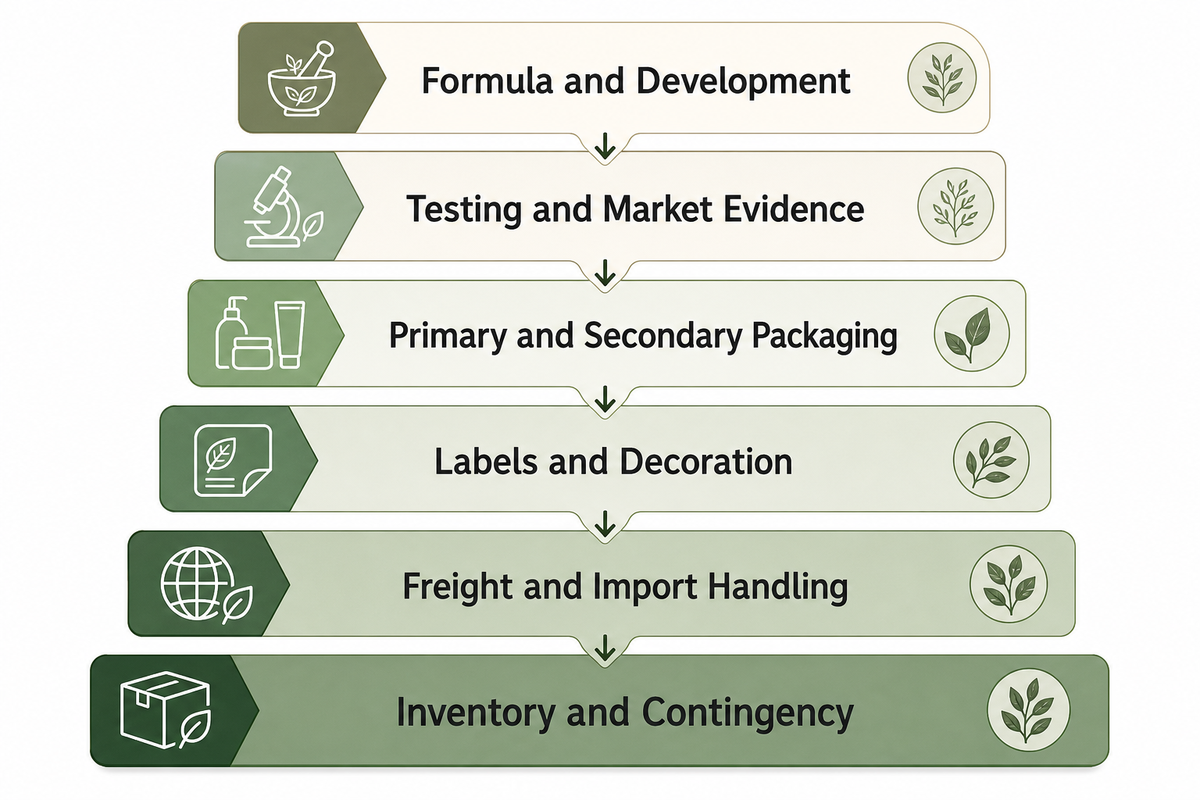
How much does it cost to start a cosmetic line? There is no honest universal answer because the quoted formula price is only one layer. The feasible first order is set by whichever layer has the tightest cash, quantity, evidence, or availability constraint.
First-SKU Constraint Stack
6. Inventory and contingency retained stock, replacements, delays, and rework
5. Freight and import handling route, documents, duties, and delivery condition
4. Labels and decoration artwork, printing, finish, and revision exposure
3. Primary and secondary packaging component availability and order quantities
2. Testing and market evidence safety, stability, compatibility, claims, and filings
1. Formula and development access, samples, revisions, raw materials, and transfer
Worked dependency example: suppose the bulk formula quantity can support 2,000 finished units, but the chosen custom pump requires an order of P components and the decorated bottle requires D units. Your packaging commitment is max(P, D), while saleable units are limited by the smallest compatible set of formula, bottle, pump, label, and carton. A component change can therefore raise tied-up inventory even when the formula order doesn’t change.
Build the budget as variables before requesting quotes: development + evidence + components + decoration + production + logistics + contingency. Record the cash date and owner for each. This method will not give you a headline number, but it will show whether the target price and first order are internally possible.
Assign Safety, Label, Listing, and Market Roles Before Artwork
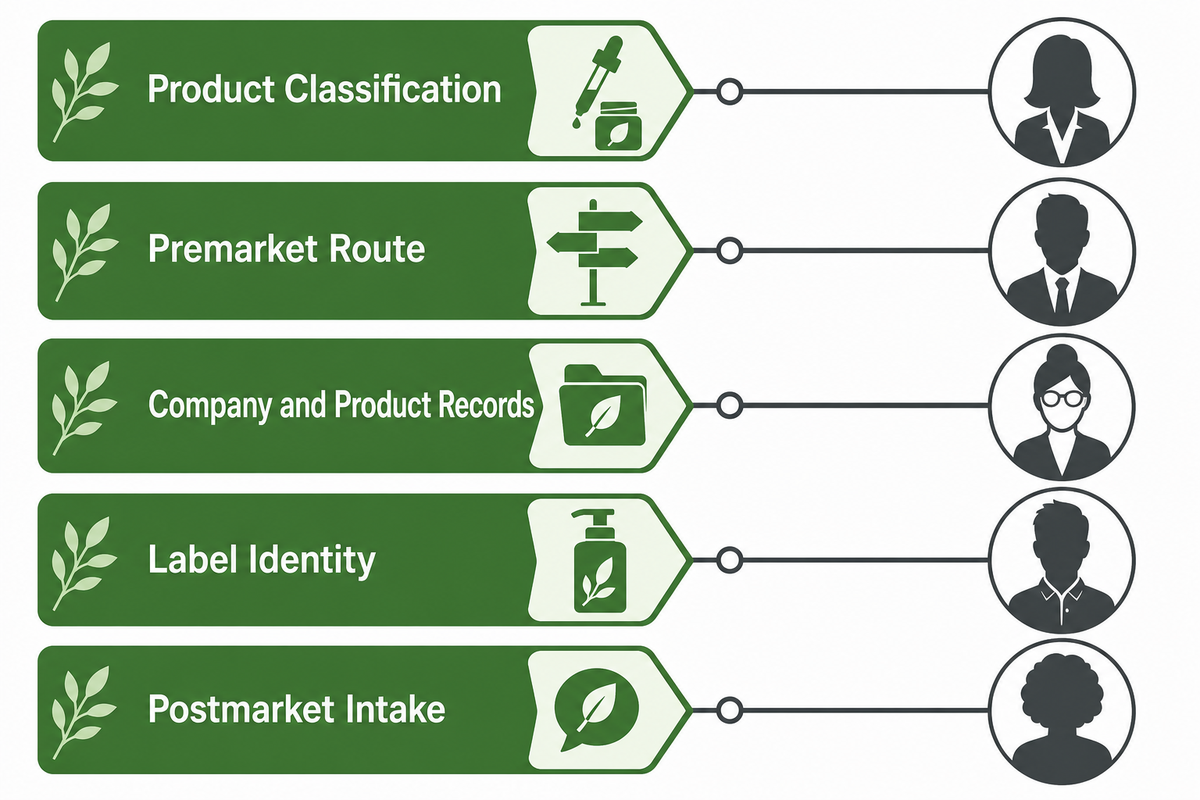
Contract manufacturers do not automatically become the owner of every regulatory task. Fill the Decision Owner Worksheet before claims and artwork are fixed. Each row needs a responsible party, required input, review date, and release evidence.
| Decision | United States checkpoint | European Union checkpoint | Name an owner |
|---|---|---|---|
| Product classification | Cosmetic only, drug, or both | Cosmetic scope and claim fit | Brand regulatory lead |
| Premarket route | Cosmetics generally lack premarket approval; color additives are an exception | Safety report before market placement | Market compliance owner |
| Company and product records | Check MoCRA applicability, facility registration, and product listing separately | Responsible person and product notification | Named filing owner |
| Label identity | Manufacturer, packer, or distributor wording must reflect the role | Responsible-person and required label information | Artwork approver |
| Postmarket intake | Complaint and serious-adverse-event escalation | Market-specific vigilance process | Postmarket owner |
FDA’s general rule is that cosmetic products and ingredients do not receive premarket approval, except color additives. That is not permission to skip safety, labeling, listing, or classification work. Facility registration and product listing are separate tracks, and listing is not approval.
MoCRA also has an applicability branch: FDA identifies exemptions for certain small businesses, while specified products—including some involving eye-mucous-membrane contact, injection, internal use, or more-than-24-hour appearance alteration—fall outside that exemption. Confirm eligibility before relying on it.
For the European Union, the European Commission identifies an in-region responsible person, a product safety report, and centralized product notification as distinct framework elements. Don’t copy a United States owner map into a European launch.
Approve Evidence, Not Just a Sample You Like
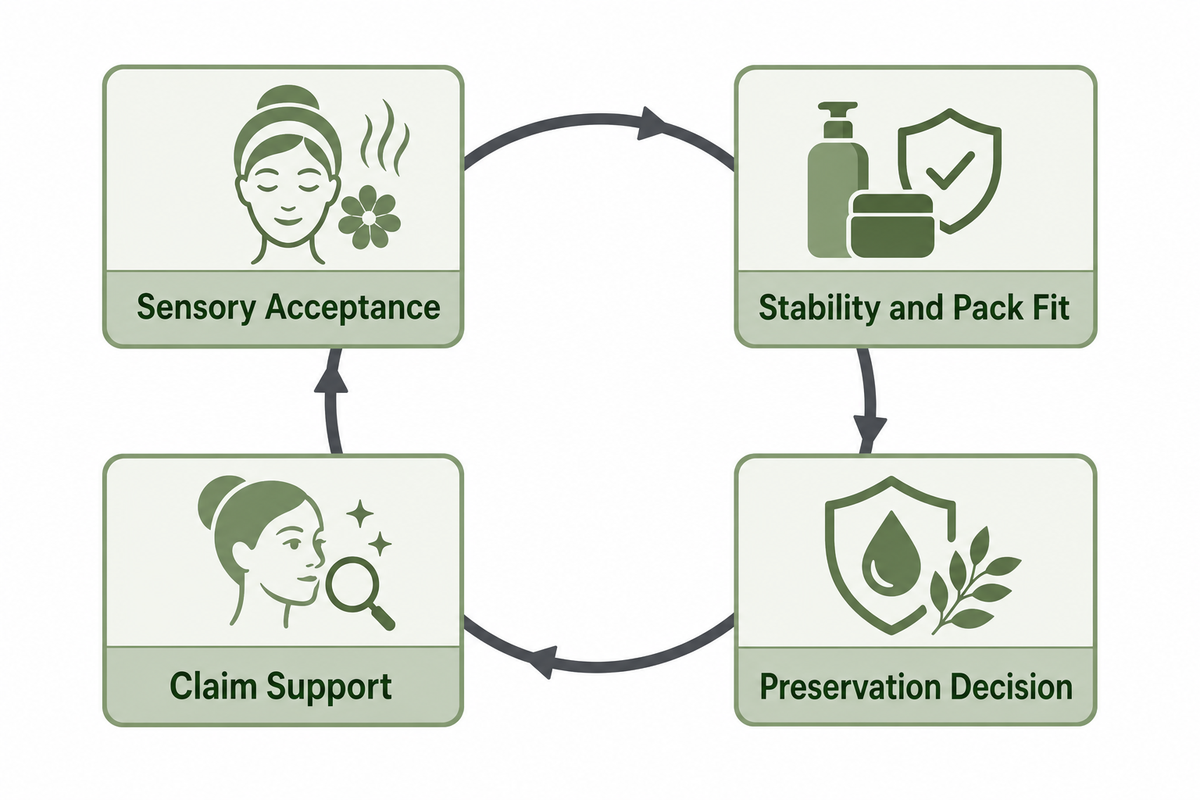
The sample can feel right and still leave important questions open. Approve sensory preference separately from product safety, stability, packaging compatibility, preservation efficacy where applicable, claim support, and the conditions that would trigger a new review.
| Decision | Record | Recheck trigger |
|---|---|---|
| Sensory acceptance | Named sample, panel notes, acceptance criteria | Formula, fragrance, color, dose, or pack change |
| Stability and pack fit | Protocol, observations, component version, exceptions | Material, closure, fill, process, or storage change |
| Preservation decision | Risk rationale and applicable evaluation | Formula, process, pack, or use-pattern change |
| Claim support | Exact claim, evidence owner, method, result, limitation | Wording, audience, media, formula, or benefit change |
ISO 11930 addresses preservation-efficacy evaluation and overall antimicrobial protection and also states applicability limits. A generic “microbiological testing” line item does not prove that preservation scope; ask what was evaluated, against which product and pack, and how the result affects release.
Assign advertising substantiation separately from label approval. The FTC’s health-products guidance addresses express and implied claims through the advertisement’s overall message and expects support to fit the specific product and promised benefit. Review websites, social posts, influencer scripts, packaging depictions, and testimonials against the same approved claim-to-evidence map; an endorsement isn’t a substitute for evidence. Because the guidance predates this article, recheck current FTC and product-category developments before campaign release.
Prepare the Formula and Package for Scale-Up
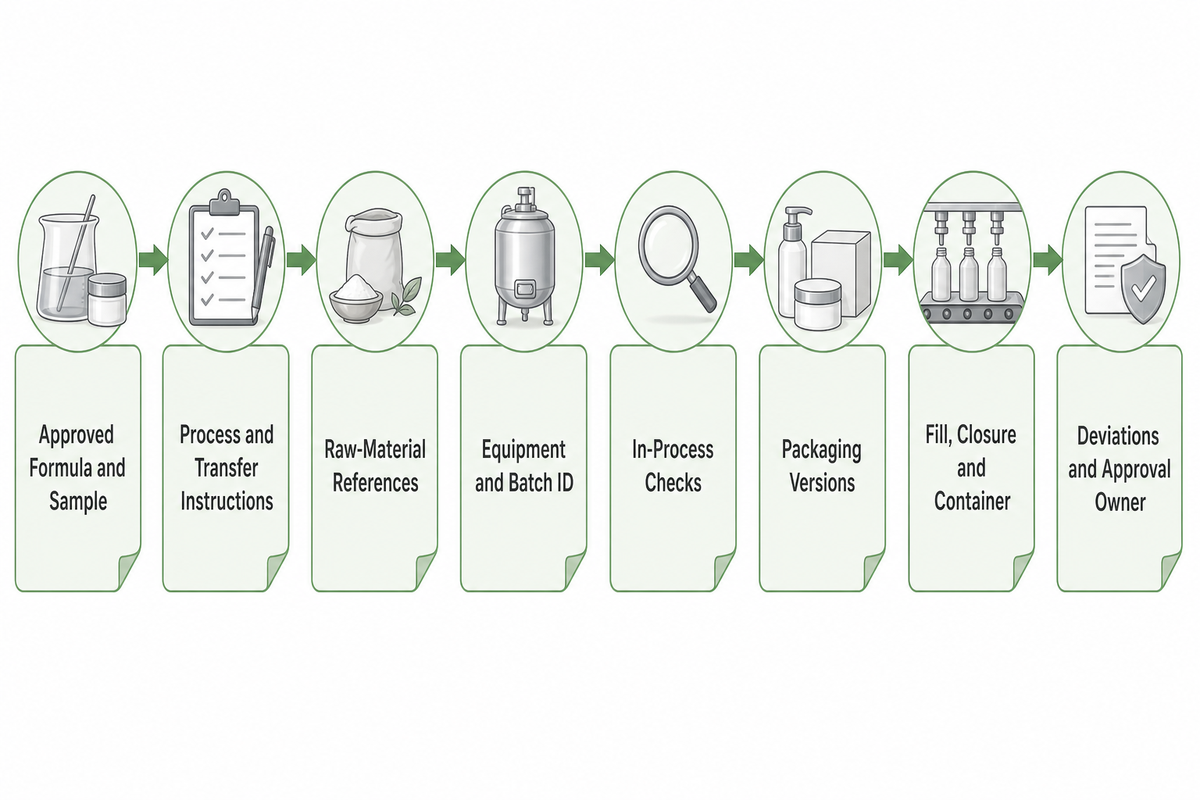
An approved laboratory sample does not guarantee the same behavior in a production vessel or final container. Batch size, equipment, order of addition, mixing, transfer, filling, raw-material variability, closure, and storage can change what the team observes.
Lab-to-production transfer checklist
- approved formula and sample version
- written processing and transfer instructions
- raw-material names and references
- equipment and batch identification
- in-process observations and checks
- packaging component versions
- fill, closure, and final-container observations
- deviations, adjustments, rework, and approval owner
FDA’s cosmetic good-manufacturing-practice checklist calls for written formulation, processing, transfer, filling, control, sampling, check, and batch records. It does not supply one universal mixing speed, temperature, or batch size, so those parameters must come from the actual formula, process, equipment, and acceptance plan.
Freeze the component and artwork revision used in the assessment. A technically acceptable bulk formula paired with an unreviewed pump, liner, bottle, or decoration is not yet a final-container decision.
Evaluate a Cosmetic Manufacturer Beyond the Sales Deck
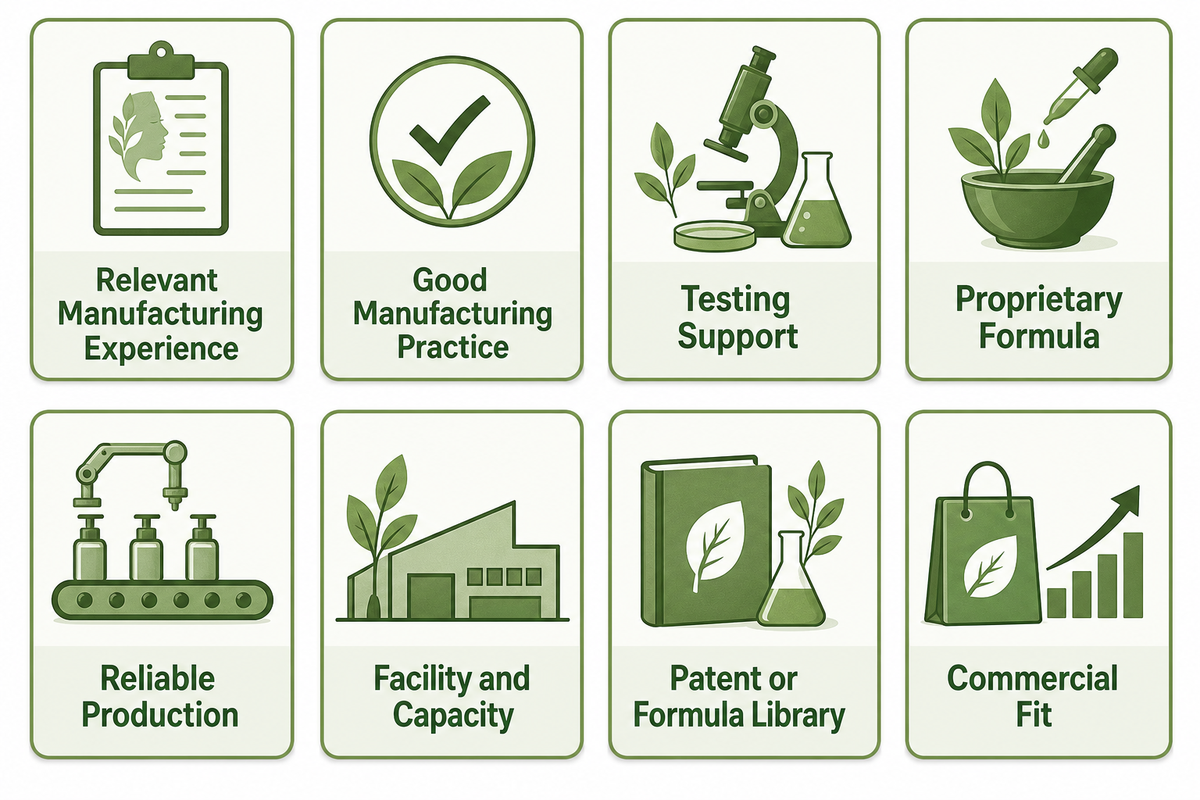
Facility size, formula count, patent count, or a certification logo may sound reassuring, but none proves fit for your first product. Due diligence asks for evidence tied to the category, equipment, process, pack, market, and contract you’ll actually use.
| Evidence category | Evidence to request | Scope to confirm | Contract consequence |
|---|---|---|---|
| Relevant manufacturing experience | Category and pack examples, equipment list, transfer approach | Your form, component, batch, and market | Trial, scale-up, and acceptance duties |
| Good manufacturing practice | Current certificate or audit evidence, issuer, site, dates | Facility and activity covered | Audit, notice, and remediation terms |
| Testing support | Protocol, laboratory, sample identity, report, exception path | Who orders, reviews, owns, and pays | Retest and change-control allocation |
| Proprietary formula | Ownership, license, permitted use, access, transfer, confidentiality | Formula, process know-how, data, and derivatives | Exit, exclusivity, and supplier-change rights |
| Reliable production | Specifications, batch records, change notices, release criteria | Subcontracting, deviations, record access | Approval authority and rejected-batch process |
| Facility and capacity | Site address, relevant equipment, available production window | Your category, pack, process, and first run | Reservation, delay notice, and alternate-site terms |
| Patent or formula library | Exact record, owner, status, territory, and project relevance | What the record covers—and does not cover | License, non-infringement, and disclosure terms |
| Commercial fit | Project-specific minimum order, quotation basis, dependency schedule | Formula, components, decoration, testing, and freight | Cancellation, excess components, and price-change rules |
ISO 22716 publishes guidance for production, control, storage, and shipment of cosmetic products; it does not certify an individual product or prove that a particular facility holds a current certificate. Ask for the document, issuer, site, activity, and validity that match your project.
Also distinguish the name on a label from physical manufacture. FDA labeling guidance permits manufacturer, packer, or distributor identity with factual qualifying wording when the named firm is not the manufacturer. A separate labeling rule in 16 CFR 503.3 shows why actual activity can matter: filling alone, materially changing bulk, and supplying only a formula can produce different results for that narrow purpose. Neither rule settles formula ownership.
Search Interest Is Not Product Demand: Validate the First SKU Before Expanding
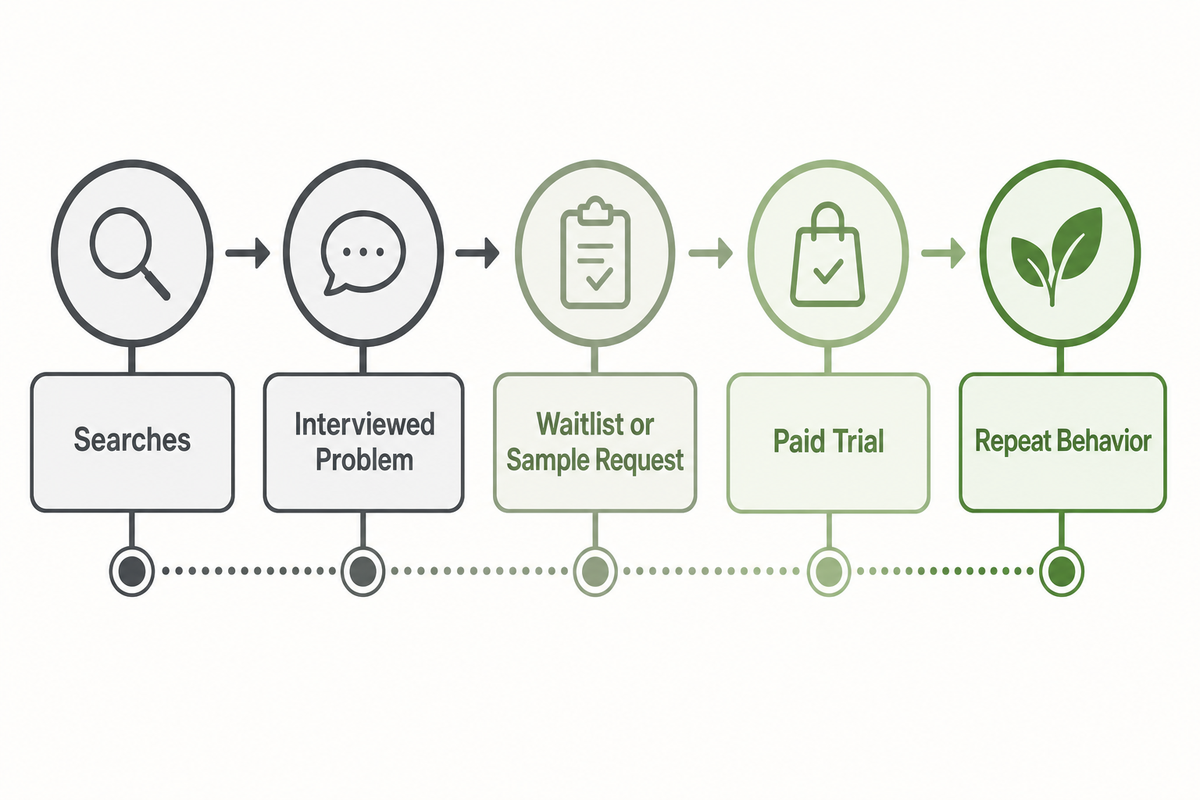
Search volume measures query behavior, not willingness to buy your formula, pack, claim, and price. In the available DataForSEO history, the exact startup query’s recent 12-month average was 358.2 versus 824.2 in months 24–36, a 56.5% decline. That says the query changed; it does not show that the cosmetics market shrank.
Searches→
Interviewed problem→
Waitlist or sample request→
Paid trial→
Repeat behavior
Interviewed problem→
Waitlist or sample request→
Paid trial→
Repeat behavior
Start small enough to learn. Interview the target audience, test the product premise, gather structured sample feedback, check channel economics, and define the signal that permits a repeat order. Expand the product line only after behavior—not enthusiasm alone—supports it.
Freeze a Production-Release Packet Before the First Run
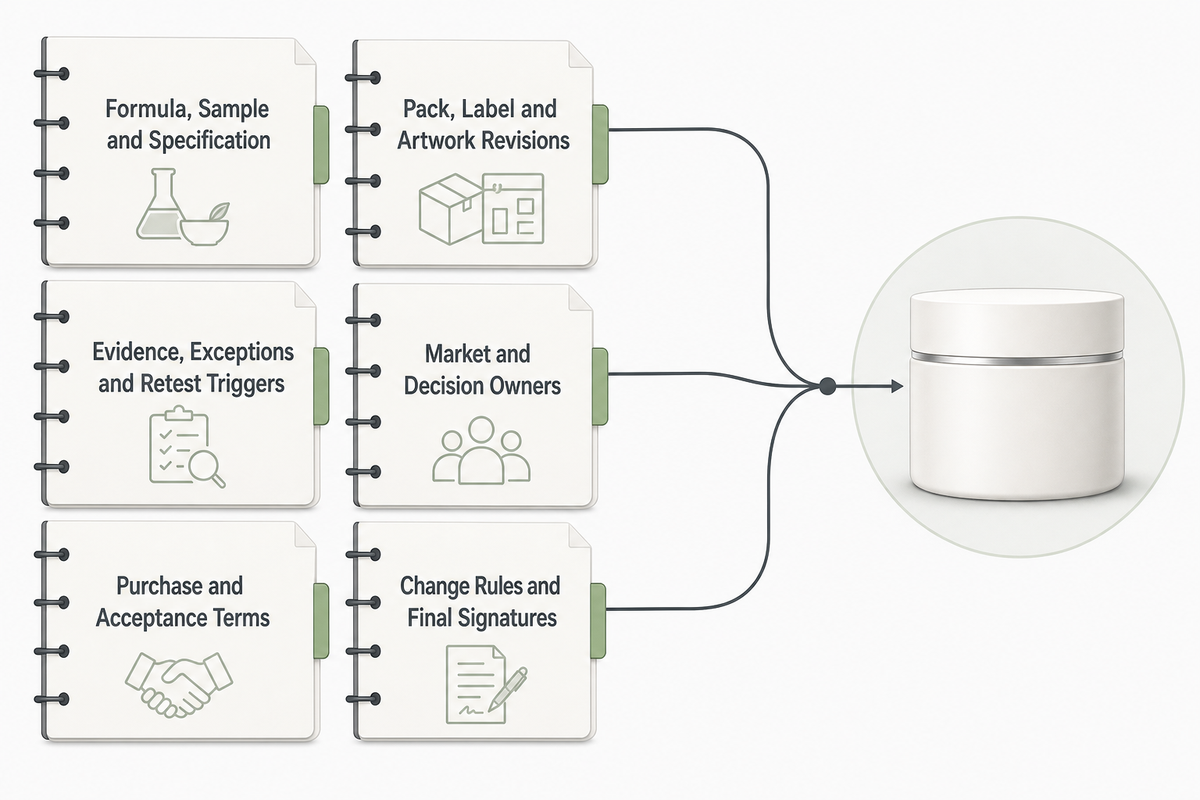
A quotation and purchase order authorize commercial work, but they do not prove that formula, packaging, artwork, evidence, market records, and quality control point to the same product. A one-page release packet closes that gap.
Production-release packet
- approved formula, sample, and product-specification references;
- approved primary pack, closure, secondary pack, label, and artwork revisions;
- evidence decisions, exceptions, unresolved limitations, and retest triggers;
- launch market, label owner, filing owner, advertising owner, and postmarket owner;
- purchase specification, quantity basis, acceptance method, and deviation authority;
- change-notification rules and final signatures from the brand and manufacturing owners.
Add a complaint and serious-adverse-event route before launch. FDA’s current MoCRA page says the responsible person must report a serious cosmetic adverse event within 15 business days; qualifying new medical or other information received within one year also has a 15-business-day submission window. Name who receives the complaint, who decides whether it is serious, who gathers the label and medical information, and who submits.
The packet should have one release state: approved, approved with named exceptions, or not approved. If a formula, component, artwork, claim, market, or owner changes after approval, reopen the affected evidence instead of quietly replacing a file.
Move from idea to a reviewable manufacturing project
NEXO Beauty Labs supports skincare, hair care, and body care development from concept through commercial production. Bring your launch premise, chosen route, product brief, and open release gaps, then start a project discussion.
NEXO Beauty Labs supports skincare, hair care, and body care development from concept through commercial production. Bring your launch premise, chosen route, product brief, and open release gaps, then start a project discussion.
Frequently Asked Questions
How much money do you need to start a cosmetic line?
There is no honest universal amount because every project has a different formula route, evidence plan, component commitment, and cost structure. Break the budget into formula and production, safety and claim evidence, packaging and decoration, freight and customs, inventory carrying costs, and contingency. Ask for quotations on the same scope and terms, then identify which cash or quantity commitment sets the affordable first run. Keep marketing and working capital separate so the manufacturing subtotal does not understate total cash needs.
Can you start a cosmetic line with no money?
Test a concept with limited cash by interviewing a specific audience, presenting a price and message, and building a waitlist. A physical launch still has development, packaging, safety, labeling, manufacturing, logistics, insurance, and selling costs. Start with one narrow product and market instead of pretending those costs or required duties disappear entirely.
Do cosmetics need FDA approval before they are sold?
Most cosmetics and cosmetic ingredients are not FDA premarket approved, but color additives are an important exception. That does not mean cosmetics are unregulated. Depending on MoCRA applicability, facilities and responsible persons may have registration or product-listing duties; labels and claims must be truthful and not misleading; and FDA may act against adulterated or misbranded products. Claims about treating disease or affecting body structure or function can move the product into a drug pathway.
Is private label or custom formulation better for a new cosmetic brand?
Private label can reduce early development work; custom formulation can provide more control over the product target. Neither route name resolves ownership, exclusivity, evidence, order quantities, or timing, so choose by the decisions you must control and put the commercial and intellectual-property terms in writing.
How long does it take to start a cosmetic line?
The timeline depends on development route, revision cycles, market evidence, packaging availability, artwork approval, assigned market duties, production scheduling, logistics, and any failed checkpoint that causes rework. Build a dependency map with owners and acceptance criteria instead of relying on one headline lead time.
References & Sources
- Cosmetic, Drug, or Both? U.S. Food and Drug Administration
- Trade Secret Management World Intellectual Property Organization
- Cosmetic Facility Registration and Product Listing U.S. Food and Drug Administration
- Modernization of Cosmetics Regulation Act U.S. Food and Drug Administration
- Cosmetics Legislation European Commission
- Health Products Compliance Guidance U.S. Federal Trade Commission
- ISO 11930 Catalogue Record International Organization for Standardization
- ISO 22716 Catalogue Record International Organization for Standardization
Why beauty brands work with NEXO
About NEXO Beauty Labs Manufacturing Support
NEXO Beauty Labs supports skincare, body care, sun care, hair care, and private label brands with formulation, sampling, filling, quality control, and export-ready launch support.
Project Review Before RFQ
Before quotation, we help clarify product category, active direction, formula stage, package choice, compliance market, MOQ, sampling schedule, and required documents.
Request a Cosmetic QuoteCompany Profile // Data Sheet
CompanyNEXO Beauty Labs
Business TypeCosmetic OEM / ODM manufacturing partner
Main ProductsPrivate label skincare, facial serums, moisturizers, cleansers, sunscreen, body care, and hair care products
Manufacturing CapabilityFormula development, sample adjustment, package sourcing, filling, QA/QC, documentation, and export support
RFQ Data NeededProduct type, formula goal, package format, target market, MOQ, claims, timeline, and benchmark samples
Websitenexobeautylabs.com