Get in touch with NEXO Beauty Labs Company

Updated August 2026
Anyone working out how to start a skincare line meets the same surprise: the hard parts aren’t the formula and the logo. How to start a skincare line is really a sequence of four decisions: the claim class you accept, the preservation system your formula forces, the package it has to survive, and the party who signs the filings. What binds a skincare product is the claim printed on the carton, the water sitting in the bottle, and the registration files someone has to submit before a single unit ships. Get those three right and a small launch is manageable. Get the first one wrong and the timeline doubles.
Deciding what type of business to run, learning how to write a business plan, defining a target audience, building brand identity and setting marketing strategies all matter, and our companion guide to starting a cosmetic line more broadly walks that sequence from positioning to launch. This article doesn’t repeat it. What follows is the part that’s specific to skincare: which claims turn a cosmetic into a drug, what registration actually requires, what preservation obligations a water phase triggers, and what a first batch really costs. Whether you call it a skincare line, a skincare business or a skincare brand, the obligations below are identical.
The skincare industry rewards preparation over speed. Founders who want to learn how to start your own skincare line in 2026, or who simply want to create one good product, are entering a beauty industry where the paperwork behind a product now travels with it. Starting a business in the skincare market isn’t harder than it was three years ago; it’s far less forgiving of guesswork.
The short answer
Starting a skincare line commits a brand owner to four things: a claim class, a preservation system, a package the formula can survive, and a named party responsible for the filings. Product classification and labeling rules of the market of sale set all four, not the size of the launch.
Five things most launch guides leave out
- Route names decide nothing. Private label, white label, OEM and ODM are commercial labels; the contract decides who owns the formula and who may move it.
- Five filing clocks run under the Modernization of Cosmetics Regulation Act, and only two of them belong to the brand owner.
- No industry-wide minimum order quantity exists. A 120-litre bulk floor is roughly 2,400 units at a 50 ml fill and roughly 12,000 units at a 10 ml fill, from the same vessel.
- Water, not product category, decides whether a preservative system is needed.
- FDA issues no approval, no licence and no certificate for a cosmetic. Registration and listing are neither an approval programme nor a marketing badge.
What Starting a Skincare Line Actually Commits You To
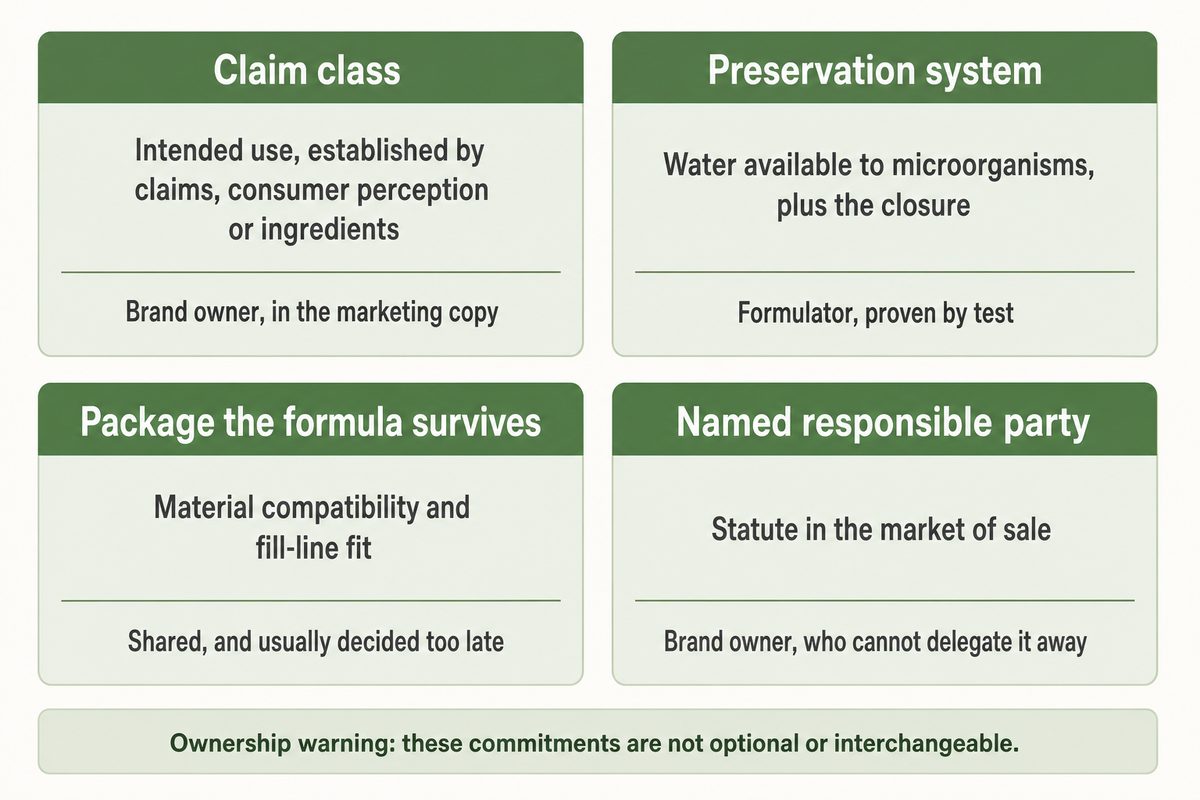
Starting a skincare line commits a brand owner to four obligations that arrive together: a claim class, a preservation system, a package the formula can survive, and a named party responsible for the filings. Each is set by the rules of the market you sell into, and each has a different owner in the supply chain.
| Commitment | What sets it | Who carries it | Covered in |
|---|---|---|---|
| Claim class | Intended use, established by claims, consumer perception or ingredients | Brand owner, in the marketing copy | Section 2 |
| Preservation system | Water available to microorganisms, plus the closure | Formulator, proven by test | Sections 5 and 7 |
| Package the formula survives | Material compatibility and fill-line fit | Shared, and usually decided too late | Section 7 |
| Named responsible party | Statute in the market of sale | Brand owner, who cannot delegate it away | Sections 3 and 10 |
One correction belongs at the very start. Registration and listing under United States law are not an approval programme and are not a promotional tool: FDA states on its own registration and listing page that it issues no certificate for a registered facility or a listed cosmetic product. Outside colour additives, there is no premarket approval for a cosmetic in the United States. Any startup planning its launch around waiting for an approval is waiting for a document that does not exist.
If you’re a shopper who landed here looking for a skincare routine, this is the wrong page. Every entrepreneur reading on is being asked to make supplier decisions, and the sections below are written to be checked against a manufacturer’s answers. Scope matters here. The rules that follow cover leave-on and rinse-off skincare products aimed at particular skin types and skincare needs, whether that’s sensitive skin, a natural skincare positioning or a clean beauty brand. Colour cosmetics such as a lip gloss, and most other beauty products, follow the same federal framework but add colour additive rules this guide doesn’t cover, and any product claiming to improve skin health beyond appearance has already crossed the line drawn in the next section.
Cosmetic or Drug? The Claim Decides, Not the Ingredient
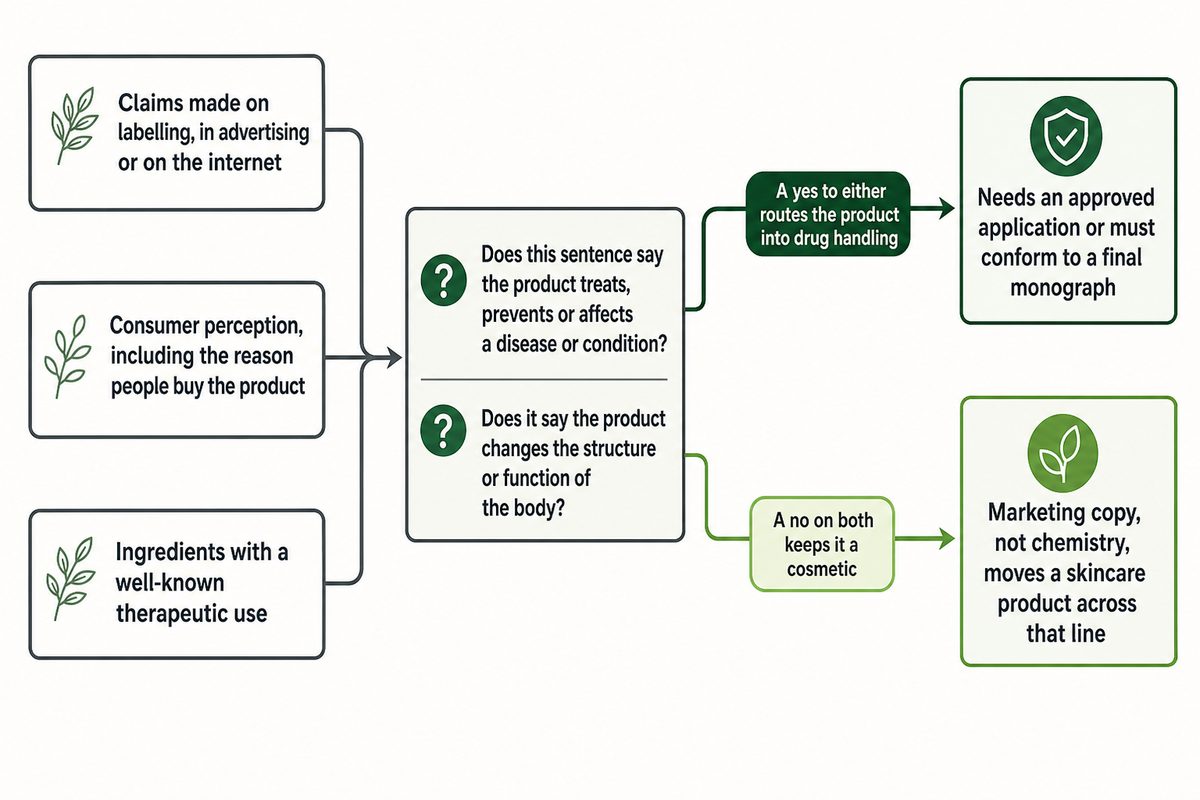
A cosmetic and an over-the-counter drug can hold the identical zinc oxide dispersion in identical bottles. What separates them is intended use, and in the United States how a brand presents the product, through its claims, its name and its imagery, sets intended use, not what sits in the formulation. Marketing copy, not chemistry, moves a skincare product across that line.
FDA names three routes by which intended use is established, and founders usually know only the first: claims made on labelling, in advertising or on the internet; consumer perception, including the reason people buy the product; and ingredients with a well-known therapeutic use. Its guidance page on whether a product is a cosmetic, a drug, or both also confirms that a product can be both at once, in which case it must satisfy both sets of requirements.
The Drug-or-Cosmetic Claim Test
Two questions, asked of every sentence in your copy deck before it reaches a designer. One: does this sentence say the product treats, prevents or affects a disease or condition? Two: does it say the product changes the structure or function of the body? A yes to either routes the product into drug handling, where it needs an approved application or must conform to a final monograph. A no on both, with no therapeutically understood ingredient carrying the message for you, keeps it a cosmetic.
Two questions, asked of every sentence in your copy deck before it reaches a designer. One: does this sentence say the product treats, prevents or affects a disease or condition? Two: does it say the product changes the structure or function of the body? A yes to either routes the product into drug handling, where it needs an approved application or must conform to a final monograph. A no on both, with no therapeutically understood ingredient carrying the message for you, keeps it a cosmetic.
| Claim wording | Product class | What it triggers | Where this does not apply |
|---|---|---|---|
| Cleanses, moisturises, softens | Cosmetic | Labeling, safety substantiation, product listing | If a therapeutically understood ingredient is the selling message |
| Reduces the appearance of fine lines | Cosmetic | Same as above, plus evidence for the appearance claim | Appearance wording only; mechanism wording changes the answer |
| Rebuilds collagen, repairs the barrier | Drug (structure or function) | Approved application or conformity with a final monograph | Not a cosmetic route in any wording |
| Treats or clears acne | Drug (disease) | Monograph active, monograph labeling, drug facts panel | Cosmetic wording about oil or shine sits elsewhere |
| SPF 30, protects against sunburn | Drug (sunscreen) | Sun protection testing and monograph compliance | No stock private-label shortcut exists for this class |
| Anti-dandruff | Drug | Monograph route | Scalp comfort or fragrance claims are cosmetic |
| Antiperspirant action | Drug | Monograph route | Deodorant fragrance claims are cosmetic |
| Calms eczema flare-ups | Drug (disease) | Monograph or approved application | Naming a condition is what does the damage |
| Ingredient with a well-known therapeutic use, presented as the reason to buy | Drug, by ingredient route | Same drug obligations, with no claim sentence needed | Ingredient present for a cosmetic function only |
| Nothing on the label, but bought as a treatment | Drug, by consumer perception | Same drug obligations | Route founders forget, because no sentence triggered it |
Classification routes and claim families from the FDA guidance cited above. Consequences are stated as the guidance states them.
Sun protection is the clearest illustration, which is why a brand planning one usually needs a dedicated sunscreen manufacturing path rather than a stock cosmetic one, and a realistic view of the substantiation cost for a sun protection claim before the copy is written.
Classification isn’t the only advertising duty. Advertising claims must be supported by evidence you hold before publication, and environmental or sustainability language carries its own substantiation expectations under the Federal Trade Commission framework. Cosmetic-versus-drug classification and advertising substantiation are two separate tests, and a claim can pass the first and fail the second.
Do I Need a License to Sell Skin Care?
No federal licence exists for selling cosmetics in the United States, and there is no brand registration either. The common assumption is that a brand registers itself with the FDA and receives an approval number in return. No such step exists. Facilities register; the responsible person lists products. Those are the two federal obligations, and neither produces a licence, a certificate or an approval number you can print on a box.
Separate from that federal answer sit the ordinary business questions any company faces, such as licensing and tax registration, plus whatever a particular state or locality requires. Those sit outside federal cosmetic law and outside the scope of this guide; check them for the states you sell into rather than assuming the federal position covers them. The legal requirements that actually bind a new brand at federal level are the two filings described next, plus the labeling rules in section 9. Anyone telling a new skincare brand to “get FDA approval” or “register your brand with the FDA” is describing a process that does not exist.
What Registration Actually Requires in the United States
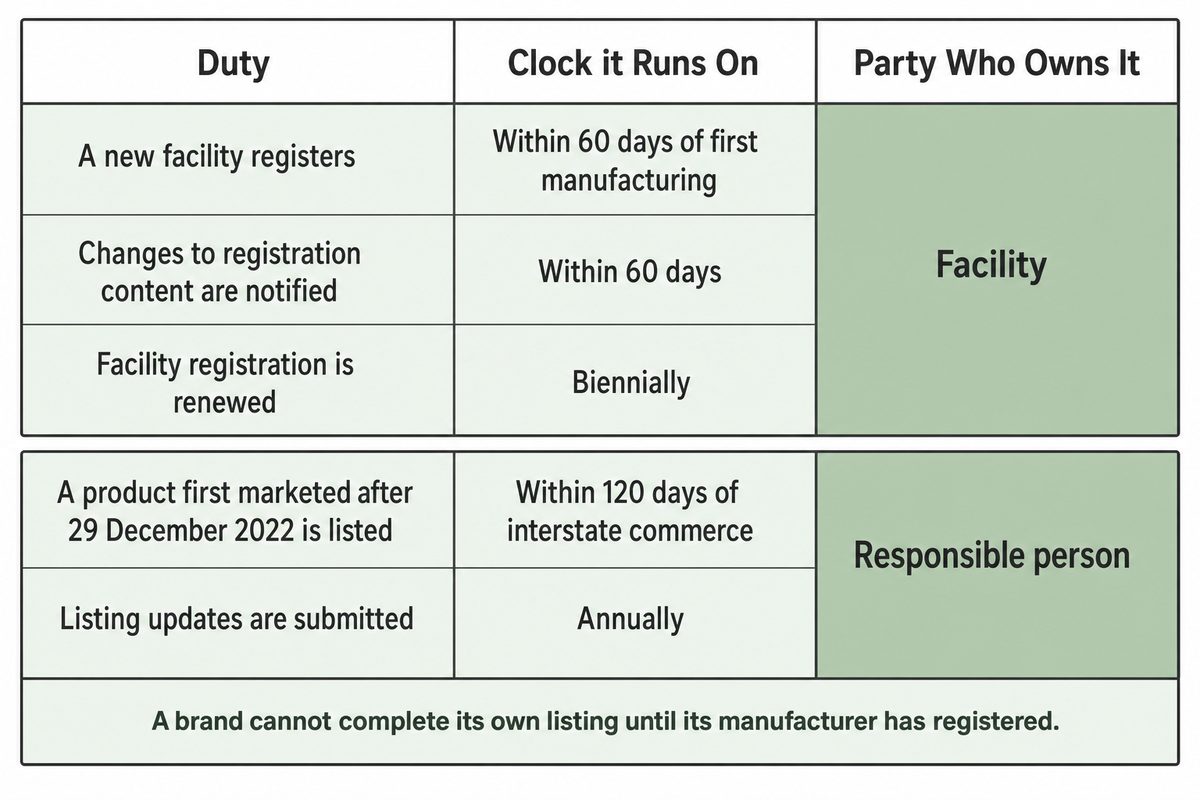
Five filing clocks run under the Modernization of Cosmetics Regulation Act, and two different parties own them. Three belong to the facility that manufactures the product. Two belong to the brand owner acting as the responsible person. Mixing them up is easy for a new skincare business, because one product needs both a registered facility behind it and a listing filed for it, and the two run in parallel.
| Provision | Duty | Clock | Owner |
|---|---|---|---|
| 364c(a)(1)(B) | A new facility registers | Within 60 days of first manufacturing | Facility |
| 364c(a)(4) | Changes to registration content are notified | Within 60 days | Facility |
| 364c(a)(2) | Facility registration is renewed | Biennially | Facility |
| 364c(c)(2) | A product first marketed after 29 December 2022 is listed | Within 120 days of interstate commerce | Responsible person |
| 364c(c)(5) | Listing updates are submitted | Annually | Responsible person |
| 364c(a)(3) | One facility needs one registration even when it makes products for several responsible persons | Not a clock, a scope rule | Facility or any responsible person made there |
Read directly from 21 U.S.C. 364c, the codified statute.
Two practical dependencies follow from that table. First, each listing must carry the facility registration number of every facility that makes the product, so a brand cannot complete its own listing until its manufacturer has registered and handed the number over. Obtaining an FDA Establishment Identifier comes before the registration itself, and FDA notes that issuing an electronic submissions gateway account takes one to three weeks. That is a real queue item almost nobody puts on a launch plan. Second, one submission may cover products that differ only in colour, fragrance, flavour or quantity of contents, so a shade or scent range is one listing rather than twelve.
Registration is also a single point of failure worth understanding. FDA may suspend a facility registration, and while it is suspended, distributing or selling cosmetics from that facility in the United States is a prohibited act. Statute puts durations around the process: five business days to offer a corrective action plan, an informal hearing no later than five business days after the order, and review of the plan within fourteen business days. Your manufacturer’s registration status is therefore part of your own risk register.
Post-market duties do not stop at filing. Serious adverse events must be reported to FDA within 15 business days, and qualifying new information received within one year of the report must also be submitted within 15 business days. Since 12 September 2025 the FDA adverse event dashboard covering cosmetic products has been public, which means the record is now visible to anyone who looks, not just to the regulator. Note also that the small-business exemption does not reach products that regularly contact the mucus membrane of the eye, are injected, are for internal use, or alter appearance for more than 24 hours where consumer removal is not part of normal use. One eye product can remove an exemption a founder assumed applied to the whole range.
Scale gives the context. FDA’s registration and listing page reported 16,398 unique active facility registrations and 1,298,361 unique active product listings as of 30 June 2026. Writing in March 2026, Jessa Boubker and Nicholas R. Johnson of Foley & Lardner recorded 14,299 registrations and 992,907 listings as of 6 January 2026. Those two readings are not in conflict; the gap between them is the point. Listings grew roughly 30.8% in under six months. Any count you read without an as-of date beside it is wrong within a quarter.
Compliance in the market is patchier than the filing numbers suggest. Trade publication Happi, relaying figures from compliance-services provider Registrar Corp through its president, reported that 48% of cosmetics surveyed at major United States retailers were non-compliant, with roughly 135,000 imported products affected and compliance at 54% in pharmacy chains against 32% in general merchandise chains. Treat those as one vendor’s survey rather than a regulator’s count, because the vendor sells the remedy. Mapping who carries which market duty before production is how a brand stays out of that statistic.
What Is a Responsible Person for Cosmetics?
A responsible person is the party whose name appears on the label as the manufacturer, packer or distributor of a cosmetic distributed in the United States, and that party carries the product listing and safety substantiation duties. For a brand using a contract manufacturer, that party is almost always the brand owner rather than the factory.
Naming a contract manufacturer on your artwork doesn’t transfer the duty; label identity and physical manufacture are different roles, and qualifying wording such as “Manufactured for” or “Distributed by” exists precisely to keep them distinct. For most new skincare brands using a contract manufacturer, the brand owner is the responsible person, files the listing, keeps the safety records, and answers for the claims, while the factory holds its own registration. Deciding which entity carries the role before artwork is drawn saves a reprint.
Private Label, White Label or Custom Formulation: Choosing Your Route
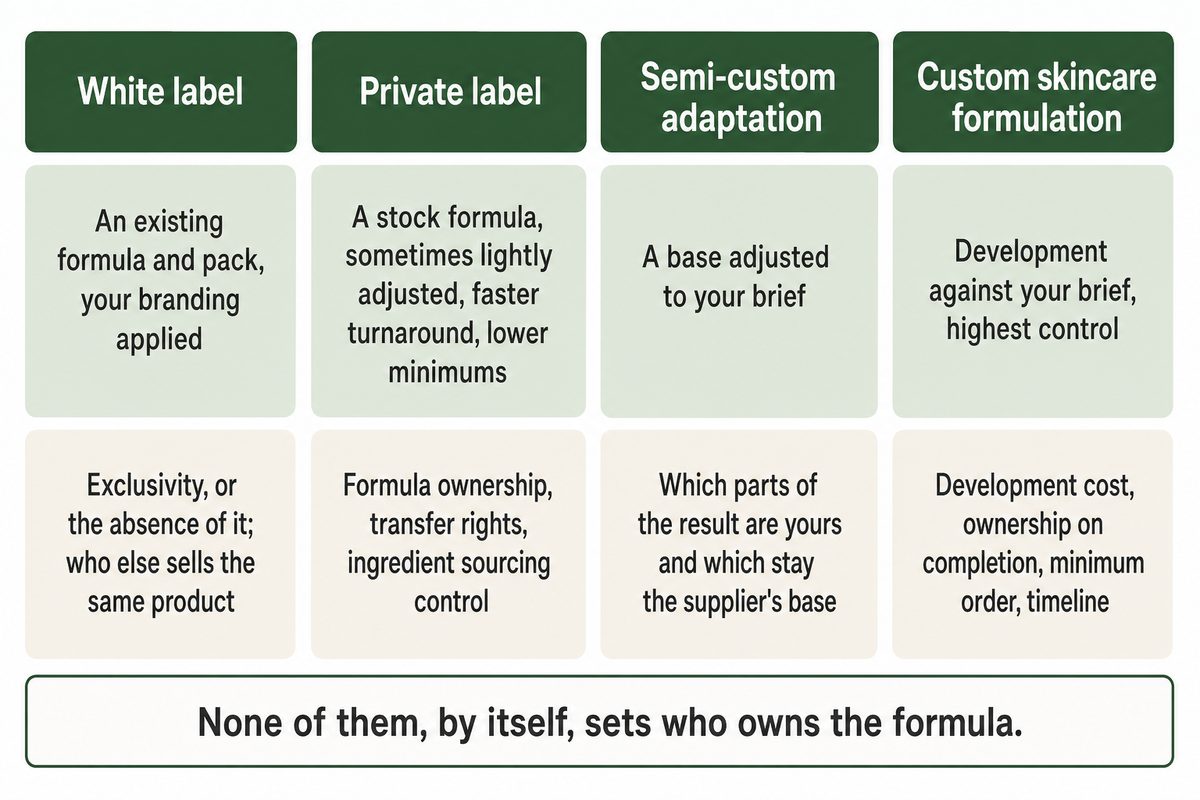
If a route name is doing the deciding, the terms that matter are still unwritten. Private label, white label, OEM and ODM describe how much development work sits with the supplier. None of them, by itself, sets who owns the formula, who may take it elsewhere, what the order floor is, or who answers to the regulator. Contract terms settle those, and volume settles the price.
| Route | Typically supplied | Still to be settled in writing | Where it does not fit |
|---|---|---|---|
| White label | An existing formula and pack, your branding applied | Exclusivity, or the absence of it; who else sells the same product | Any positioning that depends on the formula being yours alone |
| Private label | A stock formula, sometimes lightly adjusted, faster turnaround, lower minimums | Formula ownership, transfer rights, ingredient sourcing control, unit price at each volume | Drug-class products such as sun protection; second-supplier plans |
| Semi-custom adaptation | A base adjusted to your brief | Which parts of the result are yours and which stay the supplier’s base | Briefs where the base is the whole product |
| Custom skincare formulation | Development against your brief, highest control | Development cost, ownership on completion, minimum order, timeline | First launches with no budget for development or testing |
Two facts make this concrete rather than a matter of vendor labels. 21 U.S.C. 364c(a)(3) requires only a single registration per facility even when it manufactures for several responsible persons, so choosing a route never means “registering the factory” yourself. And manufacturer status for labeling purposes depends on the activity actually performed: filling alone, changing bulk, and supplying only a formula produce different outcomes. Guidance from the World Intellectual Property Organization on trade secret management makes the same point about intellectual property, that ownership follows the agreement rather than the commercial label attached to it.
When a private-label route is the wrong choice
Rachael Pontillo, writing on Create Your Skincare, sets out three mechanisms worth reading before signing. On margin: “Wholesale pricing itself is usually a 100% markup of the actual product cost from the manufacturer” — meaning a low minimum is paid for in unit cost, on every unit, indefinitely. On control: “You do not own the formulations, nor do you have any control over the ingredient quality, sourcing, or formulations themselves” — so moving to a second supplier means reformulating, and the brand carries that switching cost. On the word custom: “Sometimes private label cosmetic companies advertise that they offer ‘custom formulations.’ Their version of custom formulation is only within what they have in stock.” She also notes it is not always possible to source every product in a planned range from one house. Her conclusion is blunt: private label “will ultimately be the worst profit margin of the three cosmetic manufacturing options”. None of that makes private label wrong for a first product. It makes it wrong for a brand whose plan depends on owning the formula, on a differentiated texture, or on a second source later. Note too that a supplier’s published quality claims are not evidence it runs those programmes; ask for the records.
Rachael Pontillo, writing on Create Your Skincare, sets out three mechanisms worth reading before signing. On margin: “Wholesale pricing itself is usually a 100% markup of the actual product cost from the manufacturer” — meaning a low minimum is paid for in unit cost, on every unit, indefinitely. On control: “You do not own the formulations, nor do you have any control over the ingredient quality, sourcing, or formulations themselves” — so moving to a second supplier means reformulating, and the brand carries that switching cost. On the word custom: “Sometimes private label cosmetic companies advertise that they offer ‘custom formulations.’ Their version of custom formulation is only within what they have in stock.” She also notes it is not always possible to source every product in a planned range from one house. Her conclusion is blunt: private label “will ultimately be the worst profit margin of the three cosmetic manufacturing options”. None of that makes private label wrong for a first product. It makes it wrong for a brand whose plan depends on owning the formula, on a differentiated texture, or on a second source later. Note too that a supplier’s published quality claims are not evidence it runs those programmes; ask for the records.
Whatever route you pick, the clause that will protect your brand is the one covering ownership and transfer, not the one naming the route. Brands buying private label skincare products from a stock catalogue can still build a high-quality skincare range, provided they accept that the skincare manufacturing behind it is shared with someone else. Route selection also interacts with the claim class from section 2. You cannot lift sun protection products off a stock private-label shelf in the United States the way you can a moisturiser, because the drug obligations travel with them. Where the route comparison continues in commercial detail, including minimums and development scope, is our page on private label cosmetics development, and readers who prefer to work it through as a decision tool can use the skincare development route selector.
Water in the Formula: The Preservation Trigger Point
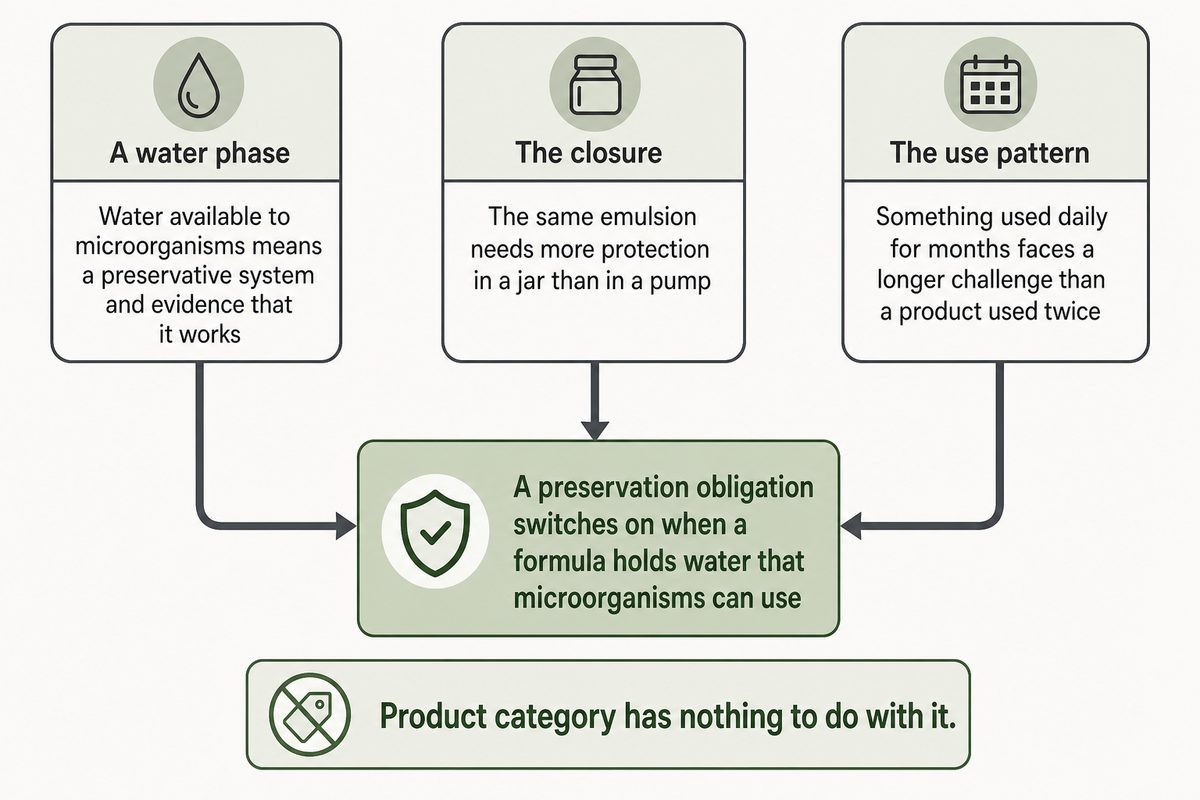
A preservation obligation switches on when a formula holds water that microorganisms can use. Product category has nothing to do with it: an anhydrous balm and a water-based serum sold side by side carry entirely different burdens. That is counter-intuitive for anyone building a natural positioning, because the word on the front of the pack does not set the burden; the water inside it does. Three conditions decide the answer, and each one pulls in a different piece of evidence.
The Preservation Trigger Point
One, a water phase. Water available to microorganisms means a preservative system and evidence that it works. Two, the closure. A pack the consumer puts fingers into reintroduces contamination at every use, so the same emulsion needs more protection in a jar than in a pump. Three, the use pattern. Tell the laboratory how often and for how long the product will be used, because that is part of the exposure the preservative system has to survive.
One, a water phase. Water available to microorganisms means a preservative system and evidence that it works. Two, the closure. A pack the consumer puts fingers into reintroduces contamination at every use, so the same emulsion needs more protection in a jar than in a pump. Three, the use pattern. Tell the laboratory how often and for how long the product will be used, because that is part of the exposure the preservative system has to survive.
Evidence for the first condition comes from the challenge test. ISO 11930 is the reference method, currently in force as ISO 11930:2019 with Amendment 1:2022; the catalogue record for ISO/CD 11930 Edition 3 shows the revision reached committee-draft consultation on 9 July 2026, so the method a new brand is quoted against is being rewritten right now. Not every challenge test is scored the same way, which is the part that catches people out. United States patent US11291204B2 records the numeric pass criterion for the CTFA challenge test: bacteria reduced by 99% in 7 days, yeast and mould by 90% in 7 days. Those thresholds belong to that method, not to ISO 11930, so ask your laboratory which test it ran and against which criterion before you read a certificate as a pass.
Screening thresholds exist for products where a conventional preservative system may not be needed. A 2025 review in the journal Cosmetics lists them as pH below 3.0 or above 10.0, alcohol above 20%, filling temperature above 65 °C, water activity of 0.75 or lower, and hydrogen peroxide above 3.0%. Read those as inputs to a risk assessment, not as a pass mark: products assessed as low risk under ISO 29621 sit outside the reference challenge test, and that assessment is a layered judgement about formula, pack and use, not a single number to clear.
Three findings from the same review complicate the comfortable version of this story. Airless pumps do not prevent anaerobic development. Natural preservatives degrade faster than synthetic ones. And Bacillus cereus survived a third challenge test above the permitted count. The patent record adds a fourth caution that catches “all-natural” briefs: organic acids are completely ineffective biocides at neutral pH, so a system quoted at pH 5.5 to 6.5 can fail a test the same blend passes at pH 4. The consequences of getting this wrong are documented: the review counts 142 FDA cosmetic recalls for contamination, of which 82 were bacteriological, with Pseudomonas species accounting for 56.34%, moulds 11% and yeasts 2%, alongside 215 products notified through the European RAPEX system from 37 countries of origin. This is the point at which the decision to work with a professional formulator, rather than adapt a recipe found online, earns the fee it costs: quality ingredients do not preserve themselves, and skincare formulas that carry water need evidence rather than intent. If you plan to formulate your skincare products around botanical extracts and minimal preservation, expect this question to get harder rather than easier. Preserved emulsion briefs belong in a custom skincare formulation conversation early, not after a pack has been ordered.
Shelf Life, Period After Opening and the Launch Calendar
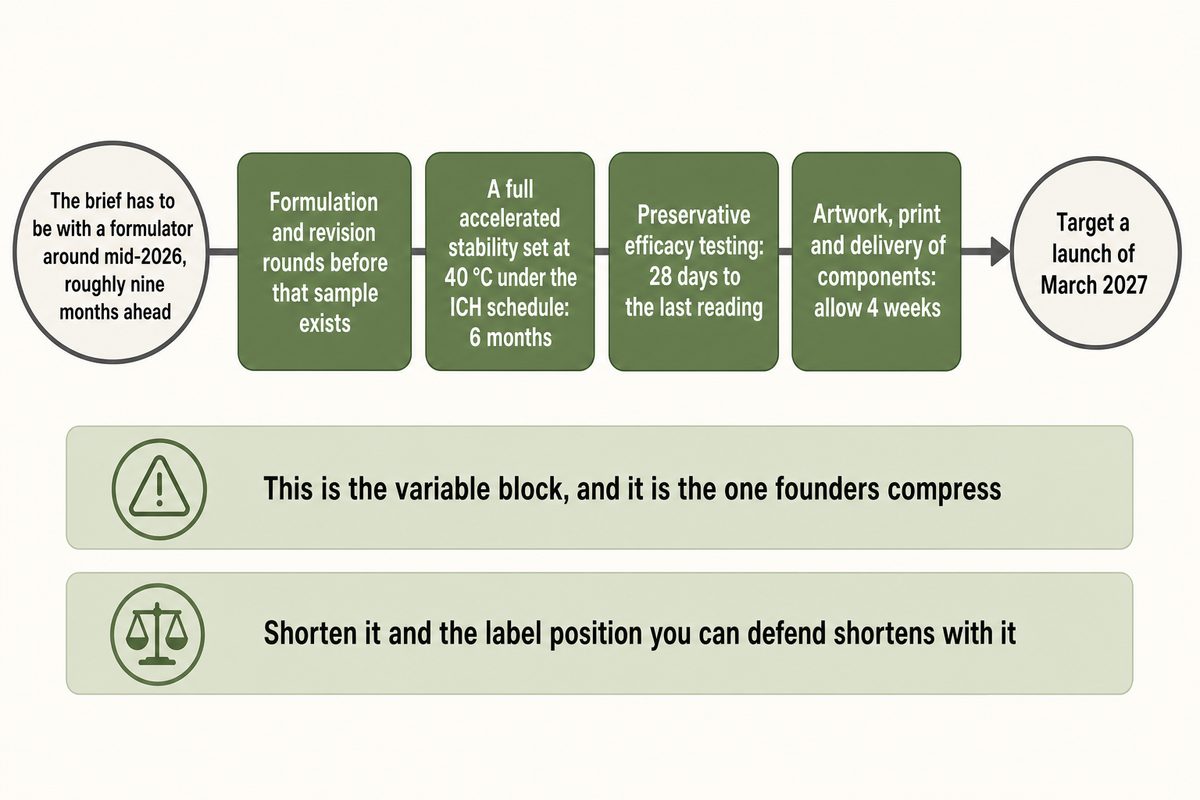
Stability testing sets your launch date, not your marketing calendar. Accelerated conditions give an early read within weeks, while a shelf-life position that has to hold for two years is only fully supported by real-time data, so decide with your laboratory which read your launch date is resting on, and whether a real-time study runs on behind it.
Certified Laboratories, summarising the ICH schedule that cosmetic testing borrows from pharmaceutical practice, describes three primary batches held at three conditions: long-term at 25 °C for 12 months, intermediate at 30 °C for 6 months, and accelerated at 40 °C for 6 months. Preservative efficacy testing under ISO 11930 runs its own course to day 28, and a formulation can clear early readings and fail later ones; the comparator table in patent US11291204B2 shows exactly that, passing early and failing at day 21 and day 28. Worth knowing before you budget for a fixed list: no United States law or regulation requires a cosmetic to carry a shelf life or an expiration date, and FDA treats determining that shelf life as the manufacturer’s responsibility, so the programme you run is a risk decision, not a checklist someone hands you.
Working the calendar backwards: a worked example
Target a launch of March 2027 and subtract, in order. Artwork, print and delivery of components: assume four weeks unless your component supplier confirms otherwise, which puts final files in early February 2027. Preservative efficacy testing on the final formula in the final pack: 28 days to the last reading, so the pack and formula must be frozen by early January 2027. A full accelerated stability set at 40 °C under the ICH schedule: 6 months, which puts the start at early July 2026. Formulation and revision rounds before that sample exists: this is the variable block, and the test durations above it cannot be shortened without shortening the data you end up with, so any compression that keeps the full set has to come from here. Working only from the fixed test durations, the brief has to be with a formulator around mid-2026 for a March 2027 launch, roughly nine months ahead, before a single revision cycle is counted. Shorten it by taking an early accelerated read at 3 months instead of the full set, and the label position you can defend shortens with it.
Target a launch of March 2027 and subtract, in order. Artwork, print and delivery of components: assume four weeks unless your component supplier confirms otherwise, which puts final files in early February 2027. Preservative efficacy testing on the final formula in the final pack: 28 days to the last reading, so the pack and formula must be frozen by early January 2027. A full accelerated stability set at 40 °C under the ICH schedule: 6 months, which puts the start at early July 2026. Formulation and revision rounds before that sample exists: this is the variable block, and the test durations above it cannot be shortened without shortening the data you end up with, so any compression that keeps the full set has to come from here. Working only from the fixed test durations, the brief has to be with a formulator around mid-2026 for a March 2027 launch, roughly nine months ahead, before a single revision cycle is counted. Shorten it by taking an early accelerated read at 3 months instead of the full set, and the label position you can defend shortens with it.
What you may print follows the same logic. Period-after-opening indications and durability positions are label elements, so they’re gated by the data you hold when artwork goes to print, not by the data you expect to hold later. Printing a shelf life the study hasn’t yet supported is the version of this mistake that reaches the market, and it’s expensive to correct once cartons exist.
The Package Decides the Formula, Not the Other Way Round
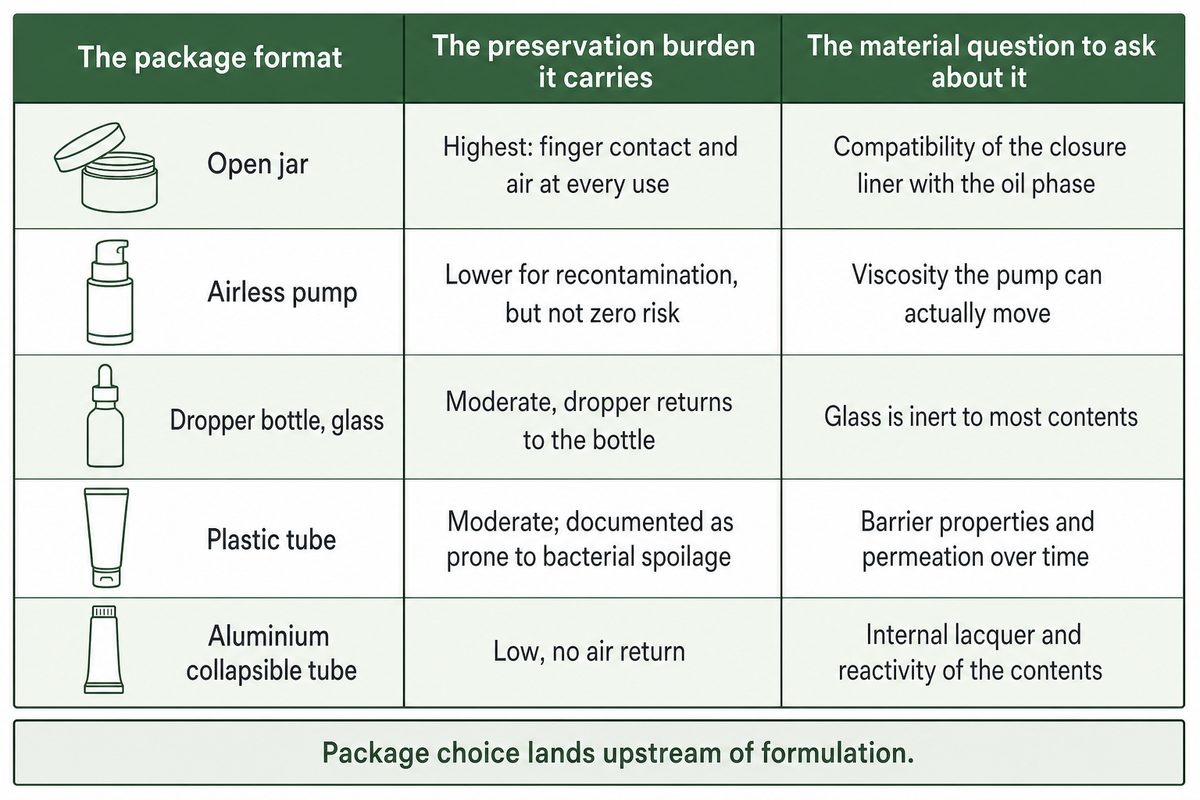
An open jar and an airless pump holding identical emulsion are two different products from a preservation point of view, because one reintroduces contamination at every use and the other doesn’t. Package choice therefore lands upstream of formulation, upstream of testing, and well upstream of artwork. The common assumption is that a formula is developed first and a container is found to hold it.
| Format | Preservation burden | Material question to ask | Not suitable for |
|---|---|---|---|
| Open jar | Highest: finger contact and air at every use | Compatibility of the closure liner with the oil phase | Low-preservative or “preservative-free” positioning |
| Airless pump | Lower for recontamination, but not zero risk | Viscosity the pump can actually move | Anaerobic organisms, which it does not prevent |
| Dropper bottle, glass | Moderate, dropper returns to the bottle | Glass is inert to most contents, with acids such as hydrofluoric the exception | Heavy or thick emulsions |
| Plastic tube | Moderate; documented as prone to bacterial spoilage | Barrier properties and permeation over time | Long durability claims without compatibility data |
| Aluminium collapsible tube | Low, no air return | Internal lacquer and reactivity of the contents | Premium shelf presence: it resists oxidation but distorts in use |
Material behaviour from the packaging review indexed as PMC9123395; anaerobic caution from the 2025 Cosmetics review.
Scale-up is where an approved bench sample meets the pack. Put that transfer on the agenda before the batch is booked: ask your manufacturer what it needs from you, what it will watch as volume rises, and what it has had to change on comparable products. Choosing an active is not the same as having a formula: the base, the preservative system and the pack all still have to be settled around it. Screening a pack for compatibility, preservation load and fill-line fit before ordering artwork keeps the artwork spend from resting on a decision you have not made yet, and packaging and texture planning is where that screen belongs.
What Does It Cost to Start a Skincare Line? Minimum Order Quantities and Production Costs
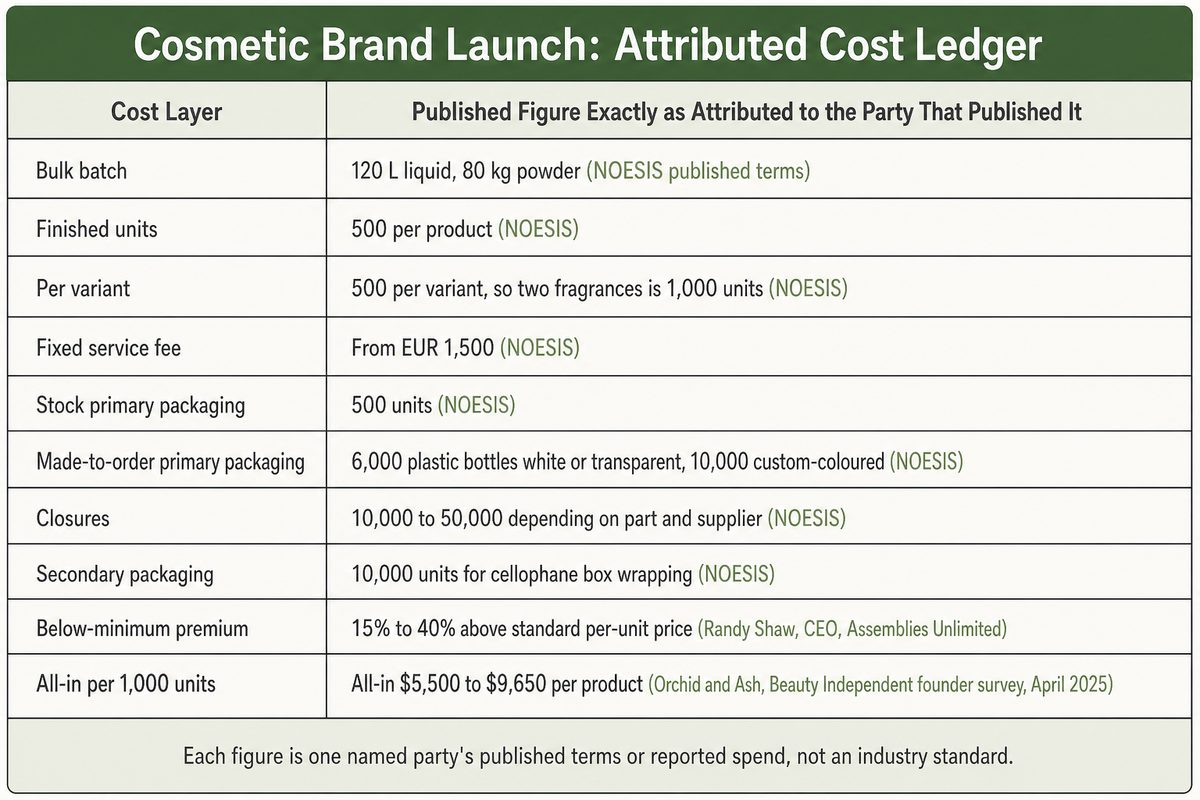
No industry-wide minimum order quantity exists for a first skincare batch. Minimums are set factory by factory and component by component, and the binding one is whichever layer sits highest, usually not the formula. Anyone quoting a single industry number is quoting one supplier’s terms, or nobody’s. It also means the cheapest quote is not always the cheapest launch, because the layer that binds your order is rarely the layer a supplier quotes.
Start with the arithmetic, because it explains the pattern that published tables only report. Bulk floors are expressed in volume, not units. One European contract manufacturer, NOESIS, publishes a technical floor of 120 litres per batch for liquids and semi-liquids and 80 kg for powders, set by the minimum working capacity of its mixing vessels. Convert that floor across fill sizes and the “category” story collapses: 120 litres is roughly 2,400 units at a 50 ml fill, roughly 4,000 units at 30 ml, and roughly 12,000 units at 10 ml. Same vessel, same formula, three very different order floors. A serum and a cream drawn from the same bulk floor reach different unit counts because their fill sizes differ, not because one is simpler to make.
| Cost layer | What sets the floor | Published figure, as attributed | What the figure does not cover |
|---|---|---|---|
| Bulk batch | Minimum working volume of the mixing vessel | 120 L liquid, 80 kg powder (NOESIS published terms) | Filling, components, decoration |
| Finished units | Filling line changeover | 500 per product (NOESIS) | Whether 500 is economic, which is a separate question |
| Per variant | Each fragrance, colour or active level is its own batch | 500 per variant, so two fragrances is 1,000 units (NOESIS) | Label-only differences, which can share a batch |
| Fixed service fee | Setup, handling, process validation, quality control, documentation | From EUR 1,500 (NOESIS) | Nothing scales it down, so it dominates small runs |
| Stock primary packaging | Supplier lot size | 500 units (NOESIS) | Decoration, which is priced separately |
| Made-to-order primary packaging | Mould and press run economics | 6,000 plastic bottles white or transparent, 10,000 custom-coloured, 5,000+ aluminium, 5,000 printed tubes (NOESIS) | This is usually the layer that binds, not the formula |
| Closures | Custom colour tooling at the closure supplier | 10,000 to 50,000 depending on part and supplier (NOESIS) | Stock closures, which sit far lower |
| Secondary packaging | A sealing mould is needed per box format | 10,000 units for cellophane box wrapping (NOESIS) | Cartons without wrapping, priced separately |
| Below-minimum premium | Running a pilot batch under the standard minimum | 15% to 40% above standard per-unit price (Randy Shaw, CEO, Assemblies Unlimited) | Stated for contract packaging generally, not skincare specifically |
| All-in per 1,000 units | One brand’s published breakdown | Boxes about $250, bottles and printing $1,000 to $1,500, formula development $2,500 to $3,000, all-in $5,500 to $9,650 per product (Orchid and Ash, Beauty Independent founder survey, April 2025) | Freight, duty, warehousing, fulfilment and working capital |
Each figure is one named party’s published terms or reported spend, not an industry standard. Minimums and prices are quoted, not published, so treat these as the shape of the stack rather than as your quote.
Two mechanisms explain why the stack behaves as it does. Randy Shaw, chief executive of contract packager Assemblies Unlimited, describes the mismatch plainly: “A co-packer might agree to fill five thousand bottles, while the bottle supplier sells those bottles only in lots of fifty thousand.” He also gives the fixed-cost arithmetic that decides small runs: a $100 line-cleaning task adds $1.00 per unit across a 100-unit run and $0.10 per unit across a 1,000-unit run. A published reference table at femfounded.org puts typical skincare and colour cosmetic minimums for pump or jar formats at 1,000 to 5,000 units per stock-keeping unit, which is one dated data point inside a documented spread, not a rule, and not a number to plan against without your own quotes.
A worked cost stack, one product form
Take a 50 ml airless cream and accept the 120-litre bulk floor as binding: that is roughly 2,400 units. Scaling the per-1,000 breakdown Orchid and Ash gave Rachel Brown of Beauty Independent in April 2025 to that quantity gives 2.4 × $5,500 to $9,650, or roughly $13,200 to $23,160 for one product, but treat that as an upper bound rather than a quote, because scaling a published stack linearly ignores the fixed-cost effect Shaw describes, and the per-unit figure falls as the run grows. Add a fixed service fee from EUR 1,500 if your manufacturer prices that way, and check whether your chosen bottle is stock; if it needs a custom colour, the closure layer alone can demand 10,000 pieces and reset the whole plan. Excluded from that total: freight, duty, warehousing, fulfilment, insurance, and the working capital tied up between paying the factory and being paid by a retailer. Run the same arithmetic at a 10 ml fill and the unit count triples while the per-unit cost falls, which is the trade-off nobody puts in a headline range.
Take a 50 ml airless cream and accept the 120-litre bulk floor as binding: that is roughly 2,400 units. Scaling the per-1,000 breakdown Orchid and Ash gave Rachel Brown of Beauty Independent in April 2025 to that quantity gives 2.4 × $5,500 to $9,650, or roughly $13,200 to $23,160 for one product, but treat that as an upper bound rather than a quote, because scaling a published stack linearly ignores the fixed-cost effect Shaw describes, and the per-unit figure falls as the run grows. Add a fixed service fee from EUR 1,500 if your manufacturer prices that way, and check whether your chosen bottle is stock; if it needs a custom colour, the closure layer alone can demand 10,000 pieces and reset the whole plan. Excluded from that total: freight, duty, warehousing, fulfilment, insurance, and the working capital tied up between paying the factory and being paid by a retailer. Run the same arithmetic at a 10 ml fill and the unit count triples while the per-unit cost falls, which is the trade-off nobody puts in a headline range.
“With as little as $25,000, new brands can experiment with an early range of four to five products on Amazon, TikTok Shop and their direct-to-consumer platform to gauge consumer response.”
Published estimates disagree so widely that the disagreement is itself the finding. In a single Beauty Independent survey, ten consultants estimated $100,000 to $750,000 to launch a beauty brand, while the founders interviewed in the same piece reported real spends of $5,500 to $20,000. Both sets of numbers are honest; they describe different launches. That’s why this section gives you the layer stack and the arithmetic instead of a range: the range you need is the one your own component choices generate. A manufacturer advertising low minimum order quantities may be describing the filling layer alone rather than the component layers underneath it, so ask which layers the number covers. Brands working near the floor should look at low minimum order skincare programmes and model the cash position with an order quantity and inventory estimator before committing to components.
Copy the table below straight into your quote request. It converts the four commitments from section 1 into the questions a manufacturer can actually answer.
RFQ checklist — copy these into your quote request:
| Parameter | What to ask for | Why it matters | How to verify |
|---|---|---|---|
| Bulk batch floor | Minimum working volume in litres or kg, per vessel | Converts to your unit floor once fill size is fixed | Ask for the figure in litres, then do the division yourself |
| Unit minimum per variant | Units per product and per fragrance or shade | Variants multiply the order, not the batch | Quote two variants and compare against one |
| Component minimums | Bottle, closure, label, carton, each separately | The highest layer sets your real order size | Request the component supplier’s own lot sizes in writing |
| Facility registration number | Confirmation the facility is registered, and the number | Your product listing cannot be completed without it | Ask when it was registered and when it next renews |
| Preservation evidence | Challenge test report on your formula in your pack | Bulk-only testing does not cover the closure you chose | Check the test method and the final reading day on the report |
| Stability programme | Conditions, durations and number of batches | Sets the earliest date you can print a durability position | Ask which readings exist today, not which are planned |
| Formula ownership | Who owns the formula, and transfer rights on exit | Decides whether a second supplier is possible later | Read the clause; the route name tells you nothing |
How Much Does It Cost to Start a Skin Care Line?
Component minimums rather than formula cost decide startup costs for a skincare line, so the honest answer is a method rather than a number. Price the layers separately: bulk batch floor, filling minimum, bottle, closure, label, carton, testing, and the fixed service fee your manufacturer charges regardless of run size.
Whichever layer sits highest sets your order, and your total is that quantity multiplied by unit cost plus development and testing. Published reference points span an enormous range; founders in one Beauty Independent survey reported $5,500 to $20,000 while consultants in the same article estimated $100,000 to $750,000, because they describe different launches, not different markets. Rachel Brown collected those founder figures for Beauty Independent in April 2025, so read them as a dated snapshot rather than a live quote; component prices and testing fees have moved since. Build your own figure from quotes on your own components, and treat any published range as orientation only. The single number worth carrying out of this section is your own highest layer, because that layer, not the formula, is what sets the order you have to place.
The Label Is the Last Thing You Build and the First Thing Anyone Checks
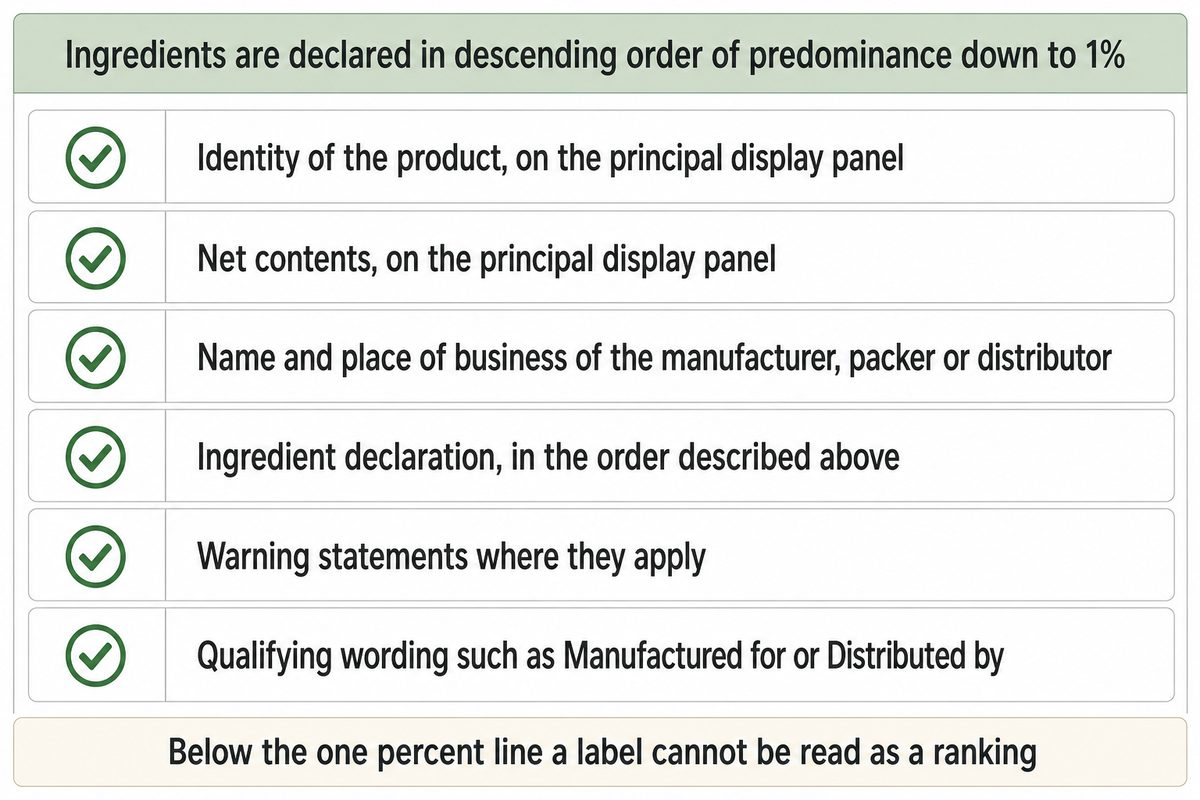
A cosmetic label declares ingredients in descending order of predominance down to 1%; below that line the remaining ingredients may appear in any order, and colour additives follow the rest. That single rule from 21 CFR 701.3 has a consequence most brands miss: below the one percent line a label can’t be read as a ranking, so a hero active may sit anywhere in the tail.
FDA’s Cosmetics Labeling Guide sets out the mandatory elements and where they belong. Type-size floors apply both to the ingredient declaration and to the principal display panel. Where the package surface is under 12 square inches, the ingredient declaration may sit off-package under stated conditions, and a separate net-contents exemption appears at 21 CFR 1.24.
- ✔ Identity of the product, on the principal display panel
- ✔ Net contents, on the principal display panel
- ✔ Name and place of business of the manufacturer, packer or distributor
- ✔ Ingredient declaration, in the order described above
- ✔ Warning statements where they apply
- ✔ Qualifying wording such as “Manufactured for” or “Distributed by” where the named party did not make the product
That last line is where private-label brands trip. Label identity and physical manufacture are different roles: the name on the pack identifies who takes responsibility, and qualifying wording keeps it honest when a contract manufacturer did the making. Deciding this at artwork stage, rather than after a print run, is the difference between a wording change and a reprint. Product labeling is also the compliance artefact the brand owns outright; your manufacturer doesn’t carry it for you.
What Is Changing in 2026 and What It Means for a First Launch
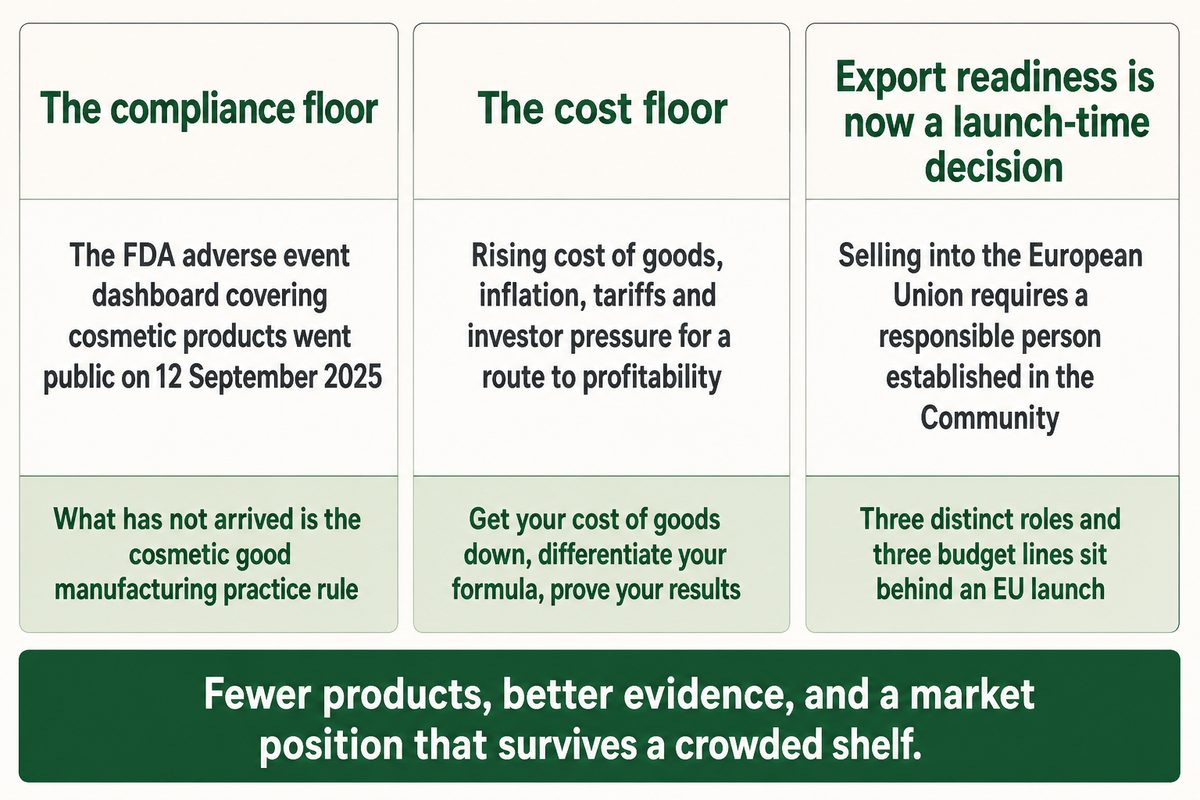
Three things have moved since 2023, and together they point one way: the compliance and cost floor under a first launch has risen while the differentiation a novelty positioning buys has fallen. Launches in 2026 should therefore be narrower and better substantiated than their 2023 equivalents. Fewer products, better evidence, and a market position that survives a crowded shelf.
Shift one, the compliance floor. Registration and listing are now routine obligations with the five clocks set out in section 3, and the post-market record is visible: the FDA adverse event dashboard covering cosmetic products went public on 12 September 2025. What has not arrived is the cosmetic good manufacturing practice rule. Foley & Lardner recorded in March 2026 that FDA had not issued final GMP regulations, with the rulemaking sitting on the Unified Agenda as a long-term action even though the statutory deadline of 29 December 2025 had passed. In the meantime EN ISO 22716:2007 is the only entry on the European Commission’s harmonised standards list for Regulation (EC) No 1223/2009 — the Commission notes the compiled list may be incomplete and carries no legal validity in itself, which makes a manufacturer’s ISO 22716 status a procurement question rather than a marketing badge.
Shift two, the cost floor. In a 2026 Beauty Independent survey of 34 indie beauty founders and executives, Kim van Haaster, founder and chief executive of Bloomeffects, attributed climbing suggested retail prices to rising cost of goods, inflation, tariffs and investor pressure for a route to profitability. Julie Pefferman’s sequencing rule follows from the same pressure and runs directly against the standard advice: “The new way is to get your cost of goods down, differentiate your formula, prove your results and let a hero emerge without overly investing in packaging.”
Shift three, export readiness is now a launch-time decision. Selling into the European Union requires a responsible person established in the Community, appointed by written mandate that the appointee accepts in writing under Article 4 of Regulation (EC) No 1223/2009; an overseas manufacturer cannot simply fill the role. A safety assessment and a notification are separate obligations again, so three distinct roles and three budget lines sit behind an EU launch. Deciding at brief stage whether the European Union is in scope changes the formula, the label and the documentation, which is why selling into the European Union belongs in the first plan rather than the second year.
On positioning, the same survey reports launch fatigue: Erica Choi, founder and aesthetician at Superegg, describes consumers paring back to fewer products with a clear purpose, and the survey also argues that major retailers all betting on K-beauty commoditises it, so a Korea-inspired market positioning carries less differentiation than it did. If you’re planning a first launch for 2027, two actions follow now: put the request for your manufacturer’s facility registration number into the brief, because you cannot complete your product listing without it, and choose one product to prove rather than a full routine to fill a shelf.
Practically, that means you start small. A soft launch, one or two products, a limited quantity, sold through your own online store before any retail conversation, lets you test the market with real money rather than survey answers. Start with a soft launch, sell online at low volume, and watch which product actually moves before committing to the component minimums that lock up cash. Using social media and small influencer partnerships to validate demand, and listing products online through a channel you control, are ways to see which product moves before the component minimums lock up cash. Entering the market this way also delays the point at which you start selling at a volume that forces a second batch.
None of that changes the order of work. The steps to create a skincare line that holds up are the same every time: settle the claim class, choose the route, price the layers, prove the preservation, then design the label. Creating your own skincare line around a clean formulation, a natural skin care positioning or a broader skincare movement changes the marketing, not the order, and wanting to start a natural range doesn’t move the preservation evidence in section 5 by a day. Whether you launch your skincare range into one country or plan for the global skincare market from the outset, the target market you choose decides which obligations bind first, and regulated markets like Europe bring the responsible-person duty described above. Launching a skincare line in one market and expanding deliberately keeps the number of regulatory regimes you answer to at one, across beauty and skincare alike. That’s what starting a skincare business looks like in 2026: to build a successful skincare business, get the first three steps right on a single product, and run a successful skincare startup on the assumption that the launch plan you wrote first is a draft.
Frequently Asked Questions
How do I start skincare for beginners?
Start with one product, one claim class and one market. Write the claim first and test it against the two classification questions, choose a route knowing what the contract must still settle, then price the component layers before committing to a formula. One well-evidenced product is a stronger first step than a full routine.
Can you start a skincare line with no money?
Concept validation costs little: interview a defined audience, present a price and a message, and build a waitlist. Physical launches do not work that way. Development, testing, components, filling, freight, insurance and any fixed service fee all arrive before revenue does, so budget for the gap between paying a factory and being paid by whoever sells the product.
How do I register my skincare business?
Two federal obligations exist, and neither is a brand registration. Your manufacturing facility registers itself and renews biennially; you, as responsible person, list each product within 120 days of it entering interstate commerce and update the listing annually. Because each listing must carry the registration number of every facility where the product is made, you cannot complete yours until your manufacturer has registered. Business licensing sits outside federal cosmetic law and outside this guide’s scope.
How long does it take to get a skincare product to market?
Fixed test durations set the floor and revision cycles set the variance. Preservative efficacy testing runs to day 28 on the final formula in the final pack. A full accelerated stability set at 40 °C under the ICH schedule runs 6 months, with long-term data at 25 °C reaching 12 months a year later. Artwork, printing and component delivery add several weeks after the formula and pack are frozen. Counting only those fixed blocks, a brief needs to be with a formulator roughly nine months before the launch you want, before a single revision round is added. Compressing the schedule usually means taking an early accelerated read instead of a full set, which narrows the durability position you can defend on the label.
What is the difference between white label and private label skincare?
White label applies your branding to an existing product sold to others as well; private label starts from a stock formula that may be adjusted for you. Neither name settles ownership, exclusivity or minimums; the contract does.
Do I need product liability insurance for a skincare line?
Treat it as a launch cost to quote rather than a question to settle later. Ask each retailer or marketplace you approach whether it requires cover and at what limits, confirm in writing whether your contract manufacturer’s policy names your brand rather than assuming it does, and price the answer alongside your components.
About this guide
The NEXO Beauty Labs technical team wrote this article. NEXO is a cosmetic OEM and ODM partner working on skincare, hair care and body care development and manufacturing. We have an interest in the subject: brands that arrive with a claim class, a pack decision and a realistic order floor already worked out are easier to quote and cheaper to serve.
Everything above is compiled from primary regulatory sources, published standards records, peer-reviewed literature, named trade-press reporting and named vendor and practitioner publications, each cited where it’s used. Vendor minimums and founder spend figures are one party’s published terms or reported experience, not industry standards, and they’re attributed as such. Regulatory requirements change, and state-level obligations are outside the scope of this guide. Nothing here is legal advice; confirm your own position with a qualified adviser before you commit to artwork or to a production run.
Working through a first skincare brief?
Bring the claim class, the fill size and the pack you have in mind, and we’ll tell you which layer sets your order floor before you spend anything on components.
References & Sources
- Registration and Listing of Cosmetic Product Facilities and Products · U.S. Food and Drug Administration
- Is It a Cosmetic, a Drug, or Both? (Or Is It Soap?) · U.S. Food and Drug Administration
- 21 U.S.C. 364c — Registration and product listing · Legal Information Institute, Cornell Law School
- How MoCRA Is Reshaping FDA Oversight of Cosmetics in 2026 · Jessa Boubker and Nicholas R. Johnson, Foley & Lardner
- ISO/CD 11930 Edition 3 catalogue record · International Organization for Standardization
- Microbiological safety and preservation of cosmetic products, Cosmetics 2025, 12(5), 198 · MDPI
- US11291204B2, Preservatives for cosmetic, toiletry and pharmaceutical compositions · United States Patent and Trademark Office record
- Cosmetic packaging materials review, PMC9123395 · National Library of Medicine, PubMed Central
- Cosmetics Labeling Guide · U.S. Food and Drug Administration
- Harmonised standards for cosmetic products · European Commission
- Julie Pefferman’s predictions for beauty in 2026 · Beauty Independent
- What indie beauty brands really spend to launch · Beauty Independent
- Imported cosmetics products still non-compliant with MoCRA · Happi