Get in touch with NEXO Beauty Labs Company

Last Modified August 2026 Written by XCX Ordinary Cosmetics Scope
Private label vs white label cosmetics is best treated as a cosmetic contract manufacturing comparison, not a contest between two fixed definitions. White label often begins with a shared, ready-made offer, while private label often allows a more brand-specific scope, but suppliers draw that line differently. Before choosing, confirm nine items in writing: formula source, related-formula sales, permitted changes, rights, transfer permission, evidence packet, change notice, binding minimums, and release responsibility.
The short answer
Choose white label for a bounded market test when the ready-made offer and its limits are acceptable. Choose private label when a defined product difference justifies more development and contract work. Neither label proves exclusivity, ownership, safety evidence, a lower minimum order, or a faster launch.
Private Label vs White Label Cosmetics at a Glance
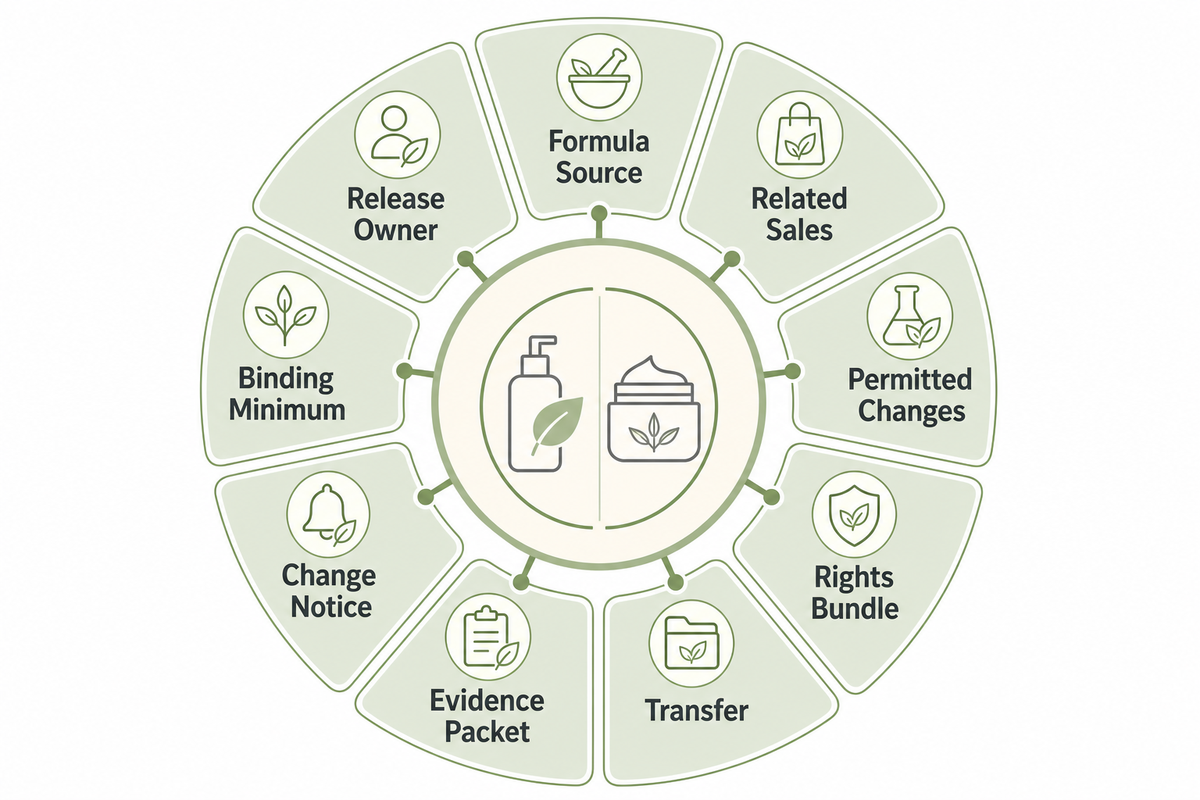
The key differences are formula starting point, permitted changes, exclusivity, rights, evidence, minimum-order constraints, change control, transfer options, and release ownership. Use the table as a request-for-evidence list. The route names provide a starting hypothesis, not a promise that any row applies to a particular supplier.
Common white-label starting point
- Existing formula and defined package choices
- Shared offer may be available to other brands
- Fewer initial product-development decisions
Common private-label starting point
- More brand-specific product or package scope
- Changes may extend beyond artwork
- More decisions require written acceptance
| Check type / buyer question | White-label starting point | Private-label starting point | Evidence to request | Limitation |
|---|---|---|---|---|
| 1. Formula source | Existing base | Existing or developed base | Formula/version identifier | Name alone proves nothing |
| 2. Related sales | Often shared | May be shared or reserved | Written sales boundary | “Exclusive” needs scope |
| 3. Permitted changes | Usually bounded | Potentially broader | Approved change matrix | Every change can alter scope |
| 4. Rights bundle | Access is common | Negotiated rights may expand | Licence, records, disclosure terms | Payment is not assignment |
| 5. Transfer | Often restricted | May be negotiated | Exit and transfer clause | Know-how may still be missing |
| 6. Evidence packet | Existing evidence may help | May need expanded review | Product- and market-specific index | Bulk history is not universal proof |
| 7. Change notice | Supplier controls base changes | Control can be shared | Notice, approval, re-test workflow | Silence is not approval |
| 8. Binding minimum | May use stocked inputs | Custom inputs may bind | Formula, component, decoration floors | No universal route number |
| 9. Release owner | Tasks may be pre-arranged | Tasks may be project-specific | Named statutory and operational owners | A contract cannot erase law |
Route Labels Are Shorthand, Not Contract Terms
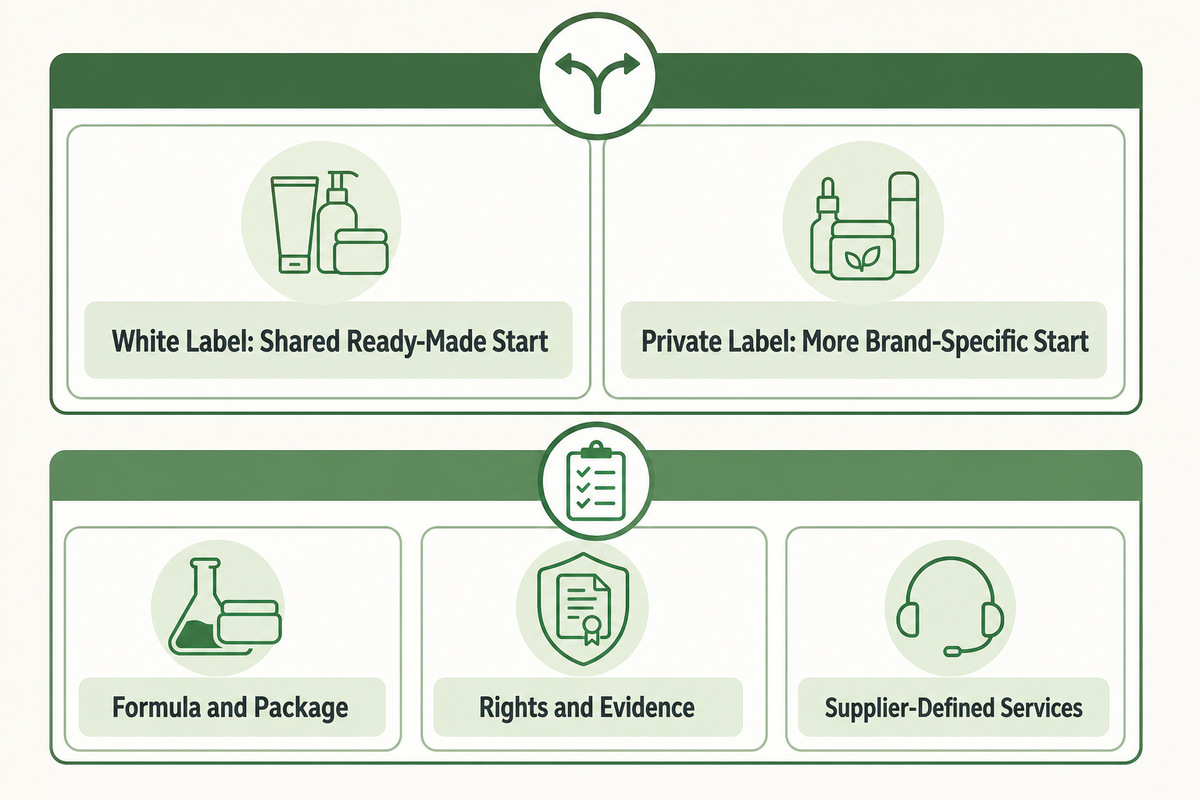
Private label commonly suggests a product prepared for one brand, while white label commonly suggests a ready-made product that can carry several brands. For this buyer comparison, treat those as starting hypotheses until the supplier defines its offer. Ask for the included formula, package, rights, evidence, and services in writing.
The FDA authority page is cited here only for the regulatory roles and product duties it describes, not as a source for the commercial meanings of private label or white label. European Union cosmetics guidance likewise supplies market-role and product-safety boundaries, while the supplier must define the offer.
Definition boundary
Common starting point: white label is often shared and ready-made; private label is often more brand-specific.
Must be written: identical-formula sales, exclusivity, formula access, permitted changes, records, testing scope, minimums, timing, transfer, and release responsibility.
Language can obscure the scope. Some buyers use white label and private label interchangeably: a retailer may call a pre-made white label product a private label product once it carries the store name, while another supplier reserves private label for limited customization. A private label brand building private label skincare, or any beauty brand entering skincare, should normalize those words in the brief.
The same route labels appear across skincare and other personal care products. A white-label skincare product still needs consumer-facing claims, packaging, ingredient, and manufacturing questions, while research and development scope must be stated when formula work is included.
Is private label the same as white label?
No fixed industry rule makes them the same or different in every offer. One supplier may call a stock formula with custom artwork private label, while another reserves that name for modified or exclusive work. Compare the defined deliverable, not the heading on a sales page.
Write down the formula version, related-formula sales, permitted changes, exclusivity boundary, rights and records, transfer path, evidence packet, binding order layers, and release owners. Two proposals using different labels can then be equivalent, while two proposals using the same label can be materially different.
There is an important scope limit. United States drug rules contain a specific definition involving private-label distribution, but that definition sits in 21 CFR 207.1 and should not be imported into an ordinary-cosmetics comparison. A product regulated as both a cosmetic and a drug needs a separate route review.
Formula Access, Exclusivity, Ownership, and Transfer Rights
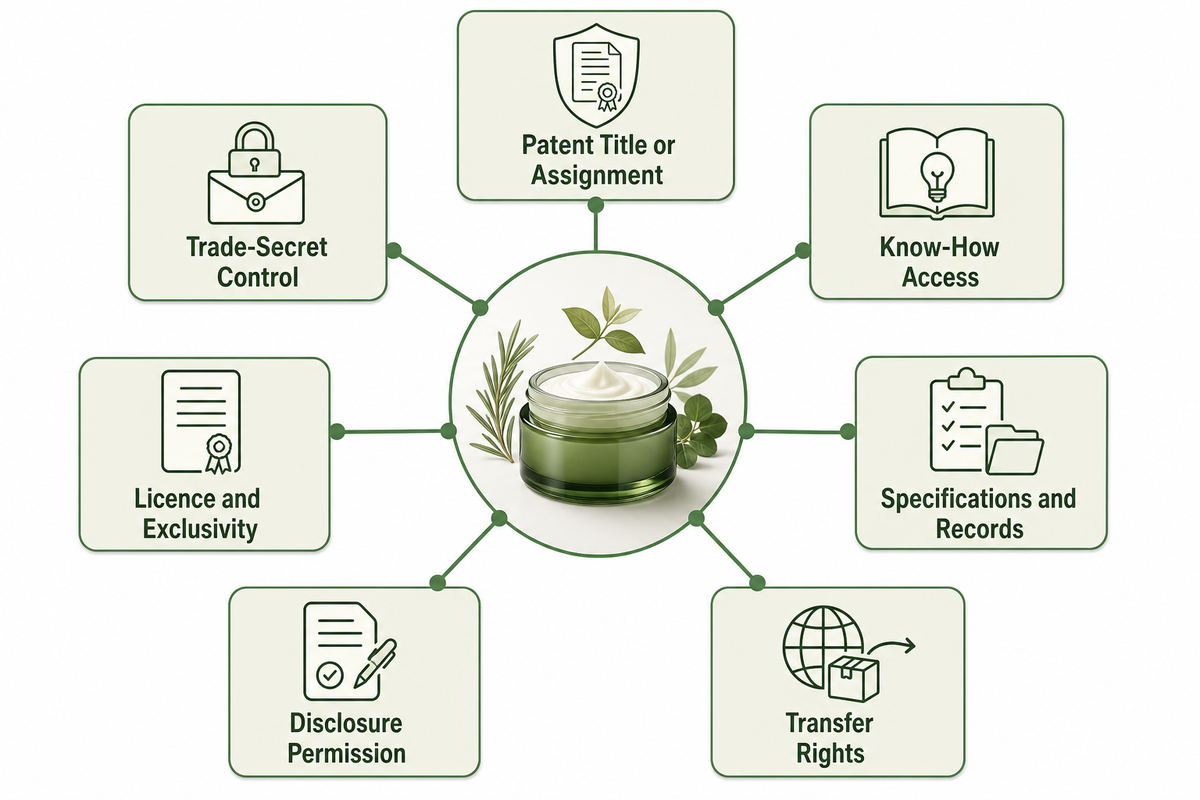
Formula control is a bundle, not a yes-or-no ownership box. Separate patent title or assignment where relevant, trade-secret control, know-how access, licence and exclusivity, specifications and supporting records, disclosure permission, and transfer rights. No private-label or white-label route automatically supplies the complete bundle.
Even patent ownership is its own question: the United States Patent and Trademark Office assignment guidance treats patent interests as assignable property. That citation supports only the patent-assignment point; it does not establish trade-secret control, know-how access, ownership of batch specifications, or permission to disclose a formula to a replacement manufacturer. Those remain separate due-diligence questions for qualified counsel and the project parties.
| State | What may be true | Evidence needed | Unresolved risk |
|---|---|---|---|
| Common stock offer | Same base available to many brands | Formula version and permitted branding | Undisclosed related sales |
| Reserved variant | A sensory or ingredient variant is reserved | Variant boundary, territory, channel, term | Base remains shared |
| Exclusive formula scope | Defined formula use is restricted | Versioned exclusivity and exceptions | Ownership or transfer still unclear |
| Transferable brand package | Defined rights and records can move | Assignment/licence, disclosure, records, assistance | Replacement process still needs validation |
Decision scenario: a founder pays for a new texture and assumes the payment buys every formula right. The defensible next step is to identify the version, inventor or contributor records where relevant, trade-secret holder, permitted disclosures, exclusivity limits, specifications, and transfer assistance before treating the product as portable. This is a synthetic procurement example, not a reported NEXO outcome.
Customization Scope: Label, Package, Sensory Profile, or Formula
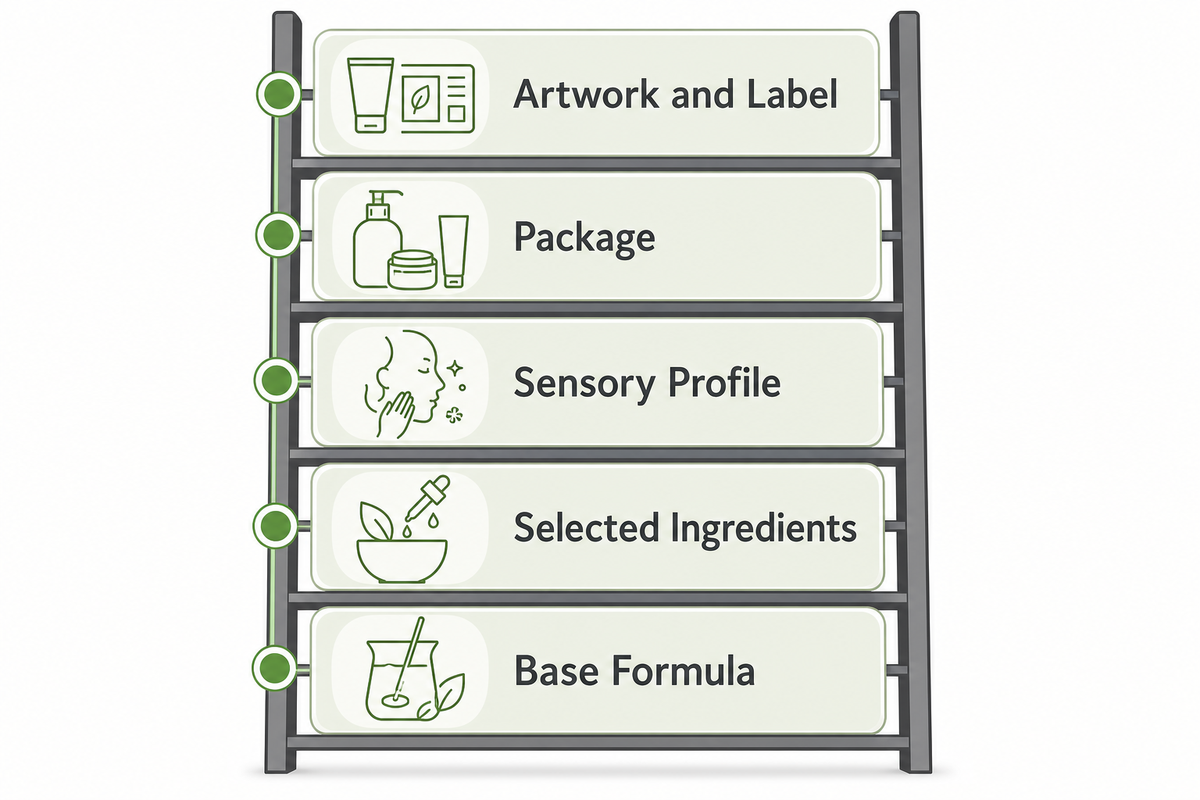
Customization is not one feature. In practice, a project can change artwork, secondary packaging, the primary container, fragrance or color, selected ingredients, or the base formula. Each level needs an acceptance record and a trigger for deciding whether safety, compatibility, labeling, cost, or timing must be reviewed again.
Five-level customization ladder
- Artwork and label: approve claims, mandatory text, dieline, and print proof.
- Package: approve component specification, supplier, decoration, closure, and compatibility decision.
- Sensory profile: define fragrance, color, viscosity, appearance, and accepted tolerance.
- Selected ingredients: identify substitutions, concentration boundaries, sourcing constraints, and re-review triggers.
- Base formula: version the formulation and define development, evidence, rights, approval, and change-control scope.
A quotation should say where its included scope stops. “Custom packaging” can mean a stock bottle with a printed label, a decorated stock component, or a new primary component; those are different supply and evidence questions. “Custom formula” can likewise mean adjusting a fragrance or building a new base through custom cosmetic formulation, so the acceptance document should identify the actual level.
The ladder is also a change log. A visual artwork edit may only reopen labeling review, while a new pump can reopen formula-package compatibility and filling questions. An ingredient or claim change can affect intended use and safety substantiation, making a simple “same product” note inadequate.
Testing, Final-Container Evidence, Market Roles, and Change Control
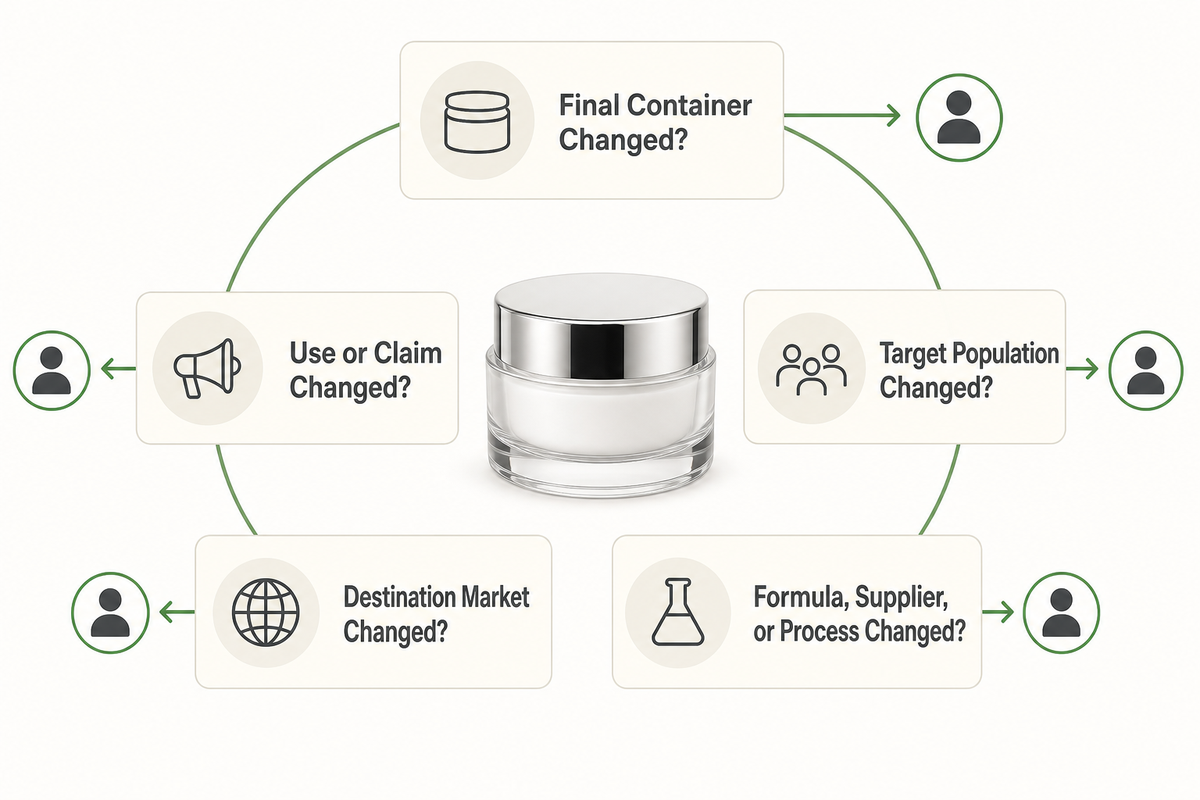
A ready-made formula does not make every final product ready for market. Confirm intended use, claims, target population, final container, destination market, available safety evidence, and later changes. Then name both the statutory market role and the operational owner who reviews, approves, documents, and releases each item.
FDA’s cosmetics product-testing guidance says manufacturers or distributors remain responsible for product safety and that no single fixed test list is prescribed for every cosmetic. The correct evidence plan therefore depends on the actual product and available information, not on whether its commercial route is called white label.
Under the Modernization of Cosmetics Regulation Act, the responsible person must ensure and maintain records supporting adequate safety substantiation. The same page distinguishes facility registration from responsible-person product listing, showing why a contract can allocate work but cannot erase the statutory role attached to the label and market.
| Duty type | Statutory clock | Buyer handoff question |
|---|---|---|
| New-facility registration | Within 60 days of first manufacturing | Who registers before 60 days elapse? |
| Registration change | Within 60 days | Who monitors the notice inside 60 days? |
| Facility renewal | Every 2 years | Who tracks renewal every 2 years? |
| New-product listing | Within 120 days of marketing | Who files before 120 days elapse? |
| Listing update | Every 1 year | Who owns the update every 1 year? |
| Serious adverse event | Within 15 business days | Who can report inside 15 business days? |
| Qualifying follow-up information | Information received within 1 year; report within 15 business days | Who watches the 1 year window and the 15 business days response? |
| Adverse-event record retention | 6 years | Where are the 6-year records controlled? |
| Qualifying small-business retention | 3 years | Who confirms the 3-year condition actually applies? |
Do not collapse the clocks: the 60 days facility-change clock and the 120 days product-listing clock belong to different parties. Keep the 2 years facility renewal separate from the 1 year product update; operational plans also need the 15 business days adverse-event response, the 1 year follow-up window, the second 15 business days reporting window, the 6 years record rule, and the qualified 3 years exception. Repeating 60 days, 120 days, 2 years, and 1 year is deliberate role clarity; the 6 years and 3 years retention rules also apply under different conditions.
The European Commission cosmetics framework separately identifies an EU-established Responsible Person, a safety report before market placement, and centralized product notification. Those are market-specific duties; this article is a planning guide, not legal advice or a substitute for product review in the destination jurisdiction.
| Question | Record to identify | Owner to name |
|---|---|---|
| Did the final container change? | Component specification and compatibility decision | Packaging and quality owner |
| Did intended use or a claim change? | Approved claim and substantiation index | Regulatory or market owner |
| Did the target population change? | Safety-review rationale | Safety assessor or qualified reviewer |
| Did the destination market change? | Market requirement and filing checklist | Named responsible market party |
| Did formula, supplier, or process change? | Change request, impact review, approval, release | Technical and quality approvers |
Decision scenario: a brand keeps the same bulk formula but changes from a jar to a pump before entering another market. The formula name did not change, yet the final container, artwork, market role, notification path, and evidence index may need review. The scenario illustrates the test; it does not report a project result.
Minimum Orders, Cost, and Timeline Depend on the Project Scope
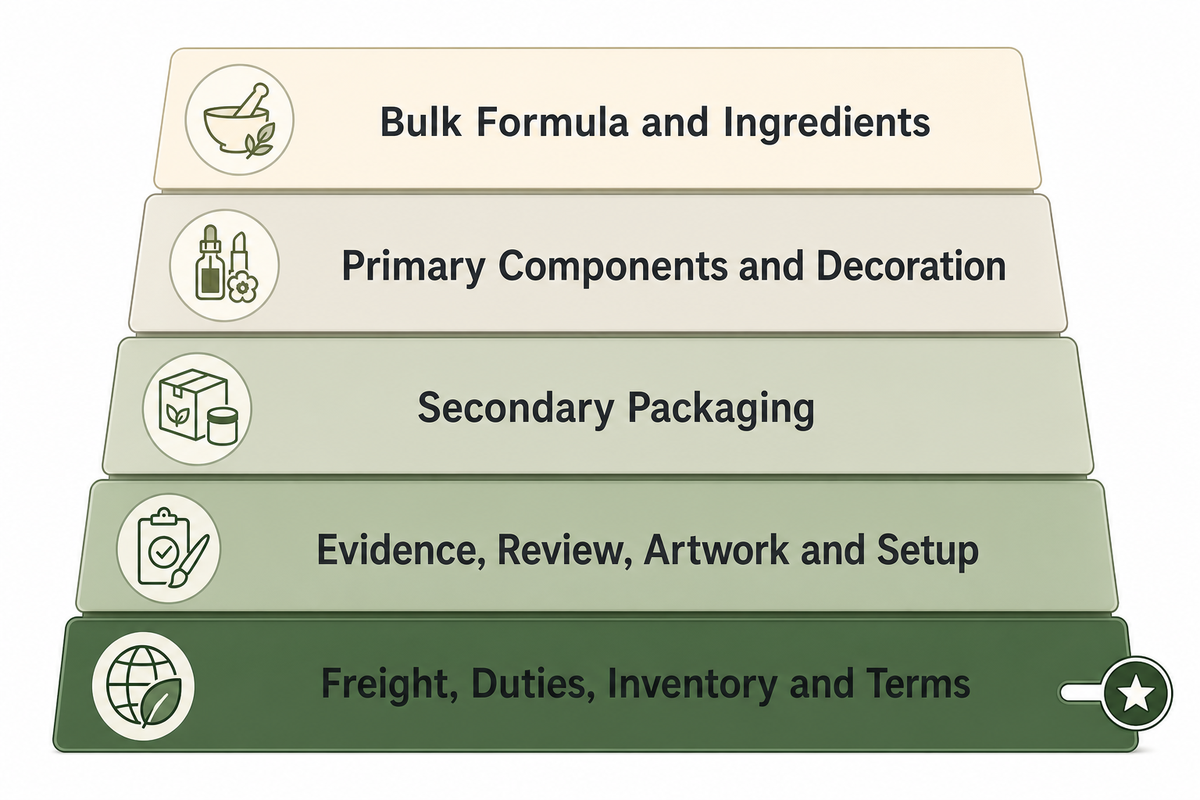
White label can reduce initial development decisions, but it is not always cheaper, faster, or available at a lower minimum. The binding constraint may come from formula batch size, an ingredient, primary packaging, decoration, secondary packaging, testing, artwork, freight, inventory, or the supplier’s commercial terms.
Quote-variable map
Total project commitment = bulk formula + ingredients + primary components + decoration + secondary packaging + evidence/review + artwork/setup + freight/duties + inventory exposure + commercial terms.
Published supplier figures diverge because they describe different equipment, components, decoration methods, service models, and scope boundaries. Contract-packaging evidence also separates a production minimum from a material or component minimum. That supports a procurement rule, not a market average: request every floor separately and identify which one sets the actual order.
Upfront product cost is only one field. Ask for minimum order quantities at every layer, then add the evidence, setup, freight, inventory, and transition commitments needed to compare like with like.
Is white label cheaper than private label?
White label can be cheaper when an existing formula, stocked component, and existing evidence packet fit the brief without extra work. It can be more expensive in total if a component minimum, decoration setup, inventory commitment, restricted transfer, or later reformulation becomes the binding cost. Compare equal scope, included evidence, and exit conditions.
Do the same with time. Ask for dependencies rather than a headline duration: brief completion, sample approval, component availability, artwork approval, evidence review, production scheduling, release documentation, and freight. This workflow does not publish a universal range or a NEXO-specific minimum, price, or lead time because the current evidence does not establish one.
White Label Fits a Bounded Market Test
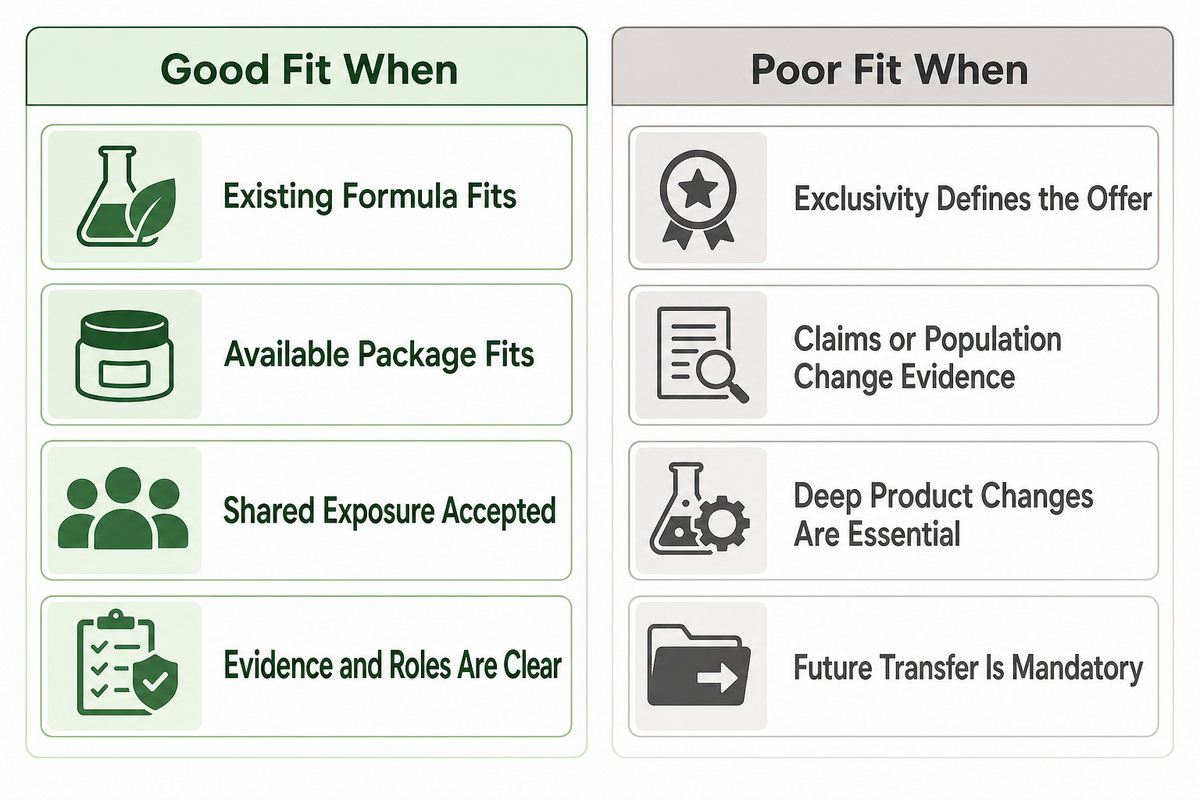
White label fits when the brand wants to test a channel, audience, category, or positioning with a defined ready-made product and accepts its written limits. That fit weakens when formula exclusivity, unusual claims, deep sensory changes, a custom primary package, or future transfer is a non-negotiable requirement.
Good fit when
- The existing formula matches the intended use.
- The available package fits the brand test.
- Shared-formula exposure is acceptable.
- The evidence and market-role packet is clear.
Poor fit when
- Formula exclusivity defines the proposition.
- A difficult claim or population changes the evidence need.
- Deep sensory or ingredient changes are essential.
- Transfer to a second manufacturer is mandatory.
Decision scenario: a new brand wants to test whether a simple moisturizer proposition earns repeat orders in one online channel. If the existing formula, package, claims, evidence, and shared-sales boundary are acceptable, white label may keep the experiment focused on demand. It does not guarantee speed or success; it limits the number of initial product decisions.
That narrower decision set may help a team market faster, but it does not create complete control or guarantee exclusive products. Those outcomes still need defined terms and evidence.
Private Label Fits a Differentiated Product Scope
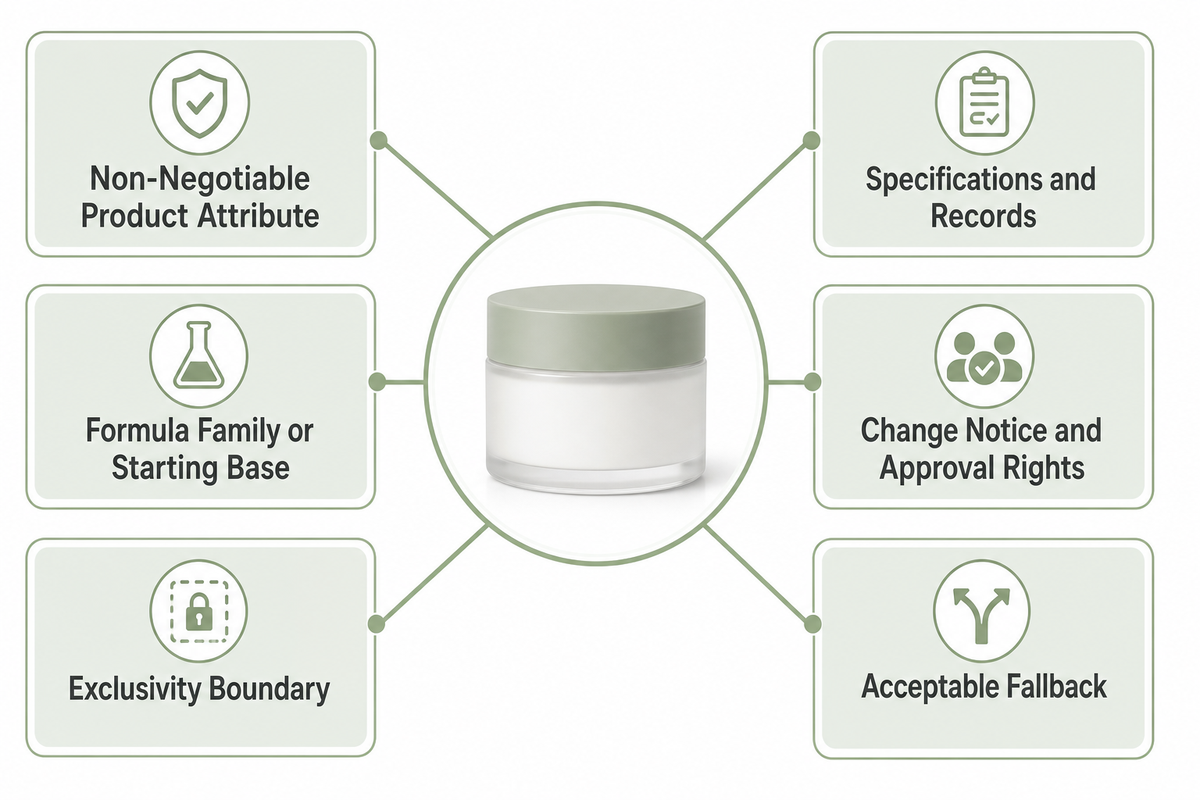
Private label fits when a brand can name the product difference that must survive quotation, approval, production, and future change. That difference might concern sensory profile, permitted ingredients, packaging, exclusivity, records, or transfer. The label itself does not guarantee uniqueness, control, margin, or a complete evidence package.
Differentiation brief
- Non-negotiable product attribute
- Permitted formula family or starting base
- Exclusivity boundary by version, market, channel, and term
- Specifications and supporting records required
- Change-notice and approval rights
- Acceptable fallback if an input or component becomes unavailable
NEXO Beauty Labs is presented in the supplied brand brief as a cosmetics development and manufacturing partner. A buyer with a defined differentiation brief can review NEXO’s private label cosmetics service scope for commercial evaluation, while this article remains the comparison and question-preparation layer.
Bring the brief, not just a route name. Discuss your cosmetic development brief
Build the 9-Field Proposal Evidence Register
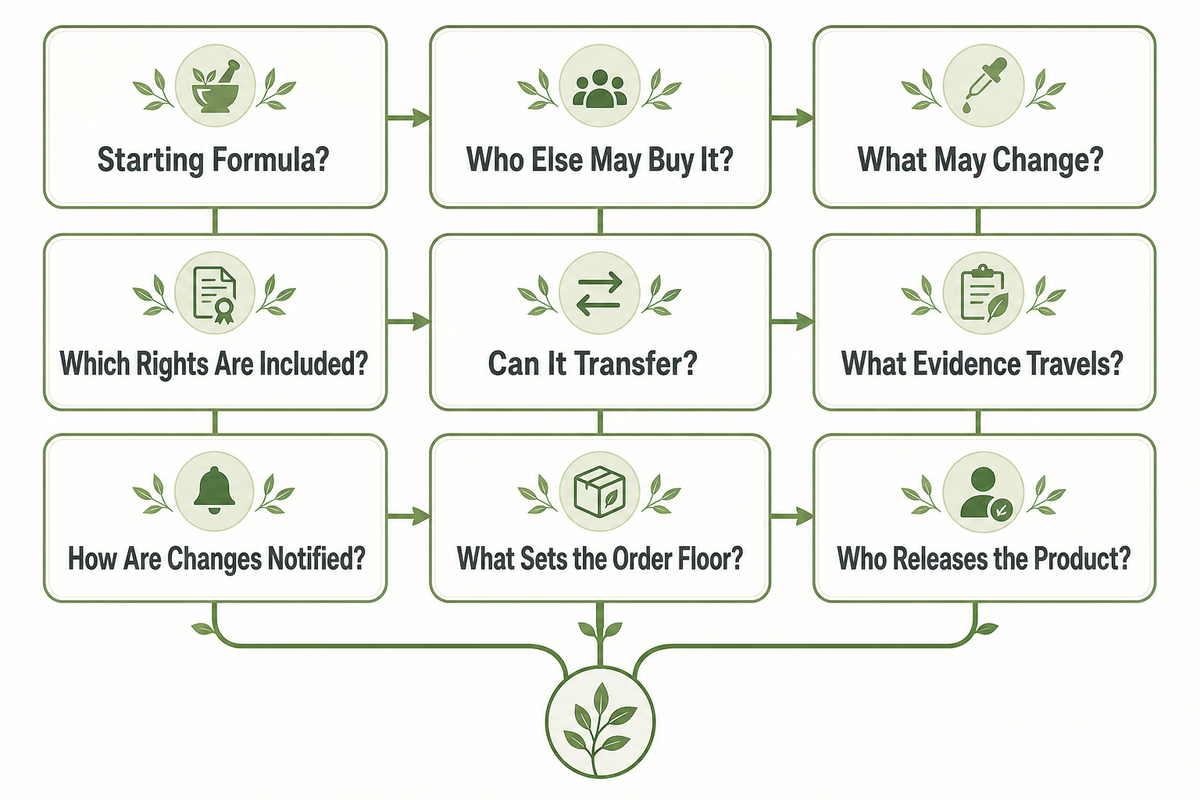
That differentiation brief becomes a register that converts every proposal statement into an answer, a source document, a contract location, a named owner, and an unresolved risk. Complete it after proposals arrive and compare suppliers only after all nine fields are answered. A polished sample or certificate logo cannot replace this evidence trail.
NEXO’s 9-Field Proposal Evidence Register is a buyer-assistance framework designed to document manufacturer answers after a proposal is in hand. It is not an industry standard or a validated assessment method, and final feasibility still requires project-specific technical, commercial, and legal review.
| Question | Answer | Evidence | Contract location | Owner | Not ready when |
|---|---|---|---|---|---|
| 1. What is the starting formula? | Name version and source | Versioned specification | Scope/exhibit | Technical | No version identifier |
| 2. Who else may buy it? | Define related sales | Sales/exclusivity statement | Exclusivity | Commercial/legal | “Exclusive” has no boundary |
| 3. What may change? | List levels and limits | Change matrix | Specifications | Technical/quality | “Custom” is undefined |
| 4. Which rights are included? | Unbundle all rights | Rights schedule | Intellectual property/confidentiality | Legal | Ownership is one word |
| 5. Can it transfer? | Name files and assistance | Transfer package index | Exit/transition | Legal/technical | Permission or records missing |
| 6. What evidence travels? | Index by product/market | Evidence dossier index | Quality/regulatory exhibit | Quality/regulatory | Only a generic certificate is shown |
| 7. How are changes notified? | Notice, impact, approval | Change-control workflow | Change clause | Supplier and brand quality | Supplier may change silently |
| 8. What sets the order floor? | List every binding layer | Quote breakdown | Commercial schedule | Procurement/finance | Only one headline minimum |
| 9. Who releases the product? | Separate statutory and operational roles | Responsibility matrix | Roles/quality agreement | Regulatory/quality | “Supplier handles compliance” |
Evidence-ready answer
- Names the formula version.
- Defines exclusivity and exceptions.
- Links each claim to a record.
- Names change and release owners.
Assumption-only answer
- Repeats “custom” or “exclusive.”
- Shows an unrelated certificate logo.
- Quotes one minimum without components.
- Says the supplier “handles everything.”
Frequently Asked Questions
The best route depends on the brand’s learning goal, required differentiation, unacceptable risks, and the evidence available for the actual product and market. These concise answers preserve the same rule used throughout the guide: compare written scope and records before comparing a route name, sample, price, or timeline.
Which is better, white label or private label?
White label is better for a bounded test when the ready-made offer and its limits are acceptable. Private label is better when a defined product difference justifies more decisions. Neither is automatically superior; use the nine contract checks against the launch goal, the evidence supplied, and the risks the brand cannot accept.
Is private label the same as white label?
Suppliers use the terms inconsistently. One may use white label for a shared stock product and private label for a modified offer, while another draws the line elsewhere. Confirm formula source, permitted changes, related-formula sales, exclusivity, rights, records, evidence, change notice, transfer, minimum-order layers, and release ownership in writing before comparing quotations.
Can I start with white label and switch to private label later?
Yes, if the first contract, records, brand assets, and future development plan leave room for the change. Treat the move as a new scope decision, because formula, package, evidence, rights, minimums, release responsibilities, supplier access, and transfer permissions may change materially. Confirm the exit package before approving the first order.
What should a cosmetics manufacturing agreement say about formula ownership?
Identify the exact formula and version, each contributor or rights holder where relevant, and any applicable patent or trade-secret interests. Separate know-how access from ownership of specifications, methods, samples, test reports, safety records, and change history. Define licensing, territory, channel, term, related-formula sales, exclusivity exceptions, permitted disclosures, subcontractor access, change notice, evidence access, exit support, and transfer assistance. State what happens if an ingredient, component, supplier, process, or law changes, and who pays for the resulting review. Also name the format and delivery date for each record, the assistance owed during a transfer, the treatment of unused packaging and inventory, and the decisions that survive termination. Qualified counsel should review the agreement in the relevant jurisdiction.
References & Sources
Primary regulatory sources carry the legal and safety boundaries in this article. Commercial sources informed terminology variance and procurement questions but do not appear here as authorities. No cited source establishes NEXO-specific certification, capacity, minimum-order, price, lead-time, testing-performance, customer, or outcome claims.
- U.S. Food and Drug Administration — FDA Authority Over Cosmetics
- U.S. Food and Drug Administration — Modernization of Cosmetics Regulation Act
- U.S. Food and Drug Administration — Product Testing of Cosmetics
- Electronic Code of Federal Regulations — 21 CFR 207.1
- European Commission — Cosmetics Legislation
- United States Patent and Trademark Office — MPEP 301, Ownership and Assignment
Turn the route name into a reviewable brief
Bring the product difference, destination market, package, evidence questions, and rights boundary you need.