Get in touch with NEXO Beauty Labs Company

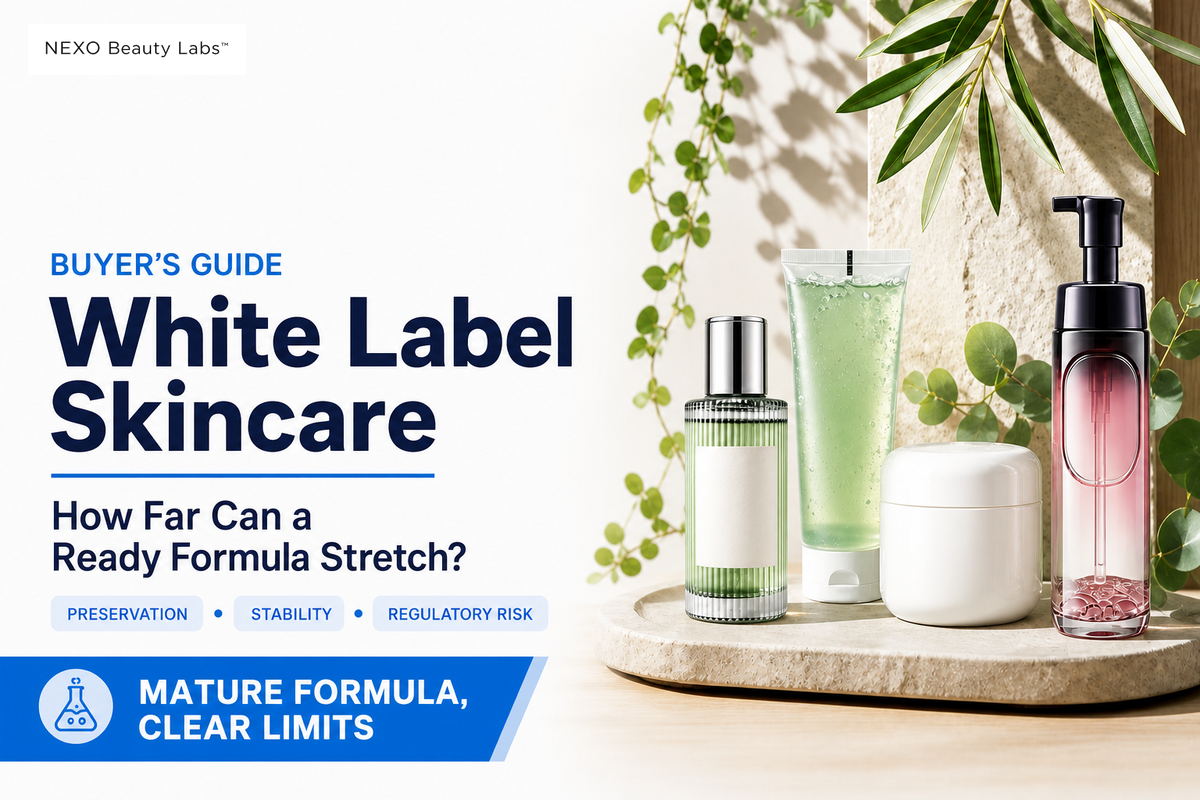
White label skincare is a manufacturing route where a brand takes a formula the manufacturer has already built, tested, and often sold under other brands, and layers its own product, ingredient, and packaging decisions on top of it. The part most buyer guides skip is that “starting from a ready formula” doesn’t mean every change you want to make is free. Some requests barely touch the underlying chemistry. Others quietly reopen preservation testing, stability testing, or even push the product into a different regulatory category entirely. This guide walks through which is which, using the formulation-chemistry mechanics that decide the answer rather than the marketing language a supplier uses to describe their service.
A mature skincare formula is validated as one combination of formula, packaging, and water content, not as an ingredient list in isolation. Preservation testing under a method like ISO 11930 is commonly carried out on the product in its marketed packaging, not on the formula alone. Changing the fragrance, the water ratio, or switching to a different pack can each independently reopen that validation, and adding certain active ingredients can move a product out of “cosmetic” and into FDA-regulated drug territory altogether.
In This Guide
- Preservation is tested as a formula+pack+water system, not a formula alone, and the standard’s own stated scope is written around testing the product in its packaging.
- A 3-month accelerated stability test is a guideline, not proof of a 2-year shelf life, and for a pure cosmetic, the US doesn’t legally require any shelf-life testing at all.
- Adding one active ingredient can turn a cosmetic into an FDA-regulated drug, depending on the claim attached to it.
- Opaque packaging blocks light but doesn’t block oxygen, two separate problems that vendor pages routinely treat as one.
- This guide is written for brand and product-development teams evaluating a mature-formula route, not for resellers shopping a zero-minimum marketplace.
Quick Specs
| What “white label” means here | Taking a formula the manufacturer has already built and validated, then customizing product, ingredient, texture, packaging, and branding choices on top of it |
| Development routes it sits alongside | Private Label Solutions, Custom ODM Development, Reference Sample Development, Contract Manufacturing |
| 3 systems a requested change can break | Preservation efficacy, physical/chemical stability, cosmetic-vs-drug claim classification |
| Written for | Brand and product-development teams evaluating a mature-formula route before requesting a quote |
| Not written for | Dropshippers or resellers looking for a zero-minimum-order marketplace listing |
What “White Label” Actually Promises, and What It Doesn’t
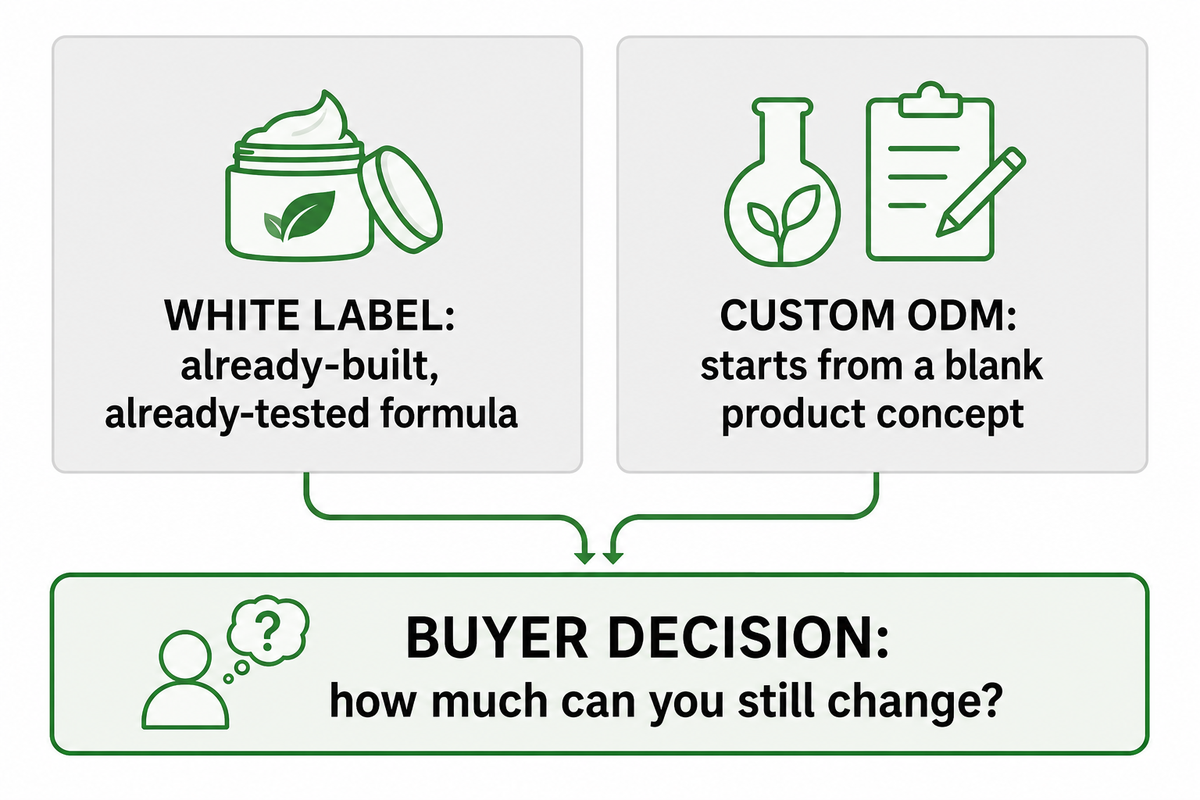
White label skincare means starting from an already-built, already-tested formula and layering on your own product, ingredient, texture, packaging, and branding choices, instead of developing a new formula from scratch. That’s different from Custom ODM development, which starts from a blank product concept.
White label skincare, more specifically, means starting from a formula the manufacturer has already built and tested, then layering on the specific product, ingredient, texture, packaging, and branding decisions a brand wants, as opposed to Custom ODM development, which starts from a broader product concept with the formula work itself still ahead of you. The distinction sounds academic until you’re the one deciding which route to brief for a new skincare brand, and a private label skin care manufacturer offering skin care products under both routes will describe the trade-offs differently depending on which one it’s steering you toward.
The two terms get used loosely across the industry, and “white label” versus “private label” versus “OEM” versus “ODM” is its own rabbit hole, this piece deliberately doesn’t re-litigate that comparison; NEXO Beauty Labs has already published a dedicated Private Label vs White Label Cosmetics comparison that walks through the full terminology breakdown. What matters for this guide is narrower and more useful: once you’ve picked the white label skincare manufacturing route because you have an established formula category to start from, how much can you actually still change before you’ve quietly stepped into a different route?
That question also doesn’t reduce neatly to “which skincare category” — a cleanser, a moisturizer, and a serum can each sit anywhere on the stretch spectrum depending on the specific change requested, not the product type alone. (NEXO’s own six skincare categories program covers the category breadth question if that’s what you’re mapping first.)
The Real Question Isn’t “White Label or Not” — It’s How Far the Base Formula Can Stretch
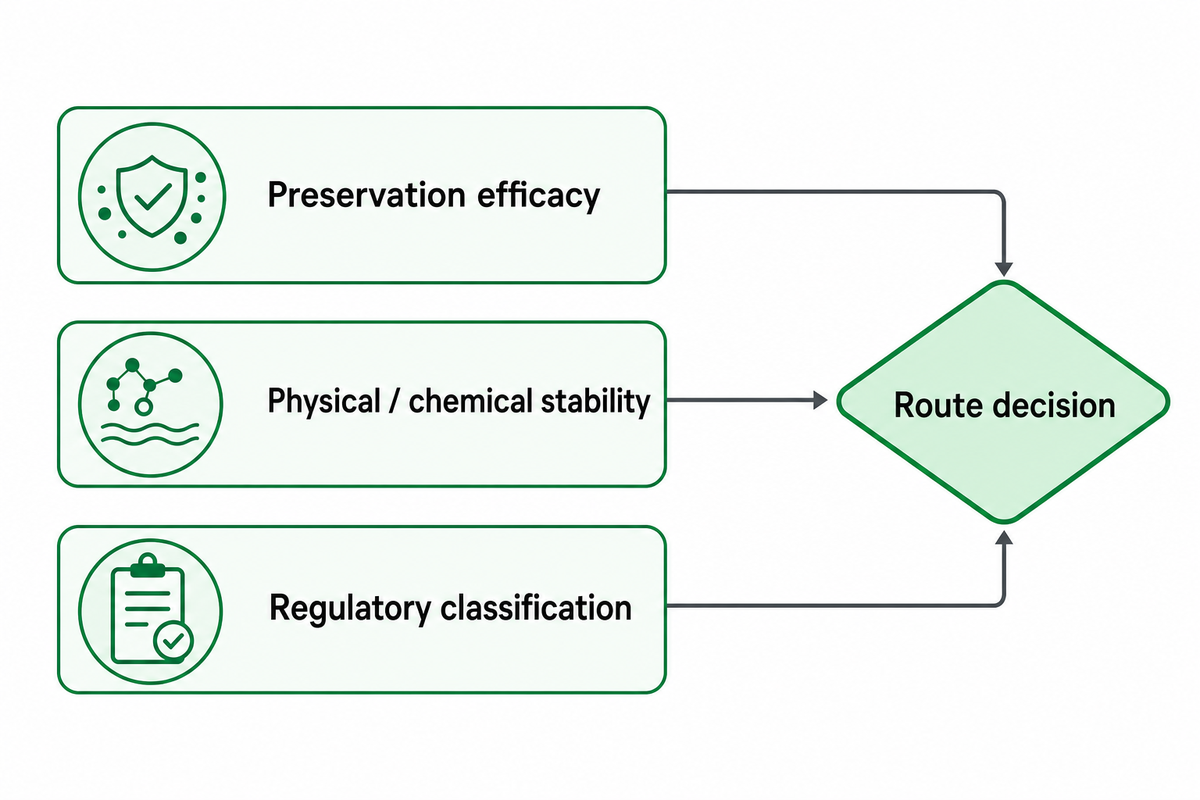
On a real production floor, a mature-formula program still runs on fixed internal timelines confirmed per project in writing, but those timelines only hold if the requested changes stay inside the original validation. Two suppliers can give a brand completely different answers to “can I change this?” because the real constraint was never the route label. It’s how far this specific mature formula can absorb the requested change before something breaks. “White label” and “private label” both start from an existing formula base; what actually varies, brief to brief, is which of three underlying systems a given change touches: preservation efficacy, physical/chemical stability, or regulatory classification. A request that looks cosmetic on paper — “just add this one ingredient” — can land on any of the three, and the answer depends on formulation chemistry, not on which label the supplier put on the service. If you want a general how-it-works walkthrough of the white label process end to end, NEXO’s White Label Cosmetics guide covers the step-by-step handoff sequence; this piece goes one level deeper, into what determines whether a specific requested change stays inside that process or forces it into a different one.
Preservation Is Validated as a System, Not Just a Formula
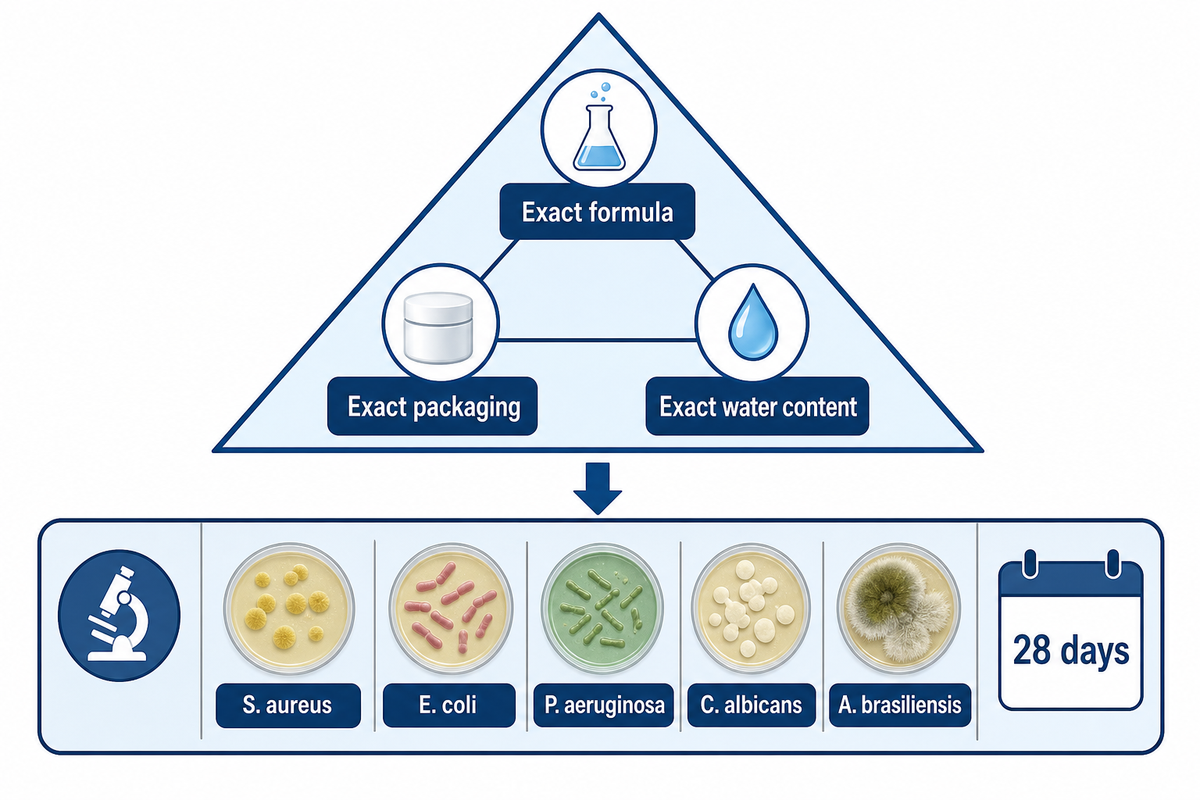
Preservation efficacy is tested and approved for one specific combination: the exact formula, exact packaging, and exact water content together. It is not tested for the formula in isolation. The most widely used international method, ISO 11930, evaluates a cosmetic’s antimicrobial protection by inoculating the product with five reference microorganisms (S. aureus, E. coli, P. aeruginosa, C. albicans, and A. brasiliensis) at defined concentrations and measuring reductions over 28 days against defined acceptance criteria. Related preservative-efficacy methods, such as USP procedures, may check log reduction at Day 14 and confirm stability again at Day 28. This kind of challenge test is commonly carried out on the product stored in its marketed packaging, not on a bulk sample in a lab beaker.
That single detail is why “we only changed the packaging, not the formula” is not automatically a safe sentence. Preservative systems interact with pack material, headspace, and the amount of air that re-enters every time a container is opened. Even a change that looks purely cosmetic to a brand can shift the microbial-exposure profile behind the original challenge test. This is not an automatic retest-everything rule either. In practice, preservation testing, packaging compatibility, and finished-product stability are treated as related but distinct assessments: an established formulation-and-pack combination with a strong track record is often assessed rather than fully retested, while a genuinely novel packaging pairing usually needs a fresh review. Under EU Regulation 1223/2009 Annex I, a Cosmetic Product Safety Report documents composition, physicochemical characteristics, stability under foreseeable storage, microbiological specifications, and packaging-material characteristics. An active-ingredient change can therefore touch several defined evidence categories even when the base formula is technically “the same.”
| Requested change | Preservation re-validation risk |
|---|---|
| Same packaging, same formula, new label graphics only | Low — no formula/pack/water change |
| Remove parabens for a “clean” claim | High — preservative system replaced |
| Change fragrance | Medium — some fragrance compounds carry antimicrobial load |
| Switch to a novel packaging format (new pack, new supplier) | Medium-High — new headspace/air-exposure profile |
| Switch between two packaging suppliers with equivalent, documented barrier properties | Low — a documented track record commonly substitutes for fresh testing in practice |
Adding or Swapping an Active Ingredient Without Starting Over
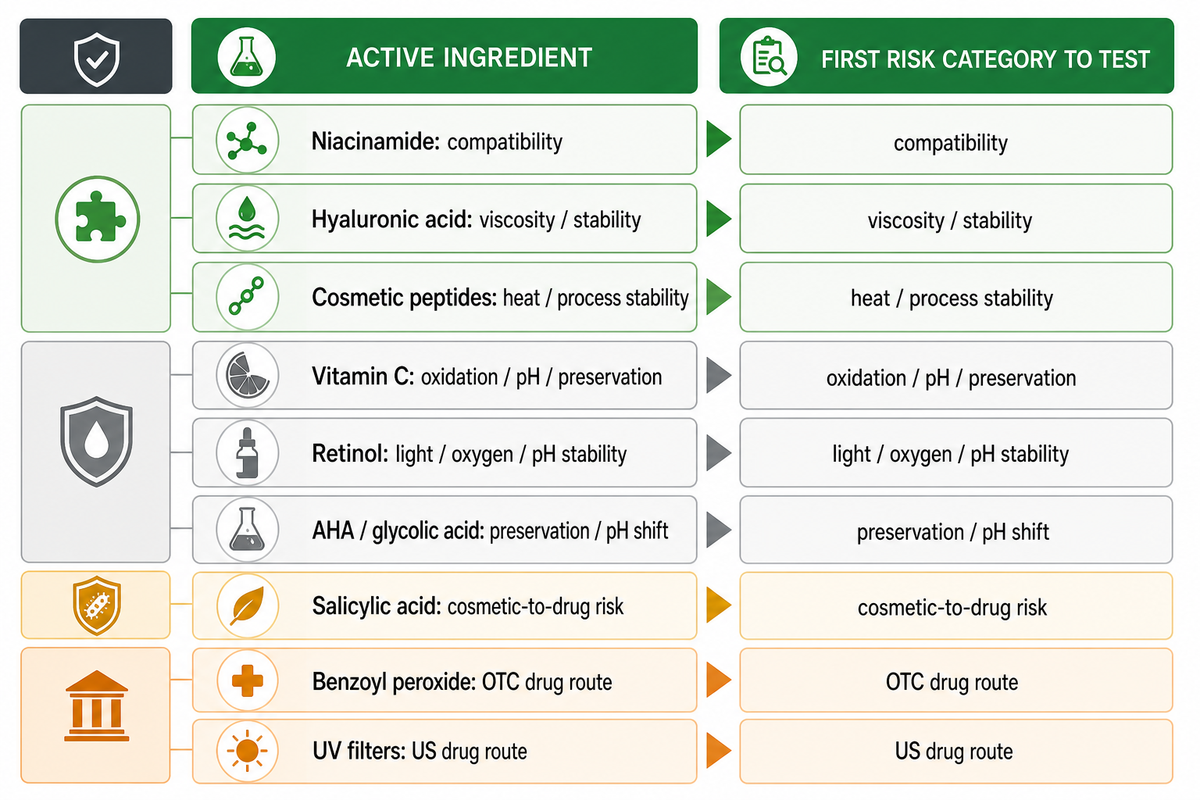
Whether adding an active ingredient stays inside white label depends on the risk it introduces, from compatibility and stability concerns to full regulatory reclassification. One published formulation study reported adding alpha-hydroxy acids (lactic or glycolic acid) to an aqueous cream. The study ran several freeze-thaw cycles across a range spanning roughly -4°C to 40°C and found that the acid addition significantly reduced preservative levels. It also reported that parabens avoided hydrolysis only after the acid was partially neutralized above roughly pH 3.5. The example is a qualified illustration of how a seemingly simple “add an exfoliating acid” request can become a preservation-chemistry problem.
The more severe version of this risk is regulatory rather than chemical. Under the FDA’s cosmetic-versus-drug framework, intended use, therapeutic claims, or an ingredient with a well-known therapeutic use can make a product a drug or a cosmetic-drug combination. FDA gives examples such as anti-acne products and moisturizers marketed with SPF claims. Products in that category generally must meet the applicable drug requirements, including premarket approval or conformity with an applicable OTC monograph; the exact path depends on the claim and formulation. That is a materially different route from a cosmetic formula adjustment. Consider a Vitamin C serum picking up an additional antioxidant blend versus a cleanser gaining a stated salicylic-acid acne claim — both can sound like “just adding an active” in a brief, but only one of them is likely to stay a cosmetic-route conversation.
| Active ingredient | Primary risk category | Typical outcome | Limitations / Not suitable for |
|---|---|---|---|
| Niacinamide (moderate %) | Compatibility | Often stays white label | Not suitable if the base is already stabilized around low-pH Vitamin C |
| Hyaluronic acid | Viscosity / stability | Often stays white label | Not suitable if it shifts texture beyond the target spec |
| Cosmetic peptides (no drug claim) | Heat/process stability | Often stays white label with a re-check | Not suitable for high-temperature processing steps |
| Vitamin C (L-ascorbic acid) | Oxidation / pH / preservation | Formula adaptation likely | Not suitable without airless or opaque packaging paired to it |
| Retinol / retinoid | Light / oxygen / pH stability | Formula adaptation likely | Not suitable in clear, non-airless packaging |
| AHA/glycolic acid (exfoliant claim) | Preservation (pH shift) | Formula adaptation / custom | Not suitable without a re-run preservation challenge test |
| Salicylic acid at an acne-treatment concentration | Regulatory (cosmetic-to-drug) | Custom / OTC-monograph route required | Not suitable as a simple formula “add” |
| Benzoyl peroxide | Regulatory (OTC drug) | Custom / OTC-monograph route required | Not suitable as a simple formula “add” |
| UV filters (SPF claim) | Regulatory (drug in the US) | Custom / OTC-monograph route required | Not suitable as a simple formula “add” |
What Stability Testing Actually Proves (and Where the “3-Month = 2-Year” Shortcut Breaks)
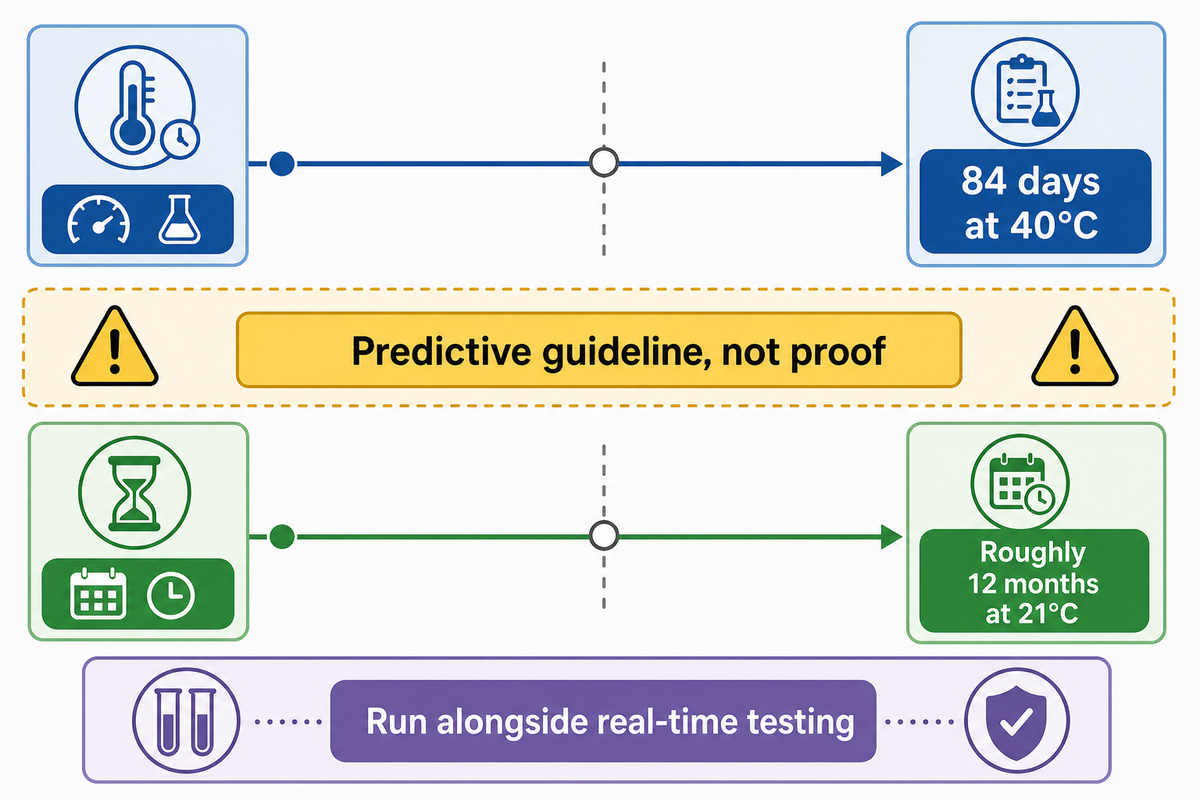
An accelerated stability test estimates shelf life; it doesn’t prove it. Industry shorthand treats 84 days at 40°C as roughly equivalent to 12 months at room temperature, but for an ordinary cosmetic in the US, running that test isn’t even a legal requirement.
An accelerated stability test run at roughly 40°C and 75% relative humidity, evaluated at 3 months and again at 6 months, is treated in the industry as a general guideline rather than scientific proof. Industry shorthand commonly treats 84 days (12 weeks) at 40°C as roughly equivalent to 12 months at an ambient 21°C. The degradation rate is generally understood to roughly double to triple for every 10°C increase, but that relationship is not a universal shelf-life equation. For an ordinary cosmetic in the US, there is no legal requirement to run this test. FDA does not mandate shelf-life or expiration testing for cosmetics the way it does for drugs, which must undergo regulated stability testing and carry a supported expiration date. Once an added active pushes a product into cosmetic-drug territory, stability testing can become a regulatory obligation.
Cosmetic chemist Perry Romanowski has described accelerated testing’s predictive power bluntly: in his view it is “not an exact science,” and a formula holding up under accelerated conditions for several weeks functions as a general guideline rather than a guarantee.
That lines up with a broader pattern in the published literature, there’s very little generally-applicable research supporting any single accelerated method as a universal shelf-life predictor, and pushing a formulation harder than it will ever realistically encounter can just as easily produce a false failure as a true one. The safeguard the industry actually relies on is running accelerated testing alongside real-time testing, never as a standalone substitute for it.
Packaging Is Part of the Formula’s Stability System, Not Just Branding
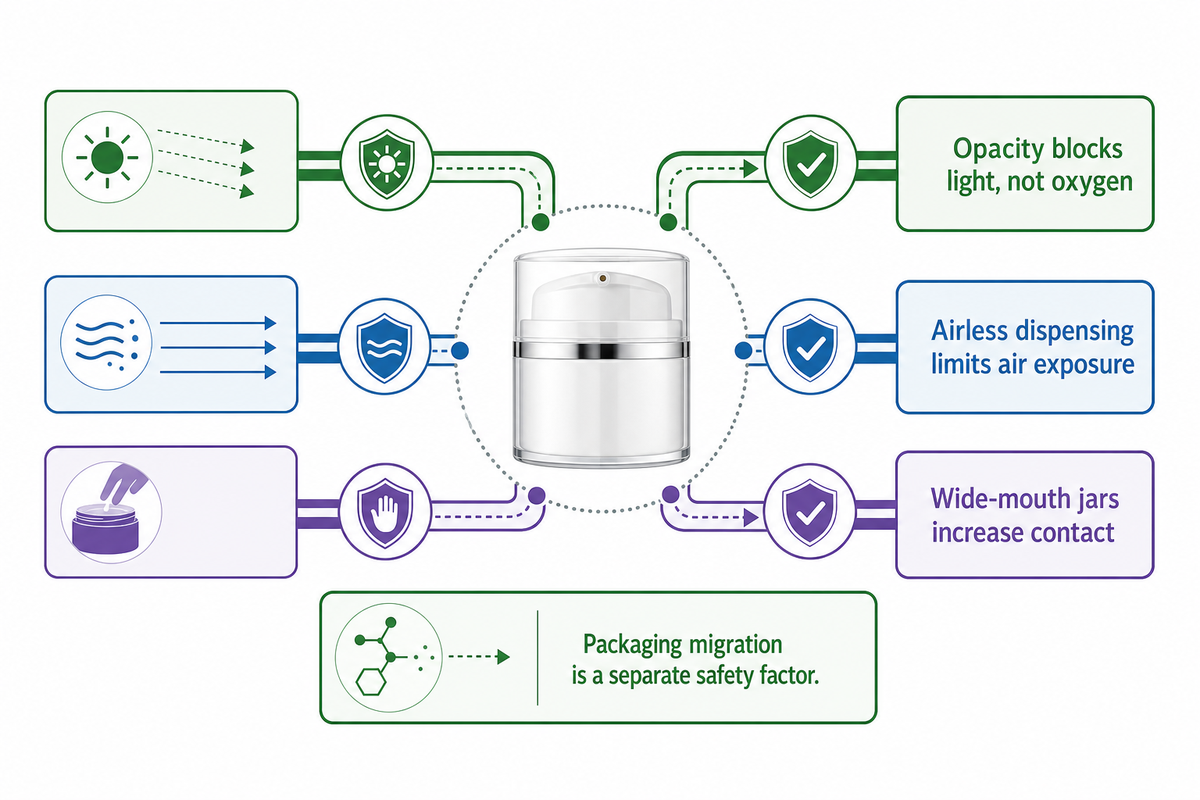
Stability testing tells you how the formula itself holds up; it says less about the container it ships in. Packaging changes can move an actives-heavy formula’s stability just as much as an ingredient change. The mechanism most vendor pages skip is that opacity and oxygen exposure are two separate problems. Vitamin C and retinol degrade largely through oxidation — a chain reaction that accelerates over time rather than proceeding at a steady rate — and that reaction is driven by light exposure, warmer storage conditions, and repeated air contact every time a container is opened. Amber glass is often reported to block roughly 99% of UV light, but that figure is product- and test-dependent. Blocking light does nothing to stop oxygen from re-entering the container; an airless dispensing mechanism, not opacity alone, is what limits that exposure.
Format matters independently of the active ingredients. Wide-mouth cleanser jars that get finger contact on every use have a different microbial- and air-exposure profile from a leave-on serum dispensed from a sealed dropper or pump. Packaging-material migration, meaning trace substances moving from the pack into the formula, is a separate safety-assessment factor under EU cosmetic guidance, beyond the light, oxygen, and microbial questions above.
up to ~99%
UV blocked by amber glass (reported estimate)
28 days
ISO 11930 challenge-test window
15 business days
FDA adverse-event reporting window
The Mature-Formula Stretch Test
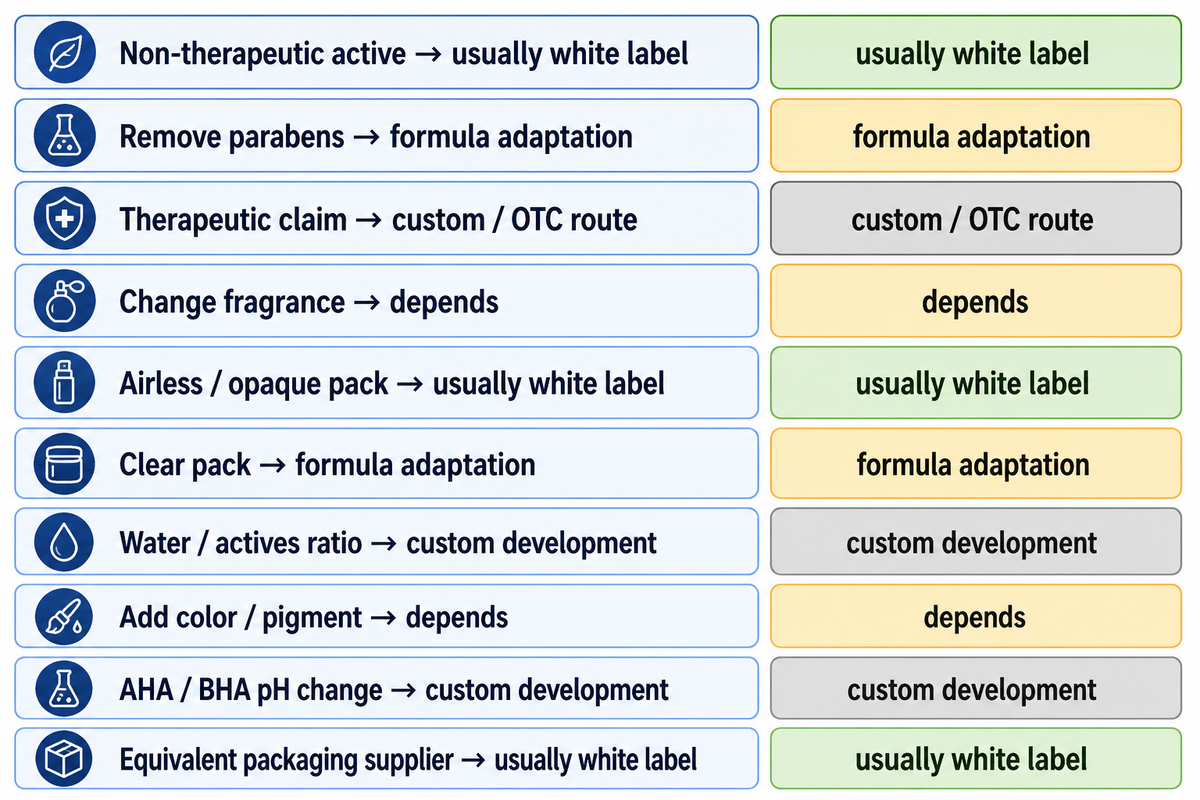
Preservation, active ingredients, and packaging each set their own breaking point, and the Mature-Formula Stretch Test below combines those three sections into a single reference lookup. Find the closest match to whatever problem you’re encountering and check typical breakdown points, whether the breakdown stays within white label, and where it routes to if it doesn’t.
| Change request | What breaks first | Still white label? | Typical route if not |
|---|---|---|---|
| Add a non-therapeutic active (e.g. hyaluronic acid) | Rarely breaks anything | Usually yes | — |
| Remove parabens / “clean” reformulation | Preservation efficacy | Depends on replacement system | Formula adaptation |
| Add an active with a therapeutic claim (SPF, anti-acne) | Regulatory classification | No | Custom / OTC-monograph development |
| Change fragrance | Preservation system (fragrance can carry antimicrobial load) | Depends | Formula adaptation |
| Switch a light-sensitive active to airless/opaque packaging | Usually improves stability | Yes | — |
| Switch a light-sensitive active to clear packaging | Physical/chemical stability | Depends | Formula adaptation |
| Change the water/actives ratio | Preservation + stability (microbial risk profile changes) | No | Custom development |
| Add color/pigment | Photostability / staining | Depends | Formula adaptation |
| Add an AHA/BHA to adjust pH | Preservative efficacy | No | Custom development |
| Swap packaging supplier, equivalent barrier properties | Rarely breaks anything | Usually yes | — |
Key takeaway: the Stretch Test rows that say “No” all share the same pattern — they change the water/actives/pH chemistry the original preservation validation was built around, or they attach a therapeutic claim. Everything else is a negotiation about degree, not a hard boundary.
Claims and Regulatory Responsibility Don’t Move With the Formula
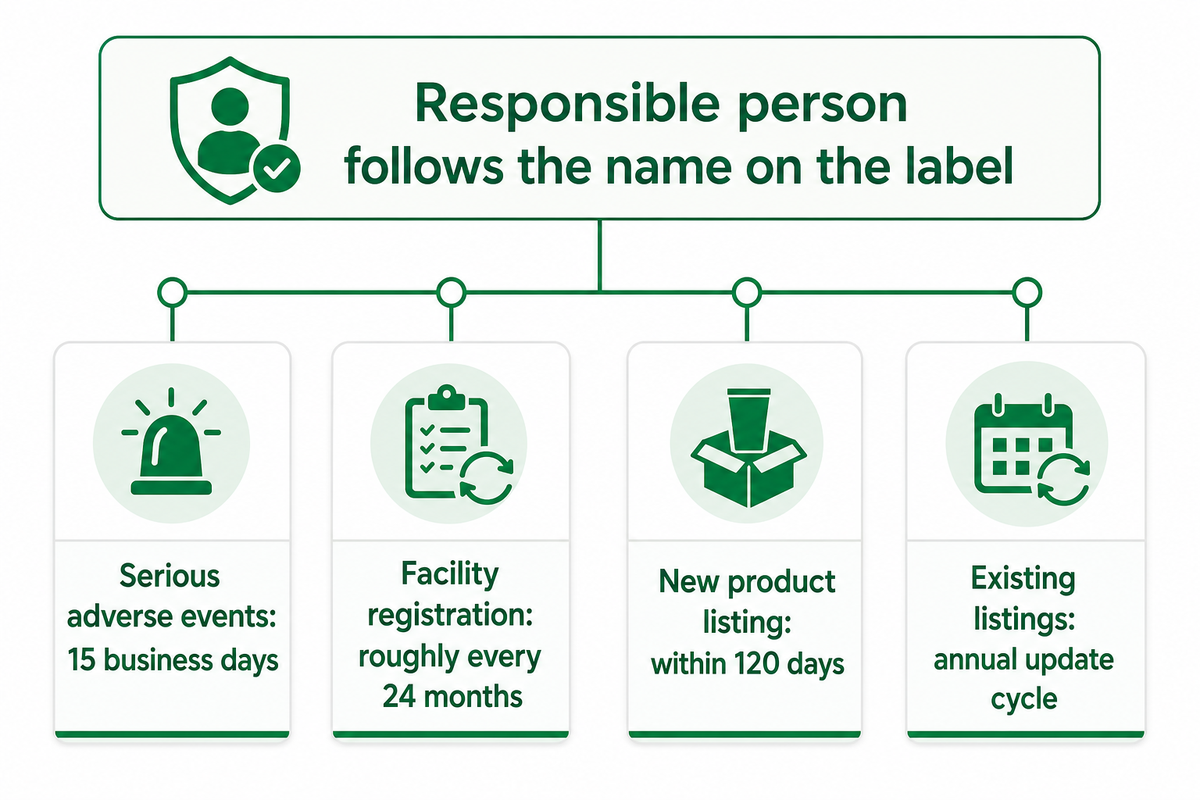
The Stretch Test rows that turn into a custom project all involve a therapeutic claim or a shift in core chemistry. That reclassification carries its own paperwork trail. Customizing a formula does not shift who is legally responsible for the product’s safety and label claims. That duty stays with whoever is named as the responsible person on the label, regardless of how much of the formula they personally developed. Under the Modernization of Cosmetics Regulation Act (MoCRA), the responsible person is the manufacturer, packer, or distributor whose name appears on the product label. That party must maintain safety-substantiation records and report serious adverse events to FDA within 15 business days of becoming aware of them. Facility registrations also require biennial renewal, due roughly every 24 months from the initial registration date. Newly marketed products have to be listed with FDA within 120 days of first marketing, while existing listings are otherwise updated on an annual cycle to reflect changes such as a new formula version. In practice, a formula tweak is not just a production-line decision; it can trigger a compliance-paperwork deadline.
When a “White Label” Request Has Actually Become a Custom Project
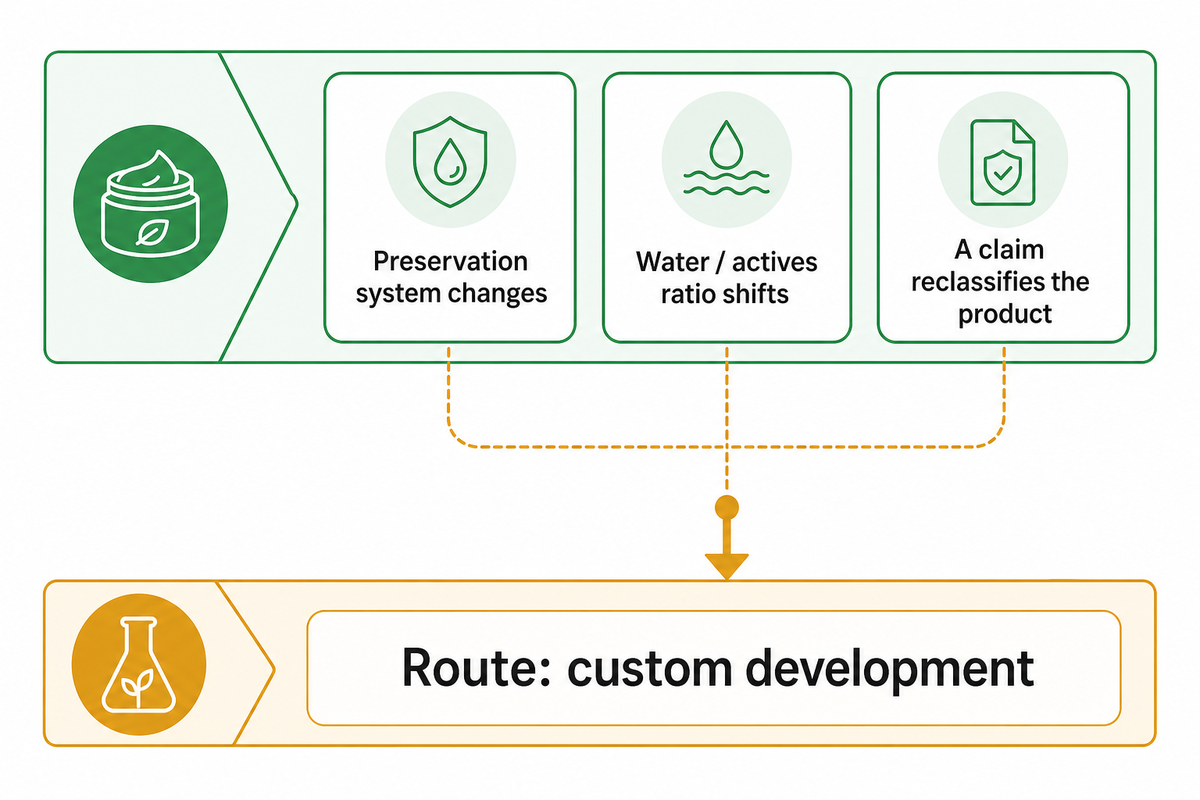
A white label request becomes a custom project once a change touches the preservation system, shifts the water-to-actives ratio, or attaches a claim that reclassifies the product. Past that point, calling it “just a tweak” only delays a conversation you’ll eventually have to have.
A white label request has crossed into custom-development territory once the changes on the table touch the preservation system, shift the water/actives ratio, or attach a claim that reclassifies the product. At that point, continuing to call it “just a tweak” mostly delays the conversation you were always going to need to have. NEXO’s own custom ODM skincare development route exists for briefs that start from a product concept rather than an existing formula. Its route-selection framework follows the same signal: match the route to the assets you actually have, not to which label sounds more premium.
When NOT to Use White Label Skincare
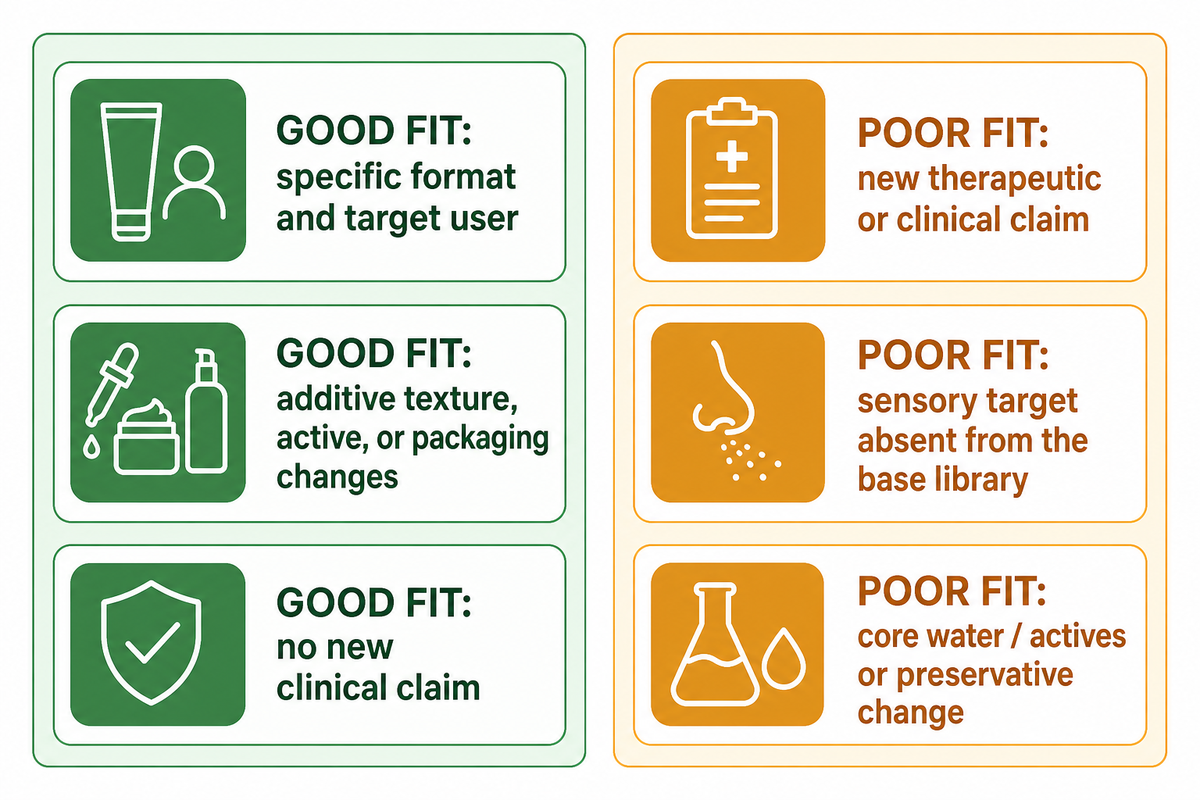
White label skincare is a poor fit when a brief needs a new clinical claim, a truly novel texture no existing formula matches, or a full reformulation for allergen sensitivities. Recognizing that before ordering samples saves a wasted sampling round.
Some briefs are a poor fit for a mature-formula route from the outset, and recognizing that before requesting samples saves a sampling round most brands would rather skip. Claim-dependent products that need new clinical substantiation for a specific efficacy claim rarely start from an existing base; the claim itself usually has to be built and tested from the ground up. A highly bespoke sensory target, such as an unusual texture or finish that no existing base in the supplier’s library approaches, tends to force a custom-development conversation. A customer base with known allergen sensitivities that requires a full reformulation, rather than a substitution of one or two ingredients, is a different scope of work from a white label brief.
One more honest note on fit: this guide is written for brand and product-development teams weighing a mature-formula route pre-RFQ, not for dropshippers or resellers evaluating a zero-minimum-order marketplace listing, which is a different buying decision with a different set of tradeoffs entirely.
It’s worth naming where that fits in the wider landscape. New brands scanning private label skincare manufacturer directories or comparing skincare manufacturers in the USA with overseas options will encounter different business models. Some private label partners offer a low minimum order and work from pre-formulated skincare; they may align with your brand through label design, custom labels and packaging, and light reformulation. Others build a full private label skincare formula from a brief, with quality control, quality standards, and R&D depth reflected in their work for established brands. The products are made to different briefs, but the preservation, stability, and regulatory-classification checks still apply once a formula, water ratio, or package changes.
Terminology also varies across manufacturer sites. “White label skin care,” “private label skin care products,” and “label skin care products” are often used interchangeably, and some sites lean on brand name recognition or advertise themselves among the top skincare companies rather than describing what’s actually included. Others use white label products, label products, or private label manufacturer support as near-synonyms. None of that vocabulary changes the underlying chemistry: teams may want products under your own brand, to reflect your brand identity, or to bring your brand to life while building your brand, and those marketing goals do not make a formula novel. Whether you need to create unique products, compare skincare options and skincare solutions, or launch a skincare line, the same chemistry questions apply. Effective skincare, natural skin care, natural skincare, and label natural skin care all still depend on preservation, stability, and regulatory classification. Organic ingredients and natural and organic skincare can be part of that brief, but they do not remove the need for testing. This guide’s scope also stops short of the dropshipping and minimum order quantities comparisons that come up when brands shop white label organic products or skincare products formulated for sensitive skin across low-commitment catalog sites — MOQs and profit margins are a real evaluation axis for that buying decision, just not the one this guide answers.
Good fit for white label
- You can name the specific product format and target user before the call
- Your requested changes are additive (texture, non-therapeutic actives, packaging) rather than structural
- You don’t need a new clinical claim substantiated
Poor fit for white label
- The product needs a new therapeutic or clinical claim
- The sensory target doesn’t exist in any base formula you’ve been shown
- You’re requesting a change to the water/actives ratio or core preservative system
📐 Engineering Note
If a preservation challenge test must be rerun, budget for the full protocol. ISO 11930’s stated scope covers testing the product in its final retail packaging; a 28-day post-inoculation timeline with Day 7, Day 14, and Day 28 checkpoints is commonly described, but exact schedules and acceptance criteria are protocol- and laboratory-dependent.
Frequently Asked Questions
Q: What is white label skincare, and how is it different from private label or custom formulation?
White label skincare takes a formula the manufacturer has already built and tested, then customizes the product, ingredient, texture, packaging, and branding decisions on top of it, without starting formula development from scratch.
Custom formulation (or Custom ODM development) starts from a broader product concept, with concept development, ingredient selection, and sensory optimization still ahead. Private label sits close to white label in most industry usage, but it can imply more room for ingredient or texture customization depending on the supplier. The labels themselves are not standardized, so the safer approach is to compare what is actually included rather than the term used. For the full route-by-route comparison, see NEXO’s dedicated Private Label vs White Label Cosmetics guide.
Q: Can I customize a white label skincare formula, or do I have to use it exactly as-is?
Most mature formulas can absorb some customization, including texture tweaks, non-therapeutic actives, and fragrance changes. How much they can absorb depends on whether the specific change touches preservation, stability, or regulatory classification.
Low-risk changes, such as packaging label graphics or minor texture adjustments within the same base chemistry, rarely require re-testing. Higher-risk changes, including removal of the preservative system, a shift in the water/actives ratio, or a therapeutic-claim ingredient, typically do. Some changes tip the project into a custom-development route entirely. The Mature-Formula Stretch Test table above maps the most common requests to their typical outcome.
Q: What happens to the preservative system if I ask for a fragrance-free or “clean” version of an existing formula?
Removing parabens or other preservatives for a “clean” claim replaces the preservative system entirely, which generally requires a fresh preservation-efficacy challenge test on the new formula-and-pack combination.
Preservation efficacy is validated for one specific system. Swapping the preservative technology, even while keeping every other ingredient the same, changes what is tested during that fresh challenge test. Fragrance changes carry a smaller version of the same risk because some fragrance compounds contribute antimicrobial load to a formula’s overall preservation profile.
Q: Does a 3-month accelerated stability test really prove a 2-year shelf life?
No, accelerated stability testing is treated industry-wide as a predictive guideline, not proof, and it is meant to be paired with real-time stability testing rather than used as a standalone claim basis.
Industry shorthand commonly treats 84 days at 40°C as roughly equivalent to 12 months at ambient temperature, but this ratio is a widely repeated rule of thumb, not a figure written into any single mandatory standard. ISO’s own technical report on cosmetic stability testing states that it does not aim to specify the conditions, parameters, or criteria of stability testing. There is very little generally applicable published research validating any single accelerated protocol as a universal shelf-life predictor across formulation types, and cosmetic chemist Perry Romanowski has described the practice directly as “not an exact science.” For a pure cosmetic in the US, there is also no FDA mandate to run stability testing; that obligation applies specifically to drug products.
Q: Can I add my own active ingredient to an existing base formula?
Yes for most non-therapeutic actives, subject to a compatibility and stability check, but an active carrying a therapeutic claim, like an SPF or acne-treatment ingredient, can move the product into FDA drug territory instead.
The active-ingredient table earlier in this guide breaks down which common additions (niacinamide, hyaluronic acid, Vitamin C, retinol, salicylic acid, UV filters) typically stay a cosmetic conversation versus which ones typically don’t.
Q: Does packaging affect the shelf life of a private label or white label skincare product?
Yes, packaging controls light and oxygen exposure, both of which drive degradation of light- and air-sensitive actives like Vitamin C and retinol independently of the base formula itself.
Opaque packaging blocks light but not oxygen; only an airless or tightly sealed dispensing mechanism addresses the air-exposure side. A wide-mouth jar and a sealed pump also carry different use-phase contamination risk, separate from the light/oxygen question.
Q: At what point does a “white label” request actually become a custom development project?
Once the requested changes touch the preservation system, shift the water-to-actives ratio, or attach a claim that reclassifies the product, the project has effectively become a custom-development brief regardless of what it’s called.
Recognizing the tipping point earlier avoids briefing a mature-formula route for a project that was always going to need custom formulation work, which typically wastes a sampling round before the reality becomes clear.
Q: Who is legally responsible for safety and label claims if I customize a manufacturer’s base formula?
Under MoCRA, the responsible person, the manufacturer, packer, or distributor named on the product label, holds the safety-substantiation and adverse-event-reporting duty, independent of how much of the formula they personally developed.
This responsibility doesn’t transfer based on formula ownership or how customized the product is; it follows whoever’s name is on the label.
Q: Do white label skincare manufacturers offer natural, organic, or “clean beauty” formulations?
Yes, most private label skincare manufacturers carry a catalog spanning conventional, natural, and organic skincare, including options built around botanical extracts and other natural ingredients for brands targeting the clean beauty or natural and organic segment.
“Clean” is a marketing term, not a regulatory category. A natural skincare or organic skincare reformulation still runs through the same preservation, stability, and cosmetic-versus-drug questions this guide covers. Removing synthetic preservatives for an organic-certifications claim is exactly the kind of “clean” swap that can reopen a full preservation challenge test running 28 days. Even a skincare line built entirely on natural products can be white label as easily as a conventional one; the chemistry check does not change with the ingredient story.
Q: Does this same logic apply to hair care, body care, or other personal care products, not just skincare?
Yes, the same formulation-chemistry logic applies across the wider personal care products space. Hair care products, body care, and skincare formulations for different skin types all go through comparable preservation, stability, and regulatory-classification checks.
Whether a brand is building a skincare range, a hair care line, or a body care collection, a similar kind of 5-microorganism, 28-day preservation challenge test is commonly applied. The manufacturer relationship still comes down to quality control, quality standards, and R&D depth, plus label design and custom labels and packaging that reflect the brand identity. The mature-formula stretch test framework holds regardless of which personal care products category or care brand segment a launch sits in.
About This Guide
This guide is grounded in the cited ISO 11930, FDA, and EU source material, with technical wording checked against the evidence listed in the references.
Discuss Your Skincare Project →
References & Sources
- ISO 11930:2019 — Cosmetics — Microbiology — Evaluation of the antimicrobial protection of a cosmetic product — International Organization for Standardization
- Modernization of Cosmetics Regulation Act of 2022 (MoCRA) — U.S. Food and Drug Administration
- Is It a Cosmetic, a Drug, or Both? (Or Is It Soap?) — U.S. Food and Drug Administration
- Registration and Listing of Cosmetic Product Facilities and Products — U.S. Food and Drug Administration
- Regulation (EC) No 1223/2009 on Cosmetic Products — European Union (EUR-Lex)
- Determining Preservative Efficacy in W/O Formulas, Part I: Test Performance and Limitations — Cosmetics & Toiletries
Related Articles
- White Label Skincare Manufacturing for Global Beauty Brands — route selection, brief-building, and project checkpoints
- How Do White Label Cosmetics Work? 8-Step Guide — the full process from ready formula to release
- Private Label vs White Label Cosmetics: Which Route Fits Your Brand? — full terminology and route comparison
- Private Label Skincare Manufacturing Across Six Categories — category breadth and program specifications