Get in touch with NEXO Beauty Labs Company

Updated September 2026 · Written by XCX · Ordinary cosmetics scope
OEM vs ODM vs Private Label Cosmetics: A Route Decision Framework is a practical comparison of who supplies product design, who performs development work, and how the buyer’s brand appears on the result. The labels are not as clear-cut as they sound. A private-label project can begin with an ODM-developed formula, a stock formula, or a buyer-supplied specification.
The short answerChoose a route only after checking product classification, the technical assets you already control, the work the manufacturer will perform, the evidence you will receive, the rights and restrictions that apply, the binding commercial constraint, and the path to a later route. Treat every route name as a starting assumption until the quotation and contract define it.
OEM vs ODM vs Private Label Cosmetics at a Glance
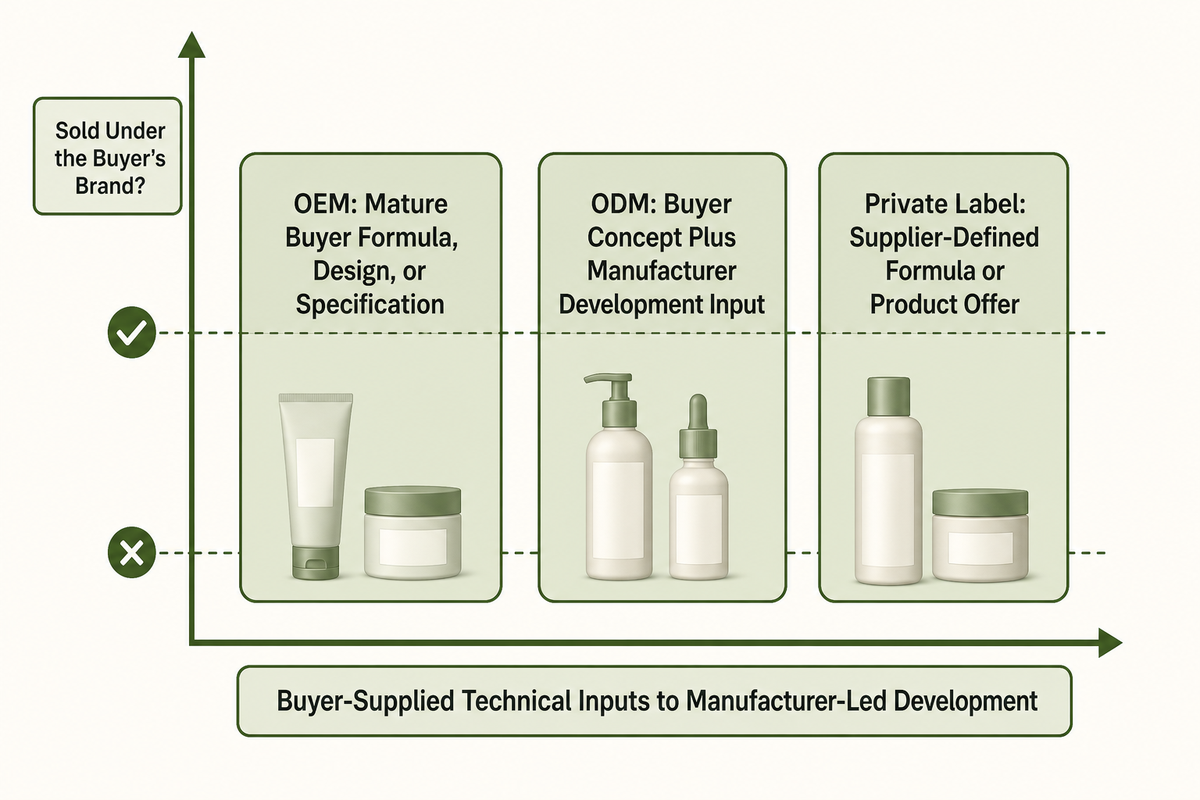
There’s a practical difference, and it starts with the product’s origin, not the logo on the package. An OEM usually means a buyer supplies a mature formula, design, or detailed specification. An ODM gives a manufacturing partner more responsibility for product development. Private label usually means the buyer’s brand will appear on the product and can be sold under either arrangement.
Two-Axis Manufacturing Route Map
The Two-Axis Manufacturing Route Map distinguishes the product’s origin from the brand that appears on it. Axis 1 defines the extent to which technical inputs are buyer supplied versus manufacturer led development. Axis 1 runs from buyer-supplied technical inputs to manufacturer-led development; Axis 2 asks whether the result is sold under the buyer’s brand.
| Comparison | OEM starting point | ODM starting point | Private-label starting point |
|---|---|---|---|
| Starting input | Mature buyer formula, design, or specification | Buyer concept plus manufacturer development input | A supplier-defined formula or product offer |
| Development owner | Buyer commonly leads technical definition | Manufacturer commonly contributes more design work | Depends on whether the base is stock, modified, or newly developed |
| Brand input | Brand brief plus controlled technical package | Market brief, product target, and approvals | Branding plus the permitted product and package choices |
| Typical differentiation | Buyer-controlled specification | Developed product response to the brief | Branding, packaging, sensory changes, or bounded formula choices |
| Evidence to request | Specification acceptance, process and release records | Development history, approved version, evidence index | Formula version, permitted changes, product-specific evidence |
| Unresolved contract question | Who approves deviations and changes? | Who controls rights, records, and future transfer? | Is the offer shared, reserved, exclusive, or transferable? |
| Best-fit condition | Technical package is mature | Development support is needed | A bounded branded offer fits the test |
The OEM vs ODM cosmetics map does not rank quality or predict outcomes in this cosmetic product development framework. The map demonstrates to a buyer what to ask a manufacturer prior to assessing price, MOQ or time-to-market.
In expanded terminology, OEM cosmetics refers to original equipment manufacturing, while ODM cosmetics refers to original design manufacturing. Product scope still begins with the intended use and product classification, not the commercial route label. Those phrases still do not create a universal scope; they only help a skincare or other cosmetics buyer ask who supplies the design input and who performs the development work.
Translate Market Language into Route Questions
Search results and supplier briefs use overlapping vocabulary. Treat these phrases as inquiry angles, not guaranteed manufacturing packages:
- OEM and ODM terms: “ODM vs OEM,” “ODM and OEM,” “OEM manufacturing,” “ODM manufacturer,” “ODM products,” and “manufacturing models” usually point to who supplies design and development input.
- Private-label terms: “ODM or private label,” “white-label,” “private label services,” “private label partnerships,” “private label arrangements,” “private label manufacturing,” and “label products” require the buyer to verify formula origin and scope.
- Market framing: “key differences,” “market entry,” “market demand,” “beauty market,” “new brands,” “competitive cosmetics market,” “enter the market,” “right model,” and “choosing the right manufacturing model” describe the decision context, not evidence of fit.
- Product and control: “production model,” “unique product,” “brand owner,” “supply chain,” “range of products,” “degree of control,” “intellectual property ownership,” “packaging and branding,” “design and production,” “specific ingredient requirements,” and “R&D” should each map to a deliverable, record, or contract clause.
- Confirm each market term against the quoted scope.
Route Names Are Starting Assumptions, Not Contract Deliverables
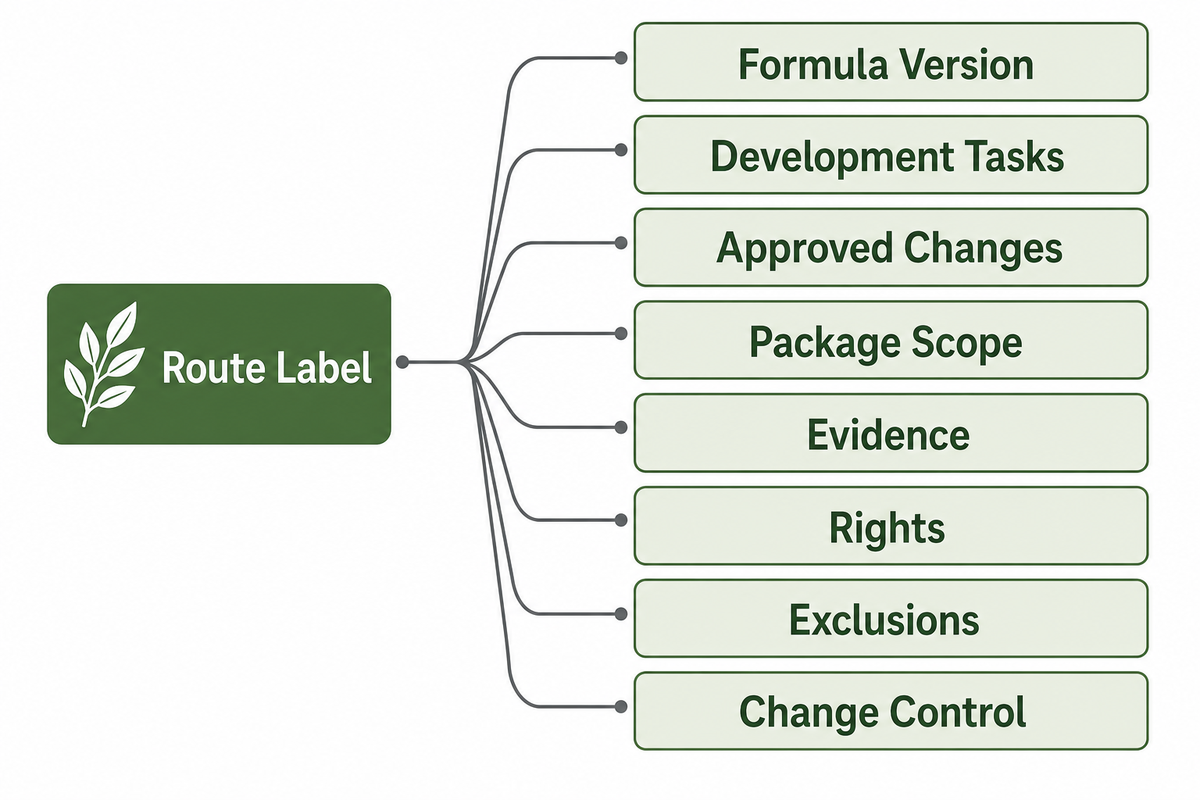
Two manufacturers can give the same route name to materially distinct services. For example, one ODM offer may start with a nearly complete formula with minimal potential modifications, while another may require new formula development. The buyer needs a written route definition covering the formula source, development work, permitted changes, records, rights, responsibilities, and exclusions.
Label versus deliverable
The label says: how the supplier commonly groups an offer.
The deliverable must say: formula version, development tasks, approved changes, package scope, evidence, rights, exclusions, acceptance points, and change control.
Supplier pages can be evidence of market usage, but each supplier has a certain level of interest in their definition. Regulatory authorities describe legal duties and product types; they don’t transform OEM, ODM, or private label into generic commercial packages. Rights questions should also be checked against the World Intellectual Property Organization’s trade-secret guidance rather than inferred from a route name.
Is private label the same as OEM or ODM?
Not necessarily. Private label refers to a product sold under the buyer’s brand, while OEM and ODM more often describe the source of product design or development. A private-label offer may use a pre-developed ODM formula, a stock base with permitted changes, or a buyer-defined specification. Compare formula source, permitted changes, rights, evidence, packaging, and responsibilities instead of assuming the label settles them. The contract must identify the actual formula, development tasks, permitted changes, and evidence package.
Start with What Your Brand Already Owns or Can Specify
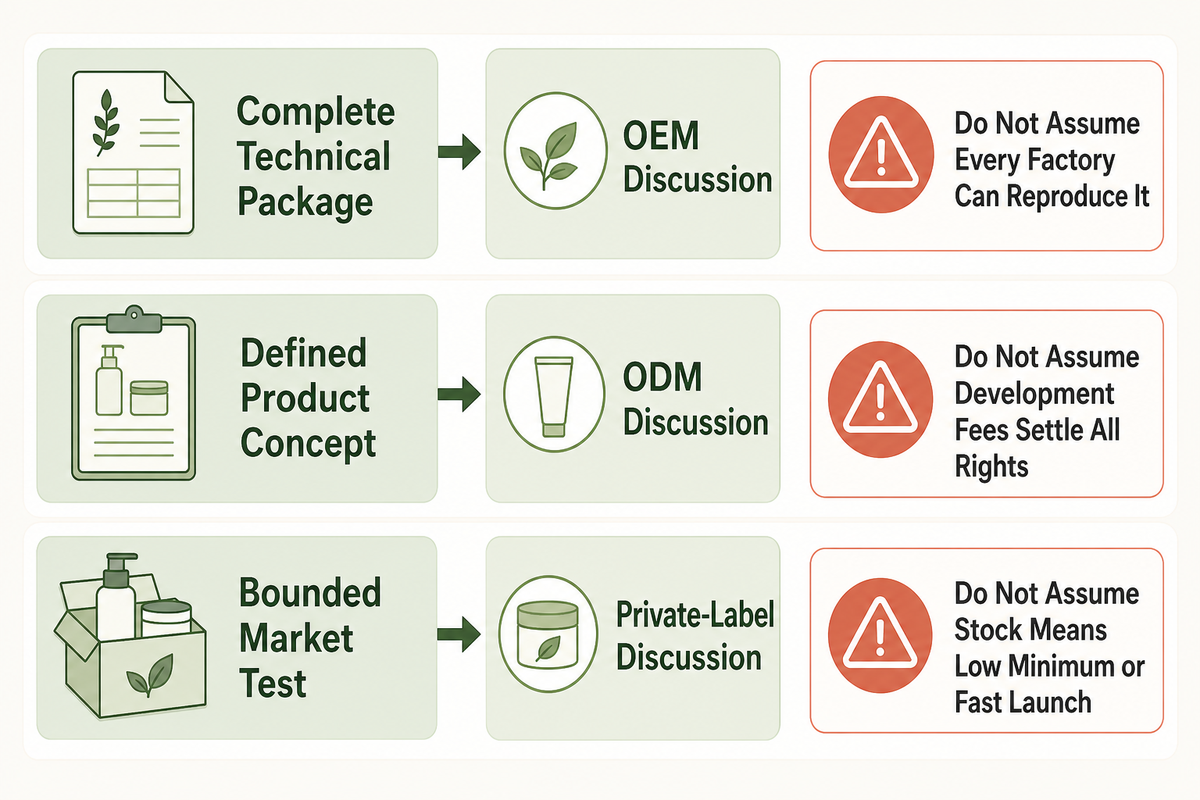
Route selection begins with the classification and description of the product and workable technical assets behind the brief. Document the intended use, claims, destination markets, formula or performance criteria, ingredient restrictions, packaging concept, internal technical resources, required evidence, and available resources. Resources alone aren’t sufficient to indicate if a route is viable.
According to the United States Food and Drug Administration’s product-classification guidance, claims may classify a product as a cosmetic, a drug, or both. Therefore, when considering using an ordinary-cosmetics route framework, exercise caution when selecting claims related to treatment, prevention, structure, or function.
| Current position | Bring to the manufacturer | Likely starting route | Do not assume |
|---|---|---|---|
| Complete technical package | Versioned formula, specifications, methods, package requirements, approved claims | OEM discussion | Every factory can reproduce or accept it |
| Defined product concept | User, market, performance target, claims boundary, ingredient and package constraints | ODM discussion | Development fees settle all rights |
| Bounded market test | Acceptable stock-product boundary, branding needs, target market, evidence questions | Private-label discussion | Stock automatically means low minimum or fast launch |
The asset list matters, but so does your team’s ability to manage those assets. If your team can’t manage specifications, resolve deviations, control changes, support scaling, or evaluate a new manufacturer, a buyer-supplied formula isn’t an advantage.
Common Fit: OEM, ODM, or Private Label
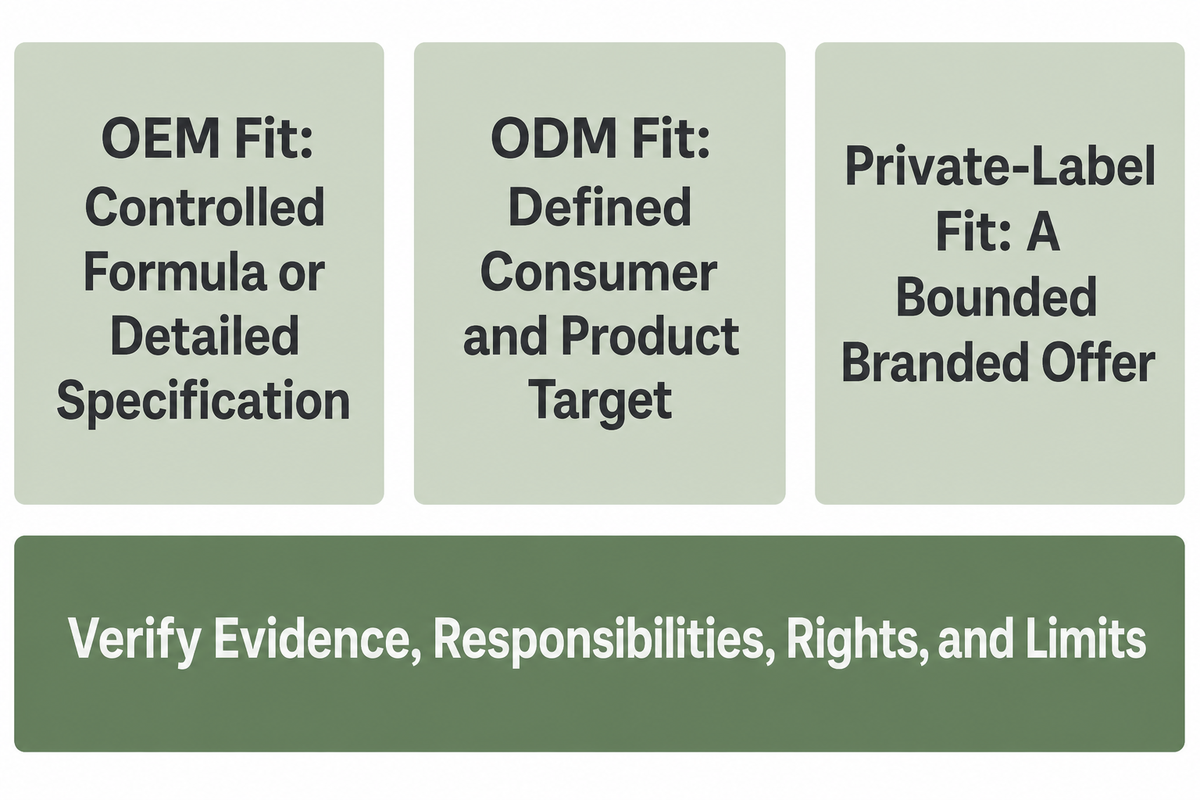
OEM commonly fits a brand with mature technical inputs, ODM fits a brand that needs product-development support, and private label fits a bounded branded offer whose disclosed limits are acceptable. These are first-cut assessments and don’t guarantee quality, cost, speed, minimum order, ownership, or regulatory readiness. The product-classification boundary remains separate from route fit.
OEM fit
- Bring a controlled formula or detailed specification.
- Verify manufacturability and acceptance criteria.
- Name deviation, change, and release owners.
- Reconsider if technical inputs are still conceptual.
ODM fit
- Bring a defined consumer and product target.
- Verify development stages and deliverables.
- Name approval, evidence, and rights boundaries.
- Reconsider if the brand needs a fully portable formula.
Private-label fit
Use it as a starting point when the existing product, allowed changes, package choices, evidence packet, and related-formula sales boundary fit a controlled market test.
Reconsider when exclusivity, unusual claims, deep sensory changes, custom primary packaging, or future transfer is non-negotiable.
Don’t convert the routes into a startup-to-enterprise ladder. A more mature company may use private label for a bounded channel assessment, while a startup may engage in an OEM discussion.
Customization should meet the non-negotiable product target and support the brand identity; it should not exist merely to make the route sound more advanced. Define the difference a consumer can encounter and the evidence needed to accept it.
Formula Control Is a Bundle of Separate Rights and Records
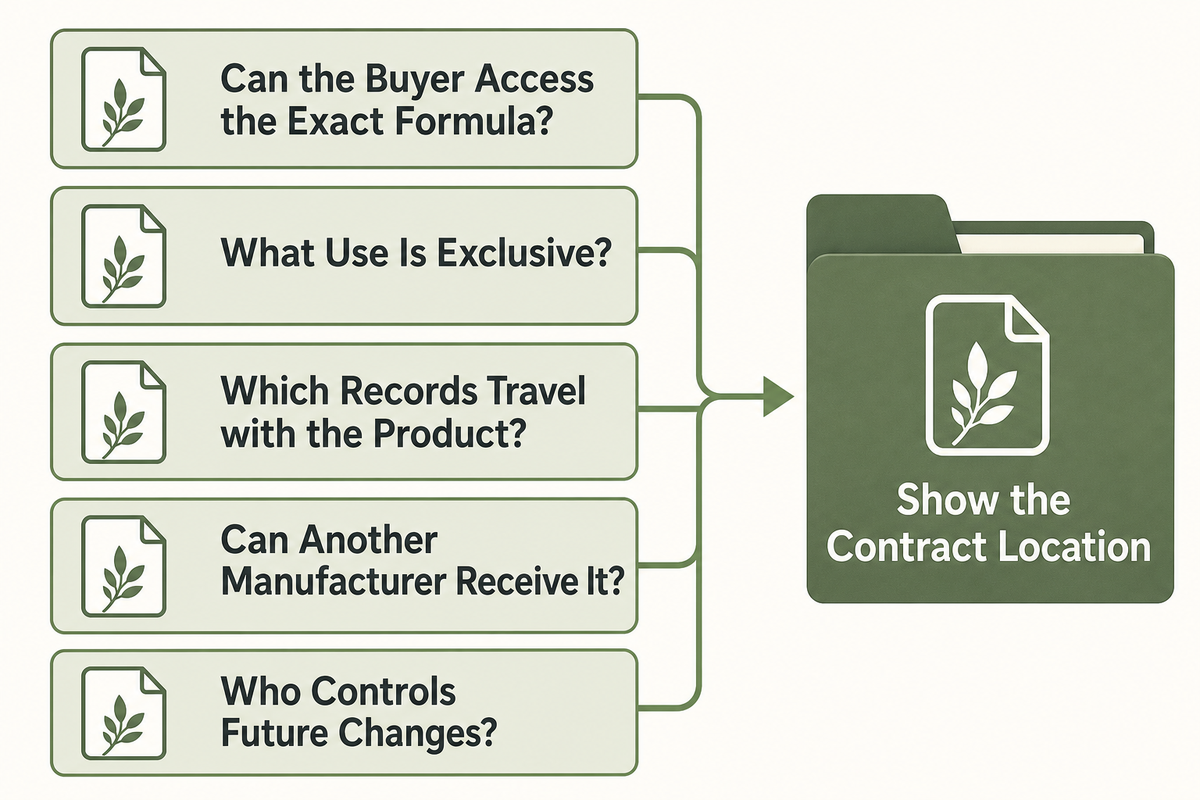
The concept of “formula ownership” is too broad to support on its own. Separate physical formula access, intellectual-property interests, confidentiality, exclusivity, specifications, supporting records, disclosure permission, upstream restrictions, permitted sales, sublicensing, and transfer rights. No route name will automatically provide the complete set.
The World Intellectual Property Organization’s trade-secret overview distinguishes confidential information, reasonable protective steps, licensing, and independent development. It supports treating confidential know-how and licensing as separate questions; it doesn’t decide ownership or contract enforceability for a specific project.
| Question | Evidence to request | Show the contract location | Hidden dependency |
|---|---|---|---|
| Can the buyer access the exact formula? | Version identifier and disclosure record | Access and confidentiality clause | Supplier know-how may remain separate |
| What use is exclusive? | Formula version, territory, channel, field, and term | Exclusivity scope and exceptions | The base or neighboring formulas may remain shared |
| Which records travel with the product? | Specifications, methods, development and change history, evidence index | Deliverables and retention clause | Data licences may restrict reuse |
| Can another manufacturer receive it? | Disclosure, licence, assignment, and assistance terms | Exit and transition clause | Ingredients, fragrance, packaging, or background intellectual property may be restricted |
| Who controls future changes? | Notice, impact review, approval, and re-release workflow | Change-control clause | A replacement input may reopen evidence work |
Payment of a development fee doesn’t, as a general rule, mean the transfer of all rights and records relating to the work done. Such project-specific legal interpretation must be left to trustworthy lawyers in the relevant jurisdiction.
A Manufacturing Route Does Not Remove Market or Safety Responsibilities
A pre-developed formula isn’t always applicable to a claim, user, container or destination market. Draw in the statutory actor, operational owner, product evidence pack, and change triggers. While a contract can assign duties, it can’t reject legal responsibilities of a facility operator, label, or the European Union Responsible Person, which can’t be avoided by a contract.
The United States Food and Drug Administration’s MoCRA page separates facility registration, responsible-person product listing, serious adverse-event reporting, record access, and safety-substantiation duties. Certain small businesses may qualify for exemptions from specified requirements, subject to exclusions, so eligibility should be checked rather than inferred from the route or company size.
| Duty type | Published clock | Handoff question |
|---|---|---|
| New facility registration | Within 60 days of first manufacturing | Who files before 60 days pass? |
| Registration change | Within 60 days | Who monitors the 60-day window? |
| Facility renewal | Every 2 years | Who owns the 2-year cycle? |
| New product listing | Within 120 days of marketing | Who files inside 120 days? |
| Product-listing update | Every 1 year | Who owns the 1 year update? |
| Serious adverse event | Within 15 business days | Who can report inside 15 business days? |
| Qualifying follow-up information | Information received within 1 year; report within 15 business days | Who watches both clocks? |
| Adverse-event records | Retain for 6 years | Where are the 6 years of records controlled? |
| Qualifying small-business records | Retain for 3 years | Who confirms the 3-year condition applies? |
The repeated clocks indicate different owners rather than one generic compliance task. Keep the 60 days registration event separate from the 120 days product listing, the 2 years facility cycle separate from the 1-year product update, and the 15 business days reporting duty separate from the 6 years or qualified 3 years record periods. The supplier handoff should name the 60 days owner and a 15-business-day escalation path. The route card should also identify the owner for each 120 days filing window, 2 years renewal cycle, and 6 years record period.
The published EU Cosmetics Regulation requires a Responsible Person and clearly defines safety assessment, product information, notifications, manufacturing and labeling. These roles are market-specific and need to be mapped to named persons or entities before they become operational.
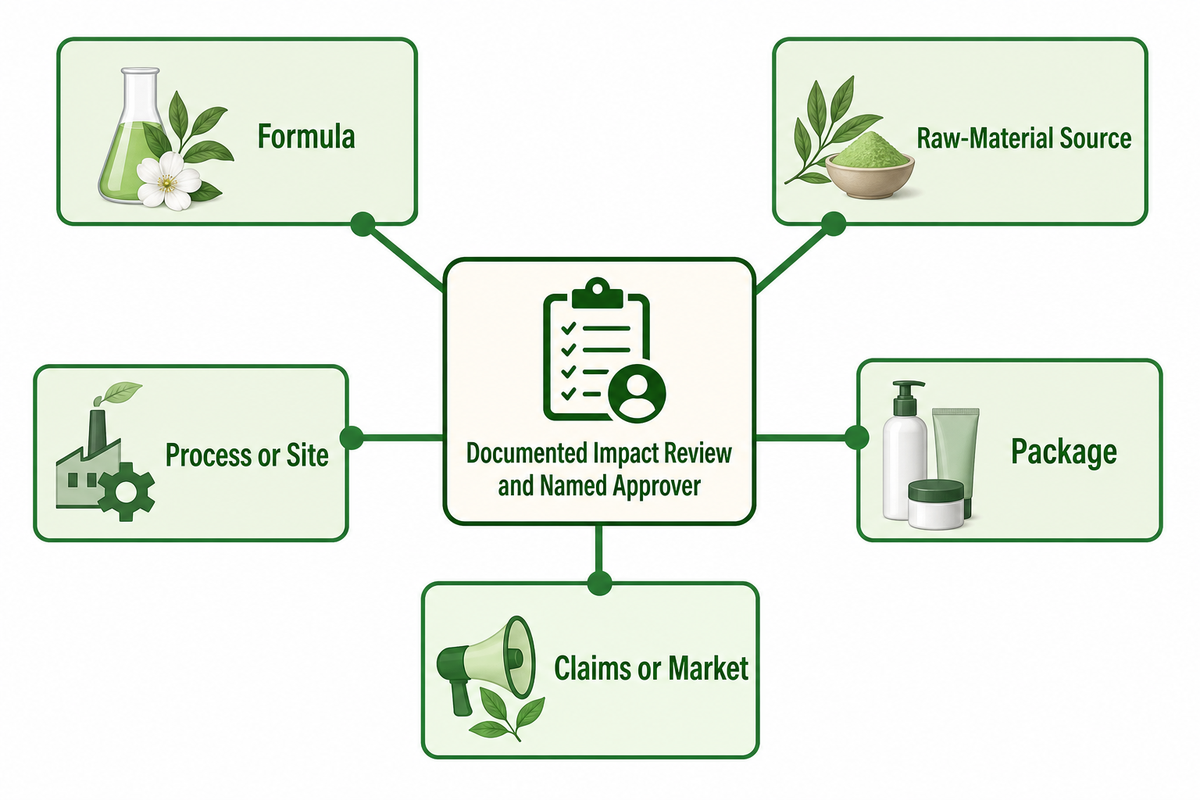
Five-point change-control check
- Formula: did an ingredient, concentration, fragrance, color, or specification change?
- Raw-material source: did the supplier, grade, documentation, or restriction change?
- Process or site: did equipment, method, scale, or manufacturing location change?
- Package: did the primary container, closure, decoration, or contact material change?
- Claims or market: did intended use, wording, target population, or destination jurisdiction change?
Each “yes” needs a documented impact review and named approver. A history of bulk formula does not, by itself, establish that a new final container, claim set, or market has an adequate evidence packet.
Minimum Order, Cost, and Timeline Follow the Scope
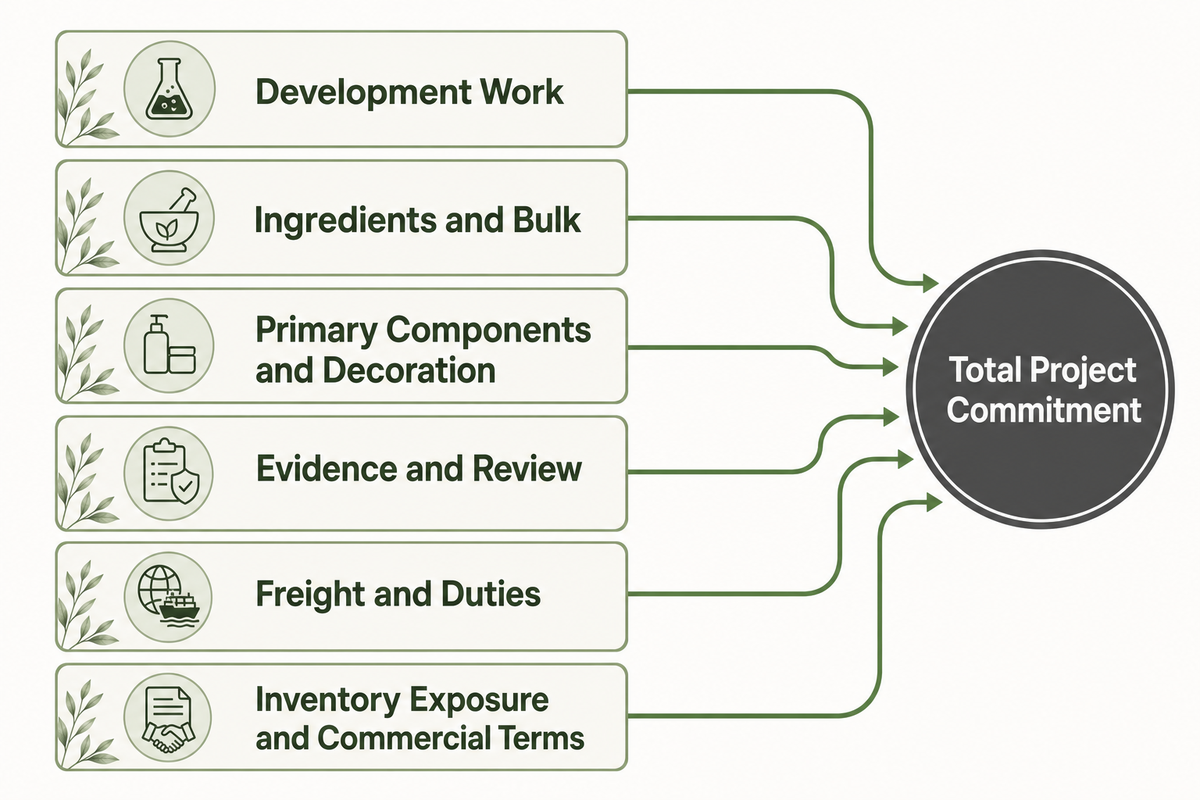
No manufacturing route is always the fastest, least expensive, or available at the lowest minimum order. The MoCRA responsibility framework also remains separate from the commercial timetable. Development work or formula batches, or even the type of ingredient used, may be the constraining factor, as may primary packaging, decoration, testing, review, artwork, freight, inventory, or the final commercial contract.
Control-to-Speed Tradeoff Ladder
The Control-to-Speed Tradeoff Ladder moves from a stock starting point to a buyer-supplied technical package, with a verification question at every rung. A higher rung is not automatically better, and a more controlled route can still move quickly when inputs are mature.
- Accept a stock starting point — verify formula version, related sales, evidence, package choices, and allowed branding.
- Select bounded modifications — verify which sensory, ingredient, package, or claim changes reopen review.
- Commission development work — verify stages, acceptance criteria, fees, rights, records, and change control.
- Supply a mature technical package — verify manufacturability, deviations, methods, scale-up, release, and transfer support.
Quote-variable map
Total project commitment = development work + formula and bulk + ingredients + primary components + decoration + secondary packaging + evidence and review + artwork and setup + freight and duties + inventory exposure + commercial terms.
Which is better, OEM or ODM?
OEM is often the stronger starting fit when the brand controls a mature technical package and can manage specifications, deviations, and changes. ODM may fit when the brand has a defined market and product concept but needs formulation or product-development input. Neither is necessarily better. A more suitable path depends on several factors, including product classification, internal capabilities, differentiation, evidence, binding commercial constraints, and the transition that the brand may need to take in the future. Route names cannot decide.
Ask for dependencies rather than a headline duration: brief completion, development and sample approval, component availability, artwork approval, evidence review, production scheduling, release documentation, and freight. This paper won’t publish a minimum price, lead time, or a NEXO-specific range, as the present evidence doesn’t support such figures.
Plan the Next Route Before You Sign the First One
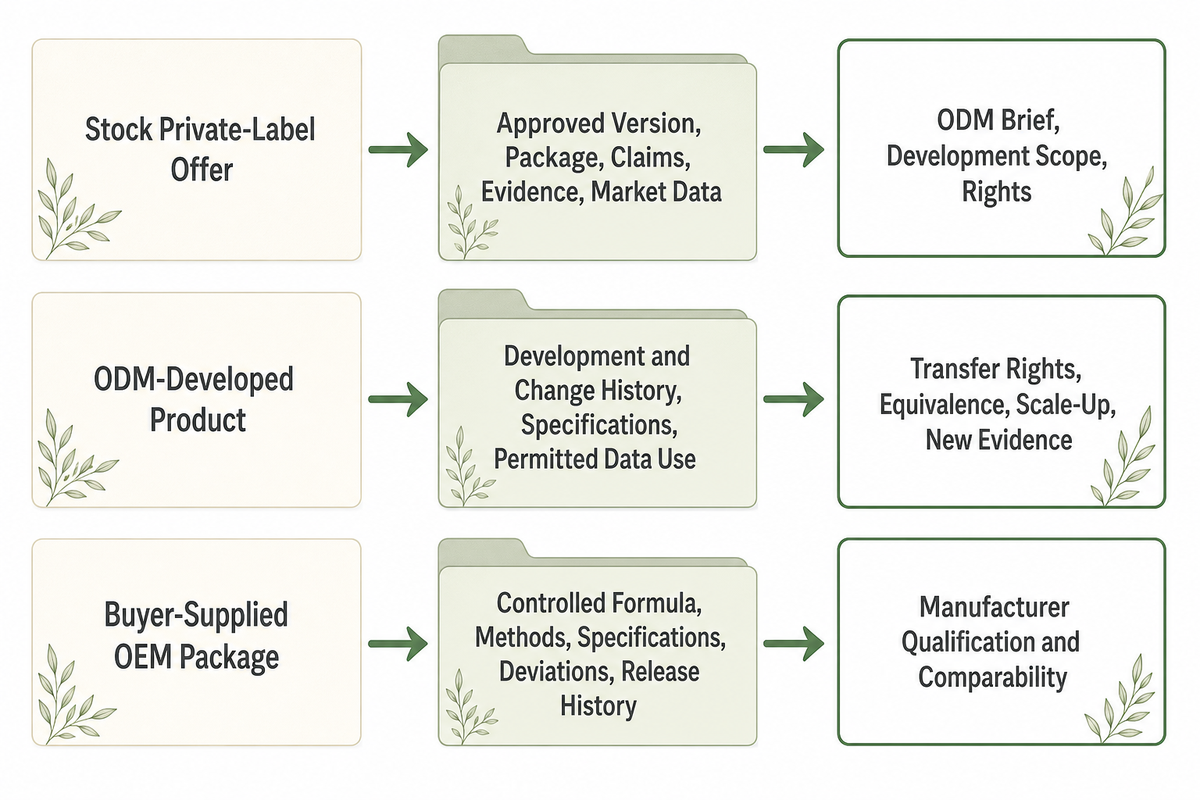
A brand can transition from a private-label user test to ODM development or an OEM specification, but that requires a new project decision. Keep the product specification, approved artwork, evidence index, version history, market feedback, permissions, and transitional help for the subsequent manufacturer review.
| Current test | Evidence to retain | Trigger to change | New review required |
|---|---|---|---|
| Stock private-label offer | Approved version, package, claims, evidence, market data | A proven unmet product need | ODM brief, development scope, rights |
| ODM-developed product | Development and change history, specifications, permitted data use | Need for tighter technical control or another source | Transfer rights, equivalence, scale-up, new evidence |
| Buyer-supplied OEM package | Controlled formula, methods, specifications, deviations, release history | Capacity, market, package, or supply strategy changes | Manufacturer qualification and comparability |
NEXO describes itself as a global cosmetics OEM and ODM partner with a manufacturing foundation dating to 1999 and an international business team focused on global partners since 2020. Brands that have moved past a bounded stock-formula test can review NEXO’s ODM development route as a possible next step.
For more context, visit NEXO Beauty Labs, read the company background, compare the private-label skincare route, or use the guide on how to start a cosmetic line.
Bring the current formula source, changes to the formula, target markets, claims boundary, and packaging. Discuss your route brief here.
The 10-Question Route Decision Card
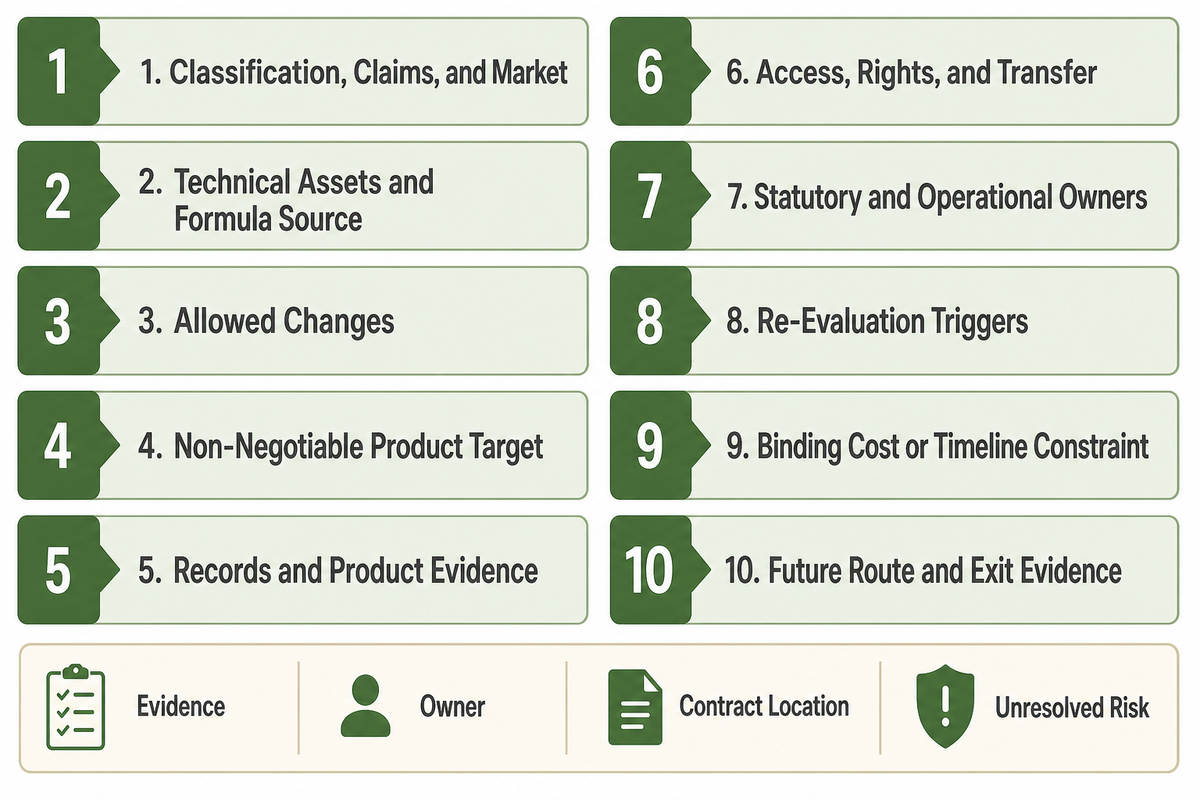
The card turns every route assumption into an answer, an evidence source, a named owner, a contract location, and an unresolved risk. Its rights fields use the trade-secret boundary only as a reference point, not as a project-specific legal conclusion. Complete it before comparing quotations. A route label, sample, unit price, or headline minimum can’t replace the record.
NEXO’s 10-Question Route Decision Card is a buyer-assistance tool to help create better manufacturer questions. It isn’t an industry standard, validated scoring method, or proven predictor, and project feasibility still requires documented technical, commercial, regulatory, and legal review.
2 axesorigin and buyer branding
10 questionsbefore quote comparison
100%answered or flagged unresolved
Document
- Name the product classification and destination market.
- Attach the versioned evidence and source record.
- Assign each technical and market responsibility.
- Point to the applicable quotation or contract line.
Do not assume
- Equate a route name with formula ownership.
- Treat a prior sale as final-product evidence.
- Compare price without matching scope.
- Delay the transition question until exit.
| Question type | Answer | Evidence | Owner | Contract location | Unresolved risk |
|---|---|---|---|---|---|
| 1. What is the product classification, intended use, claims boundary, and destination market? | Fill | Classification review | Name | Section | List |
| 2. Which technical assets exist, and who creates or supplies the starting formula? | Fill | Asset register | Name | Section | List |
| 3. Which formula, sensory, ingredient, package, or artwork changes are allowed? | Fill | Change matrix | Name | Section | List |
| 4. Which product target is non-negotiable? | Fill | Approved brief | Name | Section | List |
| 5. Which records and product-specific evidence will be delivered? | Fill | Evidence index | Name | Section | List |
| 6. What access, exclusivity, confidentiality, third-party, and transfer terms apply? | Fill | Rights schedule | Name | Section | List |
| 7. Who owns each statutory and operational responsibility? | Fill | Responsibility matrix | Name | Section | List |
| 8. What triggers re-evaluation after a change? | Fill | Change procedure | Name | Section | List |
| 9. Which component or term creates the binding minimum, cost, or timeline? | Fill | Line-item quotation | Name | Section | List |
| 10. Which future route and exit evidence must remain possible? | Fill | Transition record | Name | Section | List |
Key takeaway
Choose the documented scope that fits today’s product and preserves tomorrow’s evidence, rights, and transition path.
Frequently Asked Questions
What is the difference between OEM and ODM cosmetics?
A brand brings a mature specification, design, or technical package; the OEM builds against agreed requirements. The ODM provides more product-design or development responsibility. These terms are not universal commercial definitions, so confirm formula source, permitted changes, evidence deliverables, rights, and change control in writing.
Is private label the same as OEM or ODM?
Not always. Private label describes whose brand appears on the product, while OEM and ODM more often describe where product design or development begins. A private-label offer may use a pre-developed ODM formula, a stock base with permitted changes, or another supplier-defined arrangement.
Which is better, OEM or ODM?
OEM is often the stronger starting fit when the brand controls a mature technical package and can manage specifications and changes. ODM may fit when the brand has a defined market and product concept but needs development support. Neither is inherently better; compare internal capability, differentiation, evidence access, responsibilities, commercial constraints, and future transition needs.
Is private label always faster or cheaper?
A pre-developed starting point can reduce some development work, but packaging, decoration, testing, artwork, market review, freight, inventory, or contract terms may set the binding cost or schedule. Evaluate the extent of the work involved with the components of the project and the evidence presented in each quotation.
Can a brand move from private label to ODM or OEM later?
Yes, but the move is a new project decision. Retain product specifications, approved artwork, evidence records, version history, market feedback, and clear permissions for formula access or transfer. Define the parameters for the change of route prior to the first launch, and the next review won’t need to be initiated on an undocumented product.
References & Sources
The primary authorities listed below outline the limits and boundaries of product classification, safety, market role, intellectual property, and good manufacturing practices. These don’t define universal OEM, ODM, and private-label commercial packages.
- United States Food and Drug Administration: Modernization of Cosmetics Regulation Act
- United States Food and Drug Administration: Is It a Cosmetic, a Drug, or Both?
- United States Food and Drug Administration: Authority Over Cosmetics
- Regulation (EC) No 1223/2009 on Cosmetic Products
- European Commission: Cosmetics Legislation
- World Intellectual Property Organization: Trade Secrets
- International Organization for Standardization: ISO 22716 Cosmetics Good Manufacturing Practices
Commercial-source boundary: Competitor and supplier pages were used to compare terminology and to identify likely assumptions of potential clientele. Their route descriptions are commercially interested and weren’t used as proof of universal costs, speed, quality, ownership, minimum order, or performance.