Get in touch with NEXO Beauty Labs Company

Private Label Body Wash: A Complete Planning Guide

Updated September 2026
Private label body wash is a rinse-off cleanser made by one company and sold under another company’s brand, with the allowed choices, responsibilities, and evidence defined by the project route.
The easiest way to plan private label body wash is to think of formula, sensory feel, packaging, evidence, claims, and production records as a single, integrated, product system. This guide helps Product Managers, Quality Managers, Sourcing Managers, and Founders define and test the product system before approving a sample.
This is for educational planning, not for another sales page. NEXO has its commercial service details on the body wash manufacturing page. In this section, we’ll look at writing a brief, sample comparison, follow failures, plan evidence, and allocate decisions without thinking one good sample is a launch ready sample.
Searches such as private label body wash manufacturers, private label body wash wholesale, and private label products for small business usually point toward supplier comparison or purchasing. This guide does not rank manufacturers, quote wholesale terms, or become a storefront; the linked commercial page owns that decision path.
Within a bath and shower or personal care line, a wash can be placed next to a cleansing oil, a scrub, and other body care products. Botanical positioning might include aloe or other plant extracts, but what the brand can say is determined by ingredient lists and supporting records, not a familiar plant name. Even the word “refresh” is claim language to consider in the context.
Key takeaway
A good body-wash project has six linked files: product brief, sample scorecard, controlled formula identity, package identity, evidence plan, and claim register. If one changes, the team checks which other approvals must reopen.
What Is Private Label Body Wash?
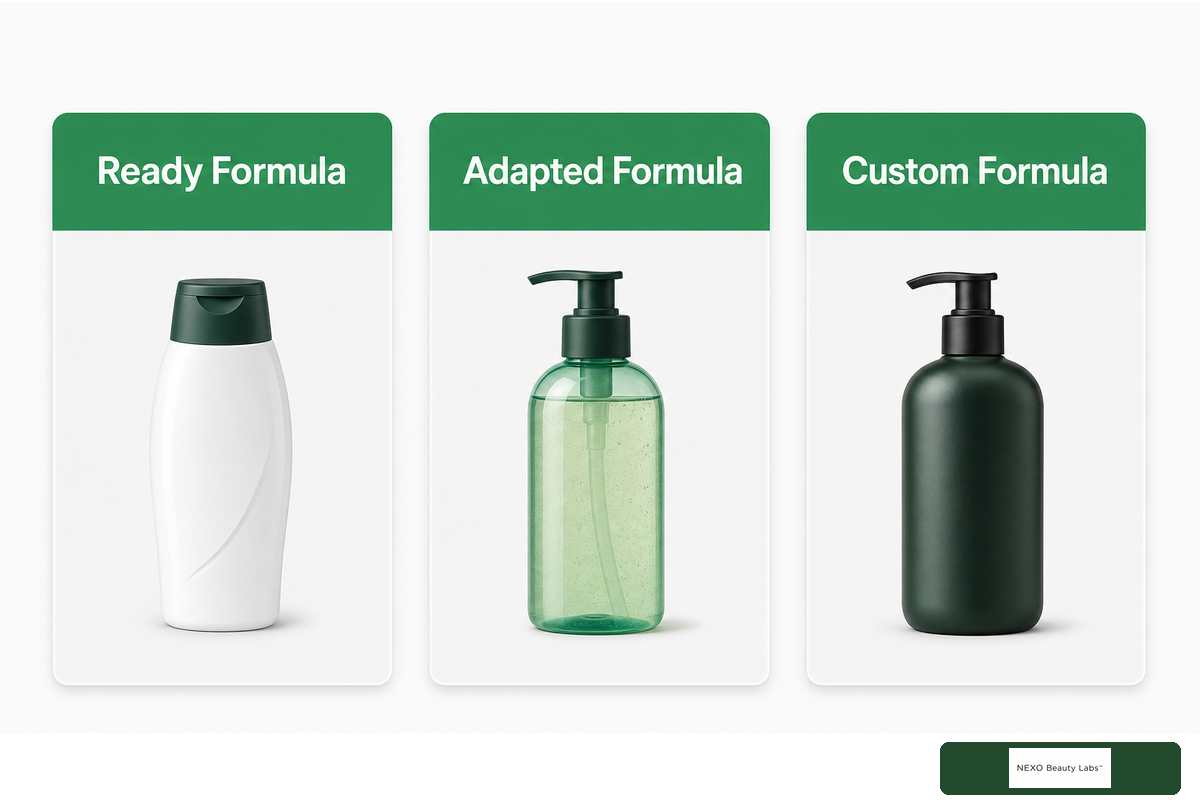
Private label body wash is made by a manufacturer and sold under another company’s brand, but the phrase does not define how much can change. Potential customers are still required to know what decisions are fixed, selectable, or new for this particular project among the areas of formula, scent, sensory, package, test, document, and ownership.
That commercial label does not settle the US product category. The FDA’s classification guidance ties the federal path to intended use and other statutory facts rather than to the private-label business model.
There’s variation in supplier language. One company may describe a formula as “private label,” while another company may use the same phrase to describe an adapted or original development route. These aren’t single legal taxonomies. Rather, they’re commercial descriptions. Instead of focusing on the label, compare the controlled inputs and evidence associated with the respective routes.
| Route | Usually starts with | Buyer must confirm |
|---|---|---|
| Ready formula | An existing formula platform and known production path | Available evidence, permitted changes, scent choices, package fit, and formula ownership terms |
| Adapted formula | A defined base with named changes | Which change reopens stability, preservation, compatibility, sensory, or claim review |
| Custom formula | A new brief and wider development scope | Decision owners, evidence burden, change control, formula rights, and commercial-version approval |
When fitting the brand position and the intended customer, the least complex route may be the most effective. More variables don’t always improve the product. They create more dependencies to define, test, and finally approve.
What Should a Body Wash Product Brief Decide?
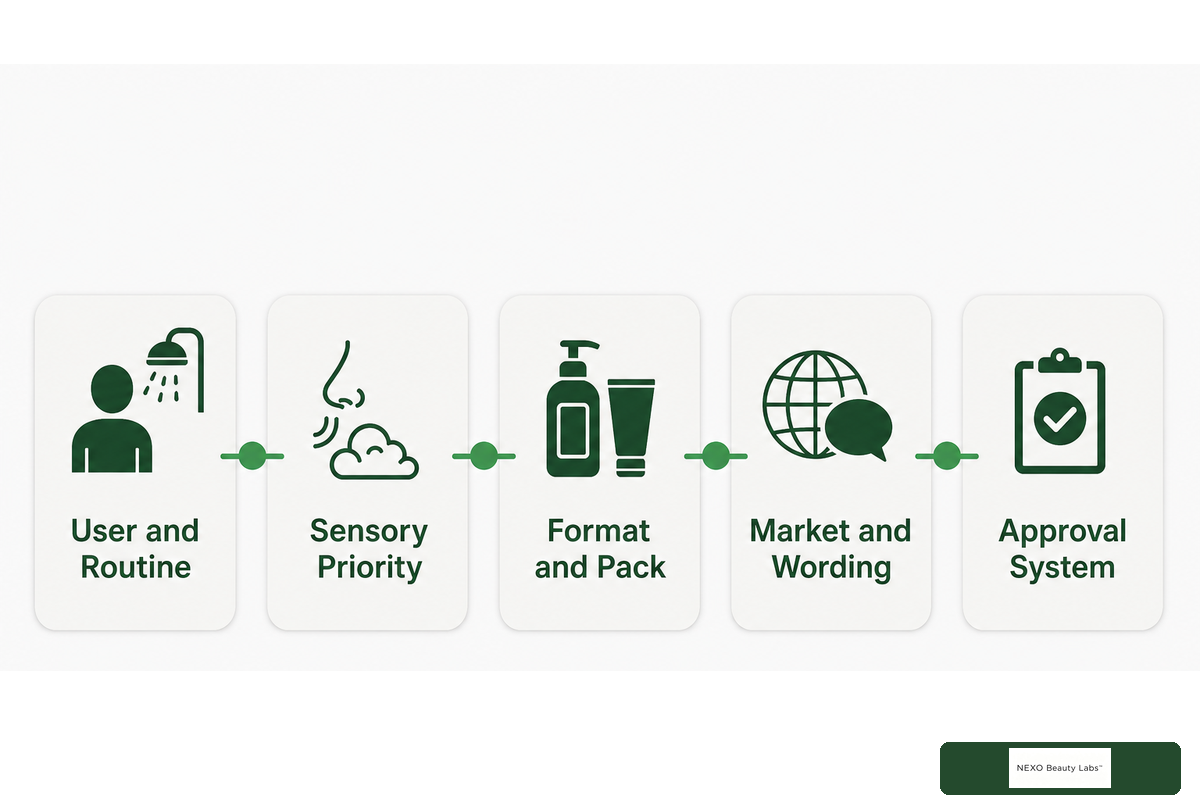
An effective brief describes the intended customer and the channel through which they’ll access the product and the routine in which they’ll use the product, as well as the product’s wash feel from pump to rinse. It also describes the intended pack, target market, the claim, and the evidence so that a formulator isn’t required to interpret a description containing vague adjectives and guess the client’s expectations.
Claims belong in the brief because the evidence burden follows the promise. The FTC’s health-products guidance explains why support must fit both express and implied objective claims.
Begin with the routine. A daily family wash, a fragrance-led spa product, a gym-bag cleanser, and a concentrate activated by the user may all be called body wash, but they impose different demands on dispensing, lather, rinsing, directions, pack handling, and consumer expectations.
| Input | Decision to record | If it stays vague |
|---|---|---|
| User and routine | Audience, frequency, dose pattern, water conditions, and use setting | Reviewers judge different products in their heads |
| Sensory priority | Lather build, cushion, rinse, residue, after-feel, and scent journey | Feedback becomes “richer” or “gentler” with no shared meaning |
| Format and pack | Liquid, gel, cream wash, foamer liquid, concentrate, bottle, tube, or refill route | Formula and dispenser are selected in isolation |
| Market and wording | Destination markets, label identity, exact claims, and intended online wording | The evidence plan starts after the promise is already designed |
| Approval system | Sample code, reviewers, acceptance rules, open issues, and change authority | A preferred sample cannot be traced into production |
Prioritize the requests. “Strong scent, dense foam, quick rinse, creamy cushion, clear appearance, and no residue” may pull a formula in several directions. Naming the primary experience and flexible attributes gives the development team a real decision hierarchy.
Should You Start With a Ready, Adapted, or Custom Formula?
To develop the product offer, begin with the least complex route that can support the promise, sensory target, package, and evidence. A formula that’s ready, aligns with the given brief, and only requires a name change, will suffice. Custom development is only justified when the intended difference isn’t supported by a ready route.
No route removes the need for product-specific safety support. The FDA’s cosmetic product-testing guidance leaves companies flexibility in method selection while keeping responsibility for safety with the manufacturer.
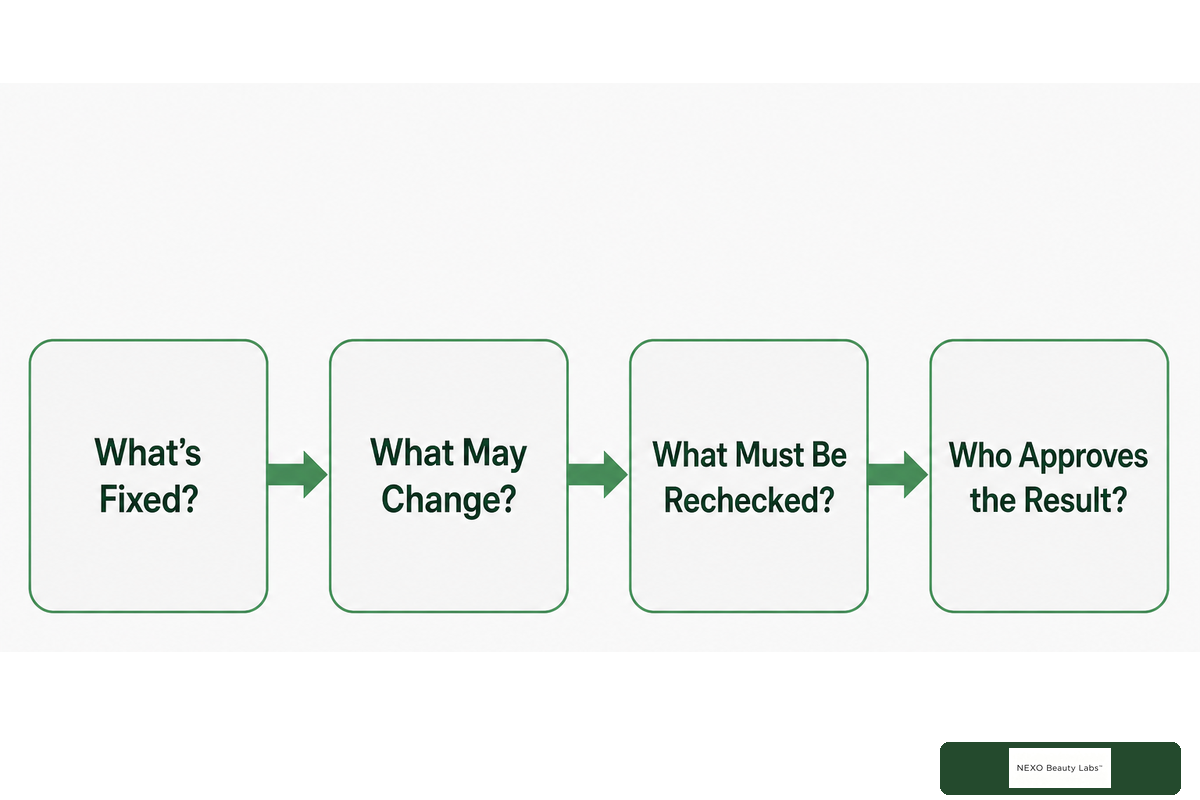
Use a route decision record before samples are ordered:
- What’s fixed? Record the base formula, manufacturing path, available records, and selectable pack family.
- What may change? Name the fragrance, color, viscosity, sensory, ingredients, and choice of dispensing system.
- What must be rechecked? Link each proposed change to formula stability, antimicrobial protection, package function, label wording, or other relevant evidence.
- Who approves the result? Separate brand, technical and regulatory approvals.
A ready route doesn’t make every claim transferable. A custom route doesn’t make every idea technically sound. In both cases, the final promise must match the finished formula and the conditions under which the evidence was created.
Decision rule
Choose custom development for a defined unmet constraint, not for prestige. If the team can’t name what an existing platform fails to deliver, the extra variables are likely to create noise rather than useful differentiation.
How Do Surfactants, Fragrance, Foam, Viscosity, and Rinse Interact?
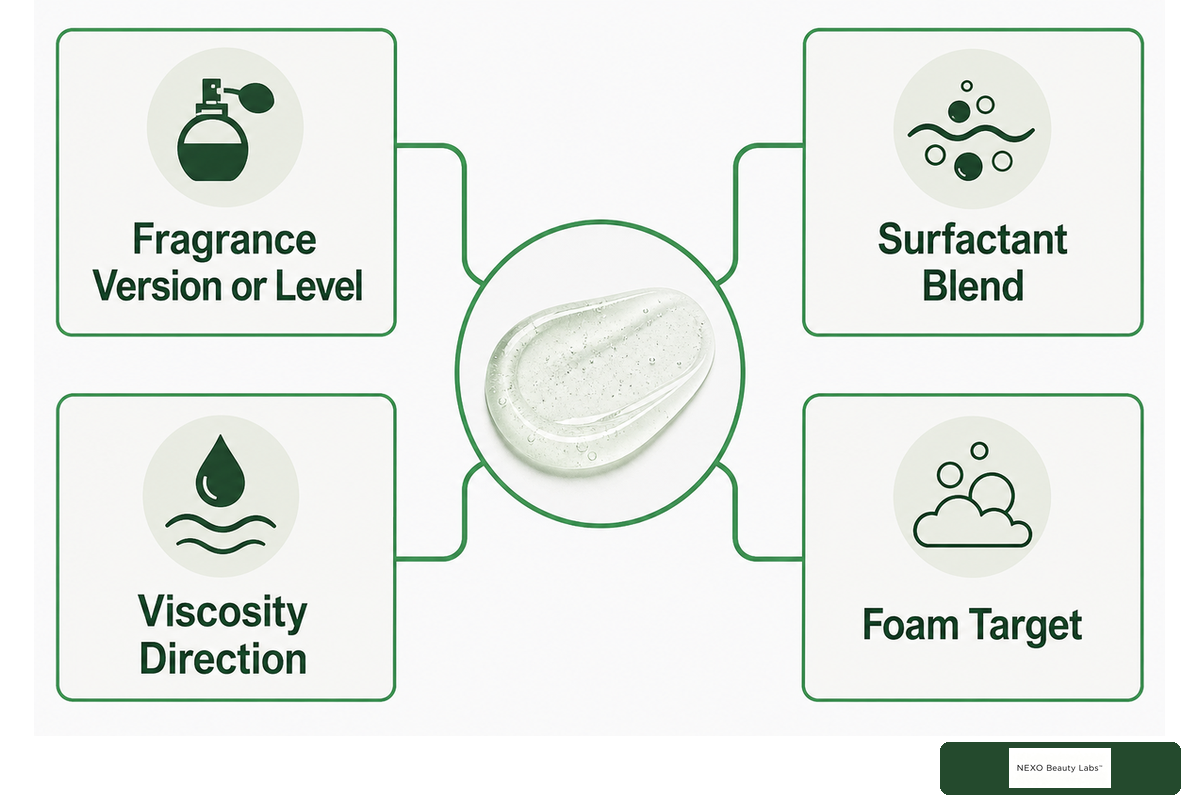
Surfactants, fragrance, foam, viscosity, and rinse must be treated as a system rather than a menu of independent choices. The selection of a surfactant solution influences cleansing, lather, rinsing, and formula; fragrance can alter viscosity, which may impact filling and dispensing; and the result perceived by the consumer is influenced by the quality of their water, the dose, and their technique. One change may require several approvals to be repeated.
The evidence plan must still be fitted to the finished product. The FDA’s testing guidance does not prescribe one universal cosmetic test list, so the team must justify methods against the actual system and intended use.
A technical article in Cosmetics & Toiletries states that perfume can either thicken or thin a surfactant system, and this effect can be either additive or solvent-like. An original formulation case tackled the same problem, but the trade source, rather than the forum, provides the technical explanation.
That interaction matters because a sample may be reviewed in bulk, while the buyer later changes fragrance strength or selects a pump with a different flow path. If the product tends to prime poorly, strings at the nozzle, or loses its cushion, the cause can’t be attributed to “the bottle” or “the formula” without tracing the version and conditions.
| Change | Possible downstream question | Evidence to revisit |
|---|---|---|
| Fragrance version or level | Did flow, clarity, odor development, or rinse perception change? | Controlled formula, stability observations, sensory review, dispensing |
| Surfactant blend | Did lather build, rinse, skin feel, or thickening behavior change? | Formula rationale, use test, physical observations |
| Viscosity direction | Can the intended component fill, prime, dispense, and close cleanly? | Measurement conditions, filled-pack function, production method |
| Foam target | Is the brand judging visual volume, density, build speed, cushion, or rinse? | Defined use conditions and panel notes |
Even a viscosity number needs context. Temperature, instrument, geometry, speed, timing, sample history, and the method all can impact a comparison. Rather than using a number from some other case, describe the method used for that formula.
How Does the Six-Signal Scorecard Improve Body Wash Sample Reviews?
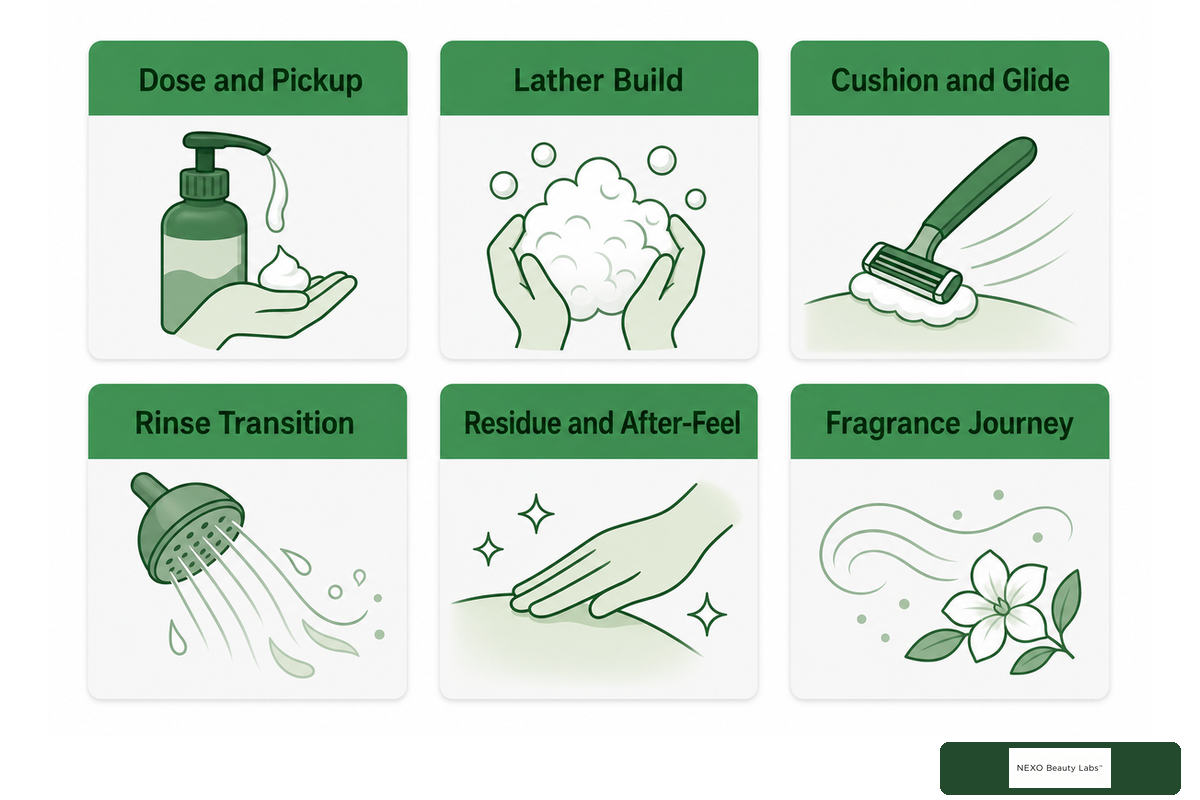
Evaluate samples under repeatable use conditions and separate observation from preference. The Six-Signal Wash-Off Experience Scorecard documents dose, lather build, cushion, rinse, residue, and fragrance journey for a named sample and package. It helps teams compare versions; it doesn’t assess safety, mildness, or clinical performance.
A PubMed-indexed study on soap and synthetic detergent bars found that structured sensory responses could add information beyond visible observations, but that study doesn’t validate a liquid body-wash formula. Its useful lesson is narrower: record what reviewers perceive and what they can observe, then keep claims and safety conclusions in their proper evidence tracks.
The PubMed record also makes the study boundary visible: it concerns soap and synthetic-detergent bars, not a validation study for the liquid formula being reviewed here.
Six-Signal Wash-Off Experience Scorecard
Editorial tool: use the same named sample, dispensing component, dose method, water condition, wash area, timing, and reviewer instructions. Mark each signal Accept, Revise, or Not reviewed, then add a short observation.
| Signal | Record this | Do not infer | Review owner |
|---|---|---|---|
| 1. Dose and pickup | Actuation or squeeze behavior and usable amount | That one dispenser fits every production lot | Product + Packaging |
| 2. Lather build | Build speed, density, and change during washing | That more foam means better cleansing | Product |
| 3. Cushion and glide | Slip, drag, and feel over the defined wash period | Clinical mildness | Product + QA |
| 4. Rinse transition | How quickly lather clears and slip changes | A universal rinse-time target | Product |
| 5. Residue and after-feel | Tightness, coating, softness, tack, or clean feel at set moments | A treatment or safety result | Product + QA |
| 6. Fragrance journey | From dispensing through wet use and after rinsing | That scent strength stays unchanged in storage | Brand + Product |
Keep open comments visible. “Revision requested because pump sputtered after the third use” is actionable. “Not premium enough” isn’t. When reviewers disagree, first check whether they used the same sample, dose, water, sequence, and scoring instruction before changing the formula.
Is Body Wash the Same as Shower Gel?
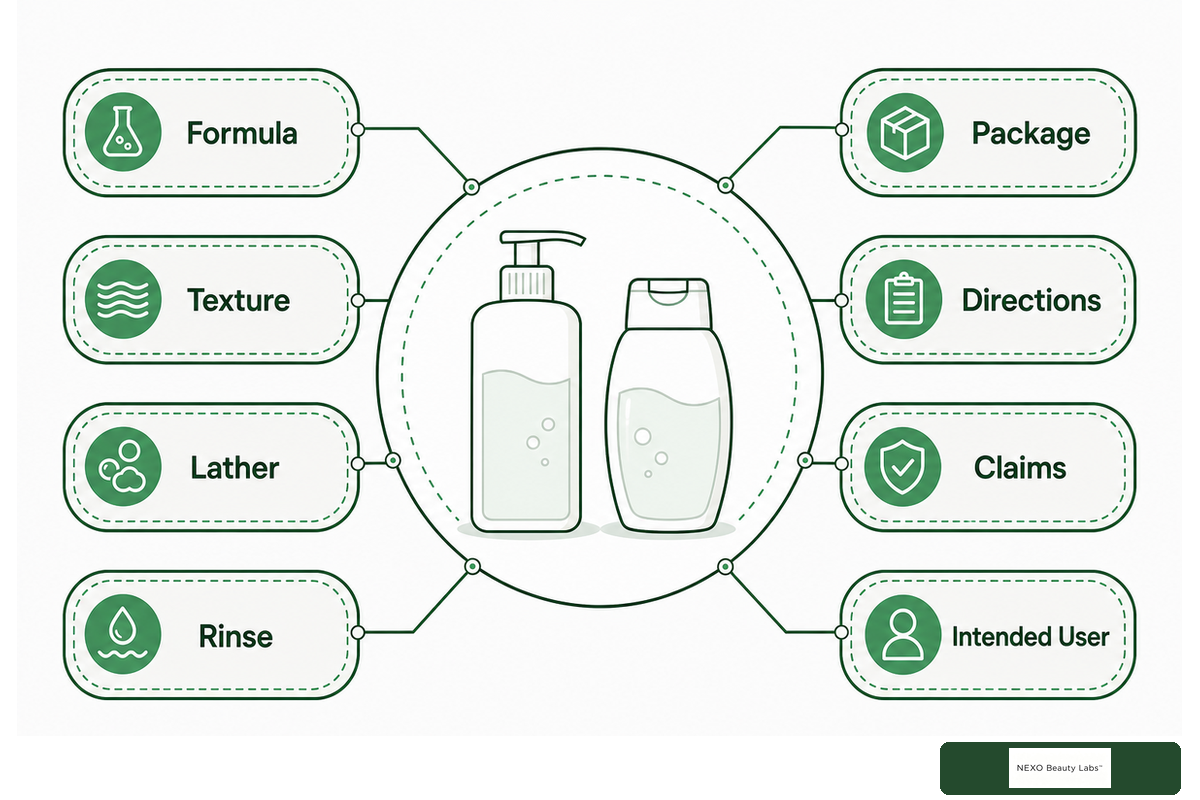
Body wash and shower gel overlap in market use, so the name alone doesn’t create a fixed technical boundary. Brands should define the actual formula, texture, lather, rinse, package, directions, claims, and intended user. Under US federal rules, classification also depends on intended use and other statutory facts.
The FDA explains that a rinse-off cleansing product can fall into several paths. Products meeting the narrow federal definition of soap depend partly on composition and on being represented solely as soap. Other products may be cosmetics, drugs, or both. The intended use of the product may also be based upon the presence of ingredients with recognized therapeutic use and the perceptions of consumers.
Use the FDA’s soap, cosmetic, and drug guidance as the federal checkpoint rather than treating “body wash” or “shower gel” as a legal answer.
Because of the reasons above, “shower gel” shouldn’t be used to refer to a single viscosity, a single surfactant system, or a single regulatory conclusion. It should be used as a positioning and a sensory term pending further review of formulation, labeling, advertising, and the definition of use.
Practical boundary
Use the consumer-facing name that fits the product story, but write the technical brief from measurable and observable product attributes. Have qualified counsel review market classification when the composition, therapeutic language, or soap representation raises a statutory question.
How Does the Pump-to-Rinse Failure Trace Find Package Problems?
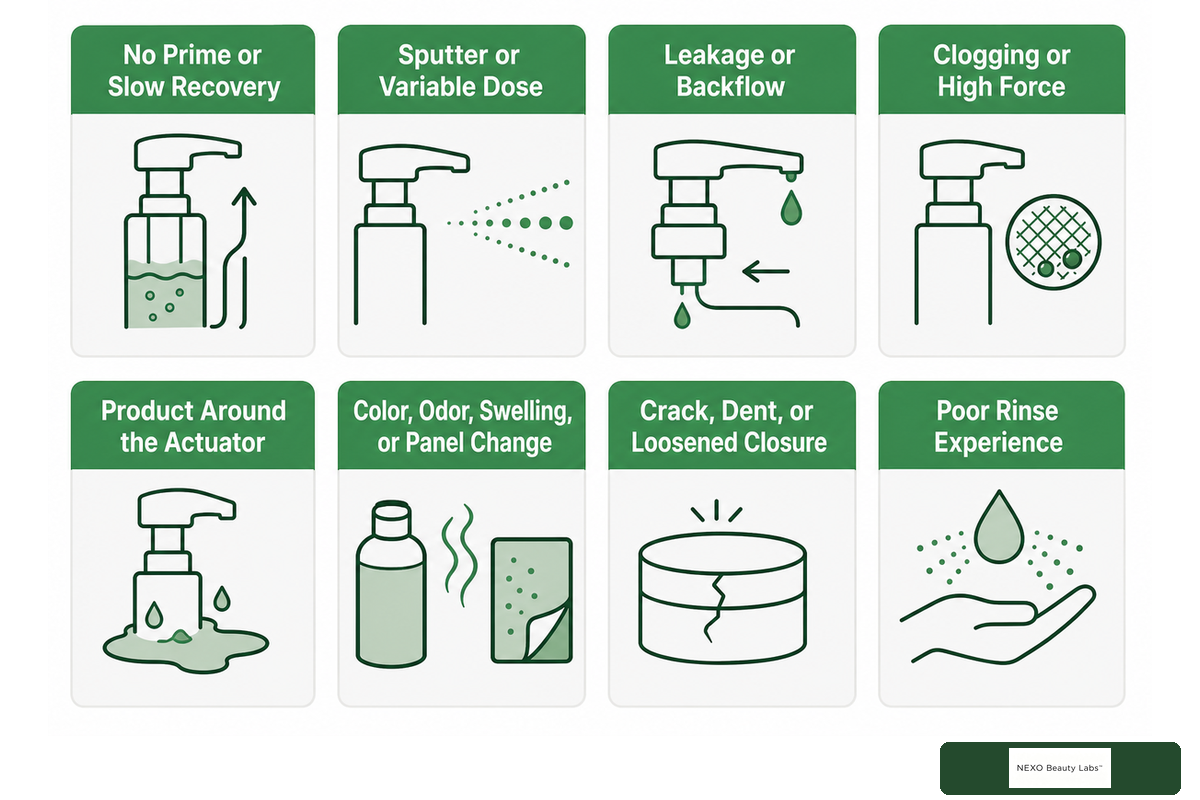
The final formula, intended packaging, filling method, storage and distribution, and product handling should all be evaluated as an integrated system. A bulk sample can look acceptable while the filled unit leaks, loses prime, traps product, transfers odor, changes appearance, or becomes difficult to use in a wet shower environment.
ISO/TR 18811’s public stability-testing scope is useful here because it leaves methodology and criteria to the manufacturer; it does not make a bulk sample a substitute for evaluating the intended filled pack.
The failure question isn’t limited to “formula or bottle?” A change in perfume may influence the product flow; flow may affect the recovery of the pump; during use, the closure may allow water to enter; decoration may fail under wet handling; and distribution stress may uncover a weakness that wasn’t evident in the desk sample. The exact component and formula version must stay visible.
Pump-to-Rinse Failure Trace
Editorial tool: This editorial tool starts with the symptom and lists potential mechanisms, likely causes, the next check, corrective path, and release owner. The list shouldn’t be treated as an exhaustive test protocol.
| Failure type | Possible mechanism | Check next | Decision owner |
|---|---|---|---|
| No prime or slow recovery | Flow behavior, dip tube, seal, headspace, or pump path | Named component with the controlled formula under intended conditions | Packaging + QA |
| Sputter or variable dose | Air entry, valve recovery, orientation, or formula variation | Repeated actuation sequence and filled-unit history | Packaging + Operations |
| Leakage or backflow | Closure fit, lock, liner, seal, pressure, or wet-use ingress | Closure specification, orientation, transport, and shower-use conditions | Packaging + QA |
| Clogging or high force | Viscosity, particles, drying at the outlet, or narrow flow path | Formula version, storage history, orifice, and cleaning behavior | Formula + Packaging |
| Product around the actuator | Poor wipe-off, backflow, dose shape, or use-angle mismatch | Wet-use sequence, outlet geometry, and closure hygiene | Packaging + Product |
| Color, odor, swelling, or panel change | Formula-contact interaction, barrier, stress, or transfer | Material disclosure and filled-pack observations against controls | QA + Packaging |
| Crack, dent, or loosened closure after shipping | Pack strength, ship case, headspace, orientation, or distribution stress | Filled-unit transport simulation and actual route assumptions | Operations + QA |
| Poor rinse experience | Dose, lather target, water, surfactant balance, or residue expectation | Scorecard under fixed use conditions | Product + QA |
A shower-use case in Packaging Digest illustrates how related design questions can include water control and product extraction. The example does NOT show that the mechanism used can be applied to other formulas. For method-level coverage, see NEXO’s separate guide to cosmetic packaging compatibility testing.
What Stability, Microbiology, and Preservation Evidence Belongs in the Plan?
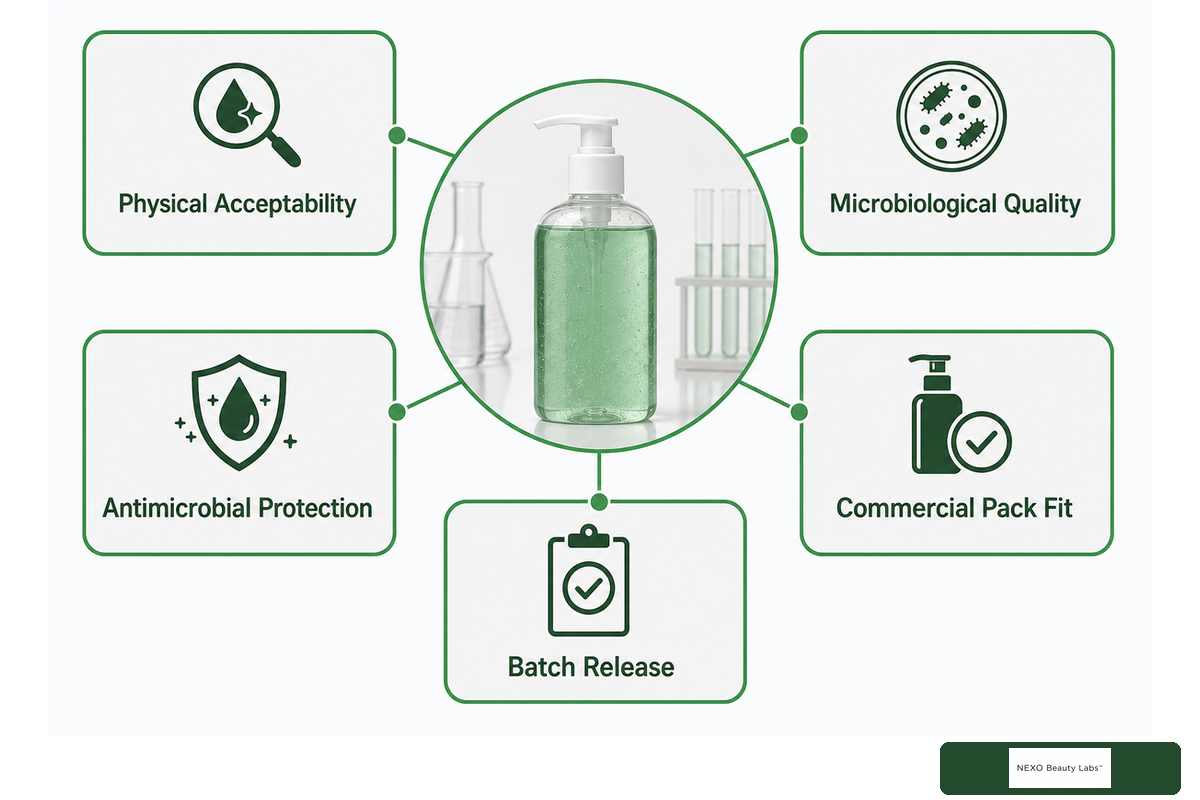
Plan each evidence question separately: Each of the following evidence questions must be planned separately: physical stability, package compatibility, microbiological quality, antimicrobial protection, safety support, and batch release. The methods, samples, conditions, timing, and acceptance criteria must be relevant to the actual formula and the market. No single attractive sample or generic “fully tested” statement answers all of these questions.
The FDA states, “Neither the law nor FDA regulations require specific tests to demonstrate the safety of individual products or ingredients.” Its product-testing guidance also keeps the manufacturer responsible for safety. Flexibility in test selection is not an exemption from holding adequate support.
Evidence principle: Test selection is flexible, but responsibility for cosmetic safety stays with the manufacturer.
Publicly available ISO scopes can assist in separating the work without claiming the results:
- ISO 11930:2019 addresses interpretation of preservation-efficacy or microbiological-risk-assessment data for antimicrobial protection.
- ISO 17516 addresses cosmetic microbiological quality and notes a risk-based exception for products considered low risk.
- ISO/TR 18811 provides some ‘stability-testing’ guidance and leaves it to the manufacturer to describe and justify the methodology and the criteria.
| Question | Project record | Does not prove alone |
|---|---|---|
| Does the formula stay physically acceptable? | Protocol, observations, specifications, conditions, and conclusion | Antimicrobial protection or package function |
| Is microbiological quality controlled? | Applicable limits, method, sampling, controls, and review | Performance through every use condition |
| Is antimicrobial protection adequate? | Risk assessment and applicable preservation-efficacy evidence | Every shelf-life or market claim |
| Does the commercial pack remain fit? | Controlled filled-pack compatibility and function review | Bulk behavior in another container |
| Can the batch be released? | Approved identity, specifications, results, deviations, and release authority | Performance outside the documented scope |
Questions related to doing ‘stability’ tests, and related methods, should be directed to the existing cosmetic stability testing guide. This article’s function is to ensure that these clearly defined records aren’t combined into a single, reassuring statement.
How Does the Evidence-before-Claim Ladder Separate US Responsibilities?
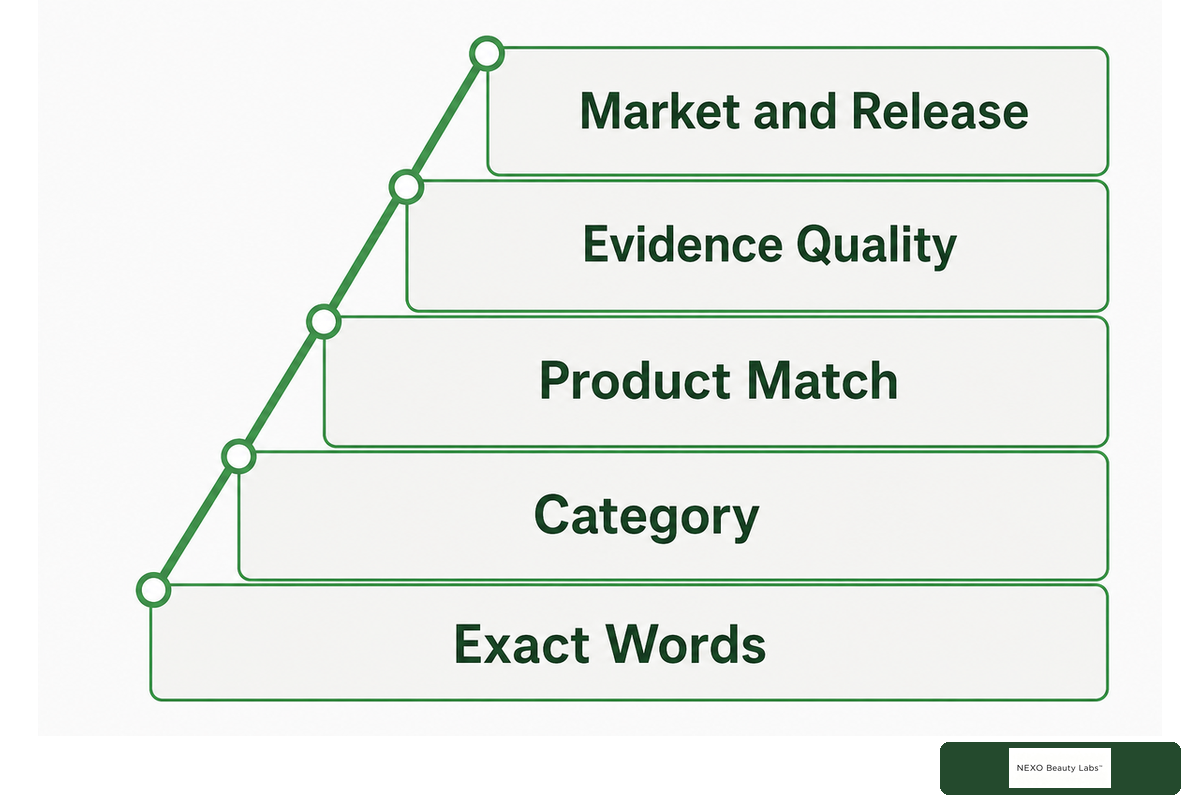
Identify the product category and the label side Responsible Person before assigning operational responsibilities in writing. For covered US cosmetics, FDA ties the Responsible Person to the manufacturer, packer, or distributor whose name appears on the label. Contracts can allocate work, but they do not rewrite that statutory identity.
Next, separate FDA product classification and MoCRA duties from the FTC standard for advertising. Intended use can be established through labeling, advertising, consumer perception, and ingredients with recognized therapeutic use. Meanwhile, an objective advertisement needs support that fits both its express words and the message consumers reasonably take away.
Evidence-before-Claim Ladder
Editorial tool: In the absence of a link in the lower rung, don’t use the ladder. The ladder is not legal advice, an approval path, or a substitute for market-specific review.
| Rung | Question | Required record | Stop condition | Owner |
|---|---|---|---|---|
| 1. Exact words | What will the pack, listing, and campaign actually say or imply? | Versioned claim register | Teams are reviewing different wording | Marketing |
| 2. Category | Could composition, representation, intended use, or therapeutic meaning change the federal path? | Classification review | Soap, cosmetic, and drug questions remain unresolved | Regulatory |
| 3. Product match | Does the evidence match the final formula, dose, use, pack, population, and outcome? | Evidence-to-claim map | Only an ingredient dossier or another formula was studied | QA + Regulatory |
| 4. Evidence quality | Is the method suitable and the conclusion no stronger than the result? | Study review with limitations | The design cannot support the promised endpoint | QA + Qualified reviewer |
| 5. Market and release | Are label identity, destination rules, records, artwork, and final product version aligned? | Approved release packet | Any market, version, or owner is still open | Brand + Regulatory + QA |
The FDA’s registration and listing page also warns against credential inflation: registration or listing does not indicate FDA approval, and FDA does not issue compliance certificates for cosmetic facility registration. Treat status records as due-diligence inputs, never as an endorsement.
For detailed claim planning, use the dedicated skin care claims substantiation guide. Requirements can also differ by state and destination market, so this federal overview isn’t a complete market-access map.
Which 2026 Body Wash Signals Are Worth Testing?
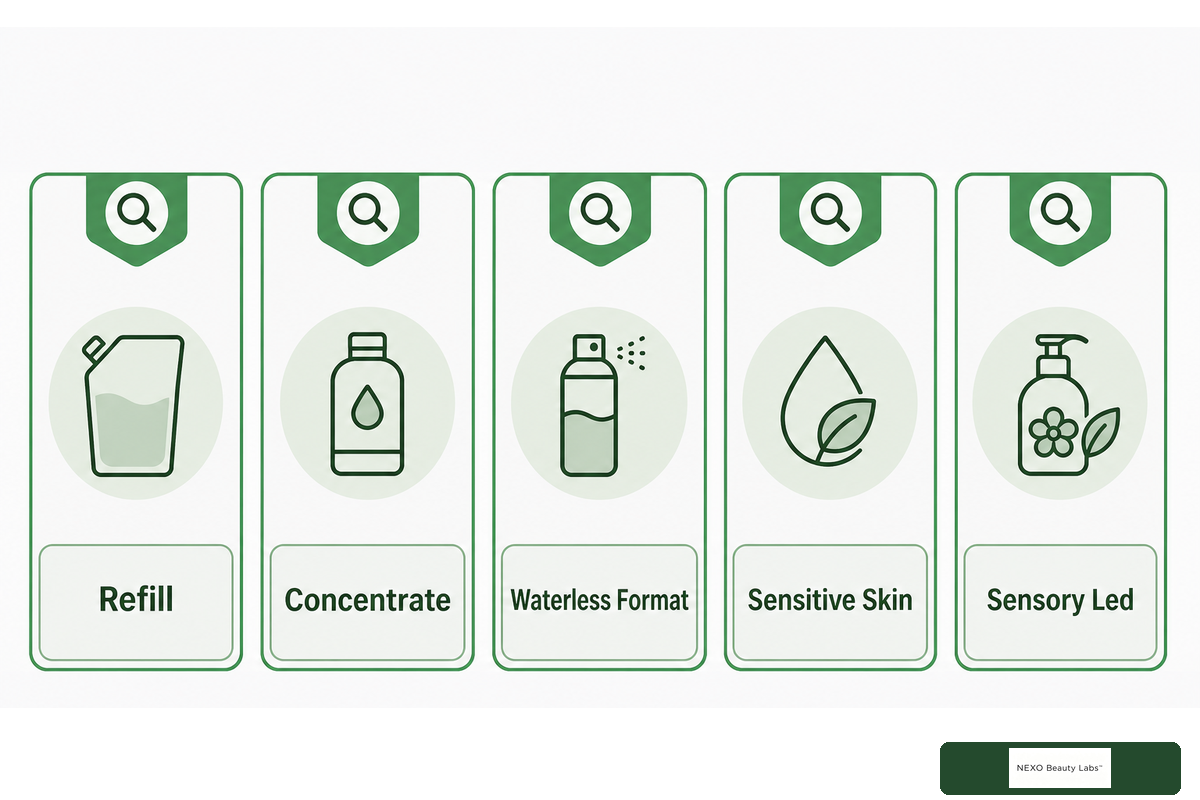
The ideas of refill, concentrate, waterless-format, sensitive-skin, and sensory-led are good starting points, but shouldn’t be expected to fulfill user demand. An example in trade can show that a format exists, however it can’t show if your audience will understand the instructions, accept the pack, buy the product, and view the proposed environmental wording as genuine.
Claim testing must be separate from format testing. The FTC’s substantiation guidance is the check on objective health-related wording; search interest or a competitor example is not claim evidence.
Treat each trend as a buyer-risk test: record the target user, supplier version, intended market, and package conditions before production, then define what failure would disqualify the idea.
Turn each trend into a falsifiable question:
- Will users dispense the intended amount without extra explanation?
- Does activation or dilution introduce a new quality, preservation, or misuse question?
- Can the pack protect the product and remain convenient in wet use?
- Does the claim describe the actual pack and collection in the real world, without overstating the benefit?
- Will the audience prefer the new format after the novelty effect fades?
A waterless concentrate, which is a different formula-and-pack system, that was reported in the packaging trade coverage is a dated example. It should prompt user, function, and claim testing, not a copy of the concept. Search data also indicates interest, and not purchase.
How Should You Evaluate a Private Label Body Wash Manufacturer?
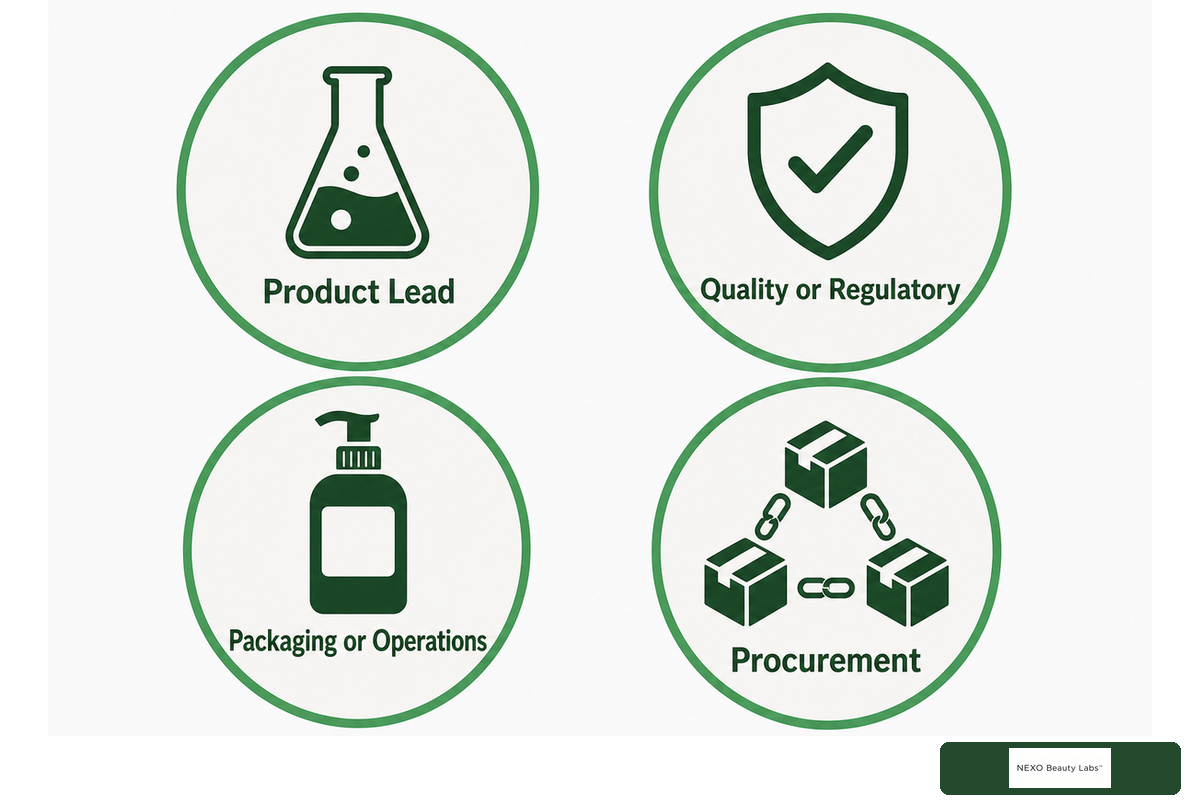
Compare a manufacturer by what it can show for the work within the specified scope. Don’t base the decision on the number of logos or on broad quality language. How are formula versions, components, specifications, deviations, test scopes, batch records, label roles, and changes controlled for your actual product and your destination market?
ISO 22716:2007 publicly covers cosmetic production, control, storage, and shipment. Their stated scope excludes research and development and the distribution of finished products. If a supplier refers to this standard, find out what site, what activities, what certification body, what dates, and what scope the evidence covers. Do not turn it into proof of product approval or total market eligibility.
| Buyer role | Ask for | Weak answer | Useful evidence |
|---|---|---|---|
| Product lead | Development route, sample coding, change process, and approval handoff | “We can make anything” | Versioned brief and sample history |
| Quality or regulatory | Applicable procedures, test scope, record custody, deviations, and release authority | A registration number presented as FDA approval | Current, scoped records and responsible owners |
| Packaging or operations | Component identity, material data, qualification, filling controls, and distribution assumptions | A reference bottle with no commercial part identity | Controlled bill of materials and test linkage |
| Procurement | Change notice, continuity, component status, and responsibility boundaries | Terms that depend on unnamed inputs | Written assumptions, owners, and exception process |
NEXO’s About Us page gives details regarding the company and its capabilities. As with any supplier, statements should be corroborated by the supplier’s latest project documentation before the buyer can consider them independent evidence.
What Must the Production Handoff File Control?
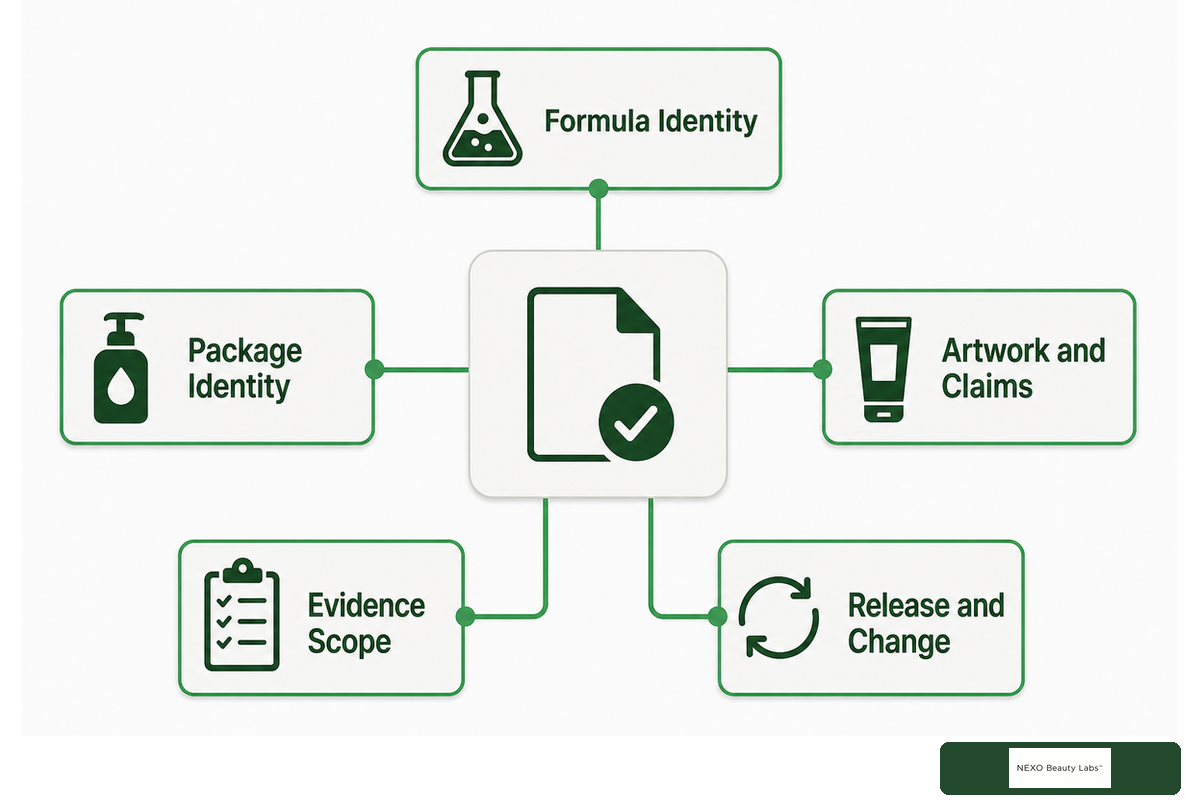
The approved sample must be associated with one controlled commercial identity: a specific formula version, raw material and fragrance references, packaging components, artwork, claims, evidence scope, specifications, and approved exceptions, as well as release authority and the change control process. If the team can’t identify the approved product, production won’t make the approved product.
The handoff sits within the production system, not outside it. ISO 22716’s public scope covers cosmetic production, control, storage, and shipment, while explicitly excluding research and development and finished-product distribution.
| Control | Minimum record | Reopen when |
|---|---|---|
| Formula identity | Approved code, revision, fragrance, color, and relevant processing assumptions | Any material, level, supplier, or process changes |
| Package identity | Container, closure, pump, liner, decoration, and ship configuration | A component, material, finish, or distribution condition changes |
| Artwork and claims | Approved label and digital wording tied to evidence | The claim, formula, audience, market, or evidence changes |
| Evidence scope | Protocols, versions, results, limitations, open issues, and owner | A change falls outside the reviewed scope |
| Release and change | Specifications, decision authority, deviation path, and notification rules | A result misses the rule or an unapproved change appears |
Keep “requested for production” separate from “released.” The first confirms what the buyer wants made. The second confirms that the produced lot met the approved release criteria within the recorded scope. Merging these decisions obscures gaps and weakens traceability.
Frequently Asked Questions
What information should I send before requesting a body wash sample?
Send the intended user and routine, development route preference, format, sensory priorities, fragrance direction, package idea, destination market, exact claim direction, and known constraints. Indicate undecided elements. A sample briefing should cover required outcomes, references, and preferences, instruct the supplier where requirements are established, show what remains flexible, and identify which evidence questions must reopen.
Can a manufacturer’s existing test data support my branded body wash?
Possibly, but I’ll first need to check what formula, package, method, storage condition, use pattern, audience, market and claim the data pertains to. A change in fragrance, component, formula, or wording may reduce transferability or require new work. Request a written gap review as opposed to thinking that evidence from a base formula would suffice for all the adapted branded versions.
Does an FDA registration number prove a body wash is approved?
No. FDA states that cosmetic facility registration and product listing do not indicate product approval, and it does not issue compliance certificates for cosmetic facility registration. Review those records only for their stated status and scope. Manufacturer evaluation still needs product-specific quality, evidence, responsibility, and change-control records, as well as the applicable market review.
Does low pH prove a body wash is mild?
No. Formula, surfactant system, use, exposure, population, and evidence are all factors. Record pH as one attribute; keep sensory review and mildness claims in their respective evidence lanes.
Can I approve packaging after I approve the formula?
Yes. You can sequence decisions, but final approval should cover the intended formula-package-use system. Dispensing, leakage, contact materials, wet handling, transport, and storage should be reviewed. A reference bottle doesn’t qualify the final filled unit.
Who should sign off on a private label body wash?
The brand’s product owner should approve brief and sensory targets; quality or regulatory should review evidence, label identity, claims and release rules; packaging or Operations should approve component identity, filled unit function, and distribution assumptions. Procurement may own supply continuity and change notice. The statutory Responsible Person and destination market duties must be identified separately from this internal chart, and unresolved scope should remain a hold rather than an assumed approval.
Turn the Guide Into a Reviewable Body Wash Brief
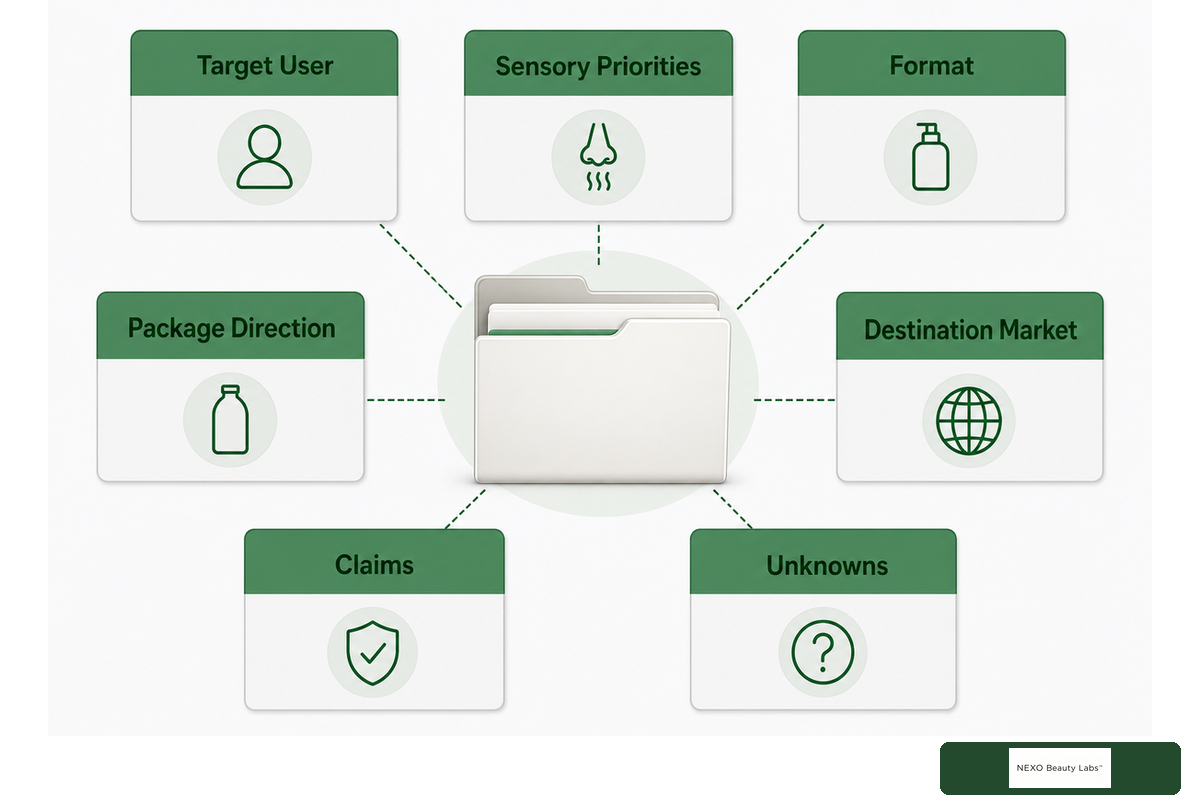
Show the target user, sensory priorities, format, package direction, destination market, and claims. Show the unknowns. NEXO can then review the project scope against a defined decision trail rather than an undefined product reference.
How This Guide Was Built
The research method for this guide combines live search-intent review, first-party page mapping, FDA and FTC guidance, public ISO scopes, technical formulation and packaging sources, one limited first-hand failure signal, and independent adversarial evidence checks. The three named tools are original editorial frameworks. They do not certify a product, replace qualified advice, or report results for a NEXO formula.
References & Sources
- U.S. FDA, Is It a Cosmetic, a Drug, or Both? (Or Is It Soap?)
- U.S. FDA, Modernization of Cosmetics Regulation Act of 2022
- U.S. FDA, Registration and Listing of Cosmetic Product Facilities and Products
- U.S. FDA, Product Testing of Cosmetics
- U.S. FTC, Health Products Compliance Guidance
- ISO, ISO 11930:2019 public scope
- ISO, ISO 17516 public scope
- ISO, ISO/TR 18811 public scope
- ISO, ISO 22716:2007 public scope
- PubMed, Self-perceived sensory responses to soap and synthetic detergent bars
- Cosmetics & Toiletries, Effect of perfumes on surfactant-system viscosity
- Packaging Digest, Shower-use pump package case
Why beauty brands work with NEXO
About NEXO Beauty Labs Manufacturing Support
NEXO Beauty Labs supports skincare, body care, sun care, hair care, and private label brands with formulation, sampling, filling, quality control, and export-ready launch support.
Project Review Before RFQ
Before quotation, we help clarify product category, active direction, formula stage, package choice, compliance market, MOQ, sampling schedule, and required documents.
Request a Cosmetic QuoteCompany Profile // Data Sheet
CompanyNEXO Beauty Labs
Business TypeCosmetic OEM / ODM manufacturing partner
Main ProductsPrivate label skincare, facial serums, moisturizers, cleansers, sunscreen, body care, and hair care products
Manufacturing CapabilityFormula development, sample adjustment, package sourcing, filling, QA/QC, documentation, and export support
RFQ Data NeededProduct type, formula goal, package format, target market, MOQ, claims, timeline, and benchmark samples
Websitenexobeautylabs.com