Get in touch with NEXO Beauty Labs Company


Private Label Hand & Foot Care: A Practical Development Guide

Private Label Hand & Foot Care is often underestimated. At first glance, the range may appear to need only a hand cream, a foot cream, and attractive packaging. However, the category covers distinct zones of use, friction, residue, application, packs, claims, and validation questions. Grouping them under one general moisturizing concept pushes critical decisions to the sample stage, so each use zone, format, pack, claim, and acceptance path must be separated in the brief.
This guide is for teams turning an early idea into a controlled development brief. Instead, it shows how to decide who the product is for, where and when it is used, what experience it must create, what the pack must do, what evidence supports the claim, and who owns each approval. For a private label foot care project, the care line is easier to govern when each SKU has a distinct use moment, product format, and acceptance path.
Why Should Hand and Foot Care Start with Use Zone and Context?
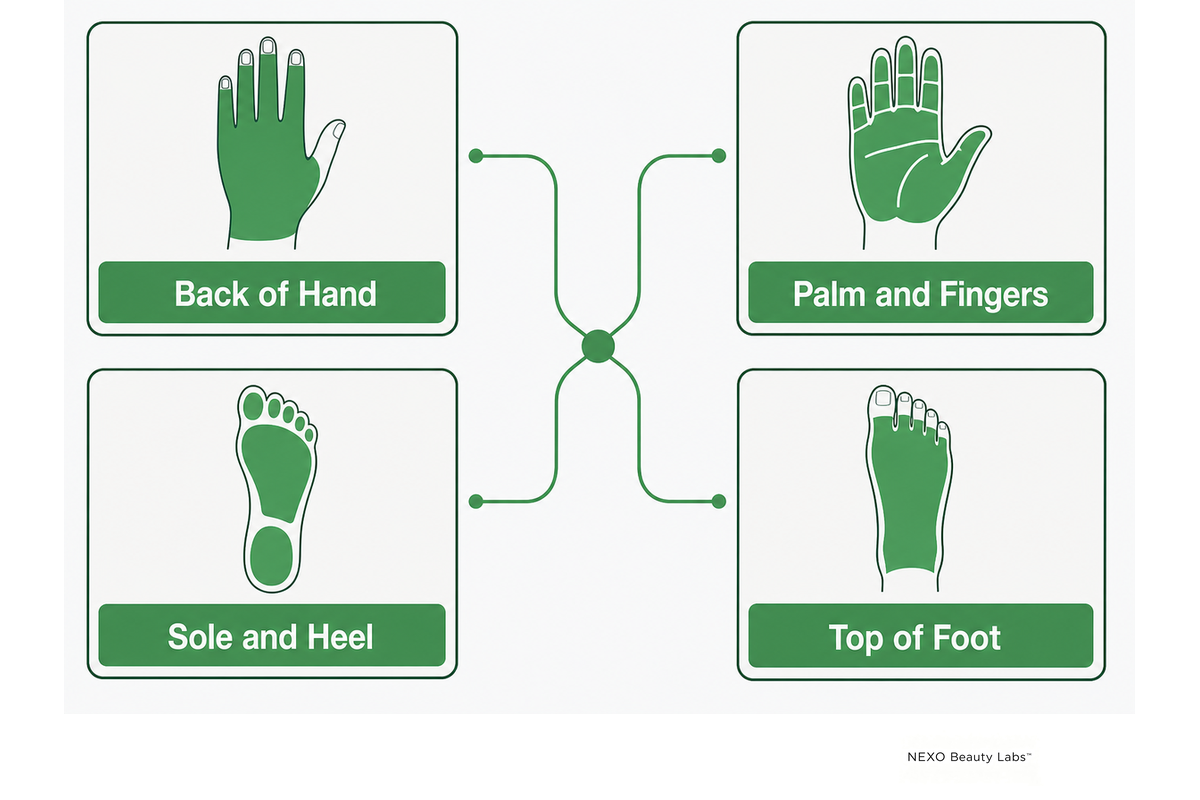
Hands and feet are not uniform development categories. The back of the hand, palm, top of the foot, and sole differ in structure and in how they are exposed, covered, washed, gripped, and walked on. A study comparing palm, sole, and hip skin supports a site-specific brief rather than a generic “dry hands and feet” brief (PubMed: palm, sole, and hip skin study).
Daytime hand products may be applied after washing, followed immediately by typing, driving, or handling tools. A nighttime hand mask allows a longer contact period and may require the use of gloves. Plantar foot creams may be used before socks or bed. Products meant for the top of the foot may require a lighter formulation that may be used with shoes that have an open design. A useful output here is not a biological rule. It describes contextual features meant to influence the target experience.
| Use zone or context | Questions to resolve | Common approval risk |
|---|---|---|
| Back of hand, daytime | How soon must normal activity resume? How much sheen is acceptable? | A rich sample is praised in a meeting but rejected in real use. |
| Palm and fingers | Will grip, touchscreens, tools, or repeated washing matter? | “Nourishing” is approved without a residue limit. |
| Sole and heel | Is the product used before socks, sleep, or walking? Is slip a concern? | Foot feel is assessed on the arm rather than the intended site. |
| Top of foot | Is the finish visible? Will footwear rub the area? | One foot brief ignores different contact and cosmetic expectations. |
A useful output is not a biological statement. It is a series of assumptions that define the use zone, time of day, dose, contact time, exposure conditions, washing frequency, extent of friction, coverage, acceptable residue, and even how packs are handled. Those assumptions make later sensory and validation decisions testable. For example, if an internal method records observations at 30 sec and 10 min, a buyer and supplier development team can expose the risk of a product that fails after normal handling even though its first impression looked acceptable.
What Belongs in the Hand-vs-Foot Brief Map?
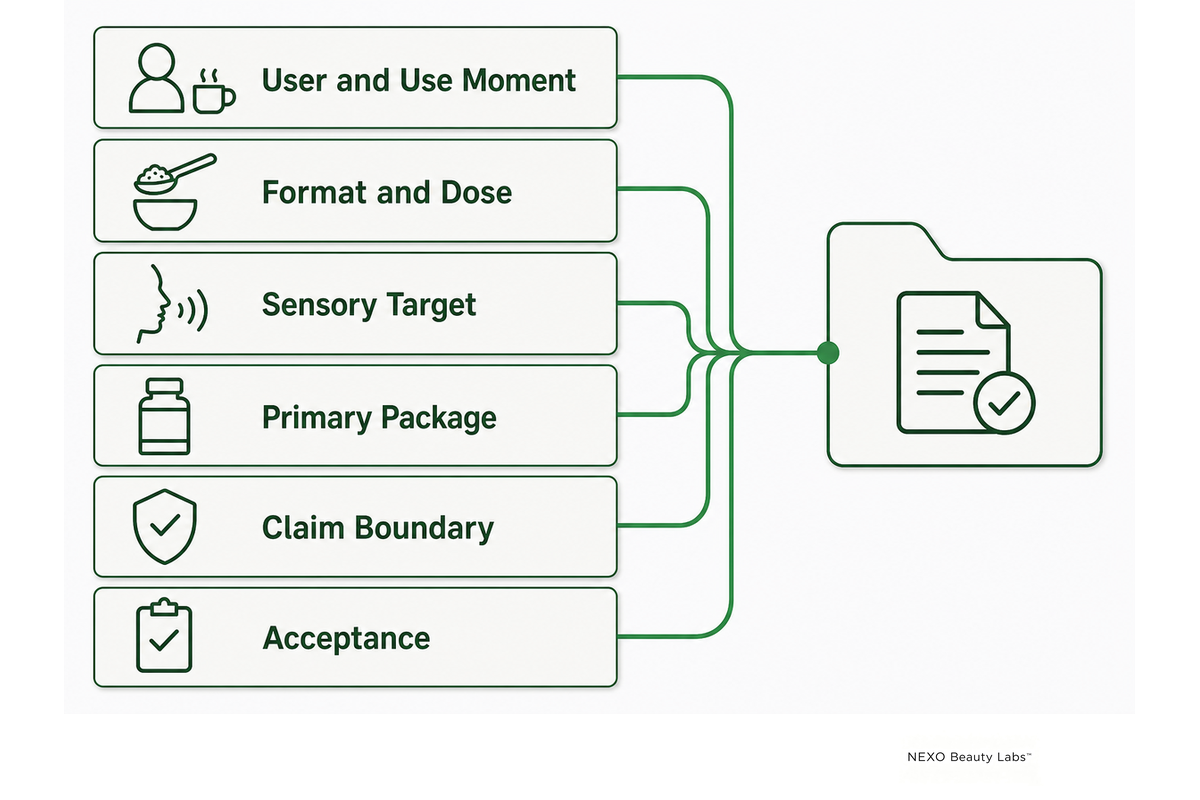
Connect the consumer proposition to an observable acceptance decision. The Hand-vs-Foot Brief Map below is an editorial planning tool, not an industry standard. Give every field an owner. Use the map to replace one poetic description with a controlled product definition. FDA explains that cosmetic firms must substantiate product safety and that testing needs depend on the product (FDA: Product Testing of Cosmetics).
| Brief field | Hand SKU decision | Foot SKU decision | Owner |
|---|---|---|---|
| User and use moment | For example, desk-side reapplication after washing | For example, evening heel care before socks | Brand/product |
| Format and dose | Cream, serum, mask, or stick; target amount | Cream, mask, peel, balm, or stick; target amount | Product/development |
| Sensory target | Spread, absorption window, tack, film, finish | Coverage, cushion, slip, residue, after-feel | Product/consumer research |
| Primary package | One-hand use, portability, contamination exposure | Controlled dose, application hygiene, barrier or kit parts | Packaging/operations |
| Claim boundary | Exact cosmetic wording and required evidence | Exact wording; escalation for disease or treatment language | Marketing/regulatory |
| Acceptance | Named conditions, scale, threshold, comparison | Named site, conditions, stop criteria, comparison | Cross-functional approvers |
Note: Complete separate versions of the map for each SKU. Although a hand cream and a foot cream may share some elements of the base architecture, this shouldn’t be understood to grant the right to merge elements of intended use, sensory, package, claim, or approval. If a field is unassigned, it shouldn’t be understood to represent a decision. During a buyer-supplier review, the map prevents the mistake of treating a 2 min hand check and a 10 min foot check as equivalent production evidence.
Cream, Mask, Peel, or Repair Stick: Which Format Fits the Job?
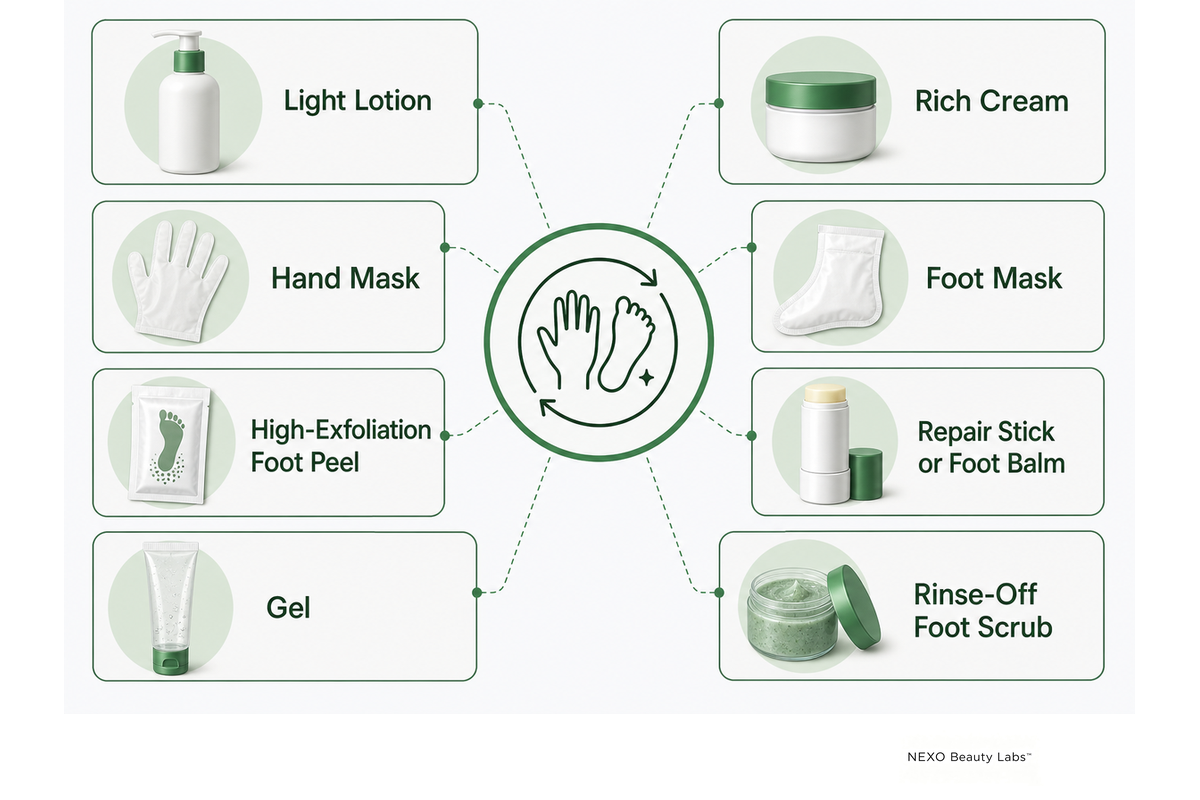
No format is inherently better. Choose the format whose delivery pattern fits the promised routine and whose risks the team can control. Product names do not settle regulatory status; in the U.S., intended use and associated claims can place a product in the cosmetic, drug, both, or another regulatory category (FDA: Cosmetics & U.S. Law).
Portfolio rule: add a format only when it performs a distinct user job. “More SKUs” is not a strategy if the use moment, sensory target, pack behavior, and claim are duplicates.
| Format type | Useful when | Briefing questions | Watch-outs |
|---|---|---|---|
| Light lotion | Frequent application and a quick return to activity matter | Flow, spread, finish, reapplication, dispensing | Light feel is mistaken for low performance |
| Rich cream | Coverage and a more persistent film fit the routine | Pickup, cushion, absorption, transfer, pack | “Rich” has no observable acceptance definition |
| Hand mask | A contained hand ritual and contact period are central | Fit, fill distribution, closure, dexterity, removal | Formula, wearable, and pouch are evaluated separately |
| Foot mask | The routine calls for contained coverage over the foot | Fit range, leakage, walking instructions, removal, residue | Slip and misuse conditions are left undefined |
| High-exfoliation foot peel | The proposition genuinely needs an acid-led exfoliation routine | Exposure, instructions, warnings, misuse, claim wording, evidence | Handled as a moisturizing mask with stronger copy |
| Repair stick or foot balm | Targeted, low-mess application and portability matter | Payoff, drag, temperature behavior, cap cleanliness, dose | Hardness approved without hot/cold or repeated-use observation |
| Gel | Slip, cooling perception, or a lighter visual language fits the job | Pickup, rub-in, film, pilling, dispenser behavior | A visual cue is treated as proof of a benefit |
| Rinse-off foot scrub | Mechanical exfoliation belongs in a wash-off routine | Particle feel, rinse, cleanup, drain and package use | Pressure and frequency are missing from directions |
| Soak or bath additive | The product belongs in a water-based ritual | Dose communication, dissolution, vessel, cleanup, claims | Use concentration and consumer interpretation are vague |
A high-exfoliation peel deserves its own path. FDA notes that the safety considerations for alpha hydroxy acid products depend on factors including acid type, concentration, pH, and formulation, and it discusses sun-sensitivity precautions (FDA: Alpha Hydroxy Acids). It should not be assumed that an acid peel is a higher strength version of a moisturizing sock mask. Its exposure, directions, warnings, claims, consumer understanding, and review expertise should be separately defined. If an internal comparison uses 5 min and 20 min observation points, the review record should separate format-specific risks and failures.
How Should Teams Describe Texture, Absorption, and After-Feel?
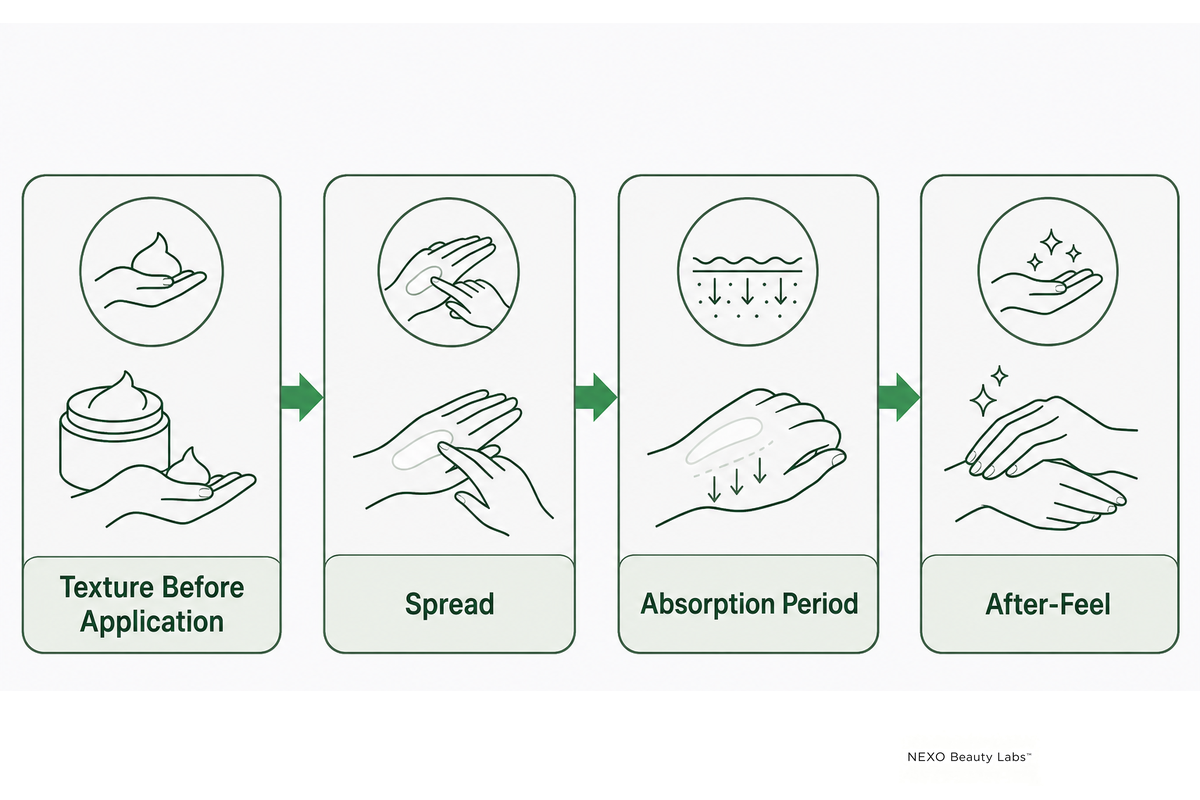
Replace adjectives with observation conditions. “Luxurious,” “fast absorbing,” and “not greasy” can be useful creative goals, but different reviewers interpret them differently. Formal sensory guidance such as ASTM E1490-19 describes structured approaches for skin creams and lotions, while ISO 13299:2016 provides general guidance for creating a sensory profile. A brand does not need to pretend that its internal scorecard is either standard; it can borrow the discipline of defined attributes, conditions, scales, and references.
- Texture before application: Take note of pickup, shape retention, stringiness, grain, cushion, and visible separation before application.
- Spread: define dose, site, number or duration of strokes, drag, coverage, and whitening.
- Absorption period: define when observations occur rather than using an unmeasured “instant” claim.
- After-feel: score tack, slipperiness, film, powderiness, softness, sheen, and transfer at named time points.
The intended site should be used. Spreadability methods for topical semisolids can produce different results depending on the method and conditions, which is another reason to record how a conclusion was reached (comparative review of spreadability methods). A heel balm judged from a jar and a cream tested only on the forearm are not real acceptance tests.
Use a consistent team of trained internal reviewers to give consistent feedback. Add suitable consumer work where needed when a claim or decision needs support. Do not average contradictory comments until the team checks whether dose, site, timing, climate, or comparator changed. Because a 30 sec first impression and a 10 min after-feel answer different questions, a qualified review panel should use explicit acceptance criteria and applicable guidance to reduce the risk of a false pass.
How Do Ingredient Roles Become a Formula Architecture?
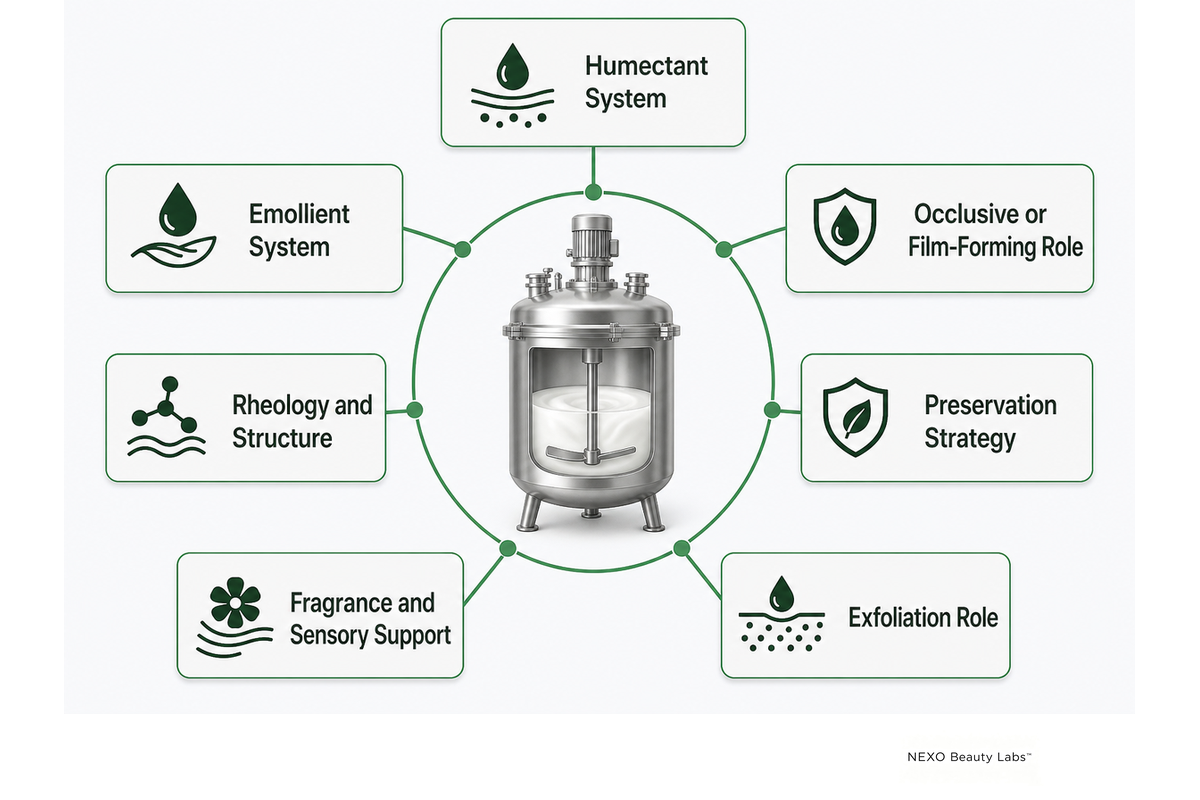
Begin with functions, not a hero-ingredient list. A care formulation should connect every role to a target, tradeoff, and evaluation. Map active ingredients against the identified formula and component set. Do not assess a role as an isolated ingredient claim. Moisturizer literature describes how humectants, emollients, occlusives, and vehicle interactions shape the finished system (review of cosmetic moisturizer vehicles). For a brand brief, a role map is more useful than a percent-free recipe.
| Role | Development question | What not to assume |
|---|---|---|
| Humectant system | What hydration-related experience and environmental use are intended? | One named humectant proves a finished-product claim. |
| Emollient system | What spread, cushion, slip, and finish are needed? | One named butter automatically creates better foot care. |
| Occlusive or film-forming role | How much protective film and residual feel are acceptable? | Maximum occlusion is appropriate for daytime hands. |
| Rheology and structure | How must the product pick up, pump, hold, and recover? | Jar texture predicts pump or tube performance. |
| Preservation strategy | What formula, pack, process, and in-use exposure must be considered? | A preservative name replaces product-specific evaluation. |
| Fragrance and sensory support | What intensity, persistence, positioning, and market constraints apply? | Masking base odor and creating a signature are the same task. |
| Exfoliation role | Is the goal cosmetic smoothing, a rinse-off scrub, or a higher-exposure peel? | All exfoliating formats share one safety and claim route. |
Each of the different functions should lead to a target, constraint, and evaluation. If marketing asks for “deep repair,” development needs the exact cosmetic meaning and regulatory review before translating it into a formula target. If the brand requests a lighter finish, packaging still has to confirm that the new viscosity and structure work with the selected dispenser. In a buyer-supplier sample review, comparing 0.20 g over 20 cm² can reveal the risk that an ingredient story passes while the finished formula fails the intended sensory target.
How Does the Format-to-Pack Risk Register Prevent Late Surprises?
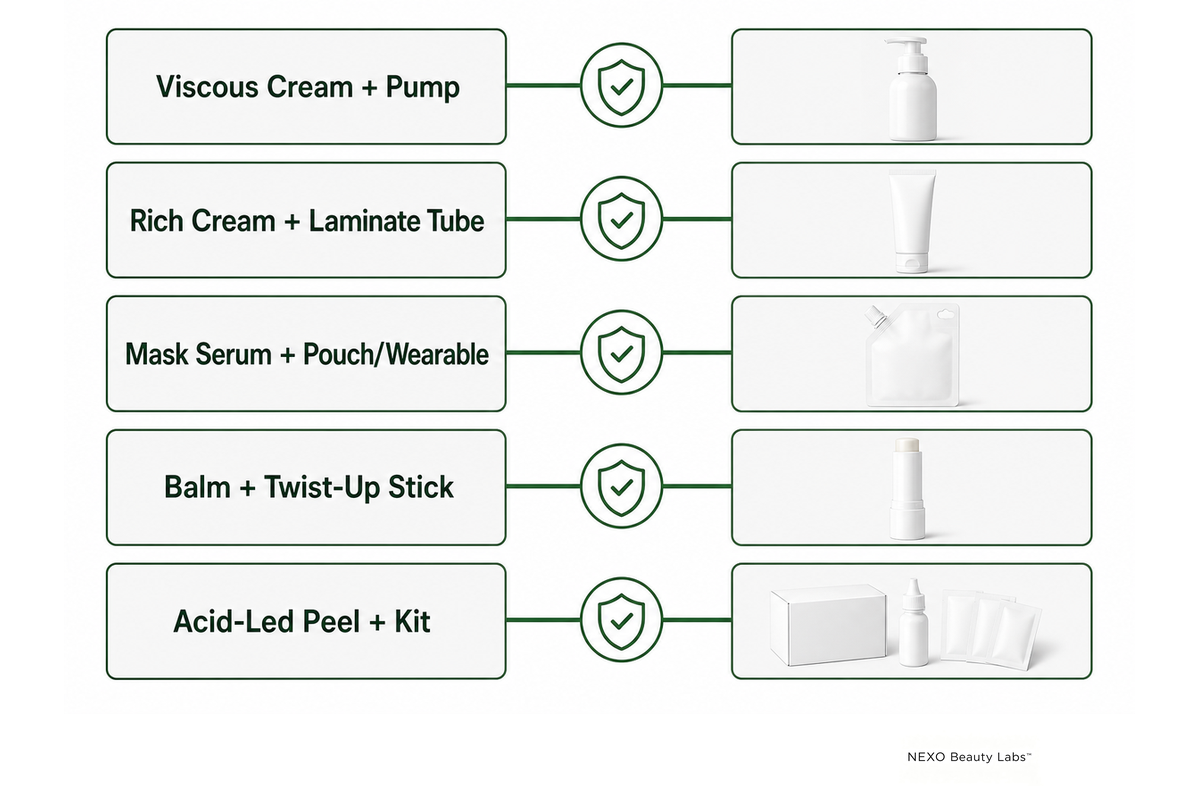
Plan packaging before formula approval because the pack affects product performance. Compatibility work should examine interaction, leakage, deformation, corrosion, color or odor change, dispensing, sealing, transport, and storage under defined conditions (overview of cosmetics packaging testing). Because cosmetics vary widely, stability guidance cautions against assuming one condition or acceptance criterion fits every category (ISO/TR 18811:2018).
The Format-to-Pack Risk Register is an editorial decision tool, not a test standard.
| Format-pack pair | Failure question | Evidence or observation | Decision owner |
|---|---|---|---|
| Viscous cream + pump | Can the system prime, dose, and evacuate across expected conditions? | Dose consistency, priming, residual product, actuator behavior | Packaging + development |
| Rich cream + laminate tube | Do formula, laminate, shoulder, seal, and cap remain compatible? | Leakage, paneling, seal integrity, appearance, dispensing | Packaging + quality |
| Mask serum + pouch/wearable | Does the system contain and distribute the fill through storage and use? | Seal, migration, leakage, fill uniformity, fit, removal | Packaging + product |
| Balm + twist-up stick | Does payoff stay usable after temperature and repeated-use exposure? | Drag, breakage, sweating, retraction, cap cleanliness | Development + operations |
| Acid-led peel + kit | Can materials, instructions, dose, and exposure be controlled as one system? | Compatibility, containment, labeling, misuse review | Regulatory + packaging |
Record severity, likelihood, detectability, mitigation, test or review method, acceptance criteria, owner, and status. Where additional detail is required, use a dedicated cosmetic packaging compatibility testing guide. Don’t reduce the decision to “the bottle looks right.” If an internal plan checks a pump after 1 day and 7 days, the team should document every leak, dispensing failure, and qualified acceptance decision because appearance alone cannot resolve compatibility risk.
Which Risk and Validation Questions Belong Before Approval?
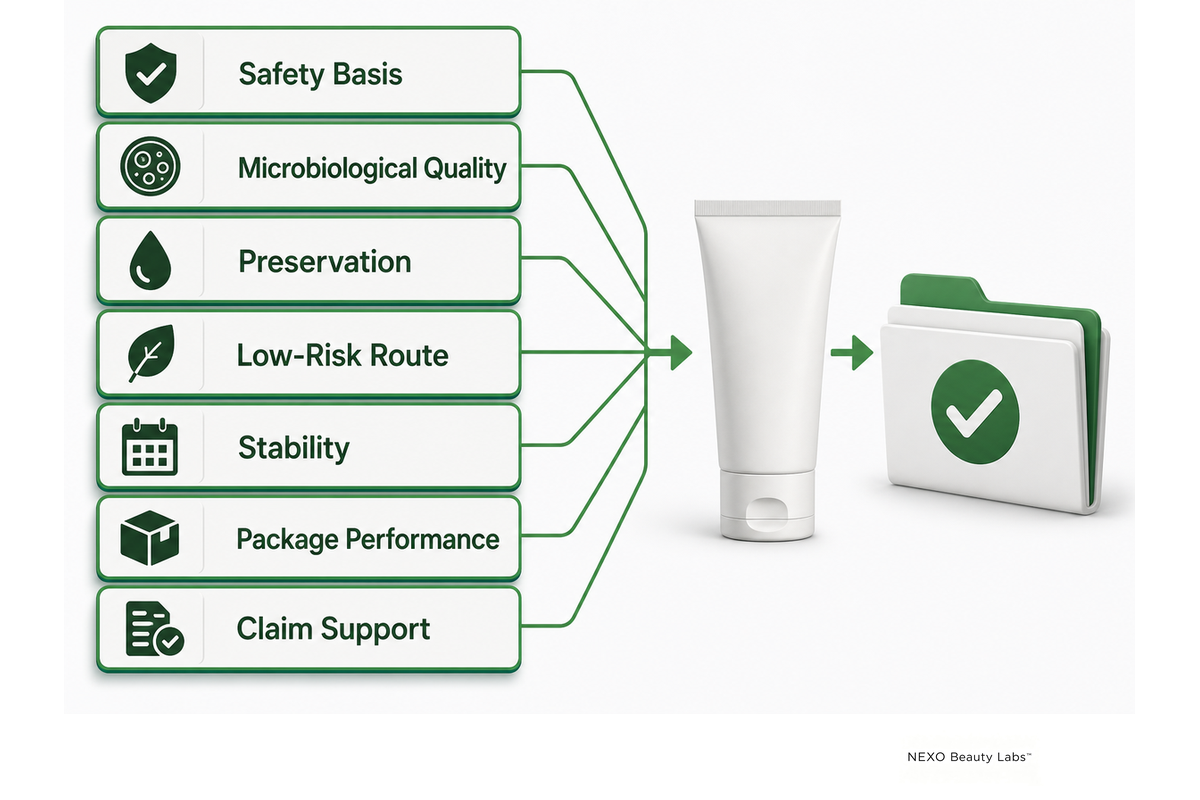
Do not ask which standard tests every product. Ask which evidence fits the intended use, formula, pack, process, market, and claim. FDA says manufacturers may use relevant safety data and testing, while companies remain responsible for product safety (FDA: Product Testing of Cosmetics). Because validation risk changes with intended use, a qualified reviewer should confirm applicable regulatory requirements, the FDA or ISO basis, protocol conditions, acceptance criteria, product version, and decision owner.
“Neither the law nor FDA regulations require specific tests to demonstrate the safety of individual products or ingredients.”
- Safety basis: What ingredient, exposure, finished-product, and historical information supports the intended conditions of use?
- Microbiological quality: What specifications and controls are appropriate? ISO 17516:2014 addresses microbiological limits for cosmetics.
- Preservation: Does the product require evaluation of antimicrobial protection, and what protocol and acceptance criteria apply? ISO 11930:2019 is one relevant published standard.
- Low-risk route: Is there a documented basis to identify the product as microbiologically low risk? ISO 29621:2017 provides risk-assessment guidance; “low risk” should be concluded, not casually declared.
- Stability: Which physical, chemical, microbiological, sensory, and functional attributes are monitored under which conditions? See this cosmetic stability testing guide for the planning logic.
- Package performance: Will filling, sealing, storage, transport, dispensing, and repeated use affect the formula or component?
- Claim support: What exact wording will appear, what’s the appropriate evidence, and is the evidence connected to the finished product and intended use?
For each activity, provide the version, protocol, conditions, measurements, acceptance criteria, the laboratory or reviewer, deviations, and approval owner. A test name without the decision it supports isn’t a validation plan.
How Should a Fixed-Condition Sample Review Be Recorded?
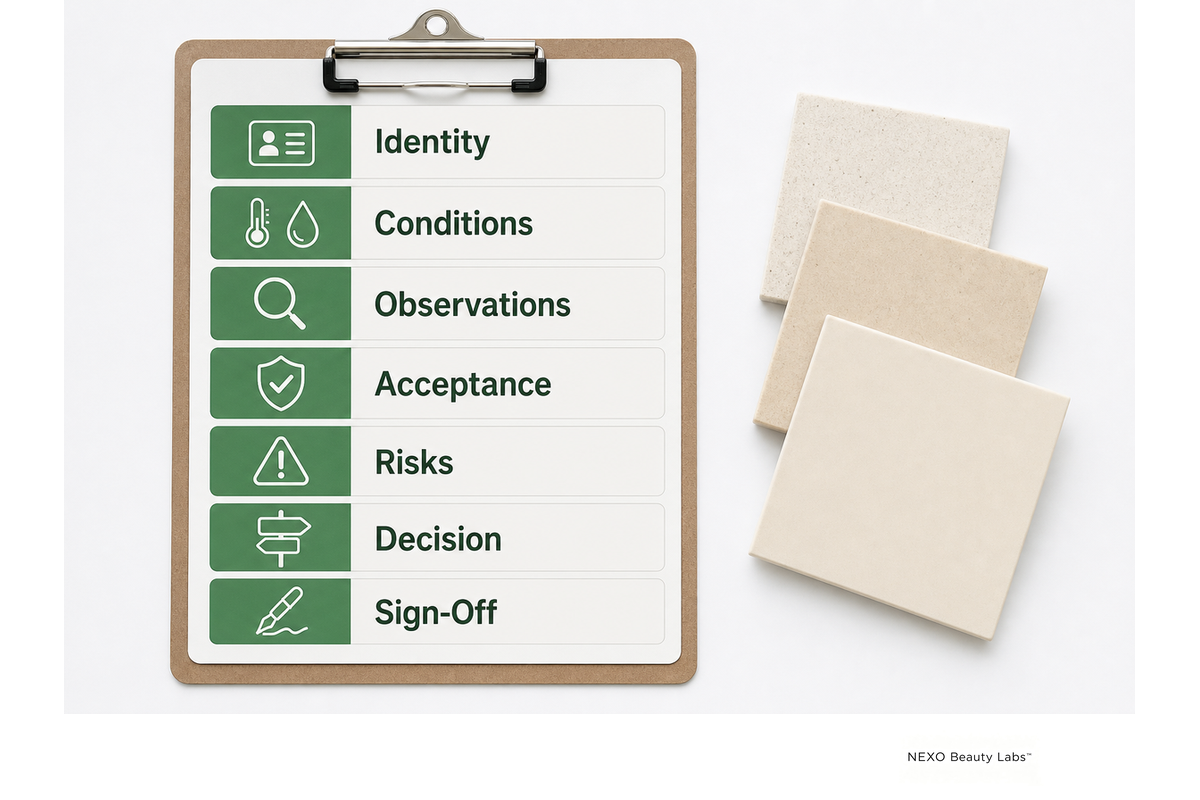
“Everyone liked sample three” is not an approval record. Structured sensory methods emphasize defined attributes and consistent assessment, and ASTM notes that more than one descriptive approach can be used for creams and lotions (ASTM E1490-19). It is not necessary to transform every brand meeting into a sensory analysis laboratory. The goal is comparable, traceable internal feedback.
Fixed-Condition Sample Acceptance Scorecard: identify the sample; fix the dose, site, timing, and environment; score observable attributes; record deviations and open risks; then capture approve, revise, or stop with named owners.
The rows below show an example of how detailed a comparison worksheet can be. Each number is an example, not a recommended specification, safety test, protocol, or claim study. Replace each value with justified conditions for the SKU and decision.
| Illustrative review type | Fixed-condition placeholder | Observation points |
|---|---|---|
| Day hand cream | 0.20 g over 20 cm² at 22°C in a controlled relative-humidity setting | 30 sec, 2 min, and 10 min |
| Palm-use cream | 0.15 g over 15 cm² at 22°C in a controlled relative-humidity setting | 30 sec, 2 min, and 10 min |
| Heel cream | 0.30 g over 25 cm² at 22°C in a controlled relative-humidity setting | 30 sec, 2 min, and 10 min |
| Dorsal-foot lotion | 0.20 g over 20 cm² at 22°C in a controlled relative-humidity setting | 30 sec, 2 min, and 10 min |
| Hand mask | 10 min contact at 22°C | 20 min exception check; a 5 sec removal note; component mass recorded to 0.1 g |
| Repair stick | 0.10 g over 10 cm² at 22°C in a controlled relative-humidity setting | 30 sec, 2 min, and 10 min |
| Record field | Example of sufficient detail |
|---|---|
| Identity | Formula version, batch or sample code, pack/component version, date received |
| Conditions | Intended use zone, defined dose, skin preparation, time points, room conditions |
| Observations | Pickup, spread, whitening, absorption, tack, film, slip, scent, visible change |
| Acceptance | Attribute scale, target range, unacceptable conditions, comparator if used |
| Risks | Unresolved package, stability, safety, claim, scale-up, or instruction questions |
| Decision | Approve for next defined stage, revise named attributes, or stop pending evidence |
| Sign-off | Product, quality, packaging, marketing/regulatory, and final decision owner as relevant |
Do not change multiple variables and consider the next sample a small improvement. If fragrance, viscosity, pack, and direction of claim all changed, capture the change set and assess the impact again on the evidence. This is how a scorecard becomes change control instead of meeting notes. The practical risk is approving a sample at 2 min that fails the same acceptance criteria at 10 min because the review conditions changed.
Where Is the Cosmetic Claim Boundary for Foot and Hand Products?
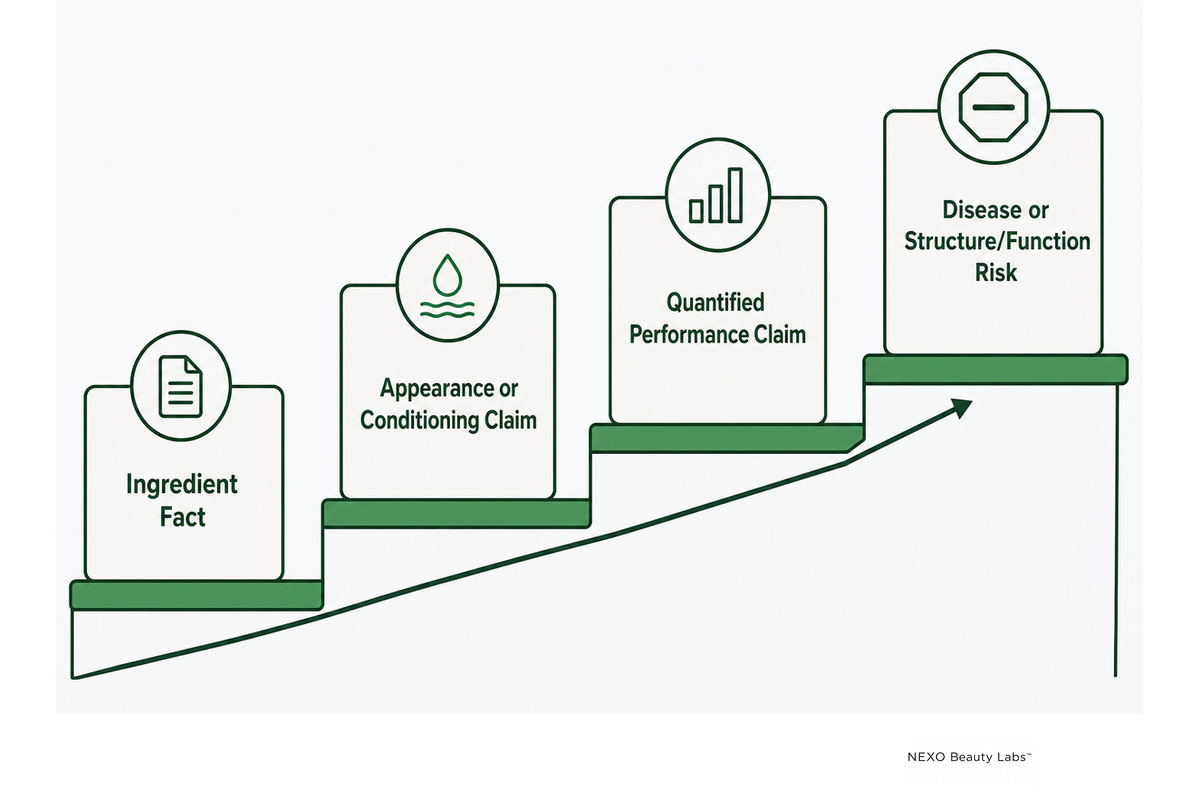
Claim review begins with exact words in context. Per U.S. law, products intended to diagnose, cure, mitigate, treat, or prevent disease—or affect the structure or function of the body—may be drugs, even when marketed in a beauty setting (FDA: Cosmetics & U.S. Law). The FTC would expect health-related advertising claims to be truthful, not misleading, and adequately substantiated (FTC Health Products Compliance Guidance).
The Cosmetic Claim Boundary Ladder is an editorial triage tool. It’s neither legal advice nor a regulatory classification standard:
- Ingredient fact: states a present ingredient or characteristic of the product. It can’t imply an unsupported outcome.
- Appearance or conditioning claim: describes cosmetic effects such as helping skin feel softer or look smoother, with suitable support for the exact wording.
- Quantified performance claim: states a number, duration, comparison, or measured result. This claim requires claim-appropriate substantiation that is aligned with the product, exact wording, context, and the use it is marketed for.
- Disease or structure/function risk: A disease risk claim or structure/function claim references treatments, prevention of, healing, infection, athlete’s foot, diabetic foot issues, or change in body structure or body function. Stop using a routine copy and instruct a qualified reviewer to check the pathway.
Ingredient reputation is not finished-product substantiation. A study on one ingredient, dose, population, or delivery system may not prove the claim for a different finished formula. Create a claim-evidence table with the exact claim, channel, market, product version, study or support, limitations, status of approval, and owner. The same principle applies in this guide to skincare claims substantiation. In a buyer-supplier review, a 1 day appearance claim and a 30 day performance claim present different overclaim risk; each can fail unless the qualified reviewer connects the exact wording to finished-product evidence and the applicable FDA or FTC framework.
Who Owns Which US Market Responsibilities?
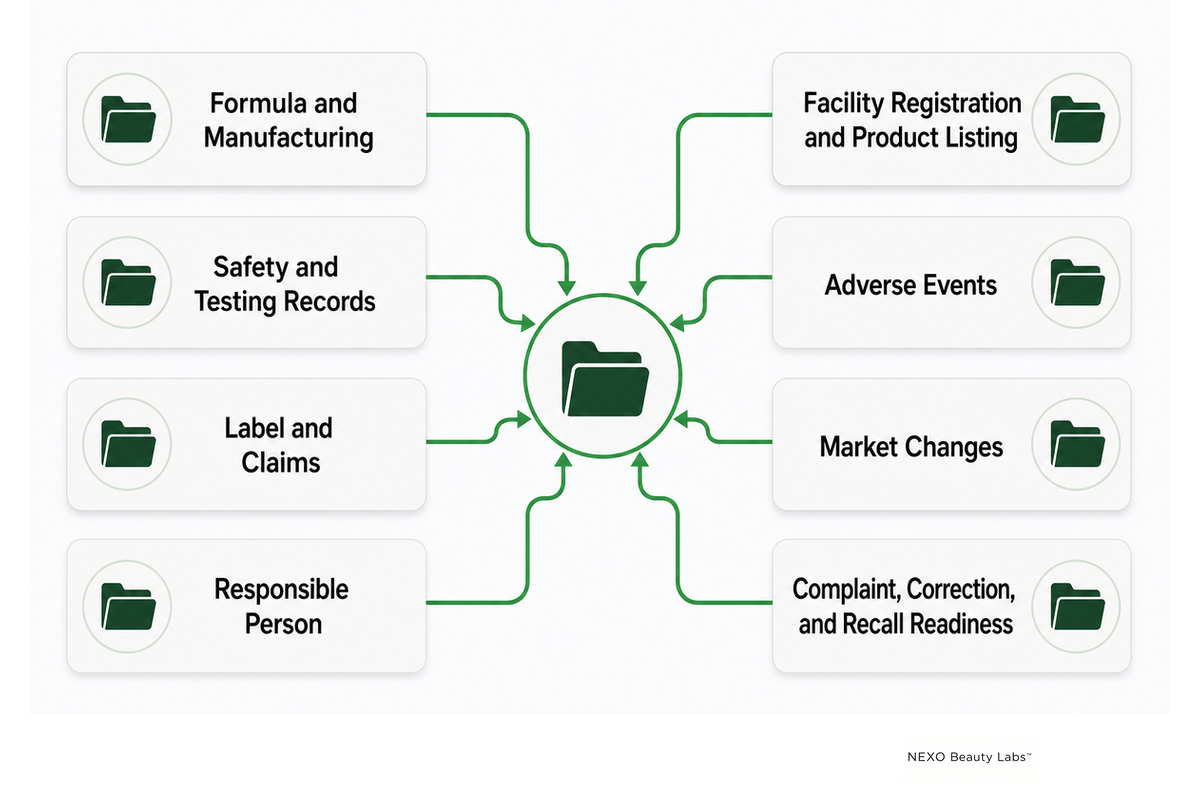
Do not write “the manufacturer handles compliance” as a catch-all. Whether the brand name appears on a label, what each party’s actual role is, and what applicable law requires determines statutory duties; a contract can assign operational responsibility but does not replace those duties. MoCRA added or expanded requirements involving facility registration, product listing, safety substantiation records, serious adverse event reporting, good manufacturing practice rulemaking, and other areas (FDA: MoCRA overview).
| Workstream | Questions to assign in writing |
|---|---|
| Formula and manufacturing | Who controls specifications, batch records, deviations, release, and change notification? |
| Safety and testing records | Who commissions, owns, retains, reviews, and can access the evidence? |
| Label and claims | Who approves identity, net contents, warnings, directions, contact details, and every marketing claim? |
| Responsible Person | Whose name appears on the label and who performs the duties attached to that role? |
| Facility registration and product listing | Which entity files, maintains, updates, or confirms applicable exemptions? |
| Adverse events | Where can consumers report? Who triages, investigates, preserves records, and handles time-bound serious-event reporting? |
| Market changes | Who reviews formula, supplier, pack, artwork, claim, or market changes before implementation? |
| Complaint, correction, and recall readiness | Who receives signals, investigates them, decides corrective action, preserves records, and coordinates any market response? |
For the applicable presentation requirements, consult FDA’s labeling resources. (Cosmetics Labeling Guide). The responsible party and the record owner must be named in the contract and the handoff file. “Shared” without a lead, due date, escalation route, and accessible documentation is an unassigned task. When a safety record is unresolved, name a qualified escalation owner and a project-defined response window rather than let the issue fail between functions.
Which 2026 Hand-and-Foot Signals Are Worth Testing?
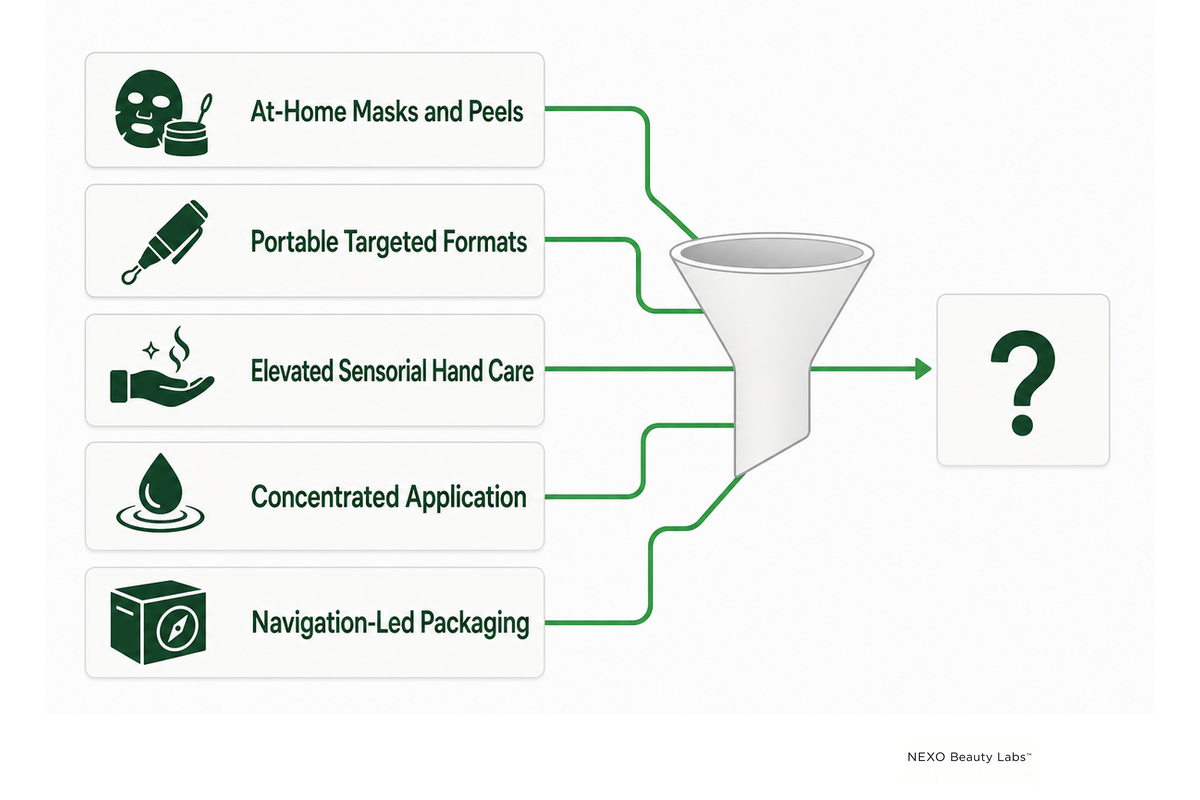
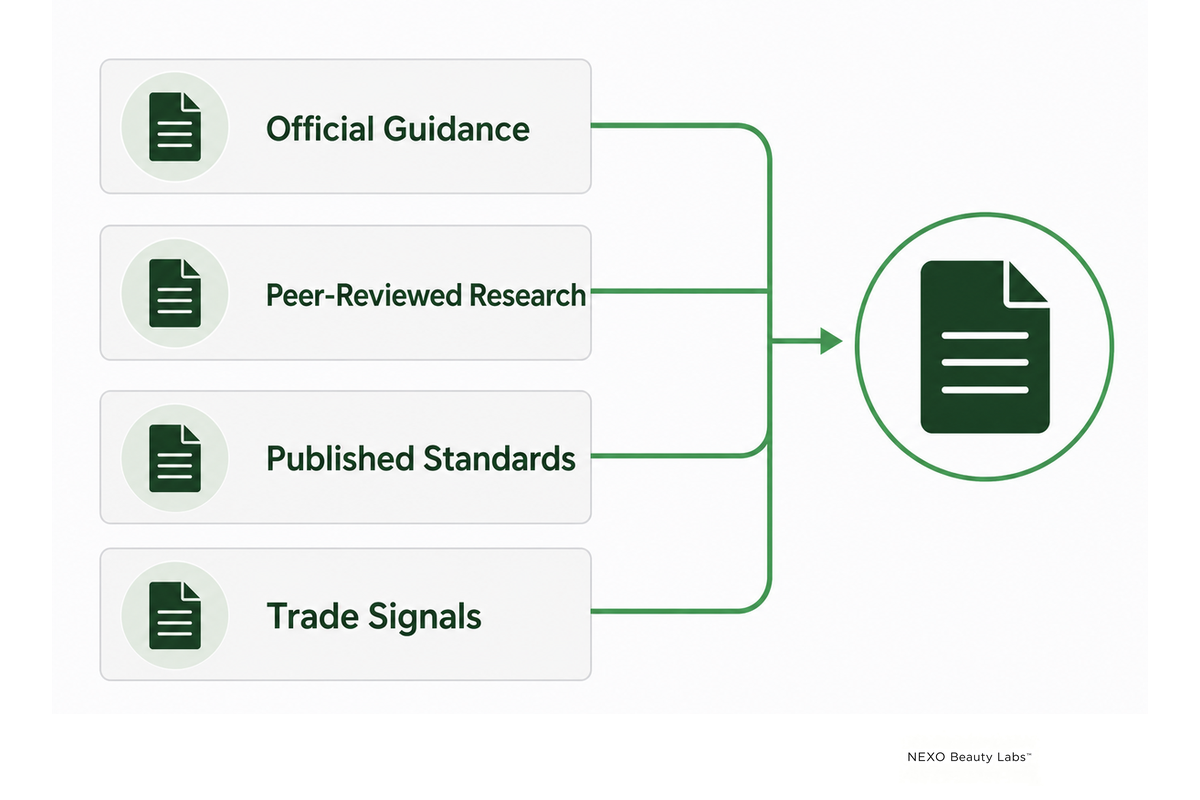
Signals are hypotheses, not market guarantees. Trade coverage has highlighted at-home foot-care routines and elevated hand-care positioning, while packaging coverage shows how established foot-care brands use structural redesigns to improve navigation and shelf communication. These examples can inspire questions, but they don’t prove demand for a specific brand or SKU (Beauty Independent: at-home foot-care example; Beauty Independent: hand-care example; Packaging Digest: foot-care packaging example).
| Signal | Testable hypothesis | Reject or revise if |
|---|---|---|
| At-home masks and peels | A defined consumer segment values a contained ritual with clear instructions. | Use complexity, warning burden, fit, leakage, or claims exceed the brand’s capability. |
| Portable targeted formats | A stick or balm solves a real reapplication or mess problem. | Payoff, hygiene, temperature behavior, or target-site use is inferior to a tube. |
| Elevated sensorial hand care | Distinct texture and scent increase routine fit for the target buyer. | The sensory target conflicts with immediate hand use or the evidence supports only generic language. |
| Concentrated application | A small-area product makes dosing and benefit communication clearer. | The user cannot distinguish the job from an existing all-over cream. |
| Navigation-led packaging | Pack structure and hierarchy help users choose routine, zone, or intensity. | More components add confusion, waste, compatibility risk, or operational complexity. |
Run signals through four filters: buyer fit, feasibility and evidence, package execution, and claim boundary. If it survives, define a small validation question—such as whether the target user can understand the format and use it correctly—rather than turning a trend article into a launch forecast. The team can test that question in a small, predefined pilot; the risk signal is a concept that fails instructions, package execution, or evidence feasibility before expansion.
What Must Be Locked in the Development Handoff File?
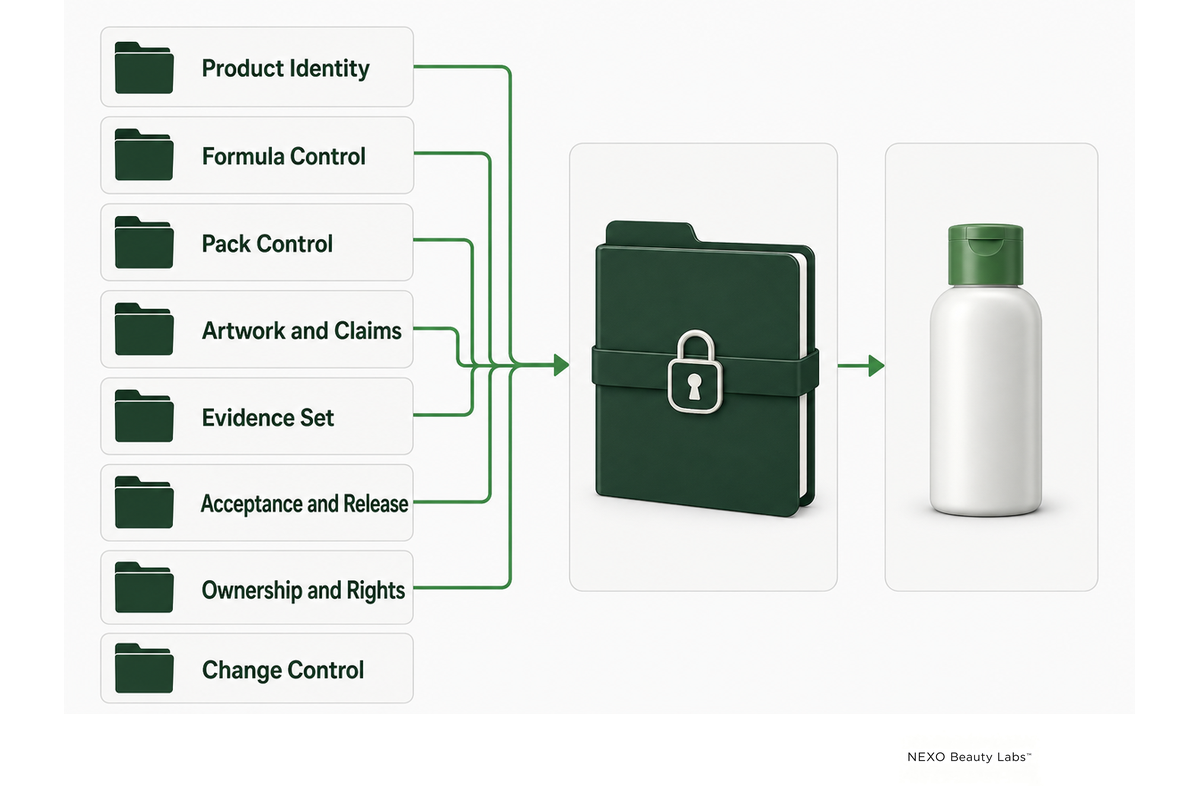
The handoff file is the controlled definition of what the team intends to make and release. Stability guidance does not provide one universal set of conditions or criteria for every cosmetic, so the file must preserve the product-specific protocol and decision basis rather than merely state “stability passed” (ISO/TR 18811:2018).
- Product Identity: SKU name, intended use, market, user, zone of use, directions, and approved product description.
- Formula control: approved version, specifications, ingredient and supplier controls, manufacturing instructions, and permitted tolerances.
- Pack Control: component drawings or specifications, material and decoration, approved suppliers, assembly, fill, seal, and functional criteria.
- Artwork and Claims: approved copy and files, evidence links, required warnings, regulatory review, translations, and version status.
- Evidence set: safety basis, microbiological rationale, preservation work where relevant, stability, compatibility, performance, and claim support.
- Acceptance and release: finished-product specifications, sampling and test methods, release authority, deviation handling, and retain strategy.
- Ownership and rights: who owns formulas, artwork, tooling, reports, raw data, samples, and access after the project ends.
- Change control: which changes require notice, evidence review, reapproval, retesting, relabeling, or listing updates.
A broader range can use the same discipline. The private label body care products guide helps place individual SKUs in a coherent portfolio, while the hand-and-foot file keeps this project’s use-zone and format decisions specific.
Once brief, responsibility and acceptance conditions are defined, a supplier-fit discussion becomes much more productive. The private label hand and foot care manufacturing page covers NEXO’s relevant commercial solution, while this guide remains focused on brand-side decision control. You can also review NEXO Beauty Labs for company context. Because a handoff failure creates production and claim risk, the buyer and supplier team should treat each sample-review time point as separate evidence and apply project-defined acceptance criteria informed by relevant guidance.
Frequently Asked Questions
What is private label hand and foot care?
Private label hand and foot care means products made for another company’s brand. A useful definition names the user, format, sensory target, package, evidence, market, and responsibility split. Those decisions determine supplier records. Commercial minimums, timing, and quotations require a separate project-fit discussion.
How is a foot cream different from a hand cream?
A single characteristic does not distinguish foot cream from hand cream. The differences arise from intended use, application area, friction, rough skin or dryness patterns, contact time, residue limits, fragrance, texture, package type, claim wording, and whether the product is intended for daily use. For example, a foot product may be designed to have a heavier or more occlusive formulation, but that is a matter of briefing and not a standard. Analyze the products based on the stated criteria.
Can a cosmetic foot cream claim to treat cracked heels, athlete’s foot, or diabetic foot problems?
Be aware. In the United States, claims about diagnosing, treating, or preventing disease, or affecting body structure or function, can create drug intent. Review the exact label, website, advertising, formula, evidence, and target market. Keep medical-population language out of routine cosmetic copy unless qualified regulatory review supports claims about cracked heels, athlete’s foot, or diabetic foot problems.
Which format is better: cream, mask, or repair stick?
Choose the format by application site, dose, contact time, sensory target, pack behavior, instructions, and evidence burden; a cream may suit frequent application, a mask may suit a contained ritual, and a repair stick or foot balm may suit targeted use. No format is universally best.
What testing should hand and foot care products complete?
There is no single universal list. The plan should depend on the intended use, formula, microbiological risk, package, process, market, instructions, and claims. Typical questions may include the safety, microbiological quality, preservation if needed, stability, compatibility of packaging, performance, and the substantiation of claims. Each protocol needs certain defined elements including the sampling conditions, acceptance criteria, versions of the product and packaging, the person responsible, and the decision for which the protocol is intended.
What should a brand send before requesting a sample?
Send a concise brief naming the user, use zone, format, sensory target, package assumptions, market and claim direction, ingredient constraints, testing expectations, and reviewers. Add fixed sample-evaluation conditions, reference products, decision owners, and open questions. That gives development controlled inputs rather than adjectives.
Discuss Your Hand & Foot Care Brief
Selected References & Sources
- U.S. Food and Drug Administration, Cosmetics & U.S. Law
- U.S. Food and Drug Administration, MoCRA
- U.S. Food and Drug Administration, Product Testing of Cosmetics
- U.S. Food and Drug Administration, Alpha Hydroxy Acids
- Federal Trade Commission, Health Products Compliance Guidance
- PubMed, Differential cell composition in palm, sole, and hip skin
- PMC, Vehicles for Drug Delivery and Cosmetic Moisturizers
- ISO 11930:2019, Evaluation of antimicrobial protection
- ISO 17516:2014, Microbiological limits
- ISO 29621:2017, Microbiologically low-risk products
- ISO/TR 18811:2018, Stability testing guidance
- ISO 13299:2016, Sensory profile guidance
- ASTM E1490-19, Sensory descriptive analysis of creams and lotions
Why beauty brands work with NEXO
About NEXO Beauty Labs Manufacturing Support
NEXO Beauty Labs supports skincare, body care, sun care, hair care, and private label brands with formulation, sampling, filling, quality control, and export-ready launch support.
Project Review Before RFQ
Before quotation, we help clarify product category, active direction, formula stage, package choice, compliance market, MOQ, sampling schedule, and required documents.
Request a Cosmetic QuoteCompany Profile // Data Sheet
CompanyNEXO Beauty Labs
Business TypeCosmetic OEM / ODM manufacturing partner
Main ProductsPrivate label skincare, facial serums, moisturizers, cleansers, sunscreen, body care, and hair care products
Manufacturing CapabilityFormula development, sample adjustment, package sourcing, filling, QA/QC, documentation, and export support
RFQ Data NeededProduct type, formula goal, package format, target market, MOQ, claims, timeline, and benchmark samples
Websitenexobeautylabs.com