Get in touch with NEXO Beauty Labs Company

Updated September 2026 · Written by XCX · Buyer verification guide
Hand cream manufacturers are easy to discover and harder to compare. Supplier pages can show available formats and services, but a buyer still needs to verify whether the quoted formula route, packaging, quality evidence, claims boundary, market responsibilities, and commercial assumptions fit the same project.
This guide does not rank factories or promise that one route is universally faster, cheaper, or better. It gives beauty brands, e-commerce teams, distributors, and private label partners a common evidence process before they shortlist a hand cream manufacturing partner.
The short answerChoose the manufacturer that can convert your product brief into a written, verifiable scope. Compare route fit, formula-pack-claim compatibility, quality evidence, market responsibility, quotation assumptions, and change control before you compare a headline price or timeline.
Choose a Manufacturer by Evidence, Not a “Best” List
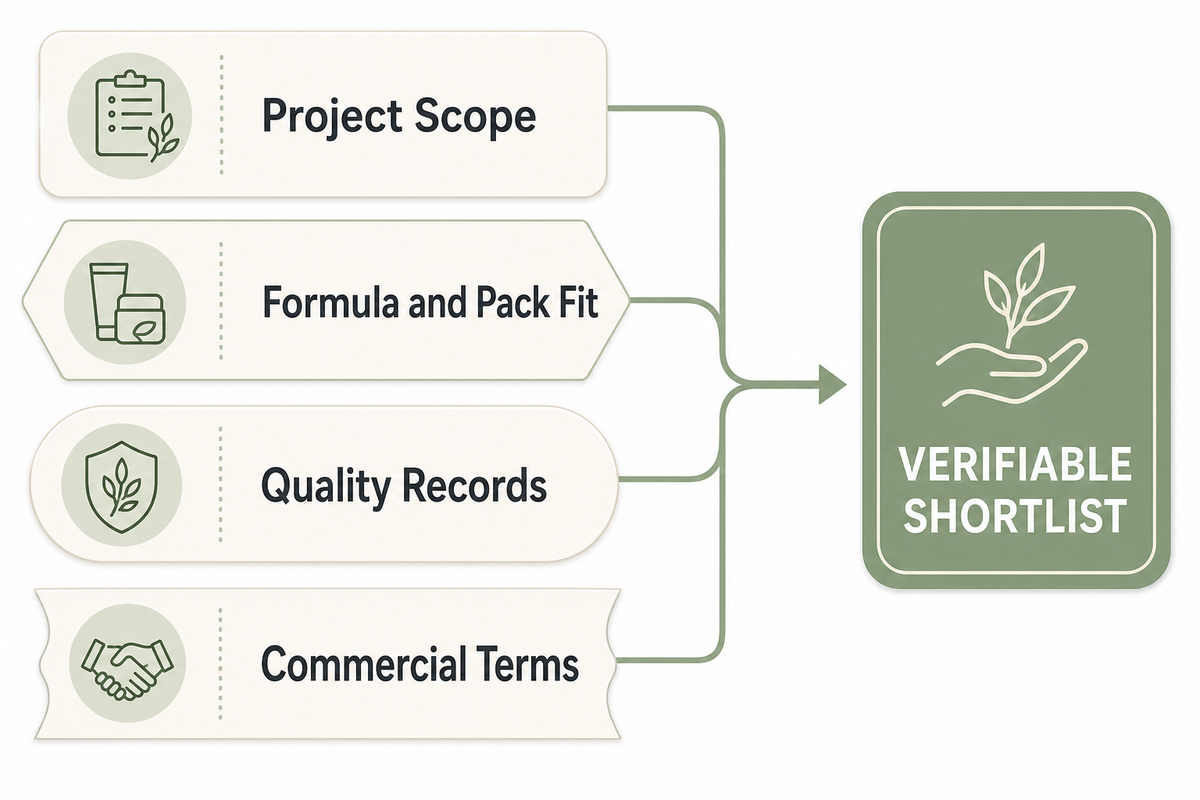
The best hand cream manufacturer is the one whose documented scope fits your brief and whose critical claims can be checked. Client lists, product catalogs, and polished factory pages may help discovery, but none of those items proves that the quoted formula, pack, test scope, documentation, or commercial terms fit your launch.
Start with five decision axes: product fit, proof, responsibility, comparability, and change control. Keep a candidate on the shortlist only when its answers are specific enough for your technical, regulatory, brand, and purchasing owners to review.
| Axis | Question | Useful evidence | Weak answer |
|---|---|---|---|
| Fit | Does the route match the product and brand objective? | Written formula route and brief response | “We can make anything” |
| Proof | Can important statements be checked? | Scoped records, reports, and valid documents | Generic quality language |
| Responsibility | Who owns each market and evidence task? | Named owner and handoff point | “We handle compliance” |
| Comparability | Are quotes built on the same assumptions? | Inclusions, exclusions, and configuration | One unexplained unit price |
| Change control | What happens when an input changes? | Notice, review, approval, and retest rules | Changes made without a defined owner |
The live search results for this keyword are commercially oriented, so independent ranking for a buyer guide is uncertain. This article therefore supports sourcing decisions and routes service inquiries to the existing commercial page instead of duplicating it.
Decode Types of Hand Cream Supplier Language
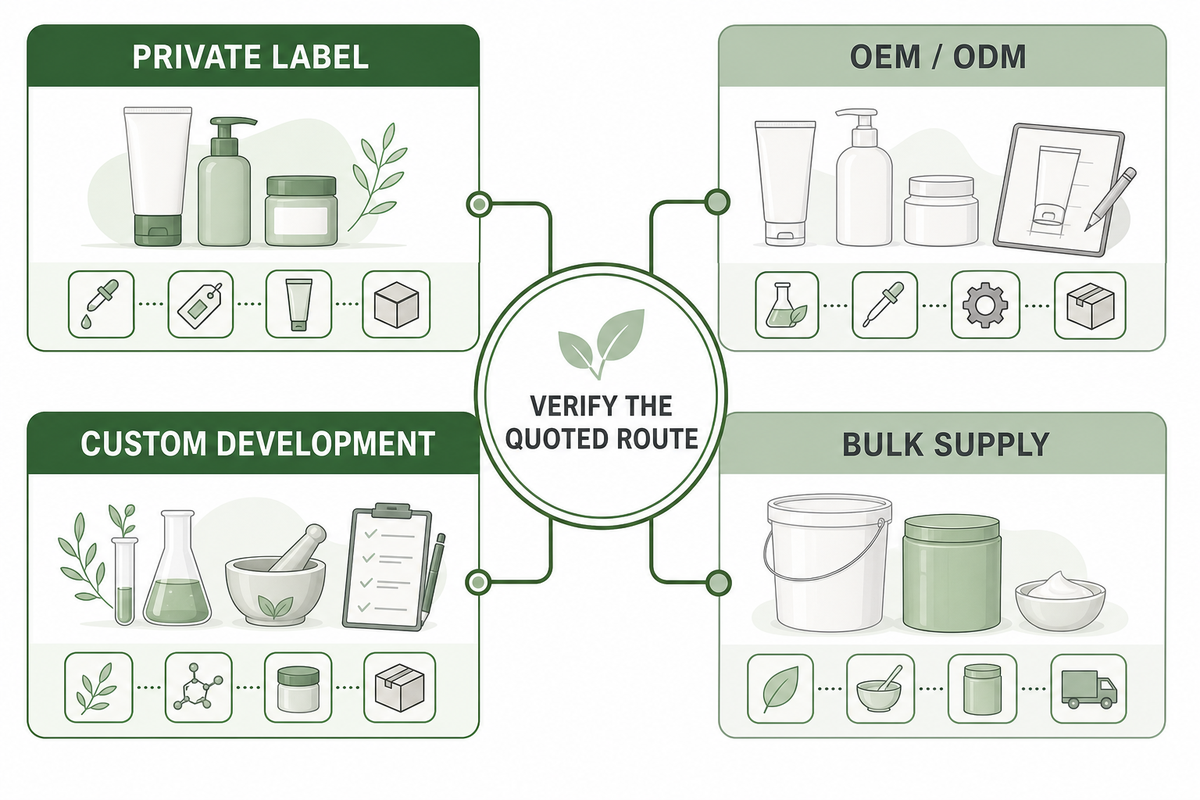
Supplier labels describe a positioning choice, not a verified capability. Treat terms such as trusted hand cream manufacturers, leading manufacturer, professional manufacturer, or high-quality products as prompts for evidence rather than shortlist conclusions.
3-Tier Supplier Label Decoder
Search results may describe a cosmetic manufacturer, skincare manufacturer, contract manufacturer, or one of several hand cream manufacturing companies. Manufacturers based in one market may serve buyers elsewhere, but location language and a cosmetics manufacturer based claim do not establish market readiness, applicable documentation, or manufacturing facilities on their own.
| Language cluster | What it may signal | What to verify |
|---|---|---|
| Private label services | Private label hand cream, private label cosmetics, or an existing hand care line | Exact base formula, available changes, pack options, evidence packet, and destination markets |
| OEM / ODM | OEM hand cream, contract manufacturing, or research and development support | Who owns the brief, R&D work, approvals, records, formula access, and change decisions |
| Custom development | Custom hand cream, custom formulas, or expertise in custom formulations | Target specification, R&D team role, sample stages, acceptance criteria, and retest triggers |
| Portfolio language | A product range spanning hand and body, body lotions, serum, cream products, or personal care products | Whether experience applies to the quoted formula, final package, intended claims, and market |
| Benefit language | Moisturizing hand creams, premium hand cream, natural skincare, or functional hand creams | Defined benefit, active ingredients or natural ingredients, substantiation, and allowed claim wording |
| Broad service language | Skincare solutions, high-quality skincare, or skincare and beauty support for care brands | Project-specific quality control, owner, deliverable, exclusion, and evidence |
| Skin care scope | A general skin care catalog or hand cream specialty | Applicable equipment, process controls, formula type, and product-specific records |
| Search-category label | Private label hand cream manufacturers, including custom formulation options | Which route is actually quoted, what can change, and which evidence follows that route |
Some catalogs combine skincare products, body care products, hand care products, lotion, and other care product categories. That breadth does not mean the same line makes every format; hand sanitizers, for example, should not be assumed to share the same regulatory route or production scope as a cosmetic hand cream.
Searchers may use hand cream suppliers, white label hand cream, bulk hand cream, or hand lotion manufacturer as interchangeable discovery labels. Treat them as search language, not proof that each result offers the same development route, evidence, or commercial configuration.
When comparing multiple suppliers, replace adjectives with a request: ask a candidate to customize its response to your brief and identify the exact hand cream production route, hand cream packaging, quality control evidence, and responsibilities. That claimed range of hand creams or broad skincare line becomes useful only after the supplier connects it to your actual product and explains how the formula is intended to moisturize within an appropriate cosmetic claims boundary.
Build a Brief That Manufacturers Can Actually Quote
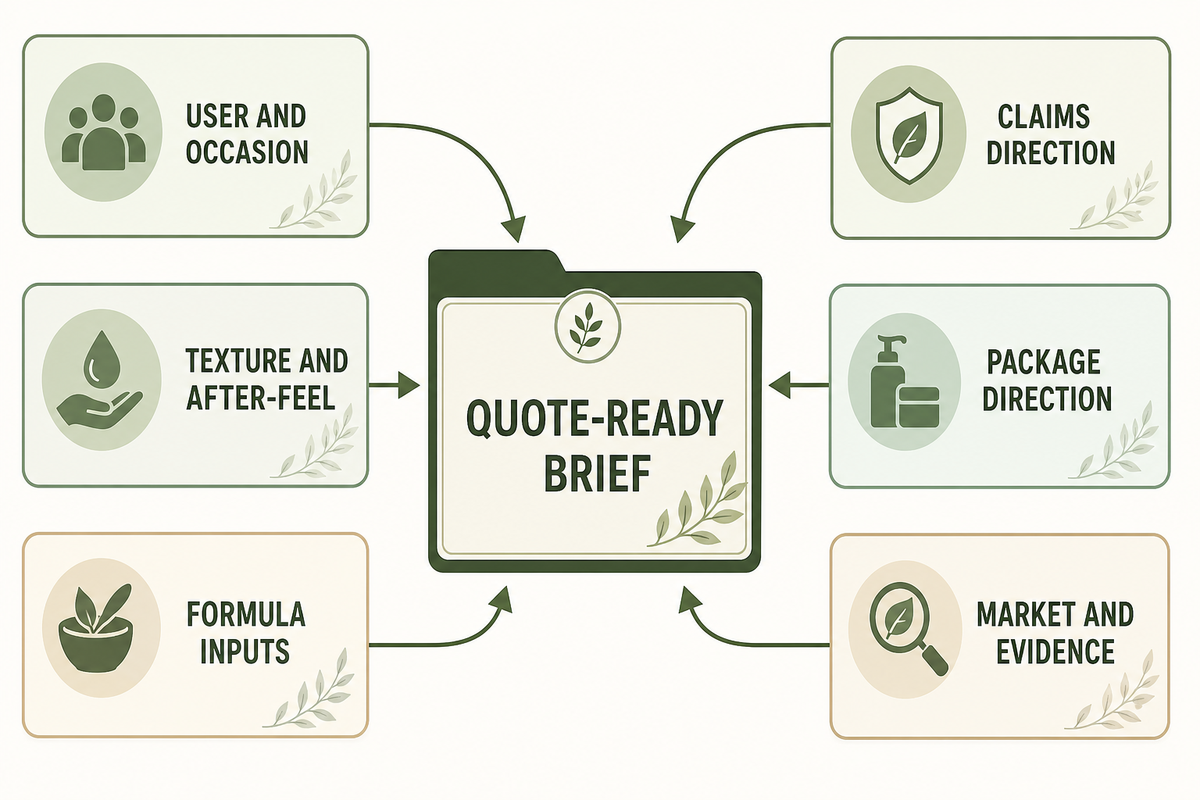
The quote-ready brief separates confirmed requirements from preferences and open questions. It should tell a manufacturer who will use the hand cream, what sensory result is expected, which claims are being considered, how the product will be packed, and where it will be sold.
It’s better to disclose unresolved issues. If the brand hasn’t finalized the claims, market, or pack, unresolved issues should be reflected in the brief, so the supplier can identify the options and unresolved issues that are most likely to result in a requote.
12-field hand cream development brief
- Target user
- Use occasion
- Texture and viscosity
- Absorption and after-feel
- Fragrance direction
- Preferred or excluded inputs
- Claims direction
- Primary package
- Fill size
- Target markets
- Artwork status
- Required evidence and documents
Indicate if a field is required, preferred, or if the supplier can make a judgment call. Preferences may be interpreted as hard constraints if not indicated otherwise.
Treat the brief as a version-controlled decision record. When the target market, pack, claim, or formula direction changes, update the brief and ask which quoted assumptions, tests, documents, or dates must be revisited.
Match the Formulation Route to the Business Objective
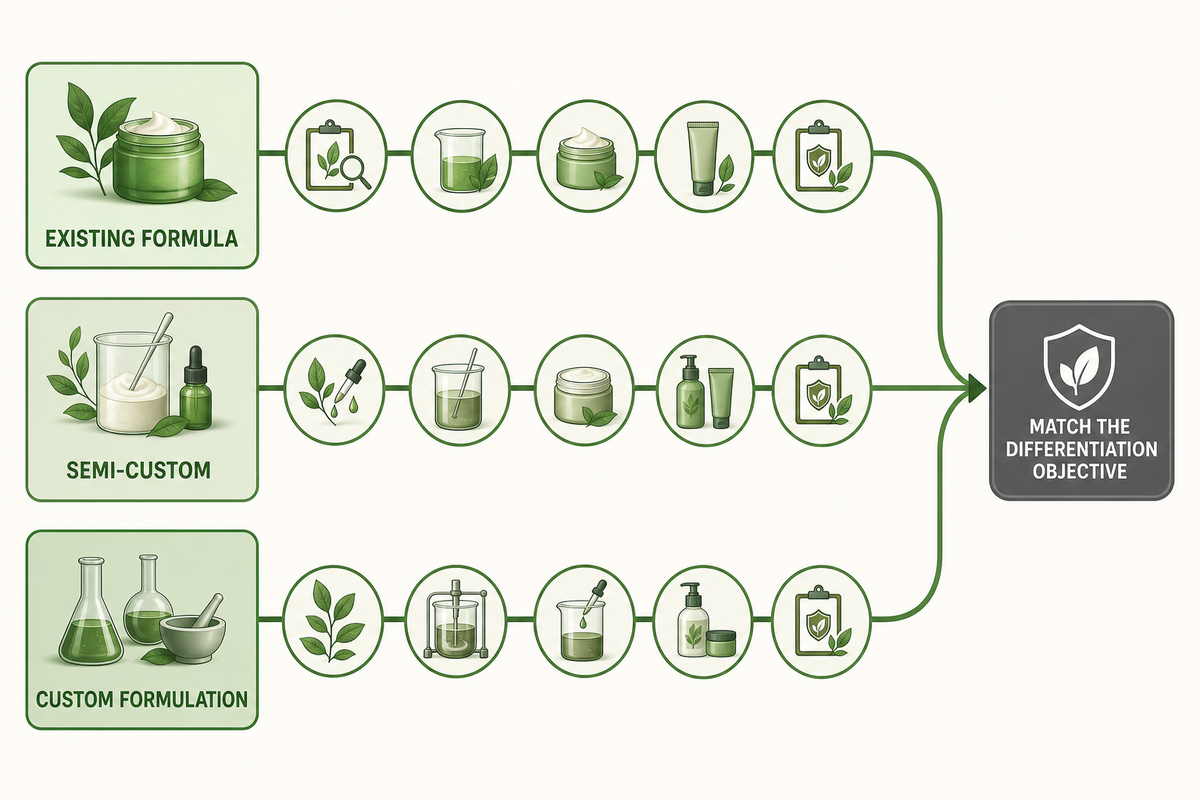
Private label hand cream, semi-custom development, and custom formulation are different starting points, not quality grades. The right route depends on how much differentiation the brand needs, which technical inputs already exist, what can change, what evidence must be delivered, and how future changes will be controlled.
| Route | Starting point | Write down | Key verification |
|---|---|---|---|
| Stock / private label | Existing formula and bounded choices | Exact base, available changes, pack options, evidence packet | The stock offer fits the intended market and claims |
| Semi-custom | Existing platform with agreed adjustments | Permitted adjustments, sample rounds, retest triggers | The change does not outrun the evidence |
| Custom formulation | Brand-specific target and development work | Target specification, milestones, acceptance, access, and change rights | The final deliverable matches the commercial and technical agreement |
Ask who supplies the starting formula, who approves each revision, which records the brand receives, and what happens if the project later moves to a different pack or market. Paying for development does not by itself answer formula access, exclusivity, transfer, or future-change questions.
A useful supplier response should identify what is fixed and what is configurable. It should also state which requested changes can alter the stability plan, compatibility work, ingredient documentation, claims review, quotation, or schedule.
Treat Formula, Packaging, and Claims as One System
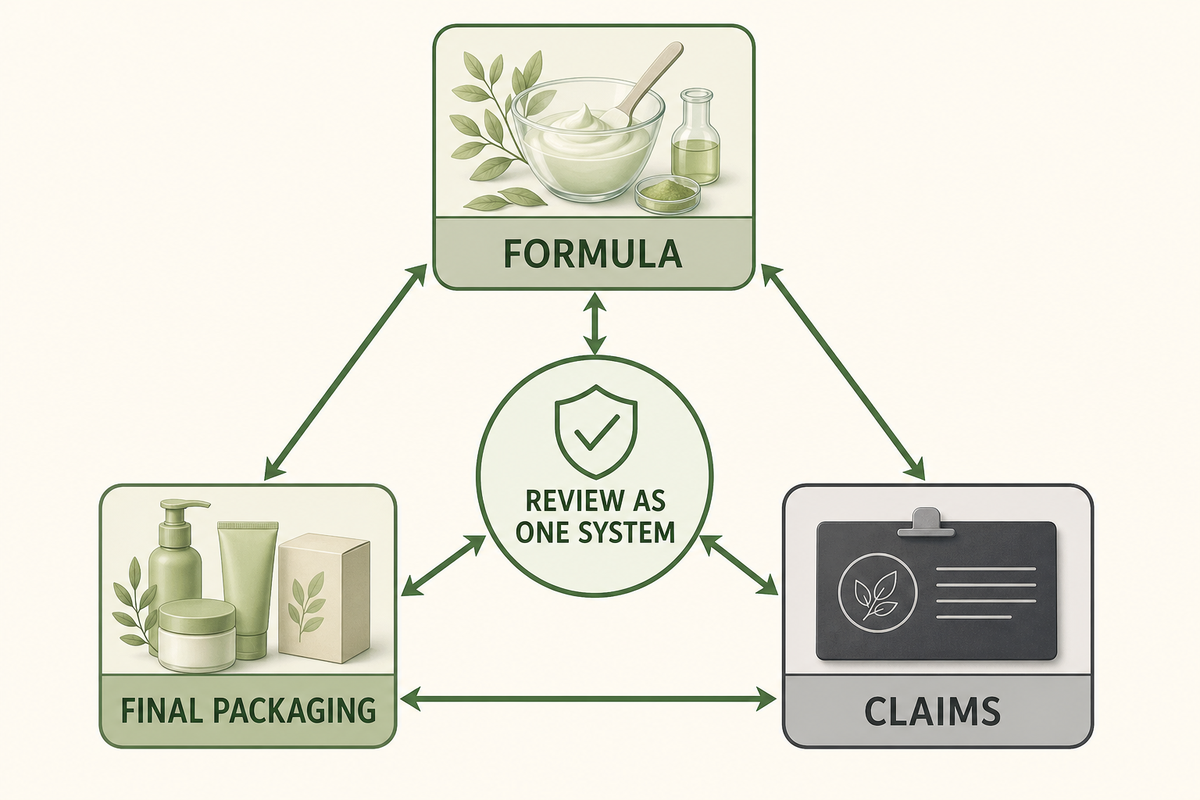
A hand cream formula can’t be assessed individually. It’s interrelated with its final packaging and the claims made about the product. The viscosity of the product affects the way the product can be dispensed. The primary product packaging affects the manner in which the product comes into contact with and/or is used by the consumer. Label space affects the information that can be provided on the package.
Formula
Texture, viscosity, fragrance, ingredient constraints, preservation approach, color, and expected use conditions.
Pack
Tube, jar, pump, closure, contact materials, decoration, fill size, dispensing behavior, transit, and label area.
Claims
Cosmetic benefit language, target user, substantiation plan, prohibited overstatement, and destination-market review.
Formula-Pack-Claim Fit Map
The map asks one question at every intersection: what evidence or decision must be revisited if this input changes? A richer texture may change the dispensing choice, a new fragrance may change documentation and sensitive-skin positioning, and a new claim may change the evidence and classification review.
Independent testing guidance describes cosmetic stability work in physical, chemical, and microbiological terms and includes packaging compatibility under defined conditions. Ask which product version and final pack the proposed program covers, which conditions and acceptance criteria apply, and who approves the conclusion rather than requesting a generic “stability test.”
| Category | Example entries a protocol might define | Buyer check |
|---|---|---|
| Fill configuration | 30 mL, 50 mL, or 75 mL | Record the exact quoted pack and fill |
| Pack dimensions | 35 mm, 40 mm, or 45 mm | Use the supplier drawing, not a visual estimate |
| Condition set | 5°C, 25°C, or 40°C | Let the qualified owner define applicable conditions |
| Relative humidity | An explicitly stated condition such as 75% RH | Do not assume humidity belongs in every protocol |
| Early observation | 24 hr or 48 hr | Define the observation and decision owner |
| Short checkpoint | 7 days, 14 days, or 30 days | Tie the checkpoint to criteria, not calendar alone |
| Longer checkpoint | 3 months, 6 months, or 12 months | Record whether data are planned, interim, or complete |
| Transport excursion | A defined scenario such as -10°C or 50°C | Use only when the approved plan calls for it |
These numbers show how to make a scope checkable; they are not a universal hand cream test schedule or acceptance limit. A plan that merely says 1 day, 2 days, 1 hr, 3 hr, or 6 hr is still incomplete unless it defines the method, condition, sample, observation, criteria, and decision owner.
The conditions, samples, and acceptance criteria must be defined based on the formula, the method of distribution and the market.
Sample acceptance box
Record the sample code, brief version, pack used, evaluation conditions, acceptance criteria, reviewers, decision, deviations, and next action. “Feels good” is feedback; it isn’t a reproducible release decision.
Ask for Quality Evidence with a Defined Scope

“High quality” is not an evidence category. Translate it into questions about incoming materials, batch traceability, in-process controls, release records, deviations, storage, shipment, complaints, and change control, then ask which records apply to the quoted hand cream and facility.
ISO 22716 provides cosmetics GMP guidance for production, control, storage, and shipment. That scope can organize due-diligence questions, but it does not prove that a particular manufacturer holds a valid certification or that a specific hand cream has passed an agreed test program.
| Supplier statement | Request | Check | Do not infer |
|---|---|---|---|
| “GMP compliant” | Quality-system scope and relevant evidence | Site, activity, issuer, validity, and applicability | Every product or market is covered |
| “Tested” | Method, sample, pack, conditions, criteria, and result owner | The report matches the quoted version | One test covers every change |
| “Traceable” | Batch and material traceability description | Links among inputs, process, release, and shipment | The brand will automatically receive all records |
| “Controlled changes” | Notice, impact assessment, approval, and re-release workflow | Who can approve each change | Equivalent input means no new review |
If a supplier presents a certificate, verify the issuer, named facility, activity scope, standard, validity period, and relationship to the quoted product. In 2026 the FDA clarified that it does not provide certificates proving cosmetic facility registration or product listing, so generic “FDA certificate” language deserves direct clarification.
Map Claims and Market Responsibilities Before Artwork
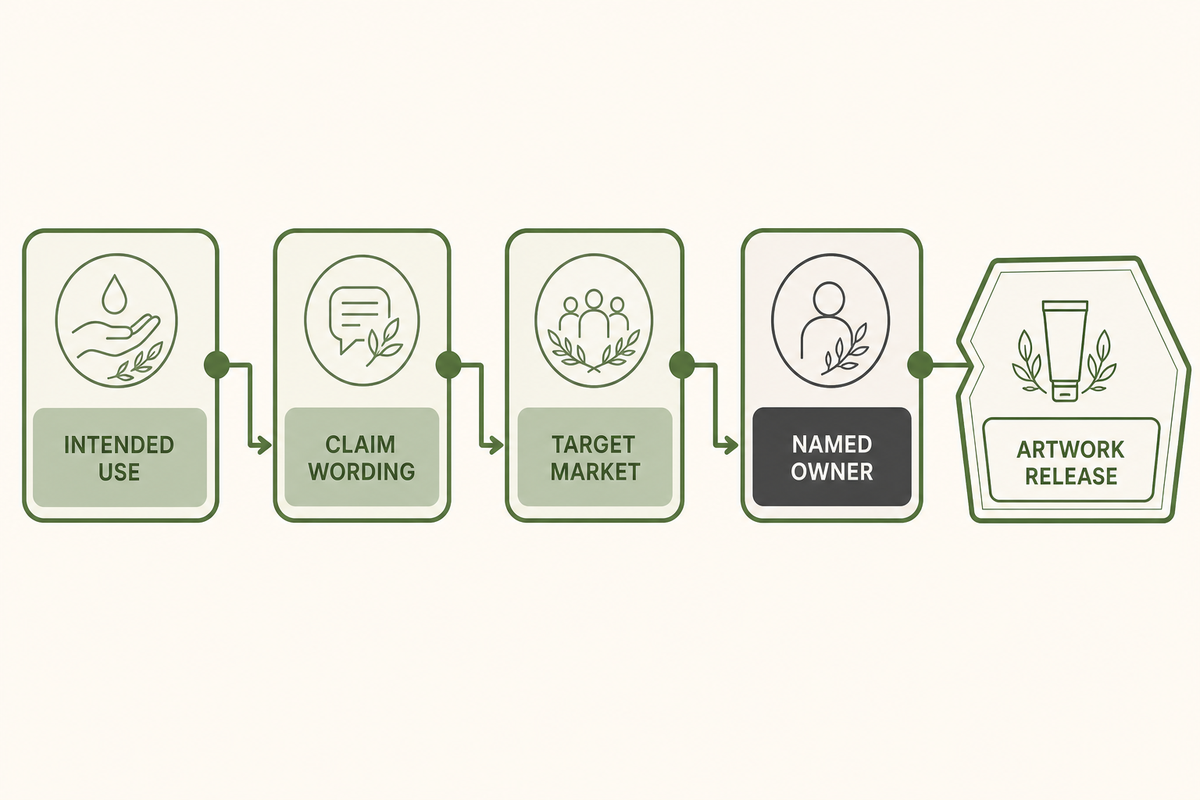
Claims are one of several layers of review. The positioning of a given claim can have significant downstream implications including first, evidence assessment and second, the definition of the intended product’s functions and features as well as the responsibilities and limitations imposed on the manufacturer and/or marketer.
The FDA explains that intended use and claims can make a product a cosmetic, a drug, or both. A moisturization or appearance claim is not interchangeable with language about treating, preventing, healing, or changing body structure or function.
Most cosmetics and cosmetic ingredients are not approved by FDA before market entry, although cosmetics remain regulated. Avoid using “FDA approved” as generic proof, and distinguish facility registration or product listing from product approval.
| Topic | Question | Name in writing |
|---|---|---|
| Facility registration | Which facility and exemption analysis apply? | Filing and renewal owner |
| Product listing | Which listed product and ingredient information is needed? | Responsible person and update owner |
| Safety substantiation | Which records support the actual formula, use, and claims? | Record owner and access location |
| Adverse events | How are complaints triaged, escalated, and reported? | Intake, assessment, reporting, and record owner |
The FDA’s MoCRA overview distinguishes these obligations and actors. Other target markets use different frameworks, so this high-level U.S. map is not legal advice or a universal market checklist.
Compare Quotations on the Same Assumptions
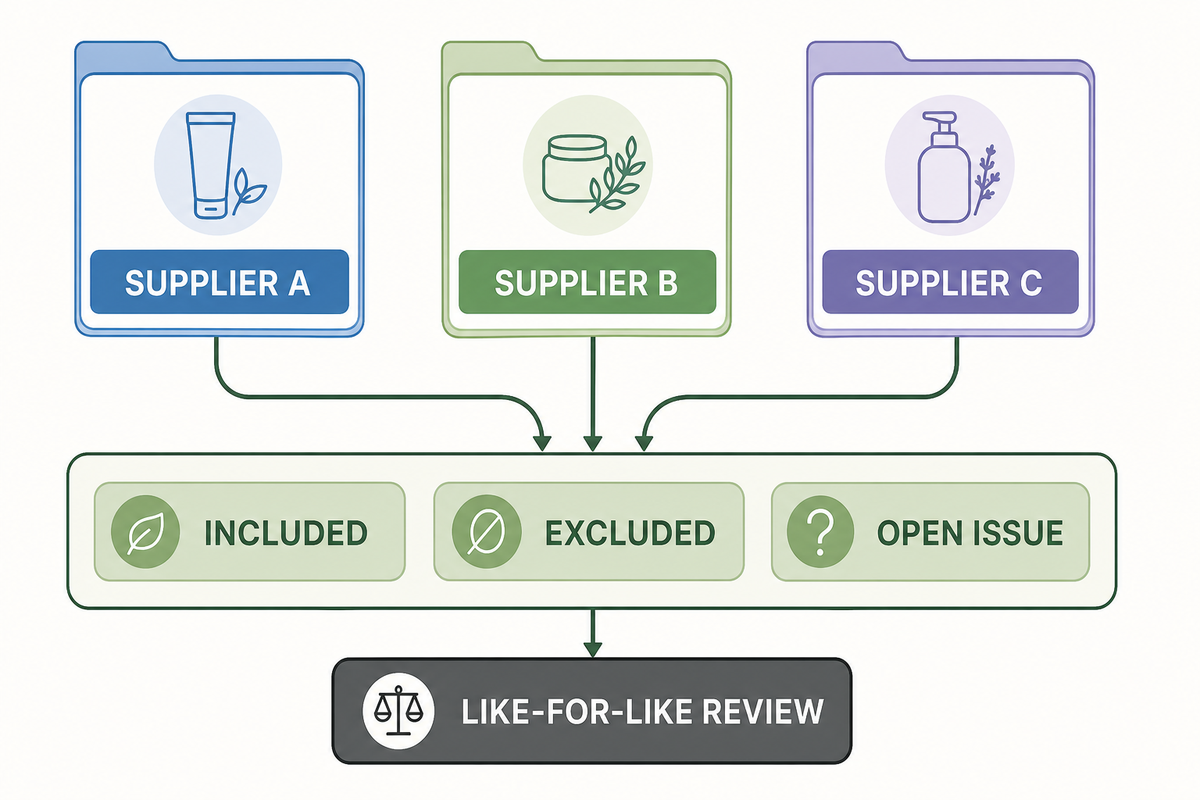
MOQ and lead time can be influenced by several other variables. These include the route of distribution, the terms of payment, the location of the warehouse, the tests and documents requested, the sample round, and the status of the artwork and packaging.
Ask each supplier to quote the same brief version and identify exclusions. If two proposals use different formula routes, packs, tests, or documentation, record the difference before calling one option cheaper or faster.
| Field | Supplier A | Supplier B | Open issue / owner |
|---|---|---|---|
| Formula route and version | Record | Record | Technical owner |
| Primary pack and decoration | Record | Record | Packaging owner |
| Testing and documents | Included / excluded | Included / excluded | Quality / regulatory owner |
| Sample and revision rounds | Record | Record | Brand owner |
| MOQ and price basis | Configuration and currency | Configuration and currency | Purchasing owner |
| Timing dependencies | Assumptions | Assumptions | Project owner |
| Change and requote trigger | Record | Record | Decision owner |
It isn’t necessarily a concern if the supplier indicates that more information is required to provide a quotation. If more information is required, the supplier should identify the nature of the omitted information and indicate why that information is necessary to provide a complete quotation.
Assess NEXO Beauty Labs Within the Same Process
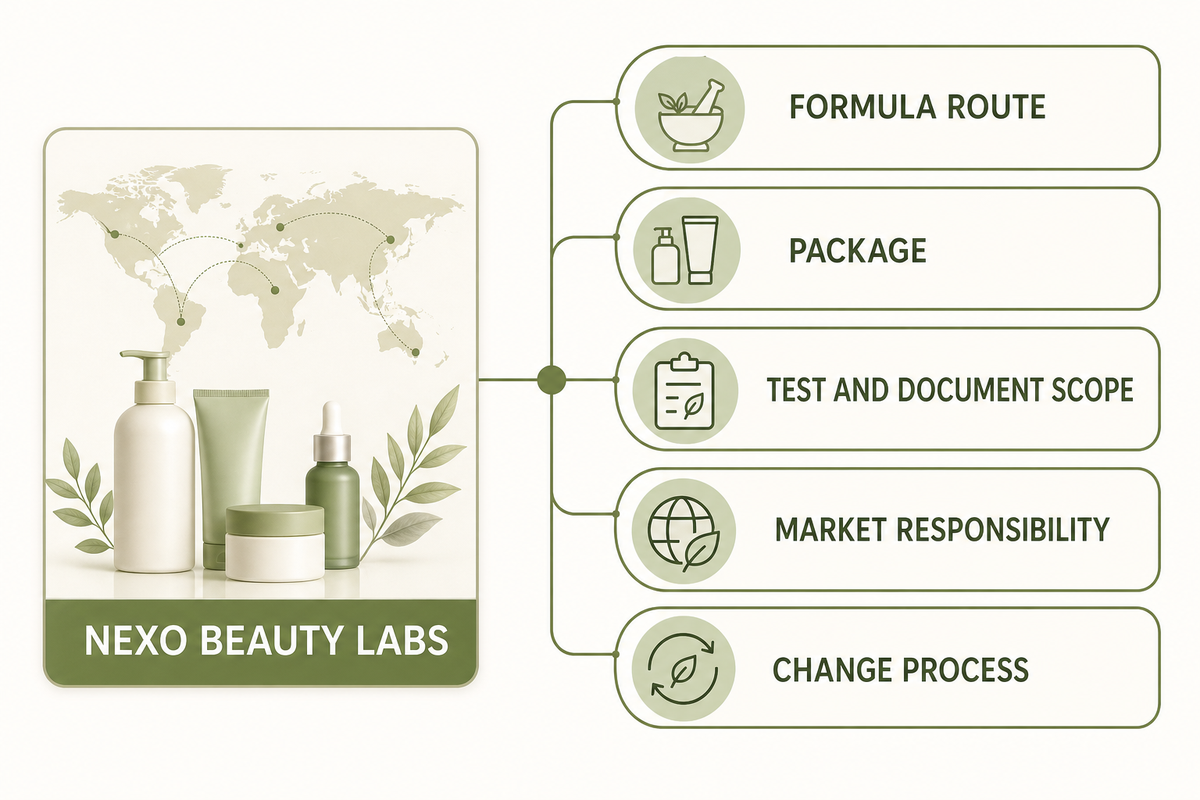
NEXO Beauty Labs describes itself as a global cosmetic OEM and ODM partner supporting skincare, hair care, and body care development, formulation innovation, and scalable manufacturing. The company-provided brief states that its manufacturing foundation dates to 1999, that it has more than 25 years of cosmetic manufacturing experience, and that its international business team has supported global markets since 2020.
Those facts provide company context; they do not replace project-specific verification. A buyer should still confirm the formula route, pack, test and document scope, target-market responsibilities, commercial configuration, and change process for the actual hand cream brief.
Move from evaluation to a scoped discussion
Review NEXO’s hand and foot care manufacturing page, then bring the same 12-field brief and evidence questions you would use with any shortlisted partner.
Copy the Hand Cream Manufacturer Evidence Docket
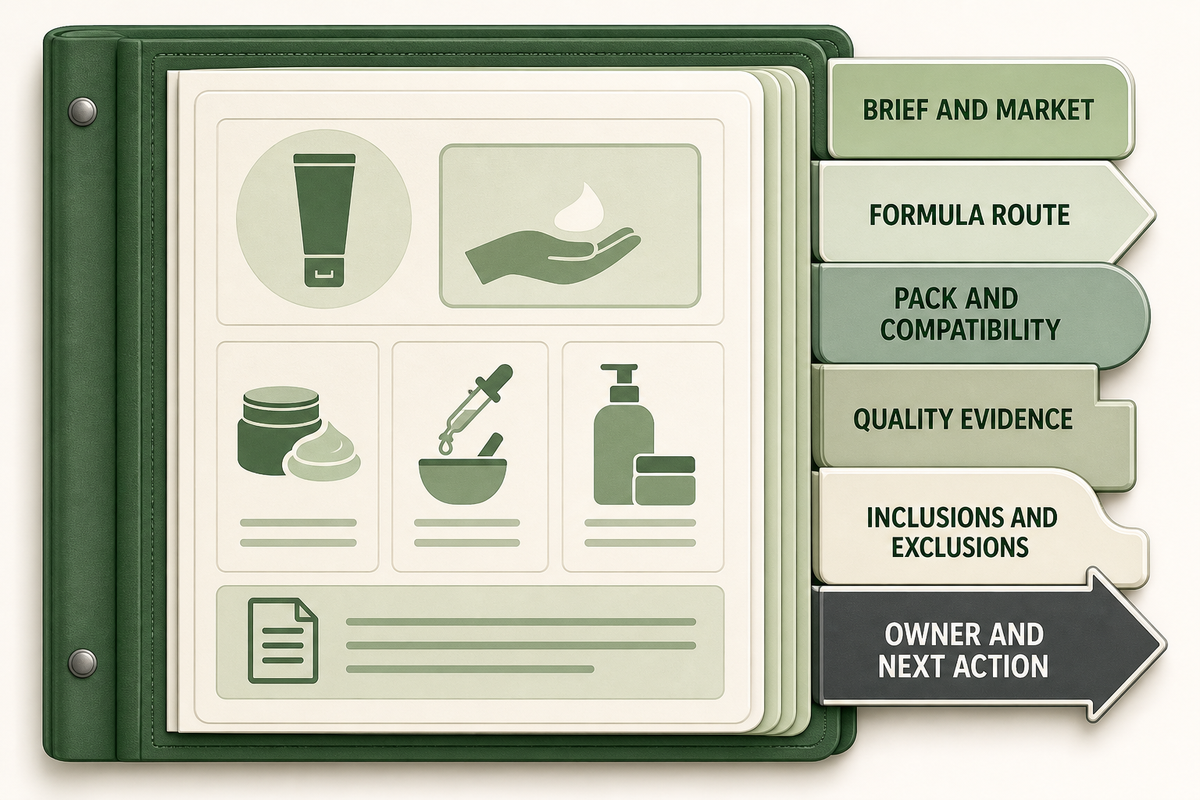
The hand cream manufacturer Evidence Docket captures sales information pertaining to a particular project and outlines the types of information that are requested of potential vendors. Send the same types of information to each potential vendor and capture the information requested, along with the date the information was provided and the individual that provided the information.
| Field | Supplier response | Evidence received | Owner / decision / next action |
|---|---|---|---|
| 1. Brief version and target market | |||
| 2. Formula route and status | |||
| 3. Permitted changes | |||
| 4. Sample acceptance | |||
| 5. Primary pack specification | |||
| 6. Compatibility plan | |||
| 7. Stability plan | |||
| 8. Claims and market roles | |||
| 9. Quality evidence | |||
| 10. Quote inclusions and exclusions | |||
| 11. Change and requote rules | |||
| 12. Open issues and exit path |
A blank field is not a failure if it has a named owner and next action. It becomes a selection risk when a critical assumption stays implicit, the evidence owner is unknown, or the quote depends on a condition that no one has recorded.
Resolve Red Flags Before Selecting a Partner
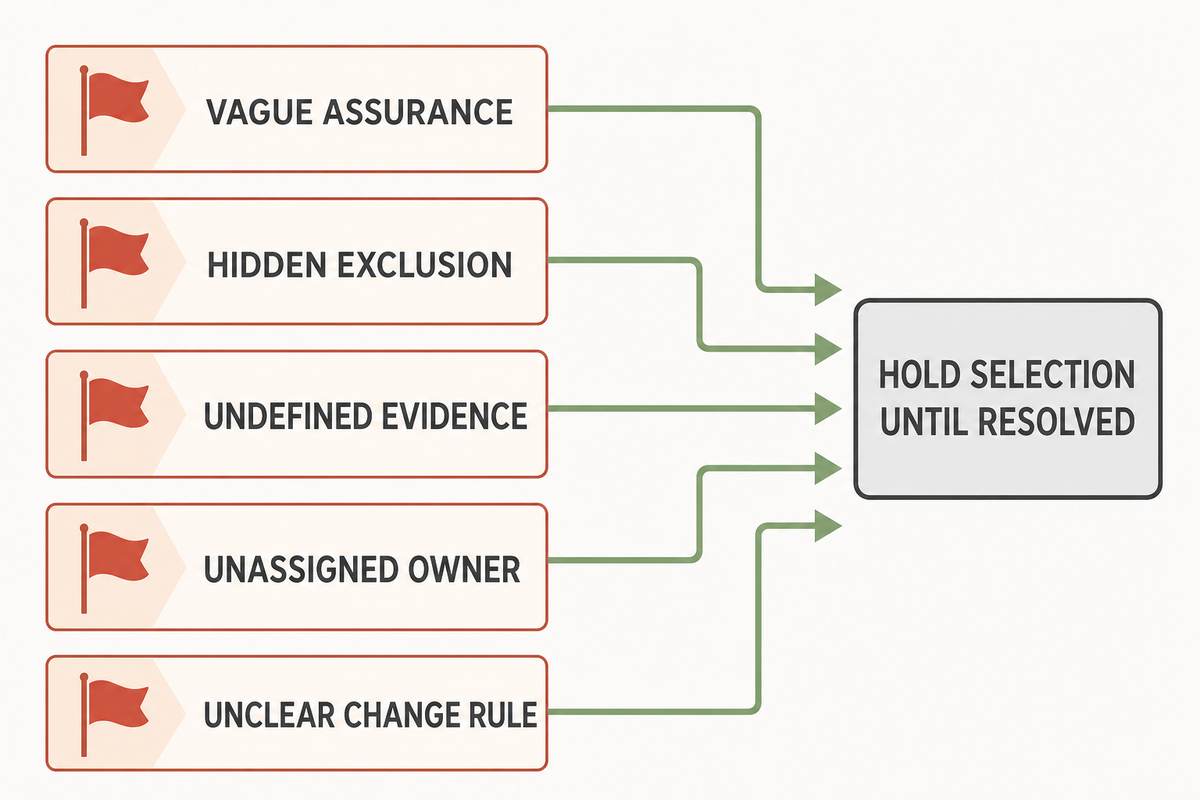
An unanswered question does not always raise a red flag. A normal clarification names the missing input and the method for resolving it; a red flag replaces evidence with a generic assurance, misstates approval or certification, hides exclusions, or refuses to define change and responsibility boundaries.
| Topic | Red flag | Normal clarification | Acceptable next evidence |
|---|---|---|---|
| Certification | Undefined “FDA certificate” | Document scope needs confirmation | Issuer, facility, scope, validity, and relevance |
| Testing | “All tests passed” without version or pack | Plan depends on final pack | Defined sample, conditions, criteria, and report owner |
| Quote | Price without configuration or exclusions | Component quote is pending | Versioned assumptions and a requote trigger |
| Claims | Unqualified approval or treatment promise | Claim wording awaits market review | Approved claim set, evidence owner, and jurisdiction review |
| Change control | Material change without notice | Alternative input needs impact review | Written notice, review, approval, and re-release path |
The final selection rule is simple: shortlist only when critical assumptions are written, evidence owners are named, and every unresolved item has a dated next action. If a supplier cannot support that level of clarity before selection, the uncertainty will not disappear after purchase.
Frequently Asked Questions
How do I choose among hand cream manufacturers?
All candidates get the same instructions. Compare the following for each candidate: formula route, primary pack, evidence scope, market responsibilities, quotation assumptions, change-control terms, critical responses, stated exclusions, named evidence owners, and dated next actions for every unresolved critical issue before you shortlist any hand cream supplier.
Is private label hand cream the same as custom formulation?
Not necessarily. Private label hand cream often starts from a manufacturer’s existing formula, while custom development begins from a brand-specific performance, texture, ingredient, or claim target. Some suppliers offer semi-custom routes between those points, so ask what is fixed, what can change, who approves changes, which documents are delivered, and whether the route matches your differentiation goal.
What quality documents should I request?
Request documents that match the product, market, and risk profile rather than collecting certificates without context. Useful questions cover quality-system scope, batch and raw-material controls, release documentation, stability and formula-pack compatibility plans, deviations, complaints, and change control. Verify the issuer, facility, scope, validity, and relationship between each document and the quoted hand cream.
How should I compare MOQ, price, and lead time?
Treat each figure as conditional on the quoted configuration. Formula route, components, testing, artwork, documentation, freight, and revision rounds can change the result. Record the assumptions and exclusions, then ask each supplier what would trigger a requote or a schedule revision.
Are hand creams FDA approved?
Most cosmetic products and ingredients are not approved by FDA before they enter the U.S. market. When determining the intended use and the claims of a given product, the product may fall under the jurisdiction of the FDA and/or other agencies. Do not use the term “FDA approved” to substantiate quality of a product. Avoid “FDA approved” as a claim; map intended use, MoCRA duties, and market review with qualified support for formula, package, label, and launch market.
References & Sources
- U.S. FDA, Modernization of Cosmetics Regulation Act of 2022
- U.S. FDA, Authority Over Cosmetics
- U.S. FDA, Is It a Cosmetic, a Drug, or Both?
- U.S. FDA, FDA Does Not Issue Cosmetic Compliance Certificates
- ISO, ISO 22716 Cosmetics GMP
- Intertek, Cosmetic Stability Testing
Educational information on standards and regulations is provided. These don’t in any way substitute legal and regulatory review for the project.