Get in touch with NEXO Beauty Labs Company
Top 10 Foot Cream Manufacturers: Who Is Best for Which Job?

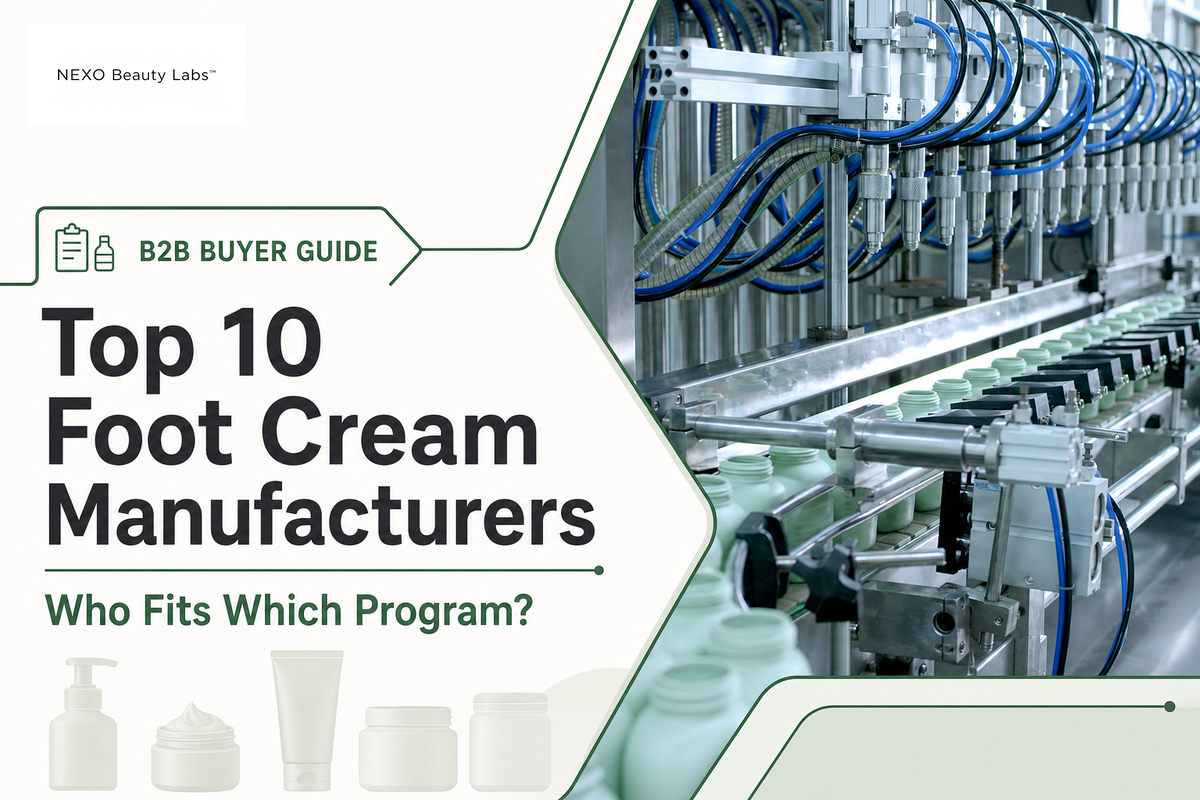
B2B manufacturer comparison
Last updated: October 2026
The best foot cream manufacturers for a B2B shortlist include NEXO Beauty Labs for multi-format hand-and-foot care, Pravada for low-volume ready-label sourcing, Cosmewax for European full-service programs, CosKorea for Korean OEM and ODM routes, and FormuNova for custom formulation in the United States. Foot cream manufacturers are companies that make finished foot-care creams for third-party brands; the right match depends on formula, package, volume, and evidence requirements.
Quick Picks
- Best for multi-format hand-and-foot-care programs from a 10,000-unit start: NEXO Beauty Labs
- Best for established European full-service foot care: Cosmewax
- Best for low-volume US ready-to-market foot cream: Pravada Private Label
- Best for Korean OEM and ODM routes with published quantity bands: CosKorea Group
- Best for Guangzhou heel-repair private label from 1,000 units: SEYE Cosmetics
- Best for tiered private-label, OEM, ODM, and custom-formula routes: SkinCraft Laboratories
Disclosure: This guide is published by NEXO Beauty Labs. We list ourselves first because this is our website, not because we claim to be the market leader. The other 9 manufacturers are grouped by what they’re best for, in no particular order within each group.
This comparison is about sourcing. Words such as soften, soothe, hydrate, and crack repair are examples of words that describe possible cosmetic briefs. They aren’t evidence to show that a manufacturer has endorsed a given claim. Likewise, a top-rated consumer product doesn’t mean that a brand owns a factory. The profiles focus on companies that publicly link finished foot care products with private label, white label, OEM, ODM or contract manufacturing.
How We Selected These Foot Cream Manufacturers
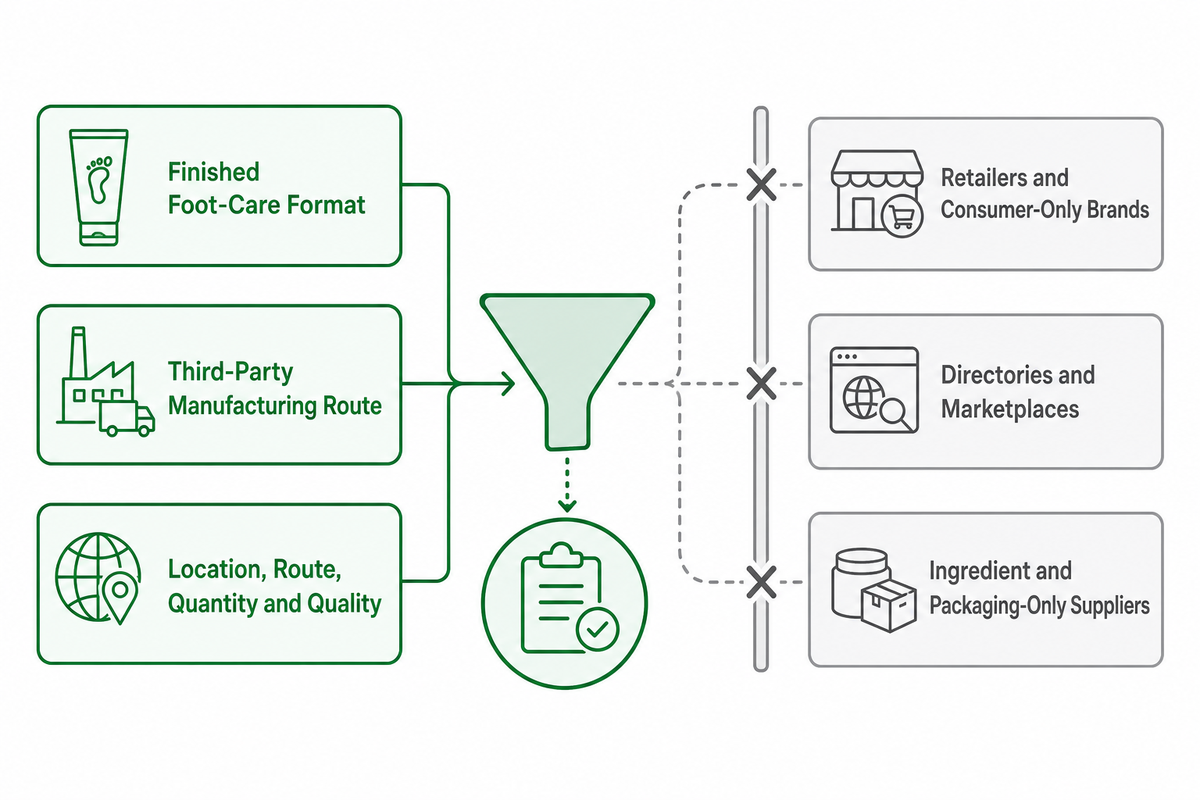
We required a company-owned page showing a finished cream, balm, mask, scrub, or similar format made for a third party. We looked for data about the company such as location, history, the route of production, the order quantity, the quality systems and the range of products manufactured. For the purpose of this study, we excluded pure retailers, consumer-only brands, distributors, directories, marketplaces, ingredient vendors, and packaging-only suppliers. Company information reflects official websites and other public sources accessed in October 2026.
For context, the ISO 22716 standard page describes cosmetic good manufacturing practices, while the FDA’s approval guidance explains why registration language should not be treated as product approval. Geography is used for planning purposes. It isn’t an indicator of product quality.
The numbering isn’t a league table. NEXO appears first under the disclosure above. The remaining sequence makes the production-route and regional comparison easier to follow. A company with a 50-unit ready-to-market route isn’t automatically better than a company that starts custom work at 10,000 units or 600 kg per batch. Those offers solve different procurement problems.
Foot Cream Manufacturer Fit Matrix
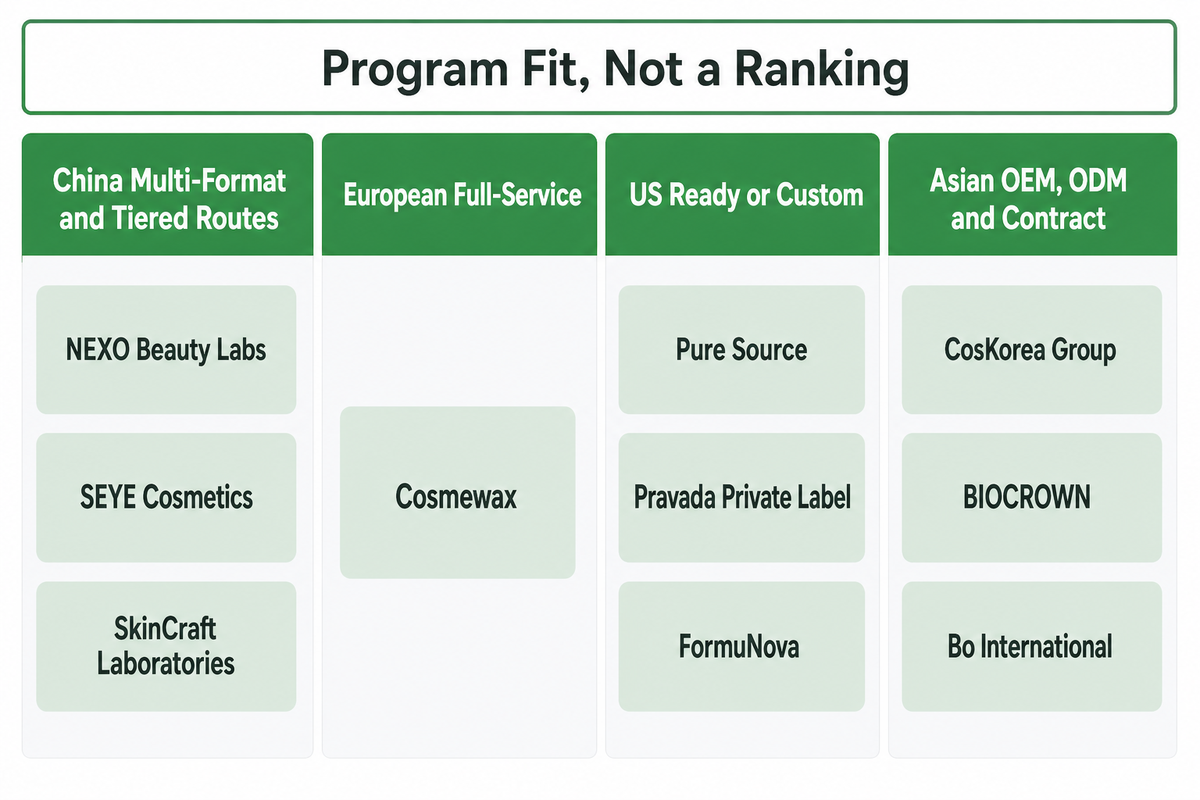
The Foot Cream Manufacturer Fit Matrix normalizes questions instead of assuming the public numbers are interchangeable. Published starting quantities are screening data, not quotes. Formula, fill weight, packaging options, decoration, SKU count, component minimums, testing, and destination can impact the order’s floor price.
| No. | Company Name | Headquarters | Founded Year | Best For | Brief Introduction | Manufacturing Route | Key Advantages | Potential Disadvantages | Official Website |
|---|---|---|---|---|---|---|---|---|---|
| 1 | NEXO Beauty Labs | Guangzhou, China | 1999 | Multi-format hand-and-foot programs | Cosmetics partner with multiple cream, mask, scrub, spray, and stick formats. | Private label and custom formula | 10,000-unit start; 56 production lines | High entry point for small tests | nexobeautylabs.com |
| 2 | Cosmewax | Barcelona, Spain | 1960 | European full-service programs | Long-established private-label maker with a dedicated foot-care category. | Full-service private label | Broad format and management-system coverage | Not US-headquartered for domestic-US partner policies | cosmewax.com |
| 3 | Pure Source | Miami, Florida, USA | 1995 | US repair-focused custom briefs | Contract maker with a page dedicated to anti-aging foot cream. | Custom contract manufacturing | Dedicated product-page evidence | Not EU-headquartered for EU-headquarters policies | thepuresource.com |
| 4 | Pravada Private Label | Fort Myers, Florida, USA | Not publicly disclosed | Low-volume ready-label launches | US producer offering an Intensive Therapy Foot Cream route. | Ready-to-market private label | Published 50-unit starting quantity | Custom changes can raise the minimum | pravadaprivatelabel.com |
| 5 | FormuNova | Stone Mountain, Georgia, USA | Not publicly disclosed | US custom formula development | Formulation and manufacturing partner with a dedicated foot-cream page. | Custom formula and private label | Public NSF facility listing | Listed Georgia site does not meet EU-location policies | formunova.com |
| 6 | CosKorea Group | South Korea | Not publicly disclosed | K-beauty OEM and ODM routes | Korean cosmetics producer with a hand-and-foot-care category. | OEM and ODM | Separate published route bands | Route must be fixed before comparison | coskoreagroup.com |
| 7 | BIOCROWN | Taiwan | 1977 | Batch-scale Taiwan programs | OEM and ODM skin-care manufacturer with foot-care product evidence. | OEM and ODM | 600 kg per batch per SKU disclosed | Weight is not a finished-unit count | biocrown.com.tw |
| 8 | Bo International | India | Not publicly disclosed | Broad India-based foot-care sourcing | Personal-care producer with creams, scrubs, salts, and sprays. | Private label and contract | Several foot-care formats | Not US-headquartered for US-headquarters policies | bointernational.net |
| 9 | SEYE Cosmetics | Guangzhou, China | 2008 | Heel-repair private label | Private-label maker with a dedicated heel-repair cream page. | Private label | Starting quantity from 1,000 units | Changes may move the product minimum | seyecosmetic.com |
| 10 | SkinCraft Laboratories | Zhongshan, Guangdong, China | 2007 | Tiered route selection | Cosmetics maker publishing separate private-label, OEM/ODM, and custom tiers. | Private label, OEM/ODM, custom | 500, 1,000, and 3,000-unit tiers | Tier name does not define editable variables | skincraftlab.com |
How to read the table: “Not publicly disclosed” marks a field without a dependable public value in the cited materials. Published quantities use different bases and should not be treated as equivalent.
Featured Manufacturer
1. NEXO Beauty Labs: Best for Multi-Format Hand-and-Foot-Care Programs
Headquarters: Guangzhou, China · Founded: 1999 · Type: private-label and contract cosmetics manufacturer
Official website: https://nexobeautylabs.com/
Main products: foot creams, hand creams, glove hand masks, sock foot masks, repair sticks, scrubs, sprays, and related body care
Capabilities / quality: formula adaptation, ingredient work, custom formula development, tubes, jars, glove packs, sock packs, and sticks; the company lists ISO 22716, ISO 9001, and FDA registration
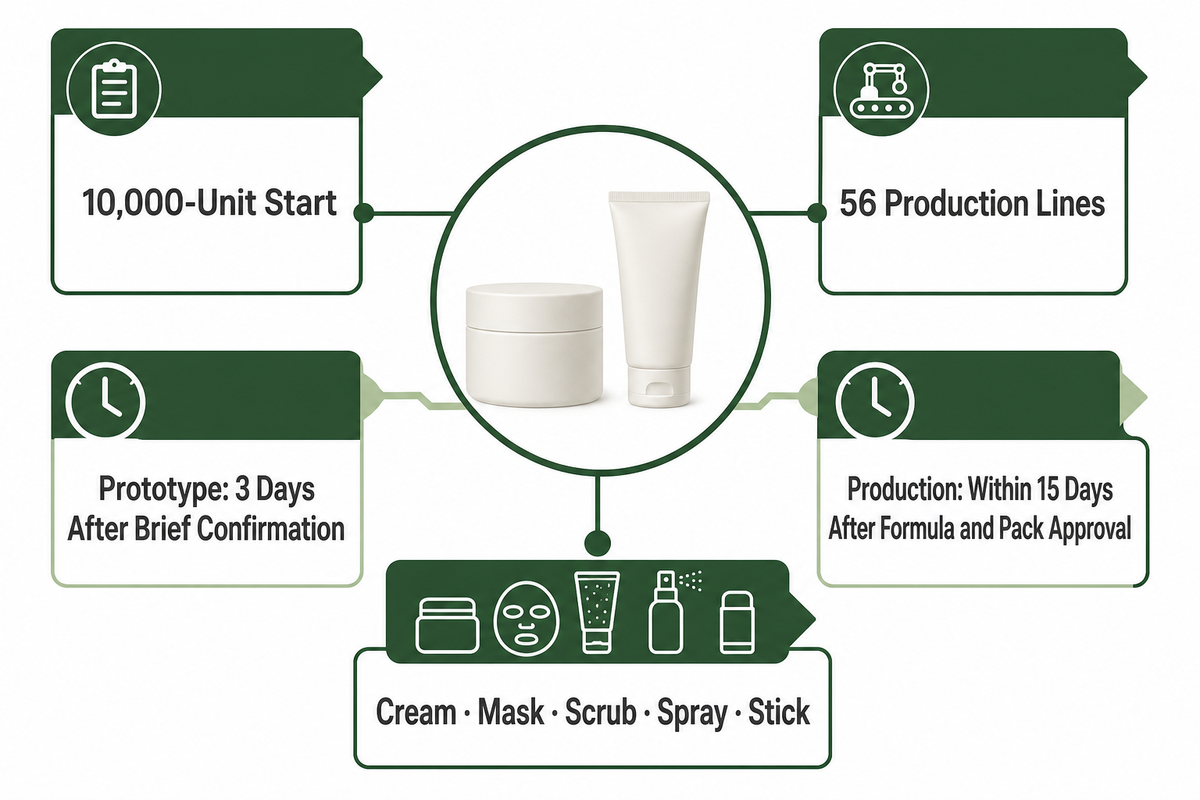
NEXO fits buyers building a coordinated hand-and-foot collection rather than a single cream; its published scope joins formula work with several package directions, while its resource page states 5,000+ formula resources and 56 production lines. The company gives a 10,000-unit starting order, prototype development in 3 days after brief confirmation, and commercial production within 15 days after formula approval and packaging qualification; those clock triggers matter because three days isn’t a shipping promise, and fifteen days isn’t concept-to-market time.
The program can cover a moisturizing cream for dry feet, a scrub to exfoliate dead skin, a sock-style sheet mask, or a repair stick; any active story involving urea, shea butter, lactic acid, salicylic acid, tea tree oil, or menthol still needs a formula brief and claim review. Limitation: the published 10,000-unit starting point may not suit a small test, and a split across formulas, formats, fragrances, or SKUs requires written confirmation; learn more on NEXO’s hand-and-foot-care manufacturing page.
European Full-Service Foot-Care Specialists
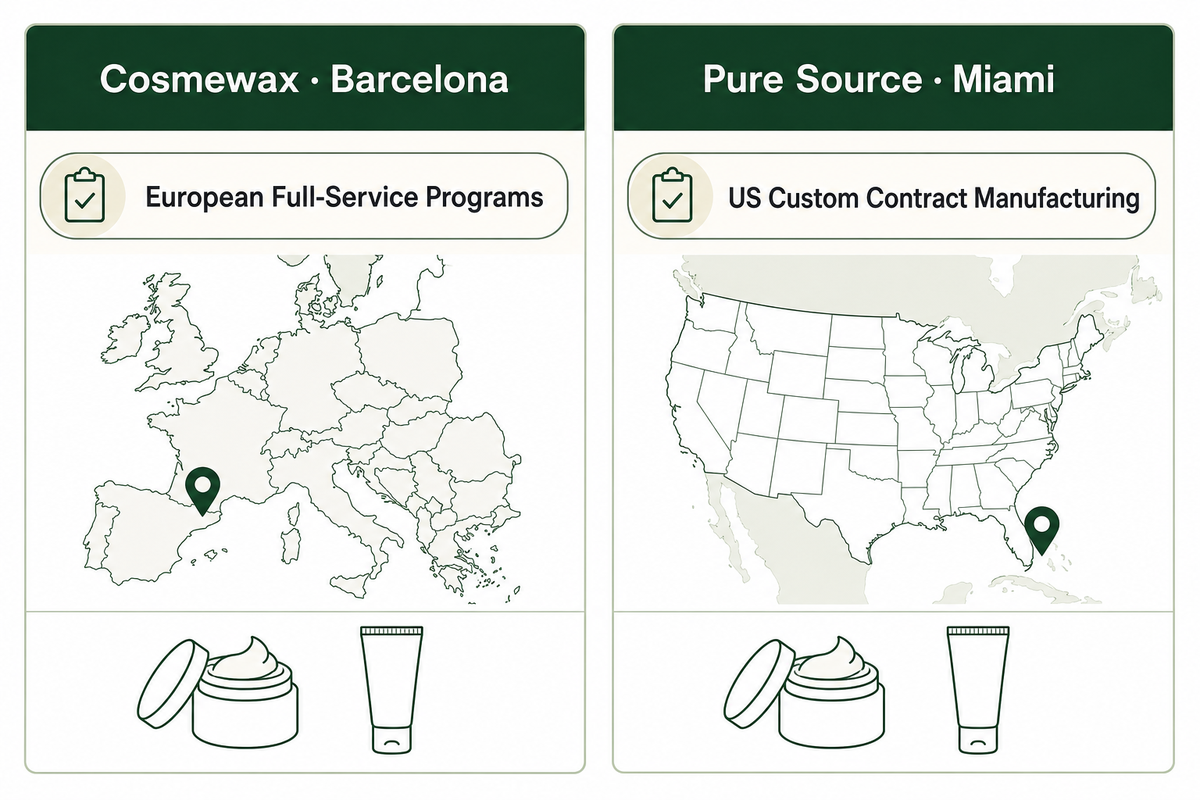
2. Cosmewax: Best for Established European Full-Service Programs
Headquarters: Barcelona, Spain · Founded: 1960 · Type: private-label cosmetics manufacturer
Official website: https://cosmewax.com/
Main products: creams, scrubs, masks, sprays, and other foot care formats
Capabilities / quality: concept development, formulation, manufacturing, filling, and packaging; the company lists ISO 22716, ISO 9001, ISO 14001, and ISO 27001
Cosmewax is a useful fit when a European program needs several linked care products and a mature full-service process; the dedicated category page goes beyond one stock foot care cream, which gives product developers room to discuss a nourishing foot product, a gel, a serum-like treatment, or companion exfoliation. Limitation: Cosmewax is headquartered in Barcelona, Spain, so it is not a US-headquartered option for procurement policies that require a domestic US partner.
3. Pure Source: Best for US Anti-Aging and Heel-Repair Cream Formulation
Headquarters: Miami, Florida, USA · Founded: 1995 · Type: cosmetics, skincare, and personal-care contract manufacturer
Official website: https://www.thepuresource.com/
Main products: anti-aging and repair-focused foot products
Capabilities / quality: custom formulation, manufacturing, filling, and packaging support; the company describes its operation as GMP compliant
Pure Source stands out because it publishes a page for anti-aging foot cream manufacturing rather than leaving buyers to infer capability from a generic body-lotion page; that positioning may suit a US brand developing creams for cracked heels, dry skin, rough skin, or dry areas that need a richer emollient system. The page can start a technical conversation about texture, absorption, non-greasy after-feel, and packaging, but it isn’t a finished specification.
A custom brief should choose the target-market spelling, moisturize or moisturise, and state whether the intended formula will nourish or soften, how each claim will be substantiated in that market, and how cosmetic dryness language will be kept separate from antifungal or fungus claims that can change product classification. Limitation: Pure Source is headquartered in Miami, Florida, so it is not an EU-headquartered option for programs whose sourcing policy requires a European partner.
North American Ready-Label and Custom Programs
4. Pravada Private Label: Best for Low-Volume Ready-to-Market Foot Cream
Headquarters: Fort Myers, Florida, USA · Founded: Not publicly disclosed · Type: US private-label cosmetics manufacturer
Official website: https://www.pravadaprivatelabel.com/
Main products: Intensive Therapy Foot Cream plus manicure and pedicure products
Capabilities / quality: ready-to-market private label with a published 50-unit starting quantity; the company lists GMP-compliant, ISO 22716-aligned, and MoCRA support language
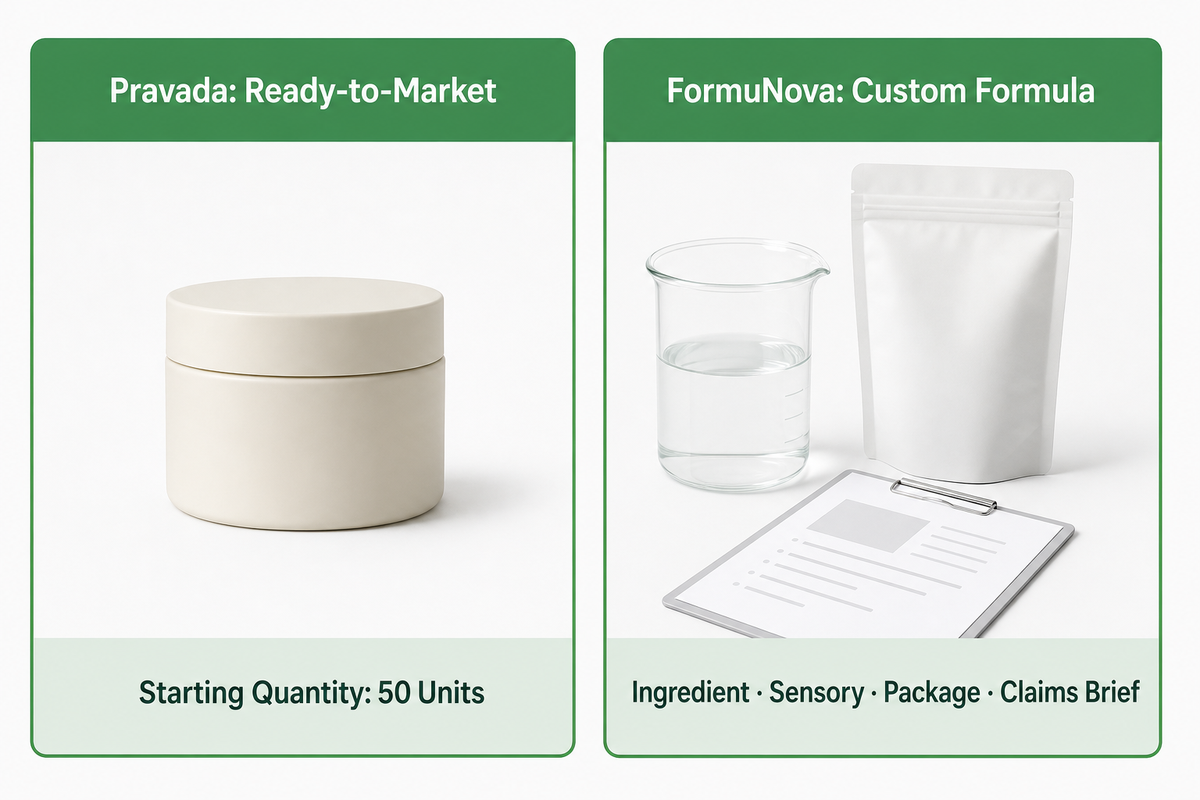
Pravada offers the clearest low-entry route in this comparison; its product page connects a specific finished product with a 50-unit starting quantity, which can help a new beauty industry buyer test branding, channel response, or a small retail account without opening a custom research and development project. It’s a ready-to-market route, so the short path comes from using an existing product and a bounded set of packaging choices.
The number must stay attached to that route because a request to change the base, add high-concentration urea, replace fragrance, add eucalyptus, or move into a different jar or tube may create new raw-material, test, or component minimums. Limitation: the 50-unit start doesn’t prove that every texture, active, scent, label, or package can be changed within that route.
5. FormuNova: Best for US Custom Foot-Cream Formulation
Headquarters: Stone Mountain, Georgia, USA · Founded: Not publicly disclosed · Type: custom formulation and private-label beauty manufacturer
Official website: https://formunova.com/
Main products: custom foot creams within beauty and personal-care manufacturing
Capabilities / quality: custom formulation, private label, manufacturing, and qualitative low-MOQ positioning; NSF lists Kerolabs Corp. DBA FormuNova Labs at Stone Mountain manufacturing facilities
FormuNova is positioned for a buyer whose brief can’t be met by an off-the-shelf base; its dedicated custom foot-cream page supports a conversation about the ingredient system, sensory target, package, fill, and product claims. A custom foot project could explore allantoin, panthenol, jojoba, glycolic acid, or other softening agents, but an ingredient name alone doesn’t set an effective level, evidence plan, or legal claim. The cited NSF listing identifies manufacturing facilities in Stone Mountain, Georgia. Limitation: that listed US site does not meet programs that require an EU production location.
Asian OEM, ODM, and Scaled Production Options
6. CosKorea Group: Best for Korean OEM and ODM Routes with Disclosed Bands
Headquarters: South Korea · Founded: Not publicly disclosed · Type: Korean OEM and ODM cosmetics manufacturer
Official website: https://coskoreagroup.com/en/
Main products: hand cream, foot cream, masks, and related hand-and-foot care
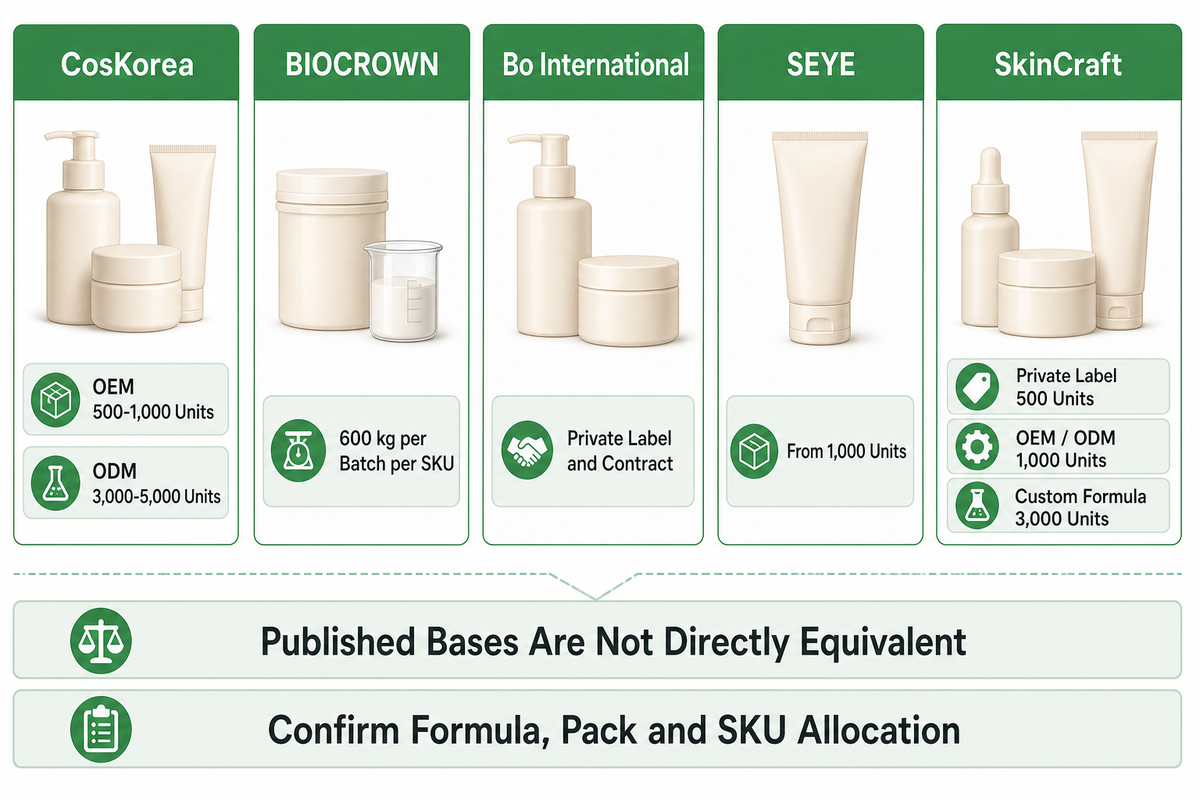
Capabilities / quality: published OEM quantities of 500–1,000 units and ODM quantities of 3,000–5,000 units; the company lists K-GMP, CGMP, ISO 9001, ISO 22000, HACCP, and Halal credentials
CosKorea is useful for buyers who want a Korean production route and need an early view of how OEM and ODM commitment levels differ; the hand-and-foot-care page ties the manufacturing model to the category and publishes separate bands. That distinction is more informative than one “low MOQ” label because it prompts the buyer to decide whether the supplier is executing a defined brief or contributing more development work.
The bands don’t explain formula count, component count, scent variants, or finished-SKU allocation, so a buyer seeking a deodorizing formula, odor control, a refreshing scent, or a claim tied to cracked feet must show which inputs are fixed and which need development. Limitation: the procurement team must confirm the correct route and permitted variables before treating either band as the project minimum.
7. BIOCROWN: Best for Taiwan-Based Batch-Scale Foot-Care Manufacturing
Headquarters: Taiwan · Founded: 1977 · Type: OEM and ODM skin-care manufacturer
Official website: https://www.biocrown.com.tw/en/
Main products: foot care and skin care formulas for private-label programs
Capabilities / quality: published minimum of 600 kg per batch per SKU; the company lists ISO 22716, ISO 9001, ISO 14001, GMP, and SGS-related credentials
BIOCROWN gives scale buyers a useful public basis, 600 kg per batch per SKU, which is a manufacturing-weight threshold rather than a count of jars or tubes. It can fit a distributor or established brand that already has forecast confidence, especially when the cream will sit inside a broader skincare portfolio, and the figure makes the key conversion inputs visible instead of hiding them behind a “from” claim.
To estimate finished units, procurement needs nominal fill weight, bulk overage, filling loss, quality-retain quantity, and component yield; a 600 kg batch can’t be converted honestly without those inputs. Limitation: the batch basis may be too large for a small launch and doesn’t reveal the final component or decoration minimum.
8. Bo International: Best for Broad India-Based Foot-Care Contract Manufacturing
Headquarters: India · Founded: Not publicly disclosed · Type: private-label and contract personal-care manufacturer
Official website: https://www.bointernational.net/
Main products: foot creams, scrubs, salts, sprays, and related foot care products
Capabilities / quality: formulation, manufacturing, filling, and packaging across personal-care categories; the company lists ISO-WHO, GMP, Kosher, HACCP, and Halal credentials
Bo International may fit a buyer that wants one India-based partner across cream, foot scrub, salts, and sprays; that category breadth can support a coordinated foot care launch rather than a single high-quality foot cream. It also gives a sourcing team more room to discuss whether natural ingredients, a non-greasy sensory target, or companion body care products should share a fragrance and packaging system. Bo International is based in India. Limitation: it is not a US-headquartered option for programs whose sourcing policy requires a US-headquartered partner.
9. SEYE Cosmetics: Best for Guangzhou Heel-Repair Private Label from 1,000 Units
Headquarters: Guangzhou, China · Founded: 2008 · Type: private-label cosmetics manufacturer
Official website: https://www.seyecosmetic.com/
Main products: private-label heel repair cream and related skin care products
Capabilities / quality: custom private label with a published starting quantity from 1,000 units; the company lists GMP, ISO 22716, and EU-compliance credentials
SEYE is one of the most direct matches for a heel-repair brief because its official page names the product and publishes a starting quantity; a 1,000-unit figure can be useful for brands that have moved beyond a micro test but don’t yet need a much larger custom foot program. It can also suit a distributor building a focused repair foot cream around dry heels or cracked skin.
The starting figure isn’t a guarantee for every formula or component because high-concentration urea, a new fragrance, a new tube, a color-matched cap, or a carton may trigger separate supplier minimums. Limitation: the final quotation must allocate the 1,000 units by formula, component, print version, and finished SKU rather than repeating a headline number.
10. SkinCraft Laboratories: Best for Tiered Private-Label, OEM, and Custom-Formula Routes
Headquarters: Nanlang, Zhongshan, Guangdong, China · Founded: 2007 · Type: private-label, OEM, ODM, and custom-formula cosmetics manufacturer
Official website: https://www.skincraftlab.com/
Main products: foot care formulas within a private-label skin care range
Capabilities / quality: published levels of 500 units for private label, 1,000 for OEM or ODM, and 3,000 for a custom formula; the company lists GMPC, ISO 22716, and US FDA CFSAN cosmetic GMP credentials
SkinCraft offers the clearest tier ladder in this group; the three public thresholds help a buyer discuss whether the project is a stock base with branding, an OEM or ODM brief, or a new custom formula. This makes it a useful candidate for buyers searching for a “label cosmetic manufacturer” when internal stakeholders haven’t yet agreed how much product development they actually need.
The route name doesn’t define editable variables, and a luxurious foot cream brief might ask for propylene glycol, jojoba, panthenol, an acid for callus care, or a different scent and package even though each choice can change testing and minimums. Limitation: procurement must obtain a route-specific change matrix covering formula, fragrance, texture, claims, package, decoration, and unit allocation.
How to Choose a Foot Cream Manufacturer
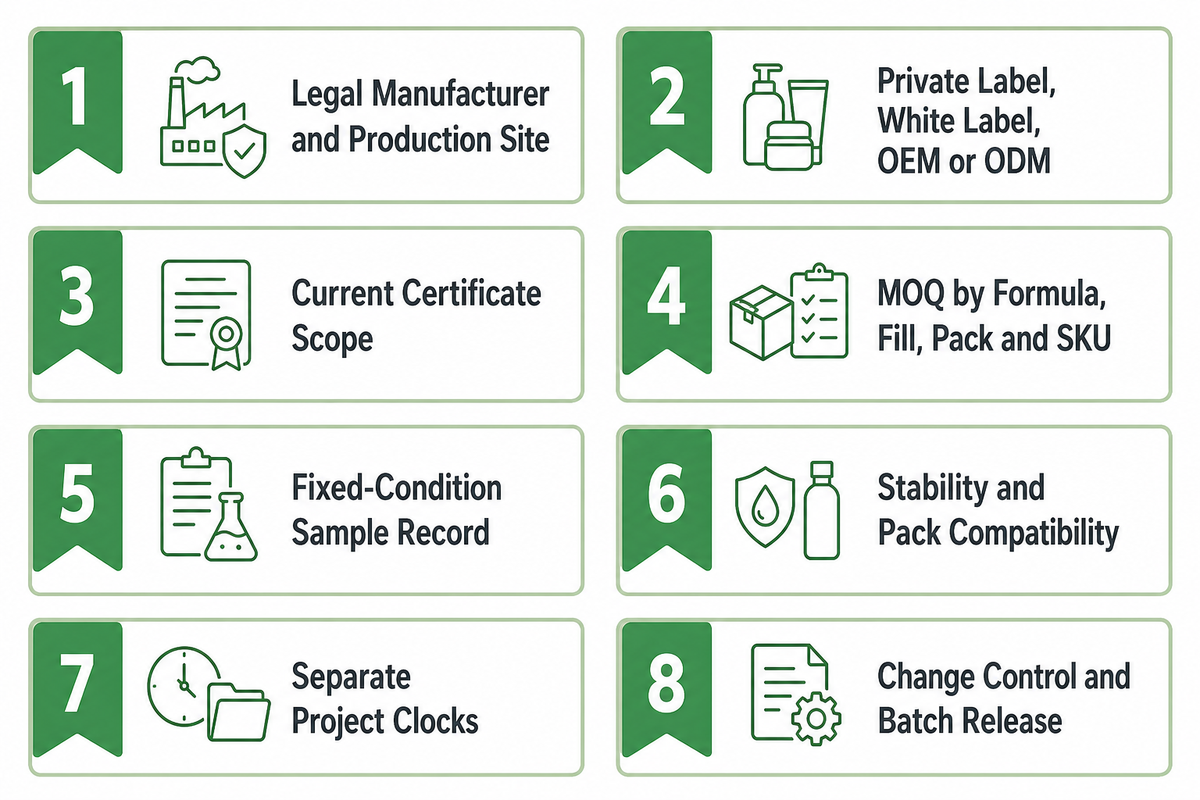
A shortlist narrows the field; the buyer’s brief and the supplier’s evidence determine fit. The Route-to-Quote Eight-Check Brief below uses public data to create an RFQ. It’s geared toward brand founders, sourcing managers, product developers, distributors, quality assurance personnel, and retail buyers assessing third-party manufacturers.
Public commercial detail is uneven: Cosmewax does not publish one universal category MOQ or production schedule; Pure Source does not publish a normalized project MOQ, lead time, or editable-variable list; FormuNova’s low-MOQ positioning does not give one numeric foot-cream threshold; and Bo International’s foot-care category does not publish a universal MOQ or project clock. Treat these as RFQ inputs rather than proof of poor fit. Request a route, formula and packaging basis, finished-SKU minimum, sample plan, and clock triggers in writing.
Freeze the Product Brief Before Comparing Quotes
Begin with the user and use case, not a copied ingredient list. For example, record the intended dry-skin use and morning application routine. For an extra-dry heel or foot crack use case, record whether a night cream or cooling leg-and-foot gel is an acceptable format. State the target texture, rub-in time, finish, fragrance direction, application area, package type, nominal fill, retail market, target price band, annual volume, and desired launch date. If the brand wants to include urea, lactic acid, salicylic acid, shea butter, tea tree oil, menthol, panthenol, jojoba or other named ingredients, state the required grade or range and explain the function. This way, the manufacturer can assess feasibility without interpreting named ingredients to mean certain product attributes.
Distinguish sensory language from evidence-heavy claims. “Rich but non-greasy,” “absorbs within the application routine,” and “fresh scent” can be recorded as sample acceptance criteria. Whether statements such as “Repairs cracked heels” or “removes calluses” or “antifungal” or “treats fungus” need support/justification or warrant a different regulatory pathway varies from market to market. Ask the supplier to mark each proposed statement as accepted, revised, unsupported, or referred for regulatory review. Use approved label claims consistently on the website, carton, distributor sheet, and other materials. A technically suitable cosmetic can reach the market with a claim the underlying evidence doesn’t support.
Then freeze the commercial comparison unit. Provide the same formula route, fill size, package construction, decoration method, carton requirement, fragrances, artwork versions, and delivery term to all shortlisted manufacturers. Request separate lines for development, samples, testing, bulk, primary packaging, decoration, secondary packaging, filling, release, freight, and one-time tooling. A low unit price tied to one bulk formula and one artwork cannot be compared fairly with a quote split across several scents, packs, or SKUs. Record suppliers’ assumptions next to their prices. The procurement team will then be able to distinguish whether a difference is due to manufacturing efficiency or a missing scope item.
Route-to-Quote Eight-Check Brief
- Legal manufacturer and physical production site
- Private label, white label, OEM, or ODM route
- Current certificate scope and covered activity
- MOQ allocation by formula, fill, package, and SKU
- Fixed-condition sample acceptance record
- Stability and packaging-compatibility plan
- Separate development, delivery, and production clocks
- Change control and batch-release evidence
1. Confirm the Legal Manufacturer and Physical Production Site
First, find out which legal entity will sign the quality agreement and the invoice, and then determine who formulates, makes bulk, fills, labels, stores and releases the batch. A trading company can bring a good product to market, but that doesn’t necessarily mean it employs the same risk model as direct foot cream manufacturing. Ask for each relevant address and identify any outsourced activity. If a certificate states a legal entity by a different name, ask for the relationship document rather than assume the two entities are the same.
This check also prevents a private-label foot-care supplier from being presented as the actual manufacturer. The NSF record for FormuNova, for example, is useful because it names Kerolabs Corp. DBA FormuNova Labs and Stone Mountain facilities. That specificity is more useful than a logo badge alone. Record the contracting entity, manufacturing site, quality-release site, and complaint owner in four separate fields.
2. Match Private Label, White Label, OEM, or ODM to the Brief
Routes are only clear when defined by both sides. The phrase “label cosmetic manufacturer” is not a consistent route definition; buyers usually need to distinguish white label, private label, OEM, and ODM. One label manufacturer may use private label to mean a base with some changes to the art; another may mean a base with fragrance, color, or active adjustments. OEM can mean a build-to-brief; ODM can mean supplier-led research and development, but usage varies. Put the editable variables in writing: base formula, active system, fragrance, texture, color, intended claim, fill size, container, decoration, carton, and insert.
A custom foot project that varies many elements shouldn’t be compared to a ready-label product based on unit count alone. A white-label product may take less time to market, because its technical file and base are more settled. Custom formulation can create stronger differentiation, but it brings more sample, test, and component decisions. Choose the route that best meets the commercial objective. Do not treat “custom” as automatically superior.
3. Request Current Certificate Scope
Ask for the issuer, certificate number, standard, covered company name, covered address, activity scope, issue date, and expiry. ISO 22716 addresses good manufacturing practice for cosmetics; ISO 9001 concerns a quality-management system; ISO 14001 concerns environmental management. None of these is a product-performance approval. A company statement can be useful for screening, but the current document and site scope matter before supplier approval.
FDA language needs similar care. Facility registration, product listing, or a company database entry must not be rewritten as “FDA approved” or “FDA certified.” The FDA’s approval explainer is a useful wording boundary. If Halal, Kosher, or market-specific evidence matters, ask which formula, facility, and certification body it covers.
4. Normalize MOQ by Formula, Fill, Package, and SKU
Convert every headline MOQ into the same four-part structure: bulk formula quantity, nominal fill, packaging minimum, and finished-SKU allocation. Pravada’s 50 ready-to-market units, SkinCraft’s 500-unit private-label tier, SEYE’s 1,000-unit start, NEXO’s 10,000-unit start, and BIOCROWN’s 600 kg per batch per SKU aren’t directly equivalent. One is a finished-product route, another is a development tier, and another is bulk weight.
For a weight-based offer, ask for bulk overage, filling loss, test and retain quantities, and expected finished yield. When a supplier offers product by count, ask whether the count can be split across fragrances, artwork versions, fill sizes, and packages. Latest prices are meaningless without the same scope. A smaller order can have higher packaging and decoration costs, while a larger bulk minimum can be efficient for an established program but unsuitable for a launch.
5. Define a Fixed-Condition Sample Acceptance Record
Give each sample a code and record formula revision, batch date, package, fill, storage condition, and evaluator. The acceptance sheet should evaluate appearance, odor, color, spread, absorption, residue, dispensing, net content, closure, and package integrity. For creams for cracked heels, the evaluators may wish to record the quantity applied and the after-feel, but such an unsubstantiated evaluation should not support a clinical claim.
Preferences should be listed next to the sensory target. Urea, lactic acid, salicylic acid, glycolic acid, shea butter, tea tree oil, eucalyptus, menthol, allantoin, panthenol, jojoba, and emollient choices can affect pH, odor, feel, package interaction, and claim wording. “Natural ingredients” isn’t a full specification. State the exact material, grade, use level or allowed range, and restricted-substance requirements.
6. Bind Stability and Packaging Compatibility to the Final System
A formula that looks acceptable in a laboratory jar may behave differently in a pump, tube, stick, sachet, or sock pack. Bind the stability plan to the final formula, component materials, fill process, storage temperatures, orientation, duration, and inspection schedule. Changes in viscosity, odor, color, separation, evaporation, leakage, paneling, swelling, print damage and dispensing performance should be noted.
There are challenging combinations in foot care briefs like rich butter systems, high acid loads, essential oils, deodorizing ingredients or a cooling sensory package. A gel, cream, serum, repair stick, scrub, or sheet mask will put components through a different kind of stress. Ask who owns compatibility work, what constitutes failure, and whether a package change restarts any part of the test plan. A sample in unbranded lab packaging doesn’t clarify this.
7. Separate Development, Sample-Delivery, and Production Clocks
Put a trigger beside every timing statement. Development may start after a signed brief and deposit. Sample delivery may depend on raw materials, package availability, or courier time. Commercial production may start only after formula approval, compatibility review, artwork approval, component arrival, and payment. NEXO’s published three-day prototype timing begins after brief confirmation, while its fifteen-day production statement begins after formula approval and packaging qualification.
Ask each candidate for the same clock map: brief accepted, first sample dispatched, revision received, formula frozen, packaging qualified, artwork approved, components received, bulk made, filling completed, release completed, and shipment ready. This can differentiate a “15-day” claim from a supplier’s full concept-to-shipment schedule. Include the owner, input and start/stop conditions for each component in the table.
8. Put Change Control and Release Evidence in the Quality Agreement
For each product, assign owners for approval of raw materials, substitutions, formula and package changes, artwork, deviations, reworks, batch records, release testing, complaints, and retain samples. Note what the supplier is allowed to change without written approval and what requires a new sample or test. The agreement should also say how long records and retain samples are kept and which documents travel with each lot.
For a cosmetic brief targeted to dryness, dry heels, rough skin, calluses and cracked heels, or general foot needs, an evidence package may include specification, ingredient list, approved label, batch record, test results and release decision. A claim such as “antifungal” or language about treating fungus can move the product outside an ordinary cosmetic route, so it needs market-specific regulatory review before the label is frozen. Boundary questions shouldn’t be referred to the factory for resolution following production.
Frequently Asked Questions
Which Is the Best Foot Cream Manufacturer for a New Beauty Brand?
The best fit depends on launch volume and development route, not on one universal winner. Pravada publishes a 50-unit start for a ready-to-market product, SkinCraft publishes tiered routes from 500 units, and NEXO publishes a 10,000-unit start for a multi-format program. A new brand should first decide whether it needs an existing base, selected changes, or a new formula.
Who Is the Largest Foot Cream Manufacturer in the World?
No reliable public source in this research establishes a single specialist as the world’s largest by foot-cream output. Different metrics include company-wide revenue, total cosmetics volume, factory area, number of lines, product breadth, and actual foot-care capacity. A “largest” claim requires a defined metric and comparable data for each candidate. Company marketing language isn’t sufficient to make a “largest” claim.
What Is the Difference Between a Foot Cream Manufacturer and a Supplier?
A manufacturer formulates, makes bulk, fills, labels, or releases the finished product, while a supplier may only distribute or coordinate it. Some suppliers manage capable third-party manufacturers, but the buyer should know the legal producer and production site. Ask who signs the quality agreement, owns the batch record, and performs release testing and complaint handling.
How Much Does Private-Label Foot Cream Cost?
A dependable public per-unit range isn’t available from the selected official sources. Comparable costing requires formula, actives, fill weight, component, decoration, carton, test plan, order quantity, SKU split, Incoterm, and destination. Request the latest prices against one frozen brief. Suppliers should separate development, bulk, packaging, testing, freight and one-time costs.
What Is a Realistic MOQ for Private-Label Foot Cream?
Public examples in this shortlist run from 50 finished units for Pravada’s ready route to 600 kg per batch per SKU at BIOCROWN. SkinCraft lists 500 units for private label, SEYE starts from 1,000 units, and NEXO states 10,000 units. These numbers aren’t equivalent because formula ownership, package, fill, customization, and SKU allocation differ.
How Do OEM, ODM, Private-Label, and White-Label Routes Differ?
White label and private label usually start from an existing base. OEM usually executes a buyer-defined brief. ODM usually includes more supplier-led development. Companies use these labels differently, so ask for an editable variable matrix. For each route and quantity, the matrix should state what can change in formula, fragrance, texture, claims, packaging, artwork, and testing.
References & Sources
- International Organization for Standardization, ISO 22716 cosmetics GMP guidance
- US Food and Drug Administration, Is It Really FDA Approved?
- NSF public listing, Kerolabs Corp. DBA FormuNova Labs
- NEXO Beauty Labs, company and manufacturing background
Build the Shortlist Around the Brief
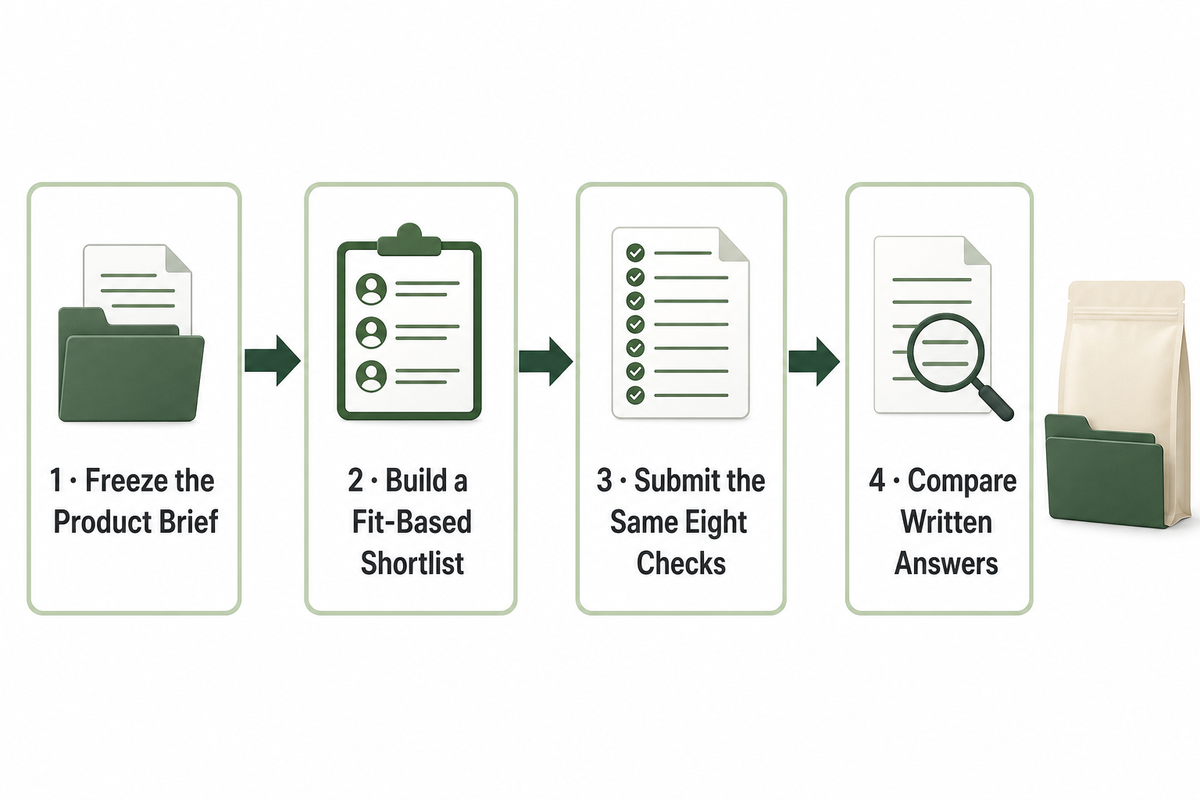
Each program has specific partner requirements. A ready-label launch requires a partner with an established base and low entry quantity. A custom formula requires a specific sensory and ingredient brief. A scaled OEM or ODM program requires a partner with reliable allocation, testing, BOM and change control. Prior to partner selection, define the target market, product route, intended user, formula target, package, volume, SKU, evidence package and launch window.
A comparison of the various programs shows why a single headline number can be misleading. Fifty ready-to-market units, 1,000 private-label units, 10,000 units across a multi-format program, and 600 kg per SKU per batch represent different levels of work. Use your route-to-quote briefing to submit the same eight checks to the shortlisted suppliers and assess the written answers rather than the marketing copy.
For a multi-format program, review NEXO’s hand-and-foot-care manufacturing capabilities and company background. The public page describes cream, mask, scrub, spray, and stick directions, along with its stated development and production triggers.
Are you ready with a formula, package, volume and launch market?
Send NEXO your product brief for a technical fit review. The team can confirm the development route, sample inputs, minimum-order basis, packaging path, and the conditions that start each project clock.
Why beauty brands work with NEXO
About NEXO Beauty Labs Manufacturing Support
NEXO Beauty Labs supports skincare, body care, sun care, hair care, and private label brands with formulation, sampling, filling, quality control, and export-ready launch support.
Project Review Before RFQ
Before quotation, we help clarify product category, active direction, formula stage, package choice, compliance market, MOQ, sampling schedule, and required documents.
Request a Cosmetic QuoteCompany Profile // Data Sheet
CompanyNEXO Beauty Labs
Business TypeCosmetic OEM / ODM manufacturing partner
Main ProductsPrivate label skincare, facial serums, moisturizers, cleansers, sunscreen, body care, and hair care products
Manufacturing CapabilityFormula development, sample adjustment, package sourcing, filling, QA/QC, documentation, and export support
RFQ Data NeededProduct type, formula goal, package format, target market, MOQ, claims, timeline, and benchmark samples
Websitenexobeautylabs.com