Get in touch with NEXO Beauty Labs Company

OEM Cosmetic Manufacturing converts agreed formulas and product briefs into branded finished goods. Cosmetic brands need those decisions to successfully pass the baton through the lab, purchase, production, fill and quality control functions. A sample can look right while the instructions for making the product, the package components or the release criteria remain undecided.
Updated October 2026 · By Cherry
OEM cosmetic manufacturing produces cosmetics to an agreed specification under a brand’s name. A usable manufacturing brief connects the formula, process, package, acceptance tests and release decision. Seven documented handovers carry those decisions into repeat orders.
A brand with a production brief can review our OEM cosmetic manufacturing services. The operational guide addresses the work between deciding on a manufacturing route and receiving consistent repeat batches. Safety, claims and labelling requirements of the target market are part of the launch plan, in addition to the manufacturing work.
Key decisions before production
- Approve the formula version and manufacturing instructions together.
- Compare quotations with the same packaging, testing and accepted-unit basis.
- Include transfer and filling in the scale-up trial.
- Identify the person who releases each batch and the person who handles market-side obligations.
What OEM Cosmetic Manufacturing Includes
OEM manufacturing means the factory makes and packs a cosmetic product to an approved brief. Formula development, sourcing, testing and documentation may be part of the service or separated. Each purchase order should show where work begins, what’s delivered, and who accepts it.
What is OEM in beauty industry?
OEM means original equipment manufacturing. In the beauty industry, an original equipment manufacturer produces branded cosmetics under an agreed specification. The phrase describes the production relationship; the contract and project records determine the development work, access to documents and commercial terms. A brand can supply a formula and/or commission formulation work.
The FDA cosmetic manufacturing checklist treats processing, transferring, filling and control records as identifiable manufacturing activities. This can serve as a basis to separate the work. A factory’s research and development capabilities should be considered separately from its ability to reproduce an approved formula on the same production line.
Some cosmetic manufacturers specialize in skin care products; others handle color cosmetics or different personal care formats. A manufacturer specializing in emulsions may still need a separate line assessment for powders, aerosols or professional makeup products. Product family belongs in the opening brief, before a purchasing team compares suppliers. Each cosmetic service should be defined in the agreement based on the deliverables.
For wider sourcing and route selection, use the cosmetic contract manufacturing guide. The manufacturing handovers begin once the brand and product directions are determined.
7-Step Batch Handover Map
The 7-Step Batch Handover Map connects each production decision to a record, its owner and the next person who needs it.
Ten records span the seven steps because formula access, process instructions and packaging approval are different deliverables. Assign names to the roles on the map when copying it to a project file.
| Step | Record | Prepared by → accepted by | Decision carried forward |
|---|---|---|---|
| 1 | Formula version and access schedule | Brand/formulator → project owner | Which formula, who may use it, which technical records may be shared |
| 1 | Manufacturing instructions | Formulator → process engineer | Materials, addition order and process variables for the intended equipment |
| 2 | Product specification | Technical team → brand and quality lead | Test method, sampling point and acceptance limit for each attribute |
| 2 | Packaging specification | Packaging team → factory | Approved container, closure, contact materials and artwork version |
| 3 | Quote and schedule baseline | Factory/purchasing → finance and brand | Included scope, minimums, payment stages and clock-start conditions |
| 4 | Pilot comparison | Process engineer → technical and quality leads | Differences from the reference and the route to first production |
| 5 | Filled-pack trial record | Filling/packaging teams → quality lead | Line settings, pack performance and follow-up study requirements |
| 6 | Batch release record | Factory quality lead → designated release authority | Results, deviations, accepted quantity and disposition |
| 7 | Change record | Proposing team → agreed approvers | What changes, which evidence is reviewed and when the change starts |
| 7 | Complaint and traceability file | Brand/customer service → quality and market-responsible roles | Affected lots, retained samples, investigation and market-side action |
A startup brand can assign several roles to a single person. Keep decisions separate even then. For example, accepting a sample’s fragrance is a different action from accepting the results for a shipment.
Step 1: Transfer the Formula and Define Access
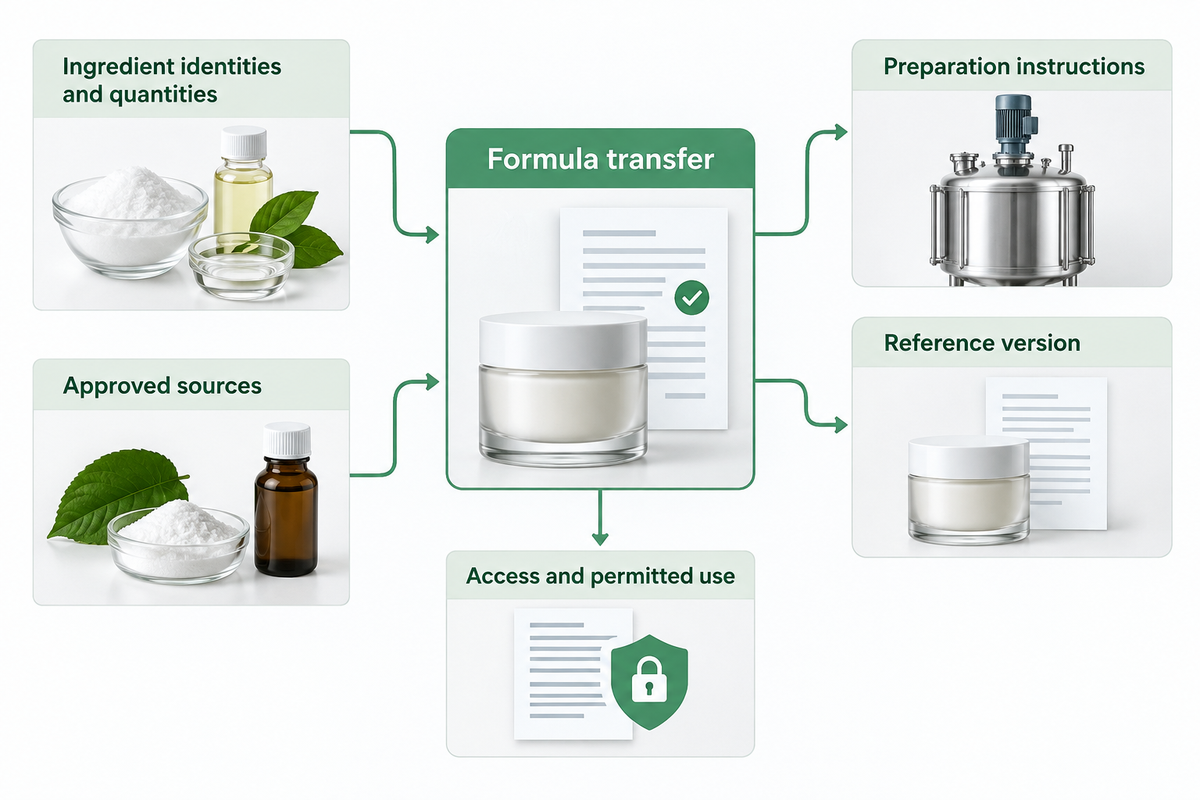
Transfer the formula with the information required to reproduce it, such as the identity and quantity of each ingredient, the approved sources, how to prepare it and the reference version. Define access to and permitted use of the record in the same agreement. Ownership, access to technical records and a receiving factory’s ability to make the product are separate questions.
A label ingredient list helps describe composition to the consumer, but production needs a quantitative formula and a working process. Raw material trade names, grades and supplier details matter when two materials share an ingredient name but have different technical characteristics. The process engineer also needs to know what the formulator tried and rejected.
Nicola Lionetti and Miriam Deola discuss this knowledge transfer in their 2024 technical article on cosmetic scale-up. Their account connects the formula with addition order, preparation conditions, material variability and comparisons between prototype and pilot batches.
Example: A brand moves a moisturizer from a first contract manufacturer to a second. Purchasing sends the ingredient declaration and an approved jar. The new factory can compare the appearance, but it still needs a quantitative formulation, grades of ingredients and process description to produce the intended product.
The project owner needs to fix access before booking a trial. Otherwise the manufacturing team is developing a replacement while finance believes it has purchased a straightforward transfer. A signed reference, permitted-use agreement, and a production-ready tech package create definite tasks for the receiving team. Any new process requires verification on the receiving equipment, even if the brand owns the formula.
The UK government’s guidance on intellectual property in collaborations suggests written arrangements for existing and new rights and their use. It shouldn’t be read as a default position on cosmetic formula ownership.
Regulatory information has its own purpose. In Great Britain, the government’s cosmetic product guidance includes ingredients and concentrations among safety report information. Agree on a workable information route for the responsible person and safety assessor in the context of commercial confidentiality.
Projects implemented by ODM and OEM can use multiple development arrangements. If a partner will also provide ODM services, itemise the development work separately. For the difference between original design manufacturing, commissioned formula development and private label products, refer to the OEM, ODM and private label comparison. A route label alone leaves too much of the transfer unfinished.
Handover result: one identified formula version, a named holder of each technical record and a written route for the people who need to use that information.
Step 2: Set Specifications for the Formula and Package
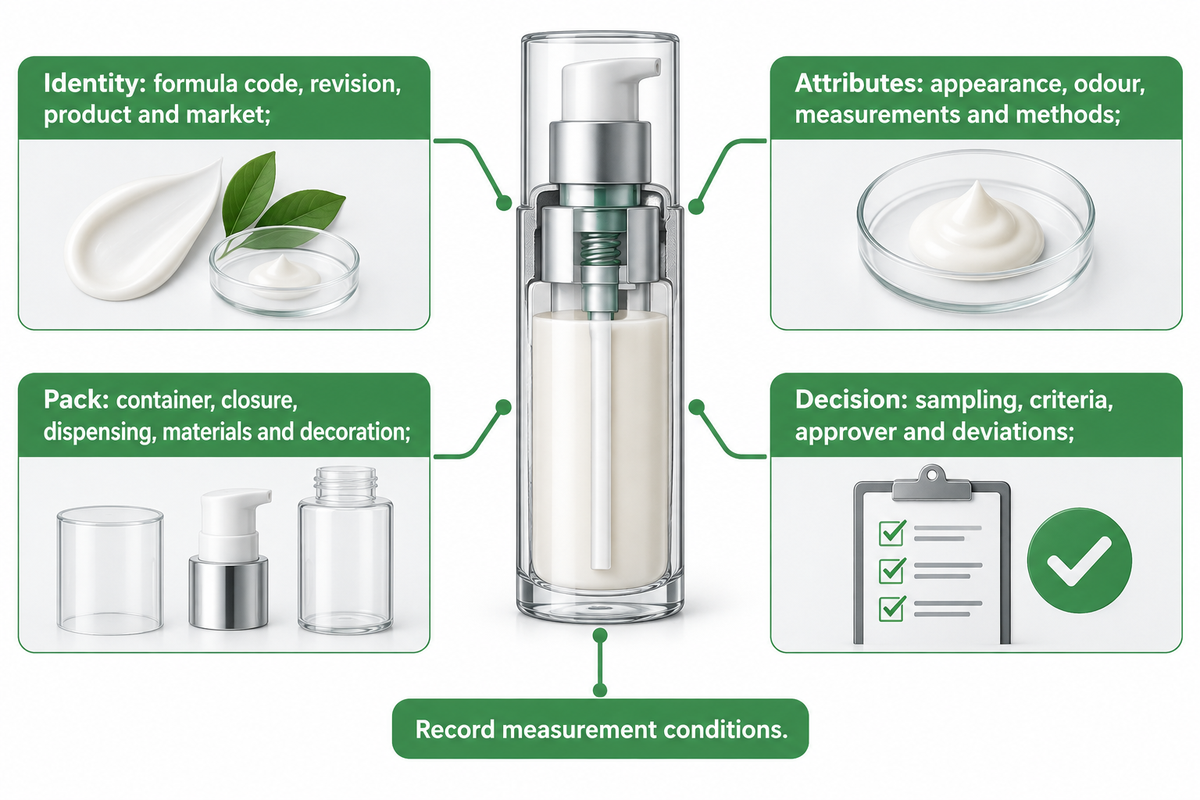
Identify the product specification before assessing the production sample.
Each acceptance attribute needs a method, sampling point and limit that the brand and factory can apply consistently.
Record the packaging configuration beside the formula version so that the finished product being evaluated matches the product intended for sale.
A development brief might request a light, fast-absorbing skincare product. A release specification must express the relevant product qualities in repeatable observations or measurements. Appearance and odor can use an agreed upon reference; for a viscosity measurement, the conditions of the measurement are important. Without the measurement conditions, it may be very difficult to compare two correct results.
ISO/TR 18811:2018 sets the framework for evaluating cosmetic stability. The standard, however, allows the manufacturer to define and justify the methods, requirements and conditions of their products. The development process therefore needs a product-specific study plan alongside the shorter checks used to release a batch.
- Identity: formula code, revision, product name and intended market.
- Product attributes: appearance, odour, relevant physical measurements and the agreed methods.
- Pack identity: container, closure, dispensing components, contact materials and decoration.
- Decision: sampling arrangements, acceptance criteria, approver and treatment of deviations.
For a pump-dispensed skin care product, “same feel as the sample” leaves two jobs unresolved. The technical team needs a comparable bulk result, while the packaging team needs usable dispensing performance. Both must be in the brief. A product can be in accordance with the bulk specification and still be difficult to be dispensed using the selected pump.
Active ingredients and organic products also need precise descriptions. An ingredient’s presence, a product claim and any organic certification are separate matters. The brand’s product design should state the intended claim, while the technical and market-responsible teams determine the relevant supporting work.
Do
- Use one approved reference version.
- Record measurement conditions with results.
- Identify the tested packaging components.
Don’t
- Replace a method with “standard quality”.
- Compare readings made under unknown conditions.
- Let artwork approval stand in for pack approval.
Handover result: An approved specification that Production, quality inspection and brand can use to reach the same acceptance decision.
Step 3: Compare Cost, MOQ and Lead Time on the Same Basis
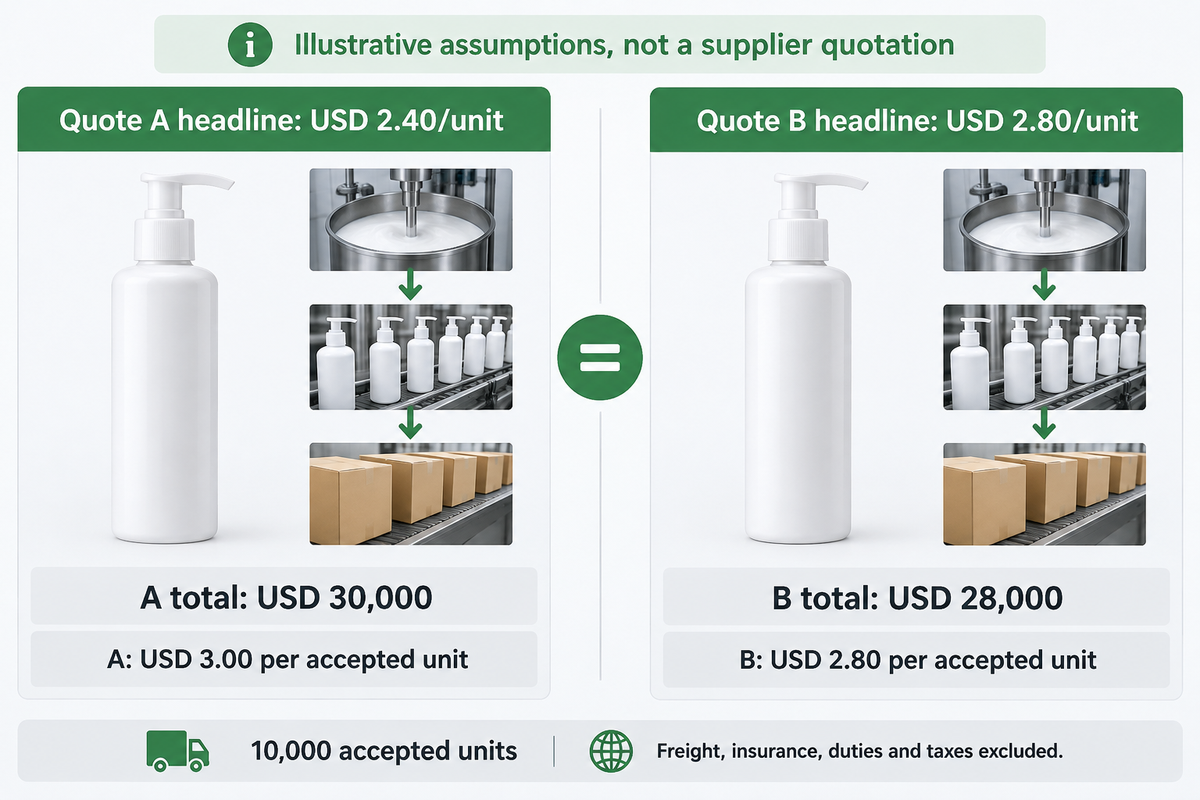
Evaluate quotations for the same scope and quantity for the same finished product. Separate bulk manufacture, packaging, filling, testing and one-time charges before comparing unit prices. Sometimes a cheaper looking unit price may, in fact, hide costs in the first order charge, whereas a higher unit price may include the costs and the charges for work done by the supplier.
Is there a minimum order quantity?
Yes. Minimum order quantities can be applied separately to the manufacturing batch, filling run and packaging purchase. For example, NEXO’s private label skincare program lists 10,000 units per stock-keeping unit. Use the minimum required for the actual project and component set; a low minimum order ad for another offer is a different program.
A minimum quantity in kilograms describes bulk mass. A minimum stated in units describes a count. Fill quantity, process losses, test samples and the availability of components connect the two. From a finance perspective, the payable quantity and expected accepted quantity (including who pays for surplus ingredients and packaging materials) should be shown separately.
Quote Scope Comparison: a completed first-order example
Assumed inputs: two quotations for 10,000 accepted units of the same 50 ml cosmetic product. Both cover equivalent filling, decoration and agreed testing. Quote A charges USD 2.40 per unit plus USD 0.50 per unit for packaging and USD 1,000 for testing. Quote B charges USD 2.80 per unit with those items included. Freight, insurance, duties and taxes are excluded from both.
| Same-scope item | Quote A | Quote B |
|---|---|---|
| Accepted finished quantity | 10,000 units | 10,000 units |
| Headline unit price | USD 2.40/unit | USD 2.80/unit |
| Headline extended price | USD 24,000 | USD 28,000 |
| Packaging addition | USD 5,000 | Included |
| Agreed testing addition | USD 1,000 | Included |
| Comparable first-order total | USD 30,000 | USD 28,000 |
| Total ÷ accepted units | USD 3.00/unit | USD 2.80/unit |
The calculation is USD 24,000 + USD 5,000 + USD 1,000 = USD 30,000 for A. Dividing by 10,000 accepted units gives USD 3.00 per accepted unit. B costs USD 28,000 ÷ 10,000 = USD 2.80. B is USD 2,000 lower for the agreed first-order scope, although its headline unit price is higher.
Acceptance changes the comparison too. If B delivers only 9,000 accepted units for the same USD 28,000 and the contract provides no replacement or credit, its cost becomes approximately USD 3.11 per accepted unit. That exceeds A’s USD 3.00. Set the remedy for rejected goods before approving the order, rather than treating every unit produced as a usable unit.
The International Trade Administration’s landed-cost guidance adds transport, insurance, tariffs and taxes and other fees to the price of the product. In cases where the decision to buy is based on delivery, compare the delivered cost beyond the factory gate. The tariff and term of delivery must be defined for the shipment in question.
Testing scope needs the same discipline. The FDA explanation of cosmetic product testing discusses available safety data and additional work needed to fill information gaps. “Testing included” should name the work and its deliverables.
For lead time, record the trigger: brief accepted, formula approved, artwork released, materials received, or deposit paid. Separate product development from production and delivery of finished products. A startup’s product planning should carry those dependencies into its cash and launch schedule.
Handover result: a comparable total, an accepted-unit denominator and a schedule whose starting conditions are explicit.
Step 4: Prove the Sample Can Survive Scale-Up
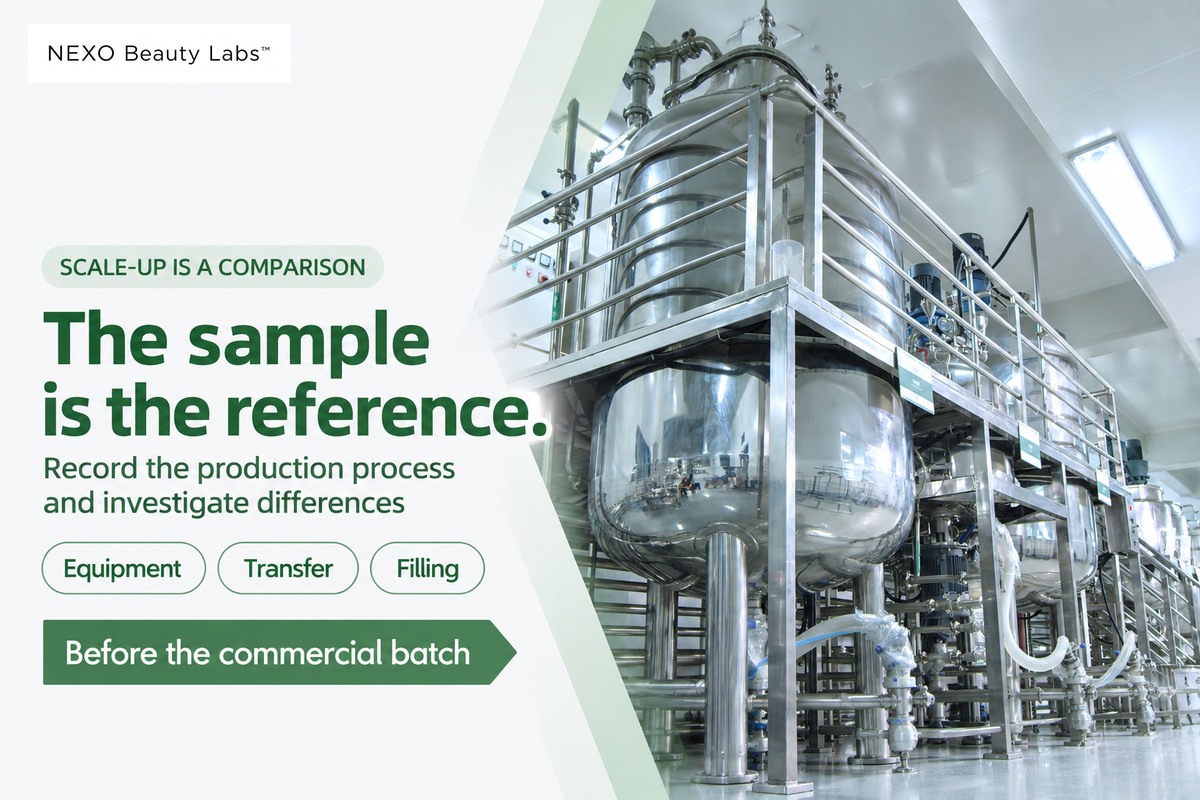
Use the pilot to compare the approved reference with product made through a representative production process. Evaluate the equipment, batch format, transfer operation and filling route together. A satisfactory laboratory sample is the reference for the pilot comparison. The pilot describes the conditions that need to be carried into the first commercial batch and how they affect the process.
The 2004 version of the Cosmetics Europe and CTFA stability guideline provides an approach to moving beyond laboratory batches. Its method guidance remains useful for planning representative samples; the study design still belongs to the product being developed.
“all negative results should be taken into consideration”
A useful pilot comparison records what changed and what followed. The research and development team supplies the laboratory history; the process engineer documents the manufacturing route; quality personnel compare samples under the agreed methods. Research and development capabilities are useful when that knowledge reaches the people running the batch.
Example: a brand approves a moisturiser from a small laboratory batch, then receives a pilot with a different texture. The team starts by checking if the same ingredient grades, the order of addition, and measurement conditions were used. They also check mixing, heating, cooling, holding, and transfer through the equipment proposed in the process description. A retained reference assists the discussion, but “looks close enough” provides no answer. The next trial should address the identified difference and record its outcome. Booking the full order immediately transfers the uncertainty to a larger inventory commitment. The brand owner needs to decide if the pilot has provided sufficient information to release the inventory commitment.
In his 2013 scale-up article, process specialist Bob Bornfriend mentions transfer and filling as the operations that may affect the packaged product. A pilot plan that ends at the mixing tank leaves that portion of the production process unevaluated.
- Compare the reference and pilot using the same relevant methods.
- Record equipment configuration and the process actually followed.
- Investigate differences before choosing the next production step.
- Assign follow-up work and acceptance to named people.
Long development programs may require continuing stability work beyond critical early stage trial decisions. Keep that work visible to finance and the launch owner. A hasty approval can move the cost of unresolved development to packaged inventory and booked production.
Handover result: a documented pilot comparison and a process for first production, with the remaining work assigned, rather than hidden in sample approval.
Step 5: Qualify Filling and Packaging Together
Qualify the formula in the intended packaging and through the proposed filling operation. Record the specific container, closure and dispensing components to capture a later change. Product packaging must preserve the product and work in use, while the filling route must produce the agreed finished configuration consistently.
Packaging design covers more than artwork. A bottle body can be constant while a pump, liner or seal changes. Procurement may notice an equivalent component, but the technical team sees a changed product-contact component. The association stability guidance refers to product-package combination and suggests evaluating each package type when a few are marketed.
Harvey Fishman’s 2010 packaging integrity column in Happi lists closure, leakage, and weight loss, and other package checks. These are good examples of problem categories for a brief. The product and its package, and the condition of the distribution channel determine the tests to be performed.
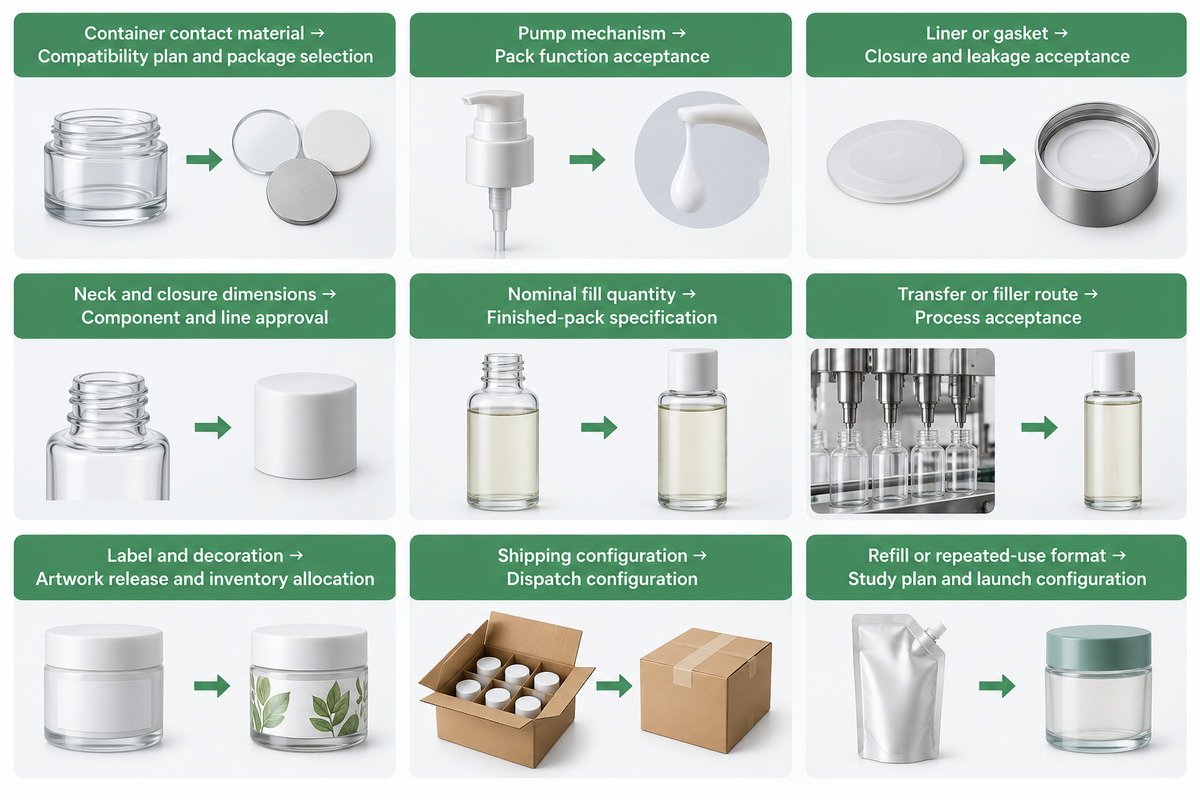
Packaging-to-Release Bottleneck Map
The packaging-to-release bottleneck map groups a changed component or operation by the next decision it can delay.
| Change group | Question to resolve | Decision waiting for the answer |
|---|---|---|
| Container contact material | How does the formula behave in the revised material? | Compatibility plan and package selection |
| Pump mechanism | Does dispensing remain usable with this product? | Pack function acceptance |
| Liner or gasket | Does the closure remain suitable after the planned exposures? | Closure and leakage acceptance |
| Neck and closure dimensions | Does the assembled pack fit and close on the line? | Component and line approval |
| Nominal fill quantity | Does the revised fill work with headspace and dispensing? | Finished-pack specification |
| Transfer or filler route | Does the filled product retain its agreed attributes? | Process acceptance |
| Label and decoration | Do approved text and decoration remain correct and usable? | Artwork release and inventory allocation |
| Shipping configuration | Does the packed product tolerate its planned distribution? | Dispatch configuration |
| Refill or repeated-use format | Which use conditions and product-contact changes need evaluation? | Study plan and launch configuration |
Example: A team replaces a pump to keep on schedule after the original component is delayed. The bottle and label stay the same, so the substitution appears minor. The factory nevertheless needs the new component drawing and samples. The relevant team reviews the work associated with the dispensing and compatibility, and the line team performs an assembly trial. Finance reviews that work against the cash tied up in the original components. The first shipment is made with the approved configuration, rather than a verbal instruction to ship “equivalent” product.
The packaging compatibility testing guide goes into greater detail on the work described above. Keep the manufacturing focus on the chosen configuration, acceptance decision and records required to hand over to the next step in the process.
Handover result: An approved filled-pack configuration, and related acceptance and test records, and a named decision regarding any component substitution.
Step 6: Release the Batch Against the Agreed Record
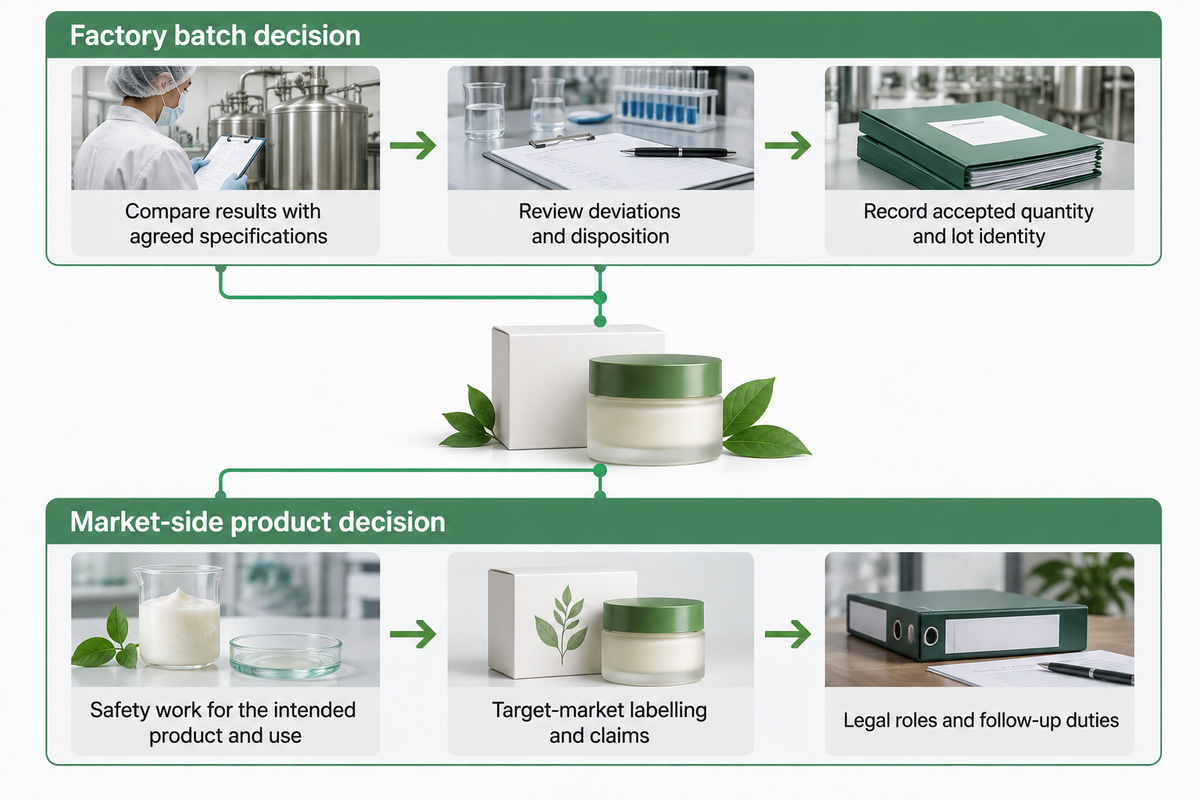
The release authority should review results, deviations and disposition before the goods move to the next agreed stage. Keep acceptance of routine batches associated with the study and related target market activities, without merging them.
The FDA manufacturing checklist describes records for materials, processing, sampling, control results and finished-product disposition. A certificate of analysis provides a synopsis of results and the release file should include the related manufacturing and deviation records.
ISO 22716:2007 gives good manufacturing practice (GMP) guidance for production, control, storage and shipment. Its public status page records confirmation in 2022. Use the definite standard and the site’s scope when talking about a factory’s quality system. Product-specific work and commercial acceptance still need their own identified records.
Factory batch decision
- Compare results with agreed specifications.
- Review deviations and disposition.
- Record accepted quantity and lot identity.
Market-side product decision
- Match safety work to the intended product and use.
- Review labelling and claims for the target market.
- Allocate the relevant legal roles and follow-up duties.
In the United States, the FDA’s MoCRA explanation identifies the responsible person by the manufacturer, packer or distributor named on the label. For product and rule definitions, decide who that person is, rather than assuming it is always the manufacturer or always the brand.
A professional manufacturer and brand should agree how rejected goods are segregated, who reviews rework and how a disputed result is investigated. These arrangements protect the commercial decision as well as product quality. The right manufacturer for the project must be able to work to that acceptance process, including when a shipment is late.
For the 10,000-unit example, the release record shows the accepted number used by finance. If that number changes, the cost and commitment to deliver must also be adjusted. A production quantity by itself isn’t an adequate basis to pay for usable inventory.
Handover result: a traceable batch decision, approved disposition and an agreed quantity of finished products ready for the next stage.
Step 7: Keep Repeat Orders Consistent
Activate a repeat order for the approved formulas, processes and packaging. Record proposed changes before use, identify their affected lots and review the relevant evidence with the agreed approvers. A repeat order should maintain the accepted production baseline, while showing changes and corrective actions to the brand.
Accepted production baselines should capture the grades and sources of ingredients, components of packaging, processing and acceptance as well as the instructions and references approved. A repeated product name leaves those details unstated. A cosmetic OEM manufacturer should have a practical way to tell the brand when an input or processing step changes.
Change review is part of repeatability. The Great Britain manufacturing guidance talks about recording and justifying changes in process and approach to product complaints. Technical review should discern administrative changes from product and support changes.
- Proposed change: record the old and new input, reason and affected product.
- Technical review: identify the relevant process, specification, study or label work.
- Approval: name the decision-maker and the first affected lot.
- Follow-up: connect production results, retained samples and complaints to that lot.
Purchasing records the ingredient name while the technical team reviews updated supplier information, composition, performance and labelling after a raw material change. Product planning should reserve time for this review. The same applies when an approved component of packaging is replaced.
Keep a route for customer complaints after delivery. Under the US modernisation framework, serious adverse-event reporting is a responsibility with a legal timeline. Customer service, the factory and the assigned responsible person should have an agreed route for information; a passed quality inspection doesn’t remove the need for follow-up work.
For a developing skincare line, resources to develop new products can compete with the work needed to maintain existing products. Give repeat-order review an owner rather than leaving it as spare capacity in the research and development team. Quality and safety work requires a place in that capacity plan.
Handover result: a current manufacturing baseline and a record connecting each approved change to the lots and product information it affects.
What Is Changing in OEM Cosmetic Manufacturing
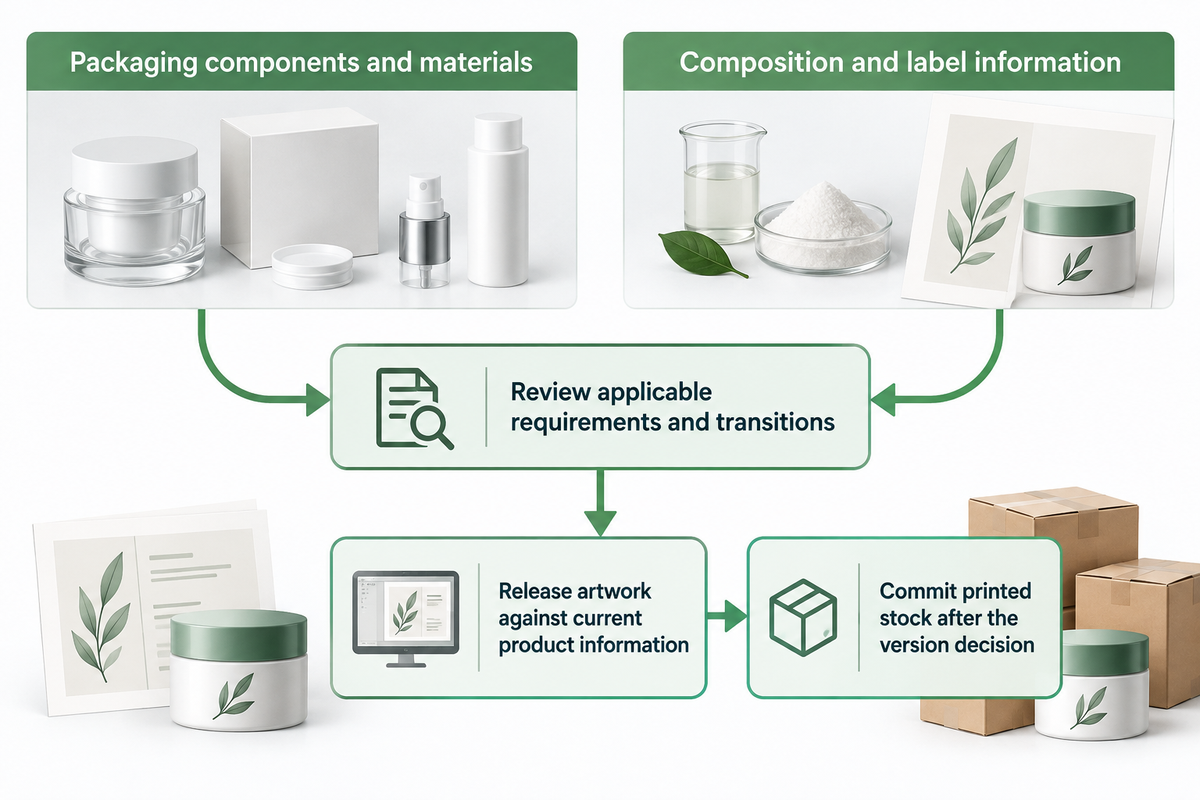
Current packaging and labeling requirements mean version control is a task of launch planning. A brand selling into the European Union needs component and composition information early enough to align packaging, and possibly artwork and labeling. Some buying and selling decisions, like buying a component or printed stock, may lock in work that affects later batches.
The European Commission publishes Regulation (EU) 2025/40 as in force on 11 February 2025, with general application from 12 August 2026. Individual requirements and transition arrangements need their own applicability review. A purchaser’s useful response is to keep component and material information with the approved package version.
A different label change is due to changes to EU fragrance allergen labeling requirements. The Commission says that from 31 July 2026, non-compliant products can’t be placed on the EU market. Products placed on the market before this date can still be made available until 31 July 2028. The conditions of the regulation apply. The information and label must be aligned with the safety file.
For a beauty brand planning a packaging reorder, those dates create a concrete decision: allocate existing stock by the applicable conditions and release new artwork against the current product information. A new product concept, which uses a refill format, provides additional product contact and usage conditions to the technical file. Neither of these decisions is resolved with market trends alone.
The cosmetic industry will continue to provide new ingredients and formats. Assess the benefit against further development work, component commitments and version changes. High-quality cosmetics need a suitable design as well as a repeatable route for execution.
Key takeaway
Treat an OEM order as seven connected handovers. Keep the formula, process, package and acceptance versions aligned before committing the next production run.
Frequently Asked Questions
What is cosmetics contract manufacturing?
Cosmetics contract manufacturing is paid production of cosmetic goods under an agreed manufacturing scope.
The contract can cover bulk manufacture, filling, packing and selected development services. Assign formula work, testing and documentation explicitly so that the commercial description matches the work ordered. A private label cosmetic project may begin with a manufacturer’s existing formula, while a transfer project may start with a brand’s developed formulation. The chosen route should still have an identified specification, acceptance process and division of responsibilities.
Can I request custom packaging design?
Yes. Put custom packaging design into the brief before component purchasing and filled-pack trials.
Separate the visual design from the technical specification. The factory needs the container, closure, dispensing components, contact materials, decoration and intended fill information. Custom artwork can use an existing pack format, while a new component can add tooling and evaluation work. Align the product development schedule with component samples and the final configuration so that purchasing doesn’t release printed or moulded inventory before the relevant decisions.
Do skincare manufacturers have their own patented technology?
Some do, but a patent must be identified and its owner and permitted use checked for the project.
An OEM cosmetic manufacturer can work with its own developments, licensed technology, client formulas or commercially available ingredients. Research and development activity alone doesn’t establish ownership of a patent. Separate the formula’s commercial rights from any patented ingredient, process or packaging feature used in the product. The manufacturing agreement should identify the relevant technology and permissions when they matter to supply, exclusivity or a future transfer.
Do I need FDA approval to sell lip gloss?
Ordinary cosmetic lip gloss has no general FDA premarket product approval requirement, but colour additives have separate approval rules.
The FDA small-business cosmetics fact sheet explains the distinction. The product must still meet applicable safety and labelling requirements, and its claims or intended use can change its regulatory classification. Review the specific colour additives for their intended use and allocate applicable registration, listing and other responsibilities. This answer concerns ordinary cosmetic classification, not products regulated as drugs.
What happens if a repeat batch does not match the approved sample?
Hold the affected goods for review against the agreed specification and investigate the difference before accepting the batch.
Use the reference version, test methods, batch records and change history to distinguish an acceptance failure from a difference caused by measurement conditions or sample age. The agreed release authority should document disposition and any rework or replacement. Connect the affected lot to retained samples and customer information where relevant, then carry the approved corrective action into the next production instructions.
NEXO Beauty Labs works with skincare, haircare and bodycare projects. For more information about our company, please see our NEXO Beauty Labs company introduction. To support a thorough understanding of the requested information, we recommend bringing together the target product, formula status, market, pack format and anticipated quantity into the same discussion.
Discuss your manufacturing brief
Editorial note: This document is a synthesis of public-facing manufacturing guides, technical articles and illustrative purchasing examples. The worked example relies on given assumptions. Project-specific product development and target-market work should be assigned within the project brief.
References & Sources
- Good Manufacturing Practice Guidelines/Inspection Checklist for Cosmetics, U.S. Food and Drug Administration.
- Scale-up considerations for cosmetic products, Nicola Lionetti and Miriam Deola, Cosmetics & Toiletries, 2024.
- Managing intellectual property when working with others, UK Government.
- Making cosmetic products available in Great Britain, UK Government.
- ISO/TR 18811:2018: stability testing of cosmetic products, International Organization for Standardization.
- Determine Total Export Price, International Trade Administration.
- Product Testing of Cosmetics, U.S. Food and Drug Administration.
- Guidelines on Stability Testing of Cosmetic Products, Cosmetics Europe and CTFA, 2004.
- Scale-up Basics for Formulators and Process Engineers, Bob Bornfriend, Cosmetics & Toiletries, 2013.
- Ensuring the Integrity of Cosmetic Packages, Harvey Fishman, Happi, 2010.
- ISO 22716:2007: Guidelines on Good Manufacturing Practices, International Organization for Standardization.
- Modernization of Cosmetics Regulation Act of 2022, U.S. Food and Drug Administration.
- Packaging waste and Regulation (EU) 2025/40, European Commission.
- Fragrance allergens labelling, European Commission.
- Small Businesses & Homemade Cosmetics Fact Sheet, U.S. Food and Drug Administration.