Get in touch with NEXO Beauty Labs Company


Updated October 2026
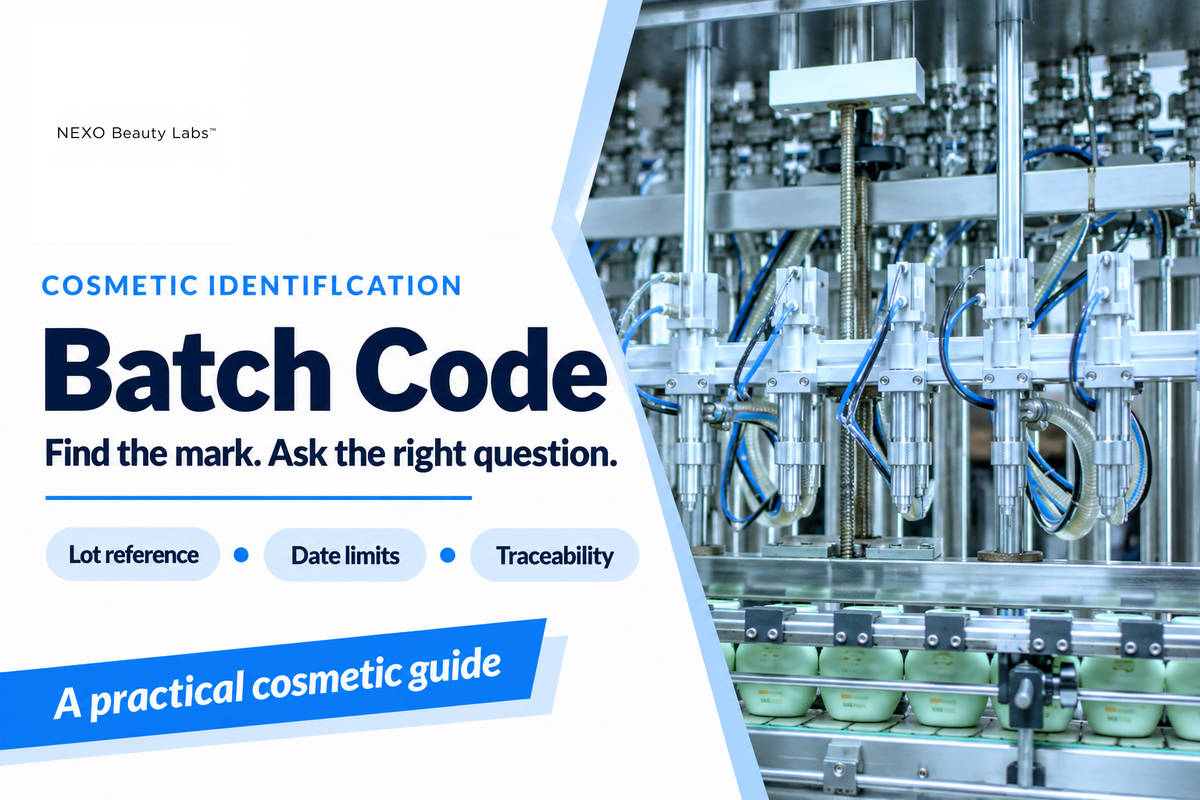
A batch code identifies a product group defined by the manufacturer and is linked to production records. On cosmetics, it may assist a brand in assessing a complaint or confirming production information. It’s distinct from an expiry date and decoding it doesn’t confirm the product’s authenticity or safety.
Start here: Photograph the code as it’s shown in print (leading zeros are important). Check the carton and bottle and use the brand’s policies before resorting to a third party. Should the outcome be ambiguous, send the pictures and purchase record, with no calculated expiry date, to the brand.
A stamp below a perfume bottle could be a factory mark, a production date or a color reference. What’s it connected to? This guide distinguishes consumer batch-code lookups from business traceability needs and separates questions about freshness from questions about who produced a makeup item or daily-use cleanser.
What Is a Cosmetic Batch Code?
A cosmetic batch code, also known as a lot number, is defined by a manufacturer and is used to identify a product group produced under a batch system. It may be in alphabetic, numeric or mixed form. The brand may have its own manufacturing-date coding system, but there’s no unified cosmetic code that enables a shopper to interpret every brand’s manufacturing date directly.
The Handcrafted Soap & Cosmetic Guild’s batch-number guidance explains the practical reason for grouping products: a maker needs to connect a particular item to its making records. In her article, Marie Gale mentions the problem of investigating returned cream, for example, when there’s no information about which production batch the cream comes from. This is a record problem. The systems should be improved to make better batch identifications for the process and the product. For beauty products, you should investigate the record of the exact product type and code.
Manufacture can consist of several steps and activities. You need to find out which step a printed lot identifies before interpreting two numbers as the same. NEXO’s quality management overview describes batch identification alongside production, inspection, release and retained-sample references; the available records should be confirmed for the project.
Where to Find the Code on Your Packaging
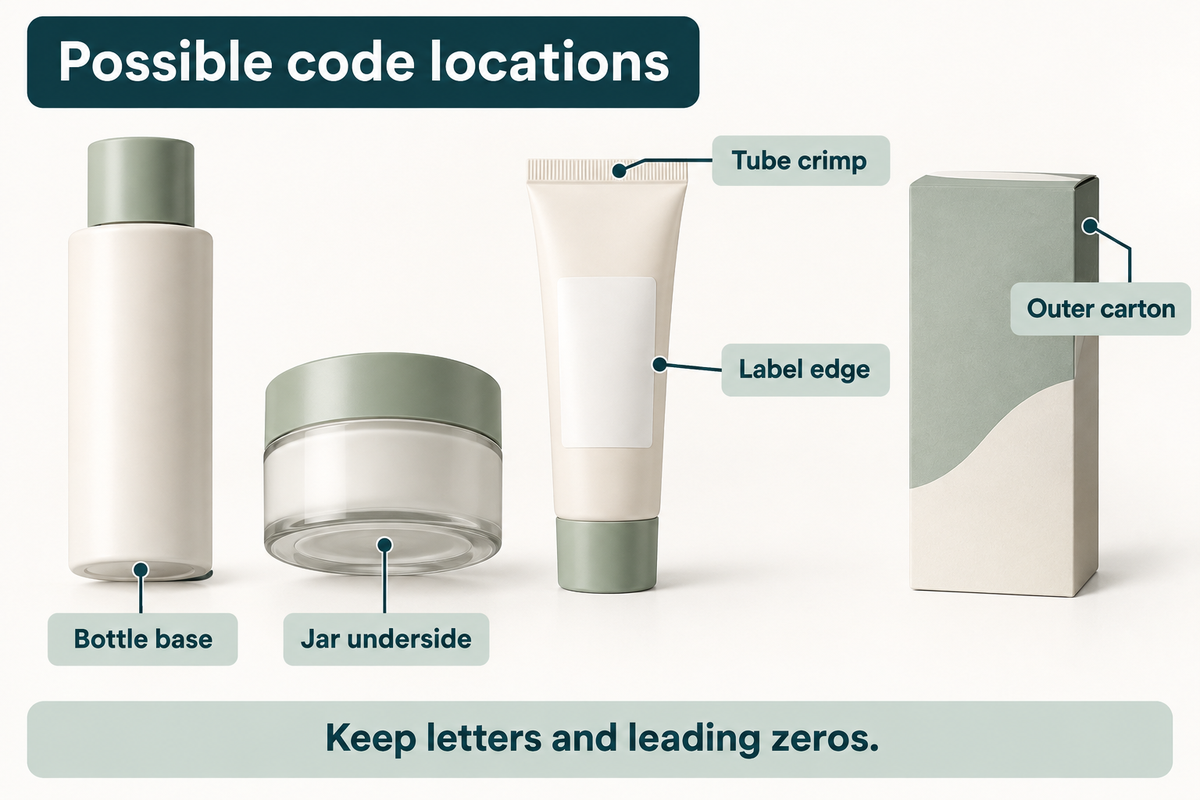
Look for a small variable print, stamp or etched mark on the bottle base, underside of a jar, tube crimp, label edge or outer carton. These are optional inspection locations. Photograph the entire package to give the brand context for distinguishing the mark shown in the close-up.
How to identify a batch code?
A mark that distinguishes production groups is often a batch code. Looking for the biggest number can be misleading, so look for a mark that differentiates production groups elsewhere. A code next to “LOT” or “Batch” is a clue. Spaces, letters, and leading zeros should be recorded as printed. When the mark is faint, take a look at it from a different angle under normal light to determine if a character is a zero or an O.
Compare the box code with the bottle, but don’t assume a mismatch is an automatic counterfeit. The same goes if multiple references describe different stages of packaging. If they’re presented as the same lot but the codes disagree, seek clarification from the brand. Keep the carton until the question is resolved. The EU small-pack exception in Article 19 states the batch reference is allowed on the packaging alone only if the size makes marking both the container and packaging practically impossible.
For the packaging buyer, the placement and integration of the code into the pack is part of the artwork and filling discussion. A glossy surface or a curved base may make a perfectly valid identifier unreadable. The skincare packaging guide provides a more complete context; endorse a legible coding area with the intended pack as opposed to relying on a generic diagram.
How to Check a Batch Code Without Guessing
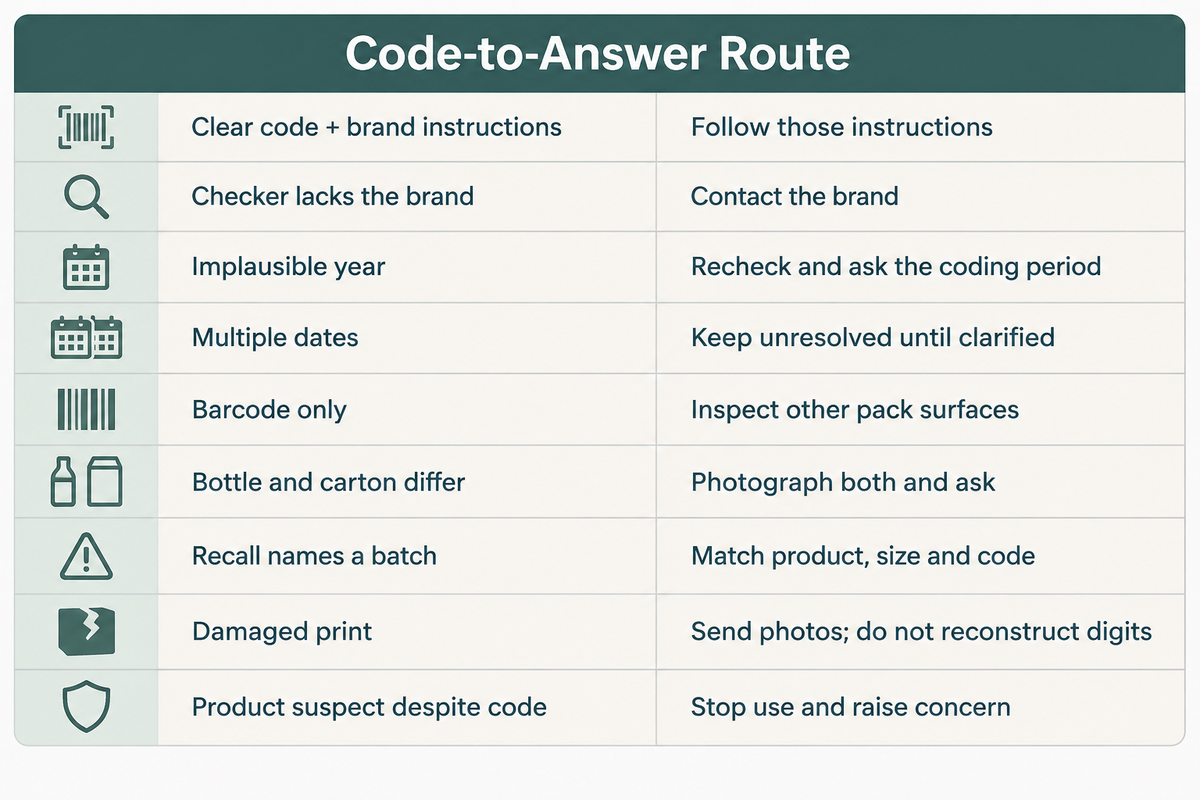
Check a batch code by correlating the correct product, brand and exact printed characters to the right information source. Start with the brand’s published instructions. A third-party result can be a lead, but an unsupported brand, ambiguous year or missing result calls for clarification, not an assumed production or expiration date.
How do I verify a batch number?
Send clear photos of code, product name and size, carton markings, seller, and purchase date to the brand. Indicate if you need manufacture info, if there’s a recall match, or if you need help with potential counterfeiting. These are different requests. A production-date lookup can’t address all these concerns, even if it comes up with a plausible date.
On a checker, select the brand, before entering the batch number. Keep a copy of the result and the lookup date. Don’t substitute the shorter stamp with the long retail product number just because the shorter stamp returns an error. If you try to decode a damaged stamp by altering characters, you might end up testing a code that was never on the pack.
There’s a Basenotes forum discussion in which a user gets unsupported-code responses from two services. This shows that a lookup can fail; it is not a judgment about that perfume. Ask the brand to check the production date when the decoder can’t resolve your item. A lot date returned by a service like Lot Date still needs to be explained within the service’s own limits.
| What you find | What to do next |
|---|---|
| A clear code and official brand instructions | Use those instructions for that product and market. |
| A checker cannot find the brand | Contact the brand; do not select a similar name. |
| The tool returns an implausible year | Recheck transcription and ask which coding period applies. |
| More than one possible date | Keep the alternatives unresolved until the brand clarifies. |
| Only a barcode number is visible | Inspect other pack surfaces for a separate lot reference. |
| Bottle and carton references differ | Photograph both and request an explanation. |
| A recall notice names a batch | Match the product, size and code to the official notice. |
| The print is damaged or rubbed off | Send photographs to the supplier; do not reconstruct digits. |
| The code checks out but the product is suspect | Stop using it and raise the concern with the brand or supplier. |
A lookup result that needs a second question
This is a fictitious perfume purchase. Consider this hypothetical perfume purchase: Imagine a shopper finds a faint stamp on a bottle purchased from a reseller. A perfume batch code checker returns a year that precedes the packaging design. Rather than trying numerous altered spellings until a date looks right, the shopper takes a photograph of the base, cap and carton, and includes a photo of the seller’s listing, and sends it to the brand. The reply may require the product’s version or market in order to identify the pertinent records. Without this information, the discrepancy will remain unresolved. This example illustrates how to ask the brand for clarification, not a guarantee that every brand will decode every old fragrance or that the first result will establish that a perfume is fraudulent.
Batch Code vs Barcode, Expiry Date and PAO
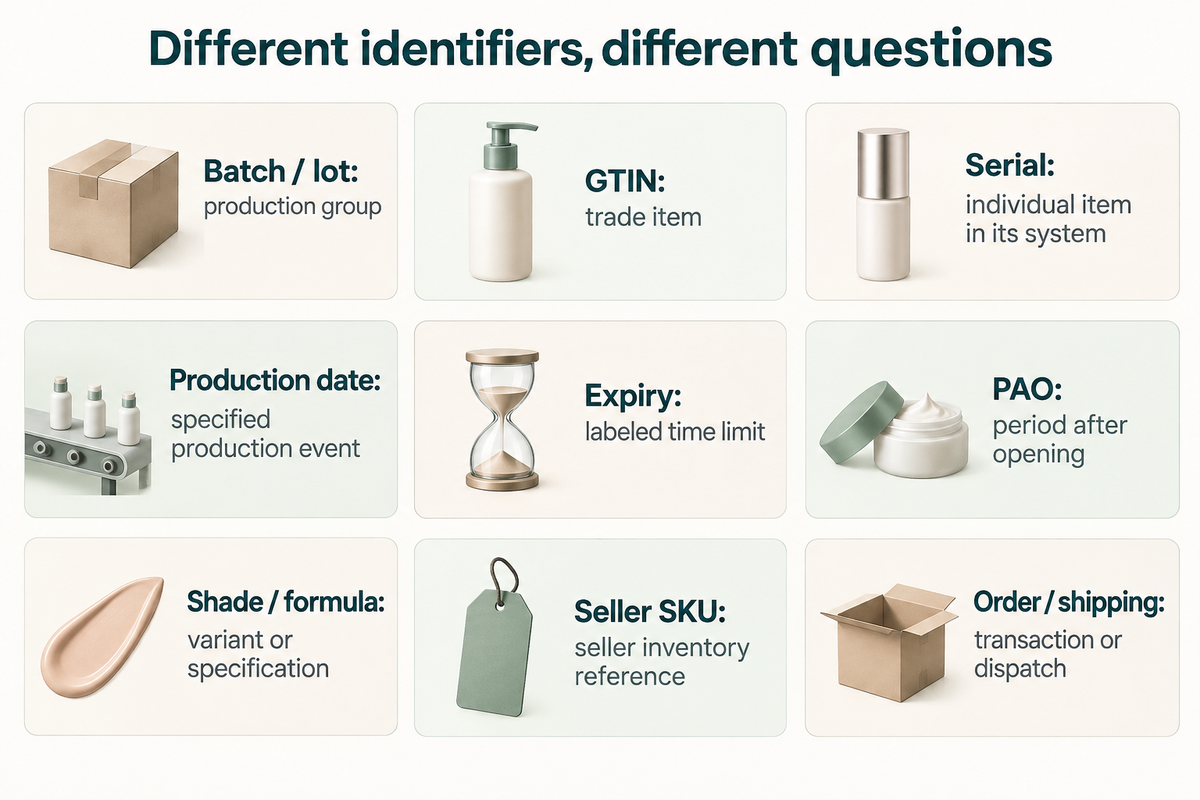
A batch code indicates a production group; a time limit indicated by an expiry date isn’t the same as a time limit indicated by a use after opening symbol. A barcode is a means of carrying data; it isn’t always a different product identity. It may carry a product identifier alone, or with other fields including a batch reference.
| Mark or identifier | What it identifies | How to use it |
|---|---|---|
| Batch / lot number | A producer-defined production group | Pair it with the exact product. |
| GTIN | A trade item | Identify the product, not its individual batch. |
| Serial number | An individual item within its identification system | Use the issuer’s verification process. |
| Manufacture / production date | When a specified production event occurred | Read the stated date format. |
| Expiry / minimum-durability date | The relevant labeled time limit | Follow the label and storage instructions. |
| PAO, such as an open jar marked 12M | A period after opening | Record when you first opened it. |
| Shade or formulation reference | A variant or specification | Confirm the variant before comparing lots. |
| Seller SKU | An inventory reference within the seller’s system | Use it to discuss the order with that seller. |
| Shipping or order reference | A transaction or dispatch | Use it to retrieve purchase and shipment records. |
The GS1 Application Identifier directory places batch/lot (10), production date (11), expiration date (17) and serial (21) fields apart. These field labels are part of the GS1 system and aren’t a key to decoding every short stamp on a cosmetic jar. A batch string is also defined in the context of the product: the same characters on unrelated products don’t constitute a batch.
Why the 30-month rule is not a shelf-life calculator
According to EU Cosmetics Regulation Article 19, a minimum durability date may be omitted on a product whose minimum durability is more than 30 months. In this case, the relevant period after opening is indicated, unless the concept of ‘opened’ durability doesn’t apply. Exactly 30 months doesn’t fall within “exceeds 30 months.” The batch reference is a separate labeling item.
In the United States, the FDA says ordinary cosmetics are not required by federal law to carry expiration dates. Products also regulated as drugs, such as certain acne treatments and sunscreens, have different rules. Do not carry the ordinary-cosmetics statement across to them.
“However, manufacturers are responsible for making sure their products are safe.”
A hypothetical unopened serum provides a clear-cut case. The carton for the serum has a lot number, and the open-jar symbol states 6M. The owner hasn’t opened it, so can’t prove a manufacture date by subtracting six months from today. Nor does the PAO symbol state how long the serum is good for after poor storage. It states a number of months after opening. The owner must check any stated date and contact the brand about the product if its history is unknown. A business placing that label on a product requires evidence of product-specific cosmetic stability testing. An online date from the batch code provides neither the storage stability study, nor the storage history.
Can a Batch Code Prove Authenticity?
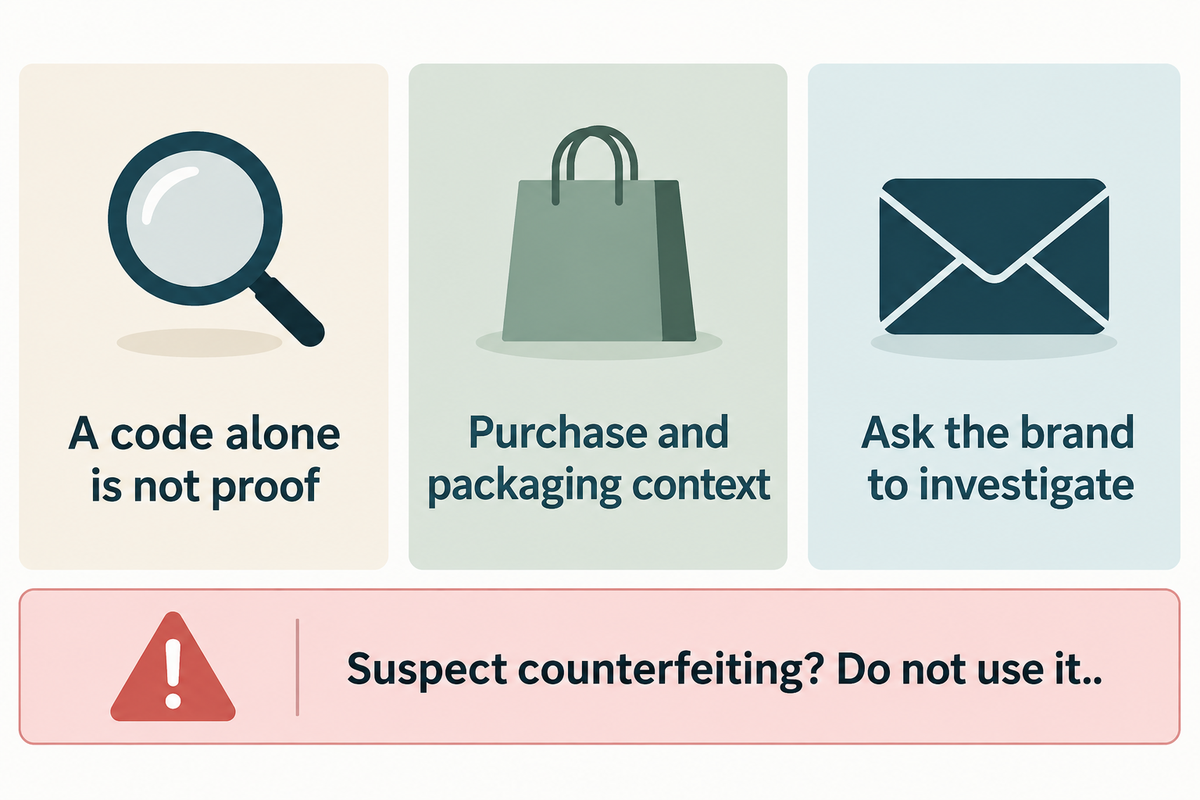
A batch code alone can’t prove that the product in your hand is genuine. Other unresolved problems can be coupled with a plausible code or a matching bottle and carton. Likewise, a failed lookup doesn’t confirm the product is a fake. Check the purchase provenance, the product and packaging together, and then ask the brand to investigate a specific concern.
GS1 US describes copied QR codes that work and take you to the original product’s website. That illustrative example focuses on QR codes, but it shows a general limitation, that a working link doesn’t prove the physical item’s origin. Batch matching is one part of a larger inquiry and shouldn’t replace the brand’s verification process. Treat that distinction as a limit on the assurance a simple lookup provides.
The Irish Health Products Regulatory Authority advises checking factors like price, packaging quality and the named supplier or manufacturer. If you suspect counterfeiting, don’t use the product and seek advice. Smell, texture or a familiar font can’t on their own provide certainty.
An official example goes further than a hypothetical fake. The February 2025 Balmonds Gentle Face Wash recall reported by the UK Office for Product Safety and Standards referenced batch #003 in a 125 ml pack. The incorrect product had been filled into that batch, so the contents didn’t match the label and the ingredient list. The batch was identifiable; its contents were incorrect. In checking an affected product, follow the instructions provided in the recall notice and don’t extrapolate issues raised with respect to other batches or brands.
How Batch Codes Connect to Traceability
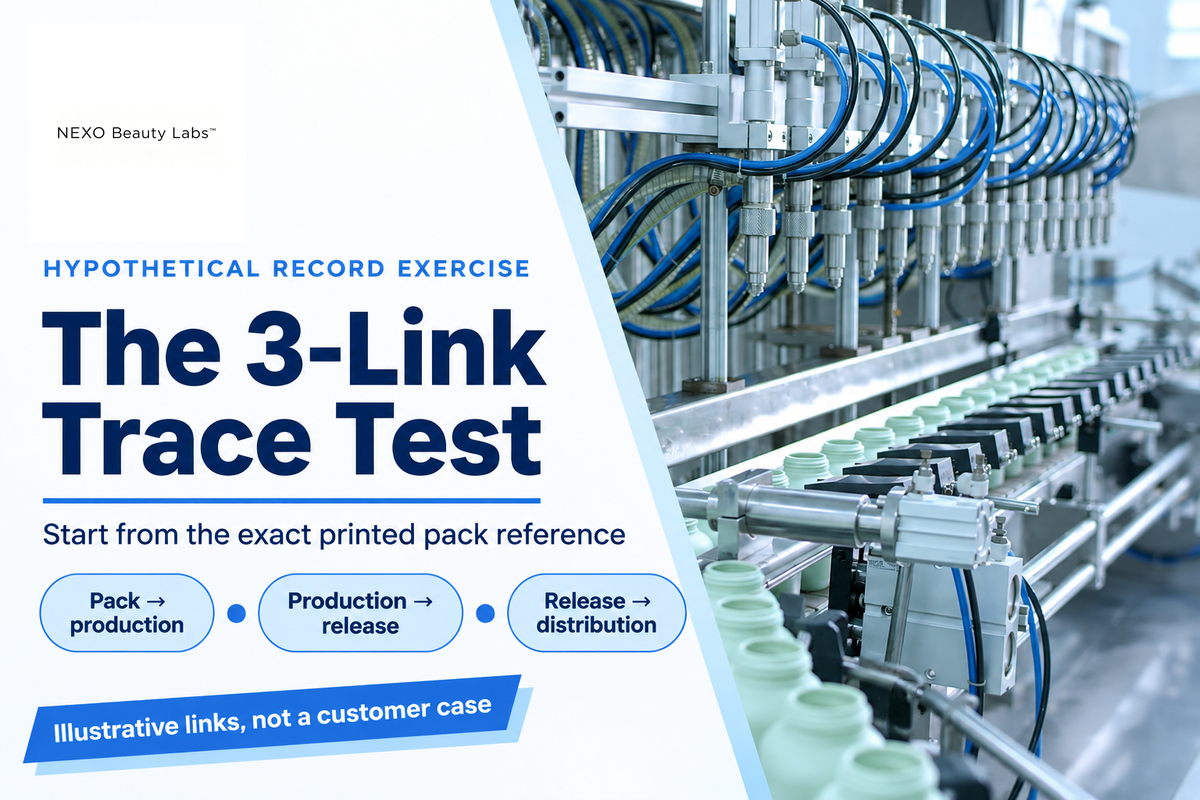
Batch traceability depends on linked records, rather than printing a number. The code on a finished pack ought to provide access to relevant production and release records and distribution records. Such records assist a firm in understanding what occurred and where the affected products went; traceability doesn’t mean that a recall would be limited to a single batch.
The FDA’s cosmetic manufacturing inspection checklist addresses package coding, batch records and distribution information. It is guidance, not a consumer decoding manual. Karl Laden’s 2023 labeling commentary in Cosmetics & Toiletries also distinguishes useful batch identification from assuming that arbitrary codes reveal a manufacturing date.
The 3-Link Trace Test: a filled example
Use the following hypothetical record chain during a supplier discussion. All identifiers are fictitious. A buyer has placed an order for a facial cleanser (CLN-A) and the finished pack shows lot FILL-X, with its filling record linking it to bulk lot BULK-X. The quality team may have a copy of the release decision for lot FILL-X, while the warehouse team has a copy of shipment (SHIP-X) and who it’s addressed to. If the buyer only receives a spreadsheet that states “batch approved,” how do you show the link to the printed pack? Ask for supporting documentation, state which fields may be shared, and identify who will retrieve the records. These sample identifiers show how various records relate to each other.
- Pack → production: CLN-A / FILL-X links to the filling record and BULK-X.
- Production → release: FILL-X links to the applicable inspection and release references.
- Release → distribution: FILL-X links to SHIP-X and the consignee record.
When documenting cosmetic batch codes and lot references, keep the exact printed value linked to the product record. Batch codes and lot numbers become worthless if the file can’t say from which package the entry was made.
A procurement manager confirms the references to be delivered. A quality manager verifies that the records resolve the question about the production batch. A warehouse manager verifies the dispatch record is for the right product and recipient. Let’s agree on these responsibilities while planning cosmetic filling and packaging, rather than following a customer complaint.
What Is Changing in Cosmetic Product Identification?
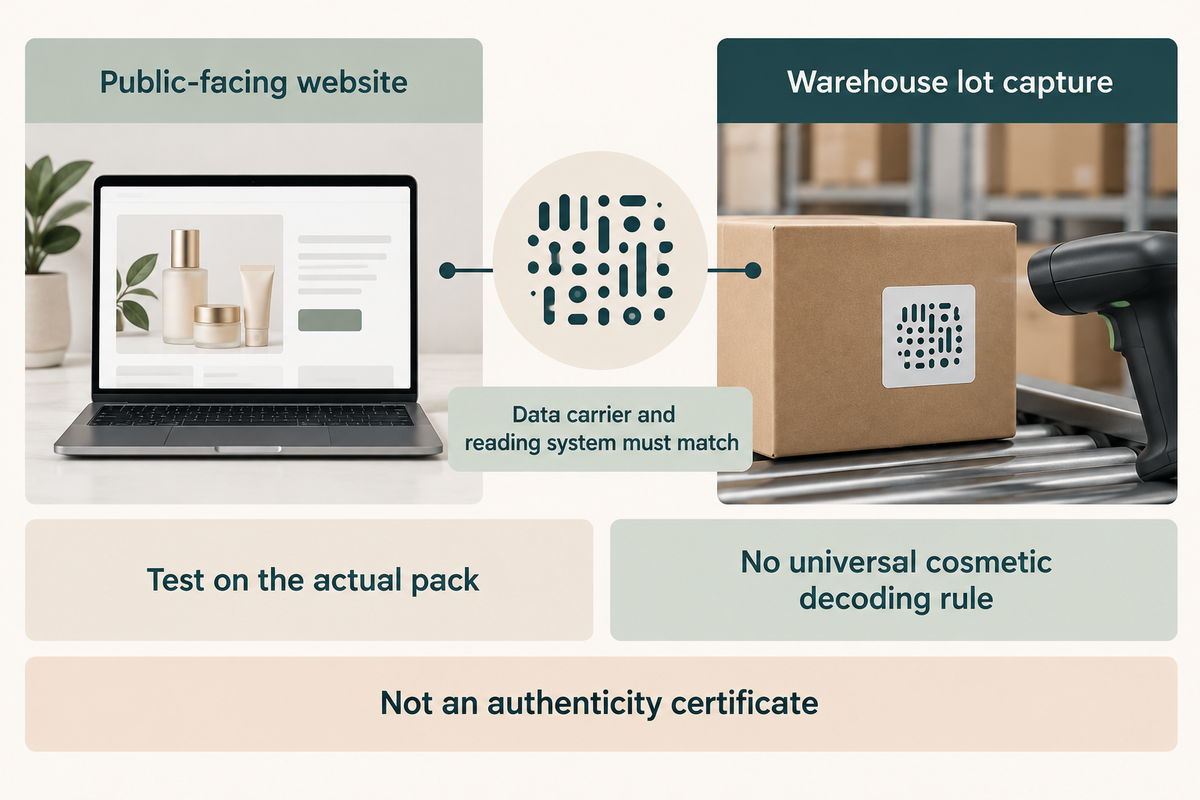
The identification of retail items is evolving towards the usage of two dimensional barcodes (2D) which can carry more data as compared to a simple product number. The advantage of utilizing 2D barcodes is the ability to link a retail item’s identity with other data in the system, if available. A system that’s built on 2D barcodes will neither introduce a universal cosmetic decoding rule nor will it make a scanned symbol an authenticity certificate.
The GS1 US Sunrise 2027 initiative assists retailers in equipping their point-of-sale systems to read and process two-dimensional barcodes. In the context of this initiative, the advisory guidance says that it isn’t necessary to fully use all capabilities of two-dimensional barcodes to meet the industry transition. This isn’t a cosmetics-only legal deadline where every pack has to change.
For a packaging project, ask which data the carrier will contain and which systems will read it. A public-facing website and a warehouse lot-capture serve different users. Prints should be tested on the actual pack under scanning conditions that are as close as possible to those anticipated. Wider material choices should be considered during the packaging compatibility review for the project. Ample data capacity is useful only if there are processes in place to manage that data.
Frequently Asked Questions
Is CheckFresh free?
CheckFresh’s public web lookup is available without a visible payment step when checked in October 2026.
Choose the relevant brand and enter the code from the package. Supported brands and formats determine whether the service can return a result. A missing entry doesn’t establish that a product is counterfeit. Keep any result as a lookup record, and contact the brand when you need clarification about that specific item.
Is a batch code the same as a barcode?
No. A batch code is information; a barcode is a way of carrying information.
A familiar retail barcode may identify the trade item without identifying the production lot. Other barcode systems can encode a lot number with a product identifier. When checking cosmetics, determine which field the service requests before typing a long product number into a batch lookup. The picture of a scannable symbol doesn’t explain its contents.
Can unopened skincare expire?
Yes. Being unopened does not give skincare an unlimited shelf life.
Follow the product’s labeled dates and storage instructions. The FDA explains that temperature, sunlight, air and changes in the formulation can affect shelf life. A date estimate from a checker does not establish how skincare products were stored. Ask the brand about its own product rather than assigning skincare and cosmetics the same lifespan regardless of their formulation or packaging.
What if there is no batch code on the cosmetic package?
Inspect the full pack and check the rules for its sales market.
The FDA states that lot numbering is not required by US cosmetics law. EU Article 19 requires a batch number or identifying reference; where size makes dual marking practically impossible, it may appear only on the packaging. Missing print alone establishes neither compliance nor authenticity.
Why does my Chanel batch code show more than one possible year?
The lookup has not resolved which coding period applies to your item.
Don’t pick a year solely because it fits the price or the seller’s story. Provide the brand with the code, photographs, product version and purchase details. General internet claims about a fixed repeating cycle aren’t a substitute for a brand-confirmed rule. The same caution applies when checking Dior or another fragrance house: a familiar-looking format is only a starting clue.
Do perfume testers have batch codes?
The answer depends on the product, packaging and sales market.
Inspect the bottle and any accompanying packaging rather than assuming all testers follow one format. If a perfume batch code is absent or unreadable, ask the brand or supplier about that item. Tester status isn’t an independent guarantee of authenticity.
How to make a batch code?
Create a documented identifier that consistently links the finished pack to the records you need.
Define the batch boundary, prevent accidental reuse within the relevant product context and record the relationship between bulk and filling lots. Agree the print location and the person responsible for checking it. A date-based code is one possible company convention, not a universal legal formula.
Before approving artwork, ask the supplier to demonstrate the path from a sample printed identifier to the corresponding records. Include the exact product variant in that exercise. If the value is shortened on a small label, document how the shortened reference resolves to the full record so the buyer and warehouse don’t have to guess.
NEXO’s batch record readiness review provides a starting point for discussing the evidence needed for a project.
References & Sources
- Shelf Life and Expiration Dating of Cosmetics U.S. FDA.
- FDA Recall Policy for Cosmetics U.S. FDA.
- Cosmetics Regulation, current consolidated text checked in October 2026 European Union, Article 19.
- Application Identifier directory GS1 Denmark; Sunrise 2027 initiative GS1 US.
- Balmonds Gentle Face Wash product recall, 21 February 2025 UK Office for Product Safety and Standards.
- Good Manufacturing Practice Guidelines / Inspection Checklist for Cosmetics U.S. FDA.
- Tips on how to spot counterfeit cosmetics HPRA.
- Lessons in Labeling from Gefilte Fish Karl Laden, Cosmetics & Toiletries, September 2023.