Get in touch with NEXO Beauty Labs Company

How Mineral Sunscreen Manufacturing Moves From Formula to Release

FORMULATION, SCALE-UP & RELEASE
Mineral Sunscreen Manufacturing is a linked development and evidence process shaped by intended sun exposure and use conditions, not a recipe defined by zinc oxide or titanium dioxide percentage alone. A market-ready product has to connect the intended claims, filter route, formula architecture, dispersion, production transfer, finished-product tests, package stability and release responsibilities. A smooth laboratory sample is only one checkpoint in the process.
This guide gives brand, quality and sourcing teams a nine-gate route from brief to release. It stays focused on mineral systems. For the wider sequence across sunscreen formats, use the broader sunscreen manufacturing guide. The framework below is an editorial planning method, not legal advice or a substitute for market-specific regulatory review.
Mineral Sunscreen Manufacturing in One View
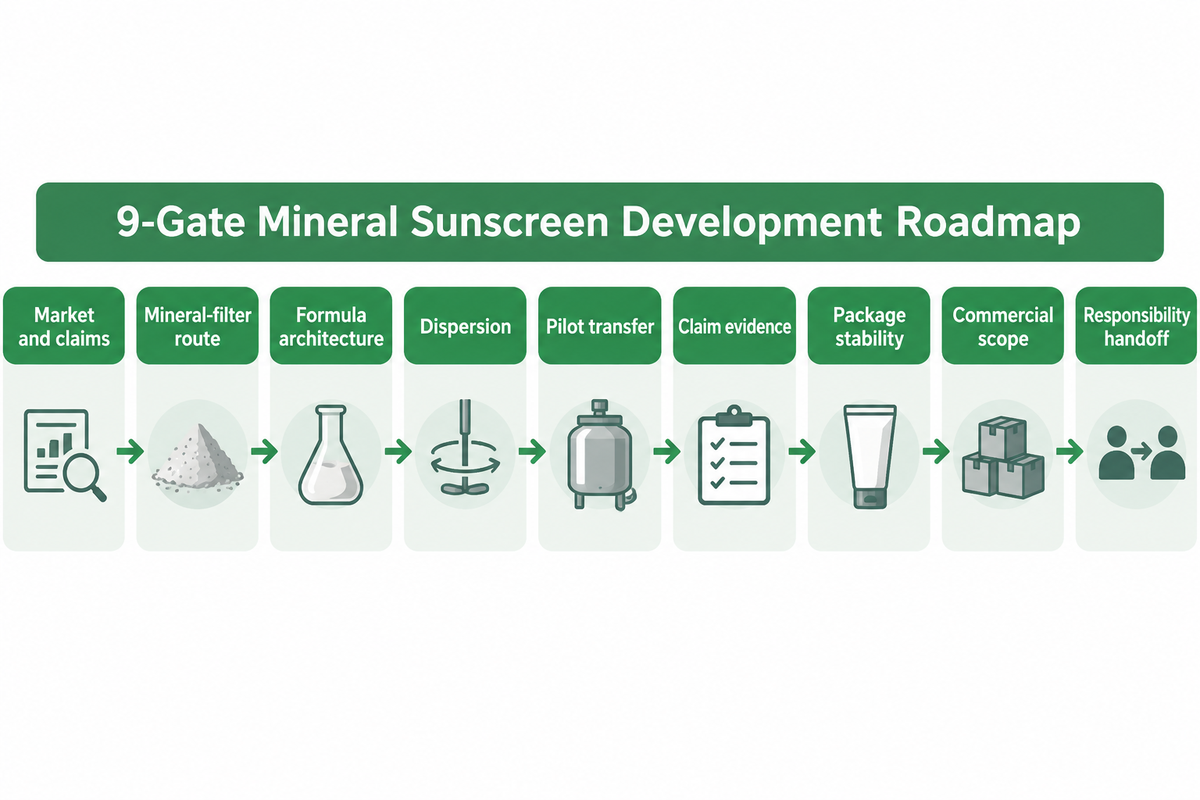
The practical route has nine gates. Each gate produces an output that the next owner can evaluate. If an output isn’t produced, the project doesn’t become safer merely because time elapses. Define the owner and the condition for moving forward before artwork, components or commercial production create pressure to accept an unresolved risk. For U.S. projects, FDA’s sunscreen labeling and effectiveness guidance ties broad-spectrum, SPF and water-resistance statements to finished-product testing and label conditions.
| Gate | Accountable owner | Decision | Evidence or output | Move forward when |
|---|---|---|---|---|
| 1. Market and claims | Brand + market adviser | Where and with which claims will the product be sold? | Market-and-claim brief | The applicable route and open questions are explicit |
| 2. Mineral-filter route | Formulator | Zinc oxide, titanium dioxide or a combined route? | Material specifications and rationale | The route fits the brief and intended market |
| 3. Formula architecture | Formulator + packaging lead | Which chassis can balance film, feel and package? | Prioritized prototype plan | Trade-offs are ranked rather than hidden |
| 4. Dispersion | Formulator + process engineer | How will particle distribution be created and observed? | Laboratory dispersion record and observations | A repeatable laboratory state is defined |
| 5. Pilot transfer | Process + quality teams | Can the state be transferred, held and filled consistently? | Pilot batch and sampling record | Scale-related differences are understood |
| 6. Claim evidence | Brand + qualified laboratory | Which finished-product tests support intended claims? | Test plan and applicable results | Evidence matches the actual product and market |
| 7. Package stability | Quality + packaging lead | Will the formula and intended pack remain suitable together? | Stability and compatibility evidence | The marketed configuration is represented |
| 8. Commercial scope | Sourcing + manufacturer | What exactly is being quoted and committed? | Comparable written scope | Formula, pack, tests and responsibilities align |
| 9. Responsibility handoff | Named release owner | Who reviews the complete evidence chain? | Approved handoff and release decision | Unknowns, deviations and changes are resolved |
The roadmap prevents three common substitutions: an ingredient document for finished-product evidence, a visually smooth sample for production uniformity, and a headline quotation for a defined manufacturing programme. None of those pairs are equivalent. The value of the gates is that they expose the missing decision before it is buried in a later failure.
Mineral Sunscreen Manufacturing Starts With the Market and Claim Route
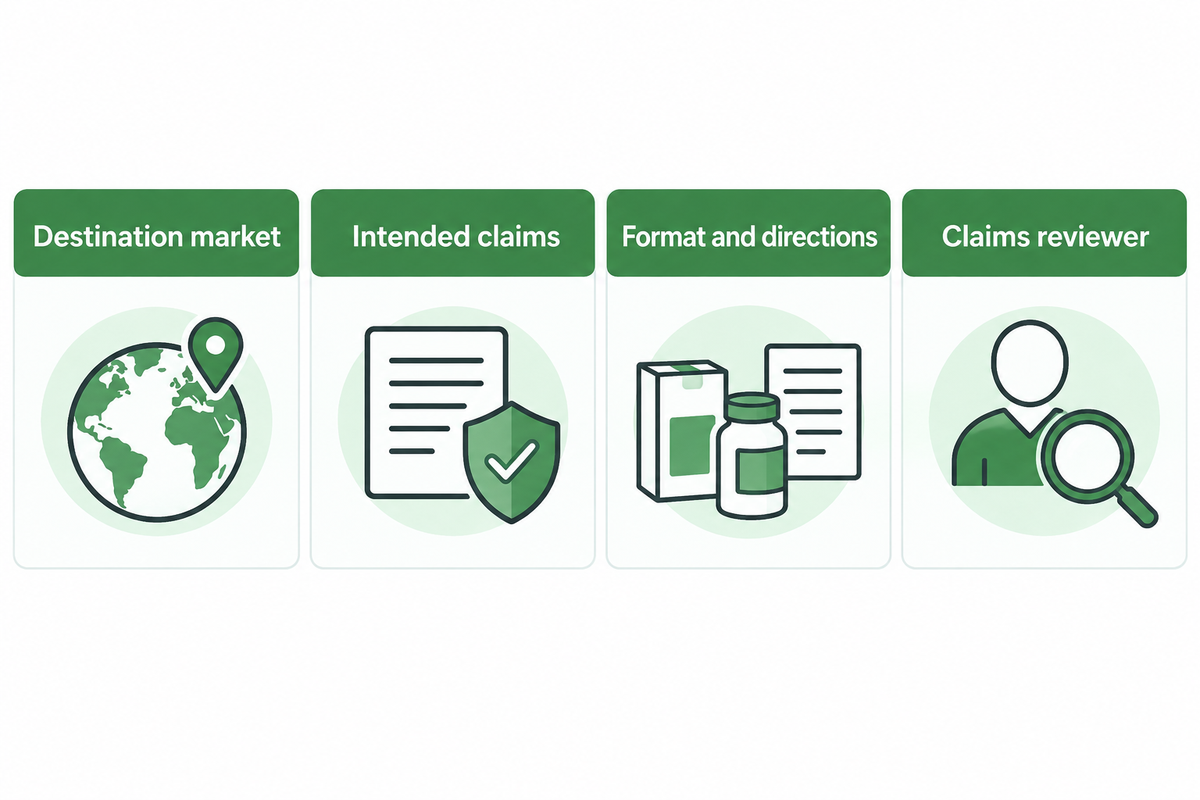
Determine intended use, destination market, dosage form and proposed claims before optimizing texture. In some jurisdictions, claims may require different wording from the wording used in the proposal. A proposal isn’t the same as a current rule. Make a short brief that defines what’s set, what requires regulatory confirmation and what’s a product-development preference.
Claims such as safe sunscreen, eco-friendly sunscreen, and reef-safe sunscreen aren’t manufacturing specifications and each requires a defined meaning and an applicable substantiation route. SPF 30 and SPF 50 are claim targets, not batch instructions. A brief that asks for SPF 30 or higher still has to define the market, format, broad-spectrum protection and water-resistance position.
| Brief question | Why it changes development | Owner |
|---|---|---|
| Which country or region receives the product first? | It sets the applicable ingredient, label and evidence route. | Brand + qualified market adviser |
| Which SPF, broad-spectrum and water-resistance claims are intended? | It determines the finished-product test plan and label review. | Brand + test laboratory |
| Which format and directions are intended? | It affects exposure, application, package and assessment questions. | Brand + formulator + packaging lead |
| Which claims are marketing preferences rather than regulated endpoints? | They still need a defined meaning and suitable substantiation. | Brand + claims reviewer |
In the United States, 21 CFR 201.327 links over-the-counter sunscreen labeling to specified testing and label conditions. FDA also maintains guidance on broad-spectrum, sun protection factor and water-resistance testing. Read those sources for the current route; do not infer a claim from raw-material percentage or from a test performed for a different formula.
Regulatory status can also contain multiple levels at the same time. FDA’s sunscreen regulatory actions explanation distinguishes current orders from later proposals. That distinction matters for zinc oxide and titanium dioxide discussions: a proposed classification, request for information or future effective date must be labeled as such. For a global launch, a similar exercise must be performed for each market; it would not be appropriate to simply transpose a United States Evidence Table to a different market.
A good output is a one-page matrix containing market, intended claim, current source, test or review owner, open question, and decision deadline. It gives formulation a stable target while keeping unresolved legal interpretation with the qualified person responsible for it.
The route also selects which active ingredients in sunscreen belong in the review. An effective sunscreen claim depends on the finished sunscreen product and applicable evidence, not merely on calling an ingredient active or listing a preferred skin type.
Zinc Oxide, Titanium Dioxide, or Both: What Changes in Manufacturing?
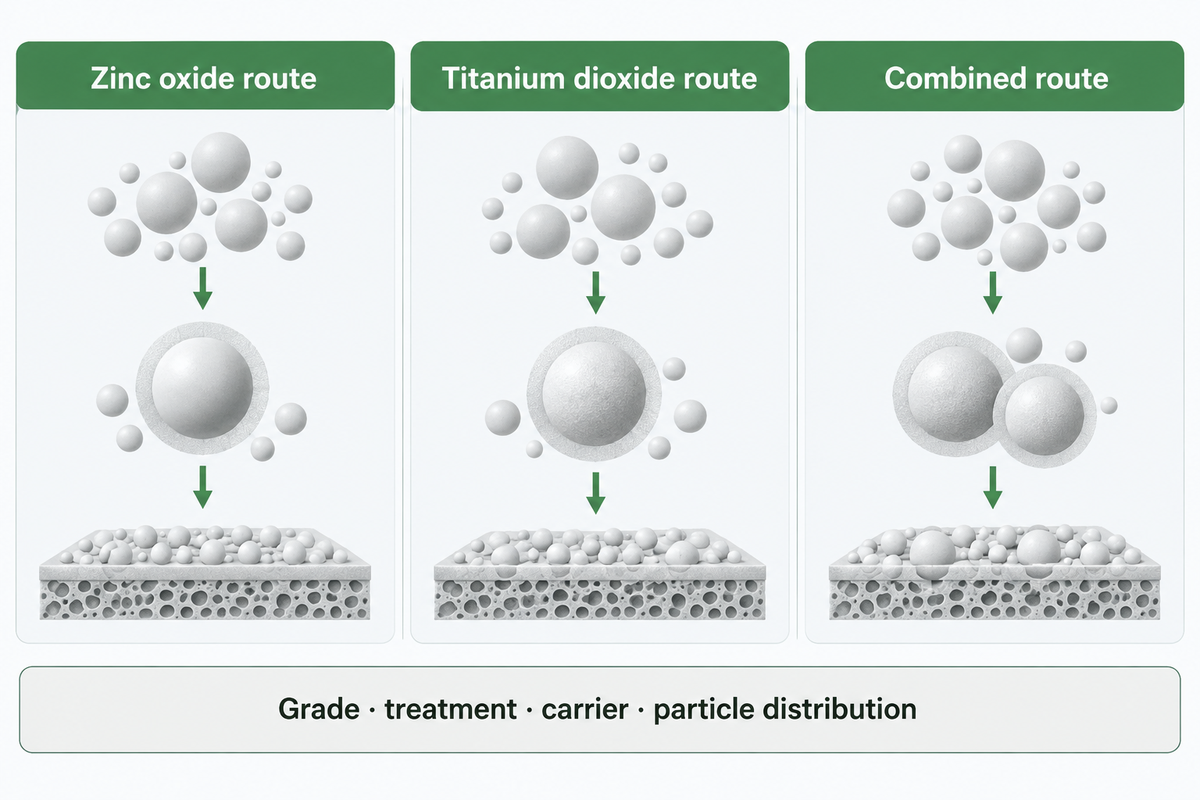
The mineral-filter route affects the ingredient list, dispersion work, optical appearance, rheology, supplier documentation, package trials, and evidence plan. The correct route is conditional; it depends on the intended market, the product format, the sensory brief, material specifications, and the actual tested finished product.
This article doesn’t consolidate mineral and chemical systems into one pathway. A hybrid sunscreen or a formula built around chemical sunscreen filters and other sunscreen actives creates a different scope. Chemical UV filters (such as oxybenzone and octinoxate and avobenzone, octocrylene and homosalate) are outside this mineral manufacturing guide unless a market assessment is required to identify the sunscreen ingredients.
What is the difference between zinc oxide and titanium dioxide in sunscreen formulations?
A formulator may choose one or a combination in pursuit of the protection profile and sensory outcome desired. Manufacturing consequences depend on the supplied grade, surface treatment, carrier, particle distribution and complete formula, so the ingredient name alone cannot predict white cast, viscosity or finished-product SPF.
| Route | Development focus | Manufacturing implication | Evidence that remains necessary |
|---|---|---|---|
| Zinc oxide route | Grade, surface treatment, wetting, optical and sensory target | Define a reproducible dispersion and monitor its behavior through transfer | Finished-product efficacy, stability and package evidence |
| Titanium dioxide route | Grade, coating, dispersion medium and interaction with the chassis | Control addition, wetting and the intended particle distribution | Finished-product efficacy, stability and package evidence |
| Combined route | Interactions among both materials and the full phase structure | Do not assume two acceptable premixes create an acceptable combined process | Finished-product efficacy, stability and package evidence |
Surface treatment and supplier form can influence how a material wets and enters the formula. That doesn’t make a universal best grade. Record the exact material identity and approved supplier documentation, as changing a grade or carrier later may be a formulation and process change, rather than a simple purchasing substitution.
Terms like mineral-based sunscreen, physical sunscreen and mineral SPF don’t define the material specification.
Most importantly, there’s no defensible equation that transforms “percentage zinc oxide” or “percentage titanium dioxide” into the labeled SPF of a finished formula. Distribution in the applied film, the rest of the formulation and the applicable test all matter. Use the sunscreen manufacturing formats and routes page to compare broader product formats; use material and prototype evidence to select the mineral route.
Choose the Formula Architecture Before You Optimize Texture
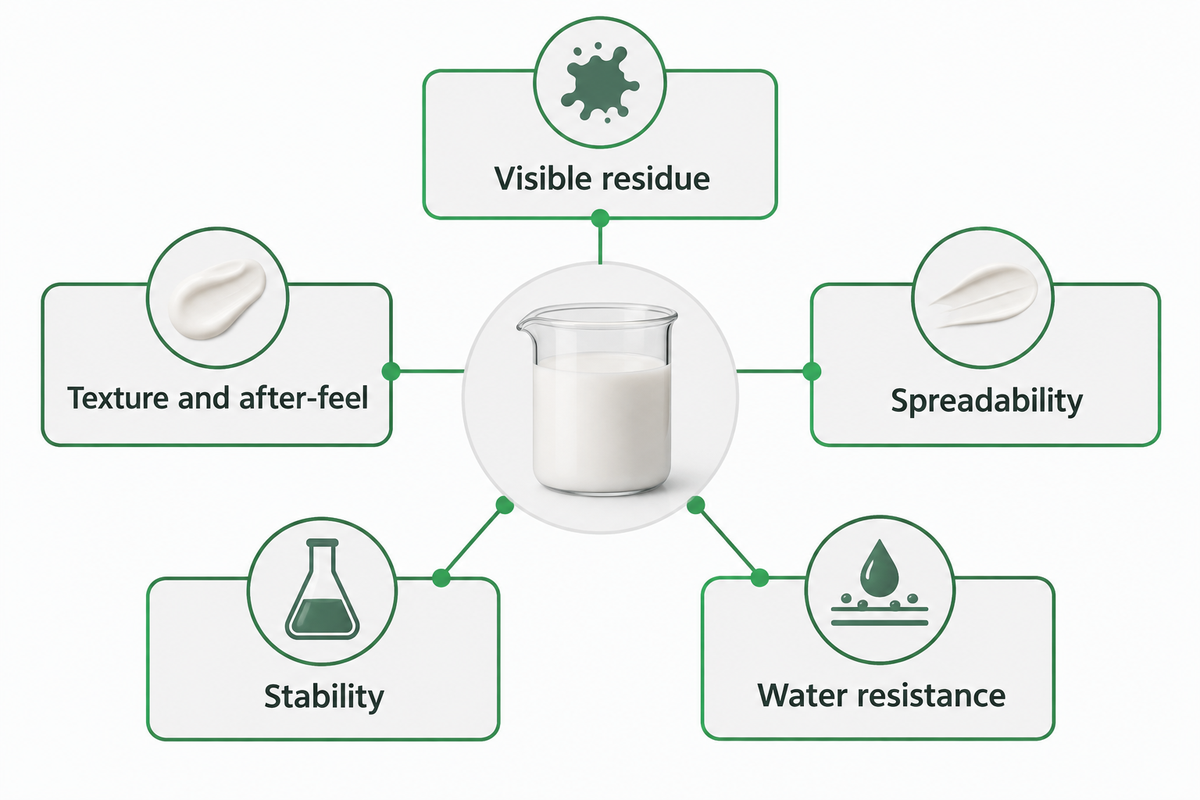
Common mineral sunscreen drawbacks include visible white cast, dense texture and oily after-feel. Stability, dispersion, water resistance and other goals can add even more trade-offs. A brief may ask for high protection, lightweight feel, spreadability, positioning for sensitive skin, acceptable appearance across darker skin tones and a low target cost at the same time. Setting these goals in order of priority can help constrain the formulator’s latitude. Australia’s TGA sunscreen manufacturing guidance identifies viscosity and blend uniformity or homogeneity among sunscreen product quality attributes, illustrating why sensory architecture and process controls need to be evaluated together.
Why do two sunscreens with the same SPF feel completely different?
Two sunscreens with the same SPF rating can feel different because they use different mineral-filter grades, phase structures, emollients, film formers, powders and rheology systems; SPF measures protection, not texture. Those choices affect drag, spread, dry-down, residue and water resistance. Finished products may feel different while supporting the same labeled SPF through their own applicable evidence.
Among the many types of sunscreen, a sunscreen lotion and a high-solids stick cannot inherit the same process merely because the label goal matches.
No formula architecture is automatically best for lower white cast, acceptable skin feel and water resistance. Compare prototypes against the ranked brief and verify the finished product. An oil in water emulsion may support a light initial feel, but still needs a stable way to carry its mineral load. A water in oil system may provide another route to film formation and water resistance, but may raise its own processing and sensory challenges. An anhydrous stick changes the formulation and packaging challenge yet again.
| Priority in the brief | Architecture question | Prototype observation | Do not assume |
|---|---|---|---|
| Reduced visible residue | Which material form and film distribution should be compared? | Application on the intended user range under defined conditions | A “non-nano” label eliminates white cast |
| Water resistance | Which film-forming route fits the intended format? | Film continuity, sensory effect and applicable finished-product test | A film former guarantees a label claim |
| Light feel | How much structure is needed to keep the mineral system stable? | Spread, dry-down, settling and recovery after storage | Lower viscosity always improves the product |
| Package convenience | Can the chosen bulk pass through and remain compatible with the pack? | Filling, delivery, leakage and stability in the intended package | Any pump or tube is interchangeable |
Every prototype should be distinct. Change the smallest practical set of variables, define the material lots and process, and explain the rationale for the next version. Inspiration may be drawn from a trending sensory claim, but it isn’t an instruction to manufacture.
How the Dispersion-to-Release Control Loop Works
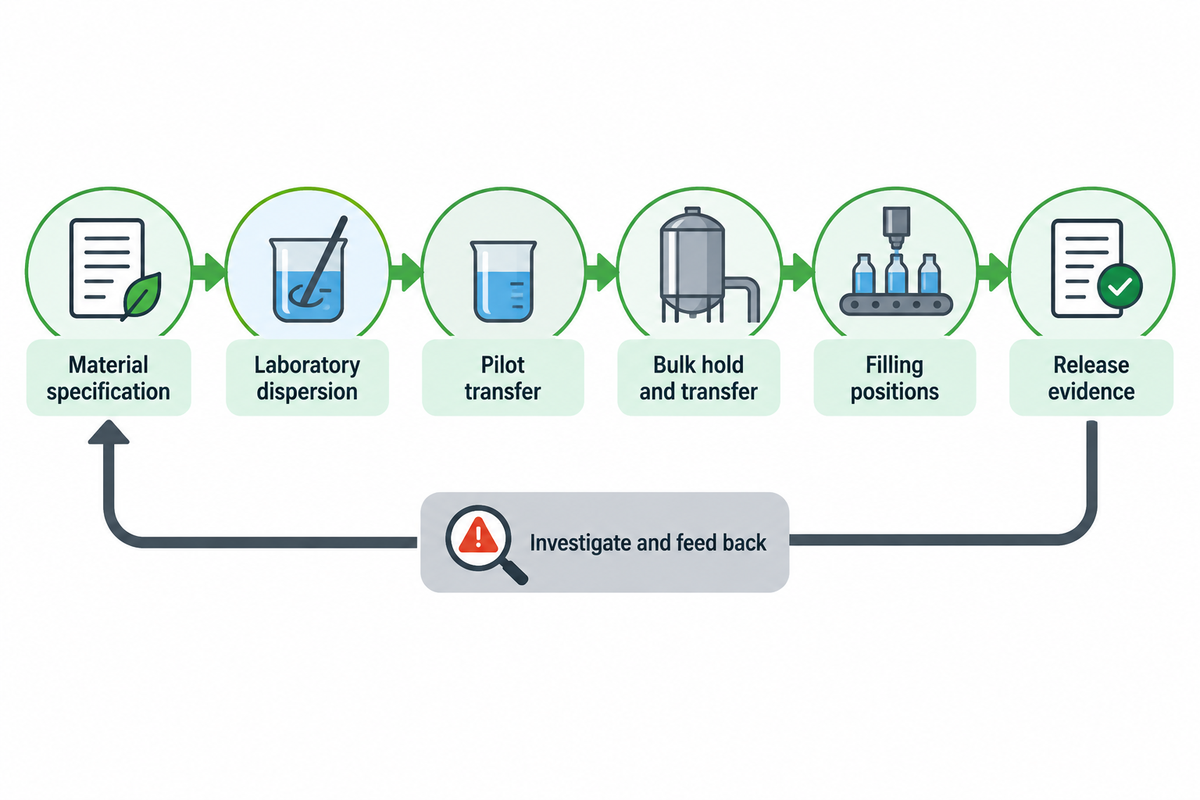
Mineral particles must be incorporated into a controlled formula state and kept representative through scale-up, holding, transfer and filling. “It looks smooth” isn’t a control strategy. The process needs observations and samples that show whether a change began with the raw material, the laboratory dispersion, the production transfer or the filled package.
| Handoff | Record or sample | Decision | Feedback if it fails |
|---|---|---|---|
| 1. Material specification | Approved identity, grade, treatment, carrier and lot documents | Is the incoming material the one developed? | Supplier qualification or change assessment |
| 2. Laboratory dispersion | Addition sequence, equipment, observation method and prototype sample | Is the intended state reproducible at laboratory scale? | Formulation or dispersion-method revision |
| 3. Pilot transfer | Equipment, order, time sequence, temperature and representative samples | Did scale change the observed state? | Process-development loop |
| 4. Bulk hold and transfer | Defined hold/transfer conditions and samples | Does bulk remain representative until filling? | Hold, agitation or transfer investigation |
| 5. Filling positions | Beginning, middle and end units tied to the batch record | Does the filled run remain uniform? | Trace back to bulk, transfer or filling history |
| 6. Release evidence | Approved results, deviations and package identity | Does the tested configuration support release? | Investigation, rework decision or rejection |
21 CFR 211.110 requires written procedures for in-process controls and appropriate testing or examination to assure batch uniformity and integrity. Process settings have to come from the formula, equipment and scale-up evidence.
A useful jurisdiction-labeled example of linking homogeneity evidence to bulk storage and filling is found in the Australian Therapeutic Goods Administration’s sunscreen manufacturing guidance. It shouldn’t be used to represent U.S. practice. Its practical lesson is portable: if release testing depends on a bulk sample, the manufacturer needs evidence that the bulk stays homogeneous through the relevant hold and filling process.
The loop closes when a later observation can trigger the correct earlier investigation. If end-of-fill units differ from beginning units, changing the mineral grade immediately may be the wrong response. First review bulk condition, agitation, transfer, delays, temperature and filling history. The evidence chain keeps a package symptom from being misdiagnosed as an ingredient problem.
Scale the Pilot Without Losing Batch Uniformity
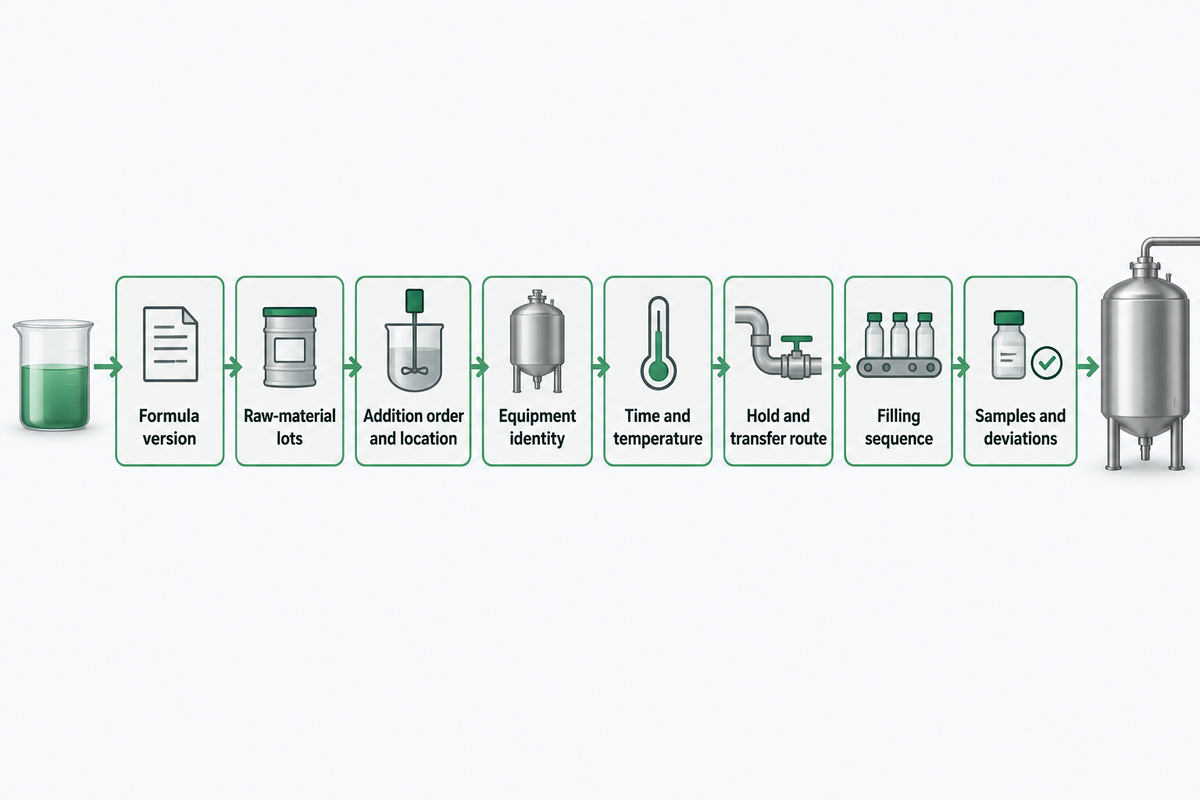
A production vessel isn’t a large version of a laboratory beaker. Equipment geometry, flow, energy input, heat transfer, addition points, batch depth and transfer path can all change the state that the process creates. Preserve the purpose of each step of the process and test if the production equipment achieves it. In the U.S. drug-manufacturing context, 21 CFR 211.110 requires in-process controls and appropriate testing or examination to assure batch uniformity and integrity.
A proper transfer record includes the approved formula version; the identity and lots of the raw materials; the order and location of addition; the identity of the equipment; the key time and temperature; bulk hold conditions; the route of transfer; the sequence of filling; the sampling points; and any interruptions or deviations. The record should capture the important variables of the process without assuming that every variable is equally important.
- Define the laboratory endpoint by recording how the team recognizes the intended dispersion and bulk state.
- Map the equipment difference. Identify the production operations needed for wetting, dispersion and bulk movement; include emulsification when the chosen architecture is an emulsion.
- Set a sampling rationale by deciding which samples reveal scale, hold, transfer and filling differences.
- Run the pilot as evidence. Record actual observations rather than rewriting the procedure after the result is known.
- Compare the chain. Examine laboratory, pilot bulk and filled-unit evidence together.
- Resolve changes before commitment. A new material grade, process sequence or package may require targeted re-evaluation.
Bulk hold needs special consideration. It’s not just whether the formula remains visually acceptable in a vessel. It’s whether the defined bulk hold, agitation, and transfer conditions preserve the characteristics for filling and the final product. Samples collected at the beginning, during and at the end of a process are useful only if their identity and process history are captured.
Applying a simple volume multiplier can produce confident-looking numbers with no relationship to the new equipment. The production setting should be established via representative results from the process development stage.
Match Finished-Product Tests to the Intended Claim
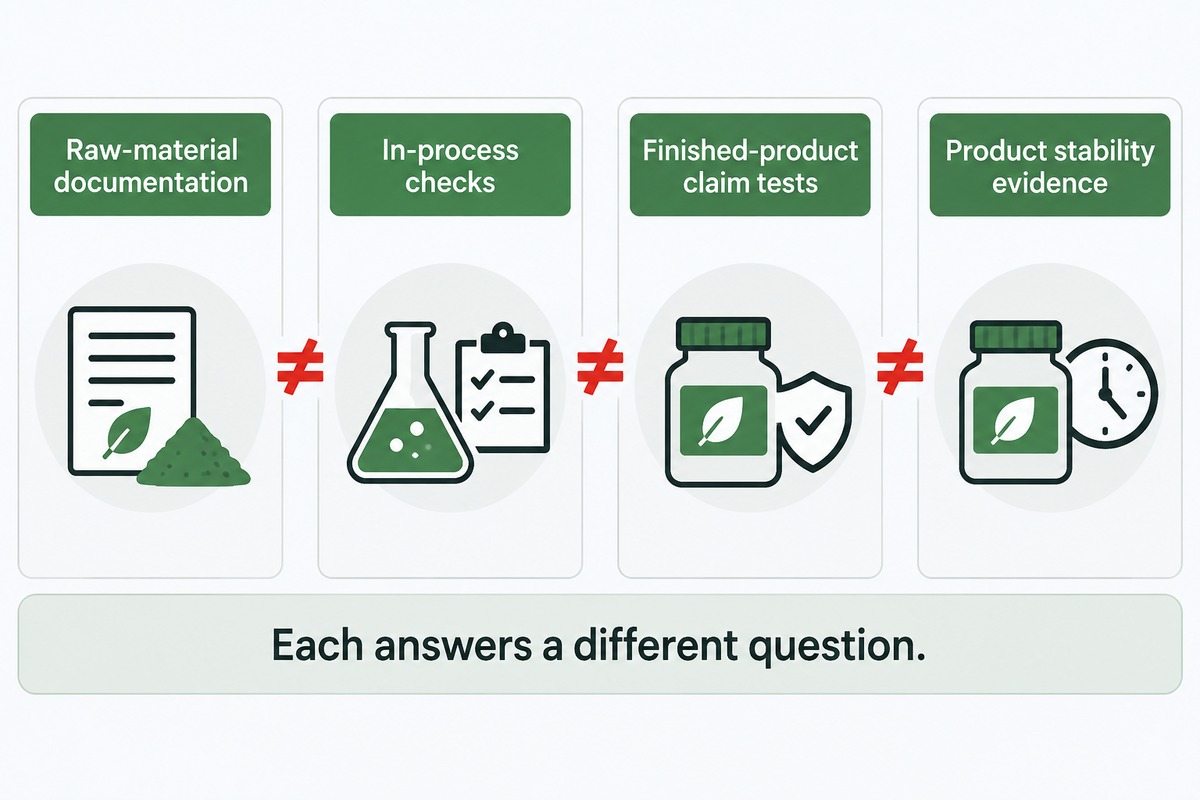
A certificate of analysis can help confirm an incoming material against its specification; finished-product claim tests provide evidence for the finished product’s SPF, for a broad-spectrum sunscreen claim and for water resistance when claimed.
SPF testing answers a claim question about the submitted SPF product; it is not a score for the elegance of the sunscreen formulas. The test brief should state whether the intended claim concerns UV protection against UVA and UVB rays, a water-resistance statement or another market-defined endpoint. References to UV rays or UVB rays in marketing copy must align with the supporting evidence and permitted labeling.
| Decision | Relevant evidence category | What it cannot replace |
|---|---|---|
| Was the approved mineral material received? | Identity, specification, supplier and lot documentation | Finished-product claim testing |
| Did the process create a uniform batch? | In-process controls and representative sampling | Long-term stability or label substantiation |
| Can the product carry an SPF or broad-spectrum claim? | Applicable finished-product method and result | Ingredient percentage or a laboratory prediction |
| Can the product carry a water-resistance statement? | Applicable test and corresponding label duration | A water-resistant ingredient or film-former claim |
| Will the marketed configuration remain suitable? | Written stability programme in the intended container-closure system | A stable bulk sample in a laboratory jar |
How do manufacturers make water-resistant sunscreens?
Formulators develop a film-forming system and complete formula intended to remain on skin under the target use conditions, then evaluate the finished product with the applicable method. The system must ensure that the formula is uniform and package compatible. In the United States, a water-resistance claim is tied to the applicable 40- or 80-minute test and label statement; a given ingredient can’t grant the claim by itself.
Can inactive ingredients affect SPF and sunscreen effectiveness?
Yes. Because the formula affects dispersion, film formation, spread and stability, ingredients outside the ultraviolet-filter list may impact the performance of the finished product. That doesn’t mean a formulator can calculate a guaranteed SPF from an emollient or film former. Screen prototypes during development and use the appropriate finished-product test for the intended claim.
FDA’s current guidance outlines the United States’ testing and labeling framework, while 21 CFR 201.327 defines test-related labeling provisions. Refer to the current source and the actual product. If a formula, mineral grade, carrier, process, or package changes, document why existing evidence still applies or state which work must be repeated.
A sun care line may contain several formats, tints and claim levels, but the report for one configuration does not automatically cover the others. Keep evidence boundaries evident when the scope is widened.
A qualified laboratory also needs a clear sample identity. Send the formula/version, batch, package, storage history and intended claim, along with your test request. Review the laboratory’s applicable method scope and any accreditation or external recognition required by the destination market; a general statement that a laboratory follows a particular standard isn’t the same as evidence that the laboratory’s relevant work has been independently assessed. The test plan should also identify the owner of raw data review, deviations, and any investigations, when sampling, screening, or repeat or confirmatory test results differ. NEXO’s in-house formulation-development pathway can hand off to a separate independent or accredited laboratory where the project requires it; the test owner remains responsible for defining the applicable protocol and interpreting the result.
Treat Formula and Package as One Stability System
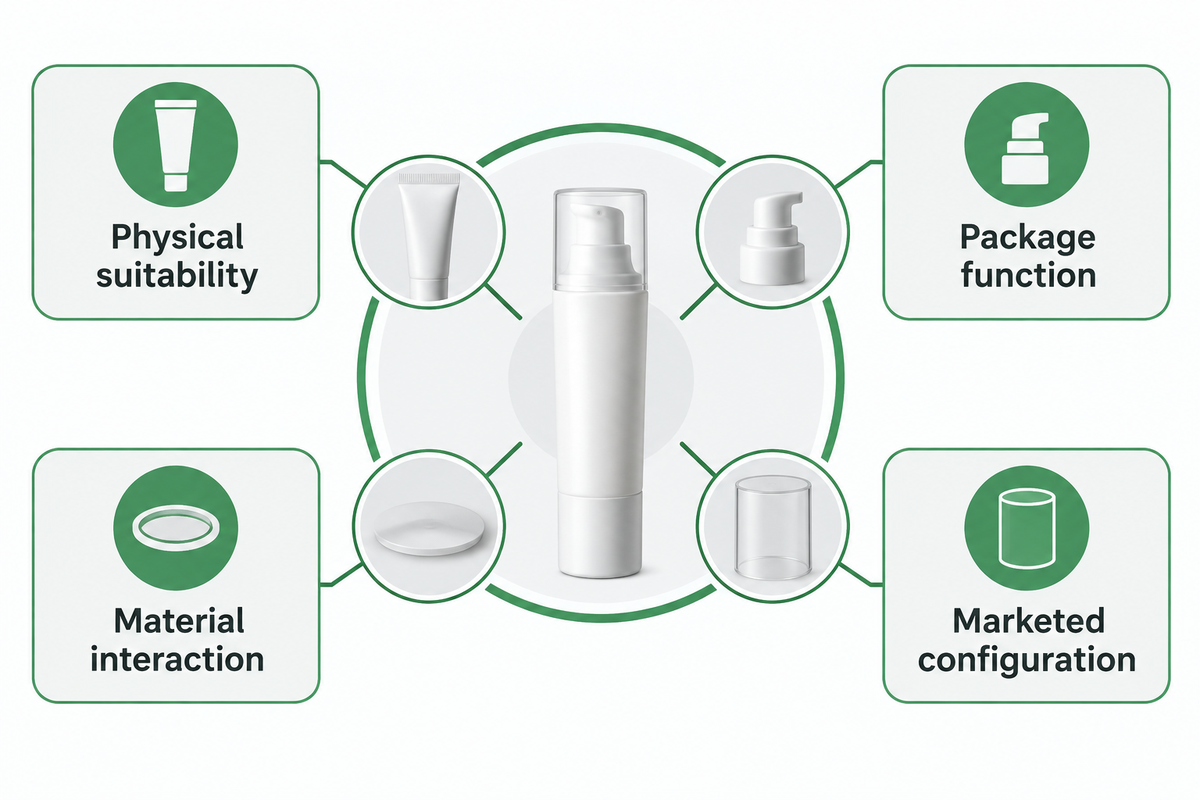
The marketed package is part of the product configuration. A formula that appears stable in an inert laboratory container may behave differently when in contact with a package component, e.g. a tube, pump, cap, liner or airless system. Product-contact materials, headspace, delivery path, light exposure, sealing and fill conditions can change the questions that stability and compatibility work must answer.
For a United States OTC drug route, 21 CFR 211.166 requires a written stability programme to assess the drug product’s stability characteristics and use the same container-closure system in which it is marketed. Thus, package selection can’t be deferred until all formula decisions are presumed to be final.
| Risk question | Observation or test input | Evidence decision |
|---|---|---|
| Does the formula remain physically suitable? | Appearance, phase behavior, viscosity/rheology using defined methods | Compare against approved, product-specific criteria |
| Does the package remain functional? | Seal, leakage, actuation or dispensing behavior as applicable | Confirm performance in the intended configuration |
| Do product and contact materials affect each other? | Compatibility observations and targeted analytical assessment | Investigate changes rather than treating them as cosmetic |
| Does the evidence support the proposed shelf life? | Written programme, time points, conditions and results | Use the qualified stability owner’s conclusion |
The written stability programme sets product-specific time points, conditions and sample quantities for the intended package and market. The programmes are product, market and risk specific and are defined by the responsible quality system. Identify the intended package as early as possible, define what may change, and prevent final component purchases or final artwork from becoming a reason to bypass an unsuitable stability result. The cosmetic stability testing decision protocol provides a more complete planning framework.
What Drives Minimum Order Quantity, Cost, and Lead Time?
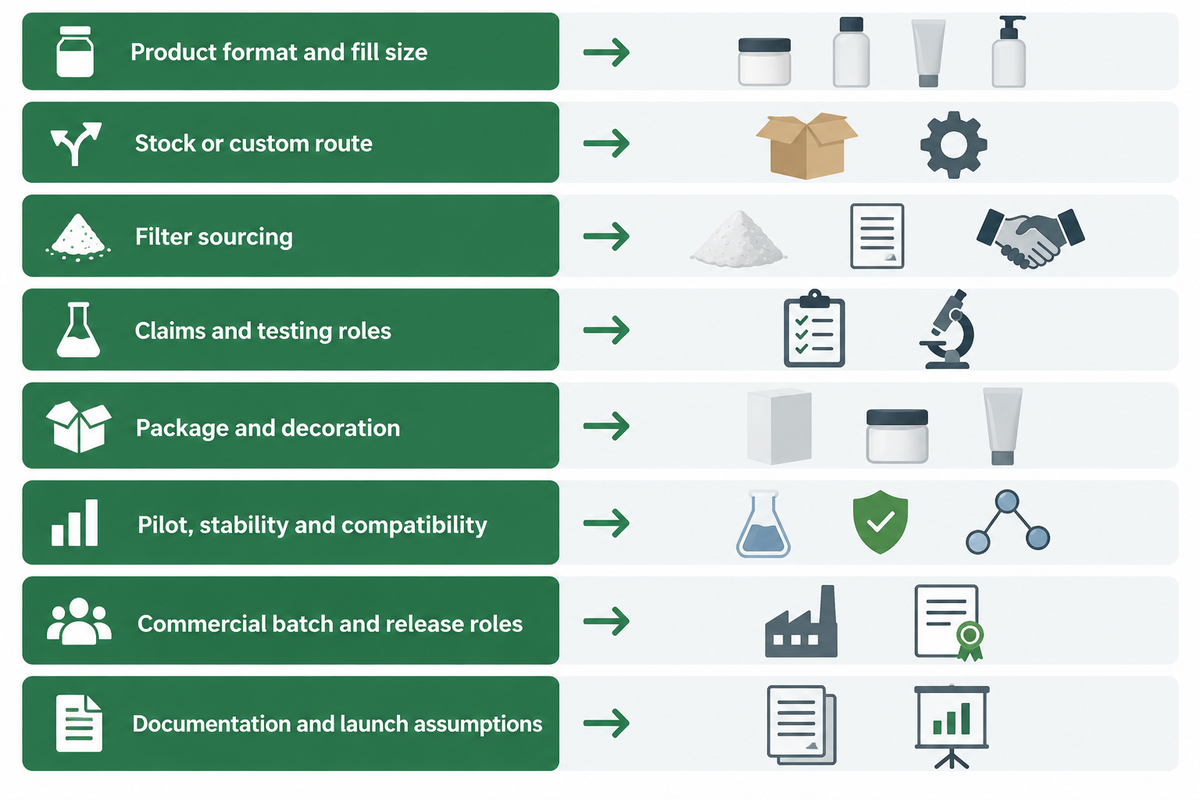
For planning and quotation, itemize the formula route, material sourcing, testing, package components, decoration, pilot work, filling constraints and destination-market documentation that may shape minimum order quantity, cost and lead time. Define the cost, lead-time and documentation assumptions needed to compare purchase constraints for the destination market. This is a scope comparison checklist. Make a like-for-like comparison of quoted work and assumptions before making a decision.
- Product format and fill size
- Stock/private-label route or custom formulation
- Mineral-filter grade and approved sourcing requirements
- Target claims and market-specific testing responsibilities
- Intended package, component ownership and decoration
- Pilot, stability and compatibility work included or excluded
- Commercial batch definition, release responsibilities and change control
- Shipping destination, documentation and launch timing assumptions
Ask prospective partners to label their assumptions and exclusions. A lower unit price may describe a stock formula in standard packaging while another quote includes custom development, intended-package trials and specified tests. Lead time may mean the time to a first sample, time to a production slot, or time to released goods; make the milestone explicit.
Exact NEXO commercial figures belong in a written scope for the defined project. Use the NEXO mineral sunscreen manufacturing programme for capability and quotation intent. This document helps the buyer to arrive with the required decisions and unknowns for a substantive discussion.
Match the Partner to the Evidence Chain, Not the Sales Deck
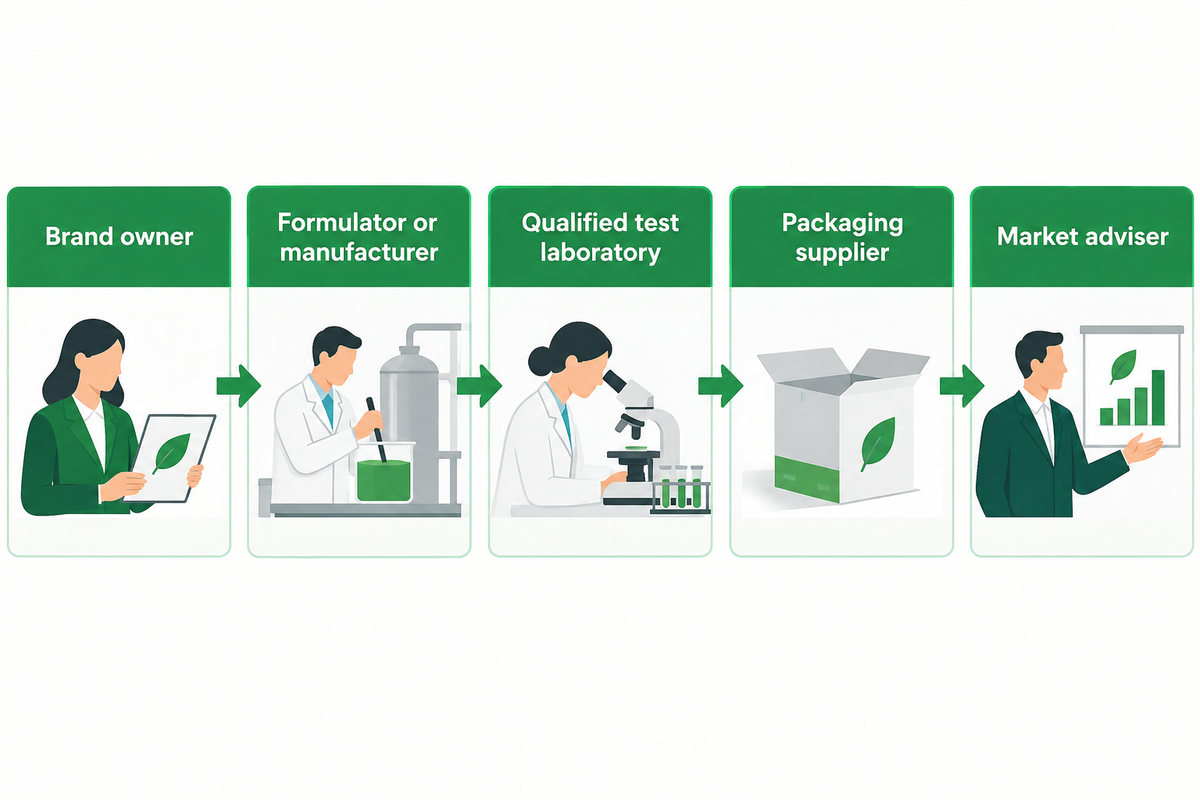
The best-equipped manufacturing partner is the one that’s able to manage the defined evidence chain directly or to coordinate qualified parties without leaving ownership gaps. Assign responsibility for failed tests, package changes and late production deviations before selection. The precise arrangement varies, but the brand should be able to name those who develop, manufacture, test, supply the package, and advise on the market route, and make the release decision.
| Role | Typical responsibility to define | Evidence to request |
|---|---|---|
| Brand owner | Intended market, claims, consumer brief and final commercial decisions | Approved brief, claims decisions and change approvals |
| Formulator/manufacturer | Formula version, process development, batch records and in-process controls | Specifications, transfer record, sampling rationale and deviations |
| Qualified test laboratory | Applicable method, sample control, result and report scope | Protocol/method identity, report and sample traceability |
| Packaging supplier | Component identity, specifications, changes and technical support | Approved drawings/specifications and lot/change information |
| Market adviser | Current jurisdiction-specific route and label review | Advice tied to the intended market and current sources |
Hand-offs should be tested with examples. If the mineral grade changes, who decides if the formula and evidence remain representative? What happens if end-of-fill samples vary? Who initiates an investigation? If the package supplier changes a contact material, who reviews compatibility impact? A reliable programme answers these questions before they become urgent.
For supplier-list intent, use the existing mineral sunscreen manufacturer comparison. A shortlist is only the beginning.
Frequently Asked Questions
Is mineral sunscreen manufacturing the same as private-label sunscreen manufacturing?
No. “Mineral” describes the UV filter route, while “private label” describes a commercial development route. A private-label product may use an existing mineral formula and standard package; in a custom programme, the formula, process, package and evidence are developed or changed for a defined brief.
Does a non-nano brief prove the finished product is safer or more effective?
No. A non-nano brief defines a material or positioning requirement, but it does not by itself establish safety, efficacy, low white cast or finished-product SPF. Look at the actual material specification, intended exposure, market requirements and complete formula. The marketed product still needs applicable safety, stability and performance evidence for its intended claims and use.
Can a laboratory SPF estimate replace the applicable finished-product test?
No. Development screening may help compare prototypes or identify poor candidates, but it is not automatically the evidence required for a label claim. Use the current method and responsible laboratory for the intended market, and send a traceable sample of the actual product configuration. Do not convert an ingredient percentage or model estimate into a guaranteed labeled SPF.
When should packaging be selected for a mineral sunscreen project?
Select the intended package early enough to include it in compatibility, filling and stability planning before final artwork or a large component commitment narrows the options. Specifying a package early doesn’t mean freezing an unsuitable package.
What documents should be handed over before production release?
The release owner needs the approved formula and version, material and finished-product specifications, manufacturing instructions and batch record, in-process and sampling records, applicable test reports, package identity, stability status, deviations, changes and final approvals. The exact records depend on the specific market and the quality system, but every item must be traceable to the batch and configuration under review.
Where should a buyer compare mineral sunscreen manufacturers?
Start by comparing relevant manufacturers, then qualify your shortlist against the same project brief. Compare formulation route, manufacturing scope, testing ownership, package support, documentation, change control and commercial assumptions. Use a list or sales page to identify candidates, then assess evidence of each supplier’s ability to manage the product, market and handoffs your programme requires.
References & Sources
- United States Food and Drug Administration. Labeling and Effectiveness Testing: Sunscreen Drug Products for Over-the-Counter Human Use – Small Entity Compliance Guide.
- United States Food and Drug Administration. Questions and Answers: FDA’s Regulatory Actions for Over-the-Counter Sunscreen.
- ECFR. 21 CFR 201.327, Over-the-counter sunscreen drug products; required labeling based on effectiveness testing.
- ECFR. 21 CFR 211.110 – Sampling and testing of in-process materials and drug products
- Electronic Code of Federal Regulations. 21 CFR 211.166, Stability testing.
- Australian Therapeutic Goods Administration. Manufacturing sunscreen and complying with Good Manufacturing Practice.
Scope Note: Regulatory requirements change and differ by market. Confirm the current route with qualified professionals for the intended product, claims and jurisdiction; the editorial frameworks in this article organize decisions and are not official standards.
Why beauty brands work with NEXO
About NEXO Beauty Labs Manufacturing Support
NEXO Beauty Labs supports skincare, body care, sun care, hair care, and private label brands with formulation, sampling, filling, quality control, and export-ready launch support.
Project Review Before RFQ
Before quotation, we help clarify product category, active direction, formula stage, package choice, compliance market, MOQ, sampling schedule, and required documents.
Request a Cosmetic QuoteCompany Profile // Data Sheet
CompanyNEXO Beauty Labs
Business TypeCosmetic OEM / ODM manufacturing partner
Main ProductsPrivate label skincare, facial serums, moisturizers, cleansers, sunscreen, body care, and hair care products
Manufacturing CapabilityFormula development, sample adjustment, package sourcing, filling, QA/QC, documentation, and export support
RFQ Data NeededProduct type, formula goal, package format, target market, MOQ, claims, timeline, and benchmark samples
Websitenexobeautylabs.com