Get in touch with NEXO Beauty Labs Company
Top 10 Mineral Sunscreen Manufacturers for Different Launch Routes

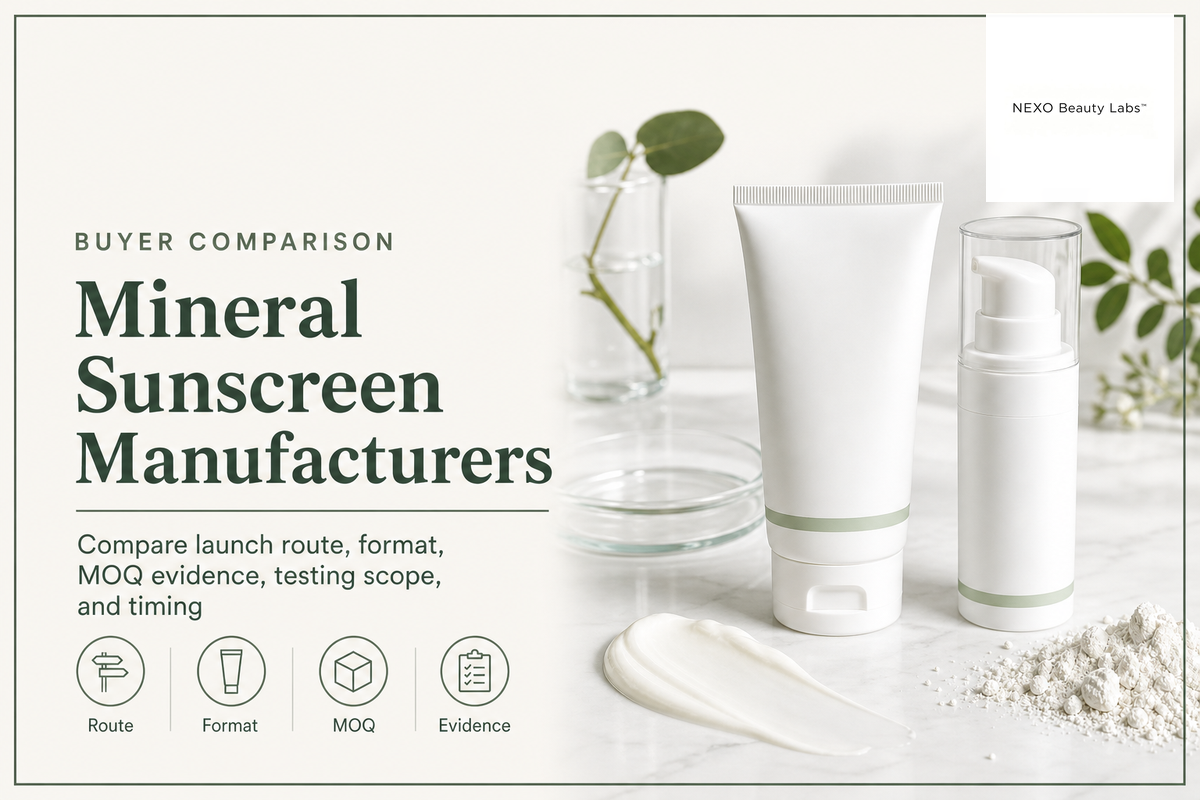
Manufacturer comparison and buyer’s evidence guide
The best mineral sunscreen manufacturers depend on your destination market, formula route, dosage format, testing ownership, minimum order quantity, and timing. NEXO publishes four development routes, Bell covers mineral, chemical, and hybrid sun care, Pure Velocity focuses on non-aerosol mineral sprays, Pure Source publishes a 5,000-unit program threshold, and InSpec offers a brush-on powder route. These are fit categories, not a universal ranking.
Quick Picks by Launch Route
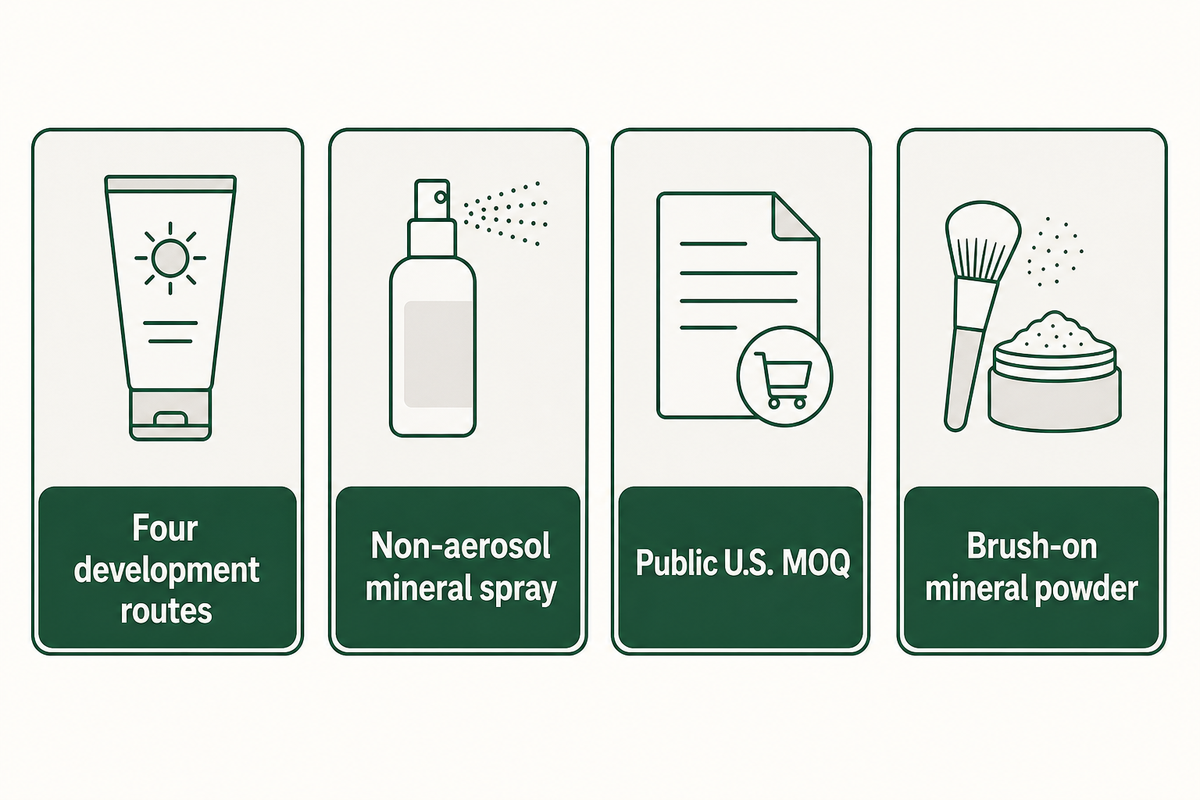
Each label shows a documented fit category from the reviewed official pages. None are universal performance rankings.
Four development routesNEXO Beauty Labs, stock, semi-custom, full-custom, and formula transfer, with public sample and production windows.
Broad U.S. sun-care platformBell International Laboratories, mineral, chemical, hybrid, and zinc-oxide-only platforms.
Non-aerosol mineral sprayPure Velocity LLC, ready-to-label and custom pump-spray concepts.
Public U.S. MOQPure Source, a reviewed reef-positioned program lists 5,000 units per product.
Brush-on mineral powderInSpec Solutions, a specialized SPF 30 powder concept and OTC manufacturing route.
Taiwan OEM/ODMBIOCROWN Biotechnology, mineral lotions, liquids, gels, creams, and sunsticks.
Disclosure: This guide is published by NEXO Beauty Labs. We list ourselves first because this is our website, not because we claim to be the market leader. The other 9 manufacturers are grouped by what they are best for, in no particular order within each group.
How We Verified the 10 Mineral Sunscreen Manufacturers
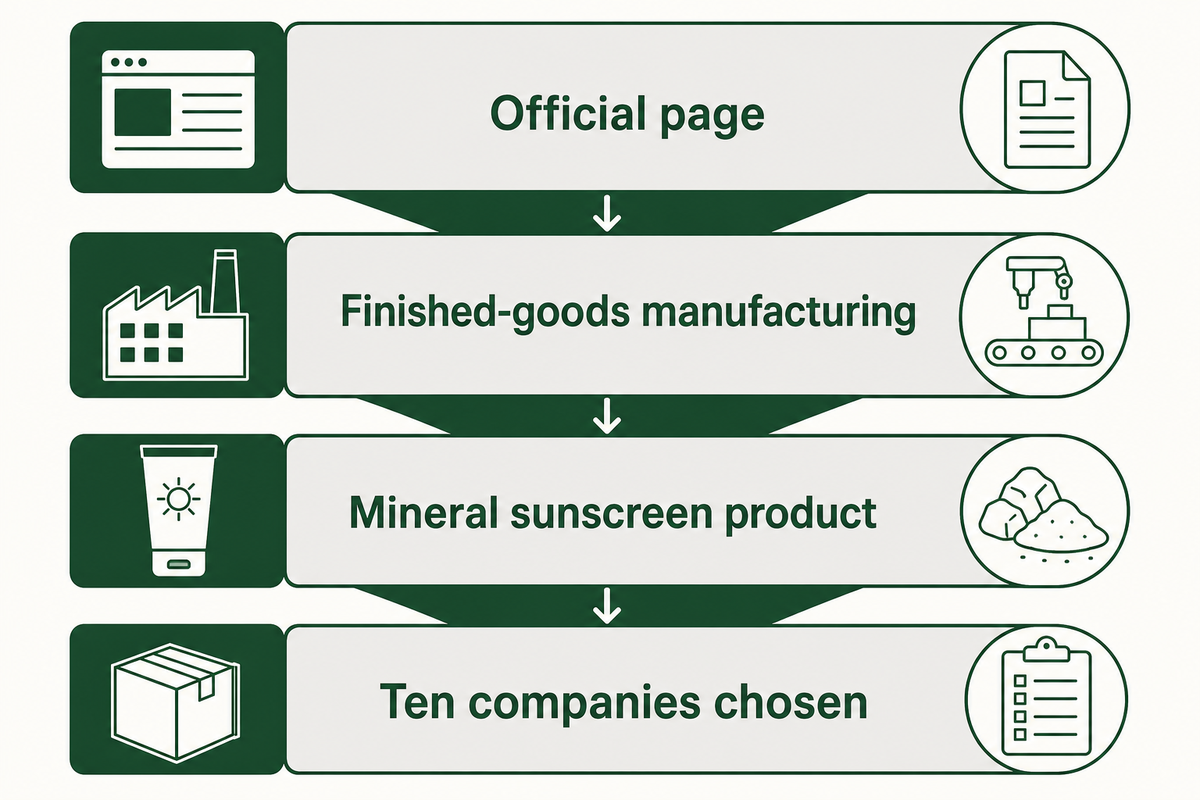
Company information was verified against official websites in October 2026.
An official page was required. Evidence showed the company acts as a sunscreen supplier that performs or controls third-party finished-goods manufacturing, and presents a mineral sunscreen product or a directly relevant finished format. We accepted integrated finished-goods manufacturers, OEM/ODM and private label cosmetics factories, clearly disclosed product development partners with production responsibility, and specialized fillers whose format role was explicit.
We excluded ingredient and dispersion suppliers, test labs, packaging-only businesses, consumer brands without disclosed manufacturing, traders, distributors, sourcing platforms, directories and marketplace listings. Sixteen candidates were screened and ten were chosen. Two initially plausible names were removed because the reviewed evidence did not establish current finished mineral-sunscreen manufacturing at a responsible factory. This matters: a polished sales page is not evidence of the legal entity, plant, process, or test-report chain behind a finished sunscreen.
Company data was compared to official websites and public sources in October 2026. Facts below are labeled by evidence strength. An official-page claim means the information is provided by the manufacturer on its website, whether it calls itself a skin care manufacturer or SPF manufacturer. A public numeric claim is a stated MOQ or timeline, not an independently guaranteed result. Not publicly disclosed means the buyer must ask. Project-specific means the answer depends on formula, pack, test plan, quantity, or destination market and should be confirmed in writing.
This was a documentary comparison, not a factory audit. We did not infer capacity, market share, product approval, or certificate validity from marketing language. A certificate logo is not proof that the contracting entity, production address, activity, and product route are all within scope.
How to Compare Mineral Sunscreen Manufacturers Before You Rank Them
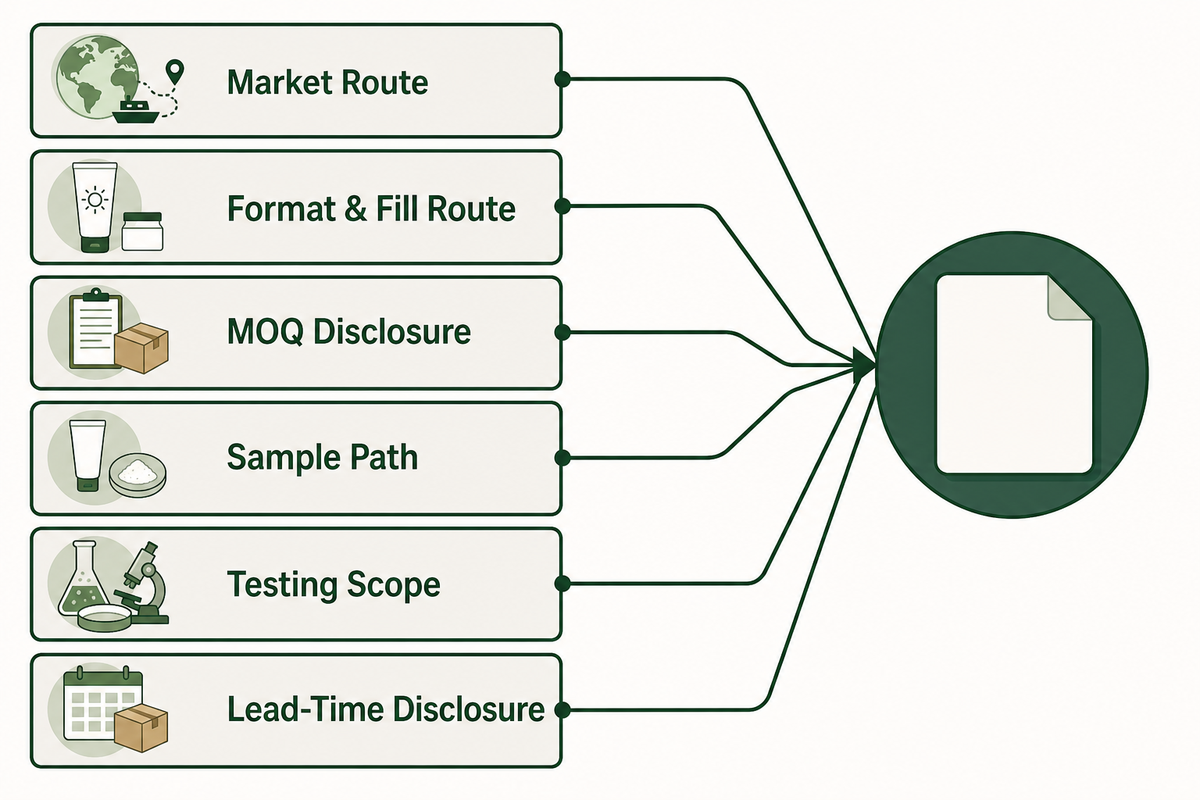
Begin with the launch route, not the brand name. Screen the legal entity, production role, destination-market classification, mineral system, dosage format, product-level testing, ownership, MOQ basis, timing basis, and document responsibility. A factory that’s suitable for an EU cosmetics project may not be qualified for a U.S. OTC sunscreen, or for special powder, stick, aerosol sunscreen, or bag-on-valve sunscreen.
Manufacturer Verification Status Key
- Official-page claim, supported by a current company page but still subject to contract and document review.
- Public numeric claim – Evidence of a published MOQ or clock whose start point, inclusions and exceptions require clarification.
- Not publicly disclosed – no reliable public number has been found; don’t replace the gap with an estimate.
- Project specific – the supplier needs to quote against a locked formula, format, pack, market, claims and forecast.
Use a route-and-evidence filter
Legal entity→Facility and role→Destination market→Mineral system→Format and pack→Testing→Ownership→MOQ and timing→Documents
Apply a knockout rule: missing non-negotiable evidence is not a neutral score. If the entity issuing the invoice isn’t the certificate holder or manufacturing entity, pause. If no party accepts written responsibility for the destination-market route, pause. If the requested test cannot cover the final sale formula and pack, pause. Geography, catalog breadth and communication style are to be considered preferences. Legal identity and product evidence are prerequisites.
Keep regulatory and testing claims separate
In the United States, sunscreen is regulated as an OTC drug. FDA establishment registration or product listing does not mean FDA approval, and neither substitutes for meeting the applicable United States OTC route. FDA’s sunscreen regulatory history also changes over time: a June 2026 action added bemotrizinol to the OTC monograph, while a September 2026 action removed PABA and trolamine salicylate. Those agency actions should never be rewritten as approval of a particular factory or product. FDA sunscreen drug-product information is the appropriate primary source to recheck before launch.
Likewise, ISO 22716:2007 covers cosmetic good manufacturing practices; it does not prove SPF, UVA protection, broad spectrum performance, or water resistance. ISO 24444:2019 with Amendment 1:2022 addresses in vivo SPF determination. ISO 24443:2021 with Amendment 1:2026 addresses in vitro UVA photoprotection, but its scope excludes powder products. ISO 23675:2024 is an in vitro SPF method with format limits and is not a universal substitute for powder, stick, or water-resistance evidence. ISO 16217:2020 describes a water-immersion procedure used in water-resistance assessment. Confirm the current edition, market acceptance, laboratory scope, and exact product applicability rather than asking for “an ISO test” in the abstract.
An Australian listed sunscreen goes through its own therapeutic goods process, including the recent changes to AS/NZS 2604:2021. A European cosmetic product goes through a different process while nano-form ingredient identity, notification, safety assessment and labeling may also define additional obligations. The terms “mineral,” “non-nano,” “reef safe,” “sensitive skin” and “clinical” aren’t standardized and don’t have the same meaning across different markets. Clarify the meaning of each claim, define the market, provide the formula, evidence and label wording before the quote.
Do not confuse a sample clock with a launch clock
A sample and production window can accurately define scope and duration, but may omit several things like formula approval, component sourcing, artwork, SPF testing, UVA work, water-resistance testing, stability and compatibility testing, microbiology, preservative efficacy, and regulatory review. The production MOQ can be less than the economic order quantity due to decorated components, cartons, a zinc oxide grade, a tint split, or a test program. Ask every supplier to show the start event and exclusions for its sample lead time, commercial clock, and minimum order quantity.
10 Mineral Sunscreen Manufacturers for Different Launch Routes in 2026
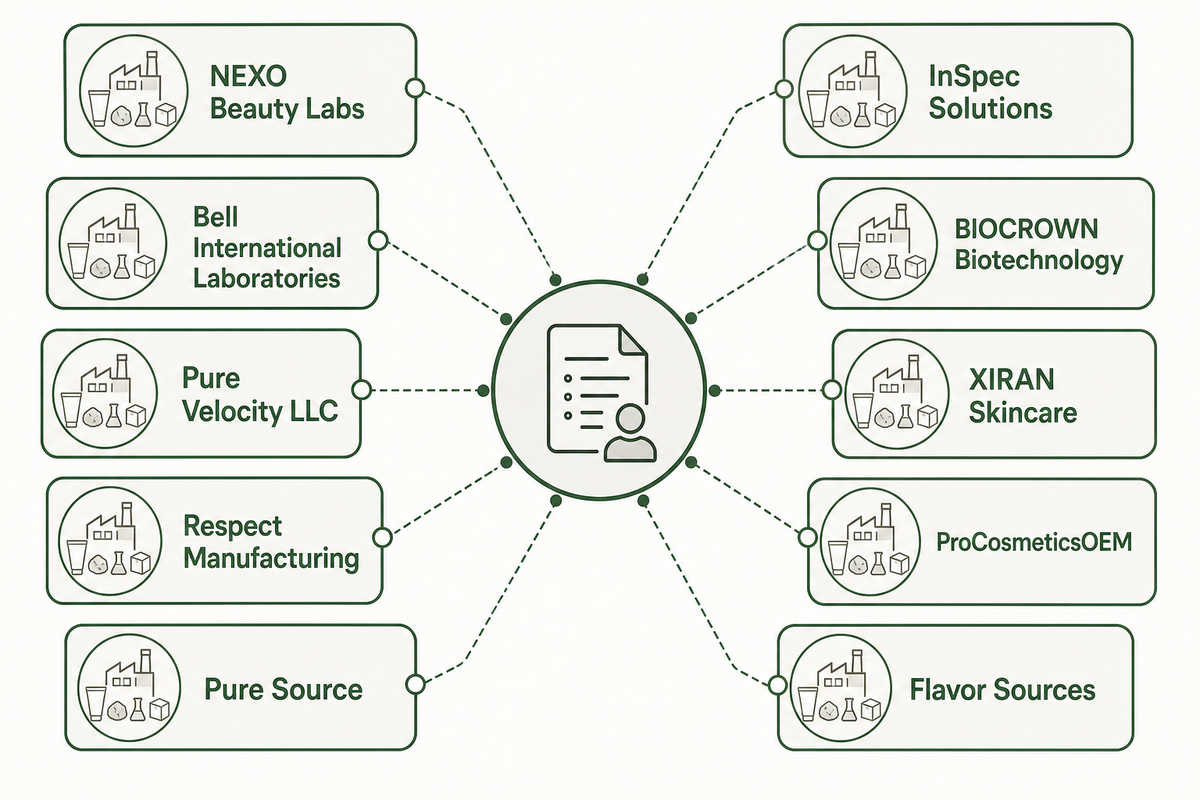
The matrix is a routing tool, not a scorecard. “Published” means the number appeared on the reviewed official page; it doesn’t make the term universal across every formula or project. Blank founding data and undisclosed timings are left visible instead of being estimated.
| No. | Company | Headquarters / base | Founded | Best for | Brief Introduction | Published MOQ | Timing evidence | Key Advantages | Potential Disadvantages | Official website |
|---|---|---|---|---|---|---|---|---|---|---|
| 1 | NEXO Beauty Labs | Guangzhou, China | Manufacturing foundation dating to 1999 | Four development routes | OEM/ODM; emulsions, fluids, gels, anhydrous products, sticks | 10,000 units/SKU standard | Samples take 3–7 days and production takes 10–15 days after formula and pack approval; both windows are measured in working days | Public routes and timing windows | 10,000-unit standard minimum can exceed a small validation run | nexobeautylabs.com |
| 2 | Bell International Laboratories | Eagan, Minnesota, USA | 1996 | Broad U.S. sun-care platform | Mineral, chemical, hybrid; lotions, sticks, fluids, sprays | Project-specific | Project-specific | R&D, testing, filling and packaging breadth | Integrated R&D and testing scope can be broader than a simple pump-lotion brief | bellinternationallabs.com/sun-care/ |
| 3 | Pure Velocity LLC | United States manufacturing | Not listed | Non-aerosol mineral spray | Turnkey and custom zinc-based face/body pump sprays | “Low” without a number | “Fast” without a schedule | Ready-to-label plus custom paths | Reviewed program centers on pump sprays, not solid stick or compact formats | purevelocityllc.com/mineral-spray-sunscreen/ |
| 4 | Respect Manufacturing | Denver, Colorado, USA | Not listed | Denver turnkey development | Mineral and chemical SPF; development through finished goods | Varies by formula and packaging | Project-specific | Single-service path from R&D through pack | Turnkey finished-goods route is less direct for bulk-only or buyer-filled programs | respectmanufacturing.com/feeds/service/private-label-sunscreen |
| 5 | Pure Source | United States manufacturing | 1995 | U.S. zinc-oxide multi-format work | Full-turnkey lotion, cream, spray and stick | 5,000 units/product on reviewed reef-positioned program | Project-specific | Public minimum on one relevant program | 5,000-unit program minimum can exceed an early validation budget | thepuresource.com/sun-care-manufacturing/mineral-sunscreen |
| 6 | InSpec Solutions | Holly Hill, Florida, USA | Confirm from official corporate records | Brush-on powder and format transfer | OTC lotions, sticks, sprays and brush-on mineral powder | Project-specific; request a written quote | Project-specific; request a milestone schedule | Specialized powder concept plus filling breadth | Powder page is narrower than a broad mineral catalog | inspecsolutions.com/products/brush-on-powdered-sunscreen |
| 7 | BIOCROWN Biotechnology | Taiwan | 1977 | Taiwan OEM/ODM and waterless formats | Lotions, creams, gels, liquids and sunsticks | Flexible, no number | 7–14 day prototype; about 20–25 working days for reviewed product route | Broad mineral-format catalog | Taiwan production does not fit a U.S.-domestic manufacturing requirement | biocrown.com.tw/en/category/A0111.html |
| 8 | XIRAN Skincare | Not listed on the reviewed product page | 2013 | Lower-entry lotion or stick comparison | Mineral SPF 50 liquids, tinted lotions and sticks | Previously published as a general 1,000 units for normal lotion/toner/cream bottles | Previously published as 25–30 working days for OEM after deposit and design confirmation | Public general entry threshold | 1,000-unit threshold covers bottle formats, not a stick program | xiranskincare.com/product/private-label-liquid-sun-shield-long-lasting-mineral-sunscreen-spf-50/ |
| 9 | ProCosmeticsOEM | Not listed on the reviewed page | Not listed | Low published entry quantity | Mineral creams, sprays, sticks, gels and tinted SPF | 500+ units | Project-specific | Several formats and a low public entry claim | Published minimum excludes validation runs below 500 units | procosmeticsoem.com/product/private-label-sunscreen-oem-odm |
| 10 | Flavor Sources | Dongguan, Guangdong, China | 2000 | China cosmetic OEM with factory-audit access | Zinc-oxide face, tinted, sensitive-skin and body programs | Project-specific | Project-specific | Factory-audit invitation and cosmetic-format breadth | China cosmetic OEM route is not a U.S.-domestic OTC option | flavorsources.com/products/sun-care/mineral-sunscreen/ |
The Publisher’s Disclosed Manufacturer Option
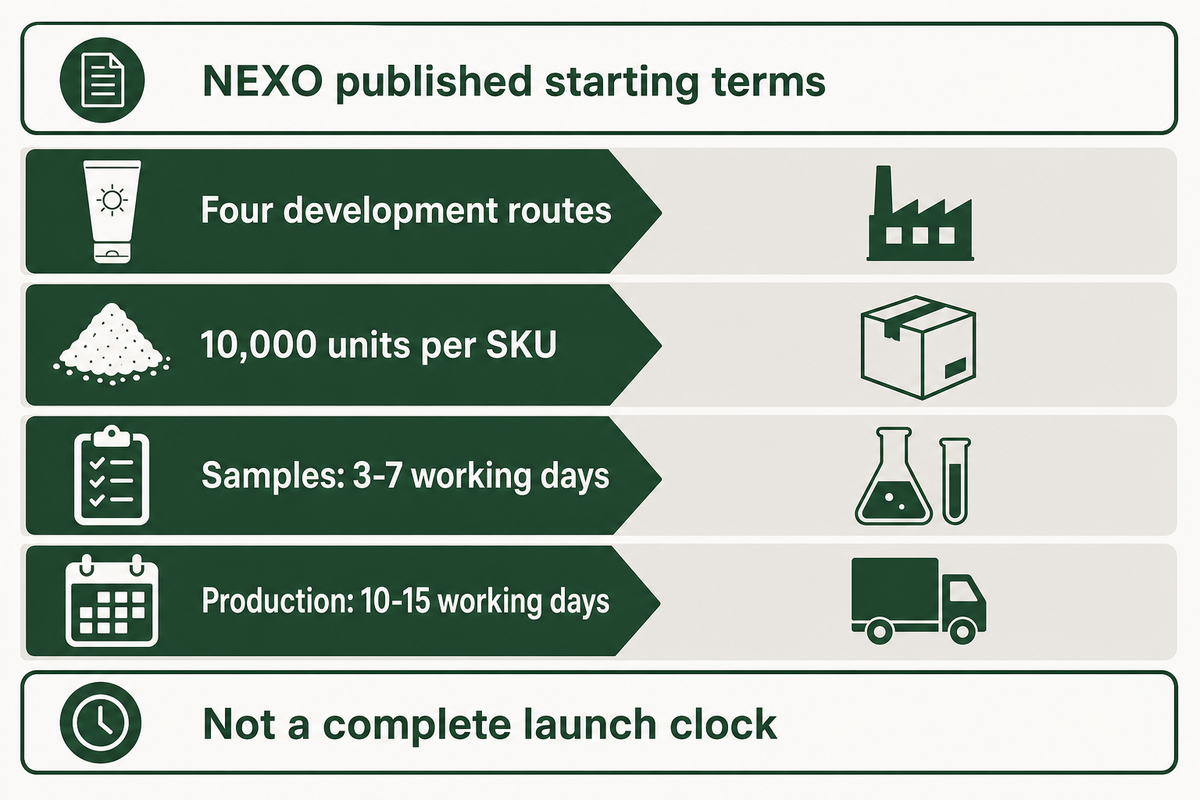
This first profile is separated because NEXO publishes the article. Read its numeric terms as attributed company statements and compare them with the same formula, market, testing, pack, and responsibility questions used for every other candidate.
1. NEXO Beauty Labs: Best for Four Development Routes and Published Timing Windows
BaseGuangzhou, China
RoleCosmetic OEM, ODM and private-label finished-goods manufacturer
Best forStock, semi-custom, full-custom and formula-transfer comparisons
Official wording reviewedOEM & ODM; mineral sunscreen formats
NEXO is the publisher of this guide, so its placement is disclosed rather than presented as an objective first-place ranking, and its manufacturing foundation dates to 1999. The reviewed pages describe mineral and hybrid emulsions, fluids, gels, anhydrous products, and sticks across stock, semi-custom, full custom, and formula-transfer paths, with testing and export-document support.
The official product page states a standard MOQ of 10,000 units per SKU, samples in 3–7 working days, and production in 10–15 working days after formula and packaging approval; these are starting terms for an OEM sunscreen or ODM sunscreen inquiry, not a complete launch clock. The site also displays Intertek ISO 22716:2007 and GMPC audit certificates.
Limitation: the 10,000-unit standard minimum may be too high for a small validation run.
Official page: nexobeautylabs.com/sunscreen-manufacturing/mineral-sunscreen-manufacturing/
U.S. Finished-Goods and OTC-Route Options
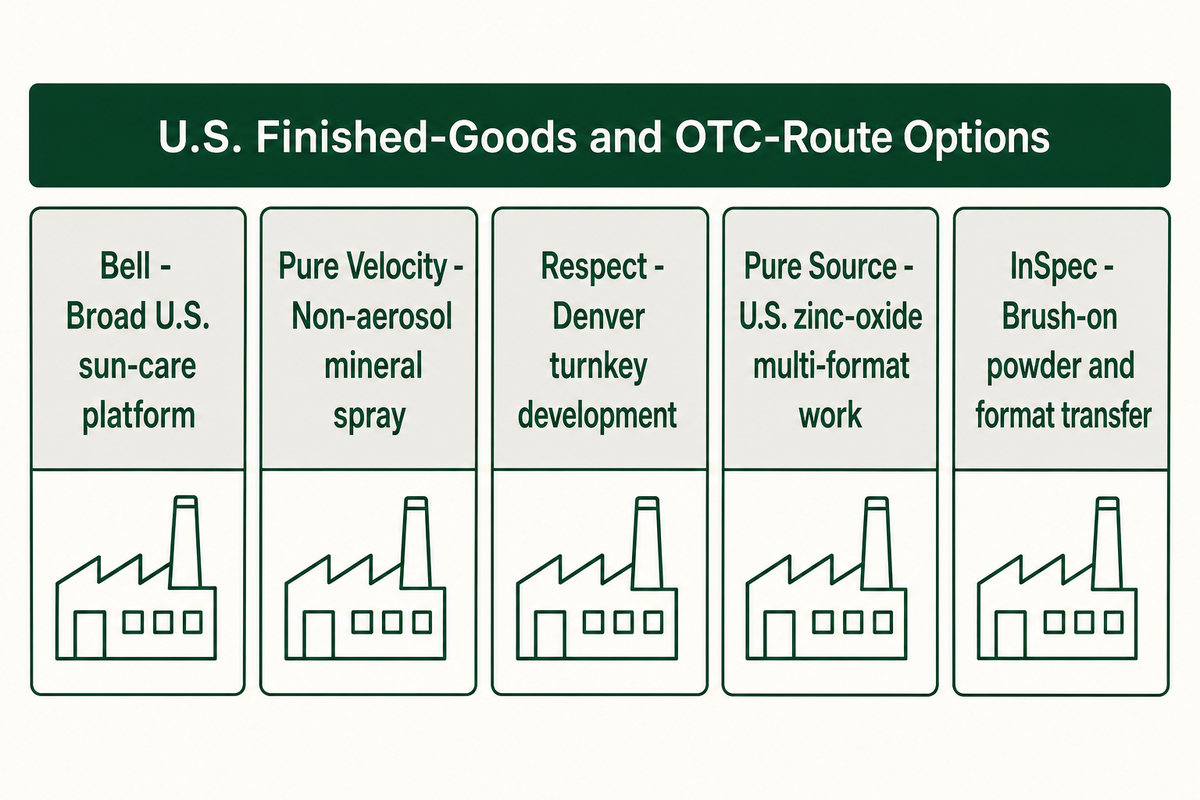
These manufacturers publish evidence of U.S. finished-goods, OTC, or format-specific activity. Their strongest use cases differ by dosage form, service scope, and minimum-order route.
2. Bell International Laboratories: Best for Mineral, Chemical, and Hybrid Sun-Care Breadth
BaseEagan, Minnesota, USA
RoleVertically integrated contract manufacturer
Best forR&D, testing and production breadth
Official wording reviewedcontract manufacturing; mineral, chemical, and hybrid; BOV; FDA Registered; zinc oxide only
Bell’s official sun-care page presents mineral, chemical, hybrid, and zinc-oxide-only platforms across lotions, sticks, fluids, and spray formats. Its described formulation, analytical and clinical testing, filling, packaging, and bag-on-valve breadth is relevant when a buyer hasn’t fixed the mineral system or dosage form.
The site lists an FDA-registered facility, Health Canada registration, and NSF Certified Organic capabilities alongside its integrated development and filling services.
Limitation: Bell’s integrated R&D and testing scope can be broader than a simple fixed-formula pump-lotion brief, making it a less direct fit for buyers who only need basic filling and packaging.
Official page: bellinternationallabs.com/sun-care/
3. Pure Velocity LLC: Best for Ready-to-Label or Custom Non-Aerosol Mineral Spray
BaseUnited States manufacturing
RolePrivate-label and custom finished sunscreen manufacturer
Best forDTC, resort and outdoor pump-spray concepts
Official wording reviewedMade in the USA; private label sunscreen manufacturing; mineral spray sunscreen
Pure Velocity’s official mineral-spray page presents zinc-based face and body pump sprays, including SPF 14, 30, and 50+ concepts, with ready-to-label and custom paths plus packaging and fulfillment. This focus suits buyers seeking a non-aerosol spray without assuming that every “spray sunscreen” uses the same valve, propellant, filling equipment, transport rules, or application pattern.
The page says its concepts use non-nano zinc oxide and describes production in FDA-registered facilities, batch certificates of analysis, and support related to ISO 24444 and ISO 24443 testing.
Limitation: the reviewed program centers on face and body pump sprays, so it is not the strongest fit for a brand whose launch depends on a solid stick or compact format.
Official page: purevelocityllc.com/mineral-spray-sunscreen/
4. Respect Manufacturing: Best for Denver-Based Turnkey Mineral-SPF Development
BaseDenver, Colorado, USA
RoleTurnkey private-label and contract manufacturer
Best forEmerging brands seeking one development-to-pack discussion
Official wording reviewedfinished product; FDA Registered
Respect Manufacturing’s official service page offers private-label mineral sunscreen using zinc oxide or titanium dioxide alongside chemical SPF products. Its R&D, custom formulation, testing coordination, production, filling, packaging, and finished-goods scope creates a turnkey manufacturing route for teams that prefer one commercial coordinator.
Respect states that MOQ varies by formulation and packaging. The website lists FDA registration, cGMP compliance, and USDA Organic certification as part of its finished-goods manufacturing offer.
Limitation: the turnkey route runs from development through finished goods, so it is less direct for buyers seeking only bulk formula or planning to control filling and packaging through separate partners.
Official page: respectmanufacturing.com/feeds/service/private-label-sunscreen
5. Pure Source: Best for a U.S. Zinc-Oxide Program With a Public MOQ
BaseUnited States manufacturing
RoleFull-turnkey OTC and cosmetic contract manufacturer
Best forLotion, cream, spray and stick programs
Official wording reviewedU.S. sunscreen manufacturer; full turnkey
Pure Source, also presented as The Pure Source on its site, offers zinc-oxide mineral sunscreen lotion, cream, spray, and stick formats with formulation, regulatory support, manufacturing, filling, testing coordination, and packaging. That breadth helps buyers compare a U.S. suncare manufacturer across a mineral sunscreen cream, mineral sunscreen stick, and other finished formats.
The reviewed reef-positioned program publishes a 5,000-unit minimum per product, and the company describes cGMP, FDA contract-manufacturing, and QAI natural-organic credentials.
Limitation: the reviewed program’s 5,000-unit minimum can exceed the budget and inventory tolerance of an early validation launch.
Official page: thepuresource.com/sun-care-manufacturing/mineral-sunscreen
6. InSpec Solutions: Best for Brush-On Mineral Powder or a Format-Specific Transfer
BaseHolly Hill, Florida, USA
RoleFDA-registered OTC and personal-care contract manufacturer
Best forBrush-on powder and specialized filling discussions
Official wording reviewedOTC contract manufacturer; 13+ filling lines; Registered, audited, and certified
InSpec’s official pages describe mineral and chemical SPF lotions, sticks, continuous sprays, and an SPF 30 brush-on powder concept using non-nano zinc oxide and titanium dioxide. Its broader materials describe in-house formulation, stability work, compounding, quality assurance, and more than thirteen filling lines for tubes, bottles, and BOV formats.
Powder flow, active distribution, brush delivery, consumer application, and test-method applicability differ from an emulsion, while ISO 24443’s powder exclusion makes the test route especially important. InSpec also lists ISO 9001:2015, SGS audit, WHO GMP, and FDA-registration claims.
Limitation: the brush-on powder concept is a narrower route than a conventional mineral lotion or stick program and cannot share the same formulation or test assumptions.
Official page: inspecsolutions.com/products/brush-on-powdered-sunscreen
Global Cosmetic OEM/ODM Options
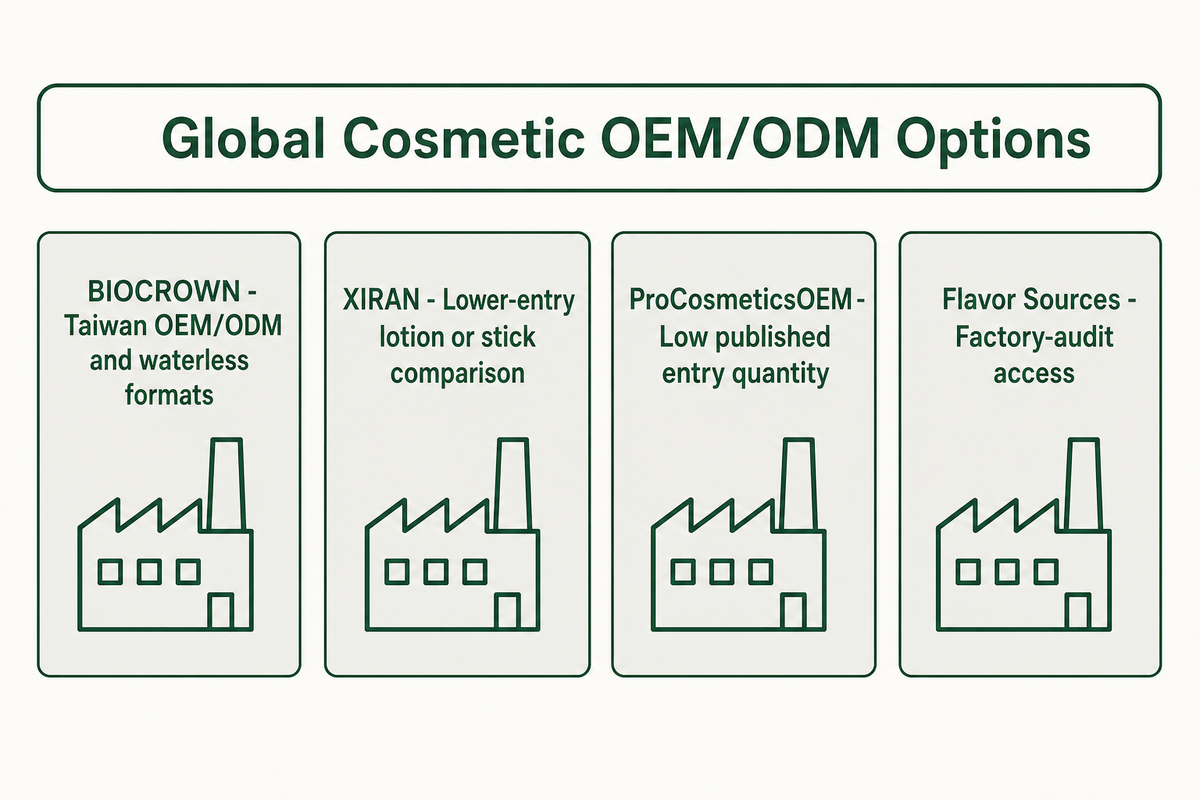
7. BIOCROWN Biotechnology: Best for Taiwan OEM/ODM Mineral SPF and Sunsticks
BaseTaiwan
Founded1977
Best forInternational brands comparing several mineral formats
Official wording reviewedprivate label; Mineral Sunscreen; 20-25 working days
BIOCROWN presents itself as a private-label, OEM, and ODM skincare manufacturer with zinc oxide and titanium dioxide lotions, creams, gels, liquids, and sunsticks. The reviewed pages add custom formulation, cleanroom production, filling, packaging, and export-document support for brands comparing emulsions with waterless or stick formats.
For the reviewed route, BIOCROWN states 7–14 days for prototypes and about 20–25 working days of lead time, while listing ISO 22716, ISO 14001, GMP, COSMOS/ECOCERT, and HALAL claims.
Limitation: production is based in Taiwan, so this candidate does not fit a sourcing policy that requires U.S.-domestic manufacturing or domestic freight.
Official page: biocrown.com.tw/en/category/A0111.html
8. XIRAN Skincare: Best for Lower-Entry Private-Label Lotion or Stick Comparisons
BasePrecise factory location not established on reviewed pages
RoleOEM, ODM and private-label skincare manufacturer
Best forSmall-to-mid-size entry comparisons
Official wording reviewedOEM/ODM; mineral sunscreen SPF 50; custom formulation
XIRAN’s official pages present zinc oxide and titanium dioxide mineral SPF 50 liquids, tinted lotions, and sticks with formula customization, packaging, stock private label, and OEM production. When reviewed, its general MOQ page stated 1,000 units for normal lotion, toner, and cream bottles, while the reviewed workflow stated 25–30 working days for OEM after deposit and design confirmation.
A stick can require a different line, mold, component, fill weight, and minimum, while a tinted mineral sunscreen adds shade-level batching and dispersion questions. XIRAN also displays FDA registration, ISO 22716, GMP, and vegan-service claims.
Limitation: the published 1,000-unit threshold applies to ordinary bottle formats, not a stick program, so stick buyers cannot use it as their commercial baseline.
Official page: xiranskincare.com/product/private-label-liquid-sun-shield-long-lasting-mineral-sunscreen-spf-50/
9. ProCosmeticsOEM: Best for a Low Published Entry MOQ Across Several Formats
BaseNot publicly disclosed on reviewed page
RolePrivate-label sunscreen OEM/ODM
Best forEarly-stage format and quantity comparisons
Official wording reviewedBroad-Spectrum Mineral Sunscreen; custom sunscreen formulations; FDA and GMP
ProCosmeticsOEM presents zinc oxide and titanium dioxide creams, sprays, sticks, gels, and tinted SPF products with custom formulation, private-label production, packaging, and sample requests. Its 500+ unit entry MOQ is the lowest numeric claim in this reviewed list and therefore a useful starting question for small initial quantities.
The 500+ unit entry point sits alongside stock and custom formula, packaging, and sample-request options on the reviewed service page.
Limitation: the published minimum excludes micro-validation runs below 500 units, even before a buyer adds multiple tints or pack variants.
Official page: procosmeticsoem.com/product/private-label-sunscreen-oem-odm
10. Flavor Sources: China Cosmetic OEM With Factory-Audit Access
BaseHoujie, Dongguan, Guangdong, China
Founded2000
Best forPublished cosmetic mineral program terms require written reconfirmation
Official wording reviewedFounded: 2000; OEM/ODM; mineral sunscreen range; Book a Virtual Audit; Our Certifications at a Glance
Flavor Sources presents zinc-oxide face, tinted, sensitive-skin, reef-positioned, and body programs with custom formula development, filling, assembly, quality control, certificate-of-analysis release, and virtual or physical factory audits.
The website lists an NMPA production license, ISO 22716, ISO 9001, GMPC, and SGS audit claims alongside its China-based cosmetic OEM/ODM offer.
Limitation: this is a China cosmetic-manufacturing route, not a U.S.-domestic OTC option, so it does not fit a brief that requires domestic drug-product manufacturing.
Official page: flavorsources.com/products/sun-care/mineral-sunscreen/
What to Ask Before You Pay for Samples or a Pilot Batch
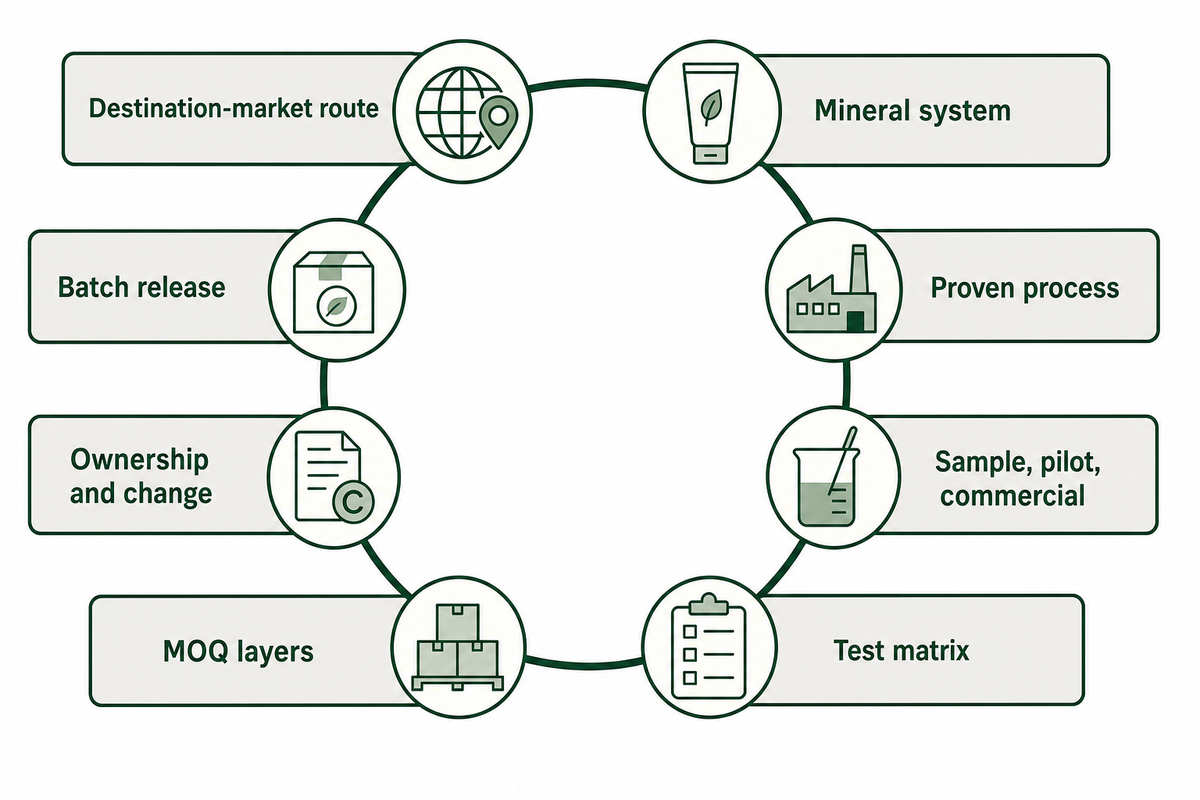
Responses to a well-formulated RFQ are comparable. Lock the destination market, dosage format, target claims, active system, expected annual volume, first-order quantity, pack and launch date to compare responses. If these aren’t locked, one supplier might quote a stock lotion in an undecorated bottle, while another supplier might quote a custom-made, tinted formula with testing and printed components.
1. Who owns the destination-market and legal route?
A responsible entity map must include the responsible entity, the site of manufacture, registration and/or notification, product listing (if applicable), safety assessment, label review, adverse-event duties, and the import role. For a United States OTC sunscreen, ordinary cosmetic GMP is insufficient. For a cosmetic product in the EU, the responsible person, safety file, and notification file, and any obligations related to the use of nanomaterials must be provided. For a listed sunscreen in Australia, the sponsor and the route the product is currently on at the TGA must be provided. Responses should be specific and name owners and exclusions instead of stating the facility is “globally compliant.”
2. What exactly is the mineral system?
Zinc oxide and titanium dioxide identities, suppliers, and grades must be provided. Coatings and dispersions must be defined. A definition of the particle status and proposed concentrations must be provided. Substitution controls that can be disclosed under confidentiality must be provided. An explanation of how choices impact target SPF and UVA protection, the likelihood of a white-cast, tint, viscosity, sensory profile, and pack, must be provided. Non-nano zinc oxide or reef safety isn’t a sufficient specification. Responses should show how the raw material choice is tied to the formulation, claims, test plan, and change control.
3. Does the format match the manufacturer’s proven process?
Indicate whether the product is a lotion, cream, fluid, stick, powder, non-aerosol pump-spray, continuous aerosol, or bag-on-valve, and define fill weight, net content, tolerances, valve or pump, liner, cap, brush, carton, transport conditions, and criteria for dispensing. Ask for format-relevant leakage, compatibility, dosage, stability, and line-trial controls. Uneven distribution of mineral UV filters requires consideration of the mixing, holding, transfer, filling, and batch-uniformity plans as much as the bench top formula.
4. How are sample, pilot, and commercial stages separated?
Require a milestone schedule with quantities, prerequisites, review days, resampling rules, and clock starts. A lab sample may establish texture and shade but not line behavior, marketed-pack compatibility, active uniformity, or commercial yield. A purpose and release plan should be documented for a pilot batch. The commercial production lead time should be traced from a defined event such as formula approval, component purchase order and shipment, and artwork approval, not from an undefined “confirmation.”
5. Which test applies to which formula, sample, laboratory, and claim?
Build a test matrix for SPF, UVA or broad-spectrum sunscreen support, water resistance, microbial testing, preservative efficacy, stability testing, packaging compatibility, and claim support for sensitive skin or other consumer claims. For children’s sunscreens, define intended population and substantiation instead of relying on gentle formula description. For each row, identify method, laboratory, scope of accreditation, sample origin, batch, owner, payer, report owner, timing, acceptance criteria, and failure path. Ask the laboratory to identify the submitted sample, receipt condition, storage, protocol deviations, raw-data retention, calculation version, and authorized final signatory.
Require the manufacturer to state whether the sample came from a lab beaker, pilot batch, or commercial batch and whether its mixing, hold, transfer, and filling history represents the intended process. This information is essential to retain traceability when a change occurs with respect to a tint, fragrance, raw material supplier, active dispersion, process parameter, manufacturing site or packing. TGA guidance on sunscreen laboratory evidence stressed appropriate accreditation scope, quality systems, data integrity and sample traceability, principles that are valuable diligence even if the product is to be marketed in another jurisdiction.
It isn’t always the case that a report on a white base formula supports a tinted or fragranced or otherwise modified sale formula. The final product, process and pack may impact the situation. In the United States, 21 CFR 211.166 ties the stability program to storage conditions and marketed containers, while 21 CFR 211.110 addresses in-process controls and batch uniformity. These should appear in the quality agreement if applicable.
6. What are all the MOQ layers?
Ask separately about MOQ, filling minimum, mineral grade, dispersion minimum, tint minimum, packaging component minimum, decoration minimum, carton minimum, SKU split, and reorder minimum. Then list one-time costs: development, line trial, tests, tooling, plates, artwork adaptation, regulatory work, freight, duties, and inspection. Normalize the above. Only then are 500-, 1,000-, 3,000-, 5,000- and 10,000-unit comparisons relevant.
7. Who owns the formula, test reports, documents, and changes?
State whether the brand receives the quantitative formula or only an ingredient list, whether it can transfer the formula, who owns new intellectual property, and which reports can be relied upon in the destination market. Ensure ingredient names, SDS and specifications where relevant, batch records, certificates of analysis and test reports, and a change-control clause. Define advance notice and approval for raw-material, supplier, process, site, test-method, or packaging changes.
8. What does batch release measure?
Put measurable release criteria into the quality agreement: appearance, odor, viscosity, pH where relevant, net content, microbiology, active or surrogate uniformity where appropriate, packaging function, labeling and lot coding, defect limits, deviation handling, corrective and preventive action, retained samples, and record access. Define record retention and access. Ask how uniformity of mineral suspension is demonstrated and what happens if a batch fails.
RFQ Responsibility Matrix
| Item | Owner | Method / basis | Timing | Deliverable | Cost | Failure path |
|---|---|---|---|---|---|---|
| Market classification and route | Brand / regulatory party / manufacturer | Current market law and product facts | Before formula lock | Signed responsibility map | Quoted separately | Stop or redesign route |
| SPF and UVA support | Named sponsor and qualified lab | Applicable current method | On defined final formula | Full report with sample traceability | Named payer | Investigate, reformulate, retest |
| Water resistance | Named sponsor and qualified lab | Claim- and market-appropriate protocol | After formula lock | Complete test report | Named payer | Remove claim or retest |
| Stability and pack compatibility | Manufacturer with brand approval | Written protocol in marketed pack | Start before scale-up; continue as agreed | Data, observations and conclusion | Quote test and samples | Change formula/pack; restart affected work |
| Commercial batch uniformity | Manufacturer quality unit | Validated process and in-process controls | Every batch as applicable | Batch record and release evidence | Included or itemized | Deviation, CAPA, reject or rework |
| Formula/report ownership | Contracting parties | Development and quality agreements | Before fees or samples | Rights and access schedule | State transfer fees | Escalation, cure, termination rights |
| Components and artwork | Named buyer / supplier / manufacturer | Approved specs and golden samples | Before purchase and filling | Approved drawings, proofs and samples | MOQ and tooling itemized | Replace, rework, or credit |
Red Flags That Can Delay a Mineral Sunscreen Launch
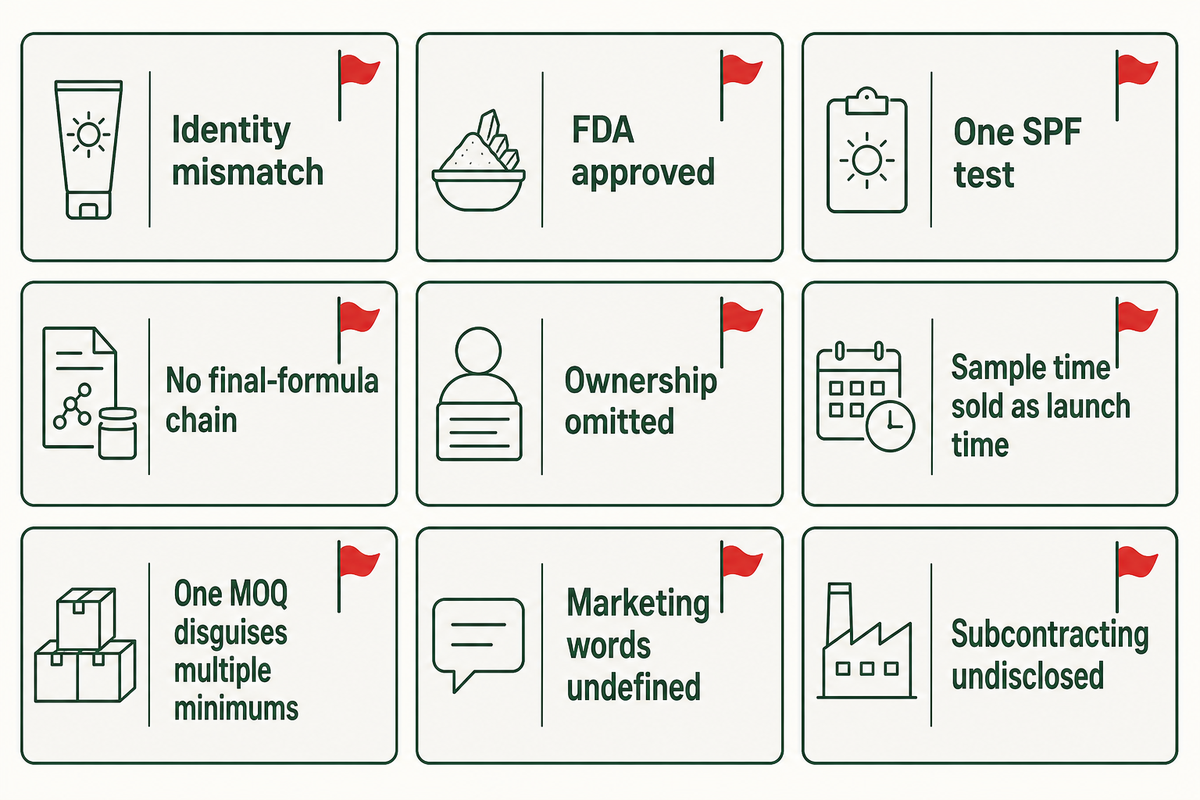
The most expensive warning signs are responsibility gaps. A low quote can become costly if no party owns testing, if a report cannot be tied to the final formula, or if the pack minimum appears only after bulk has been made. Resolve the following points before approving samples or paying a deposit.
- Identity mismatch, the quote, invoice, certificate holder, manufacturing address, website entity, and export documents refer to different parties without explanation.
- “FDA approved” based only on registration or listing, ask the supplier to correct the claim and identify the actual U.S. OTC responsibilities.
- One “SPF test”: It’s assumed that SPF, UVA, Broad Spectrum, Water Resistance, Stability, Packaging Compatibility, Microbiology, and Preservative Efficacy have been tested and/or are interchangeable.
- No final-formula chain. A base-formula report is offered for a tinted, fragranced, reformulated, or differently packaged product without a documented scientific and regulatory rationale.
- Ownership omitted, the development agreement does not state formula rights, report access, sample ownership, substitution control, or transfer conditions.
- Sample time sold as launch time, the schedule begins after unspecified approvals and excludes testing, components, regulatory work, queue time, freight, or customs.
- One MOQ disguises multiple minimums: The quantity excludes bulk, grade, tint, color, bottle, pump, carton, or individual SKU minimums.
- Marketing words undefined: Substantiation plan is lacking to support or justify wording such as: mineral, non-nano, reef safe, sensitive skin, children’s sunscreen, clean, natural, or clinical.
- Subcontracting undisclosed: The supplier/seller won’t name the parties performing bulk processing, unit filling, testing, batch release, and/or holding records.
Knockout vs. Preference Matrix
| Risk Type | Knockout condition | Preference condition | Action |
|---|---|---|---|
| Who manufactures and contracts? | Legal entity or site cannot be identified | Preferred country or time zone | Do not pay until identity is resolved |
| Who owns the market route? | No responsible party accepts required duties | Supplier offers optional regulatory support | Remove candidate or appoint qualified owner |
| Can the final product be tested? | Required product/claim evidence is unavailable | Supplier has additional screening methods | Stop, change formula/claim, or change supplier |
| Are subcontractors disclosed? | Critical production/testing party is hidden | Supplier can coordinate multiple qualified parties | Require disclosure and audit/document rights |
| Does the commercial model fit? | True MOQ or cash requirement exceeds hard limit | Catalog breadth, fulfillment, communication | Normalize quote, then score preferences |
| Is the final formula covered? | Evidence belongs to a materially different base, tint, fragrance, or active system | Supplier offers useful screening before formal work | Define final sale formula and required bridging or retesting |
| Does the packaging route work? | Required format cannot be filled, transported, or tested | Supplier offers additional stock components | Change pack or qualify another filling route |
| Are claims defined? | Required claim has no acceptable substantiation path | Supplier suggests optional marketable claims | Remove, narrow, or properly substantiate the claim |
| Is the schedule credible? | Hard launch date cannot accommodate required tests or components | One candidate offers a shorter queue | Reset timing or keep a qualified fallback |
Frequently Asked Questions
Which is the best mineral sunscreen manufacturer for a private-label launch?
No universal best exists; match the destination market, formula route, format, MOQ, and evidence needs. NEXO is relevant when comparing four development paths and public timing windows; Bell offers broad U.S. sun-care capabilities; Pure Velocity focuses on non-aerosol mineral spray; Pure Source publishes a relevant 5,000-unit program minimum; InSpec offers a brush-on powder concept; and BIOCROWN covers several Taiwan OEM/ODM formats. Screen legal identity and market route first, then compare product-level tests, formula ownership, packaging, total cash requirement, and the commercial clock. A practical winner is the candidate that answers the same locked RFQ with the clearest division of responsibility, supplies evidence tied to the final formula and pack, and can explain what happens when a sample, test, component, or batch fails. Keep a second qualified option alive until those dependencies are secure.
Who is the largest mineral sunscreen manufacturer in the world?
No verified like-for-like public dataset establishes one largest finished mineral sunscreen contract manufacturer. Parent-company revenue, employee count, factory area, claimed capacity, consumer-brand sales, and sunscreen output measure different things. A large cosmetics group may not publish mineral sunscreen volumes, and a specialist OTC plant may not publish revenue. For sourcing, capacity for your formula and format, validated process, quality history, test evidence, component readiness, and an achievable production slot are more useful than an unsupported “largest” label.
What is the difference between a mineral sunscreen manufacturer and a supplier?
A manufacturer controls or clearly discloses finished-goods production, while “supplier” may mean a factory, distributor, technology provider, ingredient company, broker, marketplace seller, or sourcing platform. Ingredient companies can provide zinc oxide, titanium dioxide, coatings, or dispersions but don’t necessarily make a market-ready sunscreen. A commercial intermediary can still be useful, but it serves a different role from the finished-goods manufacturer.
How much does private-label mineral sunscreen cost?
There’s no universal public unit price. Cost changes with stock versus custom formulation, mineral grade and dispersion, active loading, tint, target SPF and UVA claims, test program, stability and compatibility work, dosage format, component choice, decoration, MOQ, destination market, inspection, freight, and duties. Compare a landed project model, not only a per-unit quote. Itemize development and test fees, tooling, components, bulk, filling, cartons, rejects, samples, regulatory work, and reorder assumptions.
Can a cosmetic-only factory make mineral sunscreen for the U.S. OTC market?
Cosmetic GMP alone is insufficient; the responsible parties and product must satisfy current U.S. OTC drug requirements. Separate establishment registration and product listing from approval language, confirm the applicable monograph route, active ingredients, labeling, testing, records, stability program, batch controls, adverse-event responsibilities, and import arrangements. A foreign cosmetic factory may have relevant technical capability, but capability isn’t the same as a documented U.S. OTC route. Obtain advice for the actual product and contracting structure.
Which tests are needed before a mineral sunscreen launch?
The destination market and claims control the plan. Keep SPF, UVA or broad-spectrum support, water resistance, microbiology, preservative efficacy, stability, packaging compatibility, and batch-release controls as separate lines. Format affects method suitability: powders, sticks, sprays, and lotions can’t automatically share one protocol. Identify the exact final formula, production batch, marketed pack, laboratory, accreditation scope, method version, sample chain, acceptance criteria, report owner, payer, and failure path. Record whether a report covers only a base formula or the final tint, fragrance, and pack, and decide in advance who funds investigation, reformulation, and repeat work after a failure. The quality agreement should also cover raw-material substitution, in-process uniformity, retained samples, deviations, and release records. Additional safety, consumer, transport, or claim testing may be required for the market and product.
Build a Shortlist Around the Launch Route
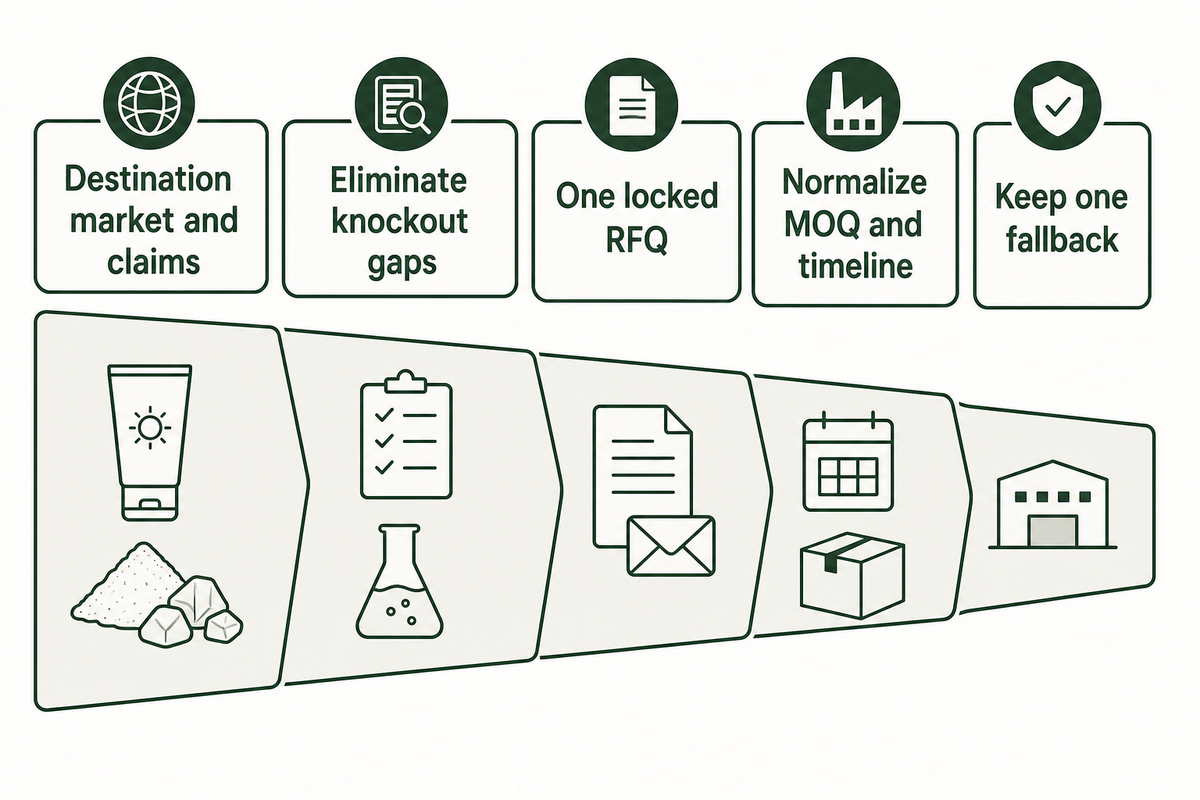
Identify the destination market and claims first. Eliminate candidates that can’t provide legal identity, production responsibility, supporting evidence, or clear subcontracting. Send one locked RFQ to the remaining companies and compare their responsibility maps and documents. Normalize every MOQ layer and timeline, and approve samples against written criteria. This is a procurement guide for sunscreen contract manufacturing, not a substitute for product-specific regulatory advice. Keep at least one fallback until the commercial batch, packing, and test path are secure.
When the target market, mineral system, format, annual volume, packaging, claims, and test responsibilities are defined, discuss mineral sunscreen manufacturing with NEXO Beauty Labs. A useful first conversation should expose constraints and unknowns; it shouldn’t promise approval, compliance, SPF performance, or an instant launch before the evidence exists.
Ready to pressure-test your brief?
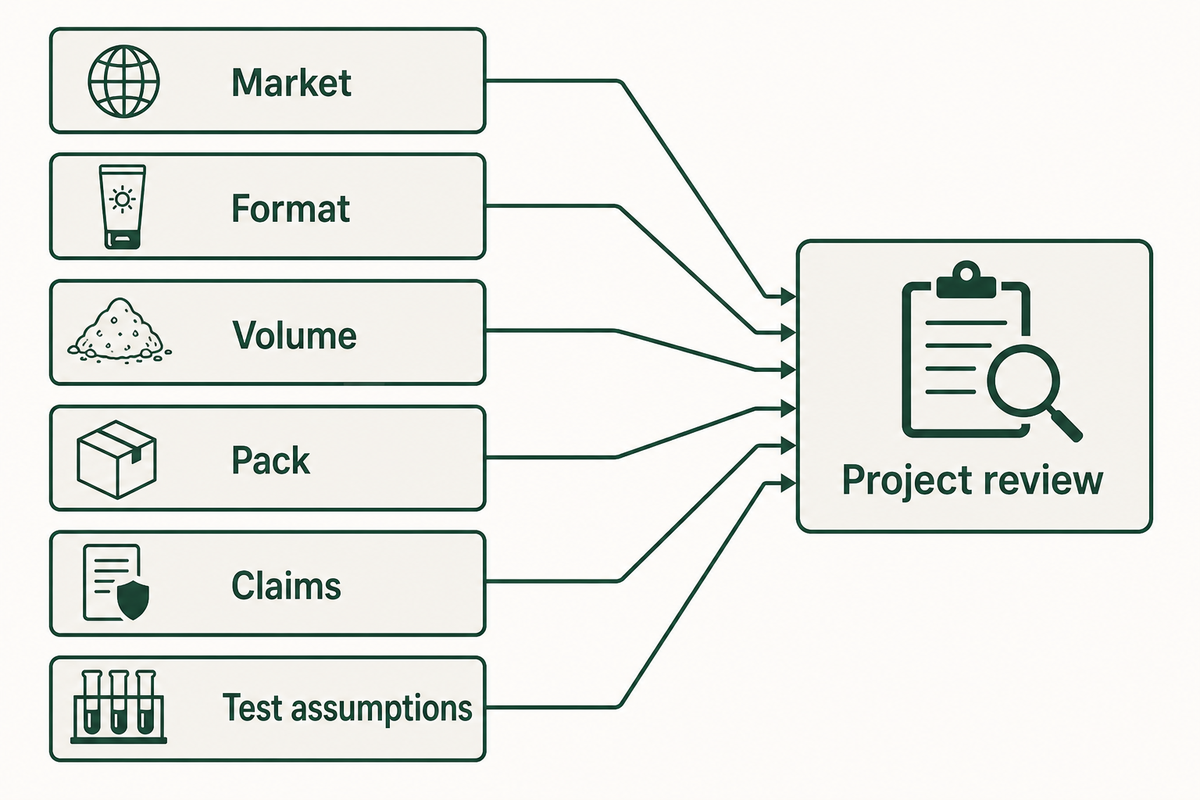
Bring your market, format, volume, pack, claims, and current test assumptions. The project review can identify the questions that need written answers before development begins.
References & Sources
- U.S. FDA — Sunscreen Drug Products Information.
- ISO 24444:2019 — In vivo determination of SPF, with Amendment 1:2022.
- ISO 24443:2021 — In vitro determination of UVA photoprotection, with Amendment 1:2026.
- ISO 23675:2024 — In vitro SPF determination.
- ISO 16217:2020 — Water-immersion procedure for water-resistance testing.
- ISO 22716:2007 — Cosmetics good manufacturing practices.
- Australian TGA — Sunscreens.
- European Commission — Nanomaterials in cosmetics.
- 21 CFR 211.166 — Stability testing.
- 21 CFR 211.110 — Sampling and testing of in-process materials and drug products.
Why beauty brands work with NEXO
About NEXO Beauty Labs Manufacturing Support
NEXO Beauty Labs supports skincare, body care, sun care, hair care, and private label brands with formulation, sampling, filling, quality control, and export-ready launch support.
Project Review Before RFQ
Before quotation, we help clarify product category, active direction, formula stage, package choice, compliance market, MOQ, sampling schedule, and required documents.
Request a Cosmetic QuoteCompany Profile // Data Sheet
CompanyNEXO Beauty Labs
Business TypeCosmetic OEM / ODM manufacturing partner
Main ProductsPrivate label skincare, facial serums, moisturizers, cleansers, sunscreen, body care, and hair care products
Manufacturing CapabilityFormula development, sample adjustment, package sourcing, filling, QA/QC, documentation, and export support
RFQ Data NeededProduct type, formula goal, package format, target market, MOQ, claims, timeline, and benchmark samples
Websitenexobeautylabs.com