Get in touch with NEXO Beauty Labs Company

Updated October 2026
Low MOQ skincare manufacturing means producing a specified skincare project at a smaller minimum quantity than a regular production offer. The useful definition isn’t a headline unit count. It’s the smallest workable combination of formula, filling process, primary package, decoration, secondary packaging, SKU plan and product specific evidence.
There may be a case where a supplier is quoting a formula in a stock bottle while the other is quoting a dedicated batch with custom artwork and decorations. While they may both be using the term low moq skincare manufacturing, they’re clearly not describing the same thing.
This guide will show how to identify constraints in low moq skincare manufacturing, and how to plan a first run based on learning. It will help users decide how to assign market responsibilities. This guide won’t disclose or compare supplier prices, propose a standard minimum, or replace a quotation. NEXO’s low moq skincare manufacturing options webpage will serve that purpose.
Scope note: This is a planning framework, not legal or safety advice. Product classification, exemptions, evidence, labeling, and market duties must be reviewed for the actual formula, claims, parties, facilities, package, and sales markets.
What Does Low MOQ Mean in Skincare Manufacturing?
MOQ is the minimum order quantity attached to a defined purchase or operation. Packaging suppliers may quote a component purchase minimum. Contract manufacturers may quote a formula batch or filling minimum. A printer may quote a different minimum for each version of the artwork. These don’t automatically equate to the number of finished units a brand can sell. In practice, the factory and packaging supplier can apply different thresholds to the same launch brief.
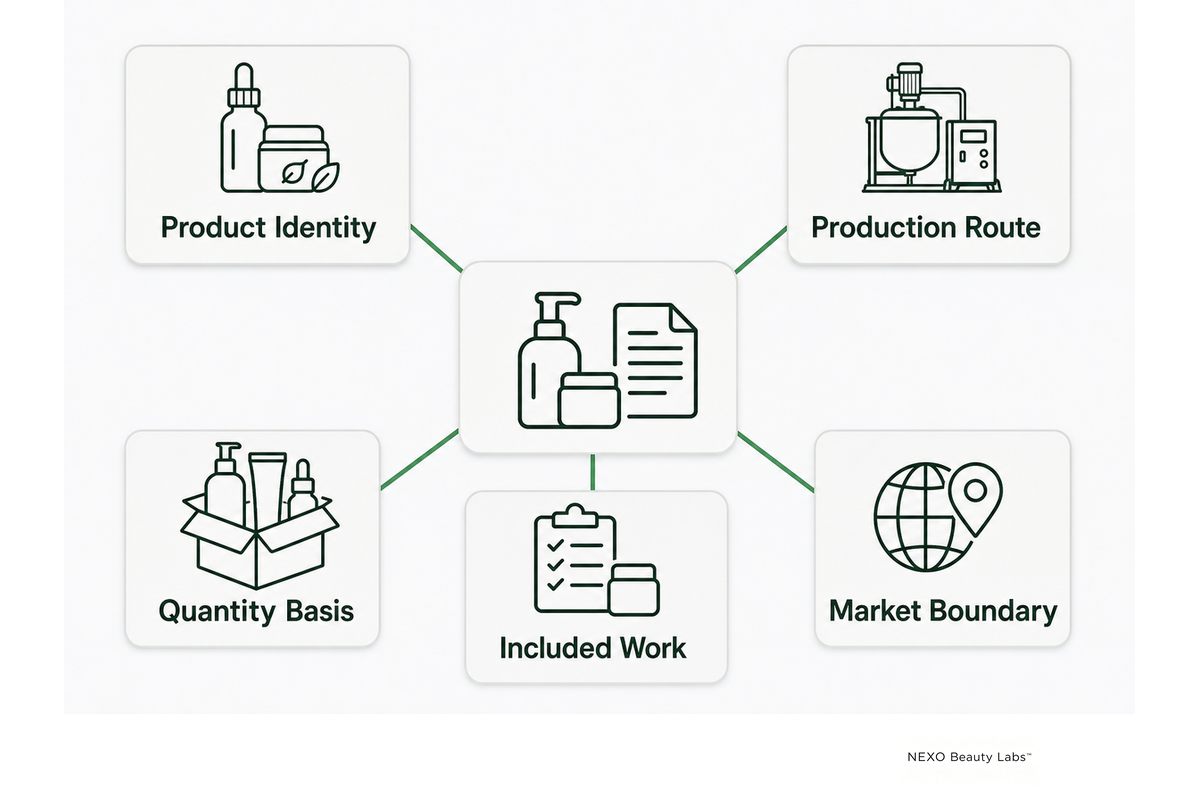
A useful low MOQ definition therefore names five things prior to naming a number:
- Product identity: Product identity covers the formula revision, fill size, package, decoration, artwork, intended use, and claims.
- Production route: Stock formula, adapted formula, custom formula, or buyer-supplied transfer.
- Quantity basis: Bulk kilograms, filling units, component pieces, cases, or finished SKUs.
- Included work: Development, sampling, testing, documentation, filling, packing, releasing, storage, and shipping.
- Market boundary: In which country or region the product is sold, along with the label and evidence versions it creates.
Without these details, “low” is a comparative word without a stable object. The actual question isn’t “Who provides the lowest number?” The actual question is “Which complete, controlled product does that number describe?”
The 10-Type Search-to-Brief Map
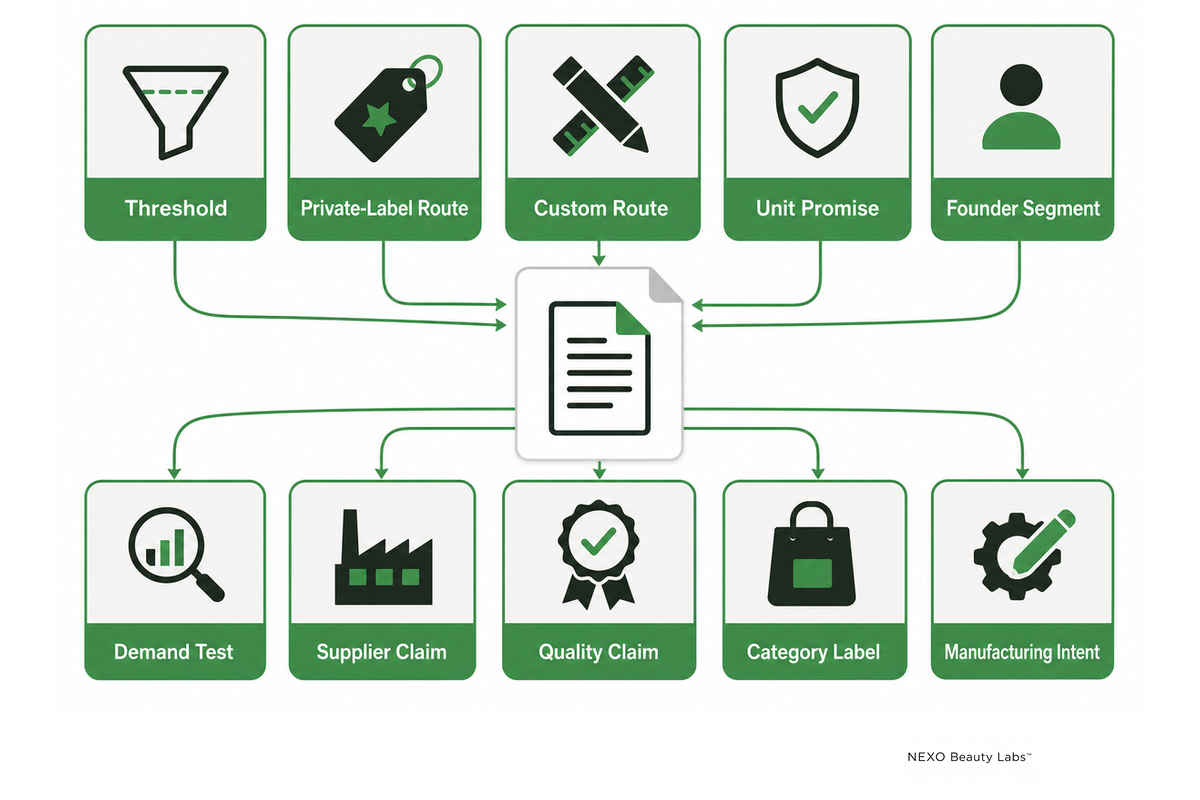
Search language blends a production route, an audience, a hoped-for quantity, and a commercial promise. For example, an MOQ means a threshold, while “MOQ stands for minimum order quantity” doesn’t explain whether that threshold is for bulk, filling, packing, artwork, or finished goods. The 10-Type Search-to-Brief Map translates searches into questions a skincare brand can actually document. It doesn’t state NEXO or any other skincare manufacturer offers every route or number shown.
| Query type | Language a team may encounter | Convert it into a controlled question |
|---|---|---|
| Threshold | low MOQ manufacturing, low-MOQ manufacturing, MOQ manufacturing, low MOQs, or a manufacturer with low minimums | Which operation has the minimum, and what complete deliverable does it cover? |
| Private-label route | private label skincare manufacturing, low-MOQ private label skincare, low-MOQ private label manufacturing, private label production, private label products, or private label cosmetics | Is the formula fixed, adapted, or newly developed, and which rights and records travel with it? |
| Custom route | custom formulation, product development, development and manufacturing, or end-to-end manufacturing | Which development stages, approvals, evidence, and ownership terms are included? |
| Unit promise | 100 units, 100 units per SKU, units per SKU, number of units, or smallest number of units | Is that hypothetical count per formula, package, artwork, market, or finished SKU? It is not a quote in this guide. |
| Founder segment | beauty founders, indie founders, indie beauty founders, indie skincare brands, established beauty businesses, or established brands | What capabilities, approvals, cash cycle, and distribution evidence does this particular team have? |
| Demand test | validate demand, testing a new category, customer feedback before committing, launch with less capital, or less capital at risk | What signal, observation window, decision owner, and reorder rule make the run a valid test? |
| Supplier claim | leading manufacturer, small-batch manufacturers, manufacturers offer, manufacturer will produce, or brands to launch | What dated, written scope supports the claim? Treat “leading manufacturer” as marketing language, not evidence. |
| Quality claim | consistent quality, product quality, better quality control, quality control processes, compliant, or good manufacturing practice | Which specification, record, method, reviewer, acceptance rule, and market requirement support it? |
| Category label | clean beauty, body care, skincare line, produce skincare, beauty industry, or global cosmetics market | What exact product, intended use and claims, countries, and channels sit behind the broad label? |
| Manufacturing intent | low MOQ cosmetic manufacturing, low-MOQ skincare manufacturing, small-batch cosmetic manufacturing, contract manufacturing, or “manufacturing gives flexibility” | Which route and constraints let brands launch without committing to thousands of units? |
This step helps a brand plan a small run without committing capital to an undefined promise. This also keeps questions about quantity separate from the evidence required to manufacture the product. A capable partner can help you, but the brief should make every assumption reviewable.
The Six-Floor MOQ Constraint Stack
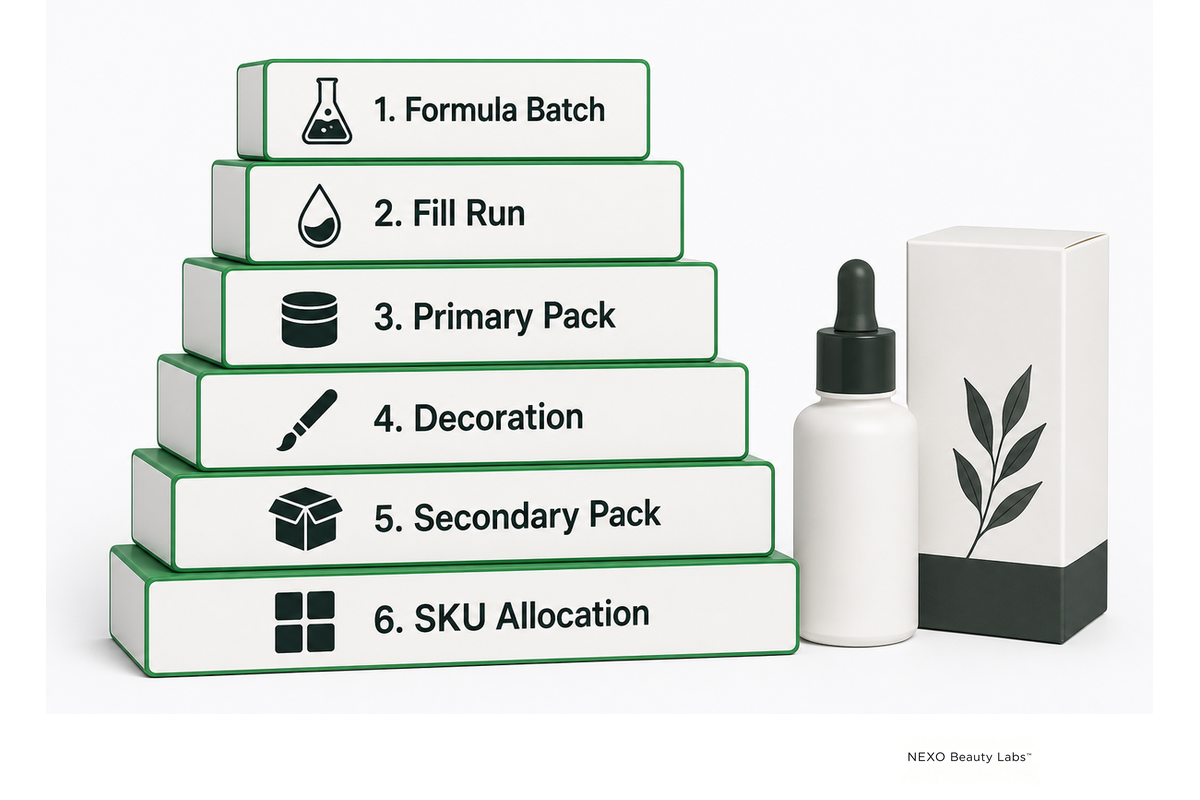
The Six-Floor MOQ Constraint Stack is a model that helps pinpoint the highest active constraint in a skincare case. It isn’t an industry-standard model or a calculator. It prevents the treatment of one supplier number as if it governed the entire case.
| Floor | What sets it | Question to resolve |
|---|---|---|
| 1. Formula batch | Vessel, mixing, raw-material lots, process loss, and reproducibility | What is the smallest technically controlled batch for this formula and process? |
| 2. Fill run | Line setup, viscosity, fill tolerance, changeover, sampling, and rejects | Which package and fill conditions does the quoted run assume? |
| 3. Primary pack | Bottle, jar, tube, closure, pump, liner, gasket, and case quantity | Is the component available, compatible, and purchasable in the required version? |
| 4. Decoration | Label, direct print, coating, color, tooling, and artwork changeover | Does the minimum apply per design, color, language, or SKU? |
| 5. Secondary pack | Carton, insert, leaflet, shipper, and pack-out configuration | Which printed and transport materials are required for this market and channel? |
| 6. SKU allocation | Fill size, fragrance, language, artwork, market, or channel versions | How is the batch divided without creating unusable fragments or unreviewed versions? |
The operating rule is simple: the practical minimum is governed by the highest unresolved floor, not by the most attractive number in the quote. The stack also demonstrates stranded inventory. If a brand purchases more decorated components than it fills, it needs clear title, storage, condition checks, change-control rules, and an exit plan for the balance.
Stock, Adapted, or Custom: Choose the Route Before the Quantity
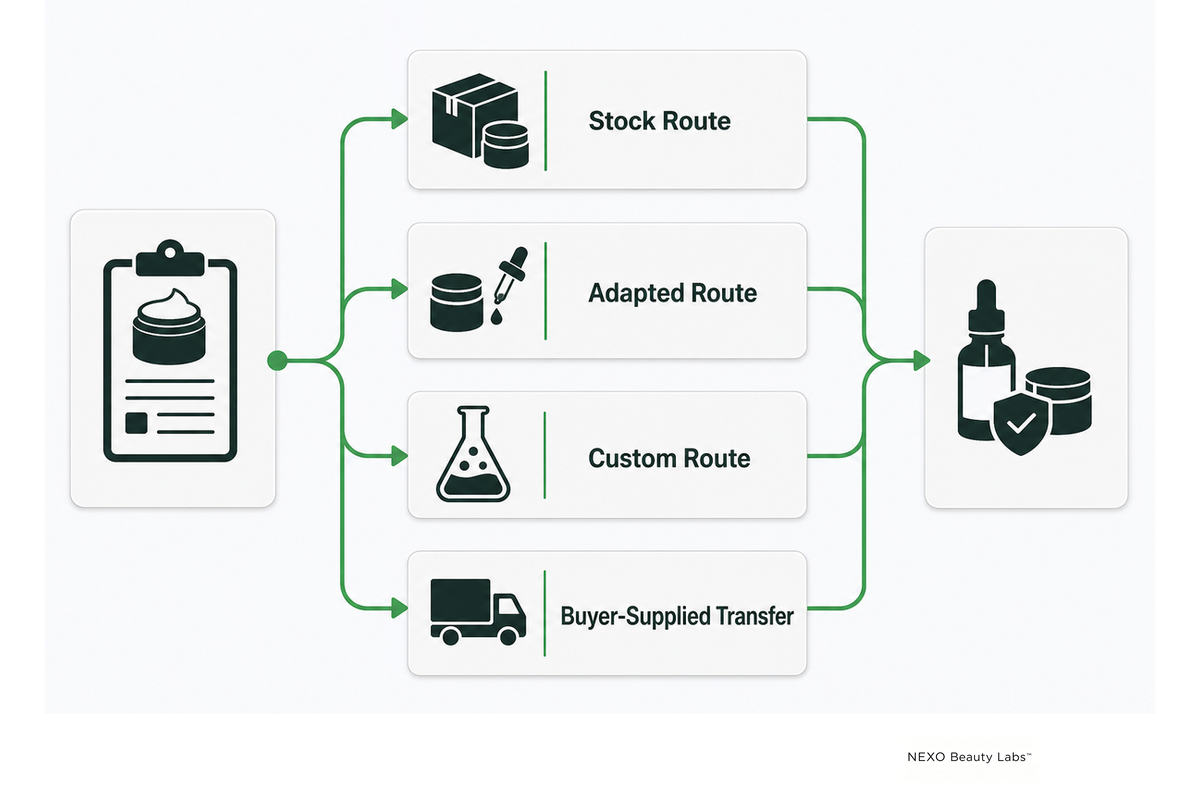
Quantity comparisons only take meaning after the production route is decided. In general, a stock route starts with an established formula and bounded package choices. An adapted route starts from an established technical platform and changes named attributes. A custom route establishes or materially redevelops formula to meet a defined requirement. A buyer-supplied transfer also starts from an established technical package, and it’s to be reproduced on a new process and a new site.
These are planning groups, not assurances. Supplier use of “private label” or “white label” OEM or ODM varies. NEXO’s OEM, ODM, and Private label Route Guide explains why the written formula source, permitted changes, rights, records, and responsibilities matter more than the route name.
Route-first comparison
- Freezes formula origin and permitted changes
- Names the package and evidence already represented
- Separates sample, pilot, short run, and commercial scale
- Compares quantities for equivalent deliverables
Number-first comparison
- Assumes every “low MOQ” offer is equivalent
- Discovers packaging restrictions after formula approval
- Treats a lab batch as proof of scale readiness
- Compares prices before defining the product
Route choice isn’t quality ranking. An off-the-shelf route can be appropriate if the boundaries fit the launch. A custom route can be inappropriate if the team isn’t able to fund, review, control, or later reproduce the added development work. Choose the least complex route that still meets the product, evidence, differentiation, and access requirements.
How Do Formula Batch, Fill Quantity, and SKU Allocation Interact?
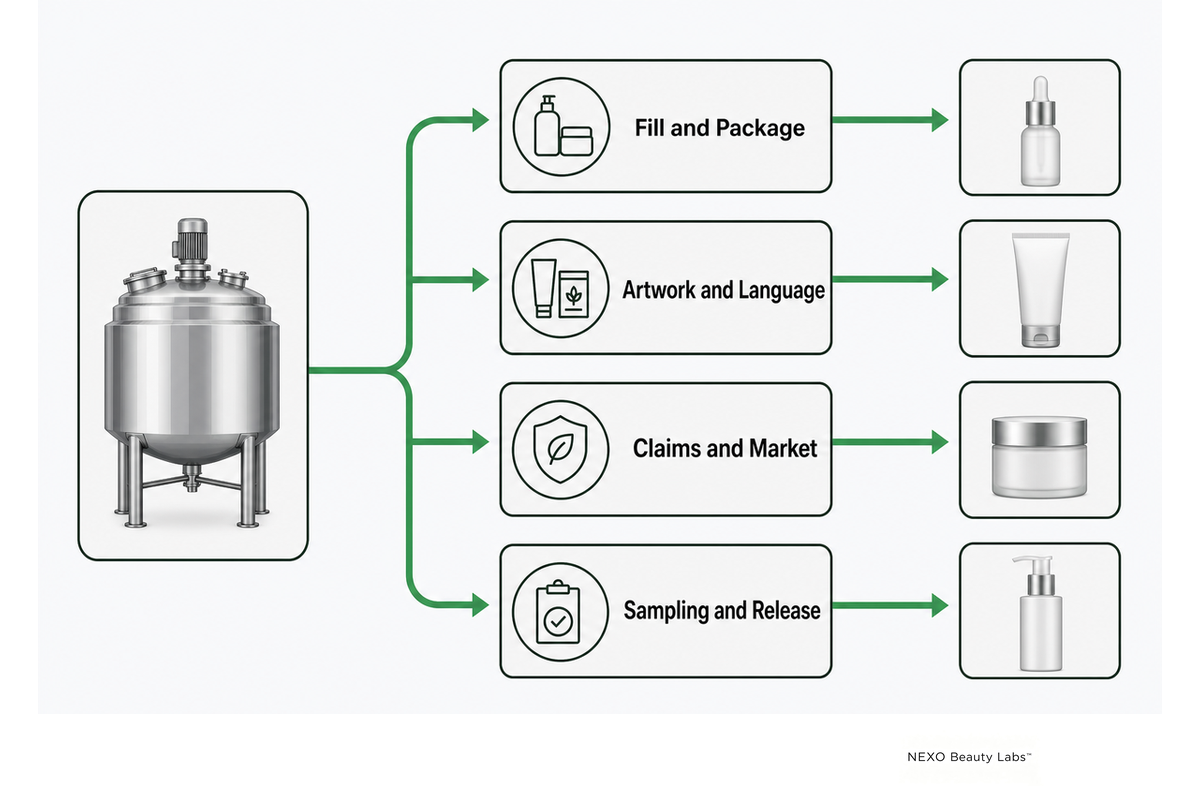
Formula batches describe bulk product, not spreadsheet totals of finished SKUs. Yield can be affected by material left in the vessel and transfer path, setup, in-process sampling, filling behavior, rejected units, and the approved overfill or tolerance policy. The team should obtain the expected method of reconciliation from the supplier, if provided, instead of adding a loss factor.
Scale can also alter the process. There can be differences in the mixing energy, the order and manner of adding ingredients, the rate of heating and cooling, the level of vacuum, and how the product is handled in a bench-scale sample versus in the production vessel. Evidence of formulating and scale-up shows the challenges of reproducing the same texture, stability, and filling behavior by using the same percentages of the same ingredients.
There are many measurement systems, and there are different ways to do the same thing. For instance, a record might identify fill volume in mL, net mass in g, a package dimension in mm, hold time in hr, observation temperature in ºC, or a formula component in %. The method must define the limits of acceptance.
The SKU plan further divides the output. For example, one bulk formula may create many labels or supply many markets, but each may create a controlled variation. For each split:
- fill size, package component, closure, or dispensing behavior;
- artwork, language, ingredient presentation, warnings, or responsible-party details;
- claims, instructions, channel requirements, or destination-market records;
- sampling, line clearance, release, case packing, or traceability.
The most conservative approach starts at the saleable item and works backward. Component, line, sample, expected loss, label, review, and release requirements determine whether an SKU allocation is usable. If anything in the chain breaks, arithmetic hasn’t created a market ready product.
Why Can Packaging Set the Practical Minimum?
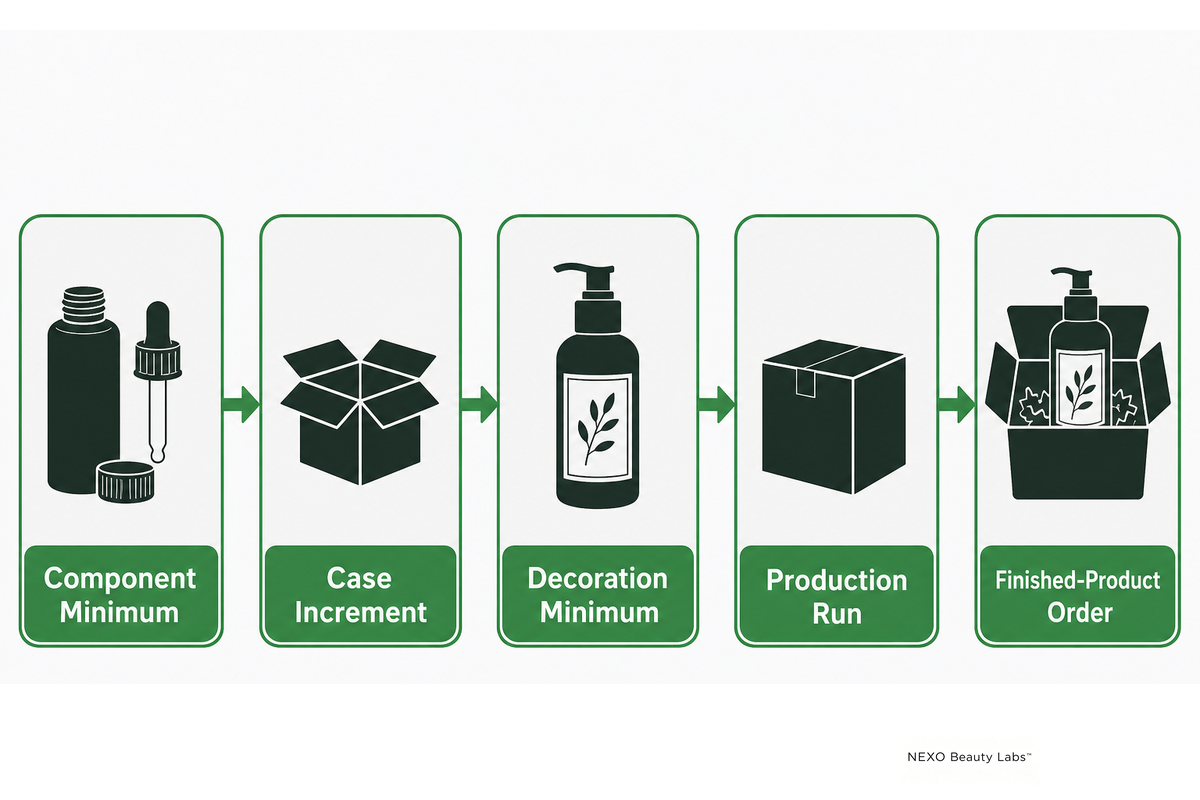
There’s a separate supply chain for packaging. A manufacturer may be able to produce the bulk formula at the required quantity, but producing the requested packaged product, e.g. a pump, coated bottle, printed tube, carton, or label, may require a different quantity. Compare the component minimum, case increment, decoration minimum, production run, and finished-product order separately.
Stock packaging can reduce one constraint, but this doesn’t prove the package is suitable. Review the exact formula-pack combination for leakage, deformation, closure function, dispensing, migration, decoration durability, transport, and consumer use. Also, NEXO’s cosmetic packaging compatibility testing guide explains why a resin name or supplier statement can’t describe a finished system. The skincare packaging guide addresses this question in detail.
Decoration is a separate means. Trade reporting suggests that for lower-volume high-mix decoration on stock packages, digital direct-to-object printing could ease constraints of tooling and artwork changes for a particular supplier and format. It doesn’t change the decisions related to purchasing the package, filling it, assessing package compatibility, and addressing the market.
Packaging rule: Ask for each component, decoration, artwork, case, and finished-unit quantity on separate lines. Then record who owns surplus stock, where it is stored, what can make it obsolete, and whether it remains usable for the next approved version.
The Fixed-Work Safety Floor: What Does Not Automatically Shrink?
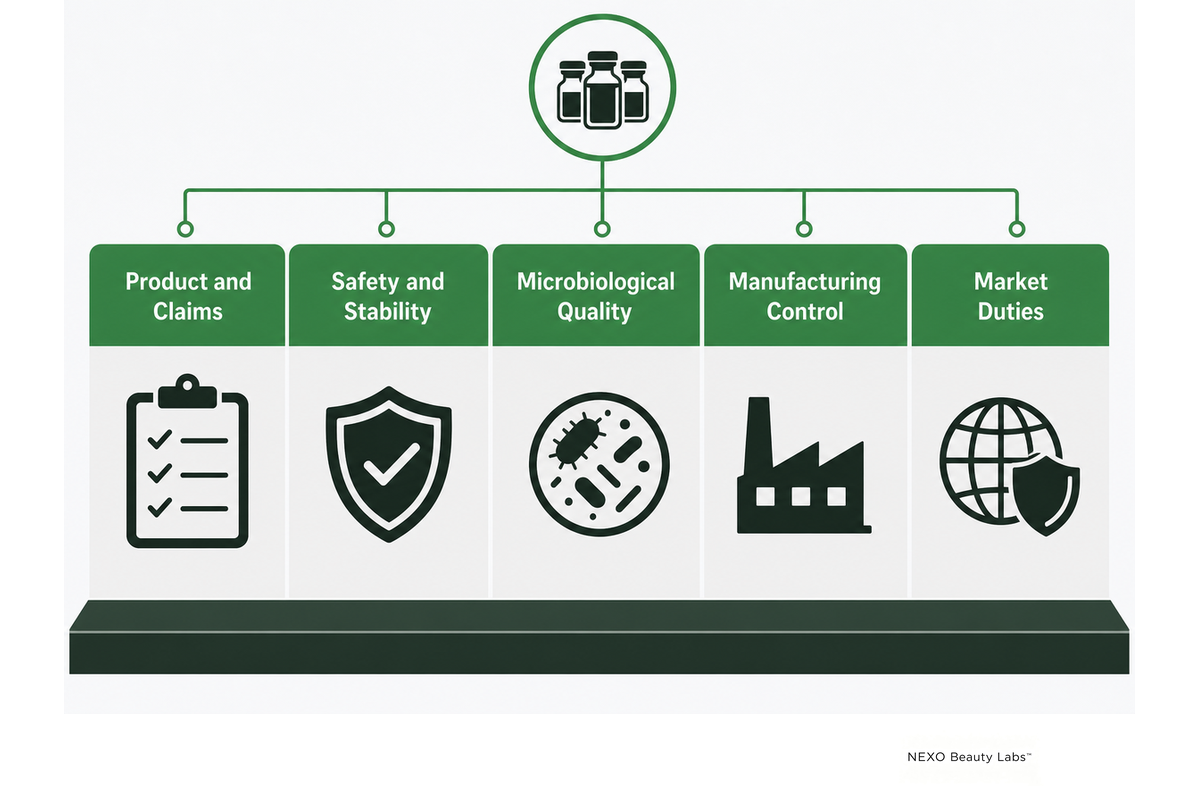
Reducing batch size limits inventory exposure. This doesn’t resolve questions regarding the classification of the product, the safety of the product, stability of the product, package compatibility, the microbiological risk, controls of the manufacturing process, labels, reports, complaints, and release for the market. Those questions follow the product and market, while exact duties and possible exemptions also depend on the entity, facility, label role, and jurisdiction.
The FDA describes its testing position plainly: “Neither the law nor FDA regulations require specific tests.” That is not permission to skip evidence. The same FDA page requires the responsible person to ensure and maintain records supporting adequate safety substantiation. The work has to be scientifically appropriate to the product rather than copied from a universal checklist.
| Question | What low volume can change | What still needs a decision |
|---|---|---|
| Product and claims | Commercial exposure and launch scope | Intended use, classification, claims boundary, and market pathway |
| Safety and stability | Sample count or study design when justified | Represented formula-pack system, risks, protocol, criteria, limitations, and reviewer |
| Microbiological quality | Testing may differ after a documented low-risk assessment | Risk basis, preservation, manufacturing hygiene, method, and release logic |
| Manufacturing control | Material quantities and run duration | Approved materials, instructions, equipment status, batch identity, sampling, records, and release |
| Market duties | Some U.S. provisions may have qualifying small-business exemptions | Actual exemption test, product exclusions, label role, EU GMP, responsible person, PIF, notification, and current rules |
The public scope of ISO 17516 illustrates the difference: microbiological testing may be unnecessary for products already considered microbiologically low risk. The exception is based on a risk conclusion, not on a small unit count. Similarly, NEXO’s cosmetic stability testing guide separates stability from broader safety, preservative, and package evidence, while its cosmetic manufacturing quality-control guide addresses the production record.
Plan a Demand-Learning Launch and Reorder Trigger
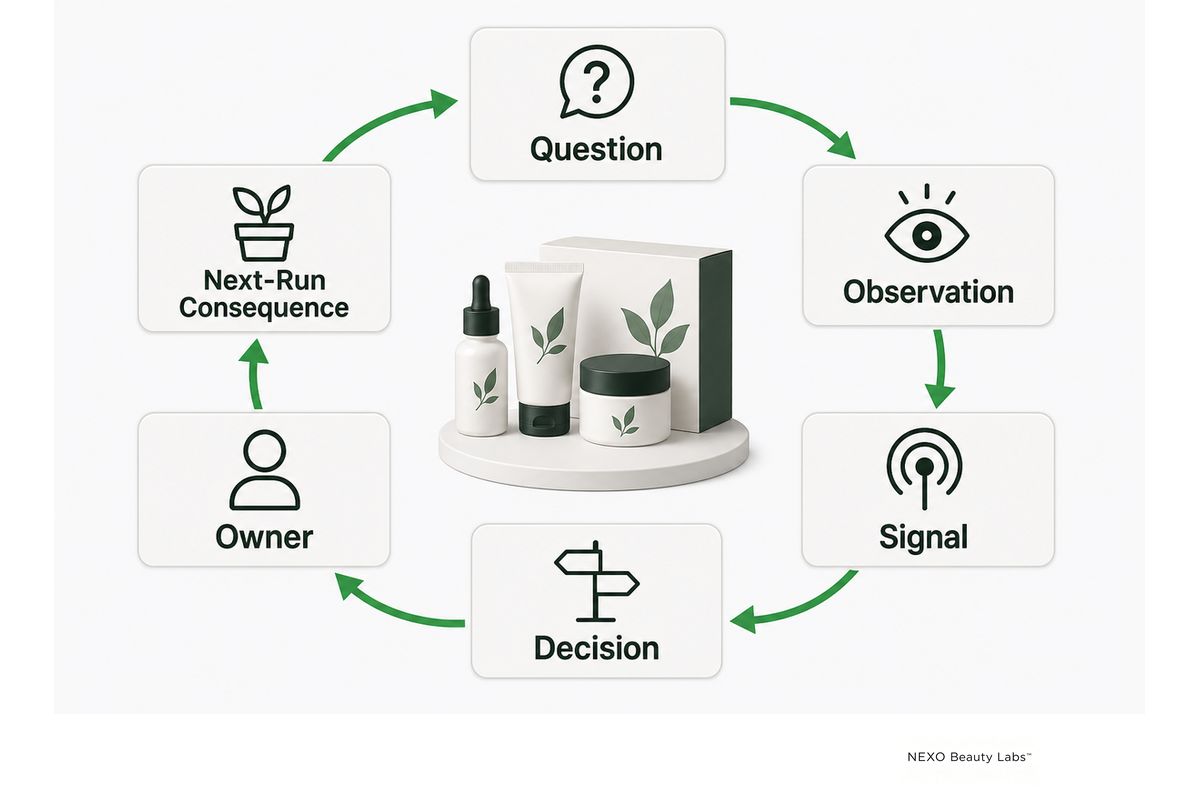
A small order isn’t necessarily a market test. It can become a useful pilot when the team states what it wants to learn, where the observation will take place, which signals matter, who will interpret them, and what action follows. In the absence of the above, it may yield a small invoice with no reusable data.
The Pilot-to-Reorder Learning Loop keeps those decisions visible:
- Question: Define one uncertainty the run can reasonably reduce such as channel fit, repeat purchase, dispensing complaint, response to a positioning choice.
- Observation: State the channel, audience, time period, product version, and data source. Don’t lump samples, gifts, retail sales and paid online orders without sufficient context.
- Signal: Define the evidence to assess: sell-through, returns, repeat orders, complaint type, package function, or qualified customer feedback.
- Decision: State the condition for reorder, revise, investigate, or stop, before the data is available.
- Owner: Identify the person who can make the decision and the person who must review product-quality or product-safety signals.
- Next-run consequence: Document what can remain unchanged and what would need to reopen formula, package, artwork, evidence, or market review.
According to founder interviews in Beauty Independent, launch assortments vary for a number of reasons. Some focused the launch on a limited assortment, then used customer feedback and sales data to assess what product to launch next. The important lesson here is the decision loop, not the number of products launched.
Assign US and EU Market Responsibilities Before Production
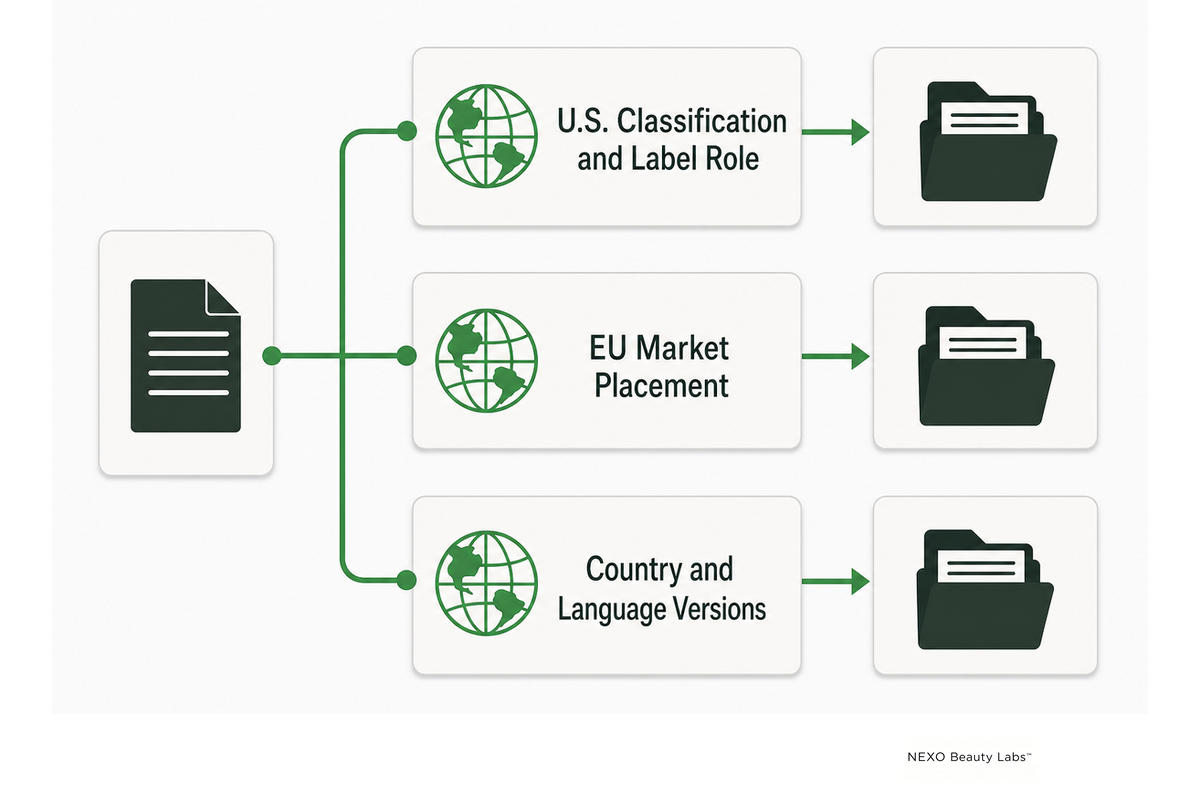
In the United States, intended-use claims can move a skincare product outside a cosmetics-only pathway. Acne-treatment, sun-protection, disease, or structure/function claims can introduce drug requirements. Freeze the proposed label and advertising claim boundary before treating the project as a conventional cosmetic. Treat the product as a cosmetic only after the classification check.
For a U.S. cosmetic, FDA defines the responsible person as the manufacturer, packer, or distributor whose name appears on the label. MoCRA assigns duties involving safety substantiation, product listing, serious adverse events, and records, while covered facilities have registration obligations. FDA also states that qualifying small businesses may be exempt from specified GMP, registration, and listing requirements, subject to product exclusions. “Low MOQ” is not the exemption test.
For the EU, Regulation 1223/2009 requires an EU responsible person and requires cosmetic manufacture to comply with GMP. The framework addresses safety assessment and report, product information file, notification, and labeling.
“The manufacture of cosmetic products shall comply with good manufacturing practice.”
Member States determine the language of specified mandatory particulars, so one production concept may need country-specific artwork versions. This can increase the decoration and SKU floors even with shared bulk formula.
| Market check | Record to identify | Do not assume |
|---|---|---|
| U.S. classification and label role | Intended-use review, exact claims, responsible-person identity, facility and exemption assessment | A manufacturer contract or small run settles the legal role |
| EU market placement | EU responsible person, GMP evidence, safety report, PIF location, notification, and label review | Non-EU manufacturing removes EU obligations |
| Country and language versions | Destination countries, required languages, approved artwork, and SKU linkage | One English artwork can serve every EU market |
The contracts may assign operational work and access, but can’t redefine the law. For a more exhaustive list, use the cosmetic labeling requirements guide in the NEXO site, and for advice on the actual product and markets, seek qualified help.
What Should Be Ready Before You Contact a Manufacturing Partner?
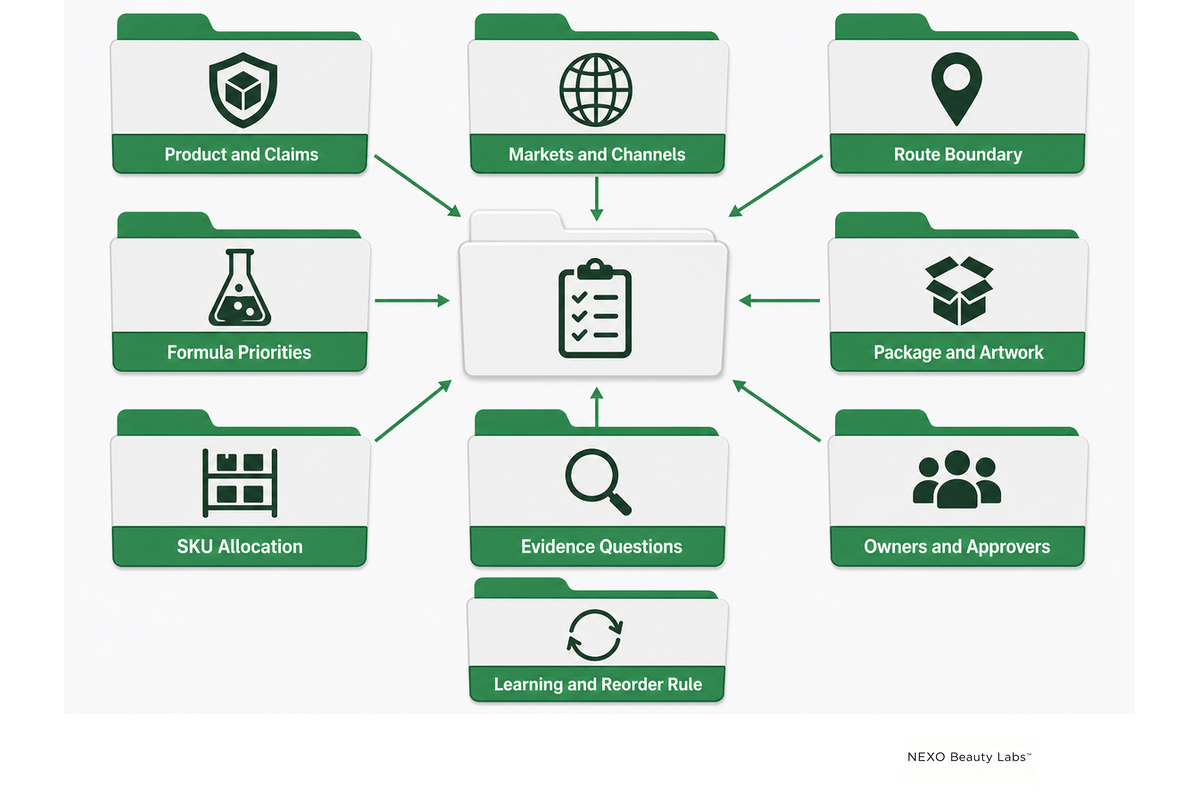
Use a reviewable brief so the manufacturer can answer a defined project instead of guessing what “the lowest MOQ” should include. Prepare the nine fields below. Together they define the product, market, route, package, evidence, ownership, and learning decision the manufacturer must review.
Bring
- Product purpose, intended use, audience, and proposed claims
- Target countries, channels, and launch objective
- Stock, adapted, custom, or transfer route boundary
- Formula and sensory priorities plus exclusions
- Fill size, package direction, decoration, and artwork versions
- SKU allocation and first-run versus annual-volume assumptions
- Safety, stability, microbiological, compatibility, and claim questions
- Version owner, approvers, records, and change triggers
- Learning question, signals, reorder rule, and stop condition
Pause when
- The claims could change product classification
- The commercial package is not identified
- One MOQ number hides several component or artwork versions
- A stock formula is assumed to carry evidence into an untested package
- No one owns the U.S. or EU market-role review
- The launch is called a test but has no decision rule
- Surplus branded packaging has no owner or exit plan
Control those nine fields, then review the public NEXO Beauty Labs company context, then move to the established commercial page for capabilities and project-specific discussion. Keeping this handoff separate allows this document to maintain its informational role.
Key takeaway
The lowest useful MOQ is the smallest quantity at which the same defined formula, pack, artwork, evidence, market roles, release logic, and learning objective can still travel together.
Discuss a Defined Small-Batch Skincare Brief
FAQ
What is the minimum order for private label skincare?
No widely accepted industry-wide minimum exists. The applicable quantity depends on the formulation route, filling process, primary components, decoration, cartons, SKU versions, evidence scope, and supplier terms. The manufacturer must be asked to separate each quantity and state its basis.
It should be stated if the view is applicable per formula, fill size, component, artwork, language, market, finished SKU, etc. In addition, the manufacturer must be asked if samples, rejects, retained units, line set-up and surplus components are included in the stated number. A small number doesn’t define the saleable output. Use NEXO’s commercial page for its current project specific manufacturing options rather than treating an editorial example as a quotation.
Does low MOQ mean lower quality?
No, quantity and quality are different controls. A smaller production run may reduce inventory exposure, but the product still needs a defined formula, appropriate manufacturing controls, packaging decisions, batch records, release criteria, and a risk-based evidence plan. Quality problems arise when a project removes necessary controls to reach a number, not because the planned run is small. Ask what remains the same as a larger run, what’s legitimate to change, and why.
Can I create a custom formula from scratch with low MOQ?
Sometimes, but “custom” and “low” must be defined together. A new formula can require development, raw-material sourcing, pilot work, testing, compatible packaging, documentation, and change control that don’t shrink in direct proportion to units. Some offers, therefore, reserve the smallest quantities for either stock or an adapted formula. Give a clear product, market, pack, claim and evidence brief and ask what route is available to satisfy the brief without omitting activities.
Is low-MOQ manufacturing more expensive per unit?
There may be fewer saleable units across which to spread setup, cleaning, line changeover, documentation, testing, and development. Plus, small purchases of ingredients and packaging may miss volume efficiencies. It’s project-specific. Evaluate the total controlled deliverable, inventory exposure, and unit price.
One-time development costs should be separated from repetitive production costs.
Can a brand start small and upgrade packaging later?
Yes, if the future change is evaluated as a new controlled package decision. An alternate bottle, pump, liner, gasket, coating, decoration, or fill condition may impact compatibility, dispensing, transportation, artwork, evidence, and SKU identity. Confirm the evidence plan before approval.
Identify which earlier evidence remains valid, what must be re-evaluated, and the disposition of unused old components before the change is approved.
What is the reorder minimum?
The reorder minimum depends on the supplier, product, component, and version. It can be different than the first order because development may be completed, packing may be stored, component terms may be changed, or the formula, artwork, market, and release may be different.
Request the reorder basis in writing and confirm the condition, ownership, and approval of any inventory carried over.
References & Sources
- U.S. FDA: Modernization of cosmetics Regulation Act of 2022 (MoCRA)
- U.S. FDA: Good Manufacturing Practice Guidelines/Inspection Checklist for cosmetics
- EUR-Lex: Regulation (EC) No 1223/2009 on Cosmetic Products
- ISO 22716:2007, Cosmetics GMP
- ISO 17516:2014, Cosmetics Microbiological Limits
- cosmetics & Toiletries: formulating Forum on Scale-up Considerations
- Packaging Digest: Digital Inkjet Gives Small brands a Big Boost
- Beauty Independent: What’s the Right Number of Products for Beauty brands to Start With?