Get in touch with NEXO Beauty Labs Company
Custom Skincare Formulation: R&D Engineering, Stability Validation, and Commercial Scale-Up Guide

Custom Skincare Formulation turns a brand’s brief into a formula that can be made consistently at commercial scale. The key decisions are which vehicle carries the active ingredients, how the formula will feel and dispense, and what evidence is needed before release. Team members ready to discuss a project can learn more about custom skincare formulation and OEM development services offered by NEXO Beauty Labs or contact them directly through our formulation project inquiry portal.
What Custom Skincare Formulation Entails in 2026: From Product Brief to Proprietary Formula
Custom skincare formulation is the structured cosmetic chemistry process of engineering a product from a technical brief, selecting the delivery vehicle, active ingredients, emulsifier architecture, sensory modifiers, and preservative system to achieve targeted skin benefits, verified physical and microbiological stability, and a formula suitable for commercial production. ISO 22716 gives good manufacturing practice guidance for production, control, storage and shipment.
SNS Insider estimated the broader personal care contract manufacturing market at USD 26.0 billion in 2025. A skincare brand preparing to launch a skincare line should decide whether a proprietary formula earns its added sampling and validation work. Name the sensory, ingredient or packaging requirement that a stock base cannot meet.
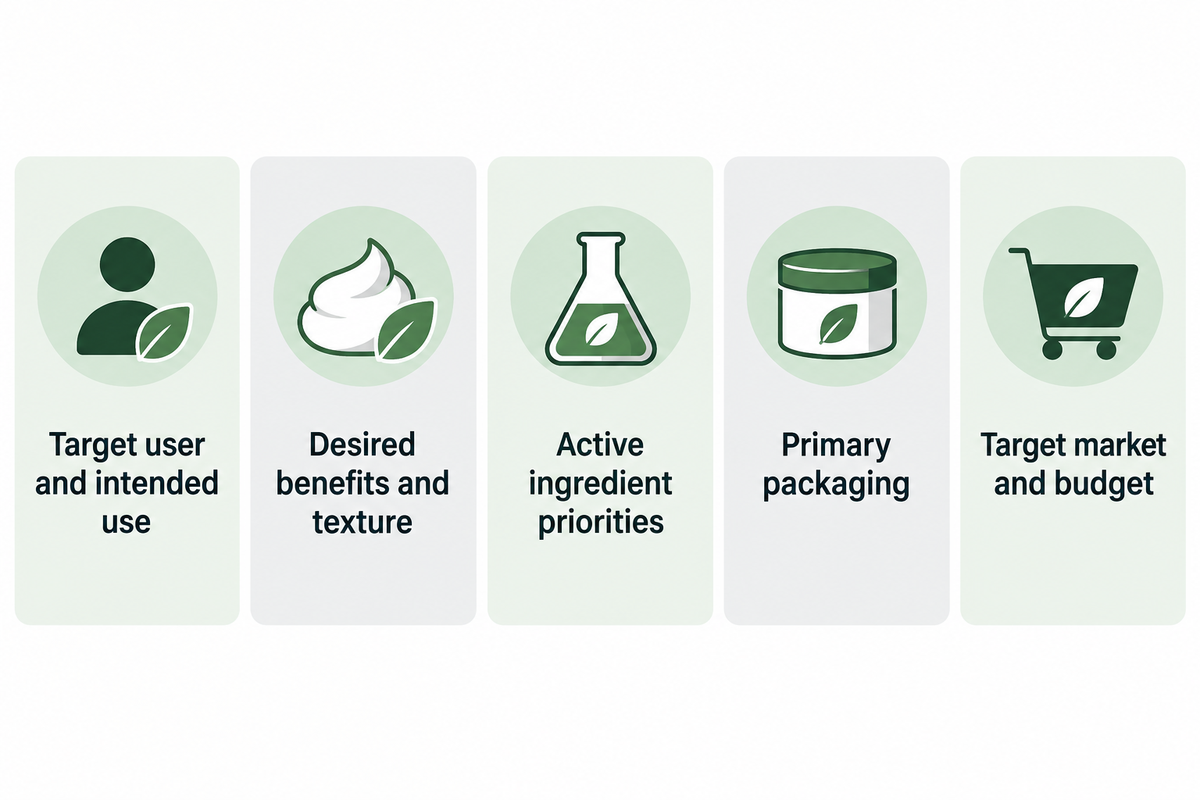
Start with a product brief that distinguishes target skin types, desired benefits and the primary packaging. List the specific skin concerns you want to address, the target market and the ingredient lists of any reference products. NEXO Beauty Labs draws on 5,000+ formulation resources for skincare, hair care products and body care. A new brand can use existing skincare products as references to give the lab a starting point for cosmetic formulation.
A beauty business deciding whether to use private label or custom development should spell out the tradeoff in its brief. Use a stock base when brand identity comes mainly from positioning and packaging, and invest in custom formulas when a measurable performance or sensory target defines the unique selling proposition. Teams that want to learn how to create a unique texture can start with a physical benchmark and a step-by-step sample evaluation.
Three Formulation Development Routes Compared: Ground-Up Custom, Formula Matching, and Co-Development
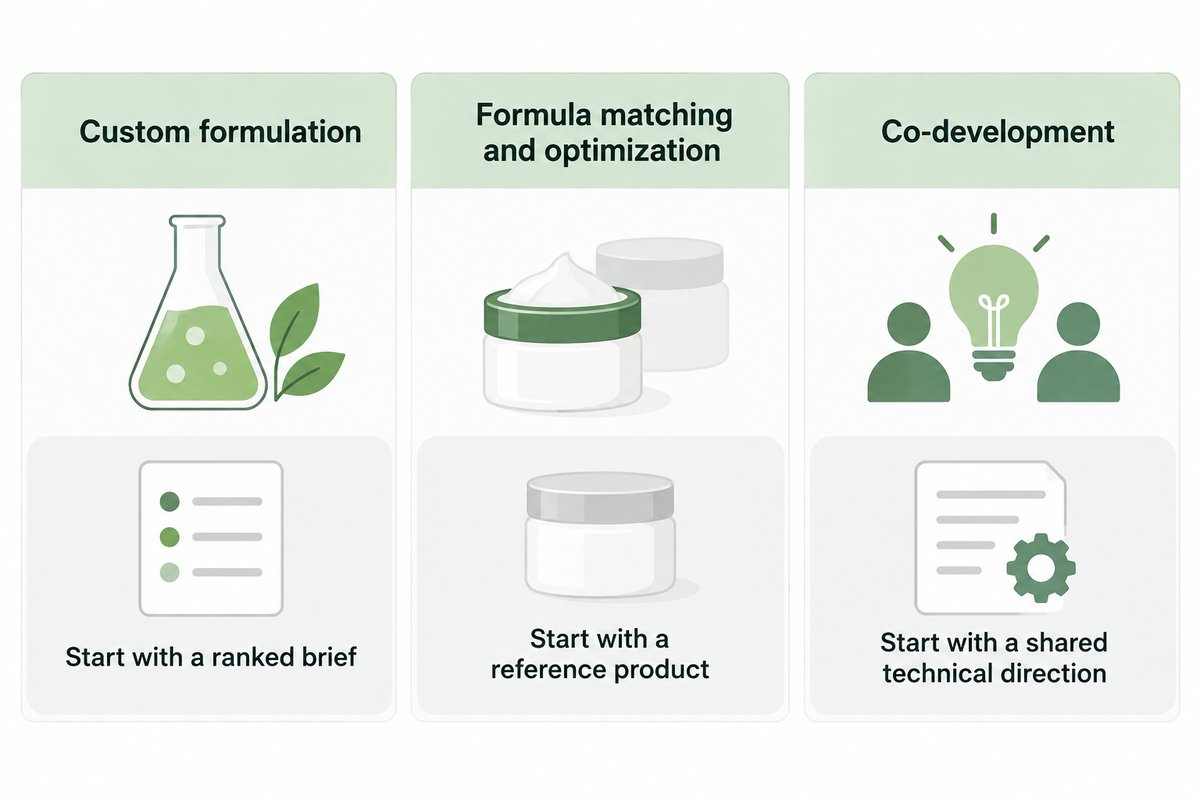
Skincare development broadly follows three technical routes: a ground-up custom formulation builds an original recipe from scratch to an agreed brief; formula matching and optimization reverse-engineers or upgrades a reference product; while co-development marries a brand’s technology with a partner’s product and process expertise through shared technical decisions.
What are the real technical, timeline, MOQ, and intellectual property (IP) ownership differences between stock private label, base formula adaptation (semi-custom), and ground-up custom skincare formulation?
Stock private label uses pre-validated factory bases with minimal formula changes, while base adaptation modifies a proven architecture to include different actives and tweak textural differences, and ground-up development builds a formula from scratch based on a brief, with IP protections largely dependent on the written agreement, rather than the route taken.
Assessing private label and custom formulation options hinges on understanding the various pathways available to structure lab work. On the NEXO Beauty Labs custom skincare platform, R&D projects are structured in 3 pathways of technical development: Custom formulation, Formula matching and optimization and Co-development. This guide groups the brief into 6 pre-formulation decisions: (01) The route of development, (02) User and intended use, (03) Sensory target, (04) Priority of the formula, (05) System of package, and (06) Commercial inputs. This guide groups the transfer records into 4 categories: Formula history, Sample observations, Testing records, and Approved transfer information.
| Development Parameter | Stock Private Label / White Label | Route 1: Formula Matching & Optimization | Route 2: Co-Development | Route 3: Ground-Up Custom Formulation |
|---|---|---|---|---|
| Starting Technical Input | A stock base from the supplier’s available catalog | 1 supplied reference product or mature base for targeted upgrade | 1 shared technical direction combining brand concept and lab platform | 1 ranked product brief engineered as a formula from scratch |
| Customization Depth | Packaging, branding, and minor fragrance or color selection | Reverse-engineering skin feel, adjusting actives, or modernizing INCI | Shared decisions on ingredients, format, sensory targets and packaging | Design vehicle, actives, rheology and preservation to the agreed brief |
| Initial R&D Sample Window | Confirm availability and sample timing for the selected stock base | Confirm timing after the reference product is received | Set a sample schedule after agreeing the technical scope | Allow time for first samples and planned revisions |
| Transfer Record Governance | Standard batch specification and packaging BOM | Reference, revisions and approved target | Decision log and formula history | Formula history and approved reference |
| Standard Commercial MOQ | Typical NEXO private-label starting point: 10,000 units per SKU for most products | Quote for the benchmark, package and sourcing needs | Quote for the shared development scope | Quote for the new formula, raw material supply and package |
| Pre-Formulation Decision Scope | Standard catalog SKU selection and packaging match | Confirm what to retain or change in the reference | Allocate decision rights and agree on feedback | Rank intended use, formula goals and package constraints |
| Sensory Evaluation Brief | Verified against existing factory reference sample | 4 sensory dimensions paired with benchmark comparison point | 4 sensory dimensions paired with shared platform target | 4 sensory dimensions engineered to bespoke acceptance language |
| Mass Production Lead Time | NEXO private-label program lists up to 15 days once the formula is approved and packaging prerequisites are met | Confirm after sample approval and package checks | Confirm after both teams approve the final scope | Confirm after validation, packaging approval and production preparation |
| Formula IP & Exclusivity | Confirm supplier ownership and buyer usage rights | Agree in writing on rights to the reference, original base and revised formula | Defined by written co-development and commercial exclusivity clauses | Negotiated in writing; full formula IP transfer requires explicit contract terms |
Discuss who can access the master batch file before agreeing to private label vs custom development fees. The ingredient declaration and confidential manufacturing formula serve different purposes. Use the contract to specify ownership of the formula and access to the manufacturing file. No matter if your team assesses options of skincare or private label hair care, the agreements have to stipulate ownership of formula intellectual property, commercial exclusivity, and buyout terms prior to bench prototyping.
The Phase-Partitioned Vehicle Compass: Engineering O/W, W/O, and Anhydrous Skincare Systems
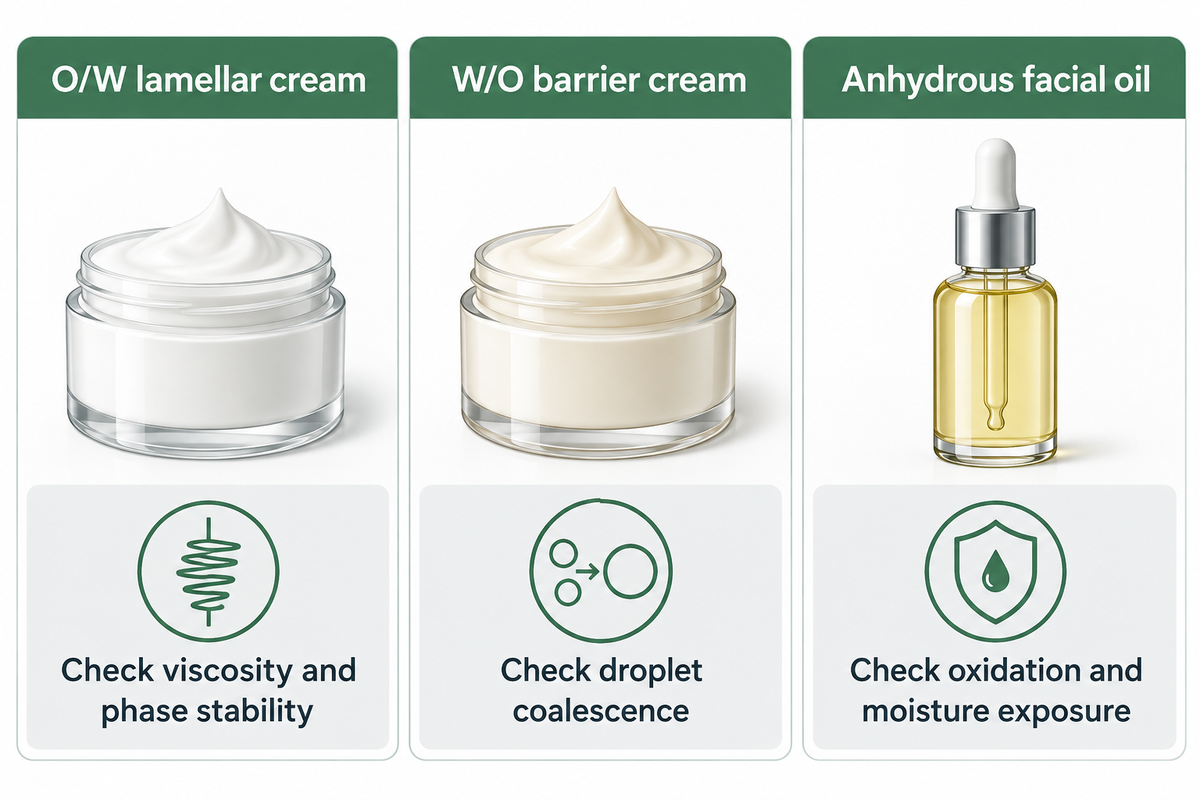
Choose the vehicle by checking where the active dissolves, how the customer uses it and which package can dispense it. An oil-in-water (O/W) vehicle can suit a light moisturizer, while a water-in-oil (W/O) vehicle may suit a richer product. Anhydrous systems remove water from the formulation and need a separate plan for oxidation.
How do cosmetic chemists engineer oil-in-water (O/W), water-in-oil (W/O), and anhydrous vehicle architectures in custom skincare formulation without triggering phase separation or active degradation?
Partition ingredients by solubility, screen the emulsifier system against the intended electrolyte load, and test each candidate in its proposed package for phase separation, pH drift and active degradation during storage before approving the selected vehicle for a pilot run in the intended primary packaging.
Use the Phase-Partitioned Vehicle Compass to narrow the candidates before mixing. Its nine categories show how a formulator can compare the continuous phase, structuring ingredients and the first stability check for each vehicle.
| Vehicle Category & Architecture Type | Continuous & Dispersed Phases | Primary Structuring & Emulsifier System | Example Ingredients & Formats | Primary Stability Control |
|---|---|---|---|---|
| Category 1: Oil-in-Water (O/W) Lamellar Cream | Aqueous continuous phase with dispersed lipid droplets | Polyglyceryl or olive-derived emulsifier paired with fatty alcohols forming lamellar liquid crystals | Barrier support creams and daily moisturizers combining niacinamide and ceramides | Verify viscosity, pH and phase stability in the actual formula after storage |
| Category 2: Oil-in-Water (O/W) Fluid Lotion | Water-rich continuous phase with dispersed oil droplets | High-HLB glucoside or citrate emulsifier stabilized with shear-thinning hydrocolloids | Lightweight facial emulsions, milky serums, and facial moisturizers | Check droplet size, viscosity and phase separation after pilot mixing |
| Category 3: Water-in-Oil (W/O) Barrier Cream | Lipid continuous phase with suspended aqueous droplets | Low-HLB lipophilic emulsifier stabilized with internal electrolyte salts and lipid waxes | Occlusive barrier creams, winter recovery balms, and water-resistant treatment bases | Preventing internal water droplet coalescence during freeze-thaw thermal cycling |
| Category 4: Gel-in-Oil & Oleogel Emulsion | Structured ester and triglyceride continuous network | Sucrose esters or polyglyceryl polyricinoleate paired with oil-phase gelling agents | Melting cleansing gels, rich overnight masks, and sensitive-skin lipid concentrates | Controlling thermal melting point and preventing high-temperature oil bleeding |
| Category 5: Anhydrous Botanical Facial Oil | Waterless lipid and ester phase with zero added water | Fast- and medium-spreading plant oils, squalane, and ester emollient cascades | Lipid-soluble vitamin C esters, retinoids, bakuchiol, and botanical oil blends | Exclusion of moisture and oxygen paired with tocopherol antioxidant stabilization |
| Category 6: Anhydrous Cleansing Balm & Stick | Solidified wax-and-oil crystalline matrix with zero water | Plant waxes and an oil-compatible rinse-off emulsifier, such as a suitable polyglyceryl ester | Waterless makeup-removing balms, solid treatment sticks, and occlusive salves | Controlled cooling crystallization rate to prevent wax graininess or sweating |
| Category 7: Single-Dose Plant Capsule Serum | Anhydrous oil serum in a sealed single-dose shell | Plant-based single-dose capsule fills at 0.5 ml, 1.0 ml, and 1.5 ml | Anhydrous oil serums and premeasured travel doses | Unit-dose oxygen barrier and capsule shell humidity compatibility verification |
| Category 8: Aqueous Hyaluronic & Peptide Gel Serum | Single aqueous phase structured by hydrocolloid polymers | Hyaluronic acid, xanthan gum, sclerotium gum, or electrolyte-tolerant crosspolymers | Hydrating facial serum boosters, peptide concentrates, and oil-free soothing gels | Screen polymer compatibility with the electrolyte load and track viscosity, pH and preservation |
| Category 9: Hydro-Glycolic & Clarifying Toner Essence | Low-viscosity aqueous and humectant solution | Water, propanediol, glycerol, and solubilizers for trace lipophilic botanicals | Exfoliating acid toners, essence waters, and treatment pad soaking solutions | Monitor pH and clarity at the chosen storage temperatures. Assess preservation for the finished formula. |
In some O/W emulsions, lamellar gel networks help stabilize the dispersion. Set the pH for the chosen emulsifier, actives and preservation system. In US10959933B1, the examples use a lactic acid and sodium lactate buffer at pH 3.8 in specific niacinamide formulas. JP7590462B2 studies sequential use of a low-pH formula containing niacinamide followed by a separate product with a higher concentration. Those examples support testing the chosen combination in the finished formula.
Consider an anhydrous vehicle when hydrolysis is a concern and the active is compatible with an oil phase. NEXO’s private label skincare manufacturing programs list plant-based single-dose capsules of 0.5 ml, 1.0 ml, and 1.5 ml. A waterless base still needs an oxidation and microbiological risk assessment that takes the package and in-use moisture exposure into account.
Active Ingredient Synergy, pH Windows, and Delivery System Design
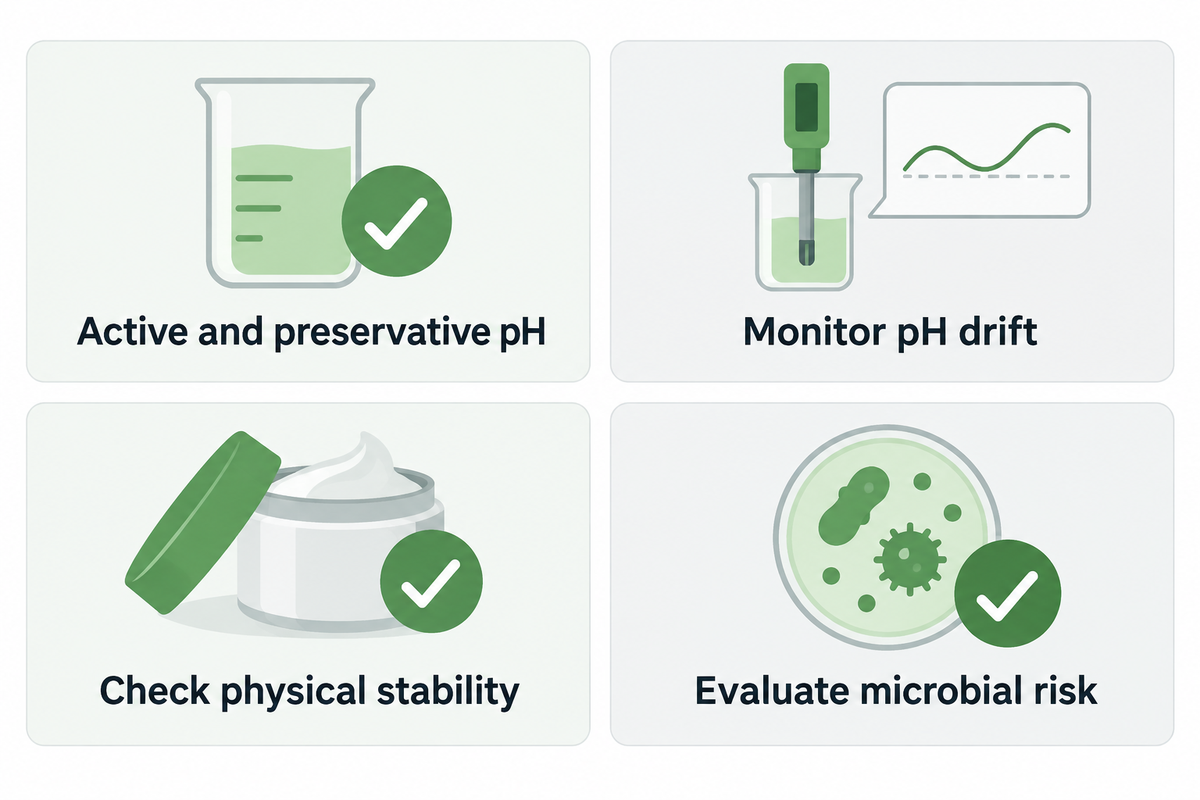
Pick the pH window by testing the full formula with its active ingredients and preservative system, including whether the acidic conditions suit sodium benzoate. Niacinamide can work at lower pH in a suitably buffered formula. Check stability and preservation together before selecting the production target.
When a brief calls for niacinamide and an acidic active such as L-ascorbic acid, make a control batch for each vehicle and measure pH drift, appearance and active stability during storage. If the compatible ranges do not overlap, consider a different ingredient form or a separate product.
- Regulation (EC) No 1223/2009, Annex V, entry 29 limits phenoxyethanol to 1.0% in a ready-to-use cosmetic product in the EU. UL Prospector’s technical review discusses its use in preservative systems. The finished formula still needs its own evidence of adequate protection.
- Brands pursuing organic and clean positioning often request phenoxyethanol-free organic acid systems, which narrow the allowable pH range of the finished cream or toner. According to Pentyl Labs’ reference on cosmetic preservatives, sodium benzoate is a common preservative in water-based and clean-label formulations, with pH-dependent activity. Select a target for the complete preservative system and verify efficacy in the finished product. For a deeper dive into hurdle preservation, review our clean beauty manufacturing and preservative compliance guide.
- Day-one viscosity gives only a first reading. Formula Botanica’s emulsion testing guide illustrates why physical stability deserves a separate test plan. For a production decision, agree on checks for separation, viscosity and pH drift, then assess microbial risk separately.
Before bench mixing, screen compatibility across pH, electrolyte load and ingredients. Track viscosity and color during storage.
The Sensory Rheology Dial: Tuning Texture, Spreadability, Absorption, and After-Feel
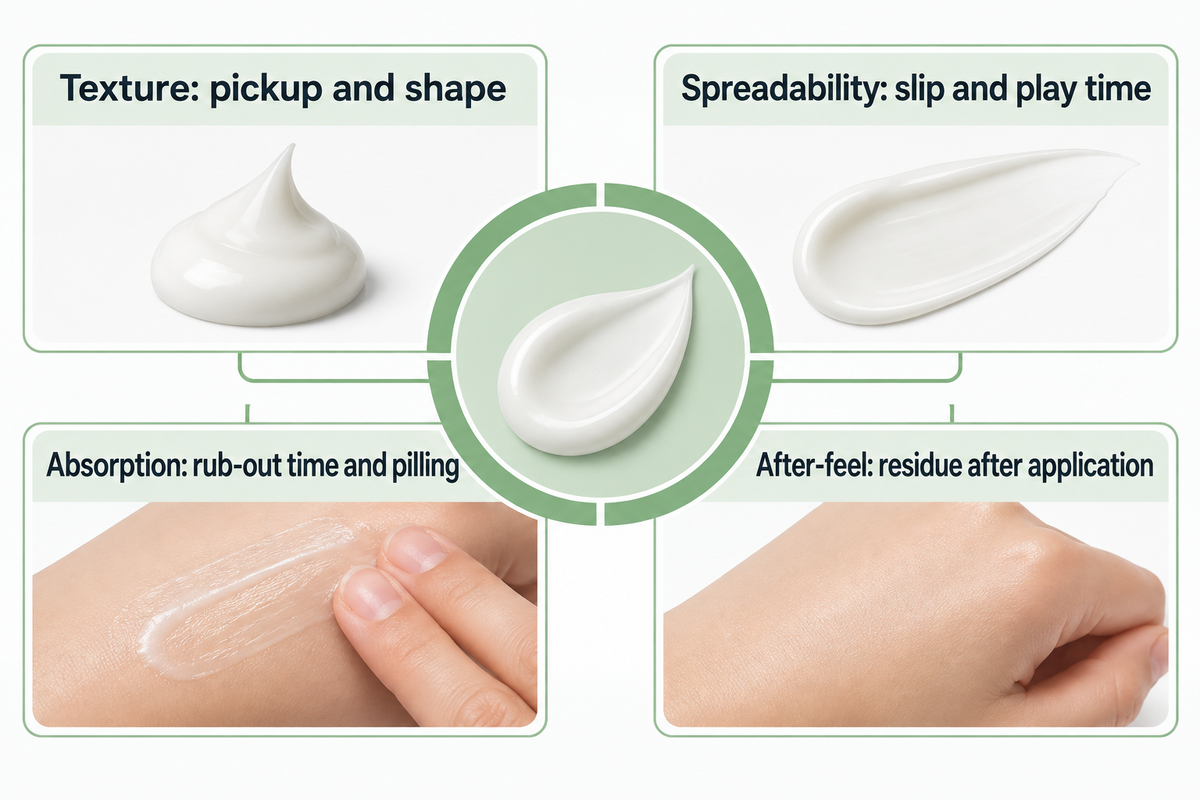
Compare 4 measurable sensory dimensions during sampling: texture, spreadability, absorption and after-feel. Screen for pilling under the intended layering routine.
In product development, saying a moisturizer should feel “luxurious” or “lightweight” typically means nothing to a chemist. The NEXO Beauty Labs sensory brief describes four dimensions and comparison points. This guide’s Sensory Rheology Dial uses those dimensions to help the brand and lab agree on written acceptance criteria.
- For texture, measure yield stress where relevant alongside pickup and dispensing tests for the intended package. To develop a bulk product with the right structure to hold its shape when stored in the container yet breaks smoothly when finger contacted, formulators adjust ratios of fatty alcohols and cross-linked polymers.
- To assess spreadability, record slip and the amount of time available to work the product across the face. Rather than use a heavy plant oil that negatively affects skin-sliding time, chemists create an emollient cascade with fast- and medium-spreading esters, triglycerides, and squalane.
- For absorption, record rub-out time and whether the product pills when layered over the intended routine. A consumer discussion on a niacinamide 10% + zinc 1% serum provides an example of a layering complaint. Reproduce the complaint with the actual combination before changing the polymer or emollient system.
- For after-feel, record any residue and describe the finish, such as dewy or cushioned.
A professional-grade sensory brief turns each observation into a comparison point the brand and lab can score together. For example, ask evaluators to record when a serum stops feeling wet and whether it rolls into visible pills over the intended moisturizer. Formula Botanica’s review of common formulation mistakes describes additional compatibility and testing pitfalls in the beauty industry.
Six Laboratory Validation Activities: Stability, Freeze-Thaw, Packaging Compatibility, and ISO 11930 Testing
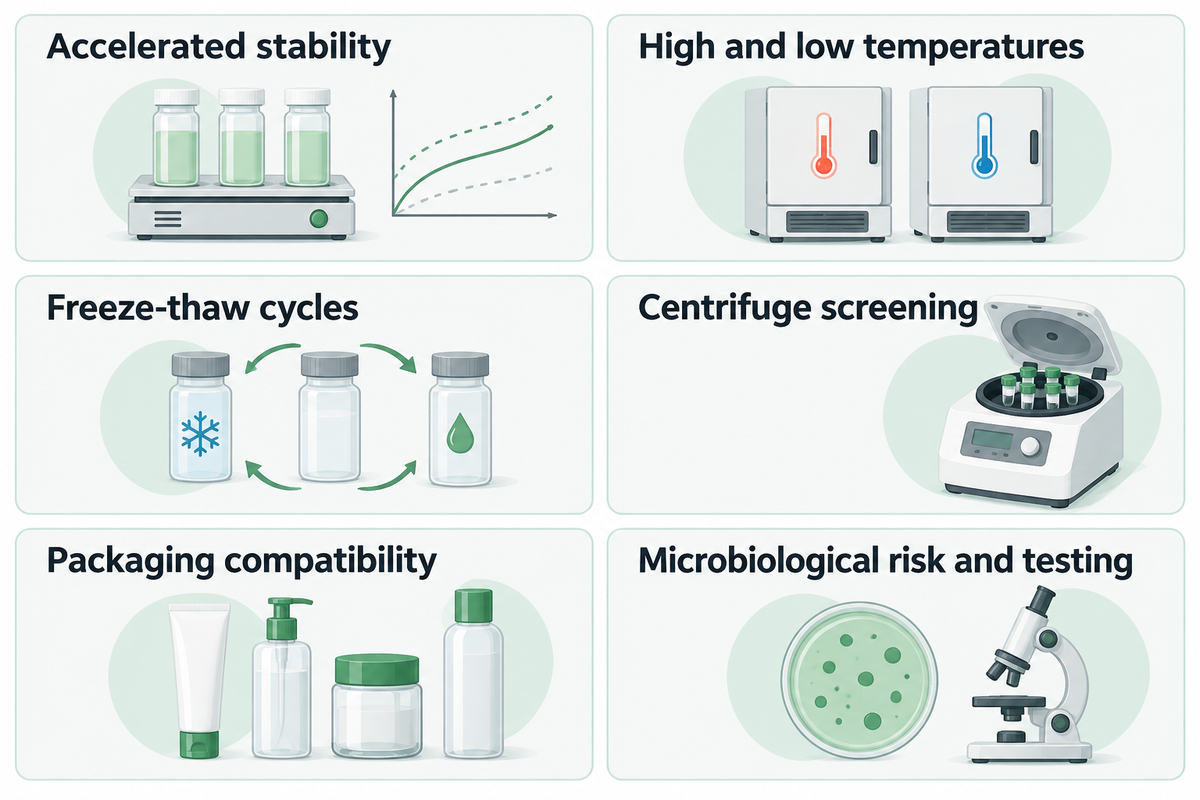
The production process needs a release decision based on evidence from the actual product. Stability and microbial risk are separate checks. A broad-spectrum preservative may be one part of the control plan, with preservative efficacy testing to ensure the system performs in the finished formula where indicated.
What laboratory validation tests, including ISO 11930 preservative challenge testing, ISO 29621 microbiological risk assessment, freeze-thaw thermal cycling, and primary packaging compatibility, should the team consider before a custom skincare formula scales to production?
Match the validation plan to the formula, container and intended use. Common workstreams include accelerated storage, high and low temperatures, freeze-thaw, centrifuge screening, packaging compatibility and a microbiological risk assessment. Where indicated, a 28-day ISO 11930 preservative efficacy test checks how well the finished formula controls the challenge organisms.
Choose accelerated storage conditions with the lab as part of risk-based safety testing for the formula and its primary packaging. Consumer Product Testing Company’s cosmetic stability overview explains how stability work supports the safety file. Specify which properties to track and what changes would trigger a reformulation or package review.
| Validation Activity | Laboratory Protocol & Conditions | Failure Modes Detected | Example Acceptance Criterion |
|---|---|---|---|
| 1. Stability Testing (Accelerated) | Accelerated thermal and humidity chamber storage alongside room-temperature retention samples | pH drift, viscosity breakdown, ester hydrolysis, color shift, and odor oxidation | Physical, chemical, and organoleptic parameters remain within specification window |
| 2. High- and Low-Temperature Assessment | Constant thermal exposure at elevated and refrigerated storage checkpoints | Lipid wax recrystallization, clouding in clear serums, or high-heat syneresis | Homogeneous appearance and recovery upon returning to ambient temperature |
| 3. Freeze-Thaw Cycles | Alternating freezing and elevated heat cycles across consecutive stress intervals | Emulsion droplet coalescence, water bleeding in W/O creams, and gel network rupture | No phase separation or persistent graininess under the agreed protocol |
| 4. Centrifuge Assessment | High-speed mechanical centrifugation of bulk emulsion prototypes | Early gravitational creaming, sedimentation of pigments/powders, or oil ringing | No visible phase split or serum separation in the specified centrifuge screen |
| 5. Packaging Compatibility Work | Aging bulk formula inside the actual primary container, pump, dropper, or tube | Dip-tube swelling, actuator clogging, or weight loss | Full mechanical dispensation and container integrity across thermal aging |
| 6. Microbiological Risk Assessment and Testing (ISO 29621 and ISO 11930) | Assess microbiological risk under ISO 29621. Where appropriate, schedule the ISO 11930 preservative efficacy test at applicable 7-, 14- and 28-day intervals by organism. | Inadequate preservative log reduction against bacteria, yeast, or mold | Document the applicable acceptance criteria and evidence for the finished formula and package |
ISO 11930:2019, with its 2022 amendment, gives a reference method for evaluating antimicrobial protection. For eligible formulas, Microbe Investigations’ protocol summary describes the challenge organisms and applicable 7-, 14- and 28-day intervals. ISO 29621:2017 guides the assessment of whether a finished product is microbiologically low risk under its production and use conditions.
The Kettle Shear Benchmark: Tracking Viscosity and Sensory Drift from Lab to Kettle
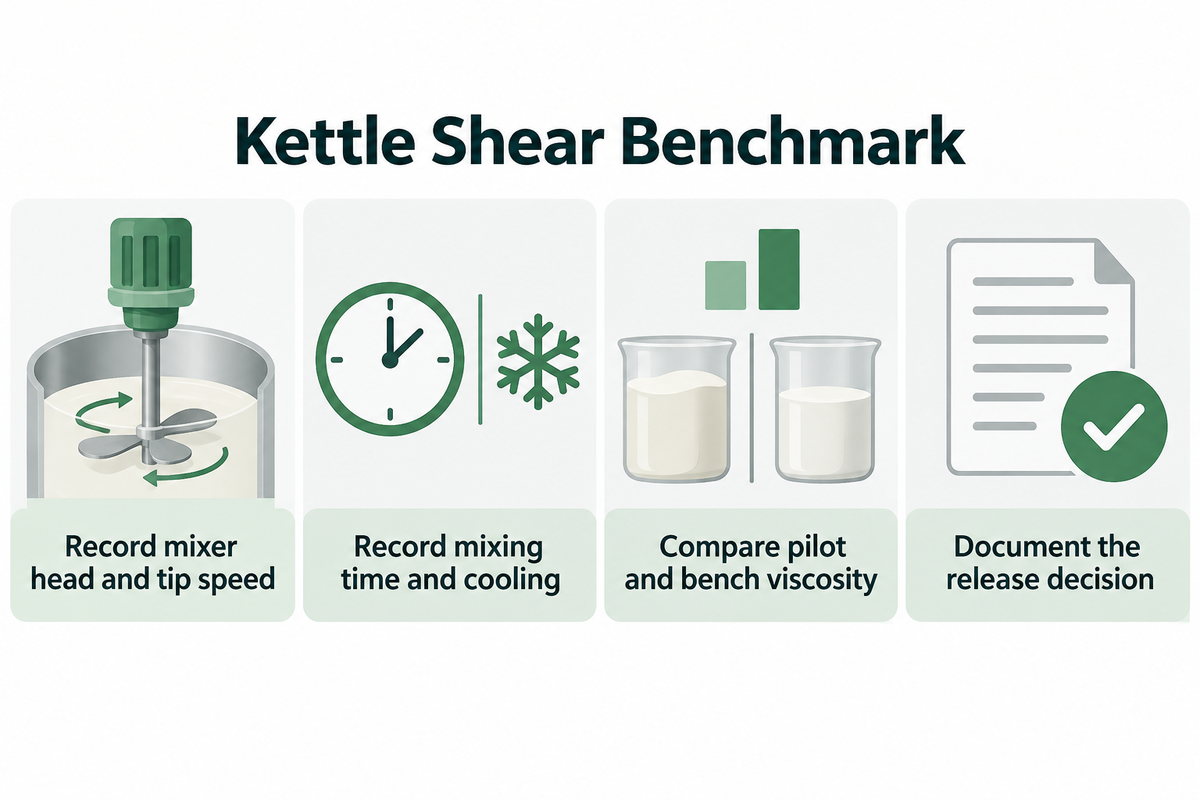
A lab sample can change viscosity at pilot scale because the mixing head, batch circulation and jacket cooling behave differently. Use the Kettle Shear Benchmark to compare the approved sample with the pilot batch. Agree on the checks before transfer, and file the results with the 4 production transfer record groups.
Why do benchtop skincare prototypes often change viscosity or skin feel during commercial scale-up, and what transfer records help catch batch-to-batch drift?
Record the mixing head geometry, tip speed, duration and cooling profile, then measure viscosity at the same product temperature and sample age as the approved bench sample. If the pilot batch drifts, document what changed in Formula History, Sample Observations, Testing Records, and Approved Transfer Information before the release decision.
A key failure in contract manufacturing occurs when a brand approves a silky lab sample, only to receive a bulk production batch that feels noticeably thinner or heavier. This guide’s Kettle Shear Benchmark turns that comparison into a pilot transfer record.
Use rotor tip speed as one comparison across mixers of different diameters. ROSS Mixers’ rotor-stator report shows that head geometry and clearance can change mixing behavior even at similar speeds. Record the head and flow conditions along with the speed, then verify the result in a pilot batch.
A food-emulsion experiment on casein hydrolysate illustrates why the settings need to be qualified. In its water-in-oil primary emulsion, the selected rotor-stator run used 530 s at 17,800 rpm and yielded 93.1 cP viscosity and a 93.8% stability index. The authors reported a measured D(90) of 0.67 μm initially and 0.77 μm at 30 days in Table 3. Use the cosmetic formula, package and pilot equipment to establish your own limits.
Before authorizing filling, compare the pilot and approved sample against the agreed acceptance criteria. Document any mismatch and assign a decision owner.
Custom Skincare Formulation Costs, Timelines, MOQs, and Regulatory Dossiers (US MoCRA & EU CPSR)
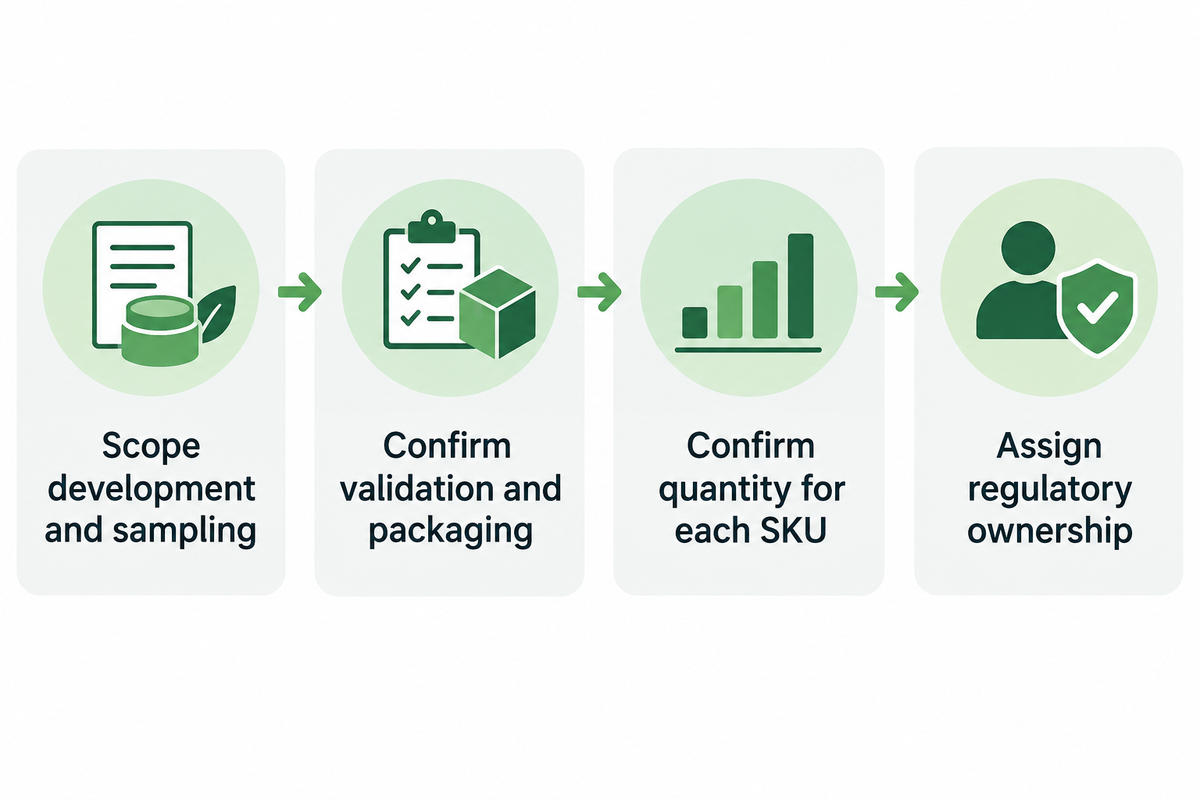
Build the launch timeline around the approvals needed to bring products to market. Budget separately for sampling, validation, regulatory compliance, tooling and production. Confirm the applicable regulatory standards and any excluded testing in the quote.
NEXO’s private-label skincare program lists 3-7 business days for qualifying formula-matching or customized samples from an accepted brief, a typical MOQ starting at 10,000 units per SKU, and production within 15 days after formula approval and packaging confirmation, with packaging available and inspection complete. Ground-up projects start with the custom formulation brief. Request a scoped schedule that includes revisions, ingredient sourcing and validation.
- Ask suppliers to itemize active ingredient sourcing, development samples, stability and challenge testing, and any packaging tooling. Check who pays for another round if the formula or packaging changes after testing starts.
- Ask whether the proposed MOQ covers the first order for each SKU. Compare pilot and production batch sizes and check how component minimums or surplus packs could create packaging waste.
- Under U.S. MoCRA, facility registration and product listing apply subject to exemptions. The responsible person must maintain adequate safety substantiation and report serious adverse events to FDA within 15 business days. For an EU launch, the responsible person must ensure a pre-market safety assessment and keep the Cosmetic Product Safety Report in the Product Information File under Regulation (EC) No 1223/2009, Articles 10 and 11. Identify who supplies the manufacturing records before commercial approval.
Use the launch plan to name the owner and due date for each document, package decision and test report. This makes it easier to find dependencies that could delay customs clearance or retail onboarding.
How to Vet and Select a Custom Skincare Formulation & OEM Manufacturing Partner
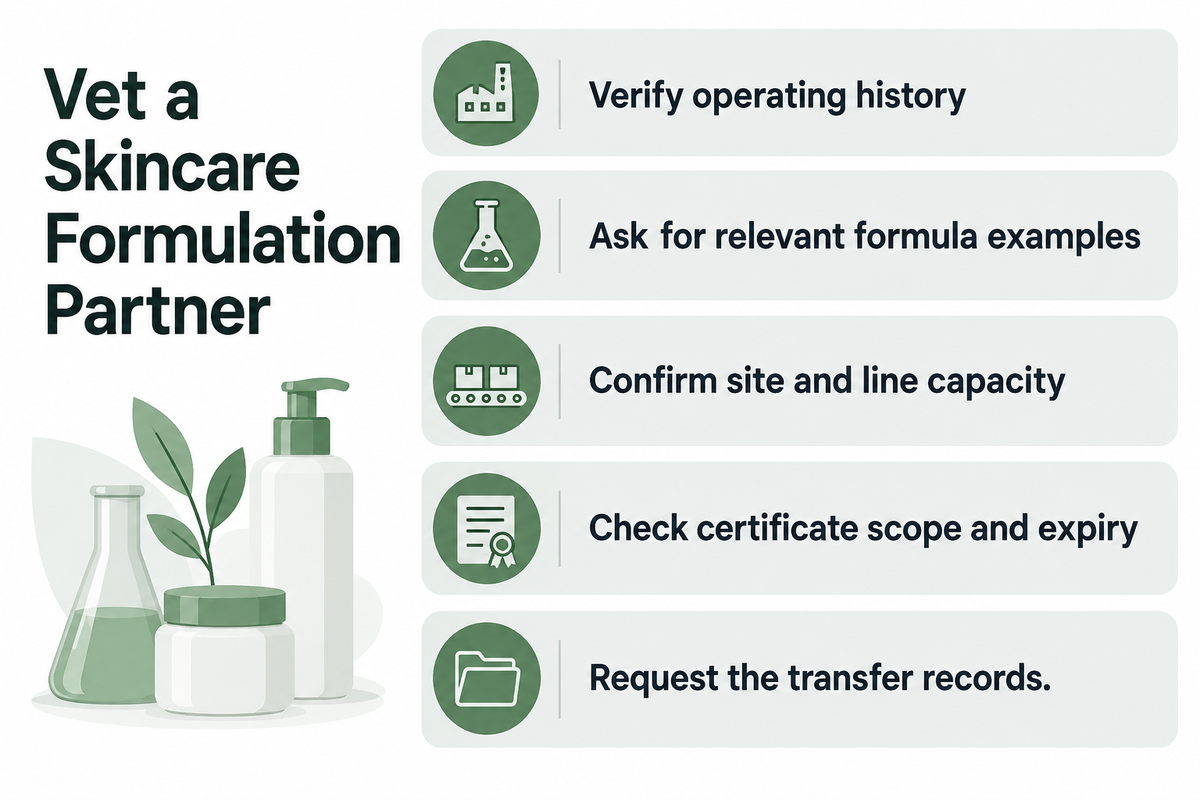
Vet a custom skincare manufacturer by asking who runs stability and microbiological testing, which plant will manufacture the product, and who approves the transfer to production. Check the plant’s GMP evidence and verify scope and issuer where the supplier claims certification.
How should a buyer compare OEM and ODM cosmetic manufacturers for custom skincare development and production?
Compare suppliers against the same brief and intended market. Request the scope of formulation work, the proposed manufacturing site and its current certificate, an example of sample feedback, and the records that follow the formula into production. Ask who can approve changes after testing starts.
Want to create custom products tailored to a specialized clinical audience? Need to discuss formulations for a hero facial serum? Want to expand brand positioning across haircare formulation and body care? Whenever you’re looking for a contract manufacturer, make sure your potential partner has these established manufacturing processes in place.
- Look into how long the factory has operated, and determine if they have a dedicated export team that handles the technical aspects of communication. NEXO Beauty Labs marries cosmetic manufacturing dating to 1999 with an international business team that supports the export business since 2020.
- Review laboratory architectures to demonstrate mature starting points across the formats of interest. Our formulators cover a library of 5,000+ formulation resources since 1999 across skincare, hair care, and body care, including cleansers, toners, moisturizers, barrier repair creams, facial serums, hero single dose capsule serums (0.5 ml, 1.0 ml, and 1.5 ml) and sheet masks.
- Check site capacity against the proposed SKU and packaging. NEXO’s published manufacturing profile lists a 36,000 m² facility and 56 production lines.
- If the supplier claims ISO 22716 certification, request the current certificate for the proposed site. Match the legal entity, audited production units, issuer and expiry date against the plant and product named in the quotation.
- Ask which of the 3 development routes fits your brief. Settle the 6 pre-formulation decisions and agree on the relevant validation work and the 4 production transfer record groups before filling.
To review your target market requirements and begin your R&D sample cycle, check out our custom skincare formulation and OEM development services or submit your project brief to NEXO Beauty Labs.
Frequently Asked Questions About Custom Skincare Formulation
How long does it take to develop a custom skincare formula from scratch?
On NEXO Beauty Labs’ skincare manufacturing platform, qualifying formula-matching or customized samples take 3-7 business days from an accepted brief, and the published production window is up to 15 days after formula approval and packaging confirmation, with packaging available and inspection complete. These are private-label program figures. A ground-up project needs its own timetable for sample revisions, packaging compatibility, stability work and preservation testing where indicated.
Who owns the formula and who can access the manufacturing file?
Formula ownership depends on the manufacturing contract. When adapting a supplier base, ask which parts remain supplier-owned, who can use the modified formula and whether any exclusivity covers your SKU, market or sales channel. For ground-up work, record who owns the recipe and who can access the manufacturing file before sampling begins.
What should a beauty brand prepare before submitting a custom skincare formulation brief?
Before bench work, agree on 6 core decisions: the development route (custom formulation, formula matching and optimization, or co-development), target user and intended use, sensory target across 4 dimensions (Texture, Spreadability, Absorption, and After-feel paired with a benchmark comparison point), formula priorities and active claims, primary package system, and commercial inputs including target cost and proposed volume per SKU.
What is the maximum phenoxyethanol concentration allowed in EU custom skincare formulas?
Phenoxyethanol is approved as a cosmetic preservative in the European Union, under Regulation (EC) No 1223/2009, at a maximum of 1.0% by weight in the ready-to-use cosmetic product. Check Annex V, entry 29, when reviewing the supplier specification. The permitted maximum gives a regulatory boundary, while the preservation test checks protection in the finished formula.
Why do anhydrous cleansing balms and capsule serums use different preservation testing than water-based creams?
Water-based creams usually need a preservation system and a finished-product efficacy test suited to the formula. Assess moisture ingress and intended use in the actual pack for waterless balms and single-dose capsules. ISO 29621 provides guidance on identifying finished products that are microbiologically low risk. Low water activity is one input in that assessment. Pay particular attention to a jar or wide-mouth package that the user can expose to water during use. Antioxidants address oxidation, which is a separate quality issue.
Can an emerging brand start with formula matching and move to ground-up custom formulation later?
Yes. A beauty brand can test market demand by adapting or matching a suitable base, then commission a ground-up formula for a flagship SKU. Agree on what the first launch should prove, such as repeat orders or feedback about texture. Carry that evidence into the brief for the ground-up version.
References & Sources
- U.S. Food and Drug Administration (FDA) Modernization of Cosmetics Regulation Act of 2022 (MoCRA)
- International Organization for Standardization (ISO) ISO 11930:2019, Evaluation of Antimicrobial Protection and ISO 29621:2017, Assessment of Microbiologically Low-Risk Products. For future revisions, see the separate ISO/CD 11930 committee draft, currently under development.
- Microbe Investigations Technical Reference ISO 11930:2019 Preservative Efficacy Test (PET) Protocol and Criteria
- Food Science & Nutrition Homogenization of Water-in-Oil Emulsions for Casein Hydrolysate Double Emulsions
- ROSS Mixers Engineering Report Homogenization of Submicron Emulsions and Rotor-Stator Tip Speed Physics
- United States Patent US10959933B1 Low pH Skin Care Composition and Methods of Using the Same
- Japanese Patent JP7590462B2 Method for Improving Skin Penetration of Vitamin B3 Compounds
- Consumer Product Testing Company (CPTC) Stability Testing of Cosmetic Products Under US MoCRA Safety Substantiation
- UL Prospector Knowledge Center Phenoxyethanol Regulatory Limits and Cosmetic Preservation Architecture
- Pentyl Labs Technical Reference pH-Dependent Efficacy of Sodium Benzoate and Cosmetic Preservatives
- Formula Botanica Formulation Science 4 Steps for Testing Your Cosmetic Emulsion
- Formula Botanica Formulation Science 10 Common Mistakes Cosmetic Formulators Make
- SNS Insider Market Research Personal Care Contract Manufacturing Market Size & Forecast
- Further market context: HTF Market Insights’ custom skincare serums report.
- Supplier perspective on cost drivers: Moksha Bio’s skincare OEM pricing overview.
Why beauty brands work with NEXO
About NEXO Beauty Labs Manufacturing Support
NEXO Beauty Labs supports skincare, body care, sun care, hair care, and private label brands with formulation, sampling, filling, quality control, and export-ready launch support.
Project Review Before RFQ
Before quotation, we help clarify product category, active direction, formula stage, package choice, compliance market, MOQ, sampling schedule, and required documents.
Request a Cosmetic QuoteCompany Profile // Data Sheet
CompanyNEXO Beauty Labs
Business TypeCosmetic OEM / ODM manufacturing partner
Main ProductsPrivate label skincare, facial serums, moisturizers, cleansers, sunscreen, body care, and hair care products
Manufacturing CapabilityFormula development, sample adjustment, package sourcing, filling, QA/QC, documentation, and export support
RFQ Data NeededProduct type, formula goal, package format, target market, MOQ, claims, timeline, and benchmark samples
Websitenexobeautylabs.com