Get in touch with NEXO Beauty Labs Company
Sunscreen Spray Manufacturing
Sunscreen Spray Manufacturing for Global Beauty Brands
- Quote within 24 business hours
- First samples in 3-7 working days
- Minimum order 10,000 units per SKU
- COA, SDS and full ingredient listing with every shipment
Sunscreen spray manufacturing starts with a decision most briefs skip: the word spray covers three different pieces of hardware, and the one you pick rewrites your formula, your testing bill and your minimum order. As a private label and custom sunscreen spray manufacturer we develop and manufacture the SPF bulk, then tell you at brief stage which spray route your product actually fits. Send a brief, a reference product, or your own formula and specification.
Your brief and formula are treated as confidential, and a mutual non-disclosure agreement covering your product concept, formulation information and commercial requirements is signed on request before development starts.
Quote turnaround
Within 24 business hours
First samples
3-7 working days, then 5-7 working days in transit
Production
10-15 working days after formula approval, packaging confirmation and production preparation
Minimum order
10,000 units per SKU
Starting point
A written brief, a reference product, or an existing formula and technical specification
With every shipment
A certificate of analysis, a safety data sheet, the full ingredient listing and the export paperwork set for your destination market
Where Our Work Starts and Stops on a Spray Programme
A spray SPF product is two jobs wearing one name. One is the bulk: filter system, carrier, film former and sensory profile. Second comes the fill: valve, actuator, propellant and the pressure vessel that turns that bulk into a spray.
Custom formulation and OEM development
We build the SPF bulk against your target market, texture brief and filter preference. Our formulation library holds more than 5,000 formulas across skincare, hair care and body care, so a custom sunscreen formulation can start from a proven base or from scratch. Existing sunscreen formulas shorten development, but they still need the fill route settled before the bulk is locked, so a fast product line is a route decision before it is a formula decision.
Bulk manufacture
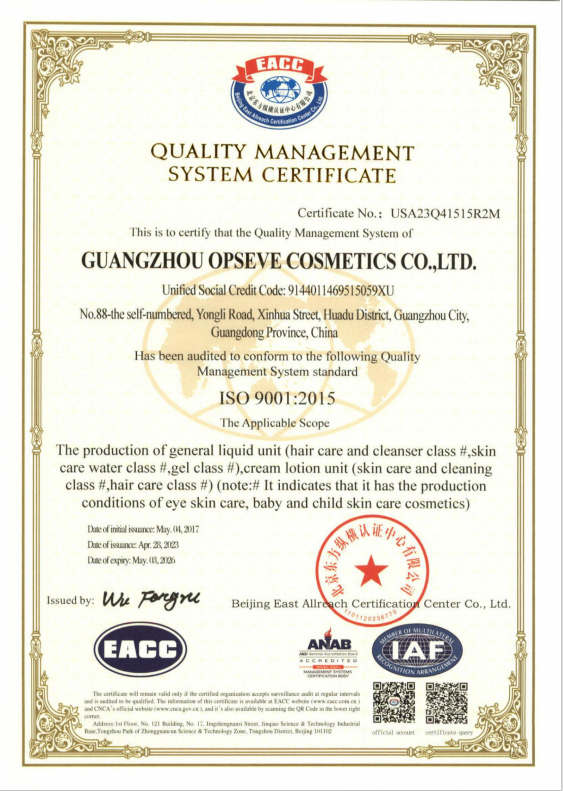
Emulsions and fluids are compounded and filled in our liquid and cream workshops. Sunscreen capacity across all formats runs to 200,000 units per day on 56 production lines, with a manufacturing history that goes back to 1999. Compounding and filling run under our ISO 22716 cosmetic good manufacturing practice system.
Fill route coordination
Packaging components are sourced and coordinated by us. Where a route calls for a pressurised fill, that step is scheduled with a specialist filler and named in your quotation rather than buried in it.
01
OEM
you bring the formula and specification, we manufacture to it.
02
ODM and custom formulation
we develop the sunscreen product against your brief and you take it to market under your own brand.
03
Reference-led development
you send a market reference and we develop a comparable bulk with your own texture and skin-feel adjustments.
04
Contract manufacturing
you hold the formula and the raw material specification, and our manufacturing services cover compounding, filling and release.
05
White label
a white label sunscreen manufacturer supplies a finished base under your label; we quote that route only where an existing base genuinely fits the brief.
06
Private label services
you take an agreed base under your own brand, and we quote the pack and the paperwork with it.
Lightweight sunscreen lotion and sunscreen essence
Facial sunscreen, plus daily-wear concepts at SPF 30 & SPF 50
Mineral sunscreen using zinc oxide and titanium dioxide
Chemical filter systems for lightweight everyday wear
Hybrid mineral and chemical systems
Tinted sunscreen (cosmetic tint in SPF base)
Skincare-infused SPF (ceramide, panthenol, niacinamide)
Kids sunscreen and cooling sunscreen concepts
Sunscreen stick
Sun care products sit inside a wider personal care programme for most of our partners, so a spray SKU is usually specified alongside skin care products from the same brief. SPF products and skincare products then share one specification trail rather than two.
Bulk tuned for a fine-mist pump behaves differently in a pressurised can, which is why spray formulas are developed against a chosen route rather than adapted to one later.
Route fit decides whether you get a high-quality sunscreen spray as much as the formula itself does.
Each personal care product in the same programme keeps its own specification and its own release record.
UV Filter Platforms We Formulate Against
Tell us the launch market in your brief, because it decides the filter system before it decides anything else. Our sunscreen programmes are built for markets that regulate sunscreen as a cosmetic. A United States launch is a different route, because an OTC sunscreen is regulated there as a drug whose rules reach the whole chain rather than only the fill, so name that sunscreen market at brief stage and we scope it separately.
Mineral
Filters
Zinc oxide, titanium dioxide
Why brands pick it
Sensitive-skin and clean beauty positioning, natural and organic sunscreen claims where the market allows them, and the widest regulatory acceptance across cosmetic-regulated markets.
Spray behaviour
Insoluble particles must be held in suspension. In standard pressurised systems they tend to settle and cluster, which risks valve clogging and uneven active delivery.
Rule of thumb
On a private label mineral sunscreen you can reasonably expect two SPF points for every 1% of zinc oxide used, which is why a high-SPF mineral spray carries a high solids load.
Chemical
Filters
Avobenzone, octocrylene, homosalate, octisalate and related organic filters
Why brands pick it
Transparent single-phase concentrates, light skin feel and the easiest path to a clear continuous spray.
Spray behaviour
Dissolves cleanly in cosmetic solvent systems, which is why most continuous sprays on shelf are chemical or hybrid rather than mineral only.
Watch item
Photostabilisers are needed to keep the system intact under sunlight, and the solvent choice drives both flammability and skin feel.
Hybrid
Filters
Zinc oxide combined with organic filters
Why brands pick it
Broad-spectrum strength from the mineral side with the lighter aesthetics of organic filters.
Spray behaviour
Lower solids than mineral-only, so atomisation is easier, but the suspension still needs anti-settling work.
Watch item
Filter combinations legal in one market are not automatically legal in another, so the pairing is chosen after the market is named.
Skincare-infused
Actives
Ceramide, ectoin, panthenol, hyaluronic acid, centella asiatica, niacinamide…
…and antioxidants, including the natural ingredients a clean-label brief usually asks for
Why brands pick it
Positions the product as daily skin care rather than beach protection, which is where the category is growing, and suits brands whose range already spans several skin types.
Spray behaviour
Added actives change viscosity and can change the spray pattern, so the actuator is matched after the final bulk, not before.
Watch item
Every added active is another compatibility and stability check, and that time sits on the critical path.
Reef-safe positioning
A private label reef safe sunscreen is defined by which organic filters are excluded, not by an added ingredient, so the reef question is answered at filter-selection stage.
Organic sunscreen & natural
What counts as an organic sunscreen claim differs by market, so the wording is fixed against the destination market before the label is drafted.
Tint
A cosmetic tint changes both the shade set and the stability profile, and a tinted sunscreen carries its own compatibility work.
SPF ladder
SPF 30 and SPF 50 are separate specifications and separate releases, not one formula at two strengths.
01
Approved filter lists do not travel. The US monograph and EU Annex VI permit different actives.
02
The United States added bemotrizinol to its monograph by final order in June 2026.
03
Any formula built on a filter missing from your destination market list cannot launch there.
04
Filter systems are not interchangeable between markets. Name the market in the brief.
05
SPF on the label is determined by in vivo panel method in ISO 24444 on finished bulk.
A Filter System Not Listed Here
Send the filter or the reference product with your brief and we will confirm feasibility, market fit and price in the quotation.
Request a spray programme quoteThe Spray System Build Sheet
Three different pieces of hardware are all sold as spray. Below, the Spray System Build Sheet sets them side by side on the six things that decide your project, so the route is chosen before the formula is locked rather than after.
Decision line
Mechanical pump spray
Bag-on-valve
Liquefied-propellant aerosol
Bulk requirement
Low-viscosity fluid or thin emulsion that atomises through a fine-mist pump.
Wide viscosity window. Valve suppliers list liquids, gels, creams and lotions as compatible.
Solvent-carried, usually chemical-filter systems; mineral loads settle and clog.
Who fills it
A conventional cosmetic liquid line. This is the route we fill ourselves.
Specialist bag-on-valve line, scheduled with a filler and named in your quotation.
Licensed pressurised-filling plant with explosion-proof handling.
Extra testing it triggers
Standard stability and packaging compatibility on the chosen pump.
Pressure-vessel and leak checks on top of the bulk release panel.
Flammability applies today; particle size and drying time are in the FDA proposed order and are not yet binding.
Transport and shipping
Ordinary cosmetic freight.
Compressed air or nitrogen is non-flammable, which keeps the classification simpler.
Flammable-aerosol handling, with the labelling that goes with it.
Effect on first order
Lowest entry volume of the three, and the usual route for a first SKU.
Component minimums for can, bag, valve and actuator set the floor.
Highest component and filling minimums of the three, so it rarely suits a first SKU.
What we own on this route
Formula, bulk, fill, labelling and the shipping document set.
Formula, bulk and the document set. Pressurised filling is a scheduled outside step.
Formula and bulk, with pressurised filling scheduled as an outside step.
What the Hardware Actually Buys You
Bag-on-valve keeps the formula in a sealed multi-layer bag and the propellant outside it, so the two never touch and the can sprays at any angle.
Valve suppliers publish evacuation of up to 99% for bag-on-valve, against roughly 90% to 95% for a conventional aerosol.
Bag-on-valve fill capacities are published at 30 ml to 400 ml, which is the practical envelope for a body or face spray.
Bag-on-valve packaging costs run higher than a conventional aerosol, and fillers put cost neutrality at 12 to 18 months once waste and premium pricing are counted.
Continuous-spray formats carry a retail premium over the equivalent pump, which is the commercial reason brands move up the ladder.
A brand trying to enter continuous spray can find that few contract manufacturers run a commercial bag-on-valve line and that most of the capacity is already committed.
Every route still carries the same ISO 24444 in vivo SPF determination; the rows above are only the checks each route adds on top of it.
Our Spray System Build Sheet exists because hardware is where spray projects fail, not chemistry. Picking the route after the formula is signed off costs you the development twice, which is the most common trade-off brands get wrong here.
Spray System Selector
Answer five questions about market, texture, SPF, first-order volume and whether you already hold a formula. It returns the route that fits, the testing it triggers and which segment we own on it.
Manufacturing Excellence
Quality Control, Certification Scope and Batch Consistency
Quality control runs from incoming materials through to finished-goods release, and every batch is recorded. Controls below are the ones that decide whether the product in the bottle matches the report in your file.

100%
Active Level MatchOne Control Decides Whether Your Label Is True
An SPF report describes the sample that was tested. Whether the product on shelf matches it depends on one thing: that the active level in production is the active level that was tested.
Regulators allow a tolerance band on active levels, and that band is where the gap between a tested formula and a produced formula opens up.
Founders in this category have described contract manufacturers producing at 18% zinc oxide when the tested formula used 20%.
SPF variation is most often traced by specialists to production inconsistency at scale-up rather than to the test method.
Our position is the simple one:
the formula we produce carries the active level of the formula that was tested, and batch consistency is one of the seven release checks on every batch.
An SPF certificate proves a sample passed on a given day in a given laboratory. Batch consistency is what makes that certificate mean something twelve months later, which is why we hold the active level rather than the tolerance band.
— NEXO Beauty Labs Quality TeamCertification Held by Our Manufacturing Facility
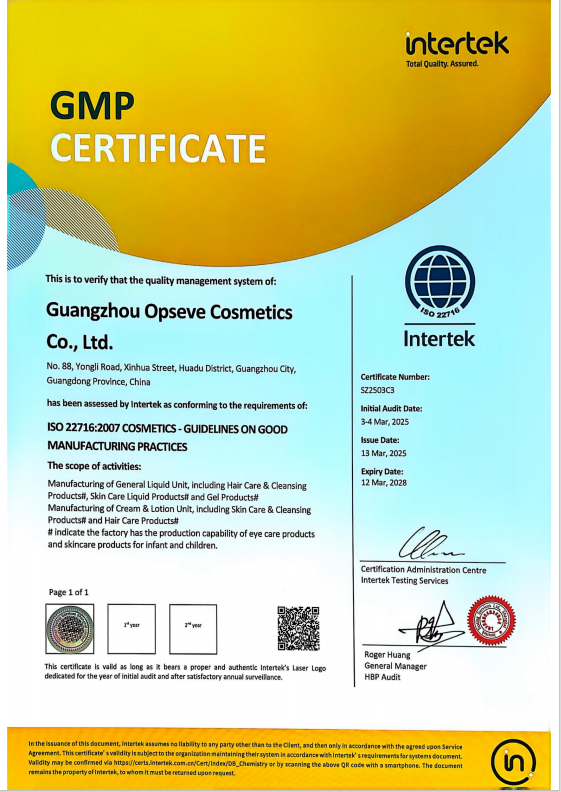
ISO 22716
ISO 22716:2007
Certificate: SZ2503C3 (Issued by Intertek)
Valid: 2025-03-13 to 2028-03-12
Scope: Registered for the general liquid workshop and the cream and lotion workshop.
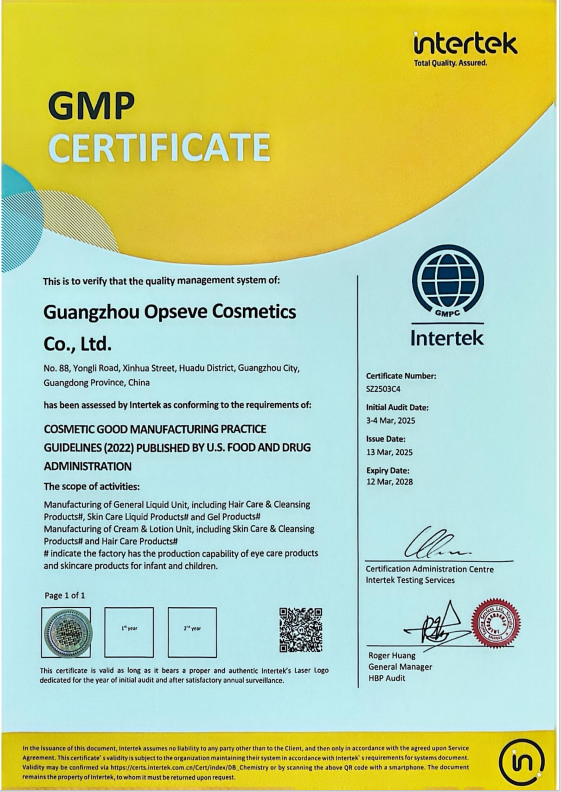
FDA GMP
Cosmetic GMP
Standard: United States FDA cosmetic GMP guideline
Certificate: SZ2503C4 (Issued by Intertek)
Valid: 2025-03-13 to 2028-03-12
Scope: Same registered scope.
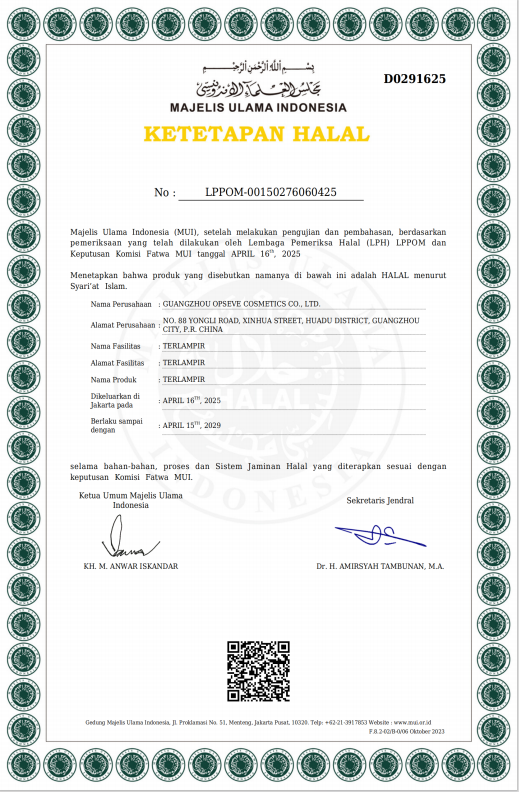
HALAL
Halal Certification
Certificate: LPPOM-00150276060425
Issued by: MUI
Valid: To 2029-04-15
Scope: At company level.
Quality Guarantee
A certificate of analysis, a safety data sheet, the full ingredient listing and the destination-market export documentation set ship with every order. If a batch measures outside the agreed specification we rework or remake it against the same written acceptance criteria used at finished-product inspection.
From Brief to Shipment, and Who Owns Each Step
01
Brief
you send a written brief, a reference product, or your existing formula and technical specification, with the launch market named.
02
Route and quotation
we recommend the fill route, flag what it triggers, and return a written quotation within 24 business hours.
03
Sample
the bulk sample is built in 3-7 working days and shipped in 5-7 working days for texture and skin-feel review.
04
Substantiation
SPF, UVA and any water-resistance testing is booked with an external accredited laboratory in your name, with the label number determined by the ISO 24444 in vivo panel method.
05
Production
after formula approval, packaging confirmation and production preparation, the batch runs in 10-15 working days under our release panel, and if it measures out of specification we rework or remake it.
06
Release and shipment
batch records are reviewed, the document set is issued and the order ships.
Who Owns the Formula
Exclusive formula development is available, and the terms are written into the quotation rather than assumed.
A mutual non-disclosure agreement covering your product concept, formulation information and commercial requirements is signed on request before development starts.
If you arrive with your own formula and specification, we manufacture to it and it stays yours.
SYSTEM.MODULE // PLANNING
Manufacturing Data Tools
TOOL_01
Spray System Build Sheet Check
The word spray covers three different pieces of hardware. Answer five questions and this returns the route that fits, the testing it triggers and which segment we own on it.
Execute Tool
TOOL_02
SPF Substantiation Cost Estimator
Substantiation sits with the brand. Select the claims you intend to carry on the label and this returns the tests they trigger and the published price range for each.
Run Estimator
TOOL_03
First Order Planner
Our minimum order is 10,000 units per SKU. Enter the SPF values, sizes and volume commitments to see where a variant stops paying for itself.
Launch Planner
PRODUCTION
Sunscreen Spray Manufacturing FAQs
Expert answers on formulation, SPF testing, regulatory compliance, and custom private label programs for your mineral sunscreen brand.
No. Mechanical pump sprays carry no propellant at all, a bag-on-valve can uses compressed air or nitrogen that never touches the formula, and a conventional aerosol mixes a liquefied propellant with the product. All three reach the shelf labelled as a spray.
It usually means either a mechanical pump or a bag-on-valve system, because neither puts a liquefied hydrocarbon propellant into the formula. That wording is a marketing description rather than a regulatory category, so the underlying hardware is what matters to your specification.
Start from the filter system and the market, not from the format. Mineral-heavy bulks favour a pump or a bag-on-valve, solvent-carried chemical systems are the easiest to run as a conventional aerosol, and the Spray System Build Sheet check walks the five inputs that decide it.
Because SPF is not always the fixed number the label implies, and the in vivo method depends on human application and human grading at every step. An ISO delegate working on sun-protection standards reports variability of plus or minus 64% between laboratories, and ISO 24444 itself only requires the 95% confidence interval for the mean to fall within plus or minus 17% of that mean.
Zinc-only sprayable systems are formulable, and published water-in-oil mineral spray formulations exist. Solids load is where it bites: formulators plan on roughly two SPF points per 1% of zinc oxide, so a high-SPF mineral spray needs anti-settling work and a route that tolerates it.
Far less than the test uses, and the common assumption that label SPF equals delivered SPF does not survive contact with real use. SPF testing applies 2 mg per square centimetre, while published studies of real users find application between 0.4 and 1.5 mg per square centimetre. That gap is worth designing the pack and the usage instructions around.
Our minimum order is 10,000 units per SKU. Aerosol contract runs commonly start at 10,000 to 25,000 units per SKU, so within the spray formats that floor sits at the low end. Much smaller minimums quoted elsewhere are for relabelling an existing stock product rather than producing a formula developed for you.
We quote within 24 business hours, build first samples in 3-7 working days with 5-7 working days in transit, and run production in 10-15 working days after formula approval, packaging confirmation and production preparation. Longer end-to-end timelines quoted elsewhere include packaging procurement, external SPF testing and label review, which sit on the same critical path but are not ours to run.
It sits with the brand and it scales with the claims you carry, which is what the Substantiation Cost Stack sets out. Published laboratory prices start around EUR 450 for an in vitro screen and EUR 1,495 to EUR 1,635 for an in vivo SPF test, while founders of custom-formula sunscreen brands report USD 20,000 to USD 30,000 per SKU all in, and the reported ceiling is up to USD 50,000 per SKU per laboratory.
No, and that is deliberate. SPF, UVA and human efficacy testing is booked with external accredited laboratories and the reports are issued in your name, while our seven-check release panel covers appearance and odour, pH, viscosity, microbiological, fill weight, packaging inspection and batch consistency on every batch.
A certificate of analysis, a safety data sheet, the full ingredient listing and the export documentation set for your destination market ship with every order. Additional market-specific documentation is confirmed in the quotation.
A private label sunscreen manufacturer working in lotion, cream or stick formats can put an existing base into your pack quickly, because the bulk, the testing and the components already exist, but moving that same brand into a private label sunscreen spray is a different exercise. A spray programme is scoped the other way round: the delivery hardware sets the component minimums, the fill route and the paperwork load, so the route is chosen before the bulk is locked. If a private label spray sunscreen is not actually what your channel needs, say so in the brief and we scope a lotion or stick programme instead.
Ask any spf spray manufacturer or sunscreen spray supplier which of the three routes they run in house and which they schedule outside, because that one answer explains their minimum order, their lead time and their document set. Then ask any sunscreen manufacturer or private label manufacturer for the release panel they run on every batch, and whether the active level in production matches the level in the tested formula.
Our sunscreen programmes are built for markets that regulate sunscreen as a cosmetic, and we have supported brands across North America, Europe, Latin America and the Middle East since 2020. A United States launch is a separate route because sunscreen is regulated there as an over-the-counter drug and those rules reach the whole chain, so name the market in the brief and we scope it accordingly.