Get in touch with NEXO Beauty Labs Company

Updated October 2026
Private label cosmetics are products that give a beauty brand access to an outside development and manufacturing system. However, the path label doesn’t finalize the important decisions. The buyer still has to define the product, understand who performs each operation, decide what evidence is required, and preserve the identity that moves from sample to production.
This handbook addresses that work as an information and control problem. It doesn’t compare prices, minimum order quantities, lead times, or quotes. Commercial questions are addressed on NEXO Beauty Labs’ private label cosmetics manufacturing options page. Here, the goal is to help a brand arrive at that commercial conversation with a defensible product record rather than a collection of attractive ideas.
Scope note: This is an editorial planning framework, not legal advice and not a substitute for product-specific safety, regulatory, claims, quality, intellectual-property, or contractual review.
What Are Private Label Cosmetics?
Private label cosmetics are products sold under a buyer’s brand while a third party performs some or all development, manufacturing, filling, packing, or labeling work. The definition is intentionally broad. Suppliers use private label, white label, OEM, ODM, semi-custom, and custom formulation differently, so the commercial name cannot replace a written scope of work.
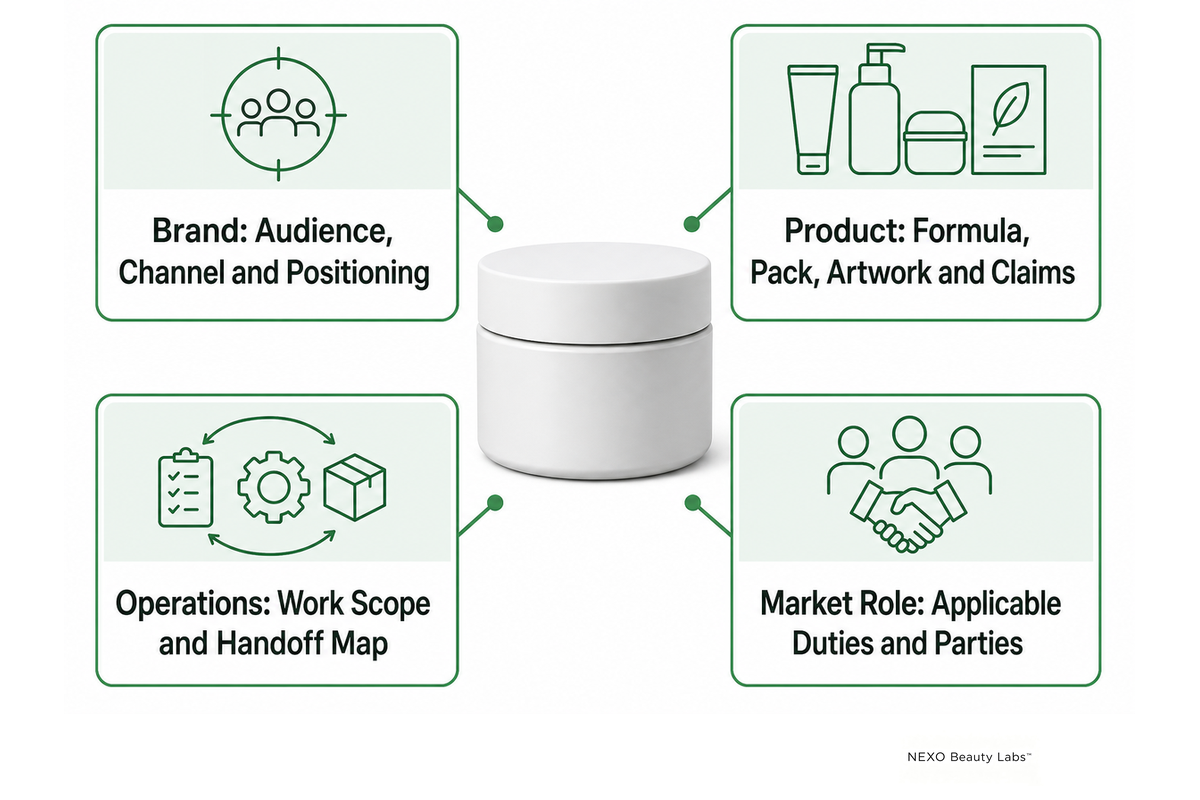
There are four layers that should remain separate: the brand layer, product layer, operations layer, and market role layer. The brand layer captures the aspects of the business related to positioning, customer, channel and brand approval. The product layer captures aspects of the product and includes formula, package, artwork, intended use and claims. The operations layer captures aspects of who performs various operations including development, manufacture, filling, packaging, labeling, testing, storage and shipping. The market role layer captures the parties that are recognized by the law in a given destination market. For example, in the USA, the FDA’s MoCRA overview describes a responsible person as the manufacturer, packer or distributor whose name appears on the label. In another example, the person informally called the product owner by the team, might not be responsible for the legal role defined in MoCRA.
| Layer | Question to answer | Record to preserve |
|---|---|---|
| Brand | Who is the product for, and where will it be sold? | Approved audience, channel, and positioning brief |
| Product | Which exact formula, pack, artwork, use, and claims define it? | Version-controlled product identity |
| Operations | Who performs each development and production step? | Process and handoff map |
| Market role | Which statutory role applies to each party? | Market-specific responsibility register |
Private Label, White Label, or Custom Formulation: Which Route Fits?
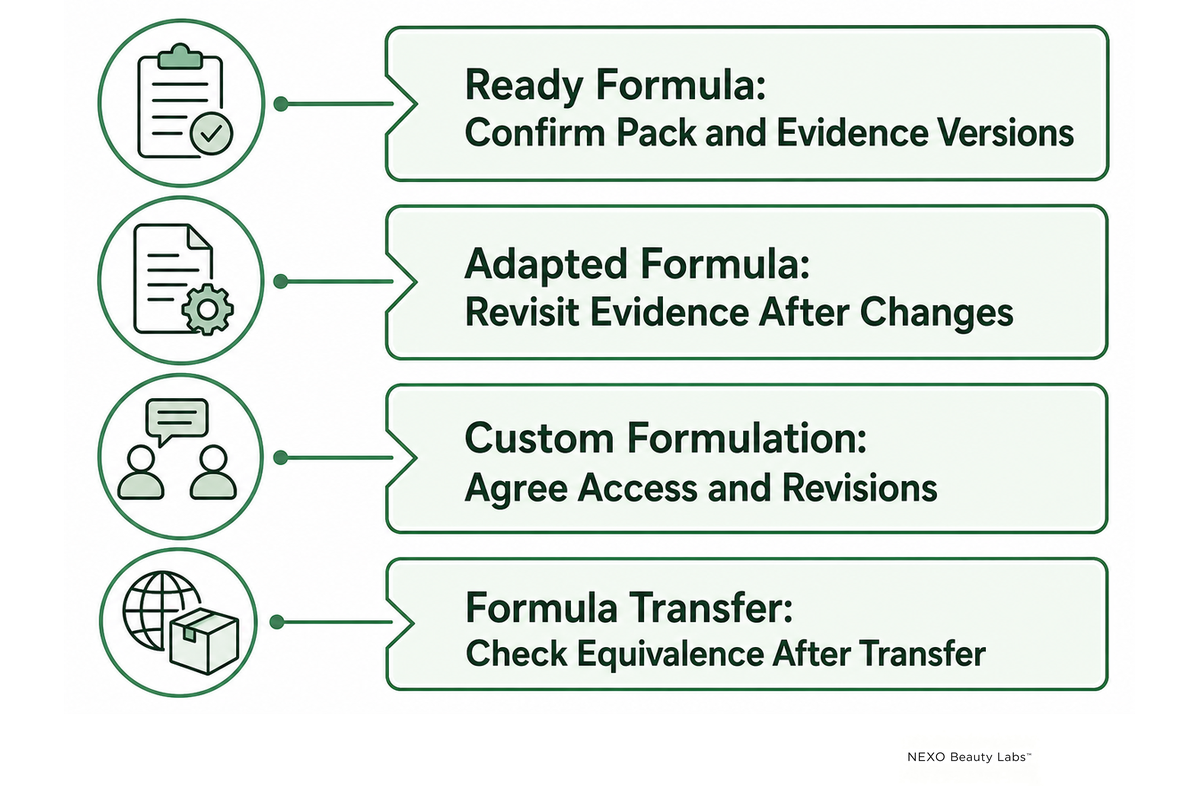
Choose a route by the decisions and records the brand needs to control, not by which label sounds more premium. The same words can describe different operations, and actual operations can affect regulatory roles. The public scope of ISO 22716, for example, covers production, control, storage, and shipment, but excludes research and development. A GMP claim therefore does not tell you who designed the formula or who holds the development record.
Use the private label Control-to-Record Rail to ask the same five questions across every route: What’s changeable by the customer? Who performs the work? Which version is approved? What evidence is created and follows the approved version? What causes the review to be repeated?
| Route | Typical buyer control | Record question | Useful when |
|---|---|---|---|
| Ready formula / white label | Branding, selected pack, and choices offered by the supplier | Which formula and evidence versions apply to this exact pack and claim set? | The supplied product fits without hidden customization |
| Adapted formula | Named sensory, ingredient, fragrance, color, or performance changes | Which earlier evidence survives, and which change needs new work? | A defined base is suitable but specific changes matter |
| Custom formulation | A larger formula and sensory design space | Who owns access, revisions, samples, evidence, and later changes? | Differentiation justifies more decisions and validation |
| Buyer-supplied formula transfer | Existing product definition, subject to transfer feasibility | What proves equivalence after raw-material, site, process, or pack transfer? | The buyer has controlled technical inputs and authority to share them |
Route-name thinking
- Assumes “custom” always means more control
- Treats a ready formula as evidence-free
- Uses one sample as the product definition
- Lets commercial language stand in for roles
Control-to-record thinking
- Names each decision the buyer can make
- Checks evidence against the exact product identity
- Controls formula, pack, artwork, and claim versions
- Separates operational work from statutory roles
Which Product Decisions Must Be Fixed Before Formula Selection?
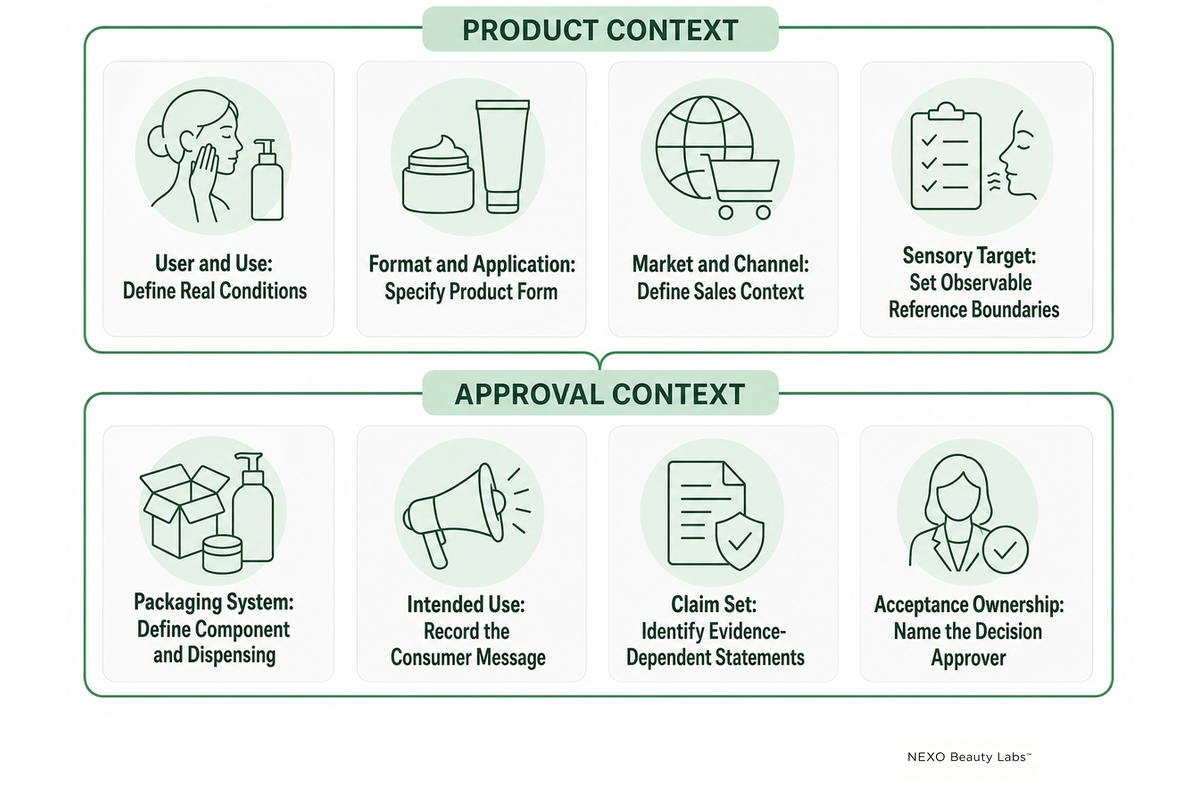
After the route boundary is selected, ingredient wish lists and product briefs still serve different functions. Before a final decision is made regarding the selection or adaptation of a makeup or skin care formula, sufficient context must be provided to the technical team to interpret performance, packaging, evidence, and claims to avoid the following situation: a sample is approved based on one set of expectations and then marketed based on a different set of expectations.
- User and use occasion: who uses the product, where, how often, and with what practical constraints?
- Format and application: cream, wash, serum, balm, stick, color cosmetic, aerosol, powder, or another defined form?
- Sales market and channel: which country or region, online or retail, direct-to-consumer or professional?
- Sensory target: appearance, fragrance, texture, spread, absorption, rinse, finish, color, and reference boundaries?
- Packaging system: component, material, dispensing route, decoration, fill, closure, and consumer-use pattern?
- Exact intended use: what will the label and marketing tell a consumer the product does?
- Claim set: which objective statements may need substantiation, and which wording is still only a concept?
- Acceptance ownership: who can approve a version, reject it, or reopen a decision?
Claims belong in the first brief, not at the end. The FDA Cosmetics Labeling Guide supplies a federal baseline, while the FTC’s advertising-substantiation policy explains why objective express and implied claims need a reasonable basis. Website copy, social posts, demonstrations, testimonials, and packaging can all contribute to the message consumers receive.
How Does Product Format Change the Evidence Plan?
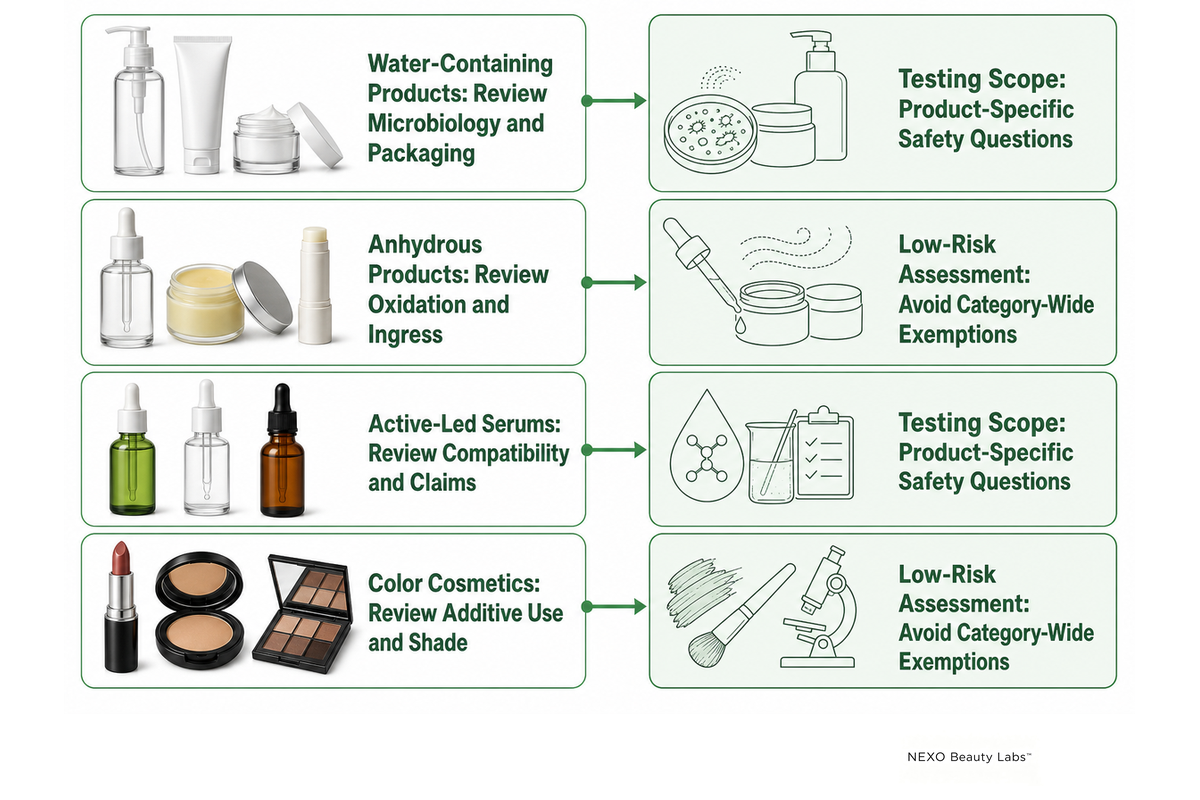
Product format is just one aspect of a complete test plan. Questions vary based on intended use, water activity, raw materials, preservation, package, consumer contact, storage, distribution, claim, market requirements, and regulations. FDA puts the boundary plainly: “We also do not have a list of tests required for any particular cosmetic product or ingredient.” Its product-testing guidance also leaves firms responsible for ensuring safety.
Standards point in the same product-specific direction. ISO 17516:2014 addresses microbiological quality and is currently in a replacement cycle. Its low-risk concept should not be turned into a category-wide exemption. ISO/TR 18811:2018 does not prescribe one universal set of stability conditions, parameters, or acceptance criteria for every cosmetic.
| Product direction | Questions to add | Do not assume |
|---|---|---|
| Water-containing cream, lotion, or wash | Microbiological risk, preservation, viscosity, separation, package contact, dispensing, and use contamination | One certificate covers the finished formula-pack system |
| Anhydrous balm or oil | Oxidation, heat response, crystallization, fragrance/color movement, ingress, and consumer-use pattern | “No water” eliminates every microbiological or stability question |
| Serum or active-led skincare | Ingredient compatibility, pH where relevant, color/odor change, delivery, pack protection, and claim support | An ingredient study proves the finished product’s claim |
| Color cosmetic | Color-additive status, shade control, application, wear, migration, package function, and claim wording | Every pigment or use is permitted in every market and body area |
Who Owns Formula, Packaging, Claims, and Records?
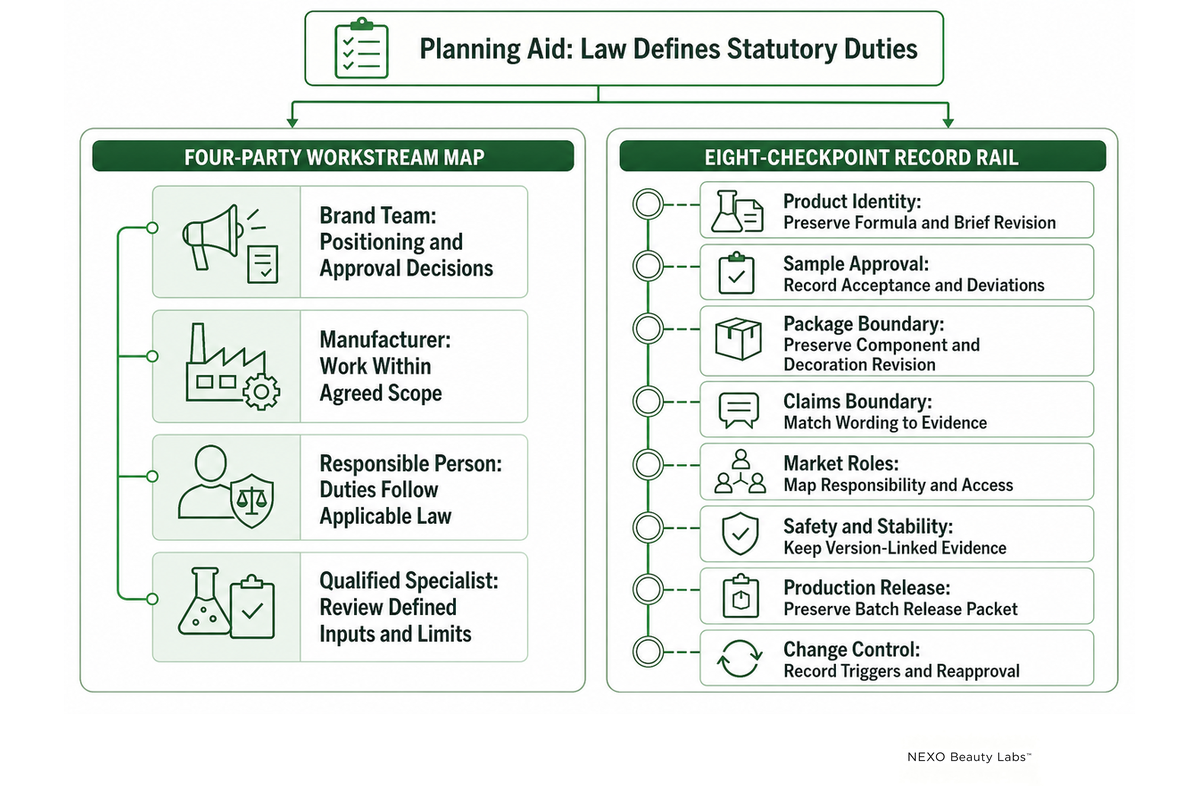
With the product-specific evidence plan defined, avoid using owner to mix five different ideas: who leads an operational task, who has a statutory duty, who holds a record, who may access it, and who approves a decision. The Four-Owner Launch Handshake is a planning name for a four-party workstream. It does not divide FDA obligations among four legal owners.
| Workstream party | Operational lead questions | Record and access questions | Role limit |
|---|---|---|---|
| Brand team | Audience, channel, positioning, artwork, and approval decisions | Which technical and market records must remain accessible? | Brand leadership does not itself prove a statutory role |
| Manufacturer | Development, production, control, storage, or shipment within the agreed scope | What is created, held, shared, retained, or changed? | The contract scope does not automatically absorb every market duty |
| Responsible person | Duties tied to the applicable market and actual label role | Can required substantiation, listing, and event records be reached? | The definition and duties come from law, not this table |
| Qualified specialist | Safety, regulatory, testing, claims, packaging, or legal review as commissioned | What inputs were reviewed, under which version and limits? | Advice does not silently transfer the client’s duties |
For each launch decision, describe the operational lead, legal responsibility (if any), record holder, access route, approver, retention basis, and change trigger. That structure conveys more fidelity than writing, “manufacturer handles compliance.”
| Decision checkpoint | Evidence source | Buyer check | Project record |
|---|---|---|---|
| Product identity | Controlled brief and formula file | Does the same version define sample and production? | Formula and brief revision |
| Sample approval | Review notes and acceptance criteria | What did the sample prove and leave open? | Signed approval and deviations |
| Package boundary | Component specification and compatibility work | Was the commercial package actually assessed? | Component and decoration revision |
| Claims boundary | Claim register and substantiation | Does evidence support the exact wording and context? | Approved claim-to-evidence map |
| Market roles | Label, agreements, and destination-market review | Who performs, holds, accesses, and approves? | Responsibility and access matrix |
| Safety and stability | Product-specific rationale and results | Do the records follow the approved formula-pack pair? | Evidence index and access route |
| Production release | Batch, quality, filling, and release records | Do release criteria match the approved version? | Batch release packet |
| Change control | Notification, impact review, and reapproval | Which changes reopen formula, package, claim, or evidence decisions? | Change trigger and decision history |
What Evidence Should Exist Before a Sample Is Approved?
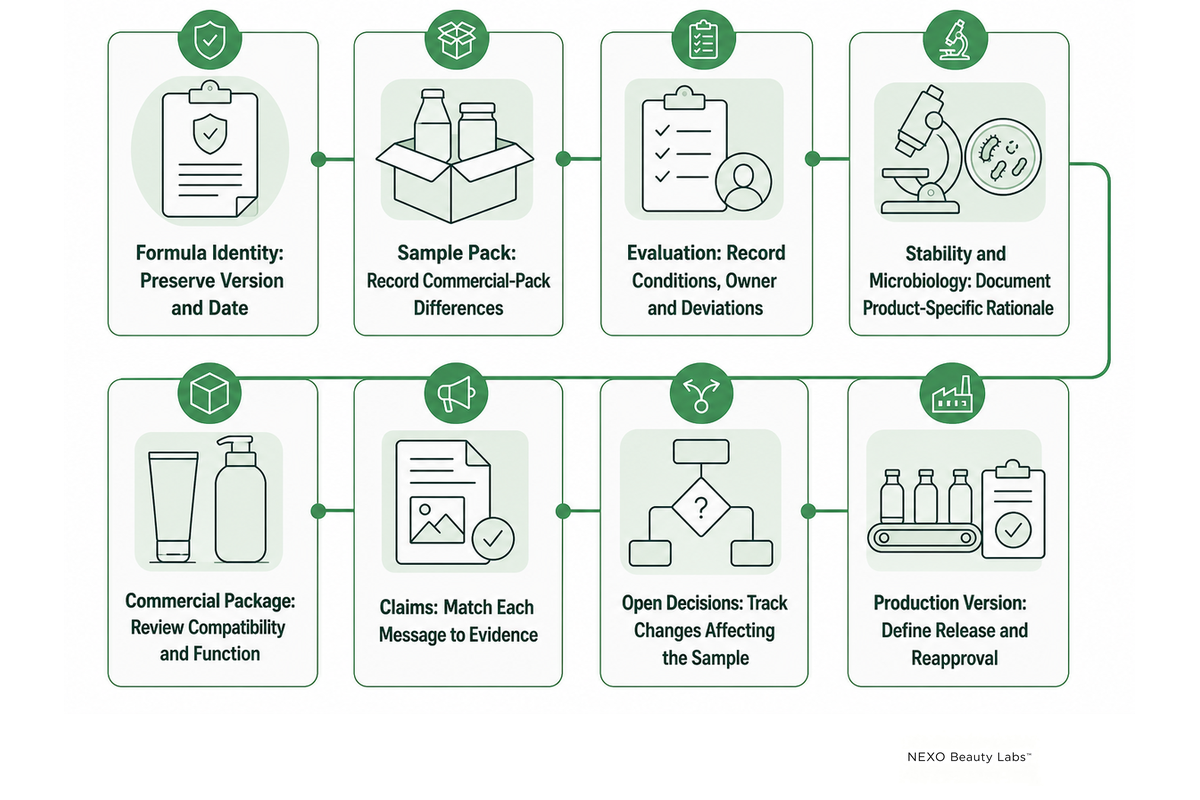
Review samples show a product under defined conditions, but they do not by themselves establish shelf life, microbiological quality, package compatibility, claim support, production consistency, or market compliance; each approval therefore needs a version-linked formula, package, evidence plan, acceptance owner, and open-questions record.
Sample approval boundary: Before approval, record exactly which formula and package versions were assessed, what the sample is allowed to prove, and which questions remain open, because a review sample alone does not establish the evidence plan for the commercial formula-pack system.
- Formula identifier, version, date, and controlled sensory description
- Exact sample pack or a documented statement that the commercial pack is still different
- Evaluation conditions, panel or decision owner, findings, and deviations
- Planned stability and microbiological rationale for the actual formula and intended use
- Package compatibility and function questions for the commercial component
- Claim-to-evidence map covering pack, website, advertising, and demonstrations
- Raw-material, fragrance, color, artwork, and market decisions still capable of changing the sample
- Release criteria for the production version and triggers for reapproval
NEXO’s separate guides explain why cosmetic stability testing and cosmetic packaging compatibility testing remain distinct scopes. That separation is consistent with the product-specific approach in FDA testing guidance and ISO/TR 18811. An appealing product appearance at a review point cannot answer all the questions that a product distribution and consumer use will raise.
What Do US Cosmetic Rules Mean for a Private Label Brand?
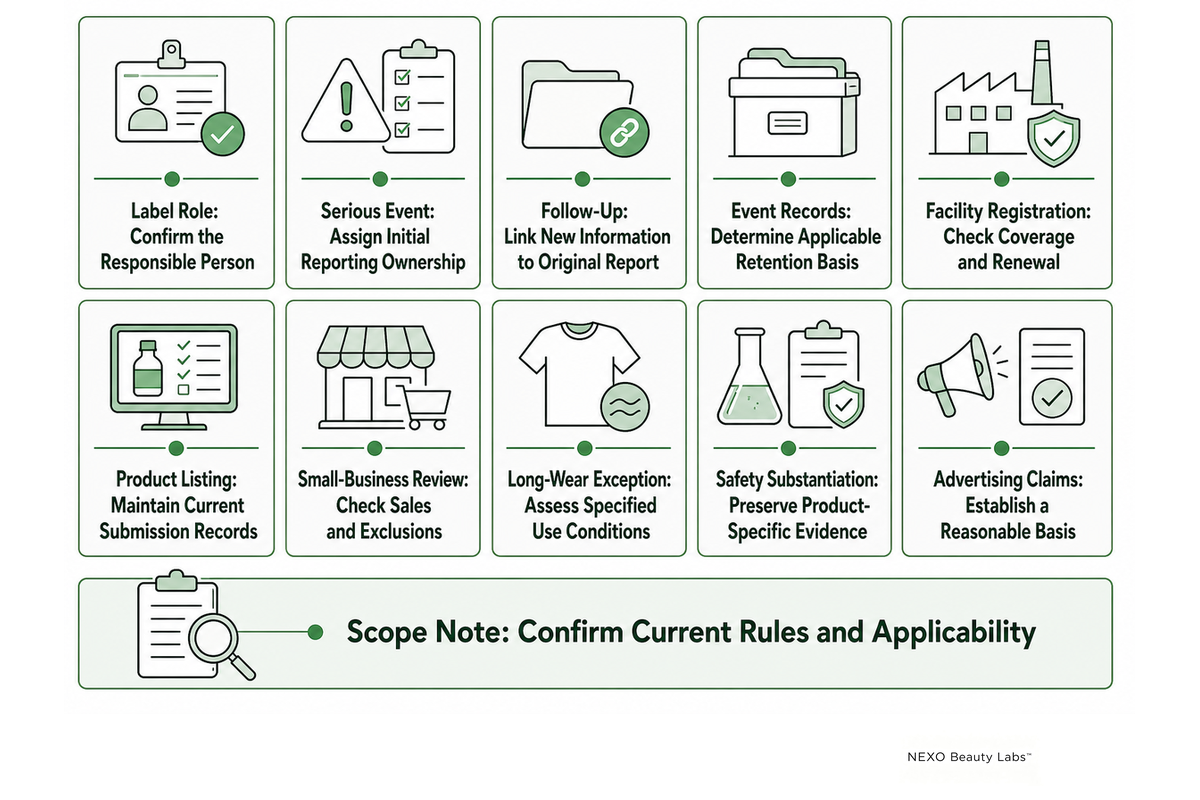
Most cosmetics and cosmetic ingredients are not FDA pre-approved, with color additives as an important exception, so a private label brand must still map the responsible person, covered facilities, safety-substantiation records, product listings, claims, and market-specific duties for the actual product. The FDA authority page is useful precisely because it separates lack of ordinary premarket approval from lack of regulation.
Under MoCRA, the label-defined responsible person and covered facilities can have different duties. Serious adverse event reporting, safety-substantiation records, facility registration, product listing, and updates should be aligned against the facts of the project. Conditional small-business exemptions don’t cover all product categories, thus a brand shouldn’t take an exemption call based on revenue alone.
Registration and listing should not be confused with approval or certification. In its September 2026 update, FDA states on the registration and listing page that it does not issue a certificate verifying compliance with cosmetic facility registration. A registration number is not proof that the finished product is approved, safe, correctly labeled, or supported for every claim.
Timing cues must be assigned as carefully as roles. FDA’s current pages describe an initial serious-adverse-event report within 15 business days , follow-up information received within 1 year of the initial report to FDA and reported within 15 business days , record-retention periods of 6 years or 3 years for a qualifying small business, facility renewal every 2 years , product-listing updates every 1 year , a 3-year sales lookback in the small-business definition, and an exemption exclusion for products intended to alter appearance for more than 24 hours under customary or usual use when consumer removal is not part of that use . Check the current verbiage and its applicability instead of copying these periods into a generic calendar.
10-Category US Duty-to-Record Map
| Category | Timing or scope cue | Project record | Mistake to avoid |
|---|---|---|---|
| Label role | Determine before market release | Responsible-person determination and contact path | Assuming the contract manufacturer is always the responsible person |
| Initial serious event | 15 business days | Intake, assessment, label copy, submission, and owner | Letting complaints sit outside the reporting path |
| Serious-event follow-up | New information within 1 year of the initial report to FDA; submit within 15 business days | Linked follow-up and original report | Closing the file after the first submission |
| Event records | 6 years generally; 3 years for a qualifying small business | Retention basis and accessible record location | Assuming the factory’s system meets every access need |
| Facility registration | Renew every 2 years when covered | Covered-facility assessment, submission owner, and status | Treating a registration number as product approval |
| Product listing | Update every 1 year when covered | Current product, ingredient, and submission record | Letting formula changes drift away from listing data |
| Small-business review | Prior 3-year average plus product exclusions | Calculation, inflation adjustment, product review, and adviser sign-off | Making the decision from revenue alone |
| Long-wear exception | Appearance alteration over 24 hours under customary or usual use when consumer removal is not part of that use | Product-category and customary-use assessment | Assuming every small-business product is exempt |
| Safety substantiation | Product-specific; no universal FDA test schedule | Qualified review basis and accessible records | Reading “no universal list” as “no evidence needed” |
| Advertising claims | Reasonable basis before dissemination | Label and advertising claim-to-evidence map | Reviewing the package but ignoring online advertising |
For a deeper labeling overview, use NEXO’s cosmetic labeling requirements guide, then obtain qualified advice for the actual product, claims, parties, and markets.
What Evidence Should Be Reviewed Before Commercial Discussions?
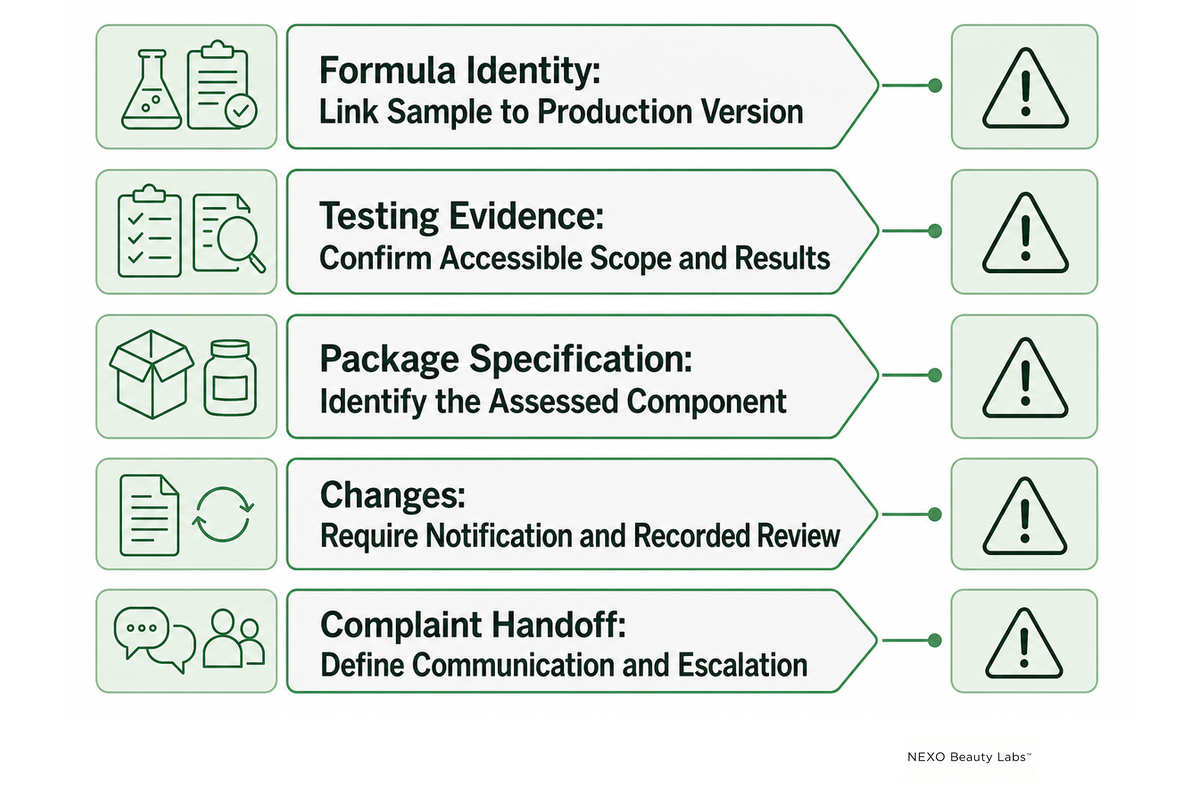
After assigning US duties and market roles, commercial negotiations can take place once the brand draws its evidence boundary. The goal isn’t to rank manufacturers with a unified score. It’s to understand if the records, access, and changes required by the project can be supported by the operating model.
| Record area | Access question | Warning sign |
|---|---|---|
| Formula identity and revision | How will the approved sample map to the production formula? | The sample name is the only identifier |
| Testing rationale and results | Which raw or reviewed evidence can the responsible party access? | A badge or “passed” statement has no scope, version, or result trail |
| Package specification | Which component version was evaluated with which formula? | A visual reference replaces material and component identity |
| Deviation and change | Who is notified before formula, raw material, process, site, pack, or claim changes? | “Equivalent” substitutions require no recorded review |
| Complaint and event handoff | How do records and samples reach the party that must evaluate an event? | No time-bound communication or escalation path |
Generic “high quality” language isn’t a substitute for this review. The relevant evidence may be held by more than one party. A brand therefore needs both custody and access questions. The public NEXO Beauty Labs company profile supplies first-party company context; product-specific evidence still belongs to the defined project and version.
How Do You Move From Sample to Production Without Losing the Approved Product?
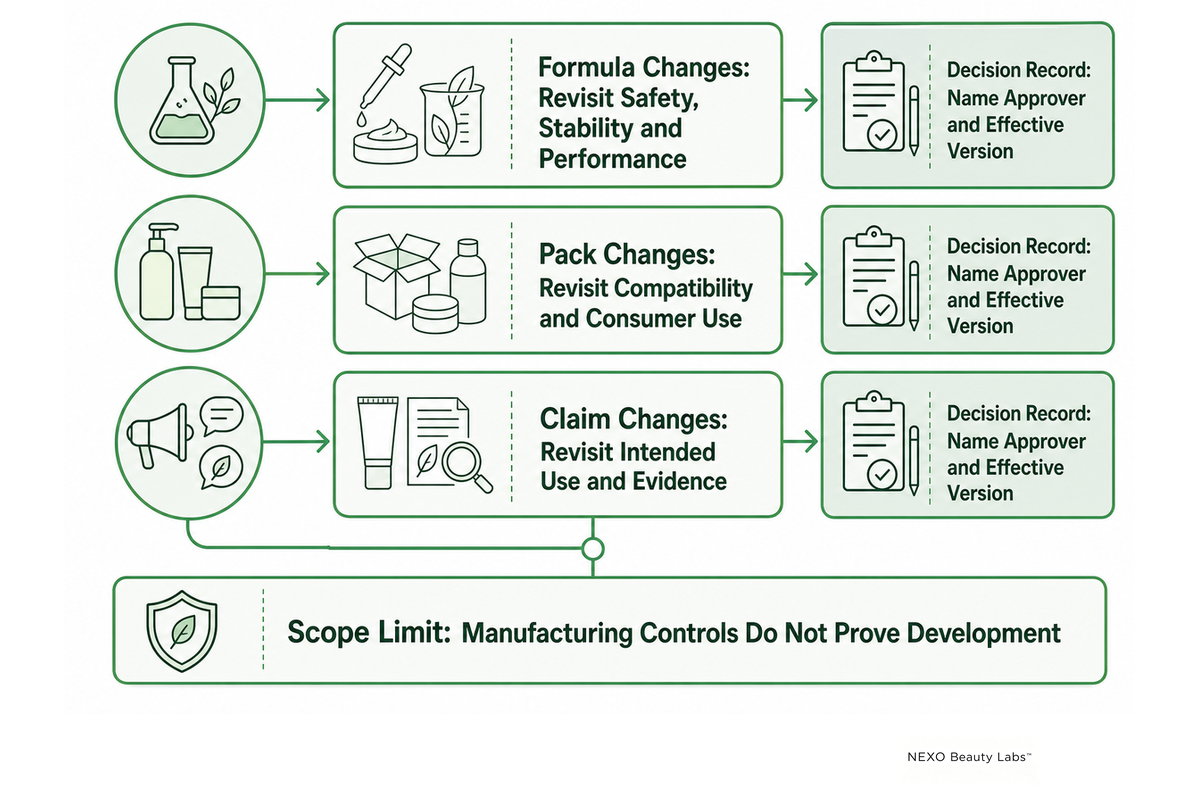
With that evidence boundary in place, a transfer fails when the only handoff instruction is “approved sample.” Production requires a linked identity: formula, raw material requirements, fragrance or shade, package specification, artwork, claims, test plan, release criteria, approved deviations and decision history.
The formula-Pack-Claim Change Trigger Board can be used as an editorial change-control tool. It doesn’t define a uniform revalidation program. It states that a change being considered has to be evaluated by the type of evidence it can influence.
| Change trigger | Evidence to revisit | Decision record |
|---|---|---|
| Formula, raw material, supplier, fragrance, color, or process | Safety basis, stability, microbiological rationale, performance, sensory target, and claims | Impact assessment, additional work, approver, and effective version |
| Bottle, jar, tube, closure, pump, liner, decoration, or fill condition | Compatibility, dispensing, protection, fill, transport, label, and consumer use | Component identity, formula pairing, findings, and release owner |
| Pack, website, social, testimonial, or demonstration claim | Intended use, classification, reasonable basis, qualification, and consistency | Exact wording, audience interpretation, evidence owner, and approval |
ISO 22716 helps define manufacturing-scope controls, but it should not be stretched into formula-development proof or a complete market-access file. The production record should show what enters the controlled process and what independent market decisions are outside of it.
When Is Private Label the Wrong Route?
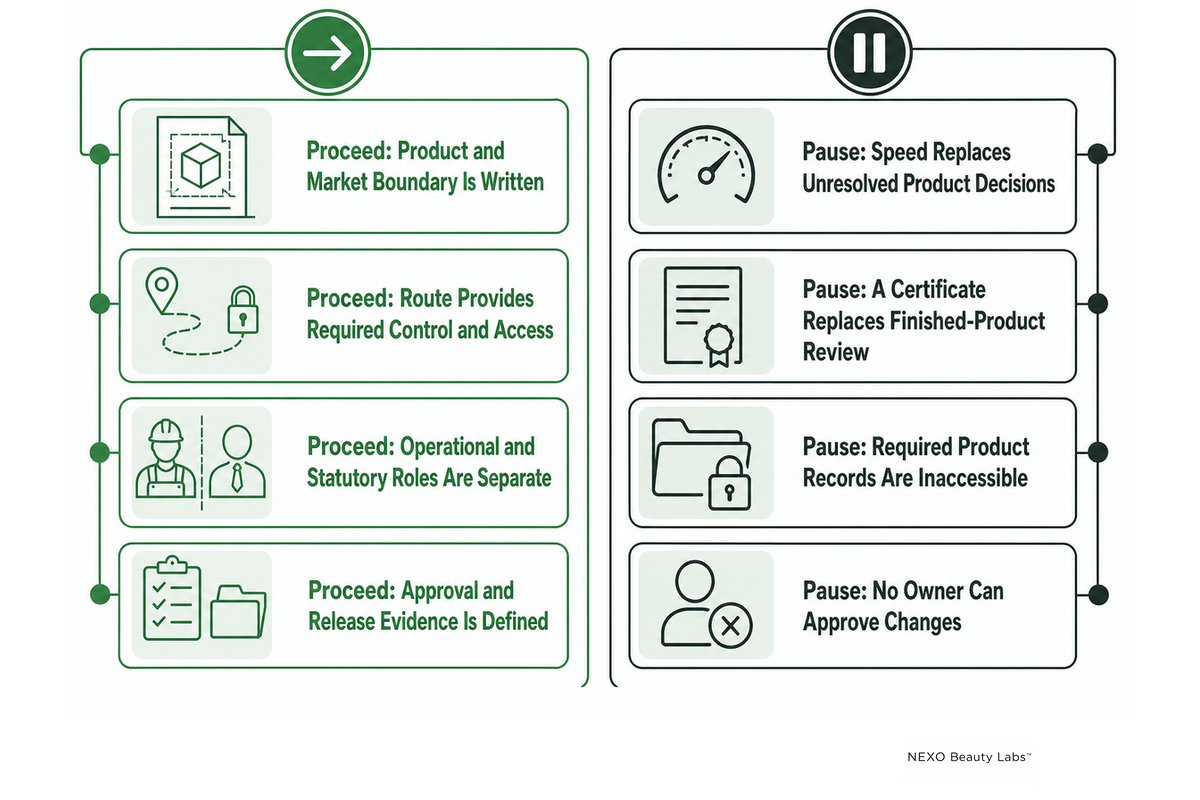
Private label isn’t always a low-risk option. It may not be an appropriate choice if the team needs differentiation that the chosen route can’t provide, the team can’t access the required product-safety evidence, or no one can make the final product identity decision. A project may be commercially premature when demand, inventory exposure, channel economics, or range priorities haven’t been tested. Those business questions should be modeled with current inputs, not answered by a market-growth headline.
Proceed when
- The product, user, market, pack, and claim boundary is written
- The route provides the control and record access the brand needs
- Operational and statutory roles are separately assigned
- Sample approval and production release have defined evidence
Pause when
- Speed is being used to avoid unresolved product decisions
- A certificate is expected to replace finished-product review
- The formula, pack, claim, or responsible-person record is inaccessible
- No one can approve changes or carry the inventory decision
What Belongs in the Project Handoff Record?
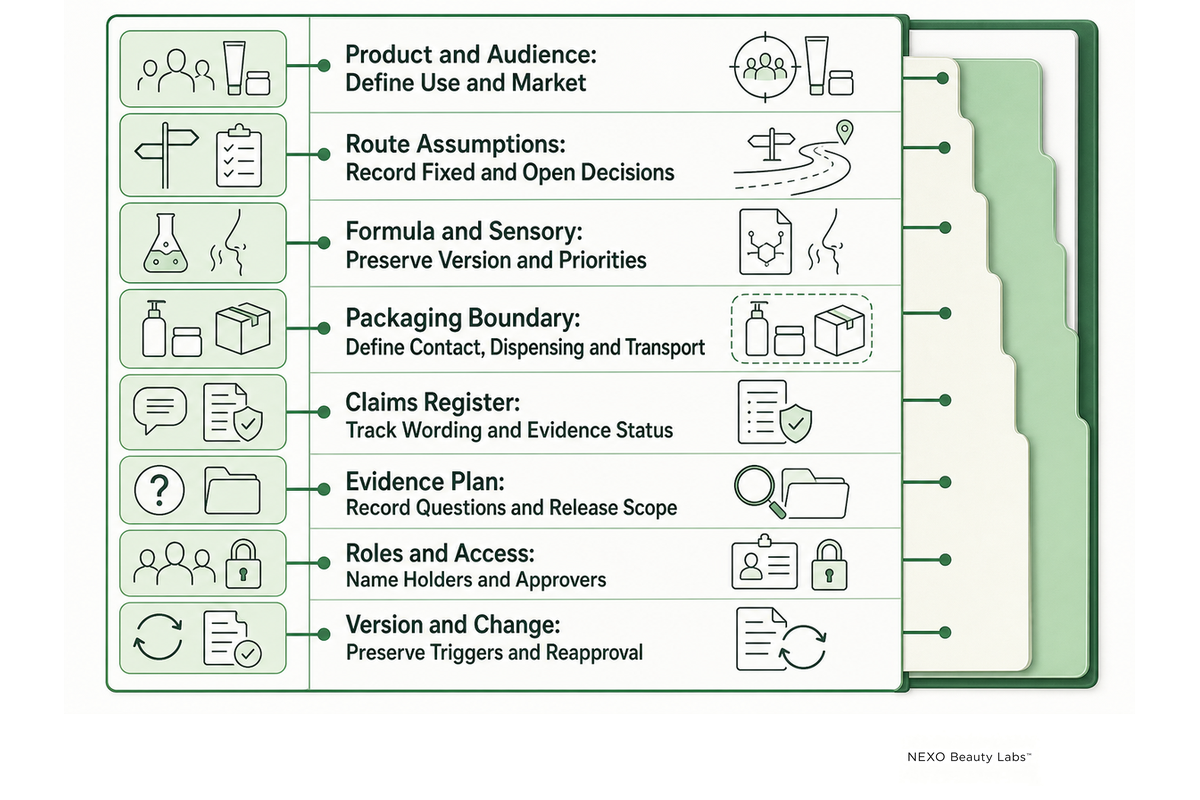
If the route remains suitable, a good handoff record isn’t a request for the lowest price. It’s the internal baseline the brand freezes prior to a commercial discussion. It should be a living document that’s short enough to review and controlled enough to trace a subsequent sample or quote to the same project.
- Product and audience: format, use occasion, target user, channel, and intended markets.
- Route assumptions: ready, adapted, custom, or transferred formula, and which decisions remain open.
- Formula and sensory target: version, references, exclusions, priority attributes, and claim implications.
- Packaging boundary: component direction, formula-contact materials, dispensing, decoration, transport, and open choices.
- Claims register: exact proposed pack and advertising wording, evidence status, and approval owner.
- Evidence plan: safety, stability, microbiological, compatibility, performance, market, and release questions.
- Roles and access: operational lead, statutory role, record holder, access route, approver, and adviser scope.
- Version and change rule: current revision, open decisions, notification triggers, and reapproval path.
Once those fields are controlled, the brand can move to the established private label cosmetics manufacturing options page for capabilities and commercial discussion without turning this guide into a second RFQ page.
Key takeaway
A private label project becomes controllable when the route, product identity, evidence, roles, record access, approval, and change triggers all describe the same version.
Discuss a Defined Private Label Cosmetics Project
Frequently Asked Questions
Are private label products legal?
Yes. Private labeling is a lawful business model, but the finished cosmetic and the companies involved still have to meet the rules that apply in each sales market. In the United States, cosmetics are generally not pre-approved by FDA, while labeling, safety substantiation, facility registration, product listing, adverse-event handling, and claim boundaries may still create duties. Put the responsible party for each duty in writing and obtain qualified regulatory advice for the actual product and market.
Is private label cosmetics profitable?
Private labeling can be profitable, but choosing this route won’t guarantee margin. Margin will be determined by validated demand, selling price, landed cost, inventory sell through, packaging, testing, fulfillment, and marketing, as well as returns, channel fees, and the retailer or distributor margin. Model one defined product and channel prior to expanding the range. A small well-evidenced assortment may be healthier than a large, broad assortment that ties cash up in slow moving inventory.
Do I need FDA approval to sell cosmetics?
Most cosmetics are not subject to FDA premarket approval in the way new drugs are, with color additives as an important exception. That does not mean a cosmetic is unregulated or FDA approved. The responsible person and covered facilities may have duties under federal law, and claims can change a product’s regulatory category. Confirm current requirements for the formula, label, claims, manufacturing locations, and sales markets before launch.
What is the difference between private label and white label cosmetics?
Usage varies by supplier. White label may describe a ready formula with limited choices, while private label may allow adaptation. Neither term guarantees formula exclusivity, record ownership, package compatibility, or a particular regulatory role. Compare the actual operations, records, change rules, and agreement.
How are private label cosmetics made?
Private label cosmetics move from a controlled product brief through formula selection, sample and evidence review, artwork approval, production, quality checks, filling, packing, release, and post-market control, with each stage tied to the approved formula, package, claims, records, and change rules.
Which MoCRA timing cues should a private label team track?
Track the applicable 15 business days, 1 year, 15 business days, 6 years, 3 years, 2 years, 1 year, 3 years, and 24 hours scoped above. Confirm the current status with qualified review. The numbers don’t govern all products or parties.
What should I ask a private label cosmetics manufacturer?
Ask what operations you perform. Which formula and package versions define your sample? Ask what evidence exists for that specific product. Ask who holds or is responsible for each record. Ask what the brand or responsible person can access. Ask how deviations and substitutions are handled. Ask which changes require notification or reapproval, and discuss price, minimums, and timing only after the product and evidence boundary is clear.
References & Sources
- U.S. FDA: FDA Authority Over Cosmetics
- U.S. FDA: Modernization of cosmetics Regulation Act of 2022 (MoCRA)
- U.S. FDA: Product Testing of Cosmetics
- U.S. FDA: Registration & Listing of cosmetic Product Facilities and Products
- U.S. FDA: Draft Guidance on Records Access Authority for cosmetic Products
- U.S. FDA: Cosmetics Labeling Guide
- U.S. FTC: Policy Statement Regarding Advertising Substantiation
- ISO 22716:2007, Cosmetics, Good Manufacturing Practices
- ISO 17516:2014, Cosmetics, Microbiology, Microbiological Limits
- ISO/TR 18811:2018, cosmetics, Guidelines on the Stability Testing of Cosmetic Products