Get in touch with NEXO Beauty Labs Company


Cosmetic Stability Testing: A 7-Decision Protocol Guide

Cosmetic stability testing is a product-specific study of whether selected formula and package attributes remain within predefined specifications under named conditions and time points. The purpose of stability testing is to support a bounded decision, not to turn a few accelerated weeks into a guaranteed shelf life or replace broader product safety, microbiological, packaging, or regulatory evidence.
The short answer
Classify the product first, then lock seven decisions: intended use, exact formula, exact package, relevant exposures, measurements, acceptance logic, and change control. Any stability conclusion is only as broad as the product system and protocol that produced it.
Classify the product first, then lock seven decisions: intended use, exact formula, exact package, relevant exposures, measurements, acceptance logic, and change control. Any stability conclusion is only as broad as the product system and protocol that produced it.
What Cosmetic Stability Testing Can and Cannot Prove
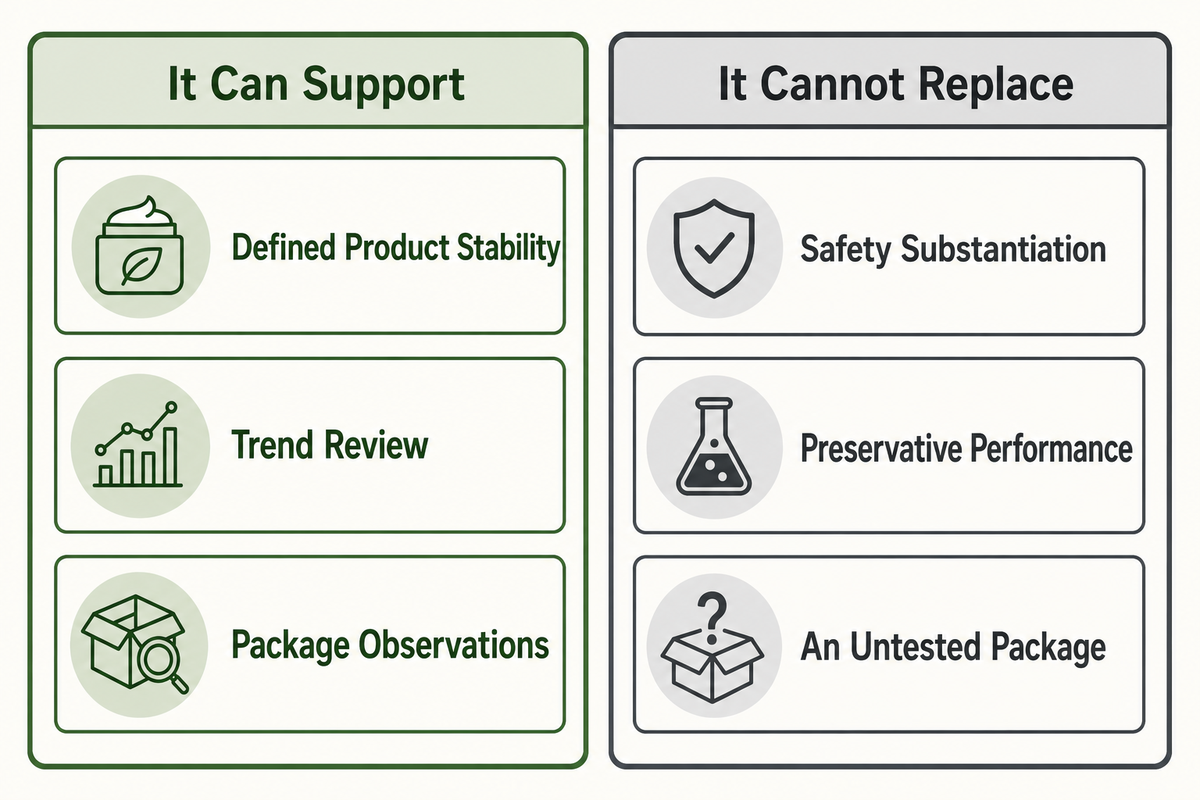
Each cosmetic stability test records whether chosen product attributes remain within predefined specifications under named conditions and time points. It can support a decision about the represented formula and package, but it cannot alone prove complete safety substantiation, preservative performance, every consumer-use condition, or a package that was never tested.
It can support
Defined product stability, trend review, package observations, a justified shelf-life assessment, and change-control decisions within the study scope.
Defined product stability, trend review, package observations, a justified shelf-life assessment, and change-control decisions within the study scope.
It cannot replace
Safety substantiation, product classification, suitable microbiological testing, claims evidence, market duties, or evidence for an unrepresented commercial pack.
Safety substantiation, product classification, suitable microbiological testing, claims evidence, market duties, or evidence for an unrepresented commercial pack.
The ISO/TR 18811 public abstract does not set one list of conditions, parameters, or criteria for all cosmetics. The United States Food and Drug Administration also says it has no required test list for every cosmetic product or ingredient. Separately, 21 U.S.C. § 364d requires the responsible person to ensure and maintain records supporting adequate safety substantiation, so the stability of the product is one evidence question rather than the complete substantiation record.
“ISO/TR 18811:2018 does not aim to specify the conditions, parameters or criteria of stability testing.”
Classification comes first
This flexible cosmetic-only framework doesn’t cover every personal care product sold in a cosmetic format. In the United States, sunscreen products, acne treatments, and other products regulated as drugs or as both drugs and cosmetics must be assessed under the applicable drug stability and expiration-dating pathway; 21 C.F.R. § 211.137 sets the expiration-dating rule and its stated exemptions.
This flexible cosmetic-only framework doesn’t cover every personal care product sold in a cosmetic format. In the United States, sunscreen products, acne treatments, and other products regulated as drugs or as both drugs and cosmetics must be assessed under the applicable drug stability and expiration-dating pathway; 21 C.F.R. § 211.137 sets the expiration-dating rule and its stated exemptions.
Separate the Five Cosmetic Stability Evidence Tracks
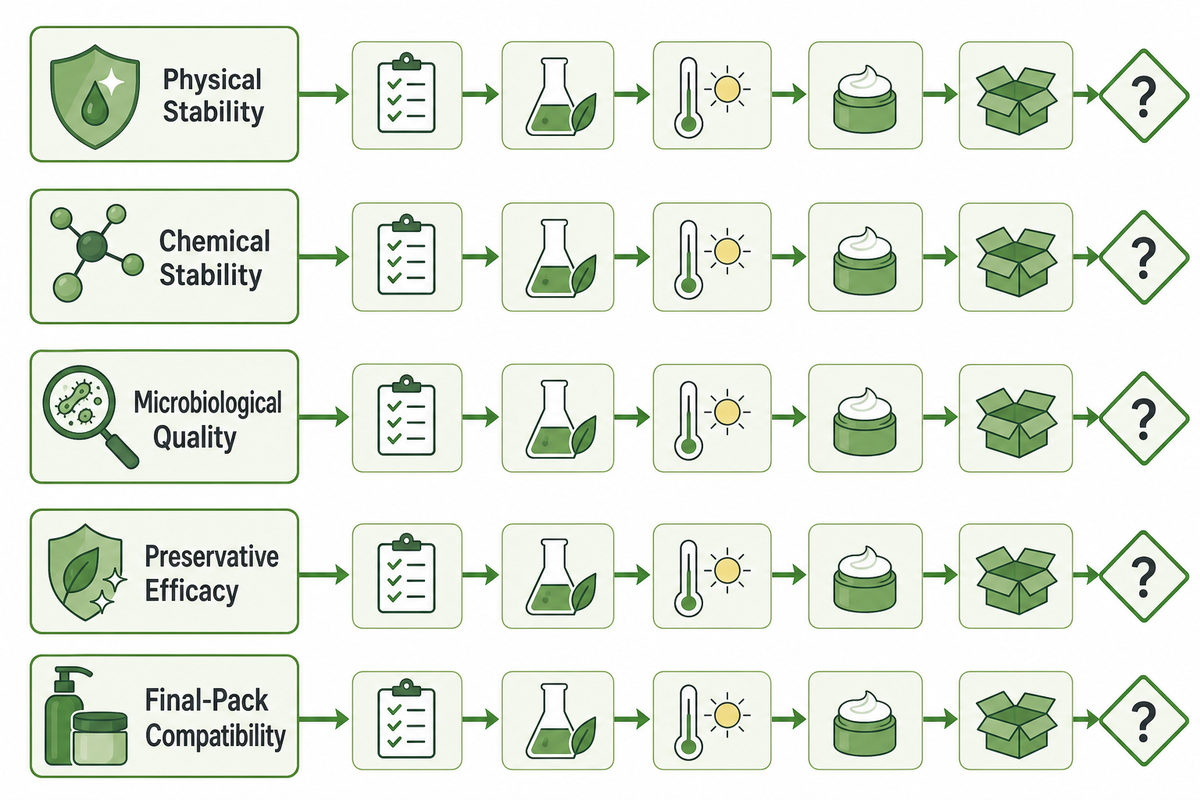
Use five coordinated evidence tracks instead of treating one report as an answer to everything. Physical and chemical stability, microbiological quality, preservative efficacy, and packaging compatibility each ask a different question, rely on their own test methods, and have limits that should be visible before testing starts.
| Evidence track | Decision question | Typical observation | Owner | Cannot prove alone |
|---|---|---|---|---|
| Physical stability | Does form and structure remain acceptable? | Appearance, separation, crystals, viscosity | Research and development / quality | Chemical or microbial status |
| Chemical stability | Do selected chemical attributes remain in specification? | pH, assay where relevant, degradation signal | Laboratory / quality | Package function or full safety |
| Microbiological quality | What is the contamination status under the method? | Counts and specified organisms | Microbiology / quality | Preservative response under challenge |
| Preservative efficacy | How does the preservation system respond? | Method-specific response and criteria | Microbiology / quality | All products or every use exposure |
| Final-pack compatibility | Do formula and commercial package remain fit together? | Mass, leakage, function, material or decoration change | Packaging / quality | Bulk formula stability in every pack |
The distinction matters most in microbiology. Microbial counts and preservative efficacy testing answer related but different questions, and the ISO 11930 public scope excludes products already determined to be microbiologically low risk from the reference test’s ordinary application.
Buyer objection: “One stability report covers everything.”
Ask the report to name the evidence track, method, sample identity, time point, criterion, and limitation. Headings such as “microbiological properties” or “compatibility test” aren’t enough unless the report names the applicable chemical and microbiological quality standards and the underlying decision.
Ask the report to name the evidence track, method, sample identity, time point, criterion, and limitation. Headings such as “microbiological properties” or “compatibility test” aren’t enough unless the report names the applicable chemical and microbiological quality standards and the underlying decision.
Define Protocol Inputs Before Samples Enter Testing
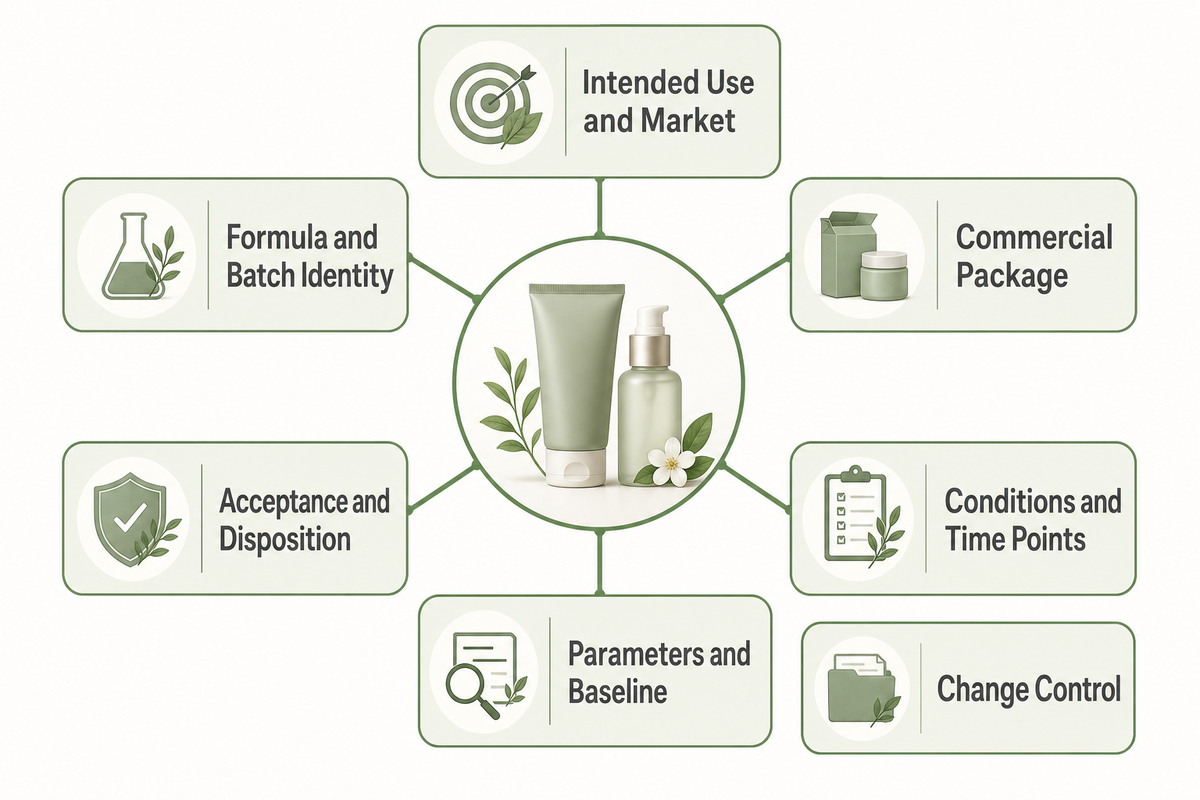
Defensible stability testing protocols begin before the laboratory receives samples. Freeze the intended market and use, formula and batch, final packaging, expected environmental conditions, shelf-life goal, test methods, baselines, time points, specifications, deviation path, disposition owner, and change-control triggers in one controlled brief.
Seven-Decision Stability Brief
- 1. Intended use and market
Classification, directions, consumer behavior, channel, transport, and climate. - 2. Formula and batch identity
Exact version, raw-material references, sample status, and manufacturing record. - 3. Commercial package
Container, closure, liner, pump, tube, jar, label, decoration, fill, and headspace. - 4. Conditions and time points
Relevant storage conditions, transport exposures, orientation, light, temperature and relative humidity. - 5. Parameters and baseline
Appearance, odor, color, pH, viscosity, mass, package function, and suitable analytical testing. - 6. Acceptance and disposition
Specifications, observation language, replicates, deviations, review, and decision owner. - 7. Change control
Formula, supplier, process, scale, site, fill, and package triggers.
Customary use belongs in the brief, not only unopened storage. The Food and Drug Administration lists consumer finger contact as a possible microbial contamination route; exposed applicators, bathroom moisture, sunlight, air, and heat can also make a retained sample and an in-use product experience different conditions.
Assign the decision, not just the task
Research and development owns formula identity and methods; packaging owns component identity; quality owns specifications and disposition; regulatory interprets the market boundary; procurement compares providers without deleting technical inputs. The linked laboratory brief readiness check can expose missing fields before a quotation is treated as comparable.
Research and development owns formula identity and methods; packaging owns component identity; quality owns specifications and disposition; regulatory interprets the market boundary; procurement compares providers without deleting technical inputs. The linked laboratory brief readiness check can expose missing fields before a quotation is treated as comparable.
Accelerated vs Real-Time Stability Testing: No Universal Multiplier
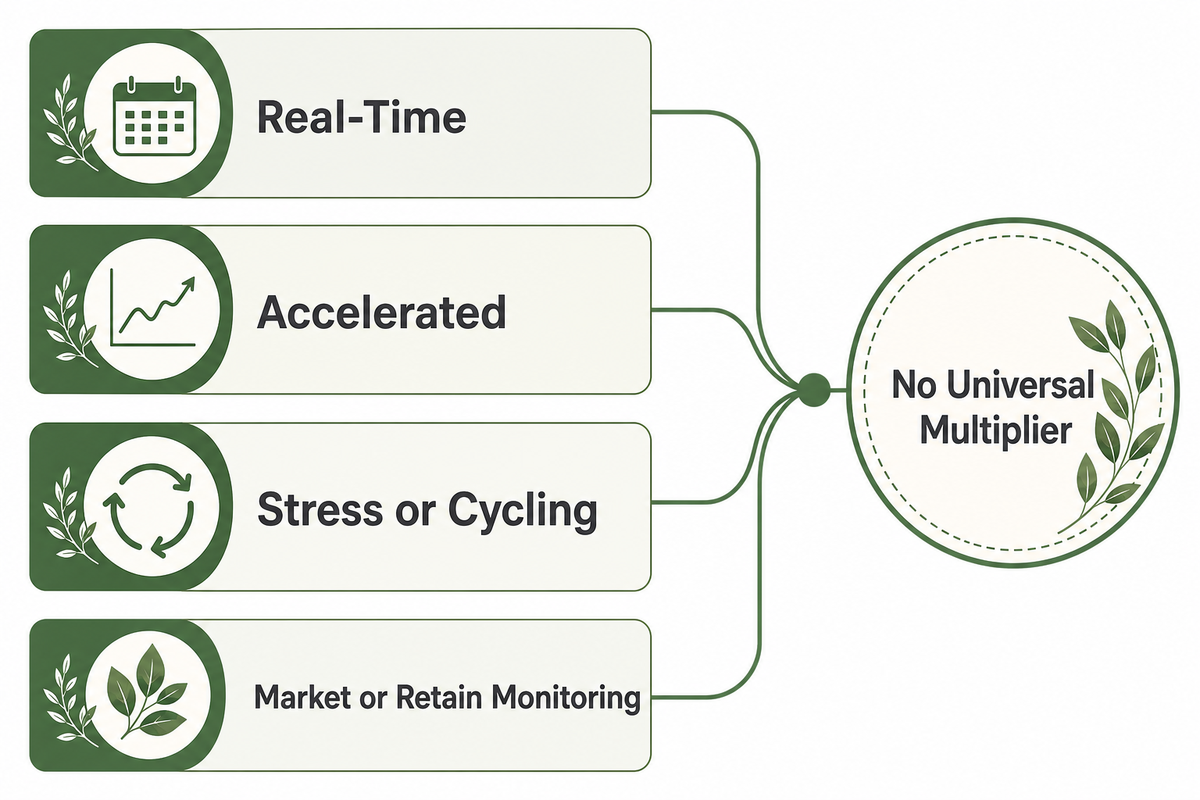
No universal cosmetic calculation makes three months under accelerated conditions equal a two-year intended shelf life. Accelerated stability testing can reveal sensitivity sooner, while real-time stability shows behavior under intended storage over time; any extrapolation needs product-specific conditions, methods, criteria, formula and package identity, and scientific reasoning.
| Study role | What it supports | Typical use | Evidence limit | Confirmation |
|---|---|---|---|---|
| Real-time | Behavior under intended storage | Long-term stability and shelf-life support | Cannot cover untested use or package changes | Ongoing review through the planned period |
| Accelerated | Earlier change signals under selected stress | Comparison, sensitivity, provisional assessment | High temperature can change the degradation mechanism | Product-specific real-time or ongoing evidence |
| Stress or cycling | Weakness exploration | Temperature testing, light, freeze-thaw, transport questions | Not a direct market-life clock | Confirm relevant signals under intended conditions |
| Market or retain monitoring | Behavior after production and release | Trend review, complaints, retained samples | Does not repair a weak original protocol | Change control and investigation |
Decision framework only. This table does not prescribe a specific temperature, humidity, duration, or shelf-life conversion.
The Cosmetics Europe guideline recommends supporting accelerated forecasts with continuing ambient observations of the product throughout its shelf life, but it also says standard tests cannot cover the wide variety of cosmetic products and various conditions. That is why an accelerated stability testing and shelf life calculation for cosmetics must show its assumptions, including specific temperature and humidity choices, instead of borrowing a fixed multiplier from a supplier page.
Three checks against common assumptions
- An accelerated pass is not always proof of the intended shelf life.
- More test rows are not necessarily better evidence when methods, criteria, or ownership are missing.
- A common assumption that every process change needs the same full retest ignores the product-specific review step.
A useful conclusion names its boundary
“The samples met the stated criteria at the scheduled time points under the specified conditions” is auditable. “The product is stable for 24 months” is incomplete unless the report shows how those stability test results support determining a product’s shelf life.
“The samples met the stated criteria at the scheduled time points under the specified conditions” is auditable. “The product is stable for 24 months” is incomplete unless the report shows how those stability test results support determining a product’s shelf life.
Choose Parameters, Time Points, and Acceptance Criteria
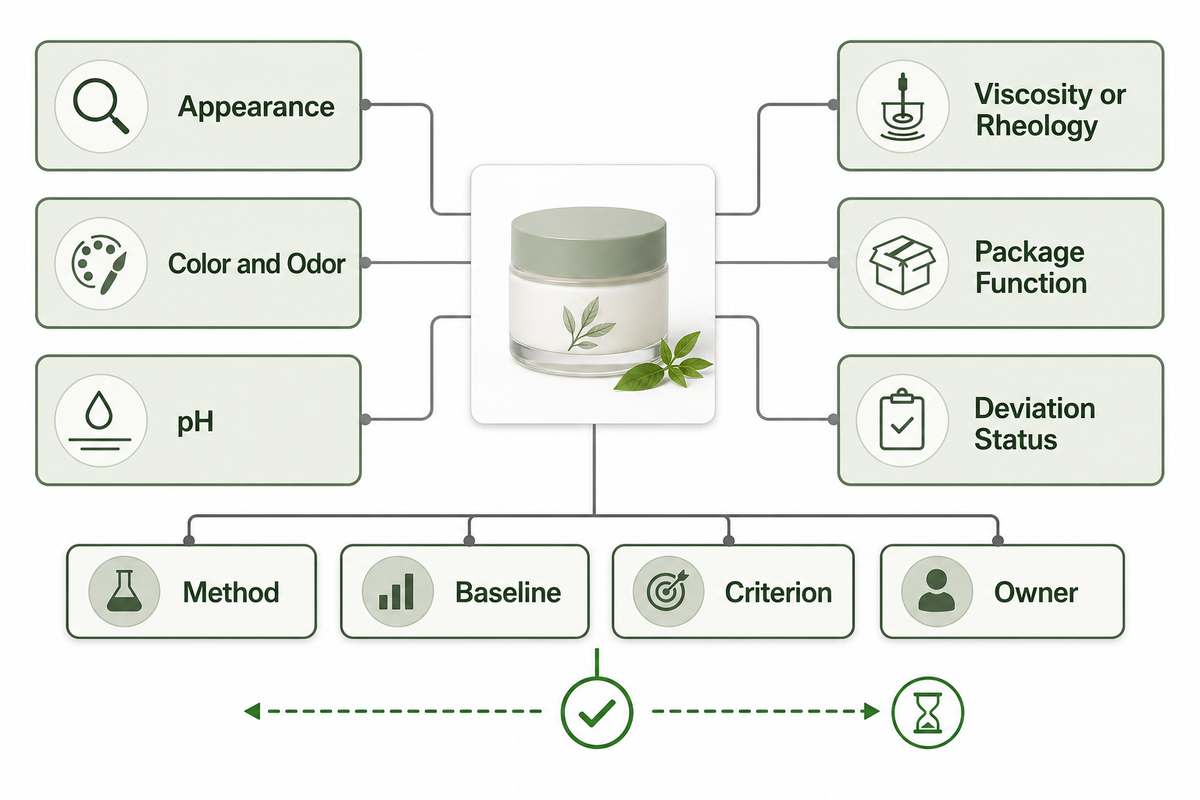
Select parameters from the formulation, dosage form, final packaging, and intended use, known sensitivities, and release risk. Define each test method, baseline, sample or replicate logic, scheduled time point, acceptance criterion, deviation route, and disposition owner before results arrive; a number without its method and specification is not a decision record.
| Parameter type | Why it may matter | Method and baseline | Possible signal | Criterion | Owner |
|---|---|---|---|---|---|
| Appearance | Visible structure and consumer acceptance | Controlled light, reference sample, description scale | Separation, sediment, crystals | Predefined descriptive limit | Quality |
| Color and odor | Oxidation, degradation, or sensory drift | Reference, instrument where suitable, trained review | Discoloration or off-odor | Approved scale and limit | Research and development / quality |
| pH | Formula behavior and defined quality target | Calibrated method, preparation, temperature | Drift from baseline | Formula-specific range | Laboratory |
| Viscosity or rheology | Flow, structure, dose, and separation risk | Instrument, geometry, speed, temperature, sample history | Thickening, thinning, yield change | Method-bound specification | Laboratory / quality |
| Mass | Evaporation, leakage, package barrier | Calibrated balance, orientation, closure state | Weight change | Pack-specific limit | Packaging / quality |
| Package function | Dose delivery and containment | Cycle, leakage, torque, dose or inspection method | Clogging, drift, deformation | Component specification | Packaging |
| Microbiological | Contamination or preservation question | Named microbiological method | Count or method-specific response | Applicable quality standard | Microbiology / quality |
| Chemical marker | Known chemical reaction or active-ingredient risk | Validated or fit-for-purpose analytical testing | Loss or degradant trend | Product-specific limit | Laboratory / regulatory |
| Deviation status | Result traceability | Protocol and investigation record | Missed point or changed method | Resolved before disposition | Quality |
One Lubrizol patent application offers an attributed example of measurable pH, Brookfield viscosity, and coalescence observations for its disclosed emulsion system. Its example includes 1 month at 50 °C, but those figures belong to that formulation and method; they are not universal limits, an International Organization for Standardization method, or a NEXO Beauty Labs specification.
Test the Formula in the Final Commercial Package
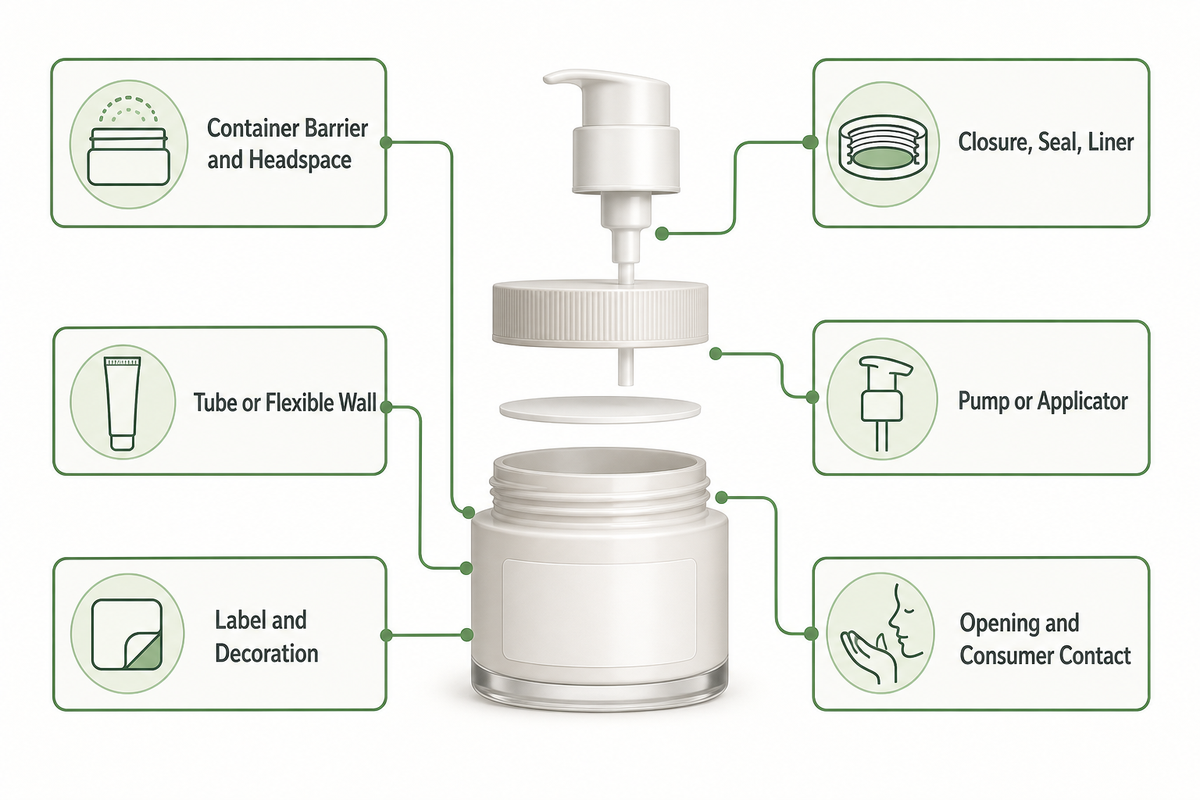
The commercial package is part of the product system being assessed. Barrier properties, headspace, closure seal, dispensing parts, liners, labels, decoration, and packaging materials can change exposure or function, so an inert-container result cannot replace compatibility testing in the intended final configuration.
| Final-Pack Risk Matrix | Possible observation | Measurement or inspection | Owner | Possible decision |
|---|---|---|---|---|
| Container barrier and headspace | Mass, odor, color, texture change | Weight, visual, analytical or sensory method | Packaging / quality | Confirm, change material, or investigate |
| Closure, seal, liner | Leakage, swelling, stress cracking, corrosion | Orientation, seal, torque, dimensional check | Packaging | Adjust component or closure process |
| Pump or applicator | Clogging, dosage drift, poor recovery | Dose mass, cycle test, visual inspection | Packaging / filling | Revise pump, fill, formula, or use direction |
| Tube or flexible wall | Paneling, delamination, deformation | Dimensional and functional inspection | Packaging | Change laminate, fill, or geometry |
| Label and decoration | Lifting, bleeding, abrasion, discoloration | Adhesion, rub, visual and legibility review | Packaging / brand | Change substrate, ink, adhesive, or finish |
| Opening and consumer contact | Air, moisture, finger or applicator exposure | Defined in-use simulation where relevant | Research and development / microbiology | Revise preservation, pack, or use conditions |
These rows are risk-screening examples for testing of packaging, not predictions that every jar, tube, or pump will fail in each way. Keep the component revision tied to the study, and use a fill-and-pack handoff record so the tested pack does not quietly become a different commercial configuration.
Revisit Evidence After Scale-Up or Change Control
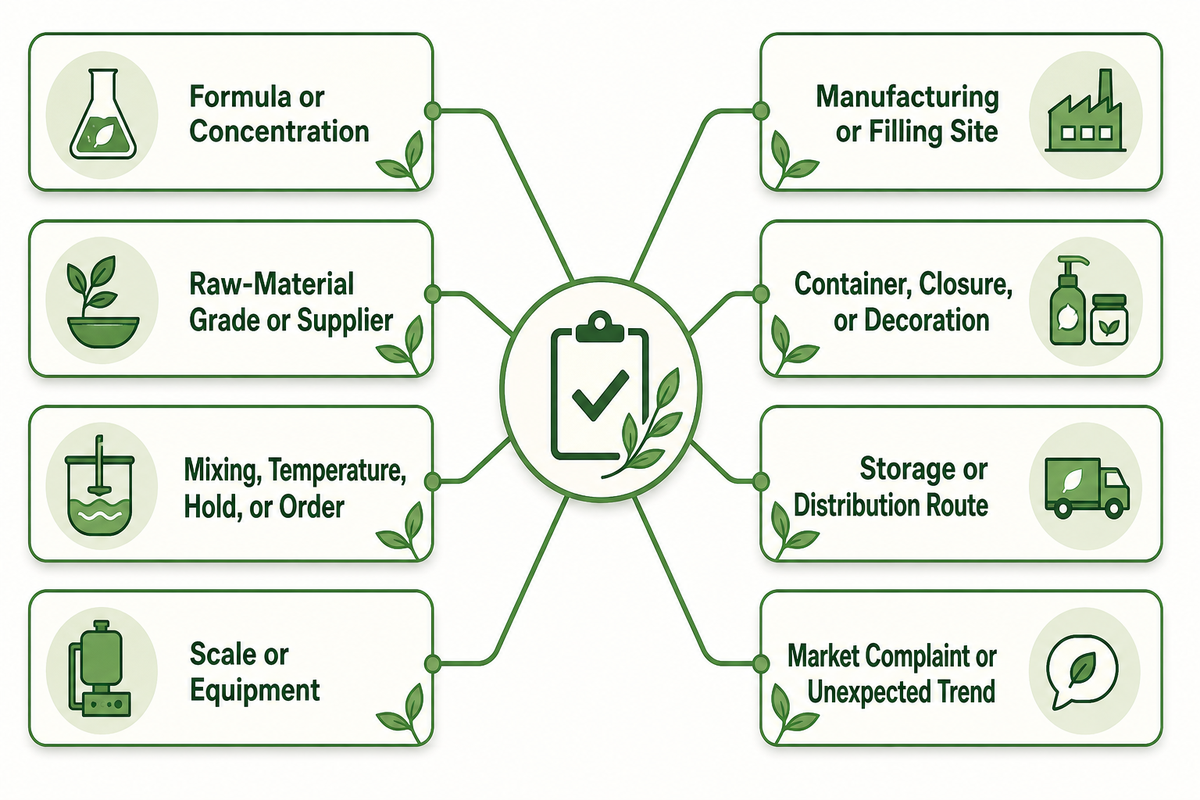
Do not reuse a prior conclusion automatically after a meaningful commercial change. Compare the new formula, material, supplier, equipment, process, scale, site, filling condition, and package with the product system represented in the stability studies, then document whether existing evidence remains applicable, targeted confirmation is enough, or a new study is needed.
| Change-Control Retest Trigger Map | Possible mechanism | Evidence affected | Review owner | Decision rationale |
|---|---|---|---|---|
| Formula or concentration | Structure, pH, preservation, degradation | Physical, chemical, microbial, pack | Research and development / quality | Assess similarity and changed risks |
| Raw-material grade or supplier | Impurities, variability, particle or functional behavior | Relevant parameters and trend | Procurement / research and development | Compare specification and performance evidence |
| Mixing, temperature, hold, or order | Droplet size, crystal structure, air, shear history | Physical stability and process controls | Manufacturing / research and development | Confirm the parameter’s effect in this formula |
| Scale or equipment | Heat and mass transfer, shear, filling behavior | Batch and package evidence | Manufacturing / quality | Use pilot, targeted, or full confirmation by risk |
| Manufacturing or filling site | Equipment, water, controls, transport, hold time | Process, microbial, package | Quality | Review site-specific differences |
| Container, closure, or decoration | Barrier, contact, seal, dose, material interaction | Compatibility and in-use behavior | Packaging / quality | Target the changed interface |
| Storage or distribution route | Temperature, humidity, light, vibration | Conditions and package protection | Supply chain / quality | Add representative exposure if absent |
| Market complaint or unexpected trend | Real-world failure mode not represented | Relevant study and postmarket record | Quality / regulatory | Investigate before extending a pass |
Experimental evidence supports this proportionate approach. In one pharmaceutical emulsion-cream model study containing lidocaine and funded by Pfizer and A*STAR, several homogenization variables had little effect in the studied system, while holding conditions and added paddle-mixer shear changed stability. The result is useful for forming process-review questions, but the commercially funded drug-product model is not independent cosmetic evidence and cannot set a universal cosmetic retest rule.
| Published-study field | Recorded value in that model system | Why it matters here |
|---|---|---|
| Oil and wax screen | Above 15% oil with below 10% emulsifying wax was less stable | Composition and process effects interact |
| Holding-temperature range | 25 °C to 35 °C | Results stay bound to the studied range |
| Paddle-mixer condition | 70 rpm for 30 min | Added shear reduced stability in this system |
| Mid-cooling hold | 20 hours | A hold can be a meaningful process variable |
| Compared homogenization speeds | 2,500 rpm and 8,000 rpm | More speed was not universally better |
| Compared homogenization times | 10 min to 30 min | Longer processing was not automatically critical |
| Cooling rate | 0.25 °C/min | A numeric record makes comparison possible |
| Bottle-test condition | 40 °C and 75% relative humidity | Conditions must travel with the result |
| Centrifugal method | 4,000 rpm at 25 °C for 7.5 hours | Method and unit define the observation |
| Short bottle observation | 1 day versus 6 days | A short result is not a shelf-life conversion |
| Petrolatum comparison | 10% to 20% | Higher content did not guarantee better stability |
Source: Pharmaceutical emulsion-cream model study containing lidocaine and funded by Pfizer and A*STAR. These are attributed drug-product study facts, not independent cosmetic evidence, a cosmetic protocol, pass criteria, or a NEXO method.
Use the Formula-Pack Stability Decision Backbone
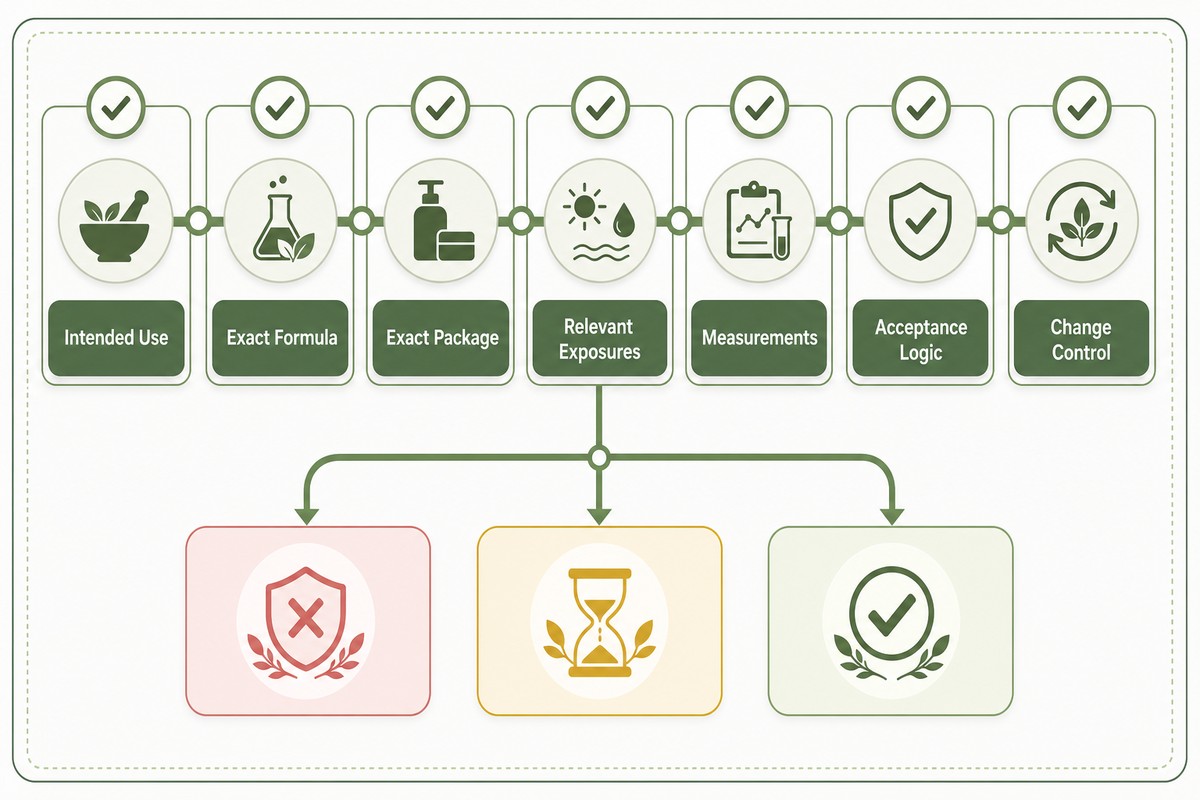
The Formula-Pack Stability Decision Backbone is a seven-check approval record for an appropriate stability testing program: intended use, exact formula, exact package, relevant exposures, measurements, acceptance logic, and change control. If an upstream check is missing, a longer schedule or a clean-looking pass statement cannot repair the unsupported part of the decision.
Cross-functional approval states
READY all seven checks name the represented input, owner, evidence, criterion, and limitation.
INCOMPLETE an input or decision owner is missing, but the gap can be closed before testing or disposition.
UNSUPPORTED the requested conclusion is broader than the formula, pack, method, condition, or evidence actually represented.
Research and development confirms formula identity; packaging confirms the commercial component set; quality control owns specifications and investigation; regulatory separates cosmetic regulation from drug requirements; procurement checks scope comparability. The linked quality-responsibility handoff helps keep those approvals visible.
Editorial framework, not a standard
NEXO’s Formula-Pack Stability Decision Backbone organizes a brief and an approval discussion. It doesn’t replace laboratory judgment, a cosmetic product safety report where applicable, good manufacturing practice, qualified scientific review, or market-specific legal advice.
NEXO’s Formula-Pack Stability Decision Backbone organizes a brief and an approval discussion. It doesn’t replace laboratory judgment, a cosmetic product safety report where applicable, good manufacturing practice, qualified scientific review, or market-specific legal advice.
A Decision-Ready Brief for Stability Testing Cosmetic Products
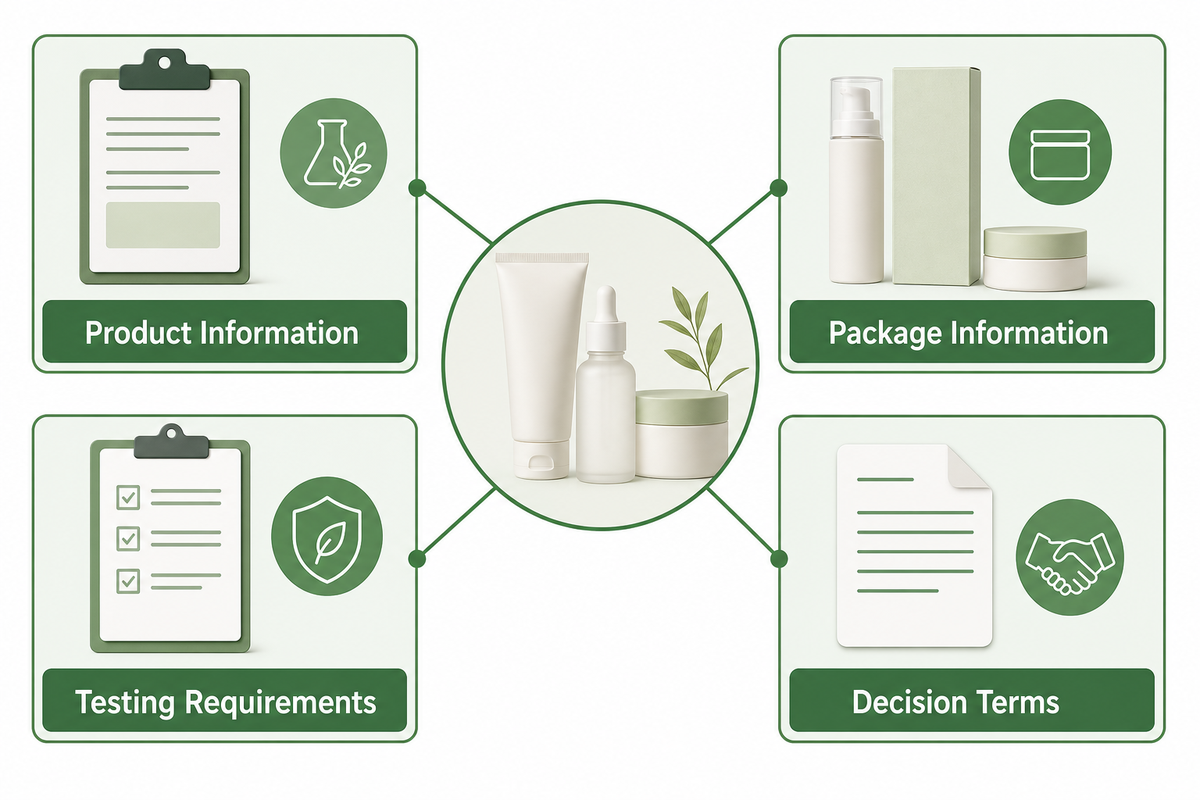
Send more than a product name and desired expiration date when requesting stability testing for cosmetics. Comparable requests identify the exact formula and batch status, market and customary use, final package, storage and transport context, intended shelf life, evidence tracks, methods or method owner, time points, specifications, samples, reporting format, deviations, and change-control expectations.
Search labels such as “cosmetic stability testing guidelines” or “cosmetic shelf life testing” are not sufficient laboratory scopes. A cosmetic stability testing cost or skincare stability testing quote becomes comparable only when the same formula, package, methods, time points, criteria, and reporting duties are priced.
Product information
Formula version, batch, form, intended use, market, directions, classification, and known sensitivities.
Formula version, batch, form, intended use, market, directions, classification, and known sensitivities.
Package information
Component drawings, materials, supplier references, closure, fill, headspace, label, and decoration.
Component drawings, materials, supplier references, closure, fill, headspace, label, and decoration.
Testing requirements
Conditions, time points, test methods, specifications, quantities, retains, report, and notification rules.
Conditions, time points, test methods, specifications, quantities, retains, report, and notification rules.
Decision terms
Deviation handling, out-of-specification route, disposition owner, change notice, and evidence ownership.
Deviation handling, out-of-specification route, disposition owner, change notice, and evidence ownership.
NEXO Beauty Labs is described by the company as a global cosmetic OEM and ODM partner for skincare, hair care, and body care product development, formulation innovation, and manufacturing. Its manufacturing foundation dates to 1999, it reports more than 25 years of cosmetic manufacturing experience, and its international team has supported global business since 2020; these company-history facts do not prove a particular testing service, laboratory accreditation, protocol, duration, or result.
Compare proposals against the same brief
- Confirm whether formula study and final-package compatibility are both included.
- Compare methods, conditions, time points, sample quantities, specifications, and raw-data access.
- Ask who reviews trends, deviations, failed points, missed points, and protocol changes.
- Keep long-term stability, the stability testing program, retain monitoring, repeat testing, and change control visible.
- Do not choose by price alone when two scopes answer different questions.
Teams planning a broader product handoff can coordinate formula, package, and production decisions with NEXO and use its sample-to-production acceptance checklist. Keep the stability brief attached to the exact formula, package, and release state throughout product development.
Bring the evidence questions into one development brief
Prepare the formula, package, market, methods, acceptance logic, and open decisions, then open a project discussion with NEXO Beauty Labs.
Prepare the formula, package, market, methods, acceptance logic, and open decisions, then open a project discussion with NEXO Beauty Labs.
Results That Should Delay a Pass Decision
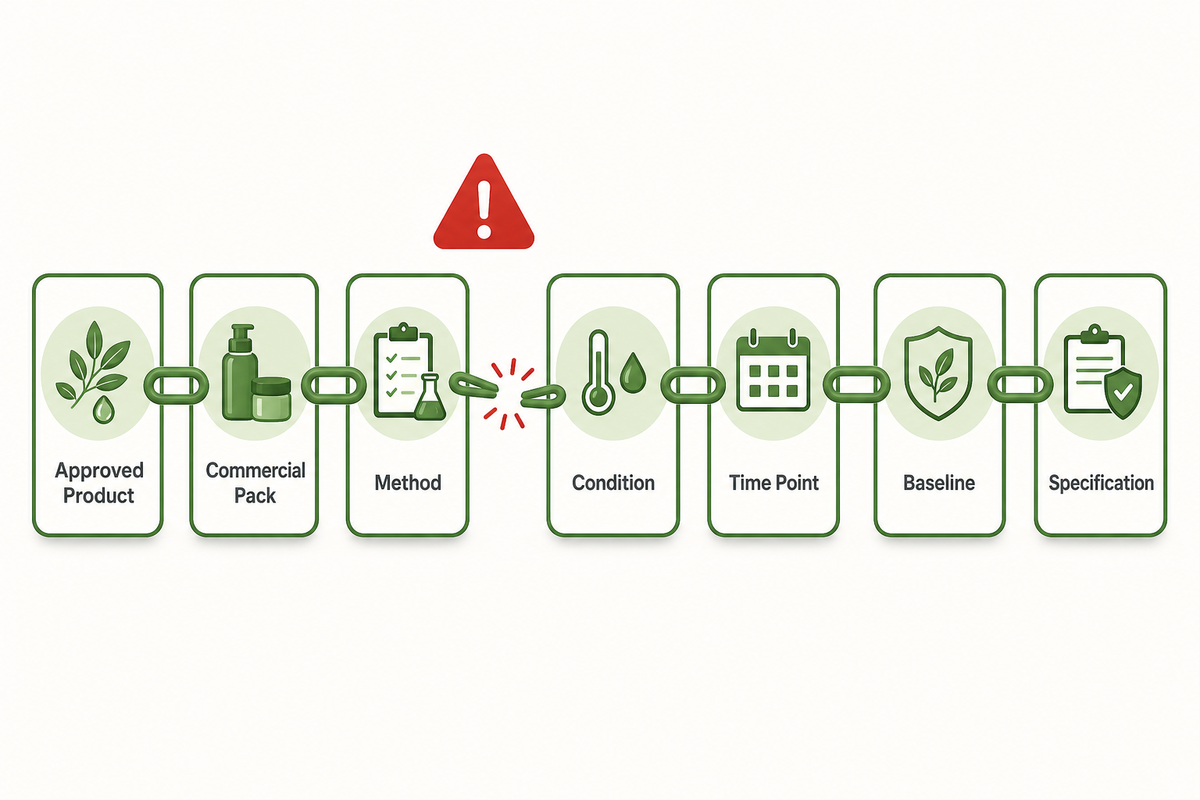
Delay a pass when the conclusion cannot be traced to the approved product, commercial pack, method, condition, time point, baseline, or specification. Missing baselines, changed methods, disagreeing samples, unresolved deviations, package malfunction, unexplained drift, or a mismatched formula make the evidence incomplete even when most checkpoints look acceptable.
Do
- Preserve raw observations and sample identity.
- Name the method and specification.
- Investigate deviations and out-of-specification results.
- Assess whether the tested product represents the commercial one.
- Assign disposition and follow-up.
Do not
- Average away a failure without rationale.
- Call an untested package compatible.
- Use a universal accelerated-time conversion.
- Ignore a changed formula, supplier, process, or pack.
- Turn an unresolved result into a marketing claim.
Treat a pass as a disposition, not the absence of an alarm. It should identify the cosmetic product’s formula and package, state what passed, protect the quality of the product, and explain how the evidence helps determine the shelf life of a product. When those fields are missing, investigate before approving the product’s stability.
Frequently Asked Questions
How is cosmetic stability testing done?
Cosmetic stability testing starts by defining the formula, batch, final package, intended use, storage and distribution context, and shelf-life goal. The protocol then assigns relevant conditions, orientations, time points, parameters, test methods, sampling logic, acceptance criteria, and decision owners. Results are compared with a documented baseline, trends and deviations are investigated, and the conclusion is limited to the represented product-and-package configuration. Real-time or ongoing evidence may continue after the accelerated phase instead of being replaced by a fixed conversion.
What are the types of stability testing?
Study roles can include real-time observation under intended storage, accelerated stability work at selected elevated temperatures, stress or cycling work used to explore sensitivity, final-package compatibility, and ongoing retained-sample monitoring. Chemical and microbiological evidence may run alongside physical observations. They are not interchangeable types with one schedule; select them by the formula, pack, use, market, and decision.
Does three months of accelerated testing prove a two-year shelf life?
No universal rule for stability testing of cosmetics makes 3 accelerated months equal 2 market years. Accelerated work can reveal sensitivity and support a product-specific assessment, but the conclusion still depends on the exposure design, temperature and humidity, sample orientation, analytical methods, physical observations, acceptance criteria, formula version, batch, final package, intended use, and scientific basis for extrapolation.
The report should state which evidence is provisional, what long-term stability work continues, and which change-control events reopen the assessment. Real-time or ongoing observations are commonly used to confirm behavior throughout the intended shelf life rather than merely validate a sales claim.
Are ICH guidelines the rules for cosmetic stability testing?
No. Product classification comes first: drug guidance does not become a universal cosmetic-only protocol. A product regulated as a drug or as both a drug and a cosmetic follows the applicable drug pathway, while a cosmetic-only plan should be justified for its own formula, package, market, use, and decision.
Is preservative efficacy testing the same as microbiological testing?
No. Microbiological testing examines contamination status under a named method, while preservative efficacy testing challenges a preservation system. ISO 11930 also contains a low-risk boundary, so its reference method is not an identical requirement for every cosmetic product, nor are the two evidence tracks interchangeable.
When should a stability study be reviewed or repeated?
Review the evidence when the formula, raw material, supplier, process, scale, equipment, site, filling condition, package, storage route, use pattern, or result changes. Start by comparing the new product system with the exact version represented by the existing study and identify a plausible mechanism for any difference. Quality, research and development, packaging, microbiology, and regulatory owners should then decide which evidence track is affected.
Document whether the prior conclusion still applies, whether targeted confirmation can close the gap, or whether a new study is needed. The decision must be risk-based: neither assuming that the old pass always applies nor requiring the same full retest for every change is a defensible default.
Make the conclusion no broader than the evidence
Use the Seven-Decision Stability Brief to align formula, package, market, methods, criteria, and change control. When you’re ready to turn those inputs into a manufacturer discussion, contact NEXO Beauty Labs.
Use the Seven-Decision Stability Brief to align formula, package, market, methods, criteria, and change control. When you’re ready to turn those inputs into a manufacturer discussion, contact NEXO Beauty Labs.
References and Sources
- ISO/TR 18811:2018, Cosmetics — Guidelines on the stability testing of cosmetic products
- United States Food and Drug Administration, Product Testing of Cosmetics
- United States Food and Drug Administration, Shelf Life and Expiration Dating of Cosmetics
- 21 C.F.R. § 211.137, Expiration dating
- United States Food and Drug Administration, Microbiological Safety and Cosmetics
- United States Food and Drug Administration, Modernization of Cosmetics Regulation Act of 2022
- 21 U.S.C. § 364d, Safety substantiation
- ISO 11930:2019, Evaluation of the antimicrobial protection of a cosmetic product
- Cosmetics Europe, Guidelines on Stability Testing of Cosmetics
- Pharmaceutical emulsion-cream model study containing lidocaine and funded by Pfizer and A*STAR
Why beauty brands work with NEXO
About NEXO Beauty Labs Manufacturing Support
NEXO Beauty Labs supports skincare, body care, sun care, hair care, and private label brands with formulation, sampling, filling, quality control, and export-ready launch support.
Project Review Before RFQ
Before quotation, we help clarify product category, active direction, formula stage, package choice, compliance market, MOQ, sampling schedule, and required documents.
Request a Cosmetic QuoteCompany Profile // Data Sheet
CompanyNEXO Beauty Labs
Business TypeCosmetic OEM / ODM manufacturing partner
Main ProductsPrivate label skincare, facial serums, moisturizers, cleansers, sunscreen, body care, and hair care products
Manufacturing CapabilityFormula development, sample adjustment, package sourcing, filling, QA/QC, documentation, and export support
RFQ Data NeededProduct type, formula goal, package format, target market, MOQ, claims, timeline, and benchmark samples
Websitenexobeautylabs.com