Get in touch with NEXO Beauty Labs Company

Updated August 2026
The skincare product development process is best managed as eight decision gates, not a fixed calendar of laboratory tasks. For conventional custom cosmetic formulation and R&D services, each gate closes only when the team can name the approved version, the evidence behind the decision, the owner, and the change that would reopen it.
Before Gate 1, screen the product’s intended use and claims. This guide covers conventional cosmetics; in the United States, sunscreen, acne-treatment, therapeutic-claim, and some other products may be drugs or cosmetic-drug combinations with additional requirements under FDA product-classification guidance.
The operating rule
Do not fund the next gate because a sample looks promising. Advance when the evidence, decision owner, and reopen trigger are recorded against the same formula, package, claim, and market version.
The 8-Decision Exit Deck
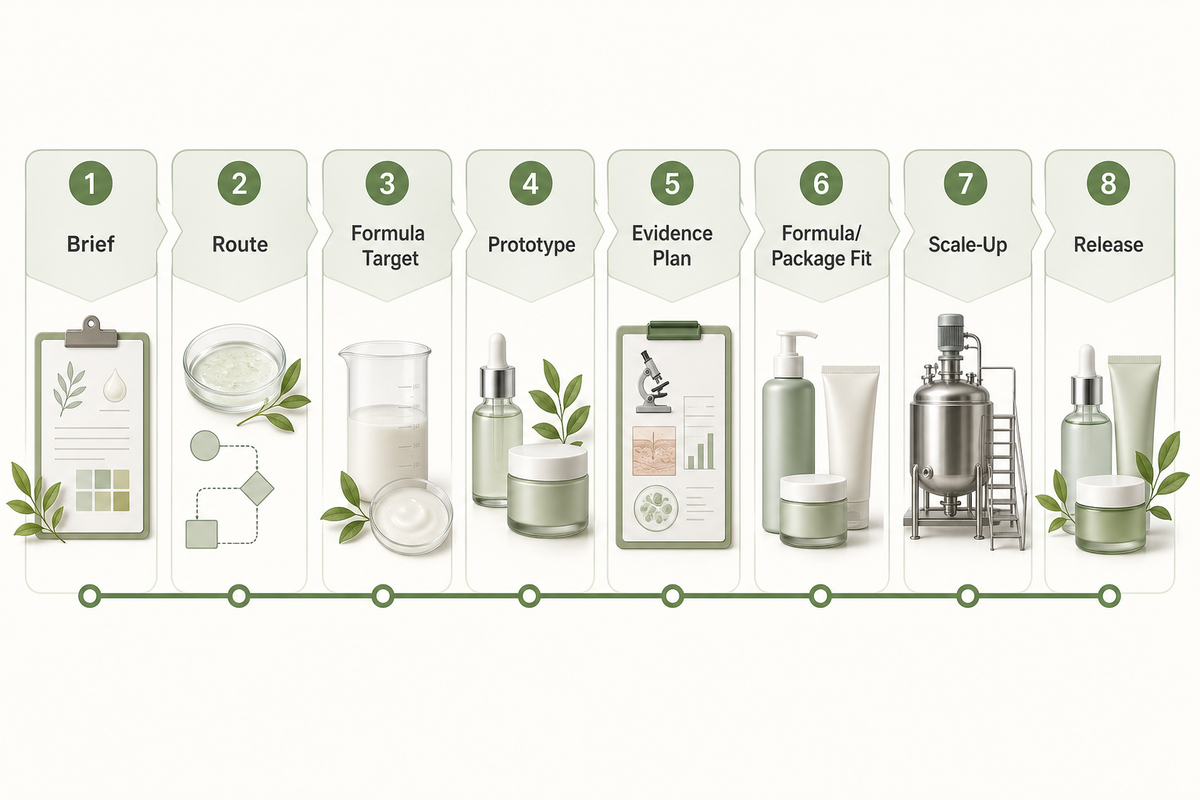
The eight gates turn an open-ended development project into controlled decisions. The map is an editorial framework, not an FDA or ISO standard, and teams can overlap workstreams when the dependencies are understood.
| Gate | Decision | Exit evidence | Owner | Limit / reopen trigger |
|---|---|---|---|---|
| 1. Brief | What product is being developed? | Approved measurable brief | Brand product lead | Use, market, claim, cost, or pack changes |
| 2. Route | Stock, modified base, or custom? | Route and contract questions resolved | Brand and manufacturer | Ownership, exclusivity, or scope changes |
| 3. Formula target | What must the formula achieve? | Target profile and feasibility record | Development team | Ingredient, claim, sensory, or cost change |
| 4. Prototype | Which version advances? | Versioned sample approval | Named approver | Uncontrolled preference or formula revision |
| 5. Evidence plan | What questions must evidence answer? | Methods, samples, criteria, and owners | Qualified specialists and responsible party | New claim, market, exposure, or data gap |
| 6. Formula/package fit | Does the final system work together? | Version-bound compatibility decisions | Formula, package, and quality leads | Material, closure, decoration, or fill change |
| 7. Scale-up transfer | Can the approved result be controlled at scale? | Transfer record and production controls | Manufacturing and quality | Equipment, order, temperature, hold, or fill change |
| 8. Release | Is the commercial version authorized? | Release packet and lifecycle owners | Authorized release owner | Deviation, complaint signal, listing, claim, or supplier change |
The map follows a broader engineering lesson from a published skin-care cream development case study: product development is hierarchical and iterative. That older case does not cover the entire modern regulatory or scale-up pathway, so current FDA and ISO sources set the boundaries used below.
| Gate type | Primary owner |
|---|---|
| Brief | Brand product lead |
| Route | Brand and manufacturer |
| Formula target | Development lead |
| Prototype | Named approver |
| Evidence plan | Qualified specialists |
| Formula/package fit | Formula, package, and quality leads |
| Scale-up transfer | Manufacturing and quality |
| Release | Authorized release owner |
Turn the Concept Into a Manufacturer-Ready Product Brief
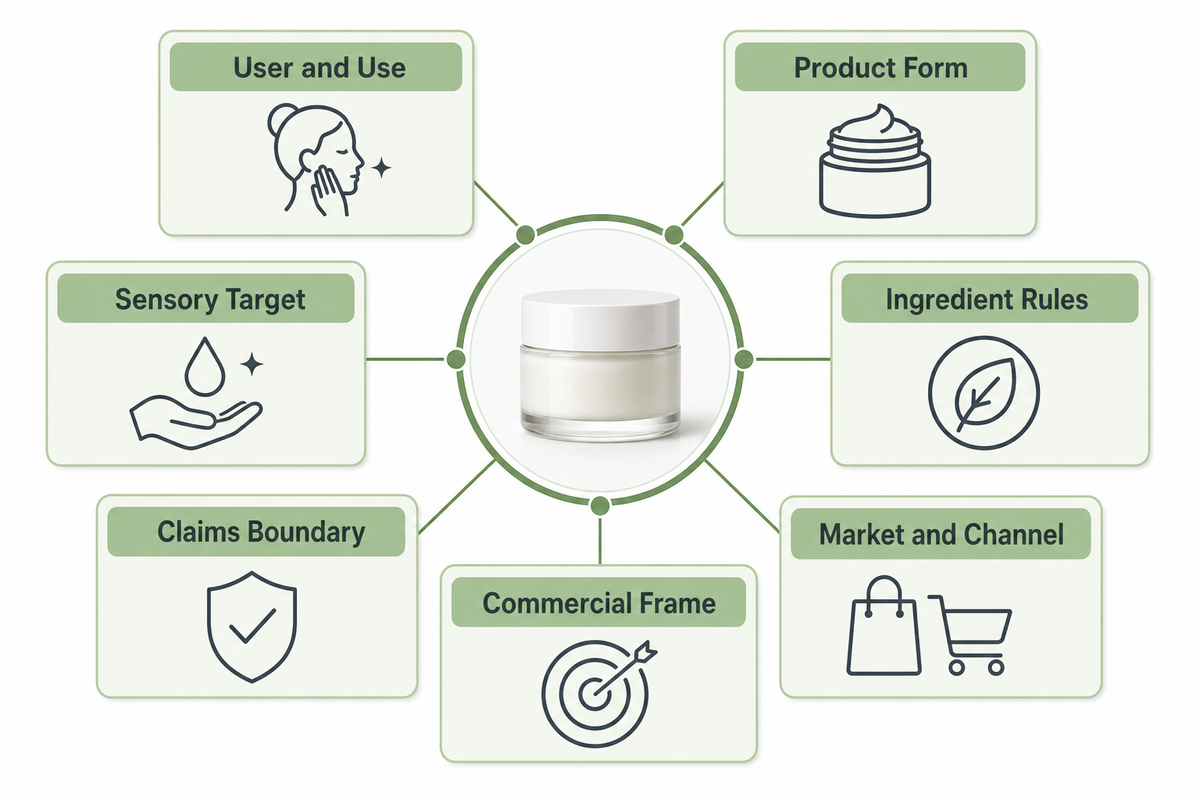
Manufacturer-ready briefs convert taste and ambition into decisions that can be tested. The gate map becomes usable only when the brief supplies measurable inputs for every later decision. Competitor samples and mood boards can illustrate direction, but neither defines acceptance criteria or who may change them. Claims boundaries deserve an early classification check because FDA ties product category to intended use, including claims and consumer-facing promotion.
| Brief field | Decision to record | Why it changes development |
|---|---|---|
| User and use | Who applies it, where, how often, and how | Sets exposure and use conditions |
| Product form | Cream, gel, serum, balm, wash, or another form | Changes process, dispensing, and package questions |
| Sensory target | Spread, absorption, after-feel, appearance, and scent boundaries | Creates observable prototype criteria |
| Ingredient rules | Required, excluded, preferred, and substitution rules | Affects feasibility, evidence, sourcing, and claims |
| Claims boundary | Permitted messages and prohibited therapeutic language | Can change classification and evidence burden |
| Market and channel | Launch countries, sales channel, and label context | Sets market review and responsibility questions |
| Commercial frame | Target cost, pack hypothesis, volume scenario, and launch window | Reveals tradeoffs without inventing a quote |
Mark every field as fixed, preferred, open, or prohibited. The type of product and any sustainability position should stay explicit instead of being inferred from a mood board, giving procurement a clean list of unresolved inputs.
Market research should translate market needs, consumer needs, market segments, and current market constraints into a product concept. Record market trends and consumer needs separately instead of compressing them into vague “trends and consumer” language. Clean beauty, upcycled content, influencer-led demand, or unique selling points belong in the brief only when they create an achievable requirement and a defensible point of difference.
Choose the Development Route Before You Compare Timelines
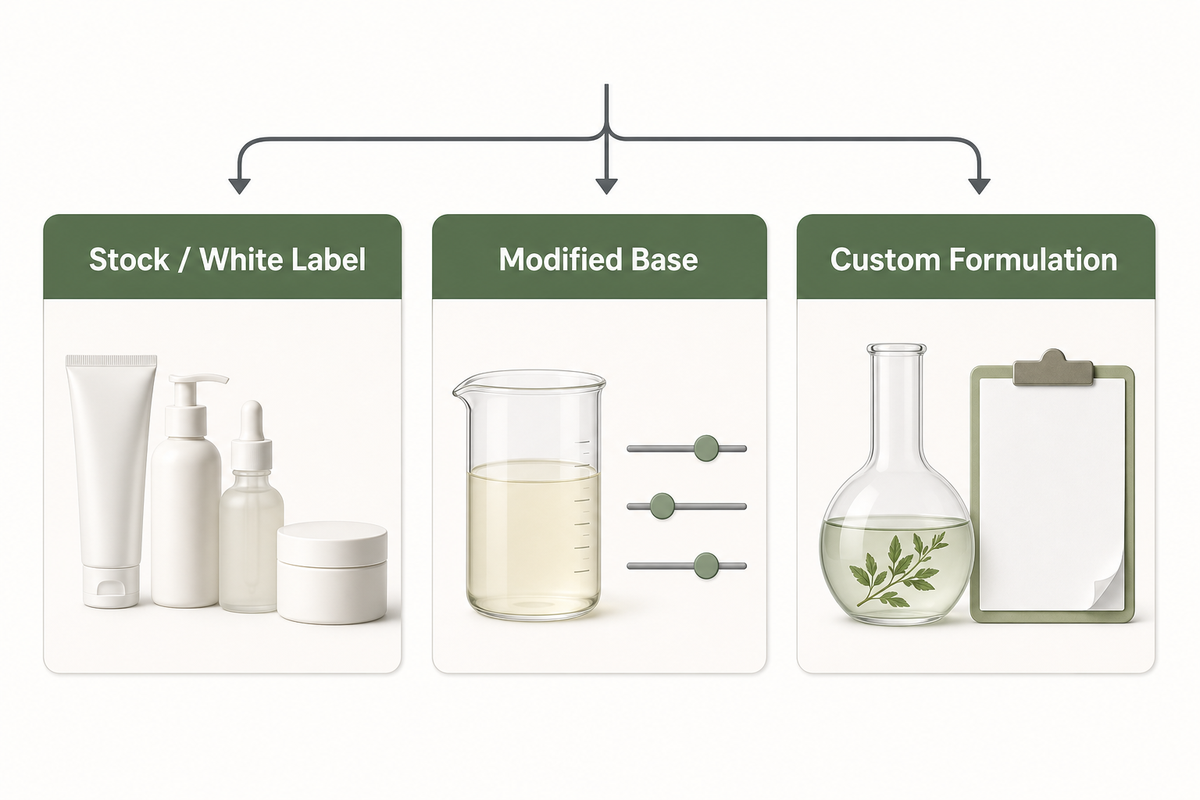
Route selection comes after the classification screen and before timeline comparison. For a new product, stock, modified-base, and custom routes start with different knowns, but route labels alone don’t settle formula ownership, exclusivity, evidence access, or change authority.
| Route | What starts fixed | Brand decisions | Disqualifier or reopen trigger |
|---|---|---|---|
| Stock / white label | Existing formula platform | Claims, pack, scent or color choices, market fit, and contract terms | Required differentiation or evidence cannot be supported |
| Modified base | Existing base with defined change scope | Which changes matter enough to re-evaluate evidence and process | Modification changes the product beyond the agreed base |
| Custom formulation | Product brief and development target | Formula target, prototype criteria, evidence plan, package, and transfer | Budget, timing, evidence, or sourcing cannot support the target |
Brands that want to assess a stock-formula starting point can review NEXO’s stock-formula skincare starting point. When the brief requires a new formula platform, compare that starting point with NEXO’s custom skincare formulation pathway. Treat each page as a route conversation, then confirm ownership, exclusivity scope and duration, change rights, evidence access, and package choices in the actual proposal and contract.
Bring a decision-ready brief
Share the intended use, product form, claims boundary, route preference, pack hypothesis, target market, and unresolved evidence questions with NEXO Beauty Labs.
Formulate, Prototype, and Control Each Revision
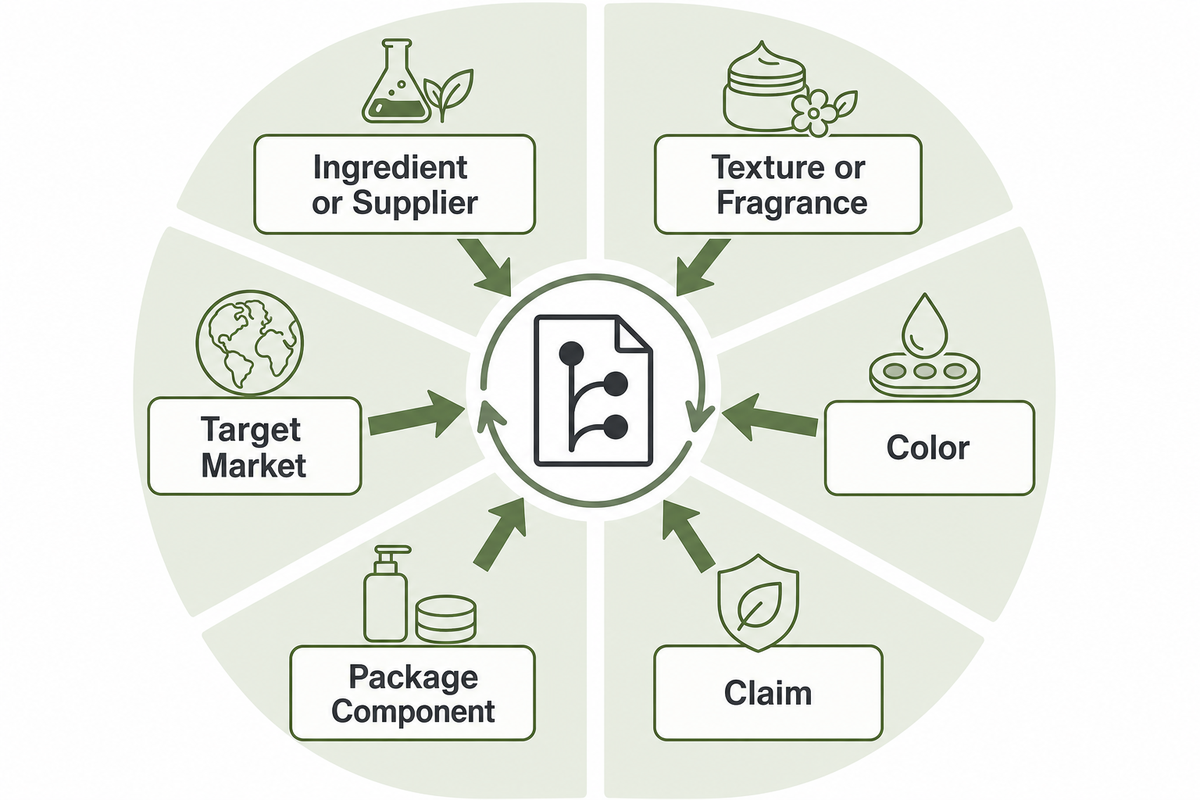
Prototype rounds create value only when each change tests a defined question. Once the development route is chosen, prototype control turns its formula assumptions into versioned evidence. A published skin-care cream development case likewise treats development as hierarchical, multidisciplinary, and iterative. The cosmetic chemist and brand approver should bind every active ingredient or sensory change to the sample code, formula version, evaluation criteria, package assumption, observations, and decision.
| Change request | Likely impact | Gate to reopen | Evidence question |
|---|---|---|---|
| Ingredient or supplier | Formula behavior, safety data, sourcing | Formula and evidence | Does the existing conclusion still apply? |
| Texture or fragrance | Sensory target, preservation, process | Prototype | Which criterion changed? |
| Color | Appearance, stability, additive-use check | Formula and evidence | Is the color additive authorized for the intended use? |
| Claim | Classification, substantiation, artwork | Brief and evidence | Does the claim change product category or support needs? |
| Package component | Protection, dispensing, compatibility, filling | Formula/package fit | Was the new component evaluated with the approved formula? |
| Target market | Classification, label, ingredient, and records | Brief and responsibility | Who confirms the new market pathway? |
More rounds are not automatically better. The revision log reveals whether the team is converging on the brief or moving preferences without a stable acceptance rule.
A product development project needs more than an initial concept. In the cosmetic product development process, R&D, formulators, and the cosmetic chemist translate the desired product into product formulation and product design choices, then test product performance, product quality, compatibility, and the stability of the product. That iterative process distinguishes actual product decisions from an overall development aspiration.
Build the Evidence Plan Around Intended Use, Formula, Claims, and Market
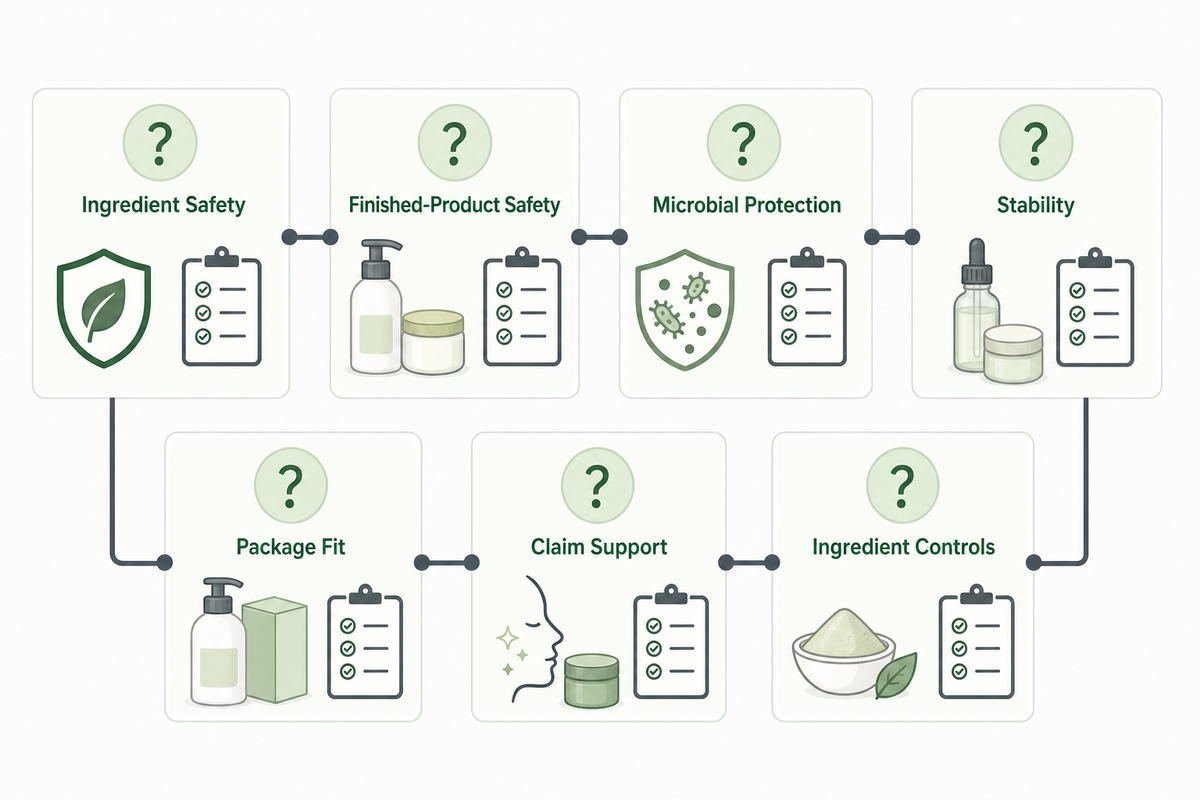
For conventional cosmetics, FDA does not publish one mandatory test list for every product. The advancing prototype and revision log identify the exact formula questions that the evidence plan must answer. Its product-testing guidance places safety responsibility on the manufacturer or distributor and allows existing ingredient or similar-formula data to support a conclusion when scientifically appropriate.
No fixed list does not mean no testing. NEXO’s cosmetic stability testing guide covers one possible workstream, while the team must still document what is known, what remains uncertain, which method addresses each gap, which formula and package version is evaluated, and what result changes the decision.
| Question | Risk driver | Evidence record | Re-evaluate when |
|---|---|---|---|
| Ingredient safety | Identity, level, exposure, user group | Available data plus gap assessment | Ingredient, supplier, level, or use changes |
| Finished-product safety | Formula interactions and customary use | Qualified safety-substantiation rationale | Formula, use, exposure, or population changes |
| Microbial protection | Water, preservation, process, pack, use | Risk assessment and appropriate method record | Preservative, process, pack, or use changes |
| Stability | Formula and intended storage | Protocol, observations, criteria, conclusion | Formula, process, pack, or storage claim changes |
| Package fit | Material, closure, dispensing, orientation | Formula-in-final-pack evaluation | Any component or formula changes |
| Claim support | Exact wording and consumer takeaway | Claim-specific substantiation | Copy, audience, channel, or formula changes |
| Ingredient controls | Restricted or specially controlled classes | Intended-use authorization check | Color, use area, market, or level changes |
Color additives illustrate why a universal checklist fails: FDA treats them differently from most cosmetic ingredients and requires authorization for the specific intended use; some also require batch certification. Separately, the public scope of ISO 11930:2019 includes preservation-efficacy testing and overall antimicrobial protection evaluation while distinguishing products assessed as low microbiological risk.
Validate the Formula and Final Packaging as One System
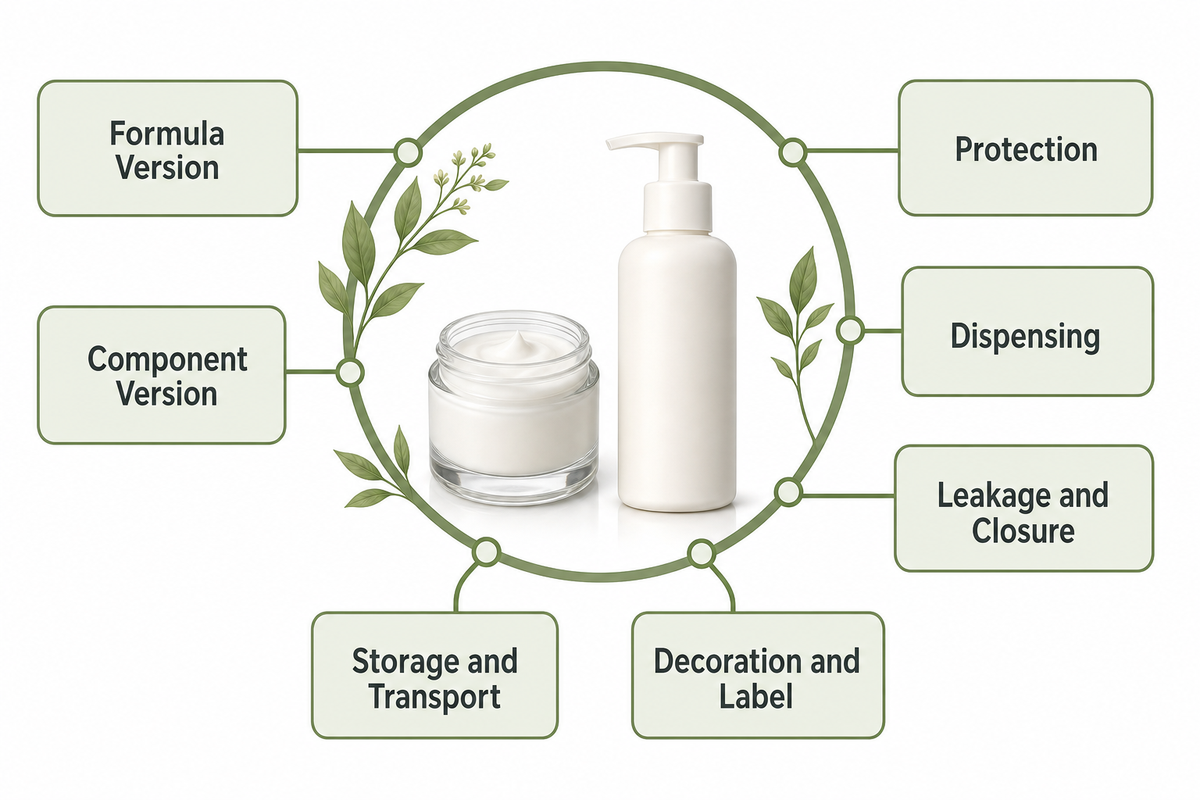
Bulk-formula stability does not establish an approved formula-package system. FDA’s microbiological safety guidance identifies inadequate package protection, manufacturing conditions, storage, shipping, and consumer use among possible contamination pathways.
Evaluate together
- Bind the formula and component version
- Observe protection, dispensing, leakage, and closure
- Include intended orientation, storage, transport, and use
- Record decoration and label interactions
Avoid shortcuts
- Approve an empty bottle by appearance alone
- Assume a similar polymer behaves identically
- Change the pump or closure after evaluation without review
- Separate fill behavior from component selection
The decision record should identify which formula was placed in which final component set, how it was stored and handled, what was observed, and who accepted the result. Changing the package can reopen microbial protection, dispensing, compatibility, filling, transport, artwork, and user-exposure questions at the same time.
One attributed patent example evaluated its disclosed formulations at 25 °C and 40 °C over 90 days, then examined a specified final commercial package. Those conditions belong only to US10912721B2 and its named assignee; they are not a universal protocol, an ISO rule, or NEXO technology.
Transfer the Approved Formula to Scale-Up and Controlled Manufacturing
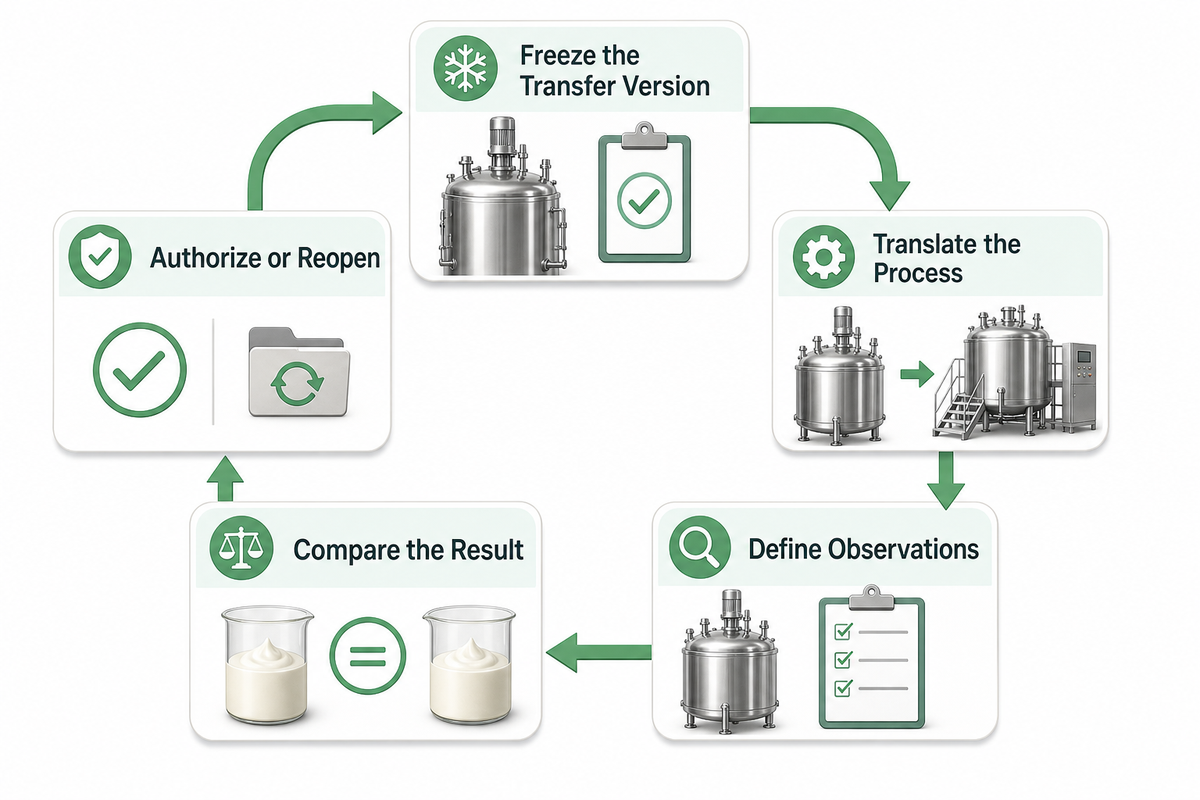
Scaling is a transfer of process knowledge, not multiplication of ingredient weights. The approved formula-package system becomes the version that manufacturing must reproduce and control. Equipment geometry, addition order, mixing or shear, temperature history, hold time, transfer, and filling can change what the batch experiences even when the formula percentages are unchanged.
Use NEXO’s cosmetic contract manufacturing scope as a project-specific discussion point, while the transfer record remains responsible for defining the actual process inputs and release evidence.
- Freeze the transfer version — identify the approved formula, sample, raw-material references, package assumption, and unresolved exception.
- Translate the process — record addition order, equipment assumptions, temperature and mixing controls, hold points, transfer, and fill conditions.
- Define observations — set in-process checks, sampling points, specification references, deviation rules, and who may decide.
- Compare the result — assess the scaled batch against the approved target using the agreed methods rather than memory of a sample.
- Authorize or reopen — document release, conditional disposition, rework, or return to formulation with the reason attached.
The public scope of ISO 22716:2007 covers production, control, storage, and shipment of cosmetic products, but excludes research and development and finished-product distribution. That boundary prevents a manufacturing standard from being used as proof that formulation development is complete or that a particular factory is certified.
One 2024 published emulsion study found that some expected process variables had minimal effects in its disclosed pharmaceutical model, while a mid-cooling hold affected stability. The study’s model-specific result is a warning against copying universal scale-up rules, not a cosmetic production protocol.
Assign United States Market Responsibilities Before Artwork and Release
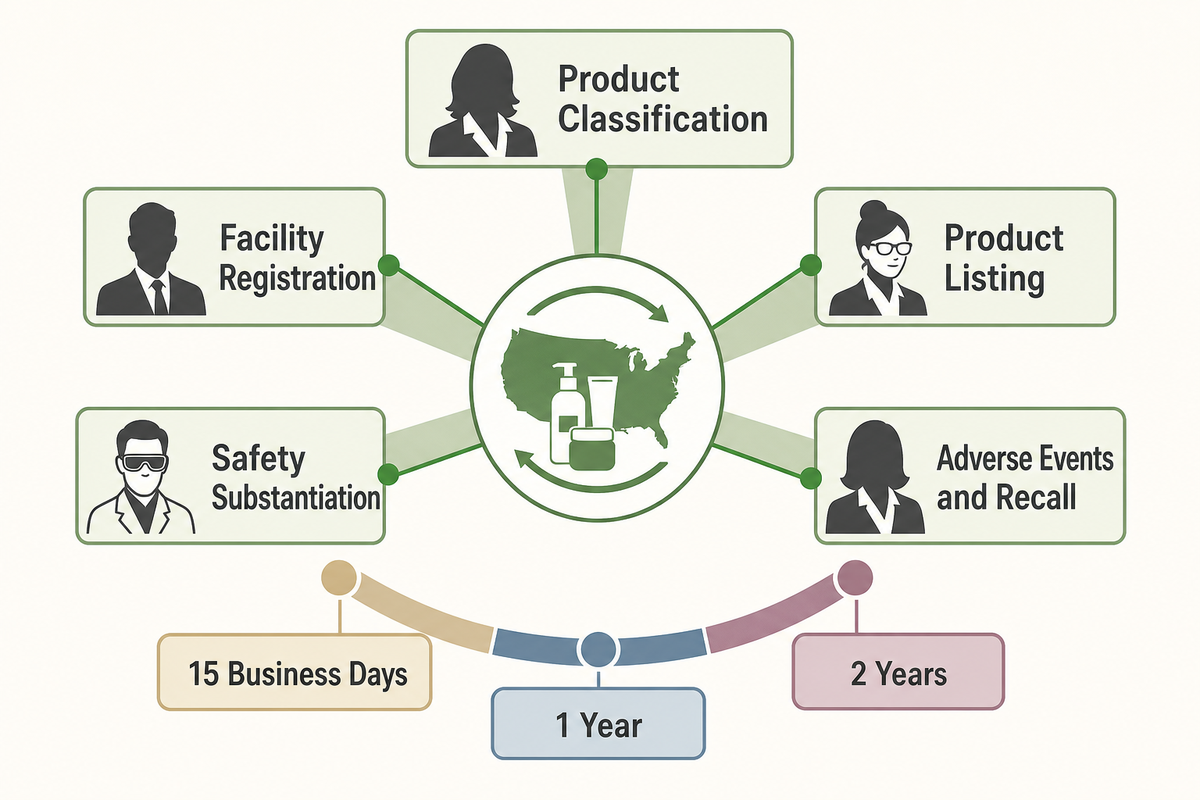
Manufacturing work and market responsibility are connected but not interchangeable. That controlled manufacturing handoff still does not assign the statutory market roles attached to the label and postmarket records. Compliant products still need named owners: under MoCRA, the responsible person is the manufacturer, packer, or distributor whose name appears on the label, so the contract manufacturer does not automatically own every United States duty.
NEXO’s quality management scope can inform the operational handoff, but it does not replace the product-specific responsibility table or transfer a statutory duty by itself.
For a consumer product in personal care, cosmetic regulations, regulatory compliance, international regulations, and other regulatory requirements must be routed to qualified owners. The evidence packet should connect product safety, safety standards, quality and safety, quality control, GMP, good manufacturing practices, inspection, and the standards of quality actually specified for the project.
15 business daysserious adverse-event reporting deadline
1 yearproduct-listing update cycle
2 yearsfacility-registration renewal cycle
| Task | Actor to identify | Record or trigger | Open question |
|---|---|---|---|
| Product classification | Brand and qualified market reviewer | Intended use, claims, ingredients, consumer context | Cosmetic, drug, or both? |
| Facility registration | Manufacturer or processor subject to the duty | Registration and renewal record | Does an exemption apply? |
| Product listing | Responsible person | Listing and annual update | Who supplies ingredient and facility information? |
| Safety substantiation | Responsible person with qualified support | Adequate substantiation records | Where are gaps, decisions, and versions retained? |
| Adverse events and recall | Responsible person plus operational contacts | Intake, assessment, report, distribution, and recall records | Can the team trace and act after launch? |
The current FDA MoCRA overview also makes small-business exemptions conditional and excludes specified product types from those exemptions. Put exemption eligibility in the responsibility table, but have qualified counsel or regulatory specialists determine its application to the actual business and product.
Build a Brief-to-Batch Handoff Spine Instead of Trusting One Headline Timeline
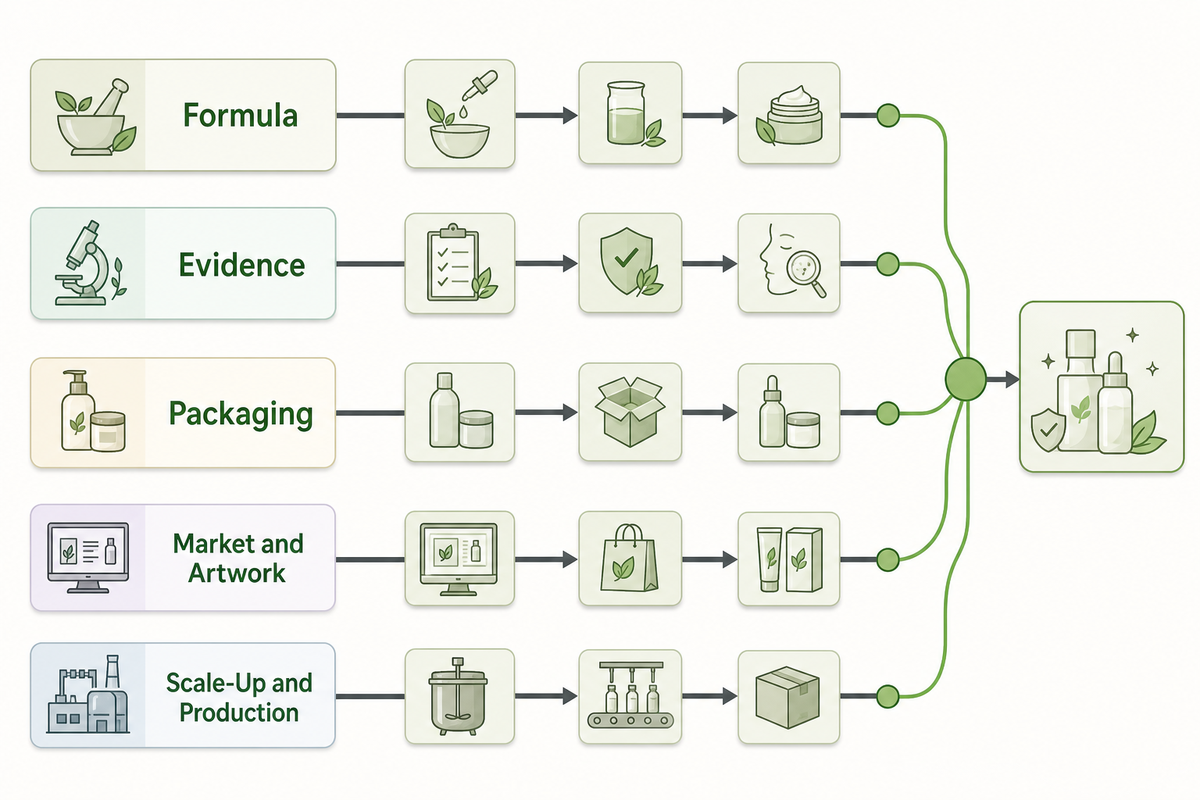
If you arrived looking for a skincare product development process timeline or a skincare product development process step by step, use the critical-path table as the scheduling framework. It answers how to develop a skincare product by showing what can run in parallel and what evidence must exist before release.
There is no honest universal duration for skincare development. The peer-reviewed case study’s hierarchical process model supports treating milestones as linked evidence gates rather than one headline duration. Product launch timing changes with route, revision count, evidence gaps, component availability, artwork, scale-up observations, production scheduling, shipping, and failed checkpoints.
| Workstream | Can start when | Release evidence | Common controlling dependency |
|---|---|---|---|
| Formula | Brief and route are defined | Approved version and target profile | Unresolved sensory or ingredient tradeoff |
| Evidence | Product questions and sample versions are known | Methods, criteria, conclusions, and exceptions | Formula, claim, or package keeps changing |
| Packaging | Form, use, channel, and formula assumptions exist | Approved final component set and fit record | Component tooling, availability, or decoration |
| Market and artwork | Classification, claims, roles, and pack panels are defined | Approved copy, artwork, listing inputs, and owner | Late claim or responsibility change |
| Scale-up and production | Transfer version and materials are released | Controlled batch, specifications, disposition, and schedule | Transfer deviation or component delivery |
For each dependency, record an owner, earliest start, input, approval criterion, and rework trigger. Ask every manufacturer to build a project-specific schedule against the same brief; comparing headline month ranges without matched scope produces false precision.
Freeze a Production-Release Packet and Govern the Postmarket Lifecycle
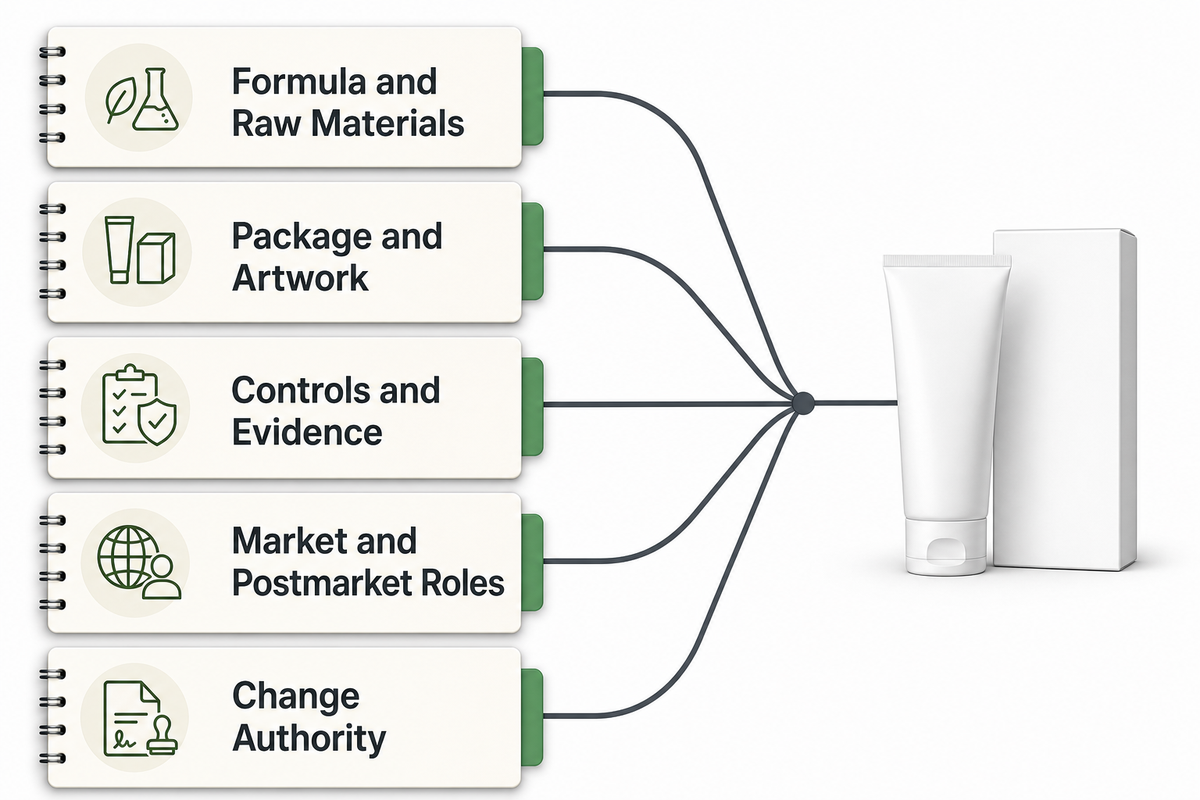
Purchase orders and approved samples do not form a complete release decision. FDA’s cosmetics manufacturing inspection checklist separates written processing instructions, in-process controls, specifications, records, rework, disposition, and retained samples.
Production-release packet
- Approved formula, sample reference, raw-material references, and permitted substitutions
- Final package components, decoration and artwork versions, fill and closure instructions
- Specifications, in-process controls, sampling, evidence decisions, exceptions, and release authority
- Market roles, product-listing inputs, retained records, adverse-event route, and recall contacts
- Change authority plus triggers for formula, supplier, package, claim, market, process, or artwork review
After launch, complaints, adverse events, deviations, supplier changes, and market updates feed back into the same packet. The team should be able to identify the affected lots, formula and component versions, distribution path, evidence decision, and person authorized to act.
Key takeaway
Conventional U.S. cosmetic projects do not end at batch release: the 15-business-day serious-adverse-event deadline, annual listing updates, and 2-year facility renewals require named postmarket owners.
Frequently Asked Questions
How do you develop a skincare product?
A commercial skincare product moves through a controlled brief, route, formula, prototype, evidence, package, scale-up, and release sequence, with a named owner and documented exit evidence at every gate.
Start by fixing intended use, product classification, product form, target market, claims boundary, sensory goal, package hypothesis, and commercial constraints. Then approve each gate against named evidence and an owner. A stage is complete when its version and reopen trigger are documented, not when the team merely likes a sample.
How long does the skincare product development process take?
No universal duration is reliable because route, revisions, evidence, packaging, artwork, scale-up, production, and rework create different critical paths; build the schedule from those dependencies instead of a fixed headline range.
Build a schedule from dependencies instead of accepting a headline range. Name each workstream’s owner, earliest start, required input, approval criterion, and reopen trigger. Separate formula, evidence, package, artwork, market-review, transfer, production, and shipping workstreams so tasks that can overlap are visible. Compare manufacturer schedules only when they answer the same brief, state the same assumptions, and include the same evidence, component, and release scope. Late failures should move the dependent launch date rather than disappear inside contingency.
Which tests are required for a new skincare product in the United States?
For conventional cosmetics, FDA does not publish one fixed test list for every product; the evidence plan must answer product-specific safety and performance questions for the actual formula and package.
Scope the plan to the intended use, classification, ingredients, formula, exposure, users, microbial risk, package, claims, available data, and remaining gaps. Record the exact sample version, method, acceptance criterion, owner, conclusion, and change that requires another review. Color additives have intended-use controls, while drug or cosmetic-drug products follow additional requirements. Qualified specialists should set the final methods and criteria for the actual product and market.
Is packaging selected before or after formulation?
Packaging enters the brief early, but final approval follows evaluation of the formula, intended pack, intended use, and filling conditions together as one version-bound system.
Early component assumptions help the development team plan dispensing, protection, filling, decoration, channel, and user experience. Final approval should identify the exact formula and component versions reviewed together. A material, pump, closure, decoration, fill, or orientation change can reopen the decision.
What should I send a skincare manufacturer first?
Send a concise product brief that separates fixed requirements, preferences, open questions, and prohibited choices so the manufacturer can identify scope and feasibility gaps before quoting.
Include the intended user and use, product form, sensory target, ingredient constraints, claims boundary, target markets, package hypothesis, sales channel, target cost, evidence expectations, and launch window. Mark assumptions separately so the manufacturer can raise feasibility questions instead of guessing which inputs may change.
Move Forward With a Gate-Ready Brief
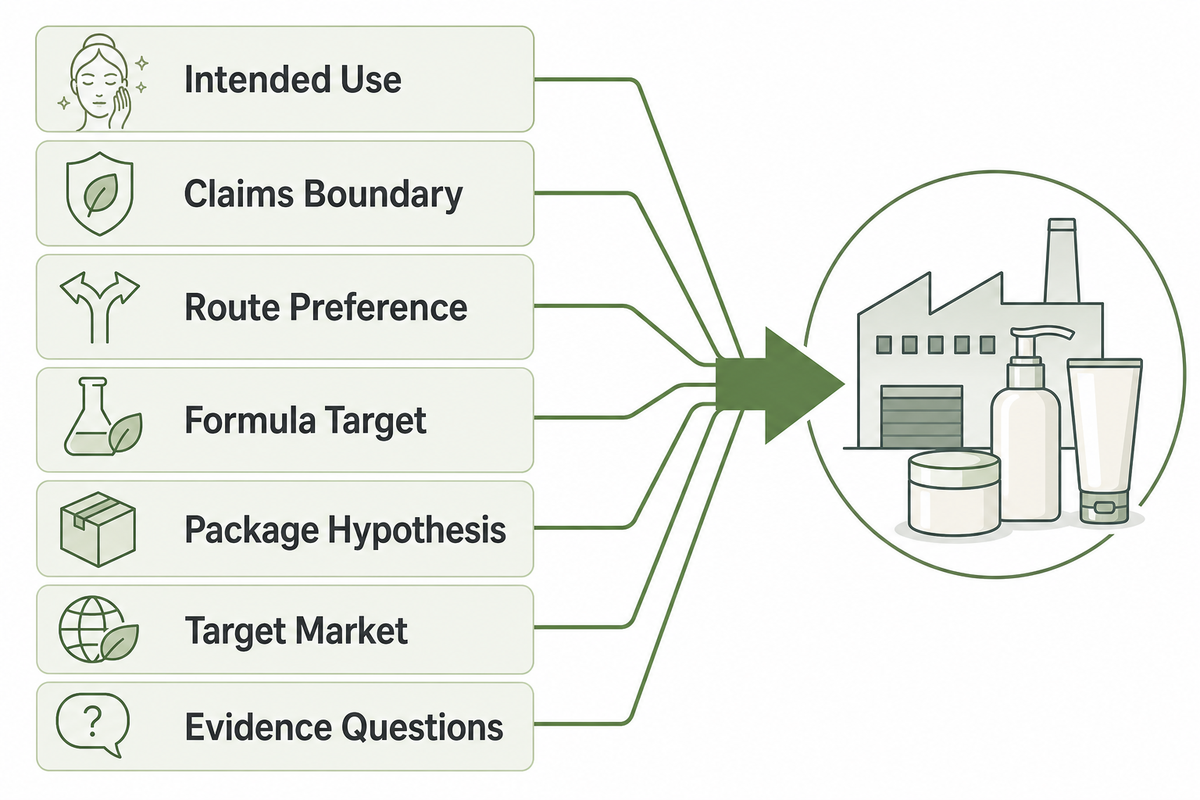
The best next step is not asking for one universal timeline. It is sending a manufacturer a stable brief, a route hypothesis, a list of unresolved classification and evidence questions, and a clear definition of the next decision.
Product development starts with a defined route, not a generic promise. Across beauty products and skin care products, an established brand and a new entrant may develop products from different starting points, but both need actionable steps to get to market and a release plan that defines launch success. Market insights cannot substitute for evidence about the product in the market or turn a broad beauty industry trend into a care product specification.
NEXO Beauty Labs is a global cosmetic OEM and ODM partner for skincare, hair care, and body care development and manufacturing. Its manufacturing foundation dates to 1999, and the company describes more than 25 years of cosmetic manufacturing experience; these company-history statements don’t replace product-specific evidence, contract terms, or market review.
Start with the decisions that are still open
Bring your intended use, claims boundary, route preference, formula target, package hypothesis, target market, and evidence questions to a development discussion.
Why NEXO Frames Development as Decisions
For readers comparing development with factory transfer, NEXO’s cosmetic contract manufacturing hub is the relevant next step. This guide turns public regulatory, standards, and research evidence into a buyer-side handoff method; the named maps and matrices are editorial tools, not NEXO performance data or industry standards.
References & Sources
- Is It a Cosmetic, a Drug, or Both? — U.S. Food and Drug Administration
- Product Testing of Cosmetics — U.S. Food and Drug Administration
- Microbiological Safety and Cosmetics — U.S. Food and Drug Administration
- Modernization of Cosmetics Regulation Act of 2022 — U.S. Food and Drug Administration
- Cosmetics Manufacturing Inspection Checklist — U.S. Food and Drug Administration
- ISO 22716:2007 — International Organization for Standardization
- ISO 11930:2019 — International Organization for Standardization
- Development of a Skin-Care Cream — PubMed Central
- Emulsion Manufacturing Process Study — PubMed