Get in touch with NEXO Beauty Labs Company

Updated August 2026
Sheet mask manufacturing is the process of formula development, substrate selection, and filling and sealing single-use facial treatment sheets, delivered to a brand under OEM, ODM, or private-label terms. If you already have a formula and just need production, or you’re starting from a blank page and need a manufacturer’s own development team, the route you pick determines almost everything else about the project — timeline, cost structure, and how much control you keep over the formula.
This guide is a working reference for brand teams sourcing a sheet mask manufacturer — also searched as face mask manufacturer, facial mask manufacturer, or private label facial sheet mask supplier, since a sheet mask is a category of facial mask within the broader beauty face masks market: what the manufacturing process actually involves, which substrate and ingredient decisions matter, what a certification claim really proves (and where it doesn’t), what to expect on MOQ and lead time, and a buyer-side sustainability question most manufacturer pages skip entirely. For NEXO Beauty Labs’ current sheet mask production programme and specs, see our sheet mask manufacturing programme page.
NEXO Beauty Labs is a global cosmetic OEM and ODM partner and skincare manufacturer working across the beauty industry — a competitive beauty industry where global beauty brands, e-commerce companies, distributors, and private label partners all compete on the same shelf. This guide draws on a manufacturing base with more than 25 years of cosmetic manufacturing experience, whose facilities and formulation library support skincare brands and beauty brands across the global market with a full range of beauty solutions, covering skin care products from capsule serums to sheet masks for different skin types — plus independent research conducted while writing it, including places where the industry’s own claims don’t hold up.
Quick Specs
| Substrate materials | Bio-cellulose, hydrogel, cotton, bamboo, microfiber, nonwoven |
| Active ingredient directions | CICA, BHA, tranexamic acid, niacinamide, panthenol |
| Development routes | 3 (mature formula, formula adaptation, custom development) |
| MOQ for this category | Not publicly stated — request a written quotation |
| Relevant standards | ISO 22716 (cosmetic GMP), ISO 21322 (substrate microbiology testing) |
What “Sheet Mask Manufacturing” Actually Covers
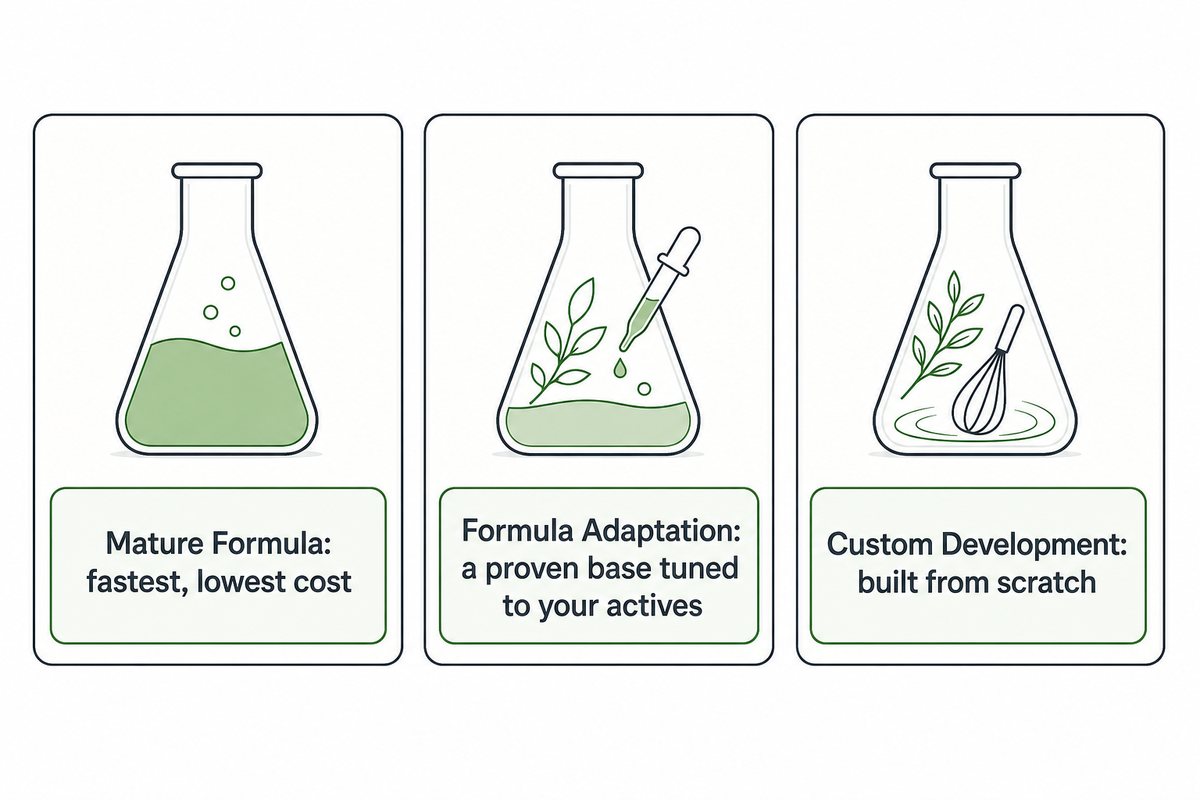
Sheet mask manufacturing is the production of single-use facial treatment sheets: a substrate material saturated with a serum or essence, cut to a facial contour, and sealed into an individual pouch. NEXO develops sheet masks as one of six skincare categories under a single brief and qualification pack, each following one of three shared routes: mature formula (fastest, lowest cost), formula adaptation (a proven base tuned to your actives), or custom development (built from scratch).
Buyers usually run into three route labels before they run into a manufacturer: OEM (you supply the formula, the factory produces it), ODM (the manufacturer supplies formula and development), and private label or white label (a broader commercial arrangement covering both, plus packaging and brand identity terms). None of these labels by itself settles formula ownership, IP rights, or exclusivity — those are contract terms, not manufacturing-route terms, and worth confirming in writing before you sign regardless of which route you pick. Ask any private label partner to walk you through private label solutions and manufacturing services for your specific product line, not just quote a price.
The Sheet Mask Manufacturing Process, Step by Step
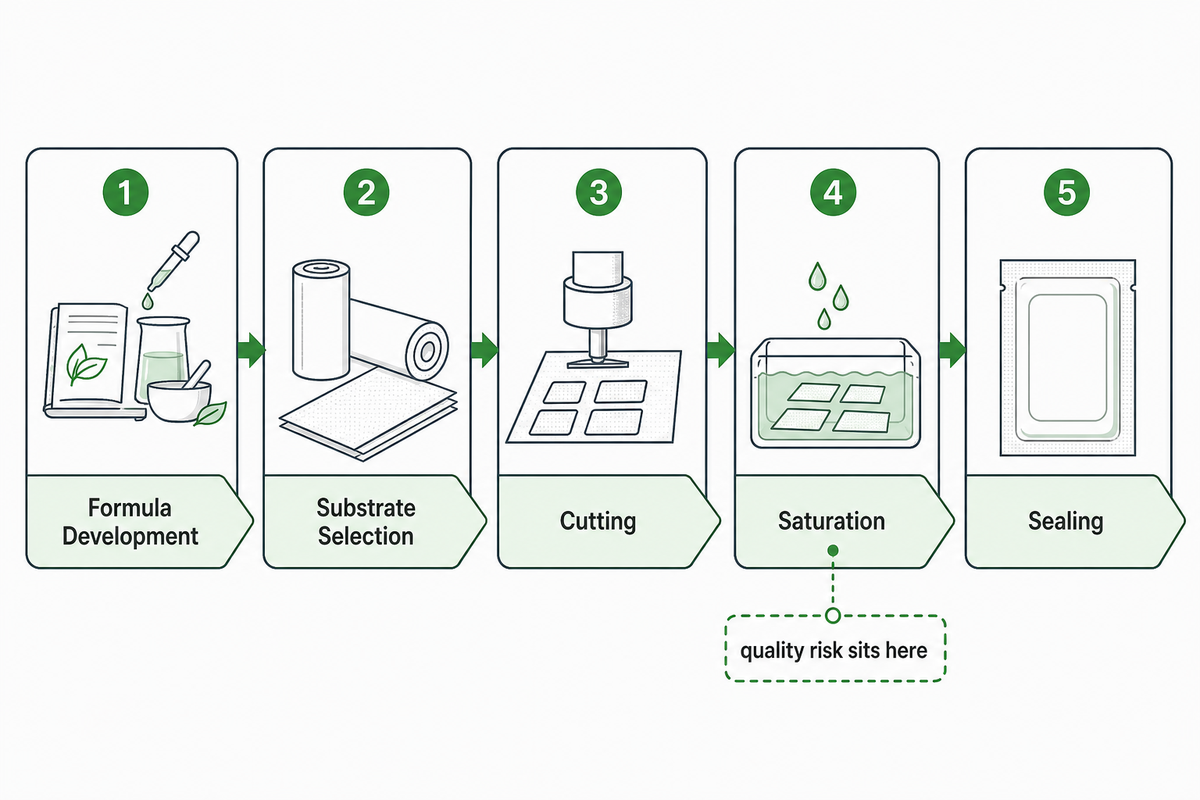
A sheet mask goes through formula development, substrate selection, cutting, saturation, and sealing — the core stages most manufacturers follow in the mask making process, though the specific sequence and equipment vary by format (a bacterial-cellulose sheet grown in a fermentation tank follows a different early-stage process than a printed hydrogel mask, a cotton sheet mask, or a die-cut non-woven sheet). Google’s own AI Overview for this topic summarizes the same generic stages, but it stops at pouching — it doesn’t cover certification, QC, or the material-tradeoff detail that actually separates manufacturers, which is where the real quality risk sits. Any manufacturer of sheet face masks serving the broader sheet masks market should be able to walk you through each stage with real production data, not a generic flowchart.
The substrate a serum is impregnated onto isn’t a purely cosmetic choice. Peer-reviewed research on cosmetic-impregnated nonwoven products found that the fabric itself can increase microbial growth and reduce preservative efficacy once impregnated (PubMed) — which is why manufacturing-grade microbiological testing exists as its own standard. ISO 21322:2020 covers the enumeration and detection of microorganisms in a cosmetic product impregnated onto a substrate such as wipes and masks, testing for aerobic mesophilic organisms, yeasts, molds, and the absence of specific pathogens including Staphylococcus aureus and Pseudomonas aeruginosa (ISO). A separate exposure study of 175 subjects found significantly higher relative exposure to common preservatives (phenoxyethanol, methylparaben) after more than 20 min of wear (PubMed) — the practical reason a recommended wear time appears on the packaging in the first place, not an arbitrary marketing choice.
📐 Engineering Note
ISO 21322 is currently being revised (ISO/DIS 21322 is in the enquiry phase), replacing the 2020 edition — if a manufacturer cites this standard, confirm which edition their test reports reference.
Choosing a Sheet Mask Substrate Material
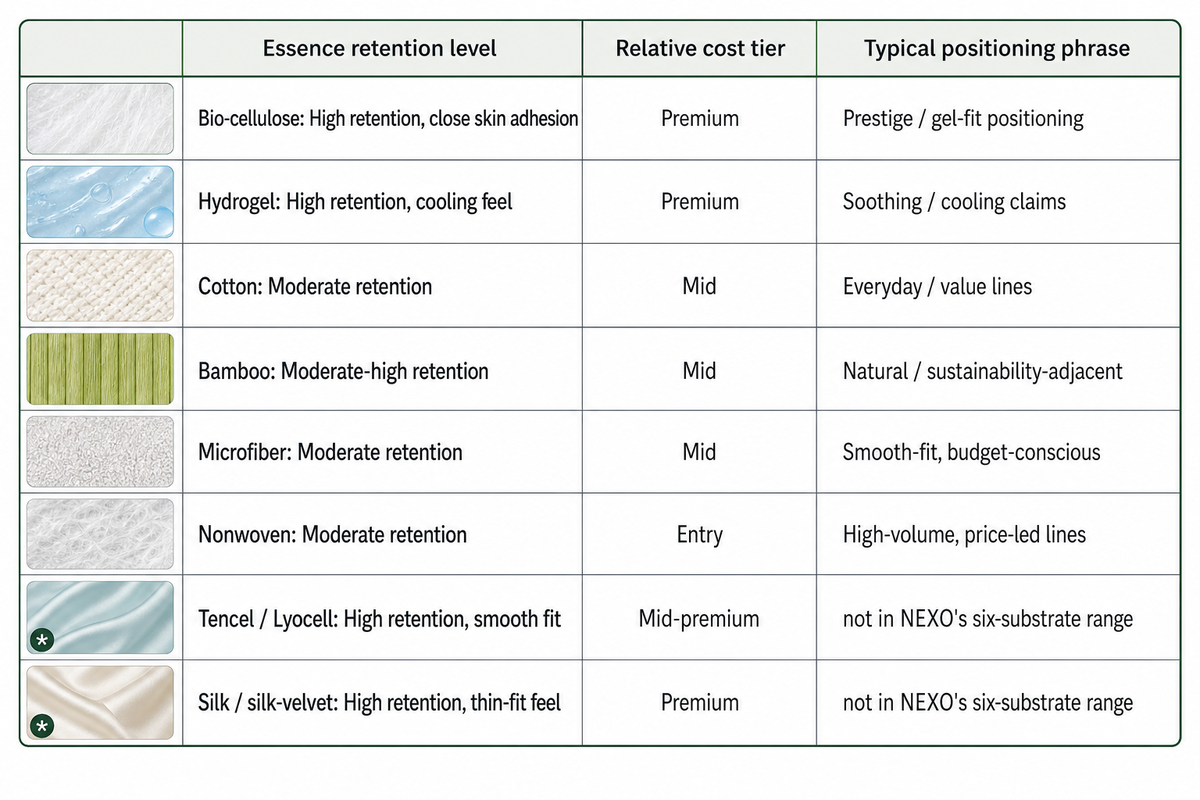
Substrate choice trades off cost, serum absorption, skin feel, and environmental profile — there isn’t a single “best” material for high-quality skincare, only a best fit for a given claim and price point. High-performance substrates for moisture retention and skin barrier support won’t necessarily suit an organic skin care or organic ingredients positioning, where a natural-fiber substrate usually reads more credibly to the buyer. A claim that a serum “penetrates deep” into skin needs the same scrutiny as any other unqualified claim in this guide — ask for the compatibility or penetration test data behind it, not just the copy. NEXO’s own sheet mask range spans six substrates; the table below summarizes the general tradeoffs buyers ask about most.
| Substrate type | Essence retention | Relative cost | Typical positioning |
|---|---|---|---|
| Bio-cellulose | High, close skin adhesion | Premium | Prestige / gel-fit positioning |
| Hydrogel | High, cooling feel | Premium | Soothing / cooling claims |
| Cotton | Moderate | Mid | Everyday / value lines |
| Bamboo | Moderate-high | Mid | Natural / sustainability-adjacent |
| Microfiber | Moderate | Mid | Smooth-fit, budget-conscious |
| Nonwoven | Moderate | Entry | High-volume, price-led lines |
| Tencel / Lyocell | High, smooth fit | Mid-premium | Broader market option; not currently in NEXO’s own six-substrate range |
| Silk / silk-velvet | High, thin-fit feel | Premium | Broader market option; not currently in NEXO’s own six-substrate range |
Bio-cellulose is worth a specific note: some 2026 market research puts it at roughly 31% of new sheet-mask product launches that year — a figure that appeared consistently across several market-research summaries, though we couldn’t directly verify it against a single named report page (unlike the market-size figures below, which we confirmed directly), so treat it as directional rather than precise. What’s independently verifiable: a peer-reviewed materials-science review found bacterial-cellulose production remains costly, slow to scale, and quality-inconsistent, with limited published research on commercial scalability (Journal of Materials Science). Share may be rising; the format hasn’t solved its production-scale challenges yet. Budget and lead-time expectations should reflect that, not just the marketing appeal.
Formulation Directions and Active Ingredients
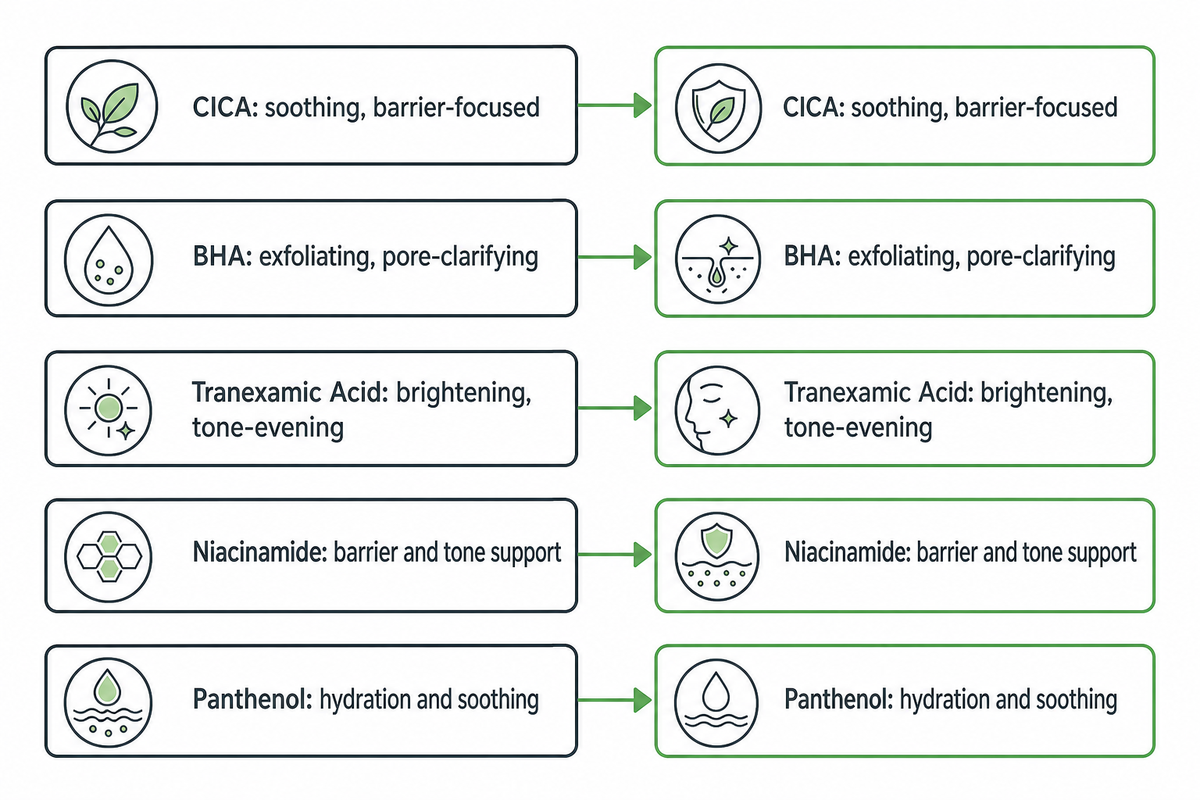
The active-ingredient direction should follow the claim you want on the box, not the other way around. Formulation development for any skincare product — a sheet mask or otherwise — starts from the claim, not the ingredient list. NEXO’s face mask products span five formulation directions: CICA (soothing, barrier-focused), BHA (exfoliating, pore-clarifying), tranexamic acid (brightening, tone-evening), niacinamide (barrier and tone support), and panthenol (hydration and soothing). A brand briefing a “sensitive skin” claim would typically start from CICA or panthenol; a “clarifying” claim points toward BHA; a “brightening” claim points toward tranexamic acid. This is the same OEM skincare formulation logic that applies across cosmetic biotechnology more broadly, not something unique to sheet masks.
Preservation strategy has to follow the same product-specific logic. ISO 11930 combines preservation-efficacy testing with microbiological risk assessment, and it explicitly distinguishes products assessed as microbiologically low risk rather than applying one universal test plan. A sheet mask’s wet, single-use format and its substrate-preservative interaction (see the process section above) mean this isn’t a box to check once and forget — it’s a per-formula assessment.
OEM vs ODM — Which Development Route Fits a Sheet Mask Launch
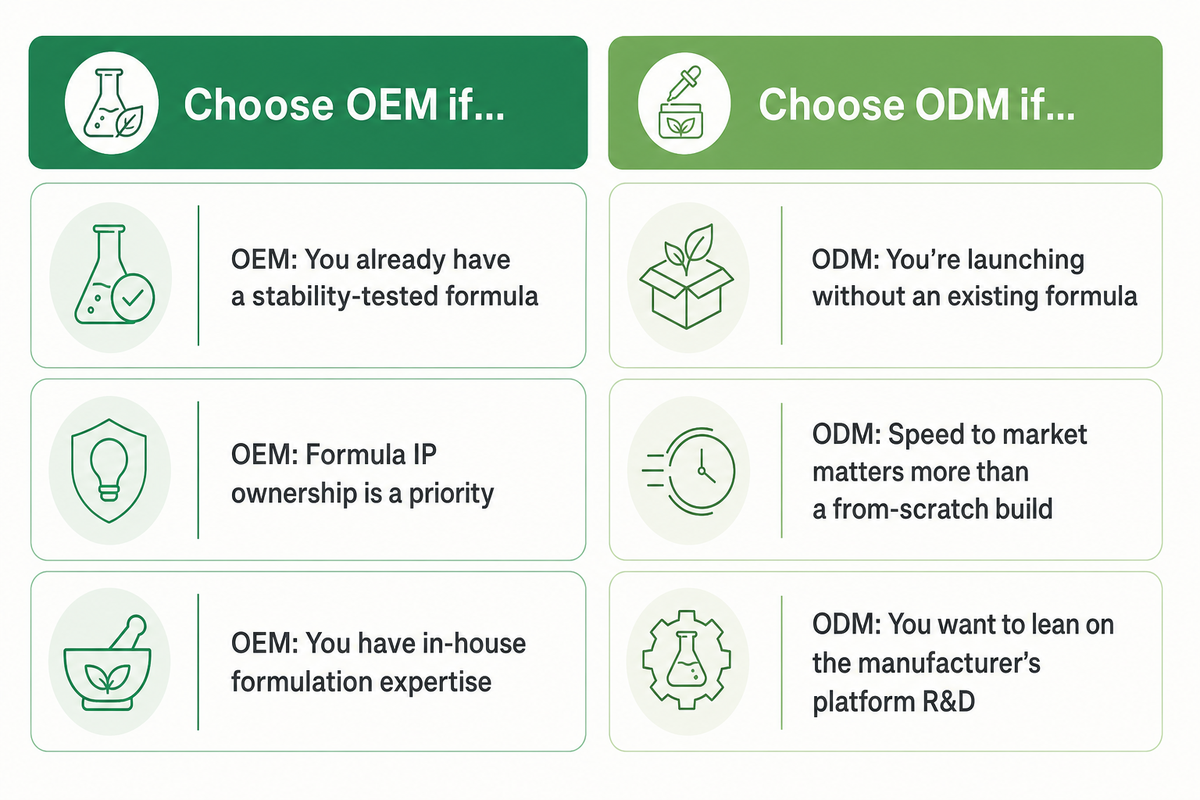
The formulation and preservative decisions covered above don’t stop mattering once you pick a manufacturer — they shape which development route actually fits. OEM cosmetic manufacturing means you bring the formula and packaging design; the factory manufactures to spec. ODM means the manufacturer’s own R&D team develops the formula for you, usually starting from an existing base. The right route depends on three factors: whether you already have a validated formula, how much timeline you have, and how much you prioritize owning the formula IP outright versus moving fast on a proven base.
Choose OEM if…
- You already have a stability-tested formula
- Formula IP ownership is a priority
- You have in-house formulation expertise
Choose ODM if…
- You’re launching without an existing formula
- Speed to market matters more than a from-scratch build
- You want to lean on the manufacturer’s platform R&D
Q: What is the MOQ for bio-cellulose mask OEM production?
Bio-cellulose mask MOQ is not standardized industry-wide and depends on the manufacturer’s shell and fill infrastructure — confirm the real figure directly rather than budgeting off a published range.
Because bio-cellulose has a different production route (often fermentation-based) than cut nonwoven or cast hydrogel sheets, MOQ tends to sit at or above general private-label cosmetic MOQ ranges rather than below them. One China-based private-label cosmetics manufacturer publishes a general MOQ range of roughly 1,000 to 5,000 units per SKU, which gives a rough sense of scale, though MOQ practice varies by manufacturer, region, and packaging complexity — this is not a bio-cellulose-specific, NEXO-specific, or verified industry-wide number. Confirm the real figure in a written quotation before budgeting around it.
Certifications That Actually Matter for a Sheet Mask Supplier
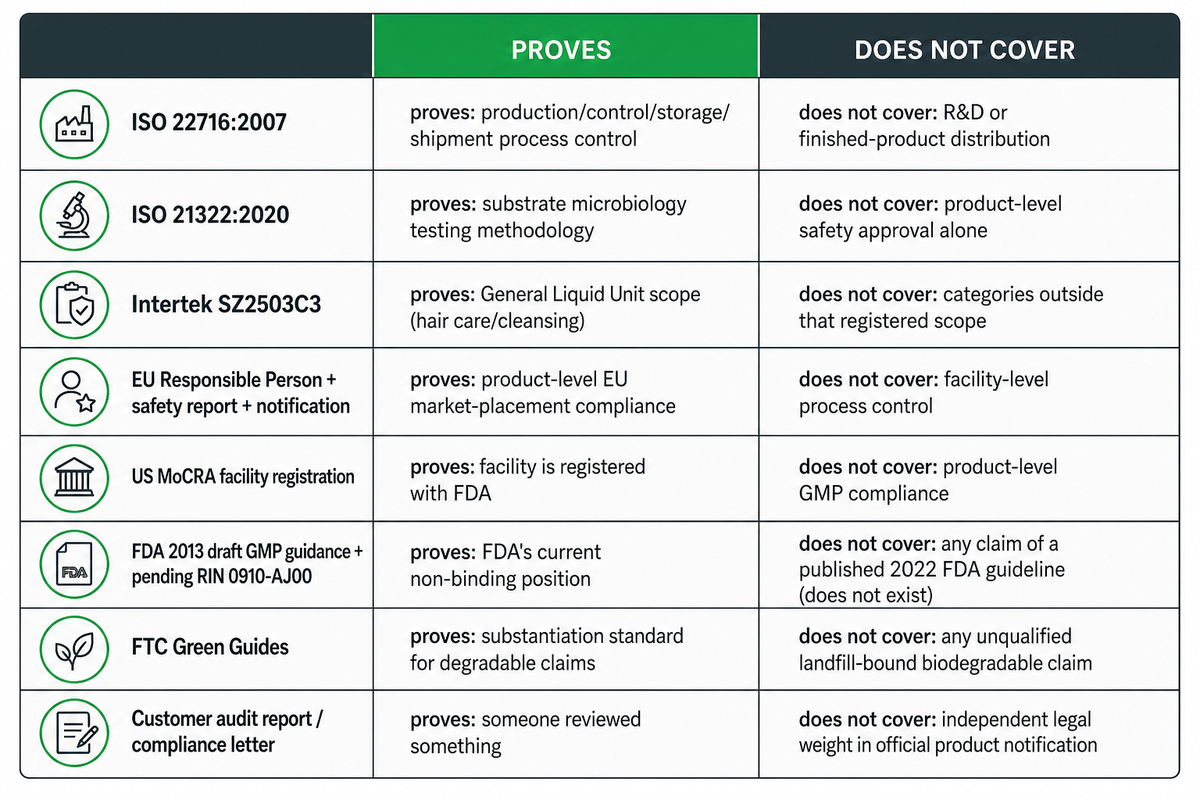
Whichever development route you choose, the manufacturer’s certification claims still need their own scrutiny. Certification claims are easy to list and hard to verify — which is exactly why they’re worth a closer look before you take one at face value. The manufacturing site behind this programme, Guangzhou Opseve Cosmetics Co., Ltd. (a distinct legal entity from the NEXO brand), holds Intertek certificate SZ2503C3, covering the General Liquid Unit production scope — registered for hair care and cleansing products, not sheet masks specifically — currently valid through 12 March 2028. That’s a real, checkable certificate; ask any manufacturer whether their certified scope actually names your product category, not just a production unit, because a certificate alone doesn’t answer every compliance question a buyer should ask.
Start with what a facility certificate actually proves. ISO 22716:2007 covers the production, control, storage, and shipment of cosmetic products — but its scope explicitly excludes research and development and distribution of finished products (ISO). A facility certificate applies to the site and its process control; it doesn’t automatically cover every product category made there, and it doesn’t settle product-level or market-specific legal responsibility. In the EU, brands must put a responsible person, a product safety report, and a product notification in place before market placement — independent of any facility-level certificate (European Commission). In the US, MoCRA layers its own separate duty on top of any facility certificate: the facility owner must register with FDA and renew that registration every 2 years, a distinct obligation from any manufacturing GMP certificate a facility might also hold. This isn’t a NEXO-specific gap: regulatory consultancies working in other markets describe the same pattern — a facility can hold an ISO 22716 certificate, a customer audit report, and a self-issued compliance letter simultaneously, with only one of those documents carrying legal weight in a given market’s product notification.
Product registration requirements sit on top of any facility certificate and vary by destination market — another reason a manufacturer offering services with custom documentation support matters more than a certificate logo. There’s a sharper version of this problem worth naming directly: a certificate’s stated scope has to actually exist. In our own research for this article, we found a real example of a certificate whose audit scheme cited a “2022 FDA cosmetic GMP guideline” that FDA has never published — FDA’s own guidance page marks its cosmetic GMP document as a 2013 draft guidance (docket FDA-2013-S-0610), not for implementation and not binding (FDA). As of this writing, FDA’s rulemaking timeline confirms no final GMP regulation exists yet: the government-wide Unified Agenda tracker lists RIN 0910-AJ00 in the “Long-Term Actions” phase, with the proposed rule itself (the step before any final rule) now scheduled for November 2027 — years past the original statutory deadline (reginfo.gov). Referencing a standard name tied to a document that doesn’t exist is a red flag worth checking, not a detail to skim past — and so is a regulatory timeline that’s already out of date by the time you read it; verify the current agenda directly before citing a date.
| Standard or obligation | What its scope proves | What it does NOT cover | Where to verify |
|---|---|---|---|
| ISO 22716:2007 | Production, control, storage, and shipment process control at the facility | R&D and finished-product distribution — explicitly excluded from scope | ISO’s own standard page (iso.org) |
| ISO 21322:2020 | Substrate microbiology testing methodology | Product-level safety approval on its own; note the ISO/DIS revision now in the enquiry phase | ISO’s own standard page (iso.org) |
| Intertek SZ2503C3 | General Liquid Unit production scope at Guangzhou Opseve Cosmetics Co., Ltd. (registered for hair care and cleansing products), valid through 12 March 2028 | Any product category outside that registered scope — sheet masks are not a named category on this certificate | Intertek’s own certificate registry |
| EU Responsible Person + safety report + notification | Product-level market-placement compliance in the EU | Facility-level process control — a separate requirement covered by ISO 22716, not this | European Commission cosmetics legislation page |
| US MoCRA facility registration (renewed every 2 years) | That the facility itself is registered with FDA | Product-level GMP compliance — a distinct obligation from facility registration | FDA’s own registration guidance pages |
| FDA 2013 draft GMP guidance (docket FDA-2013-S-0610) + pending GMP rulemaking (RIN 0910-AJ00) | FDA’s current, non-binding draft position; the government-wide Unified Agenda lists the proposed rule as scheduled for November 2027 | Any claim of a published, binding “2022 FDA cosmetic GMP guideline” — that document does not exist | reginfo.gov’s Unified Agenda tracker |
| FTC Green Guides | The substantiation standard an unqualified degradable or “dissolves” claim must meet | Any biodegradable claim on a product destined for landfill disposal — the Guides say that generally shouldn’t carry an unqualified claim at all | FTC’s own Green Guides text |
| Customer audit report or self-issued compliance letter | That someone reviewed or attested to something at some point | Independent legal weight in a market’s official product notification process — typically only one document type in that stack carries that | None published — treat as low-tier supporting evidence, not a substitute for the rows above |
3-Question Certification Audit
Before treating any manufacturer’s certification claim as settled, ask:
- Does the certificate name a real, checkable facility? Look up the certificate number in the issuing body’s own public registry, not just a screenshot on the manufacturer’s site.
- Does the standard it cites actually exist and match the stated version? Referencing a guideline, regulation, or edition that isn’t published anywhere is a documentation problem, not a compliance win.
- Does the certificate’s scope cover your product and target market, or only the facility’s general process controls? Facility certificates aren’t a substitute for market-specific product notification, safety reporting, or a named responsible person where those are legally required.
MOQ, Samples, and Lead Time — What to Expect
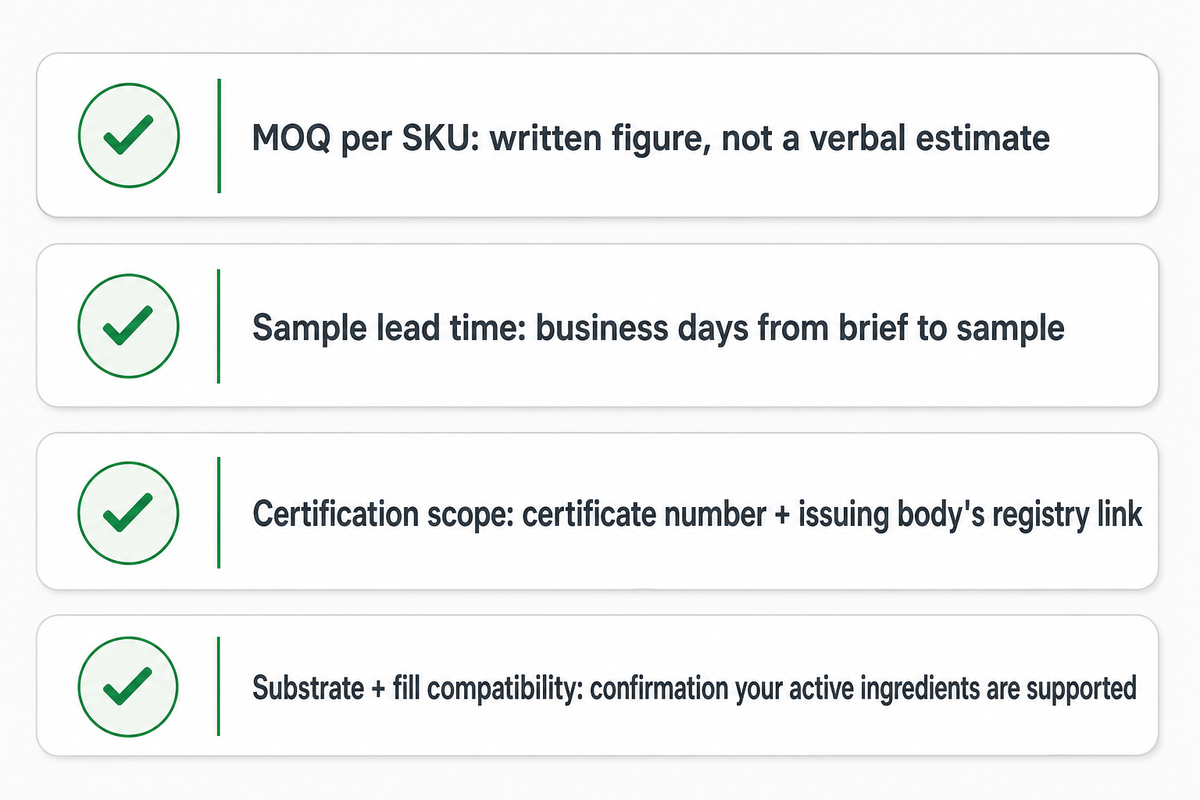
NEXO doesn’t publish a fixed MOQ figure for sheet masks the way it does for some sibling categories — treat any number you see elsewhere online as a starting point for a quote, not a locked figure. For a general sense of scale, one published private-label manufacturer range runs 1,000 to 5,000 units per SKU, with smaller pilot runs sometimes available and custom builds sometimes requiring 10,000+ units depending on packaging complexity — treat this as one reference point, not an industry-wide standard, and confirm your manufacturer’s actual figure directly — for NEXO’s own programme, that means requesting a written quotation on the sheet mask manufacturing programme page.
RFQ checklist — copy these into your quote request:
| Parameter | What to ask for | Why it matters | How to verify |
|---|---|---|---|
| MOQ per SKU | Written figure, not a verbal estimate | NEXO and most manufacturers don’t publish a fixed sheet-mask MOQ | Request in the formal quotation, confirm it covers your exact substrate + fill combination |
| Sample lead time | Business days from brief to sample | Varies significantly by development route (mature formula vs custom) | Ask for route-specific timelines, not a single blended number |
| Certification scope | Certificate number + issuing body’s registry link | Confirms the certificate is real and covers your product category | Look it up directly in the issuer’s public database (see Certification Audit above) |
| Substrate + fill compatibility | Confirmation your chosen material supports your active ingredients | Substrate affects preservative efficacy, not just feel | Ask for the manufacturer’s own stability/compatibility test data |
Is Sheet Mask Manufacturing Actually Sustainable?
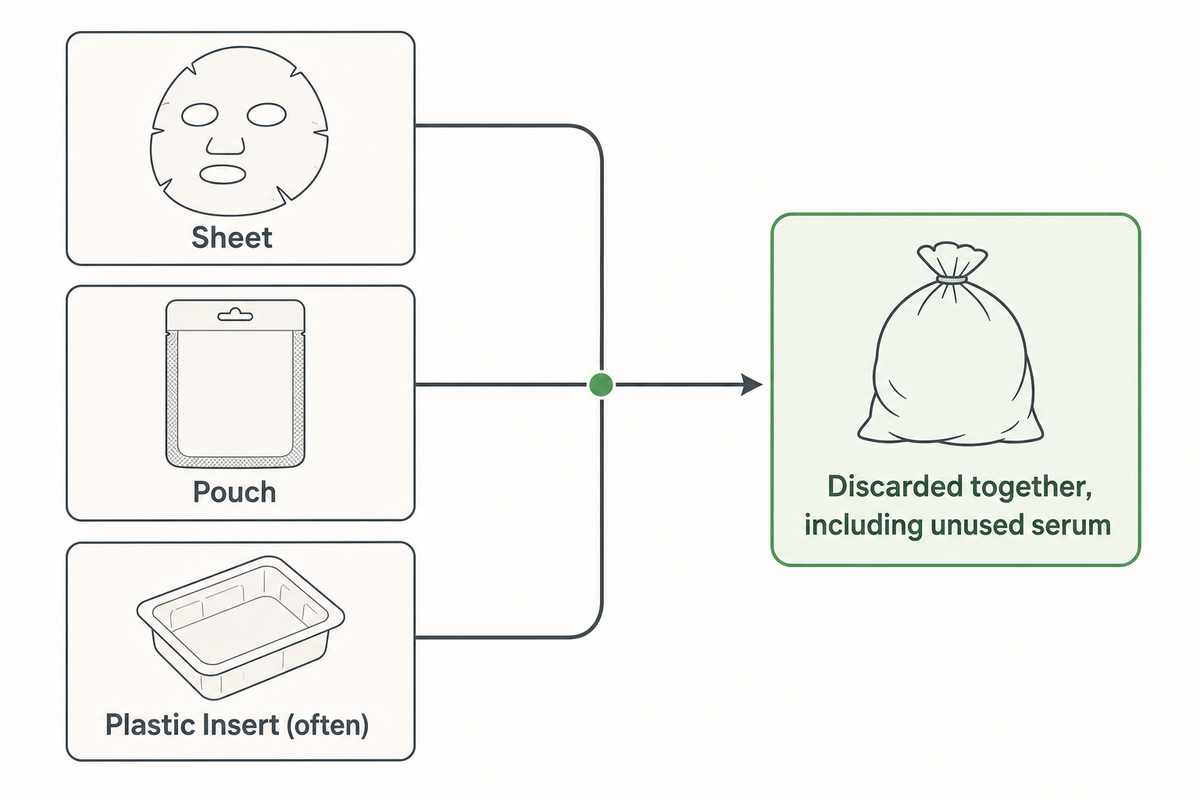
No — not by default, and the honest answer matters more than a reassuring one. It’s worth adding to the RFQ checklist above, not something to treat as an afterthought once volumes and lead time are locked in. Sheet masks are genuinely wasteful by design: plastic backing fabrics, preservative-dependent wet formulas, and disposable water-tight pouches mean the sheet, the pouch, and often an extra plastic insert are all discarded together, including unused serum.
A board-certified dermatologist quoted by the American Chemical Society put it plainly: sheet masks aren’t an eco-friendly product category, especially for everyday use.
This is the gap we call Sheet Mask Manufacturing’s Sustainability Blind Spot: none of the top-ranking manufacturer or comparison pages we reviewed for this topic address it at all. That silence doesn’t make the criticism go away — it just means buyers researching this topic have had to piece the answer together themselves.
The material shift is real, but it’s not a finished solution. Global Market Insights projects the global sheet mask market to grow from roughly $3 billion in 2026 to $5.3 billion by 2035, a CAGR of about 6.6% — figures we confirmed directly against the source report (gminsights.com). Bio-cellulose’s rising share of new launches is directionally consistent across the market-research coverage we reviewed (see the substrate section above for the specific figure and its caveat). Industry coverage documents brands moving toward compostable and dissolving formats — part of a broader, if inconsistently measured, consumer shift toward eco-friendly or reusable packaging. But “biodegradable” claims deserve the same scrutiny as certification claims: the FTC’s Green Guides require brands to back any unqualified degradable claim with proof the entire product completely breaks down under customary disposal, and state that products destined for landfill generally shouldn’t carry an unqualified biodegradable claim at all. Claiming a mask “dissolves in days” without disposal-condition substantiation is a marketing claim, not a verified environmental fact — for either a manufacturer or a brand repeating it downstream.
What this means for a buyer briefing a sheet mask programme: ask what specific substrate, packaging, and disposal-condition testing backs any sustainability claim your manufacturer wants to put on your box, before you put it there. “Eco-friendly” without that backing is exactly the kind of unqualified claim regulators are already flagging.
How to Vet a Sheet Mask Manufacturer Before You Sign
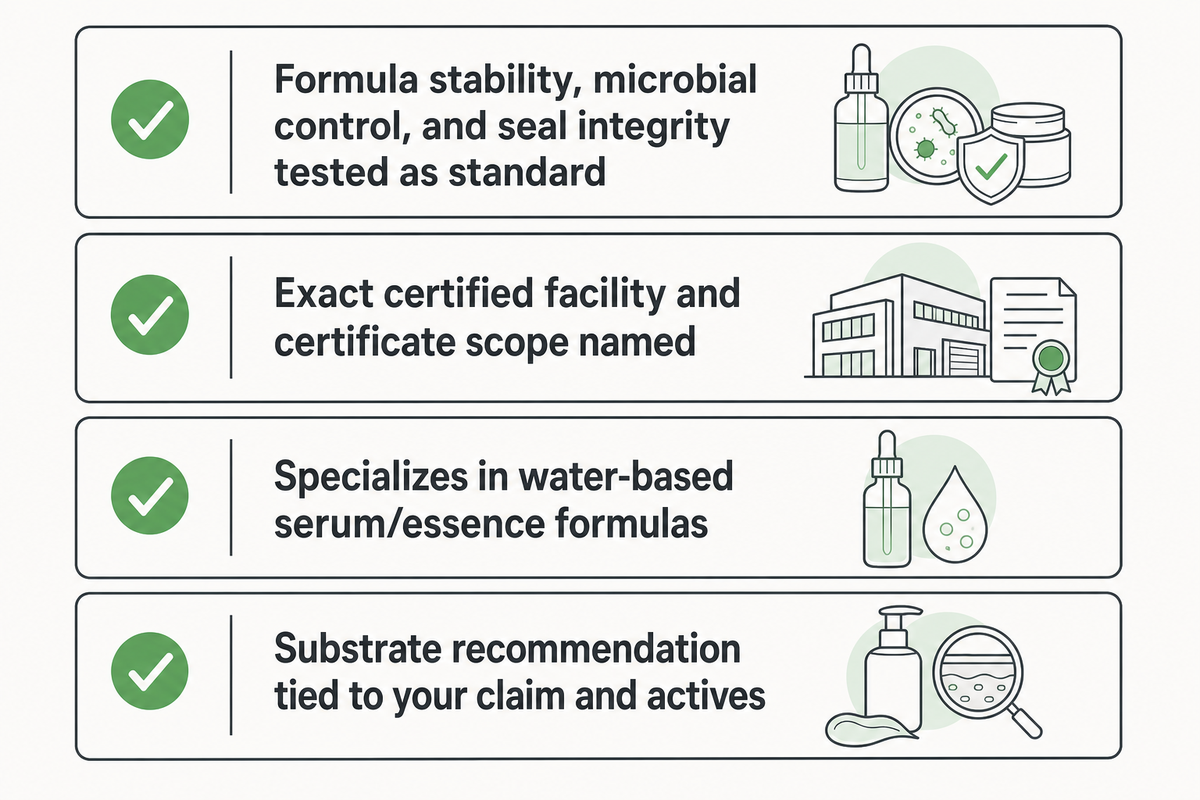
Most sourcing mistakes don’t happen because there are no good factories — they happen because the evaluation criteria are wrong from the start. Buyers who focus only on price end up choosing a supplier that looks fine on paper but doesn’t support the actual business model behind the product. Real buyer complaints on skincare review communities echo the same pattern from the other direction — users describing specific sheet masks as “a bit pointless” or “a waste of money” commonly point to inconsistent essence fill, poor sheet fit, or a scent/feel mismatch as the reason, not a fundamentally bad category.
Key Factors to Consider
- Does the manufacturer test formula stability, microbial control, and seal integrity as a standard battery, not an optional add-on?
- Can they name the exact certified facility and certificate scope — not just a logo on the page (see the Certification Audit above)?
- Do they specialize in water-based serum/essence formulas, or are they a general contract filler applying the same process to everything?
- Is the substrate recommendation backed by a reason tied to your claim and actives, or a default “this is what we always use”?
If a mask feels dry, leaks in transit, has an off odor, or delivers inconsistent skin feel between batches, buyers trace the problem to the brand printed on the pouch — not the factory. That’s the real cost of skipping the evaluation steps above.
Consumer preferences shift faster than most manufacturer catalogs update: what consumers use and buy in a given season doesn’t always match a factory’s default lineup. Whether you’re sourcing beauty sheet masks, a beauty mask, or a broader variety of products including face mask manufacturing services and sheet mask OEM lines, ask your manufacturer how often they update formulation directions to track current market trends — not just what’s in the catalog today. Some buyers specifically search for a Korean beauty or Korean sheet mask specialist on the assumption that country of origin alone signals quality; treat any origin claim the same way you’d treat a certification claim — check the actual process data behind it, don’t just repeat the story, regardless of which country a manufacturer is based in. The same questions apply across sheet masks and skincare more broadly — including sheet masks with collagen or other actives — whether you’re evaluating a skincare factory, a cosmetic and skincare contract manufacturer, or a supplier pitching white label products.
FAQ
Q: How much does private-label sheet mask production cost per unit?
Per-unit cost for a private-label sheet mask commonly ranges from roughly $0.25 to $4.00+, depending on substrate, essence load, and packaging — before any one-time formula development fee.
Basic nonwoven sheet masks run toward the low end of that range, while premium hydrogel or bio-cellulose formats sit at the top. On top of the per-unit figure, expect a one-time formula development fee if you’re not using an existing mature formula — lab fees for custom formulation commonly run from roughly $1,500 to $5,000+, covering R&D, stability testing, and packaging compatibility testing. Get a written, SKU-specific quotation before budgeting off any published range, since these figures vary significantly by manufacturer and specification.
Q: Is Private Labeling Right for My Company?
Private label fits brands that want to control formulation direction, packaging, and go-to-market without building their own manufacturing infrastructure, provided they can meet the manufacturer’s minimum order quantity.
It’s a strong fit if you have a clear positioning and claim in mind but not your own production line — you brief the formula direction (see the ingredients section above), and a manufacturer executes it. It’s a weaker fit if your differentiation depends entirely on a proprietary process a contract manufacturer can’t replicate, or if you need volumes below what most manufacturers’ MOQs support. General MOQ mechanics and IP/formula-ownership terms — the same whether you call it private label sheet masks or white label sheet mask production — are covered in more depth on NEXO’s private label skincare manufacturing programme page.
Q: How long does sheet mask contract manufacturer production take?
Timeline depends heavily on development route — a mature-formula order moves fastest, a formula-adaptation order sits in the middle, and a custom-developed formula takes considerably longer to sample and validate.
Because sheet masks span very different substrate production methods (die-cut nonwoven vs cast hydrogel vs fermented bio-cellulose), a single blended “X weeks” answer isn’t reliable. Ask your manufacturer for a route-specific timeline broken into sample development and commercial production stages, and confirm whether your chosen substrate has a different lead time than their standard formats.
Q: Can sheet masks ever be environmentally friendly?
Not without real substantiation — ask what specific testing backs any “eco-friendly,” “biodegradable,” or “dissolves in days” claim before you repeat it to your own customers.
See the sustainability section above for the full picture, including the FTC’s substantiation standard for degradable claims.
Q: Do you offer Korean sheet mask factory services for international brands?
The manufacturing base behind this programme is in Guangzhou, China, with production at Guangzhou Opseve Cosmetics Co., Ltd., serving international brands since 2020 — not a Korean facility, despite how the question is often phrased.
If Korean-manufactured sheet masks specifically are a requirement for your positioning, confirm this directly with our team so we can route you correctly — NEXO’s own production is China-based.
Why We Write This
NEXO wrote this guide because most private label sheet mask manufacturer pages we researched list certifications without publishing a certificate number or issuing-body registry link a buyer can actually check, and none of the top-ranking pages we reviewed address the sustainability question buyers increasingly ask. The same gaps apply broadly across sheet mask manufacturing companies and skincare products generally. This is the sourced reference we wanted before publishing our own programme page, and we’ll keep it updated.
References & Sources
- ISO 22716:2007 Cosmetics GMP — International Organization for Standardization
- ISO 21322:2020 Cosmetics Microbiology — International Organization for Standardization
- Draft Guidance for Industry: Cosmetic Good Manufacturing Practices — U.S. Food and Drug Administration
- Cosmetics Legislation — European Commission
- Environmental Claims: Summary of the Green Guides — U.S. Federal Trade Commission
- Substrate-preservative interaction in impregnated cosmetic products — PubMed / National Library of Medicine
- Preservative exposure and wear-time study — PubMed / National Library of Medicine
- ISO 11930 Cosmetics Microbiology — Evaluation of the Antimicrobial Protection of a Cosmetic Product — International Organization for Standardization (standard cited by designation; verify the current edition and full text directly with ISO or your test lab)
Related Articles
- NEXO Sheet Mask Manufacturing Programme — current specs, materials, and formulation directions
- Private Label Skincare Manufacturing Across Six Categories — the full NEXO skincare development brief