Get in touch with NEXO Beauty Labs Company

Custom Cosmetic Formulation & R&D: A Guide for Beauty Brands

Custom Cosmetic Formulation & R&D transforms a concept into a product idea, an ingredient system, a repeatable process and defined product characteristics. Effective development ties the brand benefit to the desired textural and physical characteristics of the product, supporting evidence and the type of packaging to be used.
A serum can feel luxurious and require different levels of preservation. A cream can look thicker without delivering the after-feel a customer prefers. Identifying the question the next prototype should answer is a major consideration in formulation development. This guide explains formulation development decisions for skincare, haircare and body care brands, from the first brief to formula transfer. Personal care products need a brief that connects consumer use with packaging design.
Start with the unresolved requirement. Choose custom work when an existing formula cannot meet a meaningful product goal. Compare samples under controlled conditions, then match safety, stability and efficacy evidence to the claims and markets you plan to enter.
What Custom Cosmetic Formulation and R&D Designs
Custom cosmetic formulation determines the composition and behavior of a cosmetic product; R&D investigates the process through which that formula can be made, evaluated and transferred to production. The brief should connect ingredient selection, the sensory attribute, packaging and the claims to be made, and provide a clear direction for the next step.
Private label starts from an available formula; custom skincare may require a different base, texture or ingredient combination. Neither is automatically better. Formulation and manufacturing are connected, but an in-house laboratory and an external development partner can divide the work differently. A founder seeking a basic moisturizer has a different concern than a brand replacing a raw material to maintain consumer experience.
What does a formulation chemist do?
A formulation chemist combines and prepares ingredients into a workable formulation and evaluates the behavior of the product. A cosmetic chemist evaluates the interplay among active ingredients, base ingredients, and the preservation system and assesses the interaction of the product with the different steps in the manufacturing process. With their knowledge and expertise, they improve a product concept to a testable version, and examine the results to determine what needs to be altered for the next round of development.
Senior, experienced chemists should define how the custom product will be validated. A well-defined development process results in more than a lab sample. Formula versions, agreed specifications and relevant evaluation records connect the preferred product to the material that will eventually be manufactured. For the rest of the project and quotation structure, see our cosmetic product development work-package guide.
Practical boundary: commissioning a 30 mL serum does not mean every laboratory service is included. Ask which formulation question the proposal resolves and which testing or production activities are priced separately.
Translate Product Vision Into a Testable Formulation Brief
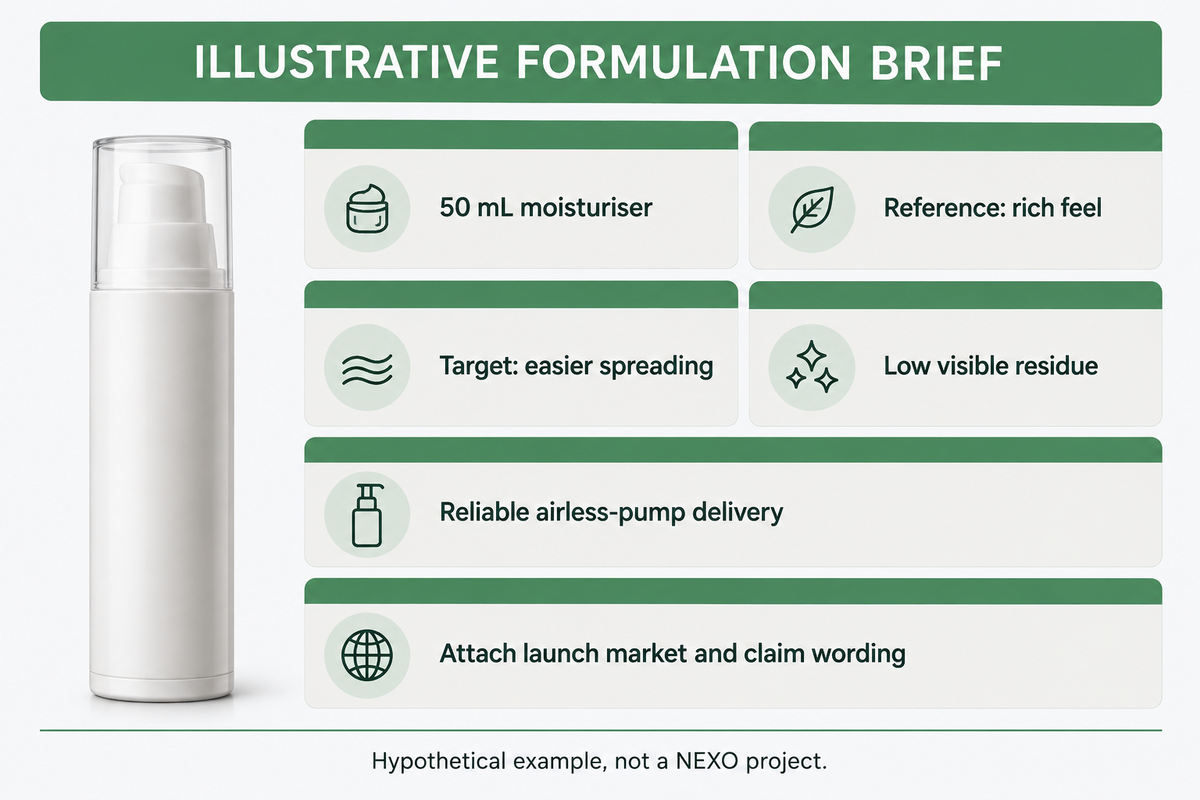
An ideal product development brief includes the planned consumer and the context of the use, the anticipated benefit, a sensory description and a target for the product, the target product and packaging, and the intended sales market. It’s also important to prioritize the requirements. The formula can be adapted more effectively when the brand/customer explains what should be altered, what can be changed, and how the preferred sample will be identified.
Imagine a hypothetical founder creating a facial moisturizer. Consider an illustrative founder preparing a 50 mL facial moisturiser for an online launch. The founder’s reference feels rich, but the target audience likes a more lightweight finish to wear under their makeup. The founder makes a series of requests for the next iteration of the product. These requests include the use of more active ingredients and a thicker base. Solving these problems doesn’t always solve the real problem. A better brief would address the product’s desired moisturising benefit alongside a smooth, even application that’s easily spreadable with no visible traces left behind, and reliable pump dispensability. Marketing comes up with the wording they want to use; the formulator figures out how to make the system do that; procurement confirms the intended packaging. The first point of comparison can then be about spreadability and visible residue instead of trying to pick an entire product launch from one nice sample.
Target-market wording belongs in the brief early. FDA’s anti-aging guidance distinguishes moisturising to make wrinkles less noticeable from intended effects on skin structure or function. Increasing collagen production is one example FDA gives of a drug or device claim. More efficacy testing alone does not keep such a claim within the cosmetic category.
Use a reference product to illustrate a characteristic, not as an instruction to copy a competitor. Draw a line between mandatory exclusions and preferences. Define who has the authority to give final approval to formulation changes. A collaborative approach is more effective when the R&D team has identified who will resolve conflicting feedback. Clarifying usable development input, such as a 50 mL pump specification, is more helpful than indicating that a product needs to be “luxurious and effective.” Setting up an effective route from concept to shelf provides numerous opportunities to achieve a goal with effective formulations. Market-ready products also need the agreed documentation and market review; a pleasing texture is one milestone.
Build an Ingredient System, Not a Hero-Ingredient List
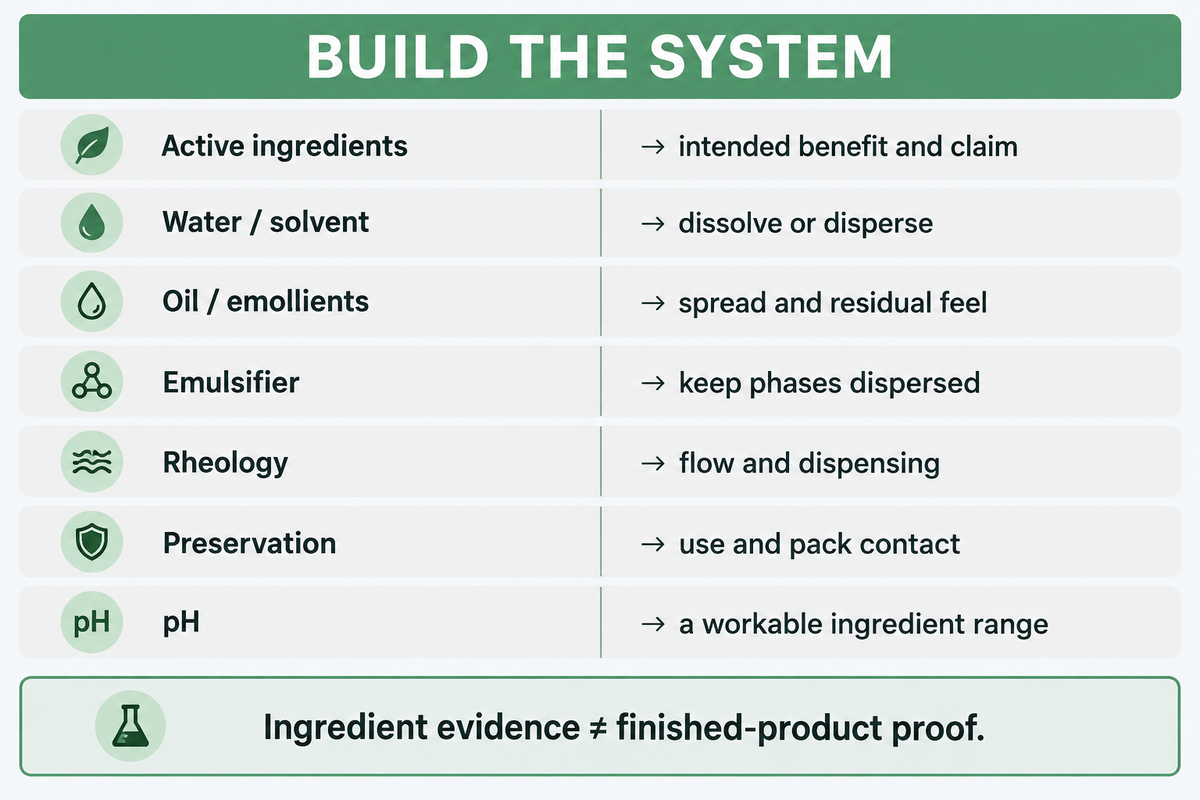
Product cosmetic formulation is the combination of ingredients and the process in which they interact. Actives contribute to the intended benefit, while solvents, emulsifiers, rheology modifiers and preservation influence whether the finished product can be made and used as intended. An ingredient list is a starting point for development, rather than a complete product specification. Product quality includes how the ingredients behave together throughout the intended use.
The discussion by Carmen Lerga on the choice of emulsifiers offers insight to oil phase composition, pH and ionic strength and how they may influence product processing. The buyer implication is concrete: From a buyer perspective, changing emulsifiers may resolve a formulation textural issue, but raises other questions. The article is a consultant’s technical explanation, not proof that a specific supplier’s formula will perform as promised.
| System element | Formulation question | What the brand should specify |
|---|---|---|
| Active ingredients | Which product goal does the active support? | Proposed benefit, target market and intended claim wording. |
| Water or solvent phase | Where will each material dissolve or disperse? | Clear or opaque appearance; ingredient exclusions. |
| Oil phase and emollients | How will spreading and residual feel be balanced? | A reference texture and the unwanted after-feel. |
| Emulsifier system | How will immiscible phases remain dispersed? | Cream, lotion or other delivery format. |
| Rheology modifier | Which flow behaviour matters during use? | Pump, dropper, tube or jar; desired dispensing behaviour. |
| Preservation system | What microbiological risks need control? | Use pattern, pack contact and intended consumer. |
| pH adjustment and buffering | Which ingredients and specifications share a workable range? | Market restrictions and agreed finished-product limits. |
| Fragrance and colour | What changes could affect composition or label? | Fragrance preference, exclusions and sale markets. |
| Process and packaging | How will the system be made, filled and dispensed? | Pack material, format and production route. |
The evidence must also link ingredients to the marketing claim. EU Regulation 655/2013 requires adequate and verifiable support when ingredient properties are extrapolated to a finished cosmetic product. Evidence from ingredient studies can be used, but the cosmetic product must also be substantiated. The rule does not impose the same clinical study on every cosmetic.
Current guidance of the European Commission states expanded fragrance-allergen labelling requirements, with applicable thresholds of 0.001% for leave-on and 0.01% for rinse-off products. Non-compliant products may no longer be placed on the EU market from 31 July 2026; qualifying products placed before that date have a transition until 31 July 2028. Ensure the relevant conditions of use and labelling are met, prior to approving artwork.
Before changing the ingredient list: ask the formulator to identify the affected function and the evidence that needs reassessment. A change of fragrance used in a 200 mL conditioner can affect more than the scent preference; it can also change the compositional information used for market review.
Use Prototype Development to Resolve Texture and Delivery Trade-offs
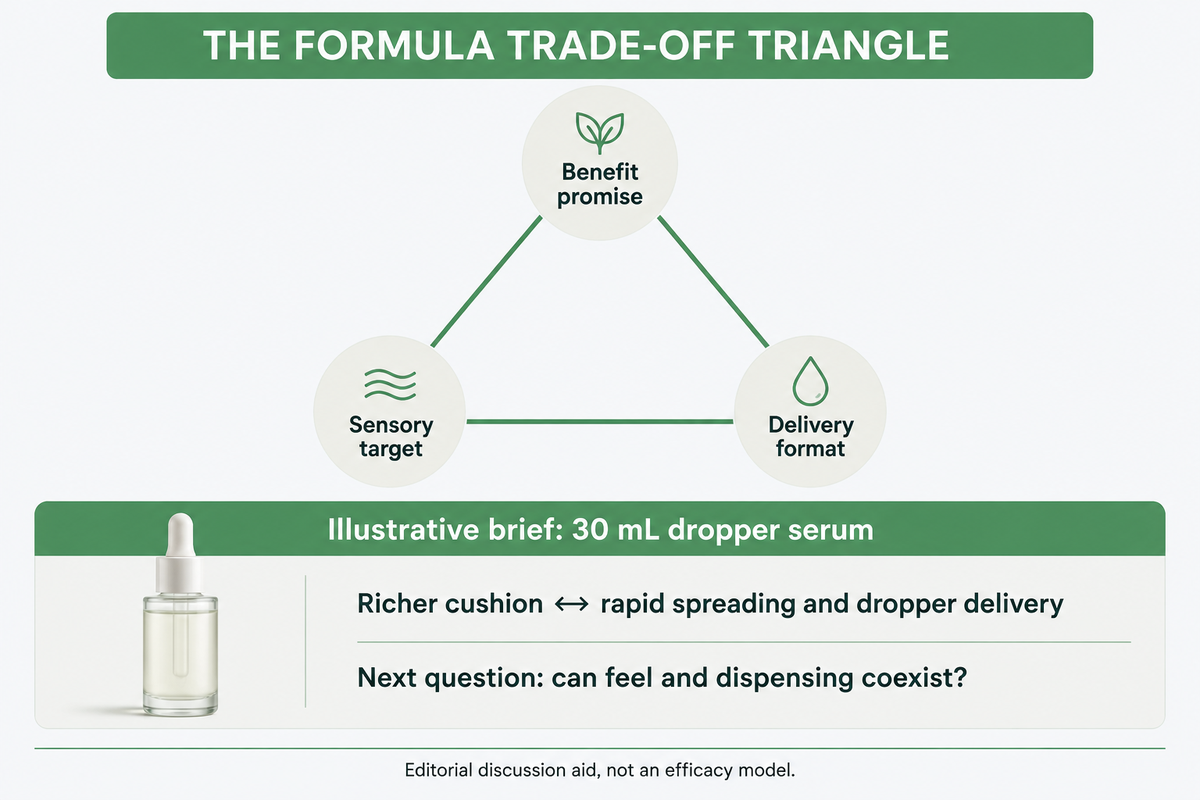
Changes designed to improve the performance of a formulation are best assessed against a defined reference and target. Blind reformulations shouldn’t be relied upon to improve all aspects of the product. Interactions between formulation components may impact final product performance and attributes.
The Formula Trade-off Triangle is a simple editorial aid. Put the benefit promise, sensory target and delivery format side by side. When one of the three factors is changed in tailored solutions, the other two need to be checked. The triangle organizes discussion on tradeoffs for a given formula. It isn’t a tool to calculate or rank formula efficacy. Before comparing the impact and performance of different versions of a formula, define what’s meant by “high-performing” for this formula.
| Illustrative brief | Decision tension | Next useful development question |
|---|---|---|
| 30 mL facial serum in a dropper | A richer cushion may conflict with the desired rapid spreading and dropper delivery. | Can the sensory target be reached while keeping the selected dispensing format? Compare coded prototypes before adding more actives. |
| 50 mL moisturiser in an airless pump | A thicker appearance may look premium while changing how the pump dispenses. | Evaluate the formula in the intended pack. Agree the dispensing check before approving the texture. |
| 200 mL rinse-off hair conditioner | More slip during application may not produce a preferred dry-hair after-feel. | Separate wet application, rinsing and dry-hair observations. Choose the next revision against the missing attribute. |
Research on cosmetics has documented the importance of sensory evaluation stages. For example, in a 2018 study by Yanan Li and colleagues, eight appearance, pick-up, and rub-in attributes of emulsions were found to differ significantly with six thickeners, while five after-feel attributes didn’t show significant differences. Researchers from Ashland and a university were included in this study. The abstract doesn’t support the claim that thicker emulsions always feel better.
Can I review samples and request changes before approving the final formula?
Sample review and revisions can be included in a development agreement, with the number of rounds and approval process defined in advance. Record the version of the formula being evaluated, the attribute to be changed and the reason for the request. A request to remove sticky residue while retaining the pump format would be more helpful than a vague request to “improve the product.”
Keep a single unresolved question in the center of the next round. A 30 mL dropper serum that spreads well but dispenses poorly needs a formula-and-pack decision, not an automatic increase in actives. Discuss whether the delivery system or the formula should be changed first.
Evaluate Lab Samples Without Confusing Preference With Efficacy
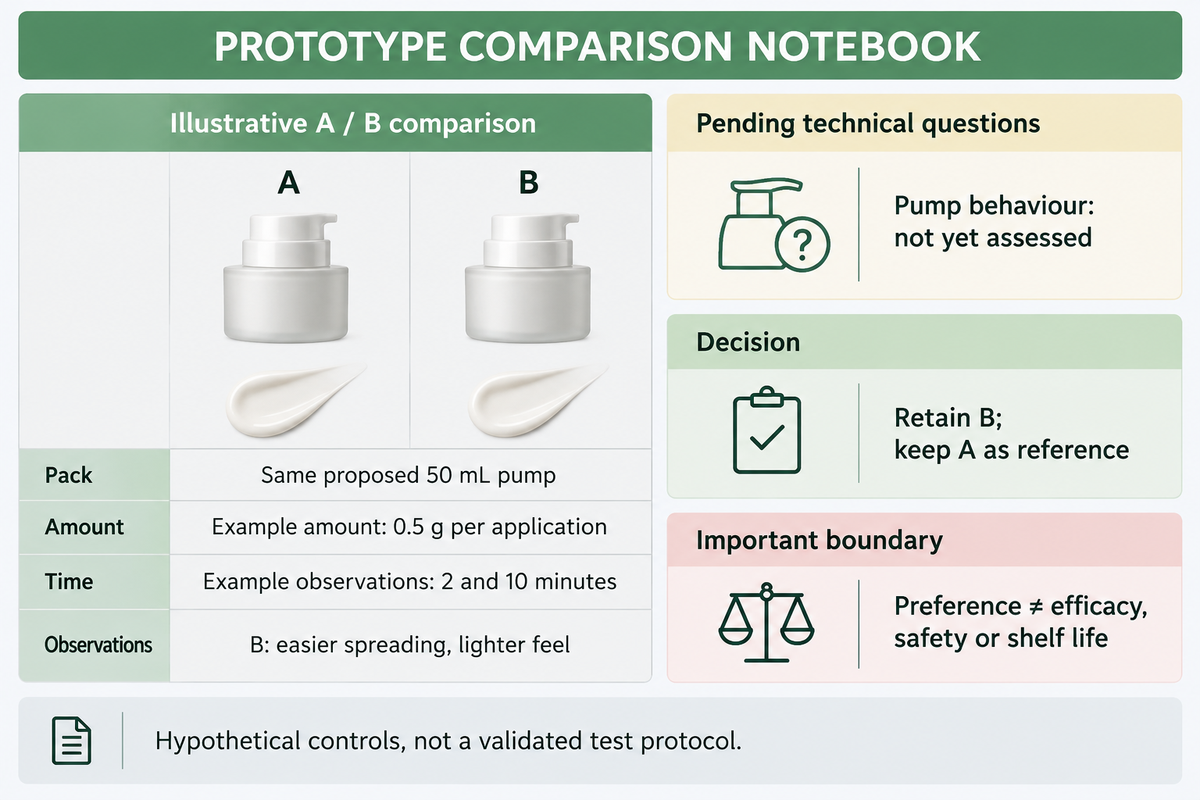
Lab samples should be evaluated against the question being asked. Was the request for a preference, a measurable attribute or support for a stated benefit? Record the sample identity and conditions. Separate your observations from your interpretations. A controlled comparison may answer the question of the next appropriate prototype, while the safety and shelf life of the product and other claims are best answered by other methods.
S. Varesi and colleagues provide a good method lesson, in their article on sensory analysis, describing the use of controlled quantities and conditions, trained evaluators and blind coding for comparison of hair care product samples. While an informal brand review may be very useful in product development and quality assurance, a substantiated sensory claim requires an appropriate research design; quality standards used as acceptance criteria should be defined separately.
Prototype Comparison Notebook
The filled example shows how to capture feedback of interest. The figures and times are illustrative comparative controls, not recommended test conditions or results from a NEXO project.
| Recorded item | Illustrative observation | Interpretation and next action |
|---|---|---|
| Question | Compare spread and residue of two moisturiser prototypes. | Keep the proposed moisturising claim unchanged during this sensory round. |
| Sample identity | Prototype A and Prototype B are recorded with their formula versions. | Ask the chemist which variables changed; preserve traceability. |
| Pack | Both samples are dispensed from the same proposed 50 mL pump format. | A different package would add a second explanation for the difference. |
| Amount | The comparison plan specifies 0.5 g per application. | This is an example control, not a validated dose or consumer instruction. |
| Application | The same evaluator uses the same defined area and rubbing sequence. | Record conditions; do not compare one fresh sample with another used differently. |
| During spreading | Evaluator describes B as easier to distribute. | Record the attribute without calling B more effective. |
| After-feel | Residue is described at 2 minutes and 10 minutes. | Example observation times only; select a protocol appropriate to the product. |
| Open technical question | B feels lighter, but its pump behaviour has not been assessed. | Check dispensing in the intended pack before selecting the preferred version. |
| Decision | Retain B for the next controlled evaluation; keep A as the reference. | A preference decision moves development forward; safety, stability and claim work remain separate. |
A product manager may prefer B immediately, while the quality lead is still waiting on an agreed-upon viscosity method and the procurement lead is waiting on the pump. Calling B “approved” would be hiding three different decisions. Instead, the manager records a sensory preference, the chemist confirms which variable changed and the team schedules the outstanding pack check. That record lets the next sample round answer a useful question without pretending that a preferred feel establishes the product’s complete performance.
Keep the language precise: “B left less noticeable residue in this comparison” is clear. “B is clinically superior” requires evidence to support that claim. The same distinction applies to a 200 mL haircare product: Easier wet combing and a preferred dry-hair feel are two different observations.
Match Stability Testing and Compliance Evidence to the Question
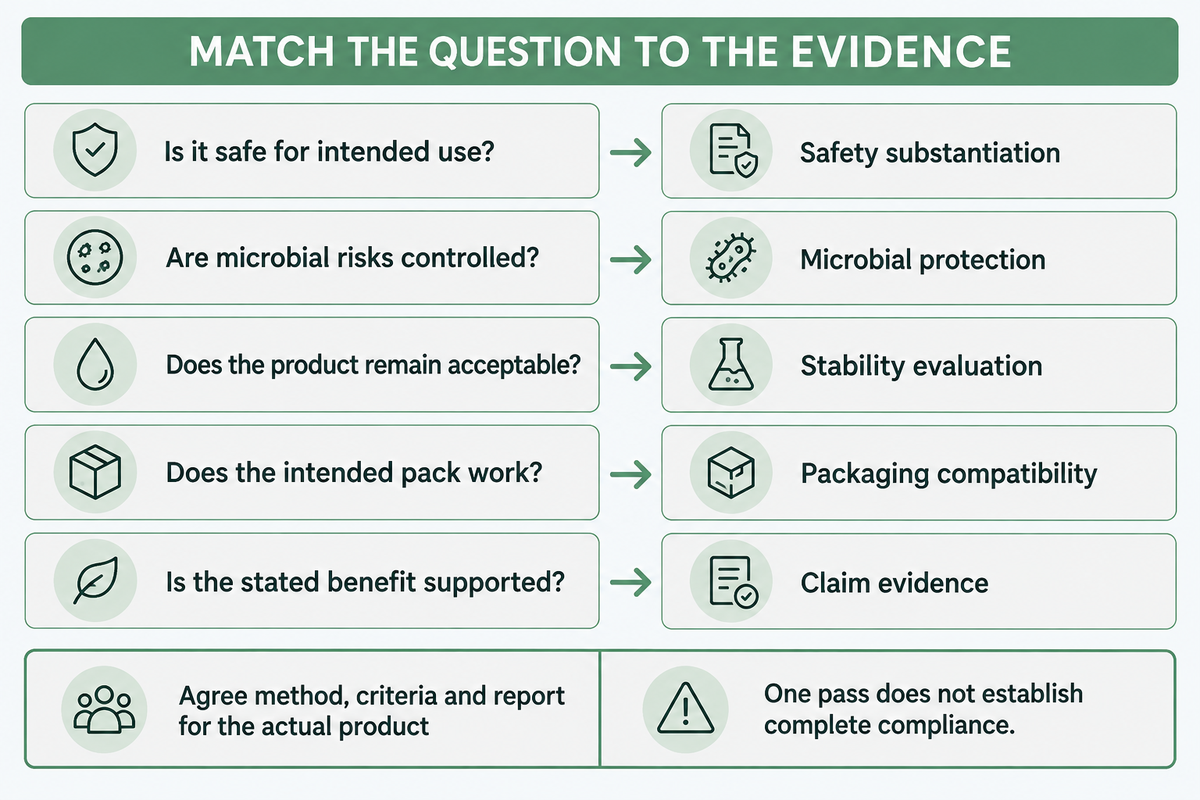
Testing should connect each product question with an appropriate method, acceptance criteria and report. Safety testing, microbial protection, physical stability, packaging compatibility and efficacy testing address different risks. The development formula, intended use, target market, and packaging should be considered when determining the evidence package; a single pass result should be interpreted within the scope of the test performed. Regulatory compliance also requires the right product classification and market documentation. Rigorous testing starts with well defined questions and methods, not an overly long test list.
FDA’s cosmetic testing explanation says there is no list of tests required for each particular cosmetic product or ingredient. Existing safety information can contribute, with additional testing where needed to address evidence gaps. FDA generally does not approve cosmetics before sale; colour additives have a separate approval framework. “FDA-registered” should not be read as finished-product approval.
“ISO/TR 18811:2018 does not aim to specify the conditions, parameters or criteria of stability testing.”
The abstract places protocol specification and justification with the manufacturer. A universal accelerated-test-to-shelf-life conversion would overstate that guidance. For more details, check our cosmetic stability testing guide.
Document responsibility as well as the method. FDA’s MoCRA summary states that the responsible person must ensure and maintain records supporting adequate safety substantiation. The label-named manufacturer, packer or distributor can be that person. Outsourcing development and agreeing formula ownership are different questions from arranging access to the required safety records.
Can manufacturers help with packaging, filling, and packaging compatibility?
Manufacturers can include the selection of packaging, filling trials and compatibility work within the agreed development scope. Confirm the actual services, pack materials and acceptance criteria in the proposal. Assess the accepted formula with the planned packaging and determine who provides the components, reviews the results and approves changes before the product is filled commercially.
A 50 mL airless pump and a jar create different use and dispensing questions. Ask what the quoted test answers rather than whether the proposal includes the longest list of test names.
Transfer the Formula Into a Repeatable Batch Process
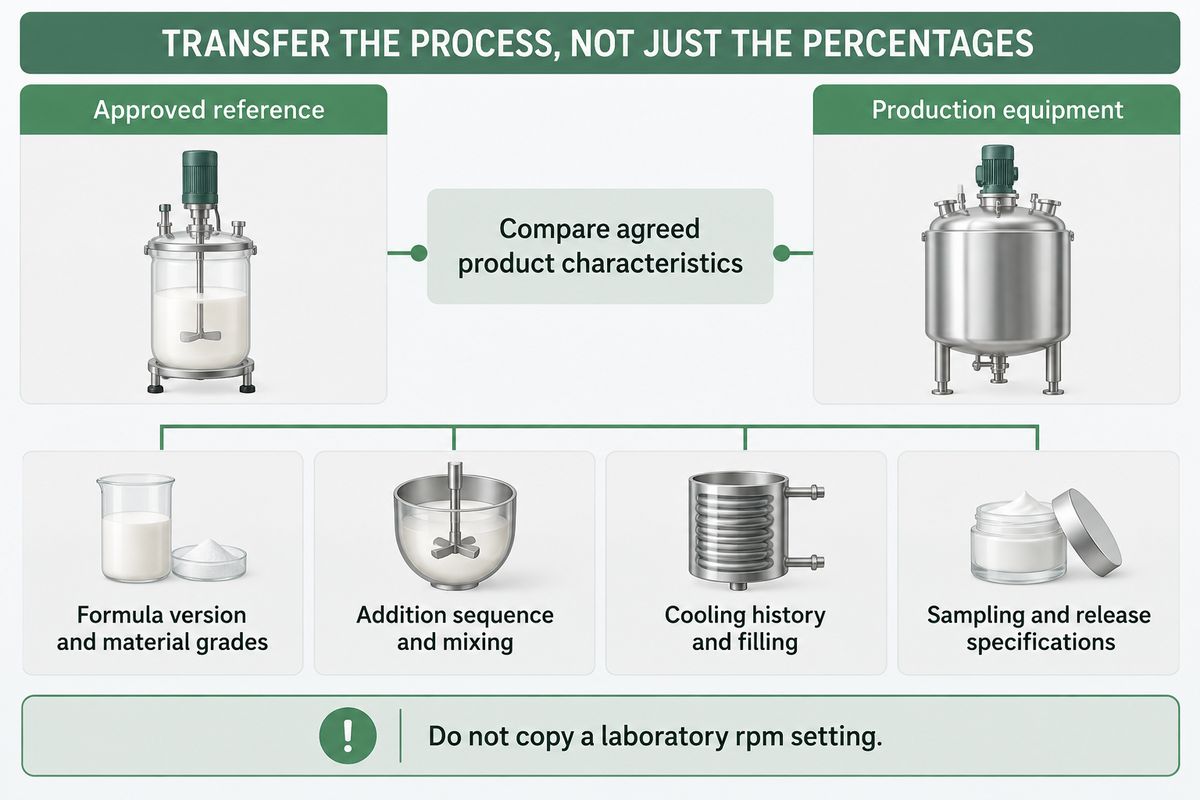
Formula transfer connects the approved composition with documented manufacturing methods and acceptance criteria. It’s important to scale-up a formula to different equipment since circulation, heat transfer and material handling may differ. The development team should explain how mixing, addition, cooling and filling will be evaluated for the actual system, then compare the resulting product with the approved reference.
Slobodanka Tamburic and colleagues’ 2023 study of cosmetic emulsions illustrates the boundary. The researchers compared 12 samples made with different ingredient choices and processes. All passed a short centrifugal test, but the paper explicitly says full long-term stability testing wasn’t performed. Hot and hot-cold processing also produced structural differences for the same water-in-oil formulation; cold processing required reformulation.
A 2026 industrial rheology review similarly discusses operation-specific scale-up, including powder incorporation, circulation, cooling and deaeration. The review is a published synthesis with academic and industry-affiliated authors, not a validation report for a NEXO batch.
Suppose an operations team transfers an approved pump lotion. While the percentages of the ingredients remain the same, the new vessel has a different mixing geometry and a different cooling history. The ideal response to the situation is to examine the process record and attributes of the product, rather than copy a laboratory rpm setting. The goal of quality is to agree on a measurement method. The aim of production is to repeat a process. The goal of procurement is to know whether an available raw-material grade is acceptable. The preferred sample remains the reference. The transfer work establishes whether the production process can reproduce the desired product characteristics.
Ask for the transfer basis: You should request the formula version, material grades, addition sequence, processing record and equipment, sampling and release specifications. A production-ready method is tied to its equipment and product; a short screen doesn’t establish commercial shelf life. There are a number of production and process-related variables that are industry specific, where industry knowledge helps. For the variables that apply to a given process, industry standards should be understood within their scope before they’re referenced for approving full-scale manufacture.
Scope Custom Formulation Cost, Timing and Formula Rights
Custom formulation costs include bench development and revisions, materials, specialist evaluations, and documentation and transfer of know-how. The timing depends on testing and decisions. A useful quotation makes the deliverables visible and separates development costs from production costs. The ownership of the formula, the scope of the license and exclusivity should be fixed before work commences on the development.
A lower starting fee may mean covering fewer sample rounds or a different kind of transfer package. Separate contract manufacturing fees from formulation fees to enable the team to evaluate the same commitment. Finance should evaluate equivalent scope. The founder should recognize the need that warrants custom work. Beyond this, return to the project-scope and quotation work packages rather than treating a sample price as the entire launch budget.
The World Intellectual Property Organization’s collaboration guidance separates background intellectual property from newly developed results and the rights to use them. Apply that distinction to the contract discussion: receiving the formula file, keeping it confidential and being entitled to transfer manufacture are separate questions. Agree how pre-existing know-how and later improvements are handled under the applicable law.
If a brand expects to move its 30 mL serum to another manufacturing partner, transfer rights matter before the first sample is commissioned. Ask for the end formula, documents and permitted uses, and what’s licensed and restricted.
Prepare Your Next Formulation Brief
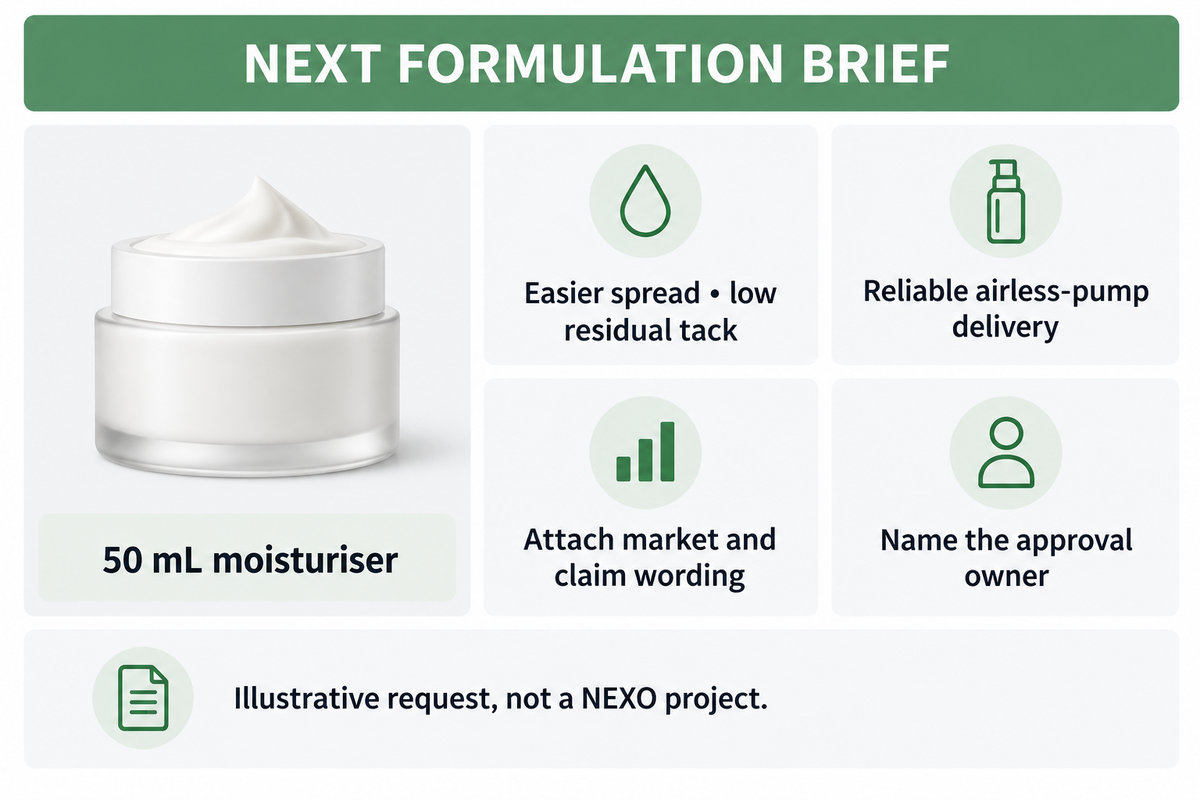
The next formulation brief should provide one product goal, the unresolved requirement, and the type of evidence needed for the next decision. It should also include a reference, target market, packaging format, constraints on the ingredients and the approval owner. A short, focused brief provides the development team with a starting point and allows the brand to review proposals based on the same criteria.
NEXO Beauty Labs specializes in the development and manufacture of Skincare, Haircare, and Body Care. Our manufacturing foundation dates to 1999, with an international business team supporting global beauty partners since 2020. Bring us the product idea along with what’s unanswered in the existing formula; discuss with us the scope of work.
For example: “We need a 50 mL moisturiser with easier spreading than our reference, low residual tack and reliable airless-pump delivery. Our first decision is which sensory direction to develop; the launch market and intended claim wording are attached.” A chemist can work with that request more productively than a long list of fashionable actives.
Consider our custom cosmetic formulation and R&D support or contact us about your formulation brief. For the next planning step, use the development scope guide to define the agreed-upon technical work and initiate a project.
Frequently Asked Questions
What is a custom formulation?
A custom formulation is a cosmetic formula developed or adapted to meet a defined product brief.
Custom work can involve the ingredient system, texture, fragrance, delivery format or manufacturing method. The useful distinction is the change the brand needs, rather than the label on a service package. A stock formula may already meet the brief. Request custom development when a specific unmet requirement justifies the extra work and verification.
How long does the custom formulation process take?
Custom formulation timing follows the work required to approve the formula and complete the agreed evidence package.
Bench development, raw-material availability, feedback, testing and packaging decisions can run on different schedules. Ask for separate dates for the first sample, the next revision and the evidence needed before production. A quick lab sample does not establish a market launch date. Freeze decisions promptly, and document which changes would reopen the development schedule.
Can a custom formula move from small-batch to large-scale production?
A custom formula can move to larger production when its process and acceptance criteria transfer successfully.
Scaling requires attention to equipment, addition sequence, mixing, heating, cooling, transfer and filling. Equal ingredient percentages alone do not capture those conditions. Compare the larger batch with the approved reference using relevant specifications and use performance. A supplier should explain the transfer work for the actual formulation, rather than offer a universal batch-size multiplier.
What testing should be included with a custom formula?
The testing package should address the formula, packaging, intended use, market and proposed claims.
Start with the questions each test must answer: safety, microbial protection, physical stability, pack compatibility or a particular benefit. Agree methods, criteria and reporting before testing. Different questions need different evidence; a pleasant sample and a stable appearance answer only part of the brief.
Who owns the formula developed for my brand?
Formula ownership follows the development agreement and applicable law, alongside any rights retained in background technology.
Ask the agreement to identify the finished formula, pre-existing know-how, later improvements, licence scope, exclusivity and transfer rights. A formula sheet is useful operational information, but its delivery does not settle every right to manufacture, disclose or modify. An NDA addresses confidentiality; ownership and permitted use need their own terms. If the brand intends to change factories later, discuss the usable transfer documents and any restrictions before commissioning the work. Have the agreement reviewed for the relevant jurisdiction.
Does a factory certificate demonstrate formulation capability?
A factory certificate describes its assessed scope; relevant development work still needs to be evaluated.
ISO 22716 guidance covers cosmetic production, control, storage and shipment, and excludes research and development. Certified facilities should be assessed against the scope shown in their documents. Review the audit scope alongside a prospective partner’s formulation approach, relevant product experience and proposed deliverables. Assess each document against the job it actually covers.
What is the budget to start or scale production?
A useful budget separates development work, evidence, packaging and the commercial production order.
Price a defined brief rather than an undefined promise of a unique product. Confirm sample rounds, raw materials, specialist tests, reports, packaging trials and transfer work in writing. Manufacturing quantity and pack selection affect a different part of the commitment. Compare offers on equal deliverables before choosing the lowest starting fee. When funds are limited, decide which requirement deserves custom work and which can be met by an existing formula. Ask what change would trigger a new quote before paying.
References & Sources
- Wrinkle Treatments and Other Anti-aging Products U.S. Food and Drug Administration.
- Oil and Water Emulsifiers in Modern Skincare Formulation Carmen Lerga, UL Prospector Knowledge Center.
- Commission Regulation (EU) No 655/2013, Annex European Union.
- Fragrance allergens labelling European Commission.
- The Rheological and Skin Sensory Properties of Cosmetic Emulsions: Influence of Thickening Agents Yanan Li and colleagues, Journal of Cosmetic Science, 2018.
- A Sense of Sensory Analysis: Testing for the Non-test Expert S. Varesi, S. Brancato, A. Bonfigli and Luigi Rigano, Cosmetics & Toiletries, 2017.
- Product Testing of Cosmetics U.S. Food and Drug Administration.
- ISO/TR 18811:2018 public abstract International Organization for Standardization.
- Modernization of Cosmetics Regulation Act of 2022 (MoCRA) U.S. Food and Drug Administration.
- Sustainability by Reduced Energy Consumption during Manufacturing: The Case of Cosmetic Emulsions Slobodanka Tamburic and colleagues, Cosmetics, 2023.
- Industrial Rheology of Cosmetic Products: From Formulation and Microstructure to Scale-Up, Process Control, Quality, Machine Learning, Digital Twins, and Consumer Performance Argang Kazem-zadeh and colleagues, Processes, 2026.
- WIPO Guide to Trade Secrets and Innovation, Part VI World Intellectual Property Organization.
- ISO 22716:2007 public abstract International Organization for Standardization.
Why beauty brands work with NEXO
About NEXO Beauty Labs Manufacturing Support
NEXO Beauty Labs supports skincare, body care, sun care, hair care, and private label brands with formulation, sampling, filling, quality control, and export-ready launch support.
Project Review Before RFQ
Before quotation, we help clarify product category, active direction, formula stage, package choice, compliance market, MOQ, sampling schedule, and required documents.
Request a Cosmetic QuoteCompany Profile // Data Sheet
CompanyNEXO Beauty Labs
Business TypeCosmetic OEM / ODM manufacturing partner
Main ProductsPrivate label skincare, facial serums, moisturizers, cleansers, sunscreen, body care, and hair care products
Manufacturing CapabilityFormula development, sample adjustment, package sourcing, filling, QA/QC, documentation, and export support
RFQ Data NeededProduct type, formula goal, package format, target market, MOQ, claims, timeline, and benchmark samples
Websitenexobeautylabs.com