Get in touch with NEXO Beauty Labs Company


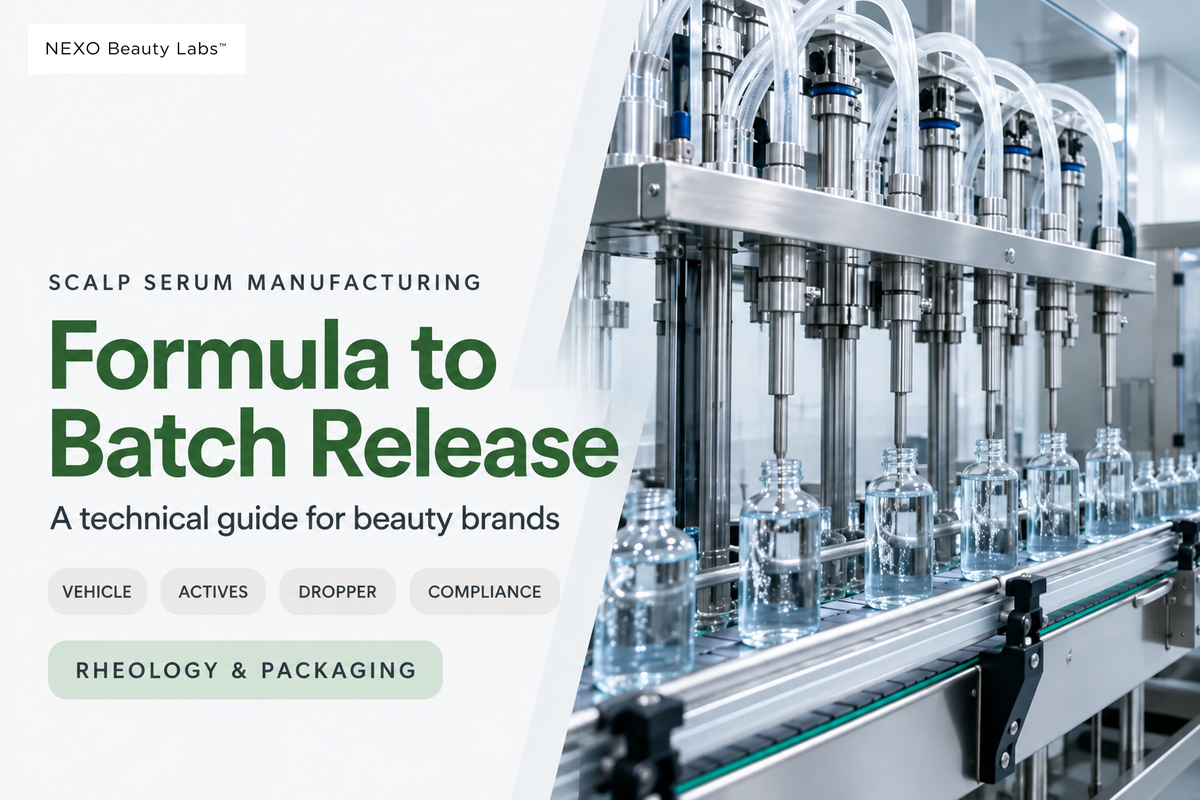
Scalp Serum Manufacturing transforms target follicle and skin briefs into a shear-stable liquid vehicle, a compatibility-tested dropper or nozzle assembly, and a lot-traceable production batch. Unlike rinse-off cleansers, leave-on scalp treatments remain on the skin barrier to provide long-term scalp health. During the planning of hair serum manufacture of a new product line, a crystal-clear prototype in a lab beaker may still precipitate crystals and swell its elastomer dropper bulb during winter transport if packaging compatibility is ignored.
Successful scalp serum production locks four engineering variables before bulk compounding: vehicle viscosity under applicator shear (measured at 25 °C with recorded viscometer settings), active solubility across pH and 4 °C cold-storage windows, elastomer compatibility inside the bottle, and US/EU safety documentation. Approving bulk liquid separately from its dispensing hardware is a frequent cause of post-filling batch rejection.
Guide at a glance
- Bind rotational viscometer settings, aqueous pH targets (such as pH 4.5 to 5.5 for soothing serums), and primary packaging into one revision-controlled specification.
- Pair aqueous, hydroalcoholic, micro-emulsion, or anhydrous vehicles with matching pipette, comb, roll-on, or pump hardware, and assess inhalation exposure if exfoliating acids use fine-mist sprays.
- Assess preservative efficacy under ISO 11930, document any low-risk rationale under ISO 29621, check microbiological limits under ISO 17516, and design stability studies using ISO/TR 18811.
- Model launch budgets per saleable released unit, and track US MoCRA 2-year registration renewals, 15-business-day serious adverse event reporting, and EU 0.001% fragrance-allergen transitions (31 July 2026 new placement; 31 July 2028 legacy stock).
Worked engineering comparisons in this guide cover adult cosmetic leave-on scalp serums. Hair-regrowth and medicated anti-dandruff claims bring products under drug requirements, while pediatric formulas and pressurized aerosols raise separate age- and inhalation-exposure safety questions.
How Scalp Serum Manufacturing Moves From Brief to Batch Release
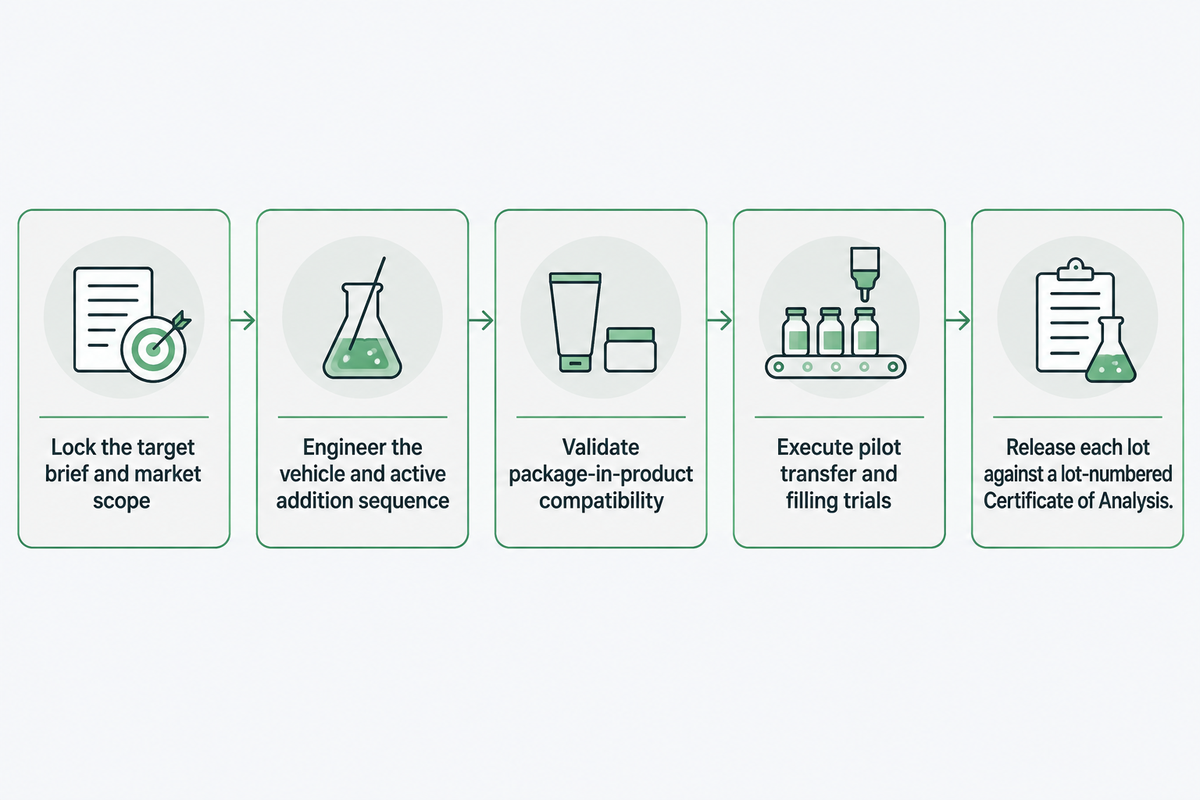
Production of scalp serum links bench formulation, pilot scale-up, peristaltic or piston filling and quality release under a single master batch record. Treating lab sampling as an aesthetic exercise creates surprises across automated capping heads, jacketed cooling tanks and high-shear transfer pumps.
Under FDA Good Manufacturing Practice inspection guidelines, plant controls cover raw-material qualification, water quality, sanitary transfer practices that prevent drip or condensate contamination, and finished-product laboratory release. Similarly, ISO 22716:2007 establishes international guidelines for the production, control, storage, and shipment of cosmetic products.
- Lock the target brief and market scope: define adult scalp skin type, leave-on dosing routine, target pH window for aqueous systems, destination target market regulations, and primary applicator format.
- Engineer the vehicle and active addition sequence: hydrate rheology modifiers before introducing electrolytes that can depress anionic gels. Map active solubility across pH and cold-storage windows, and add heat-sensitive peptides during controlled cool-down.
- Validate package-in-product compatibility: test the exact glass or plastic bottle, wiper orifice, and dropper bulb elastomer with filled pilot liquid across cold-storage, freeze-thaw, and elevated-temperature cycles.
- Execute pilot transfer and filling trials: measure rotational viscosity (specifying viscometer model, spindle, speed in rpm, and 25 °C sample temperature) both in the bulk vessel and after nozzle dispensing.
- Release each lot against a lot-numbered Certificate of Analysis: cover appearance, odor, and specific gravity. Include pH for aqueous formulas, microbiological limits, and closure integrity tests suited to the selected package.
Changes in fragrance load or chelator ratio require formal revision identifiers on the batch sheet. Separation of scalp leave-on specifications from rinse-off cleansers is important for brands considering widening hair care formulation and production capabilities. Tighter impurity, allergen and residue tolerances apply to scalp over wash-off formats during private label hair care.
Ready-Made Private Label vs Custom OEM Scalp Serum Formulation
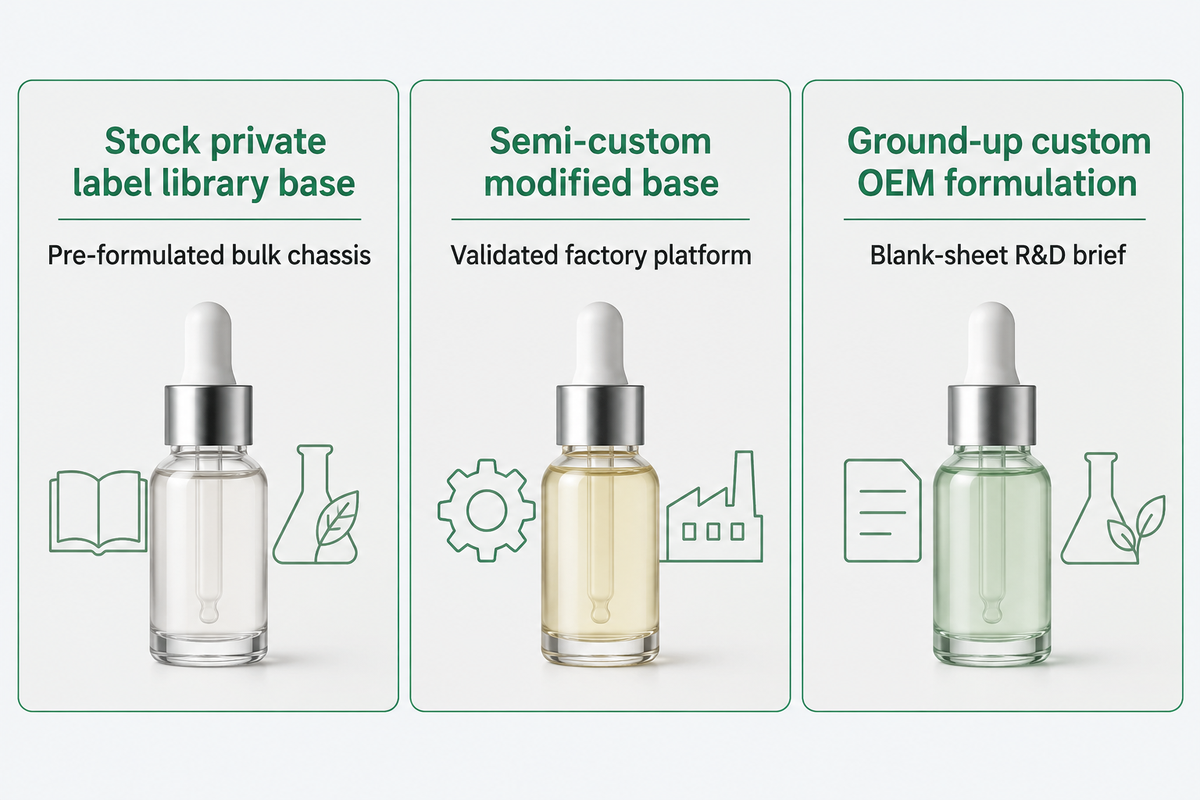
Choosing between a stock library base, a semi-custom modified platform, and a ground-up, custom OEM development determines your product development calendar, minimum order commitment, and intellectual property rights. A stock private label hair serum speeds up market entry, as its existing sensory profile and preservative system match your positioning. On the other hand, custom hair care engineering is necessary when your formulation is dependent on the use of a novel active complex or an unusual applicator, and can’t be run on a standard hair treatment chassis.
| Development Route | Starting Baseline | What Re-Triggers Stability Testing | Typical IP and Formula Ownership |
|---|---|---|---|
| Stock private label library base | Pre-formulated bulk chassis with existing bench stability data | Swapping primary bottle material, dropper elastomer bulb, or adding fragrance/color | Manufacturer retains base formula IP; brand owns label and trademark |
| Semi-custom modified base | Validated factory platform adjusted with selected active ingredients or botanicals | Any change to active percentage, electrolyte load, pH adjustment, or applicator hardware | Manufacturer owns base chassis; contract defines exclusivity on the modified variant |
| Ground-up custom OEM formulation | Blank-sheet R&D brief engineered around brand-specified vehicle and active targets | Full package-in-product stability, preservative challenge, and pilot scale-up required | Governed strictly by written development agreement, buyout milestones, or volume clauses |
Should I choose OEM or private label for a hair serum?
Choose a ready-to-use private label option when a library base gives your target scalp feel, active ingredients story, and preferred bottle compatibility. This option allows you to spend your start-up capital on branding and customer acquisition. A custom OEM development option is chosen when your serum positioning depends on a particular active ingredient or concentration, rheology, or formula structure that isn’t available with stock bases. Budget time for full package-in-product stability and challenge tests when you customize.
Let’s say an up-and-coming beauty brand selects private label scalp treatment to expedite a seasonal launch. A couple of minor changes are requested. The first is using an amber glass pipette dropper instead of the clear PET pump bottle. The second is adding rosemary essential oil to the formula. At this point, that project is no longer a plug-and-play stock run. Some constituents of rosemary essential oil can interact with certain rubbers used in dropper bulbs, and the solubilizer used to keep the oil clear in water can change the viscosity of hydrogels. In that case, the lab would need to re-evaluate physical stability and bulb compatibility before doing a bulk fill. For teams looking at how multi-SKU lines are handled by production lines, our full-line hair care batch scale-up workflow guide offers insight into pilots between benchtop validation and commercial fills.
Contractual ownership and regulatory liability also require explicit separation. Under FDA guidance for cosmetics businesses, the firm whose name appears on the label is legally responsible for ensuring the finished cosmetic is safe and properly labeled. That obligation holds even when the product is manufactured by a contract factory. In addition, FDA’s legal distinction between cosmetics and drugs turns on intended use and claims, whether the formula is stock or custom. Hair-regrowth or anti-dandruff claims bring the product under drug requirements alongside your brand vision.
Choose the Liquid Vehicle and Viscosity Window Together
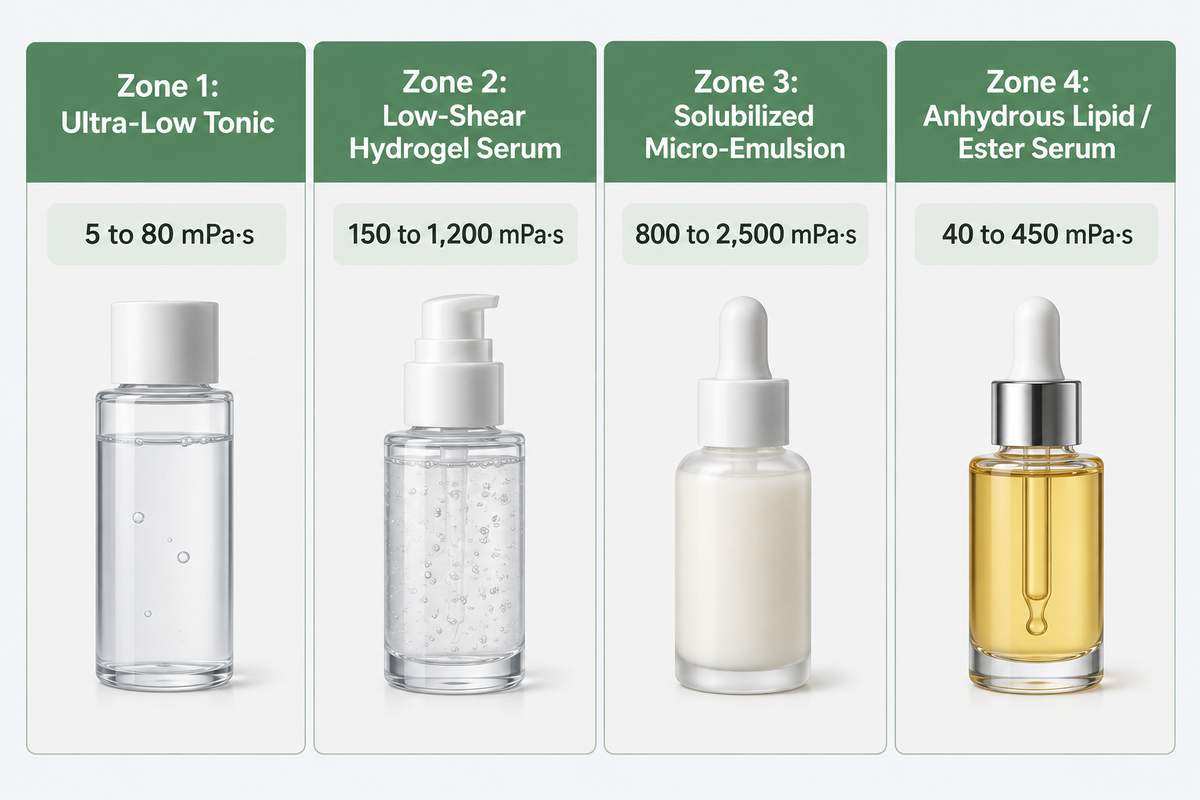
A scalp serum vehicle has to walk a narrow rheological line. It has to be thin enough to travel through a narrow orifice of a pipette without clogging, but reliable enough to cling to the curved scalp skin without rolling into the eyes. A formula that gives a best hair growth effect will fail if it drips down the forehead and mats the roots. A requirement like “lightweight, non-greasy texture” on a brief doesn’t provide any limits to the chemist. You need a defined vehicle architecture coupled with target rotational viscosity and shear-recovery.
As detailed in trade literature on rheology and its impact on cosmetic formulations and formulating scalp care products, two liquids with identical single-point Brookfield readings can behave oppositely during consumer dispensing. One liquid may rely on Newtonian solvent viscosity, while the other liquid may exhibit pseudoplastic shear-thinning and yield stress. Patent prior art such as WIPO publication WO2019113656A1 illustrates how leave-on hair care compositions lock target viscosity windows at 25 °C depending on polymer network design. Supplier formulation benchmarks such as Lubrizol’s CD-0092 clear scalp serum demonstrate how rheology modifiers balance clarity and vertical cling.
The 4-Zone Viscosity Window
The diagnostic matrix below can be used as an illustrative engineering reference to couple liquid chassis types with dispensing hardware. While active loads vary commercially, viscometers specify a model, spindle, and speed, and often a temperature at which the test is conducted. These should be noted on the specification sheet as mPa·s bands can’t be treated as universal cross-formula rules.
| Engineering Dimension | Zone 1: Ultra-Low Tonic | Zone 2: Low-Shear Hydrogel Serum | Zone 3: Solubilized Micro-Emulsion | Zone 4: Anhydrous Lipid / Ester Serum |
|---|---|---|---|---|
| Illustrative Brookfield window (25 °C) | 5 to 80 mPa·s | 150 to 1,200 mPa·s | 800 to 2,500 mPa·s | 40 to 450 mPa·s (oil-phase dependent) |
| Primary liquid chassis | Water, hydroalcoholic, or glycol-water carrier | Aqueous polymer network (HEC, xanthan, sclerotium, or polyacrylate) | Water + PEG-free or ethoxylated solubilizer / light ester phase | Caprylic/capric triglyceride, squalane, jojoba, and light alkanes |
| Polymer / thickener mechanism | Minimal or non-thickened solvent flow | H-bonding cellulosics, biogums, or neutralized crosspolymers | Associative polymers or lamellar surfactant-oil structuring | Oil-phase rheology modifiers (silica, dextrin palmitate) or neat ester blend |
| Electrolyte & salt tolerance | High (no ionic gel network to collapse) | High for nonionic HEC and salt-tolerant anionic xanthan; low for standard anionic carbomers | Moderate; excess ionic actives can salt-out solubilizer micelles | Not applicable (non-aqueous continuous phase) |
| Optical clarity target | Crystal clear (NTU < 10) | Clear to slightly translucent depending on gum grade | Translucent micro-emulsion to milky lotion-serum | Clear golden or tinted anhydrous liquid |
| Scalp spread & forehead runoff risk | Fast wetting; high forehead drip risk if over-dosed | Controlled part-line bead; shears thin under fingertip massage | Cushioned rub-in; stays localized on dry or flaky scalp zones | Slow wicking along skin; excess dose creeps onto hair shafts |
| Root-shaft greasiness & pillow transfer | Low residue on fine hair when volatile or light carriers are balanced | Low residue if humectant/gum ratio avoids dry-down tackiness | Light emollient film; suited to dry scalp or post-color care | High root-weigh-down risk unless volatile/light esters dominate |
| Best-fit primary applicator | Fine-mist spray atomizer, precision nozzle tip, or rollerball | Glass pipette dropper, multi-tooth root-comb bottle, or treatment pump | Dropper assembly with wide-bore tip, airless pump, or squeeze nozzle | Glass dropper with oil-resistant NBR/TPE bulb or metered pump |
| Filling-line shear sensitivity | Low; fills cleanly on overflow or peristaltic lines | Moderate; check temporary shear-thinning across peristaltic/piston nozzles | Moderate to high; avoid air entrapment and foam during high-speed fill | Low shear drift, but requires drip-free nozzle shutoff to keep bottle necks clean |
| Primary bench failure to screen | Volatile evaporation and cold-temperature active precipitation | Electrolyte-induced viscosity crash or stringy gum cobwebbing | High-temperature cloud point phase split at 40–45 °C | Lipid oxidation rancidity and elastomer bulb swelling |
Polymer choice in Zone 2 typically determines the success of a clean commercial scale up of a batch. As discussed in the Chemists’ Corner review of cosmetic thickening agents, polymeric thickeners work by absorbing water and uncoiling charged chains. Each thickener and family reacts differently to salts and pH. Standard anionic carbomers, upon dispersion and neutralization, form clear gels, and their viscosity can be reduced by electrolytes. Unlike a high-hold hair gel or heavy hair wax, an aqueous hair care formulation for the scalp can use non-ionic hydroxyethylcellulose (HEC), sclerotium gum, or another salt-compatible polymer. The polymer and humectant system help the vehicle resemble a light face serum, and help reduce dry down residue on a specific hair texture.
Formulate Peptide, Caffeine, Acid and Botanical Actives Without Drift
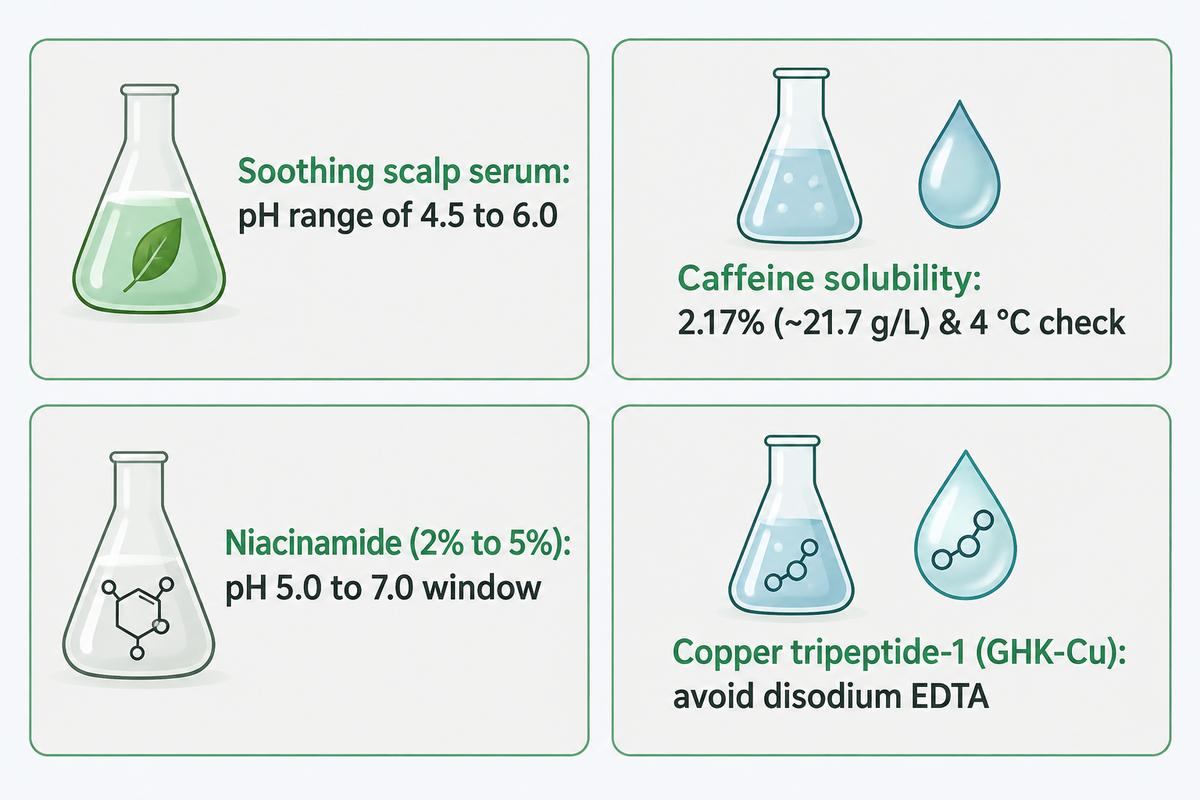
The success of cosmetic hair growth serums formulations is determined by the buffer system chosen, and incorporating multiple active ingredients outside their chemical comfort zone can cause recrystallization, hydrolysis, and color shift.
What ingredients should be included in a hair serum?
A water-based scalp-focused hair serum can combine barrier-compatible humectants (such as glycerin, panthenol, or propanediol) with targeted leave-on active ingredients inside a controlled-pH vehicle. Typical water-phase actives in skin care include zinc PCA, niacinamide, salicylic acid, and biomimetic peptide complexes. Caffeine can also be water-based. An anhydrous oil-based serum pairs rosemary oil with lightweight carrier esters. Scalp serum ingredients must be soluble or dispersible without clogging follicles and leaving a sticky film at the roots.
The peer-reviewed literature on transdermal and follicular delivery systems for alopecia states that the scalp stratum corneum forms a 10 to 20 µm barrier with a mildly acidic surface pH of 4.5 to 5.5. Hair follicles create a privileged shunt pathway for topical delivery. Maintaining a leave-on soothing scalp serum within the pH range of 4.5 to 6.0 keeps it within the range of the scalp’s mildly acidic surface.
Caffeine illustrates why bench solubility math matters before promising high percentage claims. According to a detailed review of caffeine as an active molecule in cosmetic hair products, caffeine is a hydrophilic compound (molecular weight 194.19 g/mol, log P −0.07) with room-temperature water solubility around 2.17% (~21.7 g/L). While human follicular penetration studies cited in that review detected caffeine uptake within 2 minutes of topical application, that specific 2-minute kinetic benchmark was measured using a topical shampoo formulation rather than every leave-on serum vehicle. A water-based caffeine serum without suitable co-solvents or hydrotropes can develop visible needle crystals during cold transit at 4 °C when its finished vehicle no longer keeps the caffeine dissolved. Prior-art disclosures such as patent publication WO2022069738A1 formulate moderate caffeine levels in hydroalcoholic or glycol solvents, while commercial pre-formulators also pair caffeine with co-solvents and hydrotropes such as propanediol or niacinamide. Chemists then verify clarity across 4 °C refrigeration and freeze-thaw cycles.
Best practices for the inclusion of exfoliating acids and niacinamide in the same product necessitate strict pH partitioning. The discussion in the guidance on best practices for formulating with niacinamide notes that the pH of formulations containing niacinamide (typically in the range of 2% to 5%) should be in the range of 5.0 to 7.0. It’s further noted that formulating below pH 4.0 in an unbuffered system, and the inclusion of glycolic acid or salicylic acid will accelerate hydrolysis of niacinamide to nicotinic acid at elevated storage temperatures, and may cause scalp flushing. Likewise, copper tripeptide-1 (GHK-Cu) shouldn’t be paired with strong chelating agents such as disodium EDTA (which strips the copper ion and shifts the blue complex) or strong reducing acids. When biotechnology ferments or essential oils are combined with a clean beauty brief, it’s important to define the solubilizer-to-oil ratio and perform clarification testing at various temperatures.
Match Dropper, Root-Comb, Roll-On and Spray Hardware to the Liquid
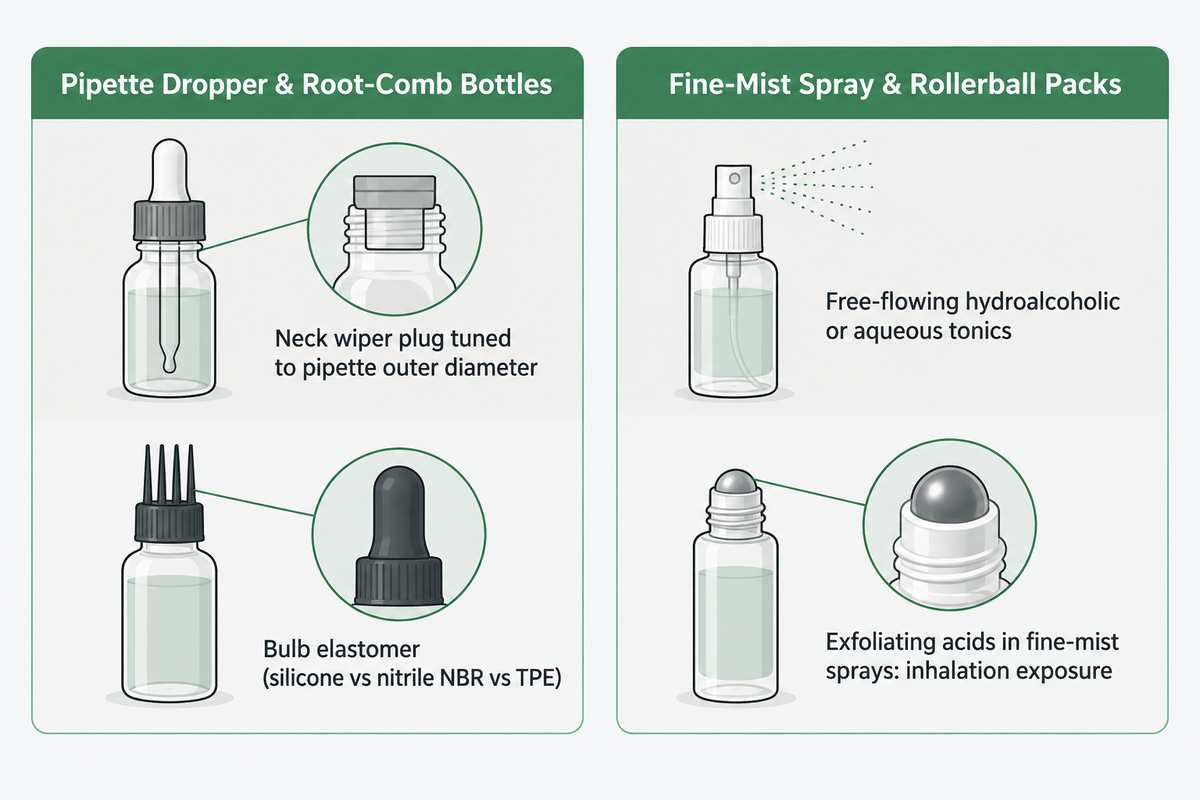
Packaging for scalp serum is an active mechanical fluid-delivery system. Consumers part their hair to apply drops or mist directly to the skin. Therefore the bottle orifice, closure liner, and elastomeric pump or bulb must be compatible with the formula’s rheology, polarity, and volatile content.
What packaging works best for hair serums?
There are many assembly options for a completed serum. Examples include precision-tip pipettes, multi-tooth root-comb applicators, and stainless-steel rollerballs. Each has its pros and cons. Fine mist sprayers are useful for low-viscosity tonics that atomize into a plume. Airless pumps are useful for protecting oxygen-sensitive emulsions. Whatever assembly you choose, treat viscosity bands as engineering reference windows and validate the filled assembly for elastomer swelling, orifice crusting, vacuum leakage, and dose weight consistency before tooling approval.
Pipette Dropper & Root-Comb Bottles
- Suited to shear-thinning hydrogels, peptide serums, and light oils that draw cleanly into the tube.
- Requires neck wiper plug tuned to pipette outer diameter to prevent collar drips.
- Bulb elastomer (silicone vs nitrile NBR vs TPE) must resist essential-oil terpene swelling.
- Screen biogum and glycol formulas for dried crystalline crusting at the tip orifice.
Fine-Mist Spray & Rollerball Packs
- Suited to free-flowing hydroalcoholic or aqueous tonics (spray) and targeted spot treatments (roll-on).
- A polymer-thickened tonic can form a narrow stream when its flow behavior prevents the selected sprayer from producing a fine mist.
- Exfoliating acids (such as salicylic acid) in fine-mist sprays create an inhalation exposure that the product safety assessment must address.
- Rollerball housing clearances must prevent ball seizure and skin-flora backflow.
Failure of the dropper bulb is one of the most common hidden defects in custom packaging launches. See O.Berk’s technical guide to dropper assembly selection and R.T.N. Applicator’s Medalist TPE vs. silicone comparison. Some bulbs made of natural rubber or silicone can swell in the presence of certain oils, solvents, and aromatic compounds. With time and under the influence of heat, an incompatible bulb can swell, soften and lose suction, and can also introduce extractables to serum. Using Nitrile (NBR), Fluorosilicone, or engineered thermoplastic elastomers (TPE) bulbs can resolve the problem of swelling due to terpenes, provided that the bulks of liquids are tested for compatibility.
In the case of the scalp serum, safety and hygiene boundaries intersect with applicator choice. If a brand uses a hair spray or a fine-mist atomizer to apply a keratolytic scalp tonic containing salicylic acid, it creates an inhalation exposure pathway. The safety assessor will need to evaluate this exposure pathway separately. Non-aerosolizing dropper or comb tips are preferred for these acid exfoliants. Additionally, because pipette tips and rollerballs contact the skin during consumer use and are repeated contact surfaces, preservative robustness should account for wet-contact bioburden re-entry.
Preservative Challenge, Stability Triage and Batch Quality Control
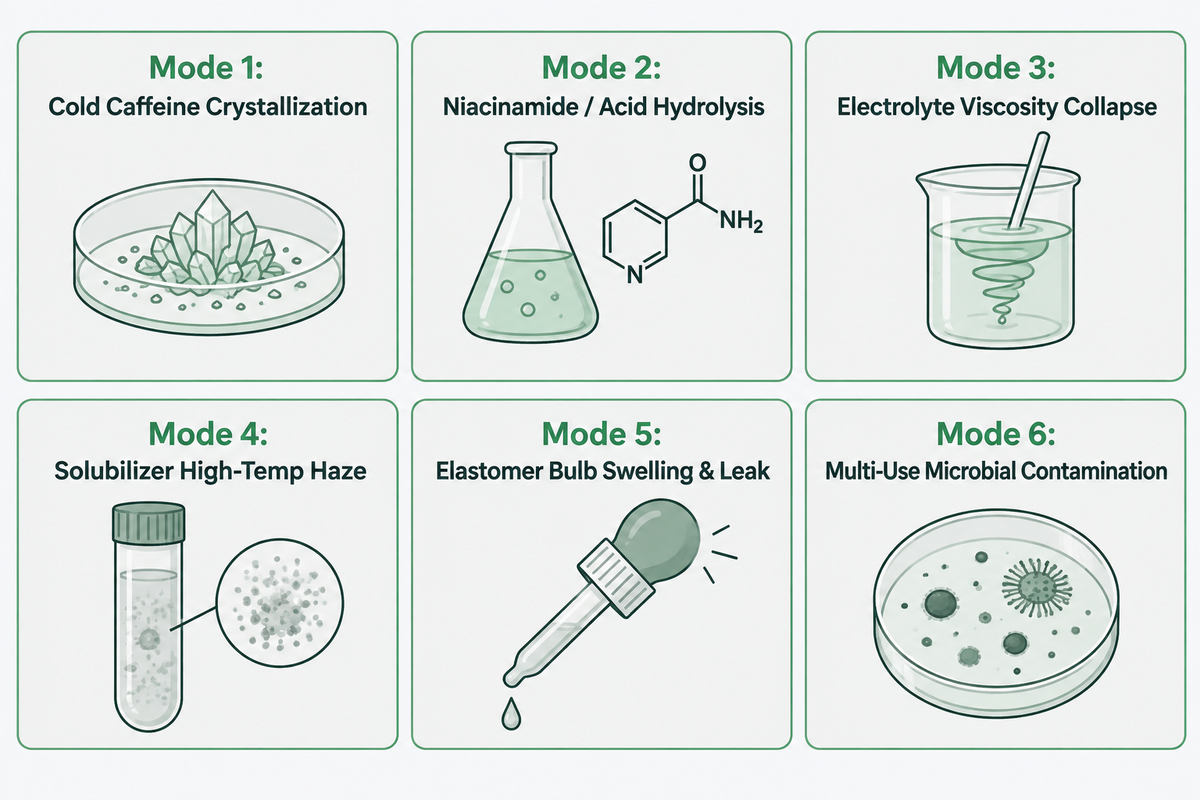
Testing the scalp serum prior to launch breaks into three major engineering categories. First, antimicrobial protection is to test if the formula is protected from being contaminated by microorganisms during production as well as during consumer use. Second, the physical-chemical stability of the formula is to test if the actives and the viscosity of the formula are stable throughout the storage period and if the color and the integrity of the serum are maintained. Last, batch quality control is to verify that each batch produced is equivalent to the master batch.
“Considering the wide variety of cosmetic products, storage and use conditions, it is not possible to define a single way to assess product stability; therefore, it is up to the manufacturer to specify and justify the stability protocol to cover test methods, specifications and conditions at which products will be tested.”
The stability principle in ISO/TR 18811:2018 means a scalp serum’s stability during cold storage is not established by its behavior at 40 °C over eight weeks in a glass jar. Caffeine has greater solubility at warmer temperatures. This can mask needle crystallization at 4 °C, during other cold storage conditions, and/or freeze-thaw cycles.
The 6-Mode Stability Triage
Prior to releasing a pilot batch, subject your filled commercial containers to the six-mode failure triage detailed below, and align to the ISO microbiological standards.
| Failure Mode / Check Dimension | Mode 1: Cold Caffeine Crystallization | Mode 2: Niacinamide / Acid Hydrolysis | Mode 3: Electrolyte Viscosity Collapse | Mode 4: Solubilizer High-Temp Haze | Mode 5: Elastomer Bulb Swelling & Leak | Mode 6: Multi-Use Microbial Contamination |
|---|---|---|---|---|---|---|
| Observable defect | White needle crystals at bottle bottom or pipette tip | Yellowing, pH drift, and consumer scalp flushing/tingling | Hydrogel turns water-thin; drips off hairline | Clear serum turns cloudy or forms top oil ring at 40–45 °C | Dropper bulb softens/swells; neck threads weep in transit | Turbidity, gas buildup, odor shift, or plate-count failure |
| Root chemical / mechanical cause | Caffeine concentration exceeds cold-storage solubility in the water-based vehicle | Niacinamide exposed to pH <4.0 acid phase hydrolyzes into nicotinic acid | Ionic salts (zinc PCA, sodium PCA, extracts) collapse anionic carbomer chains | PEG-free or polysorbate micelle cloud point exceeded or low solubilizer ratio | Terpenes (rosemary/peppermint oil) or esters migrate into silicone/rubber bulb | Preservative pH mismatch, high water activity, or scalp-contact pipette backflow |
| Primary bench detection test | 4 °C cold-storage clarity check and protocol-defined freeze-thaw cycling with crystal seeding | Accelerated elevated-temperature hold with active assay and pH drift tracking | Brookfield spindle/rpm curve before and after active-salt addition | Multi-temperature nephelometric turbidity and visual clarity check | Inverted filled-pack elevated-temperature hold plus closure leak test and bulb weight delta | ISO 11930 antimicrobial challenge test or documented low-risk water-activity dossier |
| Governing standard / regulatory anchor | ISO/TR 18811:2018 stability guidance; thermal cycling conditions set by product protocol | ISO/TR 18811:2018 chemical stability justification | ISO 22716:2007 in-process specification control | ISO/TR 18811:2018 physical phase-separation criteria | FDA container compatibility guidance & EU CPSR Part A | ISO 11930:2019+Amd 1:2022, ISO 29621:2017, ISO 17516:2026 |
| Formulation fix | Add co-solvents/hydrotropes (propanediol, niacinamide) or cap caffeine at cold-stable ceiling | Buffer niacinamide serum at pH 5.0–6.5; separate low-pH BHA into dedicated SKU | Replace anionic carbomer with non-ionic HEC, sclerotium gum, or salt-tolerant polymer | Adjust HLB co-surfactant pairing (e.g., polyglyceryl esters + co-solvent) | Reduce volatile terpene load or switch carrier ester polarity | Pair broad-spectrum preservative to actual batch pH and add booster humectants |
| Packaging / process fix | Add wiper plug to reduce tip evaporation; avoid uninsulated sub-zero storage | Use UV-protective amber glass or opaque airless pack; add during cool-down | Hydrate gum fully in main water phase before charging electrolyte pre-mix | Pre-blend essential oil and solubilizer thoroughly before gradual water addition | Upgrade bulb to nitrile (NBR), fluorosilicone, or TPE; lock capping application torque | Specify hygienic non-contact nozzle or verify preservative passes with open-dropper use |
| Batch release COA gate | Visual clarity inspection at 25 °C and retained cold-reference check | Potentiometric pH check within ±0.3 units of master target (e.g., pH 5.2–5.8) | Rotational viscosity check with recorded model, spindle, rpm, and 25 °C temp | Appearance, specific gravity, and centrifuge phase-stability verification | On-line cap removal torque log + vacuum leak chamber pass | Lot microbiological release plate count & absence of specified pathogens |
Microbiological clearance requires particular rigor. Under ISO 11930:2019 (including Amendment 1:2022), aqueous and emulsion scalp serums undergo preservation efficacy (challenge) testing unless microbiological risk is determined to be low in accordance with Annex A and ISO 29621:2017. Simply calling a formula a “hair oil” or “botanical treatment” never grants an automatic pass; low-risk status requires a documented risk assessment covering water activity, pH, alcohol concentration, production hygiene, and consumer applicator contact. ISO 17516:2014 has been withdrawn and superseded by ISO 17516:2026; finished-batch microbiological specifications should address objectionable microorganisms and the applicable ISO 17516 limits, without treating FDA guidance as a uniform zero-tolerance limit for all high-virulence pathogens. For a deeper walkthrough of challenge test curves and lab readouts, see our cosmetic laboratory stability and challenge testing protocols.
US and EU Regulatory Boundaries for Leave-On Scalp Serums
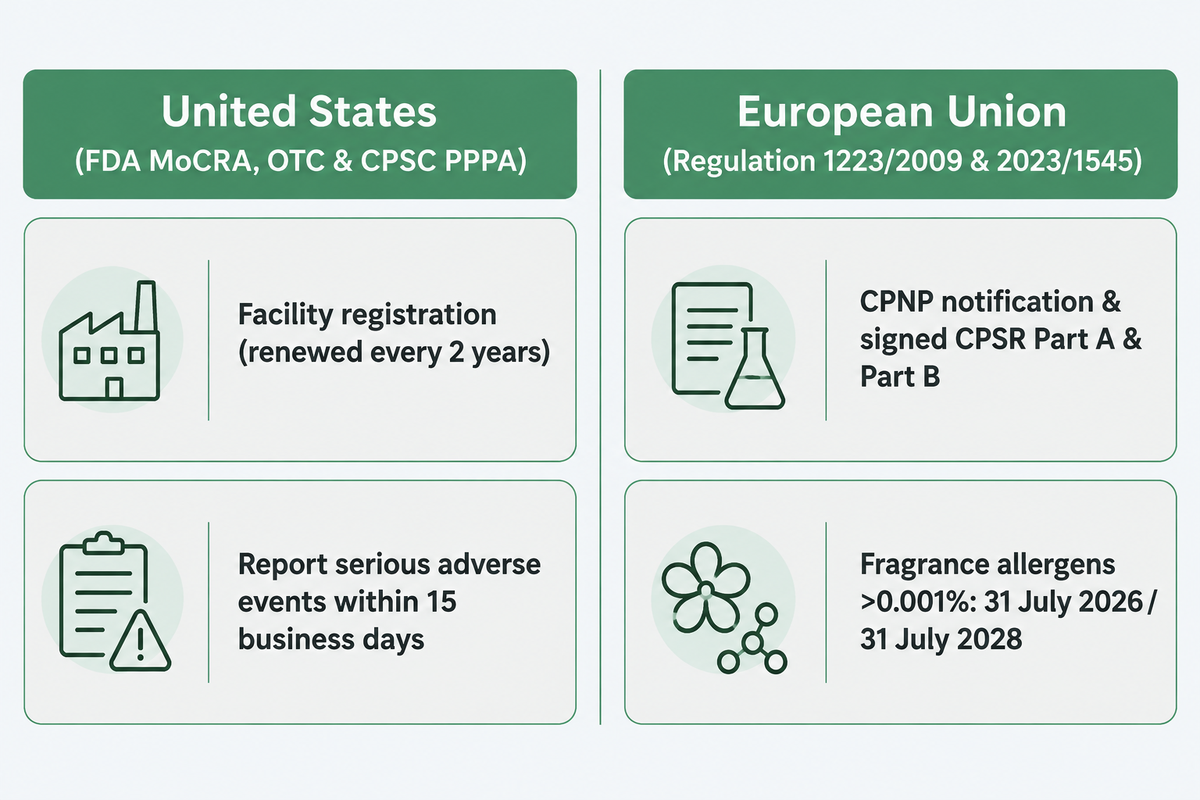
Regulatory compliance for a scalp care product starts with claim wording and ingredient disclosure long before the first label is printed. Making hair grow back or treating dandruff claims, for example, may give a cosmetic skin care product or scalp serum a drug intended use in the United States, bringing the applicable drug requirements into play.
| Compliance Dimension | United States (FDA MoCRA, OTC & CPSC PPPA) | European Union (Regulation 1223/2009 & 2023/1545) |
|---|---|---|
| Cosmetic vs drug / medicinal claim line | Cosmetics beautify or improve appearance (e.g., “hydrates scalp, supports fuller-looking hair”). Claims to regrow hair, stop hair loss, or treat dandruff trigger OTC drug monograph or NDA rules. | Cosmetics clean, protect, or maintain scalp condition. Products claiming to treat androgenetic alopecia or restore physiological hair follicles cross into medicinal products. |
| Facility & product notification | Mandatory facility registration (renewed every 2 years) and cosmetic product listing with FDA under MoCRA unless small-business exemptions apply. | Mandatory pre-market electronic notification via the Cosmetic Products Notification Portal (CPNP) by an EU-established Responsible Person. |
| Safety dossier & adverse events | Responsible Person must maintain adequate safety substantiation records and report serious adverse events to FDA within 15 business days. | Complete Product Information File (PIF) and two-part Cosmetic Product Safety Report (CPSR Part A & Part B) signed by a qualified safety assessor before market placement. |
| Fragrance allergen & packaging rules | Fragrance disclosure per Fair Packaging and Labeling Act (plus MoCRA allergen rulemakings); CPSC PPPA child-resistant closures mandatory for minoxidil preparations (>14 mg per package). | Extended individual INCI declaration of fragrance allergens above 0.001% in leave-on products under Regulation (EU) 2023/1545: mandatory for all new products placed on the EU market since 31 July 2026 (legacy stock placed before that date may sell through until 31 July 2028). |
In the United States, the Modernization of Cosmetics Regulation Act of 2022 (MoCRA) requires manufacturers and processors to register facilities with FDA and renew every two years. Meanwhile, the Responsible Person, the manufacturer, packer, or distributor named on the label, must maintain safety substantiation and follow FDA’s 15-business-day serious adverse event reporting rule. Under U.S. Consumer Product Safety Commission Poison Prevention Packaging Act (PPPA) rules, liquid minoxidil preparations containing more than 14 mg in one package require child-resistant packaging under 16 CFR § 1700.14. The finished package, including any dropper closure, is evaluated under the test procedures in 16 CFR § 1700.20.
For brands exporting to Europe, the border between cosmetics and medicinal products is partnered with an important label transition that’s already active. With the European Commission’s fragrance allergens labeling directive and Commission Regulation (EU) 2023/1545, the extended list of fragrance allergens became mandatory for new products put on the EU market as of 31 July 2026. This has already impacted leave-on products, above 0.001%, including constituents of rosemary, lavender, peppermint and citrus oils. Since 31 July 2026, scalp serums first placed on the EU market must carry the expanded fragrance-allergen declarations when the relevant thresholds are met; products placed on the market before that date may remain available until 31 July 2028. Suppliers of ingredients, such as the 2026 scalp care outlook from Seppic, state that “skinification” is moving global hair serum market briefs toward microbiome-friendly and low-allergen leave-on products which simplify cross-border compliance.
Model Order Minimums, Saleable-Unit Landed Cost and Lead-Time Bottlenecks

Quoted unit prices for bulk liquid filling don’t account for the true cost per bottle available for sale. Sound financial planning for private label launches divides the total program outlay by the net saleable units released after quality retention samples and filling line purge losses. Total program outlay includes one-time stability testing, preservative challenge testing, set-up of the applicator, and freight.
Saleable-Unit Landed Cost Model
Illustrative assumptions (not a factory price quote): Suppose a brand plans an initial custom production run of 3,000 filled 50 mL units at an assumed ex-works manufacture-and-pack rate of USD 2.60 per unit (USD 7,800 variable spend). Add USD 2,400 in one-time stability, ISO 11930 challenge testing, and EU safety report preparation, plus USD 1,350 in freight and customs clearance. Out of 3,000 gross units filled, 90 units are allocated to quality-assurance retained samples, destructive vacuum/torque checks, stability chambers, and nozzle-purge scrap, leaving 2,910 net saleable units.
| Cost Component or Unit Count | Run 1 (Initial Custom Launch) | Run 2 (Repeat Identical Order) |
|---|---|---|
| Gross filled batch quantity | 3,000 units (50 mL dropper bottle) | 3,000 units (50 mL dropper bottle) |
| Assumed variable fill & pack rate | USD 2.60 per gross unit (USD 7,800) | USD 2.60 per gross unit (USD 7,800) |
| One-time stability, preservative challenge & EU safety report preparation | USD 2,400 | USD 0 (amortized on Run 1 if formula/pack unchanged) |
| Assumed freight, insurance & import duty | USD 1,350 | USD 1,350 |
| Total cash outlay for the batch | USD 11,550 | USD 9,150 |
| Less QC retains, test samples & line purge | −90 units | −45 units (routine batch retain & line setup only) |
| Net saleable released units | 2,910 saleable units | 2,955 saleable units |
| Apparent gross cost (Outlay ÷ 3,000) | USD 3.85 per gross unit | USD 3.05 per gross unit |
| True planning cost per saleable unit | USD 3.97 per saleable unit (USD 11,550 ÷ 2,910) | USD 3.10 per saleable unit (USD 9,150 ÷ 2,955) |
Compare the USD 2.60 factory quote to the retail price, and one misses the true cost of USD 1.37 per unit for the first run. Additionally, minimum order quantity (MOQ) floors rarely align across bulk liquid and custom packaging. A contract filler might do a 3,000 unit custom hair serum batch while a custom molded root-comb applicator or colored glass bottle might require a 10,000 unit batch. When private label brands commit to high-quality private label componentry early, finance should track the cash tied up in warehoused empty packaging separately from finished goods.
How long does it take to develop a custom hair serum?
Developing a custom hair serum from approved technical brief to retail-ready shipment is governed by sequential laboratory and packaging gates rather than factory filling speed alone. Bench formulation iterations must lock vehicle rheology and active solubility first. Parallel package-in-product stability under ISO/TR 18811, ISO 11930 preservative challenge testing, custom bottle decoration, US MoCRA or EU CPNP/PIF regulatory sign-off, and raw-material staging then govern release.
| Project Stage | Primary Schedule Driver | Gating Predecessor Before Next Step |
|---|---|---|
| 1. Bench formulation & rheology lock | Iterative lab prototyping and cold/heat solubility screening | Signed brief specifying vehicle zone, active targets, pH, and reference sample |
| 2. Applicator & elastomer screening | Parallel bulb-swell, wiper, and spray-plume compatibility checks | Actual candidate dropper bulbs, wipers, and bottles filled with prototype liquid |
| 3. Stability & ISO 11930 PET hold | Protocol-defined ISO/TR 18811 storage holds and ISO 11930 challenge cycles | Locked formula revision inside the exact commercial primary packaging |
| 4. Artwork, allergen & PIF/MoCRA review | Regulatory dossier review and label allergen verification | Complete INCI breakdown, EU Regulation 2023/1545 fragrance allergen check, and claims audit |
| 5. Component procurement & decoration | Custom bottle molding, color spraying, or screen-printing lead times | Approved bottle dielines, cap torque spec, and deposit on packaging minimums |
| 6. Pilot transfer, commercial fill & COA release | Line compounding, filling, and finished-batch microbiological incubation | All raw materials, printed components, and master batch instructions released by QA |
Audit a Scalp Serum Contract Manufacturer Before Sending Your Brief
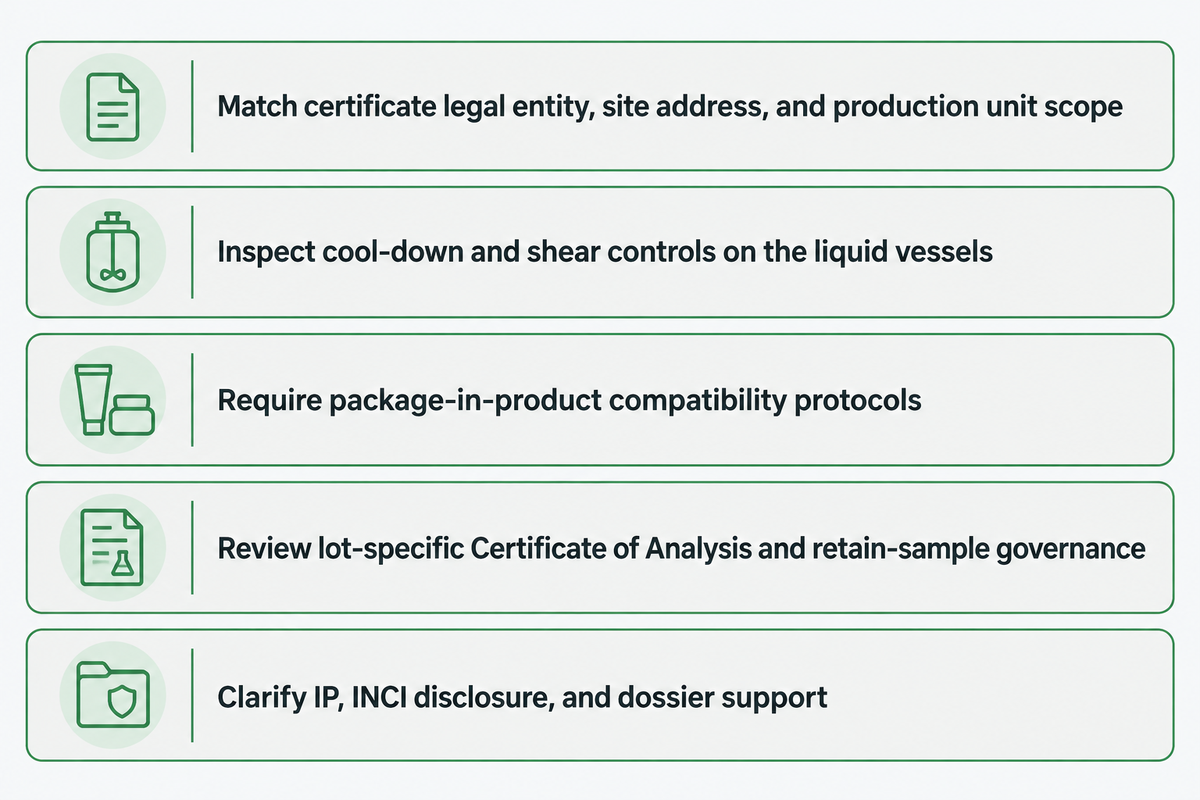
To assess a hair care manufacturer for use in a leave-on scalp product, one must look beyond standard website badges and evaluate the depth and breadth of their quality management system. Audit both R&D stability records and liquid-filling line controls separately: ISO 22716:2007 Clause 1 explicitly covers production, control, storage, and shipment while excluding research and development activities.
Prior to issuing a request for quotation or signing a purchase order, use the following checklist to verify:
- Match certificate legal entity, site address, and production unit scope: verify that the named factory on the Intertek ISO 22716 cosmetics certificate matches your contract counterparty and covers liquid compounding and filling units. Remember too that an FDA MoCRA facility registration number is a statutory filing rather than an FDA approval.
- Inspect cool-down and shear controls on the liquid vessels: confirm the plant logs jacket temperatures for heat-sensitive peptide and vitamin additions per the batch sheet and checks rotational viscosity before and after filling pumps.
- Require package-in-product compatibility protocols: test the actual commercial dropper bulb, root-comb tip, or spray valve under formulation-specific storage conditions, including a 4 °C clarity check for aqueous caffeine serums.
- Review lot-specific Certificate of Analysis and retain-sample governance: confirm that each batch ships with a signed COA covering appearance, odor, aqueous pH, viscosity settings, specific gravity, and microbiological test results assessed against ISO 17516 limits, alongside sealed shelf-life retains.
- Clarify IP, INCI disclosure, and dossier support: agree in writing whether your project uses a stock base or custom OEM hair formula, and when percentage INCI breakdowns are supplied for EU PIF/CPSR files.
NEXO Beauty Labs traces its manufacturing foundation to 1999 and its international business team’s support for global beauty brands to 2020. Its Guangzhou Opseve Cosmetics Co., Ltd. production campus spans 36,000 sq m with 56 production lines and more than 5,000 library formulas. The site holds Intertek ISO 22716:2007 verification SZ2503C3 and Intertek cGMP verification SZ2503C4, valid through 12 March 2028 for its General Liquid Unit and Cream & Lotion Unit. Our facility supports private label manufacturing across aqueous, emulsion, and anhydrous liquid formats. Whether a buyer is evaluating a private label hair growth serum or commissioning a custom hair growth serum OEM project, our chemists align bench rheology with commercial filling lines. We also coordinate cosmetic hair growth products alongside shampoo and related hair care so multi-SKU launches share unified quality control. Teams expanding into private label hair care products can review our dedicated scalp serum contract manufacturing programme for order tiers and customization options. You can also consult our separate guide to comparing shortlisted scalp serum suppliers when benchmarking regional vendor models across the hair care industry.
Scalp Serum Manufacturing FAQ
What is the typical viscosity range for a dropper-dispensed scalp serum?
Most aqueous and hydroalcoholic dropper serums sit between roughly 50 mPa·s and 2,500 mPa·s when measured on a rotational viscometer at 25 °C, depending on pipette tip bore and shear-thinning polymer choice. Water-thin tonics drip off the hairline, while stiff gels above 3,000 mPa·s often fail to draw cleanly into standard elastomer bulbs.
Do anhydrous oil-based scalp serums require preservative challenge testing?
Not necessarily: genuinely anhydrous oils with low water activity may qualify for exemption from preservative challenge testing as microbiologically low-risk products under ISO 29621:2017, but the word “oil” alone never guarantees automatic exemption. Brands must still document low water-activity measurements, raw-material bioburden controls, antioxidant protection against lipid rancidity, and wet-hand consumer-use risk whenever open pipettes touch damp scalps repeatedly.
Why does caffeine recrystallize in water-based scalp serums during winter shipping?
Anhydrous caffeine has limited cold-water solubility, roughly 2.17% w/w at 25 °C, dropping sharply near 4 °C. Without suitable co-solvents or hydrotropes such as propanediol or niacinamide, aqueous caffeine serums may precipitate white needle crystals during refrigerated transit. Determine the cold-stable concentration through formulation-specific testing at 4 °C and freeze-thaw cycling before commercial scale-up.
Can a cosmetic scalp serum legally claim hair regrowth in the United States?
No. Under the US FD&C Act, claiming to regrow hair, halt alopecia, or treat dandruff classifies the product as a drug requiring FDA OTC monograph conformance or NDA approval. Cosmetics must stick to appearance claims.
Who owns the INCI formula when a brand pays an OEM lab fee?
Paying a sampling or R&D fee doesn’t transfer intellectual property unless your manufacturing development agreement explicitly assigns formula ownership, raw-material trade-name percentages, compounding instructions, and supplier details upon milestone payment. Many contract manufacturers charge a modest customization fee simply to reserve bench chemist hours while retaining underlying base ownership. Releasing full manufacturing instructions to a third-party filler typically requires a separate buyout fee or minimum cumulative unit volume. Always settle IP assignment in writing before approving lab work.
Does changing a scalp serum bottle from amber glass to PET require new stability testing?
Yes. Switching container resin or dropper bulb elastomer alters oxygen permeability, light transmission, and extractables, so compatibility and stability checks must be repeated in the new commercial pack.
What documents should accompany every released commercial batch of scalp serum?
Every released production lot for the best private label scalp programmes should ship with a lot-numbered Certificate of Analysis signed by Quality Assurance, recording appearance, odor, pH, viscometer model/spindle/rpm reading, specific gravity, and microbiological test results assessed against ISO 17516 limits, backed on file by the executed Master Batch Record, packaging line torque logs, and sealed retain samples. For EU exports, your Responsible Person holds the Product Information File, signed Cosmetic Product Safety Report, and CPNP reference number.
Bring Your Scalp Serum Brief to NEXO Beauty Labs
Share your target vehicle architecture, active-ingredient priorities, preferred dropper or root-comb packaging, destination markets, and planned launch volume. Our R&D and GMP liquid-production teams will help you scope a clear development, stability, and manufacturing pathway across skincare and hair care.
References & Sources
- U.S. Food and Drug Administration (FDA): Modernization of Cosmetics Regulation Act of 2022 (MoCRA) and Good Manufacturing Practice (GMP) Guidelines / Inspection Checklist for Cosmetics.
- U.S. Food and Drug Administration (FDA) Regulatory & Safety Guidance: Is It a Cosmetic, a Drug, or Both?, Small Businesses & Homemade Cosmetics Fact Sheet, and Updated Instructions for Serious Adverse Event Reporting.
- U.S. Consumer Product Safety Commission (CPSC): Poison Prevention Packaging Act (PPPA) Business Guidance.
- International Organization for Standardization (ISO) GMP & Stability Standards: ISO 22716:2007 Cosmetics, Good Manufacturing Practices (GMP) and ISO/TR 18811:2018 Guidelines on the stability testing of cosmetic products.
- International Organization for Standardization (ISO) Microbiology Standards: ISO 11930:2019 & Amd 1:2022 Evaluation of antimicrobial protection, ISO 29621:2017 Microbiologically low-risk products, and ISO 17516:2014 (superseded by ISO 17516:2026) Microbiological limits.
- European Union: European Commission Fragrance Allergens Labelling Guidance and Commission Regulation (EU) 2023/1545 amending Regulation (EC) No 1223/2009.
- Peer-Reviewed Literature & Patents: Caffeine as an Active Molecule in Cosmetic Products for Hair Loss (NIH PMC11720832), Advances in Transdermal Delivery Systems for Androgenetic Alopecia (NIH PMC12389719), WIPO Patent WO2019113656A1, and WIPO Patent WO2022069738A1.
- Formulation & Rheology References: HAPPI: Rheology and Its Impact on Cosmetic Formulations, Cosmetics & Toiletries: Formulating Scalp Care Products, UL Prospector: Formulating with Niacinamide, and Chemists Corner: Thickening Agents.
- Packaging & Market References: Lubrizol CD-0092 Clear Scalp Serum, O.Berk: Dropper Assembly Selection for Serums, RTN Applicator: Medalist TPE vs Silicone, and Seppic: Scalp Care Future Outlook.