Get in touch with NEXO Beauty Labs Company



Hair Care Product Manufacturing changes a product brief into a formula, a controlled batch and a packaged product ready for release. For a private label hair care brand, the difficult step is making the approved sample repeat reliably through mixing, transfer and filling. Since different structures behave differently, shampoo, conditioners and hair oils require different checks.
A conditioner may look right in the mixing vessel and change viscosity while filling. That puts a production decision before the packaging order: evaluate the product after the transfer and filling steps, rather than approving only a hand-filled laboratory sample.
Hair care product manufacturing combines formulation, raw-material control, batching, filling and finished-product release. A launch plan also assigns packaging, testing and market responsibilities before production begins.
Guide at a glance
- Compare the product after filling, as well as the bulk in the tank.
- Choose between an existing formula, an adapted base and custom development.
- Budget against saleable units, with development and packaging costs included once.
- Match claims and launch documentation to the country of sale.
Worked format comparisons cover routine cosmetic shampoo, rinse-out conditioner and anhydrous hair oil. Medicated products, hair dyes, chemical relaxers and heated straightening systems require separate product-specific development.
What Hair Care Product Manufacturing Involves
Hair care manufacturing means product development and repeatable production. Formulation determines the ingredient system and intended performance. Manufacturing implements the design in a controlled way during mixing, transfer, filling and packaging. Quality control then compares the batch and finished packs with agreed specifications before an authorized release decision. FDA’s cosmetics inspection checklist describes written processing, transfer and filling instructions, alongside checks of raw materials, in-process samples and finished products.
In the beauty industry, product development starts before the raw materials enter the vessel. Define your brand with a clear target user, product format, market and acceptable cost. A shampoo designed for frequent washing of fine hair and a rinse-off mask for curly hair, for instance, present different product briefs. “Best hair feel” becomes useful only when the team describes slip, cleansing, residue and the routine used for comparison.
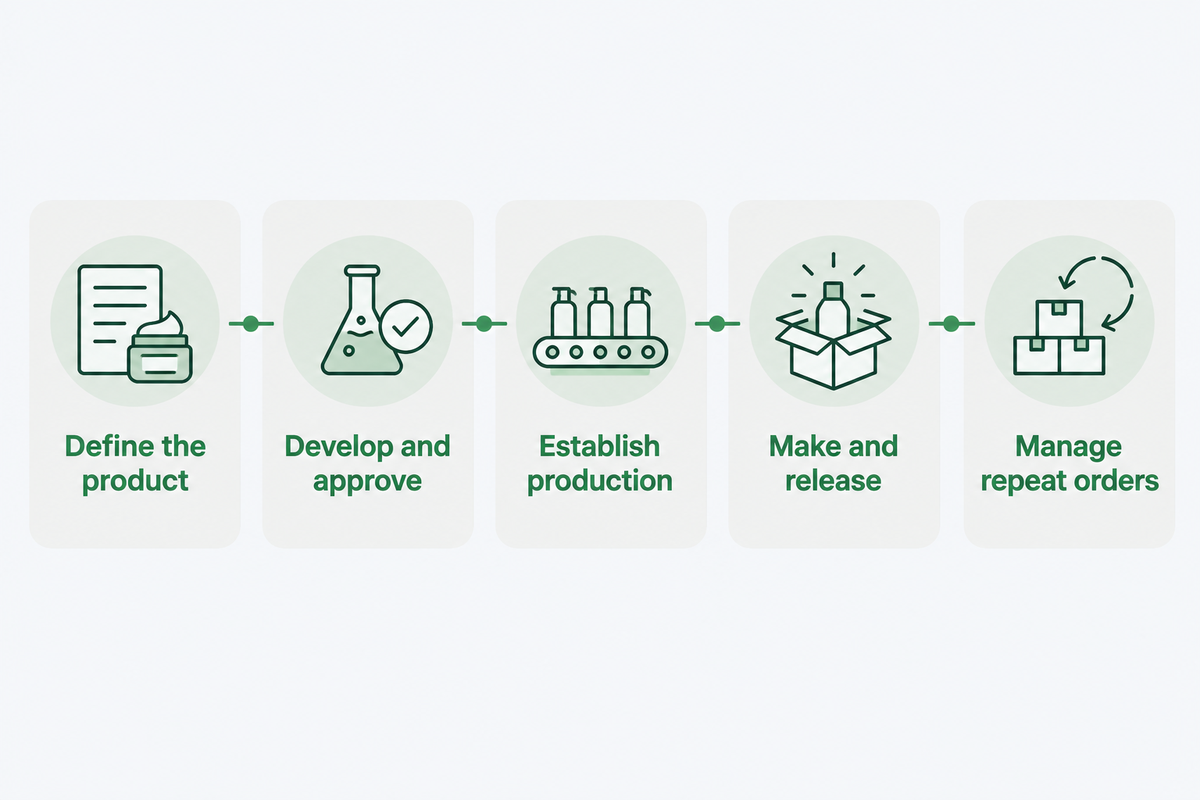
- Define the product: set the user, benefit, format and sales market.
- Develop and approve: select the formula route, compare samples and resolve the package.
- Establish production: document the pilot process and filled-product checks.
- Make and release: control materials, batch, fill and inspect against the specification.
- Manage repeat orders: retain the agreed records and review changes before the next run.
A hair care contract manufacturing service may cover a number of these tasks under a single agreement. However, the commercial agreement still needs to identify the deliverables included. “Turnkey” may be used to describe an offer; the project scope determines who develops products, buys components and approves artwork.
Choose a Formula Route Before You Build a Hair Care Line
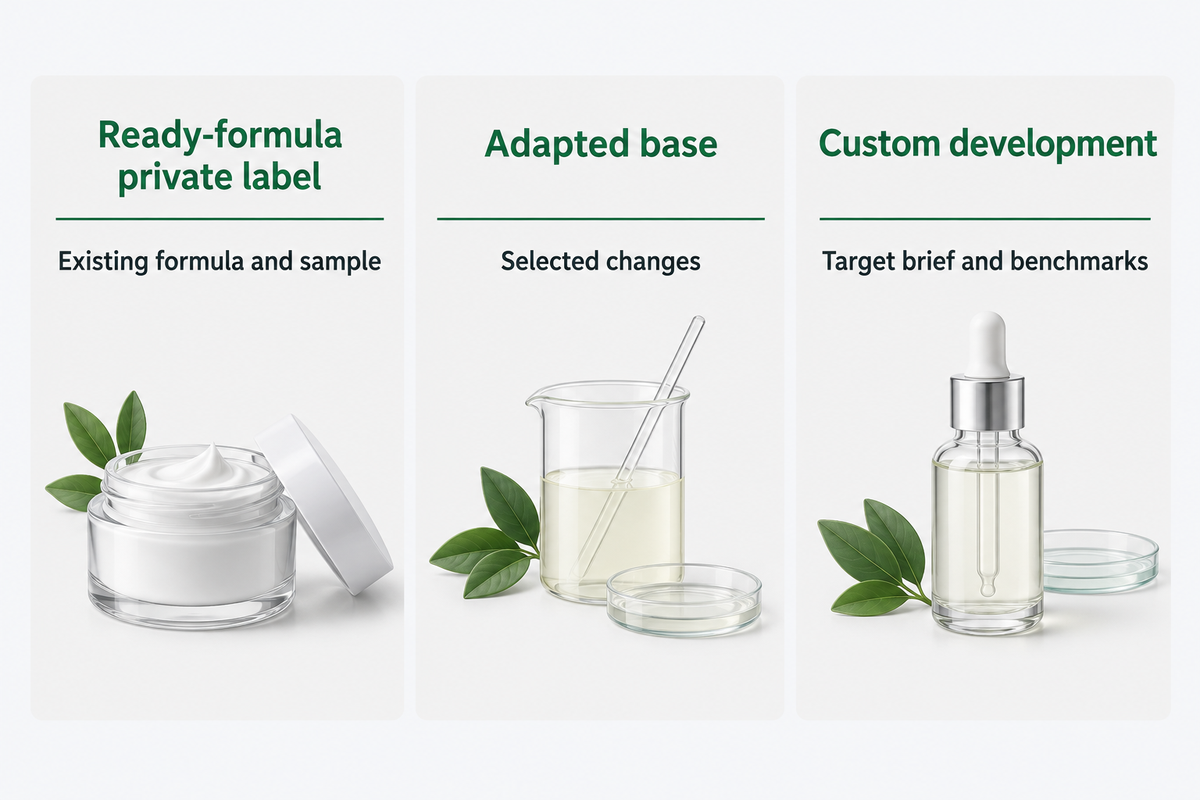
Use an existing formula when a sample already meets the intended end use. Use a base when a specified change addresses a product gap. Use custom formulation when the performance requirement lies beyond the reach of the available platform, and allow for testing and production work that follows.
| Route | What starts ready | Useful when | Decision before spending |
|---|---|---|---|
| Ready-formula private label | An existing formula and sample | The product already meets the brief | Choose the package, label and permitted options |
| Adapted base | A platform with selected changes | A fragrance, sensory or ingredient change has a clear purpose | Define the change and which existing evidence still fits |
| Custom development | The target brief and benchmarks | The target cannot be met with an available base | Agree development milestones, formula access and transfer terms |
In the cosmetics industry, white label and private label services are used differently. Comparing private label hair care offers shows what work each supplier includes. More details on the ready-formula route can be found in the guide on how white label cosmetics work.
Can private label hair care formulas be customized?
Yes, if the selected private label hair care manufacturer offers changes to that base and can develop the revised product. A fragrance change can affect viscosity, while a new pack changes dispensing and contact materials. The revised sample, its formula version and evidence must remain linked for the brand to approve manufacture.
Consider the salon owner building a retail brand with private label hair products. The shampoo sample rinses cleanly, but a stronger fragrance is requested to match the salon experience. The buyer has changed more than the fragrance. The new blend is the sample for a viscosity and dispensing comparison. The impact of the change on the existing test programme is reviewed by the laboratory. If the existing product already fits the target customers, the simpler first launch may be to keep it unchanged. Spending on a new formula is more justified when it closes a performance gap rather than making the product feel more exclusive.
Development rights are a different consideration. UK government guidance differentiates payment from ownership. IP Australia lists ownership, commercial use, transfer and modification separately. For the project agreement, break out the starting base, newly developed work, exclusivity and access to processing instructions.
Write a Brief That the Laboratory Can Actually Formulate

In hair care, there’s a description of what a product needs to do during a given process. Identify the intended user, application, sensory benchmark, package and sales market before selecting ingredients. These guide the formulator in comparison of prototypes and rejection of changes that increase cost and don’t improve the result.
The amount of product used in a service and how the stylist dispenses it are details required for products for salons. For consumer hair care product development, indicate the wash frequency and products used along with it in the hair care product line. A daily conditioner, a cleansing shampoo and a weekly mask can serve different jobs within the same product line. Hold and finished style are details needed for styling products.
What Should Be Included in a Hair Care Product Specification Sheet?
Add the approved references for the formula, appearance, odor, relevant physical measurements, pack details, test methods and acceptance limits. Include the approved reference sample, measurement conditions and the viscosity of a product at a specific temperature. A viscosity result needs its method and temperature to be comparable; the same-looking number measured differently can lead the teams to opposite release decisions.
Approve a reference to define “light,” “rich” or “easy to rinse.” Identify a clear finish for hair oils as opposed to a heavier coating. Describe the distribution and rinsing of hair masks rather than simply list conditioning ingredients. The brand decides, based upon your input, whether clean beauty’s documented positioning means an ingredient policy, a packaging choice or a claim.
As a cosmetics manufacturer, NEXO Beauty Labs works across body care, skin care and hair care. A company offering cosmetics and skin care still requires a separate brief for hair cosmetics that explains the hair care routine in its own terms. The broader prototype development process is covered in the custom cosmetic formulation and R&D guide.
How Shampoo, Conditioner and Hair Oil Change the Production Process
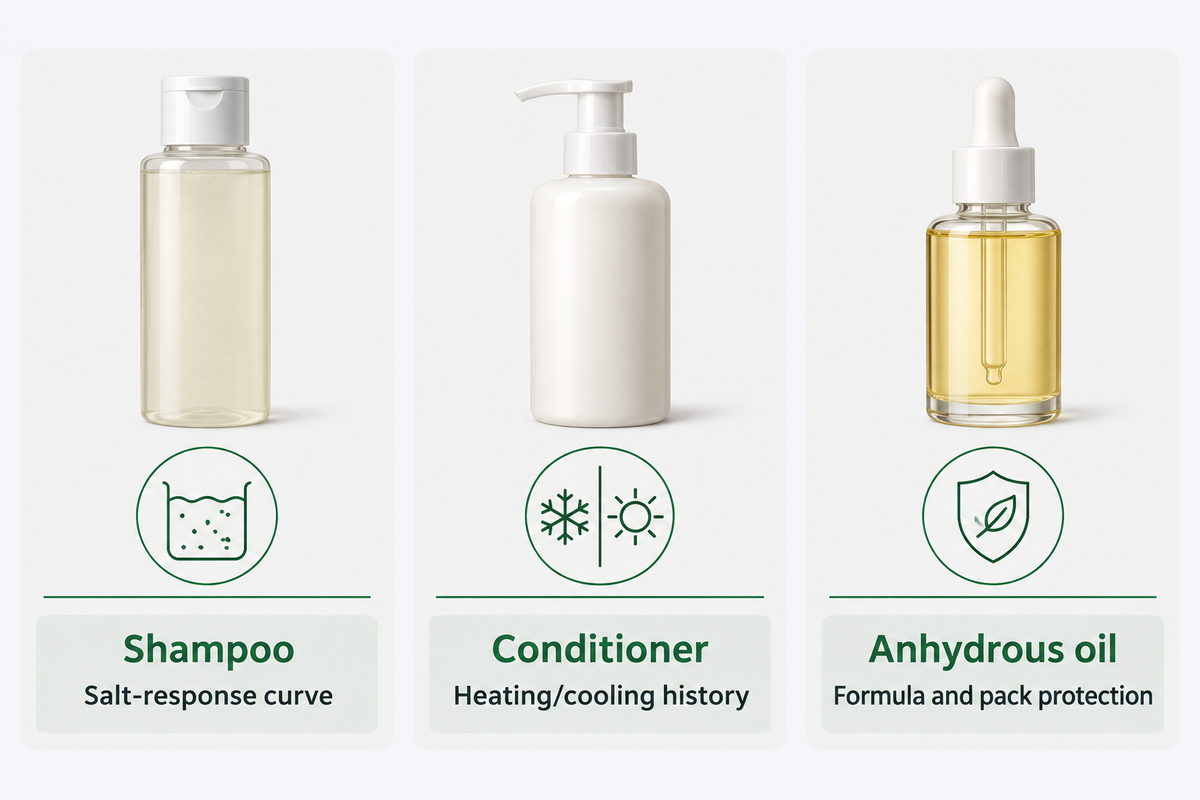
Shampoo, conditioner and anhydrous hair oils require different observations during production. A surfactant solution’s viscosity can be altered by salt and fragrance; an emulsified conditioner can be affected by the history of mixing and temperature. An oil blend shifts the comparison toward its appearance, odor and package behavior. Diagnose the stage where the difference first appears before changing the formula.
Similar to cooking where ingredients are multiplied but the history of mixing and heating isn’t reproduced, scale-up is also difficult. Cosmetic process engineers also have to reproduce dispersion, cooling and transfer. Nicola Lionetti and Miriam Deola have a process engineering article on the cosmetic scale-up where they describe a number of these variables.
The 3-Format Batch Drift Fingerprint
Use the observations below to pick the next comparison. They tell what can be investigated, not what causes a particular effect. Quality, production and packaging teams can work from the same retained samples instead of each adjusting a different part of the process.
| Format | Observation | Discriminating comparison | Next action and owner |
|---|---|---|---|
| Shampoo | Bulk becomes thinner after adjustment | Final formula against its salt-response curve | Formulation: review total salt and fragrance before further addition |
| Shampoo | Clear sample becomes cloudy in production | Appearance before and after deaeration | Production: investigate incorporated air and mixing sequence |
| Shampoo | Visible lumps or uneven texture | Material before and after the hydration stage | Production: review wetting, dispersion and hold steps |
| Conditioner | Bulk texture differs from the reference | Matched formula with recorded heating/cooling history | Formulation: compare phase and process conditions |
| Conditioner | Texture changes after filling | Retained tank sample against filled product | Production: trace pump, transfer and filler shear |
| Conditioner | Uneven appearance during storage | Filled packs from the same pilot under the study conditions | Quality: investigate stability before approving a correction |
| Anhydrous oil | Odor or color changes during storage | Same batch in candidate packs and a comparison container | Quality: investigate formula and pack protection together |
| Anhydrous oil | Leakage or inconsistent dispensing | Complete filled pack during the defined use/transport checks | Packaging: compare closure, seal and dispensing assembly |
| Anhydrous oil | Unexpected haze or particles | Reference, retained bulk and filled pack at matched conditions | Formulation: investigate material compatibility and process history |
Anhydrous hair care formulas also require a microbiological risk decision that considers production and intended use.
Translate a Good Sample Into a Repeatable Production Batch
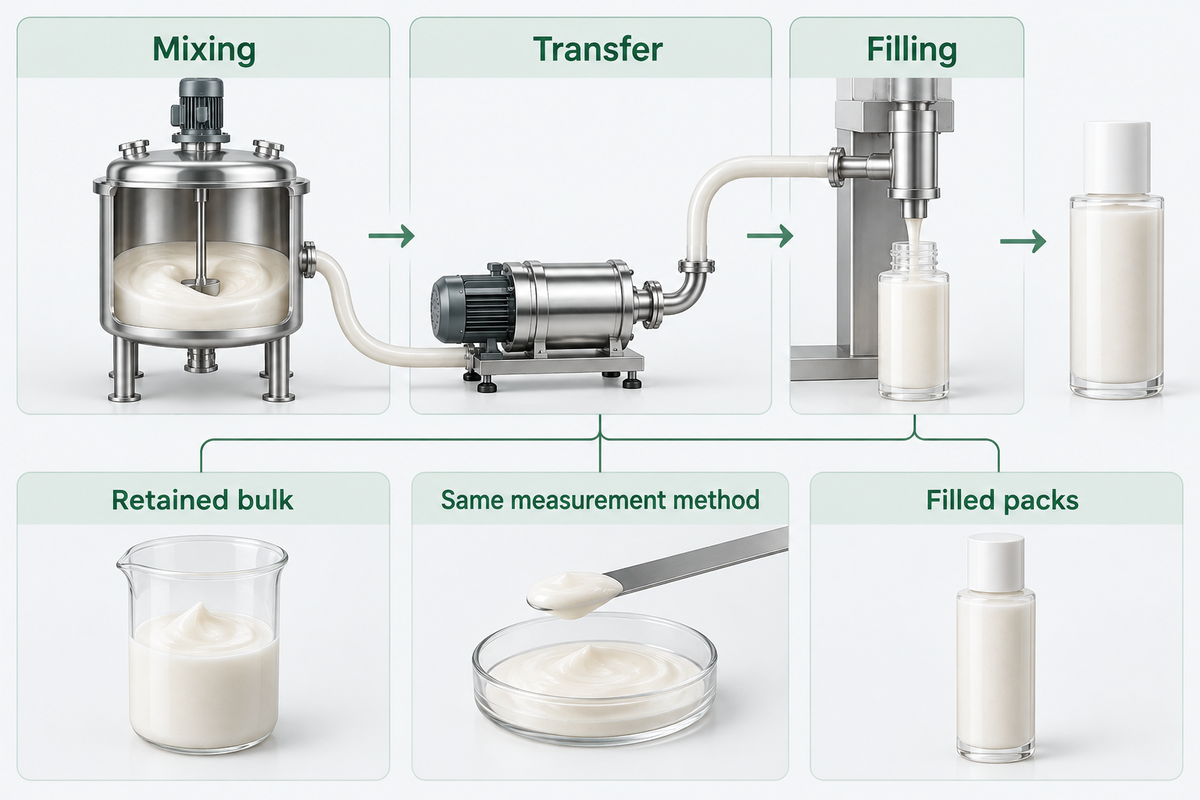
A repeatable batch needs the formula and the process that produced the approved result. Record the addition order, and relevant temperatures, mixing and transfer conditions during the pilot. Compare both retained bulk and filled packs to the reference using the same measurement method, so production differences can be located rather than guessed.
Use the same revision identifier on the approved reference sample, batch instruction, packaging specification and release record. Review fragrance or ingredient changes as formula revisions. A pack change sends the affected dispensing and compatibility work back for review.
A useful example is salt thickening. Lionetti and Deola describe building a pilot salt curve with progressive 0.1% NaCl additions and measuring viscosity after each addition. Once the curve passes through its peak, adding salt can actually lower the viscosity.
The approved production instruction therefore needs the sequence established for the formula and equipment. Copying a generic shampoo manufacturing recipe into a batch sheet can miss the effect of incoming surfactant salt, fragrance or the ability to disperse a thickened blend.
“Filling can cause shear sensitive emulsions to lose or gain viscosity.”
Scale-up should be evaluated through the final product in its container. This should include the transfer and filling processes.
Suppose a conditioner pilot passes its bulk checks, yet the first filled packs feel thinner. Samples are compared using the same method, and the location of the change is pinpointed after the tank, so the team looks at the transfer pump and the filler before reformulating. The comparison also includes the new dispensing packs that procurement may have ordered. Reformulating immediately can conceal a filling issue, and the sample approval process may have to occur again. The process engineer can compare the filled product after a defined transfer change and document the result for the production instruction.
Choose Packaging While the Formula Is Still Being Tested
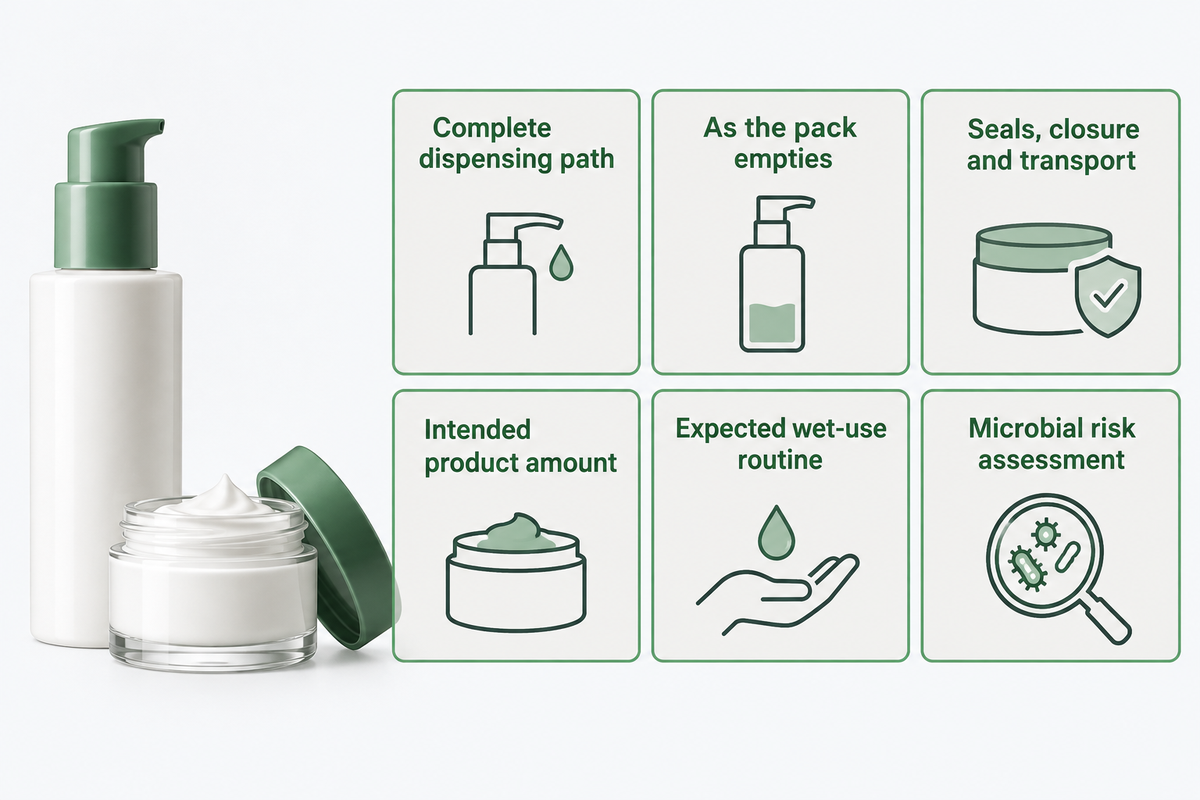
Discuss the bottle and the dispensing system with the formula and examine the complete filled pack. How the product moves through a pump or opening is affected by the viscosity of the product. The formula also interacts with the closure, seals and the bottle. Package design also determines how the end user interacts with the product, including how the product is stored.
A pump that works well with a light lotion may dispense a rich hair treatment product poorly. A convenient jar changes how a customer uses and handles the product. FDA’s cosmetics fact sheet discusses container-related safety and contamination during consumer use, including fingers entering a jar.
Pump or squeeze pack
- Evaluate flow through the complete dispensing path.
- Compare dispensing as the pack empties.
- Include seals, closure and transport handling.
Wide-opening jar
- Evaluate access to the intended product amount.
- Include the expected wet-use routine.
- Review direct handling in the microbial risk assessment.
Compare leakage, appearance, closure behavior, odor and dispensing under the agreed study conditions. These are separate observations: a stable bulk sample can coexist with a leaking pack. Approving artwork before the ingredient list and market review are settled may also create an avoidable reprint decision.
Testing, Claims and Quality Control Before Release
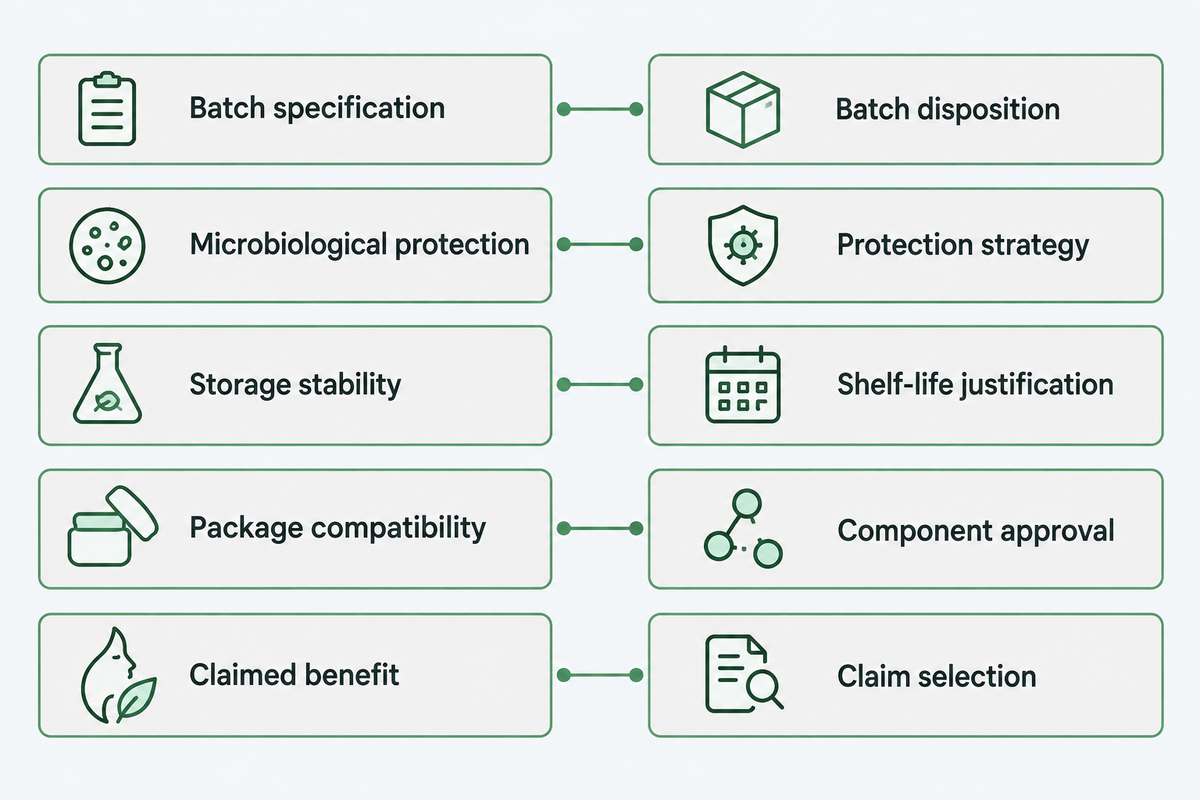
Testing should answer separate questions about safety, preservation, stability and the benefit being claimed. Batch quality checks compare manufactured product with its specification; development studies address behavior over storage and use. In the United States, the responsible person must maintain adequate safety substantiation even though FDA prescribes no single testing regimen for every cosmetic.
FDA’s explanation of U.S. cosmetics law links the applicable requirements to a product’s intended use. A product made for thinning hair claiming to restore hair growth could be a drug. In this case, the shampoo claimed to treat dandruff could be considered both a drug and a cosmetic. Private label brands need to resolve these uses before approving routine cleansing or conditioning development.
| Question | Evidence to plan | Decision it supports |
|---|---|---|
| Does the batch meet its agreed specification? | Defined physical, chemical and relevant microbial checks | Batch disposition |
| How is the formula protected during foreseeable use? | Microbiological risk assessment and appropriate preservation evaluation | Protection strategy |
| Will the product remain acceptable in storage? | Product-specific stability study | Storage and shelf-life justification |
| Does the package work with the formula? | Filled-pack compatibility and use observations | Component approval |
| Does the claimed benefit occur? | Testing matched to the wording, user and endpoint | Claim selection |
ISO 11930:2019, with Amendment 1:2022, addresses overall antimicrobial protection through preservation efficacy data, microbiological risk assessment or both. The low-risk decision connects to ISO 29621:2017. Calling a product anhydrous or packing it as a single dose does not replace that assessment.
For stability, ISO/TR 18811:2018 calls for the manufacturer to specify and justify a protocol appropriate to the product, storage and use conditions. Decide on observations and acceptance criteria prior to the study. When assessing shelf life of a product, interpret a fixed duration of the accelerated test within the protocol, and justify the result.
Other aspects of the system include manufacturing practices. ISO 22716:2007 addresses production, control, storage and shipment. Supplier screening should match a certificate’s named site and scope to the proposed work, while product performance is evaluated through the relevant product testing. NEXO’s cosmetic laboratory services guide explains how to choose tests for those different questions.
Work Out Cost and Lead Time From Saleable Units

Include the relevant development and programme costs once, add the variable costs for the run, then divide by the units expected to be available for sale. Keep factory-production time separate from the whole launch time.
The U.S. Small Business Administration’s planning guidance distinguishes fixed and variable costs. Manufacturing and private label quotations also need a clear boundary between development, packaging and services. A cosmetic business focusing solely on a bottle price in the hair care industry misses that separation.
Saleable-Unit Budget
Assumed inputs: a first run contains 5,000 filled units at $2.40 per unit for the agreed manufacture-and-pack scope, plus $3,000 of fixed development and launch costs. Freight, duties, marketing and retailer charges are excluded. This is a project-budget comparison, not a supplier quotation, profit calculation or inventory-accounting valuation.
| Budget input or result | Case A | Case B |
|---|---|---|
| Filled units | 5,000 units | 5,000 units |
| Assumed variable cost | $2.40 per filled unit | $2.40 per filled unit |
| Variable run spend | $12,000 | $12,000 |
| Fixed programme spend | $3,000 | $3,000 |
| Total included spend | $15,000 | $15,000 |
| Units unavailable for sale | 150 units | 500 units |
| Saleable units | 4,850 units | 4,500 units |
| Calculation | $15,000 ÷ 4,850 | $15,000 ÷ 4,500 |
| Planning cost per saleable unit | $3.09 | $3.33 |
For the finance lead, the total included commitment is unchanged, but fewer units carry it. For quality, units that aren’t saleable may include retained samples, damaged packs or product still held from release. Those categories need separate counts; held units may later become saleable. Do not add the same lost product cost twice if it is already included in the run spend.
Imagine a new beauty brand comparing two private label products. One offer includes a decorated bottle, while the other prices bulk filling and leaves printed components to the buyer. The lower unit price is attractive until the component minimum leaves unused bottles in storage. Procurement normalizes the package and service scope, while finance separates cash committed to unused components from the finished units available to sell. Quality provides the count for release status. Manufacturing small runs may reduce finished inventory while leaving the component commitment intact. The owner can then choose whether to start small with the available range of hair care products or commit to a customized pack programme as the business grows.
Launch dependency map
| Workstream | Depends on | Owner’s scheduling decision |
|---|---|---|
| Formula approval | Agreed brief and sample comparison | Resolve open changes before locking the version |
| Testing | Defined formula, package and intended use | Schedule the applicable studies and review points |
| Components and artwork | Approved pack, ingredient information and market review | Align procurement arrival with the required approvals |
| Production slot | Approved materials and agreed readiness conditions | State what starts the quoted production period |
| Dispatch and launch | Release, documentation and transport | Keep shipment readiness separate from the retail date |
Turn Your Approved Brief Into a Manufacturing Handoff
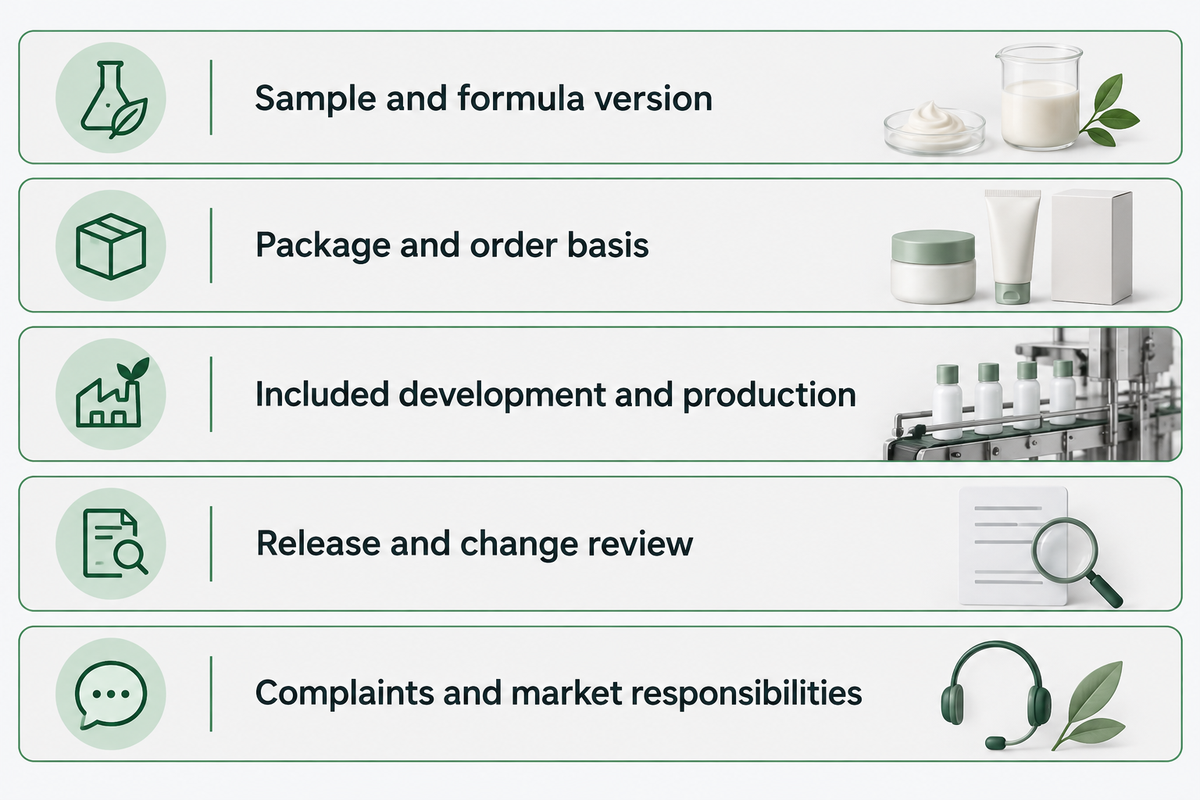
A complete private label hair care handoff connects the approved sample to the formula, process, package and release specification. Assign an owner for each unresolved decision before the order is placed. The brand also requires a route for complaints, traceable batch records and the post-production market documentation that remains necessary after the factory finishes production.
Use this short purchasing checklist when comparing a cosmetic contract manufacturer or private label labs. Even when a private label manufacturer specializes in private label, the quoted service scope must still match the approved brief.
- Identify the approved sample and formula version, permitted changes and access to the agreed development deliverables.
- Define the package, size, decoration and minimum order basis for each finished stock-keeping unit.
- Separate included development, testing, manufacture, filling and private label contract services.
- Assign specification approval, release authority, retained samples and change review.
- Assign complaint intake, investigation records and market-specific responsible-person work.
In the United States, FDA requires the responsible person to report serious cosmetic adverse events within 15 business days. A label-listed manufacturer, packer or distributor may fulfill this responsibility. For an EU launch, HPRA explains the responsible person’s obligations, including the product information file, cosmetic product safety report and notification before market placement.
NEXO Beauty Labs supports beauty brands with formulation, development and scalable manufacturing across hair care, skincare and body care. A private label hair care line can include shampoo and conditioner within that product development scope. Use the hair care development and manufacturing programme for the available commercial solution. Buyers comparing supplier types can use the existing shampoo manufacturer comparison once they define the product and order scope.
What Is Changing for Hair Care Product Launches?
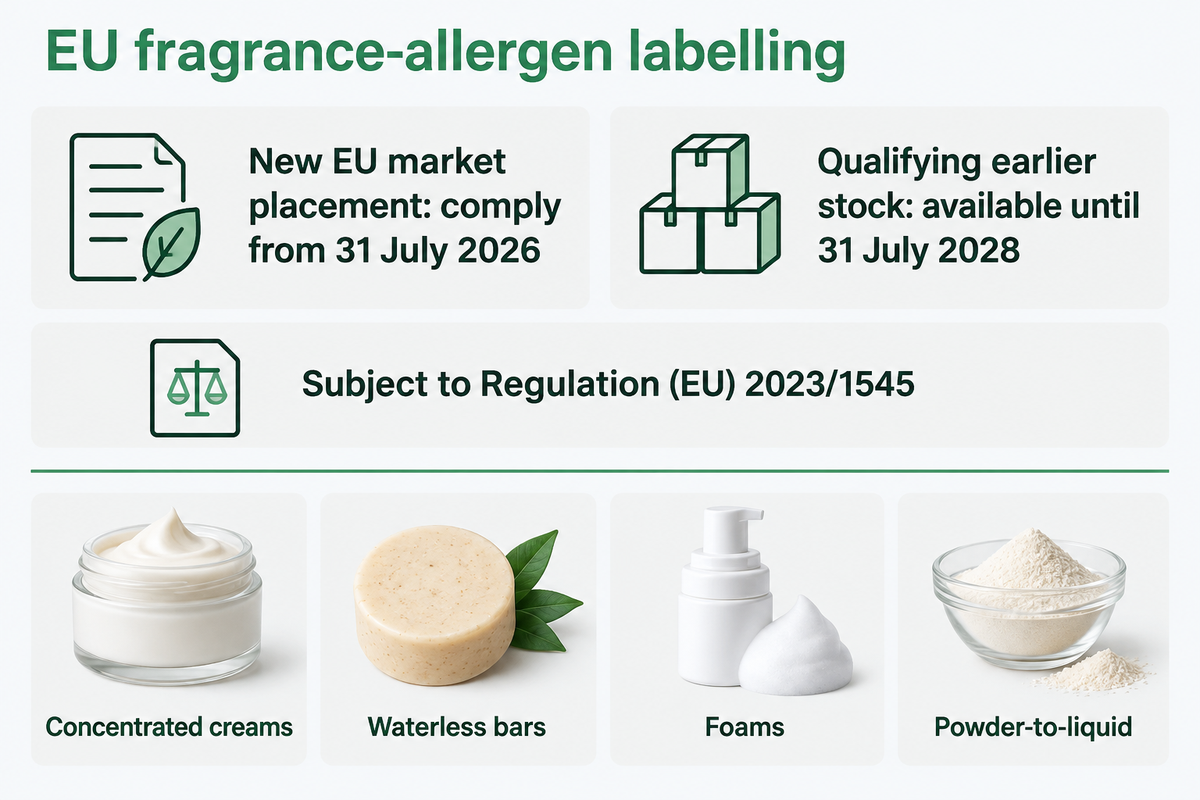
Products newly placed on the EU market since 31 July 2026 must meet the applicable updated fragrance-allergen labelling requirements. Resolve the fragrance information and the associated artwork at the same time to make purchasing decisions in line with the planned market entry.
The European Commission’s current explanation states that non-compliant products may no longer be placed on the EU market since 31 July 2026. Qualifying products placed before that date may continue to be made available until 31 July 2028, subject to the conditions in Regulation (EU) 2023/1545. Old artwork held for a new launch does not become qualifying existing stock merely because it was printed earlier.
Product selection is also going beyond the traditional bottle. Ingredient supplier AAK’s 2026 haircare outlook discusses concentrated creams, waterless bars, foams and powder-to-liquid formats. Examine the formats by application, packaging and performance in the customer’s routine. A new format can change application, packaging and how performance is evaluated.
A professional hair care brand pursuing a concentrated product, for example, needs a clear dose and use instruction before it can compare the experience with a conventional product. A lower-water architecture changes development decisions; it does not remove the need to assess the finished product’s protection and use. A brand only selling in the U.S. adjusts the product label to comply with the U.S. requirements and doesn’t consider an EU label change as a domestic adaptation.
When writing the next product brief, state the destination market and intended use before the fragrance and pack approval. For an established beauty business extending a national brand into another country, the same market assessment is required, even though the formula and manufacturer remain the same.
Hair Care Product Manufacturing FAQ
Can I start a hair care brand without developing a formula?
Yes. You can launch your own brand with existing private label hair care products rather than commission a new formula. You still need a target market, approved packaging and artwork, specification, and evidence appropriate to the finished product. An existing base shortens development; it doesn’t remove the brand’s launch responsibilities.
What Hair Care Products Can You Private Label?
Private label ranges include shampoo and related products including rinse-out conditioner, hair masks, oils and other leave-in products, depending on the supplier’s equipment and development scope. Choose the format around the user’s task and the evidence needed for its claims. A supplier offering one category shouldn’t be assumed capable of every related format.
Is private label cheaper than custom formulation?
An existing formula can reduce the development work you pay for, but the comparison includes packaging, testing, component minimums and saleable inventory. A lower bottle price can produce a larger first-order commitment. Compare the same specification and order quantity, and separate development costs from recurring manufacture, filling and packaging costs.
How long does private label hair care manufacturing take?
NEXO lists commercial production at 10–15 days after sample and artwork approval. That period covers the stated factory stage. Sample development, packaging procurement, testing, release and transport belong in the wider project schedule before the brand promises a retail launch date.
Who owns a custom-developed formula?
The development agreement sets the formula ownership and transfer arrangement. Paying for development, receiving an ingredient list and receiving a complete transferable manufacturing formula are different arrangements. Separate ownership of the starting base and new work, permitted use, exclusivity, access to processing instructions, and what happens if the supplier relationship ends. Resolve these terms before approving development expenditure, with advice appropriate to the governing law of the agreement.
Is private label hair care suitable for salons?
Yes. Professional private label hair products suit salons when they fit the clients, service routine and retail positioning. Evaluate dispensing, after-use feel, fragrance and reorder economics with the users. Professional positioning should describe the product’s use and supported benefits, rather than substitute for performance evidence.
What is the minimum quantity to manufacture private label cosmetics?
NEXO’s published hair care programme starts at 10,000 units per SKU. Other suppliers set their own conditions, so this is a supplier-specific floor. The order brief should distinguish formula, fragrance, size and finished stock-keeping unit, then identify packaging-component minimums and unused inventory. A multi-product hair care line needs its commitment calculated in units per product rather than assuming the total range shares one minimum.
Bring a Defined Hair Care Brief to NEXO
Share the product format, target market, benchmark sample, packaging direction and planned quantity. Bring your brand brief to NEXO Beauty Labs to discuss the development and manufacturing scope for your hair care line.
References & Sources
- FDA: Cosmetics & U.S. Law; small-business cosmetics fact sheet; serious adverse-event responsibilities.
- ISO public references: 11930:2019 and Amendment 1:2022, 29621:2017, TR 18811:2018 and 22716:2007.
- Lionetti and Deola: cosmetic scale-up considerations; Bornfriend: Scale-up Basics for Formulators and Process Engineers.
- UK business intellectual-property guidance; IP Australia ownership guidance; SBA business-cost planning.
- HPRA: Responsible Person for cosmetic products; European Commission fragrance-allergen guidance; Regulation (EU) 2023/1545.
- AAK Personal Care: 2026 haircare outlook, an ingredient-supplier perspective.