Get in touch with NEXO Beauty Labs Company


Global Cosmetic Manufacturing Support: End-to-End OEM, Compliance, and Export Playbook

Updated November 2026 · International OEM/ODM Operations & Export Compliance Playbook
Global cosmetic manufacturing support integrates formulation R&D, raw-material sourcing, ISO 22716 GMP production, laboratory stability and microbiological testing, multi-market regulatory requirements, and export customs coordination. A turnkey contract manufacturer runs plant production and compiles technical files. The US MoCRA and EU Regulation 1223/2009 Responsible Person retains brand-side statutory accountability.
Demand supported by international expansion across skincare, hair, and body care exposes growing brands to three costly traps during product launches: regional reformulation, border detention from mismatched customs records, and heavy fixed testing fees on small runs. This playbook solves all three through the Strictest-Intersection Formula Standard, the Dual-Track Border Clearance Dossier, and the Fixed-Compliance Dilution Curve.
Key Compliance and Cost Benchmarks Verified for 2026 Export Planning
- US FDA MoCRA: Manufacturers must register facilities, update changes within 60 days, and renew every two years; Responsible Persons file product listings within 120 days of marketing and report serious adverse events within 15 business days.
- EU Allergen Expansion: Commission Regulation (EU) 2023/1545 adds 56 fragrance allergens above 0.001% in leave-on items and 0.01% in rinse-off items; new EU placements must comply since 31 July 2026, with sell-through ending 31 July 2028.
- US Customs Rule Check: FDA Prior Notice regulations (21 CFR 1.276 to 1.285) apply strictly to imported food and animal feed, not cosmetics; commercial cosmetics clear via CBP ACE under FDA Program Code COS and Industry Code 53.
- EU Testing & CPSR Benchmarks: Published 2026 European compliance guides quote ISO 11930 challenge testing at EUR 250 to EUR 400, stability testing at EUR 250 to EUR 800, and combined EU CPSR dossiers at EUR 1,200 to EUR 2,800 per SKU.
What Global Cosmetic Manufacturing Support Includes Beyond Contract Filling
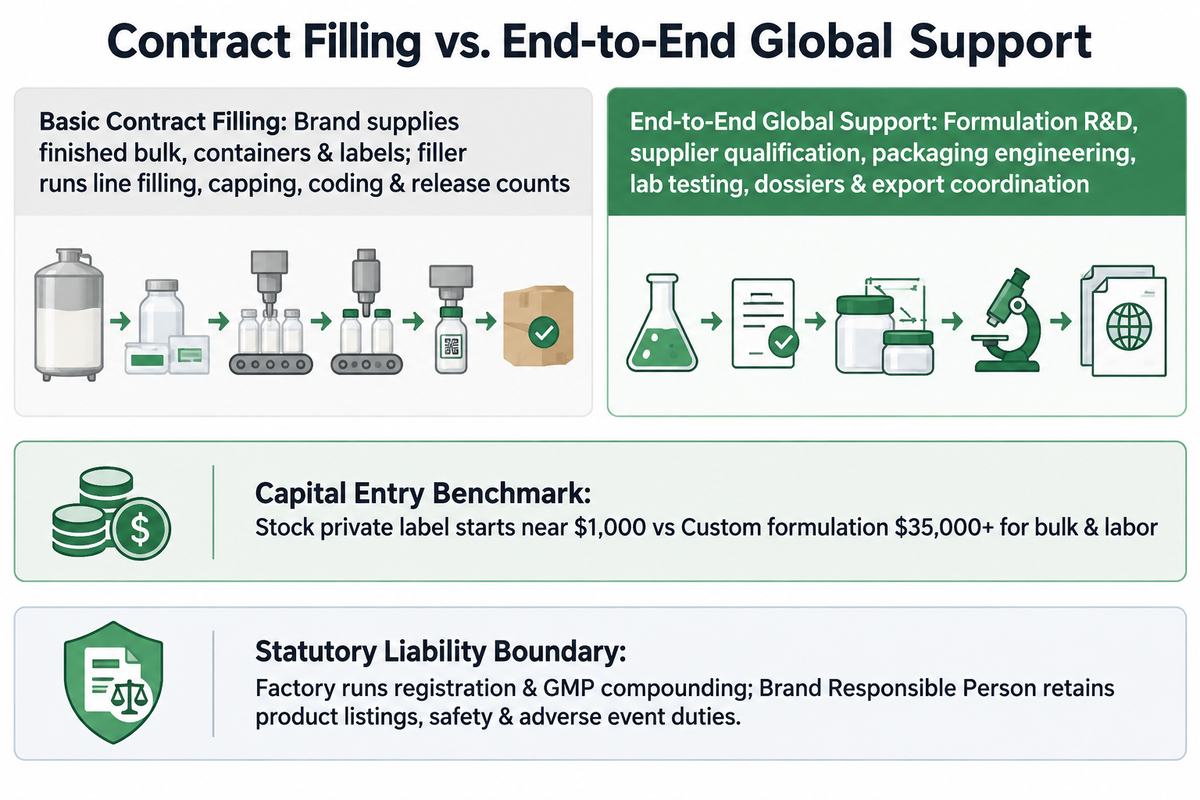
End-to-end global cosmetic manufacturing support spans formulation development, approved supplier qualification, primary packaging engineering, laboratory stability and microbiological testing, regulatory dossier preparation, and export logistics coordination. Basic contract filling stops at putting brand-supplied bulk into brand-supplied containers under agreed line checks.
Many beauty founders assume a turnkey contract transfers legal liability to the factory floor. Under the U.S. Food and Drug Administration MoCRA framework, the factory handles facility registration and GMP compounding. Meanwhile, the Responsible Person named on the label remains legally accountable for product listings, safety substantiation, label accuracy, and serious adverse event reporting. Evaluating global cosmetic manufacturing support services and cosmetic contract manufacturing capabilities starts by separating plant execution from statutory ownership in your contract.
What is the difference between turnkey cosmetic manufacturing support and basic contract filling?
Basic contract filling is a fee-for-service production step. The brand supplies finished bulk, containers, and printed labels, while the filler handles line filling, capping, coding, and release counts. Turnkey global support unites product development, raw-material sourcing, packaging compatibility testing, safety files, and export shipping under one managed manufacturing process across qualified manufacturing facilities.
The other big differentiation between the two is capital requirement. Published US manufacturer guidance by Lady Burd states that stock private-label offerings can start near $1,000. By contrast, custom formulation projects require $35,000 or more for bulk and labor before custom packaging and add-ons.
Proper tier selection safeguards cash flow throughout early product launches.
| Production Stage | Basic Contract Filling | End-to-End Global Support | Statutory Duty Holder (US MoCRA / EU 1223/2009) |
|---|---|---|---|
| 1. Product Brief & Classification | Excluded; brand defines product class. | Screens cosmetic vs. OTC drug boundaries per market. | Designated Responsible Person bears final classification liability. |
| 2. Formulation & R&D | Excluded; brand supplies approved bulk. | Lab prototypes, stability screening, and pilot scale-up. | Contractually assigned; recipe stays with lab unless transferred. |
| 3. Raw Material Procurement | Brand ships raw materials or bulk. | Approved vendor sourcing, COA checks, and allergen sheets. | Factory verifies incoming specs; brand audits purity records. |
| 4. Primary Packaging Sourcing | Brand supplies bottles, pumps, and cartons. | Component procurement, decoration, and line trials. | Responsible Person approves artwork, INCI layout, and warnings. |
| 5. Stability & Compatibility | Not included unless billed separately. | Accelerated thermal aging and container compatibility tests. | Responsible Person retains valid safety substantiation records. |
| 6. Preservative & Micro QC | Finished-batch plate count only. | ISO 11930 challenge testing plus ISO 17516 release checks. | Factory certifies batch limits; Responsible Person holds safety file. |
| 7. Compounding & Filling | Filling, sealing, torque, and lot coding. | Full ISO 22716 batching, IPQC, and master batch records. | Facility holds MoCRA registration (60-day update / biennial renewal). |
| 8. Regulatory Dossiers | Supplies COA and basic SDS only. | Compiles PIF Part A raw data, GMP statements, and INCI breakdown. | EU/UK Responsible Person holds the safety assessor’s signed CPSR and live PIF. |
| 9. Portal Filings & Listings | Excluded. | Prepares technical fields for CPNP, SCPN, and Cosmetics Direct. | Responsible Person submits listings (120 days US; pre-market EU). |
| 10. Post-Market Surveillance | Retains reference batch samples only. | Supports root-cause lot trace and corrective action reports. | US MoCRA: 15 business days; EU Art. 23: without delay to national authorities. |
How to Structure One Cosmetic Formula for US MoCRA, EU 1223/2009, UK SCPN, ASEAN, and GCC Compliance
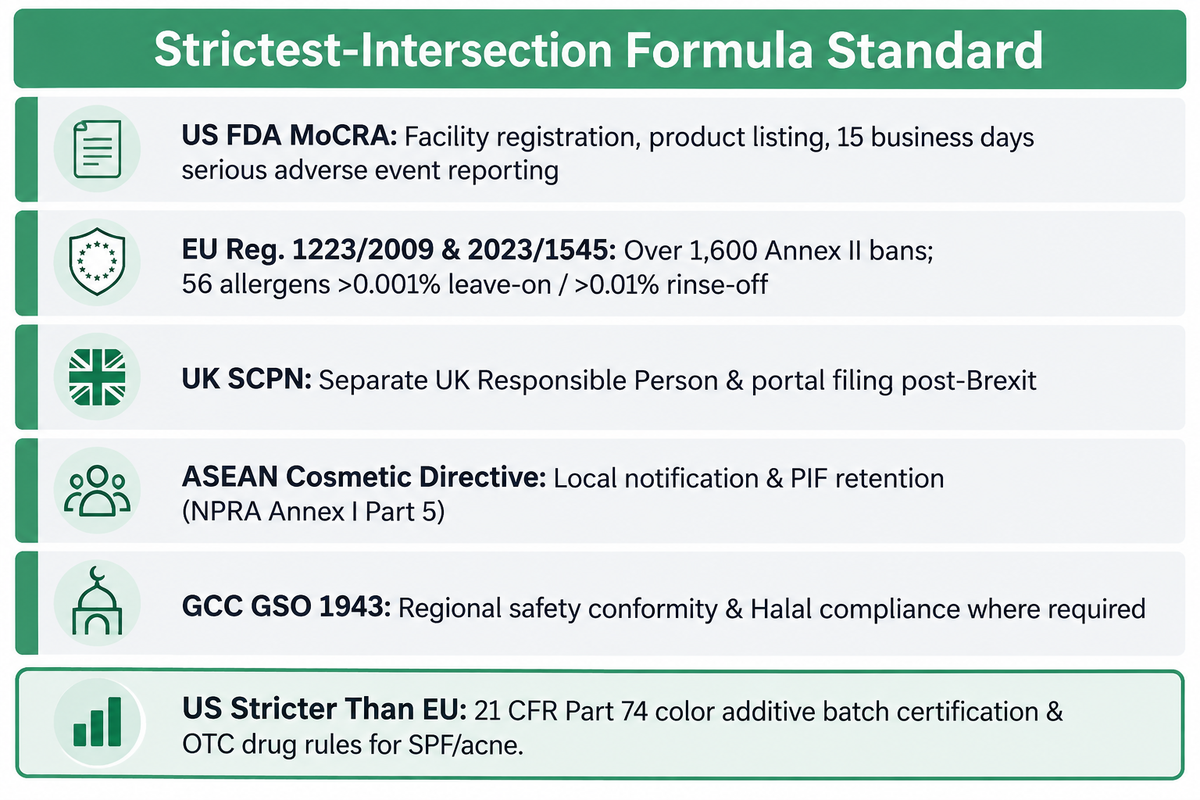
Brands avoid costly regional reformulation by screening every SKU through the Strictest-Intersection Formula Standard before lab compounding starts. Bulk chemistry locks to the narrowest shared ingredient limits and applicable regulatory bans across all five regions. Only labels, Responsible Person details, dossiers, and portal filings change by destination market.
Many expanding brands mistakenly assume an EU-compliant cream automatically satisfies US rules. While EU Regulation 1223/2009 bans over 1,600 substances under Annex II, United States rules are stricter in two key areas. First, the US mandates FDA batch certification for many synthetic color additives under 21 CFR Part 74. Second, UV filters, acne salicylic acid, and antidandruff actives treated as cosmetics in Europe count as over-the-counter drugs in the United States. Teams planning sunscreen OTC and EU UV filter manufacturing must split drug and cosmetic tracks on day one.
Claims rules create a second hurdle for retail sales growth. Under EU Regulation 655/2013, brands must hold verifiable proof for every consumer efficacy claim on the finished formula. In the United States, FDA cosmetic labeling guidance confirms labels are not pre-approved, yet disease or structure-function claims trigger drug enforcement. Reviewing skincare claim substantiation requirements early keeps one master formula eligible for cosmetic-only registration.
Fragrance allergen disclosure now requires proactive formula checks. Per the European Commission fragrance allergens guidance, Commission Regulation (EU) 2023/1545 amended Annex III to strengthen individual labelling. It adds 56 fragrance allergens whenever levels exceed 0.001% in leave-on products or 0.01% in rinse-off products. Non-compliant items cannot be newly placed on the EU market since 31 July 2026, and prior stock must clear by 31 July 2028.
Always seek a complete breakdown of allergens from fragrance houses when sampling to minimise carton reprints.
| Compliance Requirement | US FDA MoCRA | EU Reg. 1223/2009 | UK SCPN (Great Britain) | ASEAN ACD & GCC GSO 1943 |
|---|---|---|---|---|
| Designated Entity | Responsible Person on label plus U.S. Agent for foreign facilities. | EU-established Responsible Person (Art. 4). | UK-established Responsible Person. | Local market license holder or importer in each member state. |
| Facility Registration | Mandatory via Cosmetics Direct; 60-day update, biennial renewal. | No central factory portal; GMP statement inside PIF. | No central factory portal; GMP statement inside UK PIF. | Country-specific GMP verification per ASEAN / GSO rules. |
| Product Notification | Within 120 days of marketing; annual updates. | Pre-market CPNP portal notification required. | Pre-market SCPN portal entry (separate from EU CPNP). | Pre-market national filing (NPRA Malaysia, HSA Singapore, SFDA eCosma). |
| Safety Dossier | Adequate safety substantiation records retained on file. | Qualified safety assessor CPSR Part A & B inside 10-year PIF. | Qualified safety assessor (pharmacy, toxicology, medicine, or equivalent) CPSR in UK PIF. | ASEAN PIF per NPRA Annex I Part 5; GSO 1943 safety file. |
| Fragrance Allergens | FDA rulemaking pending under MoCRA; track EU list proactively. | 56 added allergens (>0.001% leave-on, >0.01% rinse-off); active 31 July 2026. | Retained EU baseline; monitor UK OPSS divergence schedules. | ASEAN and GCC annexes align closely with EU Annex III updates. |
| Color Additives | Strict FDA positive list plus batch certification lot numbers. | EU Annex IV CI number positive list; no FDA lot certification. | UK Annex IV CI positive list. | EU-modeled CI lists; avoid prohibited dyes and insect-derived carmine (CI 75470) for Halal lines. |
| Claims & Drug Split | SPF, acne, and antidandruff actives trigger OTC drug rules. | EU Reg. 655/2013 six common criteria; SPF stays cosmetic. | Mirrors EU 655/2013 and ASA advertising evidence standards. | Cosmetic-only claims; Malaysia MS 2634:2019 governs dedicated Halal lines. |
| Adverse Event Reporting | Serious adverse events reported within 15 business days; 6-year retention. | Serious undesirable effects reported without delay to national authorities. | Serious undesirable effects submitted to UK OPSS. | Prompt local authority notification by market authorization holder. |
| Small-Business Exemption | Available for qualifying small businesses under MoCRA (excludes eye, injected, internal, or altered-appearance items). | No small-business turnover exemption. | No small-business turnover exemption. | No turnover exemption; full notification required per SKU. |
Contracting OEM vs. ODM vs. Private Label: Formula Ownership and Change Control
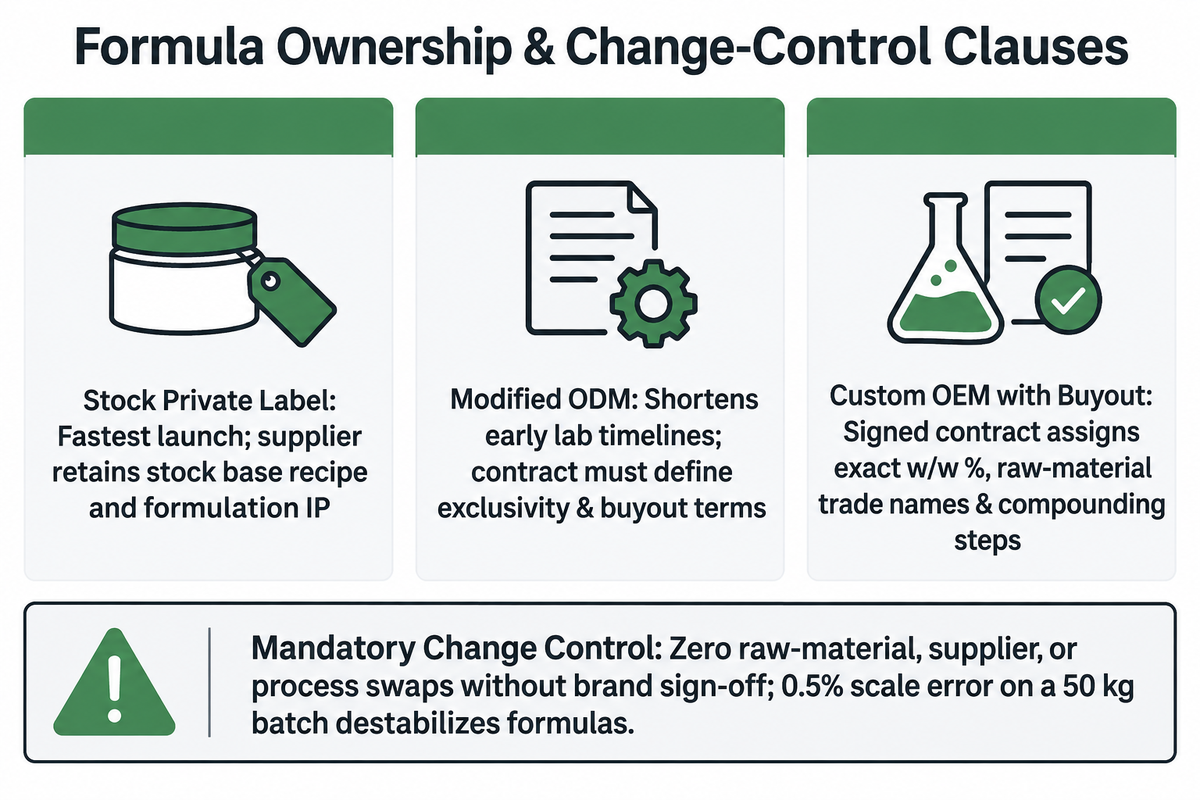
Lab development payments don’t transfer ownership of a formula. Unless a signed contract assigns exact weight-by-weight percentages, raw-material trade names, and compounding instructions, the developing lab controls the recipe as a trade secret and can refuse to release transfer data.
Veteran manufacturing executives advise securing formula ownership before entering commercial production; as one executive told Happi Magazine, “I always encourage my clients to own their formulas.”
Many brands balance speed and capital across their SKU portfolio. Early launches often start with cosmetic ODM manufacturing programs to shorten lab timelines. Once hero SKUs prove repeat revenue and attract institutional investor interest, teams transition into custom skincare formulation development with explicit buyout clauses.
Change control requires its own written clause: no raw material, supplier, or process modification without prior brand sign-off and requalification testing. Unapproved preservative or emulsifier swaps can trigger microbial failure or phase separation mid-distribution. Even small compounding errors disrupt sensitive batches. MySwissLab notes that a 0.5% weighing scale error on a 50 kg batch creates enough drift to destabilize formulas.
| Model | Formula IP Ownership | Relative Launch Speed | Portability to Backup Plant | When Not to Choose |
|---|---|---|---|---|
| White-Label Stock Base | Manufacturer retains full formula ownership. | Fastest (FormYoule cites 6 to 8 weeks for private label). | None; brand only owns trademark and artwork. | Do not choose when raising institutional capital or requiring exclusive active claims. |
| Modified ODM | Manufacturer owns base; brand holds exclusivity window if contracted. | Moderate (requires stability and compatibility re-checks). | Limited unless buyout fee and full bill of materials are written in. | Do not choose if dual-hub production in Asia and Europe is planned soon. |
| Custom OEM (Full IP Transfer) | Brand owns exact formula, INCI percentages, and compounding SOP. | Longest (FormYoule cites 15 to 22 weeks for contract manufacturing). | Full portability via formal technology transfer package. | Do not choose for low-budget tests when US custom runs cite $35,000+ for bulk and labor (Lady Burd). |
ISO 22716 GMP, Lab Testing Sequences, and Pilot Scale-Up Controls
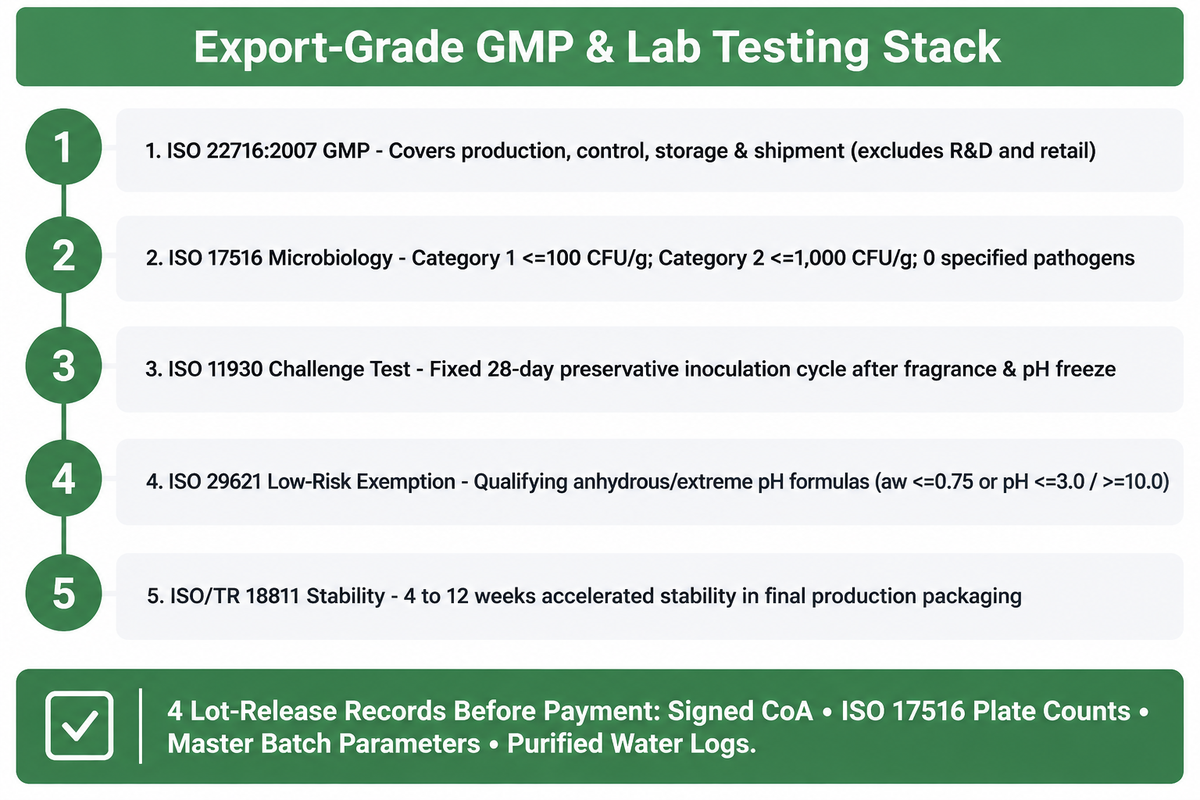
Export-grade cosmetic quality combines ISO 22716:2007 plant governance with four testing standards: ISO 17516, ISO 11930, ISO 29621, and ISO/TR 18811. Under ISO 22716:2007 (confirmed in 2022), guidelines cover production, control, storage, and shipment while excluding R&D and retail distribution.
In the United States, FDA cosmetic labeling guidance confirms the FD&C Act does not mandate one fixed testing list for every SKU. Still, FDA strongly urges appropriate toxicological and microbiological tests to substantiate safety during normal consumer use. Because FDA’s MoCRA GMP rule (RIN 0910-AJ00) remains in Long-Term Actions, pairing ISO 22716 with FDA inspection checklists serves as the practical global baseline.
What GMP and laboratory testing records should a cosmetic manufacturer provide before batch release?
Get four lot-specific records ahead of final payment or freight release: signed batch CoA, ISO 17516 microbiological plate count results complying with limits, redacted master batch parameters, and purified water logs. Retain a further two formula-and-pack validation records on file: ISO 11930 challenge data (or ISO 29621 justification) and final-pack stability summary. Only rely on supplier CoA if you have verified the competence of the supplier and the methodology they are using.
Freeze the fragrance load and pH before starting the 28-day ISO 11930 preservative challenge test (30 to 35 days in commercial labs), because later sensory tweaks invalidate the report. Bench-scale formulas also shift viscosity during commercial vessel mixing when shear rates and cooling curves change. Reviewing cosmetic stability testing protocols and cosmetic laboratory testing services before pilot runs prevents costly re-testing. A 12-week accelerated thermal test at 40 °C works as a commercial benchmark for standard formulas, whereas L-ascorbic acid serums, heat-sensitive emulsions, and natural waxes need tailored conditions and real-time confirmation under ISO/TR 18811:2018.
| Standard / Control | Core Technical Scope | Standard Lab Cadence | Export Dossier Role |
|---|---|---|---|
| ISO 22716:2007 | Production, control, storage, shipment GMP (confirmed 2022; excludes R&D). | Continuous plant system; annual surveillance audit. | Gives presumption of conformity for the mandatory EU/UK PIF GMP statement; ASEAN references ASEAN GMP Guidelines. |
| ISO 17516 | Finished-product microbiological limits (≤100 CFU/g Cat 1 eye/children <3 yr; ≤1,000 CFU/g Cat 2; 0 specified pathogens). | Run per finished production batch prior to release. | Lot-by-lot COA microbiological acceptance criteria. |
| ISO 11930:2019 | 5-organism inoculation log reduction (Criterion A / B) over 28 days. | 30 to 35 days standard (28-day inoculation period is fixed). | Preservative efficacy proof for water-bearing SKUs. |
| ISO 29621:2017 | Low-risk screening (water activity ≤0.75, pH ≤3.0 or ≥10.0, high alcohol). | Formula physicochemical risk evaluation before challenge testing. | Technical risk-assessment justification to omit routine PET for anhydrous or hostile formulas. |
| ISO/TR 18811:2018 | Formula-specific stability guidance (no single universal protocol). | 4 to 12 weeks accelerated (40 °C) plus 6 to 24 months real-time (25 °C / 60% RH). | Supports PAO and shelf-life claims inside CPSR Part A. |
Packaging Compatibility Engineering and EU PPWR 2026 Readiness
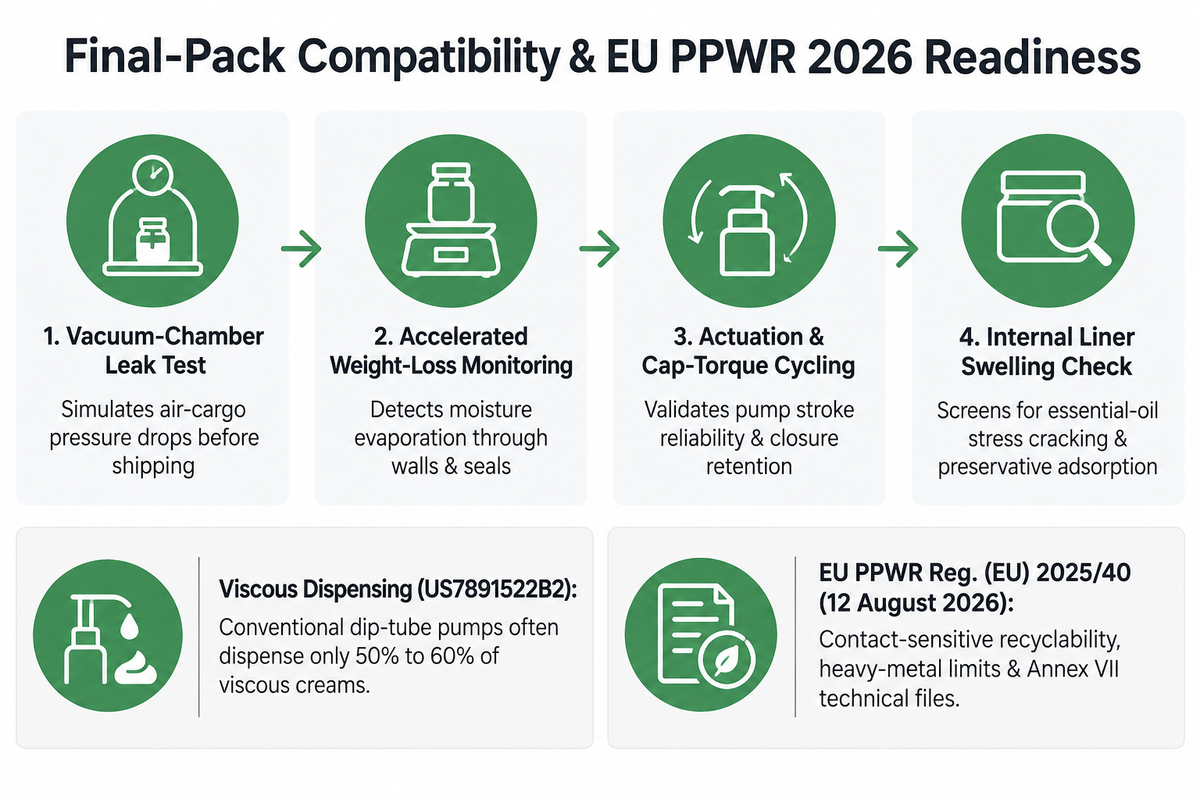
Test final-pack compatibility in the production-intent airless pump, laminated tubes or dropper bottles, since a formula stable in a beaker can still fail within a retail package. Container interactions induce pump swell, essential-oil stress cracking, preservative adsorption and altitude leaks during air transportation.
What packaging compatibility tests prevent airless pump failure and transit leaks?
Run four recommended packaging compatibility checks before bulk filling: vacuum-chamber leak tests for air-cargo pressure drops, accelerated weight-loss monitoring for moisture evaporation, mechanical actuation and cap-torque cycling, and internal liner inspection for swelling. Mechanical limits also matter for thick creams. U.S. Patent US7891522B2 notes that conventional dip-tube pumps often dispense only 50% to 60% of viscous pack contents. The patent explains how an upstanding base support ring (element 46) stops the follower piston from damaging its lower seal during packing.
European rules for sustainable packaging now govern component procurement directly. Under Regulation (EU) 2025/40 (EU PPWR), which applies across every Member State from 12 August 2026 without national transposition, operators must keep conformity records and material traceability files ready. As Intertek technical briefings clarify, PPWR’s explicit PFAS restriction targets food-contact packaging. Cosmetic primary packaging falls under contact-sensitive recyclability rules, heavy-metal limits, and Annex VII technical files.
| Packaging Check / Rule | Failure Mode Prevented | Verification Artifact Required |
|---|---|---|
| Vacuum Leak Testing | Air-freight cabin decompression seepage and oil wicking at neck threads. | Lab vacuum-chamber pass sheet on filled, torqued production samples. |
| Weight-Loss & Wall Compatibility | Moisture evaporation, paneling, or polymer stress-cracking from oils. | Accelerated weight-retention log and visual resin-integrity report. |
| Airless Piston & Actuation Test | Incomplete viscous evacuation (50%–60% trap in dip tubes) and piston seal collapse. | Dispensing dose-consistency record and drop-test seal inspection. |
| EU PPWR Reg. (EU) 2025/40 | Non-compliant multi-material packs or missing EU conformity files after 12 Aug 2026. | Component resin-grade spec sheet, heavy-metal declaration, and Annex VII file. |
Cross-Border Customs Clearance: FDA ACE Entry, EU ICS2, and Detention Prevention
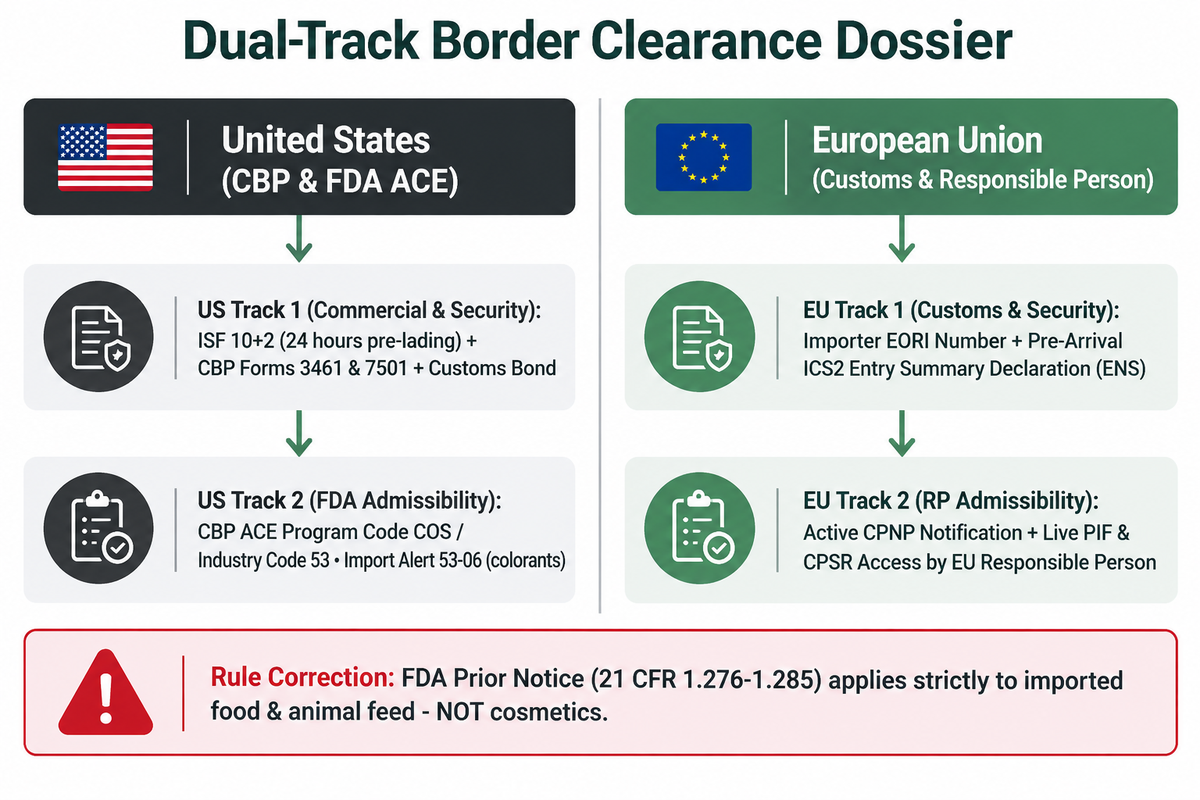
Border holds happen when importers mix up commercial customs filings with cosmetic regulatory admissibility. Running the Dual-Track Border Clearance Dossier aligns broker transmissions with destination safety records and prevents one common error: cosmetics imported into the United States do not require FDA Prior Notice.
FDA’s Prior Notice regulations (21 CFR 1.276 through 1.285) restrict Prior Notice strictly to imported food, including animal feed, under the Bioterrorism Act. Instead, imported US cosmetics must meet the same FDA laws as domestic items (FDA Importing Cosmetics). Commercial brokers transmit FDA electronic entry data through CBP ACE under Program Code COS and Industry Code 53 alongside required affirmations of compliance and structured export clearance documentation. Ocean shipments also require CBP Importer Security Filing (ISF 10+2) 24 hours before vessel lading plus CBP Forms 3461 and 7501 backed by a customs bond.
Color additive violations trigger rapid port detentions because FDA’s longstanding Import Alert 53-06 (DWPE, revised November 3, 2026) authorizes Detention Without Physical Examination for cosmetics with unapproved or uncertified color additives. Separate Import Alert 53-21 addresses non-microbial adulteration under FD&C Act Sections 601(a) through (d). Entering the EU follows a parallel two-track flow: the importer submits an EORI number and pre-arrival ICS2 Entry Summary Declaration, while the EU Responsible Person maintains active CPNP notification and live PIF access.
| Clearance Track | United States (CBP & FDA) | European Union (Customs & RP) | Common Detention Trigger |
|---|---|---|---|
| Track 1: Pre-Arrival Security | ISF 10+2 filed 24 hours prior to ocean vessel lading. | ICS2 Entry Summary Declaration (ENS) plus valid EORI number. | Late ocean ISF filing or mismatched consignee EORI. |
| Track 1: Commercial Entry | CBP 3461/7501, HTSUS 3304/3305, commercial invoice, packing list, customs bond. | EU SAD import declaration, CN code, invoice, origin certificate, VAT/EORI. | Invoice descriptions contradicting FDA Product Code or CN heading. |
| Track 2: Cosmetic Admissibility | FDA ACE PGA Program Code COS / Industry 53, FEI alignment (no food Prior Notice). | Active CPNP reference, EU RP address on pack, live CPSR & PIF on demand. | Unapproved colorants (Import Alert 53-06) or drug claims on cosmetic entries. |
| Track 2: Dangerous Goods & Lot QC | 16-section SDS for flammable alcohols/aerosols; batch COA on standby. | ADR/IATA/IMDG dangerous goods paperwork plus batch COA and allergen list. | Undeclared flammable ethanol in perfumes, toners, or setting sprays. |
| Incoterms Liability Split | FOB/CIF keeps buyer as Importer of Record; DDP makes the seller the Importer of Record, requiring a foreign seller to register as a non-resident importer backed by a US customs bond. | DDP does not replace EU Responsible Person designation under Art. 4. | Assuming freight forwarder DDP quotes transfer FDA or EU legal liability. |
Comparing China, South Korea, the United States, and Europe as Cosmetic Manufacturing Hubs
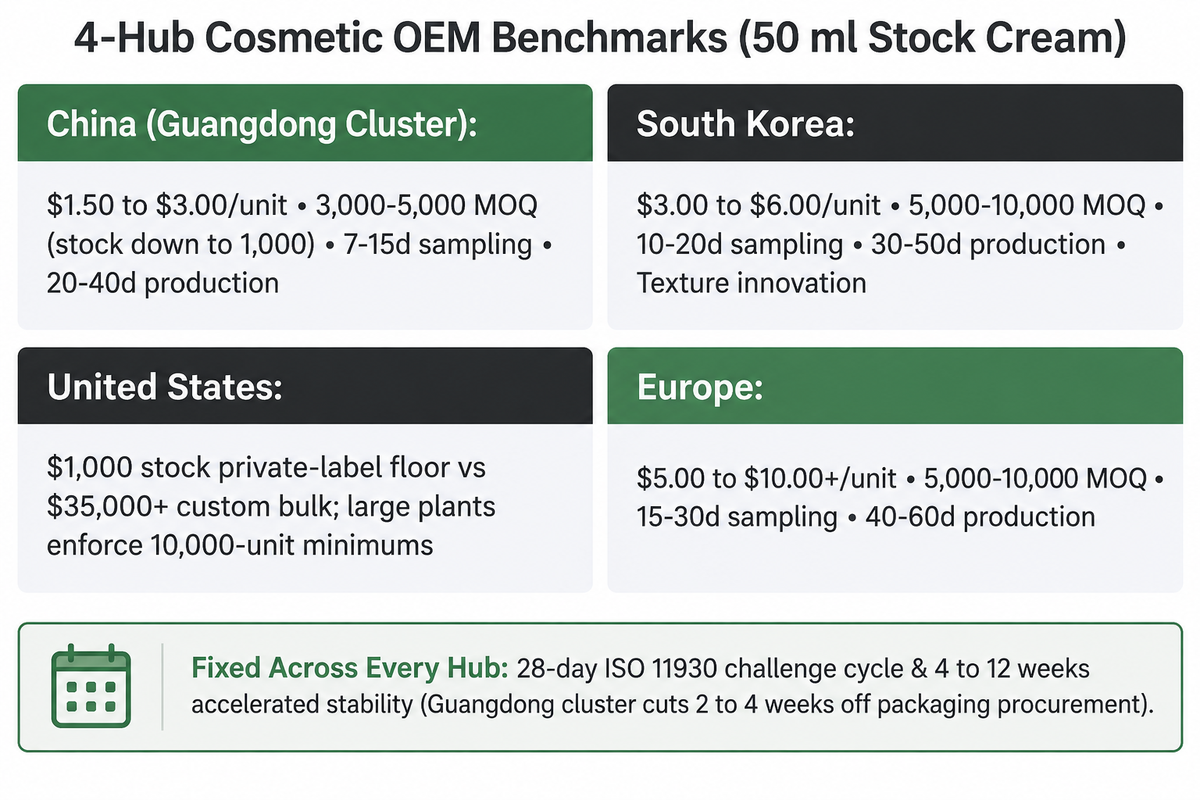
Selecting a manufacturing hub requires quoting bulk minimums separately from packaging minimums. A plant may compound 1,000 stock skincare units while custom airless bottles or printed cartons demand 3,000 to 10,000 pieces. Evaluate every hub on finished, landed SKU cost rather than factory-gate bulk pricing alone.
Published 2026 regional OEM benchmarks from 8OEM compare standard 50 ml face creams in stock packaging. Chinese plants quote $1.50 to $3.00 per unit at 3,000 to 5,000 MOQ (with flexible stock options down to 1,000 units), sampling in 7 to 15 days and producing in 20 to 40 days. South Korean cosmetics plants known for texture innovation quote $3.00 to $6.00 per unit at 5,000 to 10,000 MOQ, with 10 to 20 day sampling and 30 to 50 day production.
European plants quote $5.00 to $10.00+ per unit at 5,000 to 10,000 MOQ, with 15 to 30 day sampling and 40 to 60 day production.
Geographic clustering also changes total speed. An integrated Guangdong packaging and filling radius cuts 2 to 4 weeks off total procurement cycles compared with European alternatives (8OEM 2026 Industry Report). However, mandatory lab testing timelines stay constant across all four hubs: ISO 11930 requires its fixed 28-day inoculation cycle and accelerated stability runs 4 to 12 weeks regardless of factory country. For US production, Lady Burd cites a $1,000 private-label floor versus $35,000+ custom bulk budgets, while larger plants enforce 10,000-unit minimums. Brands targeting EU or Gulf retail should also review European cosmetic manufacturing standards and partners and the Middle East and GCC cosmetic manufacturing landscape. Quoted MOQ and lead-time brackets cover standard skincare in stock components; color shade lines, US OTC sunscreens, and private molds require higher thresholds in every region.
| Manufacturing Hub | Published Unit Price & MOQ (Stock Skincare) | Sampling, Production & Testing Cadence | Core Ecosystem Strength | When Not to Choose |
|---|---|---|---|---|
| China (Guangdong / Zhejiang) | $1.50–$3.00/unit (8OEM); 1,000 stock / 3,000–5,000 custom MOQ. | 7–15d sampling; 20–40d production; saves 2–4 weeks on pack sourcing; standard ISO test durations apply. | Deepest bottle, pump, tube, and carton cluster; competitive FOB scaling. | Skip when brand positioning legally requires “Made in USA” or “Made in France” origin claims. |
| South Korea (K-Beauty Hub) | $3.00–$6.00/unit (8OEM); 5,000–10,000 MOQ. | 10–20d sampling; 30–50d production; standard ISO test durations apply. | Novel textures, bio-ferments, sheet masks, and fast sensory R&D. | Skip for small pilot runs that cannot meet 5,000-unit line thresholds. |
| United States | Varies by tier: $1,000 stock entry vs. $35,000+ custom bulk/labor; larger plants set 10,000 MOQ (Lady Burd). | Fast domestic trucking; imported Asian packaging extends lead times; standard lab tests apply. | No import tariffs on US-made finished goods, quick domestic restocks, FDA OTC drug readiness. | Skip when custom Asian packaging drives unit cost and primary demand sits in Europe or Asia. |
| Europe (France / Italy / Germany) | $5.00–$10.00+/unit (8OEM); 5,000–10,000 MOQ. | 15–30d sampling; 40–60d production; August holiday closures add buffer; standard ISO tests apply. | Native EU 1223/2009 PIF/CPSR fluency, prestige aesthetics, EU PPWR alignment. | Skip for value-driven wholesale channels incompatible with $5.00+ base conversion costs. |
Per-SKU Cost Structure and Launch Timelines at 1,000 vs. 10,000 Units
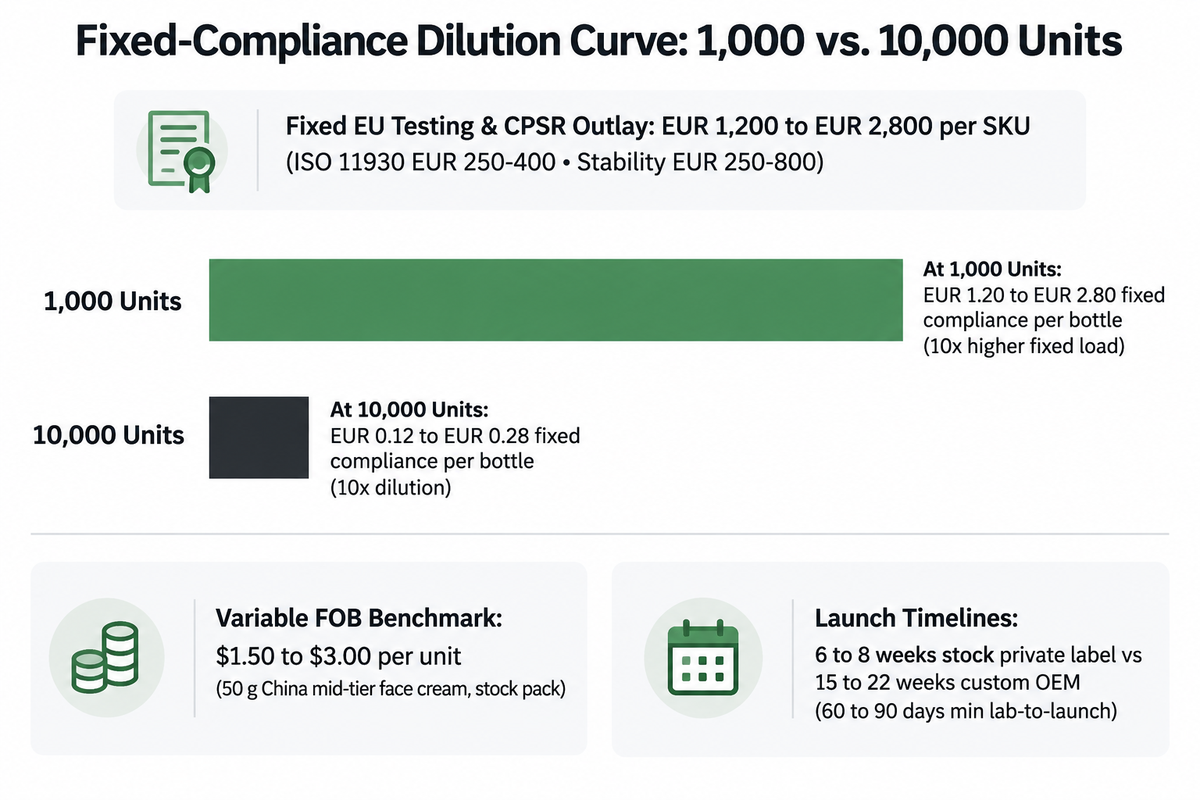
Published 2026 European compliance pricing guides show why volume growth across pilot and scale runs transforms per-bottle margins. Fixed EU per-SKU safety review and lab testing costs remain stable from 1,000 to 10,000 units. That flat cost drops tenfold per bottle as order quantity scales.
Three published European pricing guides detail the core fixed components. Challenge Test Cosmetics quotes ISO 11930 preservative testing at EUR 250 to EUR 400 (USP 51 at EUR 200 to EUR 350). Cosmetic Stability Test quotes stability packages at EUR 250 to EUR 800 (starting at EUR 250 to EUR 400 for basic accelerated testing, plus EUR 100 to EUR 250 for packaging compatibility). Global Cosmetic Regs cites EUR 400 to EUR 600 for simple CPSR safety assessments plus EUR 500 to EUR 800 in basic testing. Across complete EU CPSR programs, Global Cosmetic Regs estimates EUR 1,200 to EUR 1,800 for a simple body lotion and EUR 1,900 to EUR 2,800 for a face serum with actives.
The Fixed-Compliance Dilution Curve illustrates how smaller export batches compress gross margin. Flat EU testing and CPSR outlays of EUR 1,200 to EUR 2,800 add EUR 1.20 to EUR 2.80 per bottle at 1,000 units versus EUR 0.12 to EUR 0.28 per bottle at 10,000 units. All figures in the curve below cover one standard leave-on skincare emulsion in stock packaging, excluding freight, tariffs, clinical claim panels, and custom injection molds.
Variable FOB production amounts to 8OEM’s published 2026 China mid-tier 50 g face cream benchmark of between $1.50 and $3.00 per unit in stock packaging. For multi-market budgeting beyond EU CPSR labs, 8OEM estimates total regional compliance at $3,000 to $8,000 for the US and $5,000 to $12,000 for the EU. Early-stage founders also see private label cosmetic launch options to pre-test demand before funding custom molds.
| Per-SKU Cost Component (Published 2026 Benchmarks) | 1,000 Units (Pilot) | 3,000 Units (Growth) | 10,000 Units (Scale) |
|---|---|---|---|
| Fixed EU CPSR + Lab Pack — Simple Lotion (Global Cosmetic Regs) | €1,200 – €1,800 | €1,200 – €1,800 | €1,200 – €1,800 |
| Fixed EU CPSR + Lab Pack — Active Serum (Global Cosmetic Regs) | €1,900 – €2,800 | €1,900 – €2,800 | €1,900 – €2,800 |
| Amortized EU Lab & CPSR Cost per Unit (Simple to Active) | €1.20 – €2.80 / unit | €0.40 – €0.93 / unit | €0.12 – €0.28 / unit |
| Variable FOB Production — 50 g Mid-Tier Cream (8OEM, $1.50–$3.00/u) | $1,500 – $3,000 (stock MOQ) | $4,500 – $9,000 | $15,000 – $30,000 |
| Stock vs. Custom Tooling & Export Freight | Stock pack avoids mold fees; freight and duties quoted separately. | Stock pack with custom decoration trims unit cost 20%–35% (8OEM). | Custom injection molds become viable; ocean LCL/FCL lowers landed freight. |
Timeline planning splits cleanly along formula readiness. FormYoule reports stock private label averages 6 to 8 weeks, whereas custom contract manufacturing averages 15 to 22 weeks. From formulation freeze to retail launch, Challenge Test Cosmetics recommends 60 to 90 days minimum: 30 to 35 days for ISO 11930 challenge testing, 5 to 10 days for CPSR completion, and 15 to 60 days for batch production. Running accelerated stability (4 to 12 weeks per Cosmetic Stability Test) in parallel with the 28-day challenge test on the same pilot batch compresses critical-path delays before CPSR sign-off, filling, and ocean clearance.
How to Vet and Audit ISO 22716 Global Cosmetic OEM and ODM Partners
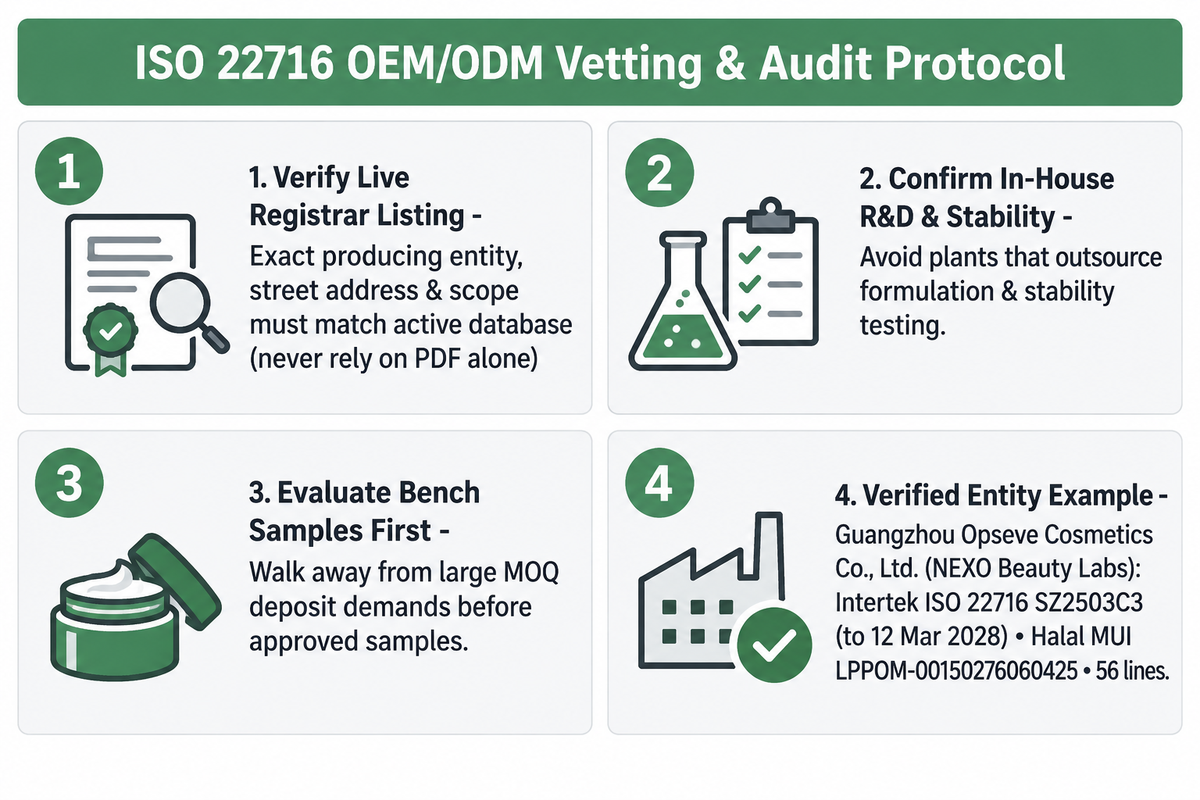
Accept an ISO 22716 certificate only when the exact producing legal entity, street address, and product category appear in the certification body’s active registry, because corporate holding certificates do not cover unlisted branch plants. Never wire a deposit based solely on an unverified PDF attachment.
Practitioner feedback on r/cosmeticscience flags two early deal-breakers. First, avoid factories that outsource R&D and stability testing, which slows iterations and blurs accountability. Second, walk away from sales reps demanding large MOQ commitments before supplying evaluated bench samples. Match partner scale to order volume across regional options. For US private-label and custom lines, brands often benchmark domestic houses such as Lady Burd. For European or North American small-batch projects, MySwissLab and FormYoule publish educational GMP testing guides. For integrated Asian skincare, hair care, and body care manufacturing lines, Guangzhou Opseve Cosmetics Co., Ltd. (USCC 9144011469515059XU) serves as the producing facility behind international business unit NEXO Beauty Labs. That facility holds Intertek ISO 22716:2007 certificate SZ2503C3 (valid to 12 March 2028) and Halal MUI certificate LPPOM-00150276060425 (valid to 15 April 2029), running 56 lines and 5,000+ developed bases on a 1999 foundation. Regardless of shortlist, verify every candidate plant’s live certificate status directly with its registrar.
What remote factory audit questions verify an ISO 22716 cosmetic manufacturer before visiting?
Inspect eight records during a live video walkthrough before paying a deposit. Ask for certificate entity and address verification, purified water microbial logs, a redacted master batch record, and stability chamber calibration stickers. Check fragrance allergen templates, incoming packaging QC rules, mock recall trace and a sample COA.
Remote Audit & RFQ Checklist — Copy These Verification Parameters Into Your Quote Request:
| Parameter | Recommended Standard | Why It Matters | How to Verify |
|---|---|---|---|
| ISO 22716 Entity Scope | Exact producing facility address & product forms listed. | Group certificates exclude subcontracted or unlisted workshops. | Confirm certificate ID directly on registrar portal (Intertek, SGS, BV). |
| US MoCRA FEI Status | Active FEI registration plus named U.S. Agent. | Required for non-exempt US cosmetic product listings and ACE entry. | Request Cosmetics Direct submission confirmation receipt. |
| Purified Water System | RO/EDI loop with routine microbial & conductivity logs. | Water is the primary phase in most emulsions and drives microbial risk. | Review recent sanitized loop conductivity and CFU plate-count logs. |
| Weighing & Scale Calibration | Calibrated balances verified against certified test weights. | MySwissLab notes 0.5% drift on 50 kg batches destabilizes emulsions. | Inspect live calibration stickers and digital batch weighing records. |
| Formula IP & Change Control | Written buyout terms plus zero-unapproved-substitution clause. | Prevents vendor lock-in and silent preservative swaps. | Include Quality Agreement and change-control SLA in master contract. |
| Export Dossier Readiness | Quantitative INCI breakdown, IFRA/allergen sheets, COA, 16-section SDS. | Safety assessors cannot sign EU/UK CPSR without full composition data. | Request a redacted sample PIF raw-data export pack before sampling. |
Preparing Your Cosmetic Supply Chain for 2026–2028 Regulatory Milestones
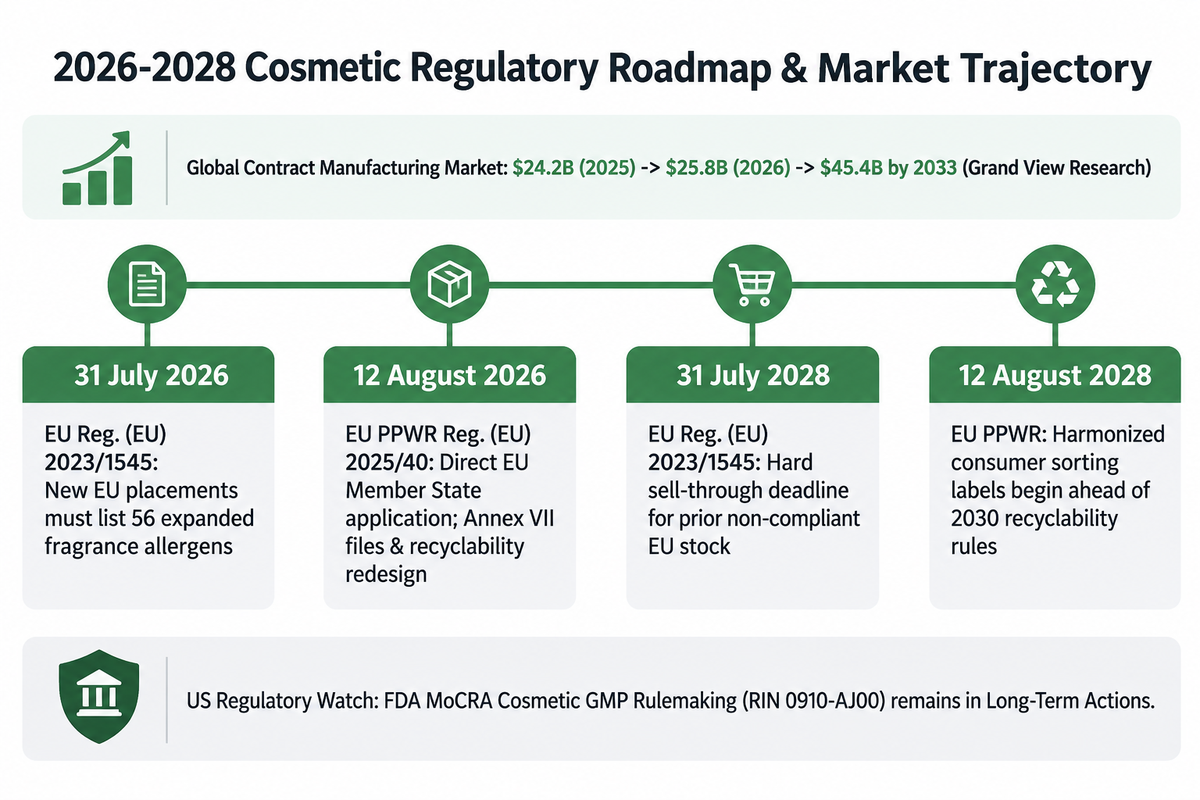
One clear trend is reshaping the global personal care manufacturing sector. Grand View Research values global personal care contract manufacturing at $24.2 billion in 2025, rising to $25.8 billion in 2026 and $45.4 billion by 2033. Three dated European milestones between 2026 and 2028 plus one pending US rulemaking are moving brands from static PDFs toward live digital batch traceability.
First, EU Regulation (EU) 2023/1545 has barred non-compliant newly placed allergen labels since 31 July 2026, setting a hard 31 July 2028 sell-through deadline for prior stock. Second, Regulation (EU) 2025/40 (EU PPWR) has applied directly across EU Member States since 12 August 2026, accelerating mono-material packaging redesigns before 2030 recyclability rules. Third, harmonized PPWR consumer sorting labels begin on 12 August 2028 (Coolset). Meanwhile, FDA Unified Agenda tracking keeps MoCRA cosmetic GMP rulemaking (RIN 0910-AJ00) in Long-Term Actions.
As Global Cosmetic Industry reports, the rise of biotechnology actives and digital supplier traceability helps factories strengthen audit readiness ahead of tighter global inspections.
| Milestone Date | Regulation / Standard | Impact on OEM/ODM Production | Required Brand Action |
|---|---|---|---|
| 31 July 2026 | Reg. (EU) 2023/1545 (New Placements) | Newly placed EU cosmetics must declare 56 added fragrance allergens. | Lock updated INCI artwork and fragrance supplier allergen sheets. |
| 12 August 2026 | Reg. (EU) 2025/40 (EU PPWR) | Direct EU packaging conformity files and material traceability apply. | Collect resin specs and recyclability files from packaging vendors. |
| 31 July 2028 | Reg. (EU) 2023/1545 (Sell-Through Cutoff) | Legacy EU inventory placed before July 2026 must exit retail shelves. | Phase out legacy packaging runs across EU distributors early. |
| Long-Term Agenda | US FDA MoCRA GMP (RIN 0910-AJ00) | Federal cosmetic GMP rulemaking pending; FDA inspections stay active. | Maintain ISO 22716 systems plus digital batch and adverse-event logs. |
Frequently Asked Questions
What does global cosmetic manufacturing support include beyond basic filling?
Global cosmetic manufacturing support covers formulation R&D, raw-material sourcing, ISO 22716 compounding, laboratory stability checks, microbiological testing, regulatory filings, and export freight coordination.
Basic contract filling only fills brand-supplied bulk into brand-supplied containers and runs the line checks without handling formulation design, packaging engineering, or multi-market technical file compilation.
Do cosmetics imported into the United States require FDA Prior Notice?
No. Under federal regulations in 21 CFR 1.276 through 1.285, FDA Prior Notice covers imported food and animal feed, never finished cosmetic shipments.
Commercial US cosmetic imports instead clear electronically through CBP ACE and FDA PREDICT using Program Code COS, Industry Code 53, accurate FDA Product Codes, and verified MoCRA facility registration alignment.
Can one cosmetic formula be sold in the US, EU, UK, ASEAN, and GCC without reformulation?
Yes, most skincare and hair care products can use one global base screened through the Strictest-Intersection Formula Standard.
Labels, Responsible Person details and portal notifications also vary by jurisdiction. SPF sunscreens, acne actives, or uncertified color additives often require separate regional versions because US OTC drug rules diverge from EU cosmetic classifications.
Who owns the formula in OEM versus ODM cosmetic manufacturing?
The brand owns custom OEM formulas only when IP transfer is signed in writing.
Under white-label or standard ODM terms, the factory controls the compounding recipe unless you sign a buyout agreement.
How much does it cost to launch a multi-market cosmetic SKU at 1,000 versus 10,000 units?
Global Cosmetic Regs cites EUR 1,200 to EUR 2,800 in flat EU CPSR and laboratory testing fees per skincare SKU, while 8OEM benchmarks mid-tier China FOB production at $1.50 to $3.00 per unit.
Fixed EU testing and safety assessment fees stay unchanged across order sizes. Per-bottle compliance therefore drops from EUR 1.20 to EUR 2.80 at 1,000 units down to EUR 0.12 to EUR 0.28 at 10,000 units. Regional registrations, custom molds, freight and destination duties will be quoted separately based on your target markets and the packaging tier.
Does hiring an ISO 22716 certified factory transfer US MoCRA or EU compliance liability?
No. ISO 22716 confirms plant quality controls but never transfers statutory Responsible Person duties.
Product listings, safety substantiation, CPNP or SCPN filings, label claims and adverse event reports will continue to be maintained by the Responsible Person.
How long does global cosmetic manufacturing take from brief to export-ready inventory?
FormYoule benchmarks stock private label at 6 to 8 weeks and custom contract manufacturing at 15 to 22 weeks from brief to launch.
Following formula freeze, laboratories process the fixed 28-day ISO 11930 preservative challenge test in parallel with accelerated stability screening (4 to 12 weeks, depending on formula sensitivity) on the same pilot batch. Toxicologist CPSR sign-off, commercial filling, lot microbiological release, and international ocean or air customs clearance then follow in sequence to reach destination warehouses.
Plan Your Multi-Market Cosmetic Launch With Verified Engineering Support
Tell us about your targeted end markets, product types, estimated first run MOQ and packaging format for a detailed OEM/ODM feasibility analysis, timeline for testing and checklist with the NEXO Beauty Labs engineering team.
Reviewed by the NEXO Beauty Labs technical team, the international OEM and ODM division of Guangzhou Opseve Cosmetics Co., Ltd. (1999 manufacturing foundation, 56 production lines). Statutory rules and published commercial benchmarks for products you manufacture and distribute are verified as of November 2026. This information is for general reference only and does not constitute legal advice.
References & Sources
- Modernization of Cosmetics Regulation Act of 2022 (MoCRA) U.S. Food and Drug Administration (FDA)
- Compliance Policy for Cosmetic Product Facility Registration and Cosmetic Product Listing U.S. Food and Drug Administration (FDA)
- Guidance for Industry: What You Need to Know About Prior Notice of Imported Food Shipments (21 CFR 1.276–1.285) U.S. Food and Drug Administration (FDA)
- Importing Cosmetics (ACE & Entry Review) U.S. Food and Drug Administration (FDA)
- Import Alert 53-06: Detention Without Physical Examination of Cosmetics Due to Color Additive Violations U.S. FDA
- Summary of Cosmetics Labeling Requirements U.S. FDA
- Fragrance Allergens Labelling (Commission Regulation (EU) 2023/1545) European Commission
- Regulation (EU) 2025/40 (EU PPWR) August 2026 Compliance Guide Coolset
- ISO 22716:2007 Cosmetics, Good Manufacturing Practices (GMP) International Organization for Standardization (ISO)
- ISO 17516 Cosmetics, Microbiology, Microbiological Limits International Organization for Standardization (ISO)
- ASEAN Cosmetic Directive Guidelines for Product Information File (Annex I Part 5) NPRA Malaysia
- US7891522B2: Airless Dispensing Pump Google Patents / USPTO
- The World According to Contract Manufacturers Happi Magazine
- Personal Care Product Contract Manufacturing Market Report (2026–2033) Grand View Research
Why beauty brands work with NEXO
About NEXO Beauty Labs Manufacturing Support
NEXO Beauty Labs supports skincare, body care, sun care, hair care, and private label brands with formulation, sampling, filling, quality control, and export-ready launch support.
Project Review Before RFQ
Before quotation, we help clarify product category, active direction, formula stage, package choice, compliance market, MOQ, sampling schedule, and required documents.
Request a Cosmetic QuoteCompany Profile // Data Sheet
CompanyNEXO Beauty Labs
Business TypeCosmetic OEM / ODM manufacturing partner
Main ProductsPrivate label skincare, facial serums, moisturizers, cleansers, sunscreen, body care, and hair care products
Manufacturing CapabilityFormula development, sample adjustment, package sourcing, filling, QA/QC, documentation, and export support
RFQ Data NeededProduct type, formula goal, package format, target market, MOQ, claims, timeline, and benchmark samples
Websitenexobeautylabs.com