Get in touch with NEXO Beauty Labs Company



Updated November 2026
A Private Label Conditioner combines a positively charged cationic lamellar emulsion with orifice-matched packaging and audited batch quality controls. Rinse-off creams, leave-in sprays and thick masks use an acidic pH between 3.5 and 5.0 to close raised cuticles and preserve the activity of organic acids. Earlier formulation choices influence viscosity stability and compliance of retail labeling across the global private label conditioner manufacturing programs.
Quick Specs: Private Label Conditioner Program Snapshot
- NEXO Beauty Labs ships OEM bench swatches within 3–7 business days (plus 5–7 business days overseas courier) and completes factory runs in 10–15 working days after dual sign-offs. Small-batch US custom formulation commonly runs four to six weeks of lab development followed by ten to twelve weeks of production once components clear.
- The cuticles of healthy hair contain an isoelectric point around pH 3.67; a cationic surfactant coupled with a C16-C22 fatty alcohol co-crystallizes into a smooth emulsion to tame frizz and detangle every hair type without harsh anionic cleansing sulfates.
- EU Regulation 2023/1545 mandates individual disclosure of 56 additional fragrance allergens above 0.01% (rinse-off) vs 0.001% (leave-on), while US FDA MoCRA mandates biennial facility registration renewals and 15-business-day reporting for serious adverse events.
- Starter small-batch US stock runs begin at 500 units (first order) and 1,000 units (reorders) per Shay Labs, whereas NEXO Beauty Labs custom bottle programs start from 10,000 units per SKU.
White Label Stock vs Semi-Custom vs Full Custom Conditioner Routes
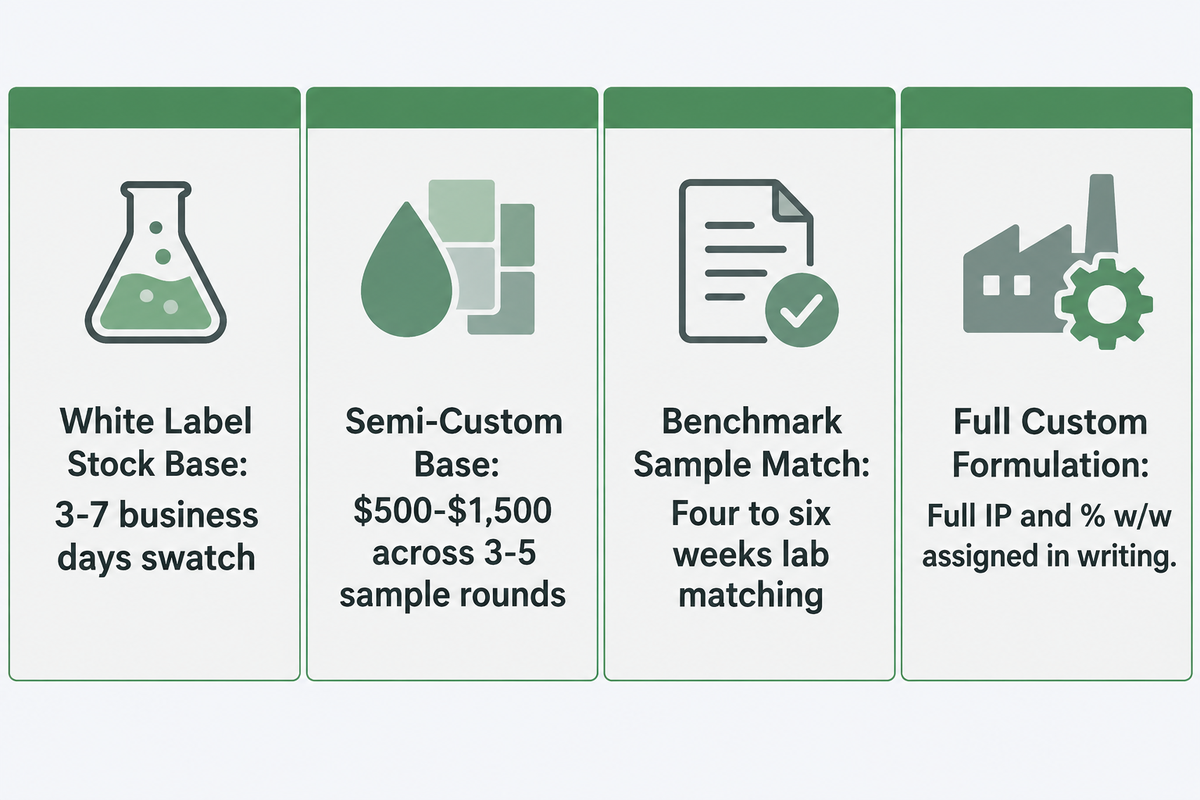
Buyers can choose between four private label sourcing routes: stock white label bases, semi-custom adjustments, benchmark sample matches, and custom OEM builds. The fastest OEM flow has bench swatches ready in 3 to 7 business days and fills orders in 10 to 15 working days after sign-off. For non-stock custom runs, US small-batch formulation workflows commonly take four to six weeks for lab development plus ten to twelve weeks for production after readiness.
Buyers reviewing contract manufacturing quotes across haircare products often expect fragrance or botanical swaps in a white label chassis to skip lab validation. Instead, essential-oil terpenes alter lamellar gel packing and challenge preservation under ISO 11930. Budget $50 to $300 per sample iteration, or up to roughly $1,500 across three to five rounds, before approving any modified catalog formula for filling.
Who gets the quantitative formula rights after the development fees is determined by the contracts. Unless specific product development agreements assign quantitative weight-percent recipes (% w/w) in writing, the factory retains the base formulation, and each hair care brand owns label branding alone. Regardless of ownership clauses, the Responsible Person named on the package label must meet statutory requirements to list the product and substantiate its safety to regulators.
What is the difference between private label and white label hair care?
White label hair care rapidly brings a new label to the market by using the same base formula for multiple labels. Private label hair care products either customize packaging, or alter base actives and fragrances, to make formulas for your brand match target audience hair needs.
Emerging founders tend to create a line using white label products at low minimums first, adding custom labels and packaging. Funding bespoke formulas comes later. Selecting the right manufacturing partner early on ensures bottle aesthetics and private label hair care formulas align with your brand positioning, avoiding late reformulation surprises and capital locked into recipes you cannot legally transfer later.
| Procurement Tier | Sample & Validation Window | Stability Re-Test Trigger | Formula Ownership Boundary | Best-Fit Brand Stage |
|---|---|---|---|---|
| White Label Stock Base | 3–7 business days swatch; 10–15 working days production post-gate | Unchanged base avoids formula re-validation; test compatibility if bottle resin swaps | Factory retains quantitative % w/w recipe; brand owns label artwork only | Initial retail tests prioritizing speed over proprietary ingredients |
| Semi-Custom Base | $500–$1,500 across 3–5 sample rounds ($50–$300/round); 10–15 working days post-gate | Fragrance, extract, or dye change triggers 15-day thermal cycling | Base stays factory-owned; variant exclusivity requires written rider | Direct-to-consumer brands seeking signature scent and hero claims |
| Benchmark Sample Match | Four to six weeks lab matching before packaging compatibility checks | Accelerated 40–45 °C aging and ISO 11930 challenge screen recommended | Quantitative formula buyout terms specified in project agreement | Growing labels shifting production away from legacy co-packers |
| Full Custom Formulation | Four to six weeks R&D plus ten to twelve weeks small-batch run after readiness | Accelerated and real-time stability, challenge test, and CPSR dossier | Full IP and quantitative % w/w formula percentages assigned in writing | Retail-ready lines and salon chains protecting bespoke assets |
Rinse-Off Conditioner vs Leave-In vs Hair Mask Format Selection
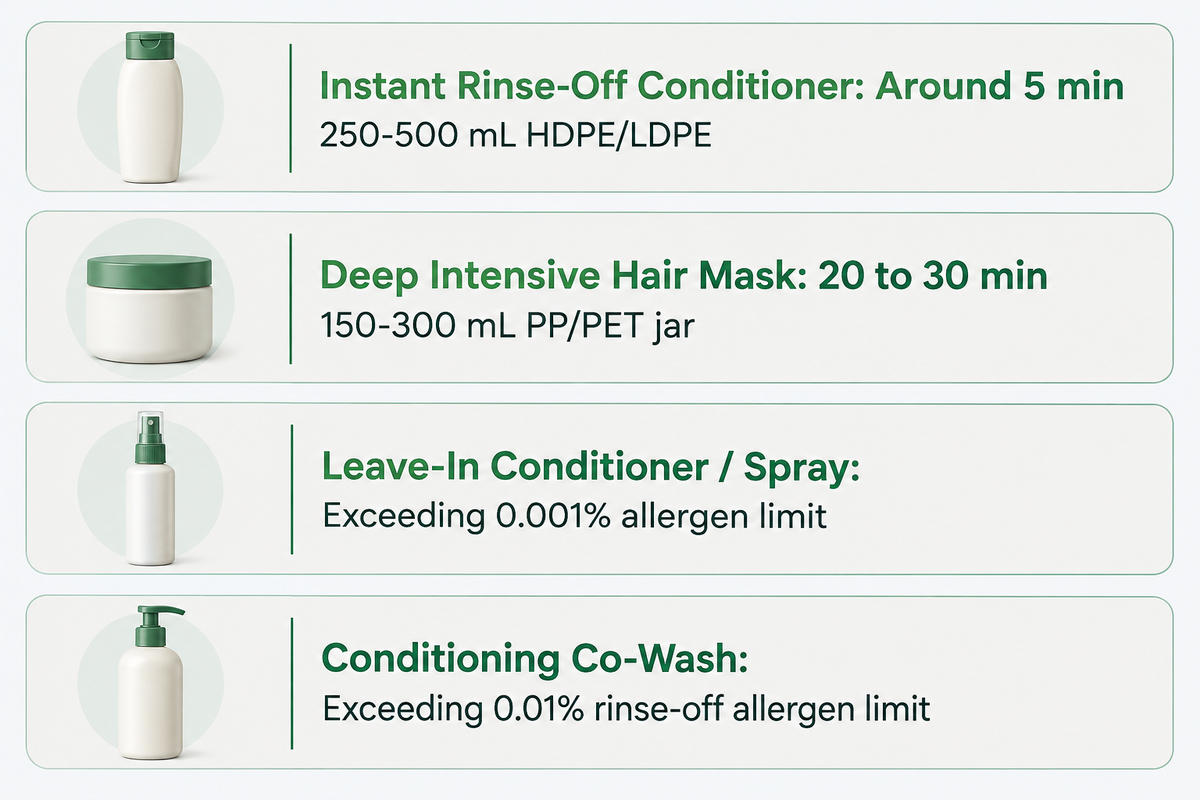
Conditioner format decides label disclosure limits immediately: under Commission Regulation (EU) 2023/1545, Annex III fragrance allergens require individual listing above 0.01% in rinse-off products versus just 0.001% in leave-in conditioners. That tenfold spread catches teams off guard when converting an identical fragrance from shower rinse cream into a leave-on detangling spray.
Dwell duration and viscosity define distinct delivery windows across haircare categories. Instant rinse-off conditioners work over brief contact (around 5 min) on normal fibers, while thick intensive hair masks remain on hair for 20 to 30 min to treat weathered cuticles. Formulators separate rinse-off emulsions from heat styling products so heavy waxes moisturize dry ends while leaving damp hair smooth and manageable. Standard retail conditioner bottles run 250–500 mL (matching core Boyu Packaging retail benchmarks, with travel packs sized 30–100 mL).
Can I pair shampoos with matching conditioners or treatments?
Yes, many brands start an initial hair care line by pairing shampoos and conditioners that share botanical scents, cohesive label graphics, and complementary bottles. Verify upfront that your supplier holds audited manufacturing approval covering thin aqueous cleansers as well as high-viscosity creams.
Liquid shampoo operates as a micellar surfactant fluid, while conditioner requires heated oil-water lamellar emulsification on specialized homogenization lines. When planning a signature shampoo line alongside heavy treatment masks in one cohesive product line, align vessel capabilities upfront. Our matching shampoo production route separates General Liquid Unit compounding from Cream & Lotion Unit homogenization within our scalable hair care manufacturing program. Choosing formulas that perform reliably strengthens retention across your product line, and our shampoo surfactant scale-up guide details electrolyte controls across paired SKUs.
| Format Archetype | Intended Dwell & Viscosity | Fatty Alcohol & Matrix Load | EU 2023/1545 Allergen Trigger | Typical Retail Pack Format |
|---|---|---|---|---|
| Instant Rinse-Off Conditioner | Around 5 min shower rinse; medium cream lotion | 2–5% cetyl or cetearyl alcohol | Exceeding 0.01% in rinse-off finished formula | 250–500 mL squeezable HDPE/LDPE bottle or wide-orifice tube |
| Deep Intensive Hair Mask | 20 to 30 min; rich high-body butter | 3–7% stearyl alcohol or 2–4% behenyl alcohol preventing runoff | Exceeding 0.01% in rinse-off finished formula | 150–300 mL wide-mouth PP/PET jar with protective inner lid |
| Leave-In Conditioner / Spray | Continuous leave-on residency; fine mist or pourable lotion | 0.5–1.5% cetyl/cetearyl alcohol or clear hydro-alcoholic quat | Exceeding 0.001% in leave-on finished formula | 50–250 mL spray atomizer, trigger mister, or serum pump |
| Conditioning Co-Wash / Clear Wash | Rinse-off with gentle lather; water-thin to thickened gel | Amidoamine salt + betaine co-surfactant blend | Exceeding 0.01% in rinse-off finished formula | 250–500 mL PET or HDPE bottle with pump or disc-top cap |
Cationic Surfactants and Lamellar Gel Network Formulation
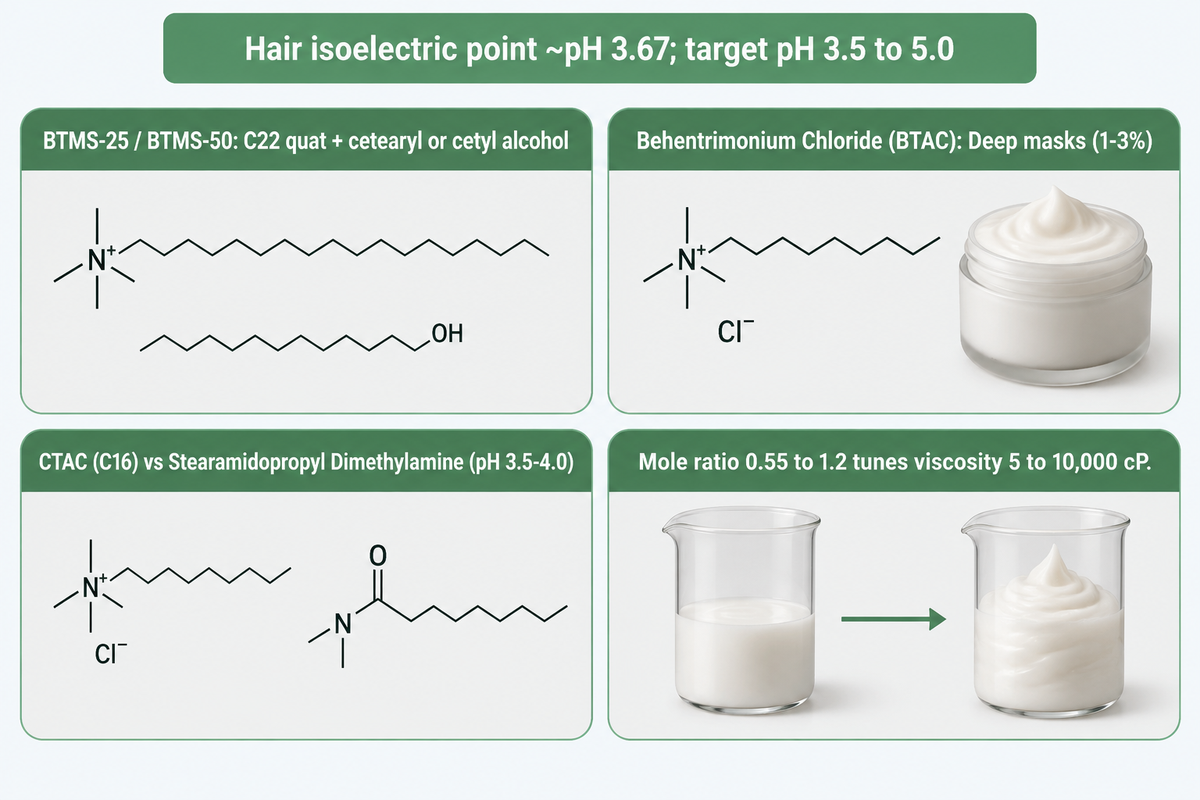
Damaged keratin surfaces hold net negative charges when wetted. Because the isoelectric point of hair sits around pH 3.67, formulators target pH 3.5 to 5.0 per Seppic formulation baselines so cationic surfactants deposit evenly through electrostatic attraction and van der Waals hydrophobic interactions.
Carbon chain length separates lightweight slip from deep detangling power. Zeta-potential and wet-combing research shows that C22 behenyl surfactants (BTAC and BTMS) adsorb far more strongly onto human hair than C16 cetrimonium chloride (CTAC) or C18 stearalkonium chloride (STAC). Behentrimonium chloride (BTAC) outperforms BTMS in wet-combing reduction because its compact chloride counterion exhibits higher ionic mobility during rinsing.
“Wet combing analysis confirmed that longer chain cationic surfactants, particularly BTMC, significantly reduced wet combing force, highlighting the importance of van der Waals interactions in stabilizing the conditioning film and improving hair manageability.”
Marketing briefs frequently misread INCI names when banning “sulfates.” Joan Morais’s formulation breakdown clarifies that Behentrimonium Methosulfate (BTMS) is a mild cationic quaternary emulsifier rather than an anionic cleansing sulfate such as sodium lauryl sulfate. Grade selection also alters cream texture: BTMS-25 carries ~25% active inside cetearyl alcohol, whereas BTMS-50 supplies ~50% active with cetyl alcohol and butylene glycol for sleeker emulsions.
Stable liquid-crystal gel phases depend on matched surfactant and fatty alcohol stoichiometry. Within the liquid-phase C16 to C18 straight-chain fatty alcohol and chloride-counterion compositions of US Patent 20200146955A1, adjusting cationic-to-fatty-alcohol mole ratio from 0.55 to 1.2 tunes viscosity from 5 to 10,000 cP (mPa·s). Elsewhere, WIPO Patent WO2015110511A1 combines cationic surfactant with fatty alcohol at a 1:1 to 1:10 weight ratio (optimal 1:2 to 1:5) before ~70 °C water dispersion to achieve 1–250 g switch Draw Mass consistency.
| Cationic System / Co-Emulsifier | Alkyl Chain & Charge Behavior | Primary Alcohol / Acid Partner | Recommended Format & Rheology | Procurement Trade-Offs |
|---|---|---|---|---|
| 1. BTMS-25 (25% active) | C22 permanent positive quat | Built-in cetearyl alcohol (C16/C18) | Thick creamy rinse-off & curly butter base | High wax body; clarify methosulfate label questions upfront |
| 2. BTMS-50 (50% active) | C22 permanent positive quat | Cetyl alcohol + butylene glycol | Sleek salon lotion or pourable conditioner | Twice active content per kg vs BTMS-25; lighter cream feel |
| 3. Behentrimonium Chloride (BTAC) | C22 quat + mobile chloride ion | Stearyl or behenyl alcohol (2–4%) | Deep rinse-off hair masks (1–3%); stricter leave-on limits apply | Strongest wet combing reduction; observe regulatory caps |
| 4. Cetrimonium Chloride (CTAC) | C16 short-chain quat | Cetyl alcohol + co-surfactants | Lightweight volumizing rinse-off & mist blends | Cost-effective slip; lower affinity on bleached hair |
| 5. Stearamidopropyl Dimethylamine | pH-activated tertiary amidoamine | In-situ lactic or citric acid (pH 3.5–4.0) | Low-buildup daily conditioner & foaming co-wash | Requires tight acid protonation control during batching |
| 6. Brassicamidopropyl Dimethylamine | Brassica-derived C22 amidoamine | Lactic or glutamic acid + cetearyl alcohol | Clean-beauty quat-free salon emulsions | Needs controlled shear to match synthetic quat creaminess |
| 7. Plant Esterquats (e.g., Disunfloweroylethyl) | Biodegradable cleavable ester linkage | Cetearyl alcohol + plant triglycerides | Eco-friendly daily conditioners & natural lines | Hydrolysis accelerates if finished pH drifts alkaline |
| 8. Stearalkonium Chloride Blend | Benzyl-substituted C18 quat | Glyceryl stearate & cetearyl alcohol | Classic pearled cream rinse emulsions | Poorer static drop on damaged cuticle vs C22 analogs |
| 9. Isostearamidopropyl Morpholine Lactate | Water-soluble liquid cationic salt | Citric acid buffer + hydroxyethylcellulose | Clear leave-in spray or non-opaque rinse-off | Needs polymer thickener; clear water appearance |
| 10. Cationic Guar + Nonionic Gel | Polysaccharide polymeric deposition | Glycerin hydration prior to lipid emulsification | Quat-free co-conditioning stabilizer | Cannot build lamellar body alone; boosts wet detangling |
Silicone Emulsions vs Botanical Esters and Clean Slip Alternatives
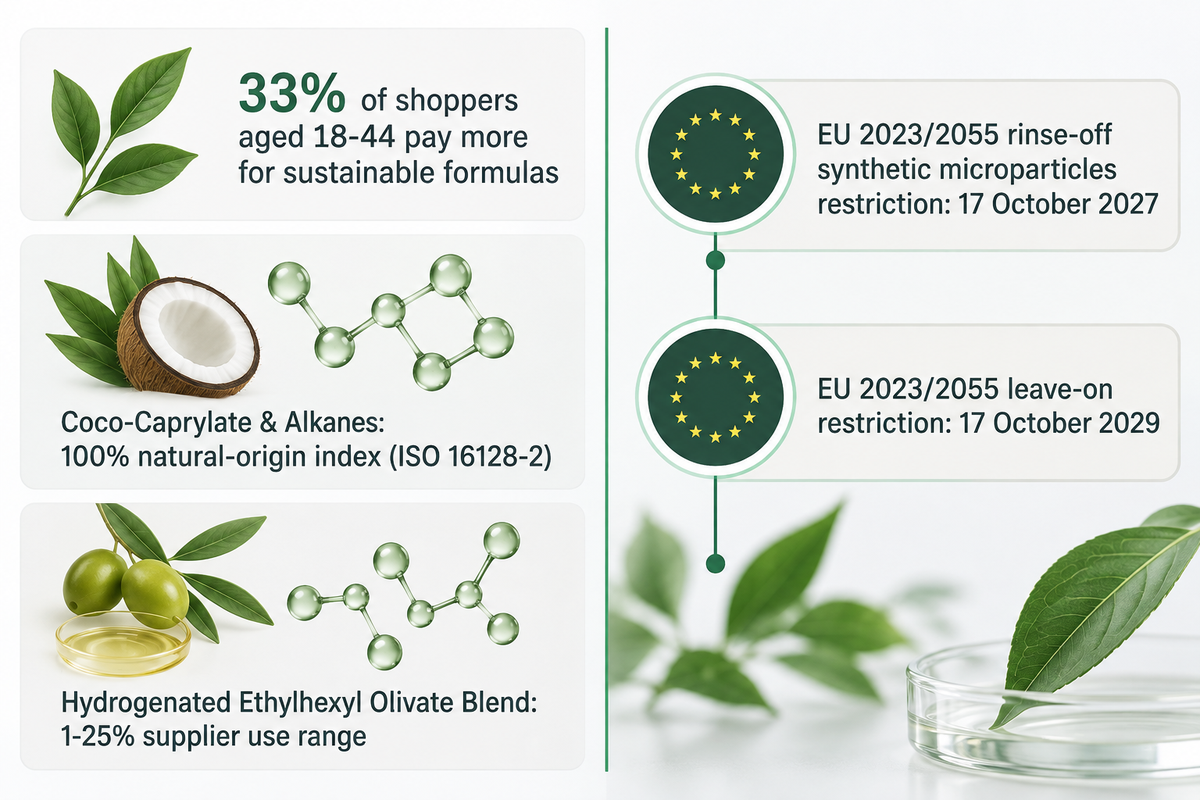
Switching from conventional silicones fits brands targeting sustainable shoppers. Mintel data in Happi find that 33% of consumers aged 18–44 pay more for products made with sustainable ingredients. Biodegradable alkanes and coco-caprylate esters achieve a 100% natural-origin index under ISO 16128-2 guidelines, fitting clean beauty formulation standards.
Replacing silicones creates trade-offs between dry-combing performance and rancidity risk. Amodimethicone adsorbs electrostatically onto negatively charged damaged sites to limit dye wash-out. In contrast, NYSCC technical reviews note that liquid plant triglycerides oxidize faster in heat and weigh down fine textures unless balanced with light alkanes or synthetic-alternative esters. Heat protection studies mention that specialized copolymers of rapeseed and tung oils outperformed benchmark silicones.
Polymer selection also shapes European REACH microplastics timelines. Under Commission Regulation (EU) 2023/2055, inorganic, natural, biodegradable, or water-soluble polymers fall out of scope. Conversely, non-biodegradable, insoluble synthetic polymer microparticles remain permitted only through 16 October 2027 (restricted from 17 October 2027) for rinse-off cosmetics and through 16 October 2029 (restricted from 17 October 2029) for leave-on products.
| Slip Class & Chemistry | Wet vs Dry Detangling Bias | Fine-Hair Buildup Residency | Heat & Oxidative Stability | Clean / EU Microplastic Fit |
|---|---|---|---|---|
| 1. Dimethicone Macroemulsion | High dry slip and shine gloss | Moderate cumulative weight on fine strands | High thermal and oxidative inertness | Excluded by strict “silicone-free” briefs |
| 2. Amodimethicone Microemulsion | Targeted wet-to-dry damaged site adsorption | Self-limiting via amine repulsion once coated | Strong dye retention on color-treated hair | Liquid siloxane polymer; fails silicone-free retail filters |
| 3. Dimethiconol + Cationic Quat Mix | Immediate soft wet combability | Moderate residency in creamy masks | Thermal and color protection | Standard salon option; subject to volatile cyclic impurity limits |
| 4. Silicone Quaternium / Panthenol Hybrid | Balanced wet slip and clear mist solubility | Low buildup in leave-in conditioners | Thermal defense without film flaking | Hybrid synthetic; avoid for 100% natural clean seals |
| 5. Volatile C13–15 Alkane or Hemisqualane | Fast-drying dry slip without grease | Very low buildup (partially evaporates on blow-dry) | Stable saturated hydrocarbon backbone | Plant-derived (hemisqualane uses a sugarcane route); fits clean lines |
| 6. Coco-Caprylate / Dicaprylyl Carbonate | Smooth, powdery light wet and dry slip | Low residency across daily haircare lines | Resistant to rancidity vs raw glycerides | 100% natural-origin index calculated under ISO 16128-2; biodegradable |
| 7. Hydrogenated Ethylhexyl Olivate Blend | Close sensory match to D5 / dimethicone | Medium soft sheen (1–25% supplier use range) | More oxidatively stable than liquid olive oil | Passes silicone-free and plant-derived briefs |
| 8. Argan & Unrefined Triglyceride Oils | Slow surface lubrication; high curl nourishment | High buildup if dosed above fine-hair ceilings | Requires antioxidants (tocopherol) against odor shift | Natural ingredients exempt under EU 2023/2055 |
| 9. Synthetic Polyquaterniums (PQ-7 / PQ-10 / PQ-113) | High wet detangling and curl definition | Variable; water-soluble salts rinse easier than resins | Thermal film support when co-formulated | Water-soluble polymers fall out of EU microplastic scope |
Hair-Type Positioning and Active Ingredient Load Architecture
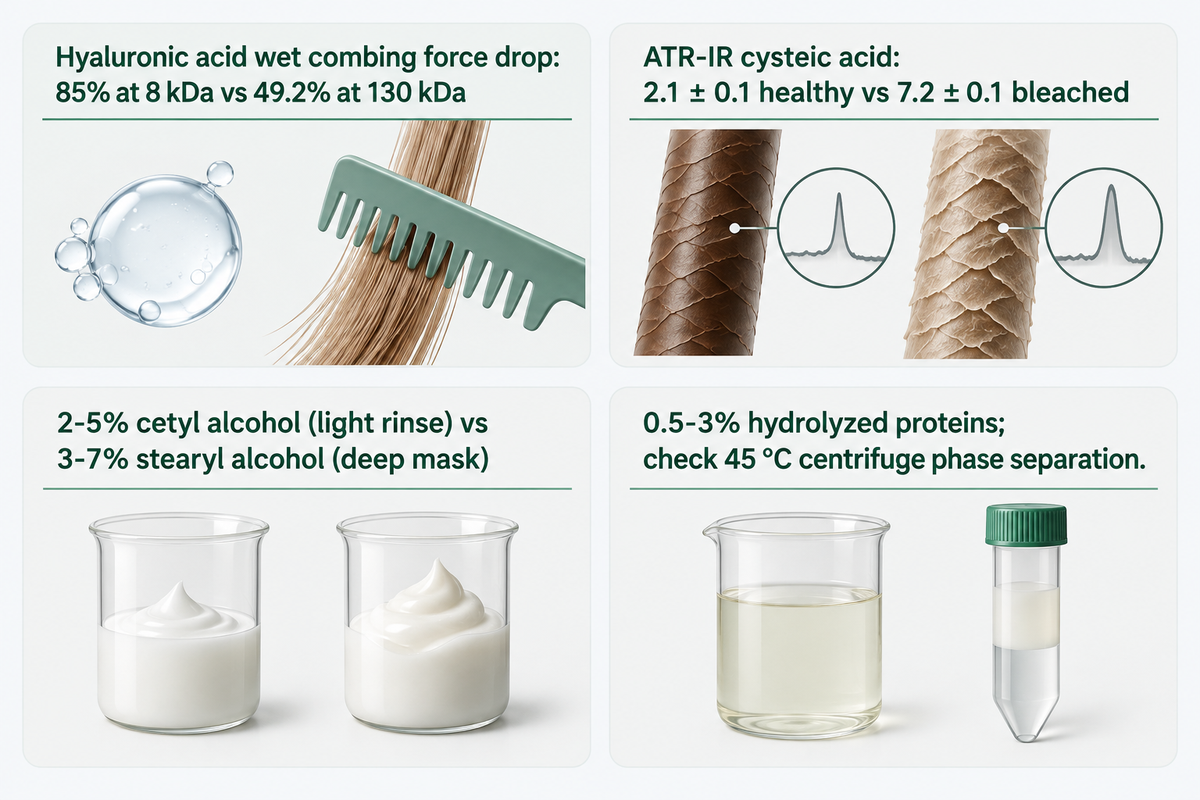
Linear increases in detangling lubrication do not occur when heavier polymer weights are stacked. In published hyaluronic acid polymer testing, hyaluronic acid lowered wet combing force by 85% at 8 kDa, dropping to 79.5% at 90 kDa and 49.2% at 130 kDa on treated hair swatches.
Marketing teams have to respect the clear chemical limits set by ATR-IR cysteic acid testing. Normalized ATR-IR cysteic acid readings are 2.1 ± 0.1 on healthy bare hair and 7.2 ± 0.1 on damaged bleached strands, yet conditioning applications cut combing friction without reversing structural oxidative damage. Instead of overstuffing actives, Global Formulation specs balance 2-5% cetyl alcohol in light rinse-off lotions against 3-7% stearyl alcohol in thick deep masks. Adding panthenol, soothing aloe vera, and nourishing argan oil helps strengthen surface combability across damaged hair, color-treated hair, or curl defining SKUs.
Can I Customise the Formulas for My Hair Care Line?
Yes, OEM laboratories customize base conditioners across fine, curly, and color-safe lines by tuning fatty alcohol chain lengths, lipid weights, active peptides, and cold-process fragrance loads. Begin professional-grade custom trials from normal formulation brackets (0.5-3% hydrolyzed proteins and 2-5% cetyl alcohol) and evaluate wet-swatch drag and 45 °C centrifuge phase separation.
Brands concentrate budget on clinically meaningful doses of panthenol, hydrolyzed keratin, or organic ingredients as compared to sprinkling trace botanicals across twenty INCI lines. Combining real actives with cruelty-free documentation supports the creation of brand identity both in salons and on retail shelves.
| Target Hair Segment | Base Fatty Alcohol & Oil Load | Core Conditioning Hero Pair | Over-Formulation Pitfall |
|---|---|---|---|
| Curly & Textured Hair | BTMS-25 + rich argan oil or shea esters | Hydration humectants + cationic guar | Excess unemulsified butter weakens curl spring and weighs roots |
| Fine & Flat Hair | Light cetyl alcohol (2–5% rinse; 0.5–1.5% leave-in) | BTMS-50 + volatile C13–15 alkane | Heavy waxes disrupt scalp balance and leave greasy crown roots |
| Bleached & Damaged Hair | 3–7% stearyl alcohol or 2–4% behenyl alcohol mask | Low-MW hydrolyzed keratin + amodimethicone | Oversized protein excess causes stiff, brittle fiber feel |
| Color-Treated & Toning | Acidic pH 3.5–4.5 lamellar emulsion per Global Formulation | Aloe vera + amino silicones or dye-shield quats | Violet pigments shift hue if pH drifts during warm warehouse hold |
| Barber & Daily Hydrate | 2% stearamidopropyl dimethylamine lactate | Panthenol + fast-rinse light ester | High-residency styling polymers reduce volume on short cuts |
pH Windows, Organic Acid Preservation, and Emulsion Stability Triage
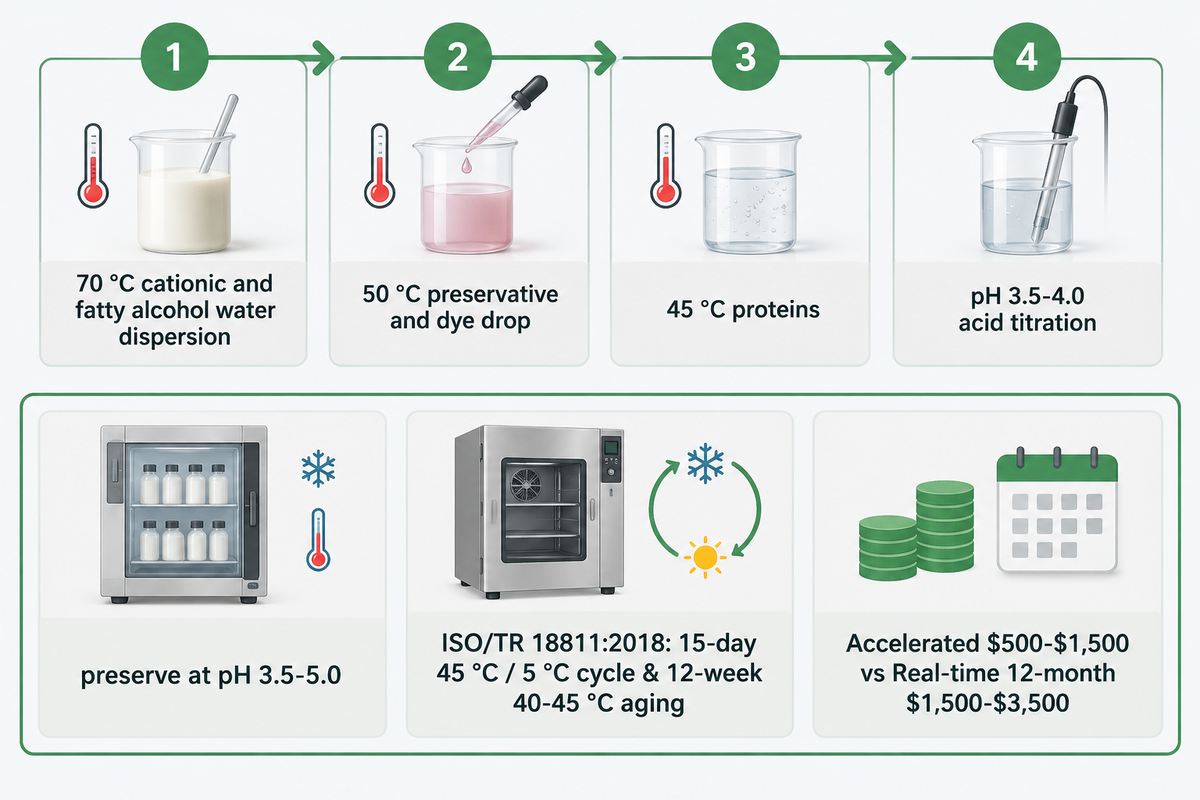
Heating sequences and acid buffering keep industrial batches smooth from tank to bottle. Following WIPO Patent WO2015110511A1, formulators co-melt cationics with fatty alcohols and disperse them into water held near 70 °C. They cool to 50 °C for preservatives and dyes following Happi compounding workflows. Formulators use lactic acid when neutralizing amidoamines cleanly into active cationic salts, whereas separate protein-retention formulas add proteins at 45 °C and titrate citric or lactic acid to pH 3.5–4.0.
Stability verification follows IVAMI cosmetic stability protocols aligned with ISO/TR 18811:2018: a 15-day thermal cycle alternating every 24 hours between 45 °C and 5 °C, plus 12-week forced aging at 40–45 °C. Plan $500–$1,500 for three-month accelerated checks and $1,500–$3,500 for real-time 12-month testing per Ecolchi’s 2026 testing budget benchmarks. Rapid accelerated screens surface early instability faults, but they do not substitute for full real-time container shelf validation.
As Medpak Solutions notes in its compounding compatibility framework, shifting pH after building target thickness frequently alters emulsion viscosity. Final acid adjustment should be part of the core formula rather than a bench-top adjustment. Align cosmetic stability testing protocols for microbial challenge runs and thermal oven scheduling across shipping seasons.
| Observed Batch Defect | Underlying Chemistry Trigger | Bench / Stability Diagnostic Check | Process or Formula Adjustment |
|---|---|---|---|
| 1. Grainy Wax Beads Post-Cooling | Stearyl or behenyl alcohol crystallized prematurely below melt temperature (~59–71 °C) under low shear during cooling | Microscope slide inspection after 24 h cure and 15-day thermal cycling | Maintain ~70 °C initial dispersion and hold steady cooling sweep rate |
| 2. Water Syneresis / Oil Sweating | Cationic-to-fatty-alcohol balance slipped out of ordered lamellar gel structure | Centrifuge phase-separation spin and 12-week 40–45 °C upright hold | Rebalance fatty alcohol excess (2–5% cetyl/cetearyl) and premelt co-dispersion |
| 3. Post-Fragrance Viscosity Crash | Essential oils or fragrance terpenes disrupted lamellar bilayer spacing when charged hot | 25 °C viscometer reading before and after fragrance drop below 45–50 °C | Charge fragrance below 45 °C or pre-solubilize oil into nonionic ester blend |
| 4. Yeast / Mold Failure in Preservative Test | Upward pH drift above organic acid ceiling or hydrophilic botanical sugar spike | ISO 11930 preservative efficacy test and 40 °C pH drift log | Keep pH 3.5–5.0 or use 0.8–1.0% phenoxyethanol + 0.05% EDTA |
Yield-Stress Rheology, Tube Filling Tolerances, and Packaging Compatibility
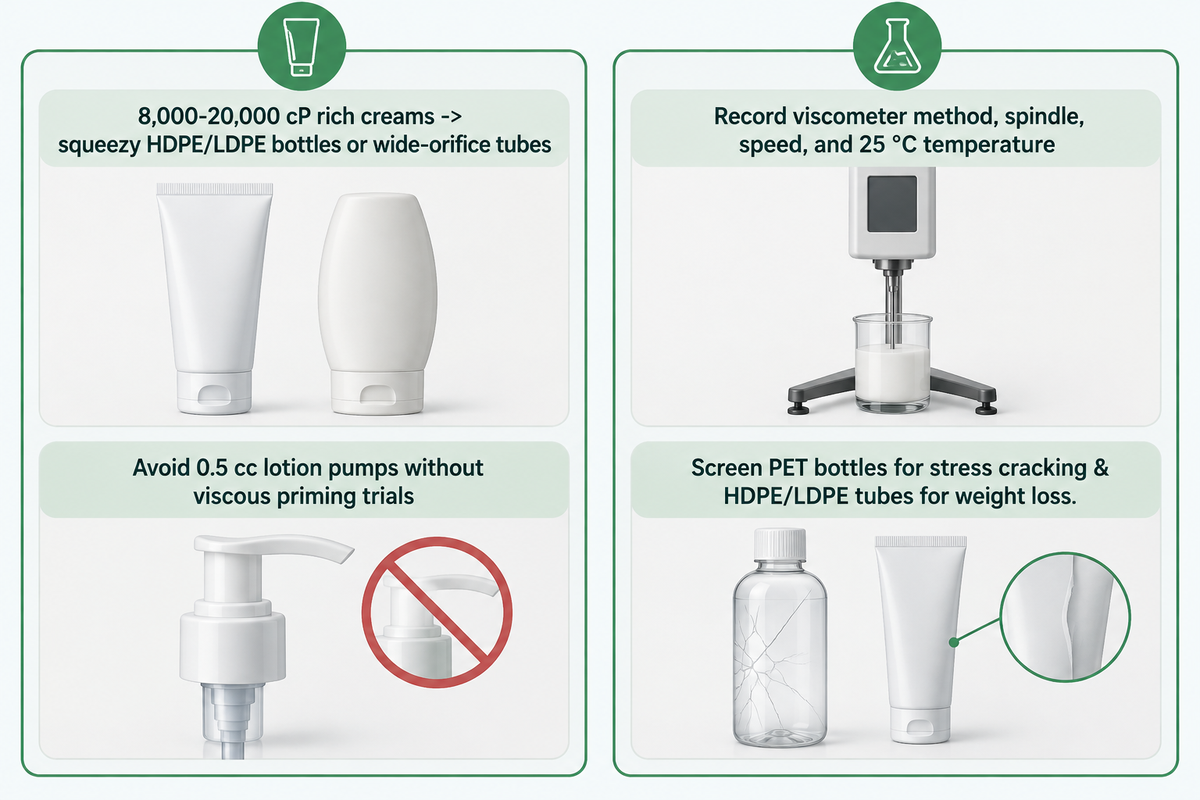
Conditioner packaging fails most frequently at the closure rather than the container wall. Boyu Packaging Engineers note that tight springs in a pump stall priming and narrow cap orifices increase squeeze effort, whereas oversized cap valves drip when stored inverted. On factory floors, scaling viscous fluids from bench kettles creates powder lumps and flow restrictions. According to Happi reporting on Unilever’s Raeford solid deodorant lines, predictive flow modeling spotted 95% of flow restrictions and reduced waste by 20% while increasing line capacity by 10%. Scaling conditioner batches likewise calls for dedicated transfer and deaeration trials.
Locking container compatibility requires exact analytical standards before approving molds. As Medpak Solutions notes, any stand-alone viscosity target without method, spindle, speed and temperature fails quality control on commercial lines. Physical testing should be combined with dedicated cosmetic packaging compatibility testing to see if essential oils are causing stress cracking in PET bottles and weight loss in squeezable HDPE/LDPE tubes.
Do: Specify Pack-Matched Rheology
- Specify squeezy HDPE/LDPE bottles or wide-orifice tubes for 8,000–20,000 cP rich creams instead of narrow pumps.
- Test evacuation force across cold shipping temperatures alongside 25 °C bench measurements.
- Record viscometer spindle number, rotational speed, and temperature on every batch specification.
- Validate headspace weight loss and closure torque inside finished commercial bottles.
Don’t: Isolate Liquid From Hardware
- Avoid ordering standard 0.5 cc lotion pumps without running viscous priming trials.
- Never approve tube or airless artwork prior to hopper deaeration checks that expose air voids.
- Avoid rigid PET containers for high-terpene botanical conditioners without stress-crack screening.
- Never accept loose viscosity ranges where upper limits stall fillers and lower specs drip in transit.
ISO Microbiological QC, U.S. MoCRA Duties, and EU 2023/1545 Labeling
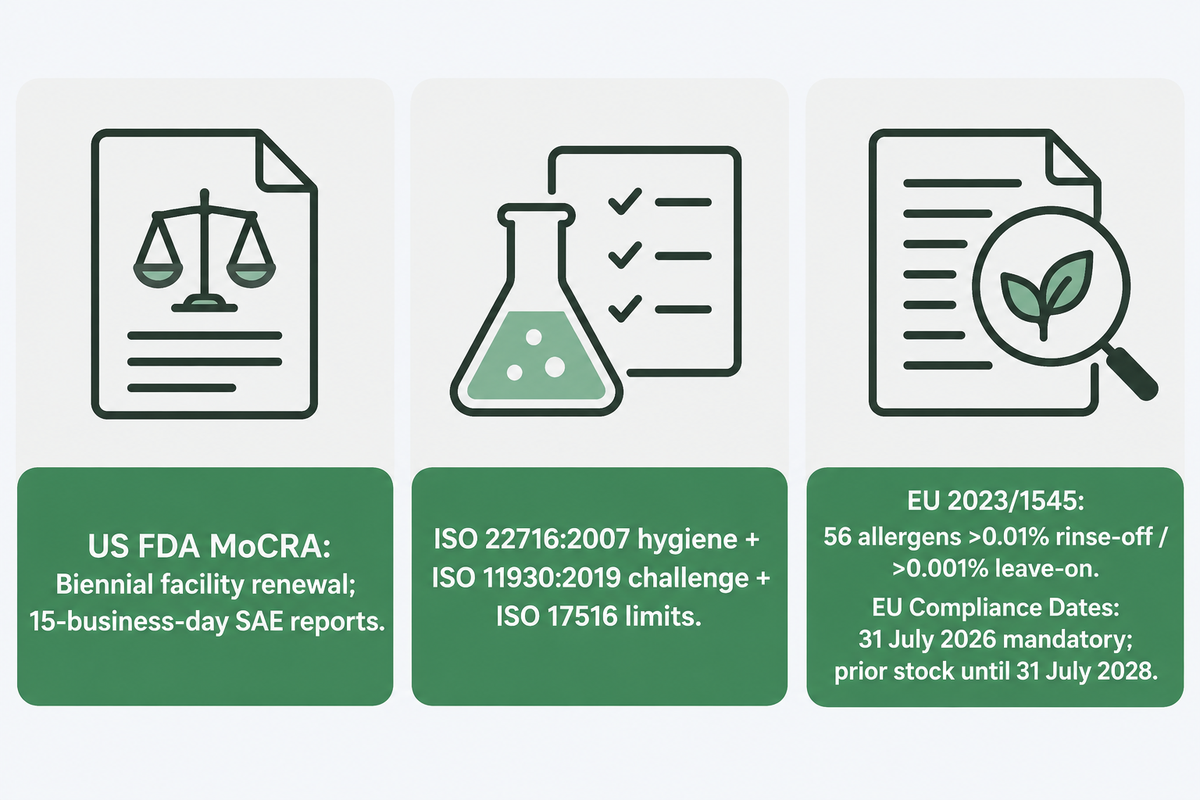
A GMP certificate from an OEM supplier doesn’t exempt a label owner from statutory duties under brand registration. Under the U.S. Modernization of Cosmetics Regulation Act of 2022 (MoCRA), every covered plant renews its FDA facility registration every two years under section 607(a)(2). FDA specifies that it never issues compliance certificates for registration. Meanwhile, the label-named Responsible Person submits cosmetic product listings, maintains safety substantiation files, and reports Serious Adverse Events to FDA within 15 business days. Claiming new hair growth or psoriasis treatment moves any conditioner into unapproved-drug scope under FD&C Act Section 201.
European launches follow harmonized production, microbiology, and allergen rules across the personal care industry. When you expand private label products from private label skincare into private label hair products, confirm the factory’s audited credentials cover both lines before ordering cartons. Batch runs follow ISO 22716:2007 hygiene controls, while preservative systems undergo development challenge validation via ISO 11930:2019 (+ Amd 1:2022) and finished lots compare against microbiological limits in the ISO 17516 framework. Under Regulation (EU) 2023/1545, 56 expanded Annex III allergens became mandatory on 31 July 2026 for new EU runs, with prior stock permitted through 31 July 2028.
| Standard / Law | Core Technical Scope | Manufacturer Duty | Brand Owner Duty (Responsible Person) |
|---|---|---|---|
| ISO 22716:2007 | Cosmetic GMP across production, QC, storage, and shipping | Maintain audited Cream & Lotion line hygiene and retain batch COA | Audit physical site certificate scope and expiration schedule |
| ISO 11930 & ISO 17516 | Development challenge testing and finished microbiological limit checks | Test batch counts against ISO 17516 limits and retain COA records | Fund ISO 11930 updates whenever fragrance or container resin alters |
| US FDA MoCRA | Biennial facility renewal, listing, 15-business-day SAE, safety files | Renew FDA facility registration every two years and provide data | Submit Cosmetics Direct listings; keep cosmetic claims outside drug rules |
| Regulation (EU) 2023/1545 | 56 expanded Annex III fragrance allergens (>0.01% rinse; >0.001% leave-on) | Collect quantitative fragrance house allergen table at formula dilution | Update INCI box artwork for new runs and watch 31 July 2028 sell-through |
MOQ Tiers, Packaging Bottlenecks, and Landed Unit Economics
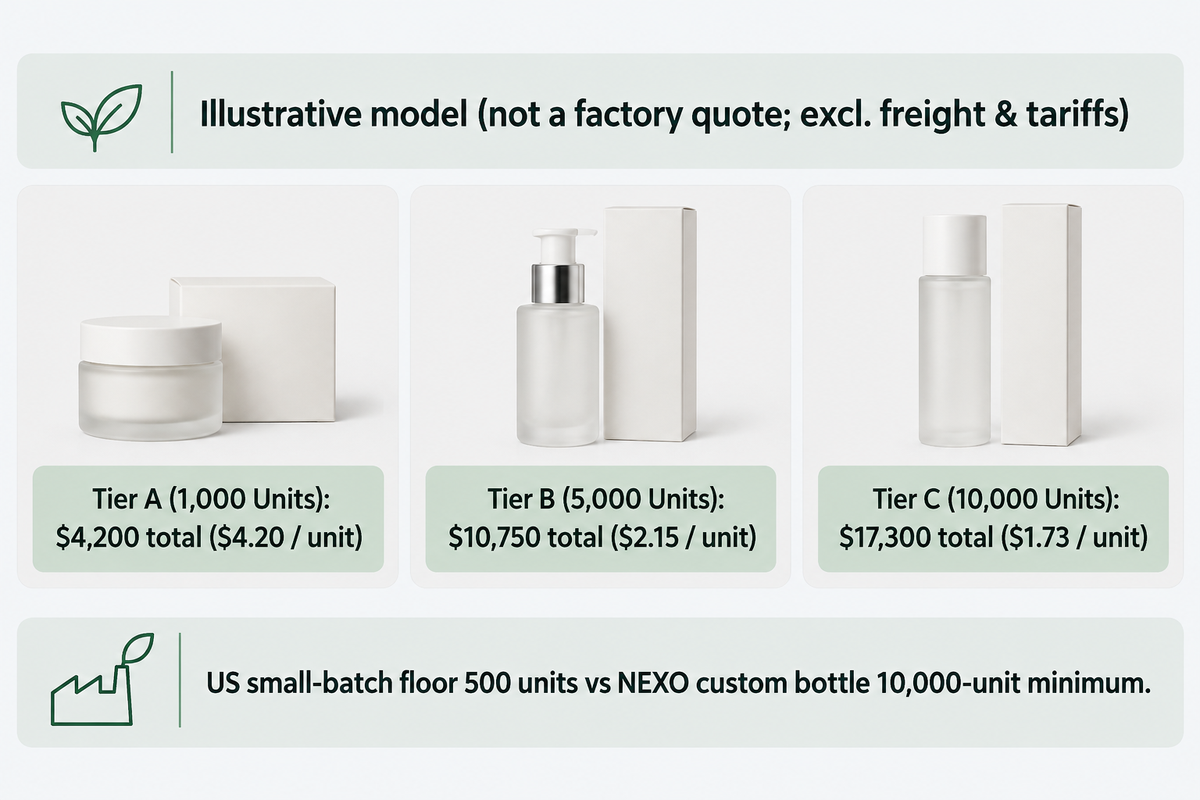
Public contract quotes across haircare span 500 to 10,000 units per SKU. US small-batch specialist Shay Labs sets first orders at 500 units per formula and reorders at 1,000. Asian Ecolchi 2026 benchmarks report conditioner compounding at $1.40-2.80/unit and 1,000-unit conditioner total per-unit ex-works at $2.50-3.95 ($1.90-2.80 compounding plus $0.45-0.85 bottle+cap and $0.15-0.30 label printing, before setup and sea freight), while NEXO Beauty Labs sets a 10,000-unit minimum per SKU on commercial custom bottle lines.
Evaluating committed units per product requires scanning three supplier gates simultaneously. As Made by Genie notes, a 250-unit formulation pour still stalls if folding box printers demand 2,500 units or custom bottle suppliers require 10,000 pieces. Fixed plant cleaning and machine setup divide sharply by run size: a $500 setup charge costs $2.00 per bottle at 250 units versus $0.05 per bottle at 10,000 units. Separately, Ecolchi data place heavy hair-mask jar-and-lid packaging at 25–35% of total product cost.
What is the minimum order quantity for Private Label Hair Care?
Minimum order quantities for private label hair care range from 500 units per formula on standard off-the-shelf US small-batch runs. Elsewhere, volumes increase to 1,000-5,000 units on regional contract lines and 10,000 units for each SKU with custom bottles or commercial OEM line minimums.
Smaller initial batches preserve retail cash and help build your brand equity, allowing you to launch your branded private label haircare products inside stock bottles with pressure sensitive labels. Moving from 500 to 10,000+ units unlocks substantial per-unit bulk and packaging cost reductions in Ecolchi’s multi-tier benchmarks once reorder volume stabilizes.
To understand how the per-bottle ex-works outlay before freight is influenced by a rigid validation budget and volume brackets, read the example calculation below.
Assumed inputs (illustrative model built from Ecolchi’s general 1,000 / 5,000 / 10,000-unit haircare per-unit manufacturing table and Made by Genie $500 setup fee, not a factory quote). First, bulk filling uses Ecolchi’s published $1.80-2.50/unit ($1.80 floor) at 1,000 units and $1.40-1.90/unit ($1.40 floor) at 5,000 units. We model $1.20/unit ($1.20-1.65 floor) at 10,000 units (conditioner catalog tables begin at $1.90-2.80, $1.50-2.20, and $1.30-1.90). Second, stock PET bottle ($0.25/unit floor) plus printed labels ($0.15, $0.10, and $0.08/unit) total $0.40, $0.35, and $0.33/unit. Third, fixed Run 1 launch fees total $2,000 ($500 setup + $500 sampling + $1,000 accelerated stability). Ocean freight, tariffs, custom molds, and certified organics remain excluded because destination rules alter final landed cost.
| Cost Line Item & Calculation Basis | Tier A: 1,000 Units (Starter) | Tier B: 5,000 Units (Growth) | Tier C: 10,000 Units (Volume Tier) |
|---|---|---|---|
| Compounding & Filling (Stock Format Bracket) | $1.80 × 1,000 = $1,800 | $1.40 × 5,000 = $7,000 | $1.20 × 10,000 = $12,000 |
| Stock Bottle ($0.25) + Label Printing Floor | $0.40 × 1,000 = $400 | $0.35 × 5,000 = $1,750 | $0.33 × 10,000 = $3,300 |
| Amortized Fixed Launch Fees ($500 Setup + $500 Sample + $1,000 Stability = $2,000) | $2,000 ÷ 1,000 = $2.00/unit | $2,000 ÷ 5,000 = $0.40/unit | $2,000 ÷ 10,000 = $0.20/unit |
| Total Illustrative Run 1 Ex-Works Cost & Per-Unit | $4,200 ($4.20 / unit) | $10,750 ($2.15 / unit) | $17,300 ($1.73 / unit) |
With the assumed inputs, scaling Run 1 from 1,000 to 10,000 units reduces the modeled ex-works cost from $4.20/bottle to $1.73/bottle.
How to Audit a Private Label Hair Conditioner Manufacturer and Issue an RFQ
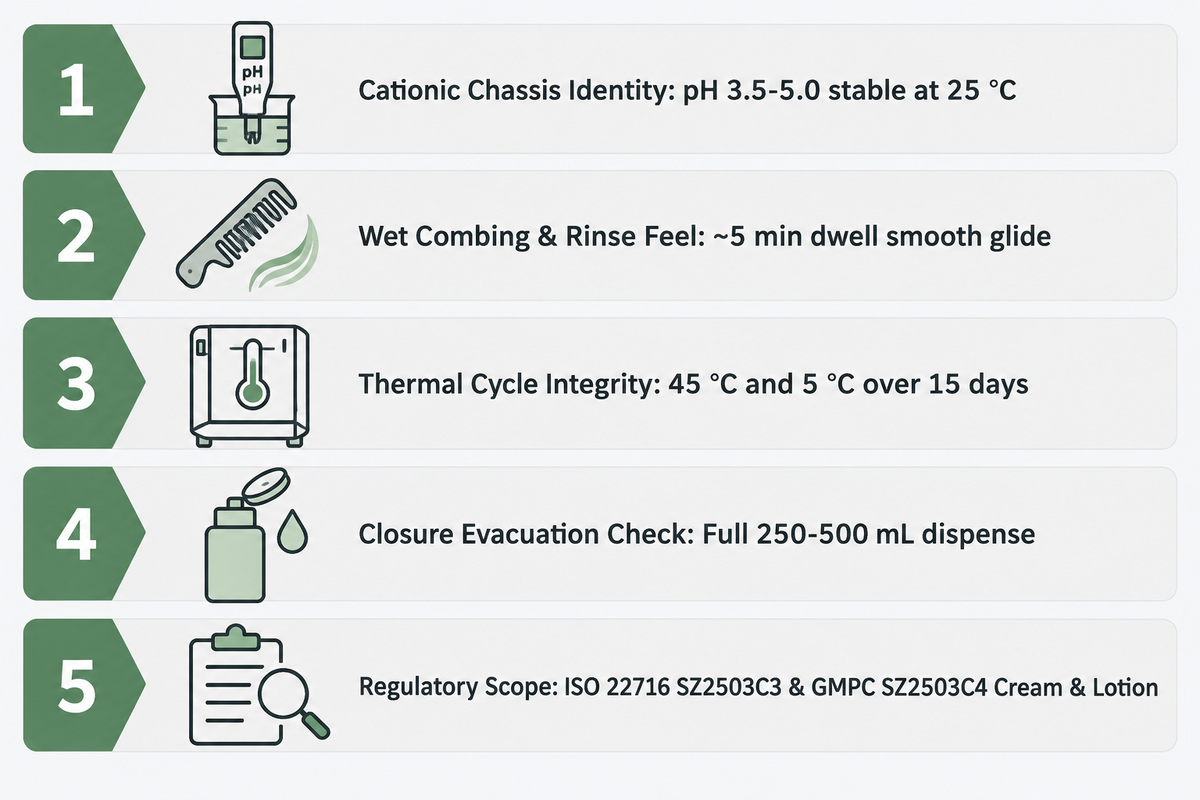
Auditing commercial hair care solutions requires verifying physical audit records and production capabilities rather than relying on sales decks. Check third-party certificate scopes using practical conditioner manufacturer shortlist criteria, confirming that Cream & Lotion Units and General Liquid Units appear explicitly. At NEXO Beauty Labs’ manufacturing partner, Guangzhou Opseve Cosmetics Co., Ltd., Intertek ISO 22716:2007 certificate SZ2503C3 (valid to 12 March 2028) covers both skin care and hair care production lines for any private label skincare brand expanding into hair care. Founded in 1999 (with NEXO’s overseas project unit active since 2020), the 36,000 m² facility runs 56 lines, houses 5,000+ formulations, and holds Intertek-issued GMPC certificate SZ2503C4 (audited against FDA 2022 GMPC guidelines) plus Halal MUI status (LPPOM-00150276060425, valid to 15 April 2029).
Prior to wiring any deposit, grade trial batches using The 5-Stage Conditioner Swatch Scorecard:
| Audit Stage | What to Test on Trial Swatches | Concrete Pass Baseline | Reject Signal |
|---|---|---|---|
| 1. Cationic Chassis Identity | Verify primary quat (BTMS-25/50 vs BTAC vs esterquat) & INCI naming | Acidic pH 3.5–5.0 stable at 25 °C | Out-of-band pH >5.5 or undocumented alkyl substitution |
| 2. Wet Combing & Rinse Feel | Comb through damp bleached tress after ~5 min rinse-off dwell | Smooth glide without heavy waxy film | Waxy matted drag or stiff dry fiber snap |
| 3. Thermal Cycle Integrity | Alternate 45 °C and 5 °C stability chambers over 15 days | Zero water syneresis, phase split, or wax grains | Oily film weeping or grainy bead separation |
| 4. Closure Evacuation Check | Dispense full 250–500 mL target pack after chilled hold | Controlled squeeze without excessive cap drip | Pump stalling, sucking air, or clogged cap valve |
| 5. Regulatory & Scope Audit | Inspect Intertek / ISO scope lines, MoCRA code, & EU 2023/1545 table | Active Cream & Lotion GMP certification + allergen table | Absent allergen dilution sheet or lapsed certificate ID |
Copy these exact engineering specifications into your quote request so manufacturing bids match cleanly:
RFQ checklist — copy these into your quote request:
| Parameter | Recommended range | Why it matters | How to verify |
|---|---|---|---|
| Target Formula pH Window | pH 3.5–5.0 (Seppic conditioner guideline) | Aligns near hair cuticle isoelectric point (~pH 3.67) and optimizes organic acid preservation | Include pH meter range on sample bench card and commercial batch COA |
| Conditioner Format Viscosity | 500–3,000 cP lotion or 8,000–20,000 cP rich cream at 25 °C | Prevents narrow pump stalling in thick creams and leak defects in thin lotions | Require viscometer model, spindle, rpm, and 25 °C temperature per Medpak spec rules |
| Cationic & Clean Slip Base | BTMS-25/50 (2–6%), BTAC (1–3% rinse-off mask), or esterquat + C13–15 alkane | Governs wet combing efficiency, buildup rate, and EU microplastic exemptions | Request quantitative active percentage, silicone exclusion letter, and biodegradability dossier |
| Primary Pack & Closure Fit | 250–500 mL squeezable HDPE/LDPE flip-top or 150–300 mL PP jar (masks) | Stops orifice clogging, closure dripping, and terpene bottle stress-cracking | Require 12-week 40–45 °C in-pack stability check and vacuum leak test prior to filling |
| Microbiological & Allergen Dossier | ISO 11930 development challenge + ISO 17516 batch limits; EU allergen >0.01% (rinse) / >0.001% (leave-on) | Supports customs documentation and reduces EU 2023/1545 labelling recall risk | Demand batch microbiological COA plus IFRA and Annex III fragrance allergen table |
| MOQ Floor & Lead Time | 500–1,000 units (US small-batch) to 10,000 units/SKU (custom pack OEM); 10–15 working days production | Aligns retail cash burn with hidden box/bottle supplier minimums | Contract exact formula, packaging, and 10–15 working-day production clock from dual sign-off |
Key takeaway
Locking cationic balance, acidic pH 3.5–5.0, closure-matched viscosity with explicit spindle tolerances, and EU/MoCRA dossier splits before approving packaging tooling reduces re-testing rework and keeps commercial OEM production within 10–15 working days once both gates clear.
Frequently Asked Questions About Private Label Conditioner Manufacturing
How does private label conditioner manufacturing work from brief to batch?
Private label conditioner manufacturing starts with a brief outlining hair type, target slip viscosity, banned ingredients, and packaging volume. Laboratories then prepare bench evaluation swatches (within three to seven business days on rapid OEM tracks) before validating in-pack stability and preservative efficacy.
Once your brand approves sensory swatches and final packaging components, the manufacturing plant compounds, homogenizes, fills, and releases tested production lots against Certificate of Analysis records.
Can I order samples from a private label hair care manufacturer before a full run?
Yes, reliable OEM partners ship bench evaluation swatches prior to taking a commercial deposit, so your team can test wet combing, rinse feel and scent stability first. Budget three to five swatch adjustments ($50 to $300 per round across multiple revisions per 2026 cost guides) before approving production.
Always test delivered swatches inside the commercial bottle, pump, or squeeze tube upright and cap-down across cool shipping conditions prior to purchase orders.
What is the timeline for developing and making a private label shampoo or conditioner batch?
Rapid OEM workflows turn stock or qualified base orders around in 10–15 working days following full formula and container sign-off. Smaller batch custom programs for the US budget four to six weeks for lab formulation. Manufacturing takes an additional ten to twelve weeks.
Factor five to seven business days for overseas sample shipping plus up to 12 weeks whenever custom blends need 40–45 °C accelerated aging studies.
Do manufacturers offer conditioner formulas for specific hair types or concerns?
Yes, contract laboratories tailor emulsions using light cetyl alcohol for fine hair and BTMS-25 for curls and keratin masks for bleached strands.
Cationic carbon chain length, lipid percentage, and finish viscosity adjust cleanly across different hair textures.
Do private label hair conditioners perform as reliably as custom formulations?
Yes, mature stock private label conditioners perform reliably because factories have already stabilized cationic-to-fatty-alcohol ratios, cooling homogenization curves, acidic preservation bands, and freeze-thaw stability. Choosing a pre-qualified formula cuts development spend and helps brands enter quickly with clean custom containers. Full custom formulation provides stronger exclusivity once repeat unit volumes support dedicated intellectual property contracts, bespoke active blends, and multi-month stability budgets.
Determining a finished product’s wet-combing feel relative to target retail margins indicates when to move from stock to custom.
Why verify GMP line scope instead of trusting a shared stock catalog claim?
An audited third-party GMP certificate listing Cream & Lotion Units alongside General Liquid Units verifies the factory’s own emulsification and compounding lines, and reduces silent outsourcing of cream fills to unvetted brokers.
Checking registry expiration dates alongside US FDA facility registration reduces compliance surprises before scale-up.
Which hair care products should a new beauty brand launch first?
Emerging brands frequently start with a matched signature shampoo line paired with rinse-off conditioners (250-500 mL core packs) or introduce an intensive treatment mask. Demand clusters around hydration, damaged hair care, and smooth detangling. Focusing capital into one cohesive product line concentrates spend into tighter unit tiers, cuts per-bottle setup fees, and accelerates repeat orders. Validate this core set before expanding into leave-in sprays or complementary skincare SKUs. Pair initial bottle volumes carefully with supplier MOQ ceilings so working cash stretches cleanly through replenishment.
Testing swatch feel across buyers validates fit for reorders before adding secondary categories.
About This Analysis
Reviewed by the NEXO Beauty Labs technical team (international OEM and ODM business unit operating since 2020 with manufacturing partner Guangzhou Opseve Cosmetics Co., Ltd., holding Intertek ISO 22716:2007 SZ2503C3 and Intertek GMPC SZ2503C4 audited to FDA 2022 GMPC guidelines).
References & Sources
- U.S. FDA regulatory & MoCRA guidance: Modernization of Cosmetics Regulation Act of 2022 (MoCRA) and FDA Cosmetic Facility Registration & Product Listing.
- European Commission statutory rules: Commission Regulation (EU) 2023/1545 Fragrance Allergens Labelling and Commission Regulation (EU) 2023/2055 Synthetic Polymer Microparticles Restriction.
- ISO international standards & accredited lab guidance: ISO/TC 217 Cosmetics Catalogue (ISO 22716:2007, ISO 11930:2019, ISO 17516, ISO/TR 18811:2018) and IVAMI Cosmetic Stability & ISO/TR 18811 Guideline.
- Peer-reviewed scientific research & patents: Zeta-Potential Adsorption & Wet Combing Study (NIH PMC13068045), Polymeric Conditioning Agents & Isoelectric Point Review (NIH PMC9921463), US Patent US20200146955A1, and WIPO Patent WO2015110511A1.
- Formulation & trade press literature: Happi Formulating Non-Traditional Hair Conditioners, Happi Sustainable Silicone Alternatives, Happi Manufacturing Scale-Up Report, and NYSCC Silicone Alternatives Review.
- Surfactant & packaging engineering literature: Seppic Conditioner Formulation Guide, Global Formulation Cationic Surfactant Toolkit, Joan Morais BTMS-25 vs BTMS-50 Guide, Boyu Packaging Container Engineering Guide, and Medpak Viscosity & Packaging Compatibility Guide.