Get in touch with NEXO Beauty Labs Company


Sunscreen Spray Manufacturing: A Guide from Formula to Spray

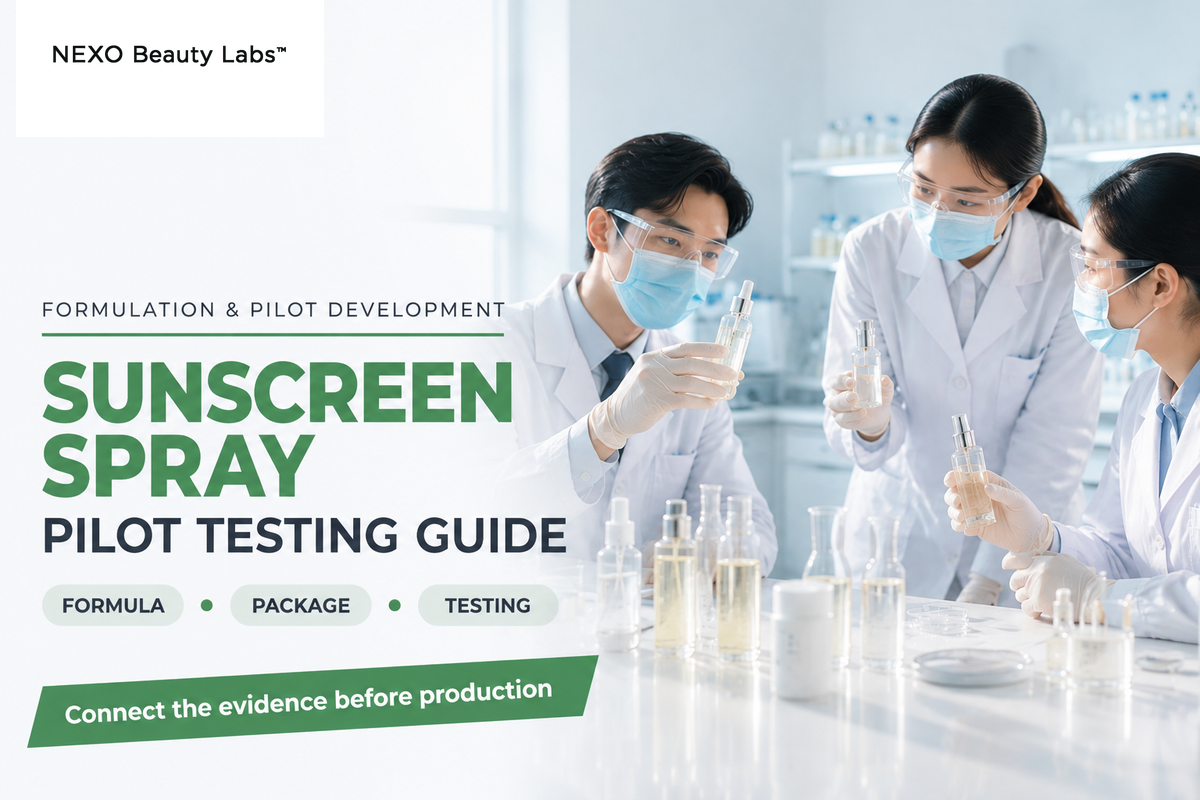
FORMULATION & PILOT DEVELOPMENT
Sunscreen Spray Manufacturing develops the formula, dispensing system and filled product together. The work integrates a selection of UV filters, bulk processing, package and finished product testing for sun protection claims. A laboratory sample can still clog its nozzle or change during storage. The critical question is whether the production configuration keeps providing the intended product.
This guide follows that question through formulation, filling and pilot decisions. It’s written for beauty-brand development teams, quality managers and packaging buyers working across skincare, sun care and personal care. The broader sunscreen manufacturing guide covers the general development route; here, the emphasis is on the interfaces that make a spray different.
How Does Sunscreen Spray Manufacturing Work?
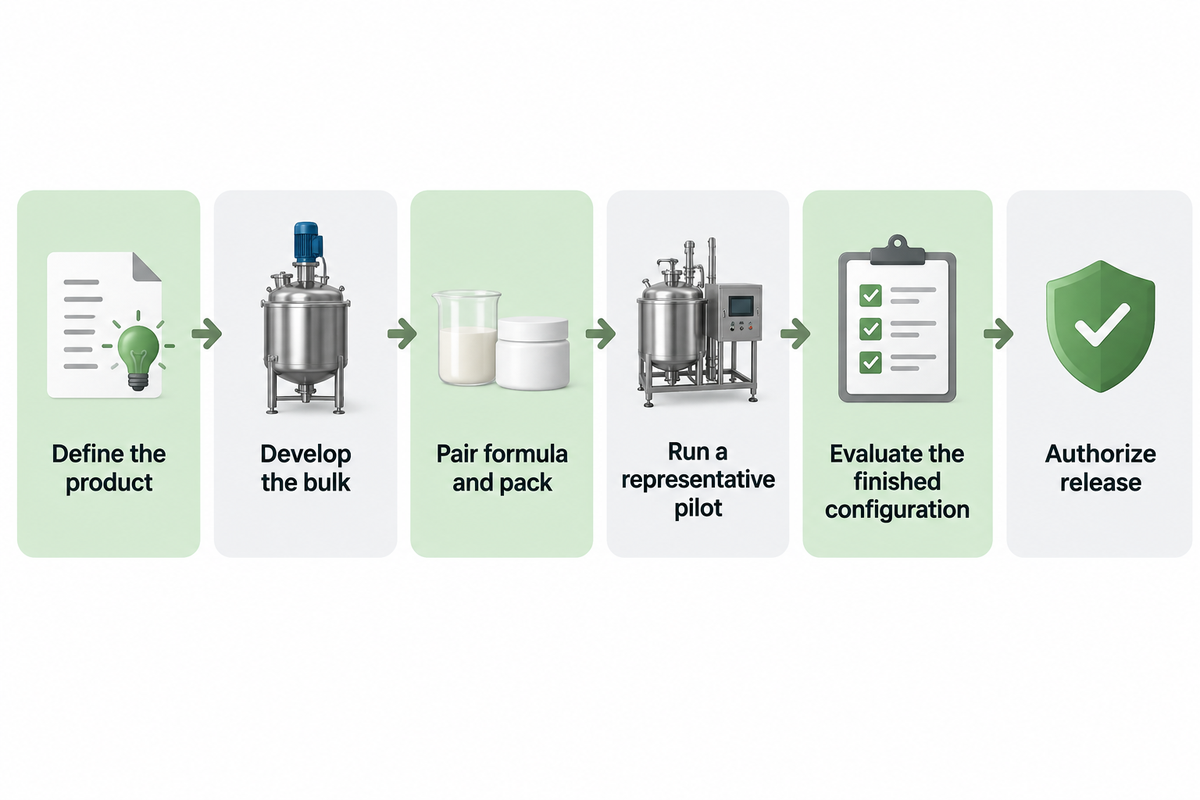
A bulk formula and a dispenser compatible with the bulk formula are developed before spray sunscreen production. The pilot connects bulk holding, mixing and filling with package and claim testing. Release depends on the finished sunscreen product meeting specified requirements, including chemical and microbiological standards, rather than a demonstration spray.
- Define the product: target market, intended use, protection claims and dispensing architecture.
- Develop the bulk: select sunscreen agents and a suitable solvent or emulsion system.
- Pair formula and pack: identify the complete product-contact path, valve and actuator.
- Run a representative pilot: preserve the connection between bulk samples and filled units.
- Evaluate the finished configuration: protection, stability, spray function and safety.
- Authorize release: review results, deviations and component identities together.
A bulk manufacturer, filler, testing laboratory, and product release owner may perform the different functions of this process. It’s essential to define the functions for each of these parties and assign the parties by name. If the bulk manufacturer and the packaging supplier approved samples, and/or parts separately, the brand still needs to appoint a person to assess the two parts, and investigate and evaluate an individual sample if the bulk sample, package, and the filled product together don’t meet their intended purpose. Australia’s TGA guidance on outsourced manufacturing demonstrates the importance of defining the party responsibilities.
Build the Sunscreen Formulation Around Spray Delivery
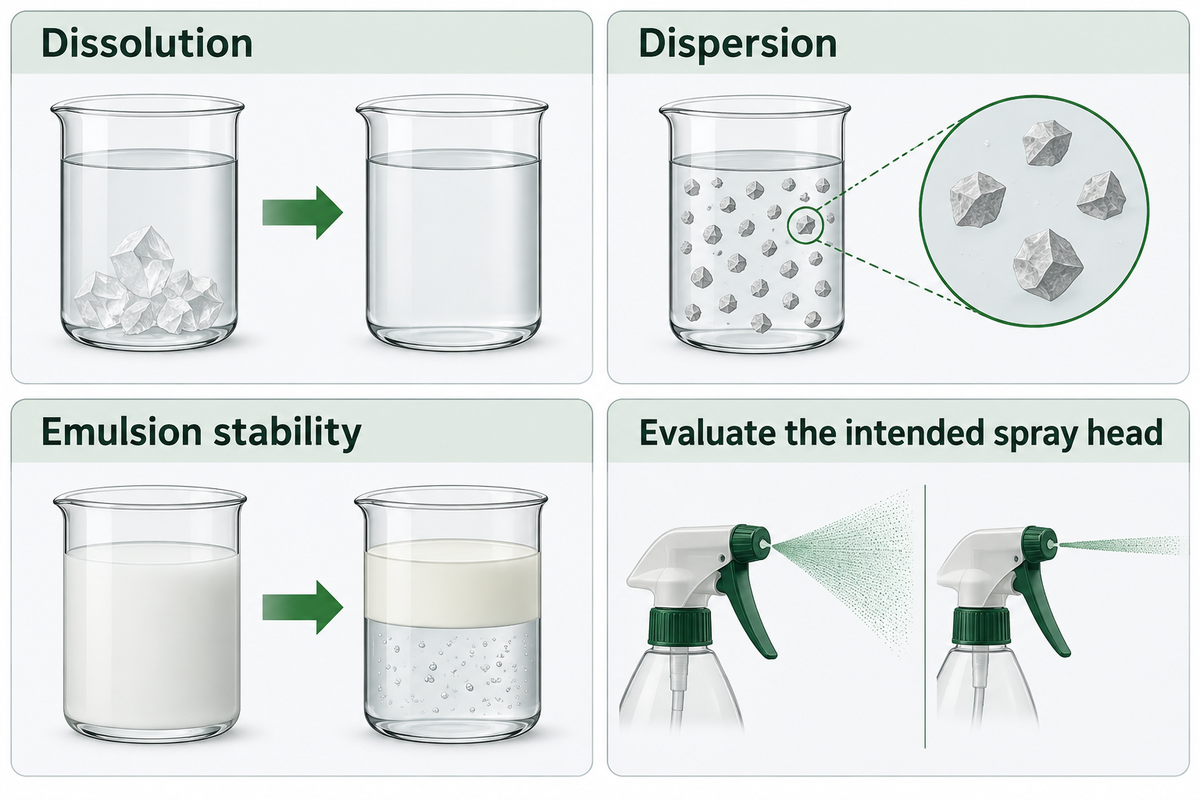
A sprayable sunscreen requires a flow profile that operates through its dispenser while supporting an even film on skin. Formulators require balancing the dissolution or dispersion of a UV-filter, while maintaining emulsion stability and the application feel. Dispensers are needed in the early prototypes to assess the flow profile of a proposed spray formulation.
The selection of UV filters begins with the ingredients approved for use in the intended market route and their applicable conditions. Chemical UV filters may require a compatible solvent system; inorganic filters such as zinc oxide and titanium dioxide require appropriate dispersion. A filter that crystallizes out of solution is a different problem from mineral particles that have agglomerated in an improperly dispersed suspension.
In the case of organic sunscreens, “organic” refers to the filter chemistry as opposed to the certification of the raw materials. Identify the individual ingredients and their roles. When a project combines active ingredients with a new solvent, the development team must evaluate that complete system against the target claims and the stability of the formulation, because approving each raw material separately leaves unanswered how the finished mixture will behave in its actual dispenser.
For an emulsion, identify the continuous phase before choosing the emulsifier, thickener and film-forming system. An oil-in-water chassis is very different from a water-in-oil chassis. Flow, preservation, and stability can be affected by changes made in the oil phase or water phase. The amount of UV filter alone doesn’t determine the finished product’s SPF performance. High SPF formulations still require a suitable base, and stability and SPF are different development issues.
How can viscosity be adjusted for spraying?
Adjust the viscosity by balancing the emollient, polymer, and solvent through deliberate formulation trials and gauge the effect on the intended spray head. Compare the rheology at a defined temperature and measurement method, assess output, and evaluate pattern and storage behavior. Cosmetic formulators, evaluate each change in the complete formulation. A single viscosity number can’t describe every pump and nozzle combination.
For instance, imagine a brief to convert a mineral lotion to a sun spray. Reducing structure may help the sample leave the nozzle, while particles may settle during storage. Increasing structure may help particles stay suspended and lead to a narrower stream. Keep the hardware fixed. If the next prototype uses a different thickener and a different nozzle at the same time, an improved mist leaves the team unable to tell which change helped or whether the thinner bulk will retain an even distribution after storage.
“Optical microscopy is one technique that helps to evaluate if the dispersion is satisfactory or not.”
What do consumers want from their sunscreen?
Consumers prize a non-greasy after-feel, low white cast and easy application. Translate consumer demands into product attributes that can be evaluated by testing: handling, spreadability and visible residue. Claims for sensitive skin require their own assessment. A silicone or other emollient chosen to improve the skin feel still needs compatibility work.
For a brand extending its care products into suncare, intended users with different skin needs belong in the brief before a preferred texture becomes a fixed requirement. Our custom cosmetic formulation process starts with that product brief.
Match the Bulk to Pump, Bag-on-Valve or Aerosol
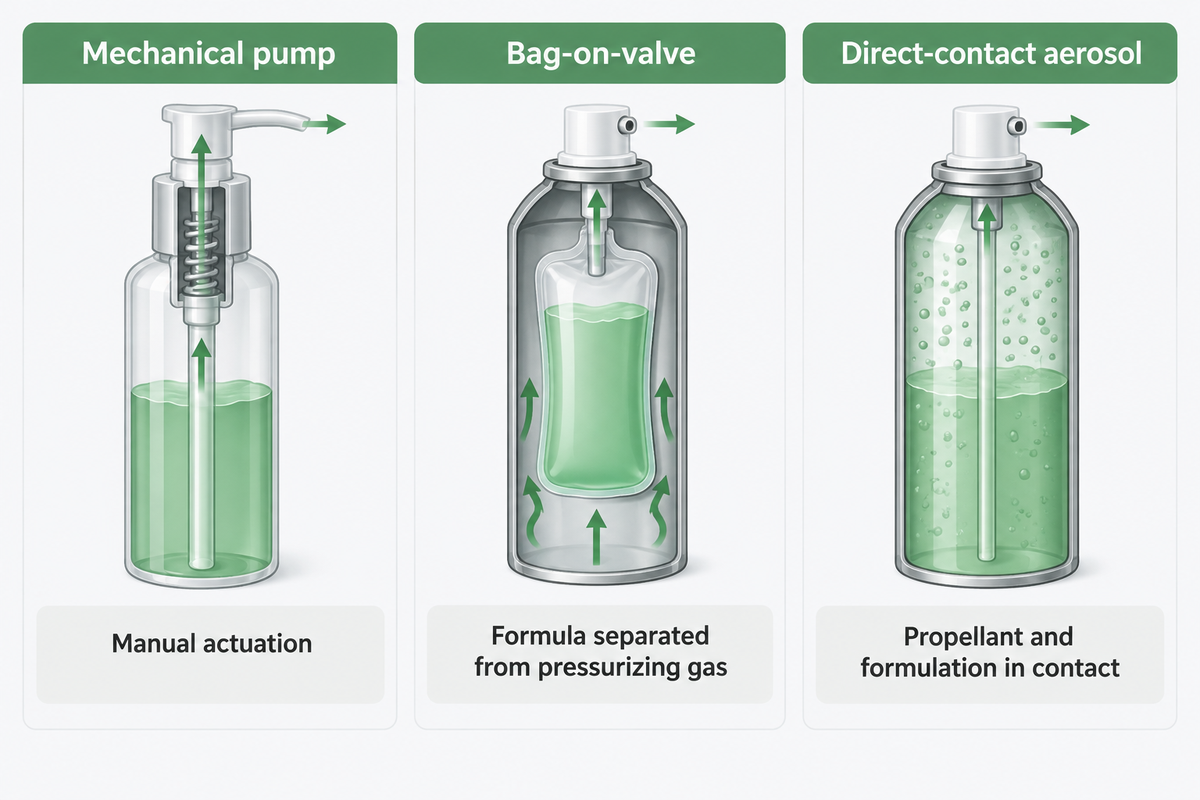
Mechanical pumps, bag-on-valve and direct-contact aerosols create varying product-contact and dispensing conditions. Choose the architecture before assuming a prototype is ready for production. The same bulk can behave differently when the flow path and pressures change.
| System | Delivery arrangement | Pilot question |
|---|---|---|
| Mechanical pump | Manual actuation moves product through the pump. | Does priming and repeated actuation deliver a usable dose and pattern? |
| Bag-on-valve | A barrier bag separates formula from the pressurizing gas. | Do the bag, seals, valve and actuator remain compatible with the formula? |
| Direct-contact aerosol | Propellant and formulation are in contact within the package. | Does the complete composition remain suitable for the selected valve, safety assessment and market route? |
Aptar describes bag-on-valve aerosols as barrier aerosols using either compressed air or nitrogen. The separation of gas and formula is an architectural feature. The ingredients of the formula, sprays and the complete product still require an appropriate safety assessment. FDA specifically warns that some sunscreen sprays contain flammable ingredients such as alcohol.
Don’t choose factory handling controls based on the word “pump” or “BOV” alone. The filling party must assess the actual materials and evaluate how the filling operation will run. A spray style quote may leave the determination of product-contact materials, filling and testing responsibilities for the development team to resolve before comparing it with an apparently cheaper alternative from another supplier. Use NEXO’s sunscreen spray manufacturing solution to help configure and manufacture sunscreen; use this guidance to help determine what the pilot must resolve.
Control Mixing, Holding and Filling as One Transfer
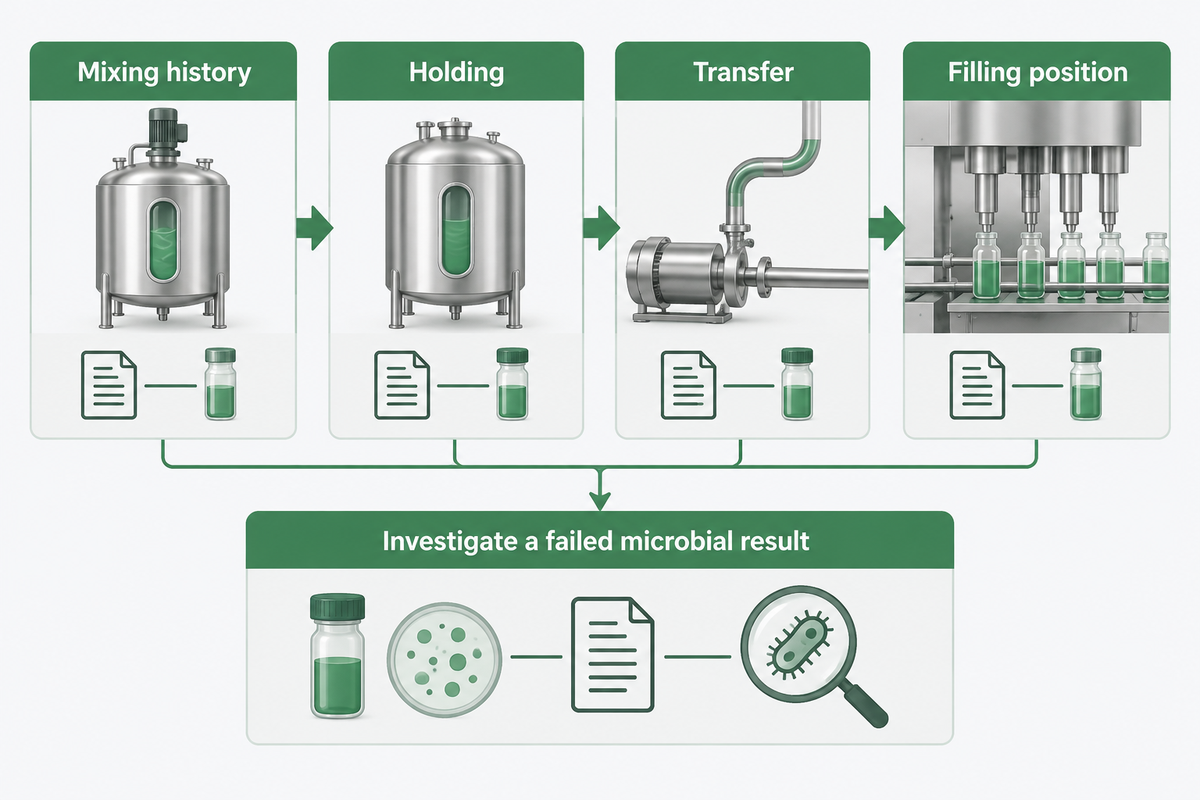
Connect the condition of the bulk to the filled units by recording mixing history, holding, transfer and filling position. Adequate control of holding may be part of the process. Continuity means maintaining an evidence chain. Sampling may reveal whether a problem is with the bulk, arises during transfer, or occurs in the package.
Australia’s TGA sunscreen manufacturing guidance links reliance on bulk chemical testing to demonstrated homogeneity during storage and filling. Sampling must be representative of the actual processes of storage and transfer. In a 2023 US warning letter to Cosmetic Science Laboratories, FDA found inadequate bulk sunscreen hold-time studies and noted that customers could rely on those claims when assigning finished-product expiry.
What makes a spray sample representative of production?
A representative sample must be traceable to the intended formula, process and package. For the proposed pilot, compare retained bulk samples with the units identified by beginning, middle and end of filling. Document any interruption, change or modification to the process, transfer or component-lot. If only the units filled at the end of the cycle behave differently, investigate that transfer history and make changes to the process, transfer or component-lots only as necessary.
Reviewing aqueous systems, including production-water suitability, cleaning and microbiological control, should be part of the same evaluation. A visually uniform emulsion can still fail a microbial specification. Stop that handoff. The Quality Owner is required to investigate all failures of the specification including microbial. If a retained bulk sample meets all physical requirements but fails a microbial test, the Quality Owner must investigate the failure and assess the affected material before another party treats the physical result as permission to fill or distribute the batch.
Qualify Spray Output Across the Life of the Pack
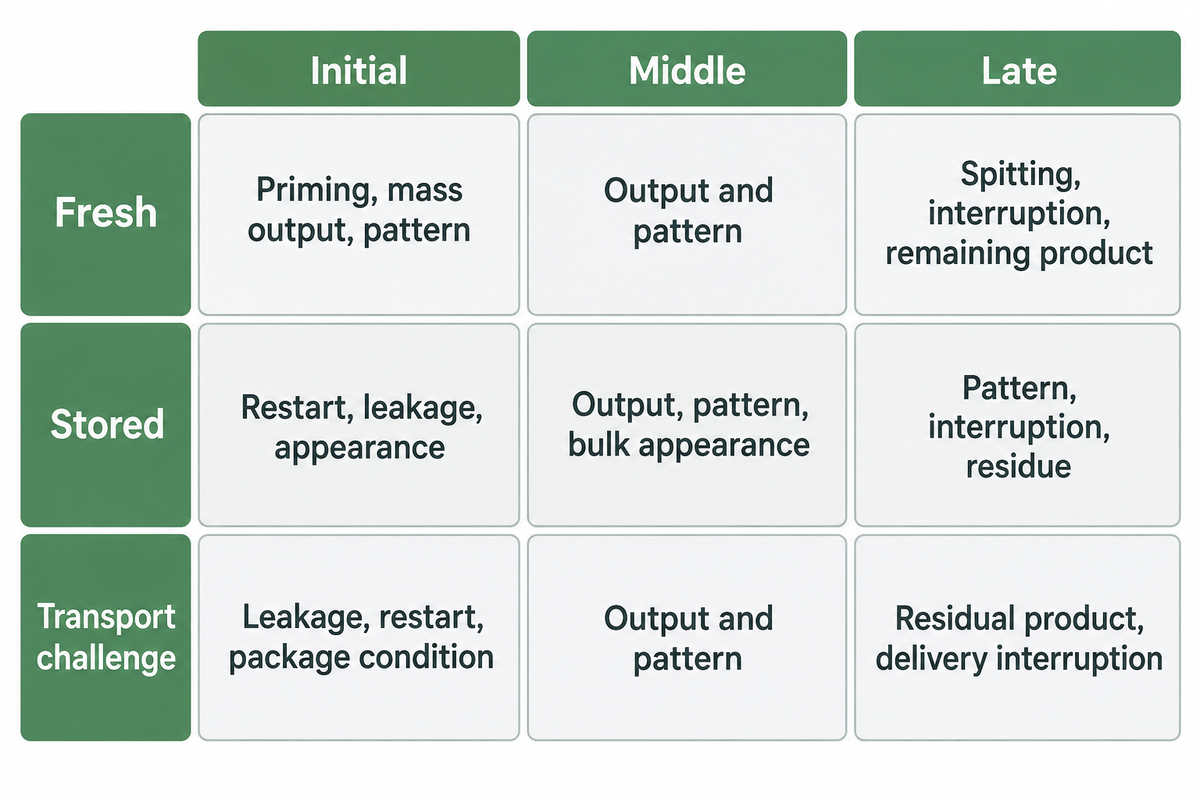
Dispensing at the beginning, in the middle and at the end of pack use should be evaluated and compared across the chosen storage and transport conditions. Document the test setup so it may be repeated. Package function, emitted particle size and measured protection address different questions; a fine looking mist can’t replace evidence from the finished product.
Priming, dose delivery, leakage and actuation are included in Intertek’s packaging compatibility guidance. A 2023 study by Berrada-Gomez and colleagues at Pierre Fabre measured 78 mixed cosmetic sprays by laser diffraction. The abstract indicates that droplet size distribution was influenced by the dispensing system and product type, as well as the form of formulation. Assess the inhalation exposure of the actual finished spray.
How should output per actuation be measured?
To determine the amount dispensed by a pump, determine the mass delivered by each complete actuation. For continuous sprays, divide the mass delivered by a defined spray time. Standard laboratory procedure must define priming, actuation, temperature, and weighing and orienting conditions. Control and limit evaporation and handling effects. The result of this procedure is a measurement of the amount dispensed, and shouldn’t be used to calculate SPF.
Hypothetical arithmetic: A pump delivering 1.20 g over 10 complete actuations provides an average delivery of 0.12 g per actuation. Report the results of the calculation, but don’t rely on the results to accept or evaluate the protection claim of the product.
| Pack condition | Use stage | Record | Decision question |
|---|---|---|---|
| Fresh | Initial | Priming, mass output, pattern | Does the first usable spray match the intended application? |
| Fresh | Middle | Output and pattern with the same setup | Does delivery change as product is consumed? |
| Fresh | Late | Spitting, interruption, remaining product | Does the package stop usefully or fail prematurely? |
| Chosen storage condition | Initial | Restart, leakage, appearance | Has storage affected the start of use? |
| Chosen storage condition | Middle | Output, pattern, bulk appearance | Is the difference associated with ageing or consumption? |
| Chosen storage condition | Late | Pattern, interruption, residue | Does an aged pack retain usable late-stage delivery? |
| Defined transport challenge | Initial | Leakage, restart, package condition | Has handling introduced a new failure? |
| Defined transport challenge | Middle | Output and pattern | Does the handling-related change persist? |
| Defined transport challenge | Late | Residual product and delivery interruption | Is the remaining product accessible through normal use? |
Use this worksheet to plan the comparisons. The qualified team must define the storage program and sample numbers, and the stages and acceptance criteria before testing. US drug stability requirements specify the marketed container-closure system. Keep this dispensing worksheet within the wider stability-testing program, with pressure-package work performed by qualified personnel.
Match SPF and Spray Safety Evidence to the Market
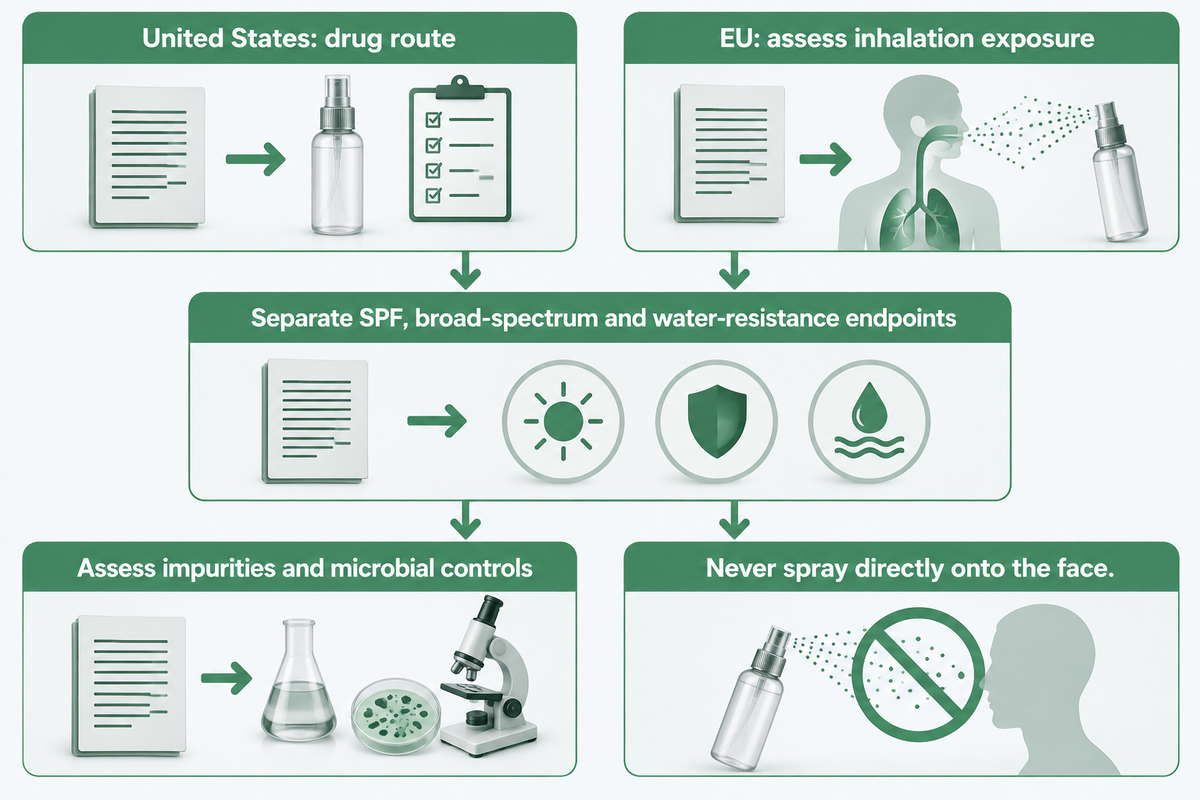
The intended use, product stability, dispensing function and spray safety must comply with the separate requirements of the destination market. SPF testing, broad-spectrum assessment and water resistance address different endpoints. A product may deliver a repeatable mass while requiring further work on other endpoints.
In the United States, sunscreens follow a drug route. SPF concerns the tested protection endpoint; for broad-spectrum testing, the applicable UVA and UVB criteria are addressed. For SPF 50 products, or for broad-spectrum protection claims, the finished-product results are required. Descriptions like “long-lasting protection” need to be based on substantiated claims and directions. Having a pleasant sensory profile doesn’t mean that a product is safe and effective.
Effective sunscreens need justification for their stated UV protection. SPF levels relate to the tested UVB protection endpoint, and a broad-spectrum assessment addresses the response across UV radiation. Look at the method instead of treating “blocks UV light” as a complete performance specification. For SPF products in multiple markets, document each claim’s regulatory requirements and sample configuration supporting it.
The 2026 change affects format selection. FDA’s final order OTC000039 added bemotrizinol with specific conditions. Spray provisions for it require no propellant or complete separation of the propellant from formulation; direct-contact propellant sprays are outside that permitted configuration for bemotrizinol. The order contains provisions for DSM-related exclusivity. Verify the applicable supply and market rights prior to assuming an ingredient disclosure provides opportunity for a private-label launch.
FDA separately finalized the PABA and trolamine salicylate action in September 2026. Finalization and effective dates differ, and other provisions from the 2021 proposal remain under review. Use the current orders for an ingredient and dosage form rather than treating every proposed spray control as an already effective requirement.
For the EU, examine the actual Annex VI entry and intended exposure. Entries for titanium dioxide nano, zinc oxide and zinc oxide nano restrict applications that may expose end-users’ lungs via inhalation. “Non-nano” or “pump” doesn’t resolve exposure assessment. Material particle dimensions and emitted-droplet distributions describe different things.
Chemical impurities require a separate supplier and test assessment. FDA’s benzene Q&A identifies possible pathways involving carbomers, isobutane and other hydrocarbon-derived components. This is a general risk assessment and not to say any NEXO product is contaminated. For aqueous products, qualify water, preservation, and other microbial controls. FDA’s 2025 SV Labs Letter described a released Lot of lotion sunscreen, where a failed microbial test was not investigated, illustrating a different failure pathway from poor spraying.
Protection claims must survive the complete product assessment. Reformulation intending to enhance the SPF still requires adequate testing; a product sold to increase the SPF doesn’t give an automatic result for a new formulation. FDA also advises that sunscreen sprays should never be applied directly to the face. Give the label reviewer the actual pack and intended use before artwork approval.
Diagnose Clogging, Spitting and Uneven Delivery
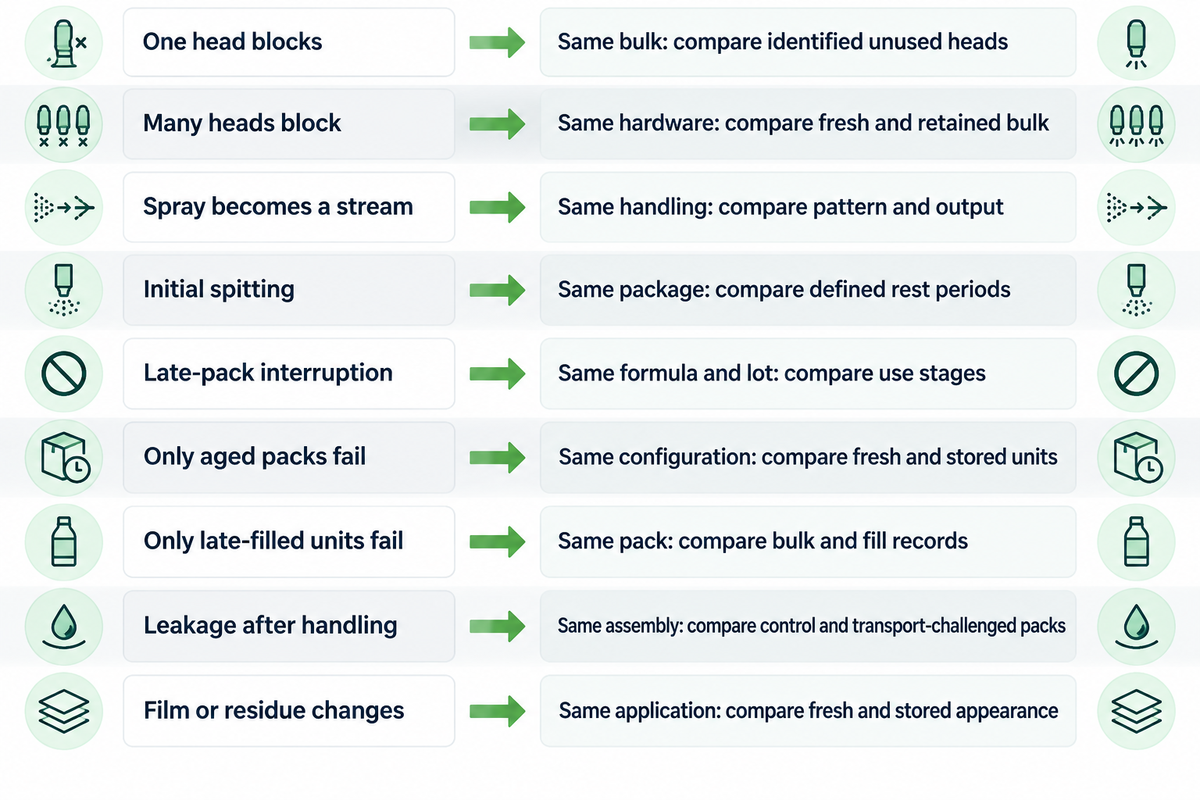
Use a spray defect to select a controlled comparison, rather than modifying the recipe directly. Keep either the recipe or the hardware constant, and evaluate the other. Signs of a bulk problem can look similar to those of a package problem, and inspection, microscopy and repeatable dispensing measurements can help distinguish them, but the symptom alone doesn’t identify its cause.
In Happi’s ZnO formulation article, BASF researchers discuss microscopy of adequate and agglomerated dispersions and coating/emollient compatibility. That distinction is important when a nozzle blocks. Insoluble powder clusters, organic-filter crystals and other residues require different investigations. Cleaning a blocked head may restore a demonstration spray while leaving the underlying issue unresolved.
| Observed pattern | Keep constant | Compare next | Decision before changing production |
|---|---|---|---|
| One head blocks | Bulk and filling history | Matching unused heads from identified lots | Check hardware variation and residue. |
| Many heads block | Hardware configuration | Fresh and retained bulk | Examine dispersion, crystals and rheology. |
| Spray becomes a stream | Handling and temperature | Pattern and output on the same setup | Assess formula/nozzle pairing. |
| Initial spitting | Complete package | Startup after different defined rest periods | Examine restart and priming behavior. |
| Late-pack interruption | Formula and component lot | Initial, middle and late observations | Investigate consumption-related delivery. |
| Only aged packs fail | Filled configuration | Fresh and stored units | Assess formula-pack compatibility. |
| Only late-filled units fail | Pack design | Bulk and fill-position records | Investigate hold and transfer history. |
| Leakage follows handling | Filled assembly | Control and transport-challenged packs | Review closure and handling suitability. |
| Film or residue changes | Application procedure | Fresh and stored product appearance | Review formula condition and affected claims. |
When deciding which factor to investigate next, use the comparison table. Don’t open or improvise changes on pressurized packages. Only change one factor at a time. If a blockage occurred and both the dispersion and the valve were changed, the next successful spray doesn’t explain if the first bulk was unstable or if the path the dispersion took through the hardware was incorrect, or if the changes postponed the problem for later use. Bring the proposed change through the responsible formulation, Packaging and Quality teams before repeating the pilot.
Plan the Pilot Before Committing to Printed Components
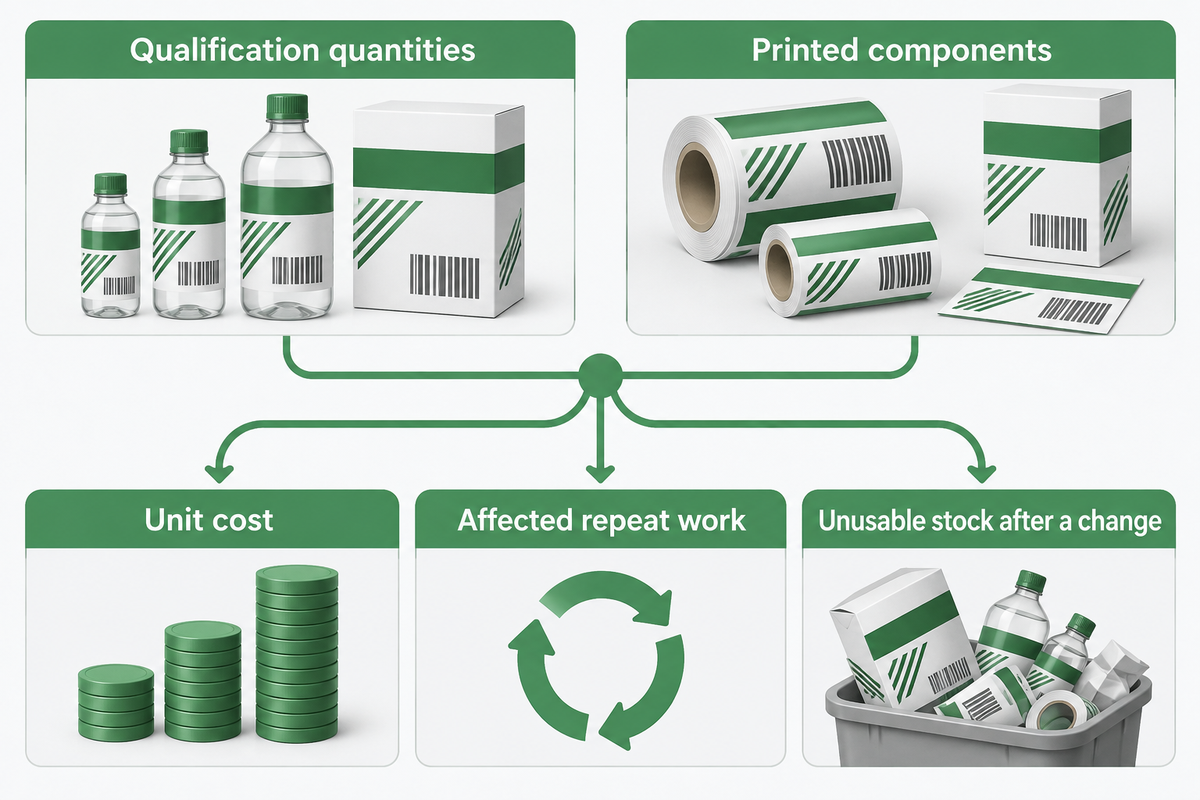
Uncertainty regarding the formula, process and actual dispensing components should be reduced before a large artwork commitment. What’s an acceptable cost to make changes at the last minute should be decided by the procurement team. Define responsibility for approving the configuration and decide which decisions need to be made later when an order is placed.
Let’s say there’s a launch with an acceptable lab sample, but unresolved valve compatibility. Buying the full printed pack quantity commits money to a potentially changing configuration. Smaller qualification quantities may preserve flexibility, although unit cost may be higher. Price the uncertainty. Finance should compare the supplier’s actual qualification quote to the cost committed to components which, after a configuration change, would become unusable, including any artwork and replacement costs which the contract allocates to the brand rather than to the component supplier.
When a component supplier offers a less expensive actuator after a pilot, purchasing has more to consider than unit cost savings: the decision also includes the cost of assessing changed spray, treatment of printed stock already made, and any repeat work prior to releasing the new configuration.
US 21 CFR 211.166 requires drug stability testing in the marketed container-closure system. Printed decoration and product contact systems are different decisions. A change in the liner, valve seal, or formula requires a scoped assessment of function, stability and affected claims. It doesn’t automatically require repeating all tests. Review scope of a change confined to artwork may be different.
Record the formula version, component codes, filled configuration, test sample identity and outstanding decisions on the spray-system build-sheet check. If a supplier provides an apparently equivalent component, obtain the actual change details before approving the substitution.
Set the Release Decision Before the Launch Deadline
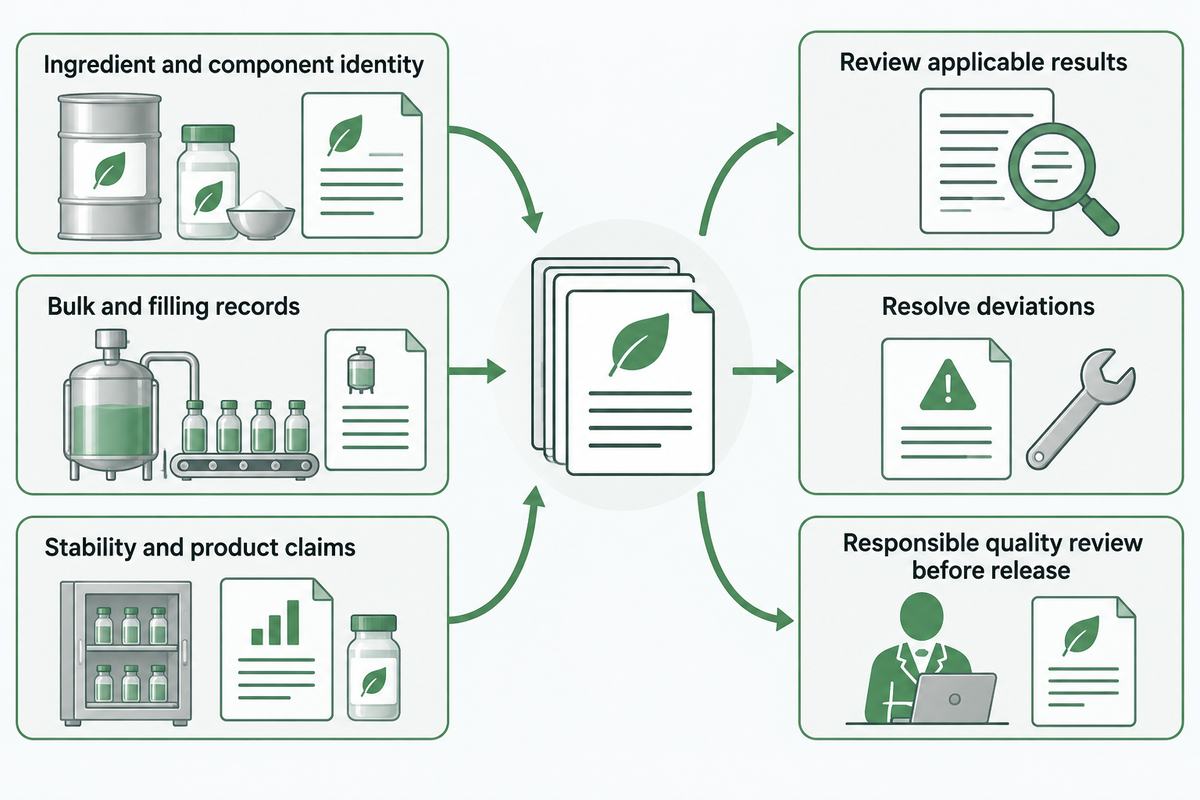
Release the finished configuration only after the responsible quality owner has reviewed the applicable results and resolved deviations. Deviations from requirements must be explained. Evidence must connect ingredient and component identity to the bulk and filling records, stability and product claims.
Involve development, packaging, procurement and quality assurance in artwork and supply commitments before key components become fixed. Development owns the formulation rationale; Packaging the component identity; Procurement substitution; and Quality the release decision and the results of the investigation. NEXO’s quality-management overview provides context for discussing the project’s documentation responsibilities. Check current FDA order status before finalizing the US-market configuration.
For your next discussion, consider the destination market, intended dispensing format, claims and the questions left unresolved by the pilot study. The first order planner will help organize this discussion. The worksheet on pack-life and the worksheet on defect comparison will help define the configuration you intend to sell.
FAQs
How does sunscreen spray manufacturing differ from lotion manufacturing?
The spray development adds a dispensing system which must work with the bulk throughout storage and use. A lotion can pour smoothly but can create an undesirable pattern through the nozzle. The spray project studies package and closure compatibility, continuous output and inhalation exposure, as well as the formula’s stability, protection claims and other quality requirements.
Can the same sunscreen formulation be used in a pump and an aerosol?
A formulation can be developed for more than one system; however, each configuration requires a separate assessment. Different contact surfaces, flow path and propellant contact can be observed. Before transferring a tested formula to a different dispenser, evaluate the ingredient’s permitted dosage form, the package’s function and the relevance of existing results.
Which tests are needed before a spray sunscreen launch?
Stability, microbiological quality, chemical impurities, package function, flammability, inhalation assessment, broad-spectrum testing, water-resistant claims, UVA protection and SPF may all be part of the test program. Choose the appropriate endpoints based on the formula, market and claims. The quality and regulatory teams determine the methods, samples and acceptance criteria for the actual product.
Why does a mineral sunscreen clog its nozzle?
Possible reasons can include agglomerated mineral particles, dried residue, an unsuitable flow path or changes during storage. Blockages alone can’t be used to determine the reasons. Compare identified hardware with retained bulk, inspect the residue and examine dispersion before changing the ingredients used.
Does bag-on-valve make a sunscreen spray nonflammable?
No. Separation of the formula from compressed air or nitrogen doesn’t classify the complete spray’s flammability. The formula may include flammable constituents, and the completed spray requires assessment and labeling. For the actual filling process, the qualified safety review of the filling party should be used. Transport and Consumer product classification, handling and warnings shouldn’t be determined based on the BOV description alone; these should be based on the complete filled product, and applicable regulations.
Can sunscreen spray be applied directly to the face?
FDA advises that sunscreen sprays should never be applied directly to the face. Follow the product’s directions and warnings. A facial-use concept also needs an appropriate formulation, dispensing format and exposure assessment; a fine mist is not evidence of inhalation safety.
Does changing an actuator require new SPF testing?
A change to an actuator doesn’t automatically require new SPF testing. What has actually changed? The output, pattern, materials, and tested sample have to be considered, as well as the relationship of the tested sample to the commercial configuration. The same applies to impact on protection testing. A change record and the rationale behind the change should be retained with the product file. Affected evidence should be resolved before the revised system is released.
References & Sources
- FDA: regulatory actions on over-the-counter sunscreen, current order-status overview.
- FDA: final order OTC000039, spray forms and market-access conditions.
- EU Cosmetics Regulation, consolidated May 2026, Annex VI.
- Berrada-Gomez et al.: particle-size distribution in cosmetic sprays, 2023 research abstract.
- 21 CFR 211.166: stability testing.
- FDA: sunscreen forms, directions and flammability.
- FDA: benzene contamination in drugs.
- FDA: SV Labs warning letter, December 2025.
- FDA: Cosmetic Science Laboratories warning letter, March 2023.
- TGA: sunscreen manufacturing guidance, Australian jurisdiction.
- Happi: BASF researchers on ZnO formulation, June 2020.
Why beauty brands work with NEXO
About NEXO Beauty Labs Manufacturing Support
NEXO Beauty Labs supports skincare, body care, sun care, hair care, and private label brands with formulation, sampling, filling, quality control, and export-ready launch support.
Project Review Before RFQ
Before quotation, we help clarify product category, active direction, formula stage, package choice, compliance market, MOQ, sampling schedule, and required documents.
Request a Cosmetic QuoteCompany Profile // Data Sheet
CompanyNEXO Beauty Labs
Business TypeCosmetic OEM / ODM manufacturing partner
Main ProductsPrivate label skincare, facial serums, moisturizers, cleansers, sunscreen, body care, and hair care products
Manufacturing CapabilityFormula development, sample adjustment, package sourcing, filling, QA/QC, documentation, and export support
RFQ Data NeededProduct type, formula goal, package format, target market, MOQ, claims, timeline, and benchmark samples
Websitenexobeautylabs.com