Get in touch with NEXO Beauty Labs Company


Updated September 2026
Two suppliers quote the same cosmetic product development brief. One comes back at a number that looks generous and a schedule that looks short. The other is three times the price and two months longer. Neither quote is dishonest. They priced different work, because nothing in the request told them which work to price.
Cosmetic product development is the work that turns an approved concept into a manufacturable, legally saleable product: brief intake, formulation, evaluation, stability, packaging compatibility, safety and regulatory review, artwork, scale-up and release. It’s bought as one service and delivered as nine separable packages.
That mismatch is what this article is about. Each of those packages has a different performer and a different closing document. The published stage models that claim to describe the sequence don’t agree with each other, and one publisher doesn’t even agree with itself. So the buyer ends up reconstructing the scope after the invoice arrives instead of before it.
Five findings that shape this guide
- No standards body publishes a specification for what a development brief must contain. We searched for one, including the resource pages of the Society of Cosmetic Chemists, and found none. Every brief template in circulation is a supplier’s or a platform’s own construction.
- Published stage counts run from four to ten, and one publisher’s cosmetics article describes four steps while its general article describes five stages. Stage-Gate International, which owns the methodology, calls its own model “discovery plus five Stages” and “right-sized for context and risk”.
- FDA does not require specific tests before a conventional cosmetic goes on sale. It requires that safety be substantiated and that the records be kept.
- The European Commission has set nine application dates for the cosmetic CMR ban line in under eight years, eight of them already in force. Gaps between application dates run from about 5.6 to 21.3 months, and no two are the same.
- Contract-manufacturing executives answering the same question in one trade-press article give answers that don’t converge: no more than two submissions when the project matches the partner’s capabilities, up to three or four for more demanding skincare and body care, three to seven iterations as a typical range, and one lab’s disclosed projects that ran 27 rounds plus 14 fragrance variations.
What cosmetic product development covers, and where it stops
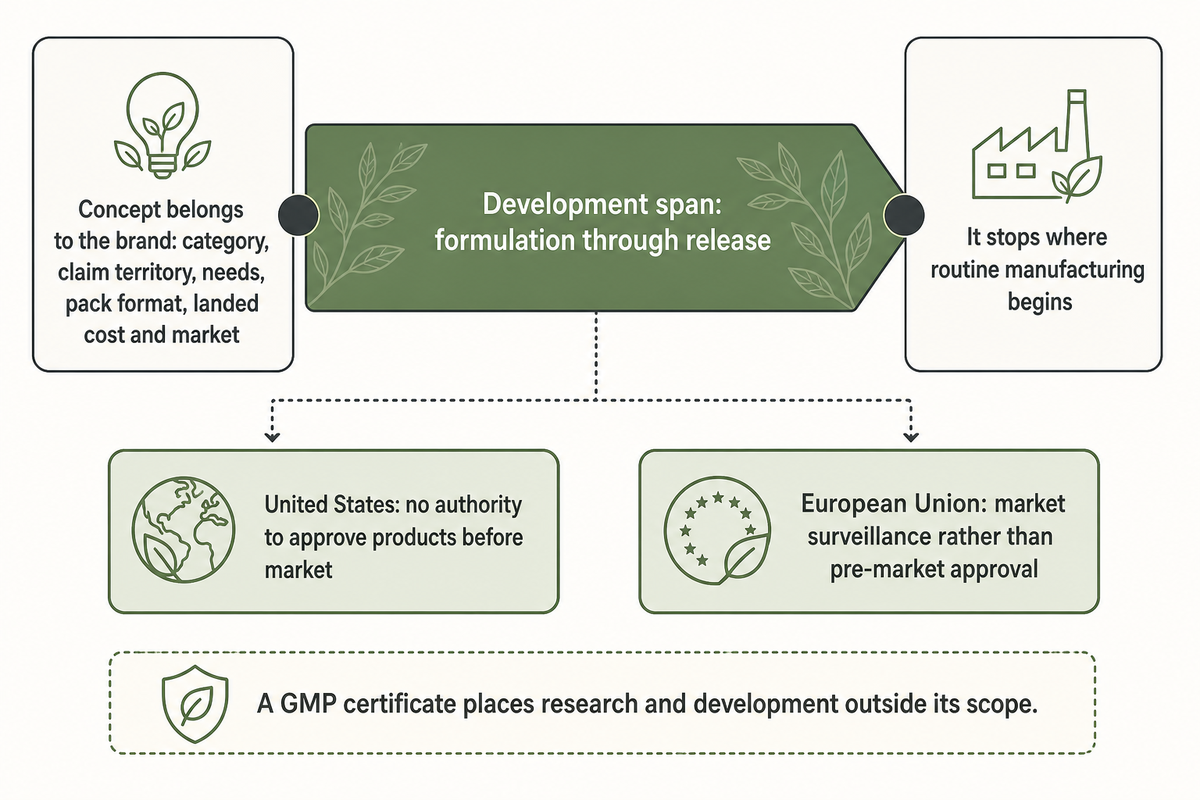
Cosmetic product development covers everything between an approved product concept and a repeatable production process: formulation, sensory and performance evaluation, stability, packaging compatibility, safety and regulatory review, artwork, scale-up and release. It stops where routine manufacturing begins. Its outer boundary is set mostly by contract rather than by any single regulatory definition.
Defining the product concept comes first and belongs to the brand: category, claim territory, target consumer needs, pack format, landed cost and market. Formulation starts only once that concept is fixed enough to be tested against. Mixing the two is the most expensive habit in the category, because a concept change reopens bench work that was already signed off. Treat the brief as a strategic document rather than a shopping list: it’s the point where a new cosmetic product stops being an idea and becomes a set of testable requirements.
Where the boundary sits legally surprises most first-time buyers. In the United States, FDA’s product testing page for cosmetics states plainly that it “does not have the legal authority to approve cosmetic products and ingredients (other than color additives) before they go on the market”, and the agency’s small business and homemade cosmetics fact sheet adds that “FDA does not require specific tests to demonstrate the safety of individual cosmetic products or ingredients”. What the law does require is that the manufacturer, packer or distributor whose name appears on the label “ensure adequate substantiation of safety” and keep the records that support it. Two duties then sit separately under the Modernization of Cosmetics Regulation Act: manufacturers and processors register their facilities with FDA and renew that registration every two years, while a responsible person lists each marketed product, including its ingredients, and updates that listing annually. Facility registration and product listing are different obligations with different clocks and often different owners, a distinction almost no supplier page draws.
The European position is built the other way round. Regulation (EC) No 1223/2009 works through market surveillance rather than pre-market approval, and, as Chris Flower and Emma Meredith of the UK trade association CTPA put it in a 2017 Cosmetics & Toiletries article last revised in 2022, “full responsibility for ensuring product compliance and safety lies with the Responsible Person”. There’s no authorisation to obtain and no file to lodge for approval; there’s a named party who must be able to produce the evidence on demand.
⚠️ A certificate does not cover this work
ISO 22716, the good manufacturing practices guideline for cosmetics, places research and development outside its scope. Nothing in a factory’s GMP certificate says how it runs a development programme. Most of the packages below sit in that gap: a manufacturing certificate speaks to how batches are made and released, not to how a development programme is run.
The nine work packages inside a development programme
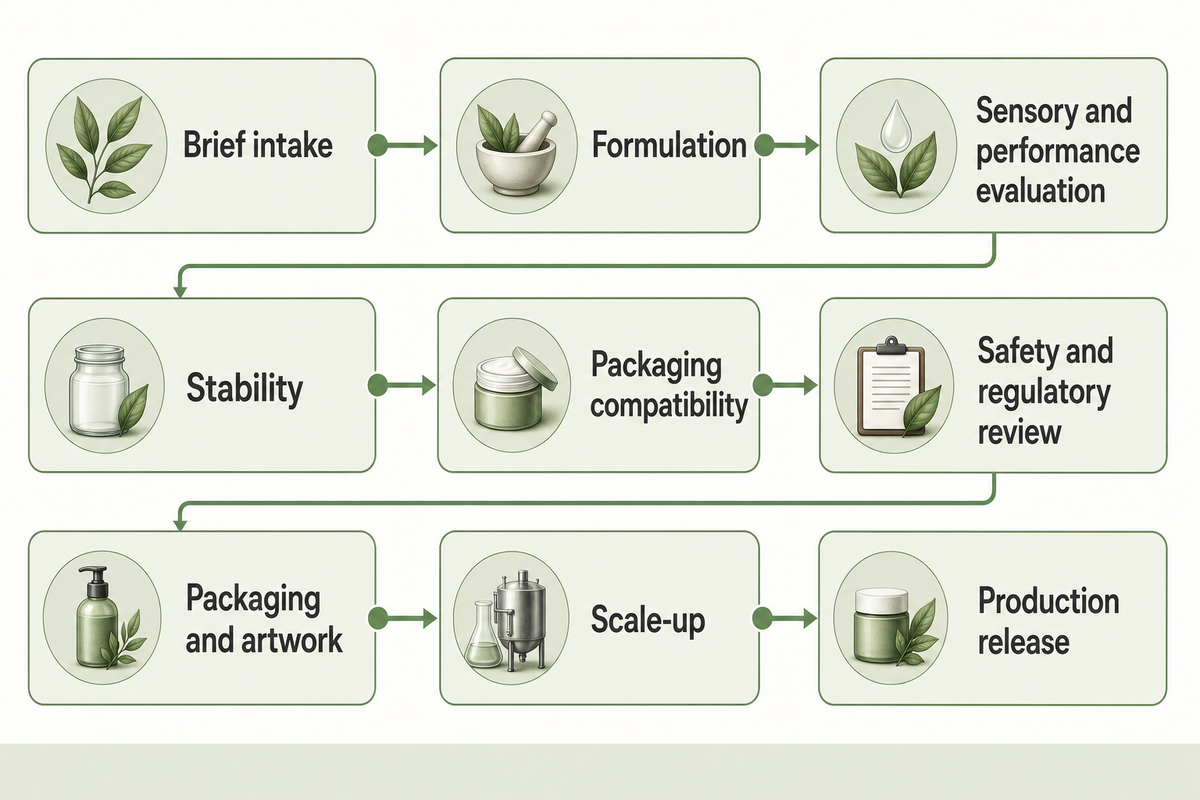
A development programme divides into nine work packages: brief intake, formulation, sensory and performance evaluation, stability, packaging compatibility, safety and regulatory review, packaging and artwork, scale-up, and production release. Each package has a performer, an output document, and an edge where responsibility passes to somebody else. Only one of the nine has its output named in law: the safety assessment, which Regulation (EC) No 1223/2009 requires as a Cosmetic Product Safety Report before an EU launch. Several of the other eight feed that file rather than sitting outside the law: Annex I makes stability data and packaging-material information required content of the safety report. The rest are defined by contract, which is why a quotation can leave them unnamed and nobody notices until the file has to be assembled.
Nine-Package Development Scope Bill
A scope bill lists each package with its performer, its output document and its stated exclusion, so a quotation can be read line by line rather than as one number.
| Work package | Who usually performs it | What it produces | What it does not cover |
|---|---|---|---|
| 1. Brief intake | Brand, with the developer or the manufacturer’s project lead | A written brief: category, claim territory, target cost, pack format, markets | Feasibility. Accepting a brief is not a finding that it works at the bench |
| 2. Formulation | Cosmetic chemist, in house or independent | Bench formula, batch sheet, numbered submission samples | Ownership of the formula, unless the agreement says so in writing |
| 3. Sensory and performance evaluation | Brand panel plus laboratory | A round-by-round evaluation record against agreed acceptance criteria | Consumer study evidence. Panel results do not substantiate a marketing claim |
| 4. Stability | Third-party or in-house laboratory | A stability report on a stated protocol, temperature set and duration | A prescribed duration. No published standard fixes one |
| 5. Packaging compatibility | Laboratory, using the pack supplier’s material data | A compatibility observation record on the final pack, not a stand-in | Transit, drop and distribution testing |
| 6. Safety and regulatory review | Safety assessor and regulatory specialist | Safety assessment (a Cosmetic Product Safety Report in the EU) and an ingredient review | Advertising copy approval. Regulatory compliance is not claim clearance |
| 7. Packaging and artwork | Brand design team, with the manufacturer’s technical check | Print-ready artwork, ingredient declaration, barcodes, pack copy | Proofing rounds. These are rarely priced into a development quote |
| 8. Scale-up | Process and manufacturing team | Pilot batch record and a production-scale process description | A single step. Bench to full batch usually passes through several intermediate scales |
| 9. Production release | Quality control function at the manufacturer | Batch record, certificate of analysis, retained samples | Market notification or facility registration, which stay with the brand |
Package 7 is where most first programmes lose time. Artwork carries the ingredient declaration, and the declaration changes whenever the formula changes, which is why the cosmetic labeling requirements for your destination markets belong in the brief rather than in the week before printing.
One hypothetical case runs through the rest of this guide, so the arithmetic can be checked rather than taken on trust. The Serum Launch Case is a face serum with a retail date 20 weeks away, a 12-week stability and compatibility plan, a 6-week preservative effectiveness test running inside that plan, and artwork that can’t go to print until the ingredient declaration is final. The figures are illustrative; the dependencies between them aren’t.
Why published stage counts disagree: four steps, seven stages or nine packages
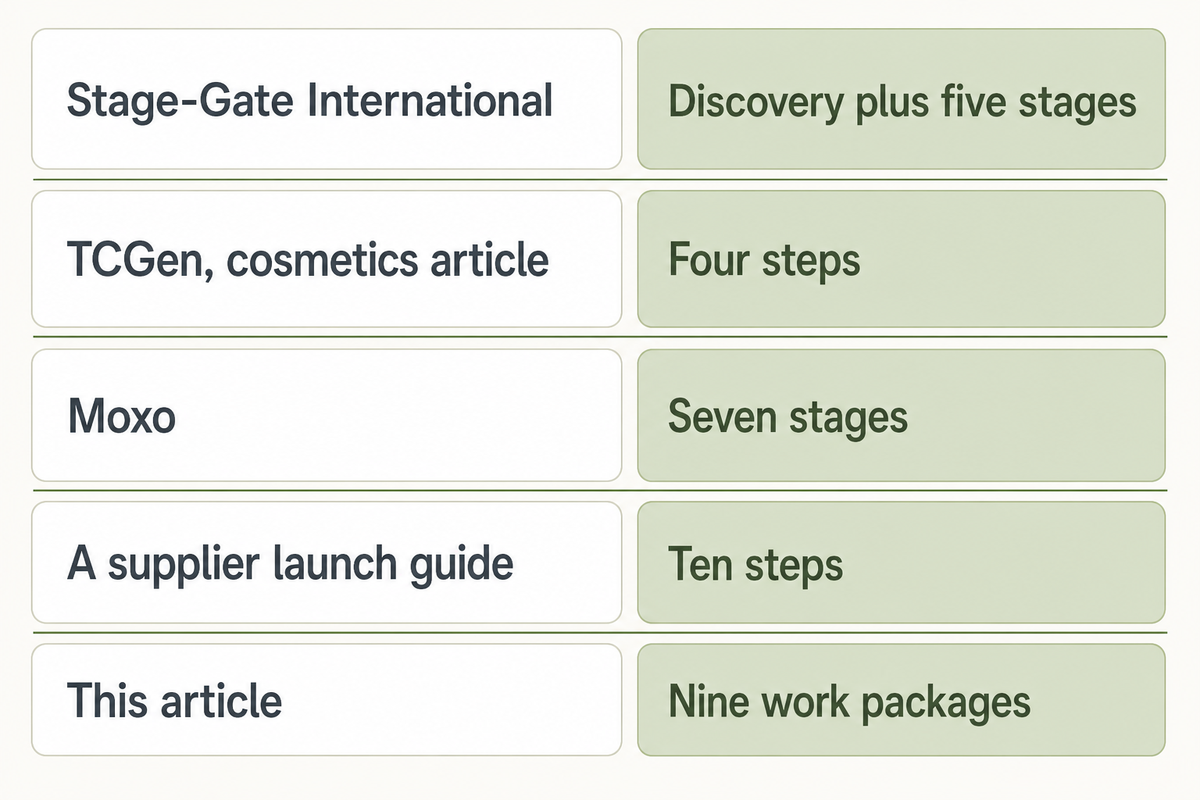
Published stage counts disagree because no standards body defines them. ISO 22716, the one international standard written for cosmetics operations, places research and development outside its scope, so there is no normative count to appeal to. Counts spanning four to ten circulate in print, and the firm that owns the best-known methodology describes its own process as right-sized for context and risk. Each published count describes its publisher’s audience, not a property of the cosmetic product development process itself.
Published Stage-Model Concordance
A concordance sets named published models side by side, with the count each one prints and the work each one merges or leaves out.
| Published model | Count as published | What it merges or leaves out | Why the count differs |
|---|---|---|---|
| Stage-Gate International, the methodology owner | Discovery plus five stages | Industry-neutral; no cosmetic-specific package appears | Its own page states the system is “right-sized for context and risk” |
| TCGen, general stage-gate article | Five stages | Gates described separately from stages | Written for a cross-industry product audience |
| TCGen, cosmetics article | Four steps, with eleven sub-activities | No packaging package and no regulatory package | Same publisher, different reader. Nothing requires the two documents to match |
| Designorate | Six stages and five gates | States outright that stages can be merged to shorten a timeline | Its text says the number “can be adapted based on the targetted aim” |
| Moxo | Seven stages | No stability package, no safety assessment | Product-management audience, unregulated category assumptions |
| A skincare contract manufacturer’s guide | Six steps | Testing and regulatory review merged into one step | Merging shortens the visible path in a sales document |
| A training provider’s published process | Seven stages | No supplier selection, no pilot batch, no consumer testing | Its per-stage ranges sum to a longer span than its own headline duration |
| A retail sourcing platform guide | Seven stages | No packaging, no regulatory review, no scale-up | Written for retail buyers rather than for developers |
| A supplier launch guide | Ten steps | Most granular count we found in print | Granularity is a presentation choice, not a finding |
| This article | Nine work packages | Packages rather than stages, so each one carries a performer and an output | Our decomposition for buying purposes. It is not a standard and does not claim to be |
Read the fourth row again, because it settles the question. Designorate doesn’t merely publish six stages; it writes that the number can be adapted to the aim of whoever is running it. When the people who publish the models tell you the count is adjustable, a buyer who asks “how many stages should my project have” is asking a question with no answer. The useful question replaces the count with a list: which pieces of work are priced, and who performs each one.
Scope Shadow: the work no quotation names
The Scope Shadow is unpriced work that falls to the brand because no document named an owner for it. Artwork proofing, ingredient declarations, claim wording, retention samples and change requests after approval all sit there. The work still gets done and still gets paid for, usually out of the buyer’s own hours.
Three published sources point to the same mechanism from different directions, and none of them is a regulator, so the evidence here is weaker than in the sections above. Say only what they say. One product-development software vendor’s published guidance on writing a brief lists failure to state who runs and who pays for testing among the common brief errors it sees. A practitioner note on formula ownership from a cosmetics testing laboratory describes what happens when a manufacturer revises a formula and those development hours were never separately invoiced: the manufacturer may have grounds to keep the revised formula and method. A formulators’ community guide adds the commercial consequence in plain words: if you don’t know and don’t own your formula, changing producer becomes close to impossible.
Four questions that expose a Scope Shadow
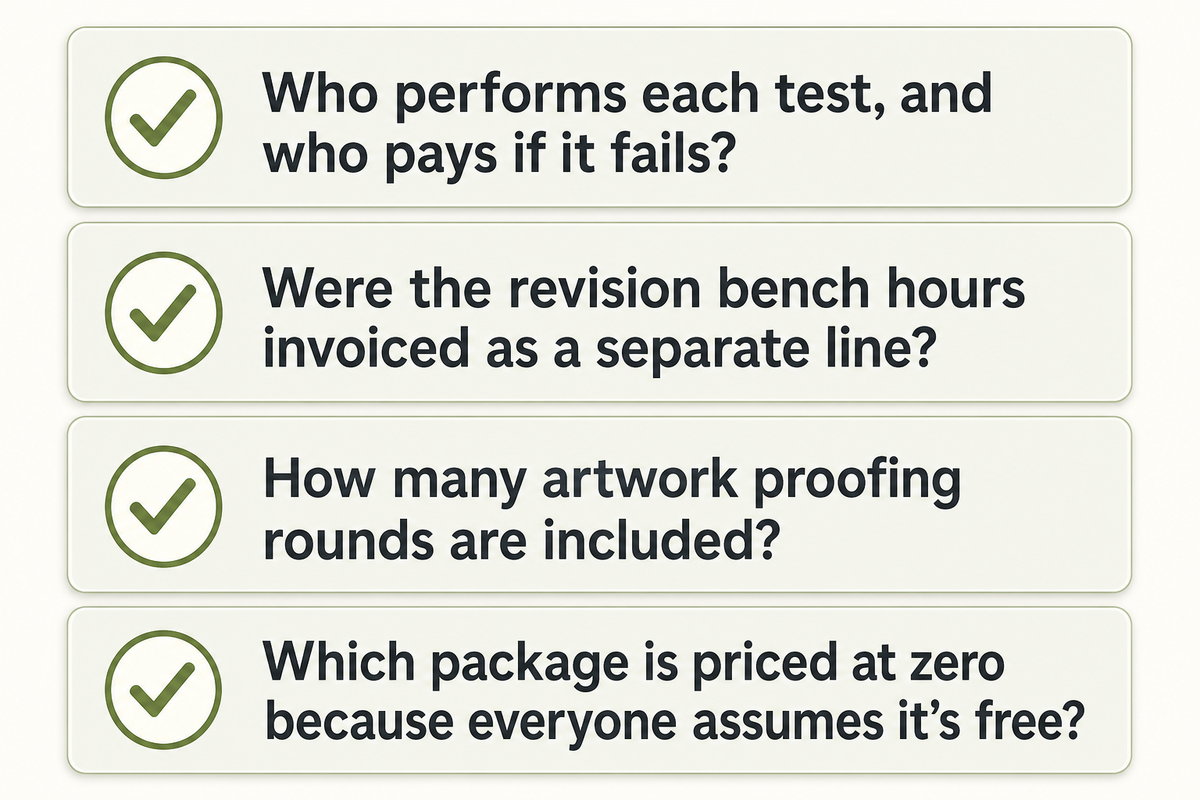
- ✔Who performs each test, and who pays if it fails and has to run a second time?
- ✔If the manufacturer revises the formula, were those bench hours invoiced as a separate line? If not, who owns the revision?
- ✔How many artwork proofing rounds are included, and what happens on the fourth?
- ✔Which of the nine packages is priced at zero because everyone assumes it’s free?
Free bench work is the most reliable shadow of the four. It looks like a discount at the quotation stage and reads as an ownership question two years later, when a second supplier asks for the formula you thought you had bought.
Who performs what: brand, developer, cosmetic chemist, manufacturer, laboratory
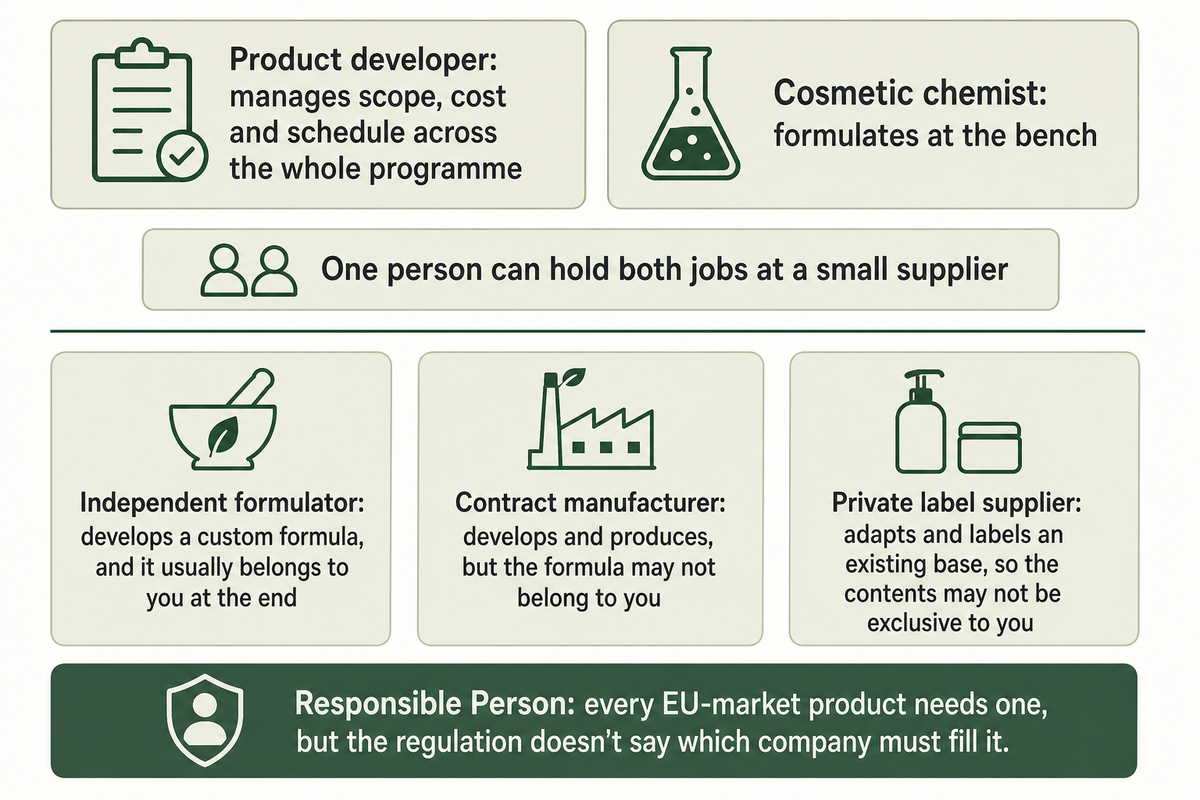
A product developer manages scope, cost and schedule across the whole programme. The cosmetic chemist formulates at the bench. One person can hold both jobs inside a small supplier, and that merger changes who’s accountable for a repeat rather than the expertise the work needs.
Underneath the job titles sit three commercial arrangements, and a formulators’ community guide separates them cleanly. An independent formulator develops a custom formula, and the formula usually belongs to you at the end. A contract manufacturer can develop and produce, sometimes discounting the laboratory work if you commit the production volume, in which case the formula may not belong to you. Private label suppliers adapt and label an existing base, so the product looks like yours while the contents may not be exclusive to you. Route names appear later in this guide; here the point is narrower: these are different counterparties, not different amounts of technical skill. Collaboration across that gap is a contract question before it’s a relationship question.
Responsibility for the finished product is a separate axis again. The Responsible Person is a role Regulation (EC) No 1223/2009 requires every EU-market product to have, but the regulation doesn’t say which company must fill it. Writing in Cosmetics & Toiletries, consultant Theresa Callaghan draws the line by company size rather than by route:
“For major multinationals, they take role of the Responsible Person (RP) on themselves since they usually have all areas of expertise required within their company organization.”
Callaghan continues that private label and retail brands, more often than not, must outsource that role, and that this is where the difficulty starts. Two practical consequences follow for a smaller brand. The party that carries the compliance role is often not the party that made the product, so the evidence has to travel between organisations on a schedule somebody has to own. And the cost of a repeat lands wherever the contract left it: if a batch fails release and the acceptance criteria were never written down, the argument is about money, not about chemistry.
How the programme shifts across skincare, hair care and body care
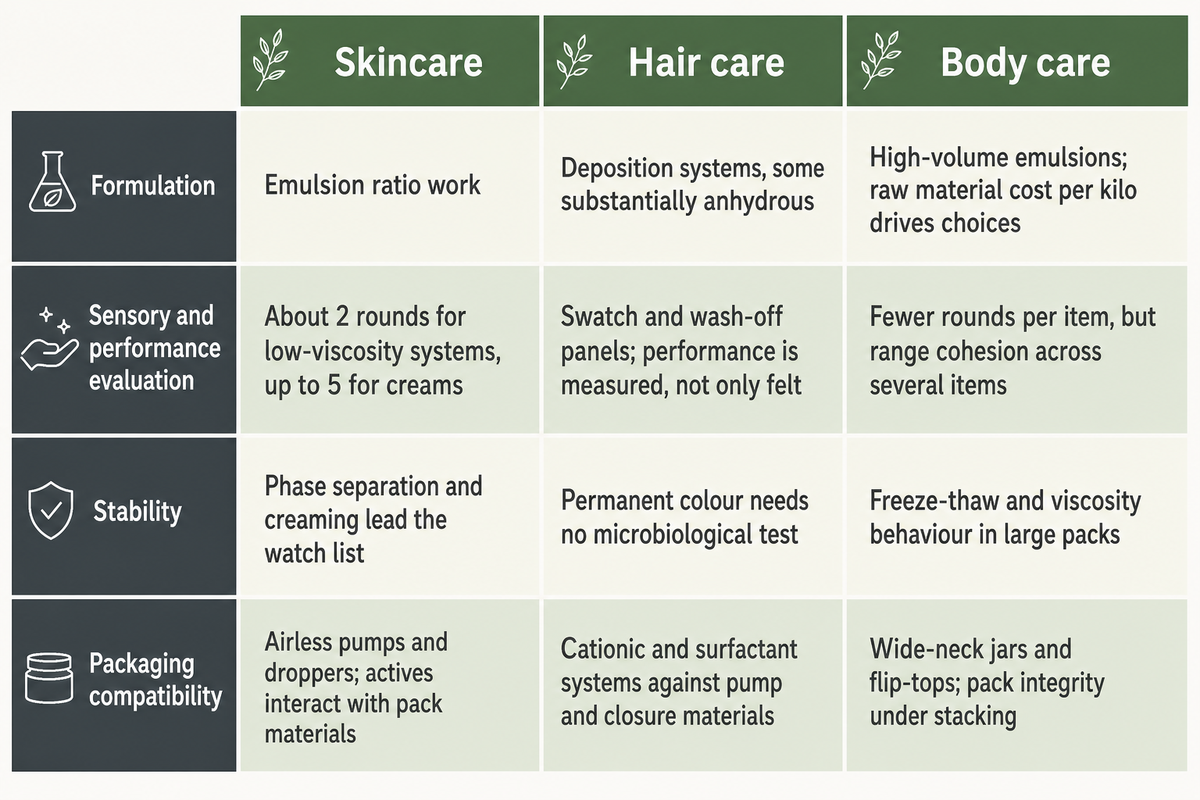
Category changes which packages get heavy, because the chemistry differs. Skincare emulsions, hair conditioning systems and large-format body care products fail in different ways, so a stability protocol written for one watches the wrong attributes in another. Skin care, hair care and body care are three engineering problems wearing one category name. Personal care breadth isn’t a marketing word here; it’s a scheduling variable.
The documentary evidence for that sits in two patent families. Skincare formulation carries that weight in the emulsion itself. One granted United States patent for a skincare emulsion base names the ratio of alkane texture enhancers to lipid emulsifiers as the key feature of the invention, tying skin feel and physical stability to one shared variable. Its hair care counterpart, a published application, claims a substantially anhydrous conditioning system built on cationic surfactants and fatty compounds in propylene glycol. Different physical chemistry, different failure modes, different attributes a protocol must watch. Practitioners describe the same split from the bench: Valerie George, writing in Happi, notes that a cleanser and a hair colour differ in physicochemical properties, packaging and evaluated attributes, and that permanent hair colour needs no microbiological testing at all. Hair results are functional before they’re aesthetic, which changes what a panel is asked to score.
Three-Category Variance Panel
A variance panel maps each of the nine packages against skincare, hair care and body care, so a buyer can see which package gets heavier before quoting.
| Work package | Skincare | Hair care | Body care |
|---|---|---|---|
| 1. Brief intake | Claim territory and texture vocabulary dominate | Performance vocabulary dominates: slip, hold, wash-out | Format, fragrance and unit cost dominate |
| 2. Formulation | Emulsion ratio work; one granted patent names the emulsifier ratio as its inventive core | Deposition systems, including substantially anhydrous ones in published applications | High-volume emulsions and surfactant systems; raw materials cost per kilo drives choices |
| 3. Sensory and performance evaluation | About 2 rounds for low-viscosity systems, up to 5 for creams and sunscreens, per EnJunaya Canton of Zuhuri Beauty | Swatch and wash-off panels; performance is measured, not only felt | Fewer rounds per item, but range cohesion across several items to hold |
| 4. Stability | Phase separation and creaming lead the watch list | Different attribute set entirely; permanent colour needs no microbiological test | Freeze-thaw and viscosity behaviour in large packs |
| 5. Packaging compatibility | Airless pumps and droppers; actives interact with pack materials | Cationic and surfactant systems against pump and closure materials | Wide-neck jars and flip-tops; large-bottle pack integrity under stacking |
| 6. Safety and regulatory review | Leave-on exposure assumptions; actives and claim support carry the file | Hair colourants sit under their own EU regime | Rinse-off exposure assumptions lighten parts of the file |
| 7. Packaging and artwork | Small panels, dense ingredient declarations | Multi-language range artwork with shared components | Larger panels; declaration space is rarely the constraint |
| 8. Scale-up | Shear-sensitive emulsification; small batches magnify process drift | Viscosity build and neutralisation steps need process control | Filling speed and line changeover dominate the economics |
| 9. Production release | Retains and certificate of analysis per batch | Shade and performance checks added where colour is involved | Same evidence set at larger batch sizes |
Rows 2 and 4 rest on the two patent documents and the named chemist cited above. The operational rows are this article’s reading of how those chemistry differences land on a schedule, not a published finding. For the skincare-only path in more depth, see our skincare product development process guide.
The evidence that closes each package
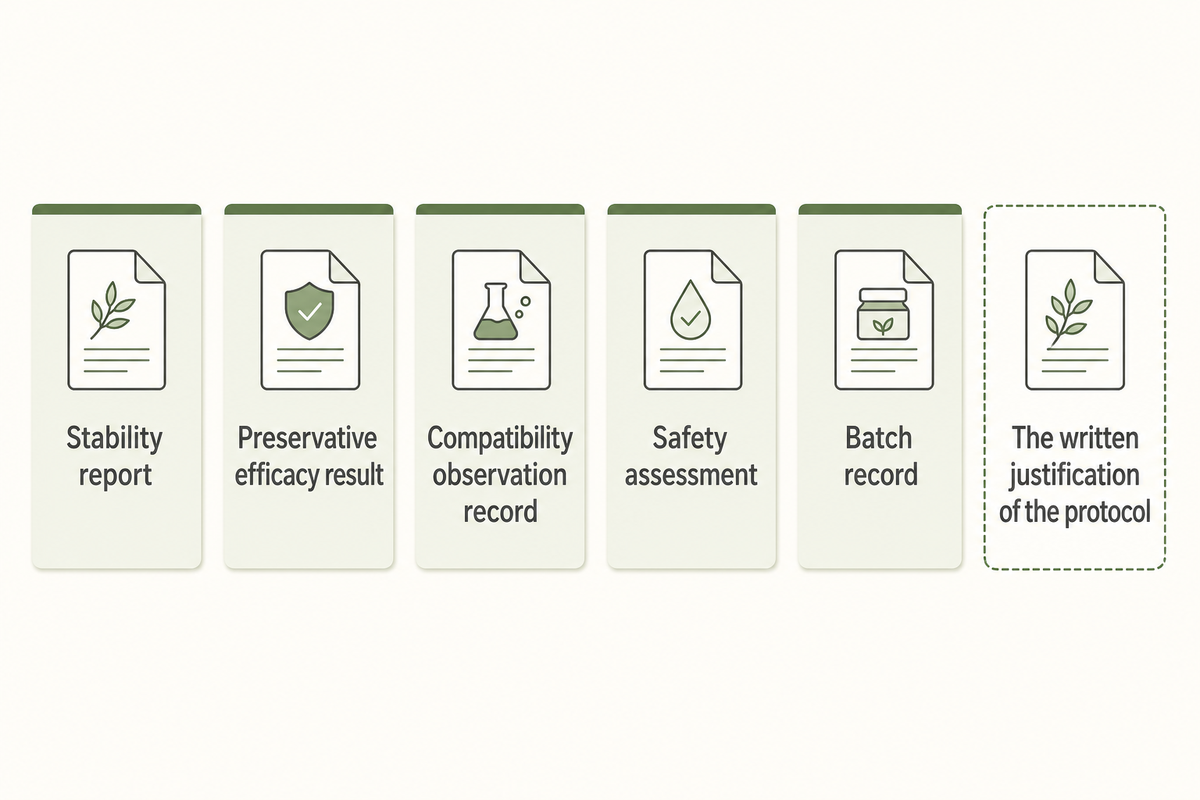
Each package closes on a document, not on a status update. Stability report, preservative efficacy result, compatibility observation record, safety assessment, batch record: five named artefacts that a buyer can ask for by name. Verification of a programme means holding those documents, not being told the work went well. One working definition of a high-quality programme is that every one of those documents exists and can be produced on request.
One artefact deserves its own paragraph, because the international standards body that might have specified it has said in print that it will not. ISO published a technical report on cosmetic stability testing, and its own summary states:
“Considering the wide variety of cosmetic products, storage and use conditions, it is not possible to define a single way to assess product stability. Therefore, it is up to the manufacturer to specify and justify the stability protocol to cover test methods, specifications and conditions at which products will be tested.”
Note the second verb. The manufacturer must specify a protocol and also justify it, which makes the justification a deliverable a buyer is entitled to request. EU law reaches the same place from the other side: Commission Implementing Decision 2013/674/EU requires that the composition used for stability testing correspond to the product actually placed on the market, without prescribing any duration, temperature or method. Ask for the protocol, its reasoning, and confirmation that the tested composition matches the one being shipped. Safety standards in this category are written as duties rather than as a test list, which is why the file, and not a certificate, is the thing to ask for.
The launch documents sit alongside the technical ones. One consultant article in Cosmetics Business names the European set explicitly: artwork creation and review, a Cosmetic Product Safety Report, a Product Information File, pre-launch notification for Europe and the UK, and Safety Data Sheets for export markets. Claims support runs on its own clock inside that set; where a skin-tolerance claim is made, dermatological testing is part of it, and the same article puts claims support at up to a couple of months. None of that is a one-off. Callaghan and the CTPA article both describe safety files as maintained objects; adverse effect data has to reach the safety assessor through an agreed route, and when the formula changes, the evidence behind the claims has to be confirmed as still valid. Stability testing and pack compatibility are the two heaviest tests in the plan, and both are worked through in our stability protocol design guide and in packaging compatibility testing.
In the Serum Launch Case the evidence set is five documents: a stability report on a stated protocol, say 12 weeks at 40 °C and 75% relative humidity if that is what gets specified and justified; a preservative effectiveness result at 6 weeks; a compatibility record taken on the final pack rather than on a stand-in; the safety assessment; and the batch record with retained samples at release. Five documents, five owners to name in the quote.
Where development timelines actually break
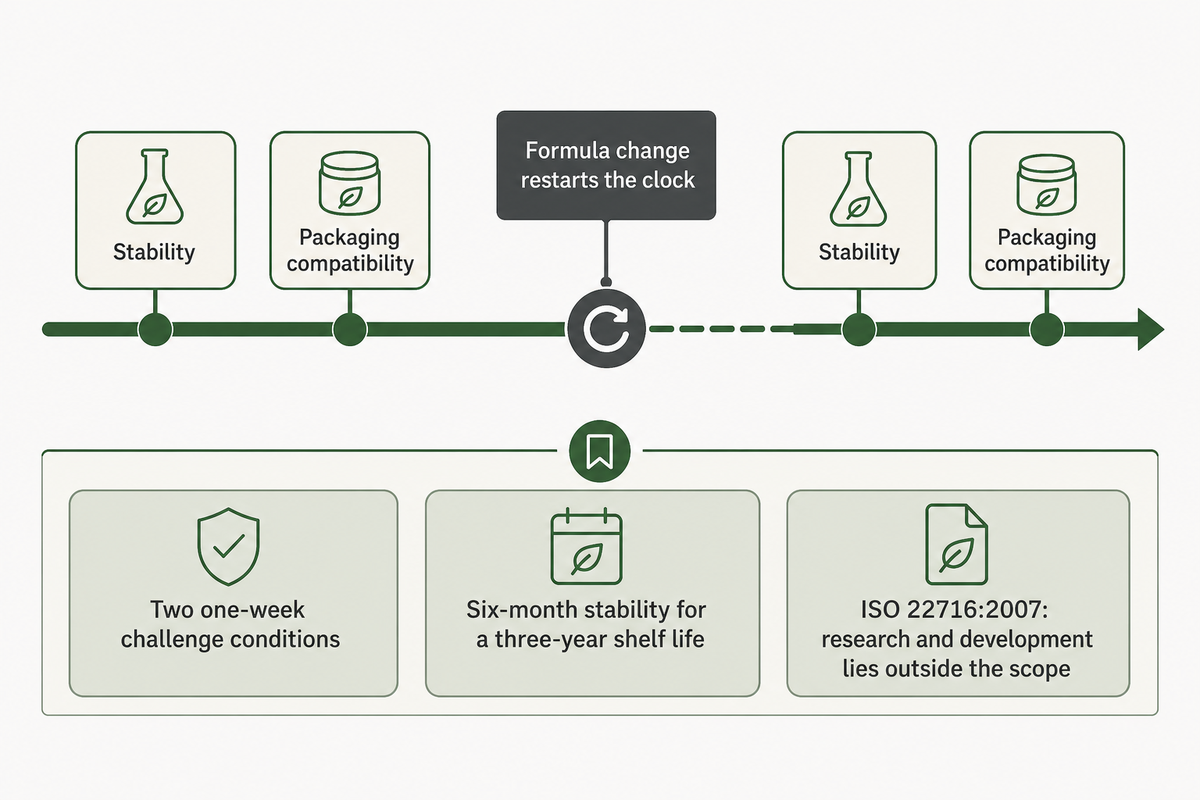
Timelines break at package dependencies, not at supplier effort. Published sources disagree openly about how long stability work should run, and the disagreement is on the record rather than hidden. Rebuild your own date from the dependency chain instead of adopting whichever single figure a supplier prints.
| Published position | What it states | What it is measuring |
|---|---|---|
| A retail sourcing platform guide | One week at 122 °F plus one week at 39 °F | Two one-week challenge conditions |
| A stability testing service page | 12 weeks at 40 °C and 75% relative humidity, sampled at weeks 0, 2, 4, 8 and 12 | An accelerated schedule on a pharmaceutical model |
| A manufacturer’s own guide | 12 weeks minimum, used to support an 18 to 24 month shelf life | Accelerated result converted to a claimed shelf life |
| Valerie George, cosmetic chemist, Happi, 2 January 2025 | Six-month stability for a three-year shelf life, offered explicitly as her own preference | A named practitioner’s convention, stated as such |
| A reader’s letter in that same column | One three-month test read as two years by some colleagues and three by others | The disagreement itself, reported from the bench |
| Consultant article, Cosmetics Business | Stability and compatibility plan 12 weeks minimum; preservative effectiveness around 6 weeks; claims support up to a couple of months | Programme duration, not shelf life |
| Commission Implementing Decision 2013/674/EU | No duration, temperature or protocol prescribed; testing must suit the product and its reasonably foreseeable use | Nothing, deliberately |
| ISO 22716:2007 | Research and development lies outside the scope of the standard | Nothing, deliberately |
Reading down that column shows why no honest single number exists, and one named chemist explains the cause rather than adding a ninth figure:
“Stability testing is interesting because there is no universal protocol that dictates how to calculate the stability of a product and its corresponding shelf life. Organizations follow similar protocols, but there are slight differences between them, such as the temperatures and time points evaluated.”
Worked example: one revision, six weeks
Return to the Serum Launch Case. Its 12-week stability and compatibility plan starts the day the bulk is made, with the 6-week preservative effectiveness test running inside it. 5 weeks in, marketing approves a change to the fragrance dose. The approval takes one afternoon. Now do the arithmetic on the evidence.
The composition on test is no longer the composition that will ship, and 2013/674/EU requires those to correspond, so the 5 weeks of accumulated data can’t carry the new formula. New bulk is made 6 weeks in, a fresh 12-week clock starts, and the evidence date moves from 12 weeks to 18 weeks. Preservative effectiveness reruns from that point and finishes about 6 weeks later, inside the new stability window, so it costs nothing extra. Net movement in the Serum Launch Case: 6 weeks, out of a one-afternoon decision. The consultant article quoted above adds the tail risk in one sentence: if any test in the plan fails, “the whole testing process will need repeating”. Fragrance is a known driver of extra rounds, so this isn’t a hypothetical: it’s the ordinary case for which a schedule should already hold a buffer.
Round counts behave the same way. Contract-manufacturing executives answering the same question in one Beauty Independent article, published in May 2024, land in six different places. One says a well-matched project should take no more than two submissions, and that more innovative claims or intensive skincare and body care may take up to three or four. Another gives three to seven iterations as the typical range. A third says the shared aim is approval within one to three rounds, then adds that most development projects in reality go beyond three. A fourth says a custom formula should ideally be perfected within two submissions but reports its own average running to two or three. A fifth reports formulating 100% of that lab’s projects to specification within four rounds, with over 90% inside three. And one discloses projects that ran 27 rounds, plus 14 fragrance variations on top of those. Cross-industry product-development writing quotes its own headline durations, but those are measured on a different scope and belong nowhere near the cosmetic figures above. Build the date from the packages you actually bought.
What changed in the last five years, and what it means for a buyer
Ingredient availability has become a dated input rather than a fixed one. Innovation in raw materials keeps arriving; the legal list it has to land on keeps moving underneath it. Anyone writing a brief today is already inside a legal clock they can’t fully read, and the practical response is to schedule a review point rather than to assume today’s ingredient list survives to launch.
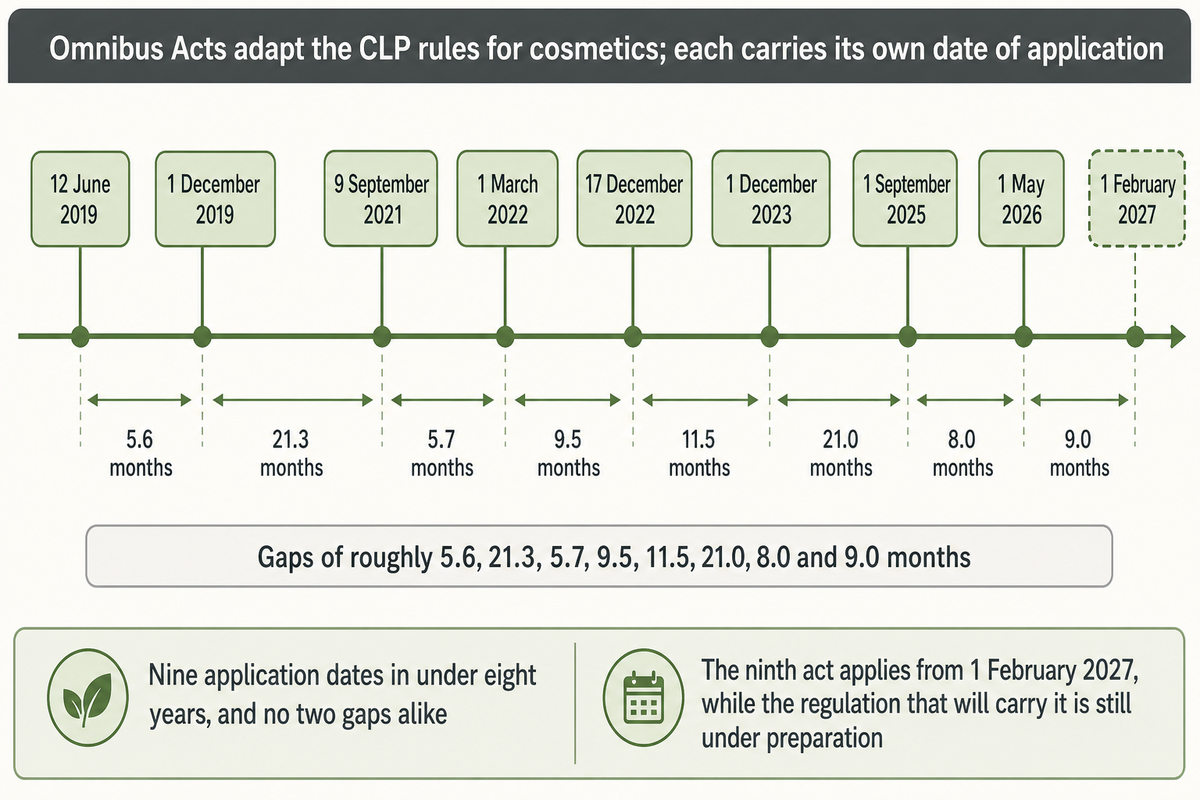
The European Commission publishes the ladder itself. An Omnibus Act implements each adaptation to technical progress under the CLP rules for cosmetics, each with its own date of application, and nine of them now sit in the table: 12 June 2019, 1 December 2019, 9 September 2021, 1 March 2022, 17 December 2022, 1 December 2023, 1 September 2025, 1 May 2026, and 1 February 2027. Subtracting neighbours gives intervals of roughly 5.6, 21.3, 5.7, 9.5, 11.5, 21.0, 8.0 and 9.0 months. The second act is the one complication in that series: part of its scope applied later, on 1 May 2020, and the intervals above count only the first date of each act. Nine application dates in under eight years, and no two gaps alike, which means the length of the current gap tells you nothing about the next one.
One row deserves attention from anyone planning into 2027. The ninth Omnibus Act applies from 1 February 2027, while the regulation that will carry it is still listed by the Commission as under preparation. The deadline exists in law before its final text does. Twelve substances appear in the published list as candidates that could be subject to measures under Article 15 of the Cosmetic Products Regulation, ozone and dinitrogen oxide among them, and they’re candidates, not bans. Two further dates are already fixed: Regulation (EU) 2026/78 has applied since 1 May 2026, and Regulation (EU) 2026/909 carries a compliance date of 1 January 2027. If your launch lands after any of those dates, put a named ingredient review into the schedule now, owned by a person rather than by “regulatory”.
Supplier-side guidance hasn’t kept pace with that. The search results for this term are still dominated by job listings and training courses rather than by buyer-facing material, which is a fair summary of why buyers keep rebuilding scope themselves. Two measurements we ran with third-party keyword tooling on 2 September 2026 read the term over different windows, and they disagree, which is why both are printed. On a five-year view, data from that DataForSEO pull puts the term up 41.5%: an average of 173 United States searches a month across the last twelve months against 122 a month in the window two to three years earlier, over the 59 months of history the tool returned. On the trailing six-month window a second pull reads minus 21.3%, with May to July 2026 averaging 123 searches a month against 157 for February to April. Read together they say the query itself is searched more than it was five years ago and less than it was in the spring; given who those results are aimed at, that is a signal about the term, not a measurement of buyer demand. Our own sweep of what answer engines cite for this term returned citations from only one of the two engines queried: 60 across 50 distinct hostnames, with no hostname cited more than three times. No source owns this answer, which is the opportunity and the warning at once. Sustainability requirements are moving on a similar footing, with sustainable packaging and recycled-content questions arriving in briefs faster than shared definitions arrive with them. Trend pressure across the beauty industry pushes new actives into briefs faster than the cosmetics industry settles what they mean, and an innovative ingredient is worth nothing to a launch if it leaves the permitted list before the launch date.
Choosing a development route without buying the label
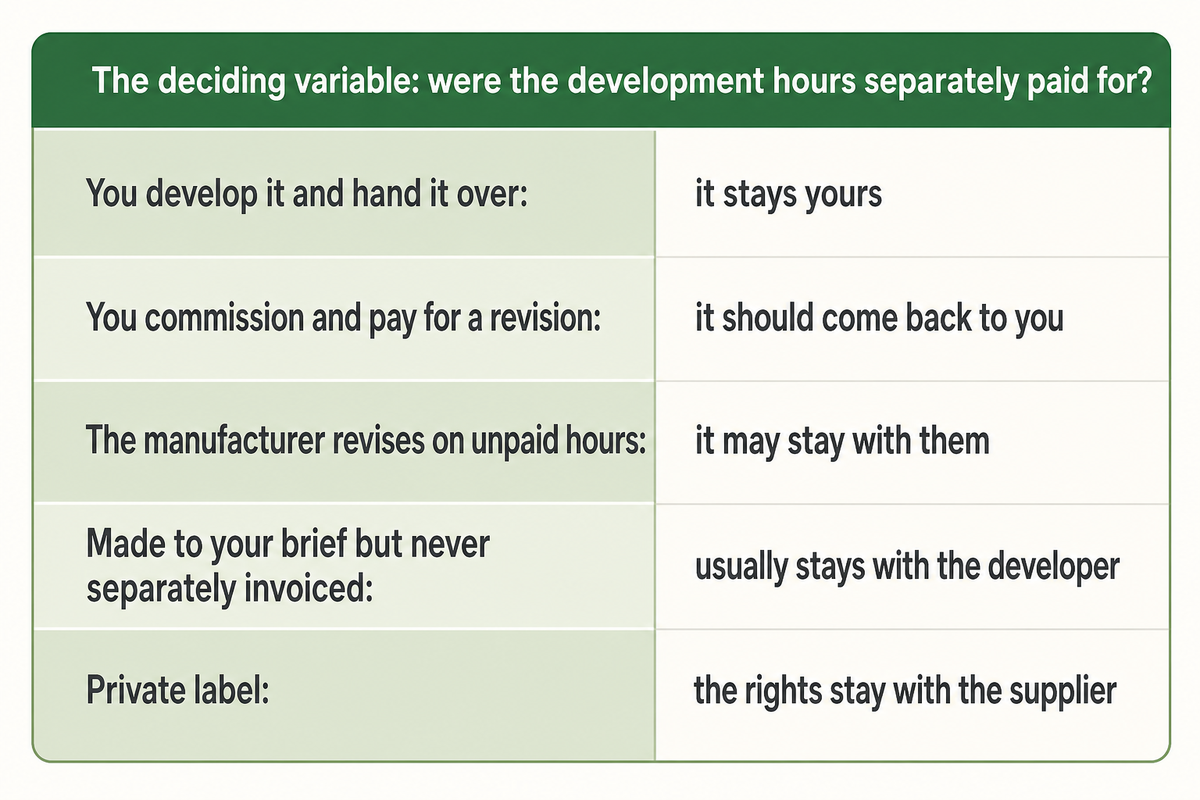
Route names describe commercial packaging, not the work removed. A published practitioner framework from a cosmetics testing laboratory sets out five situations covering formula ownership, and the variable that decides the outcome is never the route name; it’s whether the development hours were separately paid for.
In that framework, a formula you develop and hand over stays yours; a revision you commission and pay for should come back to you; a revision the manufacturer makes on unpaid hours may stay with the manufacturer; a formula developed to your brief but never separately invoiced usually stays with the developer, leaving you able to sell the batches but not to take the formula elsewhere; and private label leaves the rights with the supplier, with reverse engineering ruled out. The source is a testing laboratory rather than a law firm, describes itself as general advisory in nature, and dates from July 2016, so treat it as a map of where arguments arise and settle the specifics in your own agreement. Two situations under the same route label can end in opposite ownership, which is the whole point: the buyer who chooses by name hasn’t decided the thing that decides whether they can change producer later. A route comparison sits in our private label and white label comparison; if a custom route is the honest answer for your project, our ODM cosmetic product development page sets out how NEXO Beauty Labs scopes that work, and our custom cosmetic formulation page covers the bench packages inside it.
When a full custom programme is the wrong purchase
Custom development is a poor fit in three situations that show up repeatedly in published practitioner guidance: when the launch window is shorter than the evidence chain, when the volume can’t carry the tooling and component minimums, and when the category sits outside the formulator’s actual specialisation. Each one is checkable before you sign.
On timing, a 12-week minimum stability and compatibility plan has to clear before the market notification can go in, so a brand that needs stock in eight weeks is buying a delay, not a formula. On volume, a formulators’ community guide notes that private label starts cheaper and that custom work ultimately gives you the most flexibility. That flexibility only pays back over repeat production. On category fit, the same guide warns that a chemist who has worked on hair products will not automatically know how to make hair colour, that colour cosmetics is a specialty few formulators have, and that formulators chasing larger accounts tend to push small projects down the queue. Ask about current workload and about category-specific past work before signing, not after.
Writing a development request that produces comparable quotes
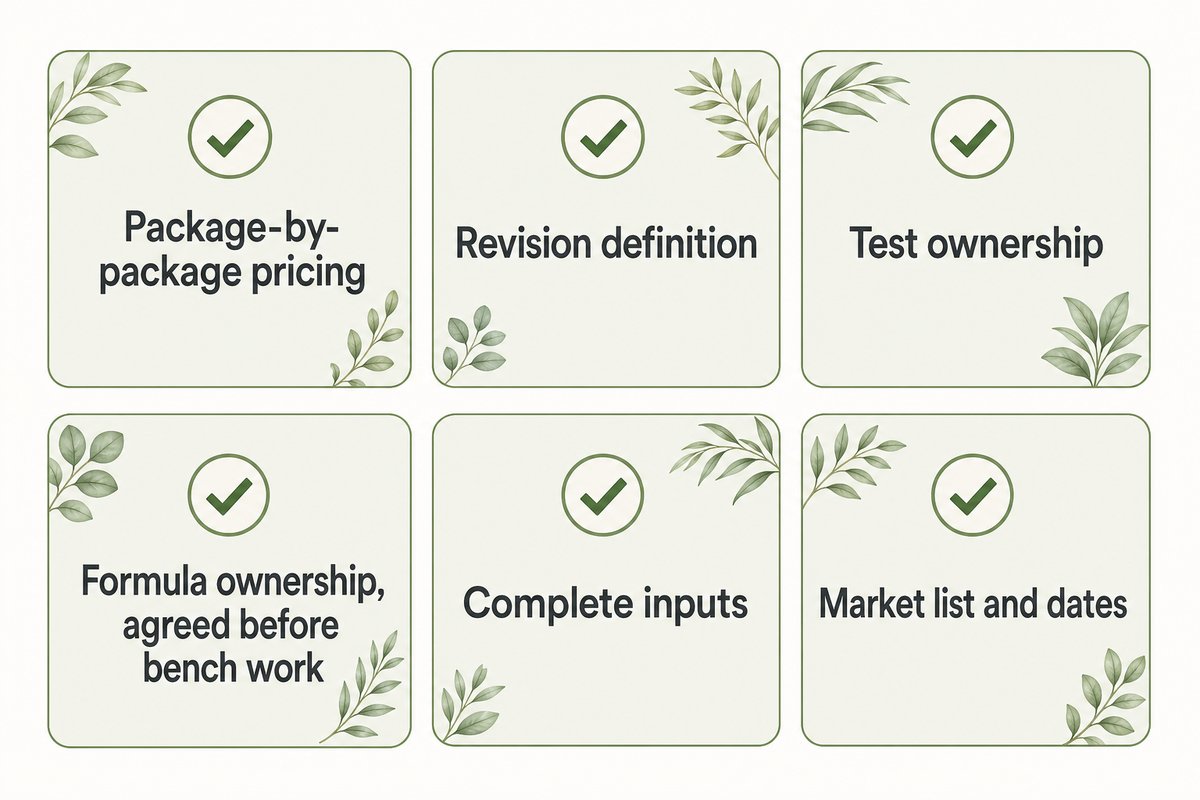
Comparable quotes come from a request that forces every supplier to price the same packages. No standards body publishes a specification for such a request, so what follows is a reasoned construction assembled from named practitioner sources, not an industry standard, an industry norm or a requirement.
We looked for an authoritative template and didn’t find one. The search covered standards bodies, trade associations and the resource pages of the Society of Cosmetic Chemists; every template in circulation belongs to a supplier or a form platform. That absence is itself useful information, because it means no supplier can reasonably object that your request departs from a standard format.
- ✔Package-by-package pricing. Ask for the nine packages priced separately, with any package quoted at zero marked as excluded rather than free.
- ✔Revision definition. State how many rounds are included and what each round is for. Prakash Purohit of Naturich Labs publishes a round-by-round split (first round for skin feel, appearance, thickness and colour, often unfragranced; second adding fragrance evaluation; third fine-tuning performance). That split is a workable model to specify against.
- ✔Test ownership. Name who performs and who pays for each test, including a second run after a failure.
- ✔Formula ownership, agreed before bench work. Settle it in the development agreement rather than at the point of dispute.
- ✔Complete inputs. One manufacturer’s president, quoted in Beauty Independent, names incomplete briefs (ingredients, performance and cost undecided before work starts) among the named causes of extra rounds. Expect 20 to 30 questions from a serious developer before the bench opens; that questioning is the cheapest part of the programme.
- ✔Market list and dates. Give destination markets and the intended launch window, so regulatory requirements and any dated ingredient review are priced rather than discovered.
Send that request to three suppliers and the quotes become readable. Where they still differ, the difference is now visible as scope rather than as price, which is the only comparison worth making.
Priced that way, a Serum Launch Case quotation reads at a glance: nine package lines, a stated number of revision rounds, a 12-week test window with the 6-week preservative test inside it, and a named owner for the artwork proofs. Three of those quotations can be compared line by line.
Suppliers that get products to market on the date they promised are the ones that priced the dependency chain, not the ones that shortened the list. If you want a second pair of eyes on a brief before it goes out, our team will read it against these nine packages and tell you which ones your current draft leaves unowned.
Planning a skincare, hair care or body care programme?
Send us your brief and we’ll map it to the nine packages, flag what’s unpriced, and tell you which route fits the volume.
Frequently asked questions
What does a cosmetic product developer do?
A cosmetic product developer owns scope, cost and schedule across a programme, translating a brief into work packages and holding suppliers to the evidence each one must produce.
The role is programme ownership rather than bench work: scope, cost and schedule, with a brief translated into work packages and suppliers held to the evidence each package must produce. In practice that means writing acceptance criteria, running the revision cycle, chasing pack and artwork inputs, and making sure the safety and regulatory file is being built alongside the formula rather than after it. The developer does not usually formulate.
What are the 7 stages of new product development, and do they apply to cosmetics?
Seven stages is one published count among several, not a settled framework. Models in print run from four to ten, and the firm that owns the best-known methodology describes its own as discovery plus five stages.
Seven stages is one published count among several, not a settled framework. Models in print run from four to ten, and the firm that owns the best-known methodology describes its own as discovery plus five stages. One consultancy states outright that the number can be adapted to the aim. For cosmetics the count matters less than which packages are priced, because the models disagree about whether packaging and regulatory work are stages at all.
How long does cosmetic product development take?
Published figures disagree, and the dependency chain matters more than any headline. A stability and compatibility plan takes 12 weeks minimum according to one consultant account, and a mid-programme formula change restarts that clock.
Published figures disagree, and the dependency chain matters more than any headline. Twelve weeks is the stated minimum for a stability and compatibility plan in one consultant account, and a mid-programme formula change restarts that clock. Named practitioners give revision expectations from two rounds to seven, with one project on record at 27. Build your date from packages, then add a buffer for one formula change.
Does the United States require specific tests before a cosmetic can be sold?
No. FDA states that it does not require specific tests to demonstrate the safety of individual cosmetic products or ingredients, and it cannot approve cosmetics other than colour additives before sale.
No. FDA states that it does not require specific tests to demonstrate the safety of individual cosmetic products or ingredients, and it cannot approve cosmetics other than colour additives before they go on the market. What the law does require is different and easy to miss: the manufacturer, packer or distributor named on the label must ensure adequate substantiation of safety and keep the records that support it. FDA describes adequate substantiation as tests, studies, research or other evidence sufficient for qualified experts to conclude the product is reasonably certain to be safe. Two separate duties also apply under the Modernization of Cosmetics Regulation Act: facilities are registered and renewed every two years by manufacturers and processors, while product listing, including ingredients, is filed by a responsible person and updated annually. Absence of a required test list is not absence of obligation.
What is the difference between a cosmetic chemist and a product developer?
A cosmetic chemist builds the formula at the bench. A product developer runs the programme around it: timelines, testing, packaging compatibility, regulatory paperwork and the handover into manufacturing.
The chemist builds the formula at the bench; the developer runs the programme around it. Small suppliers often combine both roles in one person, which changes accountability rather than the skill set, so ask which of the two you are actually buying.
About this analysis
NEXO Beauty Labs runs skincare, hair care and body care development and manufacturing from a base built up since 1999, and our international team has worked with brands, distributors and private label partners since 2020. This guide was written by comparing nine published stage models, two patent documents, four FDA pages and the EU Commission’s own CMR amendment table against how briefs actually arrive at our own bench. Capability, quality system and export statements about NEXO here are our own description of our operations, not third-party certification.
References & Sources
- Product Testing of Cosmetics — U.S. Food and Drug Administration
- Small Businesses & Homemade Cosmetics: Fact Sheet — U.S. Food and Drug Administration
- Modernization of Cosmetics Regulation Act of 2022 (MoCRA) — U.S. Food and Drug Administration
- Draft Guidance for Industry: Cosmetic Good Manufacturing Practices — U.S. Food and Drug Administration
- ISO 22716:2007 Cosmetics — Good Manufacturing Practices — International Organization for Standardization
- ISO/TR 18811:2018 Cosmetics — Guidelines on the stability testing of cosmetic products — International Organization for Standardization
- Regulation (EC) No 1223/2009 on cosmetic products — EUR-Lex, European Union
- Commission Implementing Decision 2013/674/EU on guidelines to Annex I of Regulation 1223/2009 — EUR-Lex, European Union
- Commission Regulation (EU) 2026/78 — EUR-Lex, European Union
- Commission Regulation (EU) 2026/909 — EUR-Lex, European Union
- CMR substances in cosmetic products: Omnibus Acts and dates of application — European Commission, DG GROW
- US 10,912,721 B2 — Thin emulsion base for cosmetics — United States Patent and Trademark Office record
- WO 2020/142514 A1 — Hair care and conditioning compositions — World Intellectual Property Organization record
- The Correct Duration for Stability Tests — Happi, 2 January 2025
- How many rounds does it take to get a formulation right? — Beauty Independent, 29 May 2024
- Want the Truth: Claims Development is More Than Just Evidence — Cosmetics & Toiletries
- Cosmetovigilance Connections — Cosmetics & Toiletries
- Creativity and Regulatory: Behind the scenes — Cosmetics Business
Related Articles
- How to start a cosmetic line — the launch sequence around the development work described here
- Facial cleanser manufacturing guide — one category worked through end-to-end
- Private label moisturizers guide — what changes when the base formula already exists
- OEM cosmetic manufacturing — production scope once development closes