Get in touch with NEXO Beauty Labs Company

Last updated: October 2026 · By XCX
The best sheet mask manufacturers depend on the job: BioCrown for Taiwan private-label development, Graminton for material choices and a published lower starting MOQ, Taiki for a broad mask-and-patch range, TCI Bio for CDMO breadth, Nox Bellcow for freeze-dried formats, and NEXO Beauty Labs for a direct custom-ODM discussion with this article’s publisher. This is a comparison set, not a universal ranking.
A useful shortlist begins with evidence, not a logo wall.
One example of evidence is a supplier’s willingness to publish a minimum order, but leave testing scope open. Another example is a supplier’s ability to provide details on hydrogel, bio-cellulose, or freeze-dried formats, but without specifying which entity or plant would manufacture the order. A third may quote a fast schedule that starts only after formula approval and packaging qualification.
These examples are more relevant than a simple “best manufacturer” statement.
A skincare brand looking for a private label face mask will find face mask manufacturers, wholesalers, finished-product sellers, and marketplaces on the same results page. The mask market language is broad, but the job requirements aren’t. This guide limits the comparison to companies with public manufacturing evidence and separates the finished-stock sourcing from custom development.
Quick Picks
- Best for Taiwan private-label development: BioCrown Biotechnology
- Best for published sheet-material options and a numeric starting MOQ: Graminton
- Best for a broad mask-and-patch format range: Taiki Cosmetics
- Best for a wider CDMO and skincare platform: TCI Bio
- Best for freeze-dried and lyocell mask formats: Nox Bellcow Cosmetics
- Best for discussing custom ODM with the article publisher: NEXO Beauty Labs
Publisher disclosure
This guide is published by NEXO Beauty Labs, which is included as one of the six companies. NEXO isn’t placed first and isn’t presented as an independently ranked market leader. Every company is described from current public first-party evidence, while missing, self-reported, and project-specific fields stay labeled.
If you need general process education before comparing factories, start with the NEXO sheet mask manufacturing guide. This article has a narrower job: help a brand compare supplier evidence, commercial boundaries, sample controls, and RFQ scope.
How We Selected These Sheet Mask Manufacturers
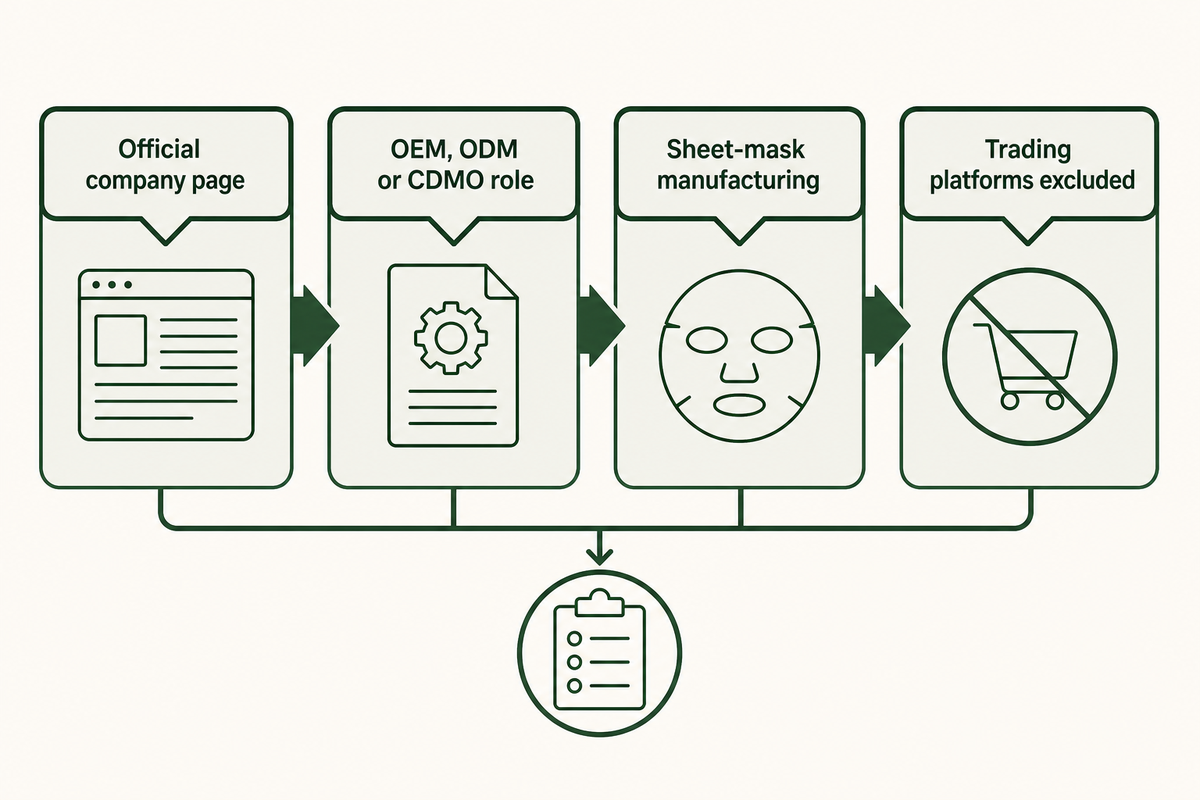
To be included in the shortlist, an official company page had to explicitly state its manufacturing or OEM/ODM/CDMO role and also indicate a specific capability with sheet-mask. Company information was verified against official company websites and public sources in October 2026. Trading companies, sourcing platforms, directories, marketplaces, brand-only pages, protective-mask manufacturers, and pages that did not establish sheet-mask manufacturing were excluded. Fermic’s reviewed page emphasized wash-off formats; Beauty Mask Factory did not clearly establish the facility or legal manufacturing role; and Seoul Mamas presented products and MOQs without clearly proving direct manufacturing.
Adjacent products did not qualify a company for this list. Though Sleeping masks, a clay mask or private label clay mask, bubble masks, body masks and an instant mask could be part of a broader skincare offering, none is indicative of sheet-mask manufacturing. Likewise, a broad mask collection or face mask collection only counted when the reviewed page connected the offer to an actual manufacturing role.
The six companies listed aren’t representative of the global supplier landscape. The assessment favored suppliers that have first-party evidence, and thus capable manufacturers whose sheet-mask work is hidden within an cosmetics-ODM page or whose pages are less visible in English language searches, may not be assessed. Thus the list doesn’t claim “top six in the world”, market share or an independent quality rank.
Manufacturer Verification Status Key
Official-page claim
Published by the company and usable with attribution.
Published by the company and usable with attribution.
Public numeric claim
A number is visible on the reviewed page, with its stated conditions.
A number is visible on the reviewed page, with its stated conditions.
Not publicly disclosed
No usable value appeared in the reviewed source set.
No usable value appeared in the reviewed source set.
Project-specific
Confirm the value, scope, clock start, and exclusions in writing.
Confirm the value, scope, clock start, and exclusions in writing.
This status key prevents a common comparison error: A blank isn’t the same as zero; “low minimums” isn’t a number; and a standard reference isn’t a certification. It also makes missing information actionable. A missing MOQ becomes an RFQ question; an unscoped certificate becomes a document request; an undefined lead time becomes a milestone schedule.
Sheet Mask Manufacturers Comparison Table
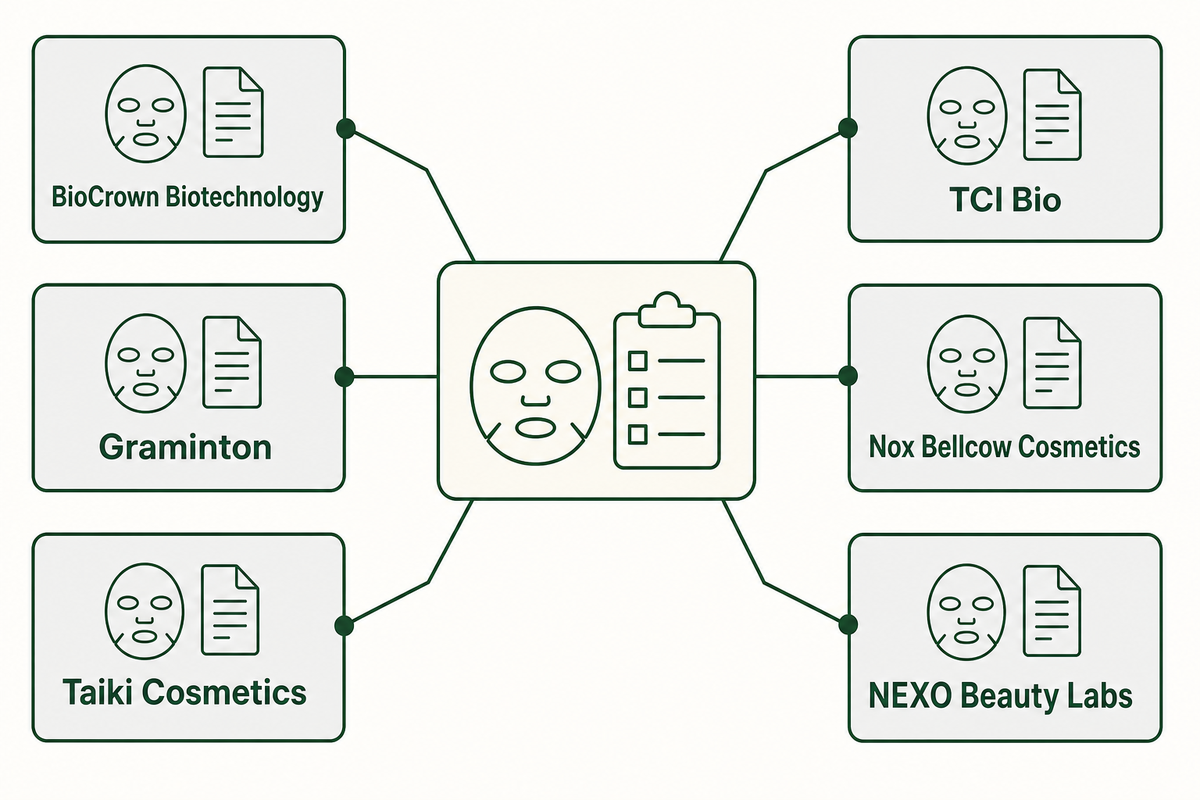
This table is a starting point, not a final assessment; use the official ISO 22716 standard record when checking what a supplier’s cosmetics-GMP claim actually covers. “Public MOQ” means the reviewed page published a number or a nonnumeric statement; it does not mean the supplier has issued a current quotation for your formula, material, sachet, artwork, or market.
A sheet face mask is both a skin care product and a package-and-process system. Several facial mask products may be offered by the same factory, but each mask product may require a different sheet, filling method, sachet barrier, and validation plan. For facial care buyers, category breadth is useful only after the proposed production route is identified.
| Company | Location | Sheet-mask category evidence | Public MOQ | Certification status | Best for | Key limitation | Official website |
|---|---|---|---|---|---|---|---|
| BioCrown Biotechnology | Taiwan | Custom facial sheet masks and formulation development | Not published | Website lists ISO 22716/GMP and other company-reported claims | Taiwan private label | Manufacturer from Taiwan; not an EU or mainland-China production route | https://www.biocrown.com.tw/en/category/A0101.html |
| Graminton | Taiwan | Cotton, lyocell, bamboo-charcoal, nanofiber, and multi-ply formats | Typically around 5,000 pieces per SKU, according to its website | ISO 22716-certified cosmetics manufacturing | Material-led programs | Packaging minimums may raise the practical order | https://www.graminton.com/oem/sheet-mask-oem/ |
| Taiki Cosmetics | Founded in Japan; production listed in Europe and Asia | Non-woven, pre-moistened, hydrogel, bio-cellulose, and patch formats | From 25,000 pieces, according to its website | Company page does not state a site-specific certificate | Broad format range | From 25,000 pieces | https://www.taikicosmetics.com/en/14-masks-patches |
| TCI Bio | Taiwan | Bio-cellulose and K-beauty facial masks, patches, and essences | “Low opening order minimums”; no sheet-mask number | Company page makes broader claims across site and product scopes | CDMO breadth | Repeat orders are fast only when products are in stock; not new custom programs | https://www.tci-bio.com/technology/private-label-sheet-masks-and-skin-care-manufacturer/ |
| Nox Bellcow Cosmetics | Zhongshan, Guangdong, China | Freeze-dried masks, eye patches, water facial sheet masks, and lyocell | Not published | Company page does not state a facility certificate | Freeze-dried formats | Immerse the dry mask sheet in warm water to activate | https://www.hknbc.com/nbc-freeze-drying-mask-series |
| NEXO Beauty Labs | Guangzhou, China | Bio-cellulose, hydrogel, cotton, bamboo, microfiber, and custom ODM | Project-specific | Company page references ISO 21322:2020 and ISO 11930:2019 test standards | Custom-ODM discussion | Production starts after formula approval and packaging qualification | https://nexobeautylabs.com/private-label-skincare/sheet-masks/ |
| Buyer control: legal entity | Project-specific | Contract party, invoice entity, and production site must align | Not applicable | Match holder and site to the proposed activity | Direct-factory role check | A brand or group name may not identify the responsible factory | Request current documents |
| Buyer control: product route | Project-specific | Formula, sheet, filling, pack, and test route | Confirm per route | Verify product and activity scope | Technical-fit check | Catalogue breadth does not prove route readiness | Attach the controlled brief |
| Buyer control: quote scope | Project-specific | Samples, tests, tooling, packaging, release, and delivery | Normalize all tiers | List included evidence | Commercial comparison | A lower unit price may omit cost or risk | Use one RFQ grid |
Two numbers look comparable at first glance, about 5,000 and 25,000 pieces, but they may sit on different formula, sheet, package, and production assumptions. Don’t sort the table by MOQ until each supplier answers the same RFQ. A lower production minimum can still be paired with a higher printed-film minimum, more paid sample rounds, a longer test plan, or a freight term that shifts cost and risk to the buyer.
Taiwan Sheet Mask Manufacturers
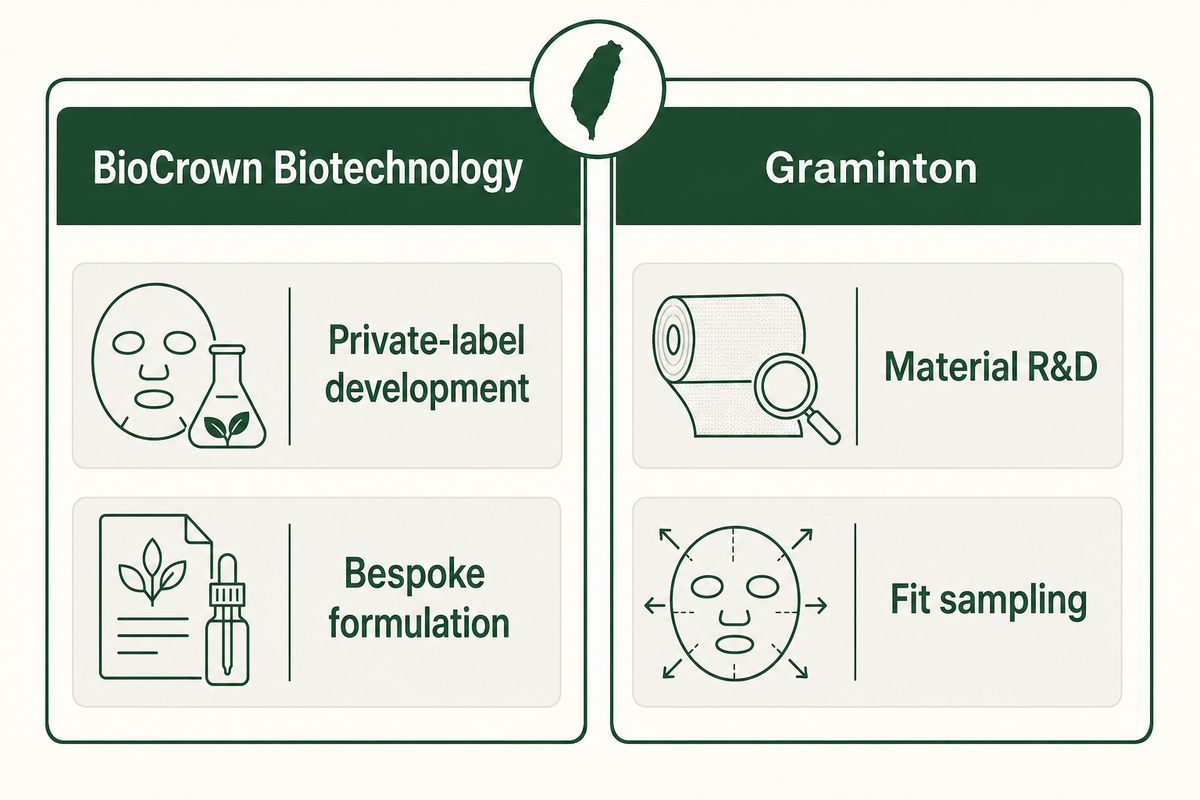
1. BioCrown Biotechnology: Best for Taiwan Private-Label Development
Headquarters/location: Taiwan · Founded: 1977 · Type: private-label facial sheet-mask manufacturer
Official website: https://www.biocrown.com.tw/en/category/A0101.html
Main products: facial sheet masks and private-label skincare · Capabilities: customized face-mask manufacturing and bespoke formulation development
BioCrown’s official page is useful for a buyer who wants a Taiwan-based private-label discussion that begins with facial sheet masks rather than a generic skincare catalogue; it describes flexible private-label development and formulation work for projects still defining serum concept, sheet format, and brand position.
A buyer discussing private labeling services should ask whether the face mask formula comes from a stock library, a modified base, a new brief, or a transferred formula, because that decision controls who owns the face mask formulas, how the face mask line is sampled, and which changes need written approval.
Key limitation: The disclosed manufacturing route is in Taiwan, so it does not fit projects that require production in the EU or mainland China.
2. Graminton: Best for Sheet-Material Options and a Published Starting MOQ
Headquarters/location: Taiwan · Founded: 1992 · Type: nonwoven developer and sheet-mask OEM manufacturer
Official website: https://www.graminton.com/oem/sheet-mask-oem/
Main products: cotton, organic cotton, lyocell, bamboo-charcoal, nanofiber, and multi-ply masks · Capabilities: material R&D, dedicated production, and fit sampling
Graminton stands out because its page connects sheet-mask production with nonwoven development and publishes a typical starting MOQ of around 5,000 pieces per SKU, giving a buyer a real opening question: does “per SKU” mean one serum, one sheet, one sachet artwork, and one carton configuration? The answer matters because printed film, carton conversion, or a material run may control the practical launch quantity even when the mask-filling minimum is lower; the page also describes fit sampling for assessing face coverage, eye and mouth openings, wet strength, and serum release together.
Material labels need precision: a buyer asking for Tencel masks should confirm whether the quoted sheet is a specific branded fiber or a generic lyocell construction, while bio-fiber masks, nanofiber sheets, and microfiber masks can carry different specifications, handling behavior, supplier names, and substantiation needs even when the retail descriptions sound similar.
Key limitation: packaging print runs and product feasibility can move the practical minimum above the published starting point.
Global Format and CDMO Options
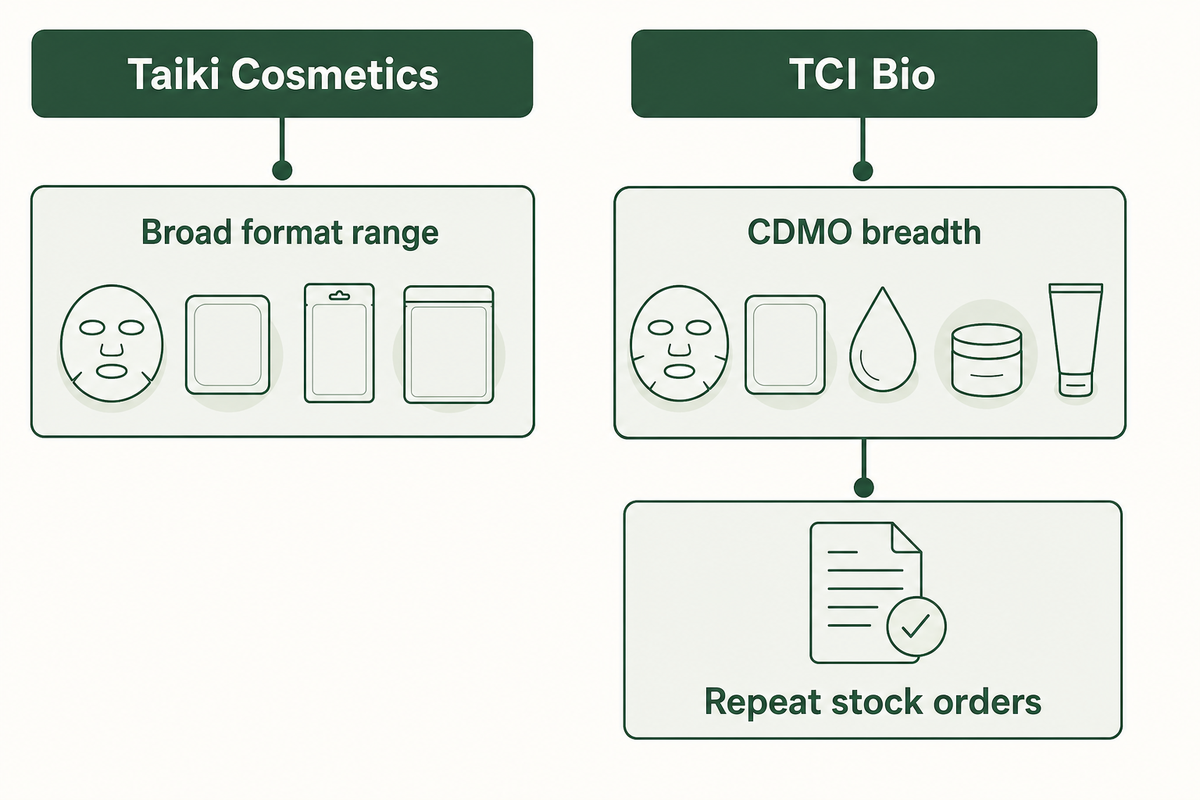
3. Taiki Cosmetics: Best for a Broad Mask-and-Patch Format Range
Headquarters/location: founded in Japan; production listed in Europe and Asia · Founded: 1930 · Type: private-label manufacturer of beauty tools, masks, and patches
Official website: https://www.taikicosmetics.com/en/14-masks-patches
Main products: non-woven, pre-moistened, hydrogel, bio-cellulose, silicone, hydrocolloid, jelly, and konjac formats · Capabilities: custom development and ready-to-market offers
Taiki gives format-led buyers a broad starting catalogue, so a brand comparing a traditional soaked sheet with a hydrogel mask, bio-cellulose, or targeted patches can ask which routes are made at the proposed site and which require a different material, process, or production region.
Broad beauty face masks and mask solutions can help a buyer explore formats, but catalogue breadth isn’t production fit; ask which skincare products and skincare lines share the quoted site, quality system, component supply chain, and sample process, then apply the answer to the exact sheet-mask route.
Key limitation: The published 25,000-piece starting point can exceed the launch volume planned by smaller brands.
4. TCI Bio: Best for CDMO Breadth
Headquarters/location: Taiwan · Founded: 1980 · Type: CDMO and private-label skincare contract manufacturer
Official website: https://www.tci-bio.com/technology/private-label-sheet-masks-and-skin-care-manufacturer/
Main products: bio-cellulose facial masks, K-beauty facial masks, eye patches, lip patches, and essences · Capabilities: wider skincare development plus stock and ready-to-ship repeat-order options
TCI Bio may fit brands that want a sheet-mask project inside a wider CDMO relationship, and its official page presents OEM/ODM, custom formulas, bio-cellulose masks, K-beauty formats, patches, and other skincare categories while describing “low opening order minimums” without a numeric sheet-mask threshold.
New brands should ask whether the proposal is private label stock, a premium private label modification, or a full concept to market program, with the R&D team, technical owner, and commercial owner named for each route because “CDMO” alone doesn’t define who approves formula, claim, package, or production changes.
Key limitation: The fast ready-to-ship route applies to repeat orders for products already in stock, not to a new custom program.
China Manufacturing and the Publisher Option
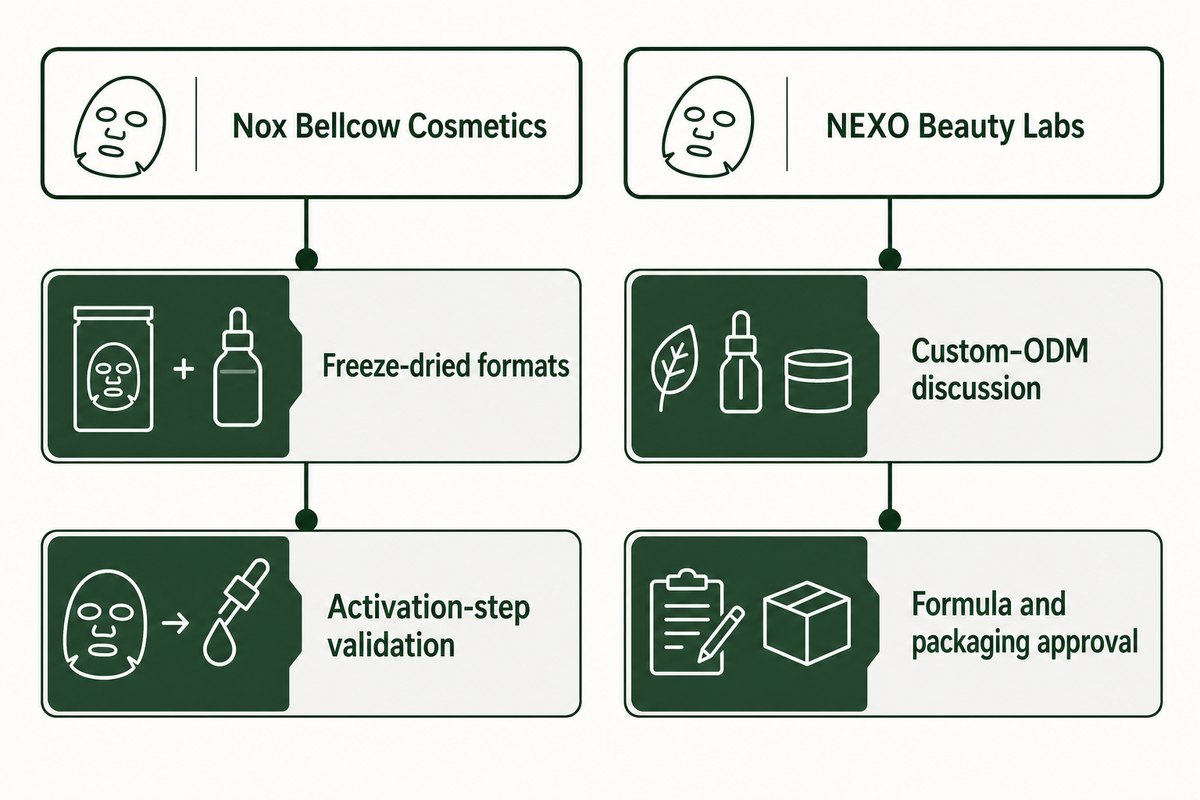
5. Nox Bellcow Cosmetics: Best for Freeze-Dried Sheet-Mask Formats
Headquarters/location: Zhongshan, Guangdong, China · Founded: 2004 · Type: cosmetics manufacturing enterprise
Official website: https://www.hknbc.com/nbc-freeze-drying-mask-series
Main products: freeze-dried masks, freeze-dried eye patches, and water facial sheet masks · Capabilities: freeze-drying formats and lyocell sheet material
Nox Bellcow’s reviewed product page adds freeze-dried masks and eye patches alongside premium water sheet masks, a relevant distinction when a brand’s concept depends on separating dry actives from a liquid activation step or presenting a differentiated format.
A freeze-dried concept can involve different dry and wet components or an activation step, so the RFQ should identify which component each party manufactures, packs, tests, supplies, and releases rather than treating the retail format as one undivided process.
Key limitation: The freeze-dried route requires water activation and adds dry-state and wet-state handling to the product brief.
6. NEXO Beauty Labs: Best for a Direct Custom-ODM Discussion With the Publisher
Headquarters/location: Guangzhou, China · Manufacturing foundation: 1999 · Type: global cosmetic OEM and ODM partner
Official website: https://nexobeautylabs.com/private-label-skincare/sheet-masks/
Main products: bio-cellulose, hydrogel, cotton, bamboo, and microfiber sheet masks · Capabilities: custom ODM development, sample development, and commercial production
NEXO is this article’s publisher, so its inclusion carries an explicit conflict-of-interest disclosure, and the page offers a direct discussion around material, serum, packaging, samples, and production rather than a claim to universal leadership. It states 3–7 business days for sample development and commercial production within 15 days after formula approval and packaging qualification, but these are first-party targets with clock-start conditions rather than guaranteed delivery dates; international sample shipping, testing, component procurement, revisions, release, and transit can sit outside a headline production window.
Key limitation: This is not a fixed-MOQ stock route, and the production clock starts only after formula approval and packaging qualification.
2026 Sheet Mask Trends That Change Supplier Fit
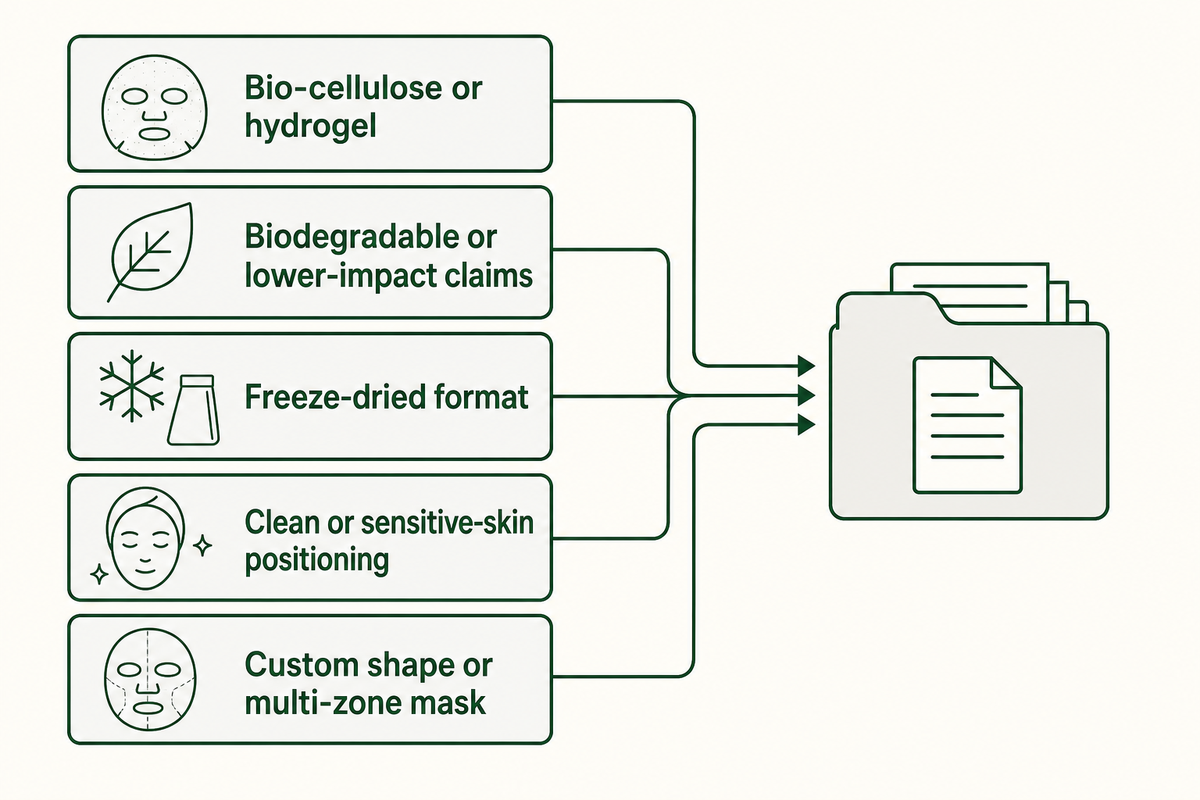
Bio-cellulose, hydrogel, and freeze-dried formats, biodegradable or lower-impact sheet claims, cleaner-formula positioning, and more differentiated shapes were observed across 2025–2026 supplier offerings. The procurement lesson isn’t that the newest substrate wins automatically. New formats mean increased burden of proof because the sheet, serum, sachet, manufacturing process, shelf-life and marketing claim need to integrate as a single system.
Bio-cellulose and hydrogel options support different sensory and positioning goals. However, the format doesn’t dictate the active ingredients. A mask formula can feature hyaluronic acid for hydration, peptide story or newer ingredients such as PDRN. Each still requires a formula- specific safety and substantiation route. “Helps hydrate” and a more clinically sounding claim don’t command similar level of evidence.
Oil control, moisturization, brightening, and sensitive-skin positioning may also target different skin types. Therefore, a concept for oily skin may not be applicable to all different skin types. Skin types and skin care claims shouldn’t be collapsed to a “universal” promise. Define the types and skin care needs in the brief so the formula, sheet, study population, instructions, and marketing language stay aligned.
The other cases also have geographic implications. The Korean beauty category and South Korean manufacturing have shaped this industry, and a major Korean supplier can potentially showcase its sheet-mask capabilities within a broader cosmetics page rather than on a standalone English page. The same discovery issue can impact suppliers serving Southeast Asian markets. This article doesn’t list a random company to fill a geographic case. Coverage limitations are kept visible until the same current official-page threshold is reached.
| Trend signal | Do not assume | Ask for instead |
|---|---|---|
| Bio-cellulose or hydrogel | Premium material means easier manufacturing or better performance | Material specification, serum compatibility, fit, handling, fill, package barrier, and stability plan |
| Biodegradable or lower-impact claims | A material name proves environmental benefit | Composition, claim definition, test method, source documents, packaging boundary, and disposal conditions |
| Freeze-dried format | Dry presentation removes validation work | Activation instructions, moisture protection, reconstitution behavior, package integrity, and change-control evidence |
| Clean or sensitive-skin positioning | A short ingredient list proves universal tolerance | Defined claim, formula rationale, safety assessment, microbiological control, compatibility, and substantiation plan |
| Custom shape or multi-zone mask | A drawing is production-ready | Cut file, fit sample, tolerances, nesting/waste assumptions, tooling ownership, and approved production reference |
Market reports often disagree on size and growth of the market because they define the market differently (e.g. different segments, different years, different forecast periods). A large forecast cannot prove that one substrate, company, or claim is right for your launch. Use trend data to ask better evidence questions, not to bypass formulation, package, or supplier qualification.
How to Choose a Sheet Mask Manufacturer
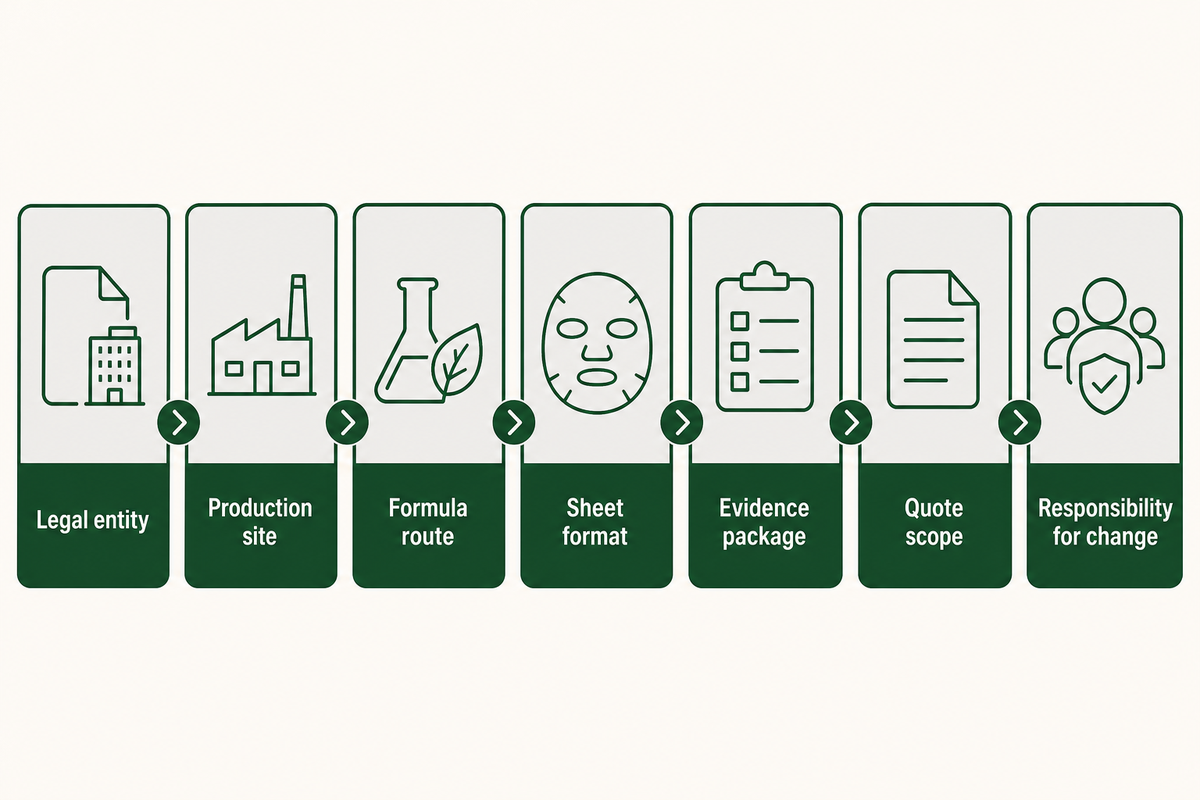
The match between your plan and the legal entity, production site, formula route, sheet format, evidence package, quote scope, and change responsibility is what matters most. The following checks allow us to turn an unstructured list into a shortlist.
A skincare manufacturer may promote years of skincare work or years of expertise, but duration isn’t evidence for the proposed project. A high-quality mask isn’t a slogan. It includes an approved specification, controlled process, suitable package, quality control plan, release evidence, and management of change.
1. Confirm the Legal Entity, Site, and Manufacturing Role
A company page may state that a company does sheet-mask manufacturing without stating which plant will make your order. Verify the contracting, invoicing, and quality entity, and factory name and address. Then, determine which steps occur there: formula, serum, sheet conversion/cutting, filling, sealing, secondary packing, testing, releasing, and storage.
For OEM production, identify what’s subcontracted and who qualifies the subcontractor. The main supplier should be responsible for approved inputs, records, deviations, release, and change notice, even if another site performs the step. This responsibility should be reflected in the quality control and commercial documents, and not only in the sales presentation.
Direct-Factory Role Test
- Verified direct factory: The proposed legal entity, site, and process align and the entity is the evidence holder.
- Factory group with disclosed site: The group owns or controls the manufacturing, and the site is named for this project.
- Accountable sourcing intermediary: Manufacturing is performed by a third party, but the intermediary identifies the site and responsibilities, and discloses change controls.
- Marketplace or directory listing: the seller and production site are not established; do not treat the listing as factory evidence.
A supplier can pass the first conversation and still fail later because the quotation, certificate, sample label, quality agreement and commercial invoice point to different legal entities, sites or processes.
2. Match the Sheet and Serum as One System
Cotton, lyocell, bamboo, microfiber, hydrogel, bio-cellulose and freeze-dried formats don’t behave similarly. Consider facial fit, wet strength, drape, serum loading and release, ease of handling during filling, skin feel, barrier to package, and evidence to support claims. A material that photographs well can still crease, tear, dry unevenly, resist automated handling, or interact poorly with the proposed formula.
If the buyer supplies a formula, finalize the intellectual-property ownership and transfer readiness early. The transfer package should provide information on usage rights, formula and process versions, grade of raw materials, mixing order and limits, time and temperature hold, permitted substitutions, equipment, in process controls, fill level and owner of revalidation. Saying “We can copy the formula” doesn’t provide a technology transfer plan. If any of the mixing equipment, water systems, sheet loading method, filling head, type of sachet or heat-sealing process differ from the one approved with the formula, then the formula may need to be confirmed for compatibility, stability andproduced on scale.
3. Check Certificate Scope, Not the Logo
ISO 22716 provides guidelines for the production, control, storage, and shipment of cosmetic products. A supplier mentioning ISO 22716 does not prove that a current certificate covers the legal entity, address, and activities proposed for your order. Request the document and check the holder, site, standard, activity scope, issuer, certificate number, issue date, expiry date, and current registry status.
Keep different evidence types separate. A test standard can define a method without certifying a factory. For substrate-based cosmetics, ISO 21322:2020 and ISO 11930:2019 address testing scopes; neither is a factory-certification substitute. A product patch test is not a quality-system certificate. ISO 14001 addresses environmental management rather than cosmetics-GMP coverage. FDA cosmetic facility registration and product listing are regulatory submissions, not FDA product approval or a compliance certificate. Medical protective-mask rules also should not be imported into a cosmetic sheet-mask comparison merely because both products use the word “mask.”
| Evidence seen | What it may show | What it does not prove |
|---|---|---|
| Certificate with holder, site, scope, issuer, and validity | A certifier issued a scoped certificate for a named organization/site | That every product, claim, line, or subcontractor is covered |
| Standard or test-method reference | A method or guidance document may be used | Factory certification or a passing result for your formula |
| Product claim or internal test | The company reports a product-level result | Independent certification, universal tolerance, or regulatory approval |
| Facility registration or product listing | A required submission may exist | FDA approval, a compliance certificate, or product performance |
4. Request Product and Batch Evidence
What will the supplier control and what will the buyer accept? The specification should include approved formula or product specification revision, INCI, raw material controls, sample certificate of analysis, microbiological limits, compatibility and stability plan, sheet specification, fill weight target, seal integrity, lot traceability, deviation and CAPA, RRS, and change notice.
Record the specified features measurably. Make the specification measurable without inventing universal limits: record sheet width and height in mm, basis weight in g/m², serum fill in g or mL, viscosity in mPa·s or cP, package thickness in µm, seal strength in N/15 mm, storage and test temperature in °C, relative humidity in %, and microbiological limits in CFU/g or CFU/mL. The buyer’s technical reviewer should approve the method, condition, tolerance, and unit for each field before any result becomes an acceptance criterion.
Do not invent universal test periods or acceptance limits. They depend on several factors, including the product, formula, package, market, claims, and responsible technical review. The key is ownership: who’s the plan sponsor? Who approves it? Which plan governs production? What creates a deviation? Who has the authority to release or reject a batch?
5. Normalize MOQ and Packaging Minimums
There are many possible interpretations for what constitutes a “MOQ.” Find out if the value applies per formula, fragrance serum, sheet material, cut shape, sachet art, carton, SKU, language version, or combined order. Separate a filling minimum for the manufacturer from a film printer’s cylinder or digital-print threshold, a carton converter’s run, and a raw-material supplier’s batch.
Request at least three volumes in an RFQ: launch, expected repeat, and scale quantities. State for each what package configuration is expected. Indicate what happens to unused printed components, bulk serum, or sheet stock, if any of it’s to be purchased, stored, or destroyed.
6. Define Sample Rounds and Approval
Various types of samples can exist. A sample can be a stock reference, a bench formula, a sheet-fit cut, a hand-filled mock-up, a printed sachet proof, a pilot or pre-production sample, or a sample retained from commercial production. These aren’t interchangeable. The purpose for each round, the quantity, the fee, the shipping term, expected turnaround time, the revisions included, the approval owner, and events that warrant resampling, must all be identified.
Sample-to-Production Approval Ladder
- A “brief freeze” sets intentions for the expected market, claims, target INCI direction, restricted ingredients, sheet format, fill and pack, and cost.
- Lab formula sample: sensory profile, appearance, odor, viscosity where relevant, and preliminary compatibility observations. Compat. Observations.
- Sheet fit and Loading Sample: cut geometry, wet handling, adhesion, drape, serum uptake/release and residue.
- Package and stability plan: sachet structure, seal, fill, compatibility, microbiological controls, and agreed study conditions.
- Pre-production reference: approved formula, sheet, fill, artwork, pack, and measurable sign-off fields.
- Production Release Reference: retained batch sample, lot documentation, deviations, release decision and change control baseline.
There are measurable changes between hand samples and commercial production. Record the formula version, sheet code, dimensions, fill target, sachet construction, seal area, artwork revision, and approver at every release point.
7. Normalize Lead Time, Incoterms, and Landed Scope
A lead-time number is useless without a clearly defined start and end. When does the schedule begin? Deposit? Approval of formula? Artwork for packaging? Completion of testing? Release for production? End of production? Quality release? Pickup from the factory? Clearance through customs? Shipment? Delivery to the buyer’s warehouse?
Incoterms clarify tasks, costs, and risks between buyer and seller, including delivery, shipment, insurance, documentation, and customs responsibilities. They don’t cover every condition of sale and don’t prove quality, compliance, lead time, or shipping performance. Put the specific Incoterm rule, named place, and version in the quote instead of writing only “FOB” or “DDP.”
| Field | Normalize before comparing | Knockout question |
|---|---|---|
| Formula route | Stock, modified stock, custom ODM, or buyer-owned transfer | Who owns formula and process files, and what can change? |
| MOQ basis | Per formula, material, artwork, SKU, pack, or combined order | Which upstream component creates a higher minimum? |
| Samples | Round types, quantity, fees, revisions, freight, and credit-back | What must be approved before production materials are committed? |
| Testing | Plan, lab, samples, repeats, reports, responsible approver | Which tests and documents are included in the quote? |
| Packaging and tooling | Film, print method, cylinders/plates, sachet, carton, master case, ownership | Who owns tooling and unused printed inventory? |
| Field | Normalize before comparing | Knockout question |
|---|---|---|
| Unit and exclusions | Currency, tax, quantity tier, included components, waste, over/under allowance | What cost can still appear after purchase order? |
| Lead-time clock | Start milestone, production, release, transit, customs, destination | Which buyer delay, test result, or change resets the schedule? |
| Delivery term | Incoterm rule, named place, version, freight, insurance, duties, documents | Where do cost and risk pass to the buyer? |
| Payment | Deposit, balance milestone, tooling, testing, credit, bank fees | Which payment is due before evidence or release is complete? |
| Change control | Formula, raw material, sheet, site, process, pack, test, and notice period | Can any production input change without written buyer approval? |
Run the grid as a controlled process, not a one-time spreadsheet. Distribute an instructions sheet, numbered questions, and a brief to each short-listed supplier. When a supplier changes an assumption, for example, changing from stock film to custom film, document the change and ask the other suppliers to provide a bid for this scope. Otherwise, the comparison drifts: one quote includes compatibility testing and printed cartons, another excludes them, and a third assumes buyer-supplied artwork or pickup at the factory.
Use an “included/excluded/buyer supplied/pending” status for each row. Pending isn’t necessarily bad, however, it should be assigned an owner and a time frame within which it’s to be completed. For example, a package-compatibility study may remain pending until the final formula and sachet structure are frozen. That is different from a supplier silently excluding the study or assuming the buyer will manage it.
Risk comparison is stronger when each role reviews its own risk before one combined decision is made. Finance should compare the landed cost scenarios rather than unit prices. Procurement should compare commercial assumptions and the risk-transfer point. QA should compare the proposed site, evidence, sample ladder, release documents and change controls. Product development should compare format, formula ownership, technical transfer, and claim substantiation.
In the end, save the quote version that wins the project. Move its formula route, sheet code, fill, pack, test plan, Incoterm, named place, lead-time clock and exclusions into the quality agreement and purchase order. If the commercial award relies on an email clarification that never reaches the controlled project documents, the comparison work has not actually protected production.
8. Use Knockout Criteria Before a Weighted Score
A score can be weighted, and still be fatal. A supplier may excel in communication, pricing and format range, and still be missing required market documents, a suitable production site, formula-transfer rights or evidence for a non-negotiable claim. Mark those fields as knockout conditions first. “Unknown” isn’t a neutral, middle score when the missing evidence controls product release or legal market access.
After knockouts, only use weighted scores for trade-offs like development, format, sample, documentation, clarity of quotes, communication, commercial, logistics, geography, and change control. Keep the evidence link or document name next to each score. This way, a preference isn’t mistaken for a fact.
A simple 100-point weighted worksheet can still be useful after knockouts. Set the weights before opening final prices: for example, QA and evidence 25, format and formulation fit 20, sample and development discipline 15, commercial scope 15, logistics and schedule 10, change control 10, and communication 5. Those numbers are an example, not a universal formula. For a regulated market launch, more weight may be assigned to evidence; a retailer testing a simple stock route may require more weight to be assigned to speed and commercial fit. The discipline is to agree on the weights and required evidence before a preferred supplier influences them.
9. Choose the Right Buying Route
Wholesale distributors are an option for existing off-the-shelf needs, smaller volumes, quick lead time, and no custom formula or special packaging. Marketplaces may help find alternatives, but are unlikely to provide enough evidence to qualify a factory. A direct OEM/ODM manufacturer is the more relevant route when the buyer needs a custom or private-label product, controlled samples, packaging development, quality documents, and a production agreement.
Don’t push every project to direct manufacturing. A small retailer testing an existing mask might be better helped with wholesale. A brand moving from concept to owning a formula needs a supplier that takes development and evidence responsibility. The route selector prevents buyers from comparing a case price for finished stock against a custom-manufacturing quote, and calling the cheaper number “better.”
A private label mask can be positioned anywhere on the route spectrum. It may be a finished stock formula with new artwork, a modified base, or a custom product developed around the buyer’s brief. Ask the manufacturer to name the route before comparing price, schedule, ownership and exclusivity.
What to send in the first RFQ
Give the same concise project brief to each manufacturer. State the destination market and responsible company; intended product type and claims; stock, modified, custom, or transferred formula route; restricted ingredients; preferred sheet material and shape; target fill; sachet and carton direction; three order-volume scenarios; desired sample rounds; required testing and documents; target launch window; destination; and the requested Incoterm and named place.
Add a controlled list of unknowns instead of speculating. Like ‘final fragrance pending’ or ‘sachet structure to be proposed’. Ask the supplier to show how each of the unknowns affects price, MOQ, sampling, testing, and commitment of components and schedule. This way, an early quote can be obtained without freezing the product.
Request two outputs: Request a commercial quote and evidence-response sheet. The quote should show inclusions, exclusions, payment, quantity tiers, tooling, testing, freight boundary, and lead-time milestones. The evidence response sheet should include the name of the legal entity and the site, in-house and subcontracted steps, certificates, sample stages, batch-release documents, change controls and the owner of each open action.
When quotes arrive, assess the evidence response sheets for clarity and consistency and then request a final quote. Close factual gaps and issue a revised common brief first. A quote with looser scope doesn’t necessarily mean it’s a better quote. The supplier may have left costs and risks outside the quote to provide a lower price.
Frequently Asked Questions
Which company is best for sheet masks?
No single company is best for every project. BioCrown may fit Taiwan private-label development; Graminton publishes a lower starting MOQ and material options; Taiki presents a broad format range; TCI offers CDMO breadth; Nox Bellcow shows freeze-dried formats; and NEXO offers a direct custom-ODM discussion with the publisher. The better choice is the company whose legal entity, site, format, evidence package, MOQ, sample plan, quote scope, and change controls match your launch.
Where can I buy face sheet masks wholesale?
For finished, already-formulated masks in smaller quantities, a wholesaler or authorized distributor can be more practical than a custom manufacturer. Ask for brand authorization where relevant, lot traceability, expiry or shelf-life information, storage conditions, compliant labeling for your market, and the exact case quantity. If you need your own formula, sheet, sachet artwork, carton, or claims, move to a private-label or OEM/ODM route and compare development, testing, MOQ, packaging, and production terms instead of only case price.
What is a typical MOQ for private-label sheet masks?
There’s no reliable universal MOQ. In the reviewed source set, Graminton says sheet-mask MOQs typically start around 5,000 pieces per SKU, while Taiki states contract manufacturing from 25,000 pieces. Other companies publish no number, use nonnumeric language, or keep MOQ project-specific. Ask whether the minimum applies to formula, sheet, artwork, sachet, carton, SKU, or combined order, because packaging and material suppliers can create a higher practical minimum.
Can I customize sheet-mask packaging?
Often, yes. Confirm the sachet, print, seal, carton, tooling ownership, minimums, unused inventory, and package-compatibility approval in writing.
How long does face-mask manufacturing take?
Lead time depends on the route and clock start. A stock formula with existing packaging can move faster than a custom formula, new sheet, printed sachet, or claim-heavy launch. Separate briefing, lab samples, revisions, compatibility and stability work, artwork, component procurement, production, quality release, freight, customs, and destination delivery. NEXO’s page, for example, states 3–7 business days for sample development and production within 15 days after formula approval and packaging qualification; those are first-party targets to confirm in the current project quote, not universal delivery guarantees.
What is the difference between a sheet mask manufacturer and a supplier?
A manufacturer performs defined production activities at a named site. A supplier may be the manufacturer, a factory group, an accountable intermediary, a wholesaler, or a marketplace seller. The difference affects who controls formula, materials, filling, packing, tests, deviations, records, and change notices. Ask for the legal entity, actual site, in-house versus subcontracted steps, certificate holder, and responsible party before treating “supplier” as “factory.”
Build a Shortlist Before Requesting Quotes
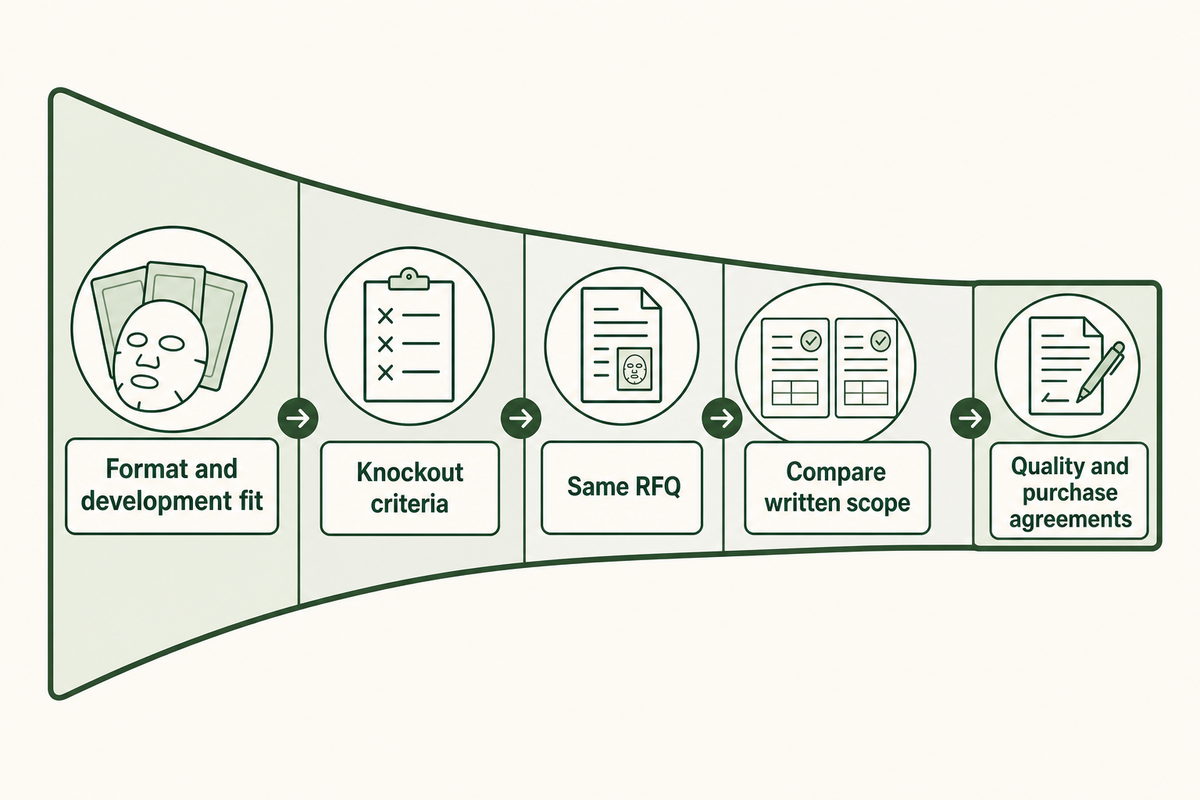
Start with approximately four candidates that match the required format and development route, and apply knockout criteria for site, market, evidence, formula rights, and non-negotiable claims. Send the same RFQ grid to the remaining candidates, and compare the written scope (not just unit price). Carry approved formula, sheet, package, test, site and change-control versions into the quality agreement and purchase order.
NEXO Beauty Labs is a global cosmetic OEM and ODM partner with a manufacturing foundation dating to 1999 and experience across skincare, hair care, and body care. If you want to discuss a custom sheet-mask brief with the publisher, review the private-label sheet mask manufacturing page. Treat the conversation like every other shortlist entry: confirm the current legal entity, site, MOQ, samples, testing, packaging, timing, and written project scope.
Turn your concept into a comparable manufacturing brief
Bring your target market, formula route, sheet format, packaging, volume scenarios, and launch window.
Discuss Your Sheet Mask Project
Bring your target market, formula route, sheet format, packaging, volume scenarios, and launch window.
Discuss Your Sheet Mask Project
References & Sources
The company profiles use the official websites shown on the cards and in the comparison table. The following authority sources define the regulatory, standard, and commercial boundaries in the buyer framework: