Get in touch with NEXO Beauty Labs Company


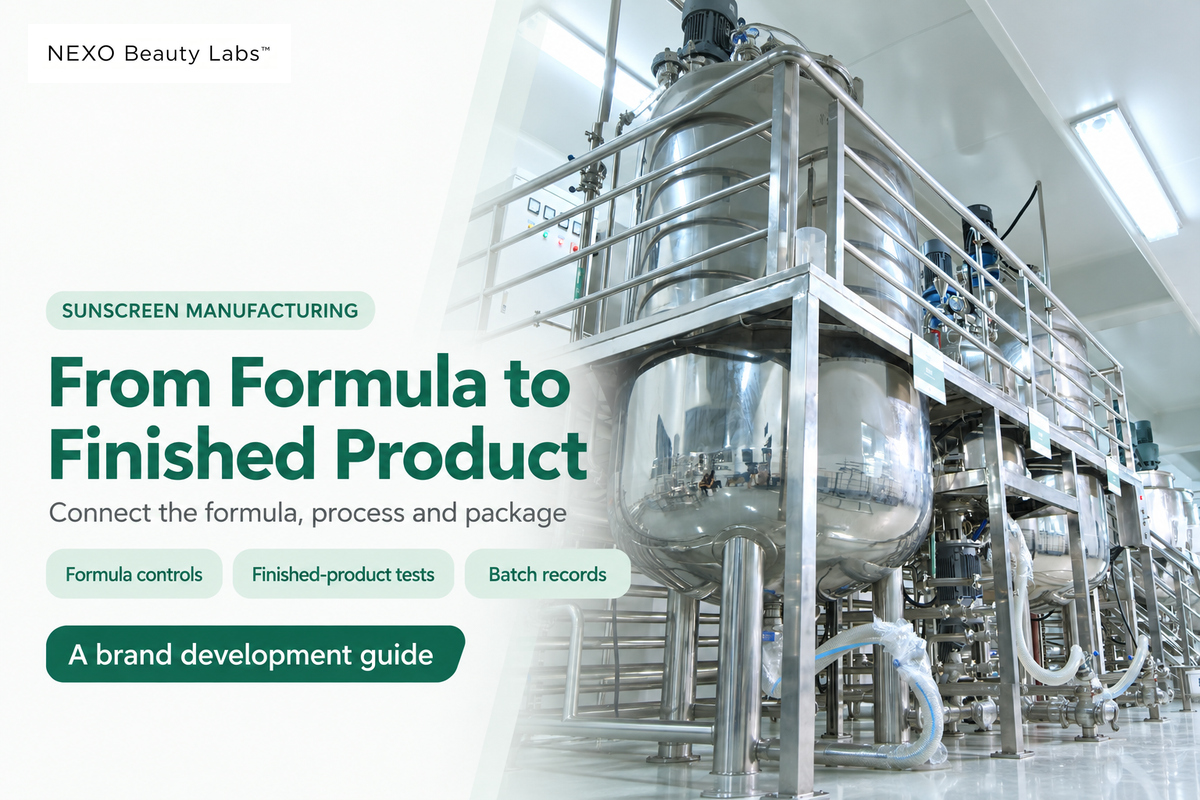
Sunscreen Manufacturing takes a product brief and turns it into a tested formula, a controlled process, and a filled package. The most difficult part for a brand in the sunscreen market is keeping these three parts together. A lotion can feel right in the laboratory yet develop crystals, lose its uniform dispersion or dispense poorly after the package or process changes.
Updated October 2026 · By Cherry
Sunscreen manufacturing begins with the destination market and intended claims, then connects filter selection, mixing, finished-product testing, scale-up and packaging. Brands should approve the formula, process and package as one development project. The evidence needed for an SPF claim, a stable package and a repeatable batch belongs in separate, traceable records.
This guide describes the principles of manufacturing sunscreen. This guide follows the decisions behind manufacturing sunscreen: what the formulator needs to control, which tests answer which questions, and what a brand should revisit after a change. Understand the tests that answer various questions. Know what a brand should revisit upon a change. Use a proof map and a change matrix to prepare a development brief and compare the scope of two competing product manufacturing proposals.
Start with the Market, Claims and Product Brief
A sunscreen brief requires the team to have named the markets, product formats, and protection claims before filters or packaging are chosen. Those choices determine the development route and the evidence the brand needs. Briefs for daily facial lotion and water-resistant body spray give the laboratory different challenges to solve.
Below is a short written specification: desired finish, body/facial use, intended skin types, SPF target, UVA claim, water-resistance claim and packaging. “For sensitive skin” and “cruelty-free” as well as other positioning claims must be treated as separate review items. R&D must understand which features are absolute and which can be flexible if the first prototype is out of spec.
The United States has classified sunscreen as an OTC drug. The FDA’s current sunscreen monograph explanation separates final requirements from proposals still under consideration. The monograph route also outlines requirements for products generally recognized as safe and effective. Other requirements for non-prescription drugs also apply. For the European Union, Regulation 1223/2009 follows the cosmetic route and requires the appointment of a responsible person, safety assessment, a product information file and notification. UV filters must meet the conditions in Annex VI.
Assign the destination’s regulatory requirements to a named project owner. Product development can then work from the same market assumptions as purchasing and label design.
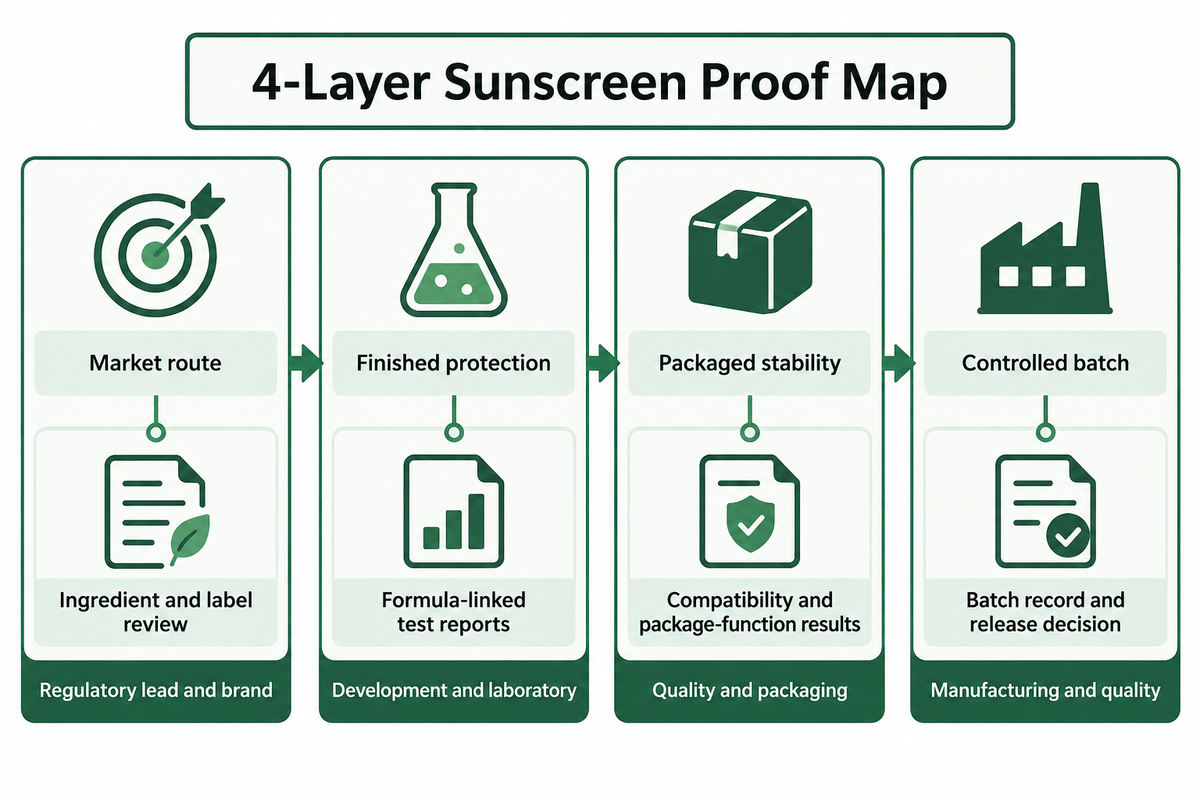
The 4-Layer Sunscreen Proof Map
Keep four folders in the project file. Each folder provides an answer to an approval question, and the absence of a report becomes evident before purchasing the components.
| Layer | Question to resolve | Record to request | Project owner |
|---|---|---|---|
| Market route | Can this formula, format and label follow the intended market route? | Ingredient and label review, assigned market responsibilities | Regulatory lead and brand |
| Finished protection | Does the tested sunscreen support its SPF, UVA and water claims? | Formula-linked reports with methods and claim results | Development and testing laboratory |
| Packaged stability | Will the formula and dispensing system remain suitable together? | Stability, compatibility and package-function results | Quality and packaging teams |
| Controlled batch | Was this batch made and released against the approved version? | Batch record, test results, deviations and release decision | Manufacturing and quality unit |
The map combines the product-file duties in EU Articles 10-11 with the FDA’s separate effectiveness testing and manufacturing controls. The folder arrangement illustrates a project method of work.
Keep sunscreen requirements visible rather than copying the brief for another care product for an existing skin care range. A personal care product can share a brand identity with the range but would need a different market pathway and test program.
Choose a Sunscreen Formulation Around Filter and Film
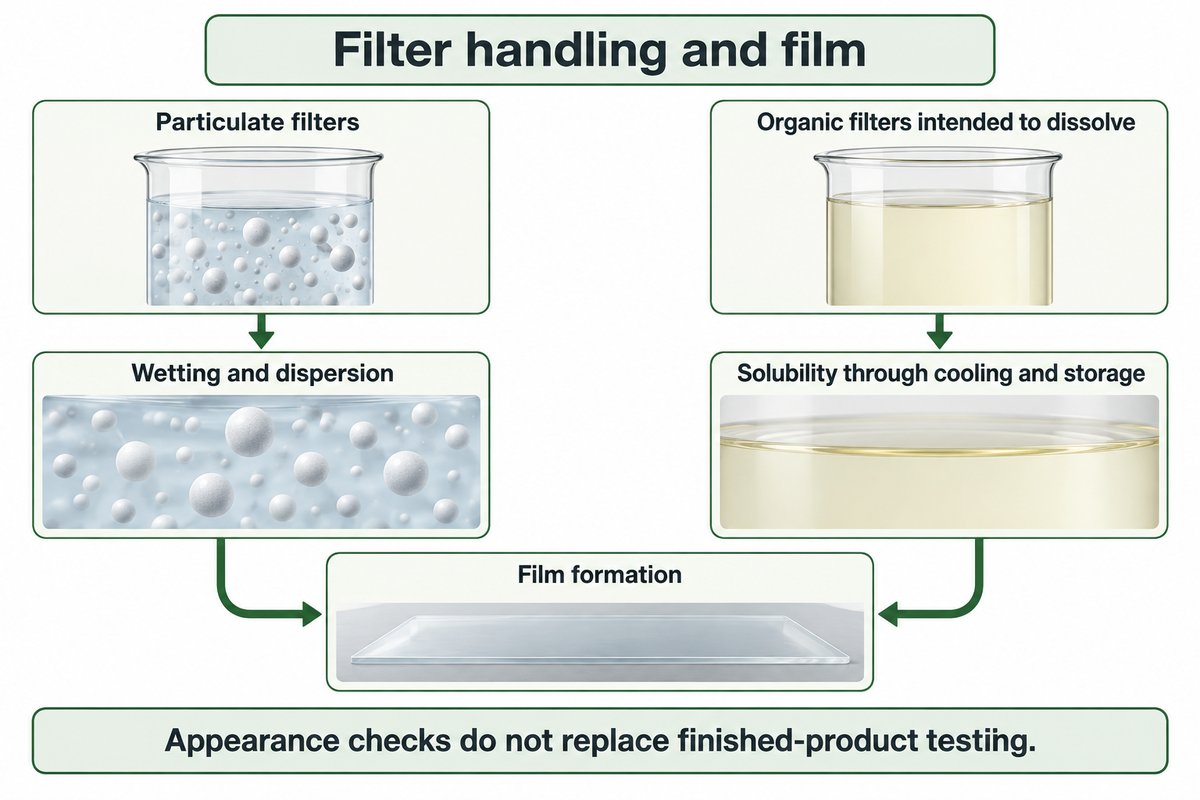
Sunscreen formulation balances a permitted filter system with dispersion or solubility, film formation, stability and skin feel. Some processing issues differ for mineral and organic filters. The full formulation must form a suitable film, thus, increasing the percentage of sunscreen actives by itself, is no substitute for complete sunscreen product testing.
Mineral or physical sunscreens use particulate filters such as zinc oxide and titanium dioxide. Powder grade, particle coating, carrier and dispersant affect how the particles behave in the formula. For organic filters intended to dissolve in the formulation, can the chosen solvent system keep them dissolved through manufacturing, cooling and storage? A hybrid formula brings both of these considerations into development.
Ellen Copsey’s formulation guidance identifies the differences between insufficient wetting, poor dispersion, incomplete dissolution and hydration of rheology modifiers. The type of distinction helps a brand ask a useful question after an unsuccessful sample: What has changed in the physical system and what observation will show whether the adjustment was successful?
“The product must spread easily and recover after spreading to form an even film.”
Further investigation of the sample is warranted. Crystals or agglomerates may be present that are too small to be seen by the naked eye. These may be spotted by means of microscopy. A drawdown of the sample can help assess if there’s a difference in terms of graininess and whitening. These are development observations; the protection claim still requires the appropriate finished-product test. The appropriate finished-product tests would have to be performed to make that determination.
The laboratory should record the actual filter trade grade and supplier, the active content of any pre-dispersion additions, addition stage and relevant checks. A zinc oxide pre-dispersion contains a carrier, as well as zinc oxide. Replacing it with another supplied material can change the effective filter input, oil balance and rheology even if the purchase description sounds similar.
For custom sunscreen formulations, resolve sensory priorities as early as possible. A brand may want a light finish, reduced white cast or a fragrance-free product for a sensitive skin positioning. Give the formulator a reference texture and a set of priorities, then review the claims and testing separately. The same approach works for a custom cosmetic formulation brief.
Follow the Sunscreen Manufacturing Process
The sunscreen process unites approved materials, controlled preparation, mixing, in-process checks and filling. For an emulsion, the team prepares the required phases and structure and distributes filters. The process design for an anhydrous or spray product is different. Control targets and observations should be defined in the production instructions.
How is sunscreen made?
Sunscreen manufacturing involves the preparation of an approved formulation, dispersing or dissolving the selected filters in suitable carriers, building the intended structure of the product, evaluating the bulk of the product, and applying agreed testing and release limits by the manufacturer. The precise addition order, heating, mixing and cooling instructions belong to the validated formula and equipment combination.
For lotion and cream systems, Silverson’s sunscreen application report describes the preparation of separate phases, emulsification and mixing to homogeneity. It identifies incomplete thickener hydration and agglomerates as possible causes of reduced performance. The example given by the equipment supplier supports the control logic; the formulator and process team should work out the specifics of the control logic for the actual product.
- Release the materials — confirm identity, grade, lot and acceptance before charging.
- Prepare the phases or base — follow the approved wetting, dissolution and hydration instructions.
- Build the product structure — control addition, mixing, heating and cooling for the selected format.
- Check the bulk — compare defined samples and measurements with the approved specification.
- Fill and review the batch — check package function, coding, results and quality release.
Sunscreen Process Control Map
The relevant question to ask is “What failure is the control intended to catch?” The examples should be included in the process review, along with the manufacturing partner.
| Process point | Failure to investigate | Control question |
|---|---|---|
| Material receipt | Wrong grade, coating or active content | Does the received lot match the approved material specification? |
| Powder wetting | Dry pockets or poor incorporation | Is the powder wetted in the intended carrier before the next step? |
| Mineral dispersion | Persistent agglomerates | Which dispersion observation or measurement confirms the target? |
| Organic-filter dissolution | Undissolved material or later crystals | What confirms dissolution and checks for crystallization after cooling? |
| Thickener hydration | Lumps or inconsistent rheology | Are addition, hydration and completion checks defined? |
| Emulsion formation | Separation or unsuitable droplet structure | Do phase addition and mixing produce the approved structure? |
| Cooling and holding | Viscosity drift, settling or crystallization | Are the cooling profile, hold conditions and sampling points recorded? |
| Transfer and filling | Uneven delivery or a package-function problem | Does the filled product meet weight, closure and dispensing checks? |
| Batch disposition | Unreviewed changes or unresolved results | Has the quality unit reviewed results and deviations before release? |
Technical mechanisms: Silverson and Croda. The record and release questions are an editorial synthesis informed by FDA manufacturing-control findings.
More mixing is not a complete corrective action. First distinguish inadequate dispersion from an incompatible carrier, incomplete hydration or a formulation that crystallizes on cooling. The manufacturing record should show the change made and the result observed, so the next batch follows an established process rather than a memory of what worked.
Change the Process for Lotions, Sticks and Sprays
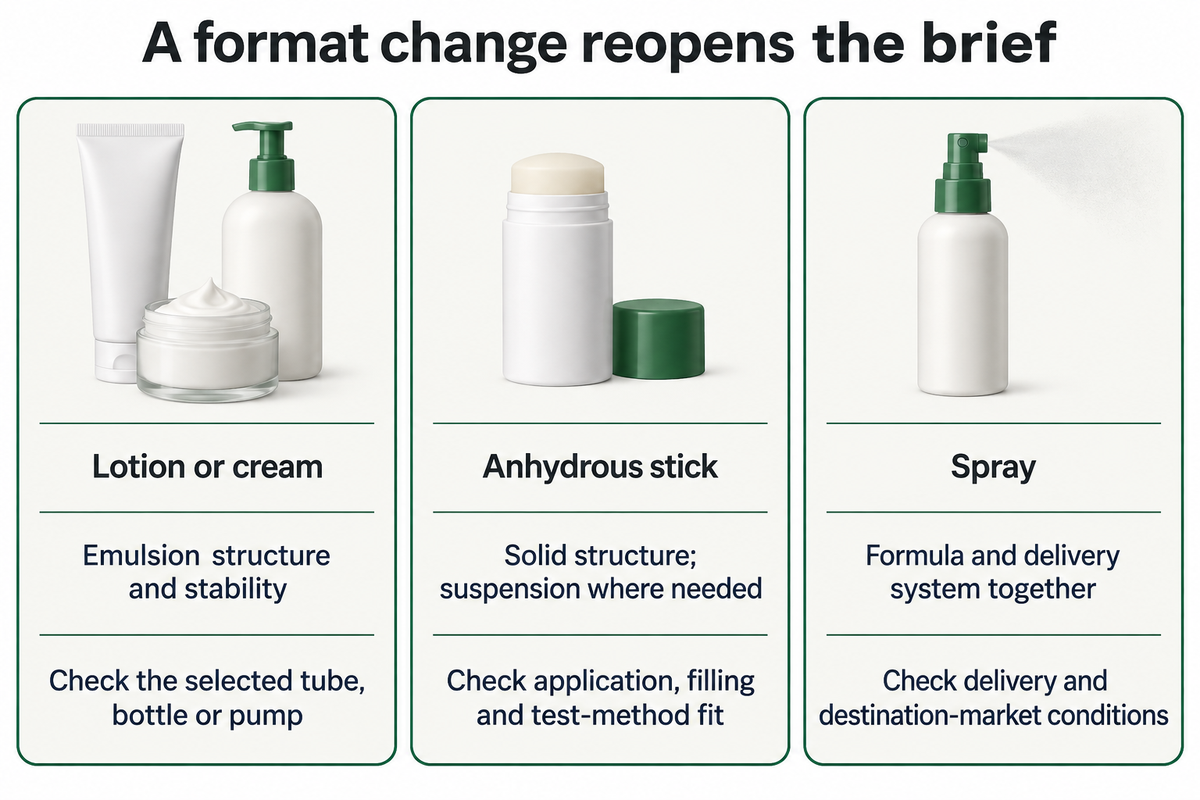
A sunscreen format changes the physical structure, processing route, and package demands. Lotions and creams use the strategy of Emulsion; Anhydrous sticks need a suitable solid structure, with suspension controls where particulate ingredients are present; Sprays demand a system that addresses formulation and delivery. Reusing a filter concept across these formats requires a format specific development and test plan.
For mineral systems, a technical review by Croda scientists in Cosmetics & Toiletries describes different challenges in oil-in-water, water-in-oil and anhydrous formulations. Water-phase interactions and pH behavior are important to emulsions. For anhydrous products, suspension and settling are of importance even though the system doesn’t contain a conventional aqueous phase to adjust the pH.
| Format | Development emphasis | Package and test question |
|---|---|---|
| Lotion or cream | Phase compatibility, dispersion, rheology and emulsion stability | Does the formula remain suitable in the selected tube, bottle or pump? |
| Anhydrous stick | Suspension where needed, solid structure, filling and cooling behavior | Does application, package operation and the selected SPF method suit the stick? |
| Spray | Bulk uniformity, flow and compatibility with the delivery system | What does the complete formula–sprayer system deliver, and which market conditions apply? |
Example: Lotions to sticks. A brand launches a facial lotion and subsequently requests a travel stick with the same filter story. The buying team, at first, treated the request as a new pack size. The formulator, however, opened a new format brief. The package applies the product differently and the available test methods must be adapted to the new form. The travel stick maintains the desired protection and finish of the lotion as design inputs, but requires the stick’s development and test scope separately. This approach preserves the marketing idea and provides a good first step to the laboratory. It also prevents the buying team from ordering a component against the lotion’s report, which was never intended to describe a stick.
Test the Finished Sunscreen Product, Not Just Ingredients
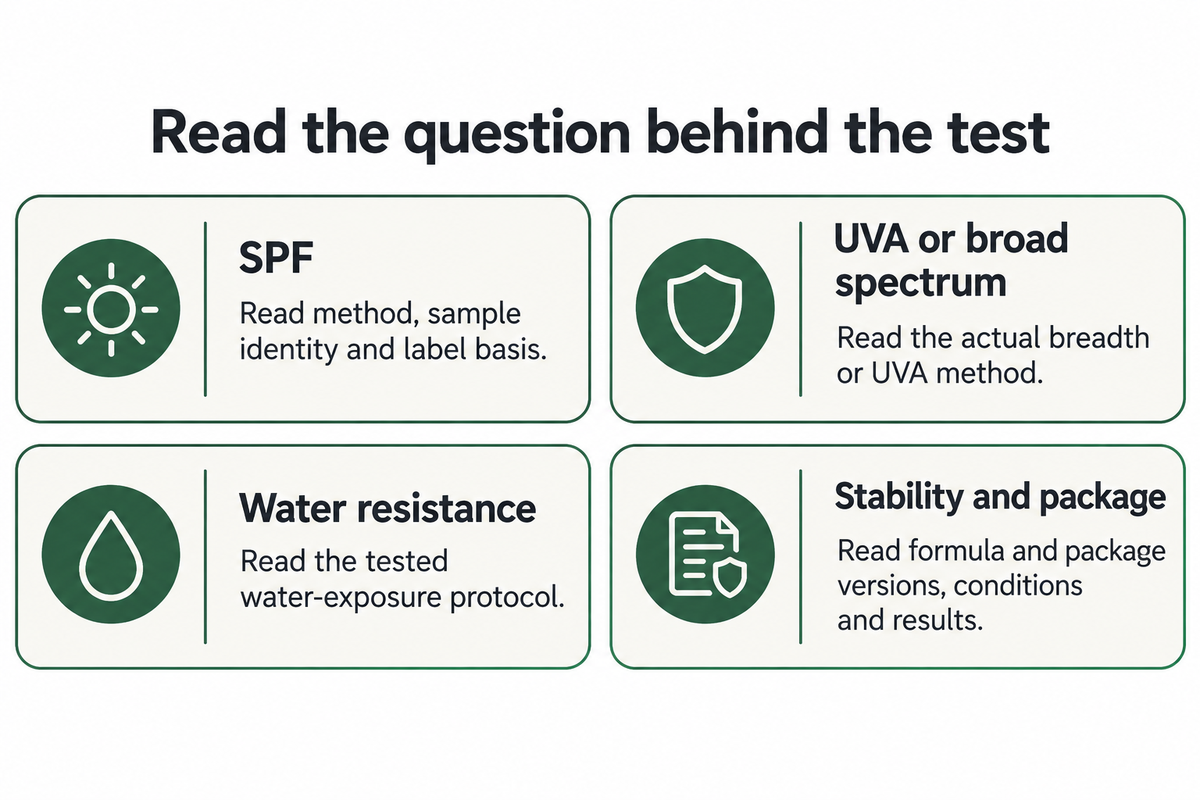
Finished product testing connects a specified formula with a test sample to a given protection claim. SPF, UVA and broad-spectrum protection, as well as water resistance answer different questions. Stability, microbiology and packaging studies evaluate the remaining product risks. Sponsors should reach agreement on the methods to be used, sample identity and the reporting requirements before comparing testing costs or accepting label artwork.
As evident in the FDA’s Labeling and Effectiveness Guidance, the FDA’s SPF method defines an application of 2 mg/cm². The broad-spectrum method describes a different in-vitro test, with a critical wavelength of at least 370 nm. The prescribed plate application is 0.75 mg/cm².
| Evidence | What to read in the report | Market-specific detail |
|---|---|---|
| SPF | Method, formula/sample code, result and label basis | FDA SPF testing specifies 2 mg/cm² application to test skin. |
| Broad spectrum or UVA | The actual UVA/breadth method and measured result | FDA broad spectrum: at least 370 nm critical wavelength. EU guidance recommends UVA-PF at least one-third of labeled SPF and 370 nm critical wavelength. |
| Water resistance | Protocol, water-exposure duration and retained protection result | FDA labeling uses tested 40-minute or 80-minute water resistance. |
| Stability and package compatibility | Formula/package versions, conditions, intervals, criteria and results | Set a product-specific protocol and justify shelf life with the relevant data. |
| Microbiological controls | Applicable microbial and preservation methods, criteria and results | Assess the actual formulation, intended use and package exposure. |
Sources: FDA guidance, questions 10–14; Commission Recommendation 2006/647/EC, section 3 and table 14; laboratory testing scope and project-specific quality assessment. The European figures are the Commission’s recommendation.
For an SPF 50 brief using that European recommendation, one-third is 50 ÷ 3, or approximately 16.7. Ask the laboratory to apply the unrounded criterion when judging the result. The team must also address the recommended 370 nm critical wavelength. The ratio and the spectral breadth describe different properties; a single SPF number doesn’t replace the UVA assessment.
There must be a clear link between the tested sample and the approved formula version. Read the report’s treatment of UVA and UVB rays in the light of the claimed sun protection. Is a report done on the requested water claim? What happens after a fragrance, tint, filter grade or a process change? Laboratory services can separate active ingredient assay, microbiology and in-package stability, as shown in Certified Laboratories’ sunscreen testing scope. Select the actual work package instead of buying a mystery “SPF testing” service.
With regard to the broader development program, use a cosmetic stability testing plan to define parameters and set acceptance criteria. A favorable appearance check at one observation point is one result in the program.
Keep Scale-Up and Batch Quality Consistent
During scale-up, the process must be adapted for use with the commercial equipment while the characteristics of the product established during development are maintained. The product can experience changes during various processes including mixing, transfer, and holding. The conditions of the product during filling can also be changed. Therefore, a pilot review should compare the product to the approved product, define the controls and evaluate the reproducibility for repeated runs of sunscreen production.
A 2025 FDA warning letter involving a zinc sunscreen illustrates the consequence of weak change control. The agency documented changes to manufacturing instructions and missing validation or stability support. The purchasing lesson is specific: ask who approves a change, what evidence is reviewed and how the approved instruction reaches the next batch.
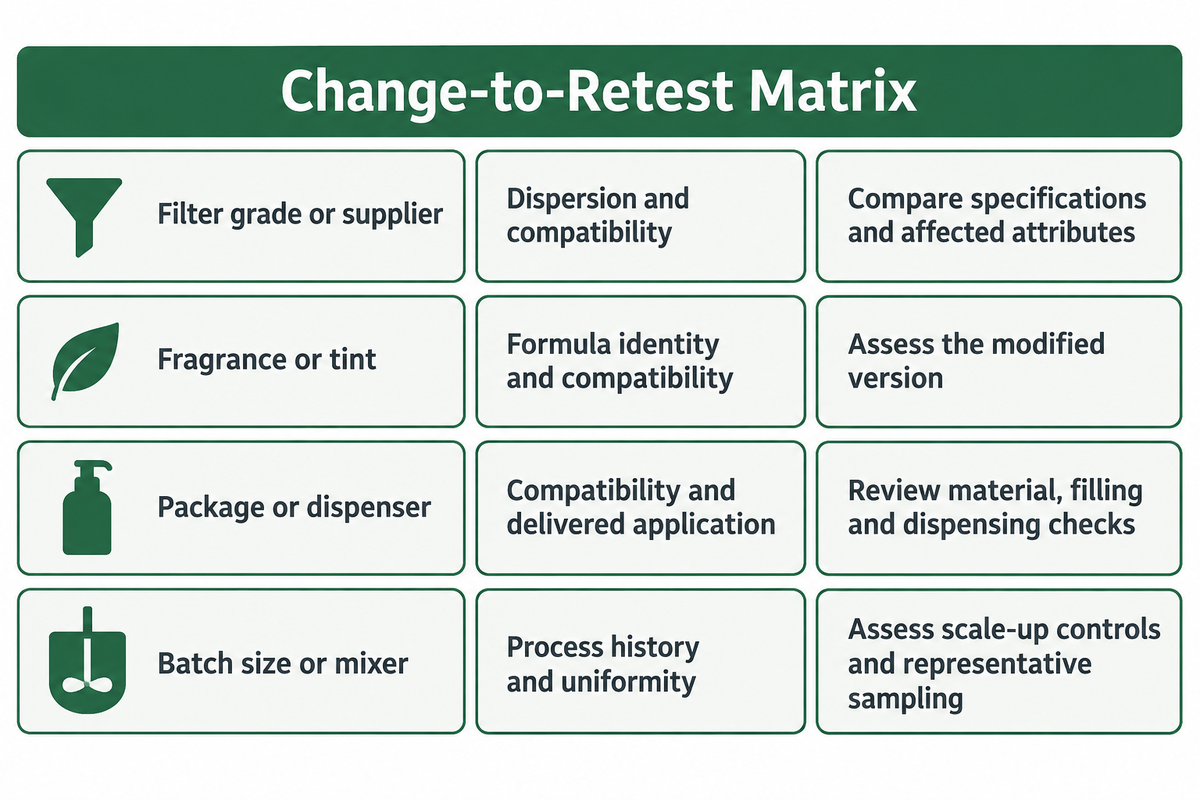
Change-to-Retest Matrix
Use the matrix when a change is proposed after sample approval. “Assess” refers to the determination of affected product attributes and what tests need to be conducted to confirm the change. Some changes need targeted package or process checks; others can require new protection-claim testing.
| Proposed change | What may be affected | Next assessment |
|---|---|---|
| Filter type or concentration | Permitted composition and protection performance | Review the market route, formula and claim-test program. |
| Filter grade, coating or supplier | Dispersion, compatibility and sensory behavior | Compare material specifications and confirm affected formula attributes. |
| Powder to pre-dispersion | Filter input, carrier balance and process | Recalculate the complete input and assess processing and claim evidence. |
| Emollient, emulsifier or thickener | Solubility, structure, rheology and film | Review stability and protection-test implications. |
| Fragrance or tint | Compatibility, sensory profile and formula identity | Assess the modified version before carrying reports forward. |
| Batch size, mixer or process sequence | Dispersion, dissolution, uniformity and reproducibility | Define pilot/process confirmation and appropriate product checks. |
| Bottle or tube resin, liner or closure | Formula interaction, sealing and storage behavior | Review package compatibility and stability coverage. |
| Pump or spray system | Dispensing, uniformity and delivery-system conditions | Check the complete filled system and applicable market requirements. |
| Lotion to stick or spray | Formula structure, application and method suitability | Create a format-specific development and test plan. |
| Market or label claim | Allowed composition, method and label basis | Recheck the destination route and evidence needed for the new claim. |
Sources for the assessment logic include the FDA case above, Croda’s material and process guidance, and the package-change considerations in Bayport Laboratories’ development guide. The matrix assigns review questions rather than a universal retesting rule.
Example: a new pump after approval. After completing development for a squeeze tube, a brand finds an airless pump that better suits its skincare range. Procurement wants to preserve the launch date and transfer the same bulk into the pump. While the packaging lead requests the resin and liner, as well as the specifications of the pump and filling, quality checks which studies used the original tube. The team separates protection and claim evidence from package compatibility and dispensing, and agrees to additional tests with the lab. Maintaining the formula as is can help keep useful development knowledge, however, the new filled system also requires an assessment. The purchase order follows that assessment, so a cosmetic packaging decision does not quietly become an unreviewed product change.
Plan Development Cost and Lead-Time Dependencies
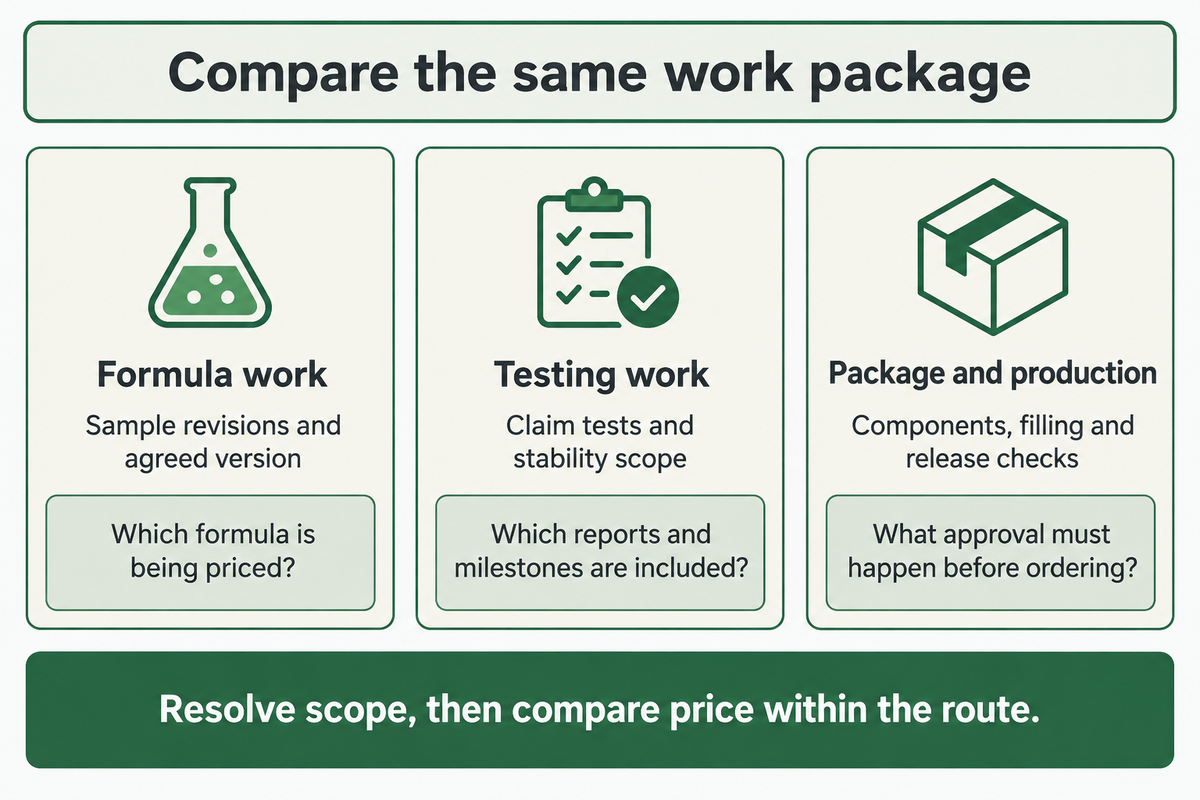
A sunscreen development budget should separate formulation work, tests, packaging, pilot and commercial manufacture. Lead time is dependent on the relationship between these activities. A useful comparison is to take a matched scope with identified approvals and delivery dates, so the brand can see which unresolved decision would delay the next purchase or test booking.
Ask for a cost breakdown of sample revisions, claim tests, stability and compatibility studies, components, filling, release checks and freight. Indicate what items would require a separate lab quote, and what a failed test or formula change would reopen. A low MOQ offer can still leave development costs outside the unit price. A premium sunscreen brief also requires the same: a more elaborate package changes the scope the buyer is comparing.
Laboratory scope influences timing. SGS describes stability, container-content interaction and physicochemical checks as distinct activities. Request the applicable protocols and reporting points for the actual product. The supplier’s production lead time after approval describes a different interval compared to the complete product development calendar.
Example: Two quotations with different scopes.
A founder compares proposals for a private label sunscreen line. The first quotation is for an existing formula in a stocked package. One covers a stocked formula in an existing package; the other includes a new tint, a different pump and additional testing. The founder is given the first quotation at a lower unit price. The founder requests each contract manufacturer to mark the same scope sheet. The comparison now shows which reports can be used for the selected product, which changes require assessment, who pays for additional samples and when components can be ordered. The founder then analyzes price within that route. This route avoids comparing a smaller developmental assignment and assuming the same custom project can be provided at a lower cost.
Compare a Sunscreen Manufacturer by Evidence
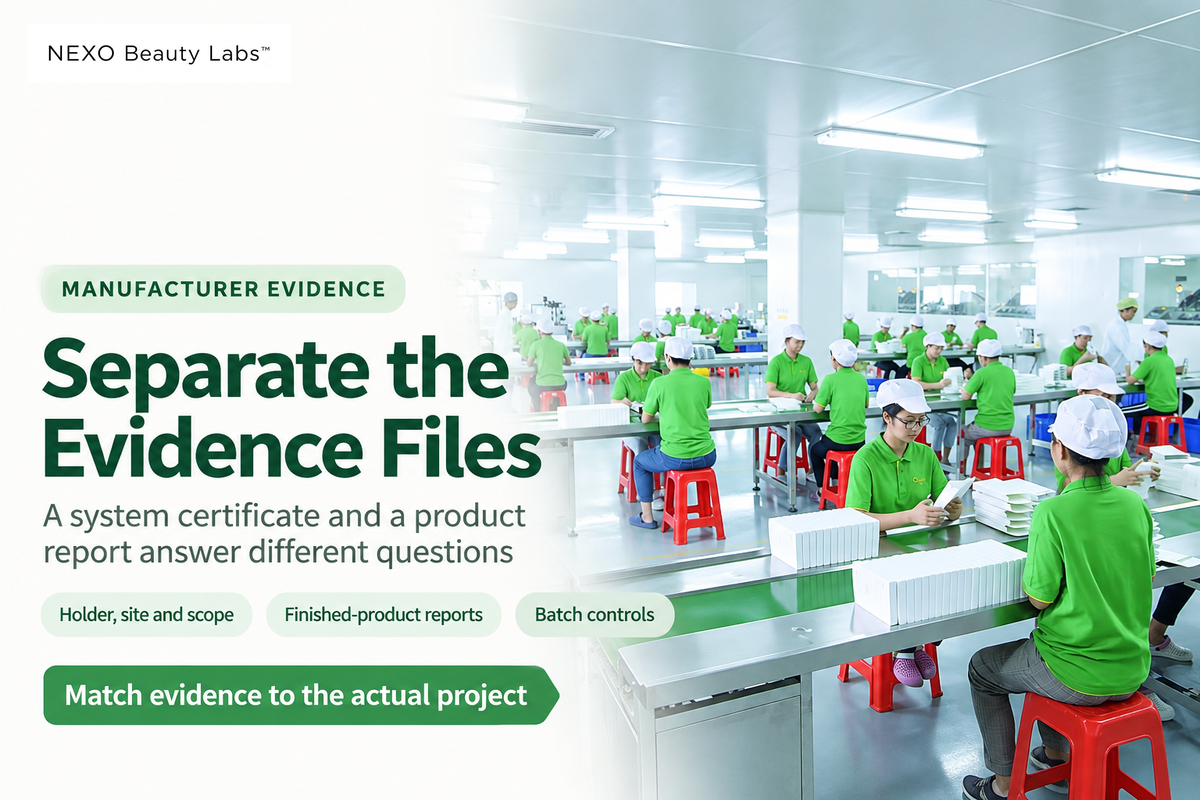
A sunscreen manufacturer should be assessed with respect to the intended formula, format, market and scope of production. Request the records that integrate these requirements with the proposed production site and testing program. A useful comparison separates company and system credentials, product related reports and controls of production and commercial terms of agreement, rather than integrating them to a single capability claim.
How to choose the right sunscreen manufacturer?
Choose a sunscreen manufacturer by matching the project’s market, formulation, format and order needs to a documented development and production plan. Identify the entity and site where the product will be manufactured. Review relevant testing reports and batch controls, and agree on change approval and access to records. Then, evaluate quotations for the same scope of work and the final package.
Experience as a hair care or body care manufacturer is useful for visits to a manufacturing site. For sunscreen, direct the discussion to filter handling and the intended dosage form, and the reports associated with the formula. Who performs work in-house, and what testing partner is involved? Clarify which records are provided to the Brand and which are retained by the site.
Keep an ISO 22716 or other good manufacturing practice (GMP) certificate in the quality-system review. For certification review, match the holder, site, scope and validity to the proposed manufacturing company. Keep the finished-product SPF and UVA reports in the product file. Ask the quality lead to explain how the site’s manufacturing standards and release checks apply to the actual order.
Existing white label or private-label route
- Identify the exact existing formula and package.
- Review the reports available for that version.
- Define which requested changes need assessment.
Custom formulation route
- Agree on the development brief and revision scope.
- Define testing, ownership and access to records.
- Plan pilot, package and production confirmation.
In the sun care industry, a private label sunscreen manufacturer and an OEM manufacturer may use these commercial labels differently. Document the actual assignment. The care product manufacturer should provide information on formula rights, testing responsibility and minimum order basis, and repeat-order change process, by whatever name it gives the service.
You can review NEXO’s sunscreen manufacturing services and share the formula route, format and package requirements. The review of the quality management overview provides additional information.
Watch the Changes in Filters and Test Methods
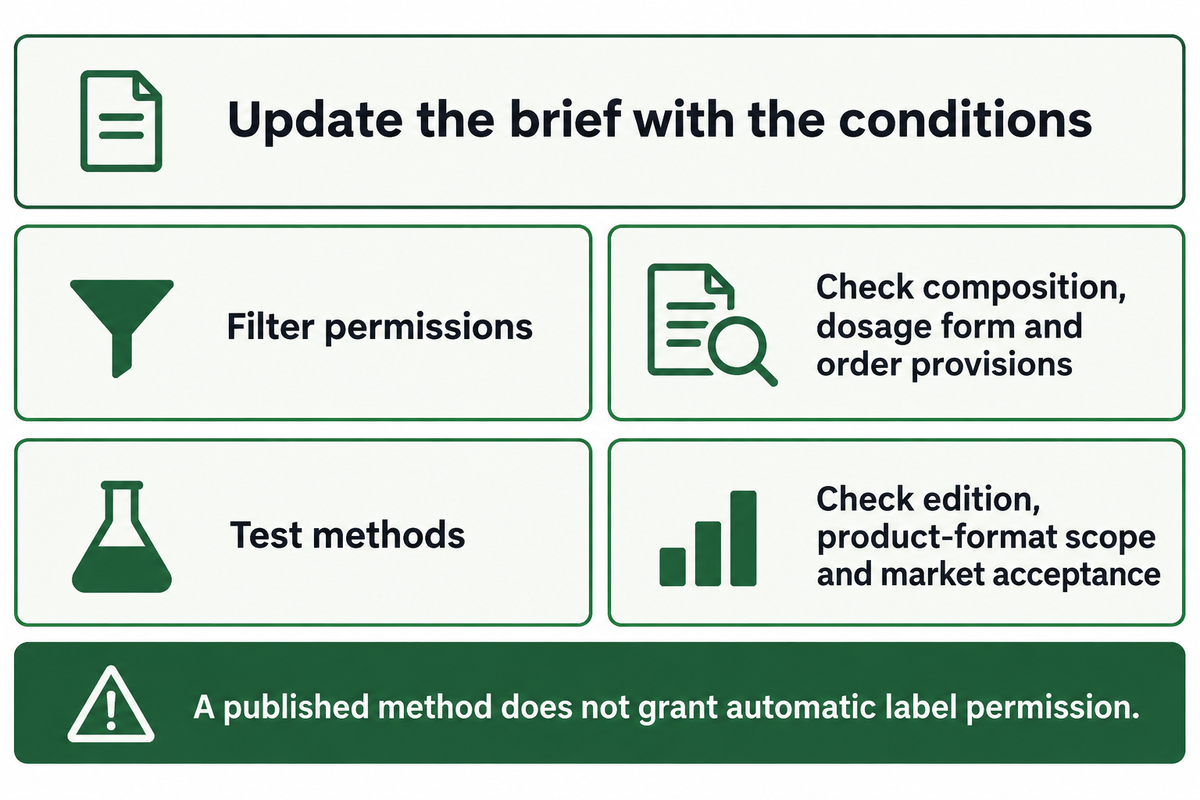
New filter permissions and test methods can change a sunscreen brief, but the brand still needs to check the exact conditions and intended format. Current developments make the distinction practical: the FDA added bemotrizinol under specified conditions in June 2026, while published ISO methods offer different testing options with explicit scope limits.
The FDA’s June 2026 notice for order OTC000039 describes bemotrizinol at concentrations up to 6%, with permitted combinations and dosage forms. Its spray conditions separate systems with no propellant from systems that isolate the propellant from the formula. Before freezing ingredient sourcing or a spray package, have the regulatory lead check the full order’s effective-date and exclusivity provisions as well as the formulation conditions.
Testing options also need a format check. ISO 23675:2024, published in December 2024, describes in-vitro determination of static SPF for emulsions or alcoholic one-phase formulations. Its public scope excludes loose or compressed powders and sticks, and it is not a water-resistance method. A lotion-to-stick project therefore cannot simply assume that this method follows the product into the new format.
ISO 23698:2024 describes measurement of SPF, UVA-PF and critical wavelength using diffuse reflectance spectroscopy. Its public scope applies to emulsions and single-phase products and says powder sunscreen use has not been evaluated. Ask the laboratory which method fits the proposed product and which results the destination market accepts.
For sunscreen brands reviewing market trends, a new standard is an investigation option, not an automatic label permission. In the test brief, provide the standard number, edition, product format and market acceptance basis. A sun care manufacturer can then discuss a defined test program, instead of a vague promise of “new-method testing.”
Key takeaway
A reliable sunscreen project connects the market brief, tested formula, final package and controlled batch. Use the four-layer proof map at approval, and reopen the relevant evidence whenever a material, process, format or package changes.
Make these decisions prior to requesting packaging solutions or confirming a manufacturing slot. A brand launching a new sunscreen line can send its market, format, claims and package brief via the sunscreen project enquiry.
Frequently Asked Questions
Can I create my own sunscreen brand?
A brand can commission sunscreen through an existing private-label formula or a custom development project, with the appropriate manufacturing and market responsibilities assigned.
Private label sunscreen manufacturing begins with deciding how much development the product needs. An existing formula and package may offer a defined starting scope, while a new filter system, tint or format opens additional work. Agree on formula rights, sample revisions, test reports, packaging and release responsibilities before ordering. Brand identity can develop alongside the technical brief, but the final claims and artwork should follow the selected market route.
The cosmetic line launch guide covers the wider business preparation.
To manufacture and sell a sunscreen in the US, must you be registered with the FDA?
U.S. drug establishment registration and drug listing follow the activities performed; a private-label distributor’s responsibilities differ from those of the manufacturing establishment.
Under 21 CFR 207.17, manufacturers, repackers, relabelers and salvagers generally must register their covered establishments, subject to exemptions. A private-label distributor that performs none of those activities isn’t required to register under that part. Section 207.41 separately addresses listing drugs supplied under a private label, including the distributor’s labeler code. Map the actual parties and activities with the regulatory lead, then assign the filing tasks in the agreement. Registration, listing and the product’s route under the current sunscreen monograph are separate questions.
What are the two ingredients to avoid in sunscreen?
The FDA’s 2026 removal action names PABA and trolamine salicylate; a brand still needs a destination-market ingredient review and the applicable effective-date provisions.
The FDA’s current explanation distinguishes that final action from other provisions of its 2021 proposal that remain under consideration. An announcement date and an order’s operative date are different project inputs. Have the regulatory lead check the current monograph, ingredient combinations and transition terms for the proposed launch. Avoid turning a general “two ingredients” question into a worldwide exclusion rule: the permitted-filter list, product category and intended claims must be reviewed for each destination.
Which sunscreen is 100% natural?
A mineral-filter label alone cannot answer a whole-formula natural-origin claim.
Review every ingredient and its processing against the named natural and organic standard the brand intends to use. Natural ingredients, filter choice and tested protection are separate development questions. Agree on the claim definition before commissioning the formula.
What is the minimum order quantity for private label sunscreen?
Minimum order quantity is a supplier and project term tied to the formula, batch and packaging scope.
Ask whether the quoted MOQ applies per formula, size or package variant, and whether component minimums differ. Confirm the manufacturing services and development costs included before comparing a low minimum order with a custom project.
Related Reading
The Perspective Behind This Manufacturing Guide
NEXO Beauty Labs publishes this guide for brands developing sun care products alongside other cosmetic and personal care products. The process maps connect filter handling, finished-product tests and manufacturing records so development, quality and purchasing teams can ask more precise questions. Cherry is the named author. For the company’s background and manufacturing focus, see About NEXO Beauty Labs.
References & Sources
- FDA, Sunscreen labeling and effectiveness testing guidance, questions 10–14
- European Union, Regulation 1223/2009, consolidated May 2026
- European Commission, Recommendation 2006/647/EC on sunscreen efficacy and claims
- Silverson, Manufacture of Sunscreen Lotion and SPF Cream
- Croda, Top 10 sun care formulation development mistakes
- ISO, 23675:2024 public scope; ISO, 23698:2024 public scope
- FDA/Federal Register, June 2026 bemotrizinol final-order notice
- Electronic Code of Federal Regulations, 21 CFR Part 207