Get in touch with NEXO Beauty Labs Company

Updated November 2026
Halal Cosmetic Manufacturing combines Islamic Sharia Halalan Toyyiban (permissible, pure, and safe) standards with a quality management system built on Good Manufacturing Practice under ISO 22716:2007 across skincare, hair care, and body care products. Compliant plants conduct raw-material evaluation across ingredient sources, fermentation media, processing aids, direct-contact packaging, line cleaning, and batch traceability to ensure products and ingredients remain free from haram ingredients and cross-contamination.
Regulatory timelines changed abruptly in Southeast Asia in late 2026. As per Emerhub, the government of Indonesia passed PP 40/2026 on 14 October 2026, pushing the mandatory halal certification for cosmetics by two years to 18 October 2028 and revoking the additional overseas pre-shipment warehouse inspections under BPJPH Regulation 4/2026. Meanwhile, Indonesia’s Cosmetic Halal Product Assurance System (SJPH) under BPJPH Decree No. 370 of 2026 and red-box non-halal labeling under BPJPH Regulation No. 3 of 2026 are already active, so brands coordinating certification and certification services must engineer compliance into base formulas early.
Oct 18, 2028
Indonesia mandatory halal cosmetic enforcement (PP 40/2026)
5 Points
Cosmetic SJPH pillars active since Oct 18, 2026 (Decree 370/2026)
$250 / 3-Yr
USA Halal Chamber plant application fee and audit cycle
4–6 Weeks
AHF reported certification timeline once dossiers are ready
What Is Halal Cosmetic Manufacturing and How Does It Differ from Vegan or Organic Production?
Halal cosmetic manufacturing requires every raw material, carrier solvent, processing aid, direct-contact package, and filling line used in halal production to comply with Islamic law under audited GMP controls. Vegan and cruelty-free labels only restrict animal inputs and animal testing respectively; ethanol sourcing, ritual cleansing, line segregation, and factory audits fall outside their scope.
Many founders treat vegan or organic stock bases as a fast shortcut to label halal on retail cartons. As the American Halal Foundation (AHF) states, vegan and cruelty-free claims don’t make beauty products halal; certification reviews formulation, manufacturing processes, and label claims together, and AHF lists 180+ markets in its commercial service information. As the American Halal Foundation (AHF) states, vegan and cruelty-free claims don’t make beauty products halal; certification reviews formulation, manufacturing processes, and label claims together, and AHF lists 180+ markets in its commercial service information. Likewise, the USA Halal Chamber of Commerce confirms that a Kosher certificate isn’t a substitute for a Halal certificate.
Picture cosmetic GMP and halal assurance as two separate locks protecting the same production floor. ISO 22716:2007 sets cosmetic GMP practices for production, control, storage, and shipment that help manage contamination risks and batch consistency. Islamic dietary laws and applicable certification criteria add a second lock for lawful slaughter and zero porcine or khamr (alcoholic beverages) contact, and segregated warehousing. While organic programs focus on agricultural origin and synthetic-input ceilings, they do not audit Islamic slaughter or Shariah line segregation. Brands moving from conventional ranges can align safety controls with clean beauty formulation and testing standards before layering halal-specific audits.
Are Halal Cosmetics Always Vegan or Cruelty-Free?
No, halal-certified products aren’t automatically vegan or cruelty-free, and plant based vegan cosmetics aren’t automatically considered halal. Permissible Halal formulas can include fish collagen, beeswax and lanolin from sheep wool, and bovine derivatives from Islamically slaughtered cattle. Conversely, a plant-based herbal toner still fails halal requirements if its botanical extract uses wine-derived ethanol or runs on equipment shared with porcine-gelatin masks.
| Audit Area | Halal Certified | Vegan | Organic | Cruelty-Free |
|---|---|---|---|---|
| Porcine & Haram Animal Inputs | Prohibited completely | All animal inputs excluded | Not judged by Shariah | Not regulated |
| Halal-Slaughtered / Marine Inputs | Permissible with slaughter/origin proof | Excluded | Judged by organic farming rules | Permitted if untested on animals |
| Ethanol & Extraction Solvents | Khamr banned; non-khamr source audited | Not restricted | Evaluated on agricultural origin | Not regulated |
| Fermentation Growth Media | Audited; porcine media forbidden | Usually focuses on finished INCI | Non-Shariah agricultural criteria | Not regulated |
| Shared Equipment & Segregation | Dedicated lines or validated cleaning/sertu | Self-declared washdowns | Conventional GMP washdowns | Not applicable |
| Direct-Contact Packaging & Brushes | Audited for najis materials & animal bristles | Focuses on animal hair & waxes | Environmental packaging focus | Not regulated |
| On-Site Facility Audit | Required plus ongoing surveillance | Often paper-only review | Periodic organic plant check | Supplier declaration review |
Sources: AHF, USA Halal Chamber of Commerce, and ChemLinked ASEAN Regulation Pedia.
When aiming for both Muslim consumers and clean-beauty retailers, starting with a vegan, alcohol-free base reduces animal-origin screening for declared ingredients, while processing aids and production materials still require halal source checks. However, full halal verification of extraction carriers, lubricants, and filling agents is still required. Dropping the vegan-equals-halal shortcut during the initial briefing prevents an unscreened glycerin or botanical extract carrier from forcing reformulation and repeat stability work later in the certification process.
Halal, Mashbooh, and Haram Cosmetic Ingredients: High-Risk Screening and Substitutes
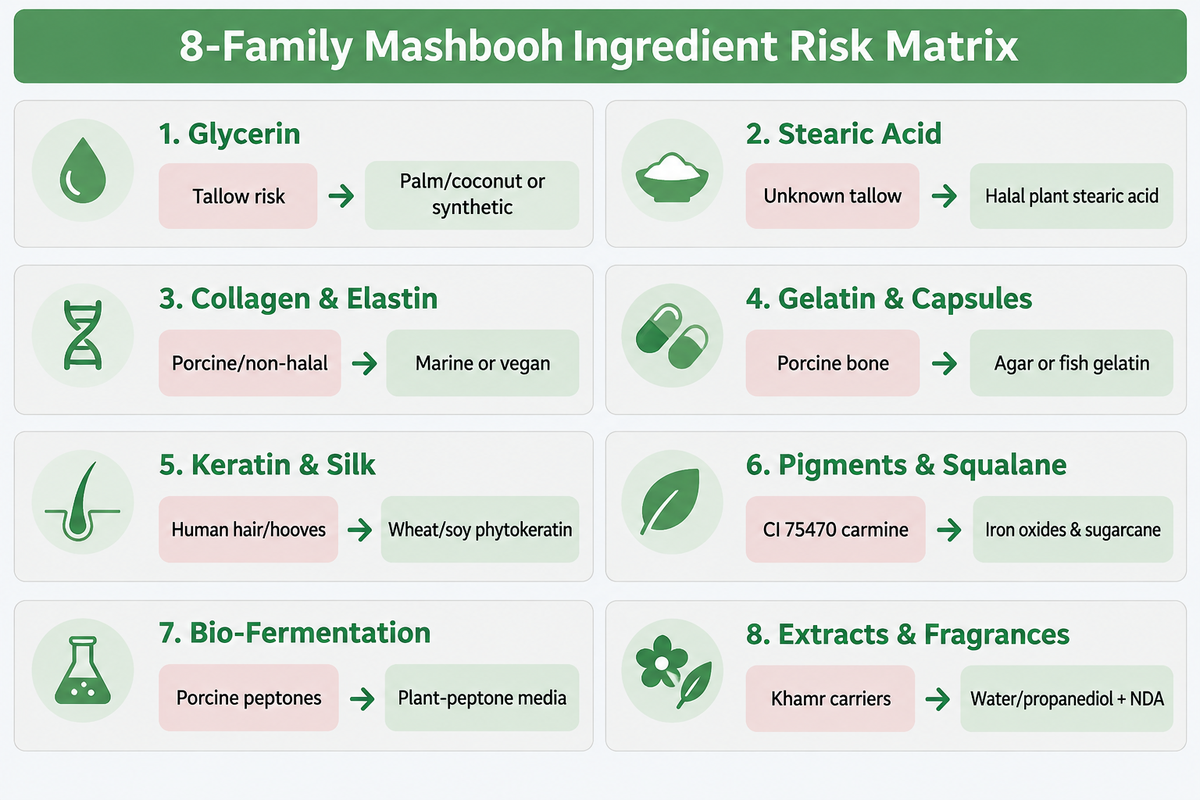
Every ingredient that flows into halal production passes through one of three screening tiers: clearly Halal, prohibited (Haram, or Najis) and critical or uncertain (Mashbooh) substances whose status is based on records of origin and processing. Screening Mashbooh inputs before bench-top tests helps brands gather the supplier documentation needed to obtain halal certification.
According to ChemLinked haram substances in Islamic law include porcine tissues and fats, blood, carrion, human body parts, non-halal-slaughtered animals, and alcoholic beverages. In color cosmetics, AHF flags cochineal-derived carmine (CI 75470) in lipsticks and blushes as non-halal, requiring mineral oxides or plant pigments instead. Most of the bottlenecks in certification come from humectants, emulsifiers, and fragrance blends of palm or tallow origin that are indistinguishable based on their INCI names.
Screening Ingredient Sources, Products and Ingredients Under Halal Rules
Before ordering pilot samples for private label skincare formulation, chemists can screen every INCI sheet against the 8-Family Mashbooh Ingredient Risk Matrix below. This matrix details common ingredient-origin risks, alternative options, and supplier records that have been used in halal cosmetic ingredient screening for compliance with Islamic standards across personal care products.
| Ingredient Family (INCI) | Typical Function | Origin & Audit Risk | Common Substitute Options | Typical Supplier Records |
|---|---|---|---|---|
| 1. Glycerin (Glycerol) | Humectant in skincare & body care | Tallow or porcine fat hydrolysis vs. vegetable oil | Halal-certified palm, coconut, or synthetic glycerin | Raw-material halal certificate + process flow chart |
| 2. Stearic Acid & Fatty Esters | Emulsifiers, pearlizers, soap bases | Often derived from tallow of unknown slaughter origin | Halal-verified plant stearic acid, glyceryl stearate, polysorbates | Oleochemical manufacturer halal certificate |
| 3. Collagen & Elastin | Firming serums, anti-aging creams | Porcine skin or non-halal-slaughtered bovine hide | Marine/fish collagen, recombinant vegan collagen, halal bovine | Species declaration + halal slaughter/processing certificate |
| 4. Gelatin & Hydrolyzed Capsules | Peel-off masks, capsules, thickeners | Frequently manufactured from porcine bone or skin | Agar, carrageenan, plant pectin, fish or halal bovine gelatin | Batch-linked halal certificate + species COA |
| 5. Keratin & Silk Proteins | Repair shampoos, hair care conditioners | Human hair (haram), hog bristles, non-halal animal hooves | Hydrolyzed wheat, soy, rice, or corn phytokeratin | Origin statement + processing-aid record |
| 6. Pigments, Waxes & Squalane | Lipsticks, blushes, balms, emollients | Carmine (CI 75470) insect red; shark squalane; animal-derived lanolin aids | Iron oxides, mineral lakes, sugarcane squalane, candelilla wax | Colorant inventory + non-animal origin COA |
| 7. Bio-Fermentation Actives | Hyaluronic acid, peptides, probiotics | Porcine peptones in growth media disqualify microbial output | Plant-peptone or mineral-media fermented actives | Growth-media composition letter + halal certificate |
| 8. Extracts, Solvents & Fragrances | Botanical extracts, parfum, toners | Khamr alcohol carriers, animal musk fixatives, tallow glycerin | Water, propanediol, halal DPG carriers, synthetic musk | Solvent breakdown + fragrance halal cert or NDA filing |
Sources: AHF Cosmetics Requirements, LPPOM MUI, and ChemLinked ASEAN Pedia.
Why Do Bio-Fermented Skincare Actives Often Fail Halal Raw Material Screening?
Bio-fermented skincare actives stall halal screening when buyers collect only Safety Data Sheets (SDS) without growth-media records. As per MUI Fatwa No. 01 of 2010, porcine-derived fermentation media render microbial cosmetic actives haram, and non-porcine impure (najis) media require physical separation and ritual purification for clearance.
For peptone screening, pair chemical hazard information in an SDS, under rules such as US 29 CFR 1910.1200 Appendix D, with a signed Halal Questionnaire and growth-media statement. Proprietary fragrance blends require a similar upfront pathway. Rather than dropping custom perfume notes, AHF documents two clearance routes: Collect a fragrance house Halal declaration, or arrange for confidential formula disclosure by the fragrance supplier to the certifier, under NDA.
Alcohol, Ethanol Limits, and Wudu-Friendly Formulation Physics in Halal Cosmetics
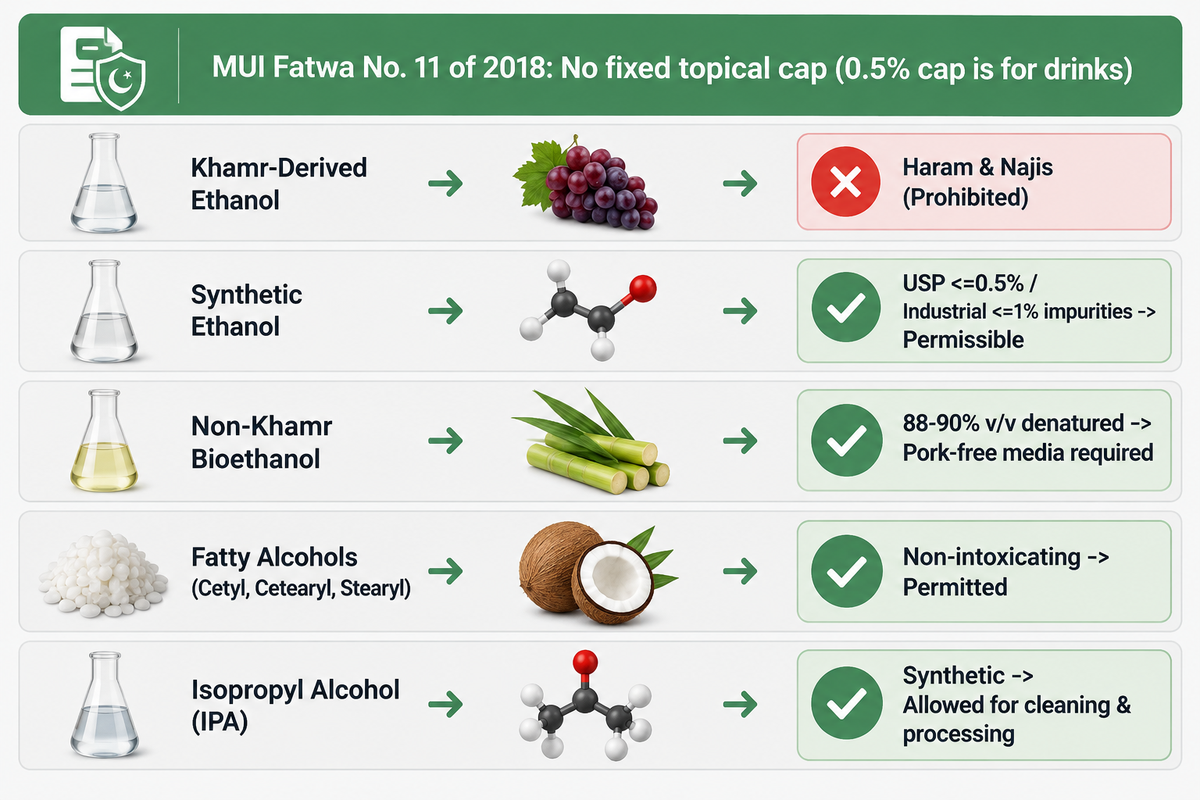
Alcohol in topical cosmetics isn’t subject to a universal cap of 0.5% under Indonesian Halal science. Per MUI Fatwa No. 11 of 2018, topical cosmetics aren’t subject to a fixed numerical ethanol limit, as long as the ethanol isn’t from the Khamr (intoxicating beverage) industry, fermentation media stay pork-free, and skin safety is ensured.
In food and cosmetics, there is no residue limit, the important thing is that it does not come from the alcohol industry. We also have to ensure that alcohol is generally produced from fermentation, and the fermentation media must be pork-free.”
Confusing the 0.5% beverage threshold in MUI Fatwa No. 10 of 2018 with topical cosmetic rules triggers avoidable rework in toners, setting sprays, and perfumes. Across the chemical industry, peer-reviewed analysis by Herdiana (2025, Risk Management and Healthcare Policy, NIH PMC11752820) contrasts two ethanol routes. In biomass fermentation, yeast toxicity stops conversion near 15% ethanol, and distillation hits an ethanol-water azeotrope at 95.6%. Synthetic ethanol, by contrast, hydrates petrochemical ethylene. Purity specs also separate grades clearly: USP pharmaceutical ethanol caps impurities at 0.5% by weight, industrial ethanol allows up to 1% impurities, and denatured ethanol runs at 88–90% v/v strength.
Is Alcohol Always Prohibited in Halal Cosmetics?
Non-intoxicating fatty alcohols and glycols are generally permissible in halal skincare and hair care, while non-Khamr ethanol is case to case, based on source, function and the certifying authority. The USA Halal Chamber of Commerce differentiates ethyl alcohol used in beverages from non-intoxicating alcohols like cetyl alcohol and isopropyl alcohol and permits their use for processing or cleaning.
Shoppers on skincare forums tend to confuse waxy emollients like cetyl, stearyl, and cetearyl alcohol with drinking ethanol because “alcohol” appears on the label. Cetyl, stearyl, and cetearyl alcohol, for example, are composed of long-chain lipids and function as emulsion thickeners. Rules across key export regions still diverge: Malaysia’s MS 2634:2019 prohibits intoxicating substances and relies on Shariah fatwa screening, while GCC markets apply GSO 2055-4:2021 alongside destination certifier ethanol thresholds. Where retail buyers require no ethanol in halal cosmetics, formulators use propanediol, pentylene glycol, or polyglyceryl-4 caprate solubilizers.
| Compound / Grade | Chemical Source & Spec (Herdiana 2025) | MUI / BPJPH Position | JAKIM / GSO / USA Halal Note |
|---|---|---|---|
| Khamr-Derived Ethanol | Alcoholic beverage fermentation by-product | Haram & Najis (prohibited) | Prohibited across all certification bodies |
| Synthetic Ethanol | Ethylene hydration (USP ≤0.5% or industrial ≤1% impurities per PMC11752820) | Permissible (Fatwa 11/2018; no fixed topical cap if safe) | Assessed per MS 2634:2019, GSO 2055-4:2021, or certifier limit |
| Non-Khamr Bioethanol (Denatured) | Cane/grain fermentation (15% raw, 95.6% azeotrope; 88–90% v/v denatured) | Permissible if non-beverage plant & pork-free media | Verify denaturant halal status and destination limit |
| Fatty Alcohols (Cetyl, Cetearyl, Stearyl) | Non-intoxicating long-chain lipids | Permissible when halal plant/synthetic origin verified | Explicitly permitted by USA Halal Chamber |
| Isopropyl Alcohol (IPA) | Synthetic non-beverage solvent / sanitizer | Permitted for surface cleaning & processing | Explicitly allowed as cleaning/processing aid |
Sources: LPPOM MUI, Herdiana (2025, PMC11752820), and USA Halal Chamber of Commerce.
For color cosmetics, waterproof sunscreens, and nail lacquers, halal certification addresses ingredient lawfulness and clean manufacturing, while wudu permeability concerns whether liquid water reaches skin or nail plates. The USA Halal Chamber FAQ explicitly confirms that certifying nail polish verifies halal ingredients and production, whereas ablution validity rests with religious scholars. Heavy occlusive silicones and standard nitrocellulose films block water even when formulated with certified halal inputs. Patent filings tackle permeability through porous polymer architectures, including cross-linked POSS nanocomposite breathable films (US8133478B2) and bioactive-glass water-permeable nail polish (EP1272144A4). Because wudu water-permeability testing lacks one harmonized ISO protocol, brands claiming breathable wear confirm accepted liquid-permeation test methods with their target authority before carton printing.
Global Halal Cosmetic Standards and Mutual Recognition (MRA): BPJPH, JAKIM, GSO, and OIC/SMIIC 4
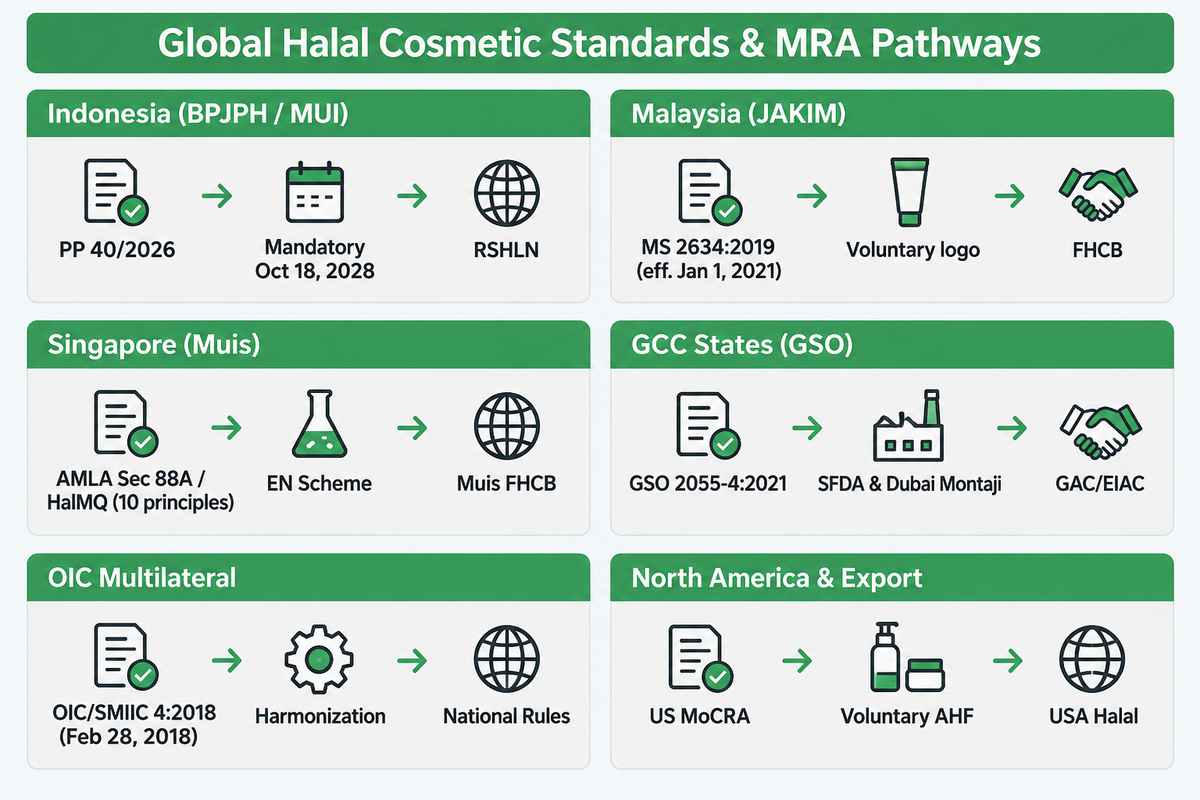
There’s no one halal certificate that clears customs across all Muslim-majority markets. Indonesia’s statutory halal mandate takes effect in October 2028, while voluntary halal marks are layered on top of mandatory cosmetic notifications in Malaysia, Singapore, and the Gulf states, making recognition checks on certifiers important before signing contracts.
Halal Certification Rules for Cosmetic Products and Personal Care Imports
Market access may involve Indonesia’s BPOM filing, Malaysia’s NPRA notification, an EU Regulation 1223/2009 Product Information File (PIF), or US FDA MoCRA facility registration, alongside the destination market’s separate halal rules. In Malaysia, halal certification stays voluntary for NPRA market entry unless the carton displays a Halal logo. In Indonesia, Law No. 33 of 2014 and PP 42/2024, amended by PP 40/2026 according to Emerhub and ChemLinked require either a BPJPH halal certificate (or registered foreign halal certificate) by the extended 2028 date or standardized red-box non-halal labeling.
| Market / Authority | Current Standard / Statute | Market Entry vs. Halal Mandate | Foreign Certificate / Recognition Path |
|---|---|---|---|
| Indonesia (BPJPH / MUI) | Law 33/2014, PP 42/2024, PP 40/2026, Decree 370/2026 (SJPH) | BPOM mandatory now; mandatory halal cosmetics begins Oct 18, 2028 (or NON HALAL label) | BPJPH-recognized foreign body (LHLN) + importer RSHLN registration via SIHALAL |
| Malaysia (JAKIM / JAIN) | MS 2634:2019 (eff. Jan 1, 2021; supersedes MS 2200-1), MPPHM 2020 | NPRA notification mandatory; halal certification voluntary unless printing Halal logo | JAKIM Recognized Foreign Halal Certification Bodies (FHCB) list |
| Singapore (Muis) | AMLA Section 88A; HalMQ (10 principles) | HSA notification mandatory; halal voluntary under PRO (local) or EN (import) | Muis-recognized FHCB + per-shipment Halal Endorsement Letter (EN Scheme) |
| GCC States (GSO / National Bodies) | GSO 2055-4:2021 (ICS 71.100.70) | Country-specific cosmetic clearance (e.g., Saudi SFDA, Dubai Montaji); halal governs Halal claims | Accredited bodies recognized by national Gulf authorities (GAC, Saudi Halal Center, UAE EIAC) |
| OIC Multilateral | OIC/SMIIC 4:2018 (published Feb 28, 2018) | Regional harmonization benchmark adopted selectively by member states | Depends on importing country’s national accreditation rules |
| North America & Export (AHF / USA Halal) | Private Shariah certification schemes | US MoCRA facility registration/listing mandatory; halal voluntary commercial credential | Verify live recognition by BPJPH, JAKIM, MUIS, or GCC bodies for your exact scope |
Sources: GSO 2055-4:2021, SMIIC, Malaysia NPRA, and ChemLinked ASEAN Pedia.
Holding a valid halal certificate from an overseas body by itself doesn’t complete Indonesian or Singaporean import compliance. Under BPJPH Decree No. 221 of 2025 (effective December 15, 2025), the Indonesian importer registers the foreign certificate on SIHALAL for an RSHLN number to establish full compliance. There’s a correction period of 5 working days, payment of the invoice within 10 working days and the renewal window opens 60 working days before the certificate expires and ends on the expiry date. The BPJPH also deactivates an RSHLN registration when the expiry date of the Mutual Recognition Agreement (MRA) of the recognized halal body expires, regardless of the expiry date of the factory’s own certificate which could be many years later. It’s important for importers to confirm the validity of the MRA and the Factory’s certificate before shipment.
Facility Controls, ISO 22716 Integration, Line Segregation, and Sertu Cleansing Protocols
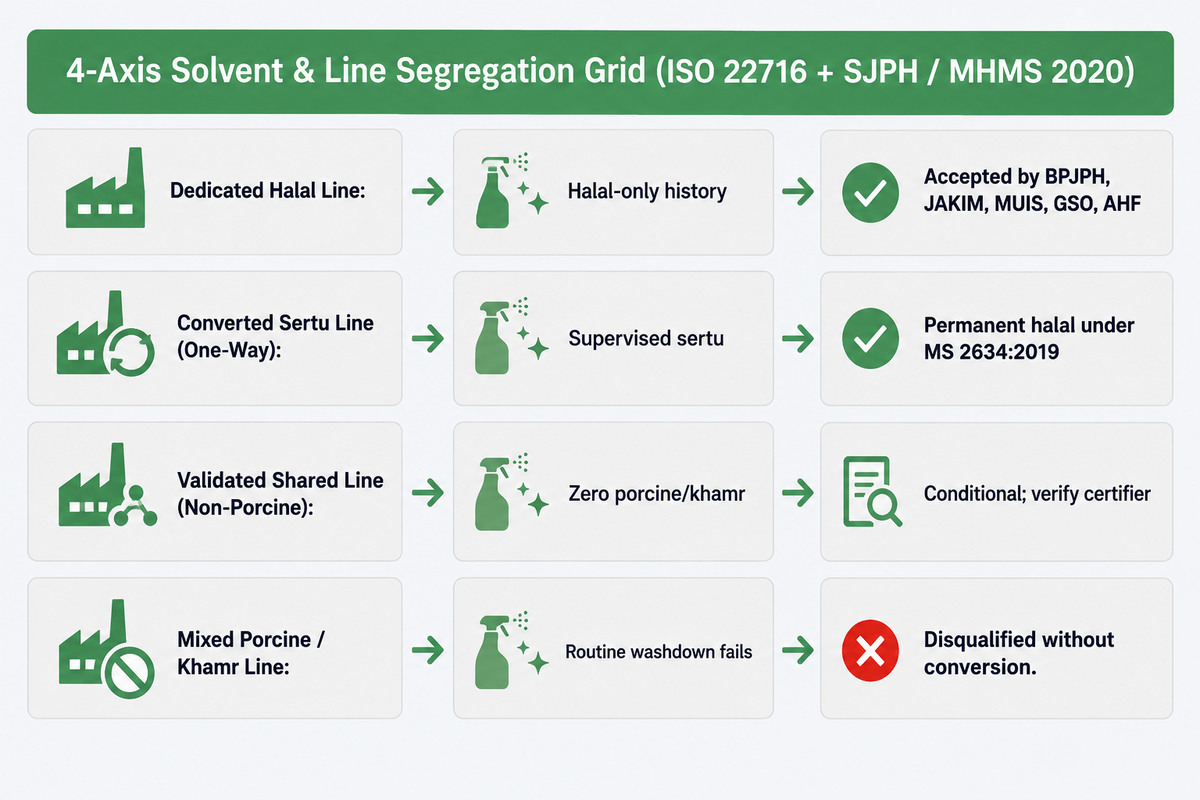
Plant-level halal assurance embeds a documented management system, such as Indonesia’s 5-point Cosmetic SJPH, Malaysia’s MHMS 2020, or Singapore’s 10-principle HalMQ, into ISO 22716 cosmetic GMP. Under Malaysia’s MS 2634:2019, lines exposed to severe impurities (najs al-mughallazah) require authority-supervised sertu cleansing and permanent halal dedication afterward.
Layering halal governance onto ISO 22716:2007 avoids running duplicate binders on the factory floor. ISO 22716 covers raw-material control, weighing equipment, cleaning procedures, storage, and deviation management in cosmetic production. Halal manufacturing extends receiving, storage, and change control: approved materials carry suitable certificates, halal drums sit apart from non-halal stock, and equipment lubricants carry halal-acceptable ingredient and source records (noting that NSF H1 indicates incidental food-contact suitability, not halal certification). Oversight bodies also enforce staffing governance: Singapore’s Muis PRO scheme requires at least two Muslim staff members including a Halal Assurance Officer, while BPJPH SJPH mandates a designated Halal Supervisor.
Permitted line architecture depends on prior contamination history and the rules of the certifying body. Use the 4-Axis Solvent & Line Segregation Grid below when assessing a contract factory’s floor plan before commercial runs.
| Production Line Architecture | Axis 1: Prior Exposure History | Axis 2: Cleansing & Changeover | Axis 3: Solvent & Lubricant Control | Axis 4: Certifier Acceptance |
|---|---|---|---|---|
| Dedicated Halal Line | New stainless steel or halal-only history | Standard ISO 22716 documented cleaning | Halal-acceptable detergents & lubricants | Accepted across BPJPH, JAKIM, MUIS, GSO, AHF |
| Converted Sertu Line (One-Way) | Prior exposure to porcine/canine najs al-mughallazah | Authority-supervised sertu ritual cleansing | Replace porous seals/hoses; full halal consumables | Allowed under MS 2634:2019 ONLY if permanently halal afterward |
| Validated Shared Line (Non-Porcine) | Shares non-certified plant/mineral formulas; zero porcine or khamr | Validated changeover washdown + swab sign-off + campaign scheduling | Non-intoxicating IPA/halal cleaners; segregated pumps | Conditional under AHF & select schemes; verify per certifier |
| Mixed Porcine / Khamr Shared Line | Alternates halal runs with porcine collagen or khamr batches | Routine washdowns cannot clear severe impurity | Using equipment contaminated with najis violates halal standards | Disqualified without authority-supervised conversion |
Sources: MS 2634:2019 & BPJPH Decree 370/2026 via ChemLinked, AHF Cleaning Validation, and ISO 22716:2007.
⚠️ Batch Change-Control Scenario (Worked Example)
Suppose a plant blends a 1,000 kg halal body-lotion batch on a validated shared homogenizer, and stock runs 12 kg short of certified palm glyceryl stearate. Pulling an emergency drum of chemically identical glyceryl stearate from an unapproved trader breaks the SJPH approved-material list immediately. Even if the finished lotion meets viscosity and pH release specs under ISO 22716, that 1,000 kg batch cannot carry the halal logo because its substituted stearate lacked prior halal approval. Approval of the supplier later on will not certify that batch.
Scale-Up Engineering, Microbiological Safety, and Halal Analytical Lab Testing
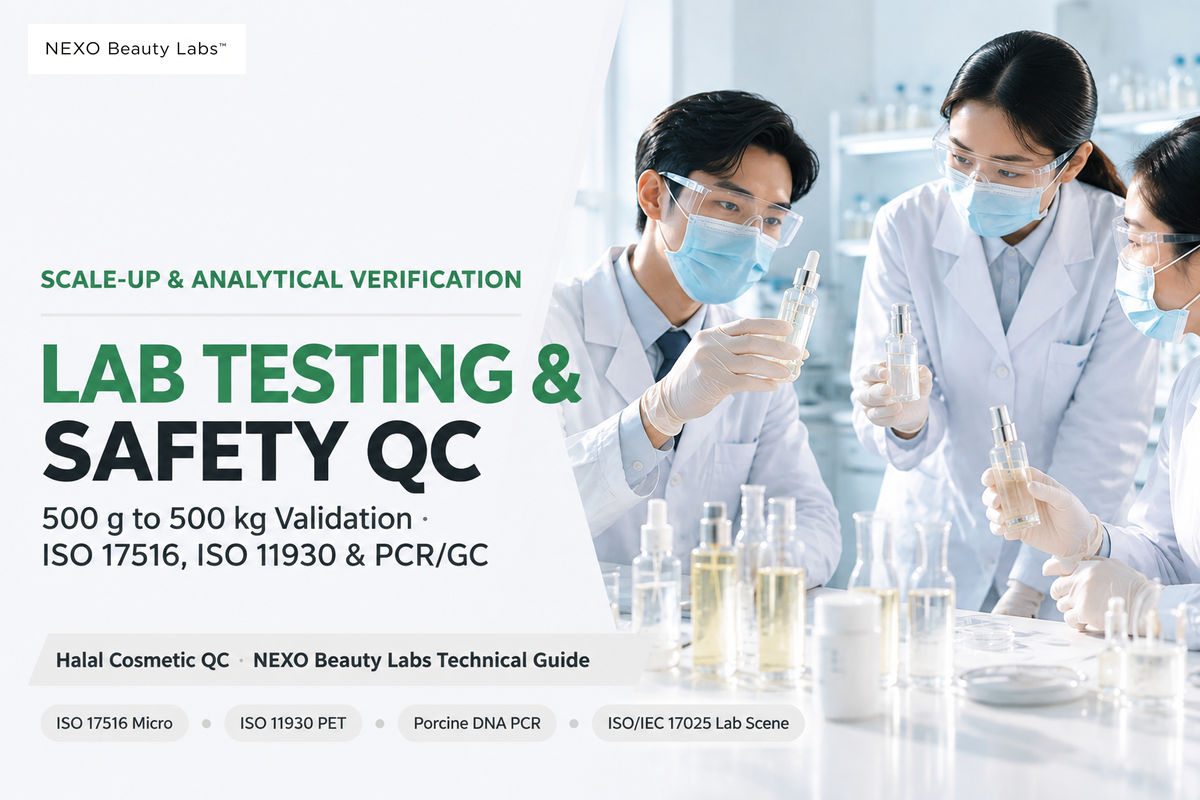
Before commercial shipment, halal cosmetic scale-up requires microbiological and stability validation matched to the product risk. Halal assurance depends on approved materials, and line controls. If a risk of the raw material justifies it, or based on the certifier’s policy, porcine DNA by PCR, or ethanol by gas chromatography can be done.
Moving halal formulations from small 500 g lab beakers to large 500 kg commercial kettles changes shear thinning, emulsion cooling curves, and preservative activity. Swapping animal gelatin or tallow esters for plant gums changes viscosity recovery, and removing ethanol from toners eliminates a secondary antimicrobial hurdle. Structured cosmetic manufacturing quality control verification ties pilot stability, preservative efficacy, and risk-based analytical tests to the production vessel before full launch.
| Test Domain | Standard / Analytical Method | Purpose | When Applied |
|---|---|---|---|
| Microbiological Limits | ISO 17516:2026 (supersedes 2014) | Sets microbiological limits for finished cosmetics | Testing frequency follows product risk assessment and quality plan |
| Low-Risk Micro Screening | ISO 29621:2017 | Defines criteria for microbiologically low-risk finished products | Formula risk review (e.g., anhydrous or extreme-pH formats) |
| Preservative Challenge | ISO 11930:2019 + Amd 1:2022 | Evaluates antimicrobial protection after solvent or additive changes | Formula lock and any preservative reformulation |
| Physical Stability | ISO/TR 18811:2018 | Provides stability study guidance across varied cosmetic formats | Pilot batches in final direct-contact packaging |
| Porcine DNA Detection | Real-Time PCR at ISO/IEC 17025 lab | Screens trace porcine DNA in animal-risk raw materials or formulas | Critical animal-risk inputs or certifier audit sampling |
| Ethanol Quantification | GC-FID / Headspace GC at ISO/IEC 17025 lab | Quantifies ethanol residue in sprays, extracts, and perfumes | Alcohol-bearing formulas or certifier surveillance requests |
Sources: ISO 17516, ISO 29621:2017, LPPOM ISO/IEC 17025:2017 Lab, and ChemLinked JAKIM Lab Rules.
Use an ISO/IEC 17025-accredited laboratory for internal pre-screening before an official halal audit. LPPOM operates an ISO/IEC 17025:2017-accredited laboratory for halal and vegan testing of cosmetic products, and ChemLinked reports that JAKIM routes audit samples to an ISO/IEC 17025-accredited government laboratory under the Malaysian Chemistry Department (paid by the applicant). Pre-audit screening detects ingredient issues early and reduces corrective work following the official plant inspection.
| Product Format | Risk Cluster | Primary Halal Audit Trigger | Primary ISO / Lab Focus |
|---|---|---|---|
| Water-Based Skincare Creams & Lotions | Cluster A: Emulsion & Lipid Risk | Glycerin, stearic acid, fatty esters | ISO 17516 + ISO 11930 + ISO/TR 18811 |
| Bio-Active Serums (Peptides / HA) | Cluster A: Biotech Media Risk | Fermentation peptones & enzyme aids | ISO 11930 + growth-media dossier |
| Body Care Washes & Shampoos | Cluster A: Surfactant & Protein Risk | Tallow surfactants, hydrolyzed keratin | ISO 17516 + supplier oleochemical certs |
| Botanical Toners & Facial Mists | Cluster B: Solvent & Extract Risk | Khamr extraction ethanol, preservative load | GC ethanol assay + ISO 11930 |
| Fine Perfumes & Body Sprays | Cluster B: Ethanol & Fixative Risk | Ethanol feedstock, musk fixatives, fragrance NDA | ISO 29621 low-risk review + GC assay |
| Peel-Off Masks & Serum Capsules | Cluster B: Animal Polymer Risk | Porcine gelatin or non-halal collagen | Porcine DNA Real-Time PCR + species COA |
| Lipsticks, Blushes & Eye Makeup | Cluster C: Pigment & Applicator Risk | Carmine (CI 75470), animal-hair brushes, waxes | ISO 29621 + colorant & brush origin audit |
| Anhydrous Balms & Body Oils | Cluster C: Wax & Packaging Risk | Squalane/lanolin origin, stearate mold release | ISO 29621 + direct-contact resin declaration |
| Water-Permeable Nail Lacquers | Cluster C: Film & Claim Risk | Halal solvent/resin compliance vs. wudu water flow | Certifier-agreed permeation test + solvent COA |
Direct-Contact Packaging, Repackager Risks, Labeling Rules, and Batch Traceability
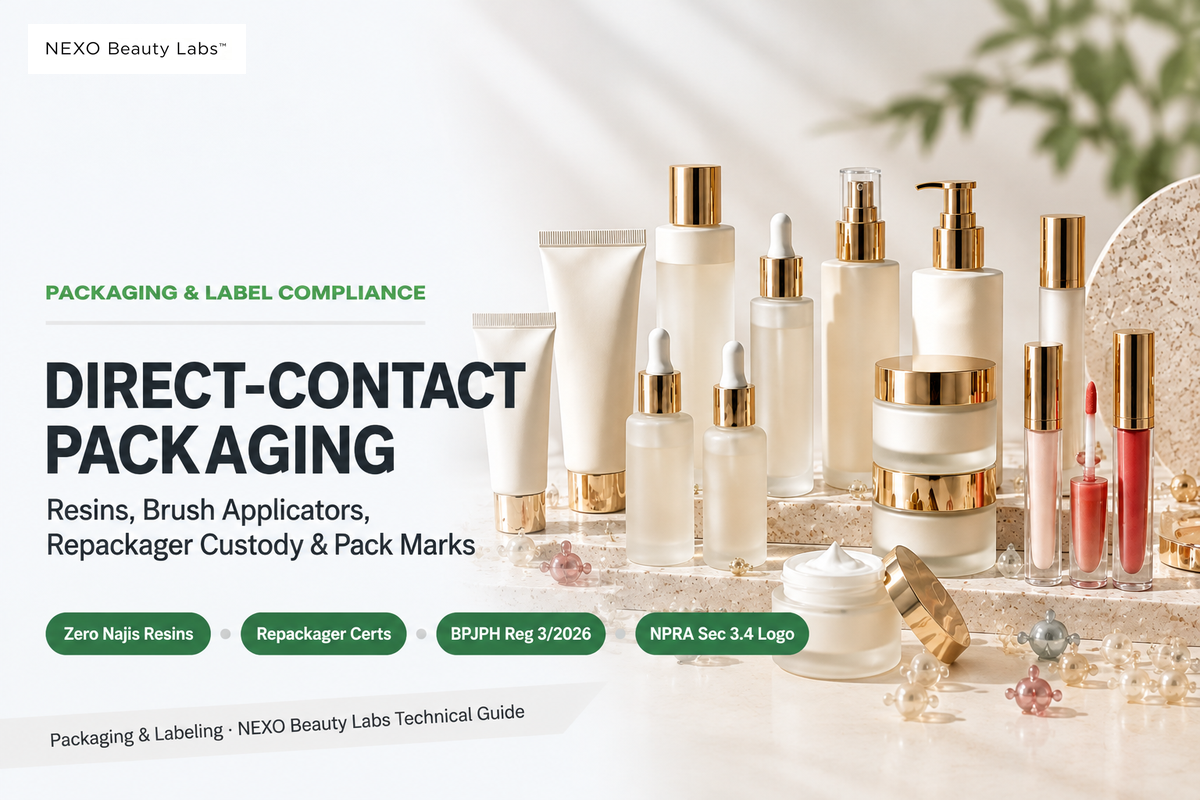
Compliance with halal standards extends to multiple direct and indirect contact materials and services including resins, applicator brushes, chemical repackagers, segregated warehouses, and legally controlled pack marks. Uncertified repackaging and the use of premature halal logos rank among the most damaging compliance failures in global halal beauty launches.
“The information on the label shall be in Bahasa Malaysia and/or English. Halal logo may be used voluntarily on a notified cosmetic product, for both the local and export markets, provided that the product has been certified and approved Halal by the Malaysia Department of Islamic Development (Jabatan Kemajuan Islam Malaysia, JAKIM) or any Islamic Body recognised by JAKIM.”
This confirms where supply chains break. In July 2026, Md Yusof, Mustafar, and Ismail (Global Journal Al-Thaqafah, GJAT, 16(1):26-37) published qualitative interviews with five Malaysian halal cosmetic manufacturers. Their research identified uncertified repackaging suppliers and an absence of complete records, coupled with supply gap and insufficient purchasing capacity of certified critical ingredients, as the main barriers to the integrity of the halal supply chain. Purchasing 25 kg of an emulsifier broken down from a 200 kg drum by an uncertified distributor, breaks chain of custody, even if the original bulk manufacturer held certification.
Parallel risks exist for primary packing and applicators. Under Malaysia’s MS 2634:2019 and AHF protocols, bottles, tubes, cap liners, adhesives, and brush applicators must be free from najis materials, including animal-derived stearate mold-release agents and hog-bristle brushes. Naming rules also apply: MS 2634:2019 forbids naming personal care items after non-halal substances or anything that creates religious confusion.
Labeling enforcement tightened across ASEAN in 2026. According to ChemLinked, Indonesia’s BPJPH Regulation No. 3 of 2026 came into effect on July 23, 2026, with a 12-month transition period until July 23, 2027. Under that rule, non-halal cosmetics must print “NON HALAL” in red capital letters inside a red rectangular box on a white background on outer packaging. Certified products in Indonesia must print the national BPJPH Halal Label and report public promotional links, while Singapore’s Muis requires the assigned Customer Code beside its logo. Printing any halal mark before receiving written certification breaches Malaysian Trade Descriptions rules and Indonesian halal statutes, making logo sign-off a critical part of your skincare claims substantiation documentation.
How to Certify a Cosmetic Line with an Overseas OEM: Audit Workflow, Costs, and Regional Hubs
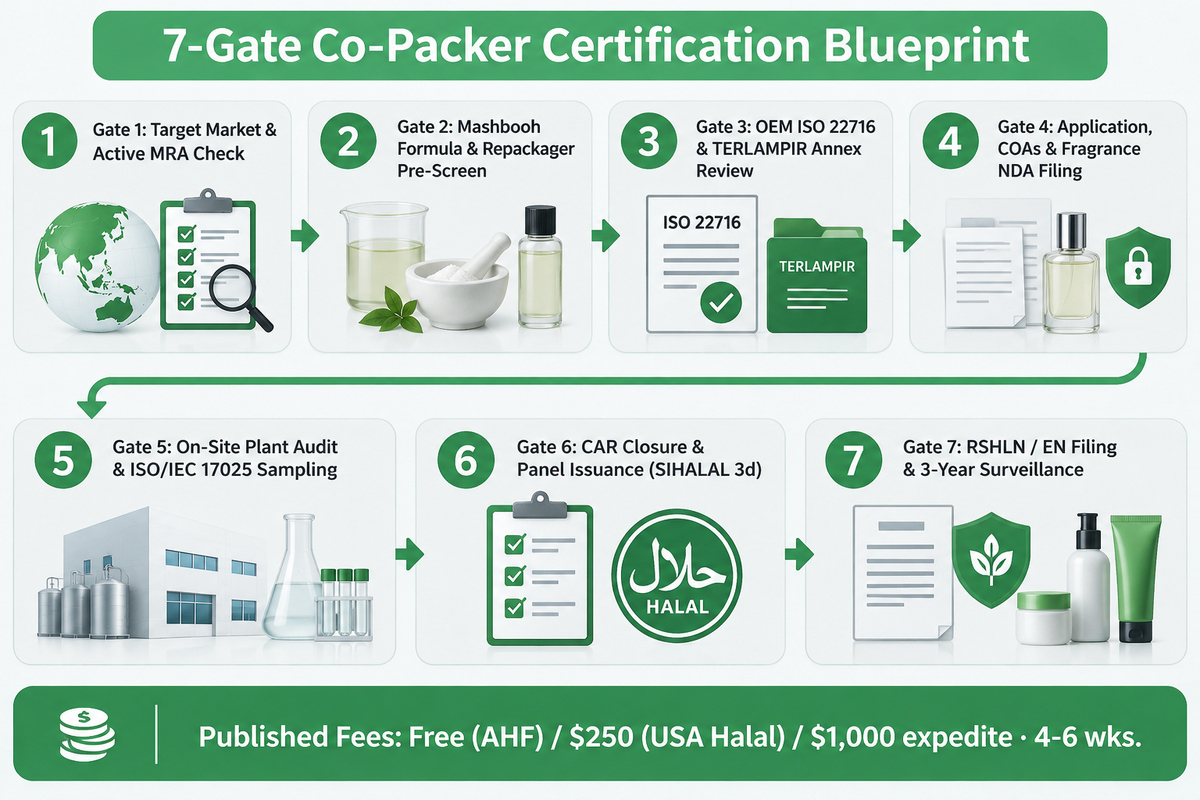
Certifying private label cosmetics made by an overseas OEM requires both the brand owner and factory to sign formal compliance contracts because halal certificates apply strictly to named plant addresses and listed product schedules. Going through a seven-gate workflow protects sampling budgets and prevents customs holds.
Accepting a company’s top-sheet halal certificate PDF without inspecting its product annex creates a costly launch delay for halal cosmetics certification. The USA Halal Chamber of Commerce explicitly confirms that certification applies strictly to specific plant locations and listed products, so a certified plant may cover only part of its catalog. Indonesian MUI certificates likewise list covered sites and SKUs on an annexed schedule (TERLAMPIR). Both sides own distinct duties: AHF outlines that the contract manufacturer maintains an Internal Halal Committee, signs the Halal Agreement, and reports supplier or process changes, while the brand owner keeps production in registered facilities and verifies carton compliance.
The 7-Gate Co-Packer Certification Blueprint: Halal Application, Halal Certificate Annexes, and Certification Services
Every overseas OEM audit process involves seven sequential gates from market selection to ongoing surveillance:
- Gate 1 (Target Market & Recognition): Identify the destination countries and check their recognized-certifier lists; for RSHLN route of Indonesia, check the active MRA validity of the issuing body and factory certificate.
- Gate 2 (Formula & Repackager Pre-Screen): Run the full INCI list, solvents, fermentation media, direct-contact packaging, and repackagers through the 8-Family Mashbooh Matrix before bench batching.
- Gate 3 (Co-Packer Scope & Annex Review): Inspect the OEM’s active ISO 22716 certificate, facility floor plan, line dedication records, and exact product annex before paying formulation deposits.
- Gate 4 (Application & Technical Dossier): File the halal application packet, quantitative formulas, COAs, supplier halal certificates, fragrance NDA disclosures, and SOPs, via SIHALAL, MYeHALAL, GoBusiness, or an international certifier.
- Gate 5 (On-Site Audit & Lab Sampling): The audit team reviews receiving, warehousing, production lines, and sanitation records; samples collected under the certifier’s procedure go to an ISO/IEC 17025:2017-accredited laboratory.
- Gate 6 (CAR Closure & Committee Issuance): Clear all non-conformities before the Halal Certification Panel (such as JAKIM’s seven-member panel or MUI’s Fatwa Assembly within 3 working days under SIHALAL) approves the issuance of the certificate.
- Gate 7 (Destination Filing & Surveillance): Register foreign certificates locally (Indonesia RSHLN or Singapore EN endorsement), approve final pack artwork, and arrange annual surveillance and testing.
How Much Does Halal Cosmetic Certification Cost and How Long Does the Audit Take?
Published application fees per plant vary from free at the American Halal Foundation (reporting a 4-6 week certification timeline once dossiers are ready) to a non-refundable $250 at the USA Halal Chamber of Commerce ($125 per additional plant). USA Halal Chamber’s $1,000 service ensures expedited application review within 5 business days once complete, priority audit scheduling, and a decision committee meeting within 5 days after the audit is cleared.
Audit windows and renewal schedules vary drastically across certification bodies. As per the rules of the USA Halal Chamber, an initial audit may take up to 6 months after provisional approval on a 3-year cycle (Year 1 Level 1 and Level 2 audit, Year 2 surveillance, Year 3 renewal starting 3 months prior, plus annual testing and unannounced audits). As summarized by ChemLinked, Indonesia’s SIHALAL sets statutory working-day benchmarks: 1 day for intake, 1 day for LPH assignment, 2 days for document review, 15 days for inspection (extendable by 15 days for imported facilities), 3 days for MUI Fatwa review, and 1 day for issuance. Singapore’s Muis collects 100% of the application fee plus 40% of the certification fee upfront and the 60% balance before issuance, starting review in 14 working days (normal) or 7 working days (express) with renewals auto-generated 120 days before expiry.
| Certification Stage | Published Benchmark / Rule | 10-SKU Budget Line Item | Published Schedule Anchor |
|---|---|---|---|
| 1. Application Filing (1 Plant) | Free (AHF) or $250 standard application fee (USA Halal); optional $1,000 expedite | Standard filing fee ($0 or $250) or optional $1,000 expedite service | 5 business days review (expedite) vs. monthly committee review |
| 2. Raw-Material Dossier & Fragrance NDA | Full supplier halal certs + NDA filings across 10 SKUs (AHF / SJPH) | Internal QA & supplier chase labor | Primary critical-path driver before audit booking |
| 3. On-Site Plant Audit & Travel | Quote-based by certifier & plant location (e.g., min. 2 JAKIM auditors) | Annual membership + auditor day rates + travel billed at cost | Up to 6 months max window (USA Halal); 15+15 working days (SIHALAL) |
| 4. Accredited Lab Assays | Applicant pays ISO/IEC 17025 lab fees (JAKIM / LPPOM / USA Halal) | Per-sample PCR & GC fees quoted by accredited lab | Scheduled inside inspection & annual testing windows |
| 5. Committee, Issuance & RSHLN | SIHALAL 3d Fatwa + 1d issue; Muis 14d/7d start & 60% final balance | 3-year surveillance cycle (annual testing + Y2 audit) | 4–6 weeks once dossier-ready (AHF); longer when full supplier rework is needed |
Copy the single-pass verification checklist below into your OEM Request for Quotation (RFQ) to ensure procurement obtains all certificates, annexes and quality clauses prior to approving samples:
Halal Cosmetic OEM RFQ Verification Checklist — copy these into your quote request:
| Parameter | Recommended spec | Why it matters | How to verify |
|---|---|---|---|
| Producing Legal Entity & Plant Address | Clear link from contract/invoice to the certified producing facility | Halal certificates cover named manufacturing sites only | Cross-check business license, ISO 22716 cert, and Halal annex address |
| Halal Certificate & Annex Scope | Active cert + named SKU/category annex + active destination recognition | Factory certs exclude unlisted SKUs; expired MRA deactivates Indonesia RSHLN | Inspect TERLAMPIR/product schedule + live BPJPH/JAKIM/GAC registry |
| Cosmetic GMP Compliance | Active ISO 22716:2007 compliance (plus authorized-body endorsement for Malaysia NPRA Sec 3.7) | Supports Malaysia foreign GMP rules, EU 1223/2009 GMP duties, and Gulf filings | Review current GMP certificate or authorized-body GMP declaration |
| Line Segregation & Sertu Status | Dedicated halal zone, validated non-porcine shared CIP, or authority-supervised sertu conversion | A line with prior porcine exposure requires prescribed cleansing and line controls before halal production | Review floor layout, cleaning SOP, and sertu certificate if converted |
| Raw-Material & Repackager Dossier | Complete Mashbooh origin certs + growth-media letters | Uncertified repackagers are a primary supply chain compliance barrier (Global Journal Al-Thaqafah, 2026) | Collect supplier halal certs + fragrance NDA path before pilot batch |
| Lab Testing & Batch Release | ISO 17516 micro limits; ISO 11930 preservative efficacy; risk-based PCR/GC at ISO/IEC 17025 lab | Matches each test to its actual release or audit purpose | Specify product-specific test plan in the quality agreement |
| Change-Control Notice | Prior written approval before any raw-material or supplier swap | Unapproved emulsifier or supplier swaps break halal status immediately | Bind Internal Halal Committee review into contract manufacturing agreement |
Comparing Global Halal Cosmetic Manufacturing Regions and Sourcing Routes
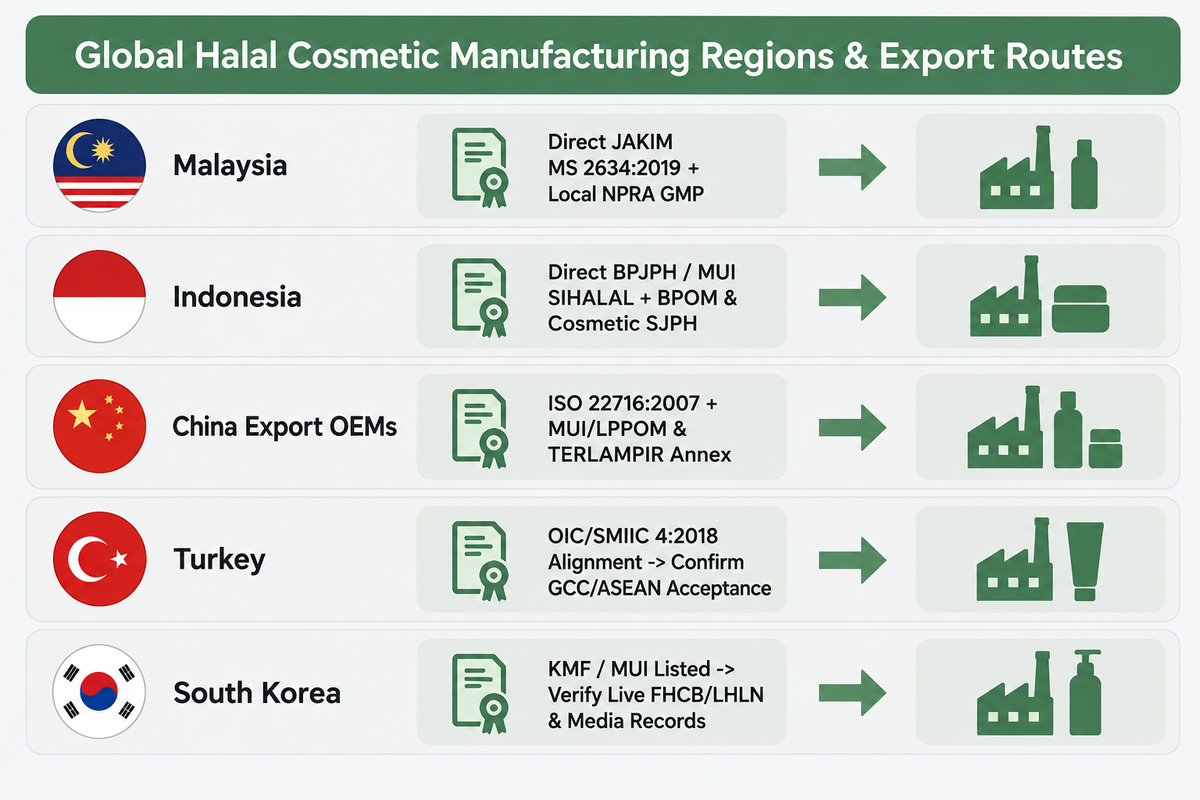
Choosing between domestic ASEAN manufacturing and overseas export hubs depends on three verifiable criteria: whether the factory’s certifier holds active recognition in your destination markets, whether the plant supplies authorized-body cosmetic GMP records, and how well its certification procedures support customized private label skincare, hair care, and body care launches.
Evaluating Halal Cosmetic Manufacturers for Halal-Certified OEM Production
Foreign factories shipping into Malaysia must satisfy Malaysia NPRA Section 3.7, which requires cosmetic GMP compliance documents to be issued or endorsed by an authorized body in the country of manufacture. Imported cosmetics in Indonesia require a BPJPH-recognized foreign halal certificate and local RSHLN registration, while Singapore’s Muis EN scheme applies to overseas certified shipments. Since the lead times and MOQs in China, Malaysia, Indonesia, Turkey, and South Korea are influenced by the readiness of paperwork and packaging tooling, compare regions primarily by the appropriateness of the regulatory and certification workflow, rather than regional averages.
| Manufacturing Region | Primary Domestic / Export Halal Path | Key Regulatory / GMP Checkpoint | Sourcing Route Consideration |
|---|---|---|---|
| Malaysia | Direct JAKIM MS 2634:2019 & MPPHM 2020 | Local NPRA GMP inspection prior to notification | Eliminates foreign FHCB checks when selling directly in Malaysia |
| Indonesia | Direct BPJPH / MUI SIHALAL & Cosmetic SJPH | BPOM registration + continuous SJPH supervision | Removes importer RSHLN registration steps for domestic Indonesian sales |
| China (Export Cosmetic OEMs) | MUI/LPPOM or destination-recognized foreign certifiers | ISO 22716:2007 + authorized-body GMP endorsement for export | Requires annex-scope (TERLAMPIR) & active MRA check per destination |
| Turkey | OIC/SMIIC 4:2018-aligned national certification | Confirm destination recognition (GCC/ASEAN) before export | Check bilateral acceptance if shipping beyond OIC/regional partners |
| South Korea | Destination-recognized bodies (e.g., KMF / MUI where listed) | Verify plant-level ISO 22716 & live FHCB/LHLN registry status | Confirm whether custom fermented bio-actives carry full media records |
OEM vs. ODM Roles & Entity Transparency: Under an ODM (turnkey library) model, the factory supplies pre-screened halal base formulas. Under custom OEM development, the brand owns formula IP and verifies every custom active’s origin proof. NEXO Beauty Labs builds on a manufacturing foundation dating back to 1999, with more than 25 years of cosmetic production experience and an international business team serving global brands since 2020. Production runs through its producing legal entity, Guangzhou Opseve Cosmetics Co., Ltd. That facility holds Intertek ISO 22716:2007 certification (SZ2503C3, valid through March 12, 2028) and MUI Halal certification (LPPOM-00150276060425, valid through April 15, 2029), with specific covered sites and SKUs confirmed via its TERLAMPIR annexed schedule during onboarding. Brands evaluating regional services for halal manufacturing can review our halal cosmetic contract manufacturing solutions for the Middle East, explore Middle East cosmetic manufacturing partners, or compare top halal suppliers in our dedicated shortlist of halal cosmetic manufacturers.
2026 Regulatory Shifts and Multi-Market Halal Formulation Architecture
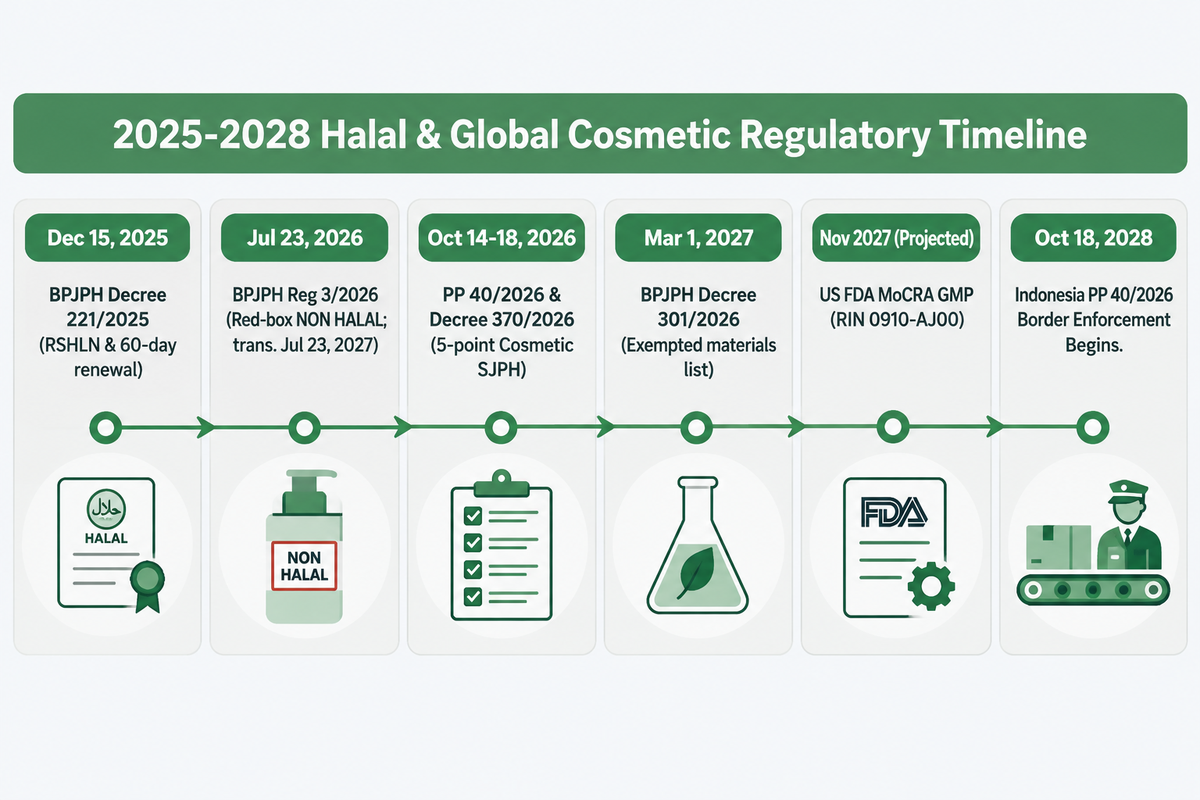
Indonesia’s October 2026 regulatory reset gives exporters a concrete two-year engineering window before mandatory border enforcement in October 2028, while Cosmetic SJPH rules (Decree 370/2026) and red-box non-halal labeling (Regulation 3/2026) already govern active shipments. Building a unified halal-ready formula backbone now can reduce costly regional reformulations.
While PP 40/2026 removes overseas pre-shipment warehouse inspections and extends final border enforcement by two years, domestic surveillance and dossier registration rules continue tightening on schedule. Continuous supervision replaced fixed domestic expiry limits under BPJPH Decree 170/2025, foreign certificate registration updated under Decree 221/2025, red-box non-halal labeling entered force July 23, 2026 (transition ending July 23, 2027), Cosmetic SJPH guidelines activated October 18, 2026, and the exempted-materials decree (Decree 301/2026) starts March 1, 2027. Western rules are advancing in parallel: US FDA MoCRA cosmetic GMP rulemaking (RIN 0910-AJ00) projects a proposed rule in November 2027 alongside EU Regulation 1223/2009 safety enforcement.
| Effective Date | Regulation / Decree | Key Requirement for Cosmetic Brands |
|---|---|---|
| Dec 15, 2025 | BPJPH Decree No. 221 of 2025 | Updated foreign certificate (RSHLN) filing; 60-working-day renewal window; MRA expiry linkage |
| Jul 23, 2026 (Transition Jul 23, 2027) | BPJPH Regulation No. 3 of 2026 | Mandatory red-box white-background “NON HALAL” outer label for non-halal cosmetics |
| Oct 14–18, 2026 | PP 40/2026 & BPJPH Decree 370/2026 | Extends cosmetic mandate to Oct 18, 2028; revokes Reg 4/2026 check; activates 5-point Cosmetic SJPH |
| Mar 1, 2027 | BPJPH Decree No. 301 of 2026 | Activates updated list of exempted raw materials and product categories |
| Nov 2027 (Projected) | US FDA MoCRA GMP (RIN 0910-AJ00) | Notice of Proposed Rulemaking for US cosmetic GMP |
| Oct 18, 2028 | Indonesia PP 40/2026 Enforcement | Halal certification or standardized red-box non-halal labeling applies to domestic and imported cosmetics |
Single-Core Multi-Market Architecture (Worked Example): Suppose a brand launches 6 skincare SKUs across the UAE, Malaysia, Indonesia, and the European Union. For six products, separate conventional and halal formulas create 12 formula variants that can require separate stability and preservative assessments and production batches. Using halal-verified plant glycerin, pork-free fermented actives, zero khamr ethanol, halal fragrance carriers, and dedicated ISO 22716 filling lets the brand standardize on 6 shared base formulas across all four regions. Safety dossiers, Foreign Halal registration, and local carton compliance are still required for each market. As market context, Md Yusof et al. (GJAT, 2026) cite projections placing the global halal cosmetics market at USD 115.03 billion by 2032, reflecting growing demand for halal-certified products across global beauty retail.
Frequently Asked Questions About Halal Cosmetic Manufacturing
What makes a cosmetic product legally and religiously halal?
A cosmetic product must meet halal standards across every ingredient, fermentation medium, solvent, processing aid, and direct-contact package to comply with Islamic law and avoid porcine or khamr contact.
A halal mark may be printed only on a certified product authorized under the destination market’s rules; in Malaysia, displaying a halal logo requires certification and approval by JAKIM or a JAKIM-recognized body.
How do I get a halal certificate for cosmetics manufactured by an overseas OEM?
The brand owner and the overseas OEM both undergo application screening, supplier record check, an on-site plant audit, and risk-based lab testing by a destination market recognized certifier.
After the Halal Certification Panel issues a certificate covering your named plant and SKU annex, your local importer registers it where required, such as in Indonesia’s SIHALAL RSHLN portal or under Singapore’s Muis EN scheme.
Are fatty alcohols like cetyl or cetearyl alcohol halal in skincare?
Yes: cetyl, stearyl, and cetearyl alcohols are non-intoxicating waxy lipids rather than beverage ethanol, and certifying bodies, such as the USA Halal Chamber, explicitly accept them in formulations.
For halal certification, document the fatty alcohol’s feedstock, processing aids, and contamination controls; for animal-derived tallow, provide verified proof of halal slaughter and processing status.
Can a shared production line make halal-certified cosmetics?
Only under strict rules: lines sharing non-porcine vegan or mineral runs may pass with validated cleaning under select schemes.
Lines exposed to porcine inputs require supervised sertu cleansing and permanent halal dedication under MS 2634:2019.
What happens if an OEM changes a raw material supplier after halal certification?
An unauthorized supplier or ingredient switch breaches the factory’s Halal Assurance System and puts the halal status of affected batches at risk.
Under BPJPH SJPH, JAKIM MHMS 2020 (and MPPHM 2020), and AHF co-packer contracts, the OEM’s Internal Halal Committee must review the replacement supplier’s halal certificate, origin letter, and COA first. The plant must then notify the certifying body before using the new lot in commercial production, so build a prior written change-control clause into every contract manufacturing agreement.
Does an OEM factory’s halal certificate automatically cover my private-label SKUs?
No: halal certification ensures that the named plant addresses and listed products on the active annex are covered, not every private label SKU automatically.
Confirm each custom formula is listed on the annex schedule before any halal logo is printed.
How can brands verify whether a manufacturer’s halal certificate is genuine and recognized?
Check three independent records before releasing tooling or sampling funds: The live certificate number on the issuing body’s portal, the annexed plant and SKU schedule, and the certifier’s active recognition in the destination country.
Under Decree No. 221 of 2025 by the BPJPH, an expired mutual recognition agreement causes the deactivation of an Indonesian foreign registration, even if the factory certificate date looks valid. It’s suggested that both dates be verified and the exact facility address be reconfirmed to safeguard customs clearance and retail listings.
References & Sources
- ISO 22716:2007, Cosmetics: Good Manufacturing Practices (GMP) Guidelines International Organization for Standardization (ISO)
- ISO 17516, Cosmetics: Microbiology, Microbiological Limits International Organization for Standardization (ISO)
- ISO 29621:2017, Cosmetics: Guidelines for the Risk Assessment and Identification of Microbiologically Low-Risk Products International Organization for Standardization (ISO)
- 3.0 Regulatory Requirements For Cosmetics (Modified November 20, 2026) National Pharmaceutical Regulatory Agency (NPRA), Ministry of Health Malaysia
- GSO 2055-4:2021, Halal Products, Part 4: Requirements for Halal Cosmetics and Personal Care GCC Standardization Organization (GSO)
- OIC/SMIIC 4:2018, Halal Cosmetics: General Requirements Standards and Metrology Institute for Islamic Countries (SMIIC)
- Alcohol in Cosmetics, Is It Halal to Use? (MUI Fatwa No. 11 of 2018) LPH LPPOM MUI
- Alcohol in Daily Products: Health Risks, Cultural Considerations, and Economic Impacts (2025) Yedi Herdiana, Risk Management and Healthcare Policy (NIH PMC)
- Maintaining Halal Supply Chain Integrity in Cosmetic Manufacturing: Exploring Challenges of Repackaging Suppliers and Ingredient Scarcity (2026) Amimah Hasniyah Md Yusof, Mastora Mustafar, & Risyawati Mohamed Ismail, Global Journal Al-Thaqafah, 16(1), 26–37
- Halal Certification Application Fees, 3-Year Cycle & FAQ USA Halal Chamber of Commerce, Inc.
- Halal Certification for Cosmetics & Personal Care American Halal Foundation (AHF)
- Indonesia Extends Halal Certification Deadlines to October 2028 for Imports, Small Businesses and Cosmetics (PP 40/2026) Emerhub (October 2026)
- ASEAN Cosmetic Halal Certification Regulation (Updated November 20, 2026) ChemLinked Cosmetic
- US8133478B2, Cosmetic Nanocomposites Based on In-Situ Cross-Linked POSS Materials Google Patents
- EP1272144A4, Novel Water-Permeable Nail Polish Formulations Incorporating Bioactive Glass Google Patents
About This Technical Guide
This technical guide translates raw-material Mashbooh screening, ethanol chemistry, ISO 22716 line segregation, and 2026–2028 BPJPH, JAKIM, and GSO halal certification requirements into practical procurement checks for skincare, hair care, and body care brands. Every standard edition, fee benchmark, and statutory date was verified against primary regulatory and peer-reviewed sources in November 2026. Reviewed by the NEXO Beauty Labs technical team.
Are you ready to move from halal formulation specifications to commercial sampling, raw-material certification checks and Middle East or worldwide delivery? Evaluate our halal cosmetic contract manufacturing solutions for the Middle East to assess production capacity, compliance and turnkey integration.