Get in touch with NEXO Beauty Labs Company


The best conditioner manufacturers for a shortlist include Pravada for staged private label orders, RainShadow Labs for bulk and filling options, HSA Cosmetics for professional ranges, and Voyant Beauty for plant-specific production planning. The right choice depends on your formula route, packaging and first-order scale, rather than the size of the supplier alone.
Last updated: October 2026
A salon purchasing an existing conditioner under its own name has a different buying task from a brand contracting a new leave-in treatment. Even when both suppliers describe their service as private label hair care manufacturing, the service included can be different. Some suppliers sell a ready-made stock; others make the formula, source the pack, and manufacture a batch for production. Identifying service routes first makes the company list useful.
Quick Picks
- Best for a small US stock-formula launch: Pravada Private Label.
- Best for bulk with optional filling: RainShadow Labs.
- Best for a small salon-branded order: Private Label Dynamics.
- Best for professional hair care in bulk or finished packs: HSA Cosmetics.
- Best for comparing a named plant’s production formats: Voyant Beauty.
- Best for a Taiwan conditioner project with a published mass-based minimum: BIOCROWN.
Disclosure: NEXO Beauty Labs publishes this directory and provides conditioner projects through its disclosed manufacturing partner. The twenty manufacturers are compared by sourcing fit, not by overall superiority or market dominance. NEXO is outside the numbered comparison.
How we selected these conditioner manufacturers
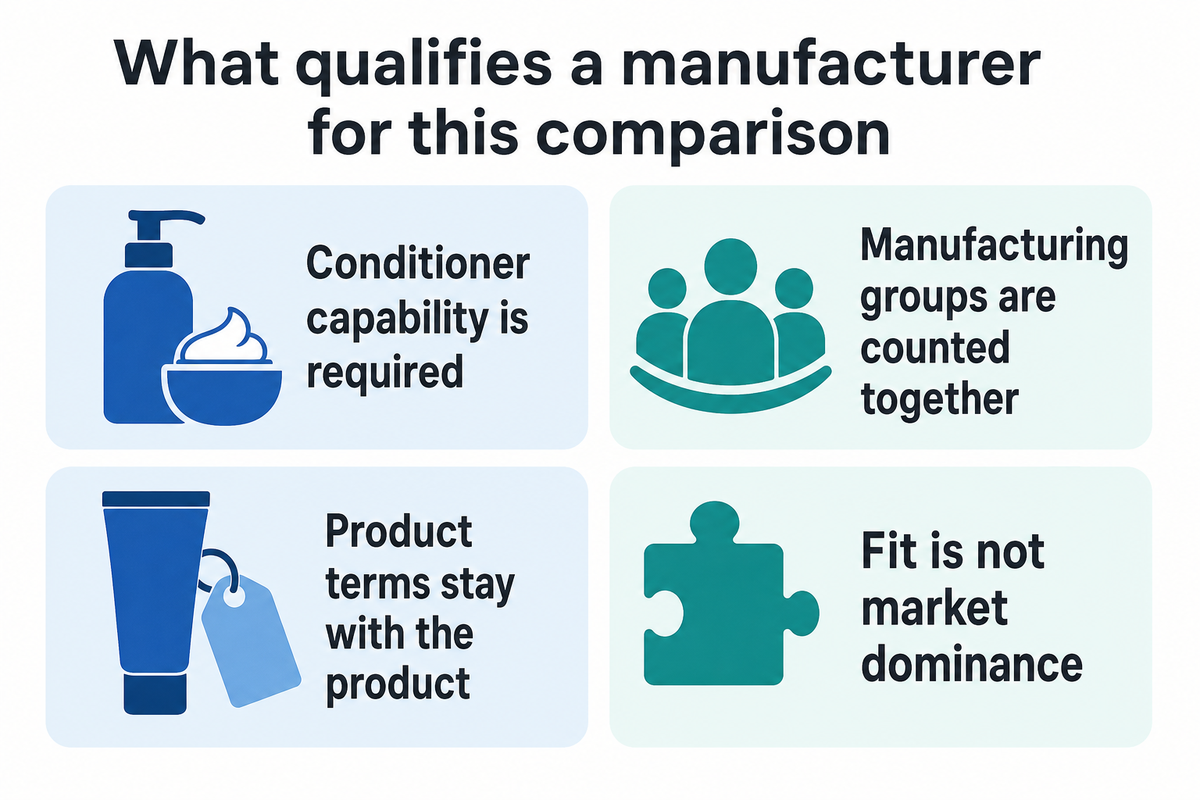
Data was verified against official web sites and public sources in October 2026. A clear product or service description of conditioner manufacturing was required. This excluded companies with a more general claim of manufacturing beauty products. The goal was to represent manufacturers based in North America, Europe, Oceania and Asia with different service routes. Ingredients-only suppliers and air-conditioning companies, consumer-only brands, directories and sourcing platforms, and trading companies without a manufacturing operation of their own were excluded. Companies in the same manufacturing group were clustered together. Company histories, legal dates of incorporation and predecessor dates retain their different meanings.
The comparisons use verifiable company information. A stated facility capacity is for the named site or group, and a product-specific minimum stays with that product. Best-for descriptions are editorial judgments about procurement fit, and are based on the above. Selection doesn’t measure market share, nor independently test conditioner performance, nor does it imply that all manufacturers accept the same order.
Conditioner Format-and-Order Comparison
The Conditioner Format-and-Order Comparison groups twenty manufacturers according to the production route and purchasing constraints described in their public information.
Use the table to find a few candidates with the right product scope before reviewing their profiles. A small order of existing private label hair care products is a different offer from a new formula developed to your brief. Public starting quantities help to differentiate those routes, but liters, gallons, kilos and finished units are different measures. A factory’s maximum tank size is also different from its minimum accepted order.
| No. | Company | Headquarters | Founded | Best For | Main Services | Key Advantages | Potential Disadvantages | Official Website |
|---|---|---|---|---|---|---|---|---|
| 1 | Pravada Private Label | Fort Myers, US | 2009 | Small launch; later custom work | Stock and custom conditioner | 50 / 250 / 2,500-piece routes | Ingredient removal moves to custom | https://www.pravadaprivatelabel.com/ |
| 2 | RainShadow Labs | St. Helens, US | 1983 | Bulk plus optional filling | Stock filling and bespoke formulas | Separate direct-buy and filled routes | Bulk gallons require pack-size planning | https://www.rainshadowlabs.com/ |
| 3 | Private Label Dynamics | Sunshine Coast, AU | Not publicly disclosed | Salon-branded retail range | Existing branded conditioners | 10 retail or five professional units | Professional buyers only | https://www.privatelabeldynamics.com/ |
| 4 | Envii Labs | Spring, US | 2016 | Small-batch format testing | Rinse-off and leave-in development | 36 units or one gallon | Selected changes require gallon testing | https://enviilabs.com/ |
| 5 | HSA Cosmetics | Bisuschio, Italy | 1982 | Professional Italian range | Bulk and finished haircare | Own laboratory and production plant | 500 kg non-colour formula minimum | https://www.hsacosmetics.com/ |
| 6 | John Drury / Bedforth | West Yorkshire, UK | 1882 business history | UK liquid production | Mixing, filling and bulk supply | 200 ml–5 L packs; IBCs | 1,000-litre starting batch | https://www.john-drury.co.uk/ |
| 7 | Herrco Cosmetics | Halesworth, UK | 1988 business; 2009 company | Bespoke salon collection | Custom manufacture and filling | Four-tonne hot/cold vessels; pouches | Aerosols and colour cosmetics excluded | https://www.herrco.co.uk/ |
| 8 | Orean | Cleckheaton, UK | 2008 UK incorporation | UK and US supply options | Development and formula transfer | Manufacturing hubs in both markets | Ingredient list alone needs development | https://weareorean.com/ |
| 9 | CarasaLab | Oiartzun, Spain | 1930 | Blonde-hair salon range | Conditioner and treatment development | Fabulous Blonde companion products | Category-specific order quantities: shampoo 500 L; masks 200 L | https://carasalab.com/en/ |
| 10 | GAR Labs | Riverside, US | Not publicly disclosed | Larger filled orders | Custom formulas or bulk | 5,000-piece and 110-gallon routes | Buyer coordinates packs and freight | https://www.garlabs.com/ |
| 11 | Formula Corp | Auburn, US | Not publicly disclosed | Broader liquid-product sourcing | Formulation, blending and filling | Branded gallon-size conditioner example | Case pack: Fortech gallon containers | https://formulacorp.com/ |
| 12 | Intercos Group / Cosmint | Agrate Brianza, Italy | 1972 group history | Multi-category brand programmes | Haircare and personal care | Cosmint: 58 vessels, 102 filling lines | Project scoping: Cosmint haircare within the group catalogue | https://www.intercos.com/ |
| 13 | Pure Source | Miami, US | 1995 | Bulk and finished presentations | Development, testing and filling | Sample packets through drums and totes | Certification scope varies by operation | https://www.thepuresource.com/ |
| 14 | Medpak Solutions | St. Petersburg, US | Not publicly disclosed | Defined launch programme | Rinse-off and leave-in manufacture | 5,000-unit launch; 10,000 standard | Launch terms differ from standard runs | https://medpaksolutions.com/ |
| 15 | Voyant Beauty | Countryside, US | 1989 VeePak predecessor | Plant-specific production planning | Compounding, filling and testing | 500–7,500 gallon tanks at Countryside | Plant pack range: tubes, bottles, jars, canisters; product minimum is separate | https://www.voyantbeauty.com/ |
| 16 | KDC/ONE | Longueuil, Canada | 1990 group history | Multi-market manufacturing | Formula and packaging development | International manufacturing network | Group project scope: custom route needs a brief; totals span all sites | https://www.kdc-one.com/en |
| 17 | BIOCROWN | Taiwan | 1977 predecessor; 2005 BIOCROWN | Mass-based conditioner batches | Formula and packaging customisation | 600 kg per item; stated timing trigger | Filled yield needs density and pack size | https://www.biocrown.com.tw/ |
| 18 | TY Cosmetic | Guangzhou, China | 2009 | Multi-product development | Formula, packaging and production | Named factory certificate documents | Terms tied to assigned factory | https://www.tyoemcosmetic.com/ |
| 19 | Xiran | Guangzhou, China | 2013 | Formula plus packaging choices | Private label and custom manufacture | Bottle, label and colour-box options | Vegan scope depends on formula | https://xiranskincare.com/ |
| 20 | Bo International | Gurugram, India | 2013 | Named keratin conditioner offer | Product and pack customisation | 2,000 units; 200 ml example | Terms specific to published product | https://www.bointernational.net/ |
Manufacturers for stock formulas and smaller first launches
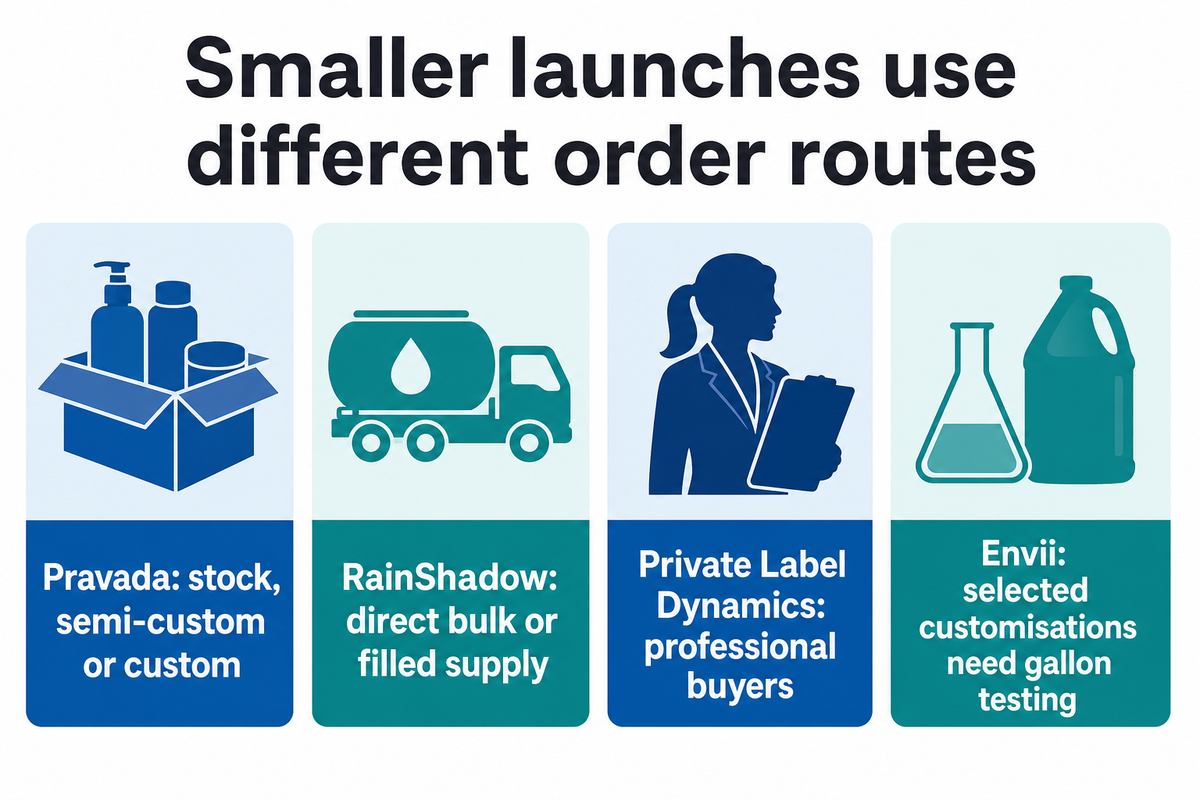
Stock formulas can reduce the development work needed to get a first branded order. Companies in this group offer small-order or flexible bulk routes, but starting quantities apply to different services. A salon ordering finished units and a brand arranging separate filling should compare those routes.
1. Pravada Private Label: Best for small US conditioner launches with a staged custom route
Headquarters: Fort Myers, Florida, USA · Founded: 2009 · Type: In-house private label and custom manufacturer
Official website: https://www.pravadaprivatelabel.com/
Main products: Density Boost, Amino Active Repair and Soft Shine Hyaluronic conditioners.
Certifications / quality scope: ISO 22716 manufacturing facility, according to its website.
Pravada gives a young hair care brand a visible path from an existing conditioner to a custom formula, with Density Boost and Amino Active Repair among the named options on its conditioner page. According to the company, the stock, semi-custom and custom routes start at 50, 250 and 2,500 pieces respectively, so a first branded launch can be considered separately from later formula development. That distinction makes this private label hair care manufacturer useful for buyers who want a modest initial range but already anticipate a more individual product; removing an ingredient from a stock formula moves the order into the custom programme.
2. RainShadow Labs: Best for bulk conditioner and flexible filling routes
Headquarters: St. Helens, Oregon, USA · Founded: 1983 · Type: Private label and custom personal-care manufacturer
Official website: https://www.rainshadowlabs.com/
Main products: Silky, Keratin and Argan conditioners; Hair Rehab mask.
Certifications / quality scope: ISO 22716:2007 stated on its website.
RainShadow separates direct bulk buying from stock filling and custom development, a useful distinction for private label brands that already have access to a filler. Its published haircare programme starts stock filling at 10 gallons and custom formulations at 25 gallons, while the named Silky, Keratin and Argan conditioners provide concrete starting points for a shampoo and conditioner collection. The Hair Rehab mask also offers a treatment companion to the wash-day range; because these order thresholds are volumes of product, the number of finished bottles depends on the selected fill size and filling arrangement.
3. Private Label Dynamics: Best for salon-branded conditioner in small finished orders
Headquarters: Sunshine Coast, Queensland, Australia · Founded: Not publicly disclosed · Type: Australian manufacturer and private-label distributor
Official website: https://www.privatelabeldynamics.com/
Main products: Moisture, Strength, Volume, Purple and Curl conditioners.
Published capability: 10 retail-size units per SKU; five professional-size units per SKU; branding included.
Private Label Dynamics is an Australian manufacturer offering branded salon products to industry professionals, with Moisture, Strength, Volume, Purple and Curl conditioner options in its catalogue. The company publishes starting orders of 10 retail-size units or five professional-size units per product code, with branding included, which gives a salon a route to a shelf-ready conditioner line without commissioning a new formula. Samples can precede that branded order, and the separate retail and professional sizes support different salon uses; access is restricted to professional business buyers rather than direct consumer shopping.
4. Envii Labs: Best for small-batch rinse-off and leave-in conditioner testing
Headquarters: Spring, Texas, USA · Founded: 2016 · Type: In-house small-batch private-label and custom manufacturer
Official website: https://enviilabs.com/
Main products: Curl Defining Leave-in Conditioner; Deep Moisture Conditioner; conditioning masks.
Published capability: 36 units or one gallon per product; formulated and packaged in-house.
Envii Labs connects small-batch orders with a chemist-founded business: Adrianne White established the company in 2016, and its website describes in-house formulation and packaging. A 36-unit or one-gallon starting order, alongside Curl Defining Leave-in Conditioner and Deep Moisture Conditioner, makes the range relevant to brands comparing rinse-off conditioning with curl care before expanding their hair care collections. The broader catalogue contains more than 85 customisable formulas across product categories; for selected customisations, small samples are unavailable and the supplier directs buyers to gallon-size testing instead.
Manufacturers for custom and professional haircare ranges
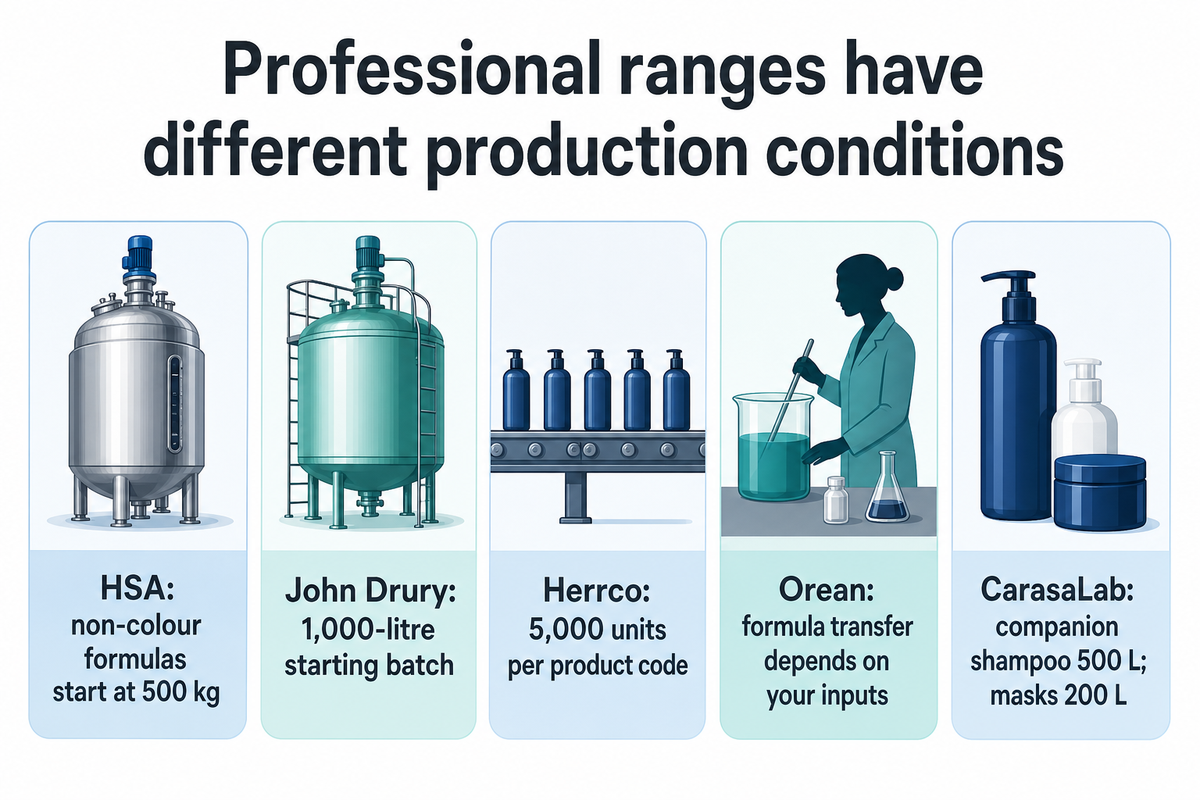
Custom and professional ranges usually start with more detailed product briefs. Capabilities described for conditioner and/or treatment by these manufacturers, along with published minimums and fills, distinguish a custom professional range from a small order of ready-labeled stock.
5. HSA Cosmetics: Best for Italian professional conditioner ranges in bulk or finished packs
Headquarters: Bisuschio, Varese, Italy · Founded: 1982 · Type: In-house cosmetic contract manufacturer
Official website: https://www.hsacosmetics.com/
Main products: Conditioners, hair masks, leave-in products and professional haircare.
Certifications / quality scope: ISO 9001:2015 and ISO 22716, according to its website.
HSA is a fit for professional hair care brands that want a manufacturer to develop and supply a coordinated range, with conditioner, hair mask and leave-in formats inside its stated haircare scope. According to its website, its own laboratory and production plant support around 1,000 haircare formulations, and customers can choose bulk or finished products rather than being confined to one packaging route. The published 500 kg minimum applies to non-colour formulas, a meaningful scale requirement for an emerging brand; the separate lower minimum shown for hair colour shouldn’t be used to budget a conditioner launch.
6. John Drury / Bedforth: Best for UK liquid conditioner production with varied fill sizes
Headquarters: West Yorkshire, England · Founded: 1882 (John Drury history) · Type: Soap-base manufacturer with Bedforth finished personal-care division
Official website: https://www.john-drury.co.uk/
Main products: Shampoos, conditioners, lotions and liquid soaps.
Certifications / quality scope: Bedforth division lists ISO 22716 / Good Manufacturing Practice (according to its website).
John Drury’s Bedforth operation combines liquid-product mixing with filling formats that span retail bottles and larger salon containers, with shampoos and conditioners explicitly listed in its manufacturing scope. Its published starting batch is 1,000 litres, with packs from 200 ml to 5 L and intermediate bulk container supply, so a buyer can discuss both consumer presentation and back-bar replenishment with the same operation. The company’s history dates to 1882, while the finished personal-care work and stated ISO 22716 system are attributed to Bedforth; the batch minimum makes this a volume-production option rather than a few-dozen-bottle launch.
7. Herrco Cosmetics: Best for bespoke professional haircare and natural product programmes
Headquarters: Halesworth, Suffolk, UK · Founded: Business history 1988; current UK company incorporated 2009 · Type: Custom beauty and cosmetics manufacturer
Official website: https://www.herrco.co.uk/
Main products: Conditioners, hair masks, treatments, hair oils and mists.
Certifications / quality scope: ISO 22716:2007; natural and organic products certified to COSMOS as stated (according to its website).
Herrco pairs bespoke hair care development with hot and cold mixing vessels up to four tonnes, and its published product range includes conditioners, masks, hair oils and mists. Its website gives a 5,000-unit starting quantity per product code and describes several packaging formats, including pouches, which can suit a professional collection extending beyond a single bottle presentation. The business traces its history to 1988, whereas the current UK limited company was incorporated in 2009; buyers planning one complete hair care collection should also note that Herrco excludes aerosols and colour cosmetics from its listed scope.
8. Orean: Best for brands needing UK and US production options
Headquarters: Cleckheaton, West Yorkshire, UK · Founded: UK company incorporated 14 October 2008 · Type: UK and US personal-care development and contract manufacturer
Official website: https://weareorean.com/
Main products: Conditioners, co-washes, masks, treatments and styling products.
Certifications / quality scope: GMP-compliant manufacturing stated on its UK/US manufacturing page (according to its website).
Orean brings UK and US production options to the same sourcing discussion, with conditioners, co-washes, masks and treatments explicitly present in its formulation range. Its published manufacturing service covers new development and formula transfer, so the distinction between an existing formula and a new hair care formulation matters more than the general promise of customisation. A brand with a complete quantitative formula has a different transfer starting point from one supplying only an ingredient list; the latter requires development work and shouldn’t be budgeted as a straightforward transfer of an already specified product.
9. CarasaLab: Best for colour-care and professional salon conditioner collections
Headquarters: Oiartzun, Gipuzkoa, Spain · Founded: 1930 · Type: Cosmetic laboratory and third-party manufacturer
Official website: https://carasalab.com/en/
Main products: Blonde-hair conditioners, shampoos, masks and professional treatments.
Published capability: In-house formulation and manufacture; ingredient and fragrance customisation.
CarasaLab’s Fabulous Blonde programme gives a specific example of the company’s colour-care focus, combining conditioners with shampoos and masks for a related professional range. The Spanish laboratory and manufacturer dates its business to 1930 and describes ingredient and fragrance customisation, which makes it relevant to salon brands developing products around a defined hair type rather than selecting unrelated catalogue items. Its published haircare order information varies between product categories and pack formats, including separate bulk quantities of 500 L for companion shampoo and 200 L for masks; a shampoo batch figure therefore doesn’t establish the order size for the conditioner or hair treatment selected for the same collection.
Manufacturers for scaled and complex production
Multi-category programs need clear connections among formulation, production, and the intended pack. The manufacturers in this section describe several ways to organize that work, including bulk supply, finished filling, and international group production. Published site or group figures retain their stated scope; the companies aren’t ordered by measured capacity.
10. GAR Labs: Best for established brands buying larger US filled orders
Headquarters: Riverside, California, USA · Founded: Not publicly disclosed · Type: Custom haircare and skincare contract manufacturer
Official website: https://www.garlabs.com/
Main products: Conditioners, shampoos, styling products and treatments.
Published capability: 5,000 pieces per product for filled orders; 110 gallons per product for bulk.
GAR Labs publishes separate starting points for finished and bulk orders: 5,000 pieces per product for filled goods and 110 gallons per product for bulk supply. The company combines on-site chemists with hot and cold filling and reports more than 100,000 units of combined daily production capacity across its products, making it a candidate for brands whose volume already supports a planned production run. Packaging components and freight require buyer coordination, so an approved conditioner formula alone doesn’t make a project production-ready; material arrival is part of the schedule for products made through this route.
11. Formula Corp: Best for conditioner alongside wider liquid-product programmes
Headquarters: Auburn, Washington, USA · Founded: Not publicly disclosed · Type: Private-label and contract liquid-product manufacturer
Official website: https://formulacorp.com/
Main products: Fortech Spa Elegance conditioner; personal and home-care liquids.
Certifications / quality scope: ISO 9001 and ISO 22716 stated on capabilities page (according to its website).
Formula Corp combines private label and contract manufacturing with a visible conditioner product, Fortech Spa Elegance, offered in cases containing four one-gallon containers. That catalogue item establishes a concrete hair conditioner format within a broader business that handles formulation, blending, filling and distribution support for personal care and other liquid products. A buyer managing more than one liquid-product category can therefore assess the wider manufacturing service alongside conditioner supply; the four-container case describes the branded product’s gallon sales format rather than a small retail-bottle option.
12. Intercos Group / Cosmint: Best for large, multi-category international brand programmes
Headquarters: Agrate Brianza, Italy (group headquarters) · Founded: 1972 (Intercos Group) · Type: Cosmetics manufacturing group including Cosmint
Official website: https://www.intercos.com/
Main products: Hair conditioners, treatments, styling and broader personal-care products.
Published capability: Cosmint lists 58 bulk vessels and 102 filling lines across its portfolio.
Intercos brings a large cosmetic manufacturing group into the comparison, with its Cosmint operation adding haircare and broader personal-care production to the group’s portfolio. The official group history dates Intercos to 1972 and records the Cosmint acquisition in August 2017, while its 2021 sustainability publication explicitly includes shampoos and conditioners in the haircare business. Cosmint’s current profile lists 58 bulk vessels and 102 filling lines across its products, a useful scale indicator for multi-category planning; this is a project-based manufacturing route, so a conditioner service brief should distinguish Cosmint’s hair and personal-care equipment from other divisions.
13. Pure Source: Best for conditioner within a wider technical personal-care portfolio
Headquarters: Miami, Florida, USA · Founded: 1995 · Type: Personal-care and topical-product contract manufacturer
Official website: https://www.thepuresource.com/
Main products: Custom hair conditioners, creams, lotions, liquids and sprays.
Certifications / quality scope: UL cGMP scope stated for topical drug creams/ointments and cosmetic lotions/creams; QAI organic programmes (according to its website).
Pure Source combines formulation and testing with filling and packaging, and its published delivery formats run from sample packets to 55-gallon drums and totes. A buyer comparing consumer packs with bulk conditioner can therefore discuss both presentations with a company that lists conditioner manufacturing alongside wider personal-care work and dates its business to 1995. Its stated UL good-manufacturing-practice scope names particular topical drug and cosmetic cream or lotion categories, while organic programmes are separately described; those scopes belong to the specified operations and products rather than automatically covering every conditioner offered by the company.
14. Medpak Solutions: Best for US production with a separate emerging-brand launch route
Headquarters: St. Petersburg, Florida, USA · Founded: Not publicly disclosed · Type: US cosmetic contract manufacturer
Official website: https://medpaksolutions.com/
Main products: Rinse-off and leave-in conditioners for different hair profiles.
Published capability: Standard runs start at 10,000 units; Launch Program starts at 5,000.
Medpak separates a Launch Program starting at 5,000 units from standard runs starting at 10,000 units, which helps a buyer place an initial order within the correct service route. Its conditioner range covers rinse-off and leave-in products, and the company’s development description includes stability work and preservative efficacy testing alongside production and packaging. That combination can suit a growing brand moving from a defined first range to repeat manufacturing; the launch threshold is a programme-specific entry point, so it shouldn’t be applied to a standard custom order without the same programme scope.
15. Voyant Beauty: Best for plant-specific production planning and established retail programmes
Headquarters: Countryside, Illinois, USA · Founded: VeePak predecessor founded 1989; acquired in 2017 · Type: Contract development and manufacturing group with operated factories
Official website: https://www.voyantbeauty.com/
Main products: Conditioner, shampoo and styling products.
Published capability: Countryside lists 500–7,500 gallon tanks, tubes, bottles and jars, with analytical and microbiological labs.
Voyant’s Countryside facility provides unusually concrete plant information for a supplier comparison: its page identifies conditioner production, headquarters functions, analytical and microbiological laboratories, and tanks spanning 500–7,500 gallons. The plant supports bottles, tubes and jars, which gives established brands several pack formats to discuss alongside compounding and filling rather than evaluating formula work in isolation. Voyant’s history also records VeePak as a predecessor founded in 1989 and acquired in 2017; the tank range describes this particular facility, where a new conditioner order should match the listed packaging range of tubes, bottles, jars or canisters.
16. KDC/ONE: Best for multi-market programmes needing formulation and packaging development
Headquarters: Longueuil, Quebec, Canada; beauty and personal care HQ in Saddle Brook, New Jersey · Founded: 1990, according to the group history · Type: Global contract manufacturing group
Official website: https://www.kdc-one.com/en
Main products: Conditioners, detanglers, masks, shampoos and heat protectants.
Published capability: 25 manufacturing facilities and 26 research and development centres and innovation hubs across the group.
KDC/ONE connects custom formulation with packaging design, filling and assembly across an international manufacturing group, and its official product list explicitly names conditioners, detanglers, masks and heat protectants. The group’s website dates its history to 1990 and reports 25 manufacturing facilities and 26 research and development centres and innovation hubs, which makes the network relevant to buyers coordinating several markets or related personal-care categories. Corporate headquarters are in Longueuil, with beauty and personal care headquarters in Saddle Brook; those group-wide resources support an individual conditioner programme built around a customer brief and exact specifications.
Manufacturers for Asian sourcing and export projects
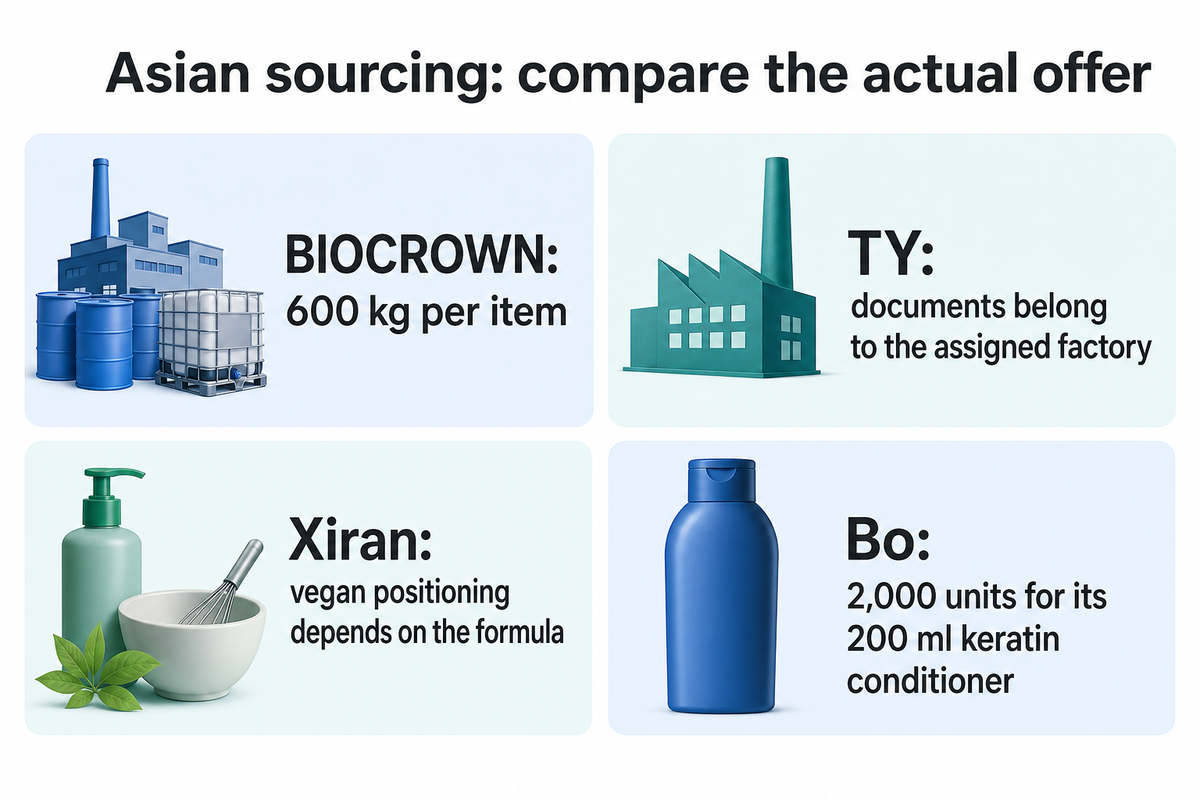
For conditioner sourcing in Asia there are different development and manufacturing options in Taiwan, China and India. Companies in this group publish conditioner specific products and/or services, and give information on minimum order quantities, and types of packaging. Factory names and product scope help differentiate one offer from the rest.
17. BIOCROWN: Best for Taiwan-based conditioner development ordered by batch mass
Headquarters: Taiwan · Founded: 1977 predecessor; BIOCROWN established 2005 · Type: Skin and haircare original-design and contract manufacturer
Official website: https://www.biocrown.com.tw/
Main products: XED0201 conditioner and customised skin/haircare products.
Certifications / quality scope: Company history records ISO 22716:2007 compliance (according to its website).
BIOCROWN supplies a specific conditioner offer, XED0201, with a published minimum of 600 kg per item and scope for formula and packaging customisation. Its stated shipment window of 20–25 working days begins after order confirmation, deposit and packaging arrival, which gives purchasing teams a more useful scheduling reference than an unqualified production-days claim. The company history distinguishes a 1977 predecessor from BIOCROWN’s establishment in 2005 and records ISO 22716:2007 compliance; because the minimum is a mass of product, bottle planning also needs the fill size, product density and filling-loss allowance.
18. TY Cosmetic: Best for multi-product haircare with integrated packaging development
Headquarters: Guangzhou, China · Founded: 2009 · Type: Cosmetic original-design and contract manufacturing group
Official website: https://www.tyoemcosmetic.com/
Main products: Rinse-off and leave-in conditioners and broader haircare.
Certifications / quality scope: ISO 22716 documents listed separately for Guangzhou Tengyu, Guangzhou Tata and Guangzhou Meixi (according to its website).
TY Cosmetic combines conditioner development with packaging sourcing and production through named factories, with rinse-off and leave-in options in its published private label conditioner range. The Guangzhou business dates its start to 2009, and its certificate page identifies separate ISO 22716 documents for Guangzhou Tengyu, Guangzhou Tata and Guangzhou Meixi rather than presenting one unnamed production site. That structure is useful for custom hair care projects involving several products and packaging choices; the relevant certificate and order conditions belong to the production entity assigned to the project, rather than transferring automatically between every factory in the group.
19. Xiran: Best for conditioner projects requiring several packaging choices
Headquarters: Guangzhou, China · Founded: 2013 · Type: Cosmetic original-design and private-label manufacturer
Official website: https://xiranskincare.com/
Main products: Tea-tree and strengthening conditioners, leave-in conditioner and hair masks.
Certifications / quality scope: ISO 22716 and GMPC stated by Guangzhou Xiran Cosmetics Co., Ltd. (according to its website).
Xiran’s conditioner offer covers formula choices together with bottles, labels and colour boxes, so the sourcing discussion can include the finished product presentation as well as the bulk itself. Its catalogue names tea-tree, strengthening and leave-in conditioners, and Guangzhou Xiran Cosmetics Co., Ltd. states ISO 22716 and cosmetic good manufacturing practice certification on its company page. The business dates its start to 2013 and suits buyers seeking several conditioner solutions within one packaging-development route; positioning such as vegan applies to the selected formula, since the wider catalogue also offers customisation with milk or honey.
20. Bo International: Best for India-based keratin conditioner with a published unit minimum
Headquarters: Gurugram, Haryana, India · Founded: 2013 · Type: Private-label and custom personal-care manufacturer
Official website: https://www.bointernational.net/
Main products: Keratin hair conditioner and broader haircare products.
Published capability: 2,000 units minimum for the published 200 ml keratin conditioner.
Bo International gives buyers a defined starting offer through its keratin conditioner product page, which lists a 200 ml presentation and a minimum of 2,000 units. The Gurugram business dates its start to 2013 and describes changes to composition, fragrance, graphics and bottle or pump choices, so a brand can assess both the conditioner formula and its intended shelf presentation. This is useful for buyers who prefer a named product as the basis of a custom hair care discussion; the published quantity and pack describe that keratin conditioner and don’t set the terms for every other formula.
How to choose a conditioner manufacturer for your order
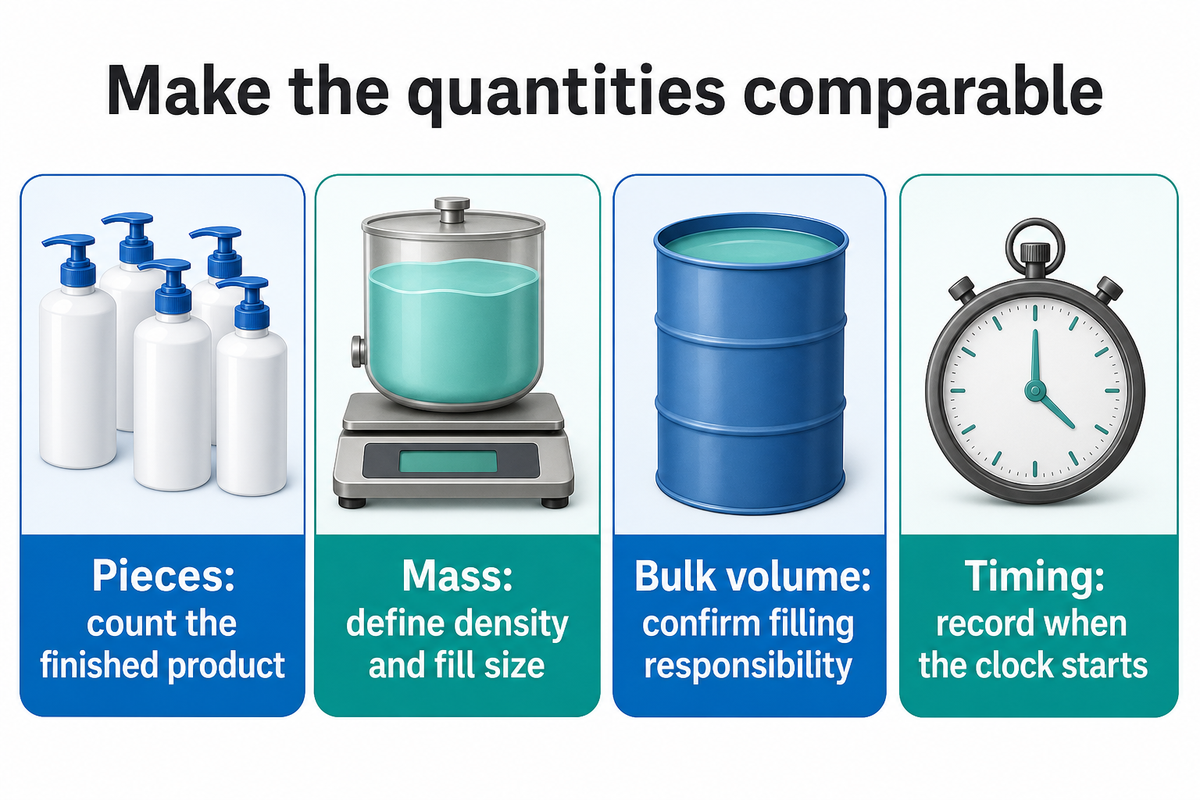
A helpful shortlist for conditioner starts with understanding the product format, and the work required from the manufacturer. Then, assess suppliers that are at the same development stage, pack and first order quantity. Evaluate the sample and production offer collectively. An advertised low minimum order quantity may mean little if it buys a different formula, or if the order leaves filling outside the price.
Choose the service route before comparing prices
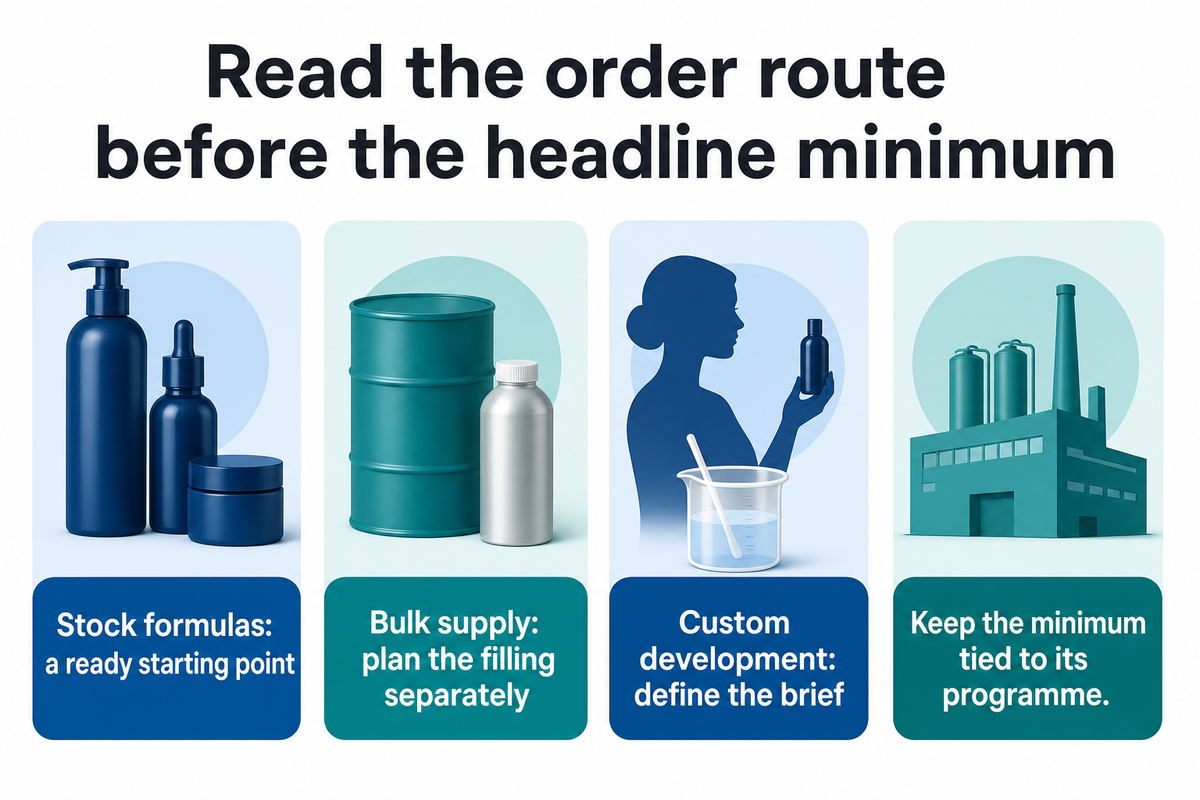
The starting point for private label conditioner is typically an existing formula. Custom formulation refers to work against a specific brief, and some manufacturers take a middle route and alter an existing base. Pravada’s differentiators are visible in separate programs. RainShadow separates direct bulk purchases from filled supply. Neither structure means all manufacturers use the same definitions, so assess the offerings behind the service names.
For a new hair care line, consider what elements can remain standard and what elements must be unique. A branded label for an existing shampoo and conditioner pair may fulfil one launch plan. For a competing brand, a different fragrance or texture and/or ingredient selection may be required. Fully customized development can include more work than adapting a stock base, and that scope and depth must be communicated by the supplier. Separate attention must be paid to formula development, and to the development of packaging, if only one of them is changing.
Specify the conditioner format and intended hair type
Product briefs for rinse-off conditioner, leave-in spray and hair mask conditioner differ from one another. Product names alone don’t represent the feel or the way a product is supposed to be used in the product brief. Is the product supposed to rinse away? Is it supposed to be left on the hair? Does the product accompany a salon service? Is the product supposed to be part of a daily styling routine? Often, a company that manufactures hair care products in general may have a focused or narrower set of conditioner formulas than a competitor that manufactures several named formats.
Identify the target user in realistic terms: curly hair, color-treated lengths, or preference for lighter finish. Different hair types don’t need a vague assurance of broad-based suitability. Products are designed for specific use: define the method and the amount to be used. For a natural hair range or a conventional hair care assortment, keep the preferences for raw materials and sensory performance separate.
Existing product families can help organise that discussion. CarasaLab links its Fabulous Blonde shampoo, conditioner and mask; Envii lists a curl-focused leave-in option. Those examples show how hair care formulas can serve a specific range rather than an assortment of unrelated products. A conditioner manufacturer offering several formats is most useful when those formats match your customers’ hair care needs.
Keep production quantities in their original units
A published minimum order quantity, often shortened to MOQ, may mean pieces of one finished product, a batch mass or a bulk volume. HSA’s 500 kg and BIOCROWN’s 600 kg figures describe mass. John Drury states 1,000 litres. GAR distinguishes 5,000 filled pieces from 110 gallons of bulk. These figures support different purchasing decisions and can’t be placed in a single lowest-to-highest unit ranking without further information.
Define net content for a filled order and the variants offered. Fragrances and formulas may each have their own minimum. For bulk, determine who fills and labels the product. What type of containers are supplied? What’s the remaining material after filling? Density is used to convert mass to volume and process losses determine saleable yield. A production figure for a group doesn’t help answer those inputs for a project.
Do
- Compare the same conditioner and pack format.
- Separate bulk supply from filling and label support.
- Keep each published minimum attached to its programme.
Don’t
- Read a sample size as a production minimum.
- Treat tank capacity as an accepted order quantity.
- Apply one product’s terms to every custom formula.
Evaluate the formula and pack as a finished product
Conditioner manufacturing includes decisions concerning dispensing and presentation along with formula. Different user experiences and different filling requirements are created by the choice of container (a tube, pump bottle or jar, for example). Compare samples in the target package when the project reaches that point, rather than approving a laboratory container and believing the commercial package will behave in the same way. The supplier must be able to provide the product with the packaging format of choice.
A brand extending its hair care collections may seek the same visual identity for conditioner, hair oil and styling products. In this case, matching graphics doesn’t guarantee that all products can use the same closure and/or pack. Product specific packaging work should be in the development scope. NEXO’s cosmetic packaging guide provides a wider packaging scope for buyers coordinating several personal care categories.
Match quality documents to the manufacturing entity
Quality review must be done on the factory and product being purchased. The name of the certificate holder along with the site address, scope and validity must be checked. A logo shouldn’t be relied upon. TY, for example, publishes different Good Manufacturing Practice (GMP) certification documents for different factories; the certificates should be read for their holder, site and named standard, and a statement of good manufacturing practice compliance differs from certification to a named standard.
See the proposed test records and release records, and the samples provided. Inquire as to which stability, compatibility and microbiological checks are performed on the selected formula and pack, and which documentation is provided for the batch. Supporting scope is required for claims of organic, vegan and cruelty-free. They can’t be extrapolated from a single ingredient, factory or product and extended to the entire conditioner range because products are manufactured, for instance, under the same commercial brand.
Precision should be given to marketing language as well. Functional hair care may describe the product’s positioning in a range, but a claim of hair growth requires evidence specific to the claim and the target market. A hair dye range or a scalp care programme likewise does not establish evidence for a conditioner claim. Keep the approved positioning aligned to the actual conditioner products and supporting documents.
Separate sample timing from the production schedule
A short sample lead time doesn’t establish a short commercial lead time. The production clock may start after formula approval, deposit, artwork approval or packaging arrival. BIOCROWN states several of those triggers with its shipment window. GAR’s buyer-supplied packaging route makes component coordination part of the schedule. Record those starting conditions when comparing quotes so that the dates describe the same stage of work.
The same is required for repeated orders. For example, an unchanged formula in the existing pack is different from an order of a new fragrance, bottle or label. To verify hair care solutions for repeat supply, identify which approvals still apply and which development work needs to be repeated. For the competitive hair care program, this may prove to be more valuable than choosing the shortest number of days displayed on a homepage.
Build a range only where the supplier’s scope fits
Some hair care manufacturers also make skincare, body products or home-care liquids; others focus more closely on professional hair care. A more extensive product line can help a brand cover more categories, but the specific hair care manufacturing capability should match the project. Generally speaking, suppliers classify their offerings broadly. Those hair care products include shampoos, masks, oils and styling products. The simple existence of a service on a supplier’s page doesn’t indicate which services share a production or development site.
A complete hair care range may first launch products tailored for shampoo and conditioner use, then hair serums or a dry shampoo. Each may require a different product format and packing. As illustrated by Herrco’s case, where they state the exclusion of aerosols, a coordinated range may still require more than one supplier. One should aim to select the manufacturer offering products with manufacturing support needed for the job instead of buying the broadest range of product categories available.
The private label shampoo manufacturing page and the wider hair care manufacturing range help separate paired wash-and-condition projects from other hair care development. Shared branding shouldn’t replace separate briefs for different uses.
Frequently asked questions about private label hair conditioner
Who are the best private label hair care manufacturers for conditioner?
The best fit depends on the conditioner you want to sell and the manufacturing service you need.
Start by separating suppliers with existing formulas from those offering custom development, then compare the product formats and order routes in the table. A company suited to a small stock-formula launch may be a poor match for a bespoke filled range. Build a shortlist around those differences before comparing samples, packaging and quotations.
How can I create my own hair conditioner product line?
Start with a specific brief covering the hair type, product format, desired feel, first order and intended packaging.
Then choose whether to brand an existing conditioner or commission development. Evaluate samples against that brief before settling the formula and pack. Ask shortlisted suppliers to separate development, production and delivery timing in their offers. This makes it easier to see whether an attractive lead time starts at your first enquiry or only after the formula and packaging have been approved.
What are the options for private label hair products for a small business?
A small business can compare existing private label formulas, bulk conditioner for separate filling, and custom development.
These routes have different costs and order requirements. Sample availability doesn’t mean that a manufacturer accepts equally small commercial batches, and a small stock purchase doesn’t establish its custom-production minimum. Select the route first, then compare the minimum quantity for the exact conditioner and packaging you intend to order before committing to several related products.
Can I buy bulk hair conditioner for my own filling operation?
Yes, where the supplier offers bulk conditioner.
Compare the supplied formula, container size and minimum quantity separately from any filling or retail-packaging service.
What is the difference between private label and custom conditioner manufacturing?
Private label commonly starts with an existing conditioner; custom manufacturing can involve development or production of a buyer-supplied formula.
Some companies also offer a middle route that modifies an existing base, so the service name alone doesn’t describe the work included. Compare what can change: fragrance, ingredient selection, texture, product format and packaging. An available stock formula may have different order terms from a modified version. Filling the same formula into a different bottle can also change the packaging quantity or schedule.
Custom development doesn’t automatically establish who owns the formula or whether other brands can buy it. Those arrangements need to be agreed with the supplier. Use the comparison to select a development route, then compare offers describing the same product and scope. The best match is the company whose documented service fits that brief.
Does a haircare manufacturer always make leave-in conditioner?
No. Shampoo or rinse-out conditioner production does not establish leave-in capability.
Look for the requested format in the manufacturer’s product range and project offer.
Build a shortlist around your conditioner launch
A focused shortlist is appropriate next. Evaluate your existing private label product against existing private label products and assess bespoke development with suppliers that offer similar work. A brand seeking customized hair care should define the changes that differentiate their product, then evaluate samples. The right manufacturer is the one whose formula, pack, order quantity and production arrangement fit the requirements.
Key takeaway
A conditioner manufacturer’s published minimum is useful only when its formula route, unit of measure, packaging scope and starting conditions match the order you intend to place.
NEXO Beauty Labs handles export projects through New Continent International Biotechnology (Guangzhou) Co., Ltd. Its published manufacturing certificate holder is Guangzhou Opseve Cosmetics Co., Ltd.; the factory’s ISO 22716:2007 certificate belongs to that manufacturing entity. NEXO’s conditioner service lists a 10,000-unit minimum per product code and a production window of 10–15 working days after formula approval and packaging confirmation.
For a similar project, the conditioner manufacturing service can be used to evaluate the formula and pack. The product format, first order quantity and the market it’s intended for should be provided to evaluate production and development options.
References & Sources
- Companies House: HERRCO COSMETICS LIMITED, current UK legal incorporation.
- Companies House: OREAN PERSONAL CARE LIMITED, current UK legal incorporation.
Related sourcing: Buyers also comparing regional cosmetic manufacturing can read the European cosmetic manufacturers comparison.